Input, Interaction, Foreigner and
           Teacher Talk
                            Damaris Escobar


               June, 2012
Content

Input and interaction in second language
 acquistion
Teacher Talk
Foreigner Talk
Input
• Stephen Krashen took a very strong position on the importance of
  input, asserting that comprehensible input is all that is necessary for
  second-language acquisition.


• Krashen pointed to studies showing that the length of time a person
  stays in a foreign country is closely linked with his level of language
  acquisition.


• Further evidence for input comes from studies on reading: large
  amounts of free voluntary reading have a significant positive effect
  on learners' vocabulary, grammar, and writing.
Interaction
• According to Long's interaction hypothesis the conditions for
  acquisition are especially good when interacting in the second
  language.


• Conditions are good when a breakdown in communication occurs
  and learners must negotiate for meaning.


• The modifications to speech arising from interactions like this help
  make input more comprehensible, provide feedback to the
  learner, and push learners to modify their speech.
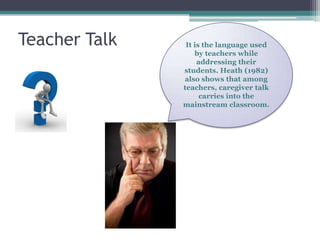
Teacher Talk    It is the language used
                   by teachers while
                    addressing their
               students. Heath (1982)
               also shows that among
               teachers, caregiver talk
                     carries into the
               mainstream classroom.
Teacher Talk Features

• Modifications/simplifications in vocab, syntax and discourse to

  accommodate      learners’   proficiency    level   and   to   increase

  comprehension.


• Shorter utterances, degree of subordination tends to be lower, more

  declaratives   and    statements    than     questions,   more    self-

  repetitions, grammatical well-formedness.
Teacher Talk Features
• Teachers tend to talk more in class with louder and more distinct

  speech. Teachers are likely to take longer pauses in speaking.


• Special teaching strategies such as repeating one's own

  questions, repeating and expanding learners' answers (recasts), as

  well as prompting answers (Gaies, 1977)
Teacher Talk Features
• Metatalk. L2 teacher talk focused on L2 learning, which is
  intimately linked with L2 language classroom, can also be called
  metatalk (Faerch, 1985).


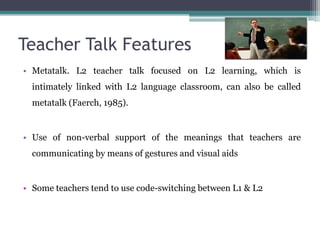
• Use of non-verbal support of the meanings that teachers are
  communicating by means of gestures and visual aids


• Some teachers tend to use code-switching between L1 & L2
Teacher Talk

• As learning context varies according to different L2 learning
  situations, L2 teacher talk also varies in the degree to which
  teachers focus on form or on meaning (Johnson, 1995).


• Teacher talk is supposed not only to provide the learners with
  simplified L2 input, to help them understand L2 input, but
  also, simultaneously, to manage L2 classroom learning process
  (Majer               &                Majer,            1996).
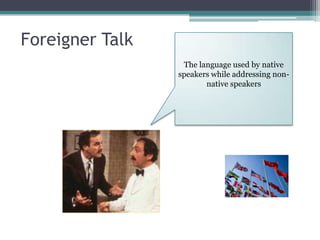
Foreigner Talk
                  The language used by native
                 speakers while addressing non-
                        native speakers
Forigner Talk Features
• The feature which is most characteristic in foreigner talk, as well as in

  caregiver talk, is its focus on communication with a less proficient and

  less experienced language user (Snow & Ferguson, 1977).


• Such a focus results in NS simplification at all language levels:

  phonology, morphology, syntax and semantics, in the slower pace of

  speech, as well as in modifications of discourse structure. Syntactic and

  semantic simplification may also entail elaboration if, for example, a

  given     vocab     item     is    paraphrased      (Wesche,      1994).
Forigner Talk Features

• Although simplifications and adjustments to Non Native
 Speakers level of comprehensibility have been discovered in
 numerous studies, their amount, range and type vary and
 depend     on    NSs'   experience   in   communicating    with
 NNSs, their attitude towards NNSs, and their motivation to
 engage      in     successful    communicative      exchanges
 (Wesche,                                                  1994)
Bibliography

• http://chrisallenthomas.wetpaint.com/page/Tea
  cher+Talk+vs.+Foreigner+Talk+%26+Caregiver
  +Talk

• http://teslcanadajournal.ca/index.php/tesl/artic
  le/viewFile/504/335
Input, interaction, foreigner and teacher talk

Input, interaction, foreigner and teacher talk

  • 1.
    Input, Interaction, Foreignerand Teacher Talk Damaris Escobar June, 2012
  • 2.
    Content Input and interactionin second language acquistion Teacher Talk Foreigner Talk
  • 3.
    Input • Stephen Krashentook a very strong position on the importance of input, asserting that comprehensible input is all that is necessary for second-language acquisition. • Krashen pointed to studies showing that the length of time a person stays in a foreign country is closely linked with his level of language acquisition. • Further evidence for input comes from studies on reading: large amounts of free voluntary reading have a significant positive effect on learners' vocabulary, grammar, and writing.
  • 4.
    Interaction • According toLong's interaction hypothesis the conditions for acquisition are especially good when interacting in the second language. • Conditions are good when a breakdown in communication occurs and learners must negotiate for meaning. • The modifications to speech arising from interactions like this help make input more comprehensible, provide feedback to the learner, and push learners to modify their speech.
  • 5.
    Teacher Talk It is the language used by teachers while addressing their students. Heath (1982) also shows that among teachers, caregiver talk carries into the mainstream classroom.
  • 6.
    Teacher Talk Features •Modifications/simplifications in vocab, syntax and discourse to accommodate learners’ proficiency level and to increase comprehension. • Shorter utterances, degree of subordination tends to be lower, more declaratives and statements than questions, more self- repetitions, grammatical well-formedness.
  • 7.
    Teacher Talk Features •Teachers tend to talk more in class with louder and more distinct speech. Teachers are likely to take longer pauses in speaking. • Special teaching strategies such as repeating one's own questions, repeating and expanding learners' answers (recasts), as well as prompting answers (Gaies, 1977)
  • 8.
    Teacher Talk Features •Metatalk. L2 teacher talk focused on L2 learning, which is intimately linked with L2 language classroom, can also be called metatalk (Faerch, 1985). • Use of non-verbal support of the meanings that teachers are communicating by means of gestures and visual aids • Some teachers tend to use code-switching between L1 & L2
  • 9.
    Teacher Talk • Aslearning context varies according to different L2 learning situations, L2 teacher talk also varies in the degree to which teachers focus on form or on meaning (Johnson, 1995). • Teacher talk is supposed not only to provide the learners with simplified L2 input, to help them understand L2 input, but also, simultaneously, to manage L2 classroom learning process (Majer & Majer, 1996).
  • 10.
    Foreigner Talk The language used by native speakers while addressing non- native speakers
  • 11.
    Forigner Talk Features •The feature which is most characteristic in foreigner talk, as well as in caregiver talk, is its focus on communication with a less proficient and less experienced language user (Snow & Ferguson, 1977). • Such a focus results in NS simplification at all language levels: phonology, morphology, syntax and semantics, in the slower pace of speech, as well as in modifications of discourse structure. Syntactic and semantic simplification may also entail elaboration if, for example, a given vocab item is paraphrased (Wesche, 1994).
  • 12.
    Forigner Talk Features •Although simplifications and adjustments to Non Native Speakers level of comprehensibility have been discovered in numerous studies, their amount, range and type vary and depend on NSs' experience in communicating with NNSs, their attitude towards NNSs, and their motivation to engage in successful communicative exchanges (Wesche, 1994)
  • 13.
    Bibliography • http://chrisallenthomas.wetpaint.com/page/Tea cher+Talk+vs.+Foreigner+Talk+%26+Caregiver +Talk • http://teslcanadajournal.ca/index.php/tesl/artic le/viewFile/504/335