Six Sigma
Breakthrough Strategy
or
Your Worse Nightmare?
Jeffrey T. Gotro, Ph.D.
Director of Research & Development
Ablestik Laboratories
2
Agenda
ƒ What is Six Sigma?
ƒ What are the challenges?
ƒ What are the rewards?
ƒ Summary and Questions
3
Six Sigma has many meanings
„ A Symbol
„ A Measure
„ A Benchmark or Goal
„ A Method
σ
4
Six Sigma: A Symbol
„ σ is a Statistical Symbol for
Standard Deviation
„ Standard Deviation is a Measure
of Variability
5
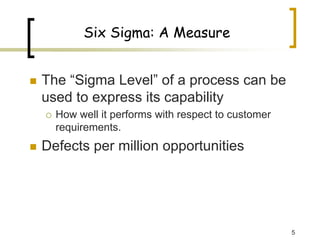
Six Sigma: A Measure
„ The “Sigma Level” of a process can be
used to express its capability
{ How well it performs with respect to customer
requirements.
„ Defects per million opportunities
6
Doing the math
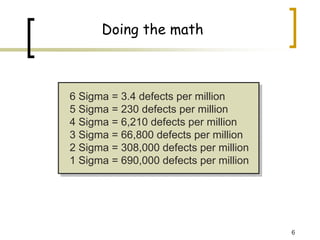
6 Sigma = 3.4 defects per million
5 Sigma = 230 defects per million
4 Sigma = 6,210 defects per million
3 Sigma = 66,800 defects per million
2 Sigma = 308,000 defects per million
1 Sigma = 690,000 defects per million
7
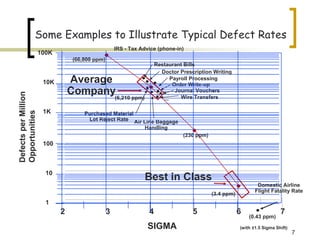
Some Examples to Illustrate Typical Defect Rates
2 3 4 5 6 7
10K
1K
100
10
(230 ppm)
Purchased Material
Lot Reject Rate
(0.43 ppm)
Payroll Processing
Journal Vouchers
Wire Transfers
Air Line Baggage
Handling
Order Write-up
IRS - Tax Advice (phone-in)
Best in Class
Domestic Airline
Flight Fatality Rate
Average
Company
Restaurant Bills
Doctor Prescription Writing
(6,210 ppm)
(3.4 ppm)
(66,800 ppm)
Defects
per
Million
Opportunities
100K
1
SIGMA (with ±1.5 Sigma Shift)
8
Six Sigma: A Benchmark or Goal
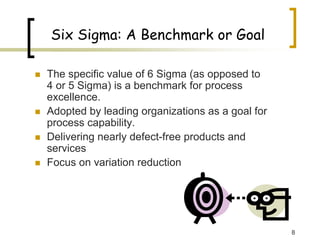
„ The specific value of 6 Sigma (as opposed to
4 or 5 Sigma) is a benchmark for process
excellence.
„ Adopted by leading organizations as a goal for
process capability.
„ Delivering nearly defect-free products and
services
„ Focus on variation reduction
9
Six Sigma: A Method
„ A well defined process and toolkit used for:
{ Product/Service Design
{ Product & Process Improvement
10
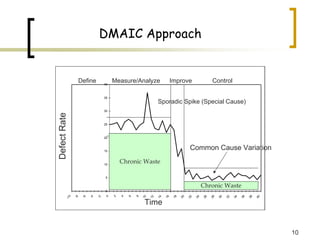
DMAIC Approach
0
5
10
15
20
25
30
35
40
-
1
0
-
8
-
6
-
4
-
2
0
2
4
6
8
1
0
1
2
1
4
1
6
1
8
2
0
2
2
2
4
2
6
2
8
3
0
3
2
3
4
3
6
3
8
4
0
Chronic Waste
Chronic Waste
Sporadic Spike (Special Cause)
Define Measure/Analyze Control
Improve
Defect
Rate
Time
Common Cause Variation
11
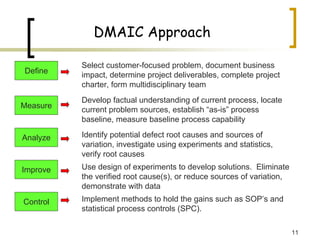
DMAIC Approach
Select customer-focused problem, document business
impact, determine project deliverables, complete project
charter, form multidisciplinary team
Define
Develop factual understanding of current process, locate
current problem sources, establish “as-is” process
baseline, measure baseline process capability
Measure
Identify potential defect root causes and sources of
variation, investigate using experiments and statistics,
verify root causes
Analyze
Use design of experiments to develop solutions. Eliminate
the verified root cause(s), or reduce sources of variation,
demonstrate with data
Improve
Implement methods to hold the gains such as SOP’s and
statistical process controls (SPC).
Control
12
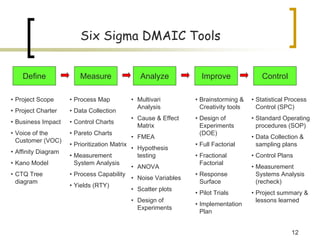
Six Sigma DMAIC Tools
Define Measure Analyze Improve Control
• Project Scope
• Project Charter
• Business Impact
• Voice of the
Customer (VOC)
• Affinity Diagram
• Kano Model
• CTQ Tree
diagram
• Process Map
• Data Collection
• Control Charts
• Pareto Charts
• Prioritization Matrix
• Measurement
System Analysis
• Process Capability
• Yields (RTY)
• Multivari
Analysis
• Cause & Effect
Matrix
• FMEA
• Hypothesis
testing
• ANOVA
• Noise Variables
• Scatter plots
• Design of
Experiments
• Brainstorming &
Creativity tools
• Design of
Experiments
(DOE)
• Full Factorial
• Fractional
Factorial
• Response
Surface
• Pilot Trials
• Implementation
Plan
• Statistical Process
Control (SPC)
• Standard Operating
procedures (SOP)
• Data Collection &
sampling plans
• Control Plans
• Measurement
Systems Analysis
(recheck)
• Project summary &
lessons learned
13
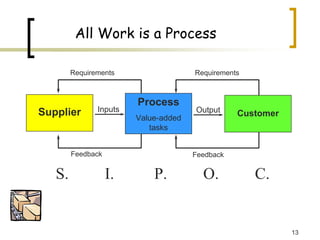
All Work is a Process
Requirements Requirements
Supplier
Process
Value-added
tasks
Customer
Inputs Output
Feedback Feedback
S. I. P. O. C.
14
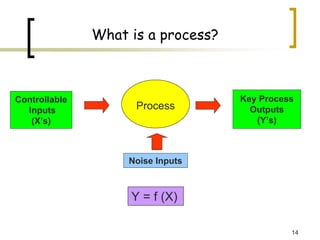
What is a process?
Controllable
Inputs
(X’s)
Key Process
Outputs
(Y’s)
Noise Inputs
Process
Y = f (X)
15
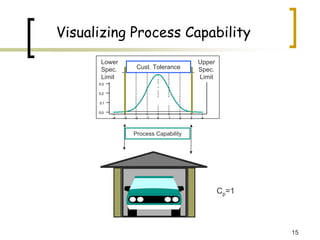
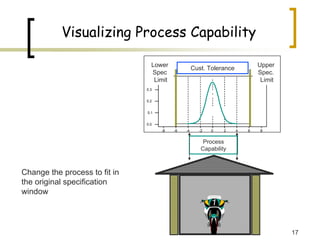
Visualizing Process Capability
4
3
2
1
0
-1
-2
-3
-4
0.4
0.3
0.2
0.1
0.0
Lower
Spec.
Limit
Upper
Spec.
Limit
Cust. Tolerance
Cp=1
Process Capability
16
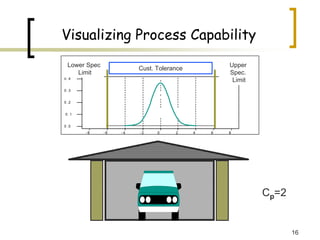
Visualizing Process Capability
8
6
4
2
0
- 2
- 4
- 6
- 8
0 .4
0 .3
0 .2
0 .1
0 .0
Lower Spec
Limit
Upper
Spec.
Limit
Cust. Tolerance
Cp=2
17
Visualizing Process Capability
8
6
4
2
0
-2
-4
-6
-8
0.4
0.3
0.2
0.1
0.0
Lower
Spec
Limit
Upper
Spec.
Limit
Cust. Tolerance
Process
Capability
Change the process to fit in
the original specification
window
18
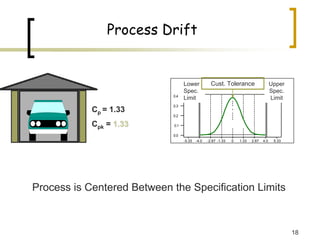
Process Drift
Cp = 1.33
Cpk = 1.33
1.33
5.33
4.0
2.67
1.33
-1.33
-2.67
-4.0
-5.33 0
0.4
0.3
0.2
0.1
0.0
Lower
Spec.
Limit
Upper
Spec.
Limit
Cust. Tolerance
Process is Centered Between the Specification Limits
19
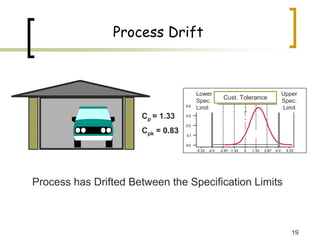
Process Drift
Cp = 1.33
Cpk = 0.83
0.83
0
0.4
0.3
0.2
0.1
0.0
5.33
4.0
2.67
1.33
-1.33
-2.67
-4.0
-5.33
Lower
Spec.
Limit
Upper
Spec.
Limit
Cust. Tolerance
Process has Drifted Between the Specification Limits
20
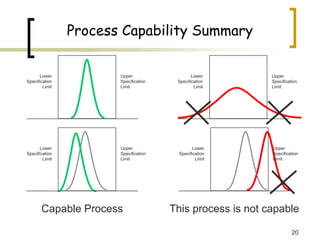
Process Capability Summary
Lower
Specification
Limit
Upper
Specification
Limit
Upper
Specification
Limit
Lower
Specification
Limit
Upper
Specification
Limit
Lower
Specification
Limit
Upper
Specification
Limit
Lower
Specification
Limit
Capable Process This process is not capable
21
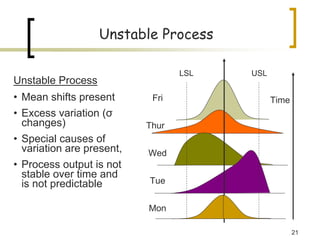
Unstable Process
Thur
LSL USL
Unstable Process
• Mean shifts present
• Excess variation (σ
changes)
• Special causes of
variation are present,
• Process output is not
stable over time and
is not predictable
Fri Time
Wed
Tue
Mon
22
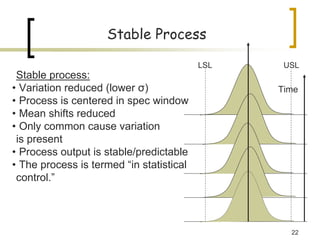
Stable process:
• Variation reduced (lower σ)
• Process is centered in spec window
• Mean shifts reduced
• Only common cause variation
is present
• Process output is stable/predictable
• The process is termed “in statistical
control.”
Time
LSL USL
Stable Process
23
History of Six Sigma
„ Originated at Motorola in the early 80’s
„ Doesn’t use “Quality” in the name
„ Uses a modification of the Deming Plan-Do-
Check-Act (PDCA) cycle
„ Adopted widely in the 90’s by major
corporations including AlliedSignal (now
Honeywell), GE, Kodak, and a growing list
of small, medium, and large companies.
24
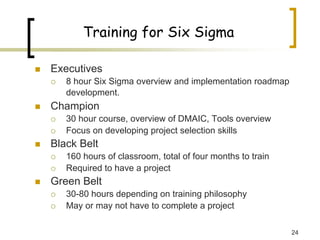
Training for Six Sigma
„ Executives
{ 8 hour Six Sigma overview and implementation roadmap
development.
„ Champion
{ 30 hour course, overview of DMAIC, Tools overview
{ Focus on developing project selection skills
„ Black Belt
{ 160 hours of classroom, total of four months to train
{ Required to have a project
„ Green Belt
{ 30-80 hours depending on training philosophy
{ May or may not have to complete a project
25
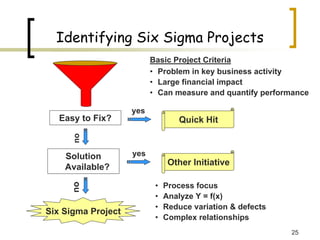
Identifying Six Sigma Projects
Basic Project Criteria
• Problem in key business activity
• Large financial impact
• Can measure and quantify performance
yes
Easy to Fix? Quick Hit
no
Solution
Available?
yes
Other Initiative
• Process focus
• Analyze Y = f(x)
• Reduce variation & defects
• Complex relationships
no
Six Sigma Project
26
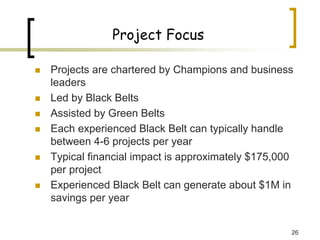
Project Focus
„ Projects are chartered by Champions and business
leaders
„ Led by Black Belts
„ Assisted by Green Belts
„ Each experienced Black Belt can typically handle
between 4-6 projects per year
„ Typical financial impact is approximately $175,000
per project
„ Experienced Black Belt can generate about $1M in
savings per year
27
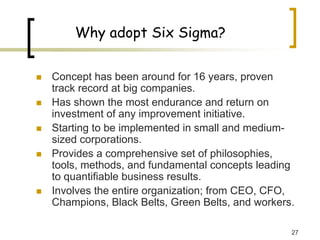
Why adopt Six Sigma?
„ Concept has been around for 16 years, proven
track record at big companies.
„ Has shown the most endurance and return on
investment of any improvement initiative.
„ Starting to be implemented in small and medium-
sized corporations.
„ Provides a comprehensive set of philosophies,
tools, methods, and fundamental concepts leading
to quantifiable business results.
„ Involves the entire organization; from CEO, CFO,
Champions, Black Belts, Green Belts, and workers.
28
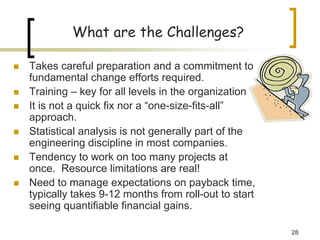
What are the Challenges?
„ Takes careful preparation and a commitment to
fundamental change efforts required.
„ Training – key for all levels in the organization
„ It is not a quick fix nor a “one-size-fits-all”
approach.
„ Statistical analysis is not generally part of the
engineering discipline in most companies.
„ Tendency to work on too many projects at
once. Resource limitations are real!
„ Need to manage expectations on payback time,
typically takes 9-12 months from roll-out to start
seeing quantifiable financial gains.
29
What are the Rewards
„ Increased value to the customers and
shareholders.
„ Improved reliability and predictability of
products and services.
„ Significant reduction in defects.
„ Institutionalization of a “process” mindset.
„ Increased competitive advantage.
30
Some Results…
„ Motorola – 10 years; $11 Billion Savings
„ AlliedSignal - $1.5 Billion estimated savings
„ General Electric – started efforts in 1995
{ 1998: $1.2 Billion less $450 Million in
costs… net benefits = $750 Million
{ 1999 Annual Report: more than $2 Billion
net benefits
{ 2001: 6,000 projects completed; $3 Billion
in savings
31
Six Sigma Summary
„ Disciplined & Systematic Approach
{ Process orientation, drive for variation reduction
{ Focus on quantitative methods and tools
{ Focus on control to hold the gains
{ Uses a new metric for defects (sigma, DPMO, ppm)
„ Results oriented management leadership, using
data-driven decision making
„ Significant training & organizational learning
32
Six Sigma Summary
„ Success happens “one project at a time”
„ Good project selection leads to large financial
impact
„ Implementation is hard work, not magic. Expect
bumps in the road, stay the course, results will
happen
„ Six Sigma is “A journey not a destination”
33
Questions?
34
Jeffrey Gotro, Ph.D.
Jtgotro@cox.net

Six sigma introduction

  • 1.
    Six Sigma Breakthrough Strategy or YourWorse Nightmare? Jeffrey T. Gotro, Ph.D. Director of Research & Development Ablestik Laboratories
  • 2.
    2 Agenda ƒ What isSix Sigma? ƒ What are the challenges? ƒ What are the rewards? ƒ Summary and Questions
  • 3.
    3 Six Sigma hasmany meanings „ A Symbol „ A Measure „ A Benchmark or Goal „ A Method σ
  • 4.
    4 Six Sigma: ASymbol „ σ is a Statistical Symbol for Standard Deviation „ Standard Deviation is a Measure of Variability
  • 5.
    5 Six Sigma: AMeasure „ The “Sigma Level” of a process can be used to express its capability { How well it performs with respect to customer requirements. „ Defects per million opportunities
  • 6.
    6 Doing the math 6Sigma = 3.4 defects per million 5 Sigma = 230 defects per million 4 Sigma = 6,210 defects per million 3 Sigma = 66,800 defects per million 2 Sigma = 308,000 defects per million 1 Sigma = 690,000 defects per million
  • 7.
    7 Some Examples toIllustrate Typical Defect Rates 2 3 4 5 6 7 10K 1K 100 10 (230 ppm) Purchased Material Lot Reject Rate (0.43 ppm) Payroll Processing Journal Vouchers Wire Transfers Air Line Baggage Handling Order Write-up IRS - Tax Advice (phone-in) Best in Class Domestic Airline Flight Fatality Rate Average Company Restaurant Bills Doctor Prescription Writing (6,210 ppm) (3.4 ppm) (66,800 ppm) Defects per Million Opportunities 100K 1 SIGMA (with ±1.5 Sigma Shift)
  • 8.
    8 Six Sigma: ABenchmark or Goal „ The specific value of 6 Sigma (as opposed to 4 or 5 Sigma) is a benchmark for process excellence. „ Adopted by leading organizations as a goal for process capability. „ Delivering nearly defect-free products and services „ Focus on variation reduction
  • 9.
    9 Six Sigma: AMethod „ A well defined process and toolkit used for: { Product/Service Design { Product & Process Improvement
  • 10.
    10 DMAIC Approach 0 5 10 15 20 25 30 35 40 - 1 0 - 8 - 6 - 4 - 2 0 2 4 6 8 1 0 1 2 1 4 1 6 1 8 2 0 2 2 2 4 2 6 2 8 3 0 3 2 3 4 3 6 3 8 4 0 Chronic Waste ChronicWaste Sporadic Spike (Special Cause) Define Measure/Analyze Control Improve Defect Rate Time Common Cause Variation
  • 11.
    11 DMAIC Approach Select customer-focusedproblem, document business impact, determine project deliverables, complete project charter, form multidisciplinary team Define Develop factual understanding of current process, locate current problem sources, establish “as-is” process baseline, measure baseline process capability Measure Identify potential defect root causes and sources of variation, investigate using experiments and statistics, verify root causes Analyze Use design of experiments to develop solutions. Eliminate the verified root cause(s), or reduce sources of variation, demonstrate with data Improve Implement methods to hold the gains such as SOP’s and statistical process controls (SPC). Control
  • 12.
    12 Six Sigma DMAICTools Define Measure Analyze Improve Control • Project Scope • Project Charter • Business Impact • Voice of the Customer (VOC) • Affinity Diagram • Kano Model • CTQ Tree diagram • Process Map • Data Collection • Control Charts • Pareto Charts • Prioritization Matrix • Measurement System Analysis • Process Capability • Yields (RTY) • Multivari Analysis • Cause & Effect Matrix • FMEA • Hypothesis testing • ANOVA • Noise Variables • Scatter plots • Design of Experiments • Brainstorming & Creativity tools • Design of Experiments (DOE) • Full Factorial • Fractional Factorial • Response Surface • Pilot Trials • Implementation Plan • Statistical Process Control (SPC) • Standard Operating procedures (SOP) • Data Collection & sampling plans • Control Plans • Measurement Systems Analysis (recheck) • Project summary & lessons learned
  • 13.
    13 All Work isa Process Requirements Requirements Supplier Process Value-added tasks Customer Inputs Output Feedback Feedback S. I. P. O. C.
  • 14.
    14 What is aprocess? Controllable Inputs (X’s) Key Process Outputs (Y’s) Noise Inputs Process Y = f (X)
  • 15.
  • 16.
    16 Visualizing Process Capability 8 6 4 2 0 -2 - 4 - 6 - 8 0 .4 0 .3 0 .2 0 .1 0 .0 Lower Spec Limit Upper Spec. Limit Cust. Tolerance Cp=2
  • 17.
    17 Visualizing Process Capability 8 6 4 2 0 -2 -4 -6 -8 0.4 0.3 0.2 0.1 0.0 Lower Spec Limit Upper Spec. Limit Cust.Tolerance Process Capability Change the process to fit in the original specification window
  • 18.
    18 Process Drift Cp =1.33 Cpk = 1.33 1.33 5.33 4.0 2.67 1.33 -1.33 -2.67 -4.0 -5.33 0 0.4 0.3 0.2 0.1 0.0 Lower Spec. Limit Upper Spec. Limit Cust. Tolerance Process is Centered Between the Specification Limits
  • 19.
    19 Process Drift Cp =1.33 Cpk = 0.83 0.83 0 0.4 0.3 0.2 0.1 0.0 5.33 4.0 2.67 1.33 -1.33 -2.67 -4.0 -5.33 Lower Spec. Limit Upper Spec. Limit Cust. Tolerance Process has Drifted Between the Specification Limits
  • 20.
  • 21.
    21 Unstable Process Thur LSL USL UnstableProcess • Mean shifts present • Excess variation (σ changes) • Special causes of variation are present, • Process output is not stable over time and is not predictable Fri Time Wed Tue Mon
  • 22.
    22 Stable process: • Variationreduced (lower σ) • Process is centered in spec window • Mean shifts reduced • Only common cause variation is present • Process output is stable/predictable • The process is termed “in statistical control.” Time LSL USL Stable Process
  • 23.
    23 History of SixSigma „ Originated at Motorola in the early 80’s „ Doesn’t use “Quality” in the name „ Uses a modification of the Deming Plan-Do- Check-Act (PDCA) cycle „ Adopted widely in the 90’s by major corporations including AlliedSignal (now Honeywell), GE, Kodak, and a growing list of small, medium, and large companies.
  • 24.
    24 Training for SixSigma „ Executives { 8 hour Six Sigma overview and implementation roadmap development. „ Champion { 30 hour course, overview of DMAIC, Tools overview { Focus on developing project selection skills „ Black Belt { 160 hours of classroom, total of four months to train { Required to have a project „ Green Belt { 30-80 hours depending on training philosophy { May or may not have to complete a project
  • 25.
    25 Identifying Six SigmaProjects Basic Project Criteria • Problem in key business activity • Large financial impact • Can measure and quantify performance yes Easy to Fix? Quick Hit no Solution Available? yes Other Initiative • Process focus • Analyze Y = f(x) • Reduce variation & defects • Complex relationships no Six Sigma Project
  • 26.
    26 Project Focus „ Projectsare chartered by Champions and business leaders „ Led by Black Belts „ Assisted by Green Belts „ Each experienced Black Belt can typically handle between 4-6 projects per year „ Typical financial impact is approximately $175,000 per project „ Experienced Black Belt can generate about $1M in savings per year
  • 27.
    27 Why adopt SixSigma? „ Concept has been around for 16 years, proven track record at big companies. „ Has shown the most endurance and return on investment of any improvement initiative. „ Starting to be implemented in small and medium- sized corporations. „ Provides a comprehensive set of philosophies, tools, methods, and fundamental concepts leading to quantifiable business results. „ Involves the entire organization; from CEO, CFO, Champions, Black Belts, Green Belts, and workers.
  • 28.
    28 What are theChallenges? „ Takes careful preparation and a commitment to fundamental change efforts required. „ Training – key for all levels in the organization „ It is not a quick fix nor a “one-size-fits-all” approach. „ Statistical analysis is not generally part of the engineering discipline in most companies. „ Tendency to work on too many projects at once. Resource limitations are real! „ Need to manage expectations on payback time, typically takes 9-12 months from roll-out to start seeing quantifiable financial gains.
  • 29.
    29 What are theRewards „ Increased value to the customers and shareholders. „ Improved reliability and predictability of products and services. „ Significant reduction in defects. „ Institutionalization of a “process” mindset. „ Increased competitive advantage.
  • 30.
    30 Some Results… „ Motorola– 10 years; $11 Billion Savings „ AlliedSignal - $1.5 Billion estimated savings „ General Electric – started efforts in 1995 { 1998: $1.2 Billion less $450 Million in costs… net benefits = $750 Million { 1999 Annual Report: more than $2 Billion net benefits { 2001: 6,000 projects completed; $3 Billion in savings
  • 31.
    31 Six Sigma Summary „Disciplined & Systematic Approach { Process orientation, drive for variation reduction { Focus on quantitative methods and tools { Focus on control to hold the gains { Uses a new metric for defects (sigma, DPMO, ppm) „ Results oriented management leadership, using data-driven decision making „ Significant training & organizational learning
  • 32.
    32 Six Sigma Summary „Success happens “one project at a time” „ Good project selection leads to large financial impact „ Implementation is hard work, not magic. Expect bumps in the road, stay the course, results will happen „ Six Sigma is “A journey not a destination”
  • 33.
  • 34.