

SIX SIGMA –Relevance to the Economic
Development Of India
Presentation by : YOGENDRA RAGHAV

At
Raffles University
Neemrana
Agenda


Relevance to India’s GDP.



History Of Six Sigma.



What is Six Sigma.



Six Sigma Methodology.



When To Use Six Sigma?



Different Six Sigma belts.



Application of Six Sigma.
Relevance to India’s GDP






Growth of GDP has increased from 7.5 % to 8 % (2004-05 to
2005-06) with an expected growth of 9.5 % in the
manufacturing sector.
India needs to grow atleast by 10% every year to join the big
boys of the global economy by 2020.
In 2000, Average per capita income in India was $500
compared to U.S.A was $32000.
Considering our population growth of about 2% per year,
India’s economy must grow nearly by 23% and sustain this
growth for the next 25 years if the Average Indian is to become
as rich as Average American having average income of
$52500 in 2025 (based on conservative growth of 2% per
year).
Relevance to India’s GDP…2

•
•
•

For moving in the direction to achieve the above, we need to
adopt
Best governance
Good business practices
Unimaginable productivity jumps.

Six Sigma is one of the important and useful tool of
the good management practices
The other tools include such as TQM, ISO, Benchmarking, Balanced,
Scorecard, SEI-CMM and the Balridge Award etc.
History Of Six Sigma


Six Sigma Was Developed at Motorola in the 1980’s as a
Method to Improve Process Quality i.e. recognizing that
products with high first pass yield rarely failed in use.



Companies that have deployed Six Sigma:
Bank of America
Motorola
GE
IBM
Kodak
Wipro and Many More

•
•
•
•
•
•
What is Sigma?

σ

Sigma - the lower case Greek letter that
denotes a statistical unit of measurement
used to define the standard deviation of a
population. It measures the variability or
spread of the data.
What is Six Sigma


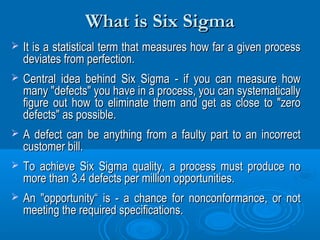
It is a statistical term that measures how far a given process
deviates from perfection.



Central idea behind Six Sigma - if you can measure how
many "defects" you have in a process, you can systematically
figure out how to eliminate them and get as close to "zero
defects" as possible.



A defect can be anything from a faulty part to an incorrect
customer bill.



To achieve Six Sigma quality, a process must produce no
more than 3.4 defects per million opportunities.



An "opportunity“ is - a chance for nonconformance, or not
meeting the required specifications.
What is Six Sigma…2

This means organizations need to be nearly
flawless in executing their key processes.
Critical to Quality:

Attributes most important to the customer

Defect:

Failing to deliver what the customer wants

Process Capability:

What your process can deliver

Variation:

What the customer sees and feels

Stable Operations:

Ensuring consistent, predictable processes to
improve what the customer sees and feels

Design for Six Sigma: Designing to meet customer needs and process
capability
Cost of Quality at various levels
of Six Sigma
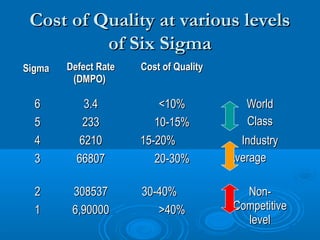
Sigma

Defect Rate
(DMPO)

Cost of Quality

6
5
4
3

3.4
233
6210
66807

<10%
10-15%
15-20%
20-30%

2
1

308537
6,90000

30-40%
>40%

World
Class
Industry
Average
NonCompetitive
level
What is Cost of Poor Quality?
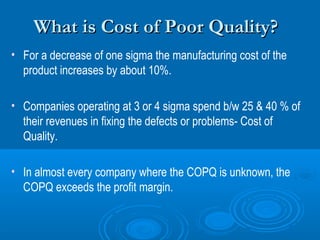
• For a decrease of one sigma the manufacturing cost of the
product increases by about 10%.
• Companies operating at 3 or 4 sigma spend b/w 25 & 40 % of
their revenues in fixing the defects or problems- Cost of
Quality.
• In almost every company where the COPQ is unknown, the
COPQ exceeds the profit margin.
Six Sigma Methodology


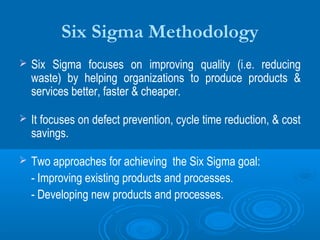
Six Sigma focuses on improving quality (i.e. reducing
waste) by helping organizations to produce products &
services better, faster & cheaper.



It focuses on defect prevention, cycle time reduction, & cost
savings.



Two approaches for achieving the Six Sigma goal:
- Improving existing products and processes.
- Developing new products and processes.
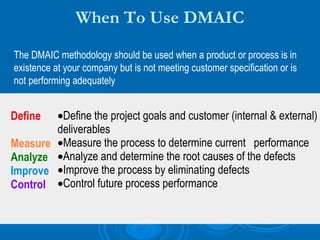
When To Use DMAIC
The DMAIC methodology should be used when a product or process is in
existence at your company but is not meeting customer specification or is
not performing adequately

Define
Measure
Analyze
Improve
Control

•Define the project goals and customer (internal & external)
deliverables
•Measure the process to determine current performance
•Analyze and determine the root causes of the defects
•Improve the process by eliminating defects
•Control future process performance
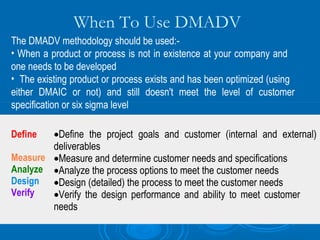
When To Use DMADV
The DMADV methodology should be used:• When a product or process is not in existence at your company and
one needs to be developed
• The existing product or process exists and has been optimized (using
either DMAIC or not) and still doesn't meet the level of customer
specification or six sigma level
•Define the project goals and customer (internal and external)
deliverables
Measure •Measure and determine customer needs and specifications
Analyze •Analyze the process options to meet the customer needs
Design •Design (detailed) the process to meet the customer needs
Verify
•Verify the design performance and ability to meet customer
needs
Define
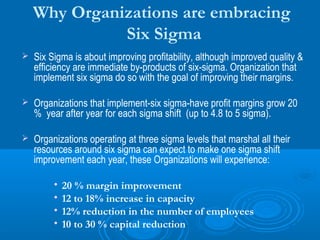
Why Organizations are embracing
Six Sigma


Six Sigma is about improving profitability, although improved quality &
efficiency are immediate by-products of six-sigma. Organization that
implement six sigma do so with the goal of improving their margins.



Organizations that implement-six sigma-have profit margins grow 20
% year after year for each sigma shift (up to 4.8 to 5 sigma).



Organizations operating at three sigma levels that marshal all their
resources around six sigma can expect to make one sigma shift
improvement each year, these Organizations will experience:
•
•
•
•

20 % margin improvement
12 to 18% increase in capacity
12% reduction in the number of employees
10 to 30 % capital reduction
It’s not all Plain Sailing!


Adoption requires a cultural change in order to gain best
results. Six Sigma has changed the DNA of many
organizations — it is now the way they work — in
everything they do and in every product they design



Top management must be patient- there is no quick fix.



Six Sigma is about getting the right answer, not just any
answer.
Six Sigma Belts

Champions

Master
Black
Belt

Black Belts

Mentor, trainer, and coach of Black Belts
and others in the organization, leads project
reviews.

Leader of teams implementing the
six sigma methodology on projects.

Green Belts

Team Members
Quality Fundamentals/ Kaizen Now

Delivers successful focused projects
using basic analytical tools, works
on less complex projects
Participates on and supports the
project teams, typically in the
context of his or her existing
responsibilities.
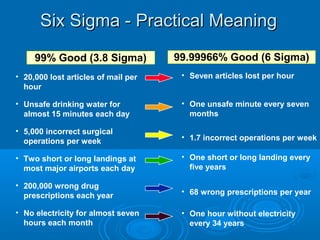
Six Sigma - Practical Meaning
99% Good (3.8 Sigma)

99.99966% Good (6 Sigma)

• 20,000 lost articles of mail per
hour

• Seven articles lost per hour

• Unsafe drinking water for
almost 15 minutes each day

• One unsafe minute every seven
months

• 5,000 incorrect surgical
operations per week

• 1.7 incorrect operations per week

• Two short or long landings at
most major airports each day

• One short or long landing every
five years

• 200,000 wrong drug
prescriptions each year

• 68 wrong prescriptions per year

• No electricity for almost seven
hours each month

• One hour without electricity
every 34 years
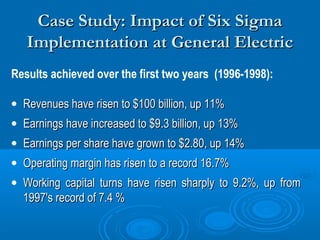
Case Study: Impact of Six Sigma
Implementation at General Electric
Results achieved over the first two years (1996-1998):
• Revenues have risen to $100 billion, up 11%
• Earnings have increased to $9.3 billion, up 13%
• Earnings per share have grown to $2.80, up 14%
• Operating margin has risen to a record 16.7%
• Working capital turns have risen sharply to 9.2%, up from
1997's record of 7.4 %
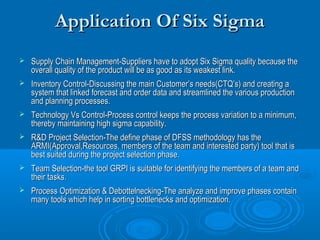
Application Of Six Sigma


Supply Chain Management-Suppliers have to adopt Six Sigma quality because the
overall quality of the product will be as good as its weakest link.



Inventory Control-Discussing the main Customer’s needs(CTQ’s) and creating a
system that linked forecast and order data and streamlined the various production
and planning processes.



Technology Vs Control-Process control keeps the process variation to a minimum,
thereby maintaining high sigma capability.



R&D Project Selection-The define phase of DFSS methodology has the
ARMI(Approval,Resources, members of the team and interested party) tool that is
best suited during the project selection phase.



Team Selection-the tool GRPI is suitable for identifying the members of a team and
their tasks.



Process Optimization & Debottelnecking-The analyze and improve phases contain
many tools which help in sorting bottlenecks and optimization.
END

Six sigma

  • 1.
    SIX SIGMA –Relevanceto the Economic Development Of India Presentation by : YOGENDRA RAGHAV At Raffles University Neemrana
  • 2.
    Agenda  Relevance to India’sGDP.  History Of Six Sigma.  What is Six Sigma.  Six Sigma Methodology.  When To Use Six Sigma?  Different Six Sigma belts.  Application of Six Sigma.
  • 3.
    Relevance to India’sGDP     Growth of GDP has increased from 7.5 % to 8 % (2004-05 to 2005-06) with an expected growth of 9.5 % in the manufacturing sector. India needs to grow atleast by 10% every year to join the big boys of the global economy by 2020. In 2000, Average per capita income in India was $500 compared to U.S.A was $32000. Considering our population growth of about 2% per year, India’s economy must grow nearly by 23% and sustain this growth for the next 25 years if the Average Indian is to become as rich as Average American having average income of $52500 in 2025 (based on conservative growth of 2% per year).
  • 4.
    Relevance to India’sGDP…2  • • • For moving in the direction to achieve the above, we need to adopt Best governance Good business practices Unimaginable productivity jumps. Six Sigma is one of the important and useful tool of the good management practices The other tools include such as TQM, ISO, Benchmarking, Balanced, Scorecard, SEI-CMM and the Balridge Award etc.
  • 5.
    History Of SixSigma  Six Sigma Was Developed at Motorola in the 1980’s as a Method to Improve Process Quality i.e. recognizing that products with high first pass yield rarely failed in use.  Companies that have deployed Six Sigma: Bank of America Motorola GE IBM Kodak Wipro and Many More • • • • • •
  • 6.
    What is Sigma? σ Sigma- the lower case Greek letter that denotes a statistical unit of measurement used to define the standard deviation of a population. It measures the variability or spread of the data.
  • 7.
    What is SixSigma  It is a statistical term that measures how far a given process deviates from perfection.  Central idea behind Six Sigma - if you can measure how many "defects" you have in a process, you can systematically figure out how to eliminate them and get as close to "zero defects" as possible.  A defect can be anything from a faulty part to an incorrect customer bill.  To achieve Six Sigma quality, a process must produce no more than 3.4 defects per million opportunities.  An "opportunity“ is - a chance for nonconformance, or not meeting the required specifications.
  • 8.
    What is SixSigma…2 This means organizations need to be nearly flawless in executing their key processes. Critical to Quality: Attributes most important to the customer Defect: Failing to deliver what the customer wants Process Capability: What your process can deliver Variation: What the customer sees and feels Stable Operations: Ensuring consistent, predictable processes to improve what the customer sees and feels Design for Six Sigma: Designing to meet customer needs and process capability
  • 9.
    Cost of Qualityat various levels of Six Sigma Sigma Defect Rate (DMPO) Cost of Quality 6 5 4 3 3.4 233 6210 66807 <10% 10-15% 15-20% 20-30% 2 1 308537 6,90000 30-40% >40% World Class Industry Average NonCompetitive level
  • 10.
    What is Costof Poor Quality? • For a decrease of one sigma the manufacturing cost of the product increases by about 10%. • Companies operating at 3 or 4 sigma spend b/w 25 & 40 % of their revenues in fixing the defects or problems- Cost of Quality. • In almost every company where the COPQ is unknown, the COPQ exceeds the profit margin.
  • 11.
    Six Sigma Methodology  SixSigma focuses on improving quality (i.e. reducing waste) by helping organizations to produce products & services better, faster & cheaper.  It focuses on defect prevention, cycle time reduction, & cost savings.  Two approaches for achieving the Six Sigma goal: - Improving existing products and processes. - Developing new products and processes.
  • 12.
    When To UseDMAIC The DMAIC methodology should be used when a product or process is in existence at your company but is not meeting customer specification or is not performing adequately Define Measure Analyze Improve Control •Define the project goals and customer (internal & external) deliverables •Measure the process to determine current performance •Analyze and determine the root causes of the defects •Improve the process by eliminating defects •Control future process performance
  • 13.
    When To UseDMADV The DMADV methodology should be used:• When a product or process is not in existence at your company and one needs to be developed • The existing product or process exists and has been optimized (using either DMAIC or not) and still doesn't meet the level of customer specification or six sigma level •Define the project goals and customer (internal and external) deliverables Measure •Measure and determine customer needs and specifications Analyze •Analyze the process options to meet the customer needs Design •Design (detailed) the process to meet the customer needs Verify •Verify the design performance and ability to meet customer needs Define
  • 14.
    Why Organizations areembracing Six Sigma  Six Sigma is about improving profitability, although improved quality & efficiency are immediate by-products of six-sigma. Organization that implement six sigma do so with the goal of improving their margins.  Organizations that implement-six sigma-have profit margins grow 20 % year after year for each sigma shift (up to 4.8 to 5 sigma).  Organizations operating at three sigma levels that marshal all their resources around six sigma can expect to make one sigma shift improvement each year, these Organizations will experience: • • • • 20 % margin improvement 12 to 18% increase in capacity 12% reduction in the number of employees 10 to 30 % capital reduction
  • 15.
    It’s not allPlain Sailing!  Adoption requires a cultural change in order to gain best results. Six Sigma has changed the DNA of many organizations — it is now the way they work — in everything they do and in every product they design  Top management must be patient- there is no quick fix.  Six Sigma is about getting the right answer, not just any answer.
  • 16.
    Six Sigma Belts Champions Master Black Belt BlackBelts Mentor, trainer, and coach of Black Belts and others in the organization, leads project reviews. Leader of teams implementing the six sigma methodology on projects. Green Belts Team Members Quality Fundamentals/ Kaizen Now Delivers successful focused projects using basic analytical tools, works on less complex projects Participates on and supports the project teams, typically in the context of his or her existing responsibilities.
  • 17.
    Six Sigma -Practical Meaning 99% Good (3.8 Sigma) 99.99966% Good (6 Sigma) • 20,000 lost articles of mail per hour • Seven articles lost per hour • Unsafe drinking water for almost 15 minutes each day • One unsafe minute every seven months • 5,000 incorrect surgical operations per week • 1.7 incorrect operations per week • Two short or long landings at most major airports each day • One short or long landing every five years • 200,000 wrong drug prescriptions each year • 68 wrong prescriptions per year • No electricity for almost seven hours each month • One hour without electricity every 34 years
  • 18.
    Case Study: Impactof Six Sigma Implementation at General Electric Results achieved over the first two years (1996-1998): • Revenues have risen to $100 billion, up 11% • Earnings have increased to $9.3 billion, up 13% • Earnings per share have grown to $2.80, up 14% • Operating margin has risen to a record 16.7% • Working capital turns have risen sharply to 9.2%, up from 1997's record of 7.4 %
  • 19.
    Application Of SixSigma  Supply Chain Management-Suppliers have to adopt Six Sigma quality because the overall quality of the product will be as good as its weakest link.  Inventory Control-Discussing the main Customer’s needs(CTQ’s) and creating a system that linked forecast and order data and streamlined the various production and planning processes.  Technology Vs Control-Process control keeps the process variation to a minimum, thereby maintaining high sigma capability.  R&D Project Selection-The define phase of DFSS methodology has the ARMI(Approval,Resources, members of the team and interested party) tool that is best suited during the project selection phase.  Team Selection-the tool GRPI is suitable for identifying the members of a team and their tasks.  Process Optimization & Debottelnecking-The analyze and improve phases contain many tools which help in sorting bottlenecks and optimization.
  • 20.

Editor's Notes

  • #2 {"16":"“Capable People Executing Capable Processes” requires the following training investments: \nManagement Black Belt Champions -- All managers bankwide attend two days of training\nQuality Fundamentals -- All associates take this five-hour course\nGreen Belt -- 15%* of associates become Green Belt- certified in a two-week class (These associates must be sponsored by their managers)\nBlack Belt -- 1 - 5%* of associates become Black Belt- certified in a four-week course. (Black Belts are selected from individuals who excel in Green Belt classes.)\nMaster Black Belt -- Fewer than 1% of associates become mentors, coaches and trainers of other Black Belts\n* At maturity, approximately 3 years from now (2004)\n"}