Casting VS Forging
Castings are integrally cast in the mold. Its stress distribution is
uniform and there is no restriction on the compression direction.
The forging is pressed by the force in the same direction, and its
internal stress has directionality, so it can only bear the pressure
with directionality.
1. Casting
1) Casting: refers to the process of melting metal into a liquid
that meets certain requirements and pouring it into the mold.
After cooling, solidification, and cleaning, castings (parts or
blanks) with a predetermined shape, size, and performance are
obtained. The basic technology of the modern machinery
manufacturing industry.
2) The cost of the blank produced by casting is low. For the parts
with complex shapes, especially the parts with the complex inner
cavities, it can show its economy; At the same time, it has wide
adaptability and good comprehensive mechanical properties.
3) However, there are many materials (such as metal, wood, fuel,
molding materials, etc.) and equipment (such as the
metallurgical furnace, sand mixer, molding machine, core
making machine, desander, shot blasting machine, cast iron
plate, etc.) required for casting production, which will produce
dust, harmful gas and noise and pollute the environment.
4) Casting is one of the earliest metal hot working processes
mastered by human beings, which has a history of about 6000
years. In 3200 BC, copper frog castings appeared in
Mesopotamia. Between the 13th and 10th centuries B.C., China
entered the heyday of bronze castings, and technology has
reached a very high level. For example, the simawu square tripod
weighing 875 kg in the Shang Dynasty, the zunpan of Marquis Yi
of the Warring States period, and the transparent mirror of the
Western Han Dynasty are all representative products of ancient
casting. Early casting was greatly influenced by pottery. Most of
the castings were tools or utensils for agricultural production,
religion, life, etc., with strong artistic color.
In 513 BC, China cast the first recorded iron casting in the world -
the Jin Ding (about 270 kg). Around the 8th century, Europe
began to produce iron castings. After the industrial revolution in
the 18th century, castings entered a new era of serving the large
industry. In the 20th century, casting has developed rapidly. It
has successively developed the nodular cast iron, the malleable
cast iron, ultra-low carbon stainless steel, aluminum copper,
aluminum-silicon, aluminum-magnesium alloys, titanium-based
and nickel-based alloys, and invented a new process for
inoculation treatment of the gray cast iron. After the 1950s, new
technologies such as wet sand high-pressure molding, chemical
hardening sand molding, core making, negative pressure
molding and other special casting and shot blasting emerged.
5) There are many kinds of castings, which are customarily
divided into:
① ordinary sand mold casting, including wet sand mold, dry
sand mold, and chemical hardening sand mold.
② According to the molding materials, special casting can be
divided into two types: special casting with natural mineral sand
as the main molding materials (such as investment casting, mud
mold casting, shell mold casting in casting workshop, negative
pressure casting, full mold casting, ceramic mold casting, etc.)
and special casting with metal as the main molding materials
(such as metal mold casting, pressure casting, continuous
casting, low-pressure casting, centrifugal casting, etc.).
6) The casting process usually includes:
① preparation of mold (a container for turning liquid metal into
solid casting). The mold can be divided into a sand mold, metal
mold, ceramic mold, clay mold, graphite mold, etc. according to
the materials used, and can be divided into the disposable mold,
semi-permanent mold, and permanent mold according to the
times of use. The quality of mold preparation is the main factor
affecting the quality of castings;
② The melting and pouring of cast metals, cast metals (cast
alloys) mainly include cast iron, cast steel, and cast non-ferrous
alloys;
③ Casting treatment and inspection, including removal of
foreign matters on the core and casting surface, removal of
sprue and riser, chipping and grinding of burrs, joints, and other
protrusions, as well as heat treatment, shaping, rust prevention
treatment, and rough machining.
2. Forging
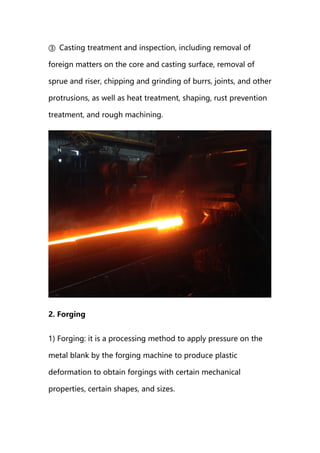
1) Forging: it is a processing method to apply pressure on the
metal blank by the forging machine to produce plastic
deformation to obtain forgings with certain mechanical
properties, certain shapes, and sizes.
2) One of the two major components of forging. Through
forging, cast porosity and welding holes of metal can be
eliminated, and the mechanical properties of forgings are
generally better than those of castings of the same material. For
important parts with high load and severe working conditions in
machinery, forgings are mostly used, except for rolled plates,
profiles, or weldments with a simple shape.
3) Forging can be divided into:
① Open forging (free forging). The metal is deformed between
the upper and lower buttresses (anvils) by impact force or
pressure to obtain the required forgings, mainly including
manual forging and mechanical forging.
② Closed mode forging. Forgings are obtained by pressing and
deforming metal blanks in a certain shape forging die chamber,
which can be divided into die forging, cold heading, rotary
forging, extrusion, etc. According to the deformation
temperature, forging can be divided into hot forging (the
processing temperature is higher than the recrystallization
temperature of the blank metal), warm forging (lower than the
recrystallization temperature), and cold forging (normal
temperature).
4) The forging materials are mainly carbon steel and alloy steel
with various components, followed by aluminum, magnesium,
titanium, copper, and their alloys. The original states of materials
include bars, ingots, metal powders, and liquid metals. The ratio
of the cross-sectional area of the metal before deformation to
the die sectional area after deformation is called the forging
ratio. Correct selection of forging ratio has a great relationship
with improving product quality and reducing cost.
3. Identification of Castings and Forgings
1) For the fine density of the surface structure of forgings, the
surface of castings should be coarser, and the machined surface
of forgings should be brighter.
2) The cast-iron section is gray and dark, while the forged steel
section is silver and bright.
3) Listen to the sound, the forging is dense, the sound is clear
after striking, and the sound of the casting is dull.
4) Polish with a grinder to see if the sparks of the two are
different (the brightness of the forgings), etc.
If you are interested in continuous casting machine, you may
contact me freely.
Email: marketing2@hanrm.com; kerrirollingmill@gmail.com;
inquiry88@hanmetallurgy.com.
Whatsapp & WeChat: +86 18392033938
Website: www.hanrm.com; www.hanmetallurgy.com

Casting VS Forging.pdf

  • 1.
    Casting VS Forging Castingsare integrally cast in the mold. Its stress distribution is uniform and there is no restriction on the compression direction. The forging is pressed by the force in the same direction, and its internal stress has directionality, so it can only bear the pressure with directionality. 1. Casting 1) Casting: refers to the process of melting metal into a liquid that meets certain requirements and pouring it into the mold. After cooling, solidification, and cleaning, castings (parts or blanks) with a predetermined shape, size, and performance are obtained. The basic technology of the modern machinery manufacturing industry.
  • 2.
    2) The costof the blank produced by casting is low. For the parts with complex shapes, especially the parts with the complex inner cavities, it can show its economy; At the same time, it has wide adaptability and good comprehensive mechanical properties. 3) However, there are many materials (such as metal, wood, fuel, molding materials, etc.) and equipment (such as the metallurgical furnace, sand mixer, molding machine, core making machine, desander, shot blasting machine, cast iron plate, etc.) required for casting production, which will produce dust, harmful gas and noise and pollute the environment. 4) Casting is one of the earliest metal hot working processes mastered by human beings, which has a history of about 6000 years. In 3200 BC, copper frog castings appeared in Mesopotamia. Between the 13th and 10th centuries B.C., China entered the heyday of bronze castings, and technology has reached a very high level. For example, the simawu square tripod weighing 875 kg in the Shang Dynasty, the zunpan of Marquis Yi of the Warring States period, and the transparent mirror of the Western Han Dynasty are all representative products of ancient casting. Early casting was greatly influenced by pottery. Most of
  • 3.
    the castings weretools or utensils for agricultural production, religion, life, etc., with strong artistic color. In 513 BC, China cast the first recorded iron casting in the world - the Jin Ding (about 270 kg). Around the 8th century, Europe began to produce iron castings. After the industrial revolution in the 18th century, castings entered a new era of serving the large industry. In the 20th century, casting has developed rapidly. It has successively developed the nodular cast iron, the malleable cast iron, ultra-low carbon stainless steel, aluminum copper, aluminum-silicon, aluminum-magnesium alloys, titanium-based and nickel-based alloys, and invented a new process for inoculation treatment of the gray cast iron. After the 1950s, new technologies such as wet sand high-pressure molding, chemical hardening sand molding, core making, negative pressure molding and other special casting and shot blasting emerged. 5) There are many kinds of castings, which are customarily divided into: ① ordinary sand mold casting, including wet sand mold, dry sand mold, and chemical hardening sand mold.
  • 4.
    ② According tothe molding materials, special casting can be divided into two types: special casting with natural mineral sand as the main molding materials (such as investment casting, mud mold casting, shell mold casting in casting workshop, negative pressure casting, full mold casting, ceramic mold casting, etc.) and special casting with metal as the main molding materials (such as metal mold casting, pressure casting, continuous casting, low-pressure casting, centrifugal casting, etc.). 6) The casting process usually includes: ① preparation of mold (a container for turning liquid metal into solid casting). The mold can be divided into a sand mold, metal mold, ceramic mold, clay mold, graphite mold, etc. according to the materials used, and can be divided into the disposable mold, semi-permanent mold, and permanent mold according to the times of use. The quality of mold preparation is the main factor affecting the quality of castings; ② The melting and pouring of cast metals, cast metals (cast alloys) mainly include cast iron, cast steel, and cast non-ferrous alloys;
  • 5.
    ③ Casting treatmentand inspection, including removal of foreign matters on the core and casting surface, removal of sprue and riser, chipping and grinding of burrs, joints, and other protrusions, as well as heat treatment, shaping, rust prevention treatment, and rough machining. 2. Forging 1) Forging: it is a processing method to apply pressure on the metal blank by the forging machine to produce plastic deformation to obtain forgings with certain mechanical properties, certain shapes, and sizes.
  • 6.
    2) One ofthe two major components of forging. Through forging, cast porosity and welding holes of metal can be eliminated, and the mechanical properties of forgings are generally better than those of castings of the same material. For important parts with high load and severe working conditions in machinery, forgings are mostly used, except for rolled plates, profiles, or weldments with a simple shape. 3) Forging can be divided into: ① Open forging (free forging). The metal is deformed between the upper and lower buttresses (anvils) by impact force or pressure to obtain the required forgings, mainly including manual forging and mechanical forging. ② Closed mode forging. Forgings are obtained by pressing and deforming metal blanks in a certain shape forging die chamber, which can be divided into die forging, cold heading, rotary forging, extrusion, etc. According to the deformation temperature, forging can be divided into hot forging (the processing temperature is higher than the recrystallization temperature of the blank metal), warm forging (lower than the recrystallization temperature), and cold forging (normal temperature).
  • 7.
    4) The forgingmaterials are mainly carbon steel and alloy steel with various components, followed by aluminum, magnesium, titanium, copper, and their alloys. The original states of materials include bars, ingots, metal powders, and liquid metals. The ratio of the cross-sectional area of the metal before deformation to the die sectional area after deformation is called the forging ratio. Correct selection of forging ratio has a great relationship with improving product quality and reducing cost. 3. Identification of Castings and Forgings 1) For the fine density of the surface structure of forgings, the surface of castings should be coarser, and the machined surface of forgings should be brighter. 2) The cast-iron section is gray and dark, while the forged steel section is silver and bright. 3) Listen to the sound, the forging is dense, the sound is clear after striking, and the sound of the casting is dull. 4) Polish with a grinder to see if the sparks of the two are different (the brightness of the forgings), etc.
  • 8.
    If you areinterested in continuous casting machine, you may contact me freely. Email: marketing2@hanrm.com; kerrirollingmill@gmail.com; inquiry88@hanmetallurgy.com. Whatsapp & WeChat: +86 18392033938 Website: www.hanrm.com; www.hanmetallurgy.com