ESSAR STEEL (I) LTD.
TUNDISH MAKING
CONTENTS
 What is Tundish ?
 Tundish preparation
 Deskulling
 Tundish lining
 Heating cycle of backup lining
 Tundish furniture
 Spraying of Tundish
 SEN fixing
 Stopper fixing
WHAT IS TUNDISH?
 In continuous casting process, Tundish is the last
vessel from which the steel goes through before
entering the mould.
 It acts as a buffer between ladle mould for
controlling the casting speed. it also act as a reservoir
of metal during ladle change.
 Liquid metal is drain from tundish through sub
merge entry nozzle.
 It helps in segregation of non-metallic inclusions
and there for yielding high quality products.
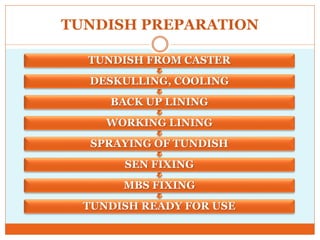
TUNDISH PREPARATION
TUNDISH FROM CASTER
DESKULLING, COOLING
BACK UP LINING
WORKING LINING
SPRAYING OF TUNDISH
SEN FIXING
MBS FIXING
TUNDISH READY FOR USE
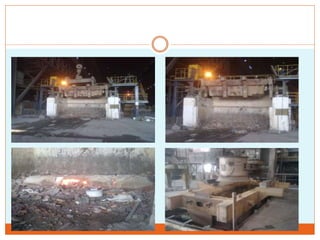
DESKULLING
 When Tundish is taken out from CSP caster, then
it goes for 4hrs cooling.
 After that it is shifted to tilter stand for deskilling.
 The spray mass and the Tundish skull is falling
down from Tundish because of its self weight and
thermal shock.
 If the skull is not falling dawn from the tundish
then we use pusher for skull removal.
 After deskulling the tundish is ready for cooling.
 The cooling fan is set above the tundish.
TUNDISH LINING
 There are 3 types of lining in tundish
1. Insulation lining
2. Tundish backup lining
3. Tundish working lining
BACKUP LINING
 Empty steel shell :- the shell of tundish must be clean
from any residual debris. Any mechanical repair required
must be done. The vent holes in the shell to be cleaned
for steam to escape during tundish heating.
 Fixing of insulating board :- insulating board
(1000×500×35 mm) are fixed along the tundish inner
surface with the sticking paste/ bituminous paint.
 Anchoring :- anchors are to be welded to the shell and
place at equal distance from one another (v=250 and
h=500 mm) to provide support to the permanent lining.
Anchors are coated with bituminous paint to allow for
differential expansion between the steel and castable
lining.
 Insulation lining
 Both bottom and side wall = 35 mm
 Material = ceramic fibre boards (1000×500×35 mm)
 Backup lining
 Bottom = 190mm
 Side wall = 180mm
 Material = 70% low cement cast able
 Working lining
 Both Bottom and side wall = 45 mm
 Material = 85% MgO based spray mass
 Mixing of LC 70% Al2O3 castable and water :- the
castable is to be mix with water in a mixer
 Casting :- the prepared batch must be casted with in
(15-20 min) and it is well settled with help of niddle
vibrators.
 Bottom thickness is 190mm and side wall is 180 mm.
 Life of backup is about 620 heats.
HEATING CYCLE OF BACKUP LINING
 Pre-heating :- total pre-heating schedule for the tundish
back-up casting is 72 hrs and it heating schedule given
below.
 1 to 6 hr increase gradually 25˚c per hr
 7 to 30 hr shocking at 150˚c
 31 to 40 hrs increase gradually 25˚c per hr
 40 to 51 hrs shocking at 400˚c
 52 to 63 hrs increase gradually 25˚c per hr
 63 to 72 hrs shocking at 800˚c
 Now tundish is ready for cooling
 When temp. Is reach at 80 to 90˚c tundish is ready for
spraying.
WORKING LINING
 Tundish shifting from tilter stand to cooling stand.
 Tundish cooling around 3 to 4 hrs.
 Spraying temp. 70 to 90˚c.
 Tundish shifting from cooling stand to spray stand.
 Debris cleaning inside the tundish.
 Fix the new furniture.
 Apply water mixed conventional castable.
 Side wall patching to be done if it required.
 Then spray the tundish.
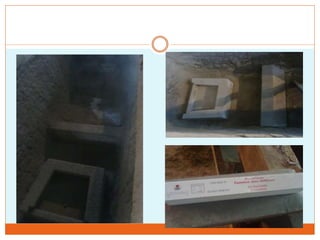
TUNDISH FURNITURE
 Turbo
 Dab
 Well block
 SEN (Sub-merge Entry Nozzle)
 Mono block stopper
 Tundish gas diffuser (TGD)
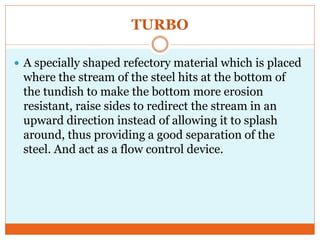
TURBO
 A specially shaped refectory material which is placed
where the stream of the steel hits at the bottom of
the tundish to make the bottom more erosion
resistant, raise sides to redirect the stream in an
upward direction instead of allowing it to splash
around, thus providing a good separation of the
steel. And act as a flow control device.
TUNDISH GAS DIFFUSER
 During casting, a controlled flow of inert gas is
introduced to the TGD, forming a continuously
renewed rising curtain of tiny gas bubbles through
which the steel flow passes..
 The diffuse gas curtain enhance inclusion removal
and improves thermal homogeneity of the steel bath
in the tundish.
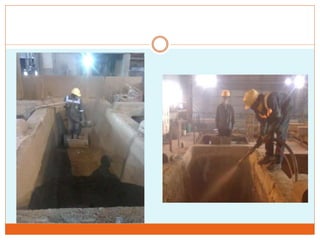
SPRAYING OF TUNDISH
 Ensure temperature at the back up lining is around 70 to
90˚c.
 Fix the furniture.
 Then spray the material in 3 layer with 85% MgO.
Thickness of each layer is 15 mm. Water required 20%.
 After each layer leave the tundish for 20 min for steam to
go out.
 Check and ensure that required thickness is achieved
with the tool.
 Make vent holes in the lining with the help of same tool.
 Once the spray is completed, leave the tundish for air
drying for 30 to 45 min and then 3 hrs. In tundish drier
at 350˚c.
SUBMERGED ENTRY NOZZLE
 Types of SEN : R3 & wider
 ISO statically pressed alumina graphite submerged
entry nozzle produced for protection of the tundish
and the mould.
 SEN top diameter : 160 to 162 mm
 SEN bell diameter : 130 to 132 mm
 SEN length : 1120 mm
 Material : 90% high alumina
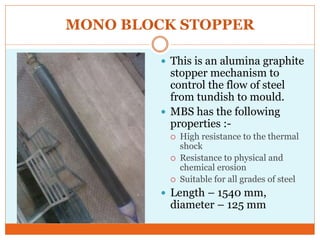
MONO BLOCK STOPPER
 This is an alumina graphite
stopper mechanism to
control the flow of steel
from tundish to mould.
 MBS has the following
properties :-
 High resistance to the thermal
shock
 Resistance to physical and
chemical erosion
 Suitable for all grades of steel
 Length – 1540 mm,
diameter – 125 mm
SEN FIXING
 Before SEN fixing preheat the split ring for quick setting of
alumina mortar.
 The high alumina mortal applied outside of split ring in 6 mm
thickness.
 Place tundish jack trolley below the tundish.
 Then place the SEN vertically on jack trolley.
 Pass the SEN into the tundish from bottom of the tundish by
lifting the jack trolley & hold it in that position.
 Then applied mortal on the SEN bell portion.
 After that ensure that SEN is vertical and measure the SEN
length below the tundish (845 mm)
 Then fill the ramming mass super 3000 (high alumina castable)
 And then apply spray mass in it.
STOPPER FIXING
 Place the tundish cover on tundish after SEN fixing.
 Fix the stopper rod mechanism.
 Then fix the stopper with SR, and check that stopper is
properly sit in SEN upper portion.
 The tundish now is ready for transport to the casting
platform. At the casting platform before starting the cast
the tundish must be preheated at 1125˚c for 90 min.
 SEN is also preheated at 1125˚c for 90 min with argon
gas.
 Now tundish is ready for cast.
 Life of MBS and SEN is 24 hrs.
PREPARED BY :-
MAYUR KORADIYA 126340321059
SANDEEP YADAV 136340321060
GUIDED BY :- VIVEK GANATRA
ASST. MANAGER CSP
CASTER
THANK YOU

Tundish making1

  • 1.
    ESSAR STEEL (I)LTD. TUNDISH MAKING
  • 2.
    CONTENTS  What isTundish ?  Tundish preparation  Deskulling  Tundish lining  Heating cycle of backup lining  Tundish furniture  Spraying of Tundish  SEN fixing  Stopper fixing
  • 3.
    WHAT IS TUNDISH? In continuous casting process, Tundish is the last vessel from which the steel goes through before entering the mould.  It acts as a buffer between ladle mould for controlling the casting speed. it also act as a reservoir of metal during ladle change.  Liquid metal is drain from tundish through sub merge entry nozzle.  It helps in segregation of non-metallic inclusions and there for yielding high quality products.
  • 4.
    TUNDISH PREPARATION TUNDISH FROMCASTER DESKULLING, COOLING BACK UP LINING WORKING LINING SPRAYING OF TUNDISH SEN FIXING MBS FIXING TUNDISH READY FOR USE
  • 5.
    DESKULLING  When Tundishis taken out from CSP caster, then it goes for 4hrs cooling.  After that it is shifted to tilter stand for deskilling.  The spray mass and the Tundish skull is falling down from Tundish because of its self weight and thermal shock.  If the skull is not falling dawn from the tundish then we use pusher for skull removal.  After deskulling the tundish is ready for cooling.  The cooling fan is set above the tundish.
  • 7.
    TUNDISH LINING  Thereare 3 types of lining in tundish 1. Insulation lining 2. Tundish backup lining 3. Tundish working lining
  • 8.
    BACKUP LINING  Emptysteel shell :- the shell of tundish must be clean from any residual debris. Any mechanical repair required must be done. The vent holes in the shell to be cleaned for steam to escape during tundish heating.  Fixing of insulating board :- insulating board (1000×500×35 mm) are fixed along the tundish inner surface with the sticking paste/ bituminous paint.  Anchoring :- anchors are to be welded to the shell and place at equal distance from one another (v=250 and h=500 mm) to provide support to the permanent lining. Anchors are coated with bituminous paint to allow for differential expansion between the steel and castable lining.
  • 9.
     Insulation lining Both bottom and side wall = 35 mm  Material = ceramic fibre boards (1000×500×35 mm)  Backup lining  Bottom = 190mm  Side wall = 180mm  Material = 70% low cement cast able  Working lining  Both Bottom and side wall = 45 mm  Material = 85% MgO based spray mass
  • 10.
     Mixing ofLC 70% Al2O3 castable and water :- the castable is to be mix with water in a mixer  Casting :- the prepared batch must be casted with in (15-20 min) and it is well settled with help of niddle vibrators.  Bottom thickness is 190mm and side wall is 180 mm.  Life of backup is about 620 heats.
  • 11.
    HEATING CYCLE OFBACKUP LINING  Pre-heating :- total pre-heating schedule for the tundish back-up casting is 72 hrs and it heating schedule given below.  1 to 6 hr increase gradually 25˚c per hr  7 to 30 hr shocking at 150˚c  31 to 40 hrs increase gradually 25˚c per hr  40 to 51 hrs shocking at 400˚c  52 to 63 hrs increase gradually 25˚c per hr  63 to 72 hrs shocking at 800˚c  Now tundish is ready for cooling  When temp. Is reach at 80 to 90˚c tundish is ready for spraying.
  • 12.
    WORKING LINING  Tundishshifting from tilter stand to cooling stand.  Tundish cooling around 3 to 4 hrs.  Spraying temp. 70 to 90˚c.  Tundish shifting from cooling stand to spray stand.  Debris cleaning inside the tundish.  Fix the new furniture.  Apply water mixed conventional castable.  Side wall patching to be done if it required.  Then spray the tundish.
  • 13.
    TUNDISH FURNITURE  Turbo Dab  Well block  SEN (Sub-merge Entry Nozzle)  Mono block stopper  Tundish gas diffuser (TGD)
  • 14.
    TURBO  A speciallyshaped refectory material which is placed where the stream of the steel hits at the bottom of the tundish to make the bottom more erosion resistant, raise sides to redirect the stream in an upward direction instead of allowing it to splash around, thus providing a good separation of the steel. And act as a flow control device.
  • 15.
    TUNDISH GAS DIFFUSER During casting, a controlled flow of inert gas is introduced to the TGD, forming a continuously renewed rising curtain of tiny gas bubbles through which the steel flow passes..  The diffuse gas curtain enhance inclusion removal and improves thermal homogeneity of the steel bath in the tundish.
  • 17.
    SPRAYING OF TUNDISH Ensure temperature at the back up lining is around 70 to 90˚c.  Fix the furniture.  Then spray the material in 3 layer with 85% MgO. Thickness of each layer is 15 mm. Water required 20%.  After each layer leave the tundish for 20 min for steam to go out.  Check and ensure that required thickness is achieved with the tool.  Make vent holes in the lining with the help of same tool.  Once the spray is completed, leave the tundish for air drying for 30 to 45 min and then 3 hrs. In tundish drier at 350˚c.
  • 19.
    SUBMERGED ENTRY NOZZLE Types of SEN : R3 & wider  ISO statically pressed alumina graphite submerged entry nozzle produced for protection of the tundish and the mould.  SEN top diameter : 160 to 162 mm  SEN bell diameter : 130 to 132 mm  SEN length : 1120 mm  Material : 90% high alumina
  • 20.
    MONO BLOCK STOPPER This is an alumina graphite stopper mechanism to control the flow of steel from tundish to mould.  MBS has the following properties :-  High resistance to the thermal shock  Resistance to physical and chemical erosion  Suitable for all grades of steel  Length – 1540 mm, diameter – 125 mm
  • 21.
    SEN FIXING  BeforeSEN fixing preheat the split ring for quick setting of alumina mortar.  The high alumina mortal applied outside of split ring in 6 mm thickness.  Place tundish jack trolley below the tundish.  Then place the SEN vertically on jack trolley.  Pass the SEN into the tundish from bottom of the tundish by lifting the jack trolley & hold it in that position.  Then applied mortal on the SEN bell portion.  After that ensure that SEN is vertical and measure the SEN length below the tundish (845 mm)  Then fill the ramming mass super 3000 (high alumina castable)  And then apply spray mass in it.
  • 22.
    STOPPER FIXING  Placethe tundish cover on tundish after SEN fixing.  Fix the stopper rod mechanism.  Then fix the stopper with SR, and check that stopper is properly sit in SEN upper portion.  The tundish now is ready for transport to the casting platform. At the casting platform before starting the cast the tundish must be preheated at 1125˚c for 90 min.  SEN is also preheated at 1125˚c for 90 min with argon gas.  Now tundish is ready for cast.  Life of MBS and SEN is 24 hrs.
  • 23.
    PREPARED BY :- MAYURKORADIYA 126340321059 SANDEEP YADAV 136340321060 GUIDED BY :- VIVEK GANATRA ASST. MANAGER CSP CASTER
  • 24.