Continous Casting
Technology
Casting and Solidification (MTL6340)
Ashish Dev (B21MT009)
Ashish Dochania (B21MT010)
Defination 3
Importance 4
Process Steps 5
Types of Continous casting 6
Key Components of Continuous
Casting Machines
7
Advantages 8
Challenges 9
Applications 10
Future Trends 11
Conclusion 13
Content
What is Continous Casting
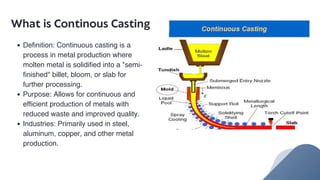
Definition: Continuous casting is a
process in metal production where
molten metal is solidified into a "semi-
finished" billet, bloom, or slab for
further processing.
Purpose: Allows for continuous and
efficient production of metals with
reduced waste and improved quality.
Industries: Primarily used in steel,
aluminum, copper, and other metal
production.
Importance of continous Casting
Efficiency: Produces metals faster than traditional
ingot casting.
Quality Control: Reduces impurities and
inconsistencies.
Cost-Effectiveness: Minimizes waste and energy
use.
Environmental Impact: Less waste and fewer
emissions compared to older methods.
Continuous Casting Process Steps
Melting: Metal is melted in a furnace.
1.
Tundish Transfer: Molten metal is
transferred to a tundish, which acts as a
reservoir.
2.
Mold Casting: Metal flows from the tundish
into a water-cooled mold, starting
solidification.
3.
Withdrawal: Semi-solid metal is slowly
pulled out of the mold.
4.
Cooling and Cutting: Metal is fully
solidified, then cut to desired lengths for
further processing.
5.
Types of Continuous Casting
Machines
Billet Casters: Used for small cross-section
products.
Bloom Casters: Suitable for larger cross-
sections, like rail tracks.
Slab Casters: Used for large flat products,
ideal for sheet metal production.
Horizontal Casters: Allows for specialized
shapes and increased efficiency in certain
applications.
Process Control Parameters
Casting Speed : Controls the solidification rate.
Cooling rate and Secondary Cooling Zone Control :
Affects solidification and thermal gradient within the
metal.
Mold Oscillation : Helps form a thin layer of solidified
metal (mold slag) that reduces friction between the mold
and cast metal.
Argon Gas Injection : Reduces impurities in the metal
and prevents cloggin in the submerged entry nozzle.
Tundish Temperature and level control : Consistent
trmperature and level help maintain uniform flow of
molten metal into the mold.
Key Components of Continues
Casting Machines
Ladle and Tundish : Controls flow of molten
metal.
Mold : Initiates solidification with cooling.
Secondary Cooling System : Continues
cooling after the mold.
Withdrawal and Straightening Units :
Control the speed and direction of solidified
metal.
Cutting Unit : Cuts the cast metal to lengths
for further processing.
Advantages
High Production Rates : Efficient for large-scale
metal production.
Improved Quality : Consistent mechanical
properties and surface quality.
Reduced Energy Costs : Less re-heating
required in further processing.
Reduced Metal Loss : Lower scrap rates
compared to traditional casting.
Challenges in Continuous Casting
Temperature Control : Ensuring uniform
cooling to avoid defects.
Flow Dynamics : Preventing turbulence in
the mold to reduce impurity entrapment.
Maintenance : Continuous wear on
components due to high temperatures and
pressure.
Defects : Addressing common issues like
cracks, inclusions, and surface roughness.
Applications
Steel Production : Widely used for
structural beams, rail tracks, and
automotive components.
Aluminum Casting : Used in sheet and
plate production for aerospace and
automotive industries.
Copper and Alloys : Produces bars, tubes,
and wires for electrical and industrial uses.
Future Trends in Continuous
Casting
Automation and AI : Enhanced quality
control and process monitoring.
Sustainability Improvements : Lower
energy consumption and reduced
emissions.
Advanced Alloys : Continuous casting for
high-performance alloys used in
specialized industries.
Conclusion
Summary : Continuous casting is an
efficient, high-quality method for producing
metals.
Benefits : Improves production rates,
reduce costs, and enhances metal
properties.
Future Outlook : Automation and
sustainable practices will continue to
advance continuous casting.
Thank You

process of continous casting and solidification .pdf

  • 1.
    Continous Casting Technology Casting andSolidification (MTL6340) Ashish Dev (B21MT009) Ashish Dochania (B21MT010)
  • 2.
    Defination 3 Importance 4 ProcessSteps 5 Types of Continous casting 6 Key Components of Continuous Casting Machines 7 Advantages 8 Challenges 9 Applications 10 Future Trends 11 Conclusion 13 Content
  • 3.
    What is ContinousCasting Definition: Continuous casting is a process in metal production where molten metal is solidified into a "semi- finished" billet, bloom, or slab for further processing. Purpose: Allows for continuous and efficient production of metals with reduced waste and improved quality. Industries: Primarily used in steel, aluminum, copper, and other metal production.
  • 4.
    Importance of continousCasting Efficiency: Produces metals faster than traditional ingot casting. Quality Control: Reduces impurities and inconsistencies. Cost-Effectiveness: Minimizes waste and energy use. Environmental Impact: Less waste and fewer emissions compared to older methods.
  • 5.
    Continuous Casting ProcessSteps Melting: Metal is melted in a furnace. 1. Tundish Transfer: Molten metal is transferred to a tundish, which acts as a reservoir. 2. Mold Casting: Metal flows from the tundish into a water-cooled mold, starting solidification. 3. Withdrawal: Semi-solid metal is slowly pulled out of the mold. 4. Cooling and Cutting: Metal is fully solidified, then cut to desired lengths for further processing. 5.
  • 7.
    Types of ContinuousCasting Machines Billet Casters: Used for small cross-section products. Bloom Casters: Suitable for larger cross- sections, like rail tracks. Slab Casters: Used for large flat products, ideal for sheet metal production. Horizontal Casters: Allows for specialized shapes and increased efficiency in certain applications.
  • 8.
    Process Control Parameters CastingSpeed : Controls the solidification rate. Cooling rate and Secondary Cooling Zone Control : Affects solidification and thermal gradient within the metal. Mold Oscillation : Helps form a thin layer of solidified metal (mold slag) that reduces friction between the mold and cast metal. Argon Gas Injection : Reduces impurities in the metal and prevents cloggin in the submerged entry nozzle. Tundish Temperature and level control : Consistent trmperature and level help maintain uniform flow of molten metal into the mold.
  • 9.
    Key Components ofContinues Casting Machines Ladle and Tundish : Controls flow of molten metal. Mold : Initiates solidification with cooling. Secondary Cooling System : Continues cooling after the mold. Withdrawal and Straightening Units : Control the speed and direction of solidified metal. Cutting Unit : Cuts the cast metal to lengths for further processing.
  • 10.
    Advantages High Production Rates: Efficient for large-scale metal production. Improved Quality : Consistent mechanical properties and surface quality. Reduced Energy Costs : Less re-heating required in further processing. Reduced Metal Loss : Lower scrap rates compared to traditional casting.
  • 11.
    Challenges in ContinuousCasting Temperature Control : Ensuring uniform cooling to avoid defects. Flow Dynamics : Preventing turbulence in the mold to reduce impurity entrapment. Maintenance : Continuous wear on components due to high temperatures and pressure. Defects : Addressing common issues like cracks, inclusions, and surface roughness.
  • 12.
    Applications Steel Production :Widely used for structural beams, rail tracks, and automotive components. Aluminum Casting : Used in sheet and plate production for aerospace and automotive industries. Copper and Alloys : Produces bars, tubes, and wires for electrical and industrial uses.
  • 13.
    Future Trends inContinuous Casting Automation and AI : Enhanced quality control and process monitoring. Sustainability Improvements : Lower energy consumption and reduced emissions. Advanced Alloys : Continuous casting for high-performance alloys used in specialized industries.
  • 14.
    Conclusion Summary : Continuouscasting is an efficient, high-quality method for producing metals. Benefits : Improves production rates, reduce costs, and enhances metal properties. Future Outlook : Automation and sustainable practices will continue to advance continuous casting.
  • 15.