A Practical Approach to
Continuous Casting of
Copper-Based Alloys and
Precious Metals
Robert Wilson
Book 725
First published in 2000 by
10M Communications Ltd
1 Carlton House Terrace
London SW1Y 5DB
© 10M Communications Ltd 2000
All rights reserved
10M Communications Ltd
is a wholly-owned subsidiary of
The Institute of Materials
ISBN 1-86125-099-1
Typeset in the UK by
Keyset Composition, Colchester
Printed and bound in the UK at
The University Press, Cambridge
Acknowledgements
My sincere thanks are conveyed to colleagues in the industry for the encouragement
and assistance given to me in the preparation of this book. Specific thanks are
extended to: Dr Chris Corti of the World Gold Council; Peter M. Raw, Consultant
in Precious Metals and Roy Rushforth of the Birmingham Assay Office for their
valuable contributions. Acknowledgement is also given to the contributions of the
many companies who supplied material for use in this publication. Finally my wife
deserves thanks for the encouragement and help she has extended to me during the
many stages of the development of this work.
The author also specifically wishes to acknowledge the following:
1. Data supplied by Copper Development Association, Verulam Industrial Estate,
224 London Road, St Albans, Herefordshire, ALI lAQ.
2. Data supplied by Copper Development Association Inc., 260 Madison Avenue,
New York, NY 10016.
3. Data taken from Health & Safety Executive publication EH40/99 - Occupa-
tional Exposure Limits 1999, HM Stationery Office.
R. Wilson.
v
Contents
Introduction ??
1 CONTINUOUS CASTING
1.1 History of Process and Evolution of Machine Design
1.2 Details of Casting Process
1.2.1 Mode of Casting
1.2.2 Vertical Continuous Casting
1.2.3 Vertical Upward Casting
1.2.4 Rautomead Upcast System
1.2.5 Pressure Upcast System
1.3 Horizontal Continuous Casting
1.3.1 Principle of Horizontal Continuous Casting
1
1
3
3
5
6
7
7
7
8
1.4 Crucibles Used in Continuous Casting 8
1.4.1 Ceramic Crucible Assemblies Used in Induction Melting-Casting 9
1.4.2 Graphite Crucible 9
1.4.2.1 Top Protection and Crucible Liner 10
1.4.2.2 Crucible Liner 11
1.4.2.3 Crucible Die Seal 11
1.4.2.4 Graphite Baffle 12
1.5 Construction and Operation of Horizontal Continuous Casting Furnace
Utilising Integrated Melt and Cast Sequence 12
1.5.1 Furnace Construction 13
1.5.1.1 Refractory Insulation 13
1.5.1.2 Low Thermal Mass Insulation 13
1.5.1.3 Heating Elements 13
1.5.1.4 Temperature Control 14
1.5.2 Industrial Horizontal Continuous Casting Furnace 14
1.6 Casting Dies and Cooler Assembly 14
1.6.1 Strip Die and Cooler Assembly 15
1.6.1.1 Nitrogen Protection Within the 'Air Gap' 16
1.6.1.2 Outward Taper on Top Face of Die 17
1.6.1.3 Fitting Starter Strip 17
1.6.2 Jacket Cooled Die Used for Rod and Billet 17
1.6.3 Probe Cooled Die for Rod and Narrow Strip Casting 18
1.6.3.1 Probe or Plate Cooled Die for Narrow Strip 19
vii
Contents
1.6.4 Dies Used in Continuous Casting of Tube
1.6.5 High Efficiency Cooler Applied to Small Diameter Rod
19
20
21
23
23
24
1.8 Casting Practice 24
1.8.1 Graphite Casting Die 24
1.8.2 Assembly of Graphite Die and and Cooler-Jacket Type Cooler 25
1.8.2.1 Fitting Starter Rods 27
1.8.3 Fitting Starter Strip to Graphite Die and Cooler-Strip Type Cooler 27
1.8.4 Assembly of Die Insert to High Speed Cooler for Small
Diameter Rod
1.9 Safety from Liquid Metal Runout
1.9.1 Failure of Cooling Water Supply
1.9.2 Break in Continuous Casting Billet Within Die
1.9.2.1 Die TemperatureIWithdrawal Interruption
1.9.2.2 Incorporating Safety Plunger at Die Exit
1.10 Trouble Shooting
1.10.1 Irregular Pulse Length
1.10.2 Cast Surface Finish-Deterioration with Time'
1.10.3 Inverse Segregation
1.10.4 Pulse Cracking
1.10.5 Porosity
1.10.6 Periodic Surface Gouging
1.10.7 Zinc Segregation on Brasses
1.10.8 Edge Cracking on Strip
1.10.9 Heat Balance Checks
1.7 Withdrawal
1.7.1 AC Servo Drive
1.7.2 Withdrawal Using Cam-Operated Indexing
1.7.3 Withdrawal Using Pneumatic Slide Feed
28
28
29
29
29
30
30
31
31
32
32
33
33
33
33
34
2 HEAT TRANSFER 37
2.1 Mode of Heat Transfer Along the Mould 37
2.1.1 The Influence of 'Air Gap' 38
2.1.2 Water Spray at Die Exit 38
2.1.3 Vertical and Horizontal Casting 39
2.1.4 Manipulation of Heat Transfer in Region of h; 39
2.1.4.1 Copper Sleeve Cooler Assembly for Rod Casting 39
2.1.4.2 Effect of Withdrawal Characteristics on Shell Formation 40
2.1.4.3 Mode of Freezing and Effect on Product Quality 41
2.1.4.4 Upcasting of Copper Rod 43
2.1.4.5 Cooler Assembly Strip 43
2.1.4.6 Jacket- and Probe-Cooled Die Assembly 43
2.2 Overall Energy Balance from Properties of Materials 44
2.2.1 Typical Heat Balance on Selected Casting Runs 45
viii
Contents
3 CONTINUOUS CASTING PLANT and EQUIPMENT 51
Casting Equipment 51
3.1 'Unicast' System Introduced by United Wire, Edinburgh 51
3.1.1 'Unicast' Horizontal Casting System 52
3.2 Rautomead International, Dundee 53
3.2.1 Precious Metal Strip Casting 53
3.2.2 Vertical Casting of Precious Metals 53
3.2.3 Computer Monitoring and Process Display with Data Logging of
Operating Parameters 'Rautocast 2000' 54
3.2.4 Rautomead Upwards Vertical Continuous Casting Plant 54
3.3 Ewen Technology - New Jersey, USA 54
3.4 Wertli 55
3.4.1 Furnace Design 55
3.4.2 The Wertli Drive Concept 56
3.4.3 Wertli Casting Mould/Cooler Design for Strip 56
3.4.3.1 Water Flow and Cooler Chamber Design 56
3.4.4 Wertli Data Recording 'Capvis' 57
3.5 Mannesmann Demag Continuous Casting 58
3.5.1 Microprocess Control 'Demag Computocast' 58
3.6 Graining Furnace - Schultheiss GmbH, Pforzheim, Germany 59
3.7 Hazelett Strip Casting Process 59
3.8 Outokumpu Upcasting 59
3.8.1 Operating Principle 60
3.8.1.1 Melting Furnace 60
3.8.1.2 Holding and Casting Furnace 61
3.8.1.3 Production Capacity 61
3.9 History of Properzi 'Wheel Casting' Technology 61
3.9.1 Equipment Capacity 62
3.9.2 Casting Wheel 63
3.9.2.1 Casting Wheel Insulation 'Sooting' 63
3.9.2.2 Rolling, Pickling and Coiling 63
3.9.3 Production of Elecrolytic-Grade Copper Rod from Copper Scrap 63
3.9.3.1 Typical Raw Material Copper Scrap 64
3.9.3.2 The Properzi-La Farga Thermal Process 64
3.9.3.3 Casting and Rolling 66
3.10 Southwire Continuous Casting Rod Process 66
3.10.1 The SRC Process 66
3.10.1.1 Vertical Shaft Furnace 67
3.10.1.2 Tundish and Automatic Metal-Pouring System (AMPS) 67
3.10.1.3 Casting Wheel 67
3.10.1.4 Rolling Mill 67
ix
Contents
3.10.2 Cast Bar Quality 68
3.10.3 Superheat and Control of Chemistry 68
3.10.4 Cast Structure 69
3.11 OHNO Continuous Casting Process 69
3.11.1 The OHNO Continuous Casting System 70
3.11.2 Industrial Application of the OHNO Process 71
4 GRAPHITE and REFRACTORY CERAMICS used in CONTINUOUS
CASTING 73
Graphite 73
4.1 Graphite Manufacture 73
4.2 Properties 74
4.2.1 Reaction of Graphite with Molten Metals 74
4.2.2 Compatibility of Graphite with Various Metal Metals 74
4.2.3 Solubility of Carbon in Selected Molten Metals 76
4.3 Thermal and Mechanical Properties of Commercially Available Die-Grade
Graphites 77
4.3.1 Thermal Conductivity 77
4.3.2 Coefficient of Thermal Expansion of Graphites - Effect of
Temperature 78
4.3.3 Thermal Expansion of Graphite and Various Ceramics 78
4.3.4 Mechanical Strength of Graphite Effect of Temperature 78
4.3.5 Bulk Density (ASTM C559-85) 79
4.3.6 Specific Electrical Resistance (ASTM C611-84) 79
4.4 Commercial Graphites used in Continuous Casting 81
4.4.1 Crucible-Grade Graphite 81
4.4.2 Die-Grade Graphite 81
4.4.2.1 Premium Fine Grained Graphite 82
4.4.2.2 Graphite Die-Grade Selection 82
4.5 Machining Guide for Graphite 82
4.6 'GRAFOIL'® Flexible Graphite 82
Ceramics used in Continuous Casting 85
4.7 Properties 85
4.7.1 Alumina (Alz03) 85
4.7.2 Zirconia (Zr02) 86
4.7.3 Magnesia (MgO) 86
4.7.4 BerYllia (BeO) 86
4.7.5 Silicon Carbide 86
4.7.6 Chrome Alumina 87
4.7.7 Mullite 87
4.7.8 Sillimanite 87
x
Contents
4.8 Ceramic Die Material Boron Nitride (BN) 87
4.9 Thermal Properties of Selected Ceramics Compared to Graphite 88
4.9.1 Thermal Conductivity 88
4.9.2 Thermal Expansion 88
4.10 Low Thermal Mass Insulation 89
4.11 Monolithic Refractories 90
4.12 Ceramic Fibre Paper 90
5 CONTINUOUS CASTING OF COPPER-BASED ALLOYS 91
5.1 High Purity Copper 91
5.1.1 Cathode 91
5.1.2 Oxide-Free Copper BS ClODCI02 93
5.2 Deoxidation of Copper 93
5.2.1 Data on Rate of Deoxidation on Controlled Casting Run on
Copper 96
5.2.2 Copper Deoxidation by Graphite Bed Filtration 97
5.2.3 Production Application of Graphite Deoxidation 97
5.2.3.1 Outokumpu Upcast 98
5.2.3.2 Rautomead Continuous Casting Equipment 98
5.3 Vertical Upcast Process for Production of OFHC
Copper Rod 98
5.3.1 Casting Operation 99
5.3.2 Rod Withdrawal 100
5.3.3 Product Purity and Residual Elements 100
5.4 Copper-Phosphorus Deoxidised 101
5.4.1 Continuous Casting Data for Copper (Phosphorus Deoxidised)
Alloys 101
5.5 Continuous Casting of High-Purity Copper 101
5.5.1 Details of the Plant 101
5.5.2 Casting Data on High-Purity Copper 103
5.6 Continuous Casting of Cu: Cd and Cu: Mg Alloys 104
5.6.1 Cu: Cd Alloys 104
5.6.2 Cu :Mg Alloys 104
5.6.3 Mechanical Properties of Cu-OF, Cu: Cd and Cu: Mg 107
5.6.4 Comparison of Properties of Cu-OF, Cu: Cd and Cu: Mg 108
5.7 Brasses 108
5.7.1 Continuous Casting of a Brasses 110
5.7.2 Continuous Casting of a-f3 Brasses 113
5.7.2.1 Free Machining a-f3 Brasses 113
5.7.2.2 Specifications, Properties and Casting Data for a-f3
Leaded Brasses 113
Xl
Contents
5.7.3 Other Low Per Cent Element Additions to Brasses 113
5.7.4 High-Tensile Brasses 113
5.7.4.1 Continuous Casting of High-Strength Brasses 117
5.7.5 Zinc Equivalent in Brasses 117
5.7.6 Zinc Rich-Surface Phase on Brasses 118
5.7.6.1 Mode of Formation of Zinc-Rich Phase 118
5.7.6.2 SEM Analyses on Zinc-Rich Surface Layer 119
5.7.6.3 Methods to Minimise the Zinc-Rich Layer 119
5.7.7 Charging and Effect of Minor Element Additions to Brasses 120
5.7.8 DZR Brass (Dezincification Resistant) 120
5.7.8.1 Continuous Casting of DZR Brass 122
5.8 Tin Bronzes 122
5.8.1 Copper-Tin Alloys 122
5.8.2 Copper- Tin-Phosphorus Alloys 123
5.8.2.1 Phosphor Bronze PBI03-C51900 124
5.8.3 Bronzes Containing Zinc 124
5.8.4 Bronzes Containing Lead 125
5.8.4.1 Leaded Gunmetal LG2-C83600 125
5.8.5 Specification, Properties and Casting Data for Cu: Sn Alloys 126
5.8.6 Silicon Bronze 127
5.9 Copper Aluminium Alloys 127
5.9.1 Castable Alloys 130
5.9.2 Melting and Casting Practice for Cu-AI Alloys 130
5.9.3 Nordic Alloy - Aluminium Bronze CuAl5Zn5Sn 133
5.9.3.1 Continuous Casting Characteristics 135
5.9.4 Mint Coinage 136
5.10 Nickel-Silver 136
5.10.1 Charging Sequence for Nickel Silver 136
5.11 Copper-Nickel Alloys 136
5.11.1 Casting Properties 138
5.11.1.1 Reaction with Graphite 138
5.12 Free Cutting Copper Alloys with Reduced or no Lead 139
5.12.1 Contamination of Copper With Bismuth 142
5.12.2 Literature Review 142
5.12.3 Continuous Casting Trials 143
5.12.4 Casting Characteristics 144
5.12.5 Federalloy" - Bismuth-Modified Tin Bronzes 144
5.12.5.1 Comparative Microstructural Study on CDA 932
(Leaded Brass - 7%
Pb) versus Federalloy 111-932
Modified 20/0Bi, 0.050/0Pbmax) 145
5.12.5.2 Concast - Continuous Casting of Federalloys 148
6 CONTINUOUS CASTING OF PRECIOUS METALS 151
6.1 Gold 151
6.1.1 Gold-Melting Characteristics 152
xii
Contents
6.2 Casting Equipment - Precious Metals 152
6.2.1 Resistance Heated 153
6.2.2 Induction Heated 153
6.3 Crucible and Die 154
6.3.2 Die and Cooler Assemblies used in Precious Metal Casting 154
6.3.1.1 Strip Casting - Wide Strip 154
6.3.1.2 Probe Cooled Die for Rod and Narrow Strip Casting 155
6.3.1.3 Thin Strip - Engineering Applications 155
6.3.1.4 Rod Casting 155
6.3.1.5 Small Diameter Rod and Thin Narrow Strip 155
6.4 Continuous Casting of Fine Gold 155
6.5 Typical Casting Run on Fine Gold Strip 156
6.6 Continuous Casting of Carat Gold 156
6.6.1 Gold Alloy 22 Carat 157
6.6.1.1 Gold-Silver-Copper 22 Carat 157
6.6.1.2 Continuous Casting Data 159
6.6.2 Gold Alloy 18 Carat 159
6.6.3 Gold Alloy 14 Carat 159
6.6.4 Gold Alloy 10 Carat 160
6.6.4.1 Hardness Characteristics of Au:Ag:Cu 18- 14- 10 Carat
Alloys 160
6.6.5 Gold Alloy 9 Carat 163
6.6.6 Fractional Element Additions to Carat Gold 163
6.6.7 Contamination of Carat Gold 165
6.6.8 Summary - Casting Data Carat Gold 165
6.7 Coloured Gold 165
6.8 Ternary Gold Alloys - Phase Diagrams 167
6.8.1 Liquidus Isotherms Ag-Au-Cu System 169
6.8.2 Solidus Isotherms Ag-Au-Cu System 169
6.8.3 Ag-Au:Ag-Cu:Au-Cu Binary Diagrams 170
6.9 Mixing and Homogenisation in Gold Alloy Casting 170
6.9.1 Gas Stirring 171
6.9.2 Induction Melting 171
6.9.3 Pre-Ingot Casting 171
6.10 Graining 172
6.10.1 Equipment for Graining 172
6.10.2 Details of Graining Process 172
6.10.3 Graining of Sterling Silver 173
6.10.4 Graining Gold Alloys 175
6.11 Assaying Gold and Silver Alloys 175
6.12 Production Casting of Gold Strip 176
6.12.1 Data on Typical Casting Run on Fine Gold and Carat Gold Strip 176
6.12.2 Casting Procedure 177
xiii
Contents
6.13 Production of Gold Solder-Filled Rod 177
6.13.1 Combined Casting Technique for Production of Cored Rod
in Gold or Silver 178
6.13.1.1 Downstream Processing of Cast Cored Rod 179
6.13.1.2 Comments on Use of this Alternative Process 180
6.14 Casting of Gold Tube 180
6.14.1 Jacket-Cooled Cooler and Die Assembly 180
6.14.2 Probe-Cooled Tube Die Assembly 180
6.14.3 Upcasting of Tube 180
6.14.4 Vertical Casting 181
6.14.5 Horizontal Casting 181
6.14.6 Tilting Horizontal Furnace 181
6.14.7 Graphite Mandrel 182
6.14.8 Starter Tube 182
6.14.9 Start Up 183
6.14.10 Alloying 183
6.14.11 Tube Break 184
6.14.12 Re-Start After Break 184
6.14.13 Stop or Interruption of Tube Casting 185
6.14.14 End of Run and Crucible Draining 186
6.15 Gold-Tin Alloys 186
6.15.1 Alloy Constitution 186
6.15.2 Casting 186
6.15.3 Crucible and Die Material and Construction 186
6.15.4 Casting Procedure 187
6.15.4.1 Details on Typical Casting Run on Resistance-Heated
Horizontal Unit 188
6.15.4.2 Casting of 88:12 Au:Ge Alloy 188
6.15.4.3 Casting 98:2 Au:Si Alloy 189
6.16 Continuous Casting of High-Purity Gold Plus Trace Beryllium 190
6.16.1 Typical Casting Run 191
6.17 Hardenable High-Carat Gold Alloys 191
6.18 Silver
6.18.1 Deoxidation of Silver
6.18.2 Casting Fine Silver
6.18.3 Silver Alloys - Silver-Copper
6.18.3.1 Constitution of Silver:Copper Alloys
6.18.3.2 Sterling Silver
6.18.4 Modified Sterling Silver Cast Using Pressure Upcaster
6.18.4.1 Casting Data
6.18.4.2 Properties of Cast Strip
6.18.5 Ag:Cu Eutectic Alloy and Similar Alloys
6.18.5.1 Casting Equipment
6.18.5.2 Casting Practice
192
192
193
193
193
193
195
196
196
197
197
198
xiv
Contents
6.18.5.3 Industrial Application of Continuous Casting of Silver
Alloys 199
6.18.6 Silver-Copper-Germanium Alloy 200
6.18.6.1 Silver-Capper-Germanium Sterling Silver -
Properties and Casting Data 200
6.18.7 Silver-Magnesium-Nickel - Oxidation Hardenable Alloy 200
6.18.7.1 Problems Associated with Casting Ag-Mg-Ni Alloy 202
6.18.7.2 Method Developed for Continuous Casting Ag-Mg-Ni
A~~ 2m
6.18.7.3 Recommended Casting Procedure 202
6.19 Noble-Metal Brazing Alloys 203
6.19.1 Continuous Casting of Au-Cu Brazing Alloys 203
6.19.2 Casting Sequence 205
6.20 Ag: Cu :Pd Brazing Alloys 205
6.20.1 Pd Reaction with Graphite 205
6.20.2 Graphite Crucible and Die 205
6.20.3 Casting Sequence for Ag: Cu :Pd Alloys 206
6.21 Ag:Cu Eutectic Brazing Alloy Conforming to BS1845 206
6.22 Group AG Silver Brazing Alloys 206
6.22.1 Casting Sequence 207
6.23 Cu-P-Ag Brazing Alloys 207
6.23.1 Copper-Phosphorus Alloys 209
6.23.2 Copper-Phosphorus-Silver Alloys 211
6.23.2.1 Ductile Range in Ag-Cu-Cu3P Alloys Cast as Small
Diameter Rods 212
6.23.3 Modified AFNOR and DIN Specifications (Restricted
Phosphorus and Silver Contents) 213
6.23.4 Continuous Casting of Cu-P-Ag Brazing Alloys 214
6.23.4.1 Melting Practice (Modified CP2 Alloys) 214
6.23.4.2 Typical Casting Procedure for Modified CP2 Alloy 215
7 CONTINUOUS CASTING OF OTHER ALLOY SYSTEMS 217
7.1 Metal Alloy Systems which Dissolve or are Aggressive to Graphite 217
7.1.1 Ceramic Crucible Containment - Graphite Composite System 217
7.1.2 Induction Heated Ceramic Crucible Assembly 217
7.2 Die Ceramics 218
7.3 Die Design 218
7.3.1 Composite Ceramic-Graphite Die 218
7.3.2 Ceramic Die Insert in Copper Sleeve Cooler 219
7.3.3 Strip Die with Boron Nitride Insert 219
7.3.4 Ceramic Die Insert for Larger Section Sizes 220
xv
Contents
7.4 Casting Applications
7.4.1 Nickel-Chromium Alloys
7.4.2 Crucible Assembly
7.5 Palladium Alloys
7.5.1 Casting Details on Palladium-Silver Alloys
7.6 Gold-Platinum-Palladium Dental Alloys
221
221
221
221
223
223
7.7 Horizontal Continuous Casting of Special Steels and High-Nickel Alloys
Applying Break-Ring Technology 223
7.7.1 The Principle of 'Break-Ring' Casting 225
7.7.1.1 Mould Design 226
7.7.2 The Influence of Casting Parameters on Product Surface Quality 226
7.7.3 Application of Break-Ring Casting 228
7.7.3.1 Casting Start-Up 228
7.8 Tin-Lead Alloys 228
7.8.1 Continuous Casting 229
7.8.1.1 Tin-Lead Alloy ASTM B32-68T-60A 231
7.8.1.2 Lead-Tin Alloy ASTM B32-60T 231
APPENDIX 1 233
National Standard Compositions for Copper Alloys ** selected aUoys** 233
ASTM standard compositions Tables 1 to 6 234
BS EN standard compositions Tables 7 to 10 241
DIN standard compositions Tables 11-15 245
**Full range and comparison of National Standards available from Copper Development
Association, Verulam Industial Estate, 224 London Road, St Albans, Herts
APPENDIX 2
Table 1 - Physical Properties of Metals
Table 2 - Coefficient of thermal expansion/solidification shrinkage
Table 3 - Conversion of atomic percent (mass percent) and vice versa
Table 4 - Copper based master alloys
249
250
251
252
254
APPENDIX 3
Table 1 - COSHH Occupational exposure limits UK regulations 1999
Table 2 - Cooling water specification
Table 3 - Nitrogen specification
255
256
259
259
Index 261
XVI
Introduction
Continuous casting of non-ferrous metals applying the closed head immersed die
system with intermittent pulse withdrawal has been practised for well over 100 years.
The first patents covering vertical casting of non-ferrous metals was in 1840-43 by
Sellers" and Laign ' with horizontal casting some considerable time later by
Peherson" in 1914. The equipment described in the early vertical casting patents very
closely resembles the equipment used in modern casting processes, indicating, even
today, the use of a relatively simple system of 'continuous solidification and
withdrawal from a shaping mould'. The process has many advantages over static
ingot and book mould casting, the most important being improved yield, reduced
energy consumption and reduction in manpower, thus reducing production costs
significantly. This book is intended to provide an account of how continuous casting
technology has developed and how the process can be used within an engineering
environment, casting a range of copper based alloys, precious metals including gold
and silver and selected nickel alloys. The text is confined to the closed-head
immersed die process applying intermittent withdrawal and is approached from a
practical aspect. Wheel casting, although accounting for very large tonnage copper
production, is a highly specialised technology, and apart from a brief description of
the process, is not within the scope of this book.
Chapter 1 gives a brief historical background to continuous casting of non-ferrous
metals with some insight into the evolution of the casting plant. Furnace design is
discussed covering resistance-heated all-graphite system and induction-heated
furnaces. Vertical, horizontal and upcasting systems are reviewed.
Die and cooler design are discussed in detail. Withdrawal systems are examined
together with process control and monitoring. The final part of the section gives an
in-depth study of casting practice.
Chapter 2 is concerned with heat transfer within the mould or casting die from a
practical aspect only. The influence of die cooler design and withdrawal character-
istics on the coefficient of heat transfer and solidification morphology are examined.
Boundary heat transfer and heat tranfer along the mould are discussed. The heat
balance equation applied to practical casting programmes illustrate its application in
determining thermal efficiency of the system.
Chapter 3 describes the range of continuous casting equipment available from
suppliers. Special systems such as wheel casting are discussed although not in
detail.
xvii
Introduction
Chapter 4 outlines graphite technology as applied to continuous casting giving a
brief account of manufacture and data on all relevant properties. Suppliers of die
quality graphites are listed and recommended grades cross referenced for all casting
applications.
Chapter 5 deals with copper and copper based alloys. Casting of strip, rod and
hollow section in horizontal and vertical mode is described and account of the
upcasting method used primarily on high conductivity copper. Examples are given
of casting runs on selected alloy systems giving guidance on process control.
Deoxidation of copper is discussed fairly extensively.
Improved alloy systems, such as Cu-Mg replacing Cu-Cd, and the introduction of
Cu-Bi alloys as an alternative to Cu-Pb free machining alloys used in potable water
plumbing systems are outlined.
Chapter 6 deals with precious metal casting in a similar way to the previous
chapter on copper. Fine gold and the carat alloys are considered fairly extensively
and examples of casting runs are discussed. Most of the carat alloys are confined to
ternary systems with additional trace metal additions. These are discussed in relation
to published data on phase diagrams on gold alloys. This information is useful in
understanding the freezing characteristics and ascertaining the solidification range
which is not always available. A wide range of industrial golds are now continuous
cast. Fine silver and sterling silver are examined together with industrial alloys such
as Ag-Mg-Ni. Dental and brazing alloys are also considered in the precious metal
section.
The final Chapter covers alloys which dissolve or are aggressive to graphite.
Ceramic crucible containment is considered and die material, generally a modified
boron nitride, is discussed The metal systems such as high nickel and nickel chrome
alloys and precious metal engineering alloys such as Au-Ag-Pd and Au-Ag-Pd-Pt
are considered. Methods for casting Tin-lead alloys which are not suitable for
processing through graphite dies are discussed. The principle of 'break ring' casting
is briefly mentioned and the features of the OHNO Continuous Casting Process with
a unidirectionally solidified structure with no equiaxed crystals is also included.
xviii
1
Continuous Casting
1.1 HISTORY OF PROCESS AND EVOLUTION OF MACHINE
DESIGN
The continuous casting of metals has been practised for well over a century. A
review of literature indicates that, apart from the outstanding work by Bessemer! on
steel casting, the first recorded patent in the non-ferrous field was by Sellers? in
America in 1840, for the manufacture of lead pipes. About the same time Laigrr'
filed a patent in America in 1843 for a method of continuous casting non-ferrous
metal tube.
The first horizontal closed-head system for continuous casting was developed by
a Swedish engineer, Pehrson" for which he was granted a US patent in 1914. This was
used for the production of cast-iron bars; the method of withdrawal was of an
intermittent nature but, as opposed to present-day systems, the mould was made to
reciprocate back towards the crucible and then retract. On pulling forward the
mould, the casting travelled freely with it, as a result of interfacial friction.
In the non-ferrous field the breakthrough in continuous casting can be credited
to Eldred5
in 1930 when he developed the first successful continuous casting
machine using graphite as the mould material. He used the process initially for
continuous casting copper rods and later used for casting a number of copper-based
alloys.
In 1938 Poland and Lindner were granted a US patent" for a vertical casting
machine very similar to Eldred. The mould made of graphite was cooled by a
close-fitting metal water-jacket. The layout of the machine, Figure 1.1, shows very
close resemblance to the TRI unit and the Unicast system still used today.
Continuous casting of non-ferrous metals can be in the vertical or horizontal
mode, the particular application generally dictated by the product size and volume
of output. We are dealing in this book with copper-based alloys, precious metals and
selected alloy systems amenable to continuous casting. High-volume tonnage casting
of aluminium applying specially adapted wheel-casting technology is a highly
specialised field of continuous casting and therefore excluded from this book. Wheel
casting of copper is, however, a very large field and, although it is not discussed in
the main text, the industrial application is covered in Chapter 3.
There are a number of definitions of continuous casting, possibly one of the more
appropriate being 'the continuous solidification and withdrawal from a shaping
mould'. It may be inferred from this simple statement as a simple process, but the
1
Continuous casting of Copper-Based Alloys and Precious Metals
Fig. 1.1 Poland and Lindner vertical caster.
metallurgical complexities involved in the process have as their focal point the
thermal and mechanical interactions between the mould and the moving solidifying
shell of the casting. Neglecting for the moment the importance of economics in
continuous casting, it is the heat transfer within the mould that is the overriding
factor for the ultimate success of the process.
The potential of graphite as a suitable mould material was quickly appreciated
by various companies such as American Smelting and Refining Company? and
Flocast." The Asarco process," patented by American Smelting and Refining
Company, was primarily designed for the continuous casting of phosphorous
deoxidised copper but is today widely used for a range of copper-based alloys and
also aluminium.
A relatively simple and inexpensive machine for the continuous casting of
bronzes was developed at the Tin Research Institute, England, by a team headed
by Ellwood9
in the early 1950s.
A layout of the TRI plant, discussed in Section 1.2.2, Figure 1.3, consists of a
gas-fired crucible acting as tundish, to the base of which is attached a graphite
mould, machined with external taper to fit into the tapered steel water-jacket.
Withdrawal is by means of two grooved rolls situated below the mould. The charge
is prepared in a separate HF induction furnace.
The Properzi process'? was introduced in Italy in the late 1930s when the first
plant was developed to continuous cast and roll lead rod used for the manufacture
2
Continuous Casting
of lead pellets for shotgun cartridges. The plant is used today for the large-scale
production of aluminium rod and copper rod.
In the continuous casting of copper wire the SCR (Southwire Continuous Rod)
system was introduced in 1964 by Southwire Company, Georgia, USA 11 and is
another interesting example of the use of high-speed casting wheel mould.
The Hazelett process" introduced their first 'ingotless rolling' plant in the
mid-1920s. It has been widely developed, and today casting plants are handling
large-scale production of continuous cast and rolled strip in aluminium, copper, lead
and zinc. Their 'Contirod' process was used for the continuous casting of copper
wire rod and the 'Contilanod' for the production of continuous cast and sheared
copper anode plate for electrolytic refining.
The Swiss company Alfred Wertli13
was founded in 1947 and in 1957 introduced
the first industrial horizontal continuous caster for the production of cast-iron rods
and later expanded into continuous casting plants for a full range of copper-based
alloys. The company are today the largest producers of horizontal casting plants
with a reputed market share of 42 % in 1994-95.
'Iechnica-Guss'" of Wurzburg, West Germany, introduced in the 1960s horizontal
continuous casting systems tailored to individual customer requirements producing
strip, billets, round bars, tubes and profiles in a range of copper-based alloys.
In the early 1950s United Wire, Edinburgh, introduced their patented 'Unicast'"
system for continuous casting brass and bronze rods, around 16 to 19 mm diameter,
as the feed stock for the manufacture of fine wire mesh used in the paper-making
industry.
The Outokumpu upward casting process" was introduced and patented in 1969
by Outokumpu O.Y., Finland. This plant is detailed in Section 1.2.3.
Rautomead," Dundee, in 1978 introduced continuous casting equipment,
horizontal and vertical, based on the all-graphite system with the 'Unicast' principle
of integrated melt, stabilise and cast from a single crucible. The system adopts
graphite low-voltage resistance heating. This equipment is utilised extensively world
wide, generally for small-scale installations where the plant can be integrated into
an engineering environment.
1.2 DETAILS OF CASTING PROCESS
The basic principles of the continuous casting process applied to non-ferrous metals
are outlined:
1.2.1 MODE OF CASTING
The 'open-head system' where the mould is separate from the holding furnace,
molten metal being poured from the furnace into an open-ended mould. This is
3
Continuous casting of Copper-Based Alloys and Precious Metals
HORIZONTAL VERTICAL
LIQUID MELT
LIQUID MELT
Fig. 1.2 CLosed-head immersed die continuous casting crucible and die assembly.
strictly speaking a semi-continuous process applied to large ingots and therefore will
not be discussed further.
The 'closed-head system' is universally applied to continuous casting of all
non-ferrous metals including precious metals. The 'casting wheel' process applies
special techniques and will be discussed later.
In Figure 1.2 the closed-head system is applied to casting in the vertical or
horizontal mode where the die or mould is combined to the furnace or holding
crucible, the liquid-solid metal forming a continuum to the exit of the mould. In this
system the die entry is immersed in the liquid. The 'upcast' system is also a
closed-head immersed die process with special features discussed in Section 1.2.3.
The crucible is heated by induction or electric resistance to maintain the melt at
the appropriate casting temperature. The crucible can act simply as a reservoir of
liquid metal above the mould, being fed separately from a melting-furnace.
Alternatively, the crucible can function as a melting, holding and casting chamber.
The crucible can be manufactured in a suitable ceramic refractory with water-
cooled graphite die assembly attached. High-quality graphite is used as the die or
mould material in the majority of non-ferrous metals including all of the copper-
based alloys, gold and silver alloys. The fully graphite-lined containment system for
the molten metal, used with submerged graphite dies and using inert gas protection,
is now applied to a wide range of applications. In all of the systems a crucial feature
of the design is the seal between crucible and die.
4
Continuous Casting
1.2.2 VERTICAL CONTINUOUS CASTING
The original patents on non-ferrous metal continuous casting dating back to Sellers?
in 1840 covered equipment operating in the vertical mode. It was not until
pioneering work by Wertli,13 Switzerland, in 1958 that the first production horizontal
plant was put into operation.
Amongst the first production vertical casting units to be introduced was the TRI
equipment developed by the Tin Research Institute in England in 1950.9
As
illustrated in Figure 1.3, the equipment consists of an induction melting unit, feeding
a casting unit acting as a tundish to the base of which is attached a die and cooler
assembly together with conventional withdrawal equipment extracting the cast ingot
in a 'pull-pause' action. Following the advent of the TRI system, a number of vertical
casting processes appeared, such as the Unicast Process introduced by United Wire
in Edinburgh. In each case the equipment was tailored to meet requirements of a
particular industry.
The TRI and Unicast equipment filled a need for equipment to produce tin
bronze in the form of rod and tube and also a selection of brasses. Since the 1950s
United Wire plant has been installed world wide particularly in Britain, France, Italy
and the USA. The quality of the cast product is excellent, indicating the virtues of
casting in the vertical mode.
Casting vertically has certain inherent technical advantages over the now much
more popular horizontal casting processes. The symmetry of cooling ensures a
uniform and predictable crystal growth pattern and uniform axial loading on the
freshly solidified shell as it is pulse withdrawn from the die. On tube or hollow
Fig. 1.3 Vertical continuous casting plant.
5
Continuous casting of Copper-Based Alloys and Precious Metals
section casting the process has particular merit as it eliminates the 'end-of-run spear'
and therefore an acceptable product is produced to the end of the cast. This latter
advantage is important when casting precious metals.
The disadvantages of vertical casting are mostly logistic: difficulty in handling long
lengths of section; cut-off is more difficult to engineer and control; and safety aspects
are more stringent.
1.2.3 VERTICAL UPCASTING METHOD
The Outokumpu upward casting process was introduced and patented in 1969 by
Outokumpu O.Y., Finland,16 with the first production unit coming into operation in
1970 for casting 'oxygen-free', small-diameter copper rod. This system has all the
technical advantages of casting in the vertical mode and for small-diameter rod none
of the disadvantages.
The method shown in Figure 1.4 consists of a graphite die partially immersed in
molten metal with the upper part surrounded by a water-cooled jacket. The
assembly is located just above the metal top surface, with the graphite die only just
immersed into the liquid and maintained precisely in position by an electronic
level-sensing control. The action of vertical pulsed withdrawal of the rod raises the
metal beyond the lower extremity of the cooler and solidification takes place. In the
GRAPHITE DIE INSERTS
'WATER
OUT ---
SECONDARY COOLER
ROD DIE TUBE DIE
Fig. 1.4 Principle of upward casting.
6
Continuous Casting
melting and transfer system Outokumpu expose the liquid metal to graphite or
charcoal resulting in deoxidation of the melt to a level of the order of 5 ppm oxygen.
The machine operates on a multi-die system, casting for example 12-mm-diameter
rods at speeds in the order of 3 m min -1.
1.2.4 RAUTOMEAD UPCAST SYSTEM
Rautomead International, Dundee, have introduced a modified upcast process,'?
based on graphite melt containment technology and using submersed dies with inert
gas protection. The equipment is used primarily for the production of small-
diameter high-purity copper rod with oxygen level in the order of 5 ppm at casting
speeds in the order of 3 m min -1. The machine is also adaptable to alloy systems such
as bronzes and brasses in rod form and also tube. Utilising an all-graphite
containment system and incorporating a specially designed graphite filter bed,
deoxidation of copper to :55 ppm oxygen is ensured. Production operation of this
system is discussed in Section 5.3.
1.2.5 PRESSURE UPCAST SYSTEM
A pressure Upcaster" was developed as a production unit at Dundee Institute of
Technology (now University of Abertay, Dundee). The unique feature of this
continuous casting plant is that during the casting operation inert gas applied to the
sealed steel furnace casing exerts pressure on the molten metal contained in the
graphite crucible, and utilising a 'U-tube design' the metal is raised into the graphite
die where it solidifies and is withdrawn through a water-cooled jacket vertically
upward in a conventional pulsed mode. On reverting to atmospheric pressure, metal
drains to the crucible. The equipment is primarily intended for casting small-section
rod in the range 1.5 mm to 10 mm diameter. The operation is environmentally
friendly and operating under a positive pressure around 0.5 bar is ideal for the
production of high-purity metals and alloys with practically zero atmospheric
pollution. The application of this unit in casting high-purity copper is given in
Section 5.5.
1.3 HORIZONTAL CONTINUOUS CASTING
The majority of continuous casting installations in use today operate in the
horizontal mode. The reason for this is mainly logistic, based on ease of product
handling and to some extent safety in operation. There are, of course, inherent
problems applying horizontal as opposed to vertical casting mainly related to
gravity-induced directional cooling; however, in most cases these difficulties can be
accommodated.
7
Continuous casting of Copper-Based Alloys and Precious Metals
CASTING FURNACE
Fig. 1.5 Schematic layout of horizontal continuous casting plant.
1.3.1 PRINCIPLE OF HORIZONTAL CONTINUOUS CASTING
Equipment illustrated in Figure 1.5 based on the original Wertli13
concept consists
of channel-type induction furnace and holding furnace, together with graphite die
and cooler assembly and runout track with withdrawal machine and cut-off device.
Molten metal flows from the melting-furnace to a holding or casting furnace which
acts as a reservoir of molten metal maintaining the required casting temperature.
The furnaces for melting and for casting are lined with refractory high-alumina
fire bricks with similar ramming mix for the inductors. The melting takes place under
a reducing atmosphere with a floating charcoal cover ensuring on copper and copper
alloys low level of oxygen in the final product. Under the prevailing reducing
conditions the service life of the refractory is generally extremely good.
Water-cooled graphite dies are attached to the holding crucible. During the
continuous casting operation metal flows into the graphite casting die where it
solidifies. The solidified strands are intermittently withdrawn in a 'pull-pause'
sequence by means of withdrawal equipment. After leaving the graphite die, which
is housed within the primary cooler, the cast strands pass through a secondary cooler
in the form of a water 'sparge' which removes the surplus heat contained in the
solidified billet. Water 'sparge cooling' beyond the exit of the die is much more
thermal efficient than using a graphite water-cooled sleeve cooler.
1.4 CRUCIBLES USED IN CONTINUOUS CASTING
The crucible can be manufactured in a refractory ceramic or from graphite.
Technical data on graphite and refractory ceramics: Chapter 4.
8
HORIZONTAL CASTER
Fig. 1.6 Induction casting units.
Continuous Casting
VERTICAL CASTER TIL TING MEL TER
1.4.1 CERAMIC CRUCIBLE ASSEMBLIES USED IN INDUCTION MELTING-CASTING
Integral ceramic crucibles are used extensively in induction melting and casting
furnaces. These are the most energy-efficient furnaces and consist of melting-units
feeding a casting unit or a single induction heated casting unit. The design varies
depending on the application. The metal type and production rate will determine the
crucible capacity and power rating. Frequency would be chosen to suit these
parameters and would be selected from 150 Hz, 250 Hz, 500 Hz, 1000 Hz, 3000 Hz
and 10,000 Hz. The high frequencies apply to small crucible capacity, decreasing for
the larger installations.
Induction melting- and casting furnaces use either integral or removable crucible
assemblies depending on the casting operation.
The most energy-efficient systems have integral crucible designed to meet the
particular application. Typical installation of induction melter and casting units is
shown schematically in Figure 1.6.
Pre-cast ceramic crucibles with graphite support carrier of the type illustrated in
Figure 1.7 are used in either induction heated or resistance heated furnaces.
Graphite requires the assembly to be operated under protective atmosphere, either
nitrogen or argon.
Details of induction heated melting/casting unit applied to precious metals are
given in Section 6.2.2.
1.4.2 GRAPHITE CRUCIBLE
Graphite can operate only in a non-oxidising atmosphere, therefore crucible and die
assembly must be housed in a sealed furnace and protected with an inert gas.
9
Continuous casting of Copper-Based Alloys and Precious Metals
REFRACTORY CHANNEL DIE RECESS
Fig. 1.7 Horizontal/vertical ceramic crucible assembly in graphite carrier.
Most high-grade coppers, brasses, tin bronzes, phosphor bronzes, aluminium
bronzes and a full range of precious metals including gold, silver and low-palladium
alloys, can be successfully cast in an all-graphite crucible and die assembly.
The crucible is manufactured in a suitable grade of graphite and constructed for
operation in the horizontal or vertical mode as illustrated in Figure 1.8.
Figure 1.8 illustrates typical crucible configuration. The crucible is machined from
a suitable grade of graphite to meet the requirement of the specific application. It
can be machined to any shape and dimension to meet furnace requirements. The
volume of the crucible is dependent on the application and may vary in capacity
from several tonnes to 1 kg or less.
In the larger sizes the crucible is first machined and then treated by the graphite
manufacturer by impregnation with coal tar pitch to minimise capillary metal
penetration due to link porosity. Referring to Chapter 4 on graphite, it will be noted
that on the larger crucibles isostatic compaction is not possible and therefore lower
density and more anisotropic properties are exhibited. These large .crucibles,
pressure impregnated with coal tar pitch, are of a very high quality. The cost of the
tonnage crucibles is high but with careful attention to operating procedures have
many years' life based on more or less continuous operation.
1.4.2.1 Top Protection and Crucible Liner
The top area of the crucible is subject to ingress of air during the charging operation
and prone to mechanical abrasion and damage. In order to protect this area a
sacrificial shield is inserted as illustrated in Figure 1.8.
The top cowling fitted to the graphite crucible is generally manufactured in clay
graphite or 'plumbago'. Plumbago is a naturally occurring variety of carbon and is
10
Continuous Casting
VER leAL HDRI ONTAL
PLUMBAGO
TOP COVER
GRAPHITE
LINER
-GRAFOIL- "ASHER ON
DIE SEALING FACE
Fig. 1.8 Graphite crucible.
cast to suit the particular application. It is hard and abrasion resistant and gives an
ideal protection in this area. In operating a casting plant in a continuous cycle the
crucible should be kept charged with the melt height well into the plumbago cowl.
The reason for this is that, in addition to ingress of air during the charging operation,
the charge metal is generally high in oxygen, such as when charging cathode copper,
and if deoxidation reaction occurs at the melt level-graphite crucible interface,
severe erosion results.
1.4.2.2 Crucible Liner
A crucible liner or protecting sleeve is frequently fitted, particularly with larger
crucibles. This liner is manufactured in graphite and acts as a protection for the main
crucible against abrasion and oxidation. One of the main advantages of the
'all-graphite containment system' is that effective deoxidation of the melt results
from reaction with graphite. The liners are relatively inexpensive and can be
replaced at intervals during the life of the main crucible.
1.4.2.3 Crucible-Die Seal
The seal between crucible and graphite die is made by means of a 'grafoil gasket'.
The gasket or washer is cut from a sheet of graphite foil nominally 1 mm thick. The
foil, originally sold under the trade name 'grafoil', consists of graphite in flexible
lamellar form which is compressible, forming a gas-tight seal. If the mating surfaces
11
Continuous casting of Copper-Based Alloys and Precious Metals
are parallel and properly aligned with adequate compression on the joint, this
provides a liquid-tight seal for all continuous casting operations. Technical data on
'grafoil' are given in Chapter 4.
1.4.2.4 Graphite Baffle
A graphite baffle as illustrated in Figure 1.8 is fitted within the crucible and held in
position between the lower and upper graphite sleeves or liners. This baffle with
suitable perforations provides an upper and lower chamber to the crucible.
The purpose of this is to facilitate melting and homogenisation of the charge in
the upper section of the crucible prior to this metal entering the casting die. Another,
most important function, is to allow sufficient time for deoxidation of the melt and
thus avoid attack on the graphite die. Slag is also retained in this upper section and
is removed periodically - 'de-slagging'.
1.5 CONSTRUCTION AND OPERATION OF HORIZONTAL
CONTINUOUS CASTING FURNACE UTILISING INTEGRATED
MELT AND CAST SEQUENCE
The salient features of the casting plant and operation are discussed.
The layout, Figure 1.9, illustrates a typical continuous casting plant operating with
an all-graphite containment system with submerged graphite dies. This type of plant
REMOVABLE STEEL TOP PLATES
PLUMBAGO CRUCIBLE PROTECTION --+-t:E3---r'IoIV
GRAPHITE CRUCIBLE
GRAPHITE BAFFLE
'WELDED STEEL CASING
'WATER TRACING
Fig. 1.9 Horizontal casting plant - integrated melt and cast sequence.
12
Continuous Casting
has many advantages for continuous casting more or less all of the copper-based
alloys and precious metals.
The furnace body is of welded construction fabricated in steel. An inert gas
atmosphere, generally high-purity nitrogen, envelops the heating elements, crucible
and die. This protection and elimination of ingress of air are ensured by maintaining
the furnace chamber under a slight positive pressure of around 2 to 3 cm water
gauge. The furnace is electrically heated using low-voltage graphite heater elements
around the crucible. Power is provided from a double-wound mains transformer
using solid-state thyristor power control and regulation.
1.5.1 FURNACE CONSTRUCTION
The steel shell, depending on crucible capacity, is fabricated in 12 mm steel plate,
welded as a gas-tight container with bolted-on top plates. The size can vary from
crucible capacity of 10 or 20 kg to units of several tonnes. The basic design is,
however, similar in all cases. The units operate generally within a light engineering
environment with furnace casing hand warm only when casting metals at tempera-
tures up to 1400°C. In specific areas of the steel shell water tracing is used.
1.5.1.1 Refractory Insulation
As illustrated in Figure 1.9, the base of the casting furnace up to and supporting the
crucible is constructed in a good-quality fire brick such as alumina silicate (nominally
50% A1203, 50% Si02).
The runout area under the crucible is constructed in a cast able fireclay concrete
providing a channel draining to a tap hole. Into the concrete is cast a base tile in a
high-density graphite or for the larger installations in a pre-cast plumbago. The base
tile supports and locates the crucible.
1.5.1.2 Low Thermal Mass Insulation
Low thermal mass insulation in the form of proprietary alumina-silicate modules is
used from the refractory fire brick base through the upper section of the caster. The
modules are constructed with flexible fibre or blanket edging to create a monolithic
insulation barrier. The insulation is designed to facilitate rapid heat-up and
cool-down cycles and to ensure minimum heat loss and low furnace body
temperatures. The alumina silicate modules and insulation blanket are supplied in
two grades, one operating up to 1400°C and high-temperature materials operating
to 1600°C.
1.5.1.3 Heating Elements
As illustrated in Figure 1.9, graphite resistance heating elements are positioned
around the crucible fed through an insulated water-cooled terminal block. By
suitable element design heating can be biased towards any particular area such as
the melt zone and die entry.
13
Continuous casting of Copper-Based Alloys and Precious Metals
1.5.1.4 Temperature Control
Thermocouples are positioned within the furnace system and by using micro-
processor control the melt temperatures and temperatures close to the die position
are generally controlled within a band of ±soC. The degree of melt temperature
control and stability is essential to ensure a consistent quality product.
1.5.2 INDUSTRIAL HORIZONTAL CONTINUOUS CASTING FURNACE
Figure 1.10 illustrates an industrial horizontal casting plant 650 kg capacity operating
as an integral melt and cast unit designed as indicated in Figure 1.9. The full range
of Rautomead graphite resistance heated furnaces are to this basic design ranging
from small 'table top' units to installations with crucible capacity of 2500 kg
(copper).
1.6 CASTING DIES AND COOLER ASSEMBLY
Casting dies used in continuous casting are constructed to suit the end product. This
can be strip, billet, rod or tube. In certain applications the die is fabricated to
produce an end product of a complex shape or design, and there is increasing
interest in casting to 'near net finished shape'. In this section we will deal with the
Die Centre Line
Pot lid
Top Thrust
Insulation Wool
Insulation
High Intensity
Graphite Heaters
Thrust Block
Graphite Crucible
Sub- Tiles
Costing m/ c Body
Fig. 1.10 Rautomead horizontal casting machine. (Courtesy Rautomead Interna-
tional, Dundee.)
14
Continuous Casting
more common die designs. The equipment suppliers have their own proprietary
designs and where necessary these are discussed in Chapter 3.
1.6.1 STRIP DIE AND COOLER ASSEMBLY
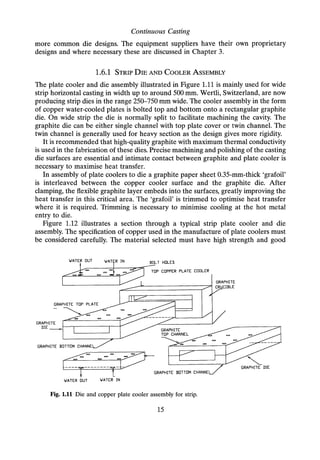
The plate cooler and die assembly illustrated in Figure 1.11 is mainly used for wide
strip horizontal casting in width up to around 500 mm. Wertli, Switzerland, are now
producing strip dies in the range 250-750 mm wide. The cooler assembly in the form
of copper water-cooled plates is bolted top and bottom onto a rectangular graphite
die. On wide strip the die is normally split to facilitate machining the cavity. The
graphite die can be either single channel with top plate cover or twin channel. The
twin channel is generally used for heavy section as the design gives more rigidity.
It is recommended that high-quality graphite with maximum thermal conductivity
is used in the fabrication of these dies. Precise machining and polishing of the casting
die surfaces are essential and intimate contact between graphite and plate cooler is
necessary to maximise heat transfer.
In assembly of plate coolers to die a graphite paper sheet 0.35-mm-thick 'grafoil'
is interleaved between the copper cooler surface and the graphite die. After
clamping, the flexible graphite layer embeds into the surfaces, greatly improving the
heat transfer in this critical area. The 'grafoil' is trimmed to optimise heat transfer
where it is required. Trimming is necessary to minimise cooling at the hot metal
entry to die.
Figure 1.12 illustrates a section through a typical strip plate cooler and die
assembly. The specification of copper used in the manufacture of plate coolers must
be considered carefully. The material selected must have high strength and good
WATER OUT WATr IN BOL THOLES
d~ ~
~
::
~~P COPPER PLATE COOLER
I l~ I GRAPHITE
CRUCIBLE
GRAPHITE
DIE __
~~ ~/
c::. c::. c::.
l---~ ----=-- ~l
1 GRAPHITE BOTTOM CHANNEL
WATER OUT WATER IN
Fig. 1.11 Die and copper plate cooler assembly for strip.
15
Continuous casting of Copper-Based Alloys and Precious Metals
STARTER
STRIP
PRIMARY METAL STRIP SLAVE METAL STRIP
Fig. 1.12 Section through strip plate cooler and die assembly.
thermal conductivity. Manufacturers of casting equipment generally have their own
proprietary specification. The material is either CuAg or CuCrZr. The copper cooler
plates are ground flat to ensure mating with the ground graphite surface. It is
essential that as close to 1000/0 copper-graphite contact is achieved otherwise heat
transfer will be drastically impaired.
1.6.1.1 Nitrogen Protection Within the ~ir Gap'
As illustrated in Figure 1.12, nitrogen protection within the 'air gap' is provided. It
is recommended this is used in all continuous casting die construction. At or close
to the solidification front the ingot shrinks away from the die forming the 'air gap'.
This should be protected with a light flow of nitrogen otherwise oxidation and
erosion of the graphite occur with time. There is some movement of the solidification
front, back or forward during a casting run. The solidification front oscillates about
a mean position and increase in speed or variation of the pulse length will alter this;
any deterioration of the die surface due to oxidation/erosion will seriously impair
the surface cast quality. Nitrogen itself does not appreciably alter heat transfer
characteristics within the 'air gap'.
It should be noted when using nitrogen feed to this position, the gas must be just
sufficient to give protection from oxidation. Too great a flow or pressure can cause
periodic 'break through' on the newly formed solidified skin resulting in 'gouge
marks' on the cast surface.
16
Continuous Casting
1.6.1.2 Outward Taper on Top Face of Die
When casting wide strip it is accepted practice to include an outward taper, around
0.001 in. per inch. This greatly assists casting conditions, prevents sticking and has no
adverse effect on quality. In certain alloy systems, such as casting 80:20 Au:Sn
eutectic alloy, an outward taper is essential.
1.6.1.3 Fitting Starter Strip
Ideally the starter strip should have the same composition as the metal being cast,
but for economic reasons, such as in precious metals, the starter strip is made shorter
than the die and attached as illustrated in Figure 1.12 to a mild steel slave strip. This
method applies to any alloy system. The primary metal strip is carefully machined
and polish finished with dimensions precisely to suit the hot end die cavity making
allowance for thermal expansion, the die having correction for solidification
shrinkage. The slave strip is carefully machine finished with no sharp edges to
damage the die. The composite starter will have the same overall dimension to
facilitate uniform take-up through the withdrawal rolls. Special techniques applied
to precious metal casting are discussed in Chapter 6.
1.6.2 JACKET-COOLED DIE USED FOR ROD OR BILLET CASTING
The jacket-cooled die is possibly one of the most used in continuous casting. The die
and cooler illustrated in Figure 1.13 is typical of the assembly used to cast rod and
narrow strip. In this case the heat is extracted radially and axially from the billet. The
CRUCIBLE
<, DIE
THERMO COUPLE/
DIE NITROGEN
GRAPHITE PLUG
~::::::::::::::::::- STEEL
STARTER
GOLD
STARTER
~ STEEL
~ SLAVE ROD
Fig. 1.13 Horizontal jacket-cooled die assembly for rod and narrow strip.
17
Continuous casting of Copper-Based Alloys and Precious Metals
steel water-jacket must be machined to ensure a tight fit with intimate interface
contact with the graphite die. On assembly the cooler is carefully lap fitted onto the
graphite, ensuring that the interface contact is as near to 1000/0 as possible. The die
has provision for search thermo-couple and nitrogen protection to the casting bore.
The design of starter bar is illustrated. For example, if this die is used for casting gold
alloy rod, two methods for starter rod construction apply: (1) graphite plug and steel
starter rod. The plug which must be tight fitting, is pushed out of position into the
crucible prior to start-up. The gold alloy flows into the cavity and freezes on to the
threaded steel rod; there is no alloying at the low temperature of the steel rod.
Casting is started in the normal way; (2) short gold alloy starter rod is machined to
fit with threaded steel rod attached. Located at a suitable position relative to the
cooler, the 'hot end' of the starter melts, while still leaving the starter/steel slave bar
intact. This procedure can apply to any metal alloy system.
1.6.3 PROBE COOLED DIE FOR ROD AND NARROW STRIP CASTING
As illustrated in Figure 1.14, cooling of the graphite die is by means of metal tube
water-coolers fabricated in copper or stainless steel; this system is covered by
patents." The tubes are positioned peripherally for rod casting and top and bottom
for strip casting. The coolers are located in carefully broached holes, thus cooling is
integral with the graphite die body and is a combination of radial and axial.
In horizontal continuous casting there is usually some degree of asymmetry in
cooling due to gravitational effect ensuring better thermal contact on the bottom
SIX INTEGRAL PROBES
COPPER COOLING PROBE
Fig. 1.14 Probe-cooled graphite die assembly.
18
Continuous Casting
RET AINING BOLTS GRAPHITE TOP DIE COVER
FEED SUMP AT HOT END OF DIE
CODLING PROBES
Fig. 1.15 Probe-cooled graphite die for thin strip.
surface of the die metal interface This results in solidification of the bottom in
advance of the top resulting in an asymmetric condition. Using the adjustable probe
coolers it is possible to enhance cooling and solidification at the top surface and thus
alter the slope of the surface solidification isotherm. It will also be noted that the
position of the solidification front can be adjusted to any predetermined position
along the bore.
In narrow strip casting adjustment to the cooling pattern by careful probe
positioning has a marked effect on casting quality and can in many cases eradicate
tendency to edge cracking.
1.6.3.1 Probe or Plate Cooled Die for Narrow Strip
As illustrated in Figure 1.15, a plate die used for thin narrow strip is cooled either
by probes positioned centrally top and bottom or by copper alloy plate coolers. The
die is machined with positive outward taper of 0.001 in. per inch and with metal
reservoir at hot entry to act as a 'heat sink' to prevent freeze back on the thin
section. This design of die is frequently used in precious metal alloy casting including
dental alloys. In this case for thin narrow strip integral probe-cooled dies are much
more versatile.
1.6.4 DIES USED IN CONTINUOUS CASTING OF TUBE
The continuous casting of tube is similar to casting rod or billet with the essential
difference that a mandrel is incorporated into the die system in order that the tube
bore may be formed.
The conventional tube die as illustrated in Figure 1.16 is a cylindrical graphite die
with water jacket cooler fitted on machine-tapered outer surface. Equipment
19
Continuous casting of Copper-Based Alloys and Precious Metals
COOLER
CRUCIBLE
L
GRAPHITE MANDREL
SHO~ING FEED CHANNELS SOLIDIFICATION FRONT
TOP end BOTTOM
TAPERED MANDREL
Fig. 1.16 Jacket-cooled die assembly for tube.
manufacturers have their own proprietary designs but essentially the basic principle
is the same throughout.
The method of securing the mandrel into the die body can be either by screwing
it into the head of the die or by push fit and doweling in position. Both methods,
properly carried out, will ensure centralisation of the mandrel relative to the die
bore.
The graphite die assembly illustrated in Figure 1.17 is cylindrical with integral
metal tube water coolers positioned peripherally around the central bore. The
tapered mandrel is fitted as in Figure 1.16. Both dies can be operated in the
horizontal or vertical mode. The jacket-cooled die is used extensively for casting
hollow billet to any particular size, the billet dimension being dictated by the furnace
capacity and product requirement.
A detailed description of tube casting is given under precious metals Section 6.14.
The principle is the same for any tube or hollow section casting. In the case of
continuous casting larger billet or hollow section the jacket-cooled die, as illustrated
in Figure 1.16, would be used. In most cases it is desirable to cast heavy section tube
in the horizontal mode although vertical casting has the advantage of solidification
isotherm symmetry; withdrawal of a massive billet vertically requires complex
engineering to ensure adequate control.
1.6.5 HIGH-EFFICIENCY COOLER ApPLIED TO SMALL-DIAMETER ROD
This cooler and die assembly is a proprietary design?" introduced for casting small
sections and can achieve relatively high cooling rates.
Cooler and die assembly illustrated in Figure 1.18 consists of a graphite mould or
insert firmly pressed into a triple-walled copper cooler jacket. Water circulates along
the inner annulus to the exit. Primary cooling of the liquid metal entering the die is
20
Continuous Casting
LIQUID METAL
GRAPHITE DIE
LIaUID MET AL
SOLIDIFICATION FRONT
LOCATION OF BOTTOM PROBES
HORIZONTAL CASTING
PERIPHERAL COOLED DIE
VERTICAL CASTING
Fig. 1.17 Probe-cooled die assembly for tube.
by conduction across graphite die wall/copper tube interface. Secondary cooling is
provided by graphite guide inserts along the length of the assembly. Insulation in the
form of alumina silicate or zirconia discs fitted between the copper cooler 'hot end'
and the graphite die shoulder reduces the cooling effect on the liquid metal entering
the die. The die can also be machined with a 'liquid metal sump' or reservoir to act
as a 'heat sink' preventing freeze back on small section rod or strip.
Production casting with this cooler design has shown that rod down to 1.5 mm
diameter and strip 10 mm wide X 2 mm thick can be cast at speeds well in excess of
1 metre per minute. A number of the continuous casting plant manufacturers are
supplying die and cooler assemblies of similar design. Thermal efficiency is discussed
in Chapter 2.
1.7 WITHDRAWAL
In continuous casting of non-ferrous metals, accuracy of the withdrawal parameters
is paramount to the quality of the cast product. In the multiplicity of casting
machines, from micro-scale equipment applied to small section sizes to fairly massive
21
Continuous casting of Copper-Based Alloys and Precious Metals
Liquid Metal
Graphite Sleeve
Seeo n d a ry _C_o_o I_e
r-+Hrt---~
u........u--1...L......Jf:a!-~-J..L.-U
** NOTE-
CONSTRUCTION
SIMILAR FOR ROD
Fig. 1.18 Die and cooler assembly for small-diameter rod. (Courtesy Rautomead
International Dundee.)
TIME
t1 acceleration
t2 pull
1 t3 deceleration
E
E t4 dwell
c-
o 15push back
.~
Q) ts overowell
Q)
o
T = t1+t2+t3
o
-c
Time, seconds
Fig. 1.19 Withdrawal sequence.
extracting gear required to achieve displacement forces in the range 50 to 100 kN,
it is necessary to ensure precise control under any operating conditions.
The pulsed extraction as indicated in Figure 1.19 is common to all systems and is
explained in Table 1.1.
Conventional electric drive using a servo motor with bevel, spur or worm gears
is used to drive withdrawal rolls opposed by pinch rolls which can be either spring
22
Continuous Casting
Table 1.1 Withdrawal sequence.
Control Function
t1 - acceleration
t2 - pull time
t3 - deceleration
T - total time
P - pulse length
t; - dwell
t5 - push back
t5 - p/back cycles
t6 - over dwell
t6 - o/dwe cycles
is the time from rest to reach full motor speed
is the time taken to cover a pre-set pulse length (P)
is the time from the end of the pulse plateau to rest and is same as t,
represents the time t, + t2 + t3 which is the total time for 1 pulse displacement
is the length in mm travelled in time (1) and is variable
is the dwell period between cycles.
is the time taken to cover a pre-set push back pulse period
is the number of cycles between push back
covers a periodic superimposed dwell
is the number of cycles between overdwell
The function controls listed cover the main casting parameters in the average servo drive control.
The time cycle is controlled in ms, the pulse distance in mm generally with accuracy of ± 0.10 mm.
Proprietary microprocess control systems are discussed under individual casting equipment suppliers in
Chapter 3.
loaded or actuated by hydraulic press-down cylinders. For heavy strip and billet
production this generally works fairly well. Backlash and system inertia can render
the system inaccurate and in most proprietary equipment has been replaced.
1.7.1 AC SERVO DRIVE
Using micro-process control with AC servo drive and backlash-free gearing between
drive motor and rollers, a high degree of accuracy is obtained. Maintaining a tight
grip on the strip, rod or section is achieved by hydraulic clamping. Proprietary
withdrawal systems have modular pre-set controls on all parameters with correction
feedback on items such as acceleration, pulse length setting and linear casting
speed.
1.7.2 WITHDRAWAL USING CAM-OPERATED INDEXING
The cam-operated indexing withdrawal systems produce controlled output
acceleration/deceleration. They are designed with the output and input shafts
integral, making the output rotation a strict function of the input rotation
determined by the shape of the cam profile. The cam is designed to have the
required index time, dwell time and number of stations and to meet the
requirements of dynamic loading, static loading, rigidity and accuracy.
The indexing cycle consists of a sequence of indexing and dwell periods. In a
typical application the unit driven by an AC variable-speed motor gives maximum
indexes (pulses) of I ODD/minute, representing a casting speed of 4 metres/minute
with an index length of 4 mm. The index period, representing the pull motion, is that
23
Continuous casting of Copper-Based Alloys and Precious Metals
part of a 3600
cycle during which rotation of the input shaft (cam) produces motion
of the output shaft from one dwell position to the next.
This system produces precise and repeatable pulse lengths (pull strokes) over
long periods of operation. The pulse length is pre-set and governed by cam profile.
The casting speed is infinitely variable up to the maximum motor speed and gearing
of the system.
1.7.3 WITHDRAWAL USING PNEUMATIC SLIDE FEED
There are a number of pneumatic slide feed units suitable for incorporating into
withdrawal systems in either vertical or horizontal continuous casting for strip, rod
or profile section. The feed distance (pulse length), feed speed and on/off times are
adjusted within close limits with good reproducibility. The characteristics of a
proprietary unit operating on small-diameter rod in the range 1.5 mm to 5 mm
diameter or strip 6 mm to 10 mm width X 1.5 mm thick are as follows:
• pressure range
• feed force at 6 bar
• clamping force at 6 bar
• feed length
• feed precision
• slide traverse speed
4 to 8 bar
180N
350N
20 mm (infinitely variable)
±0.08mm
adjustable with air pressure and damping
(typical 25 ms over 5 mm travel)
1.8 CASTING PRACTICE
In conventional non-ferrous metals continuous casting practice, with the exception
of the proprietary 'wheel casting machines', irrespective of furnace construction or
mode of casting, graphite dies are universally used, except where the alloy is
aggressive to graphite; then special procedures apply. It is appropriate to commence
our 'hands on' exercise with detailed study of die and cooler put together and fit to
the casting crucible.
1.8.1 GRAPHITE CASTING DIE
As discussed earlier in this section, the variation in design of casting dies is extensive,
from the large dies for billet, hollow section, or strip casting, to the small die inserts
used when casting, for example, 1.S-mm-diameter rod. The essential features of the
die are:
(1) Graphite used must be of a grade to suit the specific application.
(2) Precise machining to meet dimension requirements of the cast product.
24
Continuous Casting
(3) Machine finish on the casting surface is of paramount importance.
(4) On strip dies ground finish is necessary.
(5) Equally important is die sealing interface with crucible.
(6) Interface contact between graphite die and cooler.
Graphite properties and grade selection are covered in Chapter 4. Standard good
engineering machine shop practice applies to die-grade graphite. The material has
excellent machining properties and capable of taking a mirror finish on the critical
surfaces.
1.8.2 ASSEMBLY OF GRAPHITE DIE AND COOLER-JACKET TYPE COOLER
Referring to Figure 1.20, which is the die and cooler assembly illustrated in Figure
1.9 and same type as in Figure 1.13, the salient points in the final finish and
put-together are as follows:
(1) Die and cooler surface finish
The graphite die is finish machined with lapped finish on the mating surfaces with
cooler.
(2) Die bore
The die bores are fine machine finished to size making, a dimension correction
allowance for solidification shrinkage and thermal contraction on the metal or
HFIBREFAX" INSULATION
f~~~:=~=:=~=~=~~~
COOLER CONTACT ~ITH DIE
THERMOCOUPLE & N2 PROTECTION ~~~~~~~~~~~~~~~~
~r-~~~~~~~~~~~~~~~~/
I~----------~
-------------
--------------
----------------
h ~
---------- -- --
Fig. 1.20 Jacket cooler and die assembly.
25
Continuous casting of Copper-Based Alloys and Precious Metals
alloy being cast. As a guide, allowances to be made for solidification shrinkage
and thermal contraction are given in Appendix 2. In the die illustrated in Figure
1.20 there are twin bores within a single cooler. It is quite common to have this
in industrial practice and in some cases four rods are cast on a single cooler
assembly. This is not considered 'good casting practice' from the heat transfer
aspect although a number of industrial casting establishments adopt this method,
producing an acceptable product. Heat transfer aspects of this design are discussed
in Chapter 2.
(3) Nitrogen protection to die
As illustrated in sketch, nitrogen protection to the casting bores must always be
provided. If we consider, for example, casting a 25.4 mm (1 inch) diameter copper
rod the shrinkage on solidification is around 0.53 mm; therefore we have an 'air gap'
extending from the solidification front at 1083°C to the exit of the die. If this area
is not protected severe oxidation will occur in time, resulting in poor finish on the
cast ingot and premature failure. Use high-purity nitrogen with low flow rate,
possibly around 1 to 2 litres/min.
(4) Die thermocouple
Provision is made for at least one search thermocouple with bore extending along
length of die. Die temperature monitoring is necessary and die search recommended
as a data-logging exercise. Three thermocouples inserted within a single bore will
provide a suitable data record. Type K thermocouples are used having stainless steel
sheaths in sizes from 1.5 mm diameter, operating to lOOO°Cand to 1200°C for short
periods.
(5) Finish on cooler surfaces
The cooler is manufactured with a taper to match the die. On assembly careful
lapping on both cooler metal and graphite die surfaces is essential to ensure good
contact and limit the heat transfer barrier effect between die and cooler. The large
jacket coolers are normally made in mild steel.
(6) Insulation on cooler outer surfaces
The outside surfaces of the cooler are insulated using a refractory such as alumina
silicate sheet 'trade name fiberfax'. Referring to Figure 1.9, it will be noted that in
the normal furnace assembly the die and cooler are contained within the furnace
casing, therefore adequate insulation is essential to limit heat losses from the
furnace.
(7) 'Grafoil sealing gasket'
A 'grafoil' sealing gasket is fitted between die hot end face and the crucible die seal
face. In aligning the die and cooler assembly and fitting into the crucible seal, great
care must be taken to ensure good contact with no snagging of the sealing gasket.
This stage of assembly on a production plant is most important. Any liquid metal
26
Continuous Casting
leak from this joint invariably can only be corrected by stripdown and re-assembly.
Details of 'grafoil' flexible graphite sealing material are given in Chapter 4.
(8) Die thrust support
In the assembly, Figure 1.9, the horizontal die is thrust onto the crucible which in
turn is supported by a reciprocal thrust plate at the back of the crucible. This system
of clamping die assembly to crucible is common to all casting furnaces.
1.8.2.1 Fitting Starter Rods
In preparation and fitting starter rods to a new die assembly a standard procedure
should be followed. The starter rod is generally fabricated in the same material as
the continuous cast product. The starter is machined over a length slightly longer
than the die and keyed at the exit end to take a slave rod which will extend through
the withdrawal rolls. The starter should be fine machined with a polish lapped finish
over the die length. Coat the 'hot end' of the starter with 'graphite DAG' (a liquid
suspension containing graphite powder), mark the length of the die on the starter
bar to give a datum line for start-up. The dimensions must allow for the thermal
expansion on the specific metal or alloy which will occur at the hot end of the die.
It is important that the starter is a 'snug fit' but not too tight otherwise splitting
of the die will occur. If the starter is a loose 'sloppy fit' liquid metal can run down
and freeze between die and starter, resulting in scoring and damage to the die
cavity.
1.8.3 FITIING STARTER STRIP TO GRAPHITE DIE AND
COOLER-STRIP- TYPE COOLER
The assembly of the average strip die and cooler is discussed in Section 1.6.1. The
starter strip is generally fabricated in the same material as the cast product. The
starter is machined over the die length, ensuring a smooth finish.
On strip, especially wide strip, damage to the bottom graphite surface in the
region of the solidification area is extremely critical, with indentations in this area
causing 'galling or seizing up' on the cast strip and surface tearing.
The starter strip, which is generally keyed onto a slave strip, should be supported
beyond the exit of the die. Care must be taken to radius the edges and make
adjustment for thermal expansion close to the hot end of the die. The die dimensions
will take into consideration solidification shrinkage. The polished end of the starter
strip should be coated with 'graphite DAG' and the die length marked to give a
datum line for start-up. With the starter strip in the withdrawal unit, align the
withdrawal unit with respect to the casting die. Adjust the height of the bottom roll
as required. (Note - Extreme care must be taken when handling starter strip to avoid
damage to die surfaces. The widest strip (700 mm) can approach 100 kg/metre in
weight.)
27
Continuous casting of Copper-Based Alloys and Precious Metals
COPPER 01E COOLER
GRAPHITE DIE INSERT
I::::::;;j
I
GRAPHITE PACKER (SECONDARY COOLER)
Fig. 1.21 Graphite die insert and copper jacket cooler.
1.8.4 ASSEMBLY OF DIE INSERT TO HIGH-SPEED COOLER FOR
SMALL-DIAMETER ROD
In fitting the graphite die insert into the copper jacket cooler (assembly shown in
Section 1.6.5, Figure 1.18), to effect maximum cooling it is necessary to ensure
intimate contact, copper-graphite.
The graphite die insert illustrated in Figure 1.21 is machined and broached on the ID
to give a 'mirror finish'. The OD die shank is machined slightly oversize to the cooler
bore to allow final emery lap finish to size. The packers which make up the secondary
cooler section are machined to give a tight fit with bore size matching the die insert. The
cooler is heated with hot water prior to packer and die insert fitting to allow expansion
and ease of fit. The packing spacers are fitted and positioned to the correct datum line,
followed by the die, which should be a tight fit into hot copper cooler; this ensures an
intimate graphite-copper contact. The die insert is fitted with the appropriate 'fiberfax'
(alumina silicate) insulation washers on the shoulder to reduce the heat flow between
graphite die head and copper cooler face.
1.9 SAFETY FROM LIQUID METAL RUNOUT
In continuous casting in either horizontal or vertical mode there is always the danger
of molten metal runout from the die exit face.
28
Continuous Casting
With good engineering practice in equipment design and meticulous attention to
operating procedure this should never occur; however, malfunction cannot be ruled
out - therefore consideration of possible causes should be examined.
1.9.1 FAILURE OF COOLING WATER SUPPLY
In dealing with furnace services, it is mandatory that adequate alternative water
supply is fitted to ensure that all water requirements are covered from a second
source in the event of failure of the primary source.
Water is generally supplied to all services on the equipment by a closed circuit
recycling system incorporating water cooling and treatment. (Cooling water
specification is given in Appendix 3.) The alternative supply to satisfy requirements
in the case of failure of the primary source is an automatic switch over to a second
supply which can be from a static header tank or changeover to water recycling with
back-up electric pump supply. It is obvious that failure to provide a reliable
alternative water supply will seriously endanger operating personnel and can result
in serious damage to equipment.
1.9.2 BREAK IN CONTINUOUS CAST BILLET WITHIN DIE
The most likely cause of molten metal runout from the die is a break within the die
of rod, strip or tube. When a break occurs this is inevitably just beyond the
solidification front leaving a 'hot solid plug of metal' in the die. As illustrated in
Figure 1.22, this is a very precarious state and if not attended to would invariably
melt out in time.
Temperature monitoring of the die casting cavity is recommended, and provision
should always be made for this in any installation. Thermocouples positioned along
the length of the die close to the casting cavity and positioned at three locations give
adequate coverage. In most applications chrome/chrome-alumel (Type K) thermo-
couples are used. These are sheathed in stainless steel and supplied in suitable
lengths and diameter, generally 1.5 to 2 mm. The couples are relatively inexpensive
and therefore can be tested and replaced as required.
Monitoring on all thermocouples in the system is generally provided and listed on
a temperature recorder. In many installations today the temperature profiling is fed
into data-logging equipment.
1.9.2.1 Die TemperaturelWithdrawal Interruption
As illustrated in Figure 1.22, during casting under steady-state conditions a uniform
temperature plateau will be maintained, increasing or dropping only with speed of
casting. A sudden break in the continuous cast billet will result in an instant drop in
temperature recorded on thermocouples (Tl, T2, T3). At this point the solidified
29
Continuous casting of Copper-Based Alloys and Precious Metals
DIE
DIE TEMPERATURE PROFILE
Fig. 1.22 Die temperature withdrawal interlock control.
section is still within the die cavity being extracted towards the exit. By simple
circuitry the withdrawal can be stopped leaving the equipment 'safe from metal run
out'. Corrective action can then be taken to diagnose the fault and re-start.
When re-starting it is recommended that temperatures at Tl and T2 are
sufficiently low to ensure 'freeze back' prior to removal of the broken section. It is
necessary then to re-polish before re-inserting otherwise damage to the graphite
cavity will occur.
1.9.2.2 Incorporating Safety Plunger at Die Exit
A useful addition to 'rod break' safety is provided by incorporating a 'spring- or
pressure-loaded plunger' at the die exit. This consists of a steel strip or metal section
lightly loaded onto the edge of the cast strip or surface of the rod. If a break occurs
and the broken section is withdrawn beyond the die exit the steel plunger is
activated, closing the die exit.
1.10 TROUBLE-SHOOTING
In continuous casting, as in all production processes, abnormal conditions or
deviation from the norm are frequently encountered and in many cases are easily
corrected. In this section an attempt is made to highlight the more common
problems and where possible suggest remedies.
30
Continuous Casting
1.10.1 IRREGULAR PULSE LENGTH
This condition is invariably due to slip on the withdrawal rolls or a variation in the
load exerted on the runout track beyond the rolls. It may also be due to a
malfunction in the withdrawal micro-process control although this latter condition
would be noted in the withdrawal data logging. This condition will seriously affect
surface quality and in severe cases cause fissures and ultimate fracture. Noting the
condition and early corrective action are essential.
When designing withdrawal equipment the total torque requirement is a critical
factor. The displacement over a given pulse length in time and distance must remain
constant independent of the increasing load as the mass of ingot beyond the
withdrawal rolls increases.
Strip casting plants requiring high traction forces to counteract in-line forces
caused by runout track resistance, milling equipment, travelling shear, coiler and die
resistance, use hydraulic amplified drives to achieve the forces required. Such
machines are built to perform within ±O.l mm of any pulse length setting.
1.10.2 CAST SURFACE FINISH - DETERIORATION WITH TIME
Surface finish on rod, strip or tube will deteriorate with time. On starting a casting
run, once the correct conditions of pulse length and casting speed have stabilised,
an optimum surface finish will be achieved and should be maintained over a
prolonged casting period. Referring to Figure 1.23 depicting conditions within the
~
T
STEADY
STATE
CONDITIONS
UNINTERUPTED CASTING PERIODIC INTERUPTED CASTING
Fig. 1.23 Conditions within solidification zone of die.
31
Continuous casting of Copper-Based Alloys and Precious Metals
solidification zone of the die, certain criteria have to be met to give a satisfactory
product.
• temperature within die ideally should be held within ±2°C of setting once stable
equilibrium has been reached;
• steady-state thermal conditions are achieved oscillating about a mean point;
• casting should be uninterrupted if possible, employing coiling for small-diameter
rod or travelling shear or saw for strip;
• interruption causes 'freeze back' at the solidification front increasing die wear;
• pulse length once set should remain constant;
• 'push back' and/or 'over-dwell' should be used only on specific alloys.
Once casting parameters have been established there is no wear on the die
surfaces inboard of the solidification front as the graphite is simply immersed in
liquid metal. When die surfaces start to wear in the solidification zone some
deterioration of surface finish will be noted. This can be corrected by slow-down in
casting speed, causing the solidification zone to move back into the undamaged
section of the die. This adjustment can be repeated until such time as the casting
output proves uneconomical.
1.10.3 INVERSE SEGREGATION
This is manifest by low melting constituent segregation at the 'pause marks' and
found on alloy systems with wide liquidus/solidus region such as in the tin bronzes.
It occurs when a constituent such as tin, having a much lower melting-point than that
of the primary crystals, separates out on freezing causing 'sweating'. In severe cases
the build-up causes intermittent pulse cracking or fissuring.
Introduction of periodic extended pause or 'overdwell' such as 5-second pause in
50 pulses can correct this. Periodic 'push-back' can also be introduced to clear the
die interface but should only be introduced as a last resort as this technique reduces
die life; 'push-back' is not possible on tapered strip die or on tube casting.
Experimentation is necessary to determine which method is appropriate. Ef-
ficiency of die cooling can also be a contributory factor. In horizontal casting the
sloping solidification isotherm accentuates this condition. Modification to cooler
design as discussed in Chapter 2 can improve conditions.
1.10.4 PULSE CRACKING
This must be examined carefully, if possible by metallographic study, as the cause can
frequently be symptomatic of casting conditions:
Rod - On small-diameter rod cooling rate coupled with the rate of metal
displacement into the die/cooler is critical. A slow acceleration/deceleration - pull
cycle t1+ t2+ t3- tends to produce pulse cracking and limit casting speed.
32
Continuous Casting
Strip - Similar condition is apparent on strip associated with cooling rate -
adjustment in cooling pattern can correct this condition.
Metallographic examination will indicate if crack formation is associated with
phase pattern or exudation such as tin-rich segregation in tin bronzes. In brasses
excessive zinc-rich phase build-up on worn die can cause this condition. When worn
die is the cause, refurbishment is required.
1.10.5 POROSITY
This condition is infrequently noted in continuous casting and when apparent is
invariably due to out-gassing. This is found in silver alloys where insufficient time
has been allowed for deoxidation of the melt.
1.10.6 PERIODIC SURFACE GOUGING
This condition in casting strip where a surface 'gouge' appears at periodic intervals,
is invariably caused by pressure build-up on the solidification front due to excess
nitrogen or argon flow into the 'air gap' which periodically breaks through.
Reduction of gas flow will correct this condition.
1.10.7 ZINC SEGREGATION ON BRASSES
This condition is discussed in detail in Section 5.7.6. It is apparent on all Cu-Zn
alloys increasing in amount with increase in zinc content. On the free machining
brasses, Cu-Zn-Pb, it is quite pronounced, appearing in a 'periodistic pattern' due to
the build-up of zinc condensing in the die and periodic absorption into the brass
surface. It increases in severity on a worn die and can be corrected by refurbishment
of the graphite die, or it can be minimised by reduction in casting speed, causing the
solidification zone to move back into an unused part of the die. Stepping the die bore
outboard of the solidification front can minimise effect; this is discussed in Section
5.7.6.
1.10.8 EDGE CRACKING ON STRIP
In most cases edge cracking appearing on strip can be attributed to cooling. The strip
die copper alloy plate coolers are fitted onto the graphite die halves interleaved with
a sheet of graphite foil 'grafoil'. The foil is trimmed to give the optimum heat
transfer conditions depending on the strip dimensions and alloy being cast.
The die and cooler assembly is discussed in Section 1.6.1. The edge cooling
33
Continuous casting of Copper-Based Alloys and Precious Metals
conditions can be altered by modification to the copper/grafoil/graphite contact area.
On large strip edge cooling plates are also fitted. The use of probe-cooled dies makes
it possible to adjust cooling to correct the condition of edge cracking; these dies
however are only suitable for narrow strip.
1.10.9 HEAT BALANCE CHECKS
It is recommended that heat balance checks be made to ensure consistent die cooling
characteristics are maintained; the procedure is outlined in Chapter 2. In casting
runs lasting days or in some cases weeks of continuous operation these checks are
necessary at least on a daily basis.
The overall heat balance monitored periodically gives a very good indication that
Check Details
Casting speed
and pulse length
Solidification zone
Die temperature profile
Water flow wf I/min
Water temperature °C
SHMIST quantity of
heat derived from metal
SHWIST quantity of
heat taken up by
cooling water
Overall heat balance
Check manually - generally monitored and data logged
Check by stopping withdrawal for say 20 seconds and positioning
solidification isotherm relative to the die exit point - see Figure 1.23
Die temperature profile checked as outlined in Section 2.4
Water flow to be checked on each die - generally monitored and data logged
Water temperature (in) and (out) from each die
Determined from properties of the material as outlined in Section 2.6
Determined from water flow and temperature data as outlined in Section 2.6
The overall heat balance is determined for strip casting as illustrated in
example given for silver strip Section 2.6.1, Table 2.1
Note. This procedure can be incorporated into computer data logging
the casting operation is running smoothly. The quantity of heat derived from the
metal will closely match that taken up by the water and any major fluctuation will
indicate a change which if allowed to continue will affect quality of product. For
example, silting up on the water flow to the die cooler reducing water flow will alter
heat balance. Die temperature profile, together with check on the solidification
isotherms, gives a useful guide to performance.
REFERENCES
1. H. BESSEMER: UK Patents 11,317 (1846), 11,212 (1857).
2. G. E. SELLERS: US Patent 1908 (1840).
3. 1. LAIGN: US Patent 3023 (1843).
34
Continuous Casting
4. A. H. PEHRSON:
US Patent 1,088,171 (1914).
5. B. E. ELDRED:
US Patent 1,868,099 (1932).
6. POLAND
and LINDNER:
US Patent 2,136,394 (1938).
7. A. KRElLet al.: 'Asarco Process' Met. Reviews, Inst. of Metals, 1960, 5, 413-446.
8. A. KRElLet al.: 'Flo cast Process' Met. Reviews, Inst. of Metals, 1960, 5, 413-446.
9. E. C. ELLWOOD:
1of Inst. of Metals, 1955-56, 84, 319-326.
10. Properzi Process: Met. Reviews, Inst. of Metals, 1961, 6(22).
11. SOUTHWIRE:
'Southwire Revolutionises Non-Ferrous Rod Production with SCR System' 33
Magazine, June 1975.
12. Hazelett Process: Iron and Steel Eng., 1966 43(6), 105.
13. WERTLI:
Alfred Wertli AG, Winterthur, Switzerland.
14. Technica Guss: Wurzburg, West Germany
15. I. E. EWEN:United Wire Unicast Process, UK Patents 894,783, 894,784, 934,484.
16. M. RANTANEN:
Outokumpu, 'Upward Continuous Cast of Copper Wire', Wire Industry, July
1976.
17. Rautomead International: Dundee, Scotland.
18. R. WILSON:
Pressure Upcast, UK GB 2,236,498B (1992) US 5,090,471 (1992).
19. R. WILSON: Assigned to Timex Patents on Probe Die Cooling, US 4,298,516 1981, UK
203,421B 1982.
20. High-Speed Cooler for small-diameter rod, developed by Rautomead International,
Dundee.
35
2
Heat Transfer
Heat transfer and solidification behaviour in continuous casting of non-ferrous
metals, by applying water-cooled graphite moulds, has been studied by various
authors including Thomson/ Hadden,2 Mojab3
and Wilson.4 Mathematical model-
ling applied to monitoring and control of the casting process has been expanded on
by Indyk and Wilson.' Three-dimensional models, simulating various operating
conditions, are now being adopted by a number of equipment manufacturers to
study die and cooler design on the basis of the finite element method. However, this
section will deal only with practical aspects of the subject.
2.1 MODE OF HEAT TRANSFER ALONG THE MOULD
Figure 2.1 indicates that the metal-mould heat transfer can be roughly divided into
three sections. The top section (A-B), with the heat transfer coefficient between the
liquid metal and the graphite mould, is denoted by hI. The interfacial contact is good
in this area. Another advantage is that the temperature difference is high between
the two media and so the heat transfer rate is fairly high. Lower down the mould,
at point B, as the temperature falls below the liquidus, solidification begins at the
mould surface. Due to the latent heat (an additional source), h, is much higher than
h.; particularly where the shell is thin and breaks every cycle. Due to the cyclic
withdrawal the solidification front oscillates around a mean position moving up and
down the hs interface. As the thin solidified skin breaks, and the gap is filled with
liquid metal, this introduces a very high temperature gradient.
Traversing h., the metal is partly liquid and partly solid and so specific heat, latent
heat and changes in thermal conductivity have to be considered in accordance with
the liquid/solid content. In this zone thermal conductivity in the metal increases due
to the change of liquid to solid. As an approximation, in most metal systems thermal
conductivity in the solid state is taken as twice that of the liquid state.
Once the solid shell has formed, the skin is weak for some distance in the
direction of withdrawal and yields under the pressure of the liquid, thus maintaining
good contact with the mould. The last region, commencing at point C, usually
referred to as the 'air gap', exhibits a much lower heat transfer rate. This is due to
the fact that the solidified ingot contracts and breaks away from the surface of the
mould. At the exit from the mould, or die point D, the ingot may retain a significant
amount of heat and in this case would be cooled by means of a 'water sparge'. In this
37
SYMMETRIC
SOLIDIFICATION
PROFILE
SOLID
GRAPHIT E DIE
HORIZONTAL
CASTING
ASSYMETRIC SOLIDIFICATION PROFILE
Fig. 2.1 Boundary heat transfer in mould.
region the coefficient of heat transfer h; increases due to efficient contact between
the coolant and the hot metal ingot.
2.1.1 THE INFLUENCE OF 'AIR GAP'
The introduction of this heat barrier, which is virtually an insulator, drastically
reduces heat flow from the solid ingot to the graphite die/water cooler. Attempts to
allow for contraction of the metal by introducing taper into the mould has never
been successful. Introduction of helium gas into the gap, thus increasing thermal
conductivity, has been tried for special applications but again without much success.
The gas is expensive, and application is difficult to engineer. It is recommended that
on all die design provision is made to introduce nitrogen into the shrinkage cavity
in order to protect the graphite from oxidation. The nitrogen does not, in itself,
improve heat transfer.
2.1.2 WATER SPRAY AT DIE EXIT
In many applications, water spray-cooling at the exit from the die can simply be to
facilitate handling of the cast product. On the other hand it can be a major
38
Heat Transfer
component in the casting operation. There are a number of mechanisms of boundary
heat transfer involved in secondary 'sparge' cooling. These include:
(1) Film transfer. Where a steady flow of water interacts with very hot metal a
vapour film forms, retarding the cooling effect significantly.
(2) Drop or bubble transfer. Where the temperature difference between the metal
and the coolant is not so high, mobile bubbles of vapour form, enabling very
rapid cooling.
In large billets and hollow section in copper-based alloys, high exit temperatures
(red heat) are sometimes encountered involving (1) film transfer. The spray jet
configuration is designed to give initial high-pressure water impingement on the
surface to break down the vapour film. This is followed by a mist air/water spray to
initiate drop or bubble transfer.
In the majority of applications, discussed in subsequent chapters, relatively low
exit temperatures are encountered. These are often no more than 200°C and, in such
cases, heat extraction is by drop or bubble transfer. It is important that the spray jet
assembly is designed to give uniform surface coverage and prevent vapour film
formation. This is important as drop or bubble heat transfer can be over an order
of magnitude higher than film heat transfer.
Since little or nothing can be done about eliminating the effect of the 'air gap'
within the die, care should be taken to design an efficient water sparge cooling
system as this will result in considerable improvement in the overall casting
efficiency.
2.1.3 VERTICAL AND HORIZONTAL CASTING
Referring to Figure 2.1, the solidification profile in vertical continuous casting is
highly symmetrical, whereas in horizontal casting there is always a degree of
asymmetry. Owing to the weight of metal, better contact is maintained on the
bottom surface of the mould in the horizontal mode. Methods of adjusting to
improve asymmetry are discussed in later sections.
2.1.4 MANIPULATION OF HEAT TRANSFER IN THE REGION h.
Casting conditions, including die and cooler design and withdrawal parameters, have
a marked effect on heat transfer within the die assembly.
2.1.4.1 Copper Sleeve Cooler Assembly for Rod Casting
Consider the copper sleeve cooler assembly as illustrated in Figure 2.2 and discussed
in Chapter 1, Section 1.6.5. This consists of a graphite die insert assembled into a
triple-walled copper cooler jacket. Water circulates along the outer annulus to the
39
Continuous casting of Copper-Based Alloys and Precious Metals
Table 2.1 Withdrawal sequence.
Control Function
t, - acceleration
t2 - pull time
t3 - deceleration
T - total time
P - pulse length
t4 - dwell
t5 - push back
t5 - push back cycles
t6 - over dwell
t6 - overdwell cycles
is the time from rest to reach full motor speed
is the time taken to cover a pre-set pulse length (P)
is the time from the end of the pulse plateau to rest and is same as t,
represents the time t, + t2 + t3 which is the total time for 1 pulse displacement
is the length in mm travelled in time (1) and is variable
is the dwell period between cycles
is the time taken to cover a pre-set push back pulse period
is the number of cycles between push back
covers a periodic of superimposed dwell
is the number of cycles between overdwell
The function controls listed cover the main casting parameters in the average servo drive control
The time cycle is controlled in ms - the pulse distance in mm generally with accuracy of :±:O.10mm -
proprietary microprocess control systems are discussed under individual casting equipment suppliers in
Chapter 3.
hot end and exits via the central bore. The die 'hot end' is insulated up to the
shoulder with alumina silicate or zirconia designed to reduce the cooling of the die
'hot face'. The versatility of the pulsed withdrawal, as outlined in Table 2.1, is
common to most continuous casting systems and enables a wide range of parameter
adjustments to be made.
2.1.4.2 Effect of Withdrawal Characteristics on Shell Formation
Consider casting a 12-mm-diameter OFHC copper rod using copper-sleeved cooler
assembly as illustrated in Figure 2.2.
If we examine the withdrawal variables the factors to be considered are:
• displacement time Tit, + t2 + t3) single stroke displacement;
• acceleration - time taken to reach full velocity tl;
• stroke length S;
• dwell time t4; and
• stroke rate - number of strokes per minute.
Rapid displacement of metal into the graphite die insert, as indicated in Series 1,
Table 2.2 and illustrated in Figure 2.2, results in a steep temperature gradient and
thick shell formation. Superheat is important and should be such that the metal
temperature entering the die insert is around 100°C above the liquidus. This is an
arbitrary figure, but superheat must be sufficient to maintain a uniform flow pattern
and avoid any tendency to freeze back at the die/cooler entry. Insulation plays a vital
part in the die/cooler construction by preventing inboard cooling and thus
maintaining temperature at the die entry port.
Table 2.2, Series 2 represents pulse characteristics under similar casting conditions
but operating at much reduced withdrawal settings. Relatively slow displacement of
40
Heat Transfer
COPPER SLEEVE COOLER ASSEMBLY STRIP COPPER PLATE COOLER ASSEMBLY
EXTREMITY or lATER COOLING
!-PULSE LENGTH-l i-PULSE LENGTH-j
SECTIONS THROUGH GRAPHITE DIE:-
1. RAPID STROKE AND HIGH ACCELERA TIoN
GIVING HIGHER TEMPERATURE GRADIENT
~ITH INCREASED dHM/dt RESULTING IN
THICKENING OF SHELL
2 REDUCED ACCELERATION AND STROKE
SPEED GIVING LOVER TEMPERATURE
GRADIENT 'JITH REDUCED dHM/dt AND
THINNER SHELL
Fig. 2.2 Schematic diagram illustrating effect of speed of displacement of liquid metal
into cooler.
Table 2.2 Withdrawal sequence.
Function Series 1 Series 2
Displacement time T(t1 + t2 + t3) ms
Acceleration t1 (velocity at t1) mm/sec
Stroke length S mm
Dwell time t, ms
Stroke rate (strokes/min)
Casting speed V m/minute
(liquidus/solidus 1083°C) 8m
44
204
5.6
250
204
1.14
ec = 8m + superheat
1180 to 1200°C
800
85
8.0
950
33
0.26
8C = em + superheat
1180 to 1200°C
metal into the graphite die insert results in a lower rate of heat transfer and a weaker
shell formation.
2.1.4.3 Mode of Freezing and Effect on Product Quality
When casting relatively small cross-section ingots, at fast speeds, the hot strength of
the shell as it forms is low. To avoid crack formation and ultimate fracture at
temperatures approaching the solidus, the magnitude of h; must be high in order to
ensure rapid shell formation - Indyk and Wilson.s
The mode of solidification under the conditions described is as follows:
• With rapid liquid metal displacement into the cooling zone, as indicated in test
Series 1, Figure 2.2, heat transfer is predominantly radial. This is confirmed in the
photo-micrographs in Figure 2.3a.
41
Continuous casting of Copper-Based Alloys and Precious Metals
Fig. 2.3a Photo-micrograph predominantly radial cooling.
Fig. 2.3b Photo-micrograph predominantly axial cooling .
• With the much reduced rate of metal displacement, and at lower casting speed as
indicated in test Series 2, Figure 2.2, a considerable degree of axial cooling is
confirmed as shown in the photo-micrograph in Figure 2.3b.
Casting under the conditions in test Series 2 produces severe surface fissuring with
ultimate rod fracture, when casting at higher speeds.
42
Heat Transfer
2.1.4.4 Upcasting of Copper Rod
The vertical upcasting technique operating on OFHC copper rod is discussed in
Chaper 5, Section 5.3. The die assembly illustrated in Figure 5.6 is of the same
general design as the copper sleeve die assembly illustrated in Figure 2.2 and is
discussed in Chapter 1, Section 1.6.5. In this case rapid acceleration/deceleration is
used, together with fast displacement of metal into the die/cooler, operating with
pulse rates of around 1000 per minute. Under these conditions casting speeds of 3
to 4 metres/minute are achieved on 12-mm-diameter rod.
2.1.4.5 Cooler Assembly Strip
In strip casting, cooling characteristics are similar to those discussed for rod casting.
High metal displacement rates into the cooling zone favour radial cooling, and
examples are given on production plants operating on wide strip. Here line masses
of up to 250 kg are accelerated over times of 0.04 seconds to a speed of 80 mm per
second. The design of plate cooler assembly is a factor which must be carefully
considered and is discussed in Section 1.6.1.
2.1.4.6 lacket- and Probe-Cooled Die Assembly
The jacket-cooled die assembly is possibly the most popular die configuration in
continuous casting and is used for larger-diameter rod, billet, tube and hollow
section. Heat transfer is a combination of axial and radial cooling and, provided the
assembly is properly fitted, as outlined in Section 1.8.2, it is efficient. Single rod is
preferred as indicated in Figure 2.4. In certain cases, multi-rod die assemblies are
MODE OF HEAT TRANSFER
HEAT TRANSFER PREDOMINANTLY AXIAL
¥~-------T-----------------------------:
,.-------.------------ ------- ---- ---.
- - - ~~;;~;:;;; ~
PROBE COOLED DIE ASSEMBLY
FOUR RODS SINGLE ROD
UNIFORM HEAT TRANSFER
JECKET COOLED DIE ASSEMBLY WITH FOUR RODS WITHIN COOLER
Fig. 2.4 Jacket- and probe-cooled die assemblies.
43
Continuous casting of Copper-Based Alloys and Precious Metals
used, and as would be expected a 'thermally turbulent' zone is created, resulting in
poor heat transfer from the inner surfaces of the rods. In horizontal casting the
resulting oval-shaped isotherm exaggerates defects such as hot tearing, and in tin
bronzes inverse segregation tends to be more pronounced on the inner surfaces.
Jacket-cooled dies are limited to slower casting speeds.
In probe-cooled dies heat transfer is predominantly axial. The design is very
versatile and now used extensively on small-section rod, tube and strip. From the
heat transfer aspect it is not highly efficient and it is limited in casting speed. Refer
to Section 1.6.3 for further details.
2.2 OVERALL ENERGY BALANCE FROM
PROPERTIES OF MATERIALS
The thermal efficiency of the operation can be assessed by determining the
enthalpies of the liquid and solid metal ingot, and the corresponding water coolant,
using these in a simple, heat balance equation. The total quantity of heat which has
to be removed from the liquid/solid metal, within the die, is composed of superheat,
latent heat, specific heats and heat contained in the solid metal due to its
temperature. There may be a certain amount of heat due to solid-phase transforma-
tions but this would be small and can be ignored.
The overall heat balance, within the die and cooler assembly, can be represented
by the heat passing in the direction of metal flow and the coolant passing in the
opposite direction. The total enthalpy of the metal can be balanced against that of
the coolant by applying the equations outlined below.
The total heat derived from the liquid/solid ingot is:
SHM SmM
---at = ---at [CI(Oc - Om) + Lc + Cs(Om - Ox)] (2.1)
The quantity SmM/St represents the weight of metal cast per unit time and is
referred to as the 'casting rate'. It is generally more convenient to use the term
'casting speed' V, which is the linear velocity of the cast ingot. This is correlated to
the casting rate by:
SmM
--=A·p·V
St
(2.2)
The heat extracted from the metal by the coolant is:
SHW SmW
-- == -- X PW(OW2 - OWl)
St St
(2.3)
pW is unity:. 8~ = wi> (OW2 - OWl)
44
Heat Transfer
Ideally the heat given up by the metal should balance the increase in enthalpy of
the cooling water.
oHM oHW
ot ot (2.4)
where:
A = area of ingot cnr'
p = density g cm-3
V = casting speed em min -1
Cl = specific heat liquid cal/g
Cs = specific heat solid cal/g
Lc = latent heat cal/g
OWl = inlet water temperature to cooler
eW2 = outlet water temperature from cooler
wf = water flow through cooler litres/min.
(Jc = temperature of metal entering die °C
Om = mean liquidus/solidus temperature °C
Ox = temperature of metal exiting die °C
Conversion: calorie ~ joule X 4.1868 - joule ~ calorie X 0.23885
2.2.1 TYPICAL HEAT BALANCE ON SELECTED CASTING RUNS
The above approach is useful in assessing the general energy balance in continuous
casting and, as most continuous casting units display the necessary data, heat
balance on a production operation is simple to apply. Tables 2.3, 2.4, 2.5 and 2.6
provide typical data.
45
Continuous casting of Copper-Based Alloys and Precious Metals
Table 2.3 Heat balance on continuous cast sterling silver strip.
Material - sterling silver Ag 92.5 wt°/o - Cu 7.5 wt°/o
Heat balance equations:
8HM 8mM
8t = Tt [C/(8c - 8m) + Lc + Cs(8m - 8x)]
8HW
:'M = wt»: (OW2 - 8W1)
(2.1)
(2.3)
Strip
120 mm width x 10 mm thick
Casting speed
Density at 20°C
Density - liquid
Latent heat (Lc)
Specific heat liquid (C~
Specific heat solid (Cs)
Water in - temperature
Water out - temperature
Water flow (wf)
Melt temperature (OC)
Mean liquidus/solidus temperature (8m)
Metal exit temperature (Ox)
Cross section area (A)
8HM
8t
8HW
8t
8HM/8HW
at MX100
120 mm/min
10.366 g/cm3
9.210 g/cm3
27.445 cal/gm
0.070 cal/gm
0.059 cal/gm
12°C
25°C
11.75 litres/min
1025°C
845°C
90°C
12 ern"
2100 cal/sec - 8792 joule
2546 cal/sec - 10,660 joule
82.5%
46
Heat Transfer
Table 2.4 Heat balance on OFHC copper rod.
Heat balance equations:
8HM 8mM
M= Bt[C/(Oc - Om) + Lc + Cs(Om - Ox)]
8HW
:.-- = wt x (OW2 - OW,)
at
(2.1)
(2.3)
Material - OFHC copper
Cu 99.99+%
Rod
Casting speed
Density at 20°C
Density - liquid
Latent heat (Lc)
Specific heat liquid (C~
Specific heat solid (Cs)
Water in - temperature
Water out - temperature
Water flow through cooler
Melt temperature (8C)
Mean liquidus/solidus temperature (Om)
Metal exit temperature (Ox)
Cross section area (A)
Mass g/sec
12 mm diameter
1.50 metres/min
8.96 g/cm3
7.95 g/cm3
49 cal/gm
0.118 cal/gm
0.092 cal/gm
16°C
33°C
15 litres/min
1220°C
1083°C
105°C
1.13 ern"
25.333
aHM
at
aHW
8t
SHM/aHW
st BtX100
3930 cal/sec - 16,454 joule
4250 cal/sec - 17,794 joule
92%
47
Continuous casting of Copper-Based Alloys and Precious Metals
Table 2.5 Heat balance on upcast copper-bismuth alloy LG equivalent
(for casting data refer to Section 5.12.3).
Heat balance equations:
aHM amM
8t = 8t[C/(Oc - Om) + Lc + Cs(Om - Ox)]
aHW
:.-- = wt »: (OW2 - OW1)
at
(2.1)
(2.3)
Material - copper-bismuth alloy
C89844 - LG2 equivalent
Nominal analyses:
Cu% 82 - Sn%, 4 - Bi%, 3 - Ni%, 2 - Zn% 9
Tube
Casting speed
Density at 20°C
Density - liquid
Latent heat (Lc)
Specific heat liquid (C~
Specific heat solid (Cs)
Water in - temperature
Water out - temperature
Water flow through cooler
Melt temperature (BC)
Mean liquidus/solidus temperature (Om)
Metal exit temperature (Ox)
Cross section area (A)
Mass g/sec
0021 mm 10 13 mm
Casting speed 630 mm/min
8.70 g/cm3
7.81 q/crn"
39.05 cal/gm
0.107 cal/gm
0.085 cal/gm
22°C
33°C
17 litres/min
1030°C
880°C
100°C
2.136 ern"
19.515
8HM
at
8HW
at
8HM/8HW
aT atX
100
2363 cal/sec - 9893 joule
3117 cal/sec - 13,050 joule
75%
48
Heat Transfer
Table 2.6 Heat balance on horizontal on palladium-silver alloy strip
(for casting data refer to Section 5.12.3).
Heat balance equations:
8HM 8mM
at = 5t[C/(8c - Om) + Lc + Cs(Om - Ox)]
8HW
:.-- = wi »: (OW2 - OW1)
8t
(2.1)
(2.3)
Material - palladium-silver alloy Nominal analyses 0/0:
Pd 55 - Ag 35 - Sn 8 - others rem.
Strip
Casting speed
Density at 20°C
Density - liquid
Latent heat (Lc)
Specific heat liquid (C~
Specific heat solid (Cs)
Water in - temperature
Water out - temperature
Water flow through cooler
Melt temperature (OC)
Mean liquidus/solidus temperature (Om)
Metal exit temperature (ex)
Cross section area (A)
Mass g/sec
10 mm x 3 mm thick
Casting speed 450 mm/min
10.88 g/cm3
9.76 g/cm3
39.14 cal/gm
0.070 cal/gm
0.057 cal/gm
18°C
32°C
3.0 litres/min
1350°C
1225°C
90°C
0.300 ern"
2.455
8HM
8t
8HW
8t
8HM/8HW
aT 5t
X100
277 cal/sec - 1159 joule
700 cal/sec - 2931 joule
40%
49
Continuous casting of Copper-Based Alloys and Precious Metals
Symbol annotation:
aHM
-- = total heat derived from liquid/solid ingot
at in Joules sec-1
amM = total weight of metal cast in g/sec
at = (A x p x V)
aHW
-- = total heat removed from die by cooling
at water in Joules sec-1
Be = temperature of the metal entering the die °C
A = area of ingot in ern"
V = casting speed cm rnin"
p = density g crn?
D = diameter size parameter
H = heat transfer rate
H = heat transfer coefficient
K = thermal conductivity
M = metal
W= water
t = time
Conversion: joule -+ calorie x 0.23885 - calorie-+ joule x 4.1868
8m = mean liquidus - solidus temperature °C
Bx = temperature of metal at die exit °C
8w2 = outlet temperature of water from cooler °C
BW1 = inlet temperature of water to cooler °C
CI = specific heat liquid joules/g
Cs = specific heat solid joules/g
Lc = latent heat
wf = total water flow through die cooler ml sec-1
Physical properties of metals given in Appendix 2.
REFERENCES
1. R. THOMSON:
PhD Thesis, Univ. of Strathclyde, 1970.
2. R. HADDEN:
PhD Thesis, Univ. of Strathclyde, 1973.
3. F. MOJAB:PhD Thesis, Univ. of Strathclyde, 1969.
4. R. WILSON:
PhD Thesis, Univ. of Strathclyde, 1982.
5. B. INDYK
and R. WILSON:
'Heat Transfer and Solidification in Continuous Casting. Limitations
of Accuracy of Predictions and Contro', Proc. of 3rd. IntI. Conference on Numerical Methods
in Thermal Problems. Seattle, USA, 2-5 August 1983.
50
3
Continuous Casting Plant and
Equipment
This chapter gives details of a range of continuous casting equipment available,
outlining the special features and application of each. In addition, continuous casting
technology, applied to non-ferrous metals such as wheel casting, and the oce
casting process, which do not come within the scope of this book in the general text
but play an important role industrially, are discussed.
CASTING EQUIPMENT
3.1 'UNICAST' SYSTEM INTRODUCED BY
UNITED WIRE, EDINBURGH
In the mid-1950s the 'Unicast' system was developed in the works of United Wire,
Edinburgh, for continuously casting bronze and brass rod around 16 to 19 mm
diameter as feedstock for the manufacture of fine wire mesh used for paper-making
machines.
The unit illustrated schematically in Figure 3.1 is an integrated continuous casting
plant in which the complete process of melting, alloying, holding and casting takes
place in one self-contained furnace. The 'Unicast' furnace differs from the modern
version only in that refractory brick insulation is used throughout instead of low
thermal mass insulation. Design of this equipment is the subject of numerous
patents. 1
The integrated melting, homogenising and casting in an all-graphite system
produces a high-quality product with minimal residual element impurities and low
oxygen level, capable of being drawn to very fine wire.
The paper-making machine industry throughout the world in the mid-1950s and
early 1960s realised the potential of this system, useful for long-run casting of
high-quality rod. The 'Unicast' equipment was therefore extensively licensed
worldwide.
Martel-Catala et Cie, France, who had been engaged in the manufacture of
paper-making machines for more than 100 years, equipped a modern factory in 1967
to produce high-quality wire for internal consumption and marketing. Details of this
51
Continuous casting of Copper-Based Alloys and Precious Metals
TOP COVER TO CHARGING P--...~-.- __ ~_ ••••
FURNACE
STEEL CASING
DIE - COOLER ASSEMBLY
and
Fig. 3.1 Schematic view of United Wire 'Unicaster'.
equipment and a considerable amount of continuous casting data are published by
R. G. Piesche.'
The initial casting machines manufactured and used internally by United Wire
were vertical casters around 1 tonne capacity with coiling equipment to give
workable coils for subsequent rolling to 5 mm square, and then drawn down to
suitable wire sizes. United Wire operate these casting units today on a range of
brasses, bronzes and nickel-silver alloys producing rod of high quality.
3.1.1 'UNICAST' HORIZONTAL CASTING SYSTEM
In the early 1970s the first 'Unicast' horizontal casting plant was installed by Timex
Corporation, Dundee, for continuous casting brass rod for watch case manufacture,
operating under conditions similar to the United Wire vertical casters. This
operation was extremely successful, utilising as feedstock 1000/0internally generated
brass scrap. The recycled scrap from trim and machining operations on case
manufacturing together with high-quality press shop and screw machine residue
made the process economically viable. The chemistry of the product could be closely
controlled, reducing trace element impurities to limits unobtainable on purchased
stock. Also it was possible to adjust and control the leaded brass alloy to much
narrower limits than was possible on purchased material to satisfy product
requirements.
52
Continuous Casting Plant and Equipment
3.2 RAUTOMEAD INTERNATIONAL, DUNDEE
Since its inception in 1978, Rautomead, Dundee, have manufactured a wide range
of continuous casting machines for the non-ferrous metals industries primarily for
copper-based alloys and precious metals. The Rautomead resistance-heated all-
graphite system is based on the United Wire 'Unicast' technology. The design has
been refined particularly in the area of refractory insulation heating element
configuration and unit modular construction. The majority of their machines operate
in the horizontal mode with a few special-purpose machines casting vertically
downwards. In the early 1990s they introduced upward vertical casting described in
Section 3.2.4.
The construction of the Rautomead machines is essentially as outlined in Section
1.5, which describes the integrated all-graphite melt and cast system.
The casters range from small 'table top' units with crucible capacities 2 to 50 kg
(copper) to large billet and strip casters with crucible capacities to 2500 kg (copper).
In the period to the time of writing Rautomead have supplied in excess of 220
casting units worldwide.
3.2.1 PRECIOUS METAL STRIP CASTING
In the early 1980s Rautomead adapted the process to strip casting of fine gold, and
have established a significant presence in the industry by installing casting plants in
mints worldwide. The success of this development can be attributed mainly to
operating in an all-graphite containment and die system and in a totally enclosed
protective atmosphere. The metal chemistry is precisely controlled with trace
element contamination minimal. Horizontal 'table top design' units with tilting
mechanism are used on specific precious metals applications to assist in complete
drainage of the system.
3.2.2 VERTICAL CASTING OF PRECIOUS METALS
Vertical casting applied to electronic, jewellery, bullion coin and dental industries
features the all-graphite containment and die system with crucible capacities of the
order of 25 kg or designed to a specific application. The vertical machine is now used
on the smaller tube and hollow section applications. As discussed in Section 6.14.4,
vertical casting of tube ensures precise concentricity of the bore, with practically
1000/0yield of usable product.
Special-purpose induction-heated machines supplied to the electronics industry
operate with a graphite crucible and die, and inert gas protection. Depending on the
power frequency, this has the advantage of controlled metal stirring action and rapid
meltdown. On special alloy systems such as gold alloys containing appreciable
amounts of palladium andlor platinum, also certain high-nickel alloys, ceramic
53
Continuous casting of Copper-Based Alloys and Precious Metals
crucible containment is applied, operating with graphite or ceramic dies. Details of
casting conditions are given in Chapter 7.
3.2.3 COMPUTER MONITORING AND PROCESS DISPLAY WITH DATA LOGGING
OF OPERATING PARAMETERS 'RAUTOCAST 2000'
Rautomead have introduced 'Rautocast' computer monitoring using Siebe super-
visory control and data acquisition software base to provide display of all furnace
controls and casting parameters including temperature, gas and water flow,
withdrawal sequence profiles, pre-stored ramping of speeds and pulse setting using
a data bank of previous cast history. Control of in-line ancillaries, saws, coilers, etc.,
is also carried out. All parameters which are monitored have limits which can be
pre-set by the user and are stored to hard disc. Deviations greater than a pre-set
value trigger an alarm, and are recorded compacting runtime information into small
file formats.
The computer-aided monitoring and control provide a fair degree of automation
to the process.
3.2.4 RAUTOMEAD UPWARDS VERTICAL CONTINUOUS CASTING PLANT
Rautomead introduced in 1992 an Upwards Vertical Casting Process based on
graphite melt containment technology using submerged dies with inert gas pro-
tection. Details of the plant and casting operation are given in Chapter 5, Section
5.3. Details of the process applied to casting tube in leaded gunmetal are given in
Section 5.12.3.
3.3 EWEN TECHNOLOGY - NEW JERSEY, USA
Ewencast, now Ewen Technology, was founded in Edinburgh by I. E. Ewen in 1980.
The company manufactures small horizontal casting units based on the original
concept of the 'unicast system'.' The units range in capacity from a minimum of 5 kg
of copper to 500 kg copper, using an all-graphite crucible and die assembly.
A feature of the system is the use of custom-designed silicon carbide heating
elements, operating directly on mains voltage supply, thus simplifying design and
considerably reducing unit cost. The disadvantage of using standard silicon carbide
elements is the danger of short circuit when casting alloy systems which contain
volatile elements, for example zinc as a primary constituent. This problem has been
eliminated by introducing a proprietary designed nitrogen gas shield ensuring
extended service life for the heating elements even when operating at furnace
temperatures up to 1500°C.
54
Continuous Casting Plant and Equipment
The units are of modular design, the smaller casters specially adapted for the
precious metals industry, with crucible capacity in the range of 5 kg for fine gold,
casting strip and rod in appropriate sizes.
Instrumentation for precise control of casting parameters is provided with the
emphasis on simplicity in operation, and the units are designed to integrate into a
light engineering environment.
3.4 WERTLI
The Swiss company Alfred Wertli13
was founded in 1947. In 1957 it introduced the
world's first industrial horizontal continuous caster for the production of cast-iron
rods and later expanded into continuous casting plants for a full range of
copper-based alloys.
Strip Casting
'State of the art' horizontal continuous casting lines applied to non-ferrous metals
are mostly designed to cast two narrow strips up to 450 mm wide or one strip up to
800 mm width. Twin strip withdrawal machines are designed to cast two strands
simultaneously or each strand can be independently withdrawn.
Billet, Rod and Tube Casting
In this category the range of equipment covers billet casting 100 to 400 mm diameter,
bar and tube casting in the size range 25 mm to 350 mm diameter and for
small-diameter rod and wire 12 mm to 25 mm diameter. In the 'mini-caster' series
cast sizes under 12 mm diameter are dealt with.
Casting and Ancillary Equipment
• Induction-heated melting-furnaces either channel type or careless type.
• Induction-heated holding furnaces either channel type or careless type.
• High-output water-cooled graphite die assembly.
• Appropriate secondary spray cooling.
• In-line surface milling, travelling shear and coiler, where appropriate.
3.4.1 FURNACE DESIGN
Melting Furnaces
Where frequent alloy changes are required preference is given to medium-frequency
careless melters because they can be emptied completely, and can re-start melting
with a solid charge. Thus they are more versatile and can accommodate all of the
copper alloy systems. For the larger installations channel furnaces are most widely
used because of the higher efficiency of melting. The disadvantage of having to work
55
Continuous casting of Copper-Based Alloys and Precious Metals
with a permanent 'heel' of liquid metal is less important in such applications. A
schematic layout of channel furnace horizontal casting line is given in Section 1.3.1,
Figure 1.5.
Melt Transfer
Where oxidation of the melt is detrimental, covered refractory launders with
protective atmosphere shielding are recommended.
Holding Furnaces
In the Wertli system the most common and economic type of holding furnace is the
channel induction furnace. Core less induction furnaces are used on smaller
installations, especially casting precious metals, to give more flexibility.
3.4.2 THE WERTLI DRIVE CONCEPT
For strip casting plants subjected to high traction forces, due to the in-line operation
of such devices as milling equipment, travelling shear, coiler, die and track friction,
hydraulically amplified electric drives are used to achieve forces in the range of 40
to 80 kN, while maintaining motion accuracy. Such forces are easily reached if line
masses of up to 250 kg are to be accelerated in such short times as 0.04 second to a
speed of 80 mm/second.
The Wertli drive concept is designed to handle such forces and accelerations by
using backlash-free low-ratio gears together with a high-precision servo motor with
hydraulic amplification. The machine is designed to perform within ±0.10 mm of any
length setting used.
To achieve a mechanically backlash-free drive, backlash-free gears are used
between the driving motor and the rollers which drive the strands. Slippage between
the cast strand and the drive roller is to be avoided if a precise strand motion has
to be maintained over long periods of casting. The tight gripping of the strands is
achieved by hydraulic press-down cylinders.
3.4.3 WERTLI CASTING MOULD/COOLER DESIGN FOR STRIP
The conventional graphite strip die configuration is used as outlined in Section 1.6.1
using Wertli proprietary die-cooler design (Figure 3.2).
3.4.3.1 Water Flow and Cooler Chamber Design
Wertli have introduced an improved cooler design to maximise the coolant/copper
contact surface area.'
As illustrated schematically in Figure 3.2, a multi-chamber cooling system
provides increased water-cooled surface estimated to be larger by approximately
100/0 than the conventional copper plate cooler. The increased copper/coolant
56
Continuous Casting E!Ent and Equipment
CASTING COOLER ~ITH BORES
2 - 4 BORES PER SIDE
MULTI_CHAMBER COOLER I-
3 to 5 CHAMBERS -:,l 0 0 0 0 0 0 0 0
PER SIDE ---1---
40 - 50 % OF AREA COOLED
THE BASE OF THE COOLER
CAVITIES ARE MACHINED
TO GIVE INCREASED
COPPER/WATER CONTACT
AREA
----
out - r- - - - r--1 r-- r--
- '-- ~ L...- '- '- '--- '--
~
out
110 /. OF AREA COOLED
in
---- in
----
vATER INLET BK9801D
Fig. 3.2 Cooler design. (Reproduced courtesy Wertli, Switzerland.)
surface area within the chamber is achieved by 'saw tooth' machining the lower
surface of the chambers adjacent to the copper/graphite surfaces. The design of the
cooler also improves the water flow pattern within the chamber. From a heat
transfer viewpoint this design would appear to be superior to the more conventional
multi-bore configuration.
3.4.4. WERTLI DATA RECORDING 'CAPVIS'
Wertli have introduced a system of visualising the entire casting process and related
machine functions on their casting machines. This is a system of visualising the entire
casting process and all related machine functions.
The system is designed for installation on a personal computer and can be linked
via an analogue-to-digital converter to programmable logic controllers. The system
is designed to be as simple as possible, monitoring either only the most essential
features, or a comprehensive monitoring and data-logging record on all aspects of
the process. The most interesting aspects which can be covered are:
(1) All relevant temperatures, including furnace temperatures, die temperature,
strip exit temperatures and cooling water temperatures.
(2) Water flow rates, gas flows, etc.
(3) Monitoring and control settings on all withdrawal motion characteristics.
(4) Monitoring casting parameters including casting speed, pulse length, relevant
casting weights, strip .lengths, etc.
(5) Monitoring failure alarms and corrective action taken.
57
Continuous casting of Copper-Based Alloys and Precious Metals
3.5 MANNESMANN DEMAG CONTINUOUS CASTING
Since 1963, Technica have been prominent in development of continuous casting
technology applied to non-ferrous metals. In 1989 the company became a member
of the Mannesmann Demag AG group as Demag Technica GmbH. The company are
suppliers of horizontal and vertical casting plants covering large installations for
billet and strip casting to smaller plants for strip wire and tube casting of copper
alloys and precious metals.
The horizontal plants produce billets for subsequent extrusion in copper or brass
in section size between 80 and 400 mm diameter operating as single- or multi-strand
machines. Smaller horizontal casters are used for the production of tube, bar and
sections in a full range of copper alloys.
Horizontal continuous casters are manufactured casting strip widths between
50 mm and 800 mm. The majority of these machines are equipped with in-line
millers with integral chip-extraction equipment and flying shears.
In precious metal casting their 'micromelt casting plant' has been developed for
strip, wire and tube featuring a horizontal unit with tilting mechanism through 90°
to ensure complete recovery of the melt as a usable product.
Vertical continuous casting plant for copper alloy tubes and bars consists of a
channel-type induction furnace, positioned on a tilting frame and feeding into a
water-cooled graphite mould, with microprocessor-controlled withdrawal system
and automatic tube cut-off. Mould or die change is made without emptying the
holding furnace by incorporating a back-tilting mechanism, which is also a safety
feature in vertical casting in that the melting unit can be tilted off the casting position
in case of malfunction.
The product range in tubes is 20 to 125 mm outside diameter and in bars 12 to
80 mm diameter. Strand lengths are generally in the range 3-4 m.
Mannesmann AG have developed a new strip cooler for vertical and horizontal
casting applying a concept of designing for 'soft wear' on the basis of the finite
element method. A three-dimensional model simulating various operating condi-
tions provides information concerning temperature distribution, deformation and
stress conditions in cooling plates and graphite dies.
The results of this development provided the basis for the design of a new
generation of strip coolers capable of obtaining a uniform high rate of solidification.
The cooling plates in alloy copper comprise several cooling zones for individual
water flow control. It is claimed that this cooler and die assembly on industrial
applications has increased production capacity with improved product surface
quality.
3.5.1 MICROPROCESS CONTROL 'DEMAG COMPUTOCAST'
Process computer-controlled drives are fitted to the continuous casting units when
required which include servomotor-controlled drive with speed and position
58
Continuous Casting Plant and Equipment
feedback, the monitor and control of all casting parameters, a comprehensive
data-logging system, comprehensive casting program, storage and recall.
3.6 GRAINING FURNACE - SCHULTHEISS GmbH,
PFORZHEIM, GERMANY
The production of alloy in the form of granules is now extensively used, particularly
in gold and silver casting. The principle of the process and design of equipment used
are discussed in Chapter 6, Section 6.10.
Schultheuss are one of the manufacturers supplying custom-built melting and
graining furnaces in a range of crucible capacities. The units consist of medium-
frequency melting-furnace with temperature and protective atmosphere control,
housing ceramic-encased graphite crucible assembly in a range of sizes up to 2 litre
capacity with integrated, graphite stopper which controls the discharge of metal into
a stainless steel water quench tank. Interchangeable graphite crucibles are used with
hole sizes in their base adjusted to give the desired product grain size. The units are
console constructed fully automated, operating to 1300°C, in power ratings from
16A/4kVA to 37 A/24kVA.
3.7 HAZELETT STRIP CASTING PROCESS
The Hazelett steel belt casting has been developed since its invention in 1920 and
today produces some 30% of wire, rod, strip and anode copper production. The
metal is usually melted by induction and is delivered via a tun dish to a
straight-through mould formed by tensioned steel belts and edge dam blocks.
Fast film heat extraction from the mould is achieved by a proprietary design of
water spray cooling. The use of special mould coatings is also important. Strip up to
1.25 metres width and 'Contirod', a rectangular cast bar at 6-60 tonnes per hour
depending on plant capacity, can be achieved.
The 'Contilanoid' process is a state-of-the art system for producing high-quality
copper anode. In the twin belt caster, copper from the tundish is introduced between
two steel belts, which form an accurate, fully moving mould. The resulting anode
plate has to be maintained geometrically correct and flat to within close limits.
Precision hanger lugs are cast in bronze in shaped recesses and so become an
integral part of the anode body.
3.8 OUTOKUMPU UPCASTING
The Outokumpu Upward casting process was introduced and patented in 1969 by
Outokumpu O.Y., Finland. The first production unit came into operation in 1970 for
casting 'oxygen-free' small-diameter copper rod.
59
Continuous casting of Copper-Based Alloys and Precious Metals
The direct-to-size 8-mm-diameter 'Upcast' wire rod plant is the shortest route
from cathode to wire and is the simplest rod production process from the
operational point of view. In addition to copper, 'Upcast' is also used for copper
alloys and precious metals.
3.8.1 OPERATING PRINCIPLE
A typical eight-strand casting line for copper rod is shown schematically in Figure
3.3. Copper cathode and in-plant scrap are melted in a channel-type induction
furnace. The melt is transferred as required through a launder into an induction-
heated holding furnace. The withdrawal machine is located above the holding
furnace. Copper coolers with graphite dies are located above the melt with the die
insert submerged to a controlled depth. The solidified wire rods are drawn upwards
in a pulsed mode by pinch rolls and guided to the coilers. Each die unit can be
handled and changed individually without interfering with the others, facilitating
uninterrupted production. The 'Upcast' is of modular construction allowing the
plant capacity to be expanded as necessary to meet production requirements.
3.B.1.1 Melting-Furnace
The induction melting-furnace consists of a tilting drum, channel type. The melting
takes place under a cover of floating lump graphite producing a reducing
environment. The melt furnace is fitted with a number of inductors and is refractory
lined with high-alumina bricks and with similar ramming mix for the inductors.
Under the prevailing reducing conditions the service life of the refractory is good,
the furnace lining enduring a number of years of continuous operation. In contrast,
where the power input is concentrated in the inductors, the refractory is replaced on
average twice per year. The inductors can, however, be changed without emptying
the whole furnace so that interruption of production is minimal.
Fig. 3.3 A typical eight-strand casting line. (Courtesy Outokumpu, Finland.)
60
Continuous Casting Plant and Equipment
Table 3.1
Annual capacity No. of Cast rod Installed
tonnes Cu Strands size mm power kVA
3000 4 14.4 310
4500 6 14.4 400
5000 4 20 390
6000 8 14.4 600
7500 6 20 690
9000 12 14.4 830
10,000 8 20 840
12,000 16 14.4 990
15,000 12 20 1190
20,000 16 20 1560
30,000 24 20 2220
Typical figures supplied courtesy Outokumpu.
Cathode feed to the melting-furnace can be arranged either automatically or
manually depending on the production requirements. The rotating cylindrical
melting-furnace provides periodic controlled discharge via a sealed refractory-lined
launder to a holding and casting furnace. To reduce oxidation the launder is
protected with a reducing atmosphere.
3.B.1.2 Holding and Casting Furnace
This furnace is divided into two chambers. The pouring stream from the tilting
melting-furnace enters the first chamber while the casting takes place from the
second chamber. With this design there is reduced turbulence in the casting
chamber. The power input in the holding furnace is low, this being supplied by a
single inductor. Details of die and cooler assembly are given in Section 1.2.3.
3.B.1.3 Production Capacity
The casting speeds on pure copper are typically 1 metre per minute on 19 mm
diameter rod and up to 3 metres per minute on 12-mm-diameter rod. (Typical
performance data supplied by Outokumpu plants with annual capacity from 3000
tonnes to 30,000 tonnes.)
3.9 HISTORY OF PROPERZI 'WHEEL CASTING' TECHNOLOGY
In 1947 Ilario Properzi registered his first Italian patent for the continuous casting
and rolling (CCR) principle used in the production of non-ferrous metal rod, and
Continuus-Properzi SpA, Milan, Italy, was destined to become a leader in the 'wheel
casting' field.
In 1949 the Properzi method was successfully applied to aluminium production,
61
Continuous casting of Copper-Based Alloys and Precious Metals
1 Cathode charging device
2 Induction furnace
3 launder
4 Casting machine
5 Heat conveyor and Sensor Set
6 Bar preparation unit
7 Rolling mill
8 Continuous pickling and quenching unit
9 Rod take up
Fig. 3.4 Properzi 2-tonne-per-hour casting and rolling machine. (Courtesy Properzi,
Italy.)
the first commercial plants being set up in the UK and the USA in the period
1949-50.
The first attempt to apply the wheel-casting technology to copper was made by
Properzi in the 1950s, but for economic and commercial reasons this market proved
more difficult to enter and it was not until 1963 that a satisfactory commercial
operation was established and the CCR process (Continuous Casting and Rolling)
of copper rod was launched. The continuous casting and direct rolling line involves
a continuous controlled flow of molten copper poured into a revolving casting wheel
from a gas-fired melting- and refining-furnace. The copper rim of the wheel is
grooved to receive the molten metal which is then retained in the groove by a steel
belt. The solidified metal leaves the wheel and passes through a rolling-mill without
interruption.
A schematic view of a modern Properzi casting line using cathode copper is
shown in Figure 3.4.
3.9.1 EQUIPMENT CAPACITY
The company have more recently concentrated on casting lines having lower
production rates of between 2 and 12 tonnes per hour to meet the requirements of
industry. It had become apparent that production machines of 30 tonnes per hour
capacity restricted the application to only large producers. Market research
indicated that the lower-output machines covered a significant share of the
international market with 2 tonnes per hour representing the lowest economic
output for a copper rod line.
62
Continuous Casting Plant and Equipment
3.9.2 CASTING WHEEL
The casting line using cathode copper consists of a rotary induction furnace feeding
the casting wheel which has a 'U' profile. This particular shape has evolved due to
improved control of solidification and heat transfer as the metal traversed the
cooling segments of the wheel. The construction material of casting wheels has
evolved over the years and today a Cu-Cr-Zr alloy is used in the construction of the
mould for the casting of all electrolytic tough pitch copper. The position, alignment
and adjustment of the individual cooling spray nozzles throughout the entire cast bar
solidification and cooling process are of the utmost importance in controlling the
solidification and uniformity of the grain structure of the cast bar.
3.9.2.1 Casting Wheel Insulation 'Sooting'
A layer of acetylene soot is applied to both cavity and band and is an essential item
in the Properzi process. The layer serves as a release agent and insulator which
provides uniformity of heat transfer. Control of the thickness and uniformity of the
layer is vital. During each rotation of the wheel the mould and band are stripped of
the soot by high-pressure water sprays then re-sooted by the application of an
acetylene flame.
3.9.2.2 Rolling, Pickling and Coiling
The cast 'D' section passes through a bar preparation unit to the rolling-mill. The
prepared section enters the two two-high stands for the initial break-down roll
followed by six to eight three-high roll stands having work rolls positioned 1200
from
each other about the rolling-axis. This series of roll configurations improves the
plastic deformation of the rolled bar as well as its surface finish and the roundness
of the finished rod. Different combinations of the rolling mill sequence are 'tailored'
to meet product requirement (rod, narrow strip, trolley wire, etc.). An in-line rod
quenching/pickling unit follows the last rolling-stand which is in turn followed by a
continuous waxing operation to avoid reoxidation of the rod surface, and finally by
the coiling operation.
3.9.3 PRODUCTION OF ELECTROLYTIC-GRADE COPPER ROD
FROM COPPER SCRAP
A technical partnership between Properzi and La Parga Lacambre S.A., Barcelona,
Spain, was formed to develop a continuous casting and rolling-line on the Properzi
principle, utilising 1000/0copper scrap. This research was motivated by analysing the
high volume of copper scrap generated throughout the world which in the mid-1980s
was estimated to be more than 5 million metric tonnes per year. This development
resulted in the first European continuous casting and rolling line for the production
of copper rod from 1000/0 copper scrap being introduced in April 1986. The
'Properzi-La Farg thermal process' involves producing and coiling copper rod in one
operation starting from copper scrap.
63
Continuous casting of Copper-Based Alloys and Precious Metals
3.9.3.1 Typical Raw Material Copper Scrap - Chemical Composition
and Melt Losses
Table 3.2 Scrap and average chemical composition and melt loss.
Type of scrap
Special first scrap
First-class scrap
Granular copper
Second-class scrap
Consisting of clean, untinned and unalloyed copper wire and cable
Comprises unalloyed copper wire having a minimum copper 96%
Chopped copper wire without insulation - minimum copper 99%
Consists of small-diameter wire without insulation, normally telephone wire, as
well as copper plates and wire with varnish or paper insulation and clean and
small-diameter copper tubes
A mixture of miscellaneous unalloyed scrap - nominal copper 92%
Third-class scrap
Average chemical composition and melt loss of each type of scrap (ppm)
Special and First-class Granular Second-class Third-class
Ppm first-class scrap scrap scrap scrap scrap
Pb <5 <100 <500 <1000 <5000
Sn <4 <300 <100 <800 <9000
Ni <4 <50 <150 <150 <3000
Zn <25 <50 <200 <300 <1200
Sb <2 <20 <50 <100 <1000
S <15 <15 <100 <200 <8000
AI <5 <50 <40 <200 <1000
Fe <25 <50 <200 <500 <1000
Ag <10 <50 <50 <50 <500
% melt loss <1.0 <2.0 <2.0 <2.5 <2-8.0
Recommended scrap:
charge ratio
Special and first-class
scrap
30%
Second class scrap
60%
Granular and third-class
scrap
10%
Data courtesy Properzi-La Farga Lacambra.
3.9.3.2 The Properzi-La Parga Thermal Process
The operating cycles consist of melting, refining, continuous casting, solidification
and rolling of continuous copper bar to produce finished coils of electrolytic copper
rod. The heart of the process is the refining furnace with capacity in the range 50 to
80 metric tonnes per day. The furnace is characterised by its basic refractory lining
and tilting mechanism.
Magnesite bricks and castables are required in the furnace lining to withstand the
chemical attack and aggressiveness of the oxygen additives, slag and gases at
temperatures up to 1600°C.
Tilting is also necessary, not only for controlling pouring during operations, but
also because steam, air and fuel are injected beneath the liquid metal level in the
64
Continuous Casting Plant and Equipment
Table 3.3 Comparison of ETP and FRHC copper rod.
Type of copper
Rod characteristics Units FRHS* ETP**
Chemical composition %Cu +Ag 99.90 99.90
Impurities ppm 700 150
Oxygen ppm 150-300 150-300
Elongation %A100 40-45 45-50
%A200 35-40 40-45
Tensile strength MPa 230-240 220-240
Conductivity %IACS 100-100.8 100.8-101.7
Twist test to failure Number 40-45 45-55
Drawability mm 0.30 0.05
Recrystalisation temperature °C 300-325 200-250
FRHS copper rod produced by Properzi-La Farga using 100% copper scrap.
Data courtesy Properzi-La Farga Lacambra.
*FRHS - Fire Refined High Conductivity.
**ETP - Electrolytic Tough Pitch.
furnace during the refining stage of the process. This is accomplished by 'tuyeres' or
nozzles located above the liquid metal level during charging and melting operations
and beneath the metal level during refining. The tilting mechanism is supported by
two cradles. Charging and melting phases last approximately eight hours. Powerful
variable burners (oxidising and reducing) are used to enable fast melting and
thorough oxidation of the charge. The temperature of the furnace is maintained at
a high level to obtain optimum homogenisation of the melting copper. Once the
initial surface slag has been removed oxidation of the liquid bath is accomplished by
injecting air beneath the surface. This operation normally lasts up to two hours while
the furnace is maintained at a position of 20° off horizontal until the oxygen reaches
10,000 to 12,000 ppm. The oxidised impurities float on the bath surface, forming a
'secondary slag'.
The refining techniques have to be adjusted to take into account variations in the
origins of the metal scrap. The main basic impurities found in copper scrap are lead,
tin, zinc, iron, nickel, arsenic, antimony and sulphur. Small amounts of bismuth,
tellurium, chromium and silver are also occasionally found.
Removal of lead, tin and nickel impurities, which are sometimes present in
relatively large quantities, may cause some difficulties. In such cases a secondary
refining cycle may be necessary to reduce impurities to acceptable levels. Special
additives can also be used to aid refinement.
Final refining and reduction operations are required at this stage to remove the
last slag and additives from the molten bath. After skimming, the furnace is once
again tilted to permit injection of steam and fuel, to reduce the oxygen content to
less than 500 ppm. Oxygen content within the bath is then carefully adjusted to the
required value of 200-350 ppm, before the casting operation can begin.
65
Continuous casting of Copper-Based Alloys and Precious Metals
3.9.3.3 Casting and Rolling
The molten copper is transferred from the furnace to the casting machine under
controlled atmosphere in transfer launders. The liquid copper enters the copper
alloy ring mould of the casting machine where it solidifies into a continuous copper
bar of pre-determined shape and cross-sectional area as described in Section 3.9.2.
Rolling and finishing operations are outlined in Section 3.9.2.2.
3.10 SOUTHWIRE CONTINUOUS CASTING ROD PROCESS
Following some research and development with Properzi in about 1960, the
Southwire Company of Georgia, USA, introduced a continuous casting process for
the production of copper rod. This was an example of the use of the high-speed
casting wheel mould used in the production of large tonnage quantities of copper
rod. The Southwire system became highly sophisticated with computer-aided
quality-related monitoring and/or control on certain critical process parameters.
3.10.1 THESRC PROCESS
The process has been described in detail in several published papers."? The SCR
process, as it is known, incorporates a continuous melting, holding, casting, rolling,
pickling and coiling system as shown schematically in Figure 3.5.
Copper cathode is melted in a vertical shaft furnace and transferred continuously
via a covered launder to a rotating holding furnace. The purpose of the holding
SHEAR
COlLER
CASTING MACHINE
Fig. 3.5 Schematic showing major components of the SCR system.
66
Continuous Casting Plant and Equipment
furnace is to homogenise the melt, and allow its composition and temperature to be
adjusted prior to transfer via covered heated launders to a tun dish located directly
above the casting wheel.
The tundish is equipped with metering pin and pouring spout and an automatic
flow control system which regulates the flow of metal to the casting wheel to
maintain a constant level.
3.10.1.1 Vertical Shaft Furnace
The shaft furnace operates on a slightly reducing atmosphere by adjustment of the
furnace fuel-air mixture to produce a small quantity of carbon monoxide. Carbon
monoxide is present in the combusted fuel-air mixture only if there is insufficient air
(oxygen) to complete combustion. The control and monitor of the fuel: air ratio are
achieved by means of a carbon monoxide analyser incorporated in the automatic
fuel control system.
3.10.1.2 Tundish and Automatic Metal-Pouring System (AMPS)
The tundish, a reservoir above the casting wheel, is fitted with a metering pin and
spout arrangement to convey the molten metal to the wheel. The metal flow is
controlled by means of a computerised automatic metal pouring system (AMPS).
The operation of the AMPS is fully explained by Hudson."
3.10.1.3 Casting Wheel
The casting wheel, as shown in Figure 3.6, provides a trapezoidal-shaped casting
groove in the periphery of a copper alloy ring. This ring is closed by an endless steel
belt through an arc of approximately 180-210°, the belt being held in place by idler
wheels and tensioners. The casting wheel is water cooled and by adjustment of the
water flows and spray pressures on each segment of the wheel achieves a progressive
solidification pattern and the control of cast bar temperature within 10-1SoC.
The casting groove and the contact side of the steel band are coated with a
controlled layer of soot that serves as a release agent and provides uniformity of
heat extraction.
3.10.1.4 Rolling Mill
The cast bar passes to the rolling mill through a trimming and de-scaling operation.
The mill itself is composed of a number of roughing, intermediate and finishing
two-roll stands. The alternating vertical and horizontal shaft stands produce a
repetitive series of oval-to-round reductions. A soluble oil is used to cool the rolls,
control bar stock temperature and prevent the hot stock from sticking to the rolls.
Following rolling, in-line pickling, cleaning and waxing are applied prior to
coiling.
67
Continuous casting of Copper-Based Alloys and Precious Metals
TUNDISH & METERING
CAS TlNG RING
IDLER INH EEL
'~'r---~- PRESSER
WHEEL
TENSIONER
Fig. 3.6 Schematic layout of SCR casting wheel.
3.10.2 CAST BAR QUALITY
In the production of copper ETP by the SCR process the impurity level in the
feedstock cathode is critical. Impurities affect the castability and rolling of the cast
bar. The specification of the cathode is given in Table 3.4.
3.10.3 SUPERHEAT AND CONTROL OF CHEMISTRY
In the continuous casting of ETP copper with oxygen content in the melt around
400 ppm, during solidification the dissolved oxygen reacts with the impurities
present, precipitating these out of the solid solution, resulting in improved
annealability and electrical conductivity of the product.
Claim for the success of the SRC process is the ability to control to a very close
range the amount of superheat immediately prior to casting, generally around 25°C
above the liquidus.
Hydrogen is the most detrimental of all gases present in coppers, promoting
hydrogen embrittlement and a source of cracking in the cast rod. Hydrogen
dissolves readily in molten copper, and solubility is raised with increase in
temperature. Increase in oxygen, on the other hand, lowers the solubility of
68
Continuous Casting Plant and Equipment
Table 3.4 Copper (Electrolytic tough pitch). International standard specifications.
Alloy designation Composition
ISO
Oxygen
British CEN ASTM Cuolo nominal
B51400 No. CDA min ppm Residuals
Cu - ETP1 C100 99.935 400 Electrolytic tough pitch high-conductivity
0.04 % copper - higher purity
C101 CW003A C11000 99.90 400* *Oxygen and trace elements may vary
0.04% depending on the process
C11100 99.90 400 0.01 % others added by agreement to
0.04% improve resistance to softening at
elevated temperatures
Cu - ETP2
Chemical specification for electrolytic cathode B56017
Cu+
Designation AgOlo Ag% As °10 5bolo Bio/o Cd °10 Fe°10 Pbolo
Cu - Cath 1 Cu 99.99 0.0025 0.0005 0.0004 0.0002 0.0010 0.0005
Note* max As + Cd + Cr + Mn + P + Sb = 0.0015* max
Bi + Se + Te = 0.00030 max
Oxygen normally (0.020-0.050% 200-500 ppm)
Cu - Cath 2 99.90 Total impurities 500 ppm (0.0500%)
Oxygen normally (0.020-0.050% 200-500 ppm)
hydrogen in the melt. The source of hydrogen is thought to be entrapped organic
matter in the cathode.
3.10.4 CAST STRUCTURE
Using high-purity cathode and close control of temperature results in solidification
in a columnar grain pattern with good bar quality. In subsequent rolling in the SCR
process, the high temperature and severe initial reductions in the first pass cause
dynamic recrystallisation. Chia8
describes the mode of solidification on SCR tough
pitch copper rod.
3.11 OHNO CONTINUOUS CASTING PROCESS
The OHNO continuous casting concept is based on the application of the 'OHNO
separation theory of solidification'? with the continuous cast ingot consisting of
unidirectional solidified structure with no equiaxed crystals. The process is described
by Ohno and McLean.IO
69
Continuous casting of Copper-Based Alloys and Precious Metals
The patented process!' differs from conventional techniques in that molten metal
is poured into a heated mould rather than into a cooled mould or die. The mould is
heated externally and its temperature maintained above the solidification point of
the metal being cast. As a result no metal nucleates on the mould surface. By
contrast, in conventional casting systems the mould is water cooled - thus crystals
nucleate on the mould surface and grow towards the centre.
3.11.1 THE OHNO CONTINUOUS CASTING SYSTEM
The process illustrated schematically in Figure 3.7 includes a furnace, crucible,
heated mould, level-control block, water-cooling system and pinch rolls.
In the OHNO process liquid metal is fed into a heated mould from the crucible
in which the head of metal is maintained by means of a level-control device. Heat
is extracted from the molten metal by means of water spray cooling positioned near
the exit of the mould. Because the mould temperature is maintained higher than the
solidification temperature of the metal being cast, the heat flow is parallel to the
casting direction. As a result, unidirectional solidification or crystal growth actually
occurs close to the mould exit with heat transferred axially (i.e. horizontally) along
the cast product. Consequently mould-strand friction is considerably reduced or
eliminated.
The critical factors in this process are:
(1) Temperature in the mould - held just above the freezing-point of the alloy being
cast.
HEATING COILS MOULD COOLER DISTANCE
HEATING COILS CRUCIBLE MOULD OR DIE
I
HEAT FLOW PARALLEL
TO CASTING DIRECTION
Fig. 3.7 Schematic view of OHNO continuous casting process.
70
Continuous Casting Plant and Equipment
(2) Mould-cooler distance - distance between the mould exit and the water
spray.
(3) Maintaining the metal surface level in the crucible directly in line with top
surface of the feed channel to the mould.
The cooler distance (2) is dictated by the physical properties of the metal or alloy
being cast, the cross-section area and withdrawal speed. Water spray cooling is
applied, designed to freeze the ingot prior to exit from the mould.
Maintaining metal level in the mould (3) just under the metal level in the crucible
ensures minimum metastatic pressure on the meniscus-solid interface at the mould
exit. This reduces the tendency to 'break out'.
3.11.2 INDUSTRIAL ApPLICATION OF THE OHNO PROCESS
The OHNO process has been adopted by Furukawa," Japan, for the production of
oxygen-free high-purity copper rod. The rod has a structure characterised by
longitudinal crystals or may even develop into a single crystal in some growth
conditions. This special structural material is used in high-resolution audio signal
transmission, having low impurities, no grain boundaries transverse to the direction
of signal transmission, smooth surface finish and excellent physical properties.
The production casting equipment used is essentially as shown in Figure 3.7, with
some refinements, including a melting-furnace, a casting furnace with precise
metal-level control ensuring constant metastatic pressure on the solidification front.
The high-purity copper charge is deoxidised using carbonaceous material in the
melting-furnace before transfer to the casting furnace. The properties of the product
are given by Furukawa as
Copper purity %
>99.997
Density g/cnr'
8.938
Gas Impurity (ppm)
O2<5
H2<O.25
REFERENCES
1. I. E. EWEN:United Wire 'Unicast' patents - UK 894,783-894,784-934,484.
2. R. G. PIESCHE:
Monograph, Institute of Metals, 1970, pp. 85-91.
3. T. P. WERTLI:
'Update on Horizontal Continuous Strip Casting of Copper and Copper Alloys',
Symposium on Rolled and Extruded Copper Base Products, Mumbai, India, Dec. 9-10,
1998.
4. U. SINHAand R. ADAMS:'Southwire Continuous Rod Process: innovations for quality
improvements', Wire Journal International, June 1993.
5. U. SINHA
and R. ADAMS:
'Southwire Continuous Rod: A method to produce high-quality rods
for fine wire drawing and special applications', Conference Indian Copper Development
Centre and Winding Wires Manufacturers Association of India, October 1988.
6. G. T. HUDSON:
'The Production of Copper Rod by SRC Process', internal paper, Southwire
Company, Carrolton, Georgia, USA.
71
Continuous casting of Copper-Based Alloys and Precious Metals
7. 1. C. RICHARDS
et al.: 'Continuous Casting - its history, impact and future', Metals Week
Copper Conference, Dec. 10,1989.
8. H. CHIA:International Con., Inst. Wire & Mach. Assoc., Torremolinos, Spain, April 1979.
9. A. OHNo: 'Solidification, The Separation Theory and its Practical Application', ISBN
3-540-182330, Springer Verlag, New York.
10. A. OHNOand A. McLEAN: 'Ohno Continuous Casting', Advanced Materials and Processes,
4/95, pp. 43-45.
11. OHNOpatents Japan: 1,049,148 USA; 4,515,204; Germany 3,246,470.
12. K. NAKANO:
'Continuous Casting of Copper and Copper Alloys', R&D Division of Furukawa
Electric Company, Japan.
72
4
Graphite and Refractory Ceramics
Used in Continuous Casting
GRAPHITE
The graphite used in industry is manufactured from carbon-based materials rather
than mined as the natural substance; for this reason it is frequently called 'artificial
or synthetic graphite'. The manufactured material is superior to natural graphite
since it does not have the disadvantages of mechanical weakness with high impurity
and ash content associated with natural graphite.
Under non-oxidising conditions synthetic graphite is the highest-temperature
stable elemental solid known. This is related to its high binding energy and its heat
of sublimation. In general, an isostatic pressed, fine-grained electro-graphite is
suitable for most continuous casting applications. It can be made to a very high
purity, thus minimising the possibility of trace element contamination of the melt.
4.1 GRAPHITE MANUFACTURE
The manufacture of graphite involves the application of powder processing
technology on a large scale. In its manufacture carbonaceous fillers are bonded with
carbon-yielding binders and sintered together at temperatures in the order of
3000°C. Graphitisation develops crystalline graphite from the baked or amorphous
carbon. In the process, the temperature of the baked carbon is gradually raised to
3000°C graphitisation starting at approximately 2200°C.
The bulk filler material is carbon which has been carefully milled to a specific
particle size and combined with an appropriate volume of binder and thoroughly
mixed. The binder used by the graphite industry is coal tar pitch, the product of
destructive distillation of coking-coal.
The filler material is calcined petroleum coke. The precise type and volume of
filler, the particle size and the quantity of binder, all have a marked influence on the
density and final physical properties of the product.
At this stage in the manufacture the aggregate mix is ground to a specific particle
size and moulded or extruded into 'green' shapes. Extrusion or moulding is used
extensively in the graphite industry, mainly in the manufacture of rods and large
sections. With extruded products the properties are highly anisotropic, exhibiting
73
Continuous casting of Copper-Based Alloys and Precious Metals
higher physical properties in the direction of extrusion (i.e. with the grain) than
normal to the extrusion direction (i.e. across the grain). Also, the centre of extruded
material tends to have lower density than the outside edge. Directionality must of
course be considered when selecting material for specific applications.
High-quality die-grade graphite is isostatically moulded, where pressure during
moulding is equalised on all surfaces, tending to produce near-isotropic properties.
After pressing, the 'green' shapes are cured at temperatures around 1500°C,
producing a hard, fairly dense baked carbon, and at this stage the carbon is
transferred to a 'graphitising cell' where it is heated for long periods at temperatures
in excess of 2500°C. At this temperature the carbon slowly transforms to graphite,
an allotropic modification of carbon, crystallising as hexagonal platelets.
4.2 PROPERTIES
The tensile strength and elastic modulus increase with increasing temperature
up to 2400°C. Graphite exhibits extremely high thermal shock resistance, orders
of magnitude higher than most of the high-temperature ceramic refractories.
High-strength graphite with bulk density around 1.8 g cm " has an open porosity
around 80/0.
Thermal conductivity in the mould or die material is extremely important in
continuous casting and is, in fact, the most significant property governing heat
transfer. The grade of graphite used in the fabrication of die or mould exhibits
thermal conductivity values generally in the range 100-200 Wlm K. Detailed
properties of commercially available graphites are given in Table 4.5.
4.2.1 REACTION OF GRAPHITE WITH MOLTEN METALS
As a guide to the reactivity of graphite with molten metals the 'contact angle'
(wetting angle) is listed for a number of metals in Table 4.1, and for a range of
copper alloy systems in Table 4.2
Referring to graphite reaction with metals listed in Table 4.1, high-grade coppers,
brasses, tin bronzes, aluminium bronzes and a full range of precious metals including
gold, silver and low-palladium alloys can be successfully cast using a graphite
containment and die system.
4.2.2 COMPATIBILITY OF GRAPHITE WITH VARIOUS METALS
Metals with respect to graphite compatibility can be divided in general into three
categories:
(1) Metals which are virtually inert to graphite at temperatures well above their
normal casting temperature such as Cu, Sn, Au, Ag, Pb.
74
Graphite and Refractory Ceramics Used in Continuous Casting
Table 4.1 Wetting angle between liquid
metal and graphite surface.'
Metal Temperature °C Wetting angle e)
Aluminium 800 157
Aluminium 1200 0
Tin 1150 150
Antimony 900 140
Copper 1150 140
Silver 980 136
Gold 1150 136
Bismuth 800 136
Lead 800 134
Platinum 1800 87
Nickel 1550 45
Cobalt 1550 48
Iron 1550 37
Zirconium 1900 0
Titanium 1725 0
Table 4.21 Wetting of graphite by copper and dilute binary Cu alloys.
Element + Test temperature Contact time Wetting angle
Alloy At. 010 °C minutes CO)
CU pure 1150 15-20 140
Cu-AI 1.0 1145 60 127
Cu-Co 5.0 1300 15-20 138
Cu-Cr 0.3 1200 15-20 70
Cu-Cr 1.0 1145 60 45
Cu-Cr 50 1250 15-20 10
Cu-Mn 24 1200 15-20 70
Cu-Mo 1.0 1145 60 123
Cu-Ni 10 1500 15-20 139
Cu-Ni 30 1550 15-20 70
Cu-Nb 1.0 1145 60 136
Cu-Ta 1.0 1145 60 116
Cu-Ti 1.0 1145 60 128
Cu-Ti 10 1150 15-20 0
Cu-V 1.0 1145 60 117
Cu-V 6.2 1200 15-20 60
Cu-W 1.0 1145 60 128
Cu-Zr 1.0 1145 60 143
75
Continuous casting of Copper-Based Alloys and Precious Metals
(2) The alkali and alkaline earth metals which form a strong ionic bond with carbon
forming polycarbides such as MeC8 or MeC16; these elements severely weaken
the graphite.
(3) The transition elements with unfilled d-electron shells, which react with carbon
at elevated temperatures to form carbides such as Fe, Co, Ti, V, Wand Ta. The
addition of such elements to copper-based alloys decreases the wetting angle
between the molten metal and the graphite, resulting in a breakdown at the
interface and ultimate erosion.
In Table 4.2 the wetting characteristics for a number of binary copper alloys are
listed. An arbitrary value angle of 90° is considered non-wetting, above which no
noticeable attack on the graphite will occur. Contact time and temperature, of
course, must be considered together with the concentration of the alloying metal. If
we consider the case of Cu: Ni, a Cu90-Ni10 alloy has a recorded 139° wetting angle,
and in comparison a Cu70 :Ni30 alloy has a 70° wetting angle (both tested at I500C).
This is borne out by the fact that Cu: Ni alloys up to around 180/0 Ni can be
continuous cast through graphite dies. At higher Ni concentrations some erosion is
noted.
4.2.3 SOLUBILITY OF CARBON IN SELECTED MOLTEN METALS
Referring to Table 4.3, the solubility of carbon in various metals is listed. Copper is
extremely stable at high temperatures. Ni-Co-Fe-Mn are fairly reactive at I500°C.
Palladium, on the other hand, is reactive at 1500°C but relatively inert around
1200°C; this is borne out by the fact that palladium alloys up to around 40wt% can
be cast without difficulty in a graphite system.
Table 4.31
Solubility of carbon in
selected molten metals at 150QoC
(solubility of C wt.%).
Metal Solubility wt°/o
Copper
Nickel
Cobalt
Iron
0.003
2.60
3.30
5.00
7.80
2.70 @ 1505°C
0.70 @ 1200°C
1.28 @ 1705°C
Manganese
Palladium
Palladium
Platinum
76
Graphite and Refractory Ceramics Used in Continuous Casting
4.3 THERMAL AND MECHANICAL PROPERTIES OF
COMMERCIALLY AVAILABLE DIE-GRADE GRAPHITES
The thermal properties of some high quality die grade graphites are listed in
Table 4.5.
4.3.1 THERMAL CONDUCTIVITY
Thermal conductivity is defined as the quantity of heat transferred across a material
per unit time per unit temperature gradient. The property is generally estimated
from the specific electrical resistance. For most types of graphite the follow-
ing relationship will give a reasonable estimate of room temperature thermal
conductivity.
Thermal conductivity (W/mK) = 11SO/specific resistance (uohm m)
Figure 4.1 shows the general shape of the thermal conductivity curve with
temperature for die-grade graphites.
The thermal conductivity values listed by graphite suppliers are those at 'room
temperature'. The values of interest are those at operating temperatures and therefore
120 ~-------.------------~-----....-------,
J-+-TbICond I
100 --- - - _ -_ -- -- -- -~- --- -_ ..--- -- --:- -- -- -- -- ~ -- -- -_ ..-- ~- --- -- .
f . Ii!
I'"------------------
-------j----------------------------!----------------------------f---------------------------~----------------------------
Iso -------------------"---------------- -------+------------------------1---------------------------"--------------------------
; ~ --------------------------1----------------------------1---------------------------·--- ------------------;----------------------------
20 - - - •.. - . - - . - - - - - - - - - - .. - - - . ~- ..•.... - - .•. - - . - - - •...... - .:.•. - - . - .... - - - • - •• - • - ••••••• ~•. - - • - . - • - - .•• - - - - .• - - .•... ~- - • - - - - - - - .• - - - - - - - - - - - - - - - -
Or--------~------~------~--------~------~
o 300 600 900 1500 2000
Temperature, "C
Fig. 4.12
Thermal conductivity in % of the value at room temperature. (Courtesy
UCAR.)
77
Continuous casting of Copper-Based Alloys and Precious Metals
using Figure 4.1 we assess the relative values; e.g. in Table 4.5, Ringsdorfflists a value of
100 W/mK at room temperature which would give a value around 35 W/mK at the hot
face of the die at normal casting temperatures for copper in the order of 1200°C.
4.3.2 COEFFICIENT OF THERMAL EXPANSION OF GRAPHITES: EFFECT OF
TEMPERATURE
The coefficient of thermal expansion of the material is the increase in length per unit
length per degree rise in temperature.
The coefficient of average linear thermal expansion between room temperature
20°C and any final temperature T (T::; 2500°C) can be obtained by adding to
the thermal expansion coefficient at 20°C the additional term D indicated in
Table 4.4.
4.3.3 THERMAL EXPANSION OF GRAPHITE AND VARIOUS CERAMICS
As a guide to expansion characteristics of graphite with various ceramics used in
continuous casting, Figure 4.2 gives typical values. It is interesting to note that
graphite and boron nitrides are closely similar.
4.3.4 MECHANICAL STRENGTH OF GRAPHITES: EFFECT OF TEMPERATURE
The mechanical properties, flexural strength, tensile strength and compressive
strength of graphite increase with temperature. Figure 4.3 gives an indication of
Table 4.42
Coef. At roc = Coef. at 20°C + 0
Final temperature
TOC
D additional term
{X10-~
100
200
300
400
500
600
800
900
1000
1500
2000
2500
o
0.2
0.4
0.6
0.77
0.92
1.14
1.23
1.32
1.72
2.12
2.52
Figures supplied courtesy UCAR.
78
Graphite and Refractory Ceramics Used in Continuous Casting
14~----~1~----~----~----~------r-----'------,
1400
Fig. 4.22 Thermal expansion of graphite and various ceramics. (Courtesy UCAR.)
1- .• - graphitc>L
percentage increase on room temperature properties with increase in temperature.
At 2500°C die-grade graphites are on average 800/0 stronger than at room
temperature.
2- •.. -graphitc-x
12 _3........-BN
4 ---iE-- alumina
5- - •. - -beryllia
4.3.5 BULK DENSITY (ASTM C559-85)
The bulk density of graphites expressed in kg/rrr' is a simple measurement of volume
and weight. This property is significant for graphites. For example, with other
material and manufacturing factors remaining reasonably the same, a higher
apparent density will be reflected in improved mechanical strength and higher
thermal and electrical conductivity. Such properties as electrical resistance and
permeability will be lowered.
IO~----~-----+------~----4------r~--~----~
4.3.6 SPECIFIC ELECTRICAL RESISTANCE (ASTM C611-84)
The resistivity of graphite is not greatly affected by temperature. As indicated in
Figure 4.5, up to 1400°C the electrical resistance is lower than at room temperature.
In the case of CS graphite, used for resistance heating elements, the specific
resistance values are important in calculating power rating.
200 400 600 1000 1200
800
Temperature, °c
79
Continuous casting of Copper-Based Alloys and Precious Metals
90
-+-Str.vsTemp!
/
/
./ V
7
/
V
~ V
.>
.>
80
~ 70
~
~ 60
ffi
~ 50
~
~
~ 40
~
tIl
~ 30
"$. 20
10
o
o 1000 1500
Temperature, °C
2000 2500
500
Fig. 4.32
Mechanical strength at high temperature. (Courtesy DCAR.)
0>
~
600
.c
.•...•
0)
400
c
())
'-
.•...•
en 200
0
•••• J .c->:
-+- compressive V
1000 JI·····flex~ral ~
~ 11- .•- tensile l.---"V~
E 800 ~~~
o
_.'
.......
~ •• _ • - • ,Ir- •• - • - •••••• - • - . ~ •• -
20 500 1000 1500 2000 2500
Temperature C
Fig. 4.4 Strength of typical high-grade die graphite. (Courtesy Toyo Tanso, Japan.)
80
Graphite and Refractory Ceramics Used in Continuous Casting
140
I
I
I_CSgraphite I
_ .•. -ATJ graphite
~
~~
.i->
t~ ~
.....-- I
~~ .......... ••• -' ••• I~
'.
~ .,..
.....
....•~••••. - _. -t•• ••••.. ·1 •••• -- •• 1••••••• ·-1 •.......
I I
I
I
I
e
.e 120
e
~
c.
e
~ 100
e
e
e
~ 80
~
..e
=
>
.s 60
...
e
~
.S 40
~
~GI!I
! 20
o
20 200 400 600 800 1000 1200 1400 1600 1800 2000
Temperature C
Fig. 4.52
Variation of resistivity with temperature.
4.4 COMMERCIAL GRAPHITES USED IN CONTINUOUS
CASTING
Graphite is used extensively in continuous casting, as a containment material in the
form of crucibles, static moulds, launders and other handling units. It is used as
furnace resistance heating elements, refractory heat shields and in sheet or foil form
as sealing material. In the casting process graphite in flake or granular form is used
extensively as a deoxidiser. High-density graphite used in die or mould manufacture
is its most important application.
4.4.1 CRUCIBLE-GRADE GRAPHITE
Coarse-grained graphite used in the production of crucibles and also used in the
production of rods and plate for resistance heaters is supplied by graphite
manufacturers. Typical properties are given in Table 4.5: UCAR CS-grade
graphite.
4.4.2 DIE-GRADE GRAPHITE
In selecting a graphite for a die or mould it is important to study the prime
requirements of the application which are largely dictated by the expected duration
81
Continuous casting of Copper-Based Alloys and Precious Metals
of the casting campaign, and many other factors such as the metal or alloy system
being cast, type and size of die, finish required on the cast product, mode of casting
and casting temperature.
4.4.2.1 Premium Fine Grained Graphite
This family of graphites is characterised as having fine-grain particles (25 /-Lm
average) and is supplied by all the graphite manufacturers for continuous casting die
application. As all graphites are anisotropic in nature to minimise this condition,
most of the grades are consolidated by isostatic pressing.
4.4.2.2 Graphite Die-Grade Selection
As a guide to selecting a specific grade of graphite for use as die material the
following criteria should be considered:
• Abrasive characteristics of the metal on solidification.
• Is the alloy system prone to inverse segregation or exudation on solidification?
• Has the alloy system a marked chemical affinity for carbon?
• Casting temperature.
• Type of die, rod, strip, wide or extremely thin strip, hollow section.
• Mode of casting (e.g. horizontal will give more severe die wear on wide strip or
large billet).
• Physical properties of the graphite, in particular thermal conductivity and
strength.
A list of die-grade graphite supplied by various manufacturers is given in Table 4.5.
A selection guide for die-grade application is provided in Table 4.6.
4.5 MACHINING GUIDE FOR GRAPHITES
Unlike metals, graphite is a solid, porous mass, but is not especially hard. It machines
easily but causes a very high rate of tool wear because it is somewhat abrasive. For
this reason in most machining operations it is advisable to use tungsten carbide
tooling and for certain critical operations ceramic or polycrystalline diamond (PCD)
tooling may be preferred.
Machining is normally carried out dry. Adequate dust extraction is necessary
generally in the form of vacuum attachment to the machining bench.
4.6 'GRAFOIL'® FLEXIBLE GRAPHITE
Flexible sheet graphite ('grafoil'® trade mark of UCAR) is used extensively in
continuous casting mainly to provide liquid-tight seals between die and crucible. It
is also used on screw joints for electrical coupling on graphite resistance heating
82
Graphite and Refractory Ceramics Used in Continuous Casting
~
~
::l
+-'
o
~::l
C
ca
E
Q)
en
Q)
c
ca
c.
ca
J
"'C
c:
ca
«
en
::>
C
ca
Q)
c.
e
::l
w
~
::>
~
.0
"'C
.~
0..
c.
::l
en
0>
c
+=i
en
ca
o
en
::l
o
::l
c:
:;::::;
c
o
o
:I...
o
.•...
o
o
o
o
000
ocoo
~
00008888Ci
zzzzo~~~~
o
LO
CI
~
000
LO LO 0
OM
~ ~
cil~t"-
~~.§~~t"-COCOLOt"-OClo
ClMa>t"-cqNNctlNNctlctlZ
COT"""CI
~~
o
z
o
z
000
ZZZ
t"- LO
cD Or....: CI 0 LOLOOCl
;::z~Ncx)cx)cicia>
a> r....:~ T"""T"""
LOOO
NN~
~ T""" T"""
cil~~ClLO
~~.§~~~~cqOLOOMCO
MMOM~~~LO~~LriLri~
~COMMM
CI~
co
cD
ooco
cDLriLri
o
o
~
000
000
M~~
o
o
('t')
co
a:
I
o
m
co
ex:
I
LO
m
II
ex: ex: 0
ooZ
CI LO
t"-ClClCOt"-LOOLOM
,,:,,:cqcq,,:cq~cq,,:
T"""T"""T"""T"""T"""T"""T"""
••••••••• • • •••
LO
o
Lri
o
Z
o
Lri
o
o
o
~
co
ex:
I
o
83
t"-
O')
T"""
OCl
T""" E
ci E
x'C>
CI .:::t:.
E 1
.€
Z
LO
co (lj
~a.
co II
a>CI
x E
CI E
E .
E
Z
........
1
~
o
ClCI
o E
ci.€
x~
a 1
~
~
o
(JCI
ci ~
T""" ••••••••
X C>
(lj.:::t:.
a.
~
o
ci E
xo
E ::i
() 1
<i
Continuous casting of Copper-Based Alloys and Precious Metals
LC)
~
Q)
:0
~
o
..•...•
~
Q)
"t-
Q)
a:
-t
tU
s:
U
en
c
o
~
.2
0..
a.
tU
I
0>
c
~tU
U
en
~
o
~
c
~c
o
o
~
o
"t-
tJ)
~
;;:
~
C1)
c.
c.
o
o
::Jo..
OI
o
CiS
c
N
::J
o
z
c
~::J
o
z
(])
~ "
::J
o
.c
co..'E
cg~~.
o::J(J)
o ::J
o
.c
0..
c
N
::J
o
•
•
O>(])
~.§
"C
0..
0>
-c
O>cn
0>'£ >. A
~~gw
..a «1
•
84
Graphite and Refractory Ceramics Used in Continuous Casting
element assemblies. The material consists of a compressed lamellar graphite
containing no binder, supplied in sheet form, in thickness ranging from 0.20 mm to
2.0 mm. It has similar characteristics to die graphite in that it is non-wetting and has
low gas permeability. The thermal conductivity is approximately 190 W/mK parallel
to surface and 7 W/mK perpendicular to the surface.'
In die sealing the sheet is cut in the form of a gasket to suit the application and
when suitably compressed forms a complete metal seal. It is used in the all-graphite
system between die and crucible. It also provides a seal between graphite die and
ceramic crucible.
As discussed in Section 1.6.1, flexible graphite sheet is used as a laminate between
copper cooling plates and graphite strip die. In this application 0.35 mm sheet is
normally recommended.
CERAMICS USED IN CONTINUOUS CASTING
The range of ceramics which can be applied to continuous casting has a number of
disadvantages which must be accommodated when designing crucible containment
and die systems. If the component is to be subjected to thermal stresses, it is
necessary to utilise a ceramic having optimum combination of fracture strain and
toughness with acceptable thermal expansion and conductivity.
In a composite graphite/ceramic system there is the added complication of
matching relative thermal properties, in particular thermal expansion and conduc-
tivity. In many cases mismatching to some extent is inevitable and engineering
techniques have to be applied to the assembled composite to allow relative
movement while maintaining an adequate liquid seal.
4.7 PROPERTIES
The properties of a range of refractory materials used in continuous casting are
briefly considered below.
4.7.1 ALUMINA (A1203). MAXIMUM OPERATING TEMPERATURE 18000
e
DEPENDING ON GRADE
Commercial alumina ceramics contain Al203 in the range 850/0 to over 990/0.
Alumina is the most widely used ceramic in continuous casting as crucible material
or as a rammed material. The refractoriness increases with Al203 content. There is
a range of alumina crucible proprietary formulations from the high-alumina silicates,
pure alumina i.e. 95 to 990/0 A1203, chrome alumina, mullite and silimanite.
85
Continuous casting of Copper-Based Alloys and Precious Metals
4.7.2 ZIRCONIA (Zr02). MAXIMUM OPERATING TEMPERATURE 2400°C
DEPENDING ON GRADE
Zirconia is polymorphic with a monoclinic phase stable up to around 1170°C, where
it transforms to the tetragonal phase which is stable up to 2370°C, when it becomes
cubic. The tetragonal/monoclinic transformation is of technical importance in that it
is associated with a large volume change (~4 0/0) which detracts from thermal
stability. Additions of stabilising oxides, such as magnesia, calcia and yttria, can
either (i) prevent the phase change 'fully stabilised' or (ii) enable it to be controlled
'partially stabilised'. The main commercially produced zirconia ceramic is the cubic
fully stabilised with the low-cost calcia addition. Because of its very low thermal
conductivity it is used in casting die applications as an insulation material.
4.7.3 MAGNESIA (MgO). MAXIMUM OPERATING TEMPERATURE I800°C
DEPENDING ON GRADE
The straight magnesia ceramics contain around 90% MgO together with AI203-Si02
and CaO. The magnesia-spinel ceramics contain around 900/0 MgO together with
A1203• Magnesia crucibles are used extensively for the nickel-based superalloys.
4.7.4 BERYLLIA (BeO)
Beryllia is an extremely hard, abrasion-resistant refractory ceramic. BeO is unique
in that its thermal conductivity at ambient temperature is higher than many metals.
The value, although dropping off rapidly with temperature, is still comparable with
graphite in the temperature range 1000° to 1500°C. The thermal shock resistance is
poor and it has been found that with the temperature gradients encountered within
a casting die, the thermal stresses result in 'craze cracking'. The manufactured
product in the form of high-fired beryllia components presents no health hazard.
However, the extremely dense and hard nature of BeO means that it can only be
diamond machined or ground. The fine-particle dust formed in such operations is
extremely hazardous and is thus subject to mandatory health and safety controls.
4.7.5 SILICON CARBIDE
Silicon carbide crucibles are used extensively for gold and silver melting. They have
excellent thermal shock resistance with a maximum operating temperature of
1500°C. A typical composition is SiC 67.90/0- Al203 23.40/0- Si02 8.30/0remainder
trace oxides.
86
Graphite and Refractory Ceramics Used in Continuous Casting
4.7.6 CHROME ALUMINA
Manufactured as induction crucibles; typical composition: Al203 92.80/0- Si02 2.6%
- Cr 4.00/0.+ trace oxides.
4.7.7 MULLITE
This material is of the general composition(3AI203.2Si02). In the proprietary
materials which are available the proportions of AI203/Si02 do not depart
appreciably from the ratio 72.5: 27.5. It is a good general-purpose refractory for
melting copper-base alloys. It combines a maximum operating temperature of
1600°C with good thermal shock resistance.
4.7.8 SILLIMANITE
Sillimanite has the general formula A1203• Si02. It is used for general-purpose
casting crucibles, but has lower refractoriness than mullite.
4.8 CERAMIC DIE MATERIAL. BORON NITRIDE (BN);
MAXIMUM OPERATING TEMPERATURE 1600°C DEPENDING
ON GRADE
Boron nitride, like graphite, orientates its crystal structure during hot pressing.
Therefore, when isostatically pressed the solid dense material is essentially
anisotropic. Boron nitride is inorganic, inert and not wetted by a wide range of
molten metals. When one combines those characteristics with low thermal expan-
sion, high thermal conductivity and excellent thermal shock resistance, it is an
obvious choice in continuous casting applications. It is commonly used as a break
ring material in horizontal continuous casting equipment used in specialist steel
production. It has characteristics similar to graphite with excellent machining
properties.
Among its limitations are its 'platey', relatively soft structure. In die insert
applications it behaves in many respects similar to graphite, but with inferior wear
resistance. Its high cost is of the order 25 times that of die-grade graphite.
Modified boron nitrides are supplied for use as die material in Europe and the
USA. Formulations based on BN: Zr02 :SiC are now available with extremely
attractive properties. A proprietary boron nitride/zirconia ceramic, SOBN, has the
general formulation, BN 400/0:Zr02 45% :SiC 5% + others. This modified boron
nitride has improved isotropy, is less susceptible to moisture pick-up, and has a
tenfold increase in Knoop hardness.
87
Continuous casting of Copper-Based Alloys and Precious Metals
Table 4.7 Technical data on boron nitride composite Combat ZSBN. (Courtesy
Carborundum Company, New York')
Typical chemical analyses 0/0
Zr B Si C Free C
30.9 26.0 21.7 14.0 4.3 2.2 1.0 0.3
Typical physical properties
Density
g/cm3
Porosity
%
Hardness Knoop
kg/mm2
Coefficient of thermal expansion
*10-6
in/in/oC
Thermal
conductivity
W/moC
2.90 2.4-3.4 105 perpendicular
95 parallel
1.98 perpendicular*
6.40 parallel" 40° to 500°C
5.42 perpendicular**
15.40 parallel" 600° to 11OO°C
21.88
perpendicular
11.65 parallel
at 978°C
(see Figure 4.6)
Note: Combat" Grade ZSBN boron nitride - composite material combining best-performance
characteristics of hot pressed boron nitride and zirconia. The zirconia and small amount of silicon
carbide provide increased strength and corrosion resistance. It has been found superior to straight boron
nitride in continuous casting high-nickel and high-palladium alloys.
4.9 THERMAL PROPERTIES OF SELECTED CERAMICS
COMPARED TO GRAPHITE
4.9.1 THERMAL CONDUCTIVITY
Referring to Figure 4.6, it will be noted that the thermal conductivity of BeO,
although high at room temperature, drops off rapidly.
At operating temperatures around 800° to 10000
e it compares closely with BN.
The thermal conductivity of BN measured perpendicular to the pressing direction is
somewhat higher than in the parallel direction indicating anisotropic properties.
Graphite has excellent properties over the whole temperature range, and as most die
grades are isostatically pressed they have virtually isotropic properties. Al203 has
low thermal conductivity around 10000
e and Zr02 can be treated as an insulator.
4.9.2 THERMAL EXPANSION
If we refer to Figure 4.2 the thermal expansion vs. temperature of graphite and BN
matches closely and canmore or less be used in direct substitution. This, together with
comparable thermal conductivity, makes selection of BN very attractive. Alumina,
88
Graphite and Refractory Ceramics Used in Continuous Casting
180~--------~----------~--------~----------~---------.
"
160--~~
.•
-.-,---------------------!----------------------------1----------------------------:----------------------------1---------------------------
140 :':.'.',':: :: c········ ·1······· =~~:.:::: .
u ", : : : ~graphite
~ 120 --------- ------ ---------- --t.-:-------------------------1----- --------- -------------- t- -- ----- ---- ----- ----- --- - -x - AI203 ---- -------
!100 f..::::'·, <:" L L =lxtl2 .
~ :',: : Zr02 <4 Wm at 25:C.
U 80 ----
-
---
---
-
--
-
---
--
-
---
--
--;----
-------
-
-
-
--
-
-~
..
;
-
-
--
~
----
--
----
-
-
-
-
-
-
-
-
-
--
-
-
-
--
-
-:
-
-
-
-
--
-
-
-
-
-
--
-
--
-
-
-
--
----
---~
-
----
---
-
--
-
--
-
-
--
-
--
---
---
~ ",: l ..l:: _
~ 60 + : ':'-;; .
:r~~~~:~~=~t~:·:~~,:~·~~1~
25 200 400 600 800 1000
TEMPERATURE C.
Fig. 4.6 Thermal conductivity of selected refractories.
beryllia and zirconia, on the other hand, show high values of thermal expansion making
die/cooler design difficult. High expansion together with low thermal conductivity
practically rules out the use of these materials apart from special applications. It must
be noted, however, in many die/cooler designs, insulation in certain areas is required
and therefore these materials are appropriate.
4.10 LOW THERMAL MASS INSULATION
Low thermal mass insulation is used extensively in furnace linings. Materials with
low thermal conductivity and low heat storage give fast heat-up and cool-down times
with low furnace casing temperatures. The materials are supplied in three basic
forms, as pre-fired modules, as ceramic fibre boards or as refractory blanket.
The insulation materials used are essentially alumina-silicate fibres needled
together to form a composite structure either as rigid blocks or flexible blanket. The
formulations include Al203 - Si02 - Zr02 together with trace quantities of other
refractory oxides adjusted to give the desired degree of insulation operating in
temperature ranges from 1200°C to 1575°C.
One type of module blocks consists of a pre-fired vacuum-formed rectangular box
filled with bulk insulation. The module is edged on two adjacent sides with refractory
felt to seal against the next module.
89
Continuous casting of Copper-Based Alloys and Precious Metals
The standard size is 450 mm by 300 mm in thicknesses between 100 mm and
300 mm. Typical insulation on a 150-mm-thick block operating with hot face
temperature of 1250°C gives a cold face temperature around 60°C.
Blanket insulation material is used in thicknesses 12 mm to 50 mm and operates
at temperatures up to 1550°C. It has a mean thermal conductivity of 0.25 W/mK. It
is used in expansion joints between layers of insulation block, fitted in die/cooler
cavity orifice and as heat insulation and sealing at power terminal.
Ceramic boards in alumina-silicate are used as rigid seals operating in the
temperature range to 1600°C, supplied in thicknesses to 50 mm.
4.11 MONOLITHIC REFRACTORIES
Monolithic refractories are used in three forms as castable, mouldable and ramming
mixes. They are used extensively in construction and maintenance of continuous
casting plant. These materials consist of a combination of refractory oxides including
Al203 - Si02 - Fe203 - CaO formulated for each specific requirement. Depending on
the application, maximum service temperatures can be as high as 1800°C
4.12 CERAMIC FIBRE PAPER
Fiberfrax" insulation paper or cloth is a product of Carborundum Company, UK,
and is used as an insulation material especially on die and cooler assemblies and on
cold wall furnace insulation. It is essentially a 50 :50 - Si02 :Al203 + binder refrac-
tory manufactured by a wet fibre process and formed into a flexible sheet by a
paper-making process. It has exceptionally low thermal conductivity listed as
0.09 W/mK at a mean operating temperature of 600°C. The material is supplied in
sheet form in thicknesses from 0.5 mm to 5.0 mm.
REFERENCES
1. Yu V. NAYDICHet al.: Russian Metallurgy 1968,4, p. 141.
2. UCAR: Industrial Graphite Engineering Handbook.
3. Tovo TANSOCo., LTD: Graphite Suppliers, Osaka, Japan.
4. THE CARBORUNDUM
COMPANY:
Niagara Falls, New York.
5. M. H. DETRICKLIMITED:Detrick@, Skelmersdale, England.
90
5
Continuous Casting of
Copper-Based Alloys
The high-purity coppers and most of the copper-based alloys have good continuous
casting characteristics and are produced in the form of rod, strip and hollow
section.
5.1 HIGH-PURITY COPPER
Oxygen-free high-conductivity copper (BS1400 HCel) is produced extensively in
billet or rod form by continuous casting. Very low impurity levels in the product are
ensured by using as feedstock high-grade cathode (Cu-Cath-l).
5.1.1 CATHODE
The high-grade cathode copper is the product of electrolytic refining which contains
99.9+ % copper, is low in hydrogen and high in oxygen. The size of the cathode
varies depending on the refinery and may be 1200 X 900 mm in size, weighing
100-300 kg. For primary refiners the trace impurity levels depend on the ore being
used and the precise control of the process. The oxygen content of the cathode is
around 0.020/0 (200 ppm) or less.
In the continuous casting of high-conductivity copper the as-cast product will
require to have conductivity in the range (101-1020/0 lACS) with oxygen content
>5.0 ppm. From the cathode melt the oxygen content has to be reduced to this low
level without the use of soluble deoxidants. A reducing gas such as carbon monoxide
will reduce the oxygen content of the melt but will not remove any residual
hydrogen. If hydrogen is present from re-melted scrap, for example, inert gas
purging is required.
Vacuum melting rapidly removes hydrogen to a very low level. The solubility of
hydrogen in liquid copper is approximately 4.6 ppm under 1 atmosphere pressure of
hydrogen so that a reduced pressure of 0.50 mb will reduce the content to around
0.10 ppm.' In the industrial installations detailed in Chapter 3, continuous casting
high-conductivity copper, removal of oxygen from the melt is achieved by reaction
with the graphite crucible andlor solid carbonaceous packed bed.
91
Continuous casting of Copper-Based Alloys and Precious Metals
Table 5.1 Oxygen-free copper. International Standard Specifications.
Alloy designation Composition
Oxygen
British CEN ASTM Cu% max Residuals
ISO B51400 No. CDA min ppm ppm (max*)
Cu-OFE C110 CW009A C10100 99.99 10 8e + Te + Bi + As + 8b + 8n + Mn = 40*
0.0010% Hg-1* Zn-1* Cd-1* Pb-10*
Sn-10* Si-10* 8-18*
Total impurities 100 ppm
(0.0100%)
Cu-OF C103 CW008A C10200 99.95 10 Total impurities 500 ppm
0.0010% (0.0500%)
Chemical specification for electrolytic cathode - B56017: 1981
Amendment 5725 March 1988
Designation As %
Cu-CATH-1
Note* max
Cu 99.99 0.0025 0.0005 0.0004 0.0002
As + Cd + Cr + Mn + P + Sb = 0.0015*
Bi + Te + 8e = 0.0003*
S = 0.0015*
Co + Zn + 8i + Ni + Fe + Sn = 0.0020*
Note* maximum in each group - Total 65.0 ppm
Oxygen normally (0.0200% = 200 + ppm)
0.0010 0.0005
Designationt
ISA JB brand
Cu-CATH-1
Note* max
Cu-CATH-2
Cu 99.99 0.0012 0.00008 0.0001 0.00008
As + Cd + Cr + Mn + P + Sb = 0.0003*
Bi + Te + Se = 0.00021 *
S = 0.00069*
Co + Zn + Si + Ni + Fe + Sn = 0.0006*
Note* maximum in each group - Total 32.0 ppm
Oxygen normally (0.0200% = 200 + ppm)
tlSA JB brand supplied by IMI UK within BS 6017 specification but with
tighter tolerances on impurities.
99.90 Total impurities 500 ppm (0.0500%) -
oxygen normally (0.0200% + 200 + ppm)
0.0002 0.0002
Comments: There are two grades of oxygen-free high-conductivity copper C11 0
(CDA C1 01 00) - as indicated in composition this grade has a stringent
element impurity limit, very low impurity levels in this product are ensured by
using high-grade cathode Cu-CATH-1 and minimising contamination during
melting and casting.
tlSA JB brand cathode supplied by IMI, UK, within C103 (CDA C1 0200) is
slightly more tolerant.
NOTE: **Composition limits including impurity levels are as listed in Standard Handbook Part 2 - Alloy
Data (1985). Courtesy Copper Development Association Inc., USA.
92
Continuous Casting of Copper-Based Alloys
Table 5.2 Oxygen-free copper. Properties and casting data.
Properties
Density
Element g/cm3 mpoC bpOC Charging procedure
Cu 8.94 1083 2395 Copper in the form of cathode - Cu-CATH-1 or Cu-CATH-2
depending on product specification - is melted down at a
furnace temperature of 1250°C. Cover with lump charcoal and
allow time for deoxidation.
On small-diameter rod production, upcasting techniques are
used - details given in Section 5.3.
Scrap OFHC Use certified scrap to the appropriate grade as required - ensure that the scrap is
copper dry, clean and free from any extraneous matter.
Casting procedure The oxygen-free coppers are generally cast as small-diameter rod, cast in die and
cooler assembly as discussed in Section 1.6.5 at speeds of 1-3 m/min depending
on rod diameter. Large tonnage production is cast applying upcasting technique
using die and cooler assembly of the type illustrated in Section 1, Section 5.3.1.
Casting in multi-strand machines at speeds in the order of 3 m/min. Details of
proprietary processes given in Chapter 3.
Graphite die Recommend die graphite classification e with high mechanical strength and
material selection density - this is a premium-grade graphite giving longer die life on small-diameter
rod production. Refer to Chapter 4, Tables 4.5 and 4.6.
Product physical
properties
UTS Nmm-2
175 (nominal)
Elongation 0/0
40 (nominal)
Conductivity
101-102% lACS
5.1.2 OXYGEN-FREECOPPERBS CIOO CI02
The oxygen-free high-purity copper is continuous cast to comply with British,
European and American standards as outlined in Table 5.1. Continuous casting
practice is outlined in Table 5.2.
5.2 DEOXIDATION OF COPPER
After carbon the most common deoxidiser is phosphorus which is used in the form
of Cu-15%P master alloy. Phosphorus is a cheap material and its oxide is easy to
remove from the melt surface. It is technically impossible, however, to produce
oxygen-free and phosphorus-free copper. The equilibrium phosphorus content in
the melt for the oxygen-free copper exceeds the level which would adversely affect
the conductivity.
Table 5.3 published by INCRA2
lists the residual concentration required to
maintain specific oxygen levels in liquid copper at 1200°C for a variety of
deoxidants.
93
Continuous casting of Copper-Based Alloys and Precious Metals
Table 5.3 Residual concentration of deoxidants. INCRA Monograph XI, Gaseous
and Gas-Forming Elements on Copper and Copper Alloys.
Deoxidant Residual concentration Effect on electrical
to deoxidise to stated conductivity
oxygen levels at 1200°C conc. (ppm) to
ppm unless otherwise cause 10
10 reduction in Solid solubility
specified conductivity wt°lo at == 800°C
Zinc 50 ppm 0 220 ppm 0
8wt% 250 33
Phosphorus 80** 800** 13 1.8
1 ppm 0 negligible small
Lithium 0.8 =10 =5
Titanium 0.1 36 =0.15
Chromium 0.03 77 20
Aluminium less than/1 00 ppm 70 =3
Magnesium less than/100 ppm 0.01-0.09
Zirconium less than/100 ppm 25 =3.0
Silicon less than/1 00 ppm 300 <0.1
Calcium less than/1 00 ppm 38 =2
Beryllium less than/100 ppm =0.1
Boron less than/100 ppm
Data courtesy International Copper Research Association.
Note: **The derived figures for residual phosphorus are preferred values given by INCRA as they
appear to agree more closely with industrial findings. For more detailed information refer to INCRA
monograph X1.
Two-stage deoxidation has been used to minimise the effect of phosphorus on
conductivity.
Deoxidants such as Li, Ca and B can be used after phosphorus. Lithium is a strong
deoxidant and its excess amount does not affect conductivity. However, excess Li
reacts with water vapour present in the atmosphere and so adversely affects casting.
Boron is an alternative deoxidant, having a similar action to that of lithium.
Calcium is a strong deoxidant, and although its effect on conductivity is small, it
tends to form inclusions in the casting. It is added as a Cu: Ca master alloy.
The most common deoxidiser for copper that does not produce a contamination
problem is carbon. Based on the thermodynamics of the Cu-O-C system, carbon can
reduce oxygen content of copper melt down to 10-4
ppm. Carbon is practically
insoluble in copper and consequently does not affect copper properties.
Oxygen-free copper C10100 and C10200, which have an oxygen content at a
maximum of 10 ppm, are made by melting prime-quality cathode copper under
non-oxidising conditions produced by a granulated graphite covering and a
protective reducing atmosphere that is low in hydrogen and moisture. These coppers
are suitable for applications requiring high conductivity and good ductility, low gas
permeability, freedom from hydrogen porosity or low outgassing tendency.
94
Continuous Casting of Copper-Based Alloys
CRUCIBLE TOP COVER
100
I I I IIII I I
I I II
I I II
1- -A - crucible ---- top cover
.::' ~
~~
V
l,jt.--v
..--..J
V
~'
I
L-J""-
c>V ....4
.>
, ....•
Ii
IA~
1000
100
10
10 100 1000 10000
CRUCffiLE CAPACITY kg OFHC COPPER
Fig. 5.1 Graphite deoxidation of Cu - time to reduce to 100/0 of level at melt-out. Data
Courtesy International Copper Research Association.
In continuous casting employing the integral graphite crucible and die assembly
as discussed in Section 1.3, graphite acts as a neutral to reducing environment where
it chemically reduces some of the oxides which are present in the melt.
In production of high-purity coppers ('oxygen free') the end product will ideally
have 5 ppm oxygen with a maximum allowable of 10 ppm.
In the all-graphite containment system the deoxidation involves interface reaction
between liquid metal and solid carbon. Purging with high-purity nitrogen bubbling
assists the reaction, ensuring maximum surface exposure to the melt. The graphite
surface area is increased by using a perforated graphite baffle and by applying a
granular carbon top cover on the melt. As discussed later, a graphite granular filter
bed can also be used.
Work reported by INCRA3
discusses the removal of oxygen from the copper melt
by reaction with a graphite-containing crucible or by reaction with a carbon top
cover. In this work the most relevant data are the calculated time to reduce the
oxygen content of a liquid copper melt to one-tenth of its melt-out value.
The data published by INCRA, Figure 5.1, shows the course of deoxidation of a
charge of molten copper to one-tenth of its value by reaction with carbon crucible or
top cover. It will be noted that reaction with a top cover is relatively slow, with rate
of deoxidation only 10% to 120/0 of that with the crucible surface.
95
Continuous casting of Copper-Based Alloys and Precious Metals
The figures reported by INCRA give some indication of the time required to
reduce the oxygen level to one-tenth of its melt-out value in crucibles with capacities
to 1000 kg. These values can be treated as indicative only, as conditions of
temperature, exposed reactant surface area and turbulence of melt would have a
pronounced bearing on the reactions.
5.2.1 DATA ON RATE OF DEOXIDATION ON CONTROLLED CASTING
RUN ON COPPER
The results from a controlled continuous casting exercise using a 50-kg-capacity
graphite crucible with graphite liner and using mild nitrogen bubbling of the melt
throughout.
Referring to Figure 5.2, with a melt-out O2 level of 185 ppm, the time taken to
reach one-tenth of this value was around 5 min and a constant level of around 5 ppm
O2 was reached between 10 and 20 min. Casting commenced after 20 min with the
cast rod samples having approximately 5 ppm O2, These values compare reasonably
well with data published by INCRA.
1000
.~, -..am.
~~
"'
~
'

r'
~~
~"t'--.
"-..,
-- ~h ...
....
100
e
=-
Co
.S
z
f;riI
c
~
0
10
10 100 1000
TIME IN MINUTES
Fig. 5.2 Deoxidation time in graphite crucible.
96
Continuous Casting of Copper-Based Alloys
1000
.>
....-41
~ 0l00D~
....•...•
mean rate: V
.>
..-.,1.....•.•1--""
~
;::=:IF"
.>
~
•......•..
~,.....-
»>
~ ~
~
I
I
I
I
:
10 100 1000
DEOXIDATION RATE (ppm I miD)
Fig. 5.3 Deoxidation rate as a fraction of O2 in melt. Data reported by Geskin
et al.'
5.2.2 COPPER DEOXIDATION BY GRAPHITE BED FILTRATION
A most effective method of rapid deoxidation of copper in continuous casting is by
incorporating a graphite or charcoal bed into the system. This can be readily and
inexpensively implemented in most crucible assemblies.
The technique has been reported by Geskin et al" as an experimental study of
copper deoxidation using graphite rods to increase the surface area. The rate of
deoxidation was determined as a function of oxygen concentration.
As shown in Figure 5.3 the relationship is almost linear in a log .log plot, the
deoxidation rate increasing as the oxygen concentration in the melt increases.
The filtration technique, using a packed charcoal or graphite bed, indicated that
by incorporating a packed bed into the metal flow system in a continuous casting
crucible it is feasible to produce virtually oxygen-free copper with relatively short
retention time. A filtration bed of the type illustrated in Figure 5.4 can be simply
installed in any continuous casting process.
The possibility of contamination of the melt by an impurity such as sulphur
introduced via charcoal or graphite must be considered. It is recommended that
scrap graphite of good quality with low ash and impurity levels will be available
within a continuous casting foundry. This is ideal when broken into small lumps and
used as make-up and replenishment of the deoxidation filter bed.
5.2.3 PRODUCTION ApPLICATIONS OF GRAPHITE DEOXIDATION
Graphite deoxidation of melt, particularly on production of high-conductivity
copper, is applied extensively in industrial installations.
97
Continuous casting of Copper-Based Alloys and Precious Metals
DIRECTION OF
METAL FLOv GRAPHITE CRUCIBLE
LIQUID METAL GRAPHITE
PACKED BED
~---+----
Fig. 5.4 Schematic layout of crucible assembly for packed-bed deoxidation.
5.2.3.1 Outokumpu Upcast
Installations producing oxygen-free copper rod use alumina-lined channel melting-
furnace with electrolytically refined cathode copper feedstock. This raw material has
between 50 and 200 ppm O2 generally present as surface oxides and moisture. A
reducing atmosphere is maintained in the induction agitated melt using granular
charcoal which lowers the oxygen level to around 5 ppm before transfer to the
holding and casting furnace. Details of this plant are given in Chapter 3.
5.2.3.2 Rautomead Continuous Casting Equipment
The Rautomead range of plants uses integral graphite crucible and die assembly
throughout, therefore deoxidation of the melt occurs in a reducing atmosphere using
graphite as the reactant.
5.3 VERTICAL UPCAST PROCESS FOR PRODUCTION OF
OFHC COPPER ROD
Referring to Figure 5.5, the upwards vertical casting process is based on graphite
melt containment technology using submerged dies with inert gas protection.
The graphite crucible comprises two distinct chambers, a melt chamber and a
holding/casting chamber. The metal passes to the casting chamber through a
'graphite filter bed' where the final deoxidation is completed bringing the oxygen
level to 2::5 ppm prior to entering the casting die.
The die and cooler assembly shown in Figure 5.6 consists of a graphite die
98
Continuous Casting of Copper-Based Alloys
Cathode Feedstock
Casting Die &
/ Cooler Assembly
Cover Layer Of
Graphite Flake
Crucible Upper
Liner System
High Intensity
Graphite Heaters
Graphite Crucible
Fig. 5.5 Courtesy Rautomead International, Dundee.
positioned vertically within a copper cooler assembly. The die is constructed as a
graphite tube tapered on its ouside diameter to fit into the machined copper cooler.
The die can be for the casting of solid rod or fitted with a graphite mandrel for the
casting of tube. The cooler consists of a triple-walled copper jacket. Water circulates
along the inner annulus to the exit. Primary cooling of the liquid metal entering the
die is by conduction across the graphite die wall/copper interface.
Secondary cooling of the solidified metal is provided by graphite inserts
positioned along the copper cooler to the exit. The 'hot end' of the cooler assembly
is suitably insulated and encapsulated with a refractory covered nose.
5.3.1 CASTING OPERATION
The die and cooler assembly is located just above the metal top surface (see Chapter
1, Figure 1.3). The graphite die insert only is immersed into the liquid metal and
maintained precisely in position by electronic level-sensing control. The action of
vertical pulsed withdrawal of the rod raises the metal beyond the lower extremity of
the cooler and solidification takes place.
99
Continuous casting of Copper-Based Alloys and Precious Metals
I
METAL COOLER BODY
SECONDARY COOUNG
TAPER ON 00 OF DIE
EXTREMITY OF COO
INSULATIO
SOUDIFICATION FRONT
REFRACTORY COVERED NOSE
---- GRAPHITE DIE
Fig. 5.6 Courtesy Rautomead International, Dundee.
GRAPHITE DIE INSERTS
ROD DIE TUBE DIE
Each assembly is clamped into position in a frame above the crucible, and the
lower end of the casting die is submerged to a predetermined depth in the molten
metal. The frame is arranged to move up and down by means of automatic optical
level control to maintain a constant immersion depth.
A critical aspect of operational importance is that the surface of the molten metal
at both the feed and casting chambers is covered by a layer of fine graphite flake
which protects the melt surface from oxidation.
5.3.2 ROD WITHDRAWAL
Rod withdrawal is effected by using double pinch roll transporter, positioned above
die assemblies. These comprise driven, profiled withdrawal rolls mounted on shafts,
opposed and pressurised pneumatically by profiled idler rolls. Pneumatic pressure is
adjustable on each pair of rolls individually, thus permitting one strand to be started
and stopped independently of the others. In eight- or 12-strand machines two
separate drives are fitted, enabling greater versatility of production.
Standard withdrawal in a pulsed mode is achieved using a cam-operated indexing
system, producing controlled output acceleration/deceleration. The indexing cycle
consists of a sequence of indexing periods and dwell periods. In a typical application
on 12-mm-diameter rod the unit is driven by an AC variable-speed motor giving
maximum indexes (pulses) of 1000/minute representing a casting speed of 4 m/min
with an index length of 4 mm.
100
Continuous Casting of Copper-Based Alloys
5.3.3. PRODUCTPURITY ANDRESIDUAL ELEMENETS
In this all graphite system operating in conjunction with a filter bed, O2 is rapidly
reduced to <5 ppm and generally as low as 2 ppm. With graphite containment,
elemental pick up is negligible, therefore, the level of contaminant can be related
directly to the ppm metal element impurity present in the charge metal Cu-Cath. 1,
see Table 5.1. When high purity copper is required as discussed in section 5.5, the
charge material is appropriately high quality as indicated in Table 5.5. With this
quality of charge material, it is therefore possible to obtain a comparable product
utilising the production equipment and procedure outlined in this section.
5.4 COPPER - PHOSPHORUS DEOXIDISED
Phosphorus-deoxidised copper is used in applications where the copper must be
resistant to gassing (i.e. the production surface blisters or internal pores) where the
product is subjected to heat treatment in the form of welding, soldering, etc. The oxygen
is eliminated by deoxidation with phosphorus. The alloys are classified Cu-DLP with
low residual phosphorus and Cu- D HP with high residual phosphorus.
Phosphorus is the most widely used deoxidant because of its relatively strong
effect, low solubility in the solid state and relatively small effect on conductivity. The
deoxidant used is CU3P as a master alloy (Cu 150/0P) which is relatively inexpensive.
The deoxidant produces an oxide 2CU2.P20S which is liquid at the casting
temperatures, separating out readily to give an easily removable slag. Referring to
published data, INCRA3 lists the residual concentration required to maintain
specific oxygen levels in liquid copper at 1200°C for a variety of deoxidants (see
Table 5.1).
Although the electrical conductivity is reduced by phosphorus deoxidation, with
the Cu-DLP copper it is possible to attain under foundry conditions consistently
greater conductivity than 900/0lACS. With the Cu-DHP copper, values around 85%
lACS are normal.
5.4.1 CONTINUOUSCASTINGDATA FOR COPPER
(PHOSPHORUSDEOXIDISED) ALLOYS
The specification, properties and casting data for Cu-DLP and Cu-DHP are given in
Table 5.4.
5.5 CONTINUOUS CASTING OF HIGH-PURITY COPPER
High-purity copper (six-nines quality) is used as charge material in the form of ingot
produced by electron beam melting. It is cast in the pressure upcaster (Section
1.2.5).
101
Continuous casting of Copper-Based Alloys and Precious Metals
Table 5.4 Cu-OLP and Cu-OHP alloy specification and casting data.
Copper (phosphorus deoxidised )
Alloy designation Composition wt°lo
ISO BS CEN ASTM p
Cu
Cu-DLP
Cu-OHP
Physical
properties
Charging
sequence
Die material
Casting
procedure
CW023A
Liquidus/solidus
1083°C
C12000
C12100
C12200
C12210
Density g/cm3
8.94
99.90 min
99.90 min 0.004-0.012
0.005-0.012
0.015-0.040
0.015-0.025
C106 CW024A
Electrical conductivity**
90% IACA (DLP)
80% lACS (DHP)
Melt down copper at 1250°C, cover with a 20 mm layer of lump or graphite flake, lower
temperature to around 1200-1220°C, add Cu: P 15% master alloy, plunge and stir well
in, allow time for deoxidation. Furnace practice together with ogygen and conductivity
measurements on the continuous cast samples will establish a workable charge/cast
sequence.
Generally extended casting runs - use premium-grade e graphite. Refer to Tables 4.5
and 4.6.
The Cu-DLP and Cu-DHP are continuous cast in the horizontal and vertical mode in a
wide range of casting machines, cast as rod or billet, as hollow section and as strip.
Both alloys cast extremely well. The die configuration and typical range of sizes are as
follows:
Small-diameter rod 3 mm-15 mm, die/cooler high-speed copper jacket.
AC servo withdrawal, casting speed :51 m/min.
Larger-diameter rod 15 mm-30 mm, die/cooler jacket type or probe-cooled.
AC servo withdrawal - casting speed :5250 mm/min.
Billet 40 mm-200 mm, die/cooler jacket type.
Heavy-duty withdrawal - depending on size - =30 mm/min.
Hollow section The smaller section could be cast in probe-cooled die.
Jacket die and cooler used for larger section.
Typical 80 mm x 56 mm - 12 mm wall - cast 400 kg/hr.
Strip Typical 15 mm x 2 mm up 350 mm x 12 mm.
Die/cooler plate type - speed depending on volume.
Rod - upcast Rod 10 mm to 30 mm diameter upcast using the conventional
die/cooler assembly - casting speeds depending on diameter
:51 m/min.
Hollow section Small sections - typical 32 mm x 19 mm x 6.5 wall, cast in
upcast conventional die/cooler assembly typical casting speed
200 mm/min.
102
Continuous Casting of Copper-Based Alloys
[6]
[1
[1] steel furnace shell
[2] fixed top plate
[3] movable steel top plate
[4] die cooler assembly
[5] solenoid/stopper
[6] pressure loader
[7] terminal connections &
graphite heating elements
(8] top crucible (melt)
(9] bottom crucible (casting)
[10] freeze/drain plug
[11] dump box
FLOATING GRAPHITE BAFFLE
IN TOP CRUCIBLE
RWD9425C
Fig. 5.7 Pressure upcast furnace assembly. Patents UK and USA.31 Courtesy
Rautomead International, Dundee.
5.5.1 DETAILS OF THE PLANT
As shown in furnace layout Figure 5.7, the twin graphite crucible assembly,
contained within a steel pressure-sealed shell, consists of an upper melt chamber and
a lower casting chamber with integral feed ducts to die recesses. The feed ducts
draining from the base of the crucible are designed to enable more or less complete
cast-out of the melt. A duct is provided at the base of the crucible with water-cooled
freeze plug to drain any surplus metal from the system at the end of a run or to
'dump' the charge if required.
The melt crucible [8] is charged via the pressure loader [6]. This is a twin-
chamber unit with pressure seal allowing intermittent charging of cold metal
without interruption of the pressure-casting programme. The melt is mixed and
homogenised in this crucible, the mixing assisted by means of a floating graphite
baffle. Effective deoxidation of the melt is completed in the top crucible prior to
discharge to the lower casting crucible. The melt is transferred to the bottom casting
crucible [9] by activating a stopper [5]. Under pressure, the melt is raised into the
casting die [4] via integral ducts in the crucible. The furnace is operated as a
multi-die unit. Casting can be quickly terminated and metal drained from the die by
using a pressure-relief valve.
103
Continuous casting of Copper-Based Alloys and Precious Metals
Table 5.5 Data on six-nines copper continuous cast in pressure upcaster.
Charge material specification - six-nines copper with trace element impurities
specified in ppm x 10-1
Ag AI As Bi Cr Fe Mn Ni P Pb Sb Si Sn Zn
35 5 1 1 5 10 1 7 10 5 5 7 7 9
Oxygen analyses on charge material - < 10ppm
Cast rod 6 mm diameter. Trace element analyses in ppm x 10-1
Ag AI As Bi Cr Fe Mn Ni P Pb Sb Si Sn Zn
36 4 1 1 5 11 1 7 9 5 5 11 7 10
Oxygen analyses on cast rod - <4 ppm
Comments: The results indicate that the trace element pick-up on the cast rod is within acceptable
limits with reduced oxygen. The material for fine wire production is for use on high-resolution audio
signal transmission.
Data supplied courtesy Rautomead International, Dundee.
5.5.2 CASTING DATA ON HIGH-PURITY COPPER
The copper is in the form of electron beam refined ingot Cu 99.9999 purity as
specification Table 5.5. It is charged and melted in the upper crucible at a
temperature usually close to 1225°C under argon with furnace at atmospheric
pressure. Sufficient time is allowed for deoxidation.The melt is transferred to the
lower cast crucible by activating the stopper. The furnace pressure is raised to
0.5 bar, transferring metal vertically upwards into the casting dies [4] and thus
starting the casting process. Rod 6 mm diameter can be cast at 250 mm/min using a
pulse length of 3.5 mm. The initial casting run on 5 kg charge was a 'wash run'
intended to condition the crucibles and die inserts, followed by cast of 25 kg. The
analysis of the second run is given in Table 5.5.
5.6 CONTINUOUS CASTING OF Cu: Cd AND Cu: Mg ALLOYS
5.6.1 Cu: Cd ALLOYS
Extensive use is made of copper-cadmium alloys as electric trolley wire. The
material is used as an alternative to oxygen-free copper based on higher strength
while still maintaining high electrical conductivity.
Continuous casting of the CDA alloys C16200 and C16201 in the form of rod is
cast generally in the horizontal mode. More recently the upcast technique has been
applied. Details of the techniques applied to upcasting are given in Section 5.3. Alloy
specification casting data and properties are given in Table 5.6.
104
Continuous Casting of Copper-Based Alloys
Table 5.6 Copper-cadmium alloy specification and casting data.
Copper alloys (copper cadmium)
Alloy designation Composition - element wt°jo
Railway specification for
copper-cadmium cast rod
CDA specification for
copper-cadmium cast rod
Cu-Cd Cu
1.0 rem
Cu-Cd
0.7 rem
Cu
C16200 rem
C16210
Cd Others
0.50-0.90 0.10 max
0.70-1.30
Cd Others
0.70-1.20 0.10 max
0.50-1.20
Electrical resistivity Electrical
at 20°C conductivity
at 20°C
1.92 microhm-cm 90% lACS
Physical
properties
Liquidus
°C
Solidus
°C
Density g/cm3
at 20°C
1076 1030 8.89
Casting data
Properties of CuCd
alloy
Charging sequence
Casting procedure
Casting procedure
Experimental casting
procedure using
pressure upcaster
Environmental
hazards
Alloy properties
Product typical uses
Preferred equipment
Vertical upcasting or
horizontal casting
plants
Die graphite
recommended
Die Grade Category e---
Premium high strength
Other requirements
Special procedure for
adding cadmium
The copper-cadmium alloy is used in place of OFHC copper because of its
increased strength while still maintaining high electrical conductivity. Because of
the exceptional high toxicity of cadmium the alloy is rapidly being replaced by
more acceptable alloy formulation.
Melt down copper at 1250°C and cover melt with a 20 mm layer of graphite flake
- allow time for complete deoxidation of the melt, lower temperature to casting
temperature of 1200°C.
Add Cd a master alloy Cu: Cd 50: 50. Plunge the master alloy to reduce fuming.
Note: *Cadmium has a low vapour pressure 765°C at atmospheric pressure. This
results in boil off at normal casting temperature.
The alloy has been successfully cast in horizontal mode under conditions similar
to casting OFHC copper.
Production casting procedure on 20-mm-diameter rod (upcast) is as outlined in
Table 5.8 for Cu: Mg alloy - for Cu: Cd strict controls are necessary to comply
with environmental safety regulations.
Experimental casting run on Cu-Cd-07 alloy using pressure upcast
procedure as outlined in Section 5.5. Casting 6-mm-diameter rod indicated
that, using this sealed system, atmospheric contamination can be kept to
a minimum - the system was monitored over the entire casting period and
cadmium level held well within the COSHH-MEL (maximum exposure limit)
of 0.025 mg m-3
equated over an 8-hour period. The sealed furnace is
purged with argon - outgassing bubbled through a water trap.
The high toxicity of cadmium prohibits the alloy being cast unless stringent
environmental safety procedures are applied. Appendix 3 gives detailed
procedures for handling cadmium.
Electrical conductivity (typical) 90% MACS at 20°C.
Typical tensile strength as cast and cold work is given in Figure 5.6.
Electrical trolley wire - high-strength transmission lines.
105
Continuous casting of Copper-Based Alloys and Precious Metals
Table 5.7 Copper-magnesium alloy specification and casting data.
Copper alloys (copper magnesium)
Alloy designation Composition - element wt%
Railway specification for
copper-magnesium cast rod
Railway specification for
copper-magnesium cast rod
Cu-Mg
0.2
Cu-Mg
0.5
Cu
rem
Cu
rem
Mg
0.10-0.30
Mg
0.40-0.70
Others
0.10 max
Others
0.10 max
Physical properties Liquidus
°C
1070 approx
Solidus
°C
980 approx
Density g/cm3
at 20°C
8.78 approx
Density g/cm3
liquid
7.79 approx
Casting data Other requirements
Preferred equipment
Upcasting on small-
diameter rods - Section
5.3.
Die graphite
recommended
Die-grade category e
Premium high strength
Special procedure for
adding magnesium
Properties of CuMg
alloy
Charging sequence
Casting procedure
Environmental
hazards
Alloy properties
Product typical uses
The copper-magnesium alloy has been introduced as an alternative to
copper-cadmium alloy - it has increased strength while still maintaining
high electrical conductivity,
Melt down copper at 1250°C and cover melt with a 20 mm layer of
graphite flake - allow time for complete deoxidation of the melt. Lower
temperature to casting temperature of 1200°C.
Add Mg a master alloy either Cu: Mg 80: 20 or Cu: Mg 90: 10
Note: *There is always Mg loss during addition and a tendency to
'magnesium fade' during the process and this must be allowed for.
Mg fade - it is found that on the initial melt make-up for a Mg 0.4% alloy
an addition of around Mg 0.70% is required - when stable running
conditions are established allow around Mg 0.40% + 20%. When correct
conditions have been established by sampling and analyses the final
charging sequence for Cu and Mg can be made.
The alloy has been successfully cast applying upcast procedure as applied
to OFHC copper. The alloy shows tendency to pulse mark segregation
resulting in build-up of debris on the die solidification interface causing
pulse cracking. Details of typical casting run 5.6.2.1.
Magnesium fume as MgO to be avoided COSHH exposure limit TWA
10 mg m".
Magnesium metal has extremely high affinity for oxygen and burns with
incendiary properties in air. See Appendix 3 for details.
Electrical Conductivity (typical) 75 to 80% lACS at 20°C.
Typical tensile strength as cast and cold work is given in Figure 5.8.
Electrical trolley wire - high-strength transmission lines.
Fabrication properties Capacity for
cold work
Excellent
Capacity for
hot forming
Excellent
Suitability for
soldering
Excellent
Suitability for
brazing
Good
106
Continuous Casting of Copper-Based Alloys
Because of the exceptional high toxicity of cadmium, stringent environmental
controls are mandatory, hence the necessity to find suitable alternative material.
5.6.2 Cu :Mg ALLOYS
The alloys listed in Table 5.7 are cast as alternatives to the Cu: Cd alloys mainly
as rod for electrical transmission line and trolley wire. The tensile strength
and electrical conductivity, although not entirely meeting those of the Cu: Cd
alloys, are comparable. Larger-scale production is upcast, using the technique
described in Section 5.3. Alloy specification, casting data and properties are
given in Table 5.7.
5.6.2.1 Continuous Casting of Cu: Mg Alloy Rod
Table 5.8 Continuous casting data on Cu: Mg alloy upcasting - 20-mm-diameter
rod.
Alloy designation Material speCification Physical properties
CuMg05 Mg°A,
0.40-0.70
Others
0.10 max
Liquidus °C
1070
Solidus °C
980
Casting data
Charge materials Cathode copper Cu-Mg master alloy
Casting equipment Upcaster
See section 5.3
Die and cooler assembly
See Section 5.3.1
Graphite die insert
Grade eChapter 4
Tables 4.5 and 4.6
Furnace data Melt temp.
°C
1250
Rod exit
temp.oC
140
Die water
flow IImin
14
Die water
in °C
21
Die water
outOC
33
Casting procedure Cathode copper melted down giving time for deoxidation - Cu: Mg 90: 10 master
alloy (m.p. 750°C density 6.3 g/cm3) added. Plunge to avoid 'burn off' - loss of
magnesium allow +20% addition. The casting parameters set are somewhat
arbitrary and dependent on melt temperature, condition of cast rod. This alloy
exhibits a degree of inverse segregation resulting in pick-up of Mg-rich phase at
the pulse marks - to minimise this the rate of heat transfer should be maximum.
Achieved by short [T = t1 + t2 + t3]. Condition can also be reduced by introducing
a periodic overdwell which allows surface debris to collect and be withdrawn.
Withdrawal f1 sec f2 sec Tsec f4 sec P Pulses Casting
sequence accelrn pull time f1 + f2 + fa pause mm per min speed
AC servo drive fa mm/min
deceln
0.12 0.15 0.27 3.1 14 18 260
Data supplied courtesy Rautomead International, Dundee.
107
Continuous casting of Copper-Based Alloys and Precious Metals
CONTINUOUS CAST (upcAST) 10 mm diameter rod.
600----~~----~----~----~----~--~----~----~----~--~
l00~--~-----+----~----+---~-----+----~----+---~----~
O~--~----~----~----~--~----~----4-----~--~----~
o 10 20 30 40 50 60
PERCENT COLD WORK
70 80 90 100
Fig. 5.8 UTS vs % cold work Cu:OF-Cu:MgO.40-Cu:CdO.70-Cu:Cd1.0. (Con-
tinuous cast *upcast 20 mm diameter rod)."
5.6.3 MECHANICAL PROPERTIES OF Cu-OF, Cu: Cd AND CU : Mg
The data given in Figure 5.8 represent the UTS vs% cold work on the respective
continuous cast 20-mm-diameter rods.
It will be noted that the Cu: Cd 0.7% and 1.00/0show an increase in UTS when
compared to Cu: OF. The increase is, however, considerably greater in the case of
the Cu: 0.4% Mg.
5.6.4 COMPARISON OF PROPERTIES Cu-OF, Cu: Cd AND CU : Mg
Referring to Tables 5.2, 5.6 and 5.7, the electrical conductivity of the respective
materials are 100% lACS, 900/0lACS and 750/0lACS. The tensile strength, however,
shows the Cu:Mg cast rod to be considerably higher 'as cast' and in the cold worked
condition than the Cu:Cd. It would appear that many of the continental railway
companies (German and Belgian) prefer to sacrifice a little on electrical properties
and go for the higher-strength Cu: Mg alloy. The Cu: Mg alloys are the preferred
casting alloy due to safer working practice. The stringent regulations on the use of
108
Continuous Casting of Copper-Based Alloys
1,200
1,100
1,000
900
BOO
0 700
.
aU
~ 600
5 soo
'"
D.
l:
'"
f-
400
lOG
200
fOO
0
20
Point A B
°C 1083 902
Zn,% 0 32.5
Point H I
°C 454 468
Zn,% 45.5 48.9
30 -40 SO
WEIGHT PERCENTAGE ZINC
C 0 E F G
902 902 834 834 454
36.8 37.6 56.5 60.0 39.0
J K L M N
468 150 200 200 200
57.5 33.6 46.6 50.6 59.1
Fig. 5.9 CU: Zn phase diagram. Courtesy Copper Development Association, London,
'Megabytes on Copper II'.
cadmium make it extremely difficult to set up an acceptable continuous casting
system.
5.7 BRASSES
Brasses cover a range of alloys of copper and zinc containing up to around 450/0 zinc
and constitute one of the most important groups of non-ferrous engineering
materials. Referring to the Cu-Zn phase diagram, Figure 5.9, alloys containing up to
350/0 zinc are single-phase (a) cold-working alloys with high ductility and deep
drawing properties. Above 350/0 zinc the body centred cubic (f3) phase appears
109
>< 80
N
70
E
E
60
......•.•
Z
tn 50
t-
::::» 0
'III"'"" 40
~
0
30
e
0
;J 20
CI
C)
10
e
0
W 0
Continuous casting of Copper-Based Alloys and Precious Metals
1-- Elong.% -41- UTS N/mm2 x10 1
~
v-~
~.-""
........•
----
~
.---- ~ ...
~~
~
_ •...- ..-.-'
_.'
~ •..-.. -r
~
..-- •........-
-- ..-..-
•...- ..-----

'
o 10 45
15 20
5 25 30 35 40
Fig. 5.10 Cu-Zn alloys mechanical properties vs Zn %.30
Zinc ok
which is plastic at high temperatures imparting excellent hot-working properties.
Above 420/0 zinc the alloys are brittle with little commercial use.
In the single-phase alloys, solidification begins with the formation of a dendrites
on cooling below the liquidus temperature (line AD). In cooling rates met with in
continuous casting, coring occurs, outlining the dendritic structure. This 'as cast'
structure is subsequently broken down by cold working and annealing to give
twinned equiaxed grains. In Figure 5.10, mechanical properties are shown versus zinc
content: the ductility increases to a maximum around 30% zinc and then drops off
rapidly as the {3phase appears.
On the duplex al{3 alloys the solidification pattern depends on whether the zinc
content lies above or below the peritectic. Up to 37.60/0 zinc (point D) a continues
to be the primary phase, the f3 being formed by peritectic reaction which occurs in
the last liquid to solidify.
Above 37.6 wt% Zn freezing occurs with the formation of f3 dendrites and when
solidification is just complete the structure consists entirely of the f3 phase. On
cooling, as we cross the (a + f3)If3 phase boundary (line CH), at a temperature
around 770°C, a begins to separate out from the f3 phase and increases in quantity
as the temperature falls. In the solid-state reaction a precipitated from the parent f3
phase appears at the grain boundaries and inside the grains as thin plates, referred
to as a 'Widmanstatten' structure. The most common cold-working brasses are the
70: 30 brasses, known as red brass or 'cartridge brass'. In the duplex brasses the
60 :40 yellow brasses constitute the classical hot-working alloys. They often contain
110
Continuous Casting of Copper-Based Alloys
Table 5.9 Copper-Zinc alloys, brasses.
Composition % Temperature
Designation (range or max.) °C
Symbol Number Cu% Pb% Fe 0/0 Zn% Others Liquidus Solidus
EN wrought Cu-Zn
alloys
CuZn5 CW500L 94.0-96.0 rem 1065 1050
CuZn10 CW501L 89.0-91.0 rem 1045 1020
CuZn15 CW502L 84.0-86.0 rem 1025 990
CuZn20 CW503L 79.0-81.0 rem *1000 *960
CuZn28 CW504L 71.0-73.0 rem *960 *925
CuZn30 CW505L 69.0-71.0 rem *960 *915
CuZn33 CW506L 66.0-68.0 rem *940 *905
CuZn36 CW507L 63.5-65.5 rem *930 *916
CuZn37 CW508L 62.0-64.0 rem *916 *905
CuZn40 CW509L 59.5-61.5 rem *905 *902
ASTM wrought Cu-Zn
alloys UNS
C21000 94.0-96.0 0.03 0.05 rem 1065 1050
C22000 89.0-91.0 0.05 0.05 rem 1045 1020
C22600 86.0-89.0 0.05 0.05 rem 1035 1005
C23000 84.0-86.0 0.05 0.05 rem 1025 990
C23030 83.5-85.5 0.05 0.05 rem SiO.2-0.4 *1030 *1005
C23400 81.0-84.0 0.05 0.05 rem *1015 *985
C24000 78.5-81.5 0.05 0.05 rem 1000 965
C24080 78.0-82.0 0.20 rem A10.10 *1005 *980
C26000 68.8-71.5 0.07 0.05 rem 955 915
C26130 68.5-71.5 0.05 0.05 rem AsO.02-0.08 955 915
C26200 67.0-70.0 0.07 0.05 rem 955 915
C26800 64.0-68.5 0.15 0.05 rem 930 905
C27000 63.0-68.5 0.10 0.07 rem *930 *905
C27200 62.0-65.0 0.07 0.07 rem 916 905
C27400 61.0-64.0 0.10 0.05 rem 916
C28000 59.0-63.0 0.30 0.07 rem 905 900
DIN wrought Cu-Zn
alloys
CuZn5 2.0220 94.0-96.0 0.05 0.05 rem 0.1 1065 1050
CuZn10 2.0230 89.0-91.0 0.05 0.05 rem 0.1 1045 1020
CuZn15 2.0240 84.0-86.0 0.05 0.05 rem 0.1 1025 990
CuZn20 2.0250 79.0-81.0 0.05 0.05 rem 0.1 *1000 *960
CuZn28 2.0261 71.0-73.0 0.05 0.05 rem 0.1 *960 *925
CuZn30 2.0265 69.0-71.0 0.05 0.05 rem 0.1 *960 *915
CuZn33 2.0280 66.0-68.0 0.05 0.05 rem 0.1 *940 *905
CuZn36 2.0335 63.5-65.5 0.05 0.05 rem 0.1 *925 *915
CuZn37 2.0321 62.0-64.0 0.1 0.1 rem 0.1 *916
CuZn40 2.0360 59.5-61.5 0.3 0.2 rem 0.2 *905 *895
Data provided courtesy Copper Development Association - 'Megabytes on Copper II' and Copper alloys
- complete range of alloy specifications available from CDA.
Liquidus/solidus temperatures taken from CDA Standards Handbook Part 2 - 1985.
* Liquidus/solidus temperatures approximate values.
111
Continuous casting of Copper-Based Alloys and Precious Metals
TABLE 5.10 Copper-Zinc alloys, single-phase brasses. Continuous casting data.
Charge materials Zinc
Ingot
Copper
Cathode
Scrap
Certified quality - dry and
oil free
Alloy specification
Casting procedure
Control parameters
Crucible and die
materials
Charging sequence
De-slagging
Zinc losses
Environ mental
hazards
Table 5.9 covers the most common international materials.
The straight Cu-Zn brasses are cast as strip, rod, tube in a wide range of
sizes - mostly cast in the horizontal mode with some special-purpose
machines operating vertically casting rod or tube - upcasting is now used in
limited applications.
Casting die and assemblies used are discussed in Section 1.6.
Withdrawal appropriate to the application is covered in Section 1.7.
Pulse length is generally around 5-8 mm on small cross-section rod, strip, or
tube - on larger section is generally 10-20 mm.
Zinc exudation at pulse marks is apparent on the alloys increasing with zinc
content - does not present a serious problem on the single-phase alloys.
Uninterrupted casting is preferred, giving longer die life and better quality -
coiling or travelling saw or shear should be used on long runs.
As die deteriorates reduce speed to move onto unused part of the die.
Pulse sequence (refer to Section 1.10). Adjust pulse sequence to give best
conditions for the specific alloy (t1 + t2 + t3); most significant (t4) mainly affects
the overall casting speed; (t6) overdwell introduce to reduce effect of
exudation at pulse marks.
Case history - build up case history, particularly on pulse sequence.
Graphite is ideal as containment for brass-alumina and silicon carbide
crucibles used in induction melting.
Graphite used as die material throughout - for normal relatively short runs use
grade 0 - is more economical and will give good results. On extended runs
and for heavy-section strip and billet use the premium graphite's grade e -
this grade is harder and more abrasion resistant. Details in Chapter 4, Tables
4.5 and 4.6.
Initially copper is melted down and zinc added slowly until charge complete. If
available, scrap would make up the initial charge. In process charging - scrap,
zinc, scrap or copper - charge materials added slowly allowing time to
dissolve into the melt.
Special additions such as phosphorus using master alloys.
Metal surface is de-slagged periodically, frequency depending on charge
sequence and casting temperature. Use 'plumbago scoop'. Dross contains
copper and zinc and is recoverable.
Operating at temperatures well in excess of the bp of zinc keep melt
temperatures low - aim at 100° to 150°C above the liquidus. When adding
zinc do not allow it to float - cover melt with a layer of flake or lump graphite
or charcoal. If possible sandwich the zinc addition between layers of scrap -
the actual zinc loss will vary with melt temperature, type of furnace, process
etc., can generally be estimated with casting history over a short period. In
good casting practice will be between 0.5% and 1.0%.
The higher-zinc alloys tend to show greater zinc loss.
Zinc fume must be controlled with adequate extraction.
Environmental control limits refer to Appendix 3.
112
Continuous Casting of Copper-Based Alloys
lead to increase their machinability. A selected range of continuous cast brasses
conforming to international standards is listed in Tables 5.9 and 5.11.
The single-phase a brasses are sensitive to trace elements since even small
amounts of certain impurities will lead to a marked loss in ductility.
5.7.1 CONTINUOUS CASTING a BRASSES
The full range of alloys from around 10 wt% zinc to 35 wt% zinc cast without
difficulty in the form of strip, rod and hollow section. Data covering alloy
specifications, properties and casting procedures are given in Tables 5.9 and 5.10.
5.7.2 CONTINUOUS CASTING a-f3 BRASSES
The a-f3 brasses, generally in the range 57 to 61 wt% copper, are again continuous
cast without difficulty in the form of strip, rod and hollow section, over a wide range
of sizes. As with the a brasses the casting temperature should be controlled to
around 100°--+ 150°C above the liquidus to minimise zinc losses.
5.7.2.1 Free Machining a-f3 brasses
The addition of lead in the range 1 to 3 wt% to the a-f3 brasses is made to improve
machinability. Lead, being practically insoluble in brass in the solid state, separates
out in small isolated globules uniformly distributed throughout the structure. The
solubility of lead in alpha and duplex brasses has been studied by INCRA.5
The
microscopic lead particles act as chip breakers, significantly improving machinability.
Lead particle distribution is excellent in continuous cast structures.
5.7.2.2 Specifications, Properties and Casting Data for a-f3 Leaded Brasses
Data covering alloy specifications, properties and casting procedures are given in
Tables 5.11 and 5.12.
5.7.3 OTHER Low PER CENT ELEMENT ADDITIONS TO BRASSES
Tin - is added in small amounts up to about 1.0 wt% to improve corrosion resistance,
particularly in naval brasses for condenser tubes. With such small additions the tin
is retained in solid solution.
Arsenic - may be added in small amounts to brasses to inhibit dezincification
(Section 5.7.8).
Aluminium - is added in small amounts up to 2.0 wt% for specific alloys to increase
corrosion resistance. A protective aluminium oxide film forms on the surface of
the material. Aluminium is in solid solution and increases the amount of f3-phase
thus reducing the a region (Section 5.7.5).
113
Continuous casting of Copper-Based Alloys and Precious Metals
Table 5.11 Copper, zinc, lead alloys. Leaded brasses.
Composition 0/0 Temperature
Designation (range or max.) °C
Symbol Number Cuolo Pbolo Fe°/0 Zno/o Others Liquidus Solidus
EN wrought Cu-Zn-Pb
alloys
CuZn36Pb3 CW603N 60.0-62.0 2.5-3.5 rem *900 *885
CuZn36Pb4 CW609N 57.0-59.0 3.5-4.2 rem *895 *880
CuZn39Pb3 CW614N 57.0-59.0 2.5-3.5 rem *895 *880
CuZn40Pb2 CW617N 57.0-59.0 1.6-2.5 rem *895 *880
CuZn37Pb2 CW606N 61.0-62.0 1.6-2.5 rem *900 *885
CuZn38Pb2 CW608N 60.1-61.0 1.6-2.5 rem *895 *895
CuZn39Pb2 CW612N 59.0-60.0 1.6-2.5 rem *890 *885
CuZn35Pb1 CW600N 62.5-64.0 0.8-1.6 rem *895 *890
CuZn35Pb2 CW601N 62.0-63.5 1.6-2.5 rem *910 895
CuZn36Pb2As CW602N 61.0-63.0 1.7-2.8 rem AsO.02-0.15 *910 *885
ASTM wrought
Cu-Zn-Pb alloys UNS
C33000 (tube) 65.0-68.0 0.25-0.70 0.07 rem 940 940
C33200 (tube) 65.0-68.0 1.5-2.5 0.07 rem 930 900
C33500 62.0-65.0 0.25-0.70 0.15 rem 925 900
C34000 62.0-65.0 0.8-1.5 0.15 rem 925 885
C34200 62.0-65.0 1.5-2.5 0.15 rem 910 885
C35000 60.0-63.0 0.8-2.0 0.15 rem 915 895
C35300 60.0-63.0 1.5-2.5 0.15 rem 910 885
C35330 59.0-64.0 1.5-3.5 rem AsO.02-0.25
C35600 60.0-63.0 2.0-3.0 0.15 rem 905 885
C36000 60.0-63.0 2.5-3.7 0.35 rem 900 875
C37000 59.0-62.0 0.8-1.5 0.15 rem 900 885
C37100 58.0-62.0 0.6-1.2 0.15 rem 900 885
C37700 58.0-61.0 1.5-2.5 0.30 rem 895 880
C3771 0 56.5-60.0 1.0-3.0 0.30 rem 895 880
C38000 55.0-60.0 1.5-2.5 0.35 rem A10.50
SnO.30
C38500 55.0-59.0 2.5-3.5 0.35 rem 890 875
DIN wrought Cu-Zn-Pb
alloys
CuZn36Pb1.5 2.0331 62.0-64.0 0.7-2.5 0.20 rem 0.1 *925 *885
CuZn37PbO.5 2.0332 62.0-64.0 0.1-0.7 0.20 rem 0.1 *925 *885
CuZn36Pb3 2.0375 60.0-62.0 2.5-3.5 0.30 rem 0.2
CuZn38Pb1.5 2.0371 59.5-61.5 1.0-2.0 0.30 rem 0.2 *900 *885
CuZn39PbO.5 2.0372 59.5-61.5 0.3-1.5 0.30 rem 0.2 *900 *885
CuZn39Pb2 2.0380 58.5-60.0 1.5-2.5 0.40 rem 0.2 *895 *880
CuZn39Pb3 2.0401 57.0-59.0 2.5-3.5 0.50 rem 004 *895 *880
CuZn40Pb2 2.0402 57.0-59.0 1.5-2.5 0040 rem 0.3 *895 *880
CuZn44PB2 2.0410 54.0-56.0 1.0-2.5 0.50 rem 0.4 *890 *875
Data provided courtesy Copper Development Association - 'Megabytes on Copper II' and Copper alloys
- complete range of alloy specifications available from CDA.
Liquidus/solidus temperatures taken from CDA Standards Handbook Part 2 - 1985.
* Liquidus/solidus temperatures approximate values.
114
Continuous Casting of Copper-Based Alloys
TABLE 5.12 Copper, zinc, lead alloys, duplex brasses. Continuous casting data.
Charge materials Lead
Copper
Cathode
Certified quality - dry and
oil free
Zinc
Ingot
Alloy specification
Casting procedure
Control parameters
Zinc-rich phase
Crucible and die
materials
Charging sequence
De-slagging
Zinc losses
Environmental
hazards
Table 5.11 covers the most common international materials.
The Cu-Zn-Pb brasses are cast as strip, rod, tube in a wide range of sizes -
mostly cast in the horizontal mode with some special-purpose machines
operating vertically casting rod or tube - upcasting is now used in limited
applications.
Casting die and assemblies used are discussed in Section 1.6.
Withdrawal appropriate to the application is covered in Section 1.7.
Pulse length is generally around 5-8 mm on small cross-section rod strip or
tube - on larger section is generally 10-20 mm.
Zinc exudation at pulse marks appears on the alloys increasing with zinc
content - on leaded brasses with higher zinc this is more pronounced.
Uninterrupted casting is preferred giving longer die life and better quality -
coiling or travelling saw or shear should be used on long runs.
As die deteriorates reduce speed to move onto unused part of the die.
Pulse sequence (refer to Section 1.10): Adjust pulse sequence to give best
conditions for the specific alloy (t1 + t2 + t3 ) most significant (t4) mainly
affects the overall casting speed (t6) overdwell introduce to reduce effect of
exudation at pulse marks.
Case history. Build up case history particularly on pulse sequence.
Zinc exudation at pulse marks appears on the alloys increasing with zinc
content - more pronounced on the alpha-beta leaded brasses - this condition
is discussed in Section 5.7.6.
Graphite is ideal as containment for brass-alumina and silicon carbide
crucibles used in induction melting.
Graphite used as die material throughout - for normal relatively short runs use
grade 0 -is more economical and will give good results - on extended runs
and for heavy-section strip and billet use the premium graphite's grade e-
this grade is harder and more abrasion resistant. Details in Chapter 4, Tables
4.5 and 4.6.
Initially part of the copper is melted down followed by Cu-Zn-Cu sandwiching
the zinc between copper additions to minimise 'zinc burn off' - follow by
Cu-Pb-Cu adding the high-density lead between copper layers - procedure
continued until total charge has been made up - maintenance additions made
as Cu-Zn-Pb-Cu - good-quality scrap when available replaces copper. Charge
materials are added slowly giving time for pieces to dissolve into the melt
before more is added. Do not add lead to a clear melt surface - add between
layers of scrap or copper, depending on casting conditions add metal at
regular intervals of possibly 15 minutes.
Metal surface is de-slagged periodically - frequency depending on charge
sequence and casting temperature. Use 'plumbago scoop'. Dross contains
copper, zinc and lead and is recoverable.
Operating at temperatures well in excess of the bp of zinc, keep melt
temperatures low - aim at 100° to 150°C above the liquidus. When adding
zinc do not allow it to float - cover melt with a layer of lump graphite or
charcoal; do not use fine-flake graphite; sandwich the zinc addition between
layers of scrap. The actual zinc loss will vary with melt temperature, type of
furnace, process, etc. - can generally be estimated with casting history over a
short period - in good casting practice will be between 0.5% and 1.0%.
The higher-zinc alloys tend to show greater zinc loss.
With proper control and adequate extraction zinc fume should not create a
problem - adhere to regulations for environmental control for zinc and copper
(see Appendix 3).
115
Continuous casting of Copper-Based Alloys and Precious Metals
TABLE 5.13 Copper-zinc alloys. High-tensile brasses.
Designation Composition % (max or range) Temp °C
liquidus/
Symbol/number Cu AI Fe Mn Pb Si Sn Zn Others solidus
EN wrought
complex brasses
CuZn40Mn1 Pb1 AIFeSn 57.0 0.3 0.2 0.8 0.8 0.2 rem *890
CW721R 59.0 1.3 1.2 1.8 1.6 1.0 *885
CuZn40Mn1 Pb1 FeSn 56.5 0.2 0.8 0.8 0.2 rem *905
CW722R 58.5 1.2 1.8 1.6 1.0 *900
CuZn39Mn1AIPbSi 57.0 0.3 0.8 0.8 0.2 rem *890
CW718R 59.0 1.3 1.8 1.8 0.8 *880
ASTM
high-strength brasses
C86400 56.0 0.5 0.4 0.1 0.5 0.5 34.0 Ni1.0 880
62.0 1.5 2.0 1.5 1.5 1.5 42.0 862
C86500 55.0 0.5 0.4 0.1 0.4 1.0 36.0 Ni1.0 880
60.0 1.5 2.0 1.5 42.0 862
C86800 53.5 2.0 1.0 2.5 0.2 1.0 rem Ni2.5 900
57.0 2.5 4.0 4.0 880
DIN wrought
complex brasses
CuZn38SnAI 59.0 0.1 0.1 0.3 0.3 rem NiO.2-0.5 *890
2.0525 60.7 0.5 0.4 0.7 0.6 *885
CuZn38Sn1 59.0 0.1 0.2 0.5 rem NiO.20 *895
2.0530 62.0 1.0 *890
CuZn37AI1 59.0 0.3 1.0 0.6 1.0 0.5 0.3 rem NiO.60 *890
2.0510 61.5 1.3 1.6 *880
CuZn40AI1 57.5 0.4 1.0 0.8 0.8 0.7 0.4 rem Ni1.0 *885
2.0561 60.0 1.3 1.8 *870
CuZn40Mn2 57.0 0.1 1.5 1.0 0.8 0.1 0.5 rem Ni1.0 *895
2.0572 59.0 2.5 *890
CuZn40Mn1 Pb 57.0 0.6 0.5 0.4 1.0 0.4 0.5 rem Ni1.0 *885
2.0580 59.0 1.8 2.0 *880
Data provided courtesy Copper Development Association - 'Megabytes on Copper 1' and Copper alloys
- complete range of alloy specifications available from CDA.
Liquidus/solidus temperatures taken from CDA Standards Handbook Part 7 - 1996.
* Liquidus/solidus temperatures approximate values.
116
Continuous Casting of Copper-Based Alloys
Charge materials
TABLE 5.14 Copper-zinc alloys, high-strength brasses. Continuous casting data.
Cu
cathode
AI Fe Mn
Master Cu-AI Master Cu-Fe Master Cu-Mn
50:50 90:10 SO:20
Melt 54so-5S0°C Melt 1290°C Melt 920°C
Si Sn Zn
Master Cu-Si Add as metal Add as metal
90:10 Mp 232°C Mp 419°C
Melt 840°C
Pb
Add as shot or
ingot
Mp 327°C
Alloy specification
Casting procedure
Casting difficulties
Crucible and die
materials
Table 5.13 covers the alloys normally continuous cast. Note the alloys with
higher AI-Fe-Mn and Si are too aggressive to graphite and cannot be
continuous cast - it is possible that some of these alloys can be continuous
cast applying techniques outlined in Chapter 7 using ceramic die inserts.
The high-tensile brasses are cast under similar conditions to those used for
conventional brasses.
Due to the alloy additions, particularly Fe, Mn and Si, die wear is more
pronounced.
Graphite is ideal as containment for brass-alumina and silicon carbide
crucibles used in induction melting.
Graphite grade eis used for all applications due to the chemical reactivity.
With alloy additions die wear is normally severe - details of graphite selection in
Chapter 4, Tables 4.5 and 4.6.
Nickel- is retained in solid solution and small additions up to around 3.0 wt% added
to brasses to improve corrosion resistance.
Silicon - the addition of silicon to brass enhances the mechanical properties and
increases the fluidity of the molten metal. Silicon brass should preferably consist
of a single-phase a-solid solution and in this form is more resistant to corrosion
than most of the high-tensile brasses.
Manganese - The addition of manganese, iron and aluminium in various proportions
constitutes high-tensile brasses.
5.7.4 HIGH-TENSILE BRASSES
The high-strength brasses are copper-zinc alloys containing 54-62% copper plus
small amounts of alloying elements from among AI, Fe, Mn, Pb, Si, Sn and Ni. A
restricted list of the standard alloys which can be continuous cast is given in Table
5.13.
5.7.4.1 Continuous Casting of High-Strength Brasses
The casting conditions applied to the alloyed brasses are similar to those used on the
straight Cu-Pb-Zn alloys. Details given in Table 5.14.
117
Continuous casting of Copper-Based Alloys and Precious Metals
Table 5.15 Zinc equivalent in brasses.
Element Zinc equivalent In solid solution
Iron
4-6
0.9
2
0.5
8-10
2
-1.2
1**
Additions up to 3%
Additions up to 1%
Additions up to 2%
Additions up to 3%
Additions up to 3%
Additions up to 2%
Complete solid solution
Must take into account solubility in f3 phase
**Reference 5 INCRA Project 194
Aluminium
Magnesium
Manganese
Silicon
Tin
Nickel
Lead
5.7.5 ZINC EQUIVALENT IN BRASSES
Work originally carried out by Guillet" indicated that certain ternary additions to
Cu :Zn alloy system will change the solubility limits of the a phase, thus additions
of AI, Si, Sn, Pb, Fe, Ni, etc., would bring about an increase in the apparent zinc
content of the alloy (except Ni which acts in a contrary sense).
The equivalent coefficient proposed by Guillet6
represents the amount of zinc that
from the structure viewpoint is substituted for by the addition of 1% of a given
element. By means of these equivalents Guillet developed a formula for calculating
the apparent zinc content of a complex brass. Research into this most important
aspect of the influence of certain trace element additions on the structure of a + f3
brasses was undertaken by Carpenter," Parravano et al.,8 Bauer and Hansen,9 Van
Wert,1° and Hume-Rothery and Haworth.'! Extensive investigation undertaken by
INCRA and reported by Leoni and Fortina" assisted in clarifying certain anomalies
highlighted by the researchers in this field.
The INCRA results established a more reliable zinc-equivalent coefficient. It is thus
apparent that Ni acts, structurally speaking, counter to Zn, i.e. it increases the apparent
Cu content. Fe, Sn and AI, on the other hand, have the opposite effect, decreasing the
apparent Cu content. It was also concluded that the Guillet" formula applies only when
the ternary addition does not produce new phases, i.e. is wholly soluble.
Considering the zinc equivalent data listed in Table 5.15, cognisance must be
taken of residual elements present in brasses even in small amounts because of their
cumulative effect on liquidus and phase fields. The zinc-equivalent figures presented
must be considered as approximate, because inter-element effects in duplex alloys,
actual solubility and effect of temperature and cooling rate, etc., will influence the
structures. The respective zinc equivalents act as a fairly accurate guide to control
and allow for residual element addition.
5.7.6 ZINC RICH-SURFACE PHASE ON BRASSES
On continuous casting of brasses a zinc-rich phase invariably forms on the surface
as 'white metal' smears or agglomerates. This condition is found in the higher-copper
118
Continuous Casting of Copper-Based Alloys
Matrix
B phase
Zn-rich layer
Fig. 5.11 Mode of formation of Zn-rich phase on brasses.
single-phase alloys to a lesser extent, becoming more pronounced on the a + f3
free-machining brasses. It is found in both leaded and non-leaded alloys.
5.7.6.1 Mode of Formation of Zinc-Rich Phase
The 'white metal layer' is essentially a zinc-rich Zn-Cu alloy together with some
entrapped lead.
The presence of this phase has been studied by various workers (Lewis and
Savage," Bhamra'" and Wilson15
) and an extensive study of the evaporation rates
for Cu and Zn in a binary alloy system has been carried out by Aida." The 'zinc-rich
phase' forming on the surface of continuous cast brasses is due to condensation of
zinc vapour onto the cold wall of the graphite mould at or close to the initiation of
the 'air gap'and agglomeration of the low-melting zinc-rich liquid and partial
re-absorption into the hot continuous cast billet. A typical illustration of the type of
deposit is shown in photograph, Figure 5.11.
5.7.6.2 SEM Analyses on Zinc-Rich Surface Layer
Quantitative estimate of analyses through the 'white metal' surface layer illustrated
in Figure 5.11 is recorded in Table 5.16.
The SEM analyses listed in Table 5.16, confirm that the 'white metal' surface layer
forms by re-absorption of the agglomerated condensed liquid zinc into the hot cast
billet close to the solidification front, forming a regularly spaced pattern of a hard
')'phase on the surface.
119
Continuous casting of Copper-Based Alloys and Precious Metals
Table 5.1615
S.E.M. analyses on Zn-rich layer - Figure 5.11.
Distance from Phase Hardness
surface p'm Cu% Zn% Structure HV (100 g)
15 34.40 65.60 l'
33 34.04 65.96 l' 440
49 34.13 66.87 l'
70 34.23 65.77 l' 400
95 55.72 44.28 {3
117 64.42 35.58 a matrix 110
Matrix analyses 64.35 35.65 Emission spectrometer
5.7.6.3 Methods to Minimise the Zinc-Rich Phase
This condition is present on all continuous cast brasses to some extent. On the
single-phase alloys up to around 30 wt% Zn it is generally minimal and can be
accommodated in downstream processing. On the higher Zn brasses and especially
the duplex a + f3 leaded alloys the condition is more pronounced. Where this is
troublesome on downstream processing a light machine skim will remove the
deposit.
It is recommended that the 'air gap' be protected with an adequate flow of inert
gas, generally nitrogen; this protects against oxidation and also minimises to some
extent the zinc pick-up. By stepping the die orifice ahead of the solidification front,
creating a larger 'air gap', will allow the die to vent and reduce the zinc pick-up.
Creating a larger air gap will tend to reduce heat transfer in this secondary cooling
area. However, the heat transfer coefficient is already reduced in this region of the
die and can generally be compensated by introducing water sparge cooling beyond
the exit of the die.
A patented technique has recently been introduced by Wertli17
Patent EP (UK)
0447387, whereby inert gas, nitrogen or helium is passed in a transverse direction
through a gas-permeable graphite and in this way prevents ingress of zinc vapours
into the die-metal interface. This is claimed to increase die life by preventing the
hard abrasive build-up and also reduces the zinc-rich layer formation.
5.7.7 CHARGING AND EFFECT OF MINOR ELEMENT ADDITIONS TO BRASSES
In continuous casting of brasses, minor element additions are made to meet certain
requirements. The properties and effect of these elements are listed in Table 5.17.
5.7.8 DZR BRASS (DEZINCIFICATION RESISTANT)
The dezincification-resistant brasses (CuZn36Pb2As-CW602N) were introduced to
combat corrosion which occurs in conventional leaded a + f3 brasses when immersed
120
Continuous Casting of Copper-Based Alloys
Table 5.17 Minor element addition to brasses.
Material Precautions
Properties
Density glec - mpoC
Charge
sequence
p
Ni
Si
Mn
Fe
Sn
As
AI
add as master alloy 85Cu 15 P
mp 1025°C - p 5.7
8.9 1452 2732
volatile - if available add layer of scrap
to prevent fuming
add direct to melt - high melting point
add direct to melt - dissolution rates
are high
add as Cu : Si master alloy
CuSi10 mp 840°C - p 7.B
CuSi15 mp B02°C - p 6.9
CuSi20 mp 900°C - p 5.9
add as Cu: M n master alloy
CuMn20 mp 920°C p 8.0
add as Cu : Fe master alloy
CeFe10 solidus 1094°C
p 8.B
or others up to 50% Fe
7.3 232 2270
used in DZR brasses
see Section 5.7.8
use as Cu: AI master alloy
Cu50AI50 - p 4.2
eutectic 54BoC
add direct to melt - dissolution rates
high
add direct to melt - dissolution rates
high
add direct to melt
add as CuBO As20 master alloy
mp 689°C density B.1 g/cm3
add direct to melt - if necessary add
layer of scrap; to prevent oxidation do
not allow to float - rapid dissolution in
melt
Note: Approximate density p g/cm2 for master alloys.
in certain waters. Dezincification generally occurs in waters of low temporary
hardness and high chloride content. The dezincification of a brass can be inhibited
by the addition of a small amount of arsenic, but corrosion protection with arsenic
does not apply to the duplex a + f3 alloy. (Referring to Table 5.11, the Cu: Zn :Pb
alloys are duplex alf3 brasses suitable for hot working.)
The DZR hot-stamping brass (CuZn36Pb2As-CW602N) has been developed
specifically to be immune to dezincification. This alloy has a restricted composition
- Zn 35.0-37.0 - Pb 1.7-2.7 As 0.08-0.120/0 - with limitations on impurities. Within
the recommended composition, tin should be kept below 0.250/0 to ensure that the
alloy has the correct constitution and, as iron and manganese reduce the effective
arsenic content, the sum of these elements is preferably less than 0.25%.
Studying the Cu: Zn equilibrium diagram (Figure 5.9) the al{3 boundary occurs at
390/0Zn at 450°C, resulting in an all-a structure. In the DZR alloy, within the precise
Zn limits, the alloy contains sufficient (3 phase at the hot working temperature
(:=::::820°C)
to ensure adequate formability for hot stamping. The component is finally
heat treated at 500°C for around 2 hours, transforming any residual {3to a.
Detailed study of the phenomenon of dezincification and the development of
121
Continuous casting of Copper-Based Alloys and Precious Metals
DZR brasses was undertaken by BNF.18 In their equilibrium studies the range of
composition within which an acceptable alloy can be made depends on the location
of the a/a + {3 phase boundary in the Cu-Zn alloys containing Pb, As and normal
commercial impurities.
The BNF study suggested a 'zinc equivalent formula' similar to the Guillet"
method; their study indicates that an alloy with Z% zinc, TO/o tin, A % arsenic and
L% lead has the same constitution as a copper-zinc alloy with:
[
Z + 2T + 3A] 1000/ .
100 - L 10 ZInc
In this formula the tin and arsenic behave as two and three times their own weight
of zinc respectively, lead acts as a diluter and any other trace elements present can
be considered as copper.
5.7.8.1 Continuous Casting of DZR Brass
Continuous casting of dezincification-resistant a brass is the same as for conven-
tional single-phase brass as outlined in Section 5.7.1. The restricted composition
covered by specification Table 5.11 (CuZn36Pb2As-CW602N) must be strictly
observed to ensure adequate hot stamping properties in the a/{3 temperature range
and also to ensure an all-a structure after heat treatment. The bulk of this material
is cast in the form of rod.
5.8 TIN BRONZES
Tin bronzes are extensively continuously cast, generally as rod, formed section and
tube.
5.8.1 COPPER-TIN ALLOYS
The tin bronzes differ considerably from the brasses insofar as relationship between
thermal equilibria and actual structure in the cast condition. In true equilibrium an
8% tin alloy would solidify entirely as a solid solution. In practice under normal
casting conditions the wide freezing range causes extensive segregation to occur and
the last liquid to solidify is so enriched in tin that it freezes by peritectic reaction at
798°C to form {3. On cooling further the f3 transforms again.
Examining the binary Cu-Sn diagram (Figure 5.12) in equilibrium there would be
a series of eutectoid reactions where f3 would transform to a and l' at 586°C (HIJ),
then the l' would transform to a and 8 at a temperature of 520°C (KLM) and finally
the 5 would transform to a and e at 350°C. In practice the phase normally
encountered in the cast structure is a + 5 eutectoid. The 5 ~ a + B reaction proceeds
very slowly and e would appear only under prolonged low-temperature heat
treatment.
122
Continuous Casting of Copper-Based Alloys
cj
700
0
W
a::
:l
600
~
~
w
~
l: SOO
III
l-
400
300
200
100
0
0 10 15 20 l5
WEIGHT PERCENTAGE TIN
Point A B C 0 E F G H
°C 1083 798 798 798 755 755 755 586
Sn,% 0 13.5 22.0 25.5 25.9 27 30.6 15.8
Point I J K L M N 0 P
°C 586 586 520 520 520 -350 -350 -350
Sn,% 24.6 25.4 15.8 27.0 32.4 11 32.55 37.8
Point Q R S T U V W
°C 200 640 590 590 590 582 582
Sn,% 1.2 34.2 31.6 32.3 33.1 32.9 34.1
Fig. 5.12 Courtesy Copper Development Association, London, 'Megabytes on
Copper II'.
The 8 phase is an intermetallic compound CU31Sn8and is hard and brittle. The
a + 8 eutectoid is present as blue/grey phase evenly distributed in bearing bronze to
give excellent wear resistance.
5.8.2 COPPER-TIN-PHOSPHORUS ALLOYS
In many of the copper-tin alloys phosphorus is added. Phosphorus is a strong
deoxidiser, increasing fluidity and producing an alloy with increased tensile strength
and wear resistance. A vertical section through Cu-Sn-P diagram at 5% tin is shown
123
Continuous casting of Copper-Based Alloys and Precious Metals
900
U
~ sty)
::>
...
~
E
7~
6!l'
weICHT PER.CENTACE PHOSPHOR-US
Point A
·c 660
P1, 'I. 08
B
683
67
C
550
-05
Fig. 5.13 Courtesy Copper Development Association, London, 'Megabytes on
Copper II'.
in Figure 5.13 . Phosphorus is present as copper phosphide CU3P which forms by a
eutectic reaction, appearing in the microstructure as a skeleton-like structure with
the €X + a eutectoid. Cast phosphor bronzes containing up to 13 wt% tin and up to
1.0 wt% phosphorus are used mainly for heavy-duty bearings where low coefficient
of friction and high strength and toughness are required.
5.8.2.1 Phosphor Bronze PB103-C51900
The PB103 alloy is one of a range of Cu :Sn :P alloys continuous cast generally in
rod or billet form and also as hollow section. These alloys have excellent casting
properties cast in either the horizontal or vertical mode. Thermal analyses data
published by INCRA.19
Figure 5.14 indicates the freezing characteristics.
It will be noted that the freezing range between liquidus and the ternary reaction
temperature Liq + €X -+ f3 + CU3P is given as 405°C.
5.8.3 BRONZES CONTAINING ZINC
The Cu-Sn alloys containing zinc are used in the wrought state mainly in coinage
manufacture. Zinc, like phosphorus, acts as a deoxidiser forming zinc oxide, ZnO,
which is removed in the slag.
124
Continuous Casting of Copper-Based Alloys
Analysis wt%: Cu Sn P Zn Ni Fe
92,8 6,6 0,29 0,16 0,07 0,001
Thermal analysis:
• 0,5
o dT ·el
d1' s
-0.5
R = O,.S·CI 5
Superheat: 115°C
Average Cooling Rate °Cls
1,2 0,5 0,1
Liquidus temperature °c (1)
Peritectic reaction temp. °c (2)
Ternary reaction temp. (3)
Solidification range °c
Solidification time
1032 1032 1034 Liq ~ a
735 738 745 Liq + a .-.B
628 629 633 Liq + a ~ 13 + Cu
3
P
405 405 410
515 745 3360
Phases: Primary a, peritectic a, S + Cu
3
P ternary reaction
product; B transformed to a + 0 on quenching.
Sulphide inclusions.
Microsegregation:
Dendritic segregation ratio I
Element Sn p
3,7 2,5
Fig. 5.14 Thermal analyses on alloy Pbl03-C51900. Courtesy International Copper
Research Association Inc.
The most important group of cast alloys is the gunmetals with zinc in the range
2 wt% to 8 wt%. The structures are similar to the straight tin bronzes, and due to
coring a considerable amount of a + S eutectoid will be present.
5.8.4 BRONZES CONTAINING LEAD
Lead is added to the 'gunmetals' from 0.03 to 5.0 wt% and in some of the special
bearing bronzes up to 20 wt%. The lead, as in brasses, is practically insoluble in the
solid state, forming fine globules evenly dispersed throughout the dendritic matrix.
125
Continuous casting of Copper-Based Alloys and Precious Metals
Analysis wt%: Cu Zn Sn Pb Ni Sb Fe
84,0 5,9 5,0 4,6 0,17 0,15 0,11 0,06
Thermal analysis:
1000
Toe
900
800
700
600
I
0
Superheat: 55°C
+ 0,5
-0,5
R = O,soC Is
Average Cooling Rate °C/s
Liquidus temperature °c (1)
Monotectic reaction temp. °c (2)
Ternary reaction temp. °c (3)
K) Solidus temperature °c (4)
Solidification range °c
Solidification time
0,85 o.s 0,1
998 1000 1002 Liq ~ ex
880 880 887 Liq> ex + LiqPb
756 758 762 L iq + ex •.. - Li.qPb + S
750 750 760
250 250 240
312 510 1980
Phases: Primary ex peritectic S transformed to ex + 6
eutectoid, lead globules. Zinc sulphide inclusions.
Fig. 5.15 Leaded gunmetal LG2 - C83600 thermal analyses. Courtesy International
Copper Research Association Inc.
5.8.4.1 Leaded Gunmetal LG2-C83600
The LG2 alloy is one of a range of Cu: Sn :Pb alloys continuous cast generally
as rod or hollow section. These alloys have excellent casting characteristics.
Thermal analyses data published by INCRA?O Figure 5.15 indicates the freezing
characteristics.
It will be noted that the freezing range is around 250°C with a final structure of
a + a + 8 eutectoid with interspersed lead globules, with sulphur present as ZnS
inclusions.
5.8.5 SPECIFICATION, PROPERTIES AND CASTING DATA FOR CU : Sn ALLOYS
Data covering alloy specifications, properties and casting procedures are given in
Tables 5.18 to 5.21.
126
Continuous Casting of Copper-Based Alloys
Table 5.18 Copper-tin alloys (phosphor bronze).
Alloy designation Composition - element wt% Physical properties
ISO BS
ASTM
(CDA)
Pb Others
Sn nominal nominal Liquidus Solidus Density
Cu nominal max* max* °C °C g/cm3
Tin-bronze (low phosphorus)
CuSn4 PB101 C51100 rem 4.2 0.05* PO.20 1060 975 8.86
CuSnS PB102 CS1000 rem 5.0 0.05* PO.20 1050 9S0 8.86
CuSn6 PB103 C51900 rem 6.0 0.05* PO.20 1040 920 8.84
CuSn8P PB104 C52100 rem 8.0 0.05* PO.35* 1020 880 8.80
Tin-bronze (high phosphorus)
G-CuSn10P PB1 rem 10 0.75* Zn 0.3*
P 0.7
C90700 rem 10-12 O.S* Zn O.S* 999 831 8.77
Ni 0.50*
P**
G-CuSn11P PB2 rem 12 0.50* Zn 0.3*
P 0.40
C90900 rem 12-14 0.25* Zn 0.2S* 978 818 8.70
Ni 0.50*
P**
G-CuSn10PbP PB4 rem 10 0.75* Zn O.S*
P 0.6
As rem
C90700
The ASTM/CDA-Iisted materials are **Phosphorus specified on CDA ***Physical properties -
given as approximate equivalents to materials given as 1.5 max for liquidus, solidus and density
the ISO and BS specifications continuous casting. - are taken from CDA data;
we can assume
approximately same figures
for ISO/BS.
Data courtesy Copper Development Association Inc., New York.
5.8.6 SILICON BRONZE
Silicon bronzes used extensively as welding and brazing filler metals are Cu-Mn-Si
alloys continuous cast as rod, chemical specification listed in Table 5.22.
5.9 COPPER ALUMINIUM ALLOYS
The copper-aluminium alloys, known as aluminium bronzes, form an important
group of engineering materials, characterised by their high strength and corrosion
resistance. The binary Cu-AI diagram, Figure 5.16, indicates a solid solution a
127
Continuous casting of Copper-Based Alloys and Precious Metals
Table 5.19 Copper-tin alloys (phosphor bronze).
Continuous casting of tin-bronze alloy
Alloy designation Analyses - element nominal Physical properties
Liquidus Solidus Density
ISO BS ASTM Cu Sn Pb Others °C °C g/cm3
CuSn6 PB103 C51900 rem 6.0 0.05 P 1040 920 8.84
max 0.20
Casting data
Continuous horizontal 4 x 20-mm-diameter rod
Charge materials Cu (cathode) - Sn-P as 85: 15 master alloy 4 x 20-mm-diameter rod
Casting equipment Horizontal resistance Die and cooler Die insert graphite grade
heated - graphite assembly - e. Ref. Chapter 4,
containment Section 1.6.5 Tables 4.5 and 4.6
Melt temp. Rod exit Die water Die water in Die water out
°C temp.oC flow 1/min. °C °C
1200 140 7 21 32
Casting data
Charging procedure Melt-down cathode copper - cover melt with layer of lump charcoal - add tin
ingot as required stirring in with graphite pole; add phosphorus as master
alloy Cu : P 85 : 15 - stir in - do not allow to float to minimise fuming; check
and maintain phosphorus level.
Withdrawal sequence f1 sec
AC servo drive acceleration f2 sec f4 sec Pmm Casting
f3 sec pull T sec dwell pulse Pulses speed
deceleration time f1 +f2 + f3 time length per min. mm/min.
0.12 0.8 0.92 4.6 11 17 175
Comments Alloy is relatively easy to cast - may experience inverse segregation and tin
pick-up at pulse marks; introduce short overdwell if required to minimise this
condition. The above data recorded from a typical casting run.
Data courtesy Rautomead International, Dundee.
containing up to 9.4 wt% Al with a narrow freezing range similar to the brasses
forming a peritectic at 1037°C and 8.5 wt% AI. Alloys containing less than 8%
aluminium are single-phase a alloys. Solidification commences with the formation of
a dendrites. The freezing range is short with the as-cast structure being essentially
single phase. Segregation is not pronounced.
The alloy containing 10% aluminium solidifies as f3 depositing a as the line DR
is crossed and at 565°C the remaining f3 decomposes to form lamellar eutectoid
128
Continuous Casting of Copper-Based Alloys
Table 5.20 Gun metals and phosphor bronze.
Copper-tin alloy (gun metals and phosphor bronze)
Alloy designation Composition - element wt% Physical properties
Pb Others
ASTM Sn nominal nominal Liquidus Solidus Density
ISO BS (COA) Cu nominal max* max* °C °C g/cm3
G-CuSn3Pb5Zn8 LG1 rem 3 5 Zn9
Ni 2*
C83800 rem 3.3-4.2 5.0-7.0 Zn 5-8 1004 843 8.64
Ni 1 *P**
G-CuSn5Pb5Zn5 LG2 rem 5 5 Zn 5
Ni 2*
C83600 rem 5 5 Zn 5 1010 854 8.83
Ni 1*P**
G-CuSn7Pb3Zn3 LG4 rem 7 3 Zn 2.25
Ni 2*
C92200 rem 5.5-6.5 1.0-2.0 Zn 3-5 988 826 8.64
Ni 1*P**
G-CuSn10Zn2 G1 rem 10 1.5 Zn 2.0
Ni 1.5*
C92600 rem 9.3-10.5 0.8-1.5 Zn1.3-2.5 982 843 8.72
Ni 0.7*P*
G-CuSn10P PB1 rem 10 0.75* Zn 0.3*
P 0.7
C90700 rem 10-12 0.5* Zn 0.5* 999 831 8.77
Ni 0.5*P**
G-CuSn11P PB2 rem 12 0.50* Zn 0.3*
P 0.40
C90900 rem 12-14 0.25* Zn 0.25* 978 818 8.70
Ni 0.5*P**
G-CuSn10PbP PB4 rem 10 0.75* ZnO.5*
P 0.6
As rem
C90700
G-CuPb15Sn LB1 rem 9 15 Zn 1.0*
Ni 2*
C93800 rem 6.3-7.5 13-16 Zn 0.8* 943 854 9.25
Ni 1*P**
G-CuSn10Pb10 LB2 rem 10 10 Zn 1.0*
P 0.10*
Ni 2.0*
C94400 rem 7.0-9.0 9-12 Zn 0.8* 941 788 8.86
129
Continuous casting of Copper-Based Alloys and Precious Metals
Table 5.20 (continued).
Copper-tin alloy (gun metals and phosphor bronze)
Alloy designation Composition - element wt% Physical properties
ISO BS
ASTM
(CDA)
Pb Others
Sn nominal nominal Liquidus Solidus Density
Cu nominal max* max* °C °C g/cm3
Ni 1*P**
rem 5 10 Zn 2.0*
G-CuSn5Pb9
P 0.10*
Ni 2.0*
LB4 C93500 rem 4.3-6.0 8-10 Zn 2.0* 999 854 8.86
** Ni 1*P**
rem 5 20 Zn 1.0* ***
G-CuPb20Sn5
P 0.10*
C93900 rem 5.0-7.0 14-18 Zn 1.5* 943 854 9.25
LB5 Ni O.8*P**
The ASTM/CDA-listed materials are **Phosphorus specified on CDA
given as approximate equivalents to materials given as 1.5 max for
the ISO and BS specifications continuous casting.
***Physical properties -
liquidus, solidus and
density - are taken from
CDA data; we can
assume approximately
same figures for ISO/BS.
Data courtesy Copper Development Association Inc., New York.
a + 'Y2' The reaction is, of course, diffusion controlled, and normal casting rates
result in the retention of {3.The alloys we consider in continuous casting have lower
aluminium contents forming an all-a structure.
5.9.1 CASTABLE ALLOYS
Continuous casting has so far been limited to the a alloys containing 6 to 8%
aluminium. The reactivity of aluminium with graphite at the high casting tempera-
tures creates a problem for the duplex a/{3 alloys rendering them non-castable. The
single-phase alloys, however, provide an extremely useful range of materials. Table
5.23 gives international specifications for selected alloys suitable for casting.
5.9.2 MELTING AND CASTING PRACTICE FOR Cu-AI ALLOYS
The aluminium bronzes are essentially alloys of copper and aluminium with
additions of iron and nickel when required. The properties affecting the melting and
alloying of aluminium are its low specific gravity and high affinity for oxygen.
130
Continuous Casting of Copper-Based Alloys
Table 5.21 Copper-tin alloys (gun metals and phosphor bronze). Continuous
casting data.
Charge materials Cu
Cathode
Sn
Ingot
Pb
Shot
P
85 : 15 master
Zn
Ingot
Ni
Shot
Alloy specification Table 5.20 covers the most common international materials.
Casting procedure The alloys are generally cast as rod and hollow section cast in either the
horizontal mode - upcasting technique is also used for these alloys in limited
applications. Refer to Section 5.12.3 for casting procedure applied to LG2
alloy C89844 containing Bi. Casting die assemblies are discussed in Section
1.6 and withdrawal appropriate to the application in Section 1.7.
Die materials Alloys relatively abrasive - use premium-grade graphite e throughout. Ni%
relatively low - do not anticipate chemical attack. Refer to Chapter 4, Tables
4.5 and 4.6.
Control parameters Pulse length generally 10-20 mm depending on the section size - inverse
segregation is apparent to some extent on tin bronzes occurring as 'sweating'
at the pulse marks. Periodic short overdwell t6 is recommended if this gives
trouble. In the Cu-Sn-P alloys the hard abrasive a + 0 eutectoid together with
copper phosphide (CU3P) and lead appear on the surface and on worn dies
result in pulse cracking or fissuring - adjust the total pull time (7) to give
optimum surface finish. Steep heat transfer gradient is preferred by employing
short pull time (1).
Charging sequence Initially copper is melted down followed by zinc, tin, phosphorus, lead. If
good-quality scrap is available cover the additions with scrap - add slowly
and do not allow additions to float. When fully charged cover the melt with
lump charcoal or graphite. The charcoal/graphite must be dry and high quality
to prevent extraneous pick-up such as sulphur - when running, the charging
sequence should follow: phosphorus-tin-scrap-Iead-nickel. Ensure that lead is
sandwiched in layer of scrap - do not add to a clear melt surface. With
careful melt and product analyses a product case history is soon established
to maintain casting within specification limits - phosphorus is volatile and
losses to be allowed for.
De-slagging Metal surface is skimmed periodically - frequency depending on charge
sequence and casting temperature. Use 'plumbago scoop'; dross contains
copper and zinc and is recoverable.
Environmental hazards Zinc and phosphorus fume must be controlled with adequate extraction.
Environmental control limits refer to Appendix 3.
The charging sequence must therefore take into account that deoxidation of the
constituent metals must precede the addition of aluminium. Copper, iron and nickel
should be initially melted under a charcoal cover and preferably in a graphite
crucible to ensure deoxidation. The less oxygen present before the introduction of
aluminium the lower will be the amount of 'dross' formed, and the aluminium
content can be more accurately controlled.
131
Continuous casting of Copper-Based Alloys and Precious Metals
Table 5.22 Copper-manganese-silicon alloys. Manganese bronze - specification
and casting data.
Designation Composition % max range
Liquidusl
Cu Mn Si Others solidus °C
rem 0.70-1.30 2.7-3.2 1025-970
rem 0.70 0.80-2.00 1060-1030
rem 0.50-1.30 2.8-3.8 1025-970
Symbol
EN silicon bronze
CuSi3Mn1
ASTM silicon bronze
C65100
Low-silicon alloy B
C65500
High-silicon alloy A
DIN silicon bronze
SG CuSi3 94.00 0.50-1.50 2.80-4.00 1025-970
Charge materials Cu Mn Si Others
as required
Cathode or scrap Master alloy Master alloy
80 : 20 mp 920°C 80 : 20 mp 9000
e
Casting characteristics Silicon-bronze alloys cast similar to the tin bronzes - the Cu-rich end of the
Cu : Si phase diagram shows wide liquidus/solidus resulting in severe coring in
the 3% Si alloy with Si-rich eutectoid present within the dendritic matrix -
tendency to inverse segregation resulting in some 'sweating' at the pulse
marks. Cast with short T (t1 + t2 + t3) withdrawal time and use periodic
overdwell (t6) - use cooler and die assembly detailed in Section 1.6.5 - use
die graphite grade e. Considerable chemical attack (see Chapter 4, Tables
4.5 and 4.6) - 20-mm-diameter rod casts at speeds around 500 mm/min -
upcasting on 12-mm-diameter rod at 1 metre/min. Add silicon and manganese
as master alloys - avoid oxygen pick-up by maintaining adequate lump
charcoal/graphite covering on melt surface.
It is essential to use only thoroughly dried charcoal, as moisture will dissociate
and hydrogen will be absorbed into the melt.
By analysis of the oxygen content of the copper melt prior to the addition of
aluminium, a melting sequence can be established to minimise 'drossing' and give a
much closer control of the aluminium in the cast product. Overheating of the melt
has to be avoided and consideration given to the exothermic reaction occurring as
aluminium is added.
Aluminium is added as a master alloy, generally Cu: Al 50 :50 which contains a
low-melting-point eutectic at 548°C with density around 4.5 g/cm". The alloy addition
therefore has a strong tendency to float, endangering the loss of aluminium by
burning in the air. This should be avoided by plunging and stirring-in the addition,
and covering the surface with flake or lump graphite.
It should be noted that aluminium has a higher affinity for oxygen than carbon.
132
Continuous Casting of Copper-Based Alloys
u
.
T U ....,385
-;r-----
,/0(, 40 X I, X~'V
I IX, /2
o 2 .• 6 10 12 14 16 18
WEIGHT PERCENTAGE ALUMINIUM
Point A B C 0 E F G H
DC 1083 1037 1037 1037 1048 1036 1036 1036
AI,% 0 7.5 8.5 9.5 12.4 14.95 15.25 16
Point I J K L M N 0 p,p1
DC 1022 1022 1022 963 963 963 780 780
AI, % 16.9 17.1 18 15.1 15.45 16.40 13.6 -15.6
Point Q R 5 T U V W
DC 565 565 565 -385 -385 -385 0
AI, % 9.4 11.8 15.6 9.4 <11.3 16.2 16.2
Fig. 5.16 Copper-aluminium equilibrium diagram. Courtesy Copper Development
Association, London, 'Megabytes on Copper II'.
Indeed, it has a higher affinity for oxygen than most of the standard elements used
for deoxidation, thus aluminium bronze contains its own deoxidant, forming
aluminium oxide, which floats forming the 'dross or slag'. Casting data - refer to
Table 5.24.
5.9.3 NORDIC ALLOY - ALUMINIUM BRONZE CuA15Zn5Sn
The 'Nordic alloy' aluminium bronze was developed by Outokumpu" and intro-
duced as a coin material by the Swedish National Bank in 1971. The composition of
133
Continuous casting of Copper-Based Alloys and Precious Metals
Table 5.23 Copper-aluminium alloys. Aluminium bronze.
Temperature
Composition % (range or max) Liquidusl
solidus
UNS Cu AI Ni Fe Others °C
ASTM wrought
aluminium alloys
(aluminium bronzes)
C60800 rem 5.0-6.5 0.1 As 0.02-0.35 1063-1050
C61000 rem 6.0-8.5 0.5 1040
C61550 rem 7.0-8.3 1.8-2.2 1040-1030
EN wrought
aluminium alloys
(aluminium bronzes)
CuAI5As - CW3000G rem 4.0-6.5 As 0.1-0.4 1070-1055
CA 102 - old BS Spec. rem 6.0-7.5 1.0-2.5* 1045-1035
Fe+ Ni
DIN wrought
aluminium alloys
(aluminium bronzes)
CuAI5 - 2.0916 92.5-86.0 4.0-6.0 0.8 0.4 1065-1050
CuAI5As - 2.0918 rem 4.0-6.0 0.2 0.2 Mn 0.2 1070-1065
CuAI8 - 2.092 rem 7.0-9.0 0.8 0.5 Mn 0.8 1040-1030
Note: There are a number of proprietary alloys continuous cast particularly in mints including the Nordic
alloy all containing around 6% aluminium - there is no record of the higher aluminium a/{3 alloys being
continuous cast.
the material is:
Aluminium bronze Nordic alloy CuAI5Zn5Sn
Cu% AI °10 Zn% 8no/o Impurities 0/0
Balance 4.5-5.5 4.5-5.5 0.7-1.3 0.7 max
The properties of the alloy are summarised as follows:
• nickel free
• exact resistivity
• excellent coinability
• bright gold colour
• excellent anti-corrosion properties.
One of the most important properties is that it is 'nickel free'. When we consider
134
Continuous Casting of Copper-Based Alloys
Table 5.24 Copper-aluminium alloys. Aluminium bronzes - casting data ..
Charge materials Cu
Cathode
AI
Master alloy 50 : 50
Melting range
540-580°C
p 4.2 g/cm3
Ni
Add as metal
Mp 1452°C
p 8.8 g/cm3
Fe
Master alloy
Cu-Fe 90: 10
Mp 1292°C
p 8.8 g/cm3
Alloy specification Table 5.23
Casting procedure The Cu :AI alloys (aluminium bronze) are cast generally as strip or rod - the
cast surface is abrasive and die life is relatively short compared to the Cu : Zn
and Cu : Sn alloys. Preferably use graphite crucible - most of the alloys cast
at moderate speeds. Melt out copper under a charcoal cover ensuring
complete deoxidation prior to the addition of aluminium. Melt any other
additions - the less oxygen present in the melt before the introduction of
aluminium the lower will be the amount of dross formed and the aluminium
content can be more accurately controlled. Charcoal should be thoroughly
preheated, preferably to red heat, shortly before use - degassing with nitrogen
may be necessary to reduce hydrogen pick-up. DO NOT OVER-AGITATE as
this will increase dross level - bath analyses and melt case history will
establish aluminium losses. Use of fluoride flux is not necessary in graphite
system - if ceramic melt crucible used small flux addition before transfer to
casting unit may be necessary. Work at low melt temperature, not more than
100°C above liquidus - holding time after aluminium master alloy addition
must be kept to absolute minimum.
Die material Die graphite classification • which is a high-strength graphite with high
resistance to chemical attack for alloy systems having a high affinity for
carbon. Chapter 4, Tables 4.5 and 4.6.
that at least 6% of the population is reputed to show excess sensitivity to nickel then
this is a major factor to be considered when choosing coinage material. Another
factor is the precise specific resistivity of the material which affords a reliable
identity check against counterfeit and is therefore used as a standard checking
procedure in coin-in-the-slot machines. As a mint coinage metal the properties
appear to be excellent with good colour matching to 'yellow gold'. From an
economic viewpoint it would appear that 'Nordic alloy' is one of the lowest-cost of
the main coin alloys.
In 1997 the case history of the alloy appeared excellent. More than 130 million
Swedish Itl-kronor coins were in circulation showing the best anti-corrosion
properties of the copper aluminium bronzes.
5.9.3.1 Continuous Casting Characteristics
The same general procedures for casting Al-Cu alloys as outlined in Section 5.9.2
apply to the Nordic CuAl5Zn5Sn except that this material is a dilute aluminium
alloy containing zinc and tin. Referring to the Cu-AI equilibrium diagram Figure
5.16 and the Cu-Zn equilibrium diagram Figure 5.9, the Nordic alloy solidifies
135
Continuous casting of Copper-Based Alloys and Precious Metals
essentially as a single-phase a solid solution with a relatively narrow freezing range.
The copper, zinc and tin should be melted first under a charcoal or graphite lump
cover to reduce as much oxygen as possible from the copper prior to the aluminium
addition thus reducing the amount of dross formed. The bulk of the material cast is
as wide strip in widths around 300 to 500 mm X 15 mm thick at casting speeds in the
order of 200 mm/min.
5.9.4 MINT COINAGE
In 1984 the Royal Australian Mint introduced a 1-dollar coin continuous cast in
aluminium bronze 92%Cu, 60/0AI, 2%Ni followed by a 2-dollar coin in 1988. The
material is cast as strip using a Rautomead horizontal all-graphite system of the type
illustrated in Chapter 3, Section 7. The casting procedure is essentially as outlined
in Table 5.24.
5.10 NICKEL-SILVER
Nickel-silvers are alloys containing from 10 to 25% nickel, 50 to 63 % copper and the
remainder zinc. They form complete solid solutions and are comparable to the a
brasses in their single-phase structure and mechanical properties. They are white in
colour and used extensively in the manufacture of cutlery. The single-phase alloys
are very ductile and can be cold worked and deep drawn and used extensively for
the manufacture of 'EPNS' electroplated nickel silver. The addition of 1.5 to 2.00/0
lead makes them easy to engrave, and the leaded alloys are used for the manufacture
of 'Yale type' keys where the presence of lead facilitates the ease with which the
blanks can be cut to shape. A range of alloys covered by ASTM, EN and DIN
specifications is listed in Table 5.25.
5.10.1 CHARGING SEQUENCE FOR NICKEL-SILVERS
The charging sequence and casting data are given in Table 5.26.
5.11 COPPER-NICKEL ALLOYS
There are two commercially important groups of copper-nickel alloys in the 90/10
and 70/30 ranges both having exceptional corrosion resistance in sea water. With
either, 1 or 20/0each of iron and manganese is added for a further improvement in
corrosion resistance. In this form they are particularly useful for sea water condenser
systems and for cladding off-shore structures. A further group of alloys in
136
Continuous Casting of Copper-Based Alloys
Table 5.25 Copper-nickel-zinc alloys (nickel-silvers).
Temperature
Composition % (range or max) °C
Liquidusl
UNS Cu Ni Zn Pb Fe Mn solidus
ASTM wrought
Cu-Ni-Zn alloys
(nickel-silvers)
C74500 63.5-66.5 9.0-11.0 rem 0.10 0.25 0.50 1020-
C75200 63.5-66.5 16.5-19.5 rem 0.05 0.25 0.50 1110-1070
C75400 63.5-66.5 14.0-16.0 rem 0.10 0.25 0.50 1075-1040
C75700 63.5-66.5 11.0-13.0 rem 0.05 0.25 0.50 1055-955
C76700 55.5-58.0 14.0-16.0 rem 0.50
C77000 53.5-56.5 16.5-19.5 rem 0.05 0.25 0.50 1055-
EN wrought
Cu-Ni-Zn alloys
(nickel-silvers)
CuNi10Zn27 CW401J 61.0-64.0 9.0-11.0 rem **1000-975
CuNi12Zn24 CW403J 63.0-66.0 11.0-13.0 rem **1030-1015
CuNi12Zn25Pb CW404J 60.0-63.0 11.0-13.0 rem 0.5-1.5 **1020-1 000
CuNi12Zn29 CW405J 57.0-60.0 11.0-13.0 rem **1000-975
CuNi12Zn30Pb1 CW406J 56.0-58.0 11.0-13.0 rem 0.5-1.5
CuNi18Zn19Pb1 CW408J 59.5-62.5 17.0-19.0 rem 0.5-1.5 **1 060-1 045
CuNi18Zn20 CW409J 60.0-63.0 17.0-19.0 rem **1080-1075
CuNi18Zn27 CW41 OJ 53.0-56.0 17.0-19.0 rem
DIN wrought
Cu-Ni-Zn alloys
(nickel-silvers)
CuNi10Zn42Pb 2.0770 45.0-48.0 9.0-11.0 rem 0.5-2.0 0.50 0.50
CuNi12Zn24 2.0730 63.0-66.0 11.0-13.0 rem 0.03 0.30 0.50 **1030-1015
CuNi12Zn30Pb 2.0780 56.0-58.0 11.0-13.0 rem 0.3-1.5 0.30 0.70 **980-965
CuNi18Zn20 2.0740 60.0-63.0 17.0-19.0 rem 0.03 0.30 0.50 **1060-1 045
CuNi18Zn19Pb 2.0790 59.0-63.0 17.0-19.0 rem 0.3-1.5 0.30 0.70
CuNi25Zn15 2.0750 58.0-61.0 24.0-26.0 rem 0.03 0.30 0.70
Note: **Iiquidus/solidus - estimated approximate values.
ASTM data courtesy Copper Development Association Inc., New York.
EN and DIN data from COA, UK, 'Megabytes on Copper II'.
commercial use is based on Cu-3%Ni. These alloys are used for electrical connectors
and springs.
In Figure 5.17, the Cu: Ni alloys are an example of complete miscibility in the
solid and liquid states. All the alloys have identical single-phase structures. In the
cast condition the wide freezing range gives rise to heavily cored dendrites and as
the two elements inter-diffuse slowly, segregation usually persists.
137
Continuous casting of Copper-Based Alloys and Precious Metals
Table 5.26 Nickel-silver alloys - Cu-Ni-Zn.
Charge materials Ni
Add as Ni shot
Cu
Cathode
Zn
Ingot
Mn
As Cu-Mn
master alloy
Pb
Add as shot
Charge sequence In the initial charge, melt down copper followed by zinc and nickel - scrap if
available should be charged prior to adding lead if specified. The charge
materials should be added slowly giving time for additions to dissolve - do not
allow solids to float on melt surface - cover melt surface with a layer of lump
charcoal or graphite. On the higher-zinc alloys work at the lower melting range.
Once running zinc additions should be sandwiched between layers of scrap -
lead should be added on top of scrap to allow to percolate through into melt.
With the nickel addition the melting range of this series of alloys is higher than
the Cu-Zn brasses, resulting in greater tendency for zinc 'burn off' - work at the
lower temperature range and allow 1% + for zinc loss.
Equipment As for brasses, cast horizontal or vertical as required. Crucible can be either
ceramic or graphite. Die and cooler assemblies for strip, billet, rod as detailed in
Section 1.6.
Selection of
die materials
Nickel-silver alloys contain a minimum of 10% Ni - use die-grade • (see
Chapter 4, Tables 4.5 and 4.6) premium-grade resistant to chemical attack - on
the higher-nickel alloys attack is more severe and shorter die life expected. Alloys
above 18% Ni may require to be cast using ceramic dies. Boron Nitride - refer to
Chapter 7.
5.11.1 CASTING PROPERTIES
The two most popular Cu-Ni alloys contain 100/0Ni or 300/0Ni. Manganese is
invariably present as a de oxidant and desulphuriser. Iron is added up to about 20/0
to improve corrosion resistance in marine environments. In the ASTM alloy C72200
a 160/0 Ni alloy has been developed, containing around 0.50/0 Cr. The chromium
replaces some of the iron and provides a higher-strength material.
5.11.1.1 Reaction with Graphite
The copper-nickel alloys react with graphite, the effect being more apparent on the
higher-nickel alloys. Referring to Chapter 4, Table 4.2, the wetting characteristics of
the copper-nickel alloys indicate that the Cu :Ni 10 At % at 1500°C gives a wetting
angle of 139° and Cu: Ni 30 At % a wetting angle of 70° (At% ~ wt%). In continuous
casting practice it is found that there is considerable attack on graphite dies on alloys
above 20% Ni, limiting the alloys which can be cast. It is also to be noted in Table
4.3 that the solubility of carbon in nickel at 1500°C is 2.60 wt%. These figures
indicate that in casting the Cu: Ni alloys the melt temperature must be kept as low
as possible, 150°C maximum above the liquidus.
The charging sequence and casting data are given in Table 5.28.
138
Continuous Casting of Copper-Based Alloys
1.500
1.-400
1.300
l,lOG
1,100
U
.
u1
1,000
~
~
...• 900
Do.
x:
YI
t-
400
lOG
0
0 10
WEIGHT PElCENTAGE NICKEL
Point A B C D E
-c 1083 1453 368 20 -273
Ni, % 0 100 100 68.5 41.5
Fig. 5.17 Cu-Ni equilibrium diagram. Courtesy Copper Development Association,
London, 'Megabytes on Copper 11'.
5.12 FREE-CUTTING COPPER ALLOYS WITH REDUCED OR
NO LEAD
Pressure has been mounting in the USA and in Europe to eliminate lead-containing
materials from potable water plumbing systems. At present many components of
drinking-water systems are made from free-machining copper alloys containing lead.
Lead being essentially insoluble in copper in the solid state is therefore present as
fine globules of elemental lead. The health hazard arises when a corrosive water
leaches small amounts of the element out of the plumbing fittings.
Bismuth appears to have significant potential as a 'non-toxic' alternative to lead,
but it cannot be used alone in binary Cu :Bi systems because of its severe embrittling
effect even when added in minute concentrations. Extensive study has been
undertaken in the USA and Europe over the past ten years to develop viable
alternatives and a number of patents have been registered for alloy systems
139
Continuous casting of Copper-Based Alloys and Precious Metals
Table 5.27 Copper-nickel alloy specification (selected alloys).
Melting
Designation Composition % (range or max) range
°C
Symbol Number Cu Ni Fe Zn Others approximate*
EN wrought Cu-Ni
Alloys
CuNi25 CW350H rem 24.0-26.0 1160-1200
CuNi9Sn2 CW351H rem 8.5-10.5 Sn 1.8-2.8 1090-1140
CuNi1 OFe1Mn CW352H rem 9.0-11.0 1.0-2.0 Mn 0.5-1.0 1110-1160
CuNi30Fe2Mn2 CW353H rem 29.0-32.0 1.5-2.5 Mn 0.5-1.5 1170-1240
CuNi30Mn1 Fe CW354H rem 30.0-32.0 0.4-1.0 Mn 0.5-1.5 1170-1240
ASTM wrought
Cu-Ni alloys
UNS
C70700 rem 9.5-10.5 0.05 Mn 0.5 1100-1150
C70800 rem 10.5-12.5 0.10 0.20 Mn 0.15 1120-1160
C71000 rem 19.0-23.0 1.0 1.0 Mn 1.0 1150-1200
C71300 rem 23.5-26.5 0.20 1.0 Mn 1.0 1160-1220
C71500 rem 29.0-33.0 0.4-1.0 1.0 Mn 1.0 1170-1240
C72200 rem 15.0-18.0 0.5-1.0 1.0 Mn 1.0 1122-1176
Cr 0.3-0.7
DIN wrought
Cu-Ni alloys
CuNi9Sn2 2.0885 rem 8.5-10.5 0.3 Sn 1.8-2.8 Mn 0.3 1090-1140
CuNi10Fe1M 2.0872 rem 9.0-11.0 1.0-2.0 0.5 Mn 0.5-1.0 1120-1160
2.078 rem 20.0-22.0 0.5-1.0 0.5 Mn 0.5-1.5 1150-1200
CuNi25 2.0830 rem 24.0-26.0 0.3 0.5 Mn 0.5 1160-1220
CuNi30Fe2Mn2 2.0883 rem 29.0-32.0 1.5-2.5 0.5 Mn 1.5-2.5 1170-1240
Impurities Lead, sulphur, phosphorus cause hot shortness and reduce ductility and
impair weldability; must be minimal - specified in the listed alloys as
0.05% max Some of the standards overlap and in some standards
impurities are more closely controlled than in others.
Data provided courtesy Copper Development Association - 'Megabytes on Coppers II' and copper alloys
- complete range of alloy specifications available from CDA.
containing bismuth with suitable additives to eliminate embrittlement.
It has been established that the mechanism of embrittlement in the Cu :Bi system
is precipitation or a type of agglomeration of elemental bismuth at the grain
boundaries. The 'wetting' at the grain boundaries is due to the large difference in
surface tension between copper and bismuth. Embrittlement can be reduced by
adding a third element with lower surface tension, soluble in copper and insoluble
in bismuth. The elements found most successful in counteracting the effect of
bismuth in descending order of effectiveness, are P (best) >In and Sn >Sb and As
and Ge and Zn.
140
Continuous Casting of Copper-Based Alloys
Charge materials
Table 5.28 Copper-nickel alloys. Continuous casting data.
Cu
Cathode
Ni
Add as Ni shot
Mn
Cu-Mn
master alloy
Others
Sn
Cr*
*Cu-Cr
master alloy
Fe
Cu-Fe
master alloy
Charge sequence In the initial charge melt down copper at 1200o-1250°C - adjust temperature to
the casting temperature prior to adding nickel (refer to melting range - casting
temperature 100°C above the liquidus). Add iron and manganese as the
appropriate master alloy also any other additions.
Adjust the casting temperature based on the melting range of the alloy -
generally it is necessary to work at a temperature 100-150°C above the liquidus
- no volatiles present.
On casting run add additions of Cu slowly allowing time to dissolve - add Ni and
the master alloys. Allow time to dissolve - keep melt surface covered with layer
of lump graphite or charcoal.
Equipment Cast in horizontal or vertical mode. Graphite crucible will show some attack on
the higher-nickel alloys - ceramic crucibles use magnesia or zirconia for the
high-nickel alloys.
Selection of die
materials
Graphite dies are used for the listed alloys - select classification egraphite (see
Chapter 4, Tables 4.5 and 4.6. In the higher-nickel alloys die wear will increase -
it may be necessary to use ceramic insert (modified boron nitride) - this is
discussed in Chapter 7. Referring to Chapter 4 on graphites, Table 4.2 indicates
that the Cu-Ni 10% alloy is relatively non-wetting at 1500°C - at 30% Ni there is
considerable wetting.
Casting
characteristics
The Cu-Ni alloys are difficult to cast especially the higher-nickel specifications.
Withdrawal loads are high and due to the reaction with graphite there is a
tendency to hot tearing as the die surface deteriorates - on strip dies extra care
must be taken to ensure good coupling copper cooler/graphite. To lessen the
frictional forces set up in the region of the solidification front, an outward taper of
at least 0.001 in. per in. be allowed on the strip die (see Section 1.6.1.2).
High-precision servo motor withdrawal with backlash-free gearing is
recommended to ensure uniform and repeatable pulse withdrawal.
Typical
operating
conditions
CuNi25 alloy strip 300 mm x 15 mm
Melt temperature 1300°C
Casting speed 229 mm/min
Pulse length 11 mm
Pulse frequency 21/min
Average cast weight 545 kg/hr
Die life 20 hours
Data courtesy Alfred Wertli AG, Winterthur, Switzerland."
141
Continuous casting of Copper-Based Alloys and Precious Metals
5.12.1 CONTAMINATION OF COPPER WITH BISMUTH
It is important to take careful cognisance of the fact that minute traces of bismuth
will seriously embrittle pure copper and therefore strict materials segregation is
necessary within a foundry handling copper-bismuth alloys. To emphasise the ease
with which contamination can occur, an example has been given where bismuth was
transferred, possibly in a gaseous or vaporous state, between samples of con-
taminated and bismuth-free copper during annealing operations.
5.12.2 LITERATURE REVIEW
A comprehensive literature review, Bismuth in Copper and Copper Base Alloy by
D. W. Davies, is published by Copper Development Association Inc., August 1993.13
A number of patents have been issued on the subject of Cu :Bi alloys introduced to
minimise or eliminate the use of lead as a free machining agent. Relevant patents are
listed in Table 5.29.
The published literature gives some useful data comparing some relevant
properties of leaded copper alloys with alternative lead-free bismuth materials.
Work by Plewes et al.25
indicated that copper, alloyed with bismuth and ductility
enhancer such as phosphorus, indium or tin, machines as well as leaded material.
The bismuth in these ternary alloys is present as lenticular, unconnected globules,
Table 5.29 Patents covering free-machining, lead-free or low-lead alloys for use in
potable water systems."
Patent Assignee Comments
Composition 0/0
range preferred
UK 2 211 206
USA 4 879 094
1989
IMI Yorkshire
Fittings Ltd
USA 5 137 685
1992
Olin Corp.,
New Haven,
Conn.
USA 5 167 726
1992
AT&T Bell
Laboratories
Bi 2.0-3.0
Zn 5.0-8.0
Sn 2.5-5.0
Impurities 1.0 max
Cu balance
Leaded brasses in
which part of lead
may be replaced
with bismuth
Cu>60
Bi > 0.50
P>0.10
or In> 0.25
or Sn > 0.50
Used for castings - primarily but not
exclusively for use in production of
plumbing fittings for potable water
systems - continuous cast as rod or
hollow section.
The patent claim is to cover the
essentially lead-free copper alloys which
are free machining by virtue of additions
of bismuth in association with other
elements including P-In-S-Se- Te.
The patent covers machinable lead-free
wrought copper alloys.
142
Continuous Casting of Copper-Based Alloys
Table 5.30 Relative machinability of duplex brasses (with and without Pb
and Bi).
Composition A 0/0
Relative
Cu Pb Bi machinability
62.52 2.58 Nil 100 S
61.38 1.04 Nil 90
61.86 0.43 0.49 87
60.00 Nil 0.50 55
62.04 Nil 1.02 87
60.00 Nil 3.00 88
62.00 Nil Nil 35
Data J. T. Plews."
both at the grain boundaries and throughout the matrix. The new alloys have good
ductility, even at high bismuth levels, andtheir machinability is at least comparable
with that of leaded alloys.
The binary phase diagrams of Cu-X alloys (where X = Pb, Te, Se, Tl, Bi
or S) reveal that these machinability-enhancing elements have negligible solid
solubility but extensive liquid solubility in copper. During solidification, the element
precipitates and forms a dispersion of second-phase particles. When the alloy is
machined these particles function as chip breakers, reducing clogging and cold
welding and permitting an increase in cutting speed.
The dispersion can be either elemental or an intermetallic compound such as
CuTe, CuSe or CuS. The phase should be relatively soft to minimise abrasive wear
of the tool, and have low melting-point so that local heating will cause momentary
melting (hot shortness) at the tool-chip interface. The latter effect improves swarf
morphology and lubricates the tool which results in significant energy saving.
Lead is the free-machining additive of choice because, despite its low cost, it
imparts all of these characteristics to copper. In the 1990s the annual consumption
of free machining leaded copper was estimated to be in excess of 500,000 tonnes.
As indicated in Table 5.30, the machinability index in the bismuth duplex brasses
is comparable to the bismuth-free leaded alloys.
In Table 5.31 the physical properties of a number of Cu: Zn :Sn :Bi alloys are
compared with typical properties of LG1 and LG2 alloys.
5.12.3 CONTINUOUS CASTING TRIALS
Casting programmes have been held in the USA and in the UK to evaluate the
performance of lead-free bismuth-bearing copper alloys and compare these with the
standard lead-bearing free-machining alloys. An example is given here of con-
143
Continuous casting of Copper-Based Alloys and Precious Metals
Table 5.31 Patent literature (IMI Patent UK 2 211 206 A, US 4 879 094),26
Elong. Elong. 0/0 UTS
°10 at N/mm2
at UTS Impact Temp. Temp. at
Sample Cuolo Znolo Snolo Biolo break N/mm2 Joules °C °C temp.
rem 5.5 4 3 23 231 26 250 16 177
300 4 121
340 2 100
2 rem 10.0 4 3 13 145 23 250 2 85
300 4 79
3 rem 5.5 4 2 25 232 23 200 5 140
250 2 107
300 2 86
4 rem 10.0 4 2 23 220 26 250 9 153
300 2 92
5 rem 7.5 3.5 2.1 23
LG1 rem nominal nominal nominal 13 201 19
9 1 Pb 5
C83800 3 Ni2
LG2 rem nominal nominal nominal 8 186 250 4 156
5 1 Pb 5 300 6 155
C83600 5 Ni2
Cu 82 Zn 9 Sn 4 Bi 3
Ni2
tinuous cast hollow section in a copper-bismuth alloy as lead-free equivalent to
LG2-C83600. Refer to Table 5.32.
5.12.4 CASTING CHARACTERISTICS
The modified LG2-C83600 lead-free alloy with bismuth addition casts without
difficulty, the casting characteristics being very similar to the lead-bearing alloy. The
ASTM alloy C89844 is listed as copper-bismuth alloy - machinability rating 70
(brass C36000 100). Typical uses are valves and fittings for potable water.
5.12.5 FEDERALLOY® BISMUTH-MoDIFIED TIN BRONZES
The Federal Metal Company," USA, developed a range of alloys as alternatives to
the leaded alloys. The Federalloys" utilise bismuth to replace the lead together with
144
Continuous Casting of Copper-Based Alloys
Table 5.32 Continuous casting data on copper-bismuth alloy with equivalent
properties to LG2 ASTM C83600 and complying with ASTM Specification
C89844.
Specification wt% nominal Physical properties
Cu Zn Sn Bi Ni Liquidus Solidus Density Tube
rem 9 4 3 2 980°C 780°C B.70 g/cm3 0021 mm
10 13 mm
ASTM Specification C89844- copper-bismuth alloy
Cu Sn Pb Zn Fe Sb Ni Bi Others
83-86 3-5 0.20 7-10 0.30 0.25 1.0 2-4 Trace
max max max
Charge materials
Casting data - continuous (upward cast)
Cu (cathode) Zn-Sn-Ni-Bi as Cu 75 Bi 25 master alloy
Melt temp. Die water Die water Die water Comments
1030°C flow I/min. in °C outOC Casting quality good -
17 22 33 comparable to LG2 CB360a
f1
acceleration Pmm Casting
f2 f3 sec Tsec f4 pulse Pulses speed
acceleration pull time f1 + f2 +f3 dwell time length per min. mm/min.
0.10 0.90 1.00 1.00 21 30 630
Casting data
Withdrawal**
sequence
AC servo drive
Details on
withdrawal
see Ch. 1
Sect. 1.10
Note:** The withdrawal sequence represents the optimum setting for this alloy under the casting
conditions applied. Graphite die material premium-quality grade e (see Chapter 4, Tables 4.5 and 4.6).
Data courtesy Rautomead International, Dundee.
a patented grain refiner based on certain rare earth elements (Misch Metal). A
number of these alloys now have CDA designations, Table 5.29.
5.12.5.1 Comparative Microstructural Study on CDA 932 (Leaded brass - 7%Pb)
versus Federalloy 111-932 Modified (2% Bi, O.05%Pb max)
An electron microscopy study was carried out by Federal Metal Company,"
comparing the leaded 932 alloy with the lead-free bismuth alloy. Elemental x-ray
mapping indicated a uniform distribution of bismuth particles compared with some
145
Continuous casting of Copper-Based Alloys and Precious Metals
Table 5.33 Federalloy specifications.
Composition 0/0
Copper alloy No. C89325 - Federalloy 111-937
Element Residual element maximum %
Cu
Bi
Sn
Zn
Misch Mtl
Nominal Minimum Maximum
86.00 84.00 88.00
3.20 2.70 3.70
10.00 10.00 11.00
1.00
0.10 1.00
A10.005 Sb 0.50 Fe 0.15 Pb 0.10 Mn - Ni 1.00
P 0.10 Si 0.005 S 0.08 Zn 1.0
Physical properties
Liquidus Solidus Density
985°C 745°C 8.94 g/cm3
CDA lead Cu Sn Pb Trace
equivalent 80.0% 10.0% 9.5% %
C93700 nominal nominal nominal remainder
Composition %
Copper alloy C89831 - Federalloy 1-844
Element Residual element maximum %
Nominal Minimum Maximum
Cu
Bi
Sn
Zn
Misch Mtl
89.00
3.20
3.20
3.00
87.00
2.70
2.70
2.00
0.10
91.00
3.70
3.70
4.00
1.00
AI 0.005 Sb 0.25 Fe 0.30 Pb 0.10 Mn -
P 0.05 Si 0.005 S 0.08
Ni 1.00
Physical properties
Liquidus Solidus Density
1034°C 790°C 8.81 g/cm3
CDA lead Cu Sn Pb Zn
equivalent 81.0% 3.0% 7.0% 8.5%
C84400 nominal nominal nominal nominal
Copper alloy C89833 - Federalloy 1-836
Element
Cu
Bi
Sn
Zn
Misch Mtl
Composition %
Nominal Minimum Maximum
89.00 87.00 91.00
2.00 1.70 2.70
5.00 4.00 6.00
3.00 2.00 4.00
0.10 10.0
Residual element maximum %
AI 0.005 Sb 0.25 Fe 0.30 Pb 0.10 Mn - Ni 1.00
P 0.05 Si 0.005 S 0.08
Physical properties
Liquidus Solidus Density
1025°C 760°C 8.78 g/cm3
CDA lead Cu Sn Pb Zn
equivalent 85.0% 5.0% 5.0% 5.0%
C83600 nominal nominal nominal nominal
146
Continuous Casting of Copper-Based Alloys
Table 5.33 (contd.) Federalloy specifications.
Copper alloy C89835 - Federalloy 111-932
Element
Composition 0/0
Nominal Minimum Maximum
87.00 85.00 89.00
2.20 1.70 2.70
6.70 6.00 7.50
3.00 2.00 4.00
0.10 1.00
Residual element maximum 0/0
Cu
Bi
Sn
Zn
Misch Mtl
AI 0.005 Sb 0.35 Fe 0.20 Pb 0.05 Mn - Ni 1.00
P 0.10 Si 0.005 S 0.08
Physical properties
Liquidus Solidus Density
1013°C 733°C 8.89 q/crn"
CDA lead Cu Sn Pb Zn
equivalent 83.0% 6.9% 7.0% 2.5%
C93200 nominal nominal nominal nominal
Copper alloy C89837 - Federalloy I
Element
Composition 0/0
Nominal Minimum Maximum
86.00 84.00 89.00
1.00 0.70 1.20
3.50 3.00 4.00
8.00 6.00 10.00
0.10 1.00
Residual element maximum 0/0
Cu
Bi
Sn
Zn
Misch Mtl
AI O.OOS Sb 0.2S Fe 0.30 Pb 0.10 Mn - Ni 1.00
P 0.05 Si 0.005 S 0.08
Physical properties
Liquidus
1012°C
Solidus
768°C
Density
8.66 g/cm3
No COA lead equivalent alloy
Misch Metal is an alloy derived from a mixture of cerium earths. Approximate composition Ce SO% La
45% rare-earth balance.
Data courtesy of Federal Metal Company, Ohio, USA, and Concast Metal Products Company,
Penn., USA.
• Federalloy 111-937®(C8932S): Bearings (high speed and heavy pressure), pumps, impellers,
corrosion-resistant and pressure-tight castings are typical applications. CDA 937 is the leaded
equivalent.
• Federalloy 1-844® (C89831): Applications of this alloy are low-pressure valve fittings, plumbing fixtures,
facets, and air and gas fittings. CDA 844 is the leaded equivalent.
• Federalloy 1-836® (C89833): Applications include valves, flanges, pipe fittings, plumbing goods. pump
castings, water pump impellers and housings, ornamental fixtures and small gears. CDA 836 is the
leaded equivalent.
• Federalloy 111-932®(C89835): Lowest lead content (0.05% max). General utility bearings and bushings
are the main application of this alloy. COA 932 is the leaded equivalent.
• Federalloy I® (C89837): This alloy has typical applications such as low-pressure valves and fittings.
There is no CDA lead equivalent.
147
Continuous casting of Copper-Based Alloys and Precious Metals
Fig. 5.18 (a) Alloy CDA932: lead dot-map of area in page 5 x500. (b) Fed 111-932
mod: bismuth dot-map of area in page 5 x500. Courtesy The Federal Metal Company,
Bedford, Ohio.
degree of agglomeration of lead on the 7% Pb alloy. This is illustrated in
Figure 5.18.
5.12.5.2 Concast - Continuous Casting of Federalloys
Concast Metal Products Company," licensee Federalloys, continuously cast in a
range of sizes billet and hollow section from 12.5 mm (0.5 in) to 400 mm (16 in)
diameter. The alloys are cast in either the vertical or horizontal mode.
REFERENCES
1. INCRA: Monograph XI, Gaseous and Gas-Forming Elements in Copper and Copper Alloys
(Section 3.2).
2. INCRA: Monograph XI, Gaseous and Gas-Forming Elements in Copper and Copper Alloys
(Table 3.2.2).
148
Continuous Casting of Copper-Based Alloys
3. INCRA: Monograph XI, Gaseous and Gas-Forming Elements in Copper and Copper Alloys
(Section 3.2.3).
4. GESKINet al.: 'Experimental Study of Copper Deoxidation by Charcoal Filtration', AFS
Transactions, pp. 155-158, 1986.
5. INCRA: Project 194, Solubility of Lead in Alpha and Duplex Brasses, Sept. 1972.
6. L. GUILLET:
Metaliurgie, 2, 97-116, 1905, 3, 243-288, 1906.
7. H. J. CARPENTER:
1. Inst. of Metals., 8, 59-73, 1912.
8. N. PARRAVANO
et al.: Gazz; Chim. Ital., 44, 475-502, 1914.
9. O. BAUERand N. Z. HANSEN:
Metallk., 21, 147-151, 1929,190-196.
10. R. VAN
WERT:Metals and Alloys, 1, 200-205, Nov. 1929.
11. W. HUME-ROTHERY
and J. B. HAWORTH:
Phil. Mag., 43, 613-629, 1952.
12. M. LEONIet al.: INCRA Project No. 194, Sept. 1972.
13. D. M. LEWISand J. J. SAVAGE:
Met. Reviews, 1(1), 54.
14. H. S. BHAMRA:
PhD Thesis, University of Birmingham, April 1974.
15. R. WILSON:
PhD Thesis, University of Strathclyde, September 1982.
16. T. AIDA:J of Japanese Institute of Metals, 35, 604, 1971.
17. WERTLI: Patent EP (UK) 0447387, Nitrogen introduced into graphite die.
18. BNF: 'Dezincification Resistant Brasses' Br. Corros. J., 3(4), 1978.
19. INCRA: Monograph IX, Thermal Analyses, CDA Alloy C51900.
20. INCRA: Monograph IX, Thermal Analyses, CDA Alloy C83600.
21. Nordic alloy, Outokumpu.
22. T. P. WERTLI:'Update on Horizontal Continuous Strip Casting of Copper and Copper Alloys',
Symposium on Rolled and Extruded Copper Base Products, Mumbai, India, Dec. 9 and 10,
1998.
23. D. W. DAVIES:
CDA, August 1993.
24. Patents covering free-machining lead-free or low-lead copper alloys used in potable water
systems,- UK 2211206, USA 4879094, USA 5137685, USA 5 167726.
25. J. T. PLEWES
et al.: 'Free-Cutting Copper Alloys Containing No Lead', Advanced Materials and
Processes, 140, 23-27, 1991.
26. IMI Patent: Copper-Tin-Zinc-Bismuth Casting Alloy, UK 2211206, 1989.
27. Federalloy: The Federal Metal Company, Bedford, Ohio, USA.
28. CONCAST Metal Products Company, Mars, PA, USA, casting Federalloy.
29. Rautomead International, Dundee: Customer Casting Trials.
30. R. A. HIGGINS:Engineering Metallurgy, Part One, The English Universities Press Ltd,
London.
31. R. WILSON:
Pressure Upcast, UK GB 2,236,498B (1992) US 5,090,471 (1992).
149
6
Continuous Casting of Precious
Metals
Of the precious metals, comprising gold, silver and the six platinum group metals, the
alloy systems that are continuously cast are restricted to gold, silver and palladium.
Minor additions of the platinum group elements are included in a range of gold and
silver alloys. World production of silver and gold outweighs by far the production of
all other precious metals. Gold and silver for industrial use are refined electro-
lytically and are generally 99.5 to 99.90/0 pure.
6.1 GOLD
Gold is used in coinage and is a standard for monetary systems in many countries.
It is extensively used in jewellery, decoration, dental work, plating and a wide range
of electrical circuit applications.
The composition of alloys used in jewellery in most countries is denoted in the
'carat system' (spelt Karat in the USA and on the Continent). This system denotes
the proportion of pure or 'fine gold' in the alloy. Pure gold is designated 24 carat.
The alloy gold is classified as 22, 18, 14, 9 carat, etc., which indicates the parts of pure
gold in 24 parts of the alloy.
For 'hallmarking' purposes the composition or standard of the gold is also
expressed in parts per thousand (%0). Pure gold has a fineness of 1000. In the UK the
Hallmarking Act revised in January 1999 now includes 999 and 990 finenesses as well
as 916.6 fine (22 carat), 750 fine (18 carat), 585 fine (14 carat), 375 fine (9 carat).
Other hallmarks and fineness standards in the EC are also allowed. Relation
between parts per thousand and carat is given in Table 6.2.
Table 6.1 Properties (Pure). Gold.
Crystal
structure
Atomic
weight
Density
9 crn?
Melting
point
Boiling
point
Tensile Hardness
N mrn" Hv
f.c.c. 196.967 19.32 (annealed) (annealed)
100 30
151
Continuous casting of Copper-Based Alloys and Precious Metals
Table 6.2 Carat values gold* theoretical.
Fineness parts per thousand %0
Carat Gold Alloying metals 0/0 gold
24 Note: Pure gold defined as 990, 995, 999 in various countries
22 916.6 83.4 91.66
21 875.0 125.0 87.50
18 750.0 250.0 75.00
14 583.3 416.7 58.33
10 416.6 583.4 41.66
9 375.0 625.0 37.50
8 333.3 666.7 33.33
6.1.1 GOLD - MELTING CHARACTERISTICS
Gold is available commercially in several purities from 99.5% to 99.99+0/0, but pure
gold is too soft to be used for jewellery manufacture and its main use has been
for coinage and various industrial purposes. Most of the commercially important
coloured alloys for jewellery and dental applications are based on the gold-silver-
copper system, frequently modified with the addition of zinc and sometimes of
nickel, for jewellery alloys. Palladium and platinum are more commonly added
to dental alloys. In general the alloys have excellent continuous casting
properties.
The Au-Ag-Cu alloys have a low vapour pressure and therefore there is
negligible volatilisation at the normal casting temperatures around 1200°C. Zinc has
a high vapour pressure, being above its boiling-point of 910°C, and is a fairly
common addition to the alloy golds. Losses are therefore to be expected and
allowed for.
6.2 CASTING EQUIPMENT - PRECIOUS METALS
Continuous casting of precious metals, mainly gold and silver, is confined to a range
of relatively small-scale purpose-designed units casting strip and rod. The majority
operate in the horizontal mode to accommodate ancillary features such as in-line
shearing, in-line surface milling and to allow sufficient cast ingot length. There are
a number of 'mini-casters' operating vertically, generally for rod and small section
strip, and occasionally for tube manufacture.
Invariably the containment crucible is in high-density fine-grained graphite
although high-grade alumina or silicon carbide is used for special applications. The
casting units can be categorised as resistance heated or induction heated.
152
Continuous Casting of Precious Metals
GRAPHITE CRUCIBLE
SELF DRAINING-GRAPHITE
DIE ~ITH HOT END SUMP
AND INERT GAS TO
CASTING BORE-COPPER
ALLOY PLATE COOLERS
T~IN DRIVE JITHDRAJAL
ROLLS
Fig. 6.1 Induction-heated strip casting plant.
6.2.1 RESISTANCE HEATED
The general arrangement for resistance-heated casting unit is discussed in Section
1.5, illustrated in Figure 1.9, and the system applied to precious metal tube casting
discussed in Section 6.14.5, illustrated in Figure 6.15.
6.2.2 INDUCTION HEATED
Induction heating as applied to small-scale casting units with typical crucible
assembly is illustrated in Figure 6.1.
For relatively small-scale production a single melting and casting furnace is used,
consisting of a coreless induction furnace rated at around 80 kW with operating
frequency of 3000 Hz. The capacity would be typically 10 litre crucible (150 kg Au),
in pure graphite with argon protection. The furnace is equipped with a self-draining
crucible feeding a graphite strip die with copper alloy plate coolers. To increase
output and facilitate handling, two-stage cooling is generally used. The primary die
cooling is followed by 'outboard' water spray cooling.
With induction melting the casting rate in this type of furnace is high. Even with
alternate melting cycle and casting cycle, the output of finished product in gold/gold
alloys is in the range 150-300 kg/hr. Working in conjunction with a 200 kw/2 kHz
153
Continuous casting of Copper-Based Alloys and Precious Metals
coreless melter, the capacity can be in the order of 1000 kg per day, depending on
the product size and alloy being cast.
Strand withdrawal can operate with single or twin strip using electronic controlled
double pinch roll drive with DC motor or AC servo drive. Cutoff is by means of
hydraulic travelling shear and if required the strip casters are equipped with in-line
surface milling machines.
6.3 CRUCIBLE AND DIE
The crucible material almost universally adopted in continuous casting of gold is
high-density, premium-quality graphite, with low porosity, fine grain and low ash
content. Graphite specification and recommended grades are given in Chapter 4,
Tables 4.5 and 4.6. Ceramic crucibles, generally high-grade alumina or silicon
carbide, are used in induction melting. The casting mode can be either horizontal or
vertical. The graphite crucible must have sufficient wall thickness to give strength for
containment of the high-density metals.
The design should be 'self draining' to the die to ensure that maximum metal
recovery is achieved. Typical crucibles designed for operation in horizontal or
vertical mode are discussed in Section 1.4.
6.3.1 DIE AND COOLER ASSEMBLIES USED IN PRECIOUS METAL CASTING
Casting equipment suppliers have their own proprietary design of dies and cooler
systems. The basic requirement is, however, standard throughout and the principle
of operation similar. The under-noted basic designs are intended as a guide to
casting requirements.
6.3.1.1 Strip Casting - Wide Strip
A large quantity of fine gold and high-carat gold is cast as strip, employing the
horizontal mode. The mints throughout the world cast fine gold and high-carat gold
as strip in sizes up to 200 mm wide with thickness to around 20 mm. Strip of this type
in high-density metal requires careful handling; the under-noted conditions should
be observed.
(1) Graphite strip die of the type discussed in Section 1.6.1.
(2) Meticulous attention to detail on die construction is essential. Copper plate
cooler design and selection of material is also crucial to the efficiency of the die
assembly.
(3) When casting wide strip it is accepted practice to include an outward taper
within the die, approximately 0.1 % (0.001 in/in). This greatly assists casting
conditions, prevents sticking and has no adverse effect on quality.
(4) Inert gas protection is advised on all strip dies.
154
Continuous Casting of Precious Metals
(5) The preparation and fitting of starter strip must be followed precisely otherwise
damage to die and subsequent problems in casting will occur - Section 1.6.1.3.
6.3.1.2 Probe-Cooled Die for Rod and Narrow Strip Casting
A cylindrical graphite die with integral probe coolers is used for casting small-
diameter rod and strip to around 90 mm wide. Construction of the die is discussed
in Section 1.6.3 and illustrated in Figure 1.14.
6.3.1.3 Thin Strip - Engineering Applications
Discussed in Section 1.6.3.1 and illustrated in Figure 1.15, a plate die used for thin
narrow strip is cooled either by probes positioned centrally top and bottom or by
copper alloy plate coolers. The die is machined with positive outward taper of 0.1 010
(0.001 in/in) and with metal reservoir at hot entry to act as a 'heat reservoir' to
prevent freeze-back on the thin section.
6.3.1.4 Rod Casting
The jacket-cooled die assembly discussed in Section 1.6.2, illustrated in Figure 1.13,
is the most commonly used die for casting gold alloy rod. Each of the equipment
suppliers has its own particular designs, but the principle of operation is the same.
This design can handle rod down to around 15 mm diameter, but is generally
recommended for rod sizes from about 20 mm diameter upward.
6.3.1.5 Small-Diameter Rod and Thin Narrow Strip
In casting small-diameter rod, the cooler and die assembly of the type discussed in
Section 1.6.5 is illustrated in Figure 1.18. This die assembly is of proprietary design
(Ref. 20, Chapter 1), introduced to facilitate high-speed casting of rod in sizes from
around 20 mm diameter to 1.5 mm diameter and strip width 10 mm X 2 mm thick at
speeds in excess of 1 mlmin. A number of the continuous casting plant manufac-
turers are supplying die and cooler assemblies of similar design.
6.4 CONTINUOUS CASTING OF FINE GOLD
Fine gold 24 carat, with purity to '99.90/0 to 99.990/0', is cast in strip or rod form. It
is extremely soft and ductile and as in all high-purity metals can be slightly difficult
to cast at higher speeds. The hardness increases with trace impurities and rapidly
rises with cold work. Typical values for hardness and ductility (as elongation 0/0) are
given in Figure 6.2.
The metal is generally cast in the form of strip in mints for medal production and
certain coinage. The metal is also cast as fine wire. A considerable amount of the
pure gold cast is used in the electronic and instrument industry. Metal containment
is mostly in high-purity graphite, this being preferred to minimise trace element
155
Continuous casting of Copper-Based Alloys and Precious Metals
l:--!-Hardness -:-.• -: ~~ongation I
70
-------.---: ---·--------1-----··------~1
------[------------------------------i------------ -----------------------
----------------.------------------------- : -----------------------1
--------r----------------------------------------------r-------------- -------------------------------1
! : i I
= 30 ---------- --------'",------------------:-------------------------------------------f--------------------------- ---I
~ '.' : I
I20 - ----- ---- --~'."'" )---------- ---- -- --- - --;---- ----------------1
== ,,~ : !
10-- ---- ----------- -- ---- ---- ---- •• -~ ••-:-:::,.,--.-.-,:-.::::-..:_ :::':.~. L:-------------------
----------I
_ .. - ... _--_ .. _.. _ .. _ .. -
60
=
CI
i 50
i
~
~ 40
as cast 15%CW 30%CW 600/0CW
ConditioD - As Cast and Percent Cold Worked
Fig. 6.2 Fine gold properties as cast and cold worked.
contamination. Silicon carbide is used in certain induction-heated units on alloy
gold. Die material is high-grade graphite for all applications with the exception of
high-palladium and platinum-bearing alloys. The containment crucible is designed to
give drainage to the casting die to ensure complete metal recovery. Horizontal
casting is used in most cases with the exception of a few vertical proprietary
micro-casting units used for fine wire. Tilting horizontal units are now being used in
special cases to facilitate complete metal recovery.
6.5 TYPICAL CASTING RUN ON FINE GOLD STRIP
Casting procedure is applied to production run on 24-carat strip 75 mm wide X 8 mm
thick. Cast in an all-graphite system as outlined in Section 1.6.1, using heat-cooled
strip die. Casting data are outlined in Table 6.3.
6.6 CONTINUOUS CASTING OF CARAT GOLD
The full range of carat gold alloys is continuous cast as strip, rod and tube. With the
exception of special applications in tube casting and some small-diameter rod
casting, the bulk of the material is cast in the horizontal mode.
156
Continuous Casting of Precious Metals
Table 6.3 Casting data. Continuous (horizontal casting).
Furnace assembly As illustrated in Figure 1.10.
Crucible and die
assembly
Graphite crucible as illustrated in Figure 1.8.
Graphite die premium grade e -plate cooled with sump as illustrated in Figure
1.12. 300mm long - Plate cooler assembly - CDA 182 Copper-Chromium.
Product 24 carat gold - twin strip 7S.00 mm x 8.00 mm (11.S8 kg/m).
Liquidus/soi/idus 1063°C Density 19.30 g cm",
Casting data
Melt temp °C
12S0 during casting
Water flow
4 die coolers
SO.Sl/min
Die water in
29°C
Die water out
32°C
Withdrawal
sequence
AC servo
'Optimum'
Pulse length
4.Smm
Pulse time T
0.20 sec
Dwell time ~ Acceleration!
2.S sec Deceleration
t1-t4 0.02 sec
Casting
speed
98.S mm.min
Cast weight
136.9 kg/hr
Comments In this application the starter composite strip consists of a short tip of gold
around SOmm long keyed to a copper slave strip passing to the withdrawal rolls.
The melt, in this case fine gold, is melted down and allowed to stabilise. Casting
commences relatively slowly carefully observing temperature rise on the die
thermo-couples. Speed gradually increased by altering the pulse length and dwell
time until optimum conditions are achieved. Product quality largely determined by
melt temperature and withdrawal parameters.
Note: On fine gold, strip is extremely soft and generally has to be supported
between withdrawal rolls and run out tract.
Carat gold alloys cast under similar conditions and generally at higher speeds.
Data courtesy Rautomead International, Dundee.
6.6.1 GOLD ALLOY 22 CARAT
Gold 22 carat contains 91.660/0 gold and 8.340/0 of alloying metals, is generally
referred to as 'standard gold' and is the standard for British gold coinage. Fine gold
is generally alloyed with copper, silver or a proportion of each, depending on the
application. The effect on the hardness and ductility of the alloy by varying the
proportions of silver and copper is illustrated in Figure 6.3. Examining the
approximate as-cast values, it will be noted that the binary Au-8.340/0 Cu alloy
exhibits maximum hardness, this dropping off with silver additions to a minimum on
the binary Au-8.340/0 Ag alloy.
Ductility as measured by elongation is least when alloyed with equal proportions
of silver and copper and maximum in either of the binary alloys. It will be noted that
the rate of hardening on cold working increases much faster with copper than with
silver. On the other hand on the cold-worked material the final ductility on the
hard-drawn material increases with silver content. The values given are approximate
and intended as a guide to the mechanical characteristics of the alloy systems.
157
Continuous casting of Copper-Based Alloys and Precious Metals
8.34 6.2 4.1
----~----------~----------~-----------~
I I
160 ----------------------------i-----------------------------t-----------------------------r----------------------------
!:::::::::::::::::::::::::::::::1::::::---::::::::::::::::::::i:::::::::::::::::::::::::::::':::::::::-:::::::::::::::::::
~ 80 . .
-:.:~".~.:
..~.'::
:::;::t::.:
-.;-.-;:~~:
~;:<f;.;:~.::.~~~:
-~::-.::-1.::.;'."~-~::~:~~:
~.;i
20 -----------------------------r-----------------------------r-----------------------------1-----------------------------
o -- --- --- - -: -- -- - ---- -' -- --------Ir ----- -- ---
180
Elong.%
100
80
rI:J
~
~ 60
~
5: 40
60
40
20
2.14 4.24 6.34 8.34
SILVER %
I .- .•- as cast HV .••.. Elong. % - ..•- Elong lID --M- Hv - HD I
Fig. 6.3 Gold-silver-copper alloy (22 carat) as cast and cold worked. Hardness/
ductility vs. Ag-Cu'ze.
Table 6.4 22-carat gold.
Density Density
Au Cu Ag Liquidus* Solidus* liquid solid
%0 %0 %0 °C °C 9 crn? 9 em?
917 83 0 1040 1000 15.77 17.61
917 63 20 973 965 15.86 17.71
917** 55** 28** 1020 995 17.90
917*** 51*** 32*** 982 964 17.80
917 41 42 1000 984 15.97 17.82
917 20 63 1030 1010 16.07 17.93
917 0 83 1065 1040 16.17 18.04
*Liquidus, solidus temperatures derived from Au-Ag-Cu ternary diagrams; see Section 6.8.
**Data on 22-carat Au917-Cu55-Ag28 alloy given in Gold Technology (1), January 1990.
***Data on 22-carat Au917-Cu51-Ag32 alloy given in Gold Technology (10), July 1993. Published by
World Gold Council.
158
Continuous Casting of Precious Metals
Table 6.4A 21-carat gold.
Density
Au Cu Ag Liquidus* Solidus* solid
%0 %0 %0 °C °C Colour 9 cm-3
875 80.0 45.0 964 940 yellow-pink 16.8
3 N-4 N
875 107.5 17.5 952 928 pink 16.8
4 N-5 N
875 125.0 940 926 red 16.7
5N
Data including mechanical properties for three standard 21-carat gold alloys determined by The German
Precious Metals Research Institute, FEM, and listed in Gold Technology (19), July 1966, published by
World Gold Council. These alloys are extensively used in the Middle East.
6.6.1.1 Gold-Silver-Copper 22 Carat
The 22-carat alloy listed in Table 6.4 covers typical gold formulation of metal
containing copper and/or silver. Other alloys are used, all containing a minimum of
917%0gold.
The 21-carat alloy listed in Table 6.4A covers gold formulations to meet colour
requirements from 3N to 5N.
6.6.1.2 Continuous Casting Data
Graphite containment is preferred for alloy gold to ensure minimum pick-up of
extraneous matter and trace element contaminants. With induction melting a silicon
carbide or graphite crucible assembly of the type illustrated in Section 1.4.1, Figure
1.6, is used.
When using a medium-frequency coreless induction system, a certain amount of
stirring is induced, whereas with resistance heating inert gas stirring is advan-
tageous.
Homogenisation of the melt is most critical with alloy gold where invariably
the products are subject to strict assay control. Where possible it is preferable to
use pre-alloyed material in the form of ingot or grain. Continuous casting data
Table 6.5.
6.6.2 GOLD ALLOY 18 CARAT
The 18-carat gold is used extensively in the manufacture of jewellery of all kinds
containing 750/0gold and 250/0 alloying metals. In most compositions the alloying
metal is either silver or copper or a mixture of the two. Typical compilations and
properties of 18-carat gold are given in Table 6.6.
159
Continuous casting of Copper-Based Alloys and Precious Metals
Table 6.5 22-Carat gold. Continuous casting data.
Die material selection.
Refer to Chapter 4,
Tables 4.5 and 4.6.
For short runs the die material recommended is Grade O.
For longer runs and where high quality as cast finish is stipulated use
Grade e.
Charge materials In most alloys, gold-copper-silver are used as outlined in Table 6.4.
No volatiles present so burn-off is not a problem.
If possible it is preferable to use pre-alloyed material as grain, thus
maintaining precise control on composition.
In certain alloys, zinc may be substituted in part for copper or silver - in this
case some burn-off to be allowed for. Envelope zinc between layers of copper
or good-quality scrap, or wrap zinc in copper foil.
Special engineering alloys and some proprietary alloys may have trace
element additions such as ruthenium - trace elements added as master
alloys.
If virgin metals used, adopt correct sequence based on density and melting
point. Thoroughly agitate.
Case history will give a guide to gold excess allowance in fractional % in
order to meet assay requirement.
Casting conditions.
Furnace and die.
Furnace temperature to be set generally 1Ooo-1S0°C above liquidus.
If volatiles present, such as zinc, work with temperature on lower range and
avoid continuous agitation. Check bath analyses more frequently.
A range of die and cooling systems is available for strip and rod - refer to
Chapter 1, Section 1.6, for a guide to selection based on product properties
desired.
Casting conditions.
Withdrawal.
The withdrawal parameters are intended to give the flexibility necessary to
control:
(1) T(t1 + t2 + t3) the pull time or rate of displacement of liquid metal into die.
(2) P pulse length.
(3) t4 dwell time.
(4) Casting speed.
Surface finish, grain morphology, avoidance of casting defects are all
influenced by adjustments in withdrawal parameters. The withdrawal
characteristics are discussed in Section 1.7.
6.6.3 GOLD ALLOY 14 CARAT
The 14-carat standard is fixed at 58.50/0 gold, known as 585. There is a wide
application for this alloy, having similar hardness and being less expensive than the
18-carat gold. It is used extensively in industrial applications in jewellery, pen nibs
and slip rings and bushes on electrical instruments.
6.6.4 GOLD ALLOY 10 CARAT
The 10-carat alloy containing 41.70/0 gold, known as 417, is used in similar
applications to the 14-carat alloy. Mainly used in the USA as a cheaper version of
14 carat.
160
Continuous Casting of Precious Metals
Table 6.6 Typical compilation - 18-carat gold.
Density Density Hardness Elongation
Au Cu Ag Liquidus* Solidus* liquid solid annealed (ductility)
%0 %0 %0 °C °C 9 cm ? 9 cm ? Hv** 0/0**
1000 0 0 1063 1063 17.32 19.30 35 45.0
750 250 0 900 880 13.38 14.98 115 41.5
750 215 35 1010 991 13.50 15.11 132 42.0
750 160 90 885 880 15.30 200 40.0
**as cast **annealed
750 125 125 912 896 13.81 15.45 110 44.8
750 80 170 950 930 13.97 15.63 100 42.5
750 35 215 1015 983 14.13 15.81 70 39.3
750 0 250 1040 1025 14.27 15.96 35 36.1
Many 18-carat gold alloys will contain zinc.
*Liquidus, solidus temperatures derived from Au-Ag-Cu ternary diagrams, see Section 6.8.
**This 18-carat Au750-Cu160-Ag90 alloy is listed in Gold Technology - (10), July 1993,World Gold
Council. Comprehensive information is given in this publication provided by Metaux Precieux S.A.,
Neuchatel 9, Switzerland.
After date reported by E. A. Smith.'
Note. The annealed hardness can be taken to equate fairly closely with the as-cast hardness.
Table 6.7 Alloy data on Au 14-carat gold.
Density Density
Au Cu Ag Liquidus* Solidus* liquid solid
%0 %0 %0 °C °C 9 cm ? 9 cm "
585 415 0 945 915 11.63 13.05
585 355 60 905 887 11.78 13.22
585 310 105 880 870 11.90 13.35
585** 300 115 885 820 11.93 13.38
585 275 140 875 860 11.99 13.45
585 210 205 860 850 12.17 13.65
585 140 275 875 863 12.37 13.87
585 105 310 905 884 12.47 13.98
585 60 355 950 935 12.60 14.12
585 0 415 1030 1010 12.78 14.32
Many 14-carat alloys contain zinc to improve castability and malleability.
*Liquidus, solidus temperatures derived from Au-Ag-Cu ternary diagrams, see Section 6.8.
**Oata on 14-carat Au585-Cu300-Ag115 alloy given in Gold Technology (1), January 1990. Published by
World Gold Council.
161
Continuous casting of Copper-Based Alloys and Precious Metals
Copper%
20 IS 10
300
----~--------..--I ---~---I
, '"-. I I I
250 - - - -- - - - -- - - -- - - - - - --- -- ---~- -- - -- - - --- - --- --- - -_'-_. ;- : : _
l ''+'' : i
: ;....!
: :
1200 -..••.. -- .•........ - -- ..• - ."'" :.: <.1.,-, - -.r'" - -- - - -"'1
11•8 ·1····- - -.-.-.- [.- - ,--..'-:',.;: -, -,.,~ - j
~ 100 -- - - - --- - -- - - -~--- - - --- - ---- - - - - - - - - - -- -- --:- - - - -- - -- - - -- --- ----- -- ---- --:--- ---- - -- -- ---- - _ '. : J
I I til
.0 ··--·······-······j··--··········I-·····-·····--·········i······-·······-·······[-··-··-···-······1
j : : . I
10
SILVER %
15 20 25
1- -A - Aged -Quenc:bed I
Fig. 6.4A Gold-silver-copper alloys (18-carat 75%Au).
41.5
300
36.5 31.5 26.5
Copper %
21.5 16.5 11.5 6.5
t I I I I
.t··_.,_..!..
_
..
_
..
!
..
_
..
_.
t _
..
_
..
~
..
250
50
O+--------r-------+--------r-------~-------r------~--------~------~
o 10 15 20
SILVER %
25 30 35 40
Fig.6.4B Gold-silver-copper alloys (14-carat 58.5%
Au).
162
Continuous Casting of Precious Metals
Copper %
48.3 38.3 28.3 18.3 8.3
== 250
~
=
~
::J
Z
~ 200
~
~
-e
:c 150
~
~
~
U
;;: 100
3~~------------~--~------------~--~-------:----:---1
-+-- aged
____ air cooled . : , . : . . : :
300 -. - ~- quenched .. -/t-·-~·:-:-r·-:-:-:-t-·:-:-.::-:-.t:--:-:-~t-·:-:-.:::--t:--:-·-~.!-------r------.--j"..'-'--'
-·--------i-----------~--/--·:-··-·--·L .. ----L-.-----L-------i--------L. .t ---L---------;.-.--.-
50
o
10 15 20 25 30
SILVER %
35 40 45 50 5S 60
Fig.6.4C Gold-silver-copper alloys (lO-carat 41.7%Au).
6.6.4.1 Hardness Characteristics of the Au: Ag: Cu 18- 14- 10-Carat Alloys
Figures 6.4A, Band C show the effect of composition on hardness of the 18-, 14- and
10-carat gold alloys. All the alloys are age hardening, producing some very useful
alloys for engineering applications and for jewellery. Data derived from ASM Metals
Handbook - 8th edn p. 1186.
6.6.5 GOLD ALLOY 9 CARAT
These alloys contain 37.50/0 gold and is among the most widely used of the industrial
alloys. A large number of the specifications are alloys of Au :Ag :Cu in a wide range
of Ag: Cu combinations to meet the desired colour and mechanical properties.
Other metals are used in part substitution for silver and copper; included in these
are zinc and nickel. Table 6.8 gives data on 9-carat gold alloys.
Figure 6.5 gives an indication of the effect of composition on properties.
6.6.6 FRACTIONAL ELEMENT ADDITIONS TO CARAT GOLD
Where it is desirable to reduce the grain size of Au: Ag :Cu alloys, fractional
amounts of iridium, rhodium and ruthenium may be added; the actual amounts are
generally covered by proprietary and/or patented specifications. The additions are
163
Continuous casting of Copper-Based Alloys and Precious Metals
Table 6.8 Alloy data on Au 9-carat gold.
Density Density
Au Cu Ag Liquidus* Solidus* liquid solid
%0 %0 %0 °C °C 9 cm" 9 cm ?
375 0 625 1005 980 11.28 12.67
375 10 615 985 967 11.26 12.64
375 25 600 985 959 11.22 12.60
375 50 575 945 925 11.16 12.54
375 75 550 921 878 11.11 12.47
375 110 515 885 825 11.03 12.38
375 135 490 870 810 10.97 12.32
375 155 470 865 800 10.93 12.27
375 430 195 875 780 10.35 11.63
375 450 175 895 800 10.31 11.58
375 510 115 935 868 10.19 11.45
375 550 75 965 900 10.11 11.37
375 570 55 972 920 10.09 11.35
375 595 30 975 930 10.03 11.27
Liquidus, solidus temperatures derived from Au-Ag-Cu ternary diagrams, see Section 6.8.
Zinc can be substituted for part of Cu or Ag - improves castability and malleability and lowers
melting-range.
~ 100
:I
U
':!e
.a= 80
e
.:
co
~
j
r-l
~ 60
==
fIl
~
=
'E
co
== 40
20
0
Copper%
o 2.5 7.5 13.5 20.5 31.2 38.5 45 55 59.5 62.S
1~ --- -- -- -r---------.------,-------T--- -,-------,-------
-.------
---,---------T---------1
llo:::f::::::r::::::::"-::::::::~_::::::::::;:::::::::[::::::::i---I:::::::r::::::::,
----------!-------::: 1::::::::::::::::::: I:::::::::::::::::::[::::::::::••. :::::::::::::' Hardness Hv
----------------
: : : : :
l: l
62.5 60 55 49 42 31.25 24 17.5 7.5
Silver %
Fig. 6.5 Gold-silver-copper 9-carat alloy properties vs. composition copper % . Data
derived from E. A. Smith.'
164
Continuous Casting of Precious Metals
made using specially prepared master alloys. A typical master alloy would be Au :Ru
95 :5. Also used are very small amounts of Co or Fe to reduce the rate of grain
growth. Addition of nickel lightens the colour and increases the hardness.
Zinc is incorporated in carat gold, 0.5 % or less as a deoxidiser, in which case it
affects the physical properties of the alloys to a negligible extent. It improves fluidity
(up to 20/0 recommended), also increases malleability. In larger amounts, 100/0 or
more, it influences colour and modifies the mechanical properties. Zinc also reduces
the melting range, hence its use in carat gold-solder alloys.
6.6.7 CONTAMINATION OF CARAT GOLD2
Certain trace element contaminants are troublesome in carat gold alloys:
Lead - forms a brittle compound AU2Pb which deposits in the grain boundaries. It
has a melting-point as low as 418°C. Concentrations (0.005-0.060/0) can cause
cracking on cold working. As little as 0.20/0Pb in coinage causes cold shortness.
The only way to avoid the embrittlement is to use lead-free material. Sources of
lead impurity include: (a) recycling of scrap material repaired with soft solder
(tin-lead alloy), (b) the use of lead-containing brass as a master alloy for zinc
additions.
Phosphorus and Sulphur - cause similar conditions, embrittling agents being
phosphides and sulphides.
Oxygen - source of contamination-forming oxides in the lower-carat gold alloys. This
is one of the major advantages of 'graphite containment'.
Silicon - is troublesome since it can be formed at high temperatures under reducing
conditions if the melt is in contact with Si02. It is especially serious in AuPt and
AuPd alloys and in Ni white gold in which it forms brittle compounds.
6.6.8 SUMMARY - CASTING DATA CARAT GOLD
The full range of carat gold can be continuously cast without too much difficulty.
However, the wide range in composition in the ternary Au: Ag :Cu alloys
encompassing 22 carat through to 9 carat makes it difficult to generalise. In the
standard alloys and proprietary formulations, additions of other elements have to be
considered, such as zinc, nickel and trace elements added to impart specific
properties. A general guide to casting conditions is given in Table 6.9.
6.7 COLOURED GOLD
The most important coloured alloy systems with gold bases are ternary alloys of
gold-silver-copper. While maintaining the gold content within the required speci-
fication of 18 carat or 14 carat, it is possible to obtain the colour yellow, pink or red
by varying the concentration of silver and copper. Zinc is added in small quantities
165
Continuous casting of Copper-Based Alloys and Precious Metals
Table 6.9 A general guide to casting conditions for carat golds.
Die material selection Referring to applications chart Table 4.6, for short runs the die material
recommended is Grade O. For longer runs and where high quality as cast
finish is stipulated use Grade e. Where significant addition of metals
aggressive to graphite is included such as nickel or palladium use Grade e
die graphite.
Charge materials In most alloys, gold alloys covered in the 22-, 18-, 14-, and 9-carat
specifications, copper, silver are used. No volatiles present so burn-off is not a
problem.
In certain alloys zinc may be substituted in part for copper or silver - in this
case some burn-off to be allowed for. Where volatiles are present, charcoal
covering and inert gas protection cut down losses and reduce oxidation.
Special engineering alloys and some proprietary alloys may have trace
element additions such as ruthenium - trace elements added as master
alloys.
If virgin metals used, adopt correct sequence based on density and
melting-point - thoroughly agitate. If possible it is preferable to use
pre-alloyed material as grain, thus maintaining precise control on composition.
Case history will give a guide to gold excess allowance in fractional % in
order to meet assay requirement.
Segregation and
caratage control
It is found that heterogeneity is more pronounced on the lower-carat gold
alloys, 14 ct and 9 ct. It is recommended that pre-alloying either as ingot or
as grain is practised to ensure compliance with assay requirements. With
induction melting giving adequate stirring heterogeneity is not so much of a
problem as found using resistance heating when inert gas mixing is essential.
Consider adoption of floating graphite baffle.
Charge make-up must be specified to ensure that all parts of the casting
meet the caratage requirements but an absolute minimum of gold is 'given
away' through over-caratage. This will mean different gold make-up values for
the different alloys and also different forms and sizes of casting - strip, rod
and tube.
Assaying Each cast length should be assayed at the beginning and end, the cast
length, volume or weight to be determined after a case history. Any value
falling below a specified level (say, in the range 37.52-37.55% gold) should
result in the item being rejected and re-alloyed up, while values above a
specified level (say 37.65% gold) should result in re-alloying the material
down.
It is found that variations can occur, for example on top and bottom surfaces
of strip, or on inside and outside surfaces of tube. Casting conditions,
temperature, cooling rates affected by water flow, and top and bottom heat
transfer on horizontal casting influence micro-segregation and final assay.
Casting conditions
Furnace and die
Furnace temperature to be set generally 100°-150°C above liquidus.
If volatiles present, such as zinc, work with temperature on lower range and
avoid continuous agitation. Check bath analyses more frequently.
A range of die and cooling systems is available for strip and rod - refer to
Section 1.6 for a guide to selection based on product properties desired.
166
Continuous Casting of Precious Metals
Table 6.9 continued
Casting conditions.
Withdrawal.
The withdrawal parameters are intended to give the flexibility necessary to
control:
(1) t, + t2 + t3 the pull time or rate of displacement of liquid metal into die.
(2) P pulse length.
(3) t, dwell time.
(4) Casting speed.
Surface finish, grain morphology, avoidance of casting defects are all
influenced by adjustments in withdrawal parameters.
In carat gold the withdrawal conditions together with temperature and cooling
conditions influence homogeneity of the casting and thus caratage control.
Data logging is therefore an essential part of establishing the correct casting
sequence to satisfy all requirements.
Table 6.10 NIHS also ISO standard 8654. Coloured gold.
Composition 0/0
(parts per thousand metal)
Density
Alloy Colour Au Ag Cu 9 cm ?
14 carat ON yellow-green 585 340 75 14.07
14 carat 1N pale yellow 585 265 150 13,83
18 carat 2N pale yellow 750 160 90 15.60
18 carat 3N yellow 750 125 125 15.46
18 carat 4N pink 750 90 160 15.32
18 carat 5N red 750 45 205 15.15
18 carat 8N white 750 Pd or Ni + Ag + Cu + Zn
Valcambi SA, Balerna, Switzerland,"
for deoxidation, to lighten the colour, reduce hardness, raise fluidity in the casting
and reduce the melting-range. As a guide to analyses of coloured gold, composition
range is given in Table 6.10. In order to standardise the colours and to supply a
practical visual basis for comparison, the Swiss organisation NIHS (Normes
Industrielles de l'Horogerie Suisse) has established a series of standard alloys for 18
and 14 carats labelled with the initials ON, IN, 2N, 3N, 4N, 5N and 8N with precise
chemical composition and colours. The 18-carat 'white gold' contains palladium or
nickel in addition to small quantities of copper, silver and zinc to obtain the required
properties.
6.8 TERNARY GOLD ALLOYS - PHASE DIAGRAMS
The Au-Ag-Cu ternary system is the most important in commercial gold alloys. This
system has been studied in detail and literature reviewed by Prince, Raynor and
Evans.4
167
Continuous casting of Copper-Based Alloys and Precious Metals
Au
Cu
at. % Cu
Fig. 6.6 Liquidus projection of the Ag-Au-Cu system. Phase diagrams of ternary gold
alloys (Prince Raynor and Evans4).
The most relevant data to continuous casting of carat gold are the liquidus and
solidus isotherms shown in Figures 6.6. and 6.7. Referring to the liquidus projections
covering temperatures 1050°, 1000°, 950°, 900°, 850°, 800°C the isotherms should be
regarded as accurate to ±5°C within the ternary system. The monovariant eutectic
curve begins at the critical liquid composition of 320/0 Ag and 23.40/0 Au and
descends to a minimum at 767°C with a liquid containing about 14 at% Au;
thereafter the curve ascends to a binary Ag-Cu eutectic at 779°C.
In the ternary and binary diagrams under discussion all compositions are
expressed in atomic %. For those who wish to convert from atomic % to weight 0/0
(and vice versa), the relevant atomic weight is given in Appendix 2 and a reminder
of the necessary calculations for the conversion of compositions is also given. The
corresponding binary phase diagrams are also given.
168
Continuous Casting of Precious Metals
Au SOLIDUS ISOTHERMS OF THE
Au-Ag-Cu SYSTEMS at
[a]1DOOC [b]9S0C [cJ900C
[dJ850C [e J80De
60
[c]900C
40
20
COMPOSITIONS EXPRESSED IN
ATOMIC 70.
[d]850C
Cu
[e]800C
Fig. 6.7 Solidus projection fo Au-Ag-Cu system.
6.8.1 LIQUIDUS ISOTHERMS Ag-Au-Cu SYSTEM
Referring to Figure 6.6, the liquidus temperatures have been determined for the
carat Au-Ag-Cu alloy compositions listed in Tables 6.4, 6.6, 6.7 and 6.8. Although the
accuracy of liquidus isotherms is in the order of ±5°C the values listed against
specific compositions are relative and intended as an approximate guide for
continuous casting purposes. For precise accurate liquidus/solidus temperatures one
is required to adopt thermal analyses techniques on similar continuous cast
samples.
6.8.2 SOLIDUS ISOTHERMS Ag-Au-Cu SYSTEM
Referring to Figure 6.7, solidus isotherms for the Ag-Au-Cu systems at: [a] 1000°C;
[b] 950°C; [c] 90QoC;[d] 850°C; [e] 80QoChave for simplicity been incorporated into
a single graph. From these data the solidus temperatures have been determined for
the appropriate Au-Ag-Cu alloy compositions in a similar way to the liquidus
temperatures. The reservations as to the precise accuracy also apply in this case
when referring to actual continuous casting conditions. It can be noted, however, if
169
Continuous casting of Copper-Based Alloys and Precious Metals
1075~----------------~
1000
1050
1025
975
950
Ag 20 40 60 80 Au
At.% Au
Fig. 6.8 Ag-Au binary.
1200
1000
U
~ 800
.3
0
~ 600
E
Q)
t-
400
200
Ag 20 40 60 80 Cu
At.% Cu
Fig. 6.9 Ag-Cu binary.
you refer to precise data published on specific carat Au-Ag-Cu alloy compositions
the use of the isotherm projections serves as a fairly accurate guide for continuous
casting purposes.
6.8.3 Ag-Au: Ag-Cu: Au-Cu BINARYDIAGRAMS
In order to understand the ternary equilibria discussed in Figures 6.6 and 6.7, the
relevant binary diagrams are included in Figures 6.8, 6.9 and 6.10.
6.9 MIXING AND HOMOGENISATION IN GOLD ALLOY
CASTING
In preparation and casting of gold alloys it is particularly important to ensure
adequate mixing of the constituent metals prior to casting. In order to comply with
assay requirements and to meet stringent economic constraints the chemistry of the
170
Continuous Casting of Precious Metals
1200 r------------,
200
(AuCu)
1000
800
u
e 600
.3
~
8. 400
E
Q.)
I-
o
Au 20 40 60 80 Cu
At.% Cu
Fig. 6.10 Au-Cu binary.
alloy must be controlled within very narrow limits. The major constituent metals
encountered in the common alloy systems involve gold, copper, silver and possibly
zinc. These metals have widely differing densities and simply mixing in the crucible
prior to casting is difficult to ensure a homogeneous melt. It is preferable to use
pre-alloyed grain to ensure good homogeneity.
6.9.1 GAS STIRRING
Gas stirring by bubbling nitrogen or argon through the melt is reasonably effective
in mixing the constituent metals. Metal losses are encountered when the alloy
contains appreciable amounts of metals such as zinc. In such alloys it is good practice
to mix the metals such as gold, copper and silver using gas bubbling followed by zinc
addition with minimum agitation.
6.9.2 INDUCTION MELTING
Induction melting is either in a melt furnace, followed by transfer to the casting
furnace, or using an integral melt and cast furnace; induced stirring gives
considerable agitation and generally serves to homogenise the melt. This method is
used in many precious-metal foundries.
6.9.3 PRE-INGOT CASTING
To meet the required carat value it is established practice to pre-melt fine gold and
alloy in an induction furnace followed by static casting into ingot moulds, making
171
Continuous casting of Copper-Based Alloys and Precious Metals
gold bars. These bars are carefully assayed prior to use as feedstock in continuous
casting. Induction melting for ingot or book mould casting has the advantage of the
induced stirring
6.10 GRAINING
The production and use of alloy in the form of granules are now extensively used for
gold and silver casting. The granules are spherical in shape and generally produced
in the size range 2 to 3 mm diameter or 4 to 5 mm diameter. The production route
is such that elemental mixing and homogenisation is achieved prior to casting.
The advantages of this technique for the production of feedstock for continuous
casting are:
• ease of control of chemical composition
• homogeneous product
• convenient to charge with reduced melting-time
• granules are easy to handle and ship and convenient to store.
6.10.1 EQUIPMENT FOR GRAINING
There is proprietary equipment available for graining of gold and silver alloys;
details are given in Chapter 3.
6.10.2 DETAILS OF THE GRAINING PROCESS
The process consists of melting in a medium-frequency induction furnace using a
graphite crucible under a reducing atmosphere followed by quenching into water
through a perforated graphite disc with hole dimensions to produce the correct
granule size.
A schematic layout of a 'graining machine' is shown in Figure 6.11. This consists
of a medium-frequency induction furnace with graphite crucible and stopper
assembly. The molten metal passes through a perforated graphite disc with hole
dimension to give the desired grain size, into an agitated water quench tank, fitted
with a stainless mesh catchment basket. The graphite stopper with sensing
thermocouple is activated by a solenoid and in proprietary equipment the process
cycle is automated.
For convenience and to eliminate cross-contamination between materials,
graphite interchangeable crucible liners are used; these liners have the appropriate
hole size.
The furnace as shown in Figure 6.11 can also be resistance heated. Inert gas
protection is used, generally nitrogen, and this is also used for melt agitation and can
be conveniently introduced via the graphite stopper.
172
Continuous Casting of Precious Metals
Fig. 6.11 Graining crucible and furnace assembly.
6.10.3 GRAINING OF STERLING SILVER
I
GRAPHITE CRUCIBLE LINER
Extensive use is made of this process in preparation of silver alloys as feedstock for
continuous casting. As a guide, data on a specific 'graining' exercise is given in Figure
6.12.
In this case a 10-kg-capacity graphite crucible was used with five holes each
1.0 mm. The crucible operating at 1125°C is purged with high-purity nitrogen. The
charge of 5.469 kg of fine silver is first melted and thoroughly stirred by agitation
with bubbled nitrogen for a period of at least 10 minutes prior to the addition of
0.441 kg of oxygen-free high-conductivity (OFHC) copper.
It is assumed that the fine silver, depending on the source, will have a high level
of dissolved oxygen. This is removed fairly quickly by reaction with graphite,
although sufficient time should be allowed to ensure that the silver is deoxidised to
around 5 ppm O2, prior to the addition of copper.
Copper has a high affinity for oxygen, but the gas is not dissolved in the metal as
in the case of silver; it combines with the copper to form cuprous oxide CU20, which
is insoluble in the metal. Therefore, if the initial melt of fine silver is not properly
deoxidised when copper is added it combines with the gas to form CU20 so that the
silver-copper alloy granules may contain both dissolved oxygen and a certain
amount of cuprous oxide at the grain boundaries.
After the copper addition, and after sufficient time to stabilise, when the correct
temperature is indicated on the stopper base thermocouple, the melt is quenched
into water which is vigorously agitated. The granules are collected in a wire-mesh
basket, dried and sieved to size if required. It will be noted from Figure 6.12 that
90+ % weight fraction is in the range 1.90 to 3.50 mm with around 70/0 fines and a
small percentage oversize. The overall appearance of the granules is shown in
Figure 6.13.
173
Continuous casting of Copper-Based Alloys and Precious Metals
4
FRACTION SAMPLE WEIGHT
Fig. 6.12 Grain size distribution - sterling silver
Fig. 6.13 Sterling silver granules.
174
Continuous Casting of Precious Metals
6.10.4 GRAINING GOLD ALLOYS
To meet the assay requirements for hallmarking it is general practice to pre-melt
prior to continuous casting. Graining is now fairly extensively adopted. It is found
that there is more heterogeneity in continuous casting the lower-carat gold alloys.
6.11 ASSAYING GOLD AND SILVER ALLOYS
The charge make-up is of prime importance in continuous casting gold alloys. It is
a requirement that all parts of the casting meet the caratage specified and that an
absolute minimum of gold is 'given away' through over-caratage. In a 9-carat gold, for
example, with specification of 37.50 wt% Au minimum, it would generally be the
practice to use an extra 0.03 wt% Au, i.e. working with 37.53 wt% Au. The melt
should be sampled prior to commencement of casting. Each length of ingot, strip,
rod or tube should be sampled at start and finish where appropriate. The vapour
pressures or volatility of the constituent metals must be considered. Where the
vapour pressures of the constituent metals are well in excess of the melt temperature
then there should be no problem with 'boiling off' losses. This means that once a
stabilised analysis has been achieved, casting of fairly long lengths, say coiled strip,
can be cast with analyses at start and end of the run. Where volatile metals form a
significant percentage of the alloy then care must be taken to control the product
within the minimum gold requirement. More frequent melt analysis is then
recommended. In a fairly short time, the development of a case history on the
product will give adequate guide to precise control. Product analyses showing a gold
value falling below the specified level would result in the material being rejected and
're-alloyed up' while values above the specified level would result in consideration
being given to 're-alloying down'.
It is important to note that, when establishing a case history for chemical control
purposes on gold alloy continuous casting, the casting parameters influence the end
product and therefore, in addition to the chemistry, they must also be controlled.
The casting temperature, withdrawal sequence, pulse length, pulse frequency, pulse
displacement time, cooling rate, water flow, all influence the crystal growth pattern.
If one examines the micro-segregation over a pulse length, this can be significant.
Having established the optimum cast sequence for the product and ascertained the
optimum gold specification to meet the caratage assay requirement, then assay
control will be met. In many of the proprietary systems used by the casting
equipment suppliers control systems with data logging are used, thus simplifying
control.
In silver alloy casting, assay control is not nearly so problematic. The metal cost
factor is, of course, important and when we consider the LME (London Metal
Exchange) prices there is a ratio of over 55: 1 Au: Ag. It is generally accepted
practice to add a little extra without appreciably affecting the product cost. The most
important of the silver alloys, sterling silver Ag92.5 wt%-Cu7.5 wt%, is relatively
homogeneous and easy to control.
175
Continuous casting of Copper-Based Alloys and Precious Metals
Inverse segregation is found to some extent in certain gold alloys depending on
composition, and when noted this must be allowed for. In the case of gold tube, 18
carat and above, gold tends to be denuded on both inside and outside surfaces, and
allowance has to be made for this. This is due to the differential cooling rates of
outside and inside surfaces. This condition is noted only on 18- and 22-carat gold. It
is not noted on 9-carat gold.
6.12 PRODUCTION CASTING OF GOLD STRIP
Casting data on industrial production of fine gold alloy strip as anode material and
on 18-carat gold strip using induction melting follow.
6.12.1 DATA ONTYPICAL CASTINGRUN ONFINE GOLD
AND CARAT GOLD STRIP
The specific features of a small-capacity production plant and data on casting
procedure are outlined:
Casting Equipment
Furnace volume
Furnace rating
Furnace frequency
Crucible material
Crucible protection
Casting cooler and die system
Product sizes
Alloys produced
Daily output
Casting rate
Mode of operation
Temperature measurement
Strand withdrawal
Cut-off system
10 litres= 150-160 kg Au.
80kW.
3000 Hz.
Pure graphite.
Argon.
Two-stage cooling with graphite plates and spray water.
Anodes (fine gold): 100 mm X 8.5/6.5 mm.
Strips: 58 x 22 mm, 58 x 15 mm, 58 x 4.7 mm.
Au, AuAgCu.
1000-2500 kg in 6 operational hours.
150-450 kg/hour, depending on size and alloy.
Alternate melting cycle and casting cycle or with additional melting
equipment.
Continuous temperature reading from crucible for automatic control of
furnace power, temperature chart recorder, comprehensive
failure-indicating system.
Electronic-controlled double-pinch roll drive with DC motor, data input
by screen monitor, data memory, data printout.
High-precision hydraulic travelling shear for hand or automatic
operation, strand length adjustable, length tolerance is such to obtain
±2-4 g weight tolerance of cut product.
Courtesy Wertli, Switzerland.
176
Continuous Casting of Precious Metals
6.12.2 CASTING PROCEDURE
Casting data
Furnace volume
Furnace rating caster
Coreless separate melter
Crucible
Die and cooler assembly
10 litres - 150-160 kg Au.
80 kW - frequency 3000 Hz.
200 kW - frequency 2000 Hz.
High-density graphite.
Graphite plate with secondary water spray cooling.
Fine gold
Product - casting single strand
Melt temperature
Casting rate
Casting speed
Anode 180 mm x 8.5 mm.
1225°C.
400 kg/hour.
=200 mm/min.
Gold - 18 carat
Product - casting twin strand
Alloy
Melt temperature
Casting rate
Casting speed
Mode of operation
Temperature measurement
Strand withdrawal
Cut -off system
Strip 58 mm x 15 mm.
Au 750-Ag 160-Cu 90 density 15.6 g/cm3.
1050 °C* operating as a single melting and casting unit.
175 kg/hour.
=110 mm/min.
Alternate melting cycle and casting cycle or with additional
melting-equipment.
Continuous temperature reading from crucible for automatic control
of furnace power, temperature chart recorder, comprehensive
failure-indicating system.
Electronic-controlled double-pinch roll drive with DC motor, data
input by screen monitor, data memory, data printout.
High-precision hydraulic travelling shear for hand or automatic
operation, strand length adjustable, length tolerance is such to
obtain ±2-4 g weight tolerance of cut product.
Data provided courtesy Wertli, Switzerland.
6.13 PRODUCTION OF GOLD SOLDER-FILLED ROD
The continuous casting route is extensively used for the production of alloyed gold
solder-filled rod. In the production of alloy gold chains for the jewellery industry one
method of fabricating the linked chain is from small-diameter rod or fine wire with
a shell of higher melting-point than the core. In the final section with an overall
diameter 2 mm or less the lower melting 'solder' core acts as a means of self-fusing
the individual chain links in the final 'soldering operation' .
The conventional method of manufacture is to cast tube in the appropriate-carat
alloy, generally around 25 mm OD X 9.75 mm ID, giving a core size 150/0of the totaL
Rod is also cast in the appropriate 'solder alloy' and suitable diameter to fit into the
bore of the tube. Dimensions are controlled to produce a 'snug fit' without galling.
177
Continuous casting of Copper-Based Alloys and Precious Metals
Table 6.11 Typical shell-and-core composition - 9-carat cored rod.
Gold 0/0 Silver 0/0 Zinc 0/0 Copper % Indium % Tin %
Shell
Core
37.55
37.60
9.20
33.00
10.85
3.60
42.40
19.80 3.00 3.00
Casting conditions should be such that tarnish-free mating surfaces are ensured. The
tube with its inserted core is initially swaged and drawn down to size with
intermediate annealing operations. A typical shell-and-core composition for a
9-carat gold is given in Table 6.11.
6.13.1 COMBINED CASTING TECHNIQUE FOR PRODUCTION OF CORED ROD IN
GOLD OR SILVER
A combined continuous casting method for production of precious metal cored rod
was developed at Dundee Institute of Technology," now University of Abertay,
Dundee. In this development a continuous cast composite cored rod was produced
by utilising a vertical crucible assembly, casting in a single operation an alloy tube
shell with a core of different composition.
A twin-chamber graphite crucible assembly of the type illustrated in Figure 6.14
is used to cast a rod with shell and core of different composition. The initial
TWIN CHAMBER CRUCIBLE
->
DIE
Fig. 6.14 Crucible assembly for production of cored rod.
178
Continuous Casting of Precious Metals
Table 6.12 Ratio of core: shell during downstream processing of continuous cast
sterling silver cored rod.
Measured diameter Measured core diameter Core/shell ratio
mm mm 0/0
25.020 9.722 15.25
17.450 7.016 16.16
14.105 5.664 16.13
12.512 4.920 15.49
8.400 3.231 14.78
3.601 1.400 15.12
2.235 0.931 16.93
1.995 0.805 16.28
1.795 0.710 15.64
1.661 0.650 15.31
1.199 0.490 16.70
1.034 0.404 16.82
0.899 0.345 14.72
0.784 0.315 16.14
0.693 0.265 14.62
0.598 0.237 15.70
0.500 0.199 15.84
0.390 0.145 13.52
0.341 0.126 14.17
0.271 0.103 14.58
0.245 0.100 16.65
0.195 0.078 16.41
development work was made on sterling silver. The twin-compartment monolithic
crucible is constructed with both annular and central melt chambers feeding the
alloys to the appropriate positions in the casting die. The sterling silver shell material
(cavity 1) in the annular chamber is fed to the shell cavity in the casting die where
it solidifies to form the shell. The lower-melting-point silver alloy (cavity 2) in the
central chamber is fed through the mandrel into the bore of the silver tube to form
the core.
The die is cooled by a series of peripheral cooling tubes suitably positioned to
freeze the shell at a position above the core metal entry point and also to freeze the
core formed within the already solidified shell. Applying this casting sequence, cored
rod is cast in silver or gold alloy.
6.13.1.1 Downstream Processing of the Cast Cored Rod
The cast rod with a nominal core:shell ratio of 150/0 is subsequently swaged and
drawn from a starting-size of 25 mm diameter to final size of 1 mm diameter or less.
The drawing sequence involves inter-stage annealing at a cumulative reduction
around 750/0. It will be noted from Table 6.12 on a typical process sequence on
sterling silver that ratio between core and shell is maintained throughout with only
minor variations.
179
Continuous casting of Copper-Based Alloys and Precious Metals
6.13.1.2 Comments on Use of this Alternative Process
The technique for the combined continuous casting of solder-filled rod in either
carat gold or sterling silver has proved successful. Strict controls are necessary to
ensure continuity of the interfacial bond, shell to core, while still maintaining
integrity of the individual metals. Subsequent to the trials on sterling silver, 9 carat
gold cored rod was cast, the relative shell and core compositions being as indicated
in Table 6.11. The silver and gold alloys produced in this way were successfully
drawn to appropriate sizes and used for the manufacture of a variety of jewellery
chains.
6.14 CASTING OF GOLD TUBE
Gold tube is extensively continuous cast, generally for the jewellery industry in the
manufacture of rings and also for industrial applications. Metal can be cast in fine
gold or any of the carat gold alloys.
6.14.1 JACKET-COOLED COOLER AND DIE ASSEMBLY
Details of the die and cooler assemblies used in continuous casting of tube are given
in Section 1.6.4. The conventional tube die illustrated in Figure 1.16 consists of a
cylindrical graphite die with steel jacket water-cooler fitted onto the machined,
tapered outer surface of the die. The equipment manufacturers have their own
proprietary designs, but essentially the basic principle employing a graphite die with
a separate surrounding cooler is the same throughout.
The tapered graphite mandrel which will form the bore of the cast tube is
centralised and secured in the die by screw fit or dowelling. The metal enters the
tube annulus via 'gates' positioned at the mandrel head.
6.14.2 PROBE-COOLED TUBE DIE ASSEMBLY
Referring to Section 1.6.4, the die and cooler assembly shown in Figure 1.17 consists
of a cylindrical graphite die with integral adjustable copper or stainless steel
water-cooling tubes positioned peripherally around the casting cavity. The construc-
tion of the die with tube-forming mandrel is essentially as in Figure 1.16. Tube is cast
either in the vertical or horizontal mode.
6.14.3 UPCASTING OF TUBE
The upcast method can be applied to casting gold alloy tube. The Outokumpu
company are applying this technique in small-scale production plants. The construc-
tion of the tube die assembly is similar to conventional tube casting.
180
Continuous Casting of Precious Metals
6.14.4 VERTICAL CASTING
There are a number of advantages and also some disadvantages of casting gold tube
in the vertical mode. The advantages are significant. The die in the vertical caster
being directly below the crucible means that the continuous casting machine is self
draining. In vertical tube casting precise concentricity of the bore is maintained with
practically 1000/0yield of usable tube. In horizontal casting there is always a 'spear'
formed at the end of the run which increases the 'recyclable scrap inventory'. The
isothermal profile in the die of the vertical machine is symmetrical which reduces the
tendency to hot tearing during the withdrawal sequence.
Turning now to the problem of vertical casting, especially with gold alloys and
other high-density metals, special precautions must be taken to ensure that adequate
withdrawal clamping on the cast hollow section is maintained. The static load,
crucible metal to die, can be considerable. There is also the additional weight of cast
tube extending below the withdrawal rolls. Greater headroom is necessary on the
larger installations with limitations on the maximum cast length. Cut-off, generally
by 'flying saw', is somewhat difficult to engineer.
6.14.5 HORIZONTAL CASTING
When compared to vertical casting, the process of working in the horizontal mode
for tube manufacture is generally more compact; withdrawal and automated cut-off
are simplified.
Figure 6.15 illustrates a typical layout of crucible and die assembly used for
continuous casting gold alloy tube. The assembly shown utilises a probe-cooled die
system. The layout is similar when using a jacket-cooled die assembly. The graphite
crucible is manufactured in high-density graphite with consideration given to ensure
adequate mechanical strength to accommodate the high-density metal charge.
Self draining is essential to ensure complete recovery of the metal charge. On
tube casting a peripheral probe-cooled die is more versatile. As shown in Figure
6.15, adjustment on depth of probe insertion, inducing more cooling on the top
surface of the tube, improves the symmetry of freezing.
6.14.6 TILTING HORIZONTAL FURNACE
To improve draining on precious metals of smaller installations the horizontal
casting machines are generally equipped with a tilting device that is operated at the
end of the run to drain the crucible. Proprietary equipment of this type is discussed
in Chapter 3.
181
Continuous casting of Copper-Based Alloys and Precious Metals
NOTE* DEPTH OF PROBE COOLERS ADJUSTED
TO GIVE SYMMETRIC FREEZING
Fig. 6.15 Crucible and probe-cooled die assembly for tube.
6.14.7 GRAPHITE MANDREL
A tapered graphite mandrel is fitted, the taper being normally 0.50
per side per inch.
The mandrel is fitted into a machined socket at the 'hot end' of the die. Careful
machining to ensure precise centralisation of the mandrel in the die bore is
necessary, the mandrel being held in position using graphite dowels. Ports are
machined into the base of the mandrel with adequate cross-section to ensure
sufficient feed to the annular die cavity.
By using peripheral cooling probes, adjustable in depth along the die, the position
of the solidification front can be adjusted at will. In horizontal casting there is the
inherent problem of differential cooling between top and bottom surfaces. If this
problem is not addressed by variation in the probe depth as discussed above, or
some similar corrective device, the concentricity of the bore of cast tube is affected
to some extent.
6.14.8 STARTER TUBE
In vertical and horizontal continuous casting of gold tube it is necessary to fabricate
a short 'starter tube' in the same alloy being cast. This short length can generally be
machined from tube stock already cast.
As illustrated in Figure 6.16, the 'starter tube' should be, if possible, approxi-
mately the length of the die and keyed onto a steel 'slave bar' which passes to the
182
Continuous Casting of Precious Metals
Fig. 6.16 Fitting gold starter tube.
withdrawal rolls. It is recommended that the outside diameter of the 'slave bar'
matches that of the tube to facilitate uniform passage and take-up on the withdrawal
rolls. The outside diameter of the starter tube should be slightly undersize to the die
bore and the internal diameter of the 'starter tube' at the 'hot end' slightly oversize.
Constructing the 'starter tube' in this way ensures a 'snug fit' with the 'starter tube'
positioned more or less to the base head of the mandrel.
6.14.9 START Up
Careful assembly of the die with mandrel positioned central to the bore is
paramount in tube casting. The 'starter tube with slave bar attached' is carefully
fitted into the die ensuring a 'snug fit' with mandrel positioned centrally in the bore.
The die assembly is carefully clamped in position securing the 'grafoil' sealing faces
by means of the steel thrust plate onto the furnace body. Operating on an
'all-graphite system', nitrogen protection is maintained by operating the furnace at
a positive pressure of nitrogen in the region of 20-30 mm water gauge. The
procedure is discussed in Chapter 1. The furnace is brought up to operating
temperature and allowed to stabilise prior to metal charge.
Operating temperature takes into account superheat in excess of the melting-
range of the alloy system, generally around 100°C above the liquidus. The actual set
temperature takes account, of course, of the composition of the alloy, the effect of
volatile elements etc. The specific casting parameters are discussed for individual
alloy systems.
6.14.10 ALLOYING
In precious metals such as gold and silver it is essential to ensure uniform mixing so
as to meet rigid alloy specification and to comply with hallmark standards.
The alloy is charged to the crucible and melted out. A small quantity would be
charged initially to allow melting onto the starter tube. In either the vertical or
183
Continuous casting of Copper-Based Alloys and Precious Metals
horizontal mode, the cooling tubes would be positioned well into the die and
adjusted to obtain the desired temperature at the hot end.
Temperature is carefully monitored by means of search thermocouples. When
metal has keyed onto the starter tube, further charging of the crucible can
continue.
Prior to start-up, the cooling tubes are adjusted to position the solidification at the
appropriate point in the die to give a cast tube with the correct internal diameter.
Withdrawal rolls are tightened onto the tube and the casting is commenced. It is
usual to start up slowly whilst observing the die thermocouples. The die temperature
is observed to increase instantly and to continue to rise, reaching a plateau.
Subsequently, the withdrawal speed is increased gradually with adjustment of the
withdrawal pulse length as required until optimum casting conditions are achieved.
At start-up, or during the run, any sudden drop in temperature probably indicates
fracture of the tube, and withdrawal is stopped immediately.
6.14.11 TUBE BREAK
A tube break invariably occurs close to the solidification front and, as indicated
above, withdrawal must be stopped immediately. A check is made to ensure that
rolls are clamping securely onto the tube. To prevent possible run-out it is advisable
to insert the cooling probes slightly further into the die. Check die temperatures to
ensure a solid tube shell is formed and then carefully check where fracture has
occurred. The position of fracture is checked carefully by withdrawing and
examining the tube.
6.14.12 RE-START AFTER BREAK
In tube casting it is not possible to push back a fractured tube into the die; this will
only result in breaking the graphite mandrel.
Horizontal Casting
In this case, once we have determined where the fracture has occurred and ensured
that a frozen shell is maintained at the hot end of the die, the withdrawal rolls are
slackened off and the tube carefully withdrawn for examination. Determine the
position of fracture within the die. Re-insert the tube carefully and lightly tighten
down withdrawal rolls. Withdraw the cooling tubes carefully to a position slightly
ahead of the fracture. Check temperature from at least two positions along the die.
Temperature will rise slowly as liquid metal melts out the shell towards the exit of
the die. Melt-out will continue and should ultimately melt onto the fractured
outboard tube. When continuous tube is observed the cooling probes are inserted
into the correct casting position. Careful start-up procedure should now com-
mence.
184
Continuous Casting of Precious Metals
Vertical Casting
In this case re-start is much more critical and can be hazardous if the correct
procedure is not adhered to. In vertical casting the mass of metal thrusts vertically
downward from the die and is clamped in position by the withdrawal rolls. Sudden
release of clamping can result in an uncontrolled exit of the tube and possible liquid
metal run-out. With a suspected break, procedures as outlined in horizontal casting
apply. However, the withdrawal rolls should never be unclamped from the tube. In
addition, extra care needs to be taken on die temperature to ensure that the exit
temperature is kept within safe limits.
Jacket Cooled Die
With a jacket cooler it is much more difficult to re-start after a break in tube casting.
It may be possible to decrease the cooling to the die and increase melt temperature
and thus induce meltdown onto the break, otherwise it will be necessary to abandon
the casting run and drain the crucible.
6.14.13 STOP OR INTERRUPTION OF TUBE CASTING
In tube casting interruption or prolonged stop requires certain mandatory precau-
tions. When a prolonged stop in tube casting occurs, the molten metal freezes back
into the die and, as cooling proceeds, the tube contracts onto the mandrel, gripping
it tightly as shown in Figure 6.17. When temperature profile in the die indicates a
safe solidified shell towards the hot end, the withdrawal rolls should be slackened off
to allow for contraction. If the tube remains clamped, contraction on further cooling
will result in high tensile stresses and ultimate fracture of the graphite mandrel.
SOLIDIFICATION
Fig. 6.17 Freeze-back on stop or interruption of tube casting.
185
Continuous casting of Copper-Based Alloys and Precious Metals
6.14.14 END OF RUN AND CRUCIBLE DRAINING
In gold alloy tube casting in the vertical mode, the die being directly below the
crucible means that the continuous casting machine is self draining. The ability to
self drain completely is particularly important when processing small batches of
precious metals. The percentage yield of good material from a vertical caster is high,
generally close to 100%. In horizontal casting, a self-draining crucible and die
assembly of the type illustrated in Figure 6.15, is generally adopted, and this ensures
a high recovery of metal. Proprietary casting machines of the type discussed in
Chapter 3, with tilting mechanism, can be used to facilitate complete drainage from
a horizontal crucible.
Die and Crucible Maintenance
After drainage the die exit must be immediately 'plugged' with refractory wool to
protect the die and particularly the mandrel from oxidation.
6.15 GOLD-TIN ALLOYS
The Au: Sn-SO:20 (melting-point 2S0°C) eutectic alloy is fabricated in the form of
square or rectangular thin washers that are used for the final closure of integrated
circuit or hybrid packages and extensively in semiconductor manufacture. It has
good corrosion resistance, solderability and wear resistance. It is used as thin strip
around 0.5 mm thick, and because of the difficulty in breakdown rolling from the
cast state (Le. the early rolling passes), it is desirable to cast the strip as thin as
possible.
6.15.1 ALLOY CONSTITUTION
Au: Sn forms a gold-rich eutectic at 20 wt% Sn at a temperature of 2S0°C. As
indicated in a section through the binary diagram Figure 6.1S, there is a wide
liquidus-solidus range falling in temperature rapidly from 1063°C to a peritectic at
49SoC and falling to the eutectic at 280°C. We are interested only in the alloys within
this range.
6.15.2 CASTING
The SO:20 alloy is cast as thin strip, generally relatively narrow, typical dimensions
60 to 80 mm wide X 2.5 mm thick. It is a difficult alloy to cast, adhering to the die and
requiring considerable torque on the withdrawal rolls. However, the alloy has a fair
amount of hot strength and does not fracture easily. The casting is in the horizontal
mode using a plate-cooled die.
186
Continuous Casting of Precious Metals
WErGHT PER CENT TIN
2 4 6 8 10 1214 16 1820 25 30 35 40 45 50 55 60 65 70 75 80 90
900
I , , , , I I , I 1 , I
, I I I I I I r t
~3.
I

I
o VOGEL. REF 1
• OWEN, ROBERTS, REF 13
j
,
~ I
,
I
I
I
,

!
-.-
 I
I
(Au) ,

r:
, ~
<

!
N
~.6.8 t 4980 c:
CI)
(4.2)
r, 
~
I
<[
Ir 
~ i
!'  418·
5.9  ~ ~ <[
-"(3.6)
I' 
/v ""'"
~
1
30~
I  
I '

.--
: 2800
252o"""'c <,
29.3 (ZOl
, , 2170
~~
r: 0 .•...
I
,,
!
(5n)
1100
1000
800
~100
a..I
a:
:::>
~ 600
a:
LU
e,
:E
~ 500
400
300
200
100
o
Au
10 20 30 40 50 60 70
ATOMIC PER CENT TIN
Au-Sri
80 90 100
Sn
Fig. 6.18 Equilibrium diagram Au-Sn (after Hansen).
6.15.3 CRUCIBLE AND DIE MATERIAL AND CONSTRUCTION
The crucible should be constructed from good-quality high-strength graphite with
wall thickness sufficient to support the high-density melt. As in all precious metals
it should be constructed for self draining.
The die-grade graphite for this low-temperature application should have high
hardness and wear resistance with high thermal conductivity (category e) (see
Chapter 4, Tables 4.5 and 4.6). The strip die is of the type discussed in Section 1.6.1
and as illustrated in sketch, Figure 6.19. The die for thin section should be
constructed with a sump at the die entry to minimise any tendency to freeze back.
A positive outward taper of 0.1% (0.001 in per 1.000 in) assists in relieving the
tendency to jam.
6.15.4 CASTING PROCEDURE
Casting is generally made in a small-capacity horizontal furnace. The low casting
temperature and the high differential temperature between gold and tin make
187
Continuous casting of Copper-Based Alloys and Precious Metals
TAPER TOP
SURFACE
O,OOlin.lin.
Fig. 6.19 Graphite die for thin strip.
continuous casting somewhat more difficult. From the binary diagram, Figure 6.18,
it will be noted that the 80: 20 Au: Sn alloy forms a eutectic between gmp 498°C and
AuSn mp 418°C.
When melting the two metals and prior to thorough mixing and homogenisation,
widely different freezing characteristics can exist in the melt. It is therefore essential
to achieve thorough mixing and homogenisation of the melt prior to casting; this is
best achieved by considering the following:
(1) Pre-alloy ingot casting or graining is recommended to obtain a homogeneous
mix.
(2) Use a medium-frequency induction me Iter prior to pouring into the casting
crucible.
(3) If resistance heating is used melt out and thoroughly mix with inert gas, stirring
before entering casting die.
(4) If process (3) is adopted, use a graphite plug in the die entry with a steel starter
strip.
6.15.4.1 Details on Typical Casting Run on Resistance-Heated Horizontal Unit
Using a strip die and copper alloy plate cooler, strip 60 mm wide X 2.5 mm thick is
cast using graphite die with top-plate positive taper and hot-end graphite plug.
Pre-alloyed ingot assayed to the correct composition (Au: Sn 80: 20) is melted out
at around 450°C and allowed to stabilise. Casting parameters are set and the
graphite plug dislodged, allowing metal to freeze onto the starter bar. It is essential
to have a liquid metal sump at the die entry to avoid freezeback on the narrow strip.
Cooling at the low freezing temperature is less efficient so that coupling of the
copper cooler to the graphite die is more critical.
The normal procedure is to commence casting at a slow speed, increasing to
around 80 to 100 mm/min with a relatively long withdrawal pulse length around
15 mm. The alloy casts fairly well, although it is somewhat 'sticky' in the die and
requires a fairly high torque. This condition is found on most low-temperature
casting.
6.15.4.2 Casting of 88: 12 Au: Ge Alloy
The Au: Ge-88 :12 (melting point 356°C) eutectic is used in similar applications
where higher temperature is required.
188
Continuous Casting of Precious Metals
WEIGHT PER CEN; GERMANIUM
10 15 20 30 40 50 60 70 80 90
900
I
, , I I , -, I J , -,
1:3
0
i I I 1
I I
I

I
I I
I
I
/
I
1
IT
~
I
I ~
I
I
1
-:
I I
I

t>
I
/'
I
I
I
I
I
 V
I ~
~ /
I

•• I
I
I
I
1 1
.l' I
 VI I I
I
I
I
l ! !
I VI
----
I
n 3560
-
1(3..2(1.2)
...,
27
!
I
(121
0.2 to.on
1100
1000
800
-
~ 700
=>
•...
<
0:
~ 600
3:
w.t
500
(Au)
400
300
200
o
Au
10 20 30 40 50 60 70
ATOMIC PER CENT GERMANIUM
80 90 100
Ge
Fig. 6.20 Au: Ge diagram (after Hansen).
The casting procedure adopted in the case of the Au: Ge alloy is essentially the
same as used on the Au: Sn eutectic alloy.
As indicated in the Au : Ge diagram, Figure 6.20, the alloy system forms a simple
eutectic at 12 wt% Ge at 356°C. A melt temperature of 450° to 500°C would be used.
In both the Au: Sn and Au :Ge alloys the vapour pressures are such that there are
no significant volatiles at the melt out or at operating temperatures.
6.15.4.3 Casting 98:2 Au-Si Alloy
Au-Si forms a gold-rich eutectic at 6 wt% Si at a temperature of 370°C. The
Au-Si2% has an extremely wide freezing range 980°-370°C, see Figure 6.21. This
makes the alloy difficult to cast with tendency to hot tearing. The withdrawal settings
mentioned in Chapter 1, Section 1.7, will favour longish slow pull stroke [t1 --+ t3] with
extended [t4]. On copper plate strip cooler, adjust cooling pattern, with 'grafoil' as
required. Adequate outward top taper is required on the graphite die. The metal
temperature entering the die should be around 1100°C.
The Si addition makes the alloy somewhat aggressive to graphite, therefore it is
necessary to select one of the grade e die graphites with high thermal conductivity.
The casting rate on a 60 mm X 6 mm strip could be around 75 mm/min.
189
Continuous casting of Copper-Based Alloys and Precious Metals
WEIGHT PER CENT SILICON
8 10 15 20 25 30 40 50 60708090
400
I I I I 1 I I I I I I I I r
I I
I I (14041»)
f---
1 I
~
I
~
I
I
I ~
I
I j
I
l7
1063D I
I /
r-;
t-. /
/
R.
 V
I
 /
- IV 3700
J'O. .A.
-31
(-61
I
1600
1400
1200
~1000
::>
I-
<:
a::
~ 800
:::It
w
I-
600
200
o
Au
10 20 . 30 40 50 60 70
ATOMIC PER CENT SILICON
. Au-Si
80 90 100
si
Fig. 6.21 Au-Si equilibrium diagram (after Hansen).
6.16 CONTINUOUS CASTING OF HIG-H-PURITY GOLD PLUS
TRACE BERYLLIUM
Fine gold of high purity in the order of 99.9992% Au with a minute addition of
beryllium 0.0008% (8 ppm) used for the manufacture of gold bonding wire for the
semiconductor industry is continuous cast as rod, generally around 6-8 mm diameter
for subsequent cold drawing to final diameter in the range 10-40 J1,m. The main
objective in drawing is to achieve a wire with an appropriate combination of
elongation and breaking load. The specification requires extremely high purity and,
in particular, avoidance of sulphur, phosphorus and lead, all of which cause
embrittlement. Beryllium acts as a grain refiner and increases strength. Problems
during hot bonding due to grain growth are reduced by the beryllium addition. Also
effective are trace additions of yttrium or the rare earth metals. ASTM specification
(part 8 Nov. 1971, pp. 638-643) applies. Casting data refer to Table 6.13.
In continuous casting an all-graphite system is essential to ensure no cross-
contamination. It is recommended that a crucible and die assembly dedicated to the
operation be used. High-grade graphite with low ash content is necessary and should
be conditioned with a 'wash run' prior to the casting campaign. The weight of metal
cast is generally small, therefore micro-scale equipment is ideal, casting either in the
vertical or horizontal mode. With high-cost materials vertical casting is often
preferred to ensure complete recovery of metal. Alternatively, a 'table top' unit,
incorporating tilting mechanism, is ideal.
190
Continuous Casting of Precious Metals
Table 6.13 Casting data. Continuous (horizontal casting).
Crucible assembly As shown in Section 1.
Die Rod (Section 1.6.5, copper rod cooler) rod 6 mm diameter - single strand.
Die-grade graphite type f).
Charge materials Fine gold - purity Au 99.9992%.
Bery/lium** added as master alloy Au: Be 98 :2.
Liquidus/solidus 1083°C.
Melt temp. 1200°C.
Melt in closed chamber ensuring adequate extraction - crucible and die
protected with argon.
**Beryl/ium is highly toxic, and with vapour pressure only slightly higher than the
melt temperature care must be taken in handling. The furnace chamber is sealed
with well-fitting lid. Avoid fume.
Casting data Die
water Die Die
flow water water Comments
Melt. temp. I/min. in °c out °C Single die outlet.
1200°C 4.0 16 19 Metal exit temp. 80°C.
f1-f3 f2 sec. f4 sec. Pmm Pulses Casting
acceleration pull Tsec. dwell pulse per speed
deceleration time f1 +t2 + f3 time length min mm/min
0.10 0.90 1.00 1.00 5 30 155
Withdrawal**
sequence
AC servo drive
Details on
withdrawal see
Section 1.7
Note: **The withdrawal sequence was set giving relatively short pulse length producing good surface
quality.
Data courtesy Rautomead International, Dundee.
Data on a typical casting sequence are given in Table 6.13.
6.16.1 TYPICAL CASTING RUN
6.17 HARDENABLE HIGH-CARAT GOLD ALLOYS
There is considerable interest in hardenable high-carat gold alloys Au990 and above.
Gold alloy data published in Gold Technology, May 1992,6 discusses a Au990-Ti10
alloy. This alloy is suitable for every kind of cold working in the soft annealed
condition with subsequent age hardening to give hardness of 170 HY.
There is no history of this alloy being continuously cast; however, static casting is
referred to using a pure carbon or graphite crucible/ for melting the pre-alloyed
material. Due to the severe attack from high concentrations of titanium it is not
possible to alloy at the time of melting. Pre-alloying gold and titanium can be made
in a zirconia crucible, or Au: Ti master alloy can be used. The development of this
191
Continuous casting of Copper-Based Alloys and Precious Metals
material and its remarkable wear resistance for such a high-carat gold alloy are
discussed in detail by F. Keller-Bauer." One of the advantages claimed in the
jewellery industry is the production of a hard gold with properties equal to or better
than a 22 carat and hallmarked 24 carat. Further work by Akira Nishio? on
development of high-strength pure gold achieved by addition of microscopic
amounts of unspecified elements is of equal interest. The age hardening properties
are similar, giving hardness values in the region 150 to 170 RV.
Continuous casting as a suitable method of production casting seems possible.
The alloy melts at 1100°C with a recommended casting temperature 12000-1250°C.
Referring to the reactivity of titanium with graphite, Section 4.2.1, in Table 2, the
wetting angle of Cu: Ti 1.0 at% (1.2 wt%) tested at 1150°C is 128°, classified as
essentially non-wetting. Increasing the Cu: Ti to 10 at% (12 wt%) tested under the
same conditions reduces the wetting angle to zero, i.e. the melt wets graphite
completely. There are no figures available for the Au: Ti system; however, it is
reasonable to assume that results would be comparable. The favourable results with
graphite as a containment crucible in the referenced literature are encouraging.
A number of improved-strength 24-carat golds of at least 99.5% purity have been
developed in recent years, using a micro-alloying approach. This subject is discussed
in the paper by Corti," 'Metallurgy of Micro-alloyed 24-Carat Golds'. Some possible
candidate alloying additions are discussed on the basis of strengthening by
precipitation hardening or a dispersed phase arising from a eutectic reaction during
solidification. Subsequent refinement of the dispersed phase by cold working plays
an important role. In general, the alloy addition should have a low solid solubility
in gold at ambient temperatures and form an intermetallic compound of high gold
content. The key alloy additions have been shown to include calcium, beryllium and
the rare earth metals.
6.18 SILVER
In commercial applications, the special chemical properties, superior thermal and
electrical conductivity, high reflectivity, malleability, ductility and good corrosion
resistance give it a unique place in industry.
6.18.1 DEOXIDATION OF SILVER
The abnormal absorption of oxygen in molten silver is critical and must be
considered in any continuous casting operation.
When fine silver is melted it absorbs oxygen at an increasing rate with rise in
temperature. Melting in a graphite containment system is therefore recommended.
If melted in a ceramic crucible, graphite granules should be present, to act as an
oxygen 'getter'. Oxygen dissolves in the molten silver and is released on solidifica-
tion, causing gas porosity. In copper the mode of oxidation differs in that it combines
192
Continuous Casting of Precious Metals
with the metal to form cuprous oxide (CU20) which is insoluble in copper and is
found at the grain boundaries. When copper is added to molten silver containing
oxygen, it combines with the gas to form CU20 so that the silver-copper alloy may
contain both dissolved oxygen and a certain amount of cuprous oxide.
The presence of cuprous oxide in the final cast product is detrimental, decreasing
ductility of the product in downstream processing. Other deoxidants, such as lithium
or phosphorus, may be used in the casting of Ag: Cu alloys if the specification
permits their use (since any such additions will affect the electrical conductivity of
the finished product).
In alloys such as sterling silver (Ag92.5 wt%-Cu7.5 wt%) cuprous oxide, if
present, is extremely detrimental, decreasing ductility. It is therefore essential when
continuous casting fine silver or silver-copper alloys to ensure adequate deoxidation
of the melt. The deoxidation rate of fine silver in contact with graphite is similar to
that in pure copper; this is discussed in detail in Chapter 5. In silver, deoxidation is
complete fairly quickly and should be down to a level of <5 ppm prior to casting or
prior to alloying with copper.
6.18.2 CASTING FINE SILVER
Fine silver is obtained in purities of 99.999 - five nines or better. It is cast generally
as strip or rod in horizontal mode although where required vertical casting is
adopted. A typical casting run on fine silver strip is outlined in Table 6.14.
6.18.3 SILVER ALLOYS - SILVER-COPPER
The silver-copper alloys are the most important of the industrial silver alloys. The
addition of copper increases the hardness of the as-cast alloy and lowers the
electrical conductivity.
6.18.3.1 Constitution of Silver: Copper Alloys
A silver-copper eutectic forms between two terminal solid solutions, each having
very similar properties. As indicated in Figure 6.22 a eutectic is formed at 28.1 wt%
Cu at a temperature of 779°C between a silver-rich solid solution containing 8.8 wt%
Cu and f3 copper-rich solid solution containing 92 wt% Cu.
6.18.3.2 Sterling Silver
Sterling silver contains a minimum of 92.50/0silver. The remainder is unrestricted but
is normally copper, except for special-purpose alloys that may contain elements such
as cadmium, magnesium and others. The sterling silver range of alloys is possibly the
most important of all the silver alloys, and have applications ranging from flat and
hollow table-ware, jewellery, coinage, electrical contacts and engineering applica-
tions requiring high strength and good electrical conductivity.
193
Continuous casting of Copper-Based Alloys and Precious Metals
Table 6.14 Casting data. Continuous (horizontal casting). Fine silver.
Die Strip die (Chapter 1, Section 1.6) strip 65 mm x 10 mm twin strip.
Die-grade graphite type e -Chapter 4, Tables 4.5 and 4.6.
Charge materials Fine silver - purity 99.999%.
Liquidus/solidus 962°C.
Melt temp. 1100°C.
Silver grain used as charge materials.
Casting data Die
water Die Die Comments
flow water water **Total water flow to die plate
Melt. temp. IImin in °C outOC coolers - twin outlet.
1100°C 18** 12 27 Metal exit temp. 160°C.
Withdrawal** f1
sequence acceleration t2 sec f4 Pmm Pulses Casting
AC servo drive f3 pull Tsec dwell pulse per speed
Details on deceleration time t, + f2 + f3 time length min mm/min
withdrawal see 0.10 1.00 1.10 1.50 6.4 23 146
Ch. 1, Sect. 1.7.1
Note: **The withdrawal sequence was set giving relatively short pulse length producing good surface
quality - the die assembly was twin outlet.
Data courtesy Rautomead International, Dundee.
800
~~
 I'~
L 96~
(Cu)
.......•...•...
~ /V "
/
.•....•.•..
780· ~ ,1.2
/8.0 71.9
(Acj
1 
I I 
I i
I 
I
I
900
700
600
500
400
Cu 10 20 30 40 50 60 70 80 90 Ag
WEIGHT PERCENT SILVER
Fig. 6.22 Ag: Cu equilibrium diagram.
194
Continuous Casting of Precious Metals
Table 6.15 Sterling silver.
Chemical specification
Substituted for Cu
Physical properties
Density Density
Liquidus Solidus liquid solid
°C °C g/cm3
g/cm3
950 800 9.21 10.37
92.5 min. 7.5 Cd-Mg-Zn - others
Charge material Grain fine silver or grain sterling silver alloy is preferred. By using grain sterling
silver alloy, deoxidation is complete providing simpler handling.
Preferably use graphite containment and work with adequate
graphite/charcoal melt cover to ensure no pick-up of oxygen. Scrap materials
when used must be clean and free from oxide.
Furnace temperature The melt temperature should be kept as low as possible to reduce oxidation.
Work around 100°C above the liquidus.
Die and cooler For small-diameter rod the die and cooler assembly (see Section 1.6.5) is
recommended to give rapid cooling and faster casting speeds. 1 m/min or
above would be norm.
Strip dies using probe cooling (Section 1.6.3) applied to narrow strip up to
around 100 mm width.
Strip dies using copper alloy plate coolers (Section 1.6.1) applied to all sizes.
Use inert gas (generally nitrogen) protection to the die cavity 'air gap' to
protect the die graphite and reduce oxidation of the cast surface.
Depending on casting speed and volume of the cast billet, it may be
necessary to apply secondary 'sparge water cooling'.
Die graphite Grade 0 used for normal applications - short to medium run.
Grade eused where high quality as cast surface finish is necessary for
downstream processing and for extended runs. (See Chapter 4, Tables 4.5
and 4.6).
General comments Sterling silver alloys are cast without difficulty in all sizes.
It is preferable to use fine silver grain as the charge material and, as discussed in
Section 6.18.1, precautions must be taken to minimise absorption of oxygen by
melting under a reducing atmosphere and covering the melt with lump graphite or
charcoal. It is essential that the melt is fully deoxidised to an oxygen level in the
order of approximately 5 ppm prior to the addition of copper. A guide to casting
conditions is given in Table 6.15.
6.18.4 MODIFIED STERLING SILVER CAST USING PRESSURE UPCASTER
Experimental work was undertaken by R. Wilson? on sterling silver alloy systems,
substituting part of the copper with tin and magnesium or with cadmium. In sterling
silver alloys applied to deep drawing applications cadmium is used extensively,
195
Continuous casting of Copper-Based Alloys and Precious Metals
substituting part of the copper with up to 4% Cd. In this exercise comparison is
made between Ag: Cu-Ag :Cu: Cd and Ag: Cu :Sn :Mg sterling silver alloys.
The pressure up caster was used primarily because of the high toxicity of
cadmium, with a pressurised and sealed system, venting the exhaust gas via a water
trap. The atmospheric contamination, monitored over the entire casting cycle, was
held well within the international MEL (maximum exposure limit) of 0.05 mg m ?
Cd, calculated over an 8-hour period.
6.18.4.1 Casting Data
The casting operation consisted of melting and stabilising the alloys under inert
atmosphere at a furnace temperature of 1050°C and atmospheric pressure. Prior to
casting, the furnace pressure is increased to around 0.5 bar above atmospheric
pressure, thus raising the molten metal into the die, and after allowing time for the
die assembly to attain thermal stability casting commences. In this study the various
alloys were cast in the form of 9 mm X 3 mm strip with a pulse length around 4-5 mm
at a casting speed in the range 0.3-0.5 mlmin. At the end of one casting cycle, on one
alloy, pressure is lowered to atmospheric, the system is drained, charged with a
second alloy and a repeat sequence initiated.
6.18.4.2 Properties of the Cast Strip
The UTS and elongation were measured on the as-cast strip, and after reduction by
cold rolling are presented in Figure 6.23.
metal expressed in parts per thousand
700~------------~------------~------------~------------~
--+-Alloyl
~~··lg [ ~~.~~
500 ----L-----_-..,..J"---------------- ..-.. --.-------.:--.---
-------·-----··----~-~-:,-f--~-~-----·:~-;·-~··-·:---·-·-
600 -.. -
re 400
e
Z
.5
r'-J
~ 300
~1] Ag 925 Cu 75
200 -. -. -. - -. -'. -- -_.--- ---- ---- ---- -!f-I~.?~~-~-~-~?-~~-~-~~- ~-.-----:---.- ----.----- ----.-'" --.. ------.------------------ .--------------
(F1 Ag 925 Cu 52 Sn 20 Mg 3 :
100 .. ;::.: ~~~.~:. ~~::: ~g ~"'r"""""'" . .
o
20 40 60 80
AS CAST % Cold Reduction
Fig. 6.23 Sterling silver (modified specification) UTS vs. % cold reduction.
196
Continuous Casting of Precious Metals
metal expressed in parts per thousand
~~------------~-----------------=========~======----~
[11Ag 915 Cu 75
~ ---"- -c-.-~-----------------------
~~ 'III
.-:..,
". '., [31Ag 9l5Cu 52 Sn 20 Mg 3
~ 'L•• _:: ~.-j(~---------------------------------:------------------------- L.----.,... -.....J
----------------------"(21Ali 925-eil 67 SU-5-M2 3 -----
---+- Alloy 1
..•..Alloy 2
_ .•... Alloy 3
..*.. Alloy 4
_.l(- Alloy 5
[41Ag915 ~u 32 Sn 40 Mg 3
. ,'. ,
---------- ---- ----------------- -:-x-- ---------'-,- ----- --- ------------ ~----------------------- ------------;------ ------- ----- ----------------
; ". " [51Ag92S Cu35 Cd 40 :
:. -. .
,
-...------------------------------~---------------~~.------~,--------:-- --------------------------------,-------- --------------------------
~ i' ".!
: ::'·:·'··'·':;·':·.~:~t.~.·.~::~.·.~
...
~.:~~·~..:.I,;:~:~~~;
..;~~.:.~~:;~~~;
':~7.~.7~:~:;~
'.
Q~--------~--------~-----------~----------~
AsdlsT ~
% Cold Redaction
Fig. 6.24 Sterling silver 925 (modified specification) elongation vs. % cold reduction.
Referring to the mechanical properties shown in Figures 6.23 and 6.24, the tensile
strength of the as-cast alloys is comparable, with a slightly increased average on the
modified alloys. The ductility, measured by elongation, is considerably higher in
alloys [4] and [5], i.e. the 40/0 Sn-0.35 Mg and the 40/0 Cd specifications. Deep drawing
production trials corroborate these findings.
6.18.5 Ag: Cu EUTECTIC ALLOY AND SIMILAR ALLOYS
As indicated in Figure 6.22, a eutectic is formed at 28.1 wt% Cu at a temperature of
779°C between a silver-rich solid solution containing 8.8 wt% Cu and f3 copper-rich
solid solution containing 92 wt% Cu.
This alloy has the best combination of strength, hardness and electrical properties
of any of the Ag :Cu alloys. It is used extensively for contact material in electronics.
There are a number of variants of this alloy Ag: Cu 90 :10-80: 20-75 :25 for specific
applications; these alloys have a freezing range and all cast without difficulty.
6.18.5.1 Casting Equipment
A large quantity of silver-copper alloys are cast in the horizontal mode as strip in
sizes ranging from around 50 mm width to 300 mm width. The width-to-thickness
197
Continuous casting of Copper-Based Alloys and Precious Metals
Table 6.16 Charging and casting procedure for Ag : Cu eutectic alloys and Ag : Cu
alloys of similar composition.
With furnace set at 11OO°Cmelt out the required amount of Ag - top cover with (Lonza or equivalent) flake
graphite to a depth of around 30 mm; allow time to deoxidise - this should be fairly short depending on
the charge weight. Refer to Section 6.18.1. Charge the Cu and allow to melt out - reduce furnace
temperature to 9500-1000°C.
If possible the charge should be made using pre-alloyed grain - this improves homogeneity of melt and
ultimate cast material.
Properties
Material
Density
glcc
Charge
BpoC sequence Precautions
Ag generally added
as grain
10.49 961 2212 Add gradually to crucible and
melt down under nitrogen with
graphite flake top cover -
deoxidise prior to adding Cu.
Add after Ag has melted out
and allowed to deoxidise.
Cu if charge made
up of Ag and Cu
8.84 1083 2595
Scrap alloy or metals - Use if required.
ensure chemical suitability
Die graphite For normal casting runs die graphite classified 0 is suitable - for extended
recommended runs and where as-cast surface finish is critical for downstream processing
use a premium-grade classified e (see Chapter 4, Tables 4.5 and 4.6).
Typical application Used in electronic applications, contact materials, and printed circuitry
the Ag :Cu 90: 10-80: 20-75 :25 alloys are used by mints for coin
manufacture.
Note: Impurity level must be controlled within specified limits.
ratio varies widely and can be anything from 3: 1 to 30: 1. The die and cooler
assembly would generally be of the type illustrated in Section 1.6.1, consisting of a
self-draining die, fitted with plate coolers. It is desirable to construct the die with a
sump on the hot metal entry to reduce tendency of freeze back, particularly when
casting thin section. The alloys are also cast in rod form in a range of sizes.
The furnace equipment ranges from small-capacity units with crucible capacity
around 50 kg or smaller, to tonnage casting units; details of the proprietary
equipment available are given in Chapter 3.
6.18.5.2 Casting Practice
In most of the applications the charge materials would be virgin metals or certified
scrap, with particular attention paid to minimising trace metal impurities. Procedures
applied to charge materials and casting data are given in Table 6.16.
198
Continuous Casting of Precious Metals
6.18.5.3 Industrial Application of Continuous Casting of Silver Alloys
The application of continuous casting high-volume production of fine silver and
silver alloys is discussed in paper by Reti, Verespej, Handy and Harman.1o
The pros
and cons of electrical induction versus electrical resistance heating are discussed as
well as the importance of a suitable crucible material and the necessity of modern
instrumentation. Their findings are described below.
Separate Melting Unit
Their experience indicated that to be a truly continuous operation, pre-melting and
alloying using electric induction heating was preferred, being more power efficient
with improved mixing because of convection stirring.
Holding Furnace Crucible Material
Given that the crucible may remain in the holding furnace for long periods (possibly
several months) the material of choice was pure machined graphite. Chemical
reaction between the crucible material and the alloy is clearly undesirable and this
in their experience excluded the use of commercially available clay bonded graphite
or silicon carbide.
Electrical Resistance versus Electrical Induction Holding Furnace
Induction heating was attractive from an efficiency and magnetic stirring viewpoint
but was not readily available utilising graphite systems in excess of 400 kg alloy
capacity. This limitation therefore favoured the use of resistance heating with
practically no limit on crucible size.
Horizontal versus Vertical Casting Configuration
In this case horizontal was favoured because of ease of handling and adaptability of
ancillary equipment.
Instrumentation and Controls
This was along the line of most of the equipment suppliers providing computer
monitoring/control of essential parameters including AC servo drive withdrawal.
Stressed as essential were suitable alarm systems triggered by temperature and
provision of suitable data logging.
Operation of the System
To ensure maximum utilisation of casting plant including the die tooling and
ancillary equipment, a die profile would be selected, to produce rod, tube or billet,
etc., and processed through an alloy campaign as required. An example of a
campaign on silver alloys would be:
(1) start with a melt of fine silver
! downgrade to
(2) commercial silver
(99.990/0 )
(99.90/0 )
199
Continuous casting of Copper-Based Alloys and Precious Metals
(3) sterling silver
(4) coin silver
(5) eutectic
(6) contact alloy
(7) braze alloy
(8) braze alloy
(92.5Ag-7.5Cu)
(90Ag-IOCu)
(72Ag-28Cu)
(75Ag-24.5Cu-0.5Ni)
(65Ag-20Cu-15Zn)
(40Ag-30Cu-25Zn-5Ni)
Operating this type of casting sequence gives maximum use of the casting facility
with minimum cross-element contamination in the holding crucible.
Depending on the alloy specification and the tolerance to impurities, it may be
necessary to dedicate a crucible to fine silver or to Ag-Cu alloys only.
The die and cooler configurations used are as outlined in Section 1.6 with
probe-cooled dies preferred for tube casting.
6.18.6 SILVER-COPPER-GERMANIUM ALLOY
Research into the application of Ag :Cu :Ge sterling silver alloy providing improved
oxidation resistance properties is reported in a paper by Johns." A disadvantage in
the application of sterling silver appears when it is heated in an oxidising
atmosphere, allowing copper oxide to form. The oxide penetrates to some depth
below the surface, producing a dark sheen known as 'firestain'. The addition of
germanium has been found beneficial in preventing this attack. It also produces a
more ductile alloy with improved deep drawing properties.
Germanium has a greater affinity for oxygen than copper or silver and fulfils a
protective function not only in the molten state but in the wrought/cast alloy. In the
cast alloy germanium is present in solid solution in the silver-rich and copper-rich
phases. In the ternary alloy containing Ag925-Cu60-Ge15 the structure would
consist of primary silver-rich a solid solution containing f3 copper-rich particles both
containing Ge in solid solution. There is also evidence that an intermetallic phase
Cu-Ge is dispersed in the f3 copper-rich solid solution. The germanium in the
copper-rich phase forms a germanium oxide Gef), protective layer which is
transparent. This is the mechanism which prevents 'firestain'.
The most successful alloy giving protection against 'firestain' and with optimum
deep drawing properties contains: Ag92.5%
min-Cu6.4%-Gel.l %-B4 ppm.
6.18.6.1 Silver-Capper-Germanium Sterling Silver. Properties and Casting Data
Chemical specification and continuous casting data for Ag :Cu : Ge alloy, covered by
UK patent as detailed in Table 6.17.
6.18.7 SILVER-MAGNESIUM-NICKEL - OXIDATION HARDENABLE ALLOY
This alloy when heated in air or oxygen hardens by internal oxidation. The
magnesium originally present in solid solution is precipitated as submicroscopic
200
Continuous Casting of Precious Metals
Table 6.17 Silver alloys (silver: copper: germanium alloy). Alloy covered by UK
patent - Johns, P. (1993) GB 2 283 934.
Alloy designation Composition - element wt°/o
ISO
NA
British
Standard
NA
CEN
number
NA
ASTM
nearest
equivalent
NA
Fe
0.05
Cu
rem
Ge
1.5
Ag
92.6 min
B
0.003
Physical properties Liquidus
890°C
Density g/cm3
at 20°C
10.211
Density g/cm3
Liquid
9.105
Solidus
830°C
Casting data Preferred equipment.
Generally small horizontal casting furnace.
Die graphite recommended.
Category 0 - die grade used for relatively short runs.
Properties of
Ag: Cu: Ge alloy
Ref. 11, paper by P.
Johns' Santa Fe
Symposium, May 1997
This is a modified sterling silver designed to minimise or limit 'Firestain'.
The preferred composition of the alloy is 1.2-1.5 wt% Ge with an addition of
around 4 ppm boron (added as a grain refiner).
The alloy has improved ductility when compared with sterling silver and
sterling silver containing cadmium.
Charging sequence
using an all-graphite
system
Melt down at 10600
to 11OO°C and cover melt with 20 mm layer of graphite
flake - allow time for complete deoxidation of the melt - add Cu to the
deoxidised melt and allowing time for further deoxidation.
Add Ge; can be added as metal or as a Ag : Ge master alloy. Having a high
affinity for oxygen there is some loss of Ge; allow for 20% loss.
Finally add B just before casting - again you can expect some loss.
Casting procedure The alloy casts well - similar to sterling silver.
Generally cast as small-diameter rod or narrow strip:
Rod - typically 12 mm diameter.
Strip - typically 50 mm wide x 5 mm thick.
Cast horizontally at relatively slow speeds.
Use die configuration Chapter 1, Section 1.6.5 Rod.
Use die configuration Chapter 1, Section 1.6.1 Strip.
Environmental hazards The dust and fume from Ag and Cu come within the COSHH exposure limits
of 1.0 and 0.2 mg m3
TWA. Ge is not listed as toxic. However, good
housekeeping practice is necessary - adequate extraction and filtration
essential.
Product typical uses Jewellery and electrical contacts. Used in place of Ag : Cd alloys for deep
drawing operations. Replaces cadmium because of the environmental hazards.
Fabrication properties Capacity for
cold work
Excellent
Suitability for
soldering
Excellent
Suitability for
welding
Good
Plasma and laser
welding
Good
201
Continuous casting of Copper-Based Alloys and Precious Metals
MgO by oxygen diffusing from the surface inward at a faster rate than the
magnesium will diffuse outward. The nickel present as dispersed particles is added
to inhibit grain growth at the hardening temperature.
The alloy is used where high electrical and thermal conductivity are desired,
together with hardness that will not be affected by annealing during brazing, or
soldering, or by high service temperatures. Typical applications are: (1) electrical
contacts that are not affected by brazing without loss of hardness; (2) high thermal
conductivity spring clips for miniature vacuum tubes; (3) instrument and relay
springs requiring high electrical conductivity or operation at high temperature; (4)
electrical parts such as spring contacts which require extensive cold forming prior to
hardening.
6.18.7.1 Problems Associated with Casting Ag-Mg-Ni Alloy
Since Mg is so easily oxidised and Ni has a very low solubility in Ag, it has always
been difficult to produce this alloy by conventional casting and rolling procedures.
Vacuum melting and casting, often via direct chill process, have generally been
employed to maintain control of the Mg oxidation during melting. Because of the
high solubility of oxygen in molten Ag, even vacuum techniques are only marginally
successful.
6.18.7.2 Method Developed for Continuous Casting Ag: Mg: Ni Alloys
The method of continuous casting this alloy and now used in production is described
in the paper given by LaPlante.12
The alloy is cast in an all-graphite containment
system of the type described previously. The graphite crucible is the standard
precious metal self-draining type fitted with a strip, plate-cooled die assembly.
6.18.7.3 Recommended Casting Procedure
Based on development work described in LaPlante's paper, production casting is
carried out on a suitably sized unit to meet product requirements. To enable a close
control of Mg, the batch size should not be too large, optimally around 50 kg crucible
capacity. The crucible is charged with fine silver and melted down under an argon
atmosphere at an optimum temperature around 1100°C and thoroughly deoxidised
in the all-graphite containment system and using a graphite flake top metal cover.
The de-oxidation period is fairly rapid. Magnesium is then added (optimum 0.25 0/0).
The addition is made by wrapping the Mg in silver foil to reduce loss by oxidation.
Alternatively, Mg can be added as an Ag-Mg master alloy. Nickel is then added
(optimum 0.250/0). Magnesium fade, or loss of Mg in a liquid melt, is a problem
encountered when making trace element additions, e.g. in ductile irons, and is
equally troublesome in the Ag :Mg :Ni alloys. By adopting this melting and charging
sequence the problem is minimal. Production data collated over a two-year period
are given in LaPlante's paper. This indicates that samples of cast and rolled strip
analysed for Mg and Ni via inductively coupled arc plasma (ICAP) spectrometry fell
within ±O.01 wt% throughout any given run.
202
Continuous Casting of Precious Metals
Table 6.18 Charging and casting procedure for Ag : Mg : Ni.
With furnace set at 11OO°Cmelt out the required amount of Ag - top cover with (Lonza or equivalent)
flake graphite to a depth of around 30 mm; allow time to deoxidise - this should be fairly short - around
30 minutes for a 50 kg charge. Charge the Mg and Ni (Mg enclosed in an envelope of Ag foil). It is
recommended that the melt be agitated with argon bubbling - commence casting.
Properties
Material
Density
glcc
Charge
BpoC sequence Precautions
Ag generally added 10.49
as grain
Mg 1.74
*burns in air - low density
- volatile at casting
temperature
Alternatively use Ag-Mg
master alloy
Ni 8.90
added as shot
Scrap alloy or metals - Use if required.
ensure chemical suitability
651 1090
Add gradually to crucible and
melt down under argon with
graphite flake top cover -
deoxidise prior to adding Mg.
Envelope Mg in Ag foil to
prevent burning and oxidation.
Note* Mg is volatile at casting
temperature therefore Mg
addition must be immersed.
961 2212
1452 2732 Add as required to melt.
Die graphite For normal casting runs die graphite classified 0 is suitable - for extended
recommended runs and where as-cast surface finish is critical for downstream processing
use a premium-grade classified e(see Chapter 4, Tables 4.5 and 4.6).
Typical application Strip 120 mm x 20 mm thick - cast on horizontal caster - typical crucible
capacity 50 kg (silver) casting temperature 11OO°C.Casts without difficulty -
analytical control of Mg and Ni essential.
6.19 NOBLE-METAL BRAZING ALLOYS
The electronic and aerospace industries requirements have necessitated the
development of gold and palladium base brazing alloys. In the manufacture of these
alloys great care must be exercised in maintaining a low trace impurity level. The
range of materials available, listed in Tables 6.19-21, includes the gold-containing
and palladium-containing series of alloys as well as the silver--copper eutectic.
6.19.1 CONTINUOUS CASTING Au-Cu BRAZING ALLOYS
The BS1845 gold: copper brazing alloys listed in Table 6.19 are generally con-
tinuously cast as small-diameter rod or thin strip. In precious-metal casting it is
203
Continuous casting of Copper-Based Alloys and Precious Metals
Table 6.19 881845 group AU gold.
Casting
Au Cu Fe Imp. Liquidus Solidus temperature Casting
Type 0/0 0/0 0/0 0/0 °C °C range °C properties
AU1 79.5-80.5 18.5-19.5 0.5-1.5 0.15 910 905 1050-1100 Fair
max
AU2 62.5-63.0 37.0-38.0 0.15 940 930 1050-1100 Good
max
AU3 37.0-38.0 62.0-63.0 0.15 1000 980 1100-1150 Good
max
AU4 29.5-30.5 69.5-70.5 0.15 1020 995 1120-1180 Good
max
Table 6.20 Casting data Au-Cu brazing alloys.
For a charge made up of virgin metals, Au would be melted out at around 1200°C, followed by Cu as
required; furnace would then be adjusted to the appropriate casting temperature. Other additions such
as iron would be made direct to the melt. As will be noted from 8S1845 specification the total impurity
level must be kept below 0.15% maximum. Economic limitations require gold to be held within precise
limits. Starter material in the form of rod or strip should comply with alloy composition.
Properties
Density Charge
Material glcc MpoC 8poC sequence
Cu added generally 8.94 1083 2595
as cathode
Au 19.32 1063 2807
Precautions
Pre-alloyed Au : Cu
as ingot or grain
Iron added as Cu : Fe
master alloy
Add direct to melt - will
deoxidise by reaction with
graphite crucible
Add direct to melt - nlsh
density - make small additions
as required.
Use as required.
t!
Cu : Fe 90 : 10 master alloy
mp 1290°C - density 8.8 q.crrr'
Add as required.
Scrap alloy or Ag and Cu Use as required.
Die materials For medium casting runs use grade 0 graphite and grade e for extended
runs. For type Au1 alloy containing iron use grade. graphite. Refer to
Chapter 4, Tables 4.5 and 4.6.
204
Continuous Casting of Precious Metals
essential to control composition to precise limits. For economic reasons it is good
casting practice to use pre-alloyed ingots or grain as feedstock. The alloy system has
a low vapour pressure, therefore there are negligible volatiles at the casting
temperatures.
6.19.2 CASTING SEQUENCE
The Au: Cu alloys form a continuous series of solid solutions. There are two
intermetallic compounds, CuAu and CU3Au , formed in the solid state around 400°C,
but these have no influence on the castability of the listed alloys. The 800/oAu alloy
forms a eutectic at a temperature around 905°C and thereafter the liquidus/solidus
gap increases.
Details of charging sequence for Au: Cu alloys are given in Table 6.20. For
high-density precious metals it is essential to use premium-quality high-density
graphite in the construction of the crucible.
6.20 Ag: Cu :Pd BRAZING ALLOYS
Palladium and silver have extremely high affinity for oxygen, therefore the alloys
listed in Table 6.21 are melted and cast under protective atmosphere. High-purity
nitrogen or argon is recommended. The alloys are prone to trace element
contamination. Silicon and sulphur must be avoided as ppm quantities cause hot
shortness in the cast product. Palladium metal readily absorbs hydrogen. At high
temperatures, most of the ternary alloys are solid solutions.
6.20.1 Pd REACTION WITH GRAPHITE
As indicated in Chapter 4, Table 4.3, at high temperatures there is some dissolution
of carbon in palladium alloys. At 1200°C this is fairly low, increasing with
temperature. Therefore with alloys above 200/0Pd and containing Mn, excess die
wear would be expected.
6.20.2 GRAPHITE CRUCIBLE AND DIE
When continuous casting silver-palladium-containing alloys, due to the higher
density and also due to the higher intrinsic value, graphite crucibles of the type used
in gold alloys are recommended. For high-density precious metals it is essential to
use premium-quality high-density graphite in the construction of the crucible. For
recommended grades see Chapter 4, Tables 4.5 and 4.6.
205
Continuous casting of Copper-Based Alloys and Precious Metals
Table 6.21 881845 Group PD palladium.
Liquidus Solidus Casting
Type Ag% Cu% Pd% Mn% Imp.% °C °C props.
PD1 68.0-69.0 26.0-27.0 4.5-5.5 0.15 810 805 Good
max
PD2 58.0-59.0 31.0-32.0 9.5-10.5 0.15 850 825 Good
max
PD3 67.0-68.0 22.0-23.0 9.5-10.5 0.15 860 830 Good
max
PD4 64.5-65.5 19.5-20.5 14.5-15.5 0.15 900 850 Fair
max
PD5 51.5-52.5 27.5-28.5 19.5-20.5 0.15 900 875 Fair
max
PD6 53.5-54.5 20.5-21.5 24.5-25.5 0.15 950 900 Fair
max
PD7 94.5-95.5 4.5-5.5 0.15 1010 970 Good
max
PD9 74.5-75.5 19.5-20.5 4.4-5.5 0.15 1120 1000 Fair
max
PD10 63.5-64.5 32.5-33.5 2.5-3.5 0.15 1200 1180 Difficult
max *CDI*
Casting properties *CDI* ceramic die insert (in place of graphite) may be required because of high Pd
and in presence of Mn.
6.20.3 CASTING
SEQUENCE
FORAg : Cu :Pd ALLOYS
Palladium increases the liquidus and solidus temperatures of silver and copper alloys
and increases mutual solubility of silver and copper. Details of charging sequence for
Ag : Cu :Pd alloys are given in Table 6.22.
6.21 Ag: Cu EUTECTIC BRAZING ALLOY CONFORMING TO
BS1845
This alloy has the best combination of strength, hardness and electrical properties
of any of the silver alloys. For details of casting procedures, see Section 6.18.3.1.
6.22 GROUP AG SILVER BRAZING ALLOYS
This group constitutes one of the most important series of silver-bearing brazing
alloys. Continuously cast product is generally in the form of small-diameter rod or
thin strip. The alloys are listed in Table 6.24.
206
Continuous Casting of Precious Metals
Table 6.22 Casting sequence for Ag :Cu : Pd alloys.
For a charge made up of virgin metals, work under a controlled atmosphere of nitrogen or argon. Ag
would be melted out at around 1200°C and allowed sufficient time to deoxidise by reaction with
carbonaceous material. As will be noted from BS1845 specification the total impurity level must be kept
below 0.15% maximum. Note: silicon and sulphur must not be present. Economic limitations require
silver and palladium to be held within precise limits. Starter material in the form of rod or strip should
comply with alloy composition.
Material
Properties
Density Charge
glee MpoC SpoC sequence Precautions
10.49 961 2212 Melt out and allow time to
deoxidse to <5 ppm 0
8.94 1083 2595 Melt out and allow time for any
further deoxidation
12.02 1552 3140 Add after Ag + Cu have
deoxidised
7.44 1244 1962 Add generally as Cu: Mn master
alloy
Ag added generally
as grain
Cu added generally
as CU-OF
Pd
Mn
Alloy graining Alloy graining can be used to form the feedstock for continuous casting -
advantage is that homogeneous mixing is ensured and composition can be
adjusted more easily. The charging sequence listed above should apply to the
graining operation.
Scrap alloy Use as required
Die materials For Pd alloys PD1 to PD9 use die grade graphite e. For alloy PD10 use BN.
Refer to Chapter 7, Sections 7.2 and 7.3.
Note: Ag and Pd have extremely high affinity for oxygen.
6.22.1 CASTING SEQUENCE
The ternary Ag: Cu :Zn system consists of a series of solid solutions culminating in
a Cu :Ag eutectic at the Ag side and a number of peritectics on the Ag :Zn side and
on theZn :Cu side. This series of alloys encompasses a very useful freezing range in
silver brazing alloys. In the casting of these silver-bearing alloys it is recommended
that, as in the Au: Cu series, a premium-quality high-density graphite be used in
construction of the crucible.
6.23 Cu-P-Ag BRAZING ALLOYS
The copper-phosphorus filler metals provide relatively low-cost alloys with low
melting points and on copper are self fluxing. These alloys fall into three distinct
207
Continuous casting of Copper-Based Alloys and Precious Metals
Table 6.23 Silver-copper eutectic conforming to 8S1845.
Composition*
AgO/o
Impurities maximum
ppm
72 28 Bi10 Cd10 Pb30 Li30 Zn10 C40
Melting point 778°C
*Composition - in eutectic alloys with constant freezing
temperature there can be a tendency to edge cracking; it is
therefore recommended that, in this case, alloy slightly rich in Ag
be scheduled which gives a much improved casting condition.
The alloy will still conform to the 881845 specification.
Ag : Cu eutectic alloy is used for vacuum and controlled
atmosphere brazing - control of impurities is essential; it is less
expensive than either Au- or Pd-bearing alloys while still
conforming to the general requirements of noble-metal brazing
alloys.
Table 6.24 881845 group AG silver.
Liquidus!
Others solidus Casting
Type Ago/o Cuo/o Zno/o 5n% Mn% 0/0 °C props.
AG14 54-56 20-22 21-23 1.7-2.3 Cd 0.025 660 Good
max 630
AG20 39-41 29-31 27-29 1.7-2.3 Cd 0.025 710 Good
max 650
AG21 29-31 35-37 31-33 1.7-2.3 Cd 0.025 755 Good
max 665
AG5 42-44 36-38 18-22 Cd 0.025 770 Good
max 690
AG7 71-73 27-29 Cd 0.025 785 Good
max 780
AG13 59-61 25-27 12-16 Cd 0.025 730 Good
max 695
AG18 48-50 15-17 21-25 6.4-8.5 Cd 0.025 705 Fair
max 680
Ni 4.0-5.0
AG19 84-86 14-16 Cd 0.025 820 Good
max 724
208
Continuous Casting of Precious Metals
Table 6.25 Casting sequence.
For a charge made up of virgin metals, work under a controlled atmosphere of nitrogen or argon.
High-density graphite crucible (self draining) would be used. Copper is initially charged to crucible at an
operating temperature of 1200°C - flaked graphite or charcoal cover over melt - allow to deoxidise
before charging silver. Silver charged and melt temperature lowered to 950° to 1000°C. Silver will
deoxidise fairly rapidly. Zn added together with other additions and graphite (flake) cover maintained.
Temperature finally adjusted to around 150°C above liquidus of the alloy. In the binary Ag : Sn alloy
AG19.
Material
Cu added generally
as cathode
Ag generally added
as grain
Zn added generally as
segmented ingot
Sn added as ingot or
grain
Mn added as Cu: Mn
master alloy
Ni added as shot
Alloy graining
Scrap alloy
Properties
Density
glee MpoC BpoC
8.940 1083 2595
10.490 961 2212
7.133 419 906
7.300 232 2270
Charge
sequence Precautions
Add direct to melt - will
deoxidise by reaction with
graphite crucible
Add direct to copper melt -
allow time for Ag to deoxidise
Volatile - sandwich with other
addition - cover with graphite
flake
Add as required to melt
8.900 1452 Add as required to melt
2732
Alloy graining can be used to form the feedstock for continuous casting -
advantage is that homogeneous mixing is ensured and composition can be
adjusted more easily. The charging sequence listed above should apply to the
graining operation.
Use as required
Die materials For short casting runs use die-grade graphite 0 otherwise grade e·
groups: straight copper-phosphorus, silver-copper-phosphorus and modifications of
the two groups. Although these alloys are not precious metals, they have been listed
in this section of the brazing alloy group as most contain silver.
6.23.1 COPPER-PHOSPHORUS ALLOYS
If we consider the Cu-P phase diagram, Figure 6.25, the brazing alloys have a solidus
of 714°C and small changes in the phosphorus content result in a large change in the
liquidus. An indication of the flow characteristics of the alloys can be gained from
209
Continuous casting of Copper-Based Alloys and Precious Metals
Weight % Phosphorus
5 10 15 20 25 30
1200
1083
1000
U
(I)
L
800
::l
+J
0
L
(I)
Q..
600
E
(I)
.-
400
200
I I I I I I
Cu3P
r-,
-, /
~
1;// I
I
I Vaporization
:I714C ~ curve
8.4wt%P I
~
I
I d
"'{
~
"
"i ~
L{')
N
-.
~
1
Cu 10 20 30 40 50
Atomic % Phosphorus
Fig. 6.25 Cu-P diagram.
Table 6.26 Cu-P brazing alloys.
Composition Quoted Casting
International melting characteristics on
standards Designation Pwt% Cu wt% range °C small rods
AFNOR 0781 6.5-7.5 92.5-93.5 715-770 Above 7.0% P
NF A81 362 0881 7.8-8.5 91.5-92.5 715-750 difficult to cast -
brittle
AW8 A5.8 8 CuP-1 4.8-5.2 94.8-95.2 710-924 8 CuP-1 good
8 CuP-2 7.0-7.5 92.5-93.0 710-793 8 CuP-2 difficult
881845 CP3 7.0-7.8 91.8-93.0 705-800 Difficult to cast
DIN 8513 L-CuP6 5.9-6.5 93.5-94.1 710-880 L-CuP6 fair
L-CuP7 6.7-7.5 92.5-93.3 710-820 L-CuP7 and 8 very
L-CuP8 7.6-8.4 91.6-92.4 710-750 difficult
Data by J. A. Willingham.13
its melting-range. A narrow melting-range gives free-flowing behaviour, whereas a
wide range gives a mushy condition.
The mechanical properties of the brazing rod may not be of great interest to the
user, but to the manufacturer it is vitally important. The binary alloy system exhibits
zero ductility at the eutectic composition, increasing with a decrease in the
phosphorus content, but undergoing a fairly marked transition brittle to ductile in
210
Continuous Casting of Precious Metals
the region 60/0 phosphorus. The straight Cu: P alloys can be cast in billet form (which
enjoys significant tolerance to notch sensitivity), followed by a hot extrusion process
to rod.
The process is undertaken at relatively low temperature and is complex, requiring
precise controls. On the other hand, continuous casting direct to finished-size
small-diameter rod has considerable economic advantage, but in the range 2 to 5 mm
diameter the transition ductile to brittle is most marked. Continuous casting of rod
in sizes 2 to 5 mm diameter is successful only on alloys with 60/0 maximum
phosphorus.
Table 6.26 lists the copper-phosphorus brazing alloys which are manufactured to
international standards.
Referring to Table 6.26, all of the alloys can be continuous cast in billet form for
downstream processing by hot extrusion to rods. However, as the phosphorus
content increases, the ductility decreases; as the eutectic is approached the alloy
becomes almost impossible to work.
6.23.2 COPPER-PHOSPHORUS-SILVER ALLOYS
The addition of silver to the copper-phosphorus alloy improves ductility of the cast
product, but in the Cu-P-Ag system the combined effect of phosphorus and silver
must be considered. Table 6.27 gives the composition of copper-phosphorus-silver
brazing filler metals supplied to international standards.
Referring to the ternary diagram, Figure 6.26, showing the liquidus surface of the
Ag 10 20 30 40 50 60 70 80 90 Cu
Fig. 6.26 Ternary phase diagram Ag-Cu-Cu3P.
211
Continuous casting of Copper-Based Alloys and Precious Metals
Table 6.27 Range of copper-phosphorus-silver brazing alloys made to international
standards.
Composition Quoted Brazing alloy
International melting casting
standard Designation %P %Ag %Cu range °C properties
AFNOR 07 B2 6.0-7.0 0.8-1.2 Balance 645-810 Brittle - difficult
NF A81.362 06 B1 5.5-6.5 1.5-2.5 Balance 645-800 Fair
06 B2 5.5-6.5 4.5-5.5 Balance 645-780 Fair
05 B1 4.5-5.5 14.5-15.5 Balance 645-770 Good - ductile
AW8 -A5.8 B CuP-6 6.8-7.2 1.8-2.2 Balance 643-788 Brittle - difficult
B CuP-3 5.8-6.2 4.8-5.2 Balance 643-813 Good - ductile
B CuP-7 6.5-7.0 4.8-5.2 Balance 643-771 Fair
B CuP-4 7.0-7.5 5.8-6.2 Balance 643-718 Brittle - difficult
B CuP-5 4.8-5.2 14.5-15.5 Balance 643-802 Good - ductile
B81845 CP2 6.0-7.0 1.8-2.2 Balance 645-740 Brittle - difficult
CP4 5.7-6.3 4.5-5.5 Balance 640-740 Good - ductile
CP1 4.3-5.0 15.0-16.0 Balance 645-700 Good - ductile
DIN 8513 L-Ag 2P 5.9-6.5 1.5-2.5 Balance 650-810 Fair
L-Ag 5P 5.7-6.3 4.0-6.0 Balance 650-810 Good - ductile
L-Ag 15P 4.7-5.3 14.0-16.0 Balance 650-800 Good - ductile
AFNOR 06 B1(R*) 5.9-6.1 2.2-2.4 Balance Good - ductile R*
NF A81 362 Restricted
P and Ag
DIN 8513 L-Ag 2P(R*) 5.9-6.1 2.2-2.4 Balance Good - ductile R*
Restricted
P and Ag
Note: Alloys designated R* are castable only on a restricted composition - limiting P to the lower limit
and Ag to the higher limit of specification.
The modified alloys AFNOR 06 (R*) and DIN L-Ag2P (R*) are fully ductile and have composition and
properties approximating to the B81845 CP2 alloy specification.
Ag-Cu-Cu3P system, the three binary eutectics on the sides of the diagram merge
to give a eutectic at 646°C. This system forms the basis for the listed brazing alloys,
the composition of which occupies a small area adjacent to the Cu-Cu3P side of the
diagram. The majority of the ternary brazing alloys have a solidus temperature
around 646°C.
6.23.2.1 Ductile Range in the Ag-Cu-Cu3P Alloys Cast as Small-Diameter Rods
In this most important group of brazing alloys there is a sharp transition, ductile to
brittle fracture.
Within the limits specified in the standards listed in Table 6.27, materials with
maximum phosphorus content of 60/0 and minimum silver content of 2% cast
without difficulty. This therefore covers a considerable number of the alloys.
In the widely used group covered by BS1845 CP2 and the corresponding
212
Continuous Casting of Precious Metals
ALLOY DUCTILITY %
%P
~----'r----r-- 5to 10% DUCTILE ZaN E
~=T~ULLY DUCTILE ZONE
~~~~~~-+--7-~~-T--+--; 1
o
Ag 10 20 30 40 50 60 70 80 90 CU
TERNARY PHASE DIAGRAM Ag-Cu-Cu3P
Fig. 6.27 Ternary phase diagram Ag-Cu-Cu3P. (Ref. Willingham - diagram after
Weigert.)
equivalents, we find difficulty in casting, particularly the smaller-diameter rods, 3 mm
diameter and under. As indicated in work reported by Willingham,13 in common
with the straight copper-phosphorus alloys, it is the phosphorus content of the
silver-copper-phosphorus alloys which determines both their flow characteristics
and ductility. A low phosphorus content produces an alloy with sluggish flow
characteristics and good ductility, and a high phosphorus content produces an alloy
with better flow characteristics, but it is less ductile.
6.23.3 MODIFIED AFNOR AND DIN SPECIFICATIONS
(RESTRICTED P AND Ag CONTENTS)
Referring to Table 6.27, the modified AFNOR 06 Bl and DIN L-Ag2P with
restricted P and Ag composition limits, and still complying with the international
standard, is continuously cast in small-diameter rod and strip to produce a fully
ductile material. This modified alloy has properties approximating to the BS1845
CP2 material.
Referring to work published by Willingham," the combined effect of phosphorus
and silver is studied. The ductility in the ternary alloy is essentially determined by
the phosphorus content - the higher the phosphorus the lower the ductility. The
addition of silver reduces the alloy solidus temperatures and improves ductility to
some extent. The ternary diagram, Figure 6.27, maps out the brittle zone and the
213
Continuous casting of Copper-Based Alloys and Precious Metals
zones of increasing ductility. Taking as examples the modified AFNOR 06 B1 and
DIN L-Ag2P, alloys with restricted phosphorus and silver contents fall within the SOlo
ductile zone. The BS1845 CP2 alloy, on the other hand, is in the all-brittle zone.
6.23.4 CONTINUOUSCASTING OF THE Cu-P-Ag BRAZING ALLOYS
This range of brazing alloys is most conveniently cast as small-diameter rod or thin
strip. All metals and alloys are cast 'to requirements'. Rod diameters range
from around 2 mm to 5 mm and strip dimensions range around approximately
10 mm X 2.5 mm thick. Casting can be either in horizontal or vertical mode.
Mode of Freezing
The binary CU-CU3Pdiagram, Figure 6.2S, gives an indication of the liquidus/solidus
temperatures in this system. If we consider an alloy having a nominal composition
Cu91.65%-P6.0%-Ag2.35%, in the solid state the solubility of Ag in Cu is high and
P in Ag is low. Therefore, the effect on the ternary alloy is to lower the solidus to
around 646°C as indicated in the ternary diagram, Figure 6.26.
6.23.4.1 Melting Practice (Modified CP2 Alloys)
In all of the Cu-P-Ag alloys listed in Table 6.27 it is important to control closely the
chemical make-up and ensure thorough mixing of the melt, this being even more
critical when casting the modified CP2-type alloys. It is found that tight chemical
tolerances can be met, but attention to detail is necessary. The following points are
recommended to be considered.
(1) Melt temperature around 950°C - keep as low as possible to minimise loss of
phosphorus.
(2) Mix thoroughly to ensure a homogeneous melt.
(3) Use a separate induction melting-unit and transfer to a casting crucible. This is
usually most satisfactory. Alternatively, use a single melting- and casting furnace
with medium-frequency induction which can induce sufficient stirring action. A
yet further alternative is the use of a graphite crucible resistance melting
employing twin-crucible melt and casting unit as discussed in Section 6.18.4. The
twin crucibles ensure melt and homogenise prior to transfer to casting crucible.
The casting crucible can be part of a pressure casting unit or simply a unit
employing twin crucibles.
(4) Graining, as used in gold and silver alloys, although more expensive involving
two operations, is preferable to ensure conformity to tight specification limits.
(S) Phosphorus is always added as the Cu-P1SO/o master alloy. Note: Phosphorus
vaporises around 700°C. It should be handled with care because of its toxicity.
To prevent phosphorus loss, the master alloy should be added enveloped in a
copper mass, or wrapped in copper foil.
214
Continuous Casting of Precious Metals
Table 6.28 Casting data. Continuous (pressure vertical).
Crucible
assembly
As shown in Section 5.5.1.
Twin-crucible assembly using floating graphite baffle to improve mixing.
Die material Die-grade graphite type e.
Material
specification and
charge materials
Modified CP2 alloy - Cu% rem P% 5.9-6.1 Ag% 2.2-2.4.
Liquidus 810°C, solidus 646°C.
Melt temp. 980°C.
Copper OFHC grade - Cu-P15% master alloy. Fine silver grain.
Casting data Die Comments
water Die Die **Total water to 4 die coolers.
flow water water Metal exit temp. 80°C approx.
Melt. temp. I/min in °C outOC For data on heat balance see
980°C 10** 12 18 heat transfer, Section 2.6.
f1 ms
acceleration f2 ms f4 sec Pmm Pulses Casting
f3 pull Tms dwell pulse per speed
deceleration time f1 + t2 + f3 time length min em/min
3 15 18 0.14 5.4 194 104
Withdrawal**
sequence
Pneumatic slide
feed
Slide feed
withdrawal see
Section 1.10
Comments Rod quality good - material ductile - tested on 180° bend.
6.23.4.2 Typical Casting Procedure for Modified CP2 Alloy
Details of typical casting sequence applied to modified CP2 alloy rod are given in
Table 6.28.
REFERENCES
1. E. A. SMITH:Working in Precious Metals, NAG Press Ltd.
2. W. S. RApSON and T. GROENEWALD:Academic Press, London, 1978.
3. Valcambi SA, Balerna, Switzerland.
4. A. PRINCE, G. V. RAYNORand D. S. EVANS: Phase Diagrams of Ternary Gold Alloys, The
Institute of Metals, 1990.
5. S. H. MATHURE:Mphil Thesis, Dundee Institute of Technology, 1991.
6. F. KELLER-BAUER:'990 Gold, An Unsung Alloy', Gold Technology, 6, May 1992, World Gold
Council.
7. A. NISHIO: 'The Development of High Strength Pure Gold', Gold Technology, 19, July 1996,
World Gold Council.
8. C. W. CORTI: 'Metallurgy of Microalloyed 24 Carat Golds', Santa Fe Symposium on Jewellery
Manufacturing Technology, May 16-19, 1999, Albuquerque, New Mexico.
9. R. WILSON: 'Pressure Upcasting Produces Sterling Silver Strip', Metallurgia, 58, 402, 1991.
10. A. RETI, P. VERESPEJ,HANDYand HARMAN: 'Flexible Horizontal Continuous Casting Systems',
215
Continuous casting of Copper-Based Alloys and Precious Metals
Santa Fe Symposium on Jewellery Manufacturing Technology, May 21-24,1995, Albuquerque,
New Mexico.
11. P. JOHNS:
'Firestain Resistant Silver Alloys', Santa Fe Symposium on Jewellery Manufacturing
Technology, May 18-21, 1997, Albuquerque, New Mexico.
12. 1. C. LAPLANTE:
'Improved Properties in Silver-Magnesium-Nickel Alloys by Continuous
Casting', International Seminar on Continuous Casting, Dundee Institute of Technology, May
1989.
13. 1. A. WILLINGHAM:
Johnson Matthey Metals, Metals Joining Group, UK.
216
7
Continuous Casting of Other Alloy
Systems
7.1 METAL ALLOY SYSTEMS WHICH DISSOLVE OR ARE
AGGRESSIVE TO GRAPHITE
The alloy systems covered in this section are high-nickel alloys, such as copper
nickels, nickel-chromium and palladium alloys. Metals such as Ni, Fe, Cr, Ti, V, W
and Mo react with graphite to an unacceptable degree in many cases, causing rapid
dissolution or erosion. In the continuous casting field it is becoming increasingly
important to bridge this compatibility gap to satisfy the requirements of the
engineering and electronic industries. Some of the dental alloys also come into this
category. Unfortunately, so far as die material is concerned, at this time there is no
single refractory material filling this requirement, and in fact a 'graphite equivalent'
does not so far exist.
The continuous casting techniques used in handling the more reactive metals are
(1) modified resistance-heated ceramic/graphite system; (2) continuous casting
applying an induction-heated ceramic containment system through a composite
ceramic die and (3) applying the break ring casting technique. These approaches are
described in this chapter.
7.1.1 CERAMIC CRUCIBLE CONTAINMENT - GRAPHITE COMPOSITE SYSTEM
In this system the conventional single crucible melt/cast unit is adopted. Alterna-
tively, if required a combined induction-heated melt, feeding into a resistance-
heated continuous casting assembly, is used. A typical crucible assembly is illustrated
schematically in Chapter 1, Figure 1.7.
7.1.2 INDUCTION HEATED CERAMIC CRUCIBLE ASSEMBLY
Induction melting and casting furnaces use either integral or removable crucible
assemblies depending on the casting operation. The most energy-efficient systems
have an integral crucible designed to meet the particular application. A typical
installation of an induction melter and casting unit is shown schematically in Chapter
1, Figure 1.6.
217
Continuous casting of Copper-Based Alloys and Precious Metals
7.2 DIE CERAMICS
We are limited in refractory ceramics which can be used in continuous casting of
materials aggressive to graphite, and although there are a number of materials which
have been tested experimentally, boron nitride is the only material which has shown
any real success. Technical data including chemical and physical specification for BN
are given in Chapter 4, Section 4.8.
7.3 DIE DESIGN
Die design can encompass all the configurations previously discussed, using graphite
for rod, strip and tube. In many cases the die design is more complicated and has to
be constructed as a composite die, using ceramic and graphite. Based on much
research in industry, when casting in relatively small-scale equipment, the modified
boron nitrides based on a formulation BN: Zr02 :SiC are used. These materials
have comparable properties to graphite but are much more expensive and difficult
to obtain above certain sizes. Therefore this will affect die design.
7.3.1 COMPOSITECERAMIC-GRAPHITE DIE
Referring to Figure 7.1, the die section includes a graphite die carrier with provision
for adjustable cooling probes, a ceramic die insert and a graphite thrust sleeve acting
as guide and secondary cooler. The die can equally well be equipped with jacket
cooler. This type of die would generally be used for rod casting.
GRAPHITE DIE CARRIER PROBE COOLER BORE
Fig. 7.1 Ceramic-graphite composite die.
218
Continuous Casting of Other Alloy Systems
ROD STRIP
GRAPHITE
SLEEVE
CERAMIC DIE
INSERT
Fig. 7.2 Ceramic die inserts-copper sleeve cooler assembly.
7.3.2 CERAMIC DIE INSERT IN COPPER SLEEVE COOLER
Figure 7.2 shows a typical die and cooler system used for small-diameter rod and
narrow strip. The ceramic insert is generally made as short as possible for economic
reasons and is backed up by a graphite thrust sleeve acting as guide or secondary
cooler. The boron nitride inserts have similar thermal properties to graphite and
therefore can be assembled in the same way.
7.3.3 STRIP DIE WITH BORON NITRIDE INSERT
For larger strip section castings, boron nitride inserts are machined to fit into the
conventional graphite strip dies plate or probe cooled. A typical probe-cooled die
assembly with boron nitride insert and graphite carrier is illustrated in Figure 7.3.
The insert is machined as a channel with a top cover plate to fit into the graphite die
recess. The ceramic channel, in boron nitride, fits into the hot end of the die carrier
and, because of the high cost of material, is fairly short. It requires to extend only
a little beyond the solidification zone. The secondary insert is a replica in graphite
extending to the exit of the die. The near match of thermal expansion of graphite
and boron nitride ensures a good fit of inserts in the graphite carrier.
219
Continuous casting of Copper-Based Alloys and Precious Metals
CRUCIBLE
~
COLD END
GRAPHITE INSERT

~
~
CHANNEL INSERT
EN DR GRAPHITE
CODLING
PROBES
HOT END EN INSERT
Fig. 7.3 Strip die with BN insert and graphite carrier. Die can be fitted with copper
plate coolers or probe cooled.
CERAMIC CRUCIBLE ~ATER JACKET COOLER
GRAPHITE DIE HOLDER
Fig. 7.4 Ceramic die assembly with combined jacket and probe coolers.
7.3.4 CERAMIC DIE INSERT FOR LARGER SECTION SIZES
In dealing with larger-size billets, the cost and availability of boron nitride in suitable
section poses a problem. To accommodate sizes around 180 mm diameter a cooler
and die assembly was designed and is described in a paper by Wilson et al? The die
system used is illustrated schematically in Figure 7.4.
By using this combined system of jacket and adjustable probe cooler it is possible
220
Continuous Casting of Other Alloy Systems
to cast fairly large billets in a nickel-chrome alloy using economic sizes of boron
nitride.
7.4 CASTING APPLICATIONS
There are many and varied casting alloy systems operated for small-scale continuous
casting of metals that are incompatible with graphite dies. However, the procedures
applied cover more or less all types. The nickel-chrome alloys and the palladium-
silver alloys use boron nitride as the preferred die material. Zirconia has been
successfully used in some applications but its low thermal conductivity makes die
design difficult.
7.4.1 NICKEL-CHROMIUMALLOYS
Nickel-chromium alloys covering a wide range of compositions are continuously
cast applying the die cooler systems described previously. The casting procedure
applied to a Ni: Cr: Fe alloy as outlined in the paper of Wilson et al,' is discussed
below.
In this case we are dealing with a rectangular section size 175 mm X 125 mm.
The starter bar is fabricated from the alloy being cast. The crucible and die were
assembled as illustrated in Figure 7.4. The furnace was brought up to operating
temperature which for this alloy was a superheat of over 200°C to ensure the
correct die ingate temperature. The casting speed was relatively slow throughout
the run. To ensure that solidification was complete within the ceramic insert, a
static die temperature profile was taken before casting commenced and the die
temperature was monitored throughout the run. Details of casting conditions are
given in Table 7.1.
7.4.2 CRUCIBLEASSEMBLY
The crucible assembly has been illustrated in Section 1.4.1, Figure 1.7, and consists
of a ceramic crucible in high-grade alumina, zirconia or magnesia, compatible with
the alloy system being cast. It is fabricated with a graphite support crucible and a
ceramic rammed refractory back-up connecting to the horizontal or vertical die as
detailed in Figures 7.3-7.4.
7.5 PALLADIUM ALLOYS
Palladium alloys above around 40% Pd attack graphite and therefore require
ceramic containment and die systems. Containment is generally in alumina or
zirconia crucibles. Thepreferred die material is again boron nitride.
221
Continuous casting of Copper-Based Alloys and Precious Metals
Table 7.1 Continuous casting of proprietary nickel-chromium alloy horizontal
casting
Specification (nominal)
COlo
0.05
Mnolo
1.50
Siolo
0.50
Fe0/0
2.0
Cr%
11-14
Moolo
3.0
Othersolo
10
Niolo
Rem.
Crucible assembly specification (see Figure 7.5)
Crucible carrier - graphite Crucible liner - alumina-chrome Undercarriage/die feed -
alumina castable
Casting die and cooler specification
Die body - high-density graphite Die insert - modified boron
nitride BN :Zr02 :SiC
Die cooler combined
jacket/probe (Figure 7.4)
Die temperature profile
Probe T/CoC T/CoC T/CoC T/CoC T/CoC
Furnace mm from position position position position position
°C Period BN insert mm mm mm mm mm
230 200 175 159 125
1650 Static 60 1178 973 771 558 377
1650 Casting 10 1026 956 768 550 363
Cooling probes withdrawn to 60 mm from cold end of BN insert prior to start-up to allow metal to flow
into die - adjusted to 10 mm from insert during casting to ensure solidification within BN insert.
Casting conditions
Withdrawal DC motor Casting speed
On (sec) 1.0 Off (sec) 9.0 35 to 40 mm/min
Comments: Casting satisfactory on relatively large section - applying combined jacket/adjustable
probe cooling this ensured that solidification was complete within the BN die insert,
which in turn allowed minimum length of boron nitride. After extended casting run the
containment system and die showed little if any metal interaction. This process
sequence is operating on several industrial applications.
A number of palladium-silver alloys are employed for electrical contacts, silver
additions increasing the hardness but slightly lowering electrical conductivity. The
Pd-Ag binary system forms a complete series of solid solutions, behaving similarly
to Ni-Cu. The Pd-Ag and Pd-Ag-Au systems constitute a widely used range of dental
alloys. Various specifications have been established by the American Dental
Association and others, and are characterised by stringent chemical requirements.
The alloys are generally rather complex in composition and metallurgical properties,
222
Continuous Casting of Other Alloy Systems
and many proprietary compositions are marketed. All of these alloys are con-
tinuously cast, generally in the form of small-diameter rod or small-section strip.
7.5.1 CASTING DETAILS ON PALLADIUM-SILVER ALLOY
The high palladium-silver group of alloys is generally cast as narrow strip or
small-diameter rod. They usually use a resistance-heating system as outlined in Table
7.2. Other die and cooler assemblies are used such as the conventional strip-plate
cooler. Induction heating is also applied in a similar set-up, giving the advantage of
some inductive stirring. The alloys are however relatively homogeneous, forming a
series of solid solutions, and thus not inclined to segregate.
Referring to the reactivity of palladium with graphite, Section 4, Table 4.3, it will
be noted that the solubility of carbon in palladium is given as 0.70 wt% at 1200°C
increasing to 2.70 wt% at 1505°C. This carbon attack at the higher temperature
means graphite is completely unsuitable as a containment material. However, the
less severe attack at the lower temperature makes it possible to work with a suitably
selected graphite die material for short runs. Tests indicate success when induction
melting prior to transferring into a suitably ceramic-lined casting unit, and finally
processed through graphite dies.
7.6 GOLD-PLATINUM-PALLADIUM DENTAL ALLOYS
The gold-platinum-palladium alloys used in dentistry are classified in ASM Metals
Handbook, 8th edition, pp. 1188-1192.
Many of the alloys are proprietary and generally contain as major elements
Au-Pt-Pd with additions when required of Ag, Cu, Ni or Zn. They also may contain
trace additions of Ir, In or Rh. The alloys are used in the form of small-section strip
and rod. Due to the high temperature requirements and also the aggressive nature
of platinum and palladium on graphite and ceramic refractories, the applications
suitable for continuous casting are limited. However, a number of these alloys within
restricted composition limits are continuously cast. Refer to Table 7.3.
7.7 HORIZONTAL CONTINUOUS CASTING OF SPECIAL
STEELS AND HIGH-NICKEL ALLOYS APPLYING BREAK-RING
TECHNOLOGY
Horizontal casting applying the break-ring technique of rapid quenching to produce
a solidified shell differs from the conventional immersed die system that uses a
graphite water-cooled mould. Heat transfer in the area of solidification is extremely
rapid in comparison with freezing occurring at the break-ring-copper mould
223
Continuous casting of Copper-Based Alloys and Precious Metals
Table 7.2 Continuous casting of palladium-silver alloy strip. Horizontal casting.
Specification (nominal)
Ag%
35
Others 0/0
rem
Liquidus/solidus
1260o
-1190°C
Proprietary alloy
Strip - 10 mm x 3 mm thick
Crucible assembly specification (see Figure 1.7)
Crucible body - low grade
graphite
Crucible liner - alumina Undercarriage/die feed -
alumina castable
Casting die and cooler specification
Die/cooler assembly
as shown in Figure 7.3
Die insert - modified boron nitride
BN :Zr02 : SiC
For short runs graphite die insert can be used (graphite grade •
see Section 4, Tables 4.5 and 4.6)
Casting data
Charge materials
Pd-Ag-Sn- + other trace elements
Preferable to work with pre-alloyed Pd: Ag 65: 35 ingot
Casting Data Melt temp
1350°C
Die water
flow I/min
3
Die water
in °C
18
Die water
out °C
32
Comments
Water flow and
temperature taken on
individual die cooler -
metal exit 90°C
Withdrawal sequence
AC servo drive t, sec t2 sec Tsec t4 sec Pmm Casting
acceleration pull time t, + t2 + t3 dwell time pulse speed
t3 length mm/min
deceleration
0.10 0.6 0.7 12.8 450
Comments The withdrawal cycle is typical and used as a guide. With this alloy a fast pulse (T sec) is
found to be beneficial, producing rapid displacement into the die, inducing rapid cooling.
The heat balance taken on this experimental cast is discussed in Chapter 2, Section 2.2.1,
Table 2.6.
interface. This is a highly specialised field, limited to a range of special steels,
chromium-cobalt-tungsten stellites and high-nickel alloys, and as such does not fall
within the scope of this book. However, it does occupy an important place in
continuous casting technology and as it has certain similarities to processes discussed
so far, a brief description of the system is appropriate.
224
Continuous Casting of Other Alloy Systems
Table 7.3 Gold-platinum-palladium alloys.
Typical composition limits
Au °10
30-60
Pdolo
15-30
Others
In-Rh-Ir
Melt range °C
1040° -1350°C
Comments A number of the proprietary dental alloys are within the composition limits listed - these
alloys are continuous cast as narrow-section strip and fine rod. Casting conditions are
essentially as outlined in Table 7.2 for palladium-silver alloys. In the lower Pt-Pd
composition range graphite die inserts can be used for short runs. In the higher Pt-Pd
composition range furnace operating temperatures of 150QoC+ are encountered therefore
high-temperature insulation is required and refractory crucible containment must be
studied carefully. The die material required is modified boron nitride BN : Zr02 : SiC. The
crucible/casting units can be resistance or induction heated.
7.7.1 THE PRINCIPLE OF 'BREAK-RING' CASTING
Referring to the 'break-ring' cooler assembly illustrated in Figure 7.5, this consists
of a zirconia ceramic nozzle through which molten metal passes into a copper alloy
mould where it is rapidly quenched, forming a solidified shell which is rapidly
withdrawn in a pulsed mode. In this application high-pressure cooling water is
directed axially in a counter-flow through channels along the primary and secondary
coolers. The water flow rate is maintained at somewhere in the order of 200 litres per
minute, depending on the geometry of the mould.
ZIRCONIA BREAK RING
WATER WATER
IN OUT
ZIRCONIA NOZZLE/
BREAK RING
ZIRCONIA NOZZLE
BORON NITRIDE
BREAK RING
Fig. 7.5 Break-ring cooler assembly.
225
Continuous casting of Copper-Based Alloys and Precious Metals
When stable casting has been achieved the downstream face of the zirconia ring
defines the plane of the first solidification. Solidification thus occurs at the
break-ring, and thickening of the solidified shell takes place as the ingot passes along
the copper alloy mould and enters the graphite secondary cooler. Further cooling is
generally provided down-stream with the rod entering a high-pressure water spray
tube.
7.7.1.1 Mould Design
The mould design is adjusted to suit the particular application. As illustrated in
Figure 7.5 it consists of a zirconia/nozzle breaker ring (a low thermal conductivity
material for interrupting the heat flow), a copper-beryllium alloy primary solidifica-
tion section followed by a graphite sleeve secondary cooler.
The cast bar diameter is determined by the inside diameter of the copper alloy
section with the final cast bar being empirically determined. For Inconel alloys, for
example, the final cast bar diameter is only 96.5 % of the inside diameter of the
copper alloy section. This dimension is experimentally determined to be related to
the thermal characteristics of the alloy being cast.
Depending on the application, the breaking material can be zirconia (low thermal
conductivity) or it can be boron nitride (high thermal conductivity). The alternative
mould designs are illustrated in Figure 7.5. When using zirconia, the zirconia
nozzle/break-ring is fitted directly onto the copper-beryllium mould. When using
boron nitride the assembly consists of zirconia nozzle with a boron nitride
break-ring and a copper-beryllium mould.
Generally, the cooler body would be designed as a standard unit fabricated in
1BCr BNi-type stainless steel with the inner components of the cooler assembly
including copper alloy mould, ceramic and graphite components, interchangeable
according to the size of rod being produced.
7.7.2 THE INFLUENCE OF CASTING PARAMETERS ON PRODUCT SURFACE
QUALITY
In break-ring casting the product exhibits so-called 'witness marks' due to the
solidification within the mould? The primary 'witness mark' occurs at the break
point, at the break-ring-copper mould interface, as a result of shell formation at the
break-ring and the secondary 'witness mark' occurring a little later as a result of the
convergence of two solidification fronts. The primary 'witness mark' appears as a
shallow V-shaped depression while the secondary is a ripple on the surface. Under
correct conditions of casting the depth of these marks does not influence the
acceptable surface finish of the final product. The influence of specific casting
parameters on horizontal casting has been discussed by Heard et al.' These are
summarised:
(1) During the casting process any change in the mould operating conditions will
226
Continuous Casting of Other Alloy Systems
alter the solidification pattern. The depth of 'witness marks' is minimal under
conditions which favour the formation of a hotter, thinner shell.
(2) The solidification condition in the mould during the first stroke length is
influenced by the temperature at the point where the liquid metal and
break-ring and mould co-exist. The primary 'witness mark' is formed at this
location, and the depth of the mark is an indication of the heat transfer
conditions in this region. This is directly related to the shell depth at the
break-ring and the degree of re-melting which it undergoes after withdrawal. It
would appear that the optimum superheat should be around 100°C.
(3) The copper alloy mould is subjected to extreme conditions, and in horizontal
casting in the vicinity of the break-ring the heat transfer is reported to be as high
as 6000 kW/m2. The temperature in the region of the first break can be close to
the softening temperature of the copper. Mould design coupled with water
volume and flow rate is therefore of prime importance. The mould material is
either Cu-Be (Brylco 10) or Cu 1% Cr.
(4) Effect of break-ring material: Reducing the heat transfer through the break-ring
by altering the break-ring material and/or the mould break-ring design produces
a reduction in the depth of the primary 'witness marks'. The depth of the
primary 'witness marks' using break-ring material of lower thermal conductivity,
i.e. Zr02 rather than BN, and using lipless Zr02 breaking ring in place of
a lipped ring, reduces 'witness mark' depth, other conditions remaining
constant.
(5) Variation in withdrawal cycle (as applied to break-ring technology): The
withdrawal can be separated into three components: a pull stroke, a push-back
stroke and a pause period.
Typical:
on 12.5-mm-diameter rod:
Stroke length 12.5 mm
Push-back 0.10 mm
Stroke rate (min-I) 150 200 240
Casting speed (metre/min) 1.875 2.5 3.0
The inter-relationship between the total withdrawal time and duration of each
of these periods alters the solidification conditions within the mould.
The push-back is extremely small and contributes little to the casting
conditions. It compensates for shrinkage and volume changes in the mould and
accounts for closing the secondary 'witness marks'.
Variation of stroke length: With a constant pause time of (example 0.15 sec)
and a fixed pull time of (example 0.15 sec), an increase in stroke length is
represented by increased velocity. Therefore by specifying a constant pull-pause
time, the increase in stroke length corresponds to an increase in casting speed
which arises from the length rather than the time component. The increase in
casting speed by adopting this method of control is found to have minimum
effect on the 'witness marks'.
227
Continuous casting of Copper-Based Alloys and Precious Metals
7.7.3 ApPLICATION OF BREAK-RING CASTING
The system is used generally in small installations for casting high-nickel alloys such
as the high Ni-Cr alloy Inconel, the hard face cutting alloy Stellite containing
Cr-Co-W and/or Mo. It is also used to produce a range of welding alloy rods.
The casting furnace installation generally consists of a careless ram-lined
induction melting-unit, capable of tilting, feeding a holding and casting induction
unit, alumina lined, or with refractory to suit the alloy being cast. The cooler
assembly, basically constructed as illustrated in Figure 7.5, is mounted on an
adjustable carrier and refractory sealed onto the horizontal furnace crucible feed
channel. Metal passes via the zirconia nozzle/break-ring or to a combination zirconia
nozzle/boron nitride break-ring.
The metal is pulse withdrawn through the copper alloy casting mould by means
of a high-torque DC motor withdrawal unit, giving a precisely controlled cycle.
There is an optimum stroke rate and stroke length for each particular alloy which
is closely governed by the bar diameter. On alloys studied."? stroke lengths ranged
from 5 mm to 25 mm, with bar diameters in the range 3-35 mm.
The production rates are high with casting speeds generally of the order of
2-4m1min.
7.7.3.1 Casting Start- Up
The start-up procedure is critical in this rapid pulsed process to ensure engagement
with the starter rod followed by continuity of casting. A steel starter rod, generally
with a hot end starter bolt configuration to facilitate proper keying, is fitted into the
mould and sealed with circumferential graphite ribbon seal. The mould is pre-heated
with a gas-fired torch. With a mould hot face thermocouple in place to monitor the
temperature of the liquid metal entering the mould cavity, the start-up schedule used
for 35-mm-diameter casts is as follows,"
Time Data: D. J. Harvey, G. L. Vanamen, F. J. Webbere,6
to
to + 6 sec
to + 15 sec
to + 18 sec
to + 20 sec
to + 23 sec
to + 24 sec
start of metal transfer into holding furnace
metal entering mould as indicated by mould hot face thermocouple
first stroke, followed by a long dwell
second stroke, followed by a long dwell
three strokes with intervening 0.5 sec dwell
switch to standard cam mode
operate at 125 strokes/min
7.8 TIN-LEAD ALLOYS
Alloys based on tin and lead fulfil the requirements for a wide range of metallurgical
solders. These are low-melting soft solders, some covered by international standards
and many others in the same family of alloys having proprietary designations. The
228
Continuous Casting of Other Alloy Systems
Table 7.4 ASTM specifications on tin-lead alloy soft solders.
Nominal
composition Liquidus Solidus Density
Alloy wt% Impurities wt% (max) °C °C g/cm3
Tin-lead alloy soft solder ASTM B32-68 T
Sn Pb Sb Bi Cu Fe Zn AI
60A 63 37 0.12 0.25 0.02 0.005 0.005 0.08 183 1838.42
608 63 37 0.50 0.25 0.02 0.005 0.005 0.08 Approx. as above
70A 70 30 0.12 0.25 0.08 0.02 0.005 0.08 192 1838.32
708 70 30 0.50 0.25 0.08 0.02 0.005 0.08 Approx. as above
Lead-tin alloy soft solder ASTM B32-60 T Liquidus Solidus Density
°C °C g/cm3
Alloy Pb Sn Sb Bi Cu Fe Zn AI
50A 50 50 0.12 0.25 0.08 0.02 0.005 0.005 216 183 8.89
AsO.02
508 50 50 0.20- 0.25 0.08 0.02 0.005 0.005 Approx. as above
0.50 AsO.02
208 80 2 0.20- 0.2 0.08 0.02 0.005 0.005 277 183 10.20
0.50
58 95 5 0.20- 0.25 0.08 0.02 0.005 0.005 312 270 11.0
0.25 AsO.02
Tin-lead-silver alloy soft solder
Nominal Liquidus Solidus Density
Alloy composition wt% Impurities wt% max °C °C g/cm3
Sn Pb Ag Sb Bi Cu Fe Others
Sn62 62 36 2 0.2-0.5 0.25 0.08 0.02 ZnO.005 189 176 8.44
AID.005
AsO.03
CdO.005
popular alloys are (1) tin-lead alloys; (2) tin-lead-silver alloys; and (3) lead-tin
alloys. The alloys are generally supplied as fine strip or wire and are sized down to
the desired product by the suppliers from cast strip or billet. Most of the alloys can
be continuous cast into convenient section size, generally in the horizontal or vertical
mode. The ASTM specifications, Table 7.4, cover the basic alloy categories.
7.8.1 CONTINUOUS CASTING
The tin-lead alloy systems cast relatively well through graphite dies. The lead-tin
alloys, particularly the higher-lead metals, are prone to galling. These alloys
229
Continuous casting of Copper-Based Alloys and Precious Metals
Table 7.5 Continuous casting data - alloy tin 63%, lead 37%.
Fce. Liquidus
temp 410°C 277°C
solidus
183°C
Strip 138 mm width x 12 mm thick
Temperature 25 mm from die entry during casting 340°C
Withdrawal
AC servo drive
Acceleration On
deceleration 0.2 sec
0.5 sec
Pull dist
6.Smm
Off Speed Exit temp
4.2 sec 130 mm/min 90°C
approx
Casting gradually increased to above settings - limited to relatively low casting speeds on this alloy.
Data courtesy Rautomead International, Dundee.
o o
_ THERMOCOUPLES
----'
o o
E
E 0
__ .INTEGRAL WATER COOLING
- .•
»>
E
E
--'
o
L.[)
N
F: ! :~
fl.. 150 mm •. I
Fig. 7.6 Meehanite cast iron die for lead-tin soft solder. Courtesy Rautomead
International, Dundee.
therefore have to be cast with special metal dies. Meehanite is one commercial type
of a wide range of high-duty inoculated cast iron displaying finely dispersed graphite
producing a heat-treatable abrasion- and corrosion-resistant alloy. Such cast irons
are now adopted extensively as a die material.
Lead, although considered compatible with graphite when present as a minor
alloy constituent when present as the matrix material, appears to seize up, possibly
due to oxide formation. The alloys in this series are relatively soft with low hot
230
Continuous Casting of Other Alloy Systems
Table 7.6 Continuous casting data - alloy lead 80%, tin 20%.
Fce
temp 450°C
Liquidus/
solidus
183°C
Strip 138 mm width x 12 mm thick
Temperature 25 mm from die entry during casting 250°C
Withdrawal
AC servo drive
Acceleration On
deceleration 0.2 sec
0.5 sec
Pull dist
7.0mm
Off Speed Exit temp
4.5 sec 115 mm/min 90°C
approx
Casting speed gradually increased to above settings - casting quality good; it would appear that under
these conditions this is limiting speed.
Data courtesy Rautomead International, Dundee.
strength and therefore the aim is to introduce a rapid displacement of molten metal
into the die, inducing rapid cooling. The casting speeds are generally fairly low as
sufficient dwell time should be allowed between pulses. As a guide to casting
conditions, representative tin-lead and lead-tin alloys are considered.
7.8.1.1 Tin-Lead Alloy ASTM B32-68T-60A
Tin-lead alloy of nominal composition, tin 630/0, lead 370/0, is cast in the form of strip
138 mm X 12 mm thick. The die used is a split graphite (grade e) of the type
discussed in Section 1.6.1.
7.8.1.2 Lead-Tin Alloy ASTM B32-60T
Lead-tin alloy of nominal composition, lead 80%, tin 20%, is cast in the form of strip
138 mm X 12 mm thick. The die is illustrated schematically in Figure 7.6. It is
fabricated in good quality grey cast iron to the same general design as the graphite
split die for strip. Using the iron die allows for cooling water to be simply plumbed
into the top and bottom plates as an integral cooling system. This is standard with
metal dies and gives a very effective cooling system.
REFERENCES
1. R. WILSON,
1. C. LAPLANTE
and 1. D. BRADBURY:
'Continuous Casting of Non Ferrous Metals
Using Ceramic Composite Die Assembly' Proc. of Symposium by Non-Ferrous Metals
Committee of The Minerals, Metals and Materials Society, Chicago, September 28-29, 1988.
2. F. WEBBERE
and D. HARVEY:
'Solidification of Steel Bar Cast Incrementally in a Horizontal
Mould'. ISS-AIME 2nd Process and Technology Conference, Chicago, 1981, pp. 286-292.
3. R. A. HEARD,N. G. D. MOUNTFORD,
A. McLEANand M. HAISSIG:
'The Integrated Melting and
Horizontal Casting of a Boron Steel', I and SM Publication, January 1985.
4. R. A. HEARD,N. G. D. MOUNTFORD
and A. McLEAN:'The Influence of Withdrawal Parameters
on Surface Quality of Horizontally Cast Bars', Proc. of Symposium on Casting of Steel Billets,
CIM, August 1985, Vancouver, pp 227-241.
231
Continuous casting of Copper-Based Alloys and Precious Metals
5. R. A. HEARD.N. G. D. MOUNTFORD,
A. McLEANand M. HAISSIG:
'The Evaluation of Strand
Withdrawal Procedures for the Horizontal Casting of Stainless and Carbon Grade Steels', 43rd
Electric Furnace Proc., Atlanta, 1985, Vol. 43.
6. D. 1. HARVEY,
G. L. VANAMEN
and F. 1. WEBBERE:
'Horizontal Casting of Nickel Base Alloy',
Proc. of Symposium at TMS-AIME Meeting, Pittsburgh, October 8, 1980, pp. 157-171.
232
Appendix 1
National Standard Compositions for Copper Alloys
**selected alloys**
ASTM standard compositions Tables 1 to 6.
BS EN standard compositions Tables 7 to 10.
DIN standard compositions Tables 11-15.
**Full range and comparison of National Standards available from:
Copper Development Association, Verulam Industrial Estate, 224 London Road,
St. Albans, Herts.
Extracts from CD 'Megabytes on Coppers and Copper Alloys II'.
233
~
Q)
a.
a.
o
o
(J)
Q)
~CO
0)
Q)
.s
~
Q)
a.
a.
o
o
,....
(I)
:s
~
Continuous casting of Copper-Based Alloys and Precious Metals
c
o
+i
'(;;
o
Q,
E
o
c
a..
.c
a..
CJ
o
o
o
o
C')
o
o
o
o
a
o
o
CJCJCJ
000
000
000
CJ
T'""
o
o
9
LO
o
o
o
-q-LO
-q-OO
00
00
C)
<C
()
,5
::J
o
a. a.
o 0
.5: .5:
LOLOLOLOLOLOOOOOO
mmmmmmmmmmmm
aierieriaierierieriaierierierieri
mmmmmmmmmmmm
e
o
~Q,
'c
o
In
Q)
C
e
o
~c
C)
'0
Q)
C
"¢
o
o
o
o
LO
o
o
o
ci
o
a
o
o
L()
o
o
o
o
LO
CJ
o
o
ci
f'..'¢LO
CJC')OO
000
000
o 0
m m
eri eri
m m
a.()
I-:::r:
wa:
o
:::r:
a:
u..
o
·c
e
t5
(J)
Q)
(J)(J)
~~
c:c:
(J)(J)
C> C>
~~
00
c>c>c>
«««
£££
.~.~ .~
(J)(J)(J)
~ ~ ~
.•....•....•...
c: c: c:
(J) (J) (J)
C>C>C>
~~~
000
en
z
::l
000000000000 0 0
0000000CJC')"¢0T'"" CJ C')
T'""CJC')"¢LOf'..oommmOO 0 0
OOOOOOOOOOT'""T'"" T'""
000000000000 0 0
a.
.....J a.
w XC/)C/)C/).....J
u..u..u..u..u..u..u..
0000000
a.
b:
o
234
CJ
o
o
o
o
-q-
o
o
o
o
LO
o
o
o
o
o
o
o
o
LO
o
o
o
o
LO
CJ f'..-q--q-LO
o ClC')LOoo
o 0000
o ciooo
00 000000
mm mmmmmm
erieri erierierierierieri
mm mmmmmOl
a. a. a. a.
1-1-1-1-
cncncncn
00 000000
"¢o 000000
OT'"" C')-q-LOCOf'..O
T'""T'""T'""T'""T'""CJ
00 000000
CJ
o
o
~
o
o
o
a.
.....J
o
CJO
T'""-q-
00
99
LOLO
OT'""
00
00
00 000
mOl mmm
cieri erierieri
mm mmOl
a.
:::r:
o
LOLOO
CJCO-q-
000
cioo
I I I
L()OLO
T'"""¢T'""
000
cioo
00 000
00 T'""CJO
T'""CJ CJCJC')
CJCJ CJCJCJ
00 000
~
o
C
e
~
"m
e
0-
E
e
c
8~~LOLOex>8LO
oooo~~oo
00000000
.- .- ._.- c c.-·-
OJZOJZNNOJZ
D.
.c
en
.c
Q.
Q)
u.
f/J
<C
~
"0
"5
:::J
o
r::::
o
a
"t:
e
f/J
CD
C
c
o
=
aJ
C
t»
"m
CD
c
('I)
o
o
o
~
o
o
o
(J
o
o
ex>
ex>
ai
0')
o
o
LO
(J
o
o
('t)
o
o
('I)
o
o
o
o
CJ
o
o
LO
o
o
o
0>
ai
0>
o
~
CJ
o
(J)LO
U)CJ
--=0
() .
~o
o
(t)
o
o
LOCJ
f'..0
00
00
('I)
o
o
o
-.::::t
o
o
o
o
CJ
o
o
CJ
o
o
o
o
~
LO
o
o
ex> 00
ex> 0>0')
ai aiai
0> 0>0>
s:
0')
:l
.8
"CO')
~«
tt=+
(J)
lo...~
Q) o
lo... •••••
u:.a.
a,
I-
U)
c::
LL
Appendix 1
10
LO-.::::t
T'""o
o .
00
o
CJ
~
T'""
o
C
(/)
o
CJ
o
ci
I
LO
o
o
ci
LO
o
o
LO
o
ci
LO
T'""
9
o
T'""
o
C
(/)
LO
T'""
ci
.J.
o
c~
(/)0
LO
o
"LO
o
o
ci
000
f'..f'..f'..
ooci
I I I
000
~(t)~
cicio
000
CJ('t)CJ
T'""OO
ocio
I I I
~o~
OT'""O
000
cicio
~
"C s:::::: s:::::: c-
o O()O(/)CO(/)CO(/)OLOO
-.::::t O')--=o>--=o>--=o>--=o>ex>~
~ ~ .~ ~ .~ ~ .~ ~ .~ ~ ~ ~
o 0
o 0
CJ ('I)
~ ~
o 0
235
w
b:
o
('I)
CJ
o
"
('t)
o
o
o
o
o
ci
I
o
o
o
o
LO
o
o
o
I
CJ
o
o
o
0')<0
.s 2:
lo... 0
m c
.oE
lo... :l
:l.-
~c
0.0
-0
:l.:
WN
o 000
('I) 000
LO f'..0T'""
~ -.::::tLOLO
o 000
LO
o
o
o
Continuous casting of Copper-Based Alloys and Precious Metals
6'
CI
CD
:c
~
~
CD
0.
0.
o
o
rn
CD
~
.0
ctS
0)
CD
S
en
CD
rn
rn
~
a
~
.Q
(ij
o
c
ON
~
CD
0.
0.
o
o
><
m
E
~
o
G)
C)
c:
g
eft.
c:
o
~
or;;
o
Q.
E
o
o
"
CI) tn
E"
m C
C G)
+ ~
::lG>
o
C
N
~
o
co
en
en
ctS
.0
3:
:3
0 co
-.:::t 0
tn ci 0 ci
~ 1 ~ 1
G)
0 ci CI
.J:.
•. CI 0
0 ci « ci
Ci3 en
-c
E E E E E E E E E E E E E E E E
ID ID ID ID ID ID ID ID ID ID ID ID ID ID ID ID
a: a: a: a: a: a: a: a: a: a: a: a: a: a: a: a:
G)
LL
LOLOLOLOLOLOLO LOLOLOLO"''''LO'''
0000000100000000
cicicicicicici cicicicic::ic::icici
(v)LOLOLOLOLOLOOI"-LO"'LOO"'OO
OOOOOOOClOOO~~O~(')
cicicic::icicicicicicic::icicicicici
(j)(j)(j)(j)(j)(j)(j)(j)"''''''''''''''''''''''
mmmmmmmmmmmmmmmm
(j)(j)(j)(j)(j)(j) (j)(j) (j)(j) (j) 0')0') 0')0') (j)
OOOO(oOLOOLOLOOLOLOOOO
<ci",,:m<cit.ri...;,...:~,...:,...:ocx:icx:it.ri...;ct)
9'CfCfCfCf'fCfCf'l'l'l<?<?<?<?<?
O~OOLOOL{)OLOL{)OOOOOO
"';mcO"';ct)"":cx:icx:icx:icx:i~"';ct)Ci"":a>
0') coco co coco "''''(0(0(0 (0(0 (0(0 LO
tJJ
Z
:::l
0000000000000000
OOOO(V)OOCOO(V)OOOOOO
oo(Ooo-.:::tOOO~ClCOOCl-.:::to
~ClCI(V)(V)(V)-.:::t-.:::t<O<O(O(o"'''''''CO
CICICICICICICICICICICICICICICICI
0000000000000000
236
~
Q)
0.
0.
o
o
en
Q)
>.
..c
(tS
0>
Q)
g
Ui
Q)
en
en
~
..c
'"C
Q)
'"C
(tS
Q)
;:::::...
en
~
.Q
(ij
o
c
oN
e
Q)
0.
0.
o
U
~
o
(1)
C)
c
g
'eft.
c
o
+==
"Ci)
o
Co
E
o
o
"0
(1) tn
E .•.•
co c
c (1)
+ ~
::l~
o
e
(1)
.c
s
000
000
N..q-(O
MMM
000
c
N
E E E
Q) Q) Q)
a: a: a:
000
'r"'"
'r"'"
'r"'"
cicici
.Q
C.
,,!LOLO
I~~
6~~
<0<0
aiai
0')0')
LOLOLO
cicici
0')0')0')
I I I
LOLOLO
~~~
co coco
(1)
E
co
c
(1)
"0
~
.•..
tn
::l
o
.~
c.
E E E E E E
Q) Q) Q) Q) Q) Q)
a: a: a: a: a: a:
Appendix 1
LO
CJ
ci
I
CJ
o
ci
en
-c
E E E E E E E E E E E
Q) Q) Q) Q) Q) Q) Q) Q) Q) Q) Q)
a: a: a: a: a: a: a: a: a: a: a:
Of'f'LOLOLOLOLOLO
'r"'"oo
cicicicicicicicici
LOLOLOLOLOOOO
M'r"'"'r"'"'r"'"MMM
cicicicicicicici
000
Nf'LOf'LOLOLOOLOLOOf'f'~,,!LOOLO
~9~9~~~~~111911~1~
~LO~LOCOLO~~~~OLOLOCO(O~q~
d dci~ ci NNdcici
<O<O<O<O<O<O<O<OLOLOLOLO<O<O<OLOLOLO
aiaiaiaiaiaiaiaiaiaiaiaiaiaiaiaiaiai
0')0')0')0')0')0')0')0')0')0')0')0')0')0')0')0')0')0')
Q) Q)
N N
C C
e e
..c..c
en
en
~
.c
rn
c
0E>
o
LL
237
00
LO
M
cici
_ c
«Cf)
o
o
LO
co
M
o
E
Q)
a:
LO
eo
ci
LO
1
LO
N
o
ci
co
I
o
Lri
LO
Q)
N
C
e
.c
e
:::J
t5
2
:c
e
«
en
Q)
en
en
~
.o
c
E
~
.Q
(ij
o
c
"N
~
Q)
a.
a.
o
o
Continuous casting of Copper-Based Alloys and Precious Metals
i
E
I.
o
CD
C)
e
g
?F-
e
o
~
"en
o
c.
E
o
c
"C
E~
('CS CD
e E
+ CD
::sa;
o
e
N
0000000000000000000
0000000000000000000
~~O~M~ON~O~~IDM~~N~O
OO~~~~NNNMMMM~~~IDID~
~~~~~~~~~~~~~~~~~~~
0000000000000000000
IDO
o~
99
NN
00
00
en.n
«U)
ID
o
9
~o
00
CIJ_
««
LO~LO
NC')C')
000
o
~
9
N
o
o
e
UJ
OOOO~OOOOOOOOOOOOOO
~Moo~MNO~O~ONLON~~qqq
o~No~NN~MN~~o~III~~
~66666666666660006~
M~OM~~~ooLO~~IDNooooooLOLON
OONOO o~~ooooooooo
1..01..01..01..01..0
00000
00000
~LOLOLOLOLOc.oc.oc.oOO
ooooooooo~~
00000000000
1..01..0000
00 ~~
00000
~~OLOOLO~"''''OO~
oO~O~OOOONCJO
000000000000
.a
0..
~~"'''''''''''''''''''''''''''''''IDIDIDIDIDID
mmmmmmmmmmmmmmmmmmm
mmmmmmmmmmmmmmmmmmm
000000000000000000
Egg~gg~~g~~gg~~~~~~
~~~6666666666666666
~~mmmoow~~~mOOOONm~
mmoooooooooooooooo"'OO"''''~IDLOLO
238
01..0
00
+,.!.
20
E
Q)
a::
E E E
Q) Q) Q)
a:: a:: a::
o
o
N
6
C'!
00
q~
II
qgg
~oo
q
I
o
~
o
00
~ ~
00
(,0
m
m
00
NN
ID ID
I I
~~~
c.oLOLO
en en
CIJ CIJ
e e
.n.n
n;n;
~ ~
zz
000
000
CJ~<O
000000
~~~
000
(,0<0
mm
mm
en
CD
N
C
e
..c
'-
o
.c
a.
en
o
.c
.B
en
~
.Q
(ij
en
~
o
.c
a.
en
o
.c
a.
I
C
~
~
CD
a.
a.
o
o
)(
CO
E
•..
o
Q)
C)
e
g
'#.
e
o
=
"iii
o
Co
E
o
o
't'J
Q) t/)
E~
co c
c Q)
+ ~
:::IQ)
o
Appendix 1
a.
0000001.0
OOOT-OT-T-
o~~~~~~
1.01.01.01.01.01.01.0
UUUUUUU
o
~
ci
I
1.0
T-
ci
z z
1.0
o
o
I
o
o
c
N
e
en
1.01.00
OOT-
cicici
o
T-
ci
1.01.01.0
000
cicici
1.0
o
ci
.Q
a.
o
~
ci
I
o
T-
ci
~OLOI.OLOLOLOLO
~C")cqcqC")C")cqC")
9999cicioci
LOC")C")C")6chchch
~~~~ 000
ciooocicicici
o
•.......
000
~C")C")C")
~cicici
000
C")CJCJ
cicici
('I')COCOO>OOO~
N~u)~tOr-..:mT-
~~~~66~~
N~~~U)""""ai
1.0
'r'"
9
1.0
o
ci
1.0
'r'"
9~~~
~cicici
ci
000
T- T- T-
cicici
CJ
o
ci
CJLOLOLOCJLOLOLO
00000000
cic::icicic::ic::ic::ici
(L
I
(J)
1.01.0 1.0 1.0 1.0 1.0 LOtt 1.0 1.0 1.01.01.01.01.01.0
~~~~~~~~~~~~~~~~
"0
:§,
Q)
E
co
e
Q)
't'J
~
~
t/)
:s
o
"S;
e
a.
(J)
N
C
e
.0
o
..c
a.
en
o
s:
a..
E E E E E E E
Q) Q) Q) Q) Q) Q) Q)
0:0:0:0:0:0:0:
239
~EEEEEEE
1.0 Q) Q) Q) Q) Q) Q) Q)
0>0:0:0:0:0:0:0:
«
~
1.0
Q)
N
C
e
.0
o
s:
a.
en
o
..c
a..
Q)
N
C
e
.0
o
..c
a.
en
o
..c
a..
1.00000000
CJ0000000
•.......
O>OT-COO>T-q-
OOT- CJCJ
1.01.01.01.01.01.01.01.0
UUUUUU()U
UO
•••••
0 ;:R
0...•••
0
co
~ ~
c c
e e
.0.0
o 0
..c ..c
a. a.
en en
o 0
..c s:
a.. a..
Continuous casting of Copper-Based Alloys and Precious Metals
en
CD
N
C
e
.0
~
o
.c
a.
en
o
s:
a.
"'C
CD
"'C
«S
CD
:::::-
X
m
E
';$!.
o
c
o
;;
"en
o
Co
E
o
o
en
~
.Q
(ij
en
~
~
o
.c
a.
en
o
.c
a.
I
"'C
«S
CD
..
C
.~
~
Q)
a.
a.
o
o
e
N
e
en
Q)
LL
::s
o
Q)
E
m
e
Q)
"C
e
....,
rn
::s
o
.~
c.
en
z
::J
240
1.00
01.0
99
ct)r-
00
00
co 1.0
..n~
I I
1.01.0
(t)(t)
00
r- r-
oo
Cl1.O
r=~
I I
co 1.0
o(t)
1.01.0
aiai
(j)(j)
E E
Q) Q)
a: a:
r- CI
rom
Q) Q)
N N
c: c:
e e
.c.c
o 0
.c.c
Q.Q.
en en
o 0
.c.c
a.. a..
00
00
-.:::t-.:::t
('t)-.:::t
1.01.0
00
-
,-
'-
<D
Q.
Q.
o
o
(J)
<D
~
..c
ctI
Q')
<D
5.
e
<D
Q.
Q.
o
o
-;Ie
e
o
;;
"0
e
Q.
E
e
o
It)
,....
0-
o~
13 ><
c ns
:.::.E
:s
o
o
~
E
"'d"
a
00
o ~
c3~
x....:.
Q) U
~~
OC"?
00
ad
o
x
co
E
"'d"
a
a
00
1313
x x
Q) Q)
LOLO
(0(0
00
00
ad
(0
a
a
a
I
o
a
a
a,
00
"0"0
CC
co co
Appendix 1
a
"0
c
co
Z
(0
a
a
I
"'d"
a
a
a,
CI
LOCOr-
000
000
I I I
('1')(0 CO
000
ado
0> 0> 0>
«««
000
000000
0> c> 0>
«««
131313
x x x
Q) Q) Q)
C"?C"?C"?
000
odd
r--.I"'- r--.
000
000
ood
I I I
000
000
ddd
a.. a.. a..
LOCOCl
oar-
dod
I I I
C"?(oCO
000
doo
0> c> c>
«««
a.. a.. a..
000000
0> c> c>
«««
131313
x x x
Q) Q) Q)
C"?C"?C"?
000
ddd
EEE
Q)Q)Q)
eca::ec
«««
-.:::I"LO(o
500
5$5
aao
«««
-.:::1"1.0(0
000
ecceec
aaa
LOCOCl
oar-
000
I I I
('I') (0 co
000
ood
c> en c>
«««
000
~~~
0> c> 0>
«««
13013
x x x
Q) Q) Q)
LOLOLO
(0 co (0
000
000
ddd
E E E
Q)Q)Q)
a::a::a::
«««
t--CO(J)
000
$55
aaa
«««
t--CX)(J)
000
a::cece
aaa
"0
.c
E
~
««««
('I')t--(J)CI
OOOCl
0000
55$5
aaaa
««
r- C.I
00
00
ecce
aa
««««
('I')t--(J)CI
OOOC.l
0000
cea::ceec
aaaa
O>C>C>cl
««««
13131313
x x x x
Q) Q) Q) Q)
C"?-.:::I"C"?LO
0000
dddd
c c c c
"E"E"E "E
OOLOO
(J)mm(J)
mcncnm
mmm(J)
««««
"'d"LOCO(o
0000
0000
555$
aoaa
««««
-.:::I"LOCX)(o
0000
0000
a::ecceec
aaaa
c c c c c
"E "E "E"E "E
LOLOOOO
(J)cncncncn
cnmcnmcn
cnmm(J)m
«««««
Or-C"?-.:::I"LO
C.IClC.IClCI
00000
555$5
aaaoo
«««««
Or-('I')-.:::I"LO
C.IClC.IClC.I
00000
ceeccea:ec
00000
:::s
o
241
EEE
Q) Q) Q)
a: a: a:
«««
r-C.I('I')
500
555
000
«««
r-C.I('I')
050
a:cece
000
.c
o
•..
"S.
en
Q)
"0
o
..c
10
o
Q5
0.
0.
o
o
co
I"'-
m
Continuous casting of Copper-Based Alloys and Precious Metals
LO
Q)
:0
~
::J
o
en
Q)
~
.0
m
C)
CD
§.
i
(ij
~
m
c:
:0
C,.)
c:
"N
L
Q)
0-
0-
o
C,.)
"'0
c:
m
c:
':.j:j
L
Q)
0-
0-
o
C,.)
><
ns
E
...
o
Q)
C)
c:
g
'ift
e
o
:t=
'iii
o
c.
E
o
o
c:
o
~c:
C)
'iii
Q)
"C
m
'C
,;
:E
e
N
tn
2
o
.c
c.
tn
o
.c
.9:
I0 IL()
LO . LO .
"0 "-:::t
I'-r"C")
E E E E E E E E E E
m m m m m m ~ m ~ m
a: a: a: a: a: a: a: a: a: a:
e
en
LOLOOLOLOLOOLOOLOLO
1t?"icfcf1~1cf11
LOLOLOLOLOLOOLOLOLOLO
CV)'¢Lri~~CV)~CV)~~c;t)
LOLO
~e
I I
LOr"
ee
E E E E E E E E E E E
m m m m m m m m m m m
a: a: a: a: a: a: a: a: a: a: a:
OOOOOOOLOOLO
ID~ID~cv)~criLri~~
0>0>00001'-1'-<.0<.0<.0<.0
6666666J,6th
~a)~a)~a)<ricv)~a)
o>ooool'-I'-<.O<.O<.O<.OLO
"0
.a
E
~
•..
Q)
.a
E
::J
Z
-'-'-'-'-'-'.....J.....J-'-'
Or"CIC'1)-:::t LO<.OI'-oo 0>
0000000000
LOLOLOLOLOLOLOLOLOLO
SSSSSSSSSS
0000000000
242
co
Q)
zs
~
:J
o
en
Q)
>-
.0
~
0)
Q)
g
~
.Q
(ij
"0
ctS
Q)
I'
o
c
oN
~
Q)
c..
c..
o
o
><
co
E
•..
o
Q)
C)
e
g
?fe-
e
o
;:;
"in
o
Q.
E
o
o
Appendix 1
c
N
c
U)
LOLOLO
000
I I I
CICICI
000
.a
a..
LOClLOLOLOLOLO~LO~OO~OOLOLOLOOO~OO~OOOO~
M~MNNNN~N~O~NNNMNM~O~MMO~
I I I I I I I I I I I I I I I I I I I I I I I I I
~LOLO~~~~OO~OOClOO~~~LOO~OOClOO~~~OO
NMN~~~~O~OOO~~~N~~OOO~~oo
1.0
~
o
I
CI
o
o
000000
cnLOLOLOLOLO
000000
I I I I I I
LOLOLOLOLOLO
000000
000000
000000001.001.000000000000000
NmmmN~o~M~ooMommmmmm~~~~N
~~~~~~~~~~~~~~~~~~~~~~~~~
OOOOO~OLOOOOOOOooooooooooo
o~~~~omNNomm~m~~~~~~~~~N~
~LOLOLO~~LO~~~LOLO~LOLOLOLOLOLOLOLOLOLOID~
•..
Q)
.a
E
::l
Z
243
Continuous casting of Copper-Based Alloys and Precious Metals
•..
o
CD
C)
C
~
?ft-
e
o
:;::
'e;;
o
Q.
E
o
o
U)
•..
CD
.c:
(5
E E E E E E E E E
ID ID ID ID ID ID ID ID ID
a: a: a: a: a: a: a: a: a:
o
,=
o
N
00
~t-f
00
~Lri
CD
U.
LOOLOOOO
11~,=~t-f
LOOLOOOO
""':""':ciNcY:iLri
OOOLO
~ ~ ~ ~ ~ ~ ~I' ~I' ~I'
I I I I I I
OO("l)LOOOOLOLO
-q:ccir--.:ccicrioioicrid
r-
::s
o
•..
CD
.c
E
::s
z
'0
.c
E
~
OLOOOO
<cici""':NN
C'Jr-r-("I)("I)
I I I I I
OLOOOO
~crimmd
C'J CJ("I)
OLOO
~~~
OLO~
""':""':0
E E E E E
ID ID ID ID ID
a: a: a: a: a:
244
E
ID
a:
c
N
E E
ID (1)
a: a:
c c
NN
00000000 00
""':cvjcvjcvjcvjoimmC!""':cY:i
~~~~~~~~~~~
m . ·,....:,....:,....:r--.:,....:ccim,....:
r-r-r-r-r-r-r- r-
OOOOOLOOOOOO
~ccicvjcicriNct5cciocOLri
<?9<?<?~<?<?~~11
OOOOOLOOOOOO
""':et5cir--.:<cioic:iet5""':LriN
<0 co <OLO LOLO <0 LO..q..q..q
o
E~
ID~
a:~
C c
N~
~
(J)
0-
0..
o
o
"'0
(J)
.Q
(ij
3:
.Q
"'0
C
~
~
(])
0.
0..
o
o
Z
(5
><
CO
E
~
o
Cl)
C)
e
g
e
o
~
'iii
e
c.
E
o
o
.c
c.
OO"-::J
~~(J
(J(JI
I I U.
wwO
00
""""""
00
dd
I I
LOLO
00
~O
od
00
c.
Cl)
II.
'0
o
Appendix 1
('t)('t)LOLO
0000
dddd
00"1"-
~t?19
~OLO('t)
~dd
LOOO
dd
I I
('t)LO
dd
OOLOLO
~~CICI
dddd
0000
LOOOO
OClClLO
O~~O
9999
LOOOLO
ClOOOOCl
0000
dddd
::::s
o
+-' +-' +-'
en en en
Q) Q) Q)
a: a: a:
•..
Cl)
.c
E
::::s
z
1;)1;)1;)1;)
Q) Q) Q) Q)
a: a: a: a:
~g~R~~~8m~~~R~~~~~~~~ID~~
OOOOOOClCl ClCICICI('t)('t)('t)('t)LOLO",,"LO~CI~'J
oooooo~~~~~~~ ~ ~~ ~~~o~
NNNNNNNNNNNNNNNNNNNNNNNN
"0
.c
E
~
245
~
'I
~ 0
d CI
C C L09
NN
~ClLOO
dddd
('t)
o
d
Continuous casting of Copper-Based Alloys and Precious Metals
ci'
<D
(/)
(/)
~
a
(/)
.Q
«1
o
c
'N
L
<D
0.
0.
o
o
Z
Ci
CI
,..
•..
o
Q)
t»
C
~
'#.
c
o
+=
'c;;
o
Q,
E
o
o
~
Q)
.c
.•...
o
OOOOOOLOOO~
c.cir=c.cir=cr5r=criLri~r-
'P'PCfCf'l'l'?'?'?<?
OOOOO~~~~LO
-.::io;-.::io;r=c:nCO(l')Clo;
c:ncoco f'... f'... coco coco LO
0000000000
r-r-r-r-r-r-r-r-r-CI
0000000000
LOLOLOLOLOLOLOLOOO
00000000 CI
0000000000
.c
Q.
LOLOLOLOLOLOLOLOOO
OOOOOOOOr-(I')
0000000000
OOClOOOOOOO
ClCIOClClClClCl(l')(I')
0000000000
Q)
LI.
LOLOLOLOLOLOLOLOOO
00000000r-CI
0000000000
ClCICICICICICICI(I')LO
0000000000
0000000000
e
N
E E E E E E E E E E
m m m m m m m m m m
a: a: a: a: a: a: a: a: a: a:
::::s
e
•..
Q)
.c
E
::::s
z
000000000
r-r-ClClClClClCI"","
000000000
000000000
r-r-ClClClCI"","(I')"","
000000000
LOf'...LOOLOLOLOLOLO
~"1~~~1~~
f'...r-LOO(l')LOLO~~
OON~Or=N
000000000
(I')(I')(I')(I')(I')(I')LO"","LO
000000000
000000000
ClCI(I')(I')(I')"","LO"","LO
000000000
LOLOLOLOLOOOOO
OOOOOr-r-r-LO
000000000
E E E E E E E E E
m m m m m m m m m
a: a: a: a: a: a: a: a: a:
o
CI
o
0001
0Cl'
CIco ~
~°ci
~
OLO
1~~
~~o
o
000
~OCJ
~o
E E E
m m m
a: a: a:
OOLO
~cr5~
comco
I I I
000
cv)a)cv)
COLO co
246
o
LO
o
co
"CI
a
ci-
a>
rn
rn
co
:10-
.0
X
a>
0..
E
o
.g,
en
.•....
c
a>
E
a>
CD
C>
C
"~
.Q
"'ffi
"'ffi
c
o
+==
:0
-c
co
.J::.
.•....
"~
rn
.Q
"'ffi
o
c
"N
~
a>
a.
a.
o
o
Z
(5
C")
,...
(1)
:c
~
><
co
E
•..
o
CI)
C)
e
~
~
c
o
;
"en
o
Co
E
o
o
Appendix 1
D.
OLOLOO~I'-OLOOOOO
critri~ci,..-ci~"":cicricricri
'1~'1'1~~~~~L?L?L?
000000001.01.000
cciMOccicricricricrir-..:ccir'r'
I'-COI'-COLOLO 1.01.0 1.01.0 1.01.0
000000000000
,..-CI 1.01.01.01.01.01.01.01.01.0
ociociciocicicicioci
a a
o a
~o
:f,..-
1- ci
ci
01.0
~ffi~g79~~~ggg
ciciociOClcio N"":"":
NO
o
o trio
;;~;;
(I')
1.0
o
o
o
CI)
u..
1.0
(I')
o
o
6
CI
o
o
1.0
('t)
o
a
I
o
CI
o
a
1.0
o
a
1.0 1.0
"":0
I I
(1'),..-
cici
e
N
E E E E E E E E E E E E
~ ~ ~ ~ ~ ~ ~ ~ ~ ~ ~ ~
a: a: a: a: a: a: a: a: a: a: a: a:
•..
CI)
.Q
E
::s
Z
0000000
0000000
"MMNN"":N
000
~ll
NOO
01.00
~1~~
Ot.qI.OLO
cici
ooococo
~1~~9
O~LOC')"'"
M cicio
E E E E E E E
~ ~ ~ ~ ~ ~ ~
a: a: 0: a: a: a: 0:
0000000
Mr-..:ccitri~~N
Cftt>'?~~~tt>
0000000
cricitricciocricci
I'-CO 1.01.0 COLO LO
247
o
LO
N
"!
'I
CI
ci
Continuous casting of Copper-Based Alloys and Precious Metals
•..
o
Cl)
C)
c
g.
';fl.
e
o
••
"(;;
o
Q.
E
o
o
f
Cl)
.c:
o
00000000
"""~N",,"N,,,,"CJ~
00000000
OOOOOCV:>CJ
CV:>C")C")NCJOO
0000000
.c
Il.
LOLOLOI'---LO"""LO"""
00000000
Cl)
LL.
CV:>LOCV:>CV:>CV:>CV:>CV:>CV:>
00000000
c
N
1i51i51i51i51i51i)ti1i5
(]) (]) (]) (]) (]) (]) (]) (])
a: a: a: a: a: a: a: a:
:::s
o
•..
e
.c
E
:::s
z
"0
.c
E
~
248
~
.c
0>
::J
e
3:
z
o
It)
,..
><
co
E
•..
o
e
C)
c
g.
?f!.
e
o
~
"(;;
o
Q.
E
o
o
e
Cl)
.c:
s
00000
~NCJNCJ
00000
e
UJ
LOLOLOOO
~1r-r~r-r
qLOLOLOO
Mt.ri~t.ri
.c
e,
LOLOLOLOLO
00000
00000
LOLOLOLOO
cv:>cv:>cv:>cv:>~
00000
I I I I I
00000
00000
00000
CJCV:>CV:>CV:>CV:>
00000
e
LL
00000
~ ~,.....
00000
c
N
a
ggggr-f
00000
t.ri
E E E E E
(]) (]) (]) (]) (])
a:c::a:c::a:
•..
Cl)
.c
E
:::s
Z
0<.0000
oo~oo
~ ~ ~
C'JCiCiC'JC'J
(5
.c
E
l;
Appendix 2
Table 1 - Physical Properties of Metals
Table 2 - Coefficient of thermal expansion/solidificatiuon shrinkage
Table 3 - Conversion of atomic percent (mass percent) and vice versa
Table 4 - Copper based master alloys
249
"t-
o
C/)
Q)
~Q)
0-
e
0-
m
o
.~
..c
a..
,....
Q)
:c
~
C')
E
~C)
~
'e;;
c
Cl)
Q
u+'"
.- ~
E C)
o '(1)
< ~
"C
'S
g
(3
ci.
E
+'"
co
o
o
CI
+'"
co
+'"
C
Cl)
E
Cl)
iii
Continuous casting of Copper-Based Alloys and Precious Metals
LOOOOLOOO~OOOOO
a.rictj~c:icritOc:i~r--.:c:icritOr--.:
O>CJLOC") C")~OOO>~CJ
~
~~~~g~~~~~~~~g~~~~~~~~~~~~~~~~
OCJO~OO~~O~OCJ~OO~~OOOOOO~OO~~OO
000000000000000000000000000000
CICOCOC")
LOO>f'..~
Citcia.ri~
~~g~~~~~~~~~~~~~~~~~~ffi~~~~~~g~
c:iCim mcricrir--.:crir--.:r--.: r--.:ocricri ~Ci~CitO~Cir--.:tci~tcimr--.:
E
Q) E en
E E en ::::l ::::l
::J E ..c: E::J .~ ~ 55 E 0 § E E ~ § E E ~ t::Q)
.;::: ::J +' .::J_ .- Q)~ E "0 ..c: -' ~ 0 -' ...•
•.• ..•• +' E Q) ro .0 ~ - a. :.;::t::Jt::.: .- t:: -'::J :.;::t
~
~ .- ::: -' E -:;; a. r- ~ -' Q) ~ E t:: 0 .-.- ~ VI
Q) E "0 - E "" 0 ::J ••• ~I >-:0 en "0 ttS .- "0
0
._ ~ ,.. :; t:: ro C) 0
> - ~ "0.0 ~ a. t:: .- g> ffi (5 .Q :§ .,g ro ~ .E .s:: +' - .~ c - ttS t:: t:: t::
oo~8~ffi88B8~~~~~zz~~~~oc~~OO~~~~FN
250
00
<.0<.0
r--.:tci
Appendix 2
Table 2 Coefficient of thermal expansion/solidification shrinkage
Metal or alloy
Coefficient of thermal expansion Solidification shrinkage
Shrinkage factors are influenced by alloy
composition and phase structure. In practice the
data should be taken as a guide as shape and
dimension of cast product influence the actual
shrinkage. Checks on finished sizes taking die
dimension and allowing for coefficient of linear
contraction should be used to establish precise
shrinkage factors.
Ag
Au
AI
Be
Cd
Cr
Cu
In
Pb
Mg
Ni
Pd
Pt
Sn
Zn
Zr
Brass a
Brass alf3
Brass (leaded)
Brass (nickel-silver)
Cu+2% Be
Cu + 2% Ag
Cu-Cr-Zr
Cu-Ni (up to 50% Ni)
Aluminium bronze
Phosphor bronze
19.6
14.4
24.0
13.0
30.0
6.2
16.4
33.0
29.1
26.1
13.1
11.1
9.0
23.8
32.2
5.8
18.2-20.5
21.0
15.0-16.7
15.0-16.7
17.0
17.2
16.2
14.5-17.0
16.0-19.0
18.0
Copper and copper alloys
Solidification shrinkage inch/inch or mm/mm
Cu (high conductivity)
Brass a
Brass (leaded)
Tin bronze
Silicon bronze
Manganese bronze
Aluminium bronze
0.021
0.013-0.021
0.016
0.016-0.018
0.018
0.021-0.026
0.018-0.029
251
Continuous casting of Copper-Based Alloys and Precious Metals
Table 3 Conversion of atomic percent to weight percent (mass percent) and vice versa
Atomic % to Weight 0/0
In ternary diagrams discussed in Section 6 - alloy compositions are presented in terms of atomic
percentages. These compositions can be converted into weight percentages by using the atomic
weights of the elements given in Appendix 2 - Table 1.
Let a ternary alloy containing (x) atomic % of component A, (y) atomic % of component 8 and (z)
atomic % of component C.
The atomic weights of components A, Band C are denoted by (at.wt.A), (at.wt.B) and (at.wt.C)
respectively.
The weight (mass) of component A in the ternary alloy A-B-C = (x) (at.wt.A)
The weight (mass) of component 8 in the ternary alloy A-B-C = (y) (at.wt.B)
The weight (mass) of component C in the ternary alloy A-B-C = (z) (at.wt.C)
(x)(at.wt.A)(1 00)
The weight % of component A in the ternary alloy A-8-C = (x)' ) (y)( ) LD ( )( C)
(at.wr.A (±) at.wt.B ~ z at.wt.
The weight % of component B in the ternary alloy A-B-C = (x)( ) (y)( ) (z)( C)
at.wt.A E8 at.wt.B (±) at.wt.
(z)(at.wt. C)(100)
The weight % of component C in the ternary alloy A-B-C = -------------
(x)(at.wt.A) E8 (y)(at.wt.B) (±) (z)(at.wt.C)
(y)(at.wt.B)(100)
Example: Conversion of the composition of a Ag-Au-Cu alloy from atomic % to weight % (mass %). The
alloy contains 70 atomic % Ag, 20 atomic % Au, 10 atomic % Cu. The atomic weights of Ag, Au and
Cu are 107.87, 196.97 and 63.55 respectively.
The weight % (mass %) of Ag in the Ag-Au-Cu alloy = (70)(107.87) E8(20)(196.97) E8(10)(63.55)
= 62.27 weight % Ag
(70)(107.87)(100)
The weight % (mass %) of Au in the Ag-Au-Cu alloy = (70)(107.87) E8(20)(196.97) E8(10)(63.55)
(20)(196.97)(100)
= 32.49 weight % Au
The weight % (mass %) of Cu in the Ag-Au-Cu alloy = ( )( ()() ()( )
70 107.87)E8 20 196.97 E8 10 63.55
(10)(63.55)(100)
= 5.24 weight % Cu
Let a ternary alloy containing (a) weight % of component A, (b) weight % of component B and (c)
weight % of component C.
The number of atoms component A, B or C in the Ternary alloy A-8-C are:
(a) (b) (c)
(at.wt.A) (at.wt.B) (at.wt.C)
252
Appendix 2
Table 3 Continued
Weight % to atomic %
The number of atoms of component A in the ternary alloy A-8-C are:
(1a0)(a)
(at.wt.A)
(a) + (b) + (c)
(at.wt.A) (at.wt.B) (at.wt. C)
Similar expressions apply for the atomic % of components 8 and C.
Example: Conversion of the composition a 62.27 weight % Ag, 32.49 Wt.% Au, 5.24 wt. % Cu.
The number of atoms of Ag, Au and Cu are:
(62.27)
Ag = --- = 0.5773
(107.87)
(32.49)
Au = --- = 0.1649
(196.97)
(5.24)
Cu = -- = 0.0825
(63.55)
Th
. 1L f A (0.5773)(100)
e atomic <}o 0 9 = ---------
0.5773 E8 0.1649 E8 0.0825
57.73
=--=70.0
0.8247
. (0.1649)(100)
The atomic % of Au = = 20.0
0.8247
. (0.0825)(100)
The atomic % of Cu = = 10.0
0.8247
253
Table 4 Copper based master alloys
Density
Designation Melting approximate**
Copper + Composition range °C g/cm3 Application
Aluminium CuSO-AISO 548-S80 4.2 Brasses and
Cu33-A167 S48 3.S aluminium bronze
Aluminium + Boron CuSO-AI48B2 5S0-S80 4.1 Aluminium bronze
Antimony Cu50-SbSO 586 7.6 Cu-Sn bearings
Arsenic Cu80-As20 689 8.1 Dezincification
Cu70-As30 830 7.7 resistant brasses
Beryllium Cu95-BeS 1080 7.S Cu-Be alloys
Bismuth Cu75-Bi2S 1000 9.2 Cu-Bi alloys
Boron Cu98-B2 1020 8.9 Grain refining
Cadmium CuSO-CdSO 660 8.8 Cu-Cd alloys
Chromium Cu95-CrS 1240 8.8 Cu-Cr alloys
Cu90-Cr10 1350 8.7
Cobalt Cu9S-Co5 1160 8.9 Cu-Co
Cu90-C010 1220 9.0 grain refining
Iron Cu90-Fe10 1290 8.8 Cu-Fe in brasses -
Cu8S-Fe1S 13S0 8.8 aluminium bronze
Cu80-Fe20 1390 8.7 grain stabiliser
Cu70-Fe30 1415 8.6
Lithium Cu98-Li2 1080 6.8 Deoxidiser
Magnesium Cu90-Mg10 7S0 6.3 Cu-Mg
Cu85-Mg15 810 5.5 Trolley wires
Manganese Cu80-Mn20 920 8.0 High tensile
Cu70-Mn30 890 7.5 brasses - Mn
CuSO-MnSO 960 7.1 bronze
Nickel Cu90-Ni10 1100-1130 8.95 Cu-Ni alloys
Cu70-Ni30 1170-1230 8.94
CuSO-NiSO 12S0-1310 8.93
Silicon Cu90-Si10 840 7.8 Cu-Si
Cu85-Si15 802 6.9 silicon brasses
Cu80-Si20 900 5.9 silicon bronze
Cu70-Si30 1070 4.9
Silver Cu70-Ag30 780-800 9.4 Silver alloys
Tellurium Cu50-Te50 1125 7.4 Cu-Te
Cu18-Te82 340 6.6 free machining
**Density of the Master Alloy is approximate and is dependent on form and method of manufacture.
Master alloys supplied by KBM AFFILIPS PO Box 799, 5340 AT Oss, The Netherlands.
254
Appendix 3
Table 1 - COSHH Occupational exposure limits UK regulations 1999
Table 2 - Cooling water specification
Table 3 - Nitrogen specification
255
Continuous casting of Copper-Based Alloys and Precious Metals
Table 1 COSHH Occupational exposure limits, U.K. regulations 1999 (BSFTY02)
Long term
8 hour TWA Short term 10
reference period minute reference
Substance Formula mg m-3 period mg m-3 Comments
Aluminium metal AI 10
total inhalable dust
Aluminium oxides AI203 10
AI(OHhAIOOH
Beryllium metal Be 0.002* *MEL max exp limit
Bismuth compounds Bi2Te3 10 20 Metal non-toxic
5 10
Cadmium metal Cd 0.025* *MEL max exp limit
Cadmium oxide (fume) CdO 0.025* 0.05* *MEL max exp limit
Carbon C 3.5 7
Carbon dioxide CO2 9150 27400
Carbon monoxide CO 58 349
Chromium Cr 0.5
Chromium (II) Cr compounds as 0.5
chromium
Cobalt Co and compounds as 0.1 MEL
Co
Copper Cu (fume) 0.2
Copper Dusts and mist as Cu 2
Emery 10
total inhalable dust
Gold Au Not listed
Graphite C 10
total inhalable dust
Indium and In 0.1 0.3
compounds
Iron Fe as Fe203 fume 5 10
Lead and lead Pb 0.15 Lead in air standards are currently
compounds under review
Magnesium oxide as MgO fume as 10 10
Mg inhalable dust
Manganese Mn as (fume) 3
Manganese as Mn 5
compounds
Molybdenum Mo Soluble 5 Soluble 10
compounds as Mo Insoluble 10 Insoluble 20
256
Appendix 3
Table 1 Continued
Long term
8 hour TWA Short term 10
reference period minute reference
Substance Formula mg m-3 period mg m-3 Comments
Nickel Ni 1.0 3.0
Nickel inorganic Soluble compounds 0.1 MEL max exp limit
compounds as Ni Insoluble compounds 0.5
Phosphorus P4 yellow 0.1 0.3
Platinum Pt (metal) 5
Palladium Pd Not listed
Silica Si02 0.1
total inhalable dust
Silicon Si 10
total inhalable dust (metal)
Silver as metal and Ag Ag 0.1 Under review. Use
compounds figures as guidance
Sulphur dioxide S02 5 13
Tantalum Ta 5 10
Tellurium as metal and Te 0.1
compounds
Tin as metal and Sn 2 4
compounds
Ti as Ti02 Ti 10
total inhalable dust Ti02
Tungsten and W 3
compounds
Zinc as zinc oxide Zn 5 10
fume ZnO
Zirconium compounds Zr 5 10
as Zr
Data obtained from Health & Safety Executive - EH40/99 (Occupational exposure limits 1999) maximum
exposure limits and occupational exposure standards for use with COSHH (Control of substances
hazardous to health) Regulations 1999.
COSHH Occupational Exposure Limits
Setting occupational exposure limits as outlined In HSE (Health & Safety
Executive) publication
EH40/99 - Occupational Exposure Limits 1999 - HM Stationery Office publica-
tion.
257
Continuous casting of Copper-Based Alloys and Precious Metals
SUMMARY
Under COSHH there are two types of ocupational exposure limit for hazardous
substances: occupational exposure standards (OESs) and maximum exposure limits
(MELs). OESs and MELs are set to help protect the health of workers. Both types
of limit are concentrations of hazardous substances in air, averaged over a specified
period of time referred to as a time weighted average (TWA). Two time periods are
used: long-term (8 hours) and short-term (15 minutes). Short term exposure limits
(STELs) are set to help prevent effects such as eye irritation, which may occur
following exposure for a few minutes.
The OES is set as a level that (based on current scientific knowledge) will not
damage the health of workers exposed to it by inhalation day after day.
MELs are set for substances which may cause the most serious health effects, such
as cancer and occupational asthma, and for which 'safe' levels of exposure cannot
be determined or for substances for which safe levels may exist but control to these
levels is not reasonably practicable.
OESs and MELs are set on the recommendations of the Health and Safety
Commission's (HSC) Advisory Committee on Toxic Substances (ACTS) and its
Working Group on the Assessment of Toxic Chemicals (WATCH). Following
detailed review and consideration of all the relevant information, these committees
consider first what type of limit should be set following specific rules and, second, the
level at which the limit should be set.
EH40/99 EXPOSURE LIMITS
In this publication are set out:
Part 1: Controlling Exposure including Applying occupational exposure limits.
Part 2: List of occupational exposure limits and other tables.
Part 3: Technical Supplement including methods applied to measurement of
can taminan ts.
Part 4: APPENDICES. With further details on specific substances.
258
Appendix 3
Table 2 Cooling water specification
It is recommended that a closed circuit re-circulating cooling water system be used, enabling water
treatment to be introduced.
Purity Optically clear showing no turbidity or deposits (mesh size 0.38 micron)
Total hardness Maximum 80 mg/litre at pH 7.8
Maximum 60 mg/litre at pH 8.1
Maximum 40 mg/litre at pH 8.3
Electrical
conductivity
Maximum 300 micro sieverts/cm
Table 3 Nitrogen specification
The specification of nitrogen suitable for continuous casting is 99.999% high purity oxygen free.
Oxygen content Less than 5 vpm
Moisture content Less than 2 vpm
Dewpoint Better than (- 70°C)
Argon Purity and specification same as nitrogen
Nitrogen can be supplied in cryogenic containers in liquid form or as bottled pressure gas
259
Index
Key to abbreviations: D - diagrams; G - graphs; P - photographs; T - tables
Air-gap, nitrogen protection, 16, 16D, 25D, 26
Assaying - gold/silver alloys, 175, 176
Asymmetric sump profile, 18, 19, 38
Boron nitride, 87
high cost compared to graphite, 87-88
properties compared to graphite, 87
proprietory grade formulation, 87, 88T
thermal conductivity, 88T
Brasses, 109-122
arsenical, 113, 114T, 120-122
constitution, 109, 110
copper-zinc phase diagram, 109G
copper-zinc alloys, mechanical properties,
110G
copper-zinc alloys, specification, 111T
DZR alloy heat treatment, 121
DZR casting data, 122
DZR data, 120, 121
high-tensile casting data, 117T
high-tensile specification, 116T
lead distribution, 113
leaded free machining casting data, 115T
leaded free machining specification, 114T
leaded free machining, 113, 115T
low per cent element additions, 113, 117
minor element additions, 120, 121T
single phase, casting data, 112T
zinc equivalent coefficient, 118, 118T
zinc rich phase - mode of formation, 119
zinc rich phase, 118, 119P
zinc rich phase, SEM analyses, 119, 120T
Brazing alloys, copper phosphorus, 209-211
composition/properties, 210T
phase diagram/section through, 210
Brazing alloys, copper phosphorus silver,
211-215
ductility range, ternary phase diagram, 212,
213T
international standards/properties, 212T
melting practice (modified alloys), 213, 214,
215T
mode of freezing, 214
modified specification/restricted phosphorus
and silver, 213
ternary phase diagram, 211G
twin crucibles/improved mixing, 214-215T
Brazing alloys, noble metal, 203-204
gold--copper, composition/properties, 203T
gold-copper, casting practice 203T
Brazing alloys, silver, 205-210
composition/properties, 210T
silver/palladium - high affinity for oxygen,
207
silver-copper eutectic, 208T
silver-copper-palladium casting, 207T
silver-copper-palladium,
composition/properties, 206T
silver-copper-palladium, reaction with
graphite, 205
silver-copper-zinc casting, 209T
silver-copper-zinc, composition, 208T
Break-ring technology, 223-228
application, break-ring casting, 228
break-ring ceramic material, 227
casting parameters/surface quality, 226
casting start-up, 228
cooler assembly, 225D
copper alloy mould, 227
mould design, 226
principle of break-ring casting, 224-226
withdrawal conditions, 227
witness marks, primary/secondary, 226, 227
Bronzes, copper-tin alloys, 122-127
alpha + delta eutectoid, 122, 123
copper-tin alloy constitution, 122, 123
copper-tin alloys (phosphor bronze) casting
data, 129T, 131T
261
copper-tin alloys (phosphor bronze)
specification, 127T
copper-tin phase diagram, 123G
copper-tin-phosphorus alloy constitution,
123, 124
copper-tin-phosphorus alloy phase
diagram/section through, 124G
gun metal and phosphor bronze
specification, 129T, 130T
gun metal leaded, 126GT
manganese-silicon bronze
specification/casting data, 132T
phosphor bronze, thermal analyses, 125GT
Casting dies and cooler assembly, 14-21
dies for tube casting, 19, 20D
jacket die and cooler, 17D, 18
probe cooled die-rod and narrow strip, 18D,
19D
rod, high-speed die/cooler, 20, 21, 21D, 22D,
28D
small diameter rod - copper cooler jacket,
20, 21, 22D
strip - outward taper, 17, 19
strip die and cooler, 15D, 16D
strip die copper cooler - material
specification, 15, 16
thermocouple fitting, 25D, 26, 27
Casting plant and equipment, 51-71
Casting practice, 24-28
assembly die-cooler, jacket type, 25D
assembly high efficiency cooler-rod, 28
die thermocouple, 26
die thrust support, 26
finish on cooler surfaces, 26
fitting starter - strip die, 27
fitting starter rods, 27
grafoil sealing gasket, 26
graphite die machining/preparation, 24, 25
insulation on outer cooler surface, 26
nitrogen protection to die, 26, 39
solidification shrinkage, appendix 2
Ceramic fibre paper, general formulation, 90
Ceramics, 85-88
alumina composition - temperature rating,
85
beryllia composition - temperature rating,
86
chrome alumina composition - temperature
rating, 87
composite graphite/ceramic, 85
fibre paper (Fiberfrax), 90
magnesia composition - temperature rating,
86
mullite composition - temperature rating, 87
Index
silicon carbide composition - temperature
rating, 86
sillimanite composition - temperature
rating, 86
thermal conductivity compared to graphite,
89G
thermal expansion compared to graphite,
79G
zirconia composition-temperature rating, 86
zirconia stabilised/partially stabilised, 86
Closed-head casting process, 4D
Copper-phosphorus deoxidised, 101, 102T
Copper alloys, free machining with no lead,
139-148
bismuth, mechanism of embrittlement, 140
bismuth, alternative to lead, 139, 140
bismuth, mechanism of free machining, 142,
143
bismuth, wetting at grain boundaries, 140
casting trials, upward, 145T
copper contamination with bismuth, 142
Federalloy comparative microstructural
study, 145, 148P
Federalloy specification and properties,
146T, 147T
Federalloy, copper bismuth modified alloys,
144, 145
lead health hazard, 139, 140
literature review, 142, 142T, 143, 143T
machinability lead/bismuth, 143T
machinability enhancing elements, 143
patents review, 142T, 144T
physical properties, bismuth/lead alloys,
144T
potable water plumbing systems, 139
specification, 145T
Copper aluminium alloys, 127-136
copper aluminium alloys constitution, 127,
128, 130
copper aluminium alloys specification, 134T
copper aluminium casting procedure/data,
130, 131, 135T
copper aluminium phase diagram, 133G
Mint coinage data, 136
Nickel sensitivity, 135
Nordic alloy data, 133-136
Nordic alloy specification, 134T
Copper-cadmium alloys, 104, 105
copper-cadmium casting data, lOST
Copper cathode, 91, 92T
Copper de-oxidation, 93-96
deoxidation - bed filtration application, 97,
98D
deoxidation - INCRA data, 95, 96
deoxidation rate-controlled casting, 96G
262
Copper de-oxidation (contd.)
deoxidation - reaction with graphite, 94,
95G
deoxidation by graphite bed filtration, 97G
deoxidation rate - upcasting, 98
deoxidisers - elemental, 93, 94T
Copper high purity, 91, 92T, 93T
Copper magnesium alloys, 106-108
copper magnesium casting data, 106T
copper magnesium upcast 20mm rod, 107T
Cu-OF, Cu-Cd, Cu-Mg tensile properties,
108G
Copper oxygen free, 93, 93T
Copper-nickel alloys, 136-139
copper-nickel alloy phase diagram, 139G
copper-nickel alloys, constitutions, 136, 138
copper-nickel casting data, 143T
copper-nickel alloys specification, 142T
copper-nickel reaction with graphite, 138
Crucibles used in continuous casting, 8-12
ceramic assembly with graphite carrier, 10D
die seal grafoil, 11, 12
graphite baffle - floating, 102, 102D
graphite baffle, lID
graphite crucible die seal, lID
graphite crucible liner, lID
graphite, vertical/horizontal, lID
impregnation with coal tar pitch, 10
induction melting-casting, 9D
Ewen technology, USA, 54, 55
Gold - carat alloys - assaying 166T, 171, 172,
175
Gold - carat - contamination, 165
Gold - carat - fractional element additions,
163, 165
Gold - carat - general casting conditions,
166T, 167T
Gold - casting equipment, 152-155
crucible - ceramic, 152
crucible - graphite 8-12, 1520, 154
die probe cooled - narrow strip, 155
die probe cooled, thin strip, 155
die rod and narrow strip, 155
die rod casting, 155
die strip, 154, 155
furnace induction heated, 153, 153D, 154
furnace resistance heated, 12D
Gold - coloured, alloy systems, 165, 167
data ternary alloys, 165
NIHS/ISO standards, 167T
Gold - hallmarking, 151, 192
Gold - solder filled rod, 177-179
combined casting technique, 178, 179, 178D
Index
comparison conventional/combined casting,
180
composition 9 carat, 178T
downstream processing, ratio core to shell,
179, 179T
method of production, conventional, 177, 178
silver cored rod, 180
Gold - tube casting, 180-186
alloying and assay, 183, 184
die assembly/start-up, 183
end of run/crucible draining, 185
graphite mandrel - details/fitting, 182
horizontal casting, 181, 182,
horizontal crucible/die assembly, 1820D
horizontal tilting furnace, 181
jacket cooled die assembly, 180
probe cooled die assembly, 180
start-up, 183
starter tube, fabrication and fitting, 182, 183
stop or interruption of casting, 185, 185D
tube break and re-start, 184, 1853
upcasting, 180
vertical casting, advantages/disadvantages,
181, 185
Gold, 22 carat, 157-159
gold 22 carat, properties vs. composition,
158G
gold, 22 carat, composition range and
properties, 158T,
gold, 22 carat, continuous casting data, 159,
160T
gold alloy, 22 carat, general properties, 157
gold-silver-copper 22 carat, cast/cold work
properties, 158G
Gold, 21 carat, 159T
Gold, 18 carat, 159, 160
gold 18 carat, age hardening, 162G
gold, 18 carat, compilation, 159, 161T
gold, 18 carat, strip casting, 177T
Gold 14 carat, 159
gold 14 carat, age hardening, 162G
gold 14 carat, compilation, 160, 161T
Gold 10 carat, 160-163
gold 10 carat, age hardening, 163G
Gold 9 carat, 163, 164
gold 9 carat, compilation, 164T
gold 9 carat, properties vs. composition,
163, 164G
Gold alloy, graining, 172-175
graining, process data, 172, 173D
graining, proprietary equipment, (see 3.6),
172
graining, sterling silver, 175, 176GP
Gold alloy, mixinglhomogenisation, 170-172
gold alloy gas stirring, 171
263
gold alloy induction melting, 171
gold alloy pre-ingot casting, 171, 172
graining, process data, 172, 173D
graining, proprietary equipment, (see 3.6),
172
graining, sterling silver, 173, 174GP
Gold and silver assaying requirements, 175,
176
Gold high purity plus trace beryllium, 190,
191
continuous casting data 6mm rod, 191T
gold plus (beryllium 0.0008%), 190, 191
Gold, fine, 155
24 carat strip casting, 157T, 176T
continuous casting data, 155, 157T
mechanical properties, fine gold, 156G
Gold, pure, 151
carat values, theoretical 152T
gold, pure properties, 151T
gold, pure, melting characteristics, 152
Gold, 990 and above, harden able 191, 192
Gold, ternary phase diagrams, 167-170
gold-silver-copper liquidus projection, 168,
169, 168G
gold-silver-copper, binary systems, 170,
171G
gold-silver-copper solidus projection, 169,
170, 169G
Gold-germanium industrial alloy, 188, 189
gold-germanium 88:12 eutectic alloy, 188,
189
gold-germanium casting as for gold tin, 188,
189
gold-germanium phase diagram, 189G
Gold-platinum-palladium dental alloys, 223,
224T
Gold-silicon industrial alloy, 189, 190
continuous casting data 6mm rod, 191
gold-silicon 98:2 wide freezing alloy, 189,
190
gold-silicon phase diagram, 190G
gold-silicon, casting more difficult, 189
Gold-tin industrial alloy, 186-188
gold-20wt% tin, eutectic alloy, 186
gold-tin phase diagram, 187G
graphite die-thin strip, 188D
horizontal cast/thin strip, 186, 187
pre-alloy mixing required, 188
typical casting run details, 188
Gold strip, production casting runs, 157T, 176,
177T
Graining furnace - Schultheiss, 59
graining, proprietary equipment, (see 3.6)
Graining, process data, 171, 172D
graining, sterling silver, 172, 173GP
Index
Graphite, 73-85
anisotropic properties, 73
baked carbon, 76
binder material, 73
bulk density, 79, 83T
bulk filler material, 73
carbide forming elements, 77
co-efficient of thermal expansion, 78, 83T
commercial graphites, 81, 83T
contact/wetting angle, 74, 75T
crucible grade, 81, 83T
die graphite properties, 74, 83T
die graphite selection, 81, 82, 83T, 84T
electrical resistivity/specific electrical
resistance, 77, 79, 81G
electro-graphite, 73
extruded green shapes, 73
filter bed, 7, 97, 98D
grafoil, 11, 12, 26, 82, 85
graphitisation, 73
graphitising cell, 74
heating elements, 14
isostatically moulded, 74
mechanical strength at temperature, 80G
metals inert, 74
reaction with molten metals, 74, 75T
solubility in metals, 76T
thermal conductivity, 74, 77G
thermal expansion graphite/ceramics, 79G
transition elements, 77
wetting properties, 75T, 76
Gun metals, 125-130
casting data, 130
specification, 128, 129
Hazelett process, history, 3
anode Contilanoid, 59
strip casting, 59
Heat transfer, 36-49
air gap, 16, 16D, 37-38
asymmetric solidification profile, 37, 38, 39
axial cooling, 42P
effect of withdrawal, 39, 40, 41D
heat balance equations, 34, 44, 45
heat transfer coefficients, h., h., h., hw, 37,
38D
heat transfer studies referred to, Thomson,
et al., 37
jacket and probe cooled die, 43D
latent heat, 37
mode of heat transfer along the mould,
37-38D
multi-rod die assembly, 43D
radial cooling, 42P
solidification shell formation, 40, 41D
264
Heat transfer (contd.)
strip casting, 43D
symbol annotation, 50
symmetric solidification profile, 37-38, 39
typical heat balance calculations, 45-50
water drop or bubble transfer, 39
water film transfer, 39
water sparge, 37, 38
Horizontal casting plant, industrial, 14D
Horizontal continuous casting integrated melt
and cast, 7, 8D, 12-14
furnace construction, 3
heating elements, 13
low thermal mass insulation, 13
refractory insulation, 13
temperature control, 13
Low thermal mass insulation materials 13, 89,
90
alumina-silicate modules, 89
ceramic board, 90
module construction, 90
operating temperature ranges, 90
refractory blanket, 89, 90
Mannesmann Demag, 58, 59
horizontal large billets, 58
micro melt plant, 58
micro process control, 58, 59
vertical casting (tilting frame), 58
Metals aggressive to graphite -
ceramics/equipment 87, 88 217-220
boron nitride die, strip, 87, 88, 219, 220D
casting practice, 222T
ceramic crucible container, 217
ceramic die insert, copper cooler, 219D
ceramic die insert, larger section, 220
ceramic die, combined jacket/probe cooler,
220D
ceramic die, composite, 218D
induction heated crucible, 217
Monolythic refractories, general formulation,
90
Nickel silver, 136-138
nickel silver casting data, 137T
nickel silver properties, 136,
nickel silver specification, 137T
Nickel-chromium alloys, 220, 222
crucible assembly (see 1.4.1), 221, 222T
Nitrogen gas specification, appendix 3
Ohno process, 69-71
details of system, 70, 70D
industrial application, 71
Index
product properties, 71
separation theory, 69
Outokumpu upcasting, 6, 6D, 59-61
channel melting furnace, 60
de-oxidation method, 60
introduction, 6, 6D
operating principle, 60D
production capacity, 60T
refractory lining, 60
Palladium alloys, 221
dental alloys, 223
dental alloys, casting, 224T, 225T
Plumbago, 10, 11, 13
Precious metals casting equipment, 152-154
induction heated melting rate, 153
induction heated, 153D
resistance heated crucible, 182D, 12D
strand withdrawal, 154
Precious metals, die assembly, 154, 155
copper plate cooler, 154
graphite strip die (see 1.6.1), 154
probe cooled die, rod/narrow strip, (see
1.6.3), 155
rod casting (see 1.6.2), 155
small diameter rod, (see 1.6.5), 155
starter strip fitting (see 1.6.1.3), 155
strip casting - wide to 200mm, 154
strip die, outward taper 0.10/0, 154
thin strip, engineering application,(see
1.6.3.1), 155
Pressure upcasting, 72, 101-105
equipment details, 72, 103T, 104
high-purity copper, 101-105
Properzi casting, 61-66
break -down rolling, 63
casting wheel details, 63
chemistry of thermal process, 64, 65
comparison ETP and FRHC copper rod, 65
electrolytic copper from scrap, 63
history of process, 61, 62
insulation sooting, 63
modern plant, 62D
plant capacity, 62,
Properzi - La Fargo thermal process, 64
typical scrap charge, 64T
wheel casting - copper, 62
Rautomead equipment, 3,14,53,54,98-101
computer monitoring, 54
horizontal table top, 53
integrated melt and cast, 14D, 53
upwards vertical (see 5.12.3), 3, 54, 99D,
100D
vertical casting tube, (see 6.14.4)
265
Safety from liquid metal run-out, 28-30
break in continuous billet within die, 29,
30D
die temperature/withdrawal interruption,
29-30
failure of cooling water supply, 29
Silver alloys, general casting practice, 197-200
crucible - ceramic versus graphite, 199
induction versus electrical resistance, 199,200
Silver - copper alloys, 193-198
constitution, 193
eutectic alloy (28.1 wt% copper),
constitution, 197
eutectic alloy, casting practice, 198T
phase diagram, 194G
sterling silver, (92.50/0silver), 193
sterling silver, casting, 195T
sterling silver - modified alloy, 195, 196
sterling silver, modified alloy, casting, 196
sterling silver, modified alloy, properties,
196G, 1977G
Silver-copper-germanium alloy, 200
casting data, 201T
composition/patent data, 200, 201
constitution, 200
Silver fine, 192-194
casting data, 194T
deoxidation - in graphite, 192-193
oxygen absorption, 192
Silver-magnesium-nickel alloy, 200-203
casting practice typical, 203T
casting procedure recommended, 202
casting, problems associated with, 202
constitution/oxidation hardenable alloy, 200,
202
Solidification shrinkage, appendix 2
Southwire process, (SRC) 3, 66-69
automated pouring system, 67
cast structure, 69
chemical specification materials involved, 69T
chemistry control ETP copper, 68
details of casting wheel, 67, 68D
history of process, 66
operation of rolling mill, 68
reactions in vertical shaft furnace, 67
typical plant lay-out, 66D
Technica-Guss process, 3
Thermal analyses data, 124, 125G, 126G
Thermal properties ceramics/graphite, 79T, 88,
89T,
Tin-lead alloys, 2286-231
casting data (630/0tin 37% lead), 229, 230T
casting data (800/0lead 200/0tin), 231, 231T
metal casting die, 230D
Index
specification/ ASTM properties, 229T
Tin Research Institute, TRI plant, 2, 5D
Troubleshooting, 30-34
cast surface deteriorating with time, 31
edge cracking attributed to cooling (strip),
33, 34
inverse segregation - periodic over-dwell or
push-back, 32
irregular pulse length, 31
nitrogen to die air gap - surface gouging,
16, 33
periodic interrupted/uninterrupted casting,
31D
porosity - de-oxidation of melt, 33
pulse cracking - influence of withdrawal
conditions, 32, 33
pulse cracking - tin-rich segregation or
zinc-rich phase (brasses), 32,33
torque requirement to counteract traction
forces, 31
zinc segregation (brasses) - 33, see section
5.7.6
Tube casting, 19, 1808, 181, 182D
United Wire Unicast history, 3
United Wire Unicast, 50
Timex - recycling scrap, 52
unicast furnace, 50, 52D
unicast horizontal system, 52
Up casting - vertical, OFHC copper, 98, 99T
casting procedure, 99, 100
copper product purity, residual elements,
101
die and cooler assembly, 100D
graphite system, 98, 99D
rod withdrawal, cam indexer, 100
Vertical continuous casting plant - Poland &
Lindner,2D
Wertli equipment, 3, 8, 55-57
ancillary equipment, 55
data recording, 57
drive concept - backlash free, 56
history, 3, 8, 8D
melt transfer, 56
melting furnaces, 55, 56
strip cooler design, 56D
strip-rod and tube, 55, 56
Withdrawal systems
AC servo-drive, 23
cam indexing, 23, 24
DC drive, 23, 56
pneumatic slide, 24
withdrawal sequence, 22G, 23T
266
A practical approach to continuous casting

A practical approach to continuous casting

  • 1.
    A Practical Approachto Continuous Casting of Copper-Based Alloys and Precious Metals Robert Wilson
  • 2.
    Book 725 First publishedin 2000 by 10M Communications Ltd 1 Carlton House Terrace London SW1Y 5DB © 10M Communications Ltd 2000 All rights reserved 10M Communications Ltd is a wholly-owned subsidiary of The Institute of Materials ISBN 1-86125-099-1 Typeset in the UK by Keyset Composition, Colchester Printed and bound in the UK at The University Press, Cambridge
  • 3.
    Acknowledgements My sincere thanksare conveyed to colleagues in the industry for the encouragement and assistance given to me in the preparation of this book. Specific thanks are extended to: Dr Chris Corti of the World Gold Council; Peter M. Raw, Consultant in Precious Metals and Roy Rushforth of the Birmingham Assay Office for their valuable contributions. Acknowledgement is also given to the contributions of the many companies who supplied material for use in this publication. Finally my wife deserves thanks for the encouragement and help she has extended to me during the many stages of the development of this work. The author also specifically wishes to acknowledge the following: 1. Data supplied by Copper Development Association, Verulam Industrial Estate, 224 London Road, St Albans, Herefordshire, ALI lAQ. 2. Data supplied by Copper Development Association Inc., 260 Madison Avenue, New York, NY 10016. 3. Data taken from Health & Safety Executive publication EH40/99 - Occupa- tional Exposure Limits 1999, HM Stationery Office. R. Wilson. v
  • 5.
    Contents Introduction ?? 1 CONTINUOUSCASTING 1.1 History of Process and Evolution of Machine Design 1.2 Details of Casting Process 1.2.1 Mode of Casting 1.2.2 Vertical Continuous Casting 1.2.3 Vertical Upward Casting 1.2.4 Rautomead Upcast System 1.2.5 Pressure Upcast System 1.3 Horizontal Continuous Casting 1.3.1 Principle of Horizontal Continuous Casting 1 1 3 3 5 6 7 7 7 8 1.4 Crucibles Used in Continuous Casting 8 1.4.1 Ceramic Crucible Assemblies Used in Induction Melting-Casting 9 1.4.2 Graphite Crucible 9 1.4.2.1 Top Protection and Crucible Liner 10 1.4.2.2 Crucible Liner 11 1.4.2.3 Crucible Die Seal 11 1.4.2.4 Graphite Baffle 12 1.5 Construction and Operation of Horizontal Continuous Casting Furnace Utilising Integrated Melt and Cast Sequence 12 1.5.1 Furnace Construction 13 1.5.1.1 Refractory Insulation 13 1.5.1.2 Low Thermal Mass Insulation 13 1.5.1.3 Heating Elements 13 1.5.1.4 Temperature Control 14 1.5.2 Industrial Horizontal Continuous Casting Furnace 14 1.6 Casting Dies and Cooler Assembly 14 1.6.1 Strip Die and Cooler Assembly 15 1.6.1.1 Nitrogen Protection Within the 'Air Gap' 16 1.6.1.2 Outward Taper on Top Face of Die 17 1.6.1.3 Fitting Starter Strip 17 1.6.2 Jacket Cooled Die Used for Rod and Billet 17 1.6.3 Probe Cooled Die for Rod and Narrow Strip Casting 18 1.6.3.1 Probe or Plate Cooled Die for Narrow Strip 19 vii
  • 6.
    Contents 1.6.4 Dies Usedin Continuous Casting of Tube 1.6.5 High Efficiency Cooler Applied to Small Diameter Rod 19 20 21 23 23 24 1.8 Casting Practice 24 1.8.1 Graphite Casting Die 24 1.8.2 Assembly of Graphite Die and and Cooler-Jacket Type Cooler 25 1.8.2.1 Fitting Starter Rods 27 1.8.3 Fitting Starter Strip to Graphite Die and Cooler-Strip Type Cooler 27 1.8.4 Assembly of Die Insert to High Speed Cooler for Small Diameter Rod 1.9 Safety from Liquid Metal Runout 1.9.1 Failure of Cooling Water Supply 1.9.2 Break in Continuous Casting Billet Within Die 1.9.2.1 Die TemperatureIWithdrawal Interruption 1.9.2.2 Incorporating Safety Plunger at Die Exit 1.10 Trouble Shooting 1.10.1 Irregular Pulse Length 1.10.2 Cast Surface Finish-Deterioration with Time' 1.10.3 Inverse Segregation 1.10.4 Pulse Cracking 1.10.5 Porosity 1.10.6 Periodic Surface Gouging 1.10.7 Zinc Segregation on Brasses 1.10.8 Edge Cracking on Strip 1.10.9 Heat Balance Checks 1.7 Withdrawal 1.7.1 AC Servo Drive 1.7.2 Withdrawal Using Cam-Operated Indexing 1.7.3 Withdrawal Using Pneumatic Slide Feed 28 28 29 29 29 30 30 31 31 32 32 33 33 33 33 34 2 HEAT TRANSFER 37 2.1 Mode of Heat Transfer Along the Mould 37 2.1.1 The Influence of 'Air Gap' 38 2.1.2 Water Spray at Die Exit 38 2.1.3 Vertical and Horizontal Casting 39 2.1.4 Manipulation of Heat Transfer in Region of h; 39 2.1.4.1 Copper Sleeve Cooler Assembly for Rod Casting 39 2.1.4.2 Effect of Withdrawal Characteristics on Shell Formation 40 2.1.4.3 Mode of Freezing and Effect on Product Quality 41 2.1.4.4 Upcasting of Copper Rod 43 2.1.4.5 Cooler Assembly Strip 43 2.1.4.6 Jacket- and Probe-Cooled Die Assembly 43 2.2 Overall Energy Balance from Properties of Materials 44 2.2.1 Typical Heat Balance on Selected Casting Runs 45 viii
  • 7.
    Contents 3 CONTINUOUS CASTINGPLANT and EQUIPMENT 51 Casting Equipment 51 3.1 'Unicast' System Introduced by United Wire, Edinburgh 51 3.1.1 'Unicast' Horizontal Casting System 52 3.2 Rautomead International, Dundee 53 3.2.1 Precious Metal Strip Casting 53 3.2.2 Vertical Casting of Precious Metals 53 3.2.3 Computer Monitoring and Process Display with Data Logging of Operating Parameters 'Rautocast 2000' 54 3.2.4 Rautomead Upwards Vertical Continuous Casting Plant 54 3.3 Ewen Technology - New Jersey, USA 54 3.4 Wertli 55 3.4.1 Furnace Design 55 3.4.2 The Wertli Drive Concept 56 3.4.3 Wertli Casting Mould/Cooler Design for Strip 56 3.4.3.1 Water Flow and Cooler Chamber Design 56 3.4.4 Wertli Data Recording 'Capvis' 57 3.5 Mannesmann Demag Continuous Casting 58 3.5.1 Microprocess Control 'Demag Computocast' 58 3.6 Graining Furnace - Schultheiss GmbH, Pforzheim, Germany 59 3.7 Hazelett Strip Casting Process 59 3.8 Outokumpu Upcasting 59 3.8.1 Operating Principle 60 3.8.1.1 Melting Furnace 60 3.8.1.2 Holding and Casting Furnace 61 3.8.1.3 Production Capacity 61 3.9 History of Properzi 'Wheel Casting' Technology 61 3.9.1 Equipment Capacity 62 3.9.2 Casting Wheel 63 3.9.2.1 Casting Wheel Insulation 'Sooting' 63 3.9.2.2 Rolling, Pickling and Coiling 63 3.9.3 Production of Elecrolytic-Grade Copper Rod from Copper Scrap 63 3.9.3.1 Typical Raw Material Copper Scrap 64 3.9.3.2 The Properzi-La Farga Thermal Process 64 3.9.3.3 Casting and Rolling 66 3.10 Southwire Continuous Casting Rod Process 66 3.10.1 The SRC Process 66 3.10.1.1 Vertical Shaft Furnace 67 3.10.1.2 Tundish and Automatic Metal-Pouring System (AMPS) 67 3.10.1.3 Casting Wheel 67 3.10.1.4 Rolling Mill 67 ix
  • 8.
    Contents 3.10.2 Cast BarQuality 68 3.10.3 Superheat and Control of Chemistry 68 3.10.4 Cast Structure 69 3.11 OHNO Continuous Casting Process 69 3.11.1 The OHNO Continuous Casting System 70 3.11.2 Industrial Application of the OHNO Process 71 4 GRAPHITE and REFRACTORY CERAMICS used in CONTINUOUS CASTING 73 Graphite 73 4.1 Graphite Manufacture 73 4.2 Properties 74 4.2.1 Reaction of Graphite with Molten Metals 74 4.2.2 Compatibility of Graphite with Various Metal Metals 74 4.2.3 Solubility of Carbon in Selected Molten Metals 76 4.3 Thermal and Mechanical Properties of Commercially Available Die-Grade Graphites 77 4.3.1 Thermal Conductivity 77 4.3.2 Coefficient of Thermal Expansion of Graphites - Effect of Temperature 78 4.3.3 Thermal Expansion of Graphite and Various Ceramics 78 4.3.4 Mechanical Strength of Graphite Effect of Temperature 78 4.3.5 Bulk Density (ASTM C559-85) 79 4.3.6 Specific Electrical Resistance (ASTM C611-84) 79 4.4 Commercial Graphites used in Continuous Casting 81 4.4.1 Crucible-Grade Graphite 81 4.4.2 Die-Grade Graphite 81 4.4.2.1 Premium Fine Grained Graphite 82 4.4.2.2 Graphite Die-Grade Selection 82 4.5 Machining Guide for Graphite 82 4.6 'GRAFOIL'® Flexible Graphite 82 Ceramics used in Continuous Casting 85 4.7 Properties 85 4.7.1 Alumina (Alz03) 85 4.7.2 Zirconia (Zr02) 86 4.7.3 Magnesia (MgO) 86 4.7.4 BerYllia (BeO) 86 4.7.5 Silicon Carbide 86 4.7.6 Chrome Alumina 87 4.7.7 Mullite 87 4.7.8 Sillimanite 87 x
  • 9.
    Contents 4.8 Ceramic DieMaterial Boron Nitride (BN) 87 4.9 Thermal Properties of Selected Ceramics Compared to Graphite 88 4.9.1 Thermal Conductivity 88 4.9.2 Thermal Expansion 88 4.10 Low Thermal Mass Insulation 89 4.11 Monolithic Refractories 90 4.12 Ceramic Fibre Paper 90 5 CONTINUOUS CASTING OF COPPER-BASED ALLOYS 91 5.1 High Purity Copper 91 5.1.1 Cathode 91 5.1.2 Oxide-Free Copper BS ClODCI02 93 5.2 Deoxidation of Copper 93 5.2.1 Data on Rate of Deoxidation on Controlled Casting Run on Copper 96 5.2.2 Copper Deoxidation by Graphite Bed Filtration 97 5.2.3 Production Application of Graphite Deoxidation 97 5.2.3.1 Outokumpu Upcast 98 5.2.3.2 Rautomead Continuous Casting Equipment 98 5.3 Vertical Upcast Process for Production of OFHC Copper Rod 98 5.3.1 Casting Operation 99 5.3.2 Rod Withdrawal 100 5.3.3 Product Purity and Residual Elements 100 5.4 Copper-Phosphorus Deoxidised 101 5.4.1 Continuous Casting Data for Copper (Phosphorus Deoxidised) Alloys 101 5.5 Continuous Casting of High-Purity Copper 101 5.5.1 Details of the Plant 101 5.5.2 Casting Data on High-Purity Copper 103 5.6 Continuous Casting of Cu: Cd and Cu: Mg Alloys 104 5.6.1 Cu: Cd Alloys 104 5.6.2 Cu :Mg Alloys 104 5.6.3 Mechanical Properties of Cu-OF, Cu: Cd and Cu: Mg 107 5.6.4 Comparison of Properties of Cu-OF, Cu: Cd and Cu: Mg 108 5.7 Brasses 108 5.7.1 Continuous Casting of a Brasses 110 5.7.2 Continuous Casting of a-f3 Brasses 113 5.7.2.1 Free Machining a-f3 Brasses 113 5.7.2.2 Specifications, Properties and Casting Data for a-f3 Leaded Brasses 113 Xl
  • 10.
    Contents 5.7.3 Other LowPer Cent Element Additions to Brasses 113 5.7.4 High-Tensile Brasses 113 5.7.4.1 Continuous Casting of High-Strength Brasses 117 5.7.5 Zinc Equivalent in Brasses 117 5.7.6 Zinc Rich-Surface Phase on Brasses 118 5.7.6.1 Mode of Formation of Zinc-Rich Phase 118 5.7.6.2 SEM Analyses on Zinc-Rich Surface Layer 119 5.7.6.3 Methods to Minimise the Zinc-Rich Layer 119 5.7.7 Charging and Effect of Minor Element Additions to Brasses 120 5.7.8 DZR Brass (Dezincification Resistant) 120 5.7.8.1 Continuous Casting of DZR Brass 122 5.8 Tin Bronzes 122 5.8.1 Copper-Tin Alloys 122 5.8.2 Copper- Tin-Phosphorus Alloys 123 5.8.2.1 Phosphor Bronze PBI03-C51900 124 5.8.3 Bronzes Containing Zinc 124 5.8.4 Bronzes Containing Lead 125 5.8.4.1 Leaded Gunmetal LG2-C83600 125 5.8.5 Specification, Properties and Casting Data for Cu: Sn Alloys 126 5.8.6 Silicon Bronze 127 5.9 Copper Aluminium Alloys 127 5.9.1 Castable Alloys 130 5.9.2 Melting and Casting Practice for Cu-AI Alloys 130 5.9.3 Nordic Alloy - Aluminium Bronze CuAl5Zn5Sn 133 5.9.3.1 Continuous Casting Characteristics 135 5.9.4 Mint Coinage 136 5.10 Nickel-Silver 136 5.10.1 Charging Sequence for Nickel Silver 136 5.11 Copper-Nickel Alloys 136 5.11.1 Casting Properties 138 5.11.1.1 Reaction with Graphite 138 5.12 Free Cutting Copper Alloys with Reduced or no Lead 139 5.12.1 Contamination of Copper With Bismuth 142 5.12.2 Literature Review 142 5.12.3 Continuous Casting Trials 143 5.12.4 Casting Characteristics 144 5.12.5 Federalloy" - Bismuth-Modified Tin Bronzes 144 5.12.5.1 Comparative Microstructural Study on CDA 932 (Leaded Brass - 7% Pb) versus Federalloy 111-932 Modified 20/0Bi, 0.050/0Pbmax) 145 5.12.5.2 Concast - Continuous Casting of Federalloys 148 6 CONTINUOUS CASTING OF PRECIOUS METALS 151 6.1 Gold 151 6.1.1 Gold-Melting Characteristics 152 xii
  • 11.
    Contents 6.2 Casting Equipment- Precious Metals 152 6.2.1 Resistance Heated 153 6.2.2 Induction Heated 153 6.3 Crucible and Die 154 6.3.2 Die and Cooler Assemblies used in Precious Metal Casting 154 6.3.1.1 Strip Casting - Wide Strip 154 6.3.1.2 Probe Cooled Die for Rod and Narrow Strip Casting 155 6.3.1.3 Thin Strip - Engineering Applications 155 6.3.1.4 Rod Casting 155 6.3.1.5 Small Diameter Rod and Thin Narrow Strip 155 6.4 Continuous Casting of Fine Gold 155 6.5 Typical Casting Run on Fine Gold Strip 156 6.6 Continuous Casting of Carat Gold 156 6.6.1 Gold Alloy 22 Carat 157 6.6.1.1 Gold-Silver-Copper 22 Carat 157 6.6.1.2 Continuous Casting Data 159 6.6.2 Gold Alloy 18 Carat 159 6.6.3 Gold Alloy 14 Carat 159 6.6.4 Gold Alloy 10 Carat 160 6.6.4.1 Hardness Characteristics of Au:Ag:Cu 18- 14- 10 Carat Alloys 160 6.6.5 Gold Alloy 9 Carat 163 6.6.6 Fractional Element Additions to Carat Gold 163 6.6.7 Contamination of Carat Gold 165 6.6.8 Summary - Casting Data Carat Gold 165 6.7 Coloured Gold 165 6.8 Ternary Gold Alloys - Phase Diagrams 167 6.8.1 Liquidus Isotherms Ag-Au-Cu System 169 6.8.2 Solidus Isotherms Ag-Au-Cu System 169 6.8.3 Ag-Au:Ag-Cu:Au-Cu Binary Diagrams 170 6.9 Mixing and Homogenisation in Gold Alloy Casting 170 6.9.1 Gas Stirring 171 6.9.2 Induction Melting 171 6.9.3 Pre-Ingot Casting 171 6.10 Graining 172 6.10.1 Equipment for Graining 172 6.10.2 Details of Graining Process 172 6.10.3 Graining of Sterling Silver 173 6.10.4 Graining Gold Alloys 175 6.11 Assaying Gold and Silver Alloys 175 6.12 Production Casting of Gold Strip 176 6.12.1 Data on Typical Casting Run on Fine Gold and Carat Gold Strip 176 6.12.2 Casting Procedure 177 xiii
  • 12.
    Contents 6.13 Production ofGold Solder-Filled Rod 177 6.13.1 Combined Casting Technique for Production of Cored Rod in Gold or Silver 178 6.13.1.1 Downstream Processing of Cast Cored Rod 179 6.13.1.2 Comments on Use of this Alternative Process 180 6.14 Casting of Gold Tube 180 6.14.1 Jacket-Cooled Cooler and Die Assembly 180 6.14.2 Probe-Cooled Tube Die Assembly 180 6.14.3 Upcasting of Tube 180 6.14.4 Vertical Casting 181 6.14.5 Horizontal Casting 181 6.14.6 Tilting Horizontal Furnace 181 6.14.7 Graphite Mandrel 182 6.14.8 Starter Tube 182 6.14.9 Start Up 183 6.14.10 Alloying 183 6.14.11 Tube Break 184 6.14.12 Re-Start After Break 184 6.14.13 Stop or Interruption of Tube Casting 185 6.14.14 End of Run and Crucible Draining 186 6.15 Gold-Tin Alloys 186 6.15.1 Alloy Constitution 186 6.15.2 Casting 186 6.15.3 Crucible and Die Material and Construction 186 6.15.4 Casting Procedure 187 6.15.4.1 Details on Typical Casting Run on Resistance-Heated Horizontal Unit 188 6.15.4.2 Casting of 88:12 Au:Ge Alloy 188 6.15.4.3 Casting 98:2 Au:Si Alloy 189 6.16 Continuous Casting of High-Purity Gold Plus Trace Beryllium 190 6.16.1 Typical Casting Run 191 6.17 Hardenable High-Carat Gold Alloys 191 6.18 Silver 6.18.1 Deoxidation of Silver 6.18.2 Casting Fine Silver 6.18.3 Silver Alloys - Silver-Copper 6.18.3.1 Constitution of Silver:Copper Alloys 6.18.3.2 Sterling Silver 6.18.4 Modified Sterling Silver Cast Using Pressure Upcaster 6.18.4.1 Casting Data 6.18.4.2 Properties of Cast Strip 6.18.5 Ag:Cu Eutectic Alloy and Similar Alloys 6.18.5.1 Casting Equipment 6.18.5.2 Casting Practice 192 192 193 193 193 193 195 196 196 197 197 198 xiv
  • 13.
    Contents 6.18.5.3 Industrial Applicationof Continuous Casting of Silver Alloys 199 6.18.6 Silver-Copper-Germanium Alloy 200 6.18.6.1 Silver-Capper-Germanium Sterling Silver - Properties and Casting Data 200 6.18.7 Silver-Magnesium-Nickel - Oxidation Hardenable Alloy 200 6.18.7.1 Problems Associated with Casting Ag-Mg-Ni Alloy 202 6.18.7.2 Method Developed for Continuous Casting Ag-Mg-Ni A~~ 2m 6.18.7.3 Recommended Casting Procedure 202 6.19 Noble-Metal Brazing Alloys 203 6.19.1 Continuous Casting of Au-Cu Brazing Alloys 203 6.19.2 Casting Sequence 205 6.20 Ag: Cu :Pd Brazing Alloys 205 6.20.1 Pd Reaction with Graphite 205 6.20.2 Graphite Crucible and Die 205 6.20.3 Casting Sequence for Ag: Cu :Pd Alloys 206 6.21 Ag:Cu Eutectic Brazing Alloy Conforming to BS1845 206 6.22 Group AG Silver Brazing Alloys 206 6.22.1 Casting Sequence 207 6.23 Cu-P-Ag Brazing Alloys 207 6.23.1 Copper-Phosphorus Alloys 209 6.23.2 Copper-Phosphorus-Silver Alloys 211 6.23.2.1 Ductile Range in Ag-Cu-Cu3P Alloys Cast as Small Diameter Rods 212 6.23.3 Modified AFNOR and DIN Specifications (Restricted Phosphorus and Silver Contents) 213 6.23.4 Continuous Casting of Cu-P-Ag Brazing Alloys 214 6.23.4.1 Melting Practice (Modified CP2 Alloys) 214 6.23.4.2 Typical Casting Procedure for Modified CP2 Alloy 215 7 CONTINUOUS CASTING OF OTHER ALLOY SYSTEMS 217 7.1 Metal Alloy Systems which Dissolve or are Aggressive to Graphite 217 7.1.1 Ceramic Crucible Containment - Graphite Composite System 217 7.1.2 Induction Heated Ceramic Crucible Assembly 217 7.2 Die Ceramics 218 7.3 Die Design 218 7.3.1 Composite Ceramic-Graphite Die 218 7.3.2 Ceramic Die Insert in Copper Sleeve Cooler 219 7.3.3 Strip Die with Boron Nitride Insert 219 7.3.4 Ceramic Die Insert for Larger Section Sizes 220 xv
  • 14.
    Contents 7.4 Casting Applications 7.4.1Nickel-Chromium Alloys 7.4.2 Crucible Assembly 7.5 Palladium Alloys 7.5.1 Casting Details on Palladium-Silver Alloys 7.6 Gold-Platinum-Palladium Dental Alloys 221 221 221 221 223 223 7.7 Horizontal Continuous Casting of Special Steels and High-Nickel Alloys Applying Break-Ring Technology 223 7.7.1 The Principle of 'Break-Ring' Casting 225 7.7.1.1 Mould Design 226 7.7.2 The Influence of Casting Parameters on Product Surface Quality 226 7.7.3 Application of Break-Ring Casting 228 7.7.3.1 Casting Start-Up 228 7.8 Tin-Lead Alloys 228 7.8.1 Continuous Casting 229 7.8.1.1 Tin-Lead Alloy ASTM B32-68T-60A 231 7.8.1.2 Lead-Tin Alloy ASTM B32-60T 231 APPENDIX 1 233 National Standard Compositions for Copper Alloys ** selected aUoys** 233 ASTM standard compositions Tables 1 to 6 234 BS EN standard compositions Tables 7 to 10 241 DIN standard compositions Tables 11-15 245 **Full range and comparison of National Standards available from Copper Development Association, Verulam Industial Estate, 224 London Road, St Albans, Herts APPENDIX 2 Table 1 - Physical Properties of Metals Table 2 - Coefficient of thermal expansion/solidification shrinkage Table 3 - Conversion of atomic percent (mass percent) and vice versa Table 4 - Copper based master alloys 249 250 251 252 254 APPENDIX 3 Table 1 - COSHH Occupational exposure limits UK regulations 1999 Table 2 - Cooling water specification Table 3 - Nitrogen specification 255 256 259 259 Index 261 XVI
  • 15.
    Introduction Continuous casting ofnon-ferrous metals applying the closed head immersed die system with intermittent pulse withdrawal has been practised for well over 100 years. The first patents covering vertical casting of non-ferrous metals was in 1840-43 by Sellers" and Laign ' with horizontal casting some considerable time later by Peherson" in 1914. The equipment described in the early vertical casting patents very closely resembles the equipment used in modern casting processes, indicating, even today, the use of a relatively simple system of 'continuous solidification and withdrawal from a shaping mould'. The process has many advantages over static ingot and book mould casting, the most important being improved yield, reduced energy consumption and reduction in manpower, thus reducing production costs significantly. This book is intended to provide an account of how continuous casting technology has developed and how the process can be used within an engineering environment, casting a range of copper based alloys, precious metals including gold and silver and selected nickel alloys. The text is confined to the closed-head immersed die process applying intermittent withdrawal and is approached from a practical aspect. Wheel casting, although accounting for very large tonnage copper production, is a highly specialised technology, and apart from a brief description of the process, is not within the scope of this book. Chapter 1 gives a brief historical background to continuous casting of non-ferrous metals with some insight into the evolution of the casting plant. Furnace design is discussed covering resistance-heated all-graphite system and induction-heated furnaces. Vertical, horizontal and upcasting systems are reviewed. Die and cooler design are discussed in detail. Withdrawal systems are examined together with process control and monitoring. The final part of the section gives an in-depth study of casting practice. Chapter 2 is concerned with heat transfer within the mould or casting die from a practical aspect only. The influence of die cooler design and withdrawal character- istics on the coefficient of heat transfer and solidification morphology are examined. Boundary heat transfer and heat tranfer along the mould are discussed. The heat balance equation applied to practical casting programmes illustrate its application in determining thermal efficiency of the system. Chapter 3 describes the range of continuous casting equipment available from suppliers. Special systems such as wheel casting are discussed although not in detail. xvii
  • 16.
    Introduction Chapter 4 outlinesgraphite technology as applied to continuous casting giving a brief account of manufacture and data on all relevant properties. Suppliers of die quality graphites are listed and recommended grades cross referenced for all casting applications. Chapter 5 deals with copper and copper based alloys. Casting of strip, rod and hollow section in horizontal and vertical mode is described and account of the upcasting method used primarily on high conductivity copper. Examples are given of casting runs on selected alloy systems giving guidance on process control. Deoxidation of copper is discussed fairly extensively. Improved alloy systems, such as Cu-Mg replacing Cu-Cd, and the introduction of Cu-Bi alloys as an alternative to Cu-Pb free machining alloys used in potable water plumbing systems are outlined. Chapter 6 deals with precious metal casting in a similar way to the previous chapter on copper. Fine gold and the carat alloys are considered fairly extensively and examples of casting runs are discussed. Most of the carat alloys are confined to ternary systems with additional trace metal additions. These are discussed in relation to published data on phase diagrams on gold alloys. This information is useful in understanding the freezing characteristics and ascertaining the solidification range which is not always available. A wide range of industrial golds are now continuous cast. Fine silver and sterling silver are examined together with industrial alloys such as Ag-Mg-Ni. Dental and brazing alloys are also considered in the precious metal section. The final Chapter covers alloys which dissolve or are aggressive to graphite. Ceramic crucible containment is considered and die material, generally a modified boron nitride, is discussed The metal systems such as high nickel and nickel chrome alloys and precious metal engineering alloys such as Au-Ag-Pd and Au-Ag-Pd-Pt are considered. Methods for casting Tin-lead alloys which are not suitable for processing through graphite dies are discussed. The principle of 'break ring' casting is briefly mentioned and the features of the OHNO Continuous Casting Process with a unidirectionally solidified structure with no equiaxed crystals is also included. xviii
  • 17.
    1 Continuous Casting 1.1 HISTORYOF PROCESS AND EVOLUTION OF MACHINE DESIGN The continuous casting of metals has been practised for well over a century. A review of literature indicates that, apart from the outstanding work by Bessemer! on steel casting, the first recorded patent in the non-ferrous field was by Sellers? in America in 1840, for the manufacture of lead pipes. About the same time Laigrr' filed a patent in America in 1843 for a method of continuous casting non-ferrous metal tube. The first horizontal closed-head system for continuous casting was developed by a Swedish engineer, Pehrson" for which he was granted a US patent in 1914. This was used for the production of cast-iron bars; the method of withdrawal was of an intermittent nature but, as opposed to present-day systems, the mould was made to reciprocate back towards the crucible and then retract. On pulling forward the mould, the casting travelled freely with it, as a result of interfacial friction. In the non-ferrous field the breakthrough in continuous casting can be credited to Eldred5 in 1930 when he developed the first successful continuous casting machine using graphite as the mould material. He used the process initially for continuous casting copper rods and later used for casting a number of copper-based alloys. In 1938 Poland and Lindner were granted a US patent" for a vertical casting machine very similar to Eldred. The mould made of graphite was cooled by a close-fitting metal water-jacket. The layout of the machine, Figure 1.1, shows very close resemblance to the TRI unit and the Unicast system still used today. Continuous casting of non-ferrous metals can be in the vertical or horizontal mode, the particular application generally dictated by the product size and volume of output. We are dealing in this book with copper-based alloys, precious metals and selected alloy systems amenable to continuous casting. High-volume tonnage casting of aluminium applying specially adapted wheel-casting technology is a highly specialised field of continuous casting and therefore excluded from this book. Wheel casting of copper is, however, a very large field and, although it is not discussed in the main text, the industrial application is covered in Chapter 3. There are a number of definitions of continuous casting, possibly one of the more appropriate being 'the continuous solidification and withdrawal from a shaping mould'. It may be inferred from this simple statement as a simple process, but the 1
  • 18.
    Continuous casting ofCopper-Based Alloys and Precious Metals Fig. 1.1 Poland and Lindner vertical caster. metallurgical complexities involved in the process have as their focal point the thermal and mechanical interactions between the mould and the moving solidifying shell of the casting. Neglecting for the moment the importance of economics in continuous casting, it is the heat transfer within the mould that is the overriding factor for the ultimate success of the process. The potential of graphite as a suitable mould material was quickly appreciated by various companies such as American Smelting and Refining Company? and Flocast." The Asarco process," patented by American Smelting and Refining Company, was primarily designed for the continuous casting of phosphorous deoxidised copper but is today widely used for a range of copper-based alloys and also aluminium. A relatively simple and inexpensive machine for the continuous casting of bronzes was developed at the Tin Research Institute, England, by a team headed by Ellwood9 in the early 1950s. A layout of the TRI plant, discussed in Section 1.2.2, Figure 1.3, consists of a gas-fired crucible acting as tundish, to the base of which is attached a graphite mould, machined with external taper to fit into the tapered steel water-jacket. Withdrawal is by means of two grooved rolls situated below the mould. The charge is prepared in a separate HF induction furnace. The Properzi process'? was introduced in Italy in the late 1930s when the first plant was developed to continuous cast and roll lead rod used for the manufacture 2
  • 19.
    Continuous Casting of leadpellets for shotgun cartridges. The plant is used today for the large-scale production of aluminium rod and copper rod. In the continuous casting of copper wire the SCR (Southwire Continuous Rod) system was introduced in 1964 by Southwire Company, Georgia, USA 11 and is another interesting example of the use of high-speed casting wheel mould. The Hazelett process" introduced their first 'ingotless rolling' plant in the mid-1920s. It has been widely developed, and today casting plants are handling large-scale production of continuous cast and rolled strip in aluminium, copper, lead and zinc. Their 'Contirod' process was used for the continuous casting of copper wire rod and the 'Contilanod' for the production of continuous cast and sheared copper anode plate for electrolytic refining. The Swiss company Alfred Wertli13 was founded in 1947 and in 1957 introduced the first industrial horizontal continuous caster for the production of cast-iron rods and later expanded into continuous casting plants for a full range of copper-based alloys. The company are today the largest producers of horizontal casting plants with a reputed market share of 42 % in 1994-95. 'Iechnica-Guss'" of Wurzburg, West Germany, introduced in the 1960s horizontal continuous casting systems tailored to individual customer requirements producing strip, billets, round bars, tubes and profiles in a range of copper-based alloys. In the early 1950s United Wire, Edinburgh, introduced their patented 'Unicast'" system for continuous casting brass and bronze rods, around 16 to 19 mm diameter, as the feed stock for the manufacture of fine wire mesh used in the paper-making industry. The Outokumpu upward casting process" was introduced and patented in 1969 by Outokumpu O.Y., Finland. This plant is detailed in Section 1.2.3. Rautomead," Dundee, in 1978 introduced continuous casting equipment, horizontal and vertical, based on the all-graphite system with the 'Unicast' principle of integrated melt, stabilise and cast from a single crucible. The system adopts graphite low-voltage resistance heating. This equipment is utilised extensively world wide, generally for small-scale installations where the plant can be integrated into an engineering environment. 1.2 DETAILS OF CASTING PROCESS The basic principles of the continuous casting process applied to non-ferrous metals are outlined: 1.2.1 MODE OF CASTING The 'open-head system' where the mould is separate from the holding furnace, molten metal being poured from the furnace into an open-ended mould. This is 3
  • 20.
    Continuous casting ofCopper-Based Alloys and Precious Metals HORIZONTAL VERTICAL LIQUID MELT LIQUID MELT Fig. 1.2 CLosed-head immersed die continuous casting crucible and die assembly. strictly speaking a semi-continuous process applied to large ingots and therefore will not be discussed further. The 'closed-head system' is universally applied to continuous casting of all non-ferrous metals including precious metals. The 'casting wheel' process applies special techniques and will be discussed later. In Figure 1.2 the closed-head system is applied to casting in the vertical or horizontal mode where the die or mould is combined to the furnace or holding crucible, the liquid-solid metal forming a continuum to the exit of the mould. In this system the die entry is immersed in the liquid. The 'upcast' system is also a closed-head immersed die process with special features discussed in Section 1.2.3. The crucible is heated by induction or electric resistance to maintain the melt at the appropriate casting temperature. The crucible can act simply as a reservoir of liquid metal above the mould, being fed separately from a melting-furnace. Alternatively, the crucible can function as a melting, holding and casting chamber. The crucible can be manufactured in a suitable ceramic refractory with water- cooled graphite die assembly attached. High-quality graphite is used as the die or mould material in the majority of non-ferrous metals including all of the copper- based alloys, gold and silver alloys. The fully graphite-lined containment system for the molten metal, used with submerged graphite dies and using inert gas protection, is now applied to a wide range of applications. In all of the systems a crucial feature of the design is the seal between crucible and die. 4
  • 21.
    Continuous Casting 1.2.2 VERTICALCONTINUOUS CASTING The original patents on non-ferrous metal continuous casting dating back to Sellers? in 1840 covered equipment operating in the vertical mode. It was not until pioneering work by Wertli,13 Switzerland, in 1958 that the first production horizontal plant was put into operation. Amongst the first production vertical casting units to be introduced was the TRI equipment developed by the Tin Research Institute in England in 1950.9 As illustrated in Figure 1.3, the equipment consists of an induction melting unit, feeding a casting unit acting as a tundish to the base of which is attached a die and cooler assembly together with conventional withdrawal equipment extracting the cast ingot in a 'pull-pause' action. Following the advent of the TRI system, a number of vertical casting processes appeared, such as the Unicast Process introduced by United Wire in Edinburgh. In each case the equipment was tailored to meet requirements of a particular industry. The TRI and Unicast equipment filled a need for equipment to produce tin bronze in the form of rod and tube and also a selection of brasses. Since the 1950s United Wire plant has been installed world wide particularly in Britain, France, Italy and the USA. The quality of the cast product is excellent, indicating the virtues of casting in the vertical mode. Casting vertically has certain inherent technical advantages over the now much more popular horizontal casting processes. The symmetry of cooling ensures a uniform and predictable crystal growth pattern and uniform axial loading on the freshly solidified shell as it is pulse withdrawn from the die. On tube or hollow Fig. 1.3 Vertical continuous casting plant. 5
  • 22.
    Continuous casting ofCopper-Based Alloys and Precious Metals section casting the process has particular merit as it eliminates the 'end-of-run spear' and therefore an acceptable product is produced to the end of the cast. This latter advantage is important when casting precious metals. The disadvantages of vertical casting are mostly logistic: difficulty in handling long lengths of section; cut-off is more difficult to engineer and control; and safety aspects are more stringent. 1.2.3 VERTICAL UPCASTING METHOD The Outokumpu upward casting process was introduced and patented in 1969 by Outokumpu O.Y., Finland,16 with the first production unit coming into operation in 1970 for casting 'oxygen-free', small-diameter copper rod. This system has all the technical advantages of casting in the vertical mode and for small-diameter rod none of the disadvantages. The method shown in Figure 1.4 consists of a graphite die partially immersed in molten metal with the upper part surrounded by a water-cooled jacket. The assembly is located just above the metal top surface, with the graphite die only just immersed into the liquid and maintained precisely in position by an electronic level-sensing control. The action of vertical pulsed withdrawal of the rod raises the metal beyond the lower extremity of the cooler and solidification takes place. In the GRAPHITE DIE INSERTS 'WATER OUT --- SECONDARY COOLER ROD DIE TUBE DIE Fig. 1.4 Principle of upward casting. 6
  • 23.
    Continuous Casting melting andtransfer system Outokumpu expose the liquid metal to graphite or charcoal resulting in deoxidation of the melt to a level of the order of 5 ppm oxygen. The machine operates on a multi-die system, casting for example 12-mm-diameter rods at speeds in the order of 3 m min -1. 1.2.4 RAUTOMEAD UPCAST SYSTEM Rautomead International, Dundee, have introduced a modified upcast process,'? based on graphite melt containment technology and using submersed dies with inert gas protection. The equipment is used primarily for the production of small- diameter high-purity copper rod with oxygen level in the order of 5 ppm at casting speeds in the order of 3 m min -1. The machine is also adaptable to alloy systems such as bronzes and brasses in rod form and also tube. Utilising an all-graphite containment system and incorporating a specially designed graphite filter bed, deoxidation of copper to :55 ppm oxygen is ensured. Production operation of this system is discussed in Section 5.3. 1.2.5 PRESSURE UPCAST SYSTEM A pressure Upcaster" was developed as a production unit at Dundee Institute of Technology (now University of Abertay, Dundee). The unique feature of this continuous casting plant is that during the casting operation inert gas applied to the sealed steel furnace casing exerts pressure on the molten metal contained in the graphite crucible, and utilising a 'U-tube design' the metal is raised into the graphite die where it solidifies and is withdrawn through a water-cooled jacket vertically upward in a conventional pulsed mode. On reverting to atmospheric pressure, metal drains to the crucible. The equipment is primarily intended for casting small-section rod in the range 1.5 mm to 10 mm diameter. The operation is environmentally friendly and operating under a positive pressure around 0.5 bar is ideal for the production of high-purity metals and alloys with practically zero atmospheric pollution. The application of this unit in casting high-purity copper is given in Section 5.5. 1.3 HORIZONTAL CONTINUOUS CASTING The majority of continuous casting installations in use today operate in the horizontal mode. The reason for this is mainly logistic, based on ease of product handling and to some extent safety in operation. There are, of course, inherent problems applying horizontal as opposed to vertical casting mainly related to gravity-induced directional cooling; however, in most cases these difficulties can be accommodated. 7
  • 24.
    Continuous casting ofCopper-Based Alloys and Precious Metals CASTING FURNACE Fig. 1.5 Schematic layout of horizontal continuous casting plant. 1.3.1 PRINCIPLE OF HORIZONTAL CONTINUOUS CASTING Equipment illustrated in Figure 1.5 based on the original Wertli13 concept consists of channel-type induction furnace and holding furnace, together with graphite die and cooler assembly and runout track with withdrawal machine and cut-off device. Molten metal flows from the melting-furnace to a holding or casting furnace which acts as a reservoir of molten metal maintaining the required casting temperature. The furnaces for melting and for casting are lined with refractory high-alumina fire bricks with similar ramming mix for the inductors. The melting takes place under a reducing atmosphere with a floating charcoal cover ensuring on copper and copper alloys low level of oxygen in the final product. Under the prevailing reducing conditions the service life of the refractory is generally extremely good. Water-cooled graphite dies are attached to the holding crucible. During the continuous casting operation metal flows into the graphite casting die where it solidifies. The solidified strands are intermittently withdrawn in a 'pull-pause' sequence by means of withdrawal equipment. After leaving the graphite die, which is housed within the primary cooler, the cast strands pass through a secondary cooler in the form of a water 'sparge' which removes the surplus heat contained in the solidified billet. Water 'sparge cooling' beyond the exit of the die is much more thermal efficient than using a graphite water-cooled sleeve cooler. 1.4 CRUCIBLES USED IN CONTINUOUS CASTING The crucible can be manufactured in a refractory ceramic or from graphite. Technical data on graphite and refractory ceramics: Chapter 4. 8
  • 25.
    HORIZONTAL CASTER Fig. 1.6Induction casting units. Continuous Casting VERTICAL CASTER TIL TING MEL TER 1.4.1 CERAMIC CRUCIBLE ASSEMBLIES USED IN INDUCTION MELTING-CASTING Integral ceramic crucibles are used extensively in induction melting and casting furnaces. These are the most energy-efficient furnaces and consist of melting-units feeding a casting unit or a single induction heated casting unit. The design varies depending on the application. The metal type and production rate will determine the crucible capacity and power rating. Frequency would be chosen to suit these parameters and would be selected from 150 Hz, 250 Hz, 500 Hz, 1000 Hz, 3000 Hz and 10,000 Hz. The high frequencies apply to small crucible capacity, decreasing for the larger installations. Induction melting- and casting furnaces use either integral or removable crucible assemblies depending on the casting operation. The most energy-efficient systems have integral crucible designed to meet the particular application. Typical installation of induction melter and casting units is shown schematically in Figure 1.6. Pre-cast ceramic crucibles with graphite support carrier of the type illustrated in Figure 1.7 are used in either induction heated or resistance heated furnaces. Graphite requires the assembly to be operated under protective atmosphere, either nitrogen or argon. Details of induction heated melting/casting unit applied to precious metals are given in Section 6.2.2. 1.4.2 GRAPHITE CRUCIBLE Graphite can operate only in a non-oxidising atmosphere, therefore crucible and die assembly must be housed in a sealed furnace and protected with an inert gas. 9
  • 26.
    Continuous casting ofCopper-Based Alloys and Precious Metals REFRACTORY CHANNEL DIE RECESS Fig. 1.7 Horizontal/vertical ceramic crucible assembly in graphite carrier. Most high-grade coppers, brasses, tin bronzes, phosphor bronzes, aluminium bronzes and a full range of precious metals including gold, silver and low-palladium alloys, can be successfully cast in an all-graphite crucible and die assembly. The crucible is manufactured in a suitable grade of graphite and constructed for operation in the horizontal or vertical mode as illustrated in Figure 1.8. Figure 1.8 illustrates typical crucible configuration. The crucible is machined from a suitable grade of graphite to meet the requirement of the specific application. It can be machined to any shape and dimension to meet furnace requirements. The volume of the crucible is dependent on the application and may vary in capacity from several tonnes to 1 kg or less. In the larger sizes the crucible is first machined and then treated by the graphite manufacturer by impregnation with coal tar pitch to minimise capillary metal penetration due to link porosity. Referring to Chapter 4 on graphite, it will be noted that on the larger crucibles isostatic compaction is not possible and therefore lower density and more anisotropic properties are exhibited. These large .crucibles, pressure impregnated with coal tar pitch, are of a very high quality. The cost of the tonnage crucibles is high but with careful attention to operating procedures have many years' life based on more or less continuous operation. 1.4.2.1 Top Protection and Crucible Liner The top area of the crucible is subject to ingress of air during the charging operation and prone to mechanical abrasion and damage. In order to protect this area a sacrificial shield is inserted as illustrated in Figure 1.8. The top cowling fitted to the graphite crucible is generally manufactured in clay graphite or 'plumbago'. Plumbago is a naturally occurring variety of carbon and is 10
  • 27.
    Continuous Casting VER leALHDRI ONTAL PLUMBAGO TOP COVER GRAPHITE LINER -GRAFOIL- "ASHER ON DIE SEALING FACE Fig. 1.8 Graphite crucible. cast to suit the particular application. It is hard and abrasion resistant and gives an ideal protection in this area. In operating a casting plant in a continuous cycle the crucible should be kept charged with the melt height well into the plumbago cowl. The reason for this is that, in addition to ingress of air during the charging operation, the charge metal is generally high in oxygen, such as when charging cathode copper, and if deoxidation reaction occurs at the melt level-graphite crucible interface, severe erosion results. 1.4.2.2 Crucible Liner A crucible liner or protecting sleeve is frequently fitted, particularly with larger crucibles. This liner is manufactured in graphite and acts as a protection for the main crucible against abrasion and oxidation. One of the main advantages of the 'all-graphite containment system' is that effective deoxidation of the melt results from reaction with graphite. The liners are relatively inexpensive and can be replaced at intervals during the life of the main crucible. 1.4.2.3 Crucible-Die Seal The seal between crucible and graphite die is made by means of a 'grafoil gasket'. The gasket or washer is cut from a sheet of graphite foil nominally 1 mm thick. The foil, originally sold under the trade name 'grafoil', consists of graphite in flexible lamellar form which is compressible, forming a gas-tight seal. If the mating surfaces 11
  • 28.
    Continuous casting ofCopper-Based Alloys and Precious Metals are parallel and properly aligned with adequate compression on the joint, this provides a liquid-tight seal for all continuous casting operations. Technical data on 'grafoil' are given in Chapter 4. 1.4.2.4 Graphite Baffle A graphite baffle as illustrated in Figure 1.8 is fitted within the crucible and held in position between the lower and upper graphite sleeves or liners. This baffle with suitable perforations provides an upper and lower chamber to the crucible. The purpose of this is to facilitate melting and homogenisation of the charge in the upper section of the crucible prior to this metal entering the casting die. Another, most important function, is to allow sufficient time for deoxidation of the melt and thus avoid attack on the graphite die. Slag is also retained in this upper section and is removed periodically - 'de-slagging'. 1.5 CONSTRUCTION AND OPERATION OF HORIZONTAL CONTINUOUS CASTING FURNACE UTILISING INTEGRATED MELT AND CAST SEQUENCE The salient features of the casting plant and operation are discussed. The layout, Figure 1.9, illustrates a typical continuous casting plant operating with an all-graphite containment system with submerged graphite dies. This type of plant REMOVABLE STEEL TOP PLATES PLUMBAGO CRUCIBLE PROTECTION --+-t:E3---r'IoIV GRAPHITE CRUCIBLE GRAPHITE BAFFLE 'WELDED STEEL CASING 'WATER TRACING Fig. 1.9 Horizontal casting plant - integrated melt and cast sequence. 12
  • 29.
    Continuous Casting has manyadvantages for continuous casting more or less all of the copper-based alloys and precious metals. The furnace body is of welded construction fabricated in steel. An inert gas atmosphere, generally high-purity nitrogen, envelops the heating elements, crucible and die. This protection and elimination of ingress of air are ensured by maintaining the furnace chamber under a slight positive pressure of around 2 to 3 cm water gauge. The furnace is electrically heated using low-voltage graphite heater elements around the crucible. Power is provided from a double-wound mains transformer using solid-state thyristor power control and regulation. 1.5.1 FURNACE CONSTRUCTION The steel shell, depending on crucible capacity, is fabricated in 12 mm steel plate, welded as a gas-tight container with bolted-on top plates. The size can vary from crucible capacity of 10 or 20 kg to units of several tonnes. The basic design is, however, similar in all cases. The units operate generally within a light engineering environment with furnace casing hand warm only when casting metals at tempera- tures up to 1400°C. In specific areas of the steel shell water tracing is used. 1.5.1.1 Refractory Insulation As illustrated in Figure 1.9, the base of the casting furnace up to and supporting the crucible is constructed in a good-quality fire brick such as alumina silicate (nominally 50% A1203, 50% Si02). The runout area under the crucible is constructed in a cast able fireclay concrete providing a channel draining to a tap hole. Into the concrete is cast a base tile in a high-density graphite or for the larger installations in a pre-cast plumbago. The base tile supports and locates the crucible. 1.5.1.2 Low Thermal Mass Insulation Low thermal mass insulation in the form of proprietary alumina-silicate modules is used from the refractory fire brick base through the upper section of the caster. The modules are constructed with flexible fibre or blanket edging to create a monolithic insulation barrier. The insulation is designed to facilitate rapid heat-up and cool-down cycles and to ensure minimum heat loss and low furnace body temperatures. The alumina silicate modules and insulation blanket are supplied in two grades, one operating up to 1400°C and high-temperature materials operating to 1600°C. 1.5.1.3 Heating Elements As illustrated in Figure 1.9, graphite resistance heating elements are positioned around the crucible fed through an insulated water-cooled terminal block. By suitable element design heating can be biased towards any particular area such as the melt zone and die entry. 13
  • 30.
    Continuous casting ofCopper-Based Alloys and Precious Metals 1.5.1.4 Temperature Control Thermocouples are positioned within the furnace system and by using micro- processor control the melt temperatures and temperatures close to the die position are generally controlled within a band of ±soC. The degree of melt temperature control and stability is essential to ensure a consistent quality product. 1.5.2 INDUSTRIAL HORIZONTAL CONTINUOUS CASTING FURNACE Figure 1.10 illustrates an industrial horizontal casting plant 650 kg capacity operating as an integral melt and cast unit designed as indicated in Figure 1.9. The full range of Rautomead graphite resistance heated furnaces are to this basic design ranging from small 'table top' units to installations with crucible capacity of 2500 kg (copper). 1.6 CASTING DIES AND COOLER ASSEMBLY Casting dies used in continuous casting are constructed to suit the end product. This can be strip, billet, rod or tube. In certain applications the die is fabricated to produce an end product of a complex shape or design, and there is increasing interest in casting to 'near net finished shape'. In this section we will deal with the Die Centre Line Pot lid Top Thrust Insulation Wool Insulation High Intensity Graphite Heaters Thrust Block Graphite Crucible Sub- Tiles Costing m/ c Body Fig. 1.10 Rautomead horizontal casting machine. (Courtesy Rautomead Interna- tional, Dundee.) 14
  • 31.
    Continuous Casting more commondie designs. The equipment suppliers have their own proprietary designs and where necessary these are discussed in Chapter 3. 1.6.1 STRIP DIE AND COOLER ASSEMBLY The plate cooler and die assembly illustrated in Figure 1.11 is mainly used for wide strip horizontal casting in width up to around 500 mm. Wertli, Switzerland, are now producing strip dies in the range 250-750 mm wide. The cooler assembly in the form of copper water-cooled plates is bolted top and bottom onto a rectangular graphite die. On wide strip the die is normally split to facilitate machining the cavity. The graphite die can be either single channel with top plate cover or twin channel. The twin channel is generally used for heavy section as the design gives more rigidity. It is recommended that high-quality graphite with maximum thermal conductivity is used in the fabrication of these dies. Precise machining and polishing of the casting die surfaces are essential and intimate contact between graphite and plate cooler is necessary to maximise heat transfer. In assembly of plate coolers to die a graphite paper sheet 0.35-mm-thick 'grafoil' is interleaved between the copper cooler surface and the graphite die. After clamping, the flexible graphite layer embeds into the surfaces, greatly improving the heat transfer in this critical area. The 'grafoil' is trimmed to optimise heat transfer where it is required. Trimming is necessary to minimise cooling at the hot metal entry to die. Figure 1.12 illustrates a section through a typical strip plate cooler and die assembly. The specification of copper used in the manufacture of plate coolers must be considered carefully. The material selected must have high strength and good WATER OUT WATr IN BOL THOLES d~ ~ ~ :: ~~P COPPER PLATE COOLER I l~ I GRAPHITE CRUCIBLE GRAPHITE DIE __ ~~ ~/ c::. c::. c::. l---~ ----=-- ~l 1 GRAPHITE BOTTOM CHANNEL WATER OUT WATER IN Fig. 1.11 Die and copper plate cooler assembly for strip. 15
  • 32.
    Continuous casting ofCopper-Based Alloys and Precious Metals STARTER STRIP PRIMARY METAL STRIP SLAVE METAL STRIP Fig. 1.12 Section through strip plate cooler and die assembly. thermal conductivity. Manufacturers of casting equipment generally have their own proprietary specification. The material is either CuAg or CuCrZr. The copper cooler plates are ground flat to ensure mating with the ground graphite surface. It is essential that as close to 1000/0 copper-graphite contact is achieved otherwise heat transfer will be drastically impaired. 1.6.1.1 Nitrogen Protection Within the ~ir Gap' As illustrated in Figure 1.12, nitrogen protection within the 'air gap' is provided. It is recommended this is used in all continuous casting die construction. At or close to the solidification front the ingot shrinks away from the die forming the 'air gap'. This should be protected with a light flow of nitrogen otherwise oxidation and erosion of the graphite occur with time. There is some movement of the solidification front, back or forward during a casting run. The solidification front oscillates about a mean position and increase in speed or variation of the pulse length will alter this; any deterioration of the die surface due to oxidation/erosion will seriously impair the surface cast quality. Nitrogen itself does not appreciably alter heat transfer characteristics within the 'air gap'. It should be noted when using nitrogen feed to this position, the gas must be just sufficient to give protection from oxidation. Too great a flow or pressure can cause periodic 'break through' on the newly formed solidified skin resulting in 'gouge marks' on the cast surface. 16
  • 33.
    Continuous Casting 1.6.1.2 OutwardTaper on Top Face of Die When casting wide strip it is accepted practice to include an outward taper, around 0.001 in. per inch. This greatly assists casting conditions, prevents sticking and has no adverse effect on quality. In certain alloy systems, such as casting 80:20 Au:Sn eutectic alloy, an outward taper is essential. 1.6.1.3 Fitting Starter Strip Ideally the starter strip should have the same composition as the metal being cast, but for economic reasons, such as in precious metals, the starter strip is made shorter than the die and attached as illustrated in Figure 1.12 to a mild steel slave strip. This method applies to any alloy system. The primary metal strip is carefully machined and polish finished with dimensions precisely to suit the hot end die cavity making allowance for thermal expansion, the die having correction for solidification shrinkage. The slave strip is carefully machine finished with no sharp edges to damage the die. The composite starter will have the same overall dimension to facilitate uniform take-up through the withdrawal rolls. Special techniques applied to precious metal casting are discussed in Chapter 6. 1.6.2 JACKET-COOLED DIE USED FOR ROD OR BILLET CASTING The jacket-cooled die is possibly one of the most used in continuous casting. The die and cooler illustrated in Figure 1.13 is typical of the assembly used to cast rod and narrow strip. In this case the heat is extracted radially and axially from the billet. The CRUCIBLE <, DIE THERMO COUPLE/ DIE NITROGEN GRAPHITE PLUG ~::::::::::::::::::- STEEL STARTER GOLD STARTER ~ STEEL ~ SLAVE ROD Fig. 1.13 Horizontal jacket-cooled die assembly for rod and narrow strip. 17
  • 34.
    Continuous casting ofCopper-Based Alloys and Precious Metals steel water-jacket must be machined to ensure a tight fit with intimate interface contact with the graphite die. On assembly the cooler is carefully lap fitted onto the graphite, ensuring that the interface contact is as near to 1000/0 as possible. The die has provision for search thermo-couple and nitrogen protection to the casting bore. The design of starter bar is illustrated. For example, if this die is used for casting gold alloy rod, two methods for starter rod construction apply: (1) graphite plug and steel starter rod. The plug which must be tight fitting, is pushed out of position into the crucible prior to start-up. The gold alloy flows into the cavity and freezes on to the threaded steel rod; there is no alloying at the low temperature of the steel rod. Casting is started in the normal way; (2) short gold alloy starter rod is machined to fit with threaded steel rod attached. Located at a suitable position relative to the cooler, the 'hot end' of the starter melts, while still leaving the starter/steel slave bar intact. This procedure can apply to any metal alloy system. 1.6.3 PROBE COOLED DIE FOR ROD AND NARROW STRIP CASTING As illustrated in Figure 1.14, cooling of the graphite die is by means of metal tube water-coolers fabricated in copper or stainless steel; this system is covered by patents." The tubes are positioned peripherally for rod casting and top and bottom for strip casting. The coolers are located in carefully broached holes, thus cooling is integral with the graphite die body and is a combination of radial and axial. In horizontal continuous casting there is usually some degree of asymmetry in cooling due to gravitational effect ensuring better thermal contact on the bottom SIX INTEGRAL PROBES COPPER COOLING PROBE Fig. 1.14 Probe-cooled graphite die assembly. 18
  • 35.
    Continuous Casting RET AININGBOLTS GRAPHITE TOP DIE COVER FEED SUMP AT HOT END OF DIE CODLING PROBES Fig. 1.15 Probe-cooled graphite die for thin strip. surface of the die metal interface This results in solidification of the bottom in advance of the top resulting in an asymmetric condition. Using the adjustable probe coolers it is possible to enhance cooling and solidification at the top surface and thus alter the slope of the surface solidification isotherm. It will also be noted that the position of the solidification front can be adjusted to any predetermined position along the bore. In narrow strip casting adjustment to the cooling pattern by careful probe positioning has a marked effect on casting quality and can in many cases eradicate tendency to edge cracking. 1.6.3.1 Probe or Plate Cooled Die for Narrow Strip As illustrated in Figure 1.15, a plate die used for thin narrow strip is cooled either by probes positioned centrally top and bottom or by copper alloy plate coolers. The die is machined with positive outward taper of 0.001 in. per inch and with metal reservoir at hot entry to act as a 'heat sink' to prevent freeze back on the thin section. This design of die is frequently used in precious metal alloy casting including dental alloys. In this case for thin narrow strip integral probe-cooled dies are much more versatile. 1.6.4 DIES USED IN CONTINUOUS CASTING OF TUBE The continuous casting of tube is similar to casting rod or billet with the essential difference that a mandrel is incorporated into the die system in order that the tube bore may be formed. The conventional tube die as illustrated in Figure 1.16 is a cylindrical graphite die with water jacket cooler fitted on machine-tapered outer surface. Equipment 19
  • 36.
    Continuous casting ofCopper-Based Alloys and Precious Metals COOLER CRUCIBLE L GRAPHITE MANDREL SHO~ING FEED CHANNELS SOLIDIFICATION FRONT TOP end BOTTOM TAPERED MANDREL Fig. 1.16 Jacket-cooled die assembly for tube. manufacturers have their own proprietary designs but essentially the basic principle is the same throughout. The method of securing the mandrel into the die body can be either by screwing it into the head of the die or by push fit and doweling in position. Both methods, properly carried out, will ensure centralisation of the mandrel relative to the die bore. The graphite die assembly illustrated in Figure 1.17 is cylindrical with integral metal tube water coolers positioned peripherally around the central bore. The tapered mandrel is fitted as in Figure 1.16. Both dies can be operated in the horizontal or vertical mode. The jacket-cooled die is used extensively for casting hollow billet to any particular size, the billet dimension being dictated by the furnace capacity and product requirement. A detailed description of tube casting is given under precious metals Section 6.14. The principle is the same for any tube or hollow section casting. In the case of continuous casting larger billet or hollow section the jacket-cooled die, as illustrated in Figure 1.16, would be used. In most cases it is desirable to cast heavy section tube in the horizontal mode although vertical casting has the advantage of solidification isotherm symmetry; withdrawal of a massive billet vertically requires complex engineering to ensure adequate control. 1.6.5 HIGH-EFFICIENCY COOLER ApPLIED TO SMALL-DIAMETER ROD This cooler and die assembly is a proprietary design?" introduced for casting small sections and can achieve relatively high cooling rates. Cooler and die assembly illustrated in Figure 1.18 consists of a graphite mould or insert firmly pressed into a triple-walled copper cooler jacket. Water circulates along the inner annulus to the exit. Primary cooling of the liquid metal entering the die is 20
  • 37.
    Continuous Casting LIQUID METAL GRAPHITEDIE LIaUID MET AL SOLIDIFICATION FRONT LOCATION OF BOTTOM PROBES HORIZONTAL CASTING PERIPHERAL COOLED DIE VERTICAL CASTING Fig. 1.17 Probe-cooled die assembly for tube. by conduction across graphite die wall/copper tube interface. Secondary cooling is provided by graphite guide inserts along the length of the assembly. Insulation in the form of alumina silicate or zirconia discs fitted between the copper cooler 'hot end' and the graphite die shoulder reduces the cooling effect on the liquid metal entering the die. The die can also be machined with a 'liquid metal sump' or reservoir to act as a 'heat sink' preventing freeze back on small section rod or strip. Production casting with this cooler design has shown that rod down to 1.5 mm diameter and strip 10 mm wide X 2 mm thick can be cast at speeds well in excess of 1 metre per minute. A number of the continuous casting plant manufacturers are supplying die and cooler assemblies of similar design. Thermal efficiency is discussed in Chapter 2. 1.7 WITHDRAWAL In continuous casting of non-ferrous metals, accuracy of the withdrawal parameters is paramount to the quality of the cast product. In the multiplicity of casting machines, from micro-scale equipment applied to small section sizes to fairly massive 21
  • 38.
    Continuous casting ofCopper-Based Alloys and Precious Metals Liquid Metal Graphite Sleeve Seeo n d a ry _C_o_o I_e r-+Hrt---~ u........u--1...L......Jf:a!-~-J..L.-U ** NOTE- CONSTRUCTION SIMILAR FOR ROD Fig. 1.18 Die and cooler assembly for small-diameter rod. (Courtesy Rautomead International Dundee.) TIME t1 acceleration t2 pull 1 t3 deceleration E E t4 dwell c- o 15push back .~ Q) ts overowell Q) o T = t1+t2+t3 o -c Time, seconds Fig. 1.19 Withdrawal sequence. extracting gear required to achieve displacement forces in the range 50 to 100 kN, it is necessary to ensure precise control under any operating conditions. The pulsed extraction as indicated in Figure 1.19 is common to all systems and is explained in Table 1.1. Conventional electric drive using a servo motor with bevel, spur or worm gears is used to drive withdrawal rolls opposed by pinch rolls which can be either spring 22
  • 39.
    Continuous Casting Table 1.1Withdrawal sequence. Control Function t1 - acceleration t2 - pull time t3 - deceleration T - total time P - pulse length t; - dwell t5 - push back t5 - p/back cycles t6 - over dwell t6 - o/dwe cycles is the time from rest to reach full motor speed is the time taken to cover a pre-set pulse length (P) is the time from the end of the pulse plateau to rest and is same as t, represents the time t, + t2 + t3 which is the total time for 1 pulse displacement is the length in mm travelled in time (1) and is variable is the dwell period between cycles. is the time taken to cover a pre-set push back pulse period is the number of cycles between push back covers a periodic superimposed dwell is the number of cycles between overdwell The function controls listed cover the main casting parameters in the average servo drive control. The time cycle is controlled in ms, the pulse distance in mm generally with accuracy of ± 0.10 mm. Proprietary microprocess control systems are discussed under individual casting equipment suppliers in Chapter 3. loaded or actuated by hydraulic press-down cylinders. For heavy strip and billet production this generally works fairly well. Backlash and system inertia can render the system inaccurate and in most proprietary equipment has been replaced. 1.7.1 AC SERVO DRIVE Using micro-process control with AC servo drive and backlash-free gearing between drive motor and rollers, a high degree of accuracy is obtained. Maintaining a tight grip on the strip, rod or section is achieved by hydraulic clamping. Proprietary withdrawal systems have modular pre-set controls on all parameters with correction feedback on items such as acceleration, pulse length setting and linear casting speed. 1.7.2 WITHDRAWAL USING CAM-OPERATED INDEXING The cam-operated indexing withdrawal systems produce controlled output acceleration/deceleration. They are designed with the output and input shafts integral, making the output rotation a strict function of the input rotation determined by the shape of the cam profile. The cam is designed to have the required index time, dwell time and number of stations and to meet the requirements of dynamic loading, static loading, rigidity and accuracy. The indexing cycle consists of a sequence of indexing and dwell periods. In a typical application the unit driven by an AC variable-speed motor gives maximum indexes (pulses) of I ODD/minute, representing a casting speed of 4 metres/minute with an index length of 4 mm. The index period, representing the pull motion, is that 23
  • 40.
    Continuous casting ofCopper-Based Alloys and Precious Metals part of a 3600 cycle during which rotation of the input shaft (cam) produces motion of the output shaft from one dwell position to the next. This system produces precise and repeatable pulse lengths (pull strokes) over long periods of operation. The pulse length is pre-set and governed by cam profile. The casting speed is infinitely variable up to the maximum motor speed and gearing of the system. 1.7.3 WITHDRAWAL USING PNEUMATIC SLIDE FEED There are a number of pneumatic slide feed units suitable for incorporating into withdrawal systems in either vertical or horizontal continuous casting for strip, rod or profile section. The feed distance (pulse length), feed speed and on/off times are adjusted within close limits with good reproducibility. The characteristics of a proprietary unit operating on small-diameter rod in the range 1.5 mm to 5 mm diameter or strip 6 mm to 10 mm width X 1.5 mm thick are as follows: • pressure range • feed force at 6 bar • clamping force at 6 bar • feed length • feed precision • slide traverse speed 4 to 8 bar 180N 350N 20 mm (infinitely variable) ±0.08mm adjustable with air pressure and damping (typical 25 ms over 5 mm travel) 1.8 CASTING PRACTICE In conventional non-ferrous metals continuous casting practice, with the exception of the proprietary 'wheel casting machines', irrespective of furnace construction or mode of casting, graphite dies are universally used, except where the alloy is aggressive to graphite; then special procedures apply. It is appropriate to commence our 'hands on' exercise with detailed study of die and cooler put together and fit to the casting crucible. 1.8.1 GRAPHITE CASTING DIE As discussed earlier in this section, the variation in design of casting dies is extensive, from the large dies for billet, hollow section, or strip casting, to the small die inserts used when casting, for example, 1.S-mm-diameter rod. The essential features of the die are: (1) Graphite used must be of a grade to suit the specific application. (2) Precise machining to meet dimension requirements of the cast product. 24
  • 41.
    Continuous Casting (3) Machinefinish on the casting surface is of paramount importance. (4) On strip dies ground finish is necessary. (5) Equally important is die sealing interface with crucible. (6) Interface contact between graphite die and cooler. Graphite properties and grade selection are covered in Chapter 4. Standard good engineering machine shop practice applies to die-grade graphite. The material has excellent machining properties and capable of taking a mirror finish on the critical surfaces. 1.8.2 ASSEMBLY OF GRAPHITE DIE AND COOLER-JACKET TYPE COOLER Referring to Figure 1.20, which is the die and cooler assembly illustrated in Figure 1.9 and same type as in Figure 1.13, the salient points in the final finish and put-together are as follows: (1) Die and cooler surface finish The graphite die is finish machined with lapped finish on the mating surfaces with cooler. (2) Die bore The die bores are fine machine finished to size making, a dimension correction allowance for solidification shrinkage and thermal contraction on the metal or HFIBREFAX" INSULATION f~~~:=~=:=~=~=~~~ COOLER CONTACT ~ITH DIE THERMOCOUPLE & N2 PROTECTION ~~~~~~~~~~~~~~~~ ~r-~~~~~~~~~~~~~~~~/ I~----------~ ------------- -------------- ---------------- h ~ ---------- -- -- Fig. 1.20 Jacket cooler and die assembly. 25
  • 42.
    Continuous casting ofCopper-Based Alloys and Precious Metals alloy being cast. As a guide, allowances to be made for solidification shrinkage and thermal contraction are given in Appendix 2. In the die illustrated in Figure 1.20 there are twin bores within a single cooler. It is quite common to have this in industrial practice and in some cases four rods are cast on a single cooler assembly. This is not considered 'good casting practice' from the heat transfer aspect although a number of industrial casting establishments adopt this method, producing an acceptable product. Heat transfer aspects of this design are discussed in Chapter 2. (3) Nitrogen protection to die As illustrated in sketch, nitrogen protection to the casting bores must always be provided. If we consider, for example, casting a 25.4 mm (1 inch) diameter copper rod the shrinkage on solidification is around 0.53 mm; therefore we have an 'air gap' extending from the solidification front at 1083°C to the exit of the die. If this area is not protected severe oxidation will occur in time, resulting in poor finish on the cast ingot and premature failure. Use high-purity nitrogen with low flow rate, possibly around 1 to 2 litres/min. (4) Die thermocouple Provision is made for at least one search thermocouple with bore extending along length of die. Die temperature monitoring is necessary and die search recommended as a data-logging exercise. Three thermocouples inserted within a single bore will provide a suitable data record. Type K thermocouples are used having stainless steel sheaths in sizes from 1.5 mm diameter, operating to lOOO°Cand to 1200°C for short periods. (5) Finish on cooler surfaces The cooler is manufactured with a taper to match the die. On assembly careful lapping on both cooler metal and graphite die surfaces is essential to ensure good contact and limit the heat transfer barrier effect between die and cooler. The large jacket coolers are normally made in mild steel. (6) Insulation on cooler outer surfaces The outside surfaces of the cooler are insulated using a refractory such as alumina silicate sheet 'trade name fiberfax'. Referring to Figure 1.9, it will be noted that in the normal furnace assembly the die and cooler are contained within the furnace casing, therefore adequate insulation is essential to limit heat losses from the furnace. (7) 'Grafoil sealing gasket' A 'grafoil' sealing gasket is fitted between die hot end face and the crucible die seal face. In aligning the die and cooler assembly and fitting into the crucible seal, great care must be taken to ensure good contact with no snagging of the sealing gasket. This stage of assembly on a production plant is most important. Any liquid metal 26
  • 43.
    Continuous Casting leak fromthis joint invariably can only be corrected by stripdown and re-assembly. Details of 'grafoil' flexible graphite sealing material are given in Chapter 4. (8) Die thrust support In the assembly, Figure 1.9, the horizontal die is thrust onto the crucible which in turn is supported by a reciprocal thrust plate at the back of the crucible. This system of clamping die assembly to crucible is common to all casting furnaces. 1.8.2.1 Fitting Starter Rods In preparation and fitting starter rods to a new die assembly a standard procedure should be followed. The starter rod is generally fabricated in the same material as the continuous cast product. The starter is machined over a length slightly longer than the die and keyed at the exit end to take a slave rod which will extend through the withdrawal rolls. The starter should be fine machined with a polish lapped finish over the die length. Coat the 'hot end' of the starter with 'graphite DAG' (a liquid suspension containing graphite powder), mark the length of the die on the starter bar to give a datum line for start-up. The dimensions must allow for the thermal expansion on the specific metal or alloy which will occur at the hot end of the die. It is important that the starter is a 'snug fit' but not too tight otherwise splitting of the die will occur. If the starter is a loose 'sloppy fit' liquid metal can run down and freeze between die and starter, resulting in scoring and damage to the die cavity. 1.8.3 FITIING STARTER STRIP TO GRAPHITE DIE AND COOLER-STRIP- TYPE COOLER The assembly of the average strip die and cooler is discussed in Section 1.6.1. The starter strip is generally fabricated in the same material as the cast product. The starter is machined over the die length, ensuring a smooth finish. On strip, especially wide strip, damage to the bottom graphite surface in the region of the solidification area is extremely critical, with indentations in this area causing 'galling or seizing up' on the cast strip and surface tearing. The starter strip, which is generally keyed onto a slave strip, should be supported beyond the exit of the die. Care must be taken to radius the edges and make adjustment for thermal expansion close to the hot end of the die. The die dimensions will take into consideration solidification shrinkage. The polished end of the starter strip should be coated with 'graphite DAG' and the die length marked to give a datum line for start-up. With the starter strip in the withdrawal unit, align the withdrawal unit with respect to the casting die. Adjust the height of the bottom roll as required. (Note - Extreme care must be taken when handling starter strip to avoid damage to die surfaces. The widest strip (700 mm) can approach 100 kg/metre in weight.) 27
  • 44.
    Continuous casting ofCopper-Based Alloys and Precious Metals COPPER 01E COOLER GRAPHITE DIE INSERT I::::::;;j I GRAPHITE PACKER (SECONDARY COOLER) Fig. 1.21 Graphite die insert and copper jacket cooler. 1.8.4 ASSEMBLY OF DIE INSERT TO HIGH-SPEED COOLER FOR SMALL-DIAMETER ROD In fitting the graphite die insert into the copper jacket cooler (assembly shown in Section 1.6.5, Figure 1.18), to effect maximum cooling it is necessary to ensure intimate contact, copper-graphite. The graphite die insert illustrated in Figure 1.21 is machined and broached on the ID to give a 'mirror finish'. The OD die shank is machined slightly oversize to the cooler bore to allow final emery lap finish to size. The packers which make up the secondary cooler section are machined to give a tight fit with bore size matching the die insert. The cooler is heated with hot water prior to packer and die insert fitting to allow expansion and ease of fit. The packing spacers are fitted and positioned to the correct datum line, followed by the die, which should be a tight fit into hot copper cooler; this ensures an intimate graphite-copper contact. The die insert is fitted with the appropriate 'fiberfax' (alumina silicate) insulation washers on the shoulder to reduce the heat flow between graphite die head and copper cooler face. 1.9 SAFETY FROM LIQUID METAL RUNOUT In continuous casting in either horizontal or vertical mode there is always the danger of molten metal runout from the die exit face. 28
  • 45.
    Continuous Casting With goodengineering practice in equipment design and meticulous attention to operating procedure this should never occur; however, malfunction cannot be ruled out - therefore consideration of possible causes should be examined. 1.9.1 FAILURE OF COOLING WATER SUPPLY In dealing with furnace services, it is mandatory that adequate alternative water supply is fitted to ensure that all water requirements are covered from a second source in the event of failure of the primary source. Water is generally supplied to all services on the equipment by a closed circuit recycling system incorporating water cooling and treatment. (Cooling water specification is given in Appendix 3.) The alternative supply to satisfy requirements in the case of failure of the primary source is an automatic switch over to a second supply which can be from a static header tank or changeover to water recycling with back-up electric pump supply. It is obvious that failure to provide a reliable alternative water supply will seriously endanger operating personnel and can result in serious damage to equipment. 1.9.2 BREAK IN CONTINUOUS CAST BILLET WITHIN DIE The most likely cause of molten metal runout from the die is a break within the die of rod, strip or tube. When a break occurs this is inevitably just beyond the solidification front leaving a 'hot solid plug of metal' in the die. As illustrated in Figure 1.22, this is a very precarious state and if not attended to would invariably melt out in time. Temperature monitoring of the die casting cavity is recommended, and provision should always be made for this in any installation. Thermocouples positioned along the length of the die close to the casting cavity and positioned at three locations give adequate coverage. In most applications chrome/chrome-alumel (Type K) thermo- couples are used. These are sheathed in stainless steel and supplied in suitable lengths and diameter, generally 1.5 to 2 mm. The couples are relatively inexpensive and therefore can be tested and replaced as required. Monitoring on all thermocouples in the system is generally provided and listed on a temperature recorder. In many installations today the temperature profiling is fed into data-logging equipment. 1.9.2.1 Die TemperaturelWithdrawal Interruption As illustrated in Figure 1.22, during casting under steady-state conditions a uniform temperature plateau will be maintained, increasing or dropping only with speed of casting. A sudden break in the continuous cast billet will result in an instant drop in temperature recorded on thermocouples (Tl, T2, T3). At this point the solidified 29
  • 46.
    Continuous casting ofCopper-Based Alloys and Precious Metals DIE DIE TEMPERATURE PROFILE Fig. 1.22 Die temperature withdrawal interlock control. section is still within the die cavity being extracted towards the exit. By simple circuitry the withdrawal can be stopped leaving the equipment 'safe from metal run out'. Corrective action can then be taken to diagnose the fault and re-start. When re-starting it is recommended that temperatures at Tl and T2 are sufficiently low to ensure 'freeze back' prior to removal of the broken section. It is necessary then to re-polish before re-inserting otherwise damage to the graphite cavity will occur. 1.9.2.2 Incorporating Safety Plunger at Die Exit A useful addition to 'rod break' safety is provided by incorporating a 'spring- or pressure-loaded plunger' at the die exit. This consists of a steel strip or metal section lightly loaded onto the edge of the cast strip or surface of the rod. If a break occurs and the broken section is withdrawn beyond the die exit the steel plunger is activated, closing the die exit. 1.10 TROUBLE-SHOOTING In continuous casting, as in all production processes, abnormal conditions or deviation from the norm are frequently encountered and in many cases are easily corrected. In this section an attempt is made to highlight the more common problems and where possible suggest remedies. 30
  • 47.
    Continuous Casting 1.10.1 IRREGULARPULSE LENGTH This condition is invariably due to slip on the withdrawal rolls or a variation in the load exerted on the runout track beyond the rolls. It may also be due to a malfunction in the withdrawal micro-process control although this latter condition would be noted in the withdrawal data logging. This condition will seriously affect surface quality and in severe cases cause fissures and ultimate fracture. Noting the condition and early corrective action are essential. When designing withdrawal equipment the total torque requirement is a critical factor. The displacement over a given pulse length in time and distance must remain constant independent of the increasing load as the mass of ingot beyond the withdrawal rolls increases. Strip casting plants requiring high traction forces to counteract in-line forces caused by runout track resistance, milling equipment, travelling shear, coiler and die resistance, use hydraulic amplified drives to achieve the forces required. Such machines are built to perform within ±O.l mm of any pulse length setting. 1.10.2 CAST SURFACE FINISH - DETERIORATION WITH TIME Surface finish on rod, strip or tube will deteriorate with time. On starting a casting run, once the correct conditions of pulse length and casting speed have stabilised, an optimum surface finish will be achieved and should be maintained over a prolonged casting period. Referring to Figure 1.23 depicting conditions within the ~ T STEADY STATE CONDITIONS UNINTERUPTED CASTING PERIODIC INTERUPTED CASTING Fig. 1.23 Conditions within solidification zone of die. 31
  • 48.
    Continuous casting ofCopper-Based Alloys and Precious Metals solidification zone of the die, certain criteria have to be met to give a satisfactory product. • temperature within die ideally should be held within ±2°C of setting once stable equilibrium has been reached; • steady-state thermal conditions are achieved oscillating about a mean point; • casting should be uninterrupted if possible, employing coiling for small-diameter rod or travelling shear or saw for strip; • interruption causes 'freeze back' at the solidification front increasing die wear; • pulse length once set should remain constant; • 'push back' and/or 'over-dwell' should be used only on specific alloys. Once casting parameters have been established there is no wear on the die surfaces inboard of the solidification front as the graphite is simply immersed in liquid metal. When die surfaces start to wear in the solidification zone some deterioration of surface finish will be noted. This can be corrected by slow-down in casting speed, causing the solidification zone to move back into the undamaged section of the die. This adjustment can be repeated until such time as the casting output proves uneconomical. 1.10.3 INVERSE SEGREGATION This is manifest by low melting constituent segregation at the 'pause marks' and found on alloy systems with wide liquidus/solidus region such as in the tin bronzes. It occurs when a constituent such as tin, having a much lower melting-point than that of the primary crystals, separates out on freezing causing 'sweating'. In severe cases the build-up causes intermittent pulse cracking or fissuring. Introduction of periodic extended pause or 'overdwell' such as 5-second pause in 50 pulses can correct this. Periodic 'push-back' can also be introduced to clear the die interface but should only be introduced as a last resort as this technique reduces die life; 'push-back' is not possible on tapered strip die or on tube casting. Experimentation is necessary to determine which method is appropriate. Ef- ficiency of die cooling can also be a contributory factor. In horizontal casting the sloping solidification isotherm accentuates this condition. Modification to cooler design as discussed in Chapter 2 can improve conditions. 1.10.4 PULSE CRACKING This must be examined carefully, if possible by metallographic study, as the cause can frequently be symptomatic of casting conditions: Rod - On small-diameter rod cooling rate coupled with the rate of metal displacement into the die/cooler is critical. A slow acceleration/deceleration - pull cycle t1+ t2+ t3- tends to produce pulse cracking and limit casting speed. 32
  • 49.
    Continuous Casting Strip -Similar condition is apparent on strip associated with cooling rate - adjustment in cooling pattern can correct this condition. Metallographic examination will indicate if crack formation is associated with phase pattern or exudation such as tin-rich segregation in tin bronzes. In brasses excessive zinc-rich phase build-up on worn die can cause this condition. When worn die is the cause, refurbishment is required. 1.10.5 POROSITY This condition is infrequently noted in continuous casting and when apparent is invariably due to out-gassing. This is found in silver alloys where insufficient time has been allowed for deoxidation of the melt. 1.10.6 PERIODIC SURFACE GOUGING This condition in casting strip where a surface 'gouge' appears at periodic intervals, is invariably caused by pressure build-up on the solidification front due to excess nitrogen or argon flow into the 'air gap' which periodically breaks through. Reduction of gas flow will correct this condition. 1.10.7 ZINC SEGREGATION ON BRASSES This condition is discussed in detail in Section 5.7.6. It is apparent on all Cu-Zn alloys increasing in amount with increase in zinc content. On the free machining brasses, Cu-Zn-Pb, it is quite pronounced, appearing in a 'periodistic pattern' due to the build-up of zinc condensing in the die and periodic absorption into the brass surface. It increases in severity on a worn die and can be corrected by refurbishment of the graphite die, or it can be minimised by reduction in casting speed, causing the solidification zone to move back into an unused part of the die. Stepping the die bore outboard of the solidification front can minimise effect; this is discussed in Section 5.7.6. 1.10.8 EDGE CRACKING ON STRIP In most cases edge cracking appearing on strip can be attributed to cooling. The strip die copper alloy plate coolers are fitted onto the graphite die halves interleaved with a sheet of graphite foil 'grafoil'. The foil is trimmed to give the optimum heat transfer conditions depending on the strip dimensions and alloy being cast. The die and cooler assembly is discussed in Section 1.6.1. The edge cooling 33
  • 50.
    Continuous casting ofCopper-Based Alloys and Precious Metals conditions can be altered by modification to the copper/grafoil/graphite contact area. On large strip edge cooling plates are also fitted. The use of probe-cooled dies makes it possible to adjust cooling to correct the condition of edge cracking; these dies however are only suitable for narrow strip. 1.10.9 HEAT BALANCE CHECKS It is recommended that heat balance checks be made to ensure consistent die cooling characteristics are maintained; the procedure is outlined in Chapter 2. In casting runs lasting days or in some cases weeks of continuous operation these checks are necessary at least on a daily basis. The overall heat balance monitored periodically gives a very good indication that Check Details Casting speed and pulse length Solidification zone Die temperature profile Water flow wf I/min Water temperature °C SHMIST quantity of heat derived from metal SHWIST quantity of heat taken up by cooling water Overall heat balance Check manually - generally monitored and data logged Check by stopping withdrawal for say 20 seconds and positioning solidification isotherm relative to the die exit point - see Figure 1.23 Die temperature profile checked as outlined in Section 2.4 Water flow to be checked on each die - generally monitored and data logged Water temperature (in) and (out) from each die Determined from properties of the material as outlined in Section 2.6 Determined from water flow and temperature data as outlined in Section 2.6 The overall heat balance is determined for strip casting as illustrated in example given for silver strip Section 2.6.1, Table 2.1 Note. This procedure can be incorporated into computer data logging the casting operation is running smoothly. The quantity of heat derived from the metal will closely match that taken up by the water and any major fluctuation will indicate a change which if allowed to continue will affect quality of product. For example, silting up on the water flow to the die cooler reducing water flow will alter heat balance. Die temperature profile, together with check on the solidification isotherms, gives a useful guide to performance. REFERENCES 1. H. BESSEMER: UK Patents 11,317 (1846), 11,212 (1857). 2. G. E. SELLERS: US Patent 1908 (1840). 3. 1. LAIGN: US Patent 3023 (1843). 34
  • 51.
    Continuous Casting 4. A.H. PEHRSON: US Patent 1,088,171 (1914). 5. B. E. ELDRED: US Patent 1,868,099 (1932). 6. POLAND and LINDNER: US Patent 2,136,394 (1938). 7. A. KRElLet al.: 'Asarco Process' Met. Reviews, Inst. of Metals, 1960, 5, 413-446. 8. A. KRElLet al.: 'Flo cast Process' Met. Reviews, Inst. of Metals, 1960, 5, 413-446. 9. E. C. ELLWOOD: 1of Inst. of Metals, 1955-56, 84, 319-326. 10. Properzi Process: Met. Reviews, Inst. of Metals, 1961, 6(22). 11. SOUTHWIRE: 'Southwire Revolutionises Non-Ferrous Rod Production with SCR System' 33 Magazine, June 1975. 12. Hazelett Process: Iron and Steel Eng., 1966 43(6), 105. 13. WERTLI: Alfred Wertli AG, Winterthur, Switzerland. 14. Technica Guss: Wurzburg, West Germany 15. I. E. EWEN:United Wire Unicast Process, UK Patents 894,783, 894,784, 934,484. 16. M. RANTANEN: Outokumpu, 'Upward Continuous Cast of Copper Wire', Wire Industry, July 1976. 17. Rautomead International: Dundee, Scotland. 18. R. WILSON: Pressure Upcast, UK GB 2,236,498B (1992) US 5,090,471 (1992). 19. R. WILSON: Assigned to Timex Patents on Probe Die Cooling, US 4,298,516 1981, UK 203,421B 1982. 20. High-Speed Cooler for small-diameter rod, developed by Rautomead International, Dundee. 35
  • 53.
    2 Heat Transfer Heat transferand solidification behaviour in continuous casting of non-ferrous metals, by applying water-cooled graphite moulds, has been studied by various authors including Thomson/ Hadden,2 Mojab3 and Wilson.4 Mathematical model- ling applied to monitoring and control of the casting process has been expanded on by Indyk and Wilson.' Three-dimensional models, simulating various operating conditions, are now being adopted by a number of equipment manufacturers to study die and cooler design on the basis of the finite element method. However, this section will deal only with practical aspects of the subject. 2.1 MODE OF HEAT TRANSFER ALONG THE MOULD Figure 2.1 indicates that the metal-mould heat transfer can be roughly divided into three sections. The top section (A-B), with the heat transfer coefficient between the liquid metal and the graphite mould, is denoted by hI. The interfacial contact is good in this area. Another advantage is that the temperature difference is high between the two media and so the heat transfer rate is fairly high. Lower down the mould, at point B, as the temperature falls below the liquidus, solidification begins at the mould surface. Due to the latent heat (an additional source), h, is much higher than h.; particularly where the shell is thin and breaks every cycle. Due to the cyclic withdrawal the solidification front oscillates around a mean position moving up and down the hs interface. As the thin solidified skin breaks, and the gap is filled with liquid metal, this introduces a very high temperature gradient. Traversing h., the metal is partly liquid and partly solid and so specific heat, latent heat and changes in thermal conductivity have to be considered in accordance with the liquid/solid content. In this zone thermal conductivity in the metal increases due to the change of liquid to solid. As an approximation, in most metal systems thermal conductivity in the solid state is taken as twice that of the liquid state. Once the solid shell has formed, the skin is weak for some distance in the direction of withdrawal and yields under the pressure of the liquid, thus maintaining good contact with the mould. The last region, commencing at point C, usually referred to as the 'air gap', exhibits a much lower heat transfer rate. This is due to the fact that the solidified ingot contracts and breaks away from the surface of the mould. At the exit from the mould, or die point D, the ingot may retain a significant amount of heat and in this case would be cooled by means of a 'water sparge'. In this 37
  • 54.
    SYMMETRIC SOLIDIFICATION PROFILE SOLID GRAPHIT E DIE HORIZONTAL CASTING ASSYMETRICSOLIDIFICATION PROFILE Fig. 2.1 Boundary heat transfer in mould. region the coefficient of heat transfer h; increases due to efficient contact between the coolant and the hot metal ingot. 2.1.1 THE INFLUENCE OF 'AIR GAP' The introduction of this heat barrier, which is virtually an insulator, drastically reduces heat flow from the solid ingot to the graphite die/water cooler. Attempts to allow for contraction of the metal by introducing taper into the mould has never been successful. Introduction of helium gas into the gap, thus increasing thermal conductivity, has been tried for special applications but again without much success. The gas is expensive, and application is difficult to engineer. It is recommended that on all die design provision is made to introduce nitrogen into the shrinkage cavity in order to protect the graphite from oxidation. The nitrogen does not, in itself, improve heat transfer. 2.1.2 WATER SPRAY AT DIE EXIT In many applications, water spray-cooling at the exit from the die can simply be to facilitate handling of the cast product. On the other hand it can be a major 38
  • 55.
    Heat Transfer component inthe casting operation. There are a number of mechanisms of boundary heat transfer involved in secondary 'sparge' cooling. These include: (1) Film transfer. Where a steady flow of water interacts with very hot metal a vapour film forms, retarding the cooling effect significantly. (2) Drop or bubble transfer. Where the temperature difference between the metal and the coolant is not so high, mobile bubbles of vapour form, enabling very rapid cooling. In large billets and hollow section in copper-based alloys, high exit temperatures (red heat) are sometimes encountered involving (1) film transfer. The spray jet configuration is designed to give initial high-pressure water impingement on the surface to break down the vapour film. This is followed by a mist air/water spray to initiate drop or bubble transfer. In the majority of applications, discussed in subsequent chapters, relatively low exit temperatures are encountered. These are often no more than 200°C and, in such cases, heat extraction is by drop or bubble transfer. It is important that the spray jet assembly is designed to give uniform surface coverage and prevent vapour film formation. This is important as drop or bubble heat transfer can be over an order of magnitude higher than film heat transfer. Since little or nothing can be done about eliminating the effect of the 'air gap' within the die, care should be taken to design an efficient water sparge cooling system as this will result in considerable improvement in the overall casting efficiency. 2.1.3 VERTICAL AND HORIZONTAL CASTING Referring to Figure 2.1, the solidification profile in vertical continuous casting is highly symmetrical, whereas in horizontal casting there is always a degree of asymmetry. Owing to the weight of metal, better contact is maintained on the bottom surface of the mould in the horizontal mode. Methods of adjusting to improve asymmetry are discussed in later sections. 2.1.4 MANIPULATION OF HEAT TRANSFER IN THE REGION h. Casting conditions, including die and cooler design and withdrawal parameters, have a marked effect on heat transfer within the die assembly. 2.1.4.1 Copper Sleeve Cooler Assembly for Rod Casting Consider the copper sleeve cooler assembly as illustrated in Figure 2.2 and discussed in Chapter 1, Section 1.6.5. This consists of a graphite die insert assembled into a triple-walled copper cooler jacket. Water circulates along the outer annulus to the 39
  • 56.
    Continuous casting ofCopper-Based Alloys and Precious Metals Table 2.1 Withdrawal sequence. Control Function t, - acceleration t2 - pull time t3 - deceleration T - total time P - pulse length t4 - dwell t5 - push back t5 - push back cycles t6 - over dwell t6 - overdwell cycles is the time from rest to reach full motor speed is the time taken to cover a pre-set pulse length (P) is the time from the end of the pulse plateau to rest and is same as t, represents the time t, + t2 + t3 which is the total time for 1 pulse displacement is the length in mm travelled in time (1) and is variable is the dwell period between cycles is the time taken to cover a pre-set push back pulse period is the number of cycles between push back covers a periodic of superimposed dwell is the number of cycles between overdwell The function controls listed cover the main casting parameters in the average servo drive control The time cycle is controlled in ms - the pulse distance in mm generally with accuracy of :±:O.10mm - proprietary microprocess control systems are discussed under individual casting equipment suppliers in Chapter 3. hot end and exits via the central bore. The die 'hot end' is insulated up to the shoulder with alumina silicate or zirconia designed to reduce the cooling of the die 'hot face'. The versatility of the pulsed withdrawal, as outlined in Table 2.1, is common to most continuous casting systems and enables a wide range of parameter adjustments to be made. 2.1.4.2 Effect of Withdrawal Characteristics on Shell Formation Consider casting a 12-mm-diameter OFHC copper rod using copper-sleeved cooler assembly as illustrated in Figure 2.2. If we examine the withdrawal variables the factors to be considered are: • displacement time Tit, + t2 + t3) single stroke displacement; • acceleration - time taken to reach full velocity tl; • stroke length S; • dwell time t4; and • stroke rate - number of strokes per minute. Rapid displacement of metal into the graphite die insert, as indicated in Series 1, Table 2.2 and illustrated in Figure 2.2, results in a steep temperature gradient and thick shell formation. Superheat is important and should be such that the metal temperature entering the die insert is around 100°C above the liquidus. This is an arbitrary figure, but superheat must be sufficient to maintain a uniform flow pattern and avoid any tendency to freeze back at the die/cooler entry. Insulation plays a vital part in the die/cooler construction by preventing inboard cooling and thus maintaining temperature at the die entry port. Table 2.2, Series 2 represents pulse characteristics under similar casting conditions but operating at much reduced withdrawal settings. Relatively slow displacement of 40
  • 57.
    Heat Transfer COPPER SLEEVECOOLER ASSEMBLY STRIP COPPER PLATE COOLER ASSEMBLY EXTREMITY or lATER COOLING !-PULSE LENGTH-l i-PULSE LENGTH-j SECTIONS THROUGH GRAPHITE DIE:- 1. RAPID STROKE AND HIGH ACCELERA TIoN GIVING HIGHER TEMPERATURE GRADIENT ~ITH INCREASED dHM/dt RESULTING IN THICKENING OF SHELL 2 REDUCED ACCELERATION AND STROKE SPEED GIVING LOVER TEMPERATURE GRADIENT 'JITH REDUCED dHM/dt AND THINNER SHELL Fig. 2.2 Schematic diagram illustrating effect of speed of displacement of liquid metal into cooler. Table 2.2 Withdrawal sequence. Function Series 1 Series 2 Displacement time T(t1 + t2 + t3) ms Acceleration t1 (velocity at t1) mm/sec Stroke length S mm Dwell time t, ms Stroke rate (strokes/min) Casting speed V m/minute (liquidus/solidus 1083°C) 8m 44 204 5.6 250 204 1.14 ec = 8m + superheat 1180 to 1200°C 800 85 8.0 950 33 0.26 8C = em + superheat 1180 to 1200°C metal into the graphite die insert results in a lower rate of heat transfer and a weaker shell formation. 2.1.4.3 Mode of Freezing and Effect on Product Quality When casting relatively small cross-section ingots, at fast speeds, the hot strength of the shell as it forms is low. To avoid crack formation and ultimate fracture at temperatures approaching the solidus, the magnitude of h; must be high in order to ensure rapid shell formation - Indyk and Wilson.s The mode of solidification under the conditions described is as follows: • With rapid liquid metal displacement into the cooling zone, as indicated in test Series 1, Figure 2.2, heat transfer is predominantly radial. This is confirmed in the photo-micrographs in Figure 2.3a. 41
  • 58.
    Continuous casting ofCopper-Based Alloys and Precious Metals Fig. 2.3a Photo-micrograph predominantly radial cooling. Fig. 2.3b Photo-micrograph predominantly axial cooling . • With the much reduced rate of metal displacement, and at lower casting speed as indicated in test Series 2, Figure 2.2, a considerable degree of axial cooling is confirmed as shown in the photo-micrograph in Figure 2.3b. Casting under the conditions in test Series 2 produces severe surface fissuring with ultimate rod fracture, when casting at higher speeds. 42
  • 59.
    Heat Transfer 2.1.4.4 Upcastingof Copper Rod The vertical upcasting technique operating on OFHC copper rod is discussed in Chaper 5, Section 5.3. The die assembly illustrated in Figure 5.6 is of the same general design as the copper sleeve die assembly illustrated in Figure 2.2 and is discussed in Chapter 1, Section 1.6.5. In this case rapid acceleration/deceleration is used, together with fast displacement of metal into the die/cooler, operating with pulse rates of around 1000 per minute. Under these conditions casting speeds of 3 to 4 metres/minute are achieved on 12-mm-diameter rod. 2.1.4.5 Cooler Assembly Strip In strip casting, cooling characteristics are similar to those discussed for rod casting. High metal displacement rates into the cooling zone favour radial cooling, and examples are given on production plants operating on wide strip. Here line masses of up to 250 kg are accelerated over times of 0.04 seconds to a speed of 80 mm per second. The design of plate cooler assembly is a factor which must be carefully considered and is discussed in Section 1.6.1. 2.1.4.6 lacket- and Probe-Cooled Die Assembly The jacket-cooled die assembly is possibly the most popular die configuration in continuous casting and is used for larger-diameter rod, billet, tube and hollow section. Heat transfer is a combination of axial and radial cooling and, provided the assembly is properly fitted, as outlined in Section 1.8.2, it is efficient. Single rod is preferred as indicated in Figure 2.4. In certain cases, multi-rod die assemblies are MODE OF HEAT TRANSFER HEAT TRANSFER PREDOMINANTLY AXIAL ¥~-------T-----------------------------: ,.-------.------------ ------- ---- ---. - - - ~~;;~;:;;; ~ PROBE COOLED DIE ASSEMBLY FOUR RODS SINGLE ROD UNIFORM HEAT TRANSFER JECKET COOLED DIE ASSEMBLY WITH FOUR RODS WITHIN COOLER Fig. 2.4 Jacket- and probe-cooled die assemblies. 43
  • 60.
    Continuous casting ofCopper-Based Alloys and Precious Metals used, and as would be expected a 'thermally turbulent' zone is created, resulting in poor heat transfer from the inner surfaces of the rods. In horizontal casting the resulting oval-shaped isotherm exaggerates defects such as hot tearing, and in tin bronzes inverse segregation tends to be more pronounced on the inner surfaces. Jacket-cooled dies are limited to slower casting speeds. In probe-cooled dies heat transfer is predominantly axial. The design is very versatile and now used extensively on small-section rod, tube and strip. From the heat transfer aspect it is not highly efficient and it is limited in casting speed. Refer to Section 1.6.3 for further details. 2.2 OVERALL ENERGY BALANCE FROM PROPERTIES OF MATERIALS The thermal efficiency of the operation can be assessed by determining the enthalpies of the liquid and solid metal ingot, and the corresponding water coolant, using these in a simple, heat balance equation. The total quantity of heat which has to be removed from the liquid/solid metal, within the die, is composed of superheat, latent heat, specific heats and heat contained in the solid metal due to its temperature. There may be a certain amount of heat due to solid-phase transforma- tions but this would be small and can be ignored. The overall heat balance, within the die and cooler assembly, can be represented by the heat passing in the direction of metal flow and the coolant passing in the opposite direction. The total enthalpy of the metal can be balanced against that of the coolant by applying the equations outlined below. The total heat derived from the liquid/solid ingot is: SHM SmM ---at = ---at [CI(Oc - Om) + Lc + Cs(Om - Ox)] (2.1) The quantity SmM/St represents the weight of metal cast per unit time and is referred to as the 'casting rate'. It is generally more convenient to use the term 'casting speed' V, which is the linear velocity of the cast ingot. This is correlated to the casting rate by: SmM --=A·p·V St (2.2) The heat extracted from the metal by the coolant is: SHW SmW -- == -- X PW(OW2 - OWl) St St (2.3) pW is unity:. 8~ = wi> (OW2 - OWl) 44
  • 61.
    Heat Transfer Ideally theheat given up by the metal should balance the increase in enthalpy of the cooling water. oHM oHW ot ot (2.4) where: A = area of ingot cnr' p = density g cm-3 V = casting speed em min -1 Cl = specific heat liquid cal/g Cs = specific heat solid cal/g Lc = latent heat cal/g OWl = inlet water temperature to cooler eW2 = outlet water temperature from cooler wf = water flow through cooler litres/min. (Jc = temperature of metal entering die °C Om = mean liquidus/solidus temperature °C Ox = temperature of metal exiting die °C Conversion: calorie ~ joule X 4.1868 - joule ~ calorie X 0.23885 2.2.1 TYPICAL HEAT BALANCE ON SELECTED CASTING RUNS The above approach is useful in assessing the general energy balance in continuous casting and, as most continuous casting units display the necessary data, heat balance on a production operation is simple to apply. Tables 2.3, 2.4, 2.5 and 2.6 provide typical data. 45
  • 62.
    Continuous casting ofCopper-Based Alloys and Precious Metals Table 2.3 Heat balance on continuous cast sterling silver strip. Material - sterling silver Ag 92.5 wt°/o - Cu 7.5 wt°/o Heat balance equations: 8HM 8mM 8t = Tt [C/(8c - 8m) + Lc + Cs(8m - 8x)] 8HW :'M = wt»: (OW2 - 8W1) (2.1) (2.3) Strip 120 mm width x 10 mm thick Casting speed Density at 20°C Density - liquid Latent heat (Lc) Specific heat liquid (C~ Specific heat solid (Cs) Water in - temperature Water out - temperature Water flow (wf) Melt temperature (OC) Mean liquidus/solidus temperature (8m) Metal exit temperature (Ox) Cross section area (A) 8HM 8t 8HW 8t 8HM/8HW at MX100 120 mm/min 10.366 g/cm3 9.210 g/cm3 27.445 cal/gm 0.070 cal/gm 0.059 cal/gm 12°C 25°C 11.75 litres/min 1025°C 845°C 90°C 12 ern" 2100 cal/sec - 8792 joule 2546 cal/sec - 10,660 joule 82.5% 46
  • 63.
    Heat Transfer Table 2.4Heat balance on OFHC copper rod. Heat balance equations: 8HM 8mM M= Bt[C/(Oc - Om) + Lc + Cs(Om - Ox)] 8HW :.-- = wt x (OW2 - OW,) at (2.1) (2.3) Material - OFHC copper Cu 99.99+% Rod Casting speed Density at 20°C Density - liquid Latent heat (Lc) Specific heat liquid (C~ Specific heat solid (Cs) Water in - temperature Water out - temperature Water flow through cooler Melt temperature (8C) Mean liquidus/solidus temperature (Om) Metal exit temperature (Ox) Cross section area (A) Mass g/sec 12 mm diameter 1.50 metres/min 8.96 g/cm3 7.95 g/cm3 49 cal/gm 0.118 cal/gm 0.092 cal/gm 16°C 33°C 15 litres/min 1220°C 1083°C 105°C 1.13 ern" 25.333 aHM at aHW 8t SHM/aHW st BtX100 3930 cal/sec - 16,454 joule 4250 cal/sec - 17,794 joule 92% 47
  • 64.
    Continuous casting ofCopper-Based Alloys and Precious Metals Table 2.5 Heat balance on upcast copper-bismuth alloy LG equivalent (for casting data refer to Section 5.12.3). Heat balance equations: aHM amM 8t = 8t[C/(Oc - Om) + Lc + Cs(Om - Ox)] aHW :.-- = wt »: (OW2 - OW1) at (2.1) (2.3) Material - copper-bismuth alloy C89844 - LG2 equivalent Nominal analyses: Cu% 82 - Sn%, 4 - Bi%, 3 - Ni%, 2 - Zn% 9 Tube Casting speed Density at 20°C Density - liquid Latent heat (Lc) Specific heat liquid (C~ Specific heat solid (Cs) Water in - temperature Water out - temperature Water flow through cooler Melt temperature (BC) Mean liquidus/solidus temperature (Om) Metal exit temperature (Ox) Cross section area (A) Mass g/sec 0021 mm 10 13 mm Casting speed 630 mm/min 8.70 g/cm3 7.81 q/crn" 39.05 cal/gm 0.107 cal/gm 0.085 cal/gm 22°C 33°C 17 litres/min 1030°C 880°C 100°C 2.136 ern" 19.515 8HM at 8HW at 8HM/8HW aT atX 100 2363 cal/sec - 9893 joule 3117 cal/sec - 13,050 joule 75% 48
  • 65.
    Heat Transfer Table 2.6Heat balance on horizontal on palladium-silver alloy strip (for casting data refer to Section 5.12.3). Heat balance equations: 8HM 8mM at = 5t[C/(8c - Om) + Lc + Cs(Om - Ox)] 8HW :.-- = wi »: (OW2 - OW1) 8t (2.1) (2.3) Material - palladium-silver alloy Nominal analyses 0/0: Pd 55 - Ag 35 - Sn 8 - others rem. Strip Casting speed Density at 20°C Density - liquid Latent heat (Lc) Specific heat liquid (C~ Specific heat solid (Cs) Water in - temperature Water out - temperature Water flow through cooler Melt temperature (OC) Mean liquidus/solidus temperature (Om) Metal exit temperature (ex) Cross section area (A) Mass g/sec 10 mm x 3 mm thick Casting speed 450 mm/min 10.88 g/cm3 9.76 g/cm3 39.14 cal/gm 0.070 cal/gm 0.057 cal/gm 18°C 32°C 3.0 litres/min 1350°C 1225°C 90°C 0.300 ern" 2.455 8HM 8t 8HW 8t 8HM/8HW aT 5t X100 277 cal/sec - 1159 joule 700 cal/sec - 2931 joule 40% 49
  • 66.
    Continuous casting ofCopper-Based Alloys and Precious Metals Symbol annotation: aHM -- = total heat derived from liquid/solid ingot at in Joules sec-1 amM = total weight of metal cast in g/sec at = (A x p x V) aHW -- = total heat removed from die by cooling at water in Joules sec-1 Be = temperature of the metal entering the die °C A = area of ingot in ern" V = casting speed cm rnin" p = density g crn? D = diameter size parameter H = heat transfer rate H = heat transfer coefficient K = thermal conductivity M = metal W= water t = time Conversion: joule -+ calorie x 0.23885 - calorie-+ joule x 4.1868 8m = mean liquidus - solidus temperature °C Bx = temperature of metal at die exit °C 8w2 = outlet temperature of water from cooler °C BW1 = inlet temperature of water to cooler °C CI = specific heat liquid joules/g Cs = specific heat solid joules/g Lc = latent heat wf = total water flow through die cooler ml sec-1 Physical properties of metals given in Appendix 2. REFERENCES 1. R. THOMSON: PhD Thesis, Univ. of Strathclyde, 1970. 2. R. HADDEN: PhD Thesis, Univ. of Strathclyde, 1973. 3. F. MOJAB:PhD Thesis, Univ. of Strathclyde, 1969. 4. R. WILSON: PhD Thesis, Univ. of Strathclyde, 1982. 5. B. INDYK and R. WILSON: 'Heat Transfer and Solidification in Continuous Casting. Limitations of Accuracy of Predictions and Contro', Proc. of 3rd. IntI. Conference on Numerical Methods in Thermal Problems. Seattle, USA, 2-5 August 1983. 50
  • 67.
    3 Continuous Casting Plantand Equipment This chapter gives details of a range of continuous casting equipment available, outlining the special features and application of each. In addition, continuous casting technology, applied to non-ferrous metals such as wheel casting, and the oce casting process, which do not come within the scope of this book in the general text but play an important role industrially, are discussed. CASTING EQUIPMENT 3.1 'UNICAST' SYSTEM INTRODUCED BY UNITED WIRE, EDINBURGH In the mid-1950s the 'Unicast' system was developed in the works of United Wire, Edinburgh, for continuously casting bronze and brass rod around 16 to 19 mm diameter as feedstock for the manufacture of fine wire mesh used for paper-making machines. The unit illustrated schematically in Figure 3.1 is an integrated continuous casting plant in which the complete process of melting, alloying, holding and casting takes place in one self-contained furnace. The 'Unicast' furnace differs from the modern version only in that refractory brick insulation is used throughout instead of low thermal mass insulation. Design of this equipment is the subject of numerous patents. 1 The integrated melting, homogenising and casting in an all-graphite system produces a high-quality product with minimal residual element impurities and low oxygen level, capable of being drawn to very fine wire. The paper-making machine industry throughout the world in the mid-1950s and early 1960s realised the potential of this system, useful for long-run casting of high-quality rod. The 'Unicast' equipment was therefore extensively licensed worldwide. Martel-Catala et Cie, France, who had been engaged in the manufacture of paper-making machines for more than 100 years, equipped a modern factory in 1967 to produce high-quality wire for internal consumption and marketing. Details of this 51
  • 68.
    Continuous casting ofCopper-Based Alloys and Precious Metals TOP COVER TO CHARGING P--...~-.- __ ~_ •••• FURNACE STEEL CASING DIE - COOLER ASSEMBLY and Fig. 3.1 Schematic view of United Wire 'Unicaster'. equipment and a considerable amount of continuous casting data are published by R. G. Piesche.' The initial casting machines manufactured and used internally by United Wire were vertical casters around 1 tonne capacity with coiling equipment to give workable coils for subsequent rolling to 5 mm square, and then drawn down to suitable wire sizes. United Wire operate these casting units today on a range of brasses, bronzes and nickel-silver alloys producing rod of high quality. 3.1.1 'UNICAST' HORIZONTAL CASTING SYSTEM In the early 1970s the first 'Unicast' horizontal casting plant was installed by Timex Corporation, Dundee, for continuous casting brass rod for watch case manufacture, operating under conditions similar to the United Wire vertical casters. This operation was extremely successful, utilising as feedstock 1000/0internally generated brass scrap. The recycled scrap from trim and machining operations on case manufacturing together with high-quality press shop and screw machine residue made the process economically viable. The chemistry of the product could be closely controlled, reducing trace element impurities to limits unobtainable on purchased stock. Also it was possible to adjust and control the leaded brass alloy to much narrower limits than was possible on purchased material to satisfy product requirements. 52
  • 69.
    Continuous Casting Plantand Equipment 3.2 RAUTOMEAD INTERNATIONAL, DUNDEE Since its inception in 1978, Rautomead, Dundee, have manufactured a wide range of continuous casting machines for the non-ferrous metals industries primarily for copper-based alloys and precious metals. The Rautomead resistance-heated all- graphite system is based on the United Wire 'Unicast' technology. The design has been refined particularly in the area of refractory insulation heating element configuration and unit modular construction. The majority of their machines operate in the horizontal mode with a few special-purpose machines casting vertically downwards. In the early 1990s they introduced upward vertical casting described in Section 3.2.4. The construction of the Rautomead machines is essentially as outlined in Section 1.5, which describes the integrated all-graphite melt and cast system. The casters range from small 'table top' units with crucible capacities 2 to 50 kg (copper) to large billet and strip casters with crucible capacities to 2500 kg (copper). In the period to the time of writing Rautomead have supplied in excess of 220 casting units worldwide. 3.2.1 PRECIOUS METAL STRIP CASTING In the early 1980s Rautomead adapted the process to strip casting of fine gold, and have established a significant presence in the industry by installing casting plants in mints worldwide. The success of this development can be attributed mainly to operating in an all-graphite containment and die system and in a totally enclosed protective atmosphere. The metal chemistry is precisely controlled with trace element contamination minimal. Horizontal 'table top design' units with tilting mechanism are used on specific precious metals applications to assist in complete drainage of the system. 3.2.2 VERTICAL CASTING OF PRECIOUS METALS Vertical casting applied to electronic, jewellery, bullion coin and dental industries features the all-graphite containment and die system with crucible capacities of the order of 25 kg or designed to a specific application. The vertical machine is now used on the smaller tube and hollow section applications. As discussed in Section 6.14.4, vertical casting of tube ensures precise concentricity of the bore, with practically 1000/0yield of usable product. Special-purpose induction-heated machines supplied to the electronics industry operate with a graphite crucible and die, and inert gas protection. Depending on the power frequency, this has the advantage of controlled metal stirring action and rapid meltdown. On special alloy systems such as gold alloys containing appreciable amounts of palladium andlor platinum, also certain high-nickel alloys, ceramic 53
  • 70.
    Continuous casting ofCopper-Based Alloys and Precious Metals crucible containment is applied, operating with graphite or ceramic dies. Details of casting conditions are given in Chapter 7. 3.2.3 COMPUTER MONITORING AND PROCESS DISPLAY WITH DATA LOGGING OF OPERATING PARAMETERS 'RAUTOCAST 2000' Rautomead have introduced 'Rautocast' computer monitoring using Siebe super- visory control and data acquisition software base to provide display of all furnace controls and casting parameters including temperature, gas and water flow, withdrawal sequence profiles, pre-stored ramping of speeds and pulse setting using a data bank of previous cast history. Control of in-line ancillaries, saws, coilers, etc., is also carried out. All parameters which are monitored have limits which can be pre-set by the user and are stored to hard disc. Deviations greater than a pre-set value trigger an alarm, and are recorded compacting runtime information into small file formats. The computer-aided monitoring and control provide a fair degree of automation to the process. 3.2.4 RAUTOMEAD UPWARDS VERTICAL CONTINUOUS CASTING PLANT Rautomead introduced in 1992 an Upwards Vertical Casting Process based on graphite melt containment technology using submerged dies with inert gas pro- tection. Details of the plant and casting operation are given in Chapter 5, Section 5.3. Details of the process applied to casting tube in leaded gunmetal are given in Section 5.12.3. 3.3 EWEN TECHNOLOGY - NEW JERSEY, USA Ewencast, now Ewen Technology, was founded in Edinburgh by I. E. Ewen in 1980. The company manufactures small horizontal casting units based on the original concept of the 'unicast system'.' The units range in capacity from a minimum of 5 kg of copper to 500 kg copper, using an all-graphite crucible and die assembly. A feature of the system is the use of custom-designed silicon carbide heating elements, operating directly on mains voltage supply, thus simplifying design and considerably reducing unit cost. The disadvantage of using standard silicon carbide elements is the danger of short circuit when casting alloy systems which contain volatile elements, for example zinc as a primary constituent. This problem has been eliminated by introducing a proprietary designed nitrogen gas shield ensuring extended service life for the heating elements even when operating at furnace temperatures up to 1500°C. 54
  • 71.
    Continuous Casting Plantand Equipment The units are of modular design, the smaller casters specially adapted for the precious metals industry, with crucible capacity in the range of 5 kg for fine gold, casting strip and rod in appropriate sizes. Instrumentation for precise control of casting parameters is provided with the emphasis on simplicity in operation, and the units are designed to integrate into a light engineering environment. 3.4 WERTLI The Swiss company Alfred Wertli13 was founded in 1947. In 1957 it introduced the world's first industrial horizontal continuous caster for the production of cast-iron rods and later expanded into continuous casting plants for a full range of copper-based alloys. Strip Casting 'State of the art' horizontal continuous casting lines applied to non-ferrous metals are mostly designed to cast two narrow strips up to 450 mm wide or one strip up to 800 mm width. Twin strip withdrawal machines are designed to cast two strands simultaneously or each strand can be independently withdrawn. Billet, Rod and Tube Casting In this category the range of equipment covers billet casting 100 to 400 mm diameter, bar and tube casting in the size range 25 mm to 350 mm diameter and for small-diameter rod and wire 12 mm to 25 mm diameter. In the 'mini-caster' series cast sizes under 12 mm diameter are dealt with. Casting and Ancillary Equipment • Induction-heated melting-furnaces either channel type or careless type. • Induction-heated holding furnaces either channel type or careless type. • High-output water-cooled graphite die assembly. • Appropriate secondary spray cooling. • In-line surface milling, travelling shear and coiler, where appropriate. 3.4.1 FURNACE DESIGN Melting Furnaces Where frequent alloy changes are required preference is given to medium-frequency careless melters because they can be emptied completely, and can re-start melting with a solid charge. Thus they are more versatile and can accommodate all of the copper alloy systems. For the larger installations channel furnaces are most widely used because of the higher efficiency of melting. The disadvantage of having to work 55
  • 72.
    Continuous casting ofCopper-Based Alloys and Precious Metals with a permanent 'heel' of liquid metal is less important in such applications. A schematic layout of channel furnace horizontal casting line is given in Section 1.3.1, Figure 1.5. Melt Transfer Where oxidation of the melt is detrimental, covered refractory launders with protective atmosphere shielding are recommended. Holding Furnaces In the Wertli system the most common and economic type of holding furnace is the channel induction furnace. Core less induction furnaces are used on smaller installations, especially casting precious metals, to give more flexibility. 3.4.2 THE WERTLI DRIVE CONCEPT For strip casting plants subjected to high traction forces, due to the in-line operation of such devices as milling equipment, travelling shear, coiler, die and track friction, hydraulically amplified electric drives are used to achieve forces in the range of 40 to 80 kN, while maintaining motion accuracy. Such forces are easily reached if line masses of up to 250 kg are to be accelerated in such short times as 0.04 second to a speed of 80 mm/second. The Wertli drive concept is designed to handle such forces and accelerations by using backlash-free low-ratio gears together with a high-precision servo motor with hydraulic amplification. The machine is designed to perform within ±0.10 mm of any length setting used. To achieve a mechanically backlash-free drive, backlash-free gears are used between the driving motor and the rollers which drive the strands. Slippage between the cast strand and the drive roller is to be avoided if a precise strand motion has to be maintained over long periods of casting. The tight gripping of the strands is achieved by hydraulic press-down cylinders. 3.4.3 WERTLI CASTING MOULD/COOLER DESIGN FOR STRIP The conventional graphite strip die configuration is used as outlined in Section 1.6.1 using Wertli proprietary die-cooler design (Figure 3.2). 3.4.3.1 Water Flow and Cooler Chamber Design Wertli have introduced an improved cooler design to maximise the coolant/copper contact surface area.' As illustrated schematically in Figure 3.2, a multi-chamber cooling system provides increased water-cooled surface estimated to be larger by approximately 100/0 than the conventional copper plate cooler. The increased copper/coolant 56
  • 73.
    Continuous Casting E!Entand Equipment CASTING COOLER ~ITH BORES 2 - 4 BORES PER SIDE MULTI_CHAMBER COOLER I- 3 to 5 CHAMBERS -:,l 0 0 0 0 0 0 0 0 PER SIDE ---1--- 40 - 50 % OF AREA COOLED THE BASE OF THE COOLER CAVITIES ARE MACHINED TO GIVE INCREASED COPPER/WATER CONTACT AREA ---- out - r- - - - r--1 r-- r-- - '-- ~ L...- '- '- '--- '-- ~ out 110 /. OF AREA COOLED in ---- in ---- vATER INLET BK9801D Fig. 3.2 Cooler design. (Reproduced courtesy Wertli, Switzerland.) surface area within the chamber is achieved by 'saw tooth' machining the lower surface of the chambers adjacent to the copper/graphite surfaces. The design of the cooler also improves the water flow pattern within the chamber. From a heat transfer viewpoint this design would appear to be superior to the more conventional multi-bore configuration. 3.4.4. WERTLI DATA RECORDING 'CAPVIS' Wertli have introduced a system of visualising the entire casting process and related machine functions on their casting machines. This is a system of visualising the entire casting process and all related machine functions. The system is designed for installation on a personal computer and can be linked via an analogue-to-digital converter to programmable logic controllers. The system is designed to be as simple as possible, monitoring either only the most essential features, or a comprehensive monitoring and data-logging record on all aspects of the process. The most interesting aspects which can be covered are: (1) All relevant temperatures, including furnace temperatures, die temperature, strip exit temperatures and cooling water temperatures. (2) Water flow rates, gas flows, etc. (3) Monitoring and control settings on all withdrawal motion characteristics. (4) Monitoring casting parameters including casting speed, pulse length, relevant casting weights, strip .lengths, etc. (5) Monitoring failure alarms and corrective action taken. 57
  • 74.
    Continuous casting ofCopper-Based Alloys and Precious Metals 3.5 MANNESMANN DEMAG CONTINUOUS CASTING Since 1963, Technica have been prominent in development of continuous casting technology applied to non-ferrous metals. In 1989 the company became a member of the Mannesmann Demag AG group as Demag Technica GmbH. The company are suppliers of horizontal and vertical casting plants covering large installations for billet and strip casting to smaller plants for strip wire and tube casting of copper alloys and precious metals. The horizontal plants produce billets for subsequent extrusion in copper or brass in section size between 80 and 400 mm diameter operating as single- or multi-strand machines. Smaller horizontal casters are used for the production of tube, bar and sections in a full range of copper alloys. Horizontal continuous casters are manufactured casting strip widths between 50 mm and 800 mm. The majority of these machines are equipped with in-line millers with integral chip-extraction equipment and flying shears. In precious metal casting their 'micromelt casting plant' has been developed for strip, wire and tube featuring a horizontal unit with tilting mechanism through 90° to ensure complete recovery of the melt as a usable product. Vertical continuous casting plant for copper alloy tubes and bars consists of a channel-type induction furnace, positioned on a tilting frame and feeding into a water-cooled graphite mould, with microprocessor-controlled withdrawal system and automatic tube cut-off. Mould or die change is made without emptying the holding furnace by incorporating a back-tilting mechanism, which is also a safety feature in vertical casting in that the melting unit can be tilted off the casting position in case of malfunction. The product range in tubes is 20 to 125 mm outside diameter and in bars 12 to 80 mm diameter. Strand lengths are generally in the range 3-4 m. Mannesmann AG have developed a new strip cooler for vertical and horizontal casting applying a concept of designing for 'soft wear' on the basis of the finite element method. A three-dimensional model simulating various operating condi- tions provides information concerning temperature distribution, deformation and stress conditions in cooling plates and graphite dies. The results of this development provided the basis for the design of a new generation of strip coolers capable of obtaining a uniform high rate of solidification. The cooling plates in alloy copper comprise several cooling zones for individual water flow control. It is claimed that this cooler and die assembly on industrial applications has increased production capacity with improved product surface quality. 3.5.1 MICROPROCESS CONTROL 'DEMAG COMPUTOCAST' Process computer-controlled drives are fitted to the continuous casting units when required which include servomotor-controlled drive with speed and position 58
  • 75.
    Continuous Casting Plantand Equipment feedback, the monitor and control of all casting parameters, a comprehensive data-logging system, comprehensive casting program, storage and recall. 3.6 GRAINING FURNACE - SCHULTHEISS GmbH, PFORZHEIM, GERMANY The production of alloy in the form of granules is now extensively used, particularly in gold and silver casting. The principle of the process and design of equipment used are discussed in Chapter 6, Section 6.10. Schultheuss are one of the manufacturers supplying custom-built melting and graining furnaces in a range of crucible capacities. The units consist of medium- frequency melting-furnace with temperature and protective atmosphere control, housing ceramic-encased graphite crucible assembly in a range of sizes up to 2 litre capacity with integrated, graphite stopper which controls the discharge of metal into a stainless steel water quench tank. Interchangeable graphite crucibles are used with hole sizes in their base adjusted to give the desired product grain size. The units are console constructed fully automated, operating to 1300°C, in power ratings from 16A/4kVA to 37 A/24kVA. 3.7 HAZELETT STRIP CASTING PROCESS The Hazelett steel belt casting has been developed since its invention in 1920 and today produces some 30% of wire, rod, strip and anode copper production. The metal is usually melted by induction and is delivered via a tun dish to a straight-through mould formed by tensioned steel belts and edge dam blocks. Fast film heat extraction from the mould is achieved by a proprietary design of water spray cooling. The use of special mould coatings is also important. Strip up to 1.25 metres width and 'Contirod', a rectangular cast bar at 6-60 tonnes per hour depending on plant capacity, can be achieved. The 'Contilanoid' process is a state-of-the art system for producing high-quality copper anode. In the twin belt caster, copper from the tundish is introduced between two steel belts, which form an accurate, fully moving mould. The resulting anode plate has to be maintained geometrically correct and flat to within close limits. Precision hanger lugs are cast in bronze in shaped recesses and so become an integral part of the anode body. 3.8 OUTOKUMPU UPCASTING The Outokumpu Upward casting process was introduced and patented in 1969 by Outokumpu O.Y., Finland. The first production unit came into operation in 1970 for casting 'oxygen-free' small-diameter copper rod. 59
  • 76.
    Continuous casting ofCopper-Based Alloys and Precious Metals The direct-to-size 8-mm-diameter 'Upcast' wire rod plant is the shortest route from cathode to wire and is the simplest rod production process from the operational point of view. In addition to copper, 'Upcast' is also used for copper alloys and precious metals. 3.8.1 OPERATING PRINCIPLE A typical eight-strand casting line for copper rod is shown schematically in Figure 3.3. Copper cathode and in-plant scrap are melted in a channel-type induction furnace. The melt is transferred as required through a launder into an induction- heated holding furnace. The withdrawal machine is located above the holding furnace. Copper coolers with graphite dies are located above the melt with the die insert submerged to a controlled depth. The solidified wire rods are drawn upwards in a pulsed mode by pinch rolls and guided to the coilers. Each die unit can be handled and changed individually without interfering with the others, facilitating uninterrupted production. The 'Upcast' is of modular construction allowing the plant capacity to be expanded as necessary to meet production requirements. 3.B.1.1 Melting-Furnace The induction melting-furnace consists of a tilting drum, channel type. The melting takes place under a cover of floating lump graphite producing a reducing environment. The melt furnace is fitted with a number of inductors and is refractory lined with high-alumina bricks and with similar ramming mix for the inductors. Under the prevailing reducing conditions the service life of the refractory is good, the furnace lining enduring a number of years of continuous operation. In contrast, where the power input is concentrated in the inductors, the refractory is replaced on average twice per year. The inductors can, however, be changed without emptying the whole furnace so that interruption of production is minimal. Fig. 3.3 A typical eight-strand casting line. (Courtesy Outokumpu, Finland.) 60
  • 77.
    Continuous Casting Plantand Equipment Table 3.1 Annual capacity No. of Cast rod Installed tonnes Cu Strands size mm power kVA 3000 4 14.4 310 4500 6 14.4 400 5000 4 20 390 6000 8 14.4 600 7500 6 20 690 9000 12 14.4 830 10,000 8 20 840 12,000 16 14.4 990 15,000 12 20 1190 20,000 16 20 1560 30,000 24 20 2220 Typical figures supplied courtesy Outokumpu. Cathode feed to the melting-furnace can be arranged either automatically or manually depending on the production requirements. The rotating cylindrical melting-furnace provides periodic controlled discharge via a sealed refractory-lined launder to a holding and casting furnace. To reduce oxidation the launder is protected with a reducing atmosphere. 3.B.1.2 Holding and Casting Furnace This furnace is divided into two chambers. The pouring stream from the tilting melting-furnace enters the first chamber while the casting takes place from the second chamber. With this design there is reduced turbulence in the casting chamber. The power input in the holding furnace is low, this being supplied by a single inductor. Details of die and cooler assembly are given in Section 1.2.3. 3.B.1.3 Production Capacity The casting speeds on pure copper are typically 1 metre per minute on 19 mm diameter rod and up to 3 metres per minute on 12-mm-diameter rod. (Typical performance data supplied by Outokumpu plants with annual capacity from 3000 tonnes to 30,000 tonnes.) 3.9 HISTORY OF PROPERZI 'WHEEL CASTING' TECHNOLOGY In 1947 Ilario Properzi registered his first Italian patent for the continuous casting and rolling (CCR) principle used in the production of non-ferrous metal rod, and Continuus-Properzi SpA, Milan, Italy, was destined to become a leader in the 'wheel casting' field. In 1949 the Properzi method was successfully applied to aluminium production, 61
  • 78.
    Continuous casting ofCopper-Based Alloys and Precious Metals 1 Cathode charging device 2 Induction furnace 3 launder 4 Casting machine 5 Heat conveyor and Sensor Set 6 Bar preparation unit 7 Rolling mill 8 Continuous pickling and quenching unit 9 Rod take up Fig. 3.4 Properzi 2-tonne-per-hour casting and rolling machine. (Courtesy Properzi, Italy.) the first commercial plants being set up in the UK and the USA in the period 1949-50. The first attempt to apply the wheel-casting technology to copper was made by Properzi in the 1950s, but for economic and commercial reasons this market proved more difficult to enter and it was not until 1963 that a satisfactory commercial operation was established and the CCR process (Continuous Casting and Rolling) of copper rod was launched. The continuous casting and direct rolling line involves a continuous controlled flow of molten copper poured into a revolving casting wheel from a gas-fired melting- and refining-furnace. The copper rim of the wheel is grooved to receive the molten metal which is then retained in the groove by a steel belt. The solidified metal leaves the wheel and passes through a rolling-mill without interruption. A schematic view of a modern Properzi casting line using cathode copper is shown in Figure 3.4. 3.9.1 EQUIPMENT CAPACITY The company have more recently concentrated on casting lines having lower production rates of between 2 and 12 tonnes per hour to meet the requirements of industry. It had become apparent that production machines of 30 tonnes per hour capacity restricted the application to only large producers. Market research indicated that the lower-output machines covered a significant share of the international market with 2 tonnes per hour representing the lowest economic output for a copper rod line. 62
  • 79.
    Continuous Casting Plantand Equipment 3.9.2 CASTING WHEEL The casting line using cathode copper consists of a rotary induction furnace feeding the casting wheel which has a 'U' profile. This particular shape has evolved due to improved control of solidification and heat transfer as the metal traversed the cooling segments of the wheel. The construction material of casting wheels has evolved over the years and today a Cu-Cr-Zr alloy is used in the construction of the mould for the casting of all electrolytic tough pitch copper. The position, alignment and adjustment of the individual cooling spray nozzles throughout the entire cast bar solidification and cooling process are of the utmost importance in controlling the solidification and uniformity of the grain structure of the cast bar. 3.9.2.1 Casting Wheel Insulation 'Sooting' A layer of acetylene soot is applied to both cavity and band and is an essential item in the Properzi process. The layer serves as a release agent and insulator which provides uniformity of heat transfer. Control of the thickness and uniformity of the layer is vital. During each rotation of the wheel the mould and band are stripped of the soot by high-pressure water sprays then re-sooted by the application of an acetylene flame. 3.9.2.2 Rolling, Pickling and Coiling The cast 'D' section passes through a bar preparation unit to the rolling-mill. The prepared section enters the two two-high stands for the initial break-down roll followed by six to eight three-high roll stands having work rolls positioned 1200 from each other about the rolling-axis. This series of roll configurations improves the plastic deformation of the rolled bar as well as its surface finish and the roundness of the finished rod. Different combinations of the rolling mill sequence are 'tailored' to meet product requirement (rod, narrow strip, trolley wire, etc.). An in-line rod quenching/pickling unit follows the last rolling-stand which is in turn followed by a continuous waxing operation to avoid reoxidation of the rod surface, and finally by the coiling operation. 3.9.3 PRODUCTION OF ELECTROLYTIC-GRADE COPPER ROD FROM COPPER SCRAP A technical partnership between Properzi and La Parga Lacambre S.A., Barcelona, Spain, was formed to develop a continuous casting and rolling-line on the Properzi principle, utilising 1000/0copper scrap. This research was motivated by analysing the high volume of copper scrap generated throughout the world which in the mid-1980s was estimated to be more than 5 million metric tonnes per year. This development resulted in the first European continuous casting and rolling line for the production of copper rod from 1000/0 copper scrap being introduced in April 1986. The 'Properzi-La Farg thermal process' involves producing and coiling copper rod in one operation starting from copper scrap. 63
  • 80.
    Continuous casting ofCopper-Based Alloys and Precious Metals 3.9.3.1 Typical Raw Material Copper Scrap - Chemical Composition and Melt Losses Table 3.2 Scrap and average chemical composition and melt loss. Type of scrap Special first scrap First-class scrap Granular copper Second-class scrap Consisting of clean, untinned and unalloyed copper wire and cable Comprises unalloyed copper wire having a minimum copper 96% Chopped copper wire without insulation - minimum copper 99% Consists of small-diameter wire without insulation, normally telephone wire, as well as copper plates and wire with varnish or paper insulation and clean and small-diameter copper tubes A mixture of miscellaneous unalloyed scrap - nominal copper 92% Third-class scrap Average chemical composition and melt loss of each type of scrap (ppm) Special and First-class Granular Second-class Third-class Ppm first-class scrap scrap scrap scrap scrap Pb <5 <100 <500 <1000 <5000 Sn <4 <300 <100 <800 <9000 Ni <4 <50 <150 <150 <3000 Zn <25 <50 <200 <300 <1200 Sb <2 <20 <50 <100 <1000 S <15 <15 <100 <200 <8000 AI <5 <50 <40 <200 <1000 Fe <25 <50 <200 <500 <1000 Ag <10 <50 <50 <50 <500 % melt loss <1.0 <2.0 <2.0 <2.5 <2-8.0 Recommended scrap: charge ratio Special and first-class scrap 30% Second class scrap 60% Granular and third-class scrap 10% Data courtesy Properzi-La Farga Lacambra. 3.9.3.2 The Properzi-La Parga Thermal Process The operating cycles consist of melting, refining, continuous casting, solidification and rolling of continuous copper bar to produce finished coils of electrolytic copper rod. The heart of the process is the refining furnace with capacity in the range 50 to 80 metric tonnes per day. The furnace is characterised by its basic refractory lining and tilting mechanism. Magnesite bricks and castables are required in the furnace lining to withstand the chemical attack and aggressiveness of the oxygen additives, slag and gases at temperatures up to 1600°C. Tilting is also necessary, not only for controlling pouring during operations, but also because steam, air and fuel are injected beneath the liquid metal level in the 64
  • 81.
    Continuous Casting Plantand Equipment Table 3.3 Comparison of ETP and FRHC copper rod. Type of copper Rod characteristics Units FRHS* ETP** Chemical composition %Cu +Ag 99.90 99.90 Impurities ppm 700 150 Oxygen ppm 150-300 150-300 Elongation %A100 40-45 45-50 %A200 35-40 40-45 Tensile strength MPa 230-240 220-240 Conductivity %IACS 100-100.8 100.8-101.7 Twist test to failure Number 40-45 45-55 Drawability mm 0.30 0.05 Recrystalisation temperature °C 300-325 200-250 FRHS copper rod produced by Properzi-La Farga using 100% copper scrap. Data courtesy Properzi-La Farga Lacambra. *FRHS - Fire Refined High Conductivity. **ETP - Electrolytic Tough Pitch. furnace during the refining stage of the process. This is accomplished by 'tuyeres' or nozzles located above the liquid metal level during charging and melting operations and beneath the metal level during refining. The tilting mechanism is supported by two cradles. Charging and melting phases last approximately eight hours. Powerful variable burners (oxidising and reducing) are used to enable fast melting and thorough oxidation of the charge. The temperature of the furnace is maintained at a high level to obtain optimum homogenisation of the melting copper. Once the initial surface slag has been removed oxidation of the liquid bath is accomplished by injecting air beneath the surface. This operation normally lasts up to two hours while the furnace is maintained at a position of 20° off horizontal until the oxygen reaches 10,000 to 12,000 ppm. The oxidised impurities float on the bath surface, forming a 'secondary slag'. The refining techniques have to be adjusted to take into account variations in the origins of the metal scrap. The main basic impurities found in copper scrap are lead, tin, zinc, iron, nickel, arsenic, antimony and sulphur. Small amounts of bismuth, tellurium, chromium and silver are also occasionally found. Removal of lead, tin and nickel impurities, which are sometimes present in relatively large quantities, may cause some difficulties. In such cases a secondary refining cycle may be necessary to reduce impurities to acceptable levels. Special additives can also be used to aid refinement. Final refining and reduction operations are required at this stage to remove the last slag and additives from the molten bath. After skimming, the furnace is once again tilted to permit injection of steam and fuel, to reduce the oxygen content to less than 500 ppm. Oxygen content within the bath is then carefully adjusted to the required value of 200-350 ppm, before the casting operation can begin. 65
  • 82.
    Continuous casting ofCopper-Based Alloys and Precious Metals 3.9.3.3 Casting and Rolling The molten copper is transferred from the furnace to the casting machine under controlled atmosphere in transfer launders. The liquid copper enters the copper alloy ring mould of the casting machine where it solidifies into a continuous copper bar of pre-determined shape and cross-sectional area as described in Section 3.9.2. Rolling and finishing operations are outlined in Section 3.9.2.2. 3.10 SOUTHWIRE CONTINUOUS CASTING ROD PROCESS Following some research and development with Properzi in about 1960, the Southwire Company of Georgia, USA, introduced a continuous casting process for the production of copper rod. This was an example of the use of the high-speed casting wheel mould used in the production of large tonnage quantities of copper rod. The Southwire system became highly sophisticated with computer-aided quality-related monitoring and/or control on certain critical process parameters. 3.10.1 THESRC PROCESS The process has been described in detail in several published papers."? The SCR process, as it is known, incorporates a continuous melting, holding, casting, rolling, pickling and coiling system as shown schematically in Figure 3.5. Copper cathode is melted in a vertical shaft furnace and transferred continuously via a covered launder to a rotating holding furnace. The purpose of the holding SHEAR COlLER CASTING MACHINE Fig. 3.5 Schematic showing major components of the SCR system. 66
  • 83.
    Continuous Casting Plantand Equipment furnace is to homogenise the melt, and allow its composition and temperature to be adjusted prior to transfer via covered heated launders to a tun dish located directly above the casting wheel. The tundish is equipped with metering pin and pouring spout and an automatic flow control system which regulates the flow of metal to the casting wheel to maintain a constant level. 3.10.1.1 Vertical Shaft Furnace The shaft furnace operates on a slightly reducing atmosphere by adjustment of the furnace fuel-air mixture to produce a small quantity of carbon monoxide. Carbon monoxide is present in the combusted fuel-air mixture only if there is insufficient air (oxygen) to complete combustion. The control and monitor of the fuel: air ratio are achieved by means of a carbon monoxide analyser incorporated in the automatic fuel control system. 3.10.1.2 Tundish and Automatic Metal-Pouring System (AMPS) The tundish, a reservoir above the casting wheel, is fitted with a metering pin and spout arrangement to convey the molten metal to the wheel. The metal flow is controlled by means of a computerised automatic metal pouring system (AMPS). The operation of the AMPS is fully explained by Hudson." 3.10.1.3 Casting Wheel The casting wheel, as shown in Figure 3.6, provides a trapezoidal-shaped casting groove in the periphery of a copper alloy ring. This ring is closed by an endless steel belt through an arc of approximately 180-210°, the belt being held in place by idler wheels and tensioners. The casting wheel is water cooled and by adjustment of the water flows and spray pressures on each segment of the wheel achieves a progressive solidification pattern and the control of cast bar temperature within 10-1SoC. The casting groove and the contact side of the steel band are coated with a controlled layer of soot that serves as a release agent and provides uniformity of heat extraction. 3.10.1.4 Rolling Mill The cast bar passes to the rolling mill through a trimming and de-scaling operation. The mill itself is composed of a number of roughing, intermediate and finishing two-roll stands. The alternating vertical and horizontal shaft stands produce a repetitive series of oval-to-round reductions. A soluble oil is used to cool the rolls, control bar stock temperature and prevent the hot stock from sticking to the rolls. Following rolling, in-line pickling, cleaning and waxing are applied prior to coiling. 67
  • 84.
    Continuous casting ofCopper-Based Alloys and Precious Metals TUNDISH & METERING CAS TlNG RING IDLER INH EEL '~'r---~- PRESSER WHEEL TENSIONER Fig. 3.6 Schematic layout of SCR casting wheel. 3.10.2 CAST BAR QUALITY In the production of copper ETP by the SCR process the impurity level in the feedstock cathode is critical. Impurities affect the castability and rolling of the cast bar. The specification of the cathode is given in Table 3.4. 3.10.3 SUPERHEAT AND CONTROL OF CHEMISTRY In the continuous casting of ETP copper with oxygen content in the melt around 400 ppm, during solidification the dissolved oxygen reacts with the impurities present, precipitating these out of the solid solution, resulting in improved annealability and electrical conductivity of the product. Claim for the success of the SRC process is the ability to control to a very close range the amount of superheat immediately prior to casting, generally around 25°C above the liquidus. Hydrogen is the most detrimental of all gases present in coppers, promoting hydrogen embrittlement and a source of cracking in the cast rod. Hydrogen dissolves readily in molten copper, and solubility is raised with increase in temperature. Increase in oxygen, on the other hand, lowers the solubility of 68
  • 85.
    Continuous Casting Plantand Equipment Table 3.4 Copper (Electrolytic tough pitch). International standard specifications. Alloy designation Composition ISO Oxygen British CEN ASTM Cuolo nominal B51400 No. CDA min ppm Residuals Cu - ETP1 C100 99.935 400 Electrolytic tough pitch high-conductivity 0.04 % copper - higher purity C101 CW003A C11000 99.90 400* *Oxygen and trace elements may vary 0.04% depending on the process C11100 99.90 400 0.01 % others added by agreement to 0.04% improve resistance to softening at elevated temperatures Cu - ETP2 Chemical specification for electrolytic cathode B56017 Cu+ Designation AgOlo Ag% As °10 5bolo Bio/o Cd °10 Fe°10 Pbolo Cu - Cath 1 Cu 99.99 0.0025 0.0005 0.0004 0.0002 0.0010 0.0005 Note* max As + Cd + Cr + Mn + P + Sb = 0.0015* max Bi + Se + Te = 0.00030 max Oxygen normally (0.020-0.050% 200-500 ppm) Cu - Cath 2 99.90 Total impurities 500 ppm (0.0500%) Oxygen normally (0.020-0.050% 200-500 ppm) hydrogen in the melt. The source of hydrogen is thought to be entrapped organic matter in the cathode. 3.10.4 CAST STRUCTURE Using high-purity cathode and close control of temperature results in solidification in a columnar grain pattern with good bar quality. In subsequent rolling in the SCR process, the high temperature and severe initial reductions in the first pass cause dynamic recrystallisation. Chia8 describes the mode of solidification on SCR tough pitch copper rod. 3.11 OHNO CONTINUOUS CASTING PROCESS The OHNO continuous casting concept is based on the application of the 'OHNO separation theory of solidification'? with the continuous cast ingot consisting of unidirectional solidified structure with no equiaxed crystals. The process is described by Ohno and McLean.IO 69
  • 86.
    Continuous casting ofCopper-Based Alloys and Precious Metals The patented process!' differs from conventional techniques in that molten metal is poured into a heated mould rather than into a cooled mould or die. The mould is heated externally and its temperature maintained above the solidification point of the metal being cast. As a result no metal nucleates on the mould surface. By contrast, in conventional casting systems the mould is water cooled - thus crystals nucleate on the mould surface and grow towards the centre. 3.11.1 THE OHNO CONTINUOUS CASTING SYSTEM The process illustrated schematically in Figure 3.7 includes a furnace, crucible, heated mould, level-control block, water-cooling system and pinch rolls. In the OHNO process liquid metal is fed into a heated mould from the crucible in which the head of metal is maintained by means of a level-control device. Heat is extracted from the molten metal by means of water spray cooling positioned near the exit of the mould. Because the mould temperature is maintained higher than the solidification temperature of the metal being cast, the heat flow is parallel to the casting direction. As a result, unidirectional solidification or crystal growth actually occurs close to the mould exit with heat transferred axially (i.e. horizontally) along the cast product. Consequently mould-strand friction is considerably reduced or eliminated. The critical factors in this process are: (1) Temperature in the mould - held just above the freezing-point of the alloy being cast. HEATING COILS MOULD COOLER DISTANCE HEATING COILS CRUCIBLE MOULD OR DIE I HEAT FLOW PARALLEL TO CASTING DIRECTION Fig. 3.7 Schematic view of OHNO continuous casting process. 70
  • 87.
    Continuous Casting Plantand Equipment (2) Mould-cooler distance - distance between the mould exit and the water spray. (3) Maintaining the metal surface level in the crucible directly in line with top surface of the feed channel to the mould. The cooler distance (2) is dictated by the physical properties of the metal or alloy being cast, the cross-section area and withdrawal speed. Water spray cooling is applied, designed to freeze the ingot prior to exit from the mould. Maintaining metal level in the mould (3) just under the metal level in the crucible ensures minimum metastatic pressure on the meniscus-solid interface at the mould exit. This reduces the tendency to 'break out'. 3.11.2 INDUSTRIAL ApPLICATION OF THE OHNO PROCESS The OHNO process has been adopted by Furukawa," Japan, for the production of oxygen-free high-purity copper rod. The rod has a structure characterised by longitudinal crystals or may even develop into a single crystal in some growth conditions. This special structural material is used in high-resolution audio signal transmission, having low impurities, no grain boundaries transverse to the direction of signal transmission, smooth surface finish and excellent physical properties. The production casting equipment used is essentially as shown in Figure 3.7, with some refinements, including a melting-furnace, a casting furnace with precise metal-level control ensuring constant metastatic pressure on the solidification front. The high-purity copper charge is deoxidised using carbonaceous material in the melting-furnace before transfer to the casting furnace. The properties of the product are given by Furukawa as Copper purity % >99.997 Density g/cnr' 8.938 Gas Impurity (ppm) O2<5 H2<O.25 REFERENCES 1. I. E. EWEN:United Wire 'Unicast' patents - UK 894,783-894,784-934,484. 2. R. G. PIESCHE: Monograph, Institute of Metals, 1970, pp. 85-91. 3. T. P. WERTLI: 'Update on Horizontal Continuous Strip Casting of Copper and Copper Alloys', Symposium on Rolled and Extruded Copper Base Products, Mumbai, India, Dec. 9-10, 1998. 4. U. SINHAand R. ADAMS:'Southwire Continuous Rod Process: innovations for quality improvements', Wire Journal International, June 1993. 5. U. SINHA and R. ADAMS: 'Southwire Continuous Rod: A method to produce high-quality rods for fine wire drawing and special applications', Conference Indian Copper Development Centre and Winding Wires Manufacturers Association of India, October 1988. 6. G. T. HUDSON: 'The Production of Copper Rod by SRC Process', internal paper, Southwire Company, Carrolton, Georgia, USA. 71
  • 88.
    Continuous casting ofCopper-Based Alloys and Precious Metals 7. 1. C. RICHARDS et al.: 'Continuous Casting - its history, impact and future', Metals Week Copper Conference, Dec. 10,1989. 8. H. CHIA:International Con., Inst. Wire & Mach. Assoc., Torremolinos, Spain, April 1979. 9. A. OHNo: 'Solidification, The Separation Theory and its Practical Application', ISBN 3-540-182330, Springer Verlag, New York. 10. A. OHNOand A. McLEAN: 'Ohno Continuous Casting', Advanced Materials and Processes, 4/95, pp. 43-45. 11. OHNOpatents Japan: 1,049,148 USA; 4,515,204; Germany 3,246,470. 12. K. NAKANO: 'Continuous Casting of Copper and Copper Alloys', R&D Division of Furukawa Electric Company, Japan. 72
  • 89.
    4 Graphite and RefractoryCeramics Used in Continuous Casting GRAPHITE The graphite used in industry is manufactured from carbon-based materials rather than mined as the natural substance; for this reason it is frequently called 'artificial or synthetic graphite'. The manufactured material is superior to natural graphite since it does not have the disadvantages of mechanical weakness with high impurity and ash content associated with natural graphite. Under non-oxidising conditions synthetic graphite is the highest-temperature stable elemental solid known. This is related to its high binding energy and its heat of sublimation. In general, an isostatic pressed, fine-grained electro-graphite is suitable for most continuous casting applications. It can be made to a very high purity, thus minimising the possibility of trace element contamination of the melt. 4.1 GRAPHITE MANUFACTURE The manufacture of graphite involves the application of powder processing technology on a large scale. In its manufacture carbonaceous fillers are bonded with carbon-yielding binders and sintered together at temperatures in the order of 3000°C. Graphitisation develops crystalline graphite from the baked or amorphous carbon. In the process, the temperature of the baked carbon is gradually raised to 3000°C graphitisation starting at approximately 2200°C. The bulk filler material is carbon which has been carefully milled to a specific particle size and combined with an appropriate volume of binder and thoroughly mixed. The binder used by the graphite industry is coal tar pitch, the product of destructive distillation of coking-coal. The filler material is calcined petroleum coke. The precise type and volume of filler, the particle size and the quantity of binder, all have a marked influence on the density and final physical properties of the product. At this stage in the manufacture the aggregate mix is ground to a specific particle size and moulded or extruded into 'green' shapes. Extrusion or moulding is used extensively in the graphite industry, mainly in the manufacture of rods and large sections. With extruded products the properties are highly anisotropic, exhibiting 73
  • 90.
    Continuous casting ofCopper-Based Alloys and Precious Metals higher physical properties in the direction of extrusion (i.e. with the grain) than normal to the extrusion direction (i.e. across the grain). Also, the centre of extruded material tends to have lower density than the outside edge. Directionality must of course be considered when selecting material for specific applications. High-quality die-grade graphite is isostatically moulded, where pressure during moulding is equalised on all surfaces, tending to produce near-isotropic properties. After pressing, the 'green' shapes are cured at temperatures around 1500°C, producing a hard, fairly dense baked carbon, and at this stage the carbon is transferred to a 'graphitising cell' where it is heated for long periods at temperatures in excess of 2500°C. At this temperature the carbon slowly transforms to graphite, an allotropic modification of carbon, crystallising as hexagonal platelets. 4.2 PROPERTIES The tensile strength and elastic modulus increase with increasing temperature up to 2400°C. Graphite exhibits extremely high thermal shock resistance, orders of magnitude higher than most of the high-temperature ceramic refractories. High-strength graphite with bulk density around 1.8 g cm " has an open porosity around 80/0. Thermal conductivity in the mould or die material is extremely important in continuous casting and is, in fact, the most significant property governing heat transfer. The grade of graphite used in the fabrication of die or mould exhibits thermal conductivity values generally in the range 100-200 Wlm K. Detailed properties of commercially available graphites are given in Table 4.5. 4.2.1 REACTION OF GRAPHITE WITH MOLTEN METALS As a guide to the reactivity of graphite with molten metals the 'contact angle' (wetting angle) is listed for a number of metals in Table 4.1, and for a range of copper alloy systems in Table 4.2 Referring to graphite reaction with metals listed in Table 4.1, high-grade coppers, brasses, tin bronzes, aluminium bronzes and a full range of precious metals including gold, silver and low-palladium alloys can be successfully cast using a graphite containment and die system. 4.2.2 COMPATIBILITY OF GRAPHITE WITH VARIOUS METALS Metals with respect to graphite compatibility can be divided in general into three categories: (1) Metals which are virtually inert to graphite at temperatures well above their normal casting temperature such as Cu, Sn, Au, Ag, Pb. 74
  • 91.
    Graphite and RefractoryCeramics Used in Continuous Casting Table 4.1 Wetting angle between liquid metal and graphite surface.' Metal Temperature °C Wetting angle e) Aluminium 800 157 Aluminium 1200 0 Tin 1150 150 Antimony 900 140 Copper 1150 140 Silver 980 136 Gold 1150 136 Bismuth 800 136 Lead 800 134 Platinum 1800 87 Nickel 1550 45 Cobalt 1550 48 Iron 1550 37 Zirconium 1900 0 Titanium 1725 0 Table 4.21 Wetting of graphite by copper and dilute binary Cu alloys. Element + Test temperature Contact time Wetting angle Alloy At. 010 °C minutes CO) CU pure 1150 15-20 140 Cu-AI 1.0 1145 60 127 Cu-Co 5.0 1300 15-20 138 Cu-Cr 0.3 1200 15-20 70 Cu-Cr 1.0 1145 60 45 Cu-Cr 50 1250 15-20 10 Cu-Mn 24 1200 15-20 70 Cu-Mo 1.0 1145 60 123 Cu-Ni 10 1500 15-20 139 Cu-Ni 30 1550 15-20 70 Cu-Nb 1.0 1145 60 136 Cu-Ta 1.0 1145 60 116 Cu-Ti 1.0 1145 60 128 Cu-Ti 10 1150 15-20 0 Cu-V 1.0 1145 60 117 Cu-V 6.2 1200 15-20 60 Cu-W 1.0 1145 60 128 Cu-Zr 1.0 1145 60 143 75
  • 92.
    Continuous casting ofCopper-Based Alloys and Precious Metals (2) The alkali and alkaline earth metals which form a strong ionic bond with carbon forming polycarbides such as MeC8 or MeC16; these elements severely weaken the graphite. (3) The transition elements with unfilled d-electron shells, which react with carbon at elevated temperatures to form carbides such as Fe, Co, Ti, V, Wand Ta. The addition of such elements to copper-based alloys decreases the wetting angle between the molten metal and the graphite, resulting in a breakdown at the interface and ultimate erosion. In Table 4.2 the wetting characteristics for a number of binary copper alloys are listed. An arbitrary value angle of 90° is considered non-wetting, above which no noticeable attack on the graphite will occur. Contact time and temperature, of course, must be considered together with the concentration of the alloying metal. If we consider the case of Cu: Ni, a Cu90-Ni10 alloy has a recorded 139° wetting angle, and in comparison a Cu70 :Ni30 alloy has a 70° wetting angle (both tested at I500C). This is borne out by the fact that Cu: Ni alloys up to around 180/0 Ni can be continuous cast through graphite dies. At higher Ni concentrations some erosion is noted. 4.2.3 SOLUBILITY OF CARBON IN SELECTED MOLTEN METALS Referring to Table 4.3, the solubility of carbon in various metals is listed. Copper is extremely stable at high temperatures. Ni-Co-Fe-Mn are fairly reactive at I500°C. Palladium, on the other hand, is reactive at 1500°C but relatively inert around 1200°C; this is borne out by the fact that palladium alloys up to around 40wt% can be cast without difficulty in a graphite system. Table 4.31 Solubility of carbon in selected molten metals at 150QoC (solubility of C wt.%). Metal Solubility wt°/o Copper Nickel Cobalt Iron 0.003 2.60 3.30 5.00 7.80 2.70 @ 1505°C 0.70 @ 1200°C 1.28 @ 1705°C Manganese Palladium Palladium Platinum 76
  • 93.
    Graphite and RefractoryCeramics Used in Continuous Casting 4.3 THERMAL AND MECHANICAL PROPERTIES OF COMMERCIALLY AVAILABLE DIE-GRADE GRAPHITES The thermal properties of some high quality die grade graphites are listed in Table 4.5. 4.3.1 THERMAL CONDUCTIVITY Thermal conductivity is defined as the quantity of heat transferred across a material per unit time per unit temperature gradient. The property is generally estimated from the specific electrical resistance. For most types of graphite the follow- ing relationship will give a reasonable estimate of room temperature thermal conductivity. Thermal conductivity (W/mK) = 11SO/specific resistance (uohm m) Figure 4.1 shows the general shape of the thermal conductivity curve with temperature for die-grade graphites. The thermal conductivity values listed by graphite suppliers are those at 'room temperature'. The values of interest are those at operating temperatures and therefore 120 ~-------.------------~-----....-------, J-+-TbICond I 100 --- - - _ -_ -- -- -- -~- --- -_ ..--- -- --:- -- -- -- -- ~ -- -- -_ ..-- ~- --- -- . f . Ii! I'"------------------ -------j----------------------------!----------------------------f---------------------------~---------------------------- Iso -------------------"---------------- -------+------------------------1---------------------------"-------------------------- ; ~ --------------------------1----------------------------1---------------------------·--- ------------------;---------------------------- 20 - - - •.. - . - - . - - - - - - - - - - .. - - - . ~- ..•.... - - .•. - - . - - - •...... - .:.•. - - . - .... - - - • - •• - • - ••••••• ~•. - - • - . - • - - .•• - - - - .• - - .•... ~- - • - - - - - - - .• - - - - - - - - - - - - - - - - Or--------~------~------~--------~------~ o 300 600 900 1500 2000 Temperature, "C Fig. 4.12 Thermal conductivity in % of the value at room temperature. (Courtesy UCAR.) 77
  • 94.
    Continuous casting ofCopper-Based Alloys and Precious Metals using Figure 4.1 we assess the relative values; e.g. in Table 4.5, Ringsdorfflists a value of 100 W/mK at room temperature which would give a value around 35 W/mK at the hot face of the die at normal casting temperatures for copper in the order of 1200°C. 4.3.2 COEFFICIENT OF THERMAL EXPANSION OF GRAPHITES: EFFECT OF TEMPERATURE The coefficient of thermal expansion of the material is the increase in length per unit length per degree rise in temperature. The coefficient of average linear thermal expansion between room temperature 20°C and any final temperature T (T::; 2500°C) can be obtained by adding to the thermal expansion coefficient at 20°C the additional term D indicated in Table 4.4. 4.3.3 THERMAL EXPANSION OF GRAPHITE AND VARIOUS CERAMICS As a guide to expansion characteristics of graphite with various ceramics used in continuous casting, Figure 4.2 gives typical values. It is interesting to note that graphite and boron nitrides are closely similar. 4.3.4 MECHANICAL STRENGTH OF GRAPHITES: EFFECT OF TEMPERATURE The mechanical properties, flexural strength, tensile strength and compressive strength of graphite increase with temperature. Figure 4.3 gives an indication of Table 4.42 Coef. At roc = Coef. at 20°C + 0 Final temperature TOC D additional term {X10-~ 100 200 300 400 500 600 800 900 1000 1500 2000 2500 o 0.2 0.4 0.6 0.77 0.92 1.14 1.23 1.32 1.72 2.12 2.52 Figures supplied courtesy UCAR. 78
  • 95.
    Graphite and RefractoryCeramics Used in Continuous Casting 14~----~1~----~----~----~------r-----'------, 1400 Fig. 4.22 Thermal expansion of graphite and various ceramics. (Courtesy UCAR.) 1- .• - graphitc>L percentage increase on room temperature properties with increase in temperature. At 2500°C die-grade graphites are on average 800/0 stronger than at room temperature. 2- •.. -graphitc-x 12 _3........-BN 4 ---iE-- alumina 5- - •. - -beryllia 4.3.5 BULK DENSITY (ASTM C559-85) The bulk density of graphites expressed in kg/rrr' is a simple measurement of volume and weight. This property is significant for graphites. For example, with other material and manufacturing factors remaining reasonably the same, a higher apparent density will be reflected in improved mechanical strength and higher thermal and electrical conductivity. Such properties as electrical resistance and permeability will be lowered. IO~----~-----+------~----4------r~--~----~ 4.3.6 SPECIFIC ELECTRICAL RESISTANCE (ASTM C611-84) The resistivity of graphite is not greatly affected by temperature. As indicated in Figure 4.5, up to 1400°C the electrical resistance is lower than at room temperature. In the case of CS graphite, used for resistance heating elements, the specific resistance values are important in calculating power rating. 200 400 600 1000 1200 800 Temperature, °c 79
  • 96.
    Continuous casting ofCopper-Based Alloys and Precious Metals 90 -+-Str.vsTemp! / / ./ V 7 / V ~ V .> .> 80 ~ 70 ~ ~ 60 ffi ~ 50 ~ ~ ~ 40 ~ tIl ~ 30 "$. 20 10 o o 1000 1500 Temperature, °C 2000 2500 500 Fig. 4.32 Mechanical strength at high temperature. (Courtesy DCAR.) 0> ~ 600 .c .•...• 0) 400 c ()) '- .•...• en 200 0 •••• J .c->: -+- compressive V 1000 JI·····flex~ral ~ ~ 11- .•- tensile l.---"V~ E 800 ~~~ o _.' ....... ~ •• _ • - • ,Ir- •• - • - •••••• - • - . ~ •• - 20 500 1000 1500 2000 2500 Temperature C Fig. 4.4 Strength of typical high-grade die graphite. (Courtesy Toyo Tanso, Japan.) 80
  • 97.
    Graphite and RefractoryCeramics Used in Continuous Casting 140 I I I_CSgraphite I _ .•. -ATJ graphite ~ ~~ .i-> t~ ~ .....-- I ~~ .......... ••• -' ••• I~ '. ~ .,.. ..... ....•~••••. - _. -t•• ••••.. ·1 •••• -- •• 1••••••• ·-1 •....... I I I I I e .e 120 e ~ c. e ~ 100 e e e ~ 80 ~ ..e = > .s 60 ... e ~ .S 40 ~ ~GI!I ! 20 o 20 200 400 600 800 1000 1200 1400 1600 1800 2000 Temperature C Fig. 4.52 Variation of resistivity with temperature. 4.4 COMMERCIAL GRAPHITES USED IN CONTINUOUS CASTING Graphite is used extensively in continuous casting, as a containment material in the form of crucibles, static moulds, launders and other handling units. It is used as furnace resistance heating elements, refractory heat shields and in sheet or foil form as sealing material. In the casting process graphite in flake or granular form is used extensively as a deoxidiser. High-density graphite used in die or mould manufacture is its most important application. 4.4.1 CRUCIBLE-GRADE GRAPHITE Coarse-grained graphite used in the production of crucibles and also used in the production of rods and plate for resistance heaters is supplied by graphite manufacturers. Typical properties are given in Table 4.5: UCAR CS-grade graphite. 4.4.2 DIE-GRADE GRAPHITE In selecting a graphite for a die or mould it is important to study the prime requirements of the application which are largely dictated by the expected duration 81
  • 98.
    Continuous casting ofCopper-Based Alloys and Precious Metals of the casting campaign, and many other factors such as the metal or alloy system being cast, type and size of die, finish required on the cast product, mode of casting and casting temperature. 4.4.2.1 Premium Fine Grained Graphite This family of graphites is characterised as having fine-grain particles (25 /-Lm average) and is supplied by all the graphite manufacturers for continuous casting die application. As all graphites are anisotropic in nature to minimise this condition, most of the grades are consolidated by isostatic pressing. 4.4.2.2 Graphite Die-Grade Selection As a guide to selecting a specific grade of graphite for use as die material the following criteria should be considered: • Abrasive characteristics of the metal on solidification. • Is the alloy system prone to inverse segregation or exudation on solidification? • Has the alloy system a marked chemical affinity for carbon? • Casting temperature. • Type of die, rod, strip, wide or extremely thin strip, hollow section. • Mode of casting (e.g. horizontal will give more severe die wear on wide strip or large billet). • Physical properties of the graphite, in particular thermal conductivity and strength. A list of die-grade graphite supplied by various manufacturers is given in Table 4.5. A selection guide for die-grade application is provided in Table 4.6. 4.5 MACHINING GUIDE FOR GRAPHITES Unlike metals, graphite is a solid, porous mass, but is not especially hard. It machines easily but causes a very high rate of tool wear because it is somewhat abrasive. For this reason in most machining operations it is advisable to use tungsten carbide tooling and for certain critical operations ceramic or polycrystalline diamond (PCD) tooling may be preferred. Machining is normally carried out dry. Adequate dust extraction is necessary generally in the form of vacuum attachment to the machining bench. 4.6 'GRAFOIL'® FLEXIBLE GRAPHITE Flexible sheet graphite ('grafoil'® trade mark of UCAR) is used extensively in continuous casting mainly to provide liquid-tight seals between die and crucible. It is also used on screw joints for electrical coupling on graphite resistance heating 82
  • 99.
    Graphite and RefractoryCeramics Used in Continuous Casting ~ ~ ::l +-' o ~::l C ca E Q) en Q) c ca c. ca J "'C c: ca « en ::> C ca Q) c. e ::l w ~ ::> ~ .0 "'C .~ 0.. c. ::l en 0> c +=i en ca o en ::l o ::l c: :;::::; c o o :I... o .•... o o o o 000 ocoo ~ 00008888Ci zzzzo~~~~ o LO CI ~ 000 LO LO 0 OM ~ ~ cil~t"- ~~.§~~t"-COCOLOt"-OClo ClMa>t"-cqNNctlNNctlctlZ COT"""CI ~~ o z o z 000 ZZZ t"- LO cD Or....: CI 0 LOLOOCl ;::z~Ncx)cx)cicia> a> r....:~ T"""T""" LOOO NN~ ~ T""" T""" cil~~ClLO ~~.§~~~~cqOLOOMCO MMOM~~~LO~~LriLri~ ~COMMM CI~ co cD ooco cDLriLri o o ~ 000 000 M~~ o o ('t') co a: I o m co ex: I LO m II ex: ex: 0 ooZ CI LO t"-ClClCOt"-LOOLOM ,,:,,:cqcq,,:cq~cq,,: T"""T"""T"""T"""T"""T"""T""" ••••••••• • • ••• LO o Lri o Z o Lri o o o ~ co ex: I o 83 t"- O') T""" OCl T""" E ci E x'C> CI .:::t:. E 1 .€ Z LO co (lj ~a. co II a>CI x E CI E E . E Z ........ 1 ~ o ClCI o E ci.€ x~ a 1 ~ ~ o (JCI ci ~ T""" •••••••• X C> (lj.:::t:. a. ~ o ci E xo E ::i () 1 <i
  • 100.
    Continuous casting ofCopper-Based Alloys and Precious Metals LC) ~ Q) :0 ~ o ..•...• ~ Q) "t- Q) a: -t tU s: U en c o ~ .2 0.. a. tU I 0> c ~tU U en ~ o ~ c ~c o o ~ o "t- tJ) ~ ;;: ~ C1) c. c. o o ::Jo.. OI o CiS c N ::J o z c ~::J o z (]) ~ " ::J o .c co..'E cg~~. o::J(J) o ::J o .c 0.. c N ::J o • • O>(]) ~.§ "C 0.. 0> -c O>cn 0>'£ >. A ~~gw ..a «1 • 84
  • 101.
    Graphite and RefractoryCeramics Used in Continuous Casting element assemblies. The material consists of a compressed lamellar graphite containing no binder, supplied in sheet form, in thickness ranging from 0.20 mm to 2.0 mm. It has similar characteristics to die graphite in that it is non-wetting and has low gas permeability. The thermal conductivity is approximately 190 W/mK parallel to surface and 7 W/mK perpendicular to the surface.' In die sealing the sheet is cut in the form of a gasket to suit the application and when suitably compressed forms a complete metal seal. It is used in the all-graphite system between die and crucible. It also provides a seal between graphite die and ceramic crucible. As discussed in Section 1.6.1, flexible graphite sheet is used as a laminate between copper cooling plates and graphite strip die. In this application 0.35 mm sheet is normally recommended. CERAMICS USED IN CONTINUOUS CASTING The range of ceramics which can be applied to continuous casting has a number of disadvantages which must be accommodated when designing crucible containment and die systems. If the component is to be subjected to thermal stresses, it is necessary to utilise a ceramic having optimum combination of fracture strain and toughness with acceptable thermal expansion and conductivity. In a composite graphite/ceramic system there is the added complication of matching relative thermal properties, in particular thermal expansion and conduc- tivity. In many cases mismatching to some extent is inevitable and engineering techniques have to be applied to the assembled composite to allow relative movement while maintaining an adequate liquid seal. 4.7 PROPERTIES The properties of a range of refractory materials used in continuous casting are briefly considered below. 4.7.1 ALUMINA (A1203). MAXIMUM OPERATING TEMPERATURE 18000 e DEPENDING ON GRADE Commercial alumina ceramics contain Al203 in the range 850/0 to over 990/0. Alumina is the most widely used ceramic in continuous casting as crucible material or as a rammed material. The refractoriness increases with Al203 content. There is a range of alumina crucible proprietary formulations from the high-alumina silicates, pure alumina i.e. 95 to 990/0 A1203, chrome alumina, mullite and silimanite. 85
  • 102.
    Continuous casting ofCopper-Based Alloys and Precious Metals 4.7.2 ZIRCONIA (Zr02). MAXIMUM OPERATING TEMPERATURE 2400°C DEPENDING ON GRADE Zirconia is polymorphic with a monoclinic phase stable up to around 1170°C, where it transforms to the tetragonal phase which is stable up to 2370°C, when it becomes cubic. The tetragonal/monoclinic transformation is of technical importance in that it is associated with a large volume change (~4 0/0) which detracts from thermal stability. Additions of stabilising oxides, such as magnesia, calcia and yttria, can either (i) prevent the phase change 'fully stabilised' or (ii) enable it to be controlled 'partially stabilised'. The main commercially produced zirconia ceramic is the cubic fully stabilised with the low-cost calcia addition. Because of its very low thermal conductivity it is used in casting die applications as an insulation material. 4.7.3 MAGNESIA (MgO). MAXIMUM OPERATING TEMPERATURE I800°C DEPENDING ON GRADE The straight magnesia ceramics contain around 90% MgO together with AI203-Si02 and CaO. The magnesia-spinel ceramics contain around 900/0 MgO together with A1203• Magnesia crucibles are used extensively for the nickel-based superalloys. 4.7.4 BERYLLIA (BeO) Beryllia is an extremely hard, abrasion-resistant refractory ceramic. BeO is unique in that its thermal conductivity at ambient temperature is higher than many metals. The value, although dropping off rapidly with temperature, is still comparable with graphite in the temperature range 1000° to 1500°C. The thermal shock resistance is poor and it has been found that with the temperature gradients encountered within a casting die, the thermal stresses result in 'craze cracking'. The manufactured product in the form of high-fired beryllia components presents no health hazard. However, the extremely dense and hard nature of BeO means that it can only be diamond machined or ground. The fine-particle dust formed in such operations is extremely hazardous and is thus subject to mandatory health and safety controls. 4.7.5 SILICON CARBIDE Silicon carbide crucibles are used extensively for gold and silver melting. They have excellent thermal shock resistance with a maximum operating temperature of 1500°C. A typical composition is SiC 67.90/0- Al203 23.40/0- Si02 8.30/0remainder trace oxides. 86
  • 103.
    Graphite and RefractoryCeramics Used in Continuous Casting 4.7.6 CHROME ALUMINA Manufactured as induction crucibles; typical composition: Al203 92.80/0- Si02 2.6% - Cr 4.00/0.+ trace oxides. 4.7.7 MULLITE This material is of the general composition(3AI203.2Si02). In the proprietary materials which are available the proportions of AI203/Si02 do not depart appreciably from the ratio 72.5: 27.5. It is a good general-purpose refractory for melting copper-base alloys. It combines a maximum operating temperature of 1600°C with good thermal shock resistance. 4.7.8 SILLIMANITE Sillimanite has the general formula A1203• Si02. It is used for general-purpose casting crucibles, but has lower refractoriness than mullite. 4.8 CERAMIC DIE MATERIAL. BORON NITRIDE (BN); MAXIMUM OPERATING TEMPERATURE 1600°C DEPENDING ON GRADE Boron nitride, like graphite, orientates its crystal structure during hot pressing. Therefore, when isostatically pressed the solid dense material is essentially anisotropic. Boron nitride is inorganic, inert and not wetted by a wide range of molten metals. When one combines those characteristics with low thermal expan- sion, high thermal conductivity and excellent thermal shock resistance, it is an obvious choice in continuous casting applications. It is commonly used as a break ring material in horizontal continuous casting equipment used in specialist steel production. It has characteristics similar to graphite with excellent machining properties. Among its limitations are its 'platey', relatively soft structure. In die insert applications it behaves in many respects similar to graphite, but with inferior wear resistance. Its high cost is of the order 25 times that of die-grade graphite. Modified boron nitrides are supplied for use as die material in Europe and the USA. Formulations based on BN: Zr02 :SiC are now available with extremely attractive properties. A proprietary boron nitride/zirconia ceramic, SOBN, has the general formulation, BN 400/0:Zr02 45% :SiC 5% + others. This modified boron nitride has improved isotropy, is less susceptible to moisture pick-up, and has a tenfold increase in Knoop hardness. 87
  • 104.
    Continuous casting ofCopper-Based Alloys and Precious Metals Table 4.7 Technical data on boron nitride composite Combat ZSBN. (Courtesy Carborundum Company, New York') Typical chemical analyses 0/0 Zr B Si C Free C 30.9 26.0 21.7 14.0 4.3 2.2 1.0 0.3 Typical physical properties Density g/cm3 Porosity % Hardness Knoop kg/mm2 Coefficient of thermal expansion *10-6 in/in/oC Thermal conductivity W/moC 2.90 2.4-3.4 105 perpendicular 95 parallel 1.98 perpendicular* 6.40 parallel" 40° to 500°C 5.42 perpendicular** 15.40 parallel" 600° to 11OO°C 21.88 perpendicular 11.65 parallel at 978°C (see Figure 4.6) Note: Combat" Grade ZSBN boron nitride - composite material combining best-performance characteristics of hot pressed boron nitride and zirconia. The zirconia and small amount of silicon carbide provide increased strength and corrosion resistance. It has been found superior to straight boron nitride in continuous casting high-nickel and high-palladium alloys. 4.9 THERMAL PROPERTIES OF SELECTED CERAMICS COMPARED TO GRAPHITE 4.9.1 THERMAL CONDUCTIVITY Referring to Figure 4.6, it will be noted that the thermal conductivity of BeO, although high at room temperature, drops off rapidly. At operating temperatures around 800° to 10000 e it compares closely with BN. The thermal conductivity of BN measured perpendicular to the pressing direction is somewhat higher than in the parallel direction indicating anisotropic properties. Graphite has excellent properties over the whole temperature range, and as most die grades are isostatically pressed they have virtually isotropic properties. Al203 has low thermal conductivity around 10000 e and Zr02 can be treated as an insulator. 4.9.2 THERMAL EXPANSION If we refer to Figure 4.2 the thermal expansion vs. temperature of graphite and BN matches closely and canmore or less be used in direct substitution. This, together with comparable thermal conductivity, makes selection of BN very attractive. Alumina, 88
  • 105.
    Graphite and RefractoryCeramics Used in Continuous Casting 180~--------~----------~--------~----------~---------. " 160--~~ .• -.-,---------------------!----------------------------1----------------------------:----------------------------1--------------------------- 140 :':.'.',':: :: c········ ·1······· =~~:.:::: . u ", : : : ~graphite ~ 120 --------- ------ ---------- --t.-:-------------------------1----- --------- -------------- t- -- ----- ---- ----- ----- --- - -x - AI203 ---- ------- !100 f..::::'·, <:" L L =lxtl2 . ~ :',: : Zr02 <4 Wm at 25:C. U 80 ---- - --- --- - -- - --- -- - --- -- --;---- ------- - - - -- - -~ .. ; - - -- ~ ---- -- ---- - - - - - - - - - -- - - - -- - -: - - - - -- - - - - - -- - -- - - - -- ---- ---~ - ---- --- - -- - -- - - -- - -- --- --- ~ ",: l ..l:: _ ~ 60 + : ':'-;; . :r~~~~:~~=~t~:·:~~,:~·~~1~ 25 200 400 600 800 1000 TEMPERATURE C. Fig. 4.6 Thermal conductivity of selected refractories. beryllia and zirconia, on the other hand, show high values of thermal expansion making die/cooler design difficult. High expansion together with low thermal conductivity practically rules out the use of these materials apart from special applications. It must be noted, however, in many die/cooler designs, insulation in certain areas is required and therefore these materials are appropriate. 4.10 LOW THERMAL MASS INSULATION Low thermal mass insulation is used extensively in furnace linings. Materials with low thermal conductivity and low heat storage give fast heat-up and cool-down times with low furnace casing temperatures. The materials are supplied in three basic forms, as pre-fired modules, as ceramic fibre boards or as refractory blanket. The insulation materials used are essentially alumina-silicate fibres needled together to form a composite structure either as rigid blocks or flexible blanket. The formulations include Al203 - Si02 - Zr02 together with trace quantities of other refractory oxides adjusted to give the desired degree of insulation operating in temperature ranges from 1200°C to 1575°C. One type of module blocks consists of a pre-fired vacuum-formed rectangular box filled with bulk insulation. The module is edged on two adjacent sides with refractory felt to seal against the next module. 89
  • 106.
    Continuous casting ofCopper-Based Alloys and Precious Metals The standard size is 450 mm by 300 mm in thicknesses between 100 mm and 300 mm. Typical insulation on a 150-mm-thick block operating with hot face temperature of 1250°C gives a cold face temperature around 60°C. Blanket insulation material is used in thicknesses 12 mm to 50 mm and operates at temperatures up to 1550°C. It has a mean thermal conductivity of 0.25 W/mK. It is used in expansion joints between layers of insulation block, fitted in die/cooler cavity orifice and as heat insulation and sealing at power terminal. Ceramic boards in alumina-silicate are used as rigid seals operating in the temperature range to 1600°C, supplied in thicknesses to 50 mm. 4.11 MONOLITHIC REFRACTORIES Monolithic refractories are used in three forms as castable, mouldable and ramming mixes. They are used extensively in construction and maintenance of continuous casting plant. These materials consist of a combination of refractory oxides including Al203 - Si02 - Fe203 - CaO formulated for each specific requirement. Depending on the application, maximum service temperatures can be as high as 1800°C 4.12 CERAMIC FIBRE PAPER Fiberfrax" insulation paper or cloth is a product of Carborundum Company, UK, and is used as an insulation material especially on die and cooler assemblies and on cold wall furnace insulation. It is essentially a 50 :50 - Si02 :Al203 + binder refrac- tory manufactured by a wet fibre process and formed into a flexible sheet by a paper-making process. It has exceptionally low thermal conductivity listed as 0.09 W/mK at a mean operating temperature of 600°C. The material is supplied in sheet form in thicknesses from 0.5 mm to 5.0 mm. REFERENCES 1. Yu V. NAYDICHet al.: Russian Metallurgy 1968,4, p. 141. 2. UCAR: Industrial Graphite Engineering Handbook. 3. Tovo TANSOCo., LTD: Graphite Suppliers, Osaka, Japan. 4. THE CARBORUNDUM COMPANY: Niagara Falls, New York. 5. M. H. DETRICKLIMITED:Detrick@, Skelmersdale, England. 90
  • 107.
    5 Continuous Casting of Copper-BasedAlloys The high-purity coppers and most of the copper-based alloys have good continuous casting characteristics and are produced in the form of rod, strip and hollow section. 5.1 HIGH-PURITY COPPER Oxygen-free high-conductivity copper (BS1400 HCel) is produced extensively in billet or rod form by continuous casting. Very low impurity levels in the product are ensured by using as feedstock high-grade cathode (Cu-Cath-l). 5.1.1 CATHODE The high-grade cathode copper is the product of electrolytic refining which contains 99.9+ % copper, is low in hydrogen and high in oxygen. The size of the cathode varies depending on the refinery and may be 1200 X 900 mm in size, weighing 100-300 kg. For primary refiners the trace impurity levels depend on the ore being used and the precise control of the process. The oxygen content of the cathode is around 0.020/0 (200 ppm) or less. In the continuous casting of high-conductivity copper the as-cast product will require to have conductivity in the range (101-1020/0 lACS) with oxygen content >5.0 ppm. From the cathode melt the oxygen content has to be reduced to this low level without the use of soluble deoxidants. A reducing gas such as carbon monoxide will reduce the oxygen content of the melt but will not remove any residual hydrogen. If hydrogen is present from re-melted scrap, for example, inert gas purging is required. Vacuum melting rapidly removes hydrogen to a very low level. The solubility of hydrogen in liquid copper is approximately 4.6 ppm under 1 atmosphere pressure of hydrogen so that a reduced pressure of 0.50 mb will reduce the content to around 0.10 ppm.' In the industrial installations detailed in Chapter 3, continuous casting high-conductivity copper, removal of oxygen from the melt is achieved by reaction with the graphite crucible andlor solid carbonaceous packed bed. 91
  • 108.
    Continuous casting ofCopper-Based Alloys and Precious Metals Table 5.1 Oxygen-free copper. International Standard Specifications. Alloy designation Composition Oxygen British CEN ASTM Cu% max Residuals ISO B51400 No. CDA min ppm ppm (max*) Cu-OFE C110 CW009A C10100 99.99 10 8e + Te + Bi + As + 8b + 8n + Mn = 40* 0.0010% Hg-1* Zn-1* Cd-1* Pb-10* Sn-10* Si-10* 8-18* Total impurities 100 ppm (0.0100%) Cu-OF C103 CW008A C10200 99.95 10 Total impurities 500 ppm 0.0010% (0.0500%) Chemical specification for electrolytic cathode - B56017: 1981 Amendment 5725 March 1988 Designation As % Cu-CATH-1 Note* max Cu 99.99 0.0025 0.0005 0.0004 0.0002 As + Cd + Cr + Mn + P + Sb = 0.0015* Bi + Te + 8e = 0.0003* S = 0.0015* Co + Zn + 8i + Ni + Fe + Sn = 0.0020* Note* maximum in each group - Total 65.0 ppm Oxygen normally (0.0200% = 200 + ppm) 0.0010 0.0005 Designationt ISA JB brand Cu-CATH-1 Note* max Cu-CATH-2 Cu 99.99 0.0012 0.00008 0.0001 0.00008 As + Cd + Cr + Mn + P + Sb = 0.0003* Bi + Te + Se = 0.00021 * S = 0.00069* Co + Zn + Si + Ni + Fe + Sn = 0.0006* Note* maximum in each group - Total 32.0 ppm Oxygen normally (0.0200% = 200 + ppm) tlSA JB brand supplied by IMI UK within BS 6017 specification but with tighter tolerances on impurities. 99.90 Total impurities 500 ppm (0.0500%) - oxygen normally (0.0200% + 200 + ppm) 0.0002 0.0002 Comments: There are two grades of oxygen-free high-conductivity copper C11 0 (CDA C1 01 00) - as indicated in composition this grade has a stringent element impurity limit, very low impurity levels in this product are ensured by using high-grade cathode Cu-CATH-1 and minimising contamination during melting and casting. tlSA JB brand cathode supplied by IMI, UK, within C103 (CDA C1 0200) is slightly more tolerant. NOTE: **Composition limits including impurity levels are as listed in Standard Handbook Part 2 - Alloy Data (1985). Courtesy Copper Development Association Inc., USA. 92
  • 109.
    Continuous Casting ofCopper-Based Alloys Table 5.2 Oxygen-free copper. Properties and casting data. Properties Density Element g/cm3 mpoC bpOC Charging procedure Cu 8.94 1083 2395 Copper in the form of cathode - Cu-CATH-1 or Cu-CATH-2 depending on product specification - is melted down at a furnace temperature of 1250°C. Cover with lump charcoal and allow time for deoxidation. On small-diameter rod production, upcasting techniques are used - details given in Section 5.3. Scrap OFHC Use certified scrap to the appropriate grade as required - ensure that the scrap is copper dry, clean and free from any extraneous matter. Casting procedure The oxygen-free coppers are generally cast as small-diameter rod, cast in die and cooler assembly as discussed in Section 1.6.5 at speeds of 1-3 m/min depending on rod diameter. Large tonnage production is cast applying upcasting technique using die and cooler assembly of the type illustrated in Section 1, Section 5.3.1. Casting in multi-strand machines at speeds in the order of 3 m/min. Details of proprietary processes given in Chapter 3. Graphite die Recommend die graphite classification e with high mechanical strength and material selection density - this is a premium-grade graphite giving longer die life on small-diameter rod production. Refer to Chapter 4, Tables 4.5 and 4.6. Product physical properties UTS Nmm-2 175 (nominal) Elongation 0/0 40 (nominal) Conductivity 101-102% lACS 5.1.2 OXYGEN-FREECOPPERBS CIOO CI02 The oxygen-free high-purity copper is continuous cast to comply with British, European and American standards as outlined in Table 5.1. Continuous casting practice is outlined in Table 5.2. 5.2 DEOXIDATION OF COPPER After carbon the most common deoxidiser is phosphorus which is used in the form of Cu-15%P master alloy. Phosphorus is a cheap material and its oxide is easy to remove from the melt surface. It is technically impossible, however, to produce oxygen-free and phosphorus-free copper. The equilibrium phosphorus content in the melt for the oxygen-free copper exceeds the level which would adversely affect the conductivity. Table 5.3 published by INCRA2 lists the residual concentration required to maintain specific oxygen levels in liquid copper at 1200°C for a variety of deoxidants. 93
  • 110.
    Continuous casting ofCopper-Based Alloys and Precious Metals Table 5.3 Residual concentration of deoxidants. INCRA Monograph XI, Gaseous and Gas-Forming Elements on Copper and Copper Alloys. Deoxidant Residual concentration Effect on electrical to deoxidise to stated conductivity oxygen levels at 1200°C conc. (ppm) to ppm unless otherwise cause 10 10 reduction in Solid solubility specified conductivity wt°lo at == 800°C Zinc 50 ppm 0 220 ppm 0 8wt% 250 33 Phosphorus 80** 800** 13 1.8 1 ppm 0 negligible small Lithium 0.8 =10 =5 Titanium 0.1 36 =0.15 Chromium 0.03 77 20 Aluminium less than/1 00 ppm 70 =3 Magnesium less than/100 ppm 0.01-0.09 Zirconium less than/100 ppm 25 =3.0 Silicon less than/1 00 ppm 300 <0.1 Calcium less than/1 00 ppm 38 =2 Beryllium less than/100 ppm =0.1 Boron less than/100 ppm Data courtesy International Copper Research Association. Note: **The derived figures for residual phosphorus are preferred values given by INCRA as they appear to agree more closely with industrial findings. For more detailed information refer to INCRA monograph X1. Two-stage deoxidation has been used to minimise the effect of phosphorus on conductivity. Deoxidants such as Li, Ca and B can be used after phosphorus. Lithium is a strong deoxidant and its excess amount does not affect conductivity. However, excess Li reacts with water vapour present in the atmosphere and so adversely affects casting. Boron is an alternative deoxidant, having a similar action to that of lithium. Calcium is a strong deoxidant, and although its effect on conductivity is small, it tends to form inclusions in the casting. It is added as a Cu: Ca master alloy. The most common deoxidiser for copper that does not produce a contamination problem is carbon. Based on the thermodynamics of the Cu-O-C system, carbon can reduce oxygen content of copper melt down to 10-4 ppm. Carbon is practically insoluble in copper and consequently does not affect copper properties. Oxygen-free copper C10100 and C10200, which have an oxygen content at a maximum of 10 ppm, are made by melting prime-quality cathode copper under non-oxidising conditions produced by a granulated graphite covering and a protective reducing atmosphere that is low in hydrogen and moisture. These coppers are suitable for applications requiring high conductivity and good ductility, low gas permeability, freedom from hydrogen porosity or low outgassing tendency. 94
  • 111.
    Continuous Casting ofCopper-Based Alloys CRUCIBLE TOP COVER 100 I I I IIII I I I I II I I II 1- -A - crucible ---- top cover .::' ~ ~~ V l,jt.--v ..--..J V ~' I L-J""- c>V ....4 .> , ....• Ii IA~ 1000 100 10 10 100 1000 10000 CRUCffiLE CAPACITY kg OFHC COPPER Fig. 5.1 Graphite deoxidation of Cu - time to reduce to 100/0 of level at melt-out. Data Courtesy International Copper Research Association. In continuous casting employing the integral graphite crucible and die assembly as discussed in Section 1.3, graphite acts as a neutral to reducing environment where it chemically reduces some of the oxides which are present in the melt. In production of high-purity coppers ('oxygen free') the end product will ideally have 5 ppm oxygen with a maximum allowable of 10 ppm. In the all-graphite containment system the deoxidation involves interface reaction between liquid metal and solid carbon. Purging with high-purity nitrogen bubbling assists the reaction, ensuring maximum surface exposure to the melt. The graphite surface area is increased by using a perforated graphite baffle and by applying a granular carbon top cover on the melt. As discussed later, a graphite granular filter bed can also be used. Work reported by INCRA3 discusses the removal of oxygen from the copper melt by reaction with a graphite-containing crucible or by reaction with a carbon top cover. In this work the most relevant data are the calculated time to reduce the oxygen content of a liquid copper melt to one-tenth of its melt-out value. The data published by INCRA, Figure 5.1, shows the course of deoxidation of a charge of molten copper to one-tenth of its value by reaction with carbon crucible or top cover. It will be noted that reaction with a top cover is relatively slow, with rate of deoxidation only 10% to 120/0 of that with the crucible surface. 95
  • 112.
    Continuous casting ofCopper-Based Alloys and Precious Metals The figures reported by INCRA give some indication of the time required to reduce the oxygen level to one-tenth of its melt-out value in crucibles with capacities to 1000 kg. These values can be treated as indicative only, as conditions of temperature, exposed reactant surface area and turbulence of melt would have a pronounced bearing on the reactions. 5.2.1 DATA ON RATE OF DEOXIDATION ON CONTROLLED CASTING RUN ON COPPER The results from a controlled continuous casting exercise using a 50-kg-capacity graphite crucible with graphite liner and using mild nitrogen bubbling of the melt throughout. Referring to Figure 5.2, with a melt-out O2 level of 185 ppm, the time taken to reach one-tenth of this value was around 5 min and a constant level of around 5 ppm O2 was reached between 10 and 20 min. Casting commenced after 20 min with the cast rod samples having approximately 5 ppm O2, These values compare reasonably well with data published by INCRA. 1000 .~, -..am. ~~ "' ~ ' r' ~~ ~"t'--. "-.., -- ~h ... .... 100 e =- Co .S z f;riI c ~ 0 10 10 100 1000 TIME IN MINUTES Fig. 5.2 Deoxidation time in graphite crucible. 96
  • 113.
    Continuous Casting ofCopper-Based Alloys 1000 .> ....-41 ~ 0l00D~ ....•...• mean rate: V .> ..-.,1.....•.•1--"" ~ ;::=:IF" .> ~ •......•.. ~,.....- »> ~ ~ ~ I I I I : 10 100 1000 DEOXIDATION RATE (ppm I miD) Fig. 5.3 Deoxidation rate as a fraction of O2 in melt. Data reported by Geskin et al.' 5.2.2 COPPER DEOXIDATION BY GRAPHITE BED FILTRATION A most effective method of rapid deoxidation of copper in continuous casting is by incorporating a graphite or charcoal bed into the system. This can be readily and inexpensively implemented in most crucible assemblies. The technique has been reported by Geskin et al" as an experimental study of copper deoxidation using graphite rods to increase the surface area. The rate of deoxidation was determined as a function of oxygen concentration. As shown in Figure 5.3 the relationship is almost linear in a log .log plot, the deoxidation rate increasing as the oxygen concentration in the melt increases. The filtration technique, using a packed charcoal or graphite bed, indicated that by incorporating a packed bed into the metal flow system in a continuous casting crucible it is feasible to produce virtually oxygen-free copper with relatively short retention time. A filtration bed of the type illustrated in Figure 5.4 can be simply installed in any continuous casting process. The possibility of contamination of the melt by an impurity such as sulphur introduced via charcoal or graphite must be considered. It is recommended that scrap graphite of good quality with low ash and impurity levels will be available within a continuous casting foundry. This is ideal when broken into small lumps and used as make-up and replenishment of the deoxidation filter bed. 5.2.3 PRODUCTION ApPLICATIONS OF GRAPHITE DEOXIDATION Graphite deoxidation of melt, particularly on production of high-conductivity copper, is applied extensively in industrial installations. 97
  • 114.
    Continuous casting ofCopper-Based Alloys and Precious Metals DIRECTION OF METAL FLOv GRAPHITE CRUCIBLE LIQUID METAL GRAPHITE PACKED BED ~---+---- Fig. 5.4 Schematic layout of crucible assembly for packed-bed deoxidation. 5.2.3.1 Outokumpu Upcast Installations producing oxygen-free copper rod use alumina-lined channel melting- furnace with electrolytically refined cathode copper feedstock. This raw material has between 50 and 200 ppm O2 generally present as surface oxides and moisture. A reducing atmosphere is maintained in the induction agitated melt using granular charcoal which lowers the oxygen level to around 5 ppm before transfer to the holding and casting furnace. Details of this plant are given in Chapter 3. 5.2.3.2 Rautomead Continuous Casting Equipment The Rautomead range of plants uses integral graphite crucible and die assembly throughout, therefore deoxidation of the melt occurs in a reducing atmosphere using graphite as the reactant. 5.3 VERTICAL UPCAST PROCESS FOR PRODUCTION OF OFHC COPPER ROD Referring to Figure 5.5, the upwards vertical casting process is based on graphite melt containment technology using submerged dies with inert gas protection. The graphite crucible comprises two distinct chambers, a melt chamber and a holding/casting chamber. The metal passes to the casting chamber through a 'graphite filter bed' where the final deoxidation is completed bringing the oxygen level to 2::5 ppm prior to entering the casting die. The die and cooler assembly shown in Figure 5.6 consists of a graphite die 98
  • 115.
    Continuous Casting ofCopper-Based Alloys Cathode Feedstock Casting Die & / Cooler Assembly Cover Layer Of Graphite Flake Crucible Upper Liner System High Intensity Graphite Heaters Graphite Crucible Fig. 5.5 Courtesy Rautomead International, Dundee. positioned vertically within a copper cooler assembly. The die is constructed as a graphite tube tapered on its ouside diameter to fit into the machined copper cooler. The die can be for the casting of solid rod or fitted with a graphite mandrel for the casting of tube. The cooler consists of a triple-walled copper jacket. Water circulates along the inner annulus to the exit. Primary cooling of the liquid metal entering the die is by conduction across the graphite die wall/copper interface. Secondary cooling of the solidified metal is provided by graphite inserts positioned along the copper cooler to the exit. The 'hot end' of the cooler assembly is suitably insulated and encapsulated with a refractory covered nose. 5.3.1 CASTING OPERATION The die and cooler assembly is located just above the metal top surface (see Chapter 1, Figure 1.3). The graphite die insert only is immersed into the liquid metal and maintained precisely in position by electronic level-sensing control. The action of vertical pulsed withdrawal of the rod raises the metal beyond the lower extremity of the cooler and solidification takes place. 99
  • 116.
    Continuous casting ofCopper-Based Alloys and Precious Metals I METAL COOLER BODY SECONDARY COOUNG TAPER ON 00 OF DIE EXTREMITY OF COO INSULATIO SOUDIFICATION FRONT REFRACTORY COVERED NOSE ---- GRAPHITE DIE Fig. 5.6 Courtesy Rautomead International, Dundee. GRAPHITE DIE INSERTS ROD DIE TUBE DIE Each assembly is clamped into position in a frame above the crucible, and the lower end of the casting die is submerged to a predetermined depth in the molten metal. The frame is arranged to move up and down by means of automatic optical level control to maintain a constant immersion depth. A critical aspect of operational importance is that the surface of the molten metal at both the feed and casting chambers is covered by a layer of fine graphite flake which protects the melt surface from oxidation. 5.3.2 ROD WITHDRAWAL Rod withdrawal is effected by using double pinch roll transporter, positioned above die assemblies. These comprise driven, profiled withdrawal rolls mounted on shafts, opposed and pressurised pneumatically by profiled idler rolls. Pneumatic pressure is adjustable on each pair of rolls individually, thus permitting one strand to be started and stopped independently of the others. In eight- or 12-strand machines two separate drives are fitted, enabling greater versatility of production. Standard withdrawal in a pulsed mode is achieved using a cam-operated indexing system, producing controlled output acceleration/deceleration. The indexing cycle consists of a sequence of indexing periods and dwell periods. In a typical application on 12-mm-diameter rod the unit is driven by an AC variable-speed motor giving maximum indexes (pulses) of 1000/minute representing a casting speed of 4 m/min with an index length of 4 mm. 100
  • 117.
    Continuous Casting ofCopper-Based Alloys 5.3.3. PRODUCTPURITY ANDRESIDUAL ELEMENETS In this all graphite system operating in conjunction with a filter bed, O2 is rapidly reduced to <5 ppm and generally as low as 2 ppm. With graphite containment, elemental pick up is negligible, therefore, the level of contaminant can be related directly to the ppm metal element impurity present in the charge metal Cu-Cath. 1, see Table 5.1. When high purity copper is required as discussed in section 5.5, the charge material is appropriately high quality as indicated in Table 5.5. With this quality of charge material, it is therefore possible to obtain a comparable product utilising the production equipment and procedure outlined in this section. 5.4 COPPER - PHOSPHORUS DEOXIDISED Phosphorus-deoxidised copper is used in applications where the copper must be resistant to gassing (i.e. the production surface blisters or internal pores) where the product is subjected to heat treatment in the form of welding, soldering, etc. The oxygen is eliminated by deoxidation with phosphorus. The alloys are classified Cu-DLP with low residual phosphorus and Cu- D HP with high residual phosphorus. Phosphorus is the most widely used deoxidant because of its relatively strong effect, low solubility in the solid state and relatively small effect on conductivity. The deoxidant used is CU3P as a master alloy (Cu 150/0P) which is relatively inexpensive. The deoxidant produces an oxide 2CU2.P20S which is liquid at the casting temperatures, separating out readily to give an easily removable slag. Referring to published data, INCRA3 lists the residual concentration required to maintain specific oxygen levels in liquid copper at 1200°C for a variety of deoxidants (see Table 5.1). Although the electrical conductivity is reduced by phosphorus deoxidation, with the Cu-DLP copper it is possible to attain under foundry conditions consistently greater conductivity than 900/0lACS. With the Cu-DHP copper, values around 85% lACS are normal. 5.4.1 CONTINUOUSCASTINGDATA FOR COPPER (PHOSPHORUSDEOXIDISED) ALLOYS The specification, properties and casting data for Cu-DLP and Cu-DHP are given in Table 5.4. 5.5 CONTINUOUS CASTING OF HIGH-PURITY COPPER High-purity copper (six-nines quality) is used as charge material in the form of ingot produced by electron beam melting. It is cast in the pressure upcaster (Section 1.2.5). 101
  • 118.
    Continuous casting ofCopper-Based Alloys and Precious Metals Table 5.4 Cu-OLP and Cu-OHP alloy specification and casting data. Copper (phosphorus deoxidised ) Alloy designation Composition wt°lo ISO BS CEN ASTM p Cu Cu-DLP Cu-OHP Physical properties Charging sequence Die material Casting procedure CW023A Liquidus/solidus 1083°C C12000 C12100 C12200 C12210 Density g/cm3 8.94 99.90 min 99.90 min 0.004-0.012 0.005-0.012 0.015-0.040 0.015-0.025 C106 CW024A Electrical conductivity** 90% IACA (DLP) 80% lACS (DHP) Melt down copper at 1250°C, cover with a 20 mm layer of lump or graphite flake, lower temperature to around 1200-1220°C, add Cu: P 15% master alloy, plunge and stir well in, allow time for deoxidation. Furnace practice together with ogygen and conductivity measurements on the continuous cast samples will establish a workable charge/cast sequence. Generally extended casting runs - use premium-grade e graphite. Refer to Tables 4.5 and 4.6. The Cu-DLP and Cu-DHP are continuous cast in the horizontal and vertical mode in a wide range of casting machines, cast as rod or billet, as hollow section and as strip. Both alloys cast extremely well. The die configuration and typical range of sizes are as follows: Small-diameter rod 3 mm-15 mm, die/cooler high-speed copper jacket. AC servo withdrawal, casting speed :51 m/min. Larger-diameter rod 15 mm-30 mm, die/cooler jacket type or probe-cooled. AC servo withdrawal - casting speed :5250 mm/min. Billet 40 mm-200 mm, die/cooler jacket type. Heavy-duty withdrawal - depending on size - =30 mm/min. Hollow section The smaller section could be cast in probe-cooled die. Jacket die and cooler used for larger section. Typical 80 mm x 56 mm - 12 mm wall - cast 400 kg/hr. Strip Typical 15 mm x 2 mm up 350 mm x 12 mm. Die/cooler plate type - speed depending on volume. Rod - upcast Rod 10 mm to 30 mm diameter upcast using the conventional die/cooler assembly - casting speeds depending on diameter :51 m/min. Hollow section Small sections - typical 32 mm x 19 mm x 6.5 wall, cast in upcast conventional die/cooler assembly typical casting speed 200 mm/min. 102
  • 119.
    Continuous Casting ofCopper-Based Alloys [6] [1 [1] steel furnace shell [2] fixed top plate [3] movable steel top plate [4] die cooler assembly [5] solenoid/stopper [6] pressure loader [7] terminal connections & graphite heating elements (8] top crucible (melt) (9] bottom crucible (casting) [10] freeze/drain plug [11] dump box FLOATING GRAPHITE BAFFLE IN TOP CRUCIBLE RWD9425C Fig. 5.7 Pressure upcast furnace assembly. Patents UK and USA.31 Courtesy Rautomead International, Dundee. 5.5.1 DETAILS OF THE PLANT As shown in furnace layout Figure 5.7, the twin graphite crucible assembly, contained within a steel pressure-sealed shell, consists of an upper melt chamber and a lower casting chamber with integral feed ducts to die recesses. The feed ducts draining from the base of the crucible are designed to enable more or less complete cast-out of the melt. A duct is provided at the base of the crucible with water-cooled freeze plug to drain any surplus metal from the system at the end of a run or to 'dump' the charge if required. The melt crucible [8] is charged via the pressure loader [6]. This is a twin- chamber unit with pressure seal allowing intermittent charging of cold metal without interruption of the pressure-casting programme. The melt is mixed and homogenised in this crucible, the mixing assisted by means of a floating graphite baffle. Effective deoxidation of the melt is completed in the top crucible prior to discharge to the lower casting crucible. The melt is transferred to the bottom casting crucible [9] by activating a stopper [5]. Under pressure, the melt is raised into the casting die [4] via integral ducts in the crucible. The furnace is operated as a multi-die unit. Casting can be quickly terminated and metal drained from the die by using a pressure-relief valve. 103
  • 120.
    Continuous casting ofCopper-Based Alloys and Precious Metals Table 5.5 Data on six-nines copper continuous cast in pressure upcaster. Charge material specification - six-nines copper with trace element impurities specified in ppm x 10-1 Ag AI As Bi Cr Fe Mn Ni P Pb Sb Si Sn Zn 35 5 1 1 5 10 1 7 10 5 5 7 7 9 Oxygen analyses on charge material - < 10ppm Cast rod 6 mm diameter. Trace element analyses in ppm x 10-1 Ag AI As Bi Cr Fe Mn Ni P Pb Sb Si Sn Zn 36 4 1 1 5 11 1 7 9 5 5 11 7 10 Oxygen analyses on cast rod - <4 ppm Comments: The results indicate that the trace element pick-up on the cast rod is within acceptable limits with reduced oxygen. The material for fine wire production is for use on high-resolution audio signal transmission. Data supplied courtesy Rautomead International, Dundee. 5.5.2 CASTING DATA ON HIGH-PURITY COPPER The copper is in the form of electron beam refined ingot Cu 99.9999 purity as specification Table 5.5. It is charged and melted in the upper crucible at a temperature usually close to 1225°C under argon with furnace at atmospheric pressure. Sufficient time is allowed for deoxidation.The melt is transferred to the lower cast crucible by activating the stopper. The furnace pressure is raised to 0.5 bar, transferring metal vertically upwards into the casting dies [4] and thus starting the casting process. Rod 6 mm diameter can be cast at 250 mm/min using a pulse length of 3.5 mm. The initial casting run on 5 kg charge was a 'wash run' intended to condition the crucibles and die inserts, followed by cast of 25 kg. The analysis of the second run is given in Table 5.5. 5.6 CONTINUOUS CASTING OF Cu: Cd AND Cu: Mg ALLOYS 5.6.1 Cu: Cd ALLOYS Extensive use is made of copper-cadmium alloys as electric trolley wire. The material is used as an alternative to oxygen-free copper based on higher strength while still maintaining high electrical conductivity. Continuous casting of the CDA alloys C16200 and C16201 in the form of rod is cast generally in the horizontal mode. More recently the upcast technique has been applied. Details of the techniques applied to upcasting are given in Section 5.3. Alloy specification casting data and properties are given in Table 5.6. 104
  • 121.
    Continuous Casting ofCopper-Based Alloys Table 5.6 Copper-cadmium alloy specification and casting data. Copper alloys (copper cadmium) Alloy designation Composition - element wt°jo Railway specification for copper-cadmium cast rod CDA specification for copper-cadmium cast rod Cu-Cd Cu 1.0 rem Cu-Cd 0.7 rem Cu C16200 rem C16210 Cd Others 0.50-0.90 0.10 max 0.70-1.30 Cd Others 0.70-1.20 0.10 max 0.50-1.20 Electrical resistivity Electrical at 20°C conductivity at 20°C 1.92 microhm-cm 90% lACS Physical properties Liquidus °C Solidus °C Density g/cm3 at 20°C 1076 1030 8.89 Casting data Properties of CuCd alloy Charging sequence Casting procedure Casting procedure Experimental casting procedure using pressure upcaster Environmental hazards Alloy properties Product typical uses Preferred equipment Vertical upcasting or horizontal casting plants Die graphite recommended Die Grade Category e--- Premium high strength Other requirements Special procedure for adding cadmium The copper-cadmium alloy is used in place of OFHC copper because of its increased strength while still maintaining high electrical conductivity. Because of the exceptional high toxicity of cadmium the alloy is rapidly being replaced by more acceptable alloy formulation. Melt down copper at 1250°C and cover melt with a 20 mm layer of graphite flake - allow time for complete deoxidation of the melt, lower temperature to casting temperature of 1200°C. Add Cd a master alloy Cu: Cd 50: 50. Plunge the master alloy to reduce fuming. Note: *Cadmium has a low vapour pressure 765°C at atmospheric pressure. This results in boil off at normal casting temperature. The alloy has been successfully cast in horizontal mode under conditions similar to casting OFHC copper. Production casting procedure on 20-mm-diameter rod (upcast) is as outlined in Table 5.8 for Cu: Mg alloy - for Cu: Cd strict controls are necessary to comply with environmental safety regulations. Experimental casting run on Cu-Cd-07 alloy using pressure upcast procedure as outlined in Section 5.5. Casting 6-mm-diameter rod indicated that, using this sealed system, atmospheric contamination can be kept to a minimum - the system was monitored over the entire casting period and cadmium level held well within the COSHH-MEL (maximum exposure limit) of 0.025 mg m-3 equated over an 8-hour period. The sealed furnace is purged with argon - outgassing bubbled through a water trap. The high toxicity of cadmium prohibits the alloy being cast unless stringent environmental safety procedures are applied. Appendix 3 gives detailed procedures for handling cadmium. Electrical conductivity (typical) 90% MACS at 20°C. Typical tensile strength as cast and cold work is given in Figure 5.6. Electrical trolley wire - high-strength transmission lines. 105
  • 122.
    Continuous casting ofCopper-Based Alloys and Precious Metals Table 5.7 Copper-magnesium alloy specification and casting data. Copper alloys (copper magnesium) Alloy designation Composition - element wt% Railway specification for copper-magnesium cast rod Railway specification for copper-magnesium cast rod Cu-Mg 0.2 Cu-Mg 0.5 Cu rem Cu rem Mg 0.10-0.30 Mg 0.40-0.70 Others 0.10 max Others 0.10 max Physical properties Liquidus °C 1070 approx Solidus °C 980 approx Density g/cm3 at 20°C 8.78 approx Density g/cm3 liquid 7.79 approx Casting data Other requirements Preferred equipment Upcasting on small- diameter rods - Section 5.3. Die graphite recommended Die-grade category e Premium high strength Special procedure for adding magnesium Properties of CuMg alloy Charging sequence Casting procedure Environmental hazards Alloy properties Product typical uses The copper-magnesium alloy has been introduced as an alternative to copper-cadmium alloy - it has increased strength while still maintaining high electrical conductivity, Melt down copper at 1250°C and cover melt with a 20 mm layer of graphite flake - allow time for complete deoxidation of the melt. Lower temperature to casting temperature of 1200°C. Add Mg a master alloy either Cu: Mg 80: 20 or Cu: Mg 90: 10 Note: *There is always Mg loss during addition and a tendency to 'magnesium fade' during the process and this must be allowed for. Mg fade - it is found that on the initial melt make-up for a Mg 0.4% alloy an addition of around Mg 0.70% is required - when stable running conditions are established allow around Mg 0.40% + 20%. When correct conditions have been established by sampling and analyses the final charging sequence for Cu and Mg can be made. The alloy has been successfully cast applying upcast procedure as applied to OFHC copper. The alloy shows tendency to pulse mark segregation resulting in build-up of debris on the die solidification interface causing pulse cracking. Details of typical casting run 5.6.2.1. Magnesium fume as MgO to be avoided COSHH exposure limit TWA 10 mg m". Magnesium metal has extremely high affinity for oxygen and burns with incendiary properties in air. See Appendix 3 for details. Electrical Conductivity (typical) 75 to 80% lACS at 20°C. Typical tensile strength as cast and cold work is given in Figure 5.8. Electrical trolley wire - high-strength transmission lines. Fabrication properties Capacity for cold work Excellent Capacity for hot forming Excellent Suitability for soldering Excellent Suitability for brazing Good 106
  • 123.
    Continuous Casting ofCopper-Based Alloys Because of the exceptional high toxicity of cadmium, stringent environmental controls are mandatory, hence the necessity to find suitable alternative material. 5.6.2 Cu :Mg ALLOYS The alloys listed in Table 5.7 are cast as alternatives to the Cu: Cd alloys mainly as rod for electrical transmission line and trolley wire. The tensile strength and electrical conductivity, although not entirely meeting those of the Cu: Cd alloys, are comparable. Larger-scale production is upcast, using the technique described in Section 5.3. Alloy specification, casting data and properties are given in Table 5.7. 5.6.2.1 Continuous Casting of Cu: Mg Alloy Rod Table 5.8 Continuous casting data on Cu: Mg alloy upcasting - 20-mm-diameter rod. Alloy designation Material speCification Physical properties CuMg05 Mg°A, 0.40-0.70 Others 0.10 max Liquidus °C 1070 Solidus °C 980 Casting data Charge materials Cathode copper Cu-Mg master alloy Casting equipment Upcaster See section 5.3 Die and cooler assembly See Section 5.3.1 Graphite die insert Grade eChapter 4 Tables 4.5 and 4.6 Furnace data Melt temp. °C 1250 Rod exit temp.oC 140 Die water flow IImin 14 Die water in °C 21 Die water outOC 33 Casting procedure Cathode copper melted down giving time for deoxidation - Cu: Mg 90: 10 master alloy (m.p. 750°C density 6.3 g/cm3) added. Plunge to avoid 'burn off' - loss of magnesium allow +20% addition. The casting parameters set are somewhat arbitrary and dependent on melt temperature, condition of cast rod. This alloy exhibits a degree of inverse segregation resulting in pick-up of Mg-rich phase at the pulse marks - to minimise this the rate of heat transfer should be maximum. Achieved by short [T = t1 + t2 + t3]. Condition can also be reduced by introducing a periodic overdwell which allows surface debris to collect and be withdrawn. Withdrawal f1 sec f2 sec Tsec f4 sec P Pulses Casting sequence accelrn pull time f1 + f2 + fa pause mm per min speed AC servo drive fa mm/min deceln 0.12 0.15 0.27 3.1 14 18 260 Data supplied courtesy Rautomead International, Dundee. 107
  • 124.
    Continuous casting ofCopper-Based Alloys and Precious Metals CONTINUOUS CAST (upcAST) 10 mm diameter rod. 600----~~----~----~----~----~--~----~----~----~--~ l00~--~-----+----~----+---~-----+----~----+---~----~ O~--~----~----~----~--~----~----4-----~--~----~ o 10 20 30 40 50 60 PERCENT COLD WORK 70 80 90 100 Fig. 5.8 UTS vs % cold work Cu:OF-Cu:MgO.40-Cu:CdO.70-Cu:Cd1.0. (Con- tinuous cast *upcast 20 mm diameter rod)." 5.6.3 MECHANICAL PROPERTIES OF Cu-OF, Cu: Cd AND CU : Mg The data given in Figure 5.8 represent the UTS vs% cold work on the respective continuous cast 20-mm-diameter rods. It will be noted that the Cu: Cd 0.7% and 1.00/0show an increase in UTS when compared to Cu: OF. The increase is, however, considerably greater in the case of the Cu: 0.4% Mg. 5.6.4 COMPARISON OF PROPERTIES Cu-OF, Cu: Cd AND CU : Mg Referring to Tables 5.2, 5.6 and 5.7, the electrical conductivity of the respective materials are 100% lACS, 900/0lACS and 750/0lACS. The tensile strength, however, shows the Cu:Mg cast rod to be considerably higher 'as cast' and in the cold worked condition than the Cu:Cd. It would appear that many of the continental railway companies (German and Belgian) prefer to sacrifice a little on electrical properties and go for the higher-strength Cu: Mg alloy. The Cu: Mg alloys are the preferred casting alloy due to safer working practice. The stringent regulations on the use of 108
  • 125.
    Continuous Casting ofCopper-Based Alloys 1,200 1,100 1,000 900 BOO 0 700 . aU ~ 600 5 soo '" D. l: '" f- 400 lOG 200 fOO 0 20 Point A B °C 1083 902 Zn,% 0 32.5 Point H I °C 454 468 Zn,% 45.5 48.9 30 -40 SO WEIGHT PERCENTAGE ZINC C 0 E F G 902 902 834 834 454 36.8 37.6 56.5 60.0 39.0 J K L M N 468 150 200 200 200 57.5 33.6 46.6 50.6 59.1 Fig. 5.9 CU: Zn phase diagram. Courtesy Copper Development Association, London, 'Megabytes on Copper II'. cadmium make it extremely difficult to set up an acceptable continuous casting system. 5.7 BRASSES Brasses cover a range of alloys of copper and zinc containing up to around 450/0 zinc and constitute one of the most important groups of non-ferrous engineering materials. Referring to the Cu-Zn phase diagram, Figure 5.9, alloys containing up to 350/0 zinc are single-phase (a) cold-working alloys with high ductility and deep drawing properties. Above 350/0 zinc the body centred cubic (f3) phase appears 109
  • 126.
    >< 80 N 70 E E 60 ......•.• Z tn 50 t- ::::»0 'III"'"" 40 ~ 0 30 e 0 ;J 20 CI C) 10 e 0 W 0 Continuous casting of Copper-Based Alloys and Precious Metals 1-- Elong.% -41- UTS N/mm2 x10 1 ~ v-~ ~.-"" ........• ---- ~ .---- ~ ... ~~ ~ _ •...- ..-.-' _.' ~ •..-.. -r ~ ..-- •........- -- ..-..- •...- ..----- ' o 10 45 15 20 5 25 30 35 40 Fig. 5.10 Cu-Zn alloys mechanical properties vs Zn %.30 Zinc ok which is plastic at high temperatures imparting excellent hot-working properties. Above 420/0 zinc the alloys are brittle with little commercial use. In the single-phase alloys, solidification begins with the formation of a dendrites on cooling below the liquidus temperature (line AD). In cooling rates met with in continuous casting, coring occurs, outlining the dendritic structure. This 'as cast' structure is subsequently broken down by cold working and annealing to give twinned equiaxed grains. In Figure 5.10, mechanical properties are shown versus zinc content: the ductility increases to a maximum around 30% zinc and then drops off rapidly as the {3phase appears. On the duplex al{3 alloys the solidification pattern depends on whether the zinc content lies above or below the peritectic. Up to 37.60/0 zinc (point D) a continues to be the primary phase, the f3 being formed by peritectic reaction which occurs in the last liquid to solidify. Above 37.6 wt% Zn freezing occurs with the formation of f3 dendrites and when solidification is just complete the structure consists entirely of the f3 phase. On cooling, as we cross the (a + f3)If3 phase boundary (line CH), at a temperature around 770°C, a begins to separate out from the f3 phase and increases in quantity as the temperature falls. In the solid-state reaction a precipitated from the parent f3 phase appears at the grain boundaries and inside the grains as thin plates, referred to as a 'Widmanstatten' structure. The most common cold-working brasses are the 70: 30 brasses, known as red brass or 'cartridge brass'. In the duplex brasses the 60 :40 yellow brasses constitute the classical hot-working alloys. They often contain 110
  • 127.
    Continuous Casting ofCopper-Based Alloys Table 5.9 Copper-Zinc alloys, brasses. Composition % Temperature Designation (range or max.) °C Symbol Number Cu% Pb% Fe 0/0 Zn% Others Liquidus Solidus EN wrought Cu-Zn alloys CuZn5 CW500L 94.0-96.0 rem 1065 1050 CuZn10 CW501L 89.0-91.0 rem 1045 1020 CuZn15 CW502L 84.0-86.0 rem 1025 990 CuZn20 CW503L 79.0-81.0 rem *1000 *960 CuZn28 CW504L 71.0-73.0 rem *960 *925 CuZn30 CW505L 69.0-71.0 rem *960 *915 CuZn33 CW506L 66.0-68.0 rem *940 *905 CuZn36 CW507L 63.5-65.5 rem *930 *916 CuZn37 CW508L 62.0-64.0 rem *916 *905 CuZn40 CW509L 59.5-61.5 rem *905 *902 ASTM wrought Cu-Zn alloys UNS C21000 94.0-96.0 0.03 0.05 rem 1065 1050 C22000 89.0-91.0 0.05 0.05 rem 1045 1020 C22600 86.0-89.0 0.05 0.05 rem 1035 1005 C23000 84.0-86.0 0.05 0.05 rem 1025 990 C23030 83.5-85.5 0.05 0.05 rem SiO.2-0.4 *1030 *1005 C23400 81.0-84.0 0.05 0.05 rem *1015 *985 C24000 78.5-81.5 0.05 0.05 rem 1000 965 C24080 78.0-82.0 0.20 rem A10.10 *1005 *980 C26000 68.8-71.5 0.07 0.05 rem 955 915 C26130 68.5-71.5 0.05 0.05 rem AsO.02-0.08 955 915 C26200 67.0-70.0 0.07 0.05 rem 955 915 C26800 64.0-68.5 0.15 0.05 rem 930 905 C27000 63.0-68.5 0.10 0.07 rem *930 *905 C27200 62.0-65.0 0.07 0.07 rem 916 905 C27400 61.0-64.0 0.10 0.05 rem 916 C28000 59.0-63.0 0.30 0.07 rem 905 900 DIN wrought Cu-Zn alloys CuZn5 2.0220 94.0-96.0 0.05 0.05 rem 0.1 1065 1050 CuZn10 2.0230 89.0-91.0 0.05 0.05 rem 0.1 1045 1020 CuZn15 2.0240 84.0-86.0 0.05 0.05 rem 0.1 1025 990 CuZn20 2.0250 79.0-81.0 0.05 0.05 rem 0.1 *1000 *960 CuZn28 2.0261 71.0-73.0 0.05 0.05 rem 0.1 *960 *925 CuZn30 2.0265 69.0-71.0 0.05 0.05 rem 0.1 *960 *915 CuZn33 2.0280 66.0-68.0 0.05 0.05 rem 0.1 *940 *905 CuZn36 2.0335 63.5-65.5 0.05 0.05 rem 0.1 *925 *915 CuZn37 2.0321 62.0-64.0 0.1 0.1 rem 0.1 *916 CuZn40 2.0360 59.5-61.5 0.3 0.2 rem 0.2 *905 *895 Data provided courtesy Copper Development Association - 'Megabytes on Copper II' and Copper alloys - complete range of alloy specifications available from CDA. Liquidus/solidus temperatures taken from CDA Standards Handbook Part 2 - 1985. * Liquidus/solidus temperatures approximate values. 111
  • 128.
    Continuous casting ofCopper-Based Alloys and Precious Metals TABLE 5.10 Copper-Zinc alloys, single-phase brasses. Continuous casting data. Charge materials Zinc Ingot Copper Cathode Scrap Certified quality - dry and oil free Alloy specification Casting procedure Control parameters Crucible and die materials Charging sequence De-slagging Zinc losses Environ mental hazards Table 5.9 covers the most common international materials. The straight Cu-Zn brasses are cast as strip, rod, tube in a wide range of sizes - mostly cast in the horizontal mode with some special-purpose machines operating vertically casting rod or tube - upcasting is now used in limited applications. Casting die and assemblies used are discussed in Section 1.6. Withdrawal appropriate to the application is covered in Section 1.7. Pulse length is generally around 5-8 mm on small cross-section rod, strip, or tube - on larger section is generally 10-20 mm. Zinc exudation at pulse marks is apparent on the alloys increasing with zinc content - does not present a serious problem on the single-phase alloys. Uninterrupted casting is preferred, giving longer die life and better quality - coiling or travelling saw or shear should be used on long runs. As die deteriorates reduce speed to move onto unused part of the die. Pulse sequence (refer to Section 1.10). Adjust pulse sequence to give best conditions for the specific alloy (t1 + t2 + t3); most significant (t4) mainly affects the overall casting speed; (t6) overdwell introduce to reduce effect of exudation at pulse marks. Case history - build up case history, particularly on pulse sequence. Graphite is ideal as containment for brass-alumina and silicon carbide crucibles used in induction melting. Graphite used as die material throughout - for normal relatively short runs use grade 0 - is more economical and will give good results. On extended runs and for heavy-section strip and billet use the premium graphite's grade e - this grade is harder and more abrasion resistant. Details in Chapter 4, Tables 4.5 and 4.6. Initially copper is melted down and zinc added slowly until charge complete. If available, scrap would make up the initial charge. In process charging - scrap, zinc, scrap or copper - charge materials added slowly allowing time to dissolve into the melt. Special additions such as phosphorus using master alloys. Metal surface is de-slagged periodically, frequency depending on charge sequence and casting temperature. Use 'plumbago scoop'. Dross contains copper and zinc and is recoverable. Operating at temperatures well in excess of the bp of zinc keep melt temperatures low - aim at 100° to 150°C above the liquidus. When adding zinc do not allow it to float - cover melt with a layer of flake or lump graphite or charcoal. If possible sandwich the zinc addition between layers of scrap - the actual zinc loss will vary with melt temperature, type of furnace, process etc., can generally be estimated with casting history over a short period. In good casting practice will be between 0.5% and 1.0%. The higher-zinc alloys tend to show greater zinc loss. Zinc fume must be controlled with adequate extraction. Environmental control limits refer to Appendix 3. 112
  • 129.
    Continuous Casting ofCopper-Based Alloys lead to increase their machinability. A selected range of continuous cast brasses conforming to international standards is listed in Tables 5.9 and 5.11. The single-phase a brasses are sensitive to trace elements since even small amounts of certain impurities will lead to a marked loss in ductility. 5.7.1 CONTINUOUS CASTING a BRASSES The full range of alloys from around 10 wt% zinc to 35 wt% zinc cast without difficulty in the form of strip, rod and hollow section. Data covering alloy specifications, properties and casting procedures are given in Tables 5.9 and 5.10. 5.7.2 CONTINUOUS CASTING a-f3 BRASSES The a-f3 brasses, generally in the range 57 to 61 wt% copper, are again continuous cast without difficulty in the form of strip, rod and hollow section, over a wide range of sizes. As with the a brasses the casting temperature should be controlled to around 100°--+ 150°C above the liquidus to minimise zinc losses. 5.7.2.1 Free Machining a-f3 brasses The addition of lead in the range 1 to 3 wt% to the a-f3 brasses is made to improve machinability. Lead, being practically insoluble in brass in the solid state, separates out in small isolated globules uniformly distributed throughout the structure. The solubility of lead in alpha and duplex brasses has been studied by INCRA.5 The microscopic lead particles act as chip breakers, significantly improving machinability. Lead particle distribution is excellent in continuous cast structures. 5.7.2.2 Specifications, Properties and Casting Data for a-f3 Leaded Brasses Data covering alloy specifications, properties and casting procedures are given in Tables 5.11 and 5.12. 5.7.3 OTHER Low PER CENT ELEMENT ADDITIONS TO BRASSES Tin - is added in small amounts up to about 1.0 wt% to improve corrosion resistance, particularly in naval brasses for condenser tubes. With such small additions the tin is retained in solid solution. Arsenic - may be added in small amounts to brasses to inhibit dezincification (Section 5.7.8). Aluminium - is added in small amounts up to 2.0 wt% for specific alloys to increase corrosion resistance. A protective aluminium oxide film forms on the surface of the material. Aluminium is in solid solution and increases the amount of f3-phase thus reducing the a region (Section 5.7.5). 113
  • 130.
    Continuous casting ofCopper-Based Alloys and Precious Metals Table 5.11 Copper, zinc, lead alloys. Leaded brasses. Composition 0/0 Temperature Designation (range or max.) °C Symbol Number Cuolo Pbolo Fe°/0 Zno/o Others Liquidus Solidus EN wrought Cu-Zn-Pb alloys CuZn36Pb3 CW603N 60.0-62.0 2.5-3.5 rem *900 *885 CuZn36Pb4 CW609N 57.0-59.0 3.5-4.2 rem *895 *880 CuZn39Pb3 CW614N 57.0-59.0 2.5-3.5 rem *895 *880 CuZn40Pb2 CW617N 57.0-59.0 1.6-2.5 rem *895 *880 CuZn37Pb2 CW606N 61.0-62.0 1.6-2.5 rem *900 *885 CuZn38Pb2 CW608N 60.1-61.0 1.6-2.5 rem *895 *895 CuZn39Pb2 CW612N 59.0-60.0 1.6-2.5 rem *890 *885 CuZn35Pb1 CW600N 62.5-64.0 0.8-1.6 rem *895 *890 CuZn35Pb2 CW601N 62.0-63.5 1.6-2.5 rem *910 895 CuZn36Pb2As CW602N 61.0-63.0 1.7-2.8 rem AsO.02-0.15 *910 *885 ASTM wrought Cu-Zn-Pb alloys UNS C33000 (tube) 65.0-68.0 0.25-0.70 0.07 rem 940 940 C33200 (tube) 65.0-68.0 1.5-2.5 0.07 rem 930 900 C33500 62.0-65.0 0.25-0.70 0.15 rem 925 900 C34000 62.0-65.0 0.8-1.5 0.15 rem 925 885 C34200 62.0-65.0 1.5-2.5 0.15 rem 910 885 C35000 60.0-63.0 0.8-2.0 0.15 rem 915 895 C35300 60.0-63.0 1.5-2.5 0.15 rem 910 885 C35330 59.0-64.0 1.5-3.5 rem AsO.02-0.25 C35600 60.0-63.0 2.0-3.0 0.15 rem 905 885 C36000 60.0-63.0 2.5-3.7 0.35 rem 900 875 C37000 59.0-62.0 0.8-1.5 0.15 rem 900 885 C37100 58.0-62.0 0.6-1.2 0.15 rem 900 885 C37700 58.0-61.0 1.5-2.5 0.30 rem 895 880 C3771 0 56.5-60.0 1.0-3.0 0.30 rem 895 880 C38000 55.0-60.0 1.5-2.5 0.35 rem A10.50 SnO.30 C38500 55.0-59.0 2.5-3.5 0.35 rem 890 875 DIN wrought Cu-Zn-Pb alloys CuZn36Pb1.5 2.0331 62.0-64.0 0.7-2.5 0.20 rem 0.1 *925 *885 CuZn37PbO.5 2.0332 62.0-64.0 0.1-0.7 0.20 rem 0.1 *925 *885 CuZn36Pb3 2.0375 60.0-62.0 2.5-3.5 0.30 rem 0.2 CuZn38Pb1.5 2.0371 59.5-61.5 1.0-2.0 0.30 rem 0.2 *900 *885 CuZn39PbO.5 2.0372 59.5-61.5 0.3-1.5 0.30 rem 0.2 *900 *885 CuZn39Pb2 2.0380 58.5-60.0 1.5-2.5 0.40 rem 0.2 *895 *880 CuZn39Pb3 2.0401 57.0-59.0 2.5-3.5 0.50 rem 004 *895 *880 CuZn40Pb2 2.0402 57.0-59.0 1.5-2.5 0040 rem 0.3 *895 *880 CuZn44PB2 2.0410 54.0-56.0 1.0-2.5 0.50 rem 0.4 *890 *875 Data provided courtesy Copper Development Association - 'Megabytes on Copper II' and Copper alloys - complete range of alloy specifications available from CDA. Liquidus/solidus temperatures taken from CDA Standards Handbook Part 2 - 1985. * Liquidus/solidus temperatures approximate values. 114
  • 131.
    Continuous Casting ofCopper-Based Alloys TABLE 5.12 Copper, zinc, lead alloys, duplex brasses. Continuous casting data. Charge materials Lead Copper Cathode Certified quality - dry and oil free Zinc Ingot Alloy specification Casting procedure Control parameters Zinc-rich phase Crucible and die materials Charging sequence De-slagging Zinc losses Environmental hazards Table 5.11 covers the most common international materials. The Cu-Zn-Pb brasses are cast as strip, rod, tube in a wide range of sizes - mostly cast in the horizontal mode with some special-purpose machines operating vertically casting rod or tube - upcasting is now used in limited applications. Casting die and assemblies used are discussed in Section 1.6. Withdrawal appropriate to the application is covered in Section 1.7. Pulse length is generally around 5-8 mm on small cross-section rod strip or tube - on larger section is generally 10-20 mm. Zinc exudation at pulse marks appears on the alloys increasing with zinc content - on leaded brasses with higher zinc this is more pronounced. Uninterrupted casting is preferred giving longer die life and better quality - coiling or travelling saw or shear should be used on long runs. As die deteriorates reduce speed to move onto unused part of the die. Pulse sequence (refer to Section 1.10): Adjust pulse sequence to give best conditions for the specific alloy (t1 + t2 + t3 ) most significant (t4) mainly affects the overall casting speed (t6) overdwell introduce to reduce effect of exudation at pulse marks. Case history. Build up case history particularly on pulse sequence. Zinc exudation at pulse marks appears on the alloys increasing with zinc content - more pronounced on the alpha-beta leaded brasses - this condition is discussed in Section 5.7.6. Graphite is ideal as containment for brass-alumina and silicon carbide crucibles used in induction melting. Graphite used as die material throughout - for normal relatively short runs use grade 0 -is more economical and will give good results - on extended runs and for heavy-section strip and billet use the premium graphite's grade e- this grade is harder and more abrasion resistant. Details in Chapter 4, Tables 4.5 and 4.6. Initially part of the copper is melted down followed by Cu-Zn-Cu sandwiching the zinc between copper additions to minimise 'zinc burn off' - follow by Cu-Pb-Cu adding the high-density lead between copper layers - procedure continued until total charge has been made up - maintenance additions made as Cu-Zn-Pb-Cu - good-quality scrap when available replaces copper. Charge materials are added slowly giving time for pieces to dissolve into the melt before more is added. Do not add lead to a clear melt surface - add between layers of scrap or copper, depending on casting conditions add metal at regular intervals of possibly 15 minutes. Metal surface is de-slagged periodically - frequency depending on charge sequence and casting temperature. Use 'plumbago scoop'. Dross contains copper, zinc and lead and is recoverable. Operating at temperatures well in excess of the bp of zinc, keep melt temperatures low - aim at 100° to 150°C above the liquidus. When adding zinc do not allow it to float - cover melt with a layer of lump graphite or charcoal; do not use fine-flake graphite; sandwich the zinc addition between layers of scrap. The actual zinc loss will vary with melt temperature, type of furnace, process, etc. - can generally be estimated with casting history over a short period - in good casting practice will be between 0.5% and 1.0%. The higher-zinc alloys tend to show greater zinc loss. With proper control and adequate extraction zinc fume should not create a problem - adhere to regulations for environmental control for zinc and copper (see Appendix 3). 115
  • 132.
    Continuous casting ofCopper-Based Alloys and Precious Metals TABLE 5.13 Copper-zinc alloys. High-tensile brasses. Designation Composition % (max or range) Temp °C liquidus/ Symbol/number Cu AI Fe Mn Pb Si Sn Zn Others solidus EN wrought complex brasses CuZn40Mn1 Pb1 AIFeSn 57.0 0.3 0.2 0.8 0.8 0.2 rem *890 CW721R 59.0 1.3 1.2 1.8 1.6 1.0 *885 CuZn40Mn1 Pb1 FeSn 56.5 0.2 0.8 0.8 0.2 rem *905 CW722R 58.5 1.2 1.8 1.6 1.0 *900 CuZn39Mn1AIPbSi 57.0 0.3 0.8 0.8 0.2 rem *890 CW718R 59.0 1.3 1.8 1.8 0.8 *880 ASTM high-strength brasses C86400 56.0 0.5 0.4 0.1 0.5 0.5 34.0 Ni1.0 880 62.0 1.5 2.0 1.5 1.5 1.5 42.0 862 C86500 55.0 0.5 0.4 0.1 0.4 1.0 36.0 Ni1.0 880 60.0 1.5 2.0 1.5 42.0 862 C86800 53.5 2.0 1.0 2.5 0.2 1.0 rem Ni2.5 900 57.0 2.5 4.0 4.0 880 DIN wrought complex brasses CuZn38SnAI 59.0 0.1 0.1 0.3 0.3 rem NiO.2-0.5 *890 2.0525 60.7 0.5 0.4 0.7 0.6 *885 CuZn38Sn1 59.0 0.1 0.2 0.5 rem NiO.20 *895 2.0530 62.0 1.0 *890 CuZn37AI1 59.0 0.3 1.0 0.6 1.0 0.5 0.3 rem NiO.60 *890 2.0510 61.5 1.3 1.6 *880 CuZn40AI1 57.5 0.4 1.0 0.8 0.8 0.7 0.4 rem Ni1.0 *885 2.0561 60.0 1.3 1.8 *870 CuZn40Mn2 57.0 0.1 1.5 1.0 0.8 0.1 0.5 rem Ni1.0 *895 2.0572 59.0 2.5 *890 CuZn40Mn1 Pb 57.0 0.6 0.5 0.4 1.0 0.4 0.5 rem Ni1.0 *885 2.0580 59.0 1.8 2.0 *880 Data provided courtesy Copper Development Association - 'Megabytes on Copper 1' and Copper alloys - complete range of alloy specifications available from CDA. Liquidus/solidus temperatures taken from CDA Standards Handbook Part 7 - 1996. * Liquidus/solidus temperatures approximate values. 116
  • 133.
    Continuous Casting ofCopper-Based Alloys Charge materials TABLE 5.14 Copper-zinc alloys, high-strength brasses. Continuous casting data. Cu cathode AI Fe Mn Master Cu-AI Master Cu-Fe Master Cu-Mn 50:50 90:10 SO:20 Melt 54so-5S0°C Melt 1290°C Melt 920°C Si Sn Zn Master Cu-Si Add as metal Add as metal 90:10 Mp 232°C Mp 419°C Melt 840°C Pb Add as shot or ingot Mp 327°C Alloy specification Casting procedure Casting difficulties Crucible and die materials Table 5.13 covers the alloys normally continuous cast. Note the alloys with higher AI-Fe-Mn and Si are too aggressive to graphite and cannot be continuous cast - it is possible that some of these alloys can be continuous cast applying techniques outlined in Chapter 7 using ceramic die inserts. The high-tensile brasses are cast under similar conditions to those used for conventional brasses. Due to the alloy additions, particularly Fe, Mn and Si, die wear is more pronounced. Graphite is ideal as containment for brass-alumina and silicon carbide crucibles used in induction melting. Graphite grade eis used for all applications due to the chemical reactivity. With alloy additions die wear is normally severe - details of graphite selection in Chapter 4, Tables 4.5 and 4.6. Nickel- is retained in solid solution and small additions up to around 3.0 wt% added to brasses to improve corrosion resistance. Silicon - the addition of silicon to brass enhances the mechanical properties and increases the fluidity of the molten metal. Silicon brass should preferably consist of a single-phase a-solid solution and in this form is more resistant to corrosion than most of the high-tensile brasses. Manganese - The addition of manganese, iron and aluminium in various proportions constitutes high-tensile brasses. 5.7.4 HIGH-TENSILE BRASSES The high-strength brasses are copper-zinc alloys containing 54-62% copper plus small amounts of alloying elements from among AI, Fe, Mn, Pb, Si, Sn and Ni. A restricted list of the standard alloys which can be continuous cast is given in Table 5.13. 5.7.4.1 Continuous Casting of High-Strength Brasses The casting conditions applied to the alloyed brasses are similar to those used on the straight Cu-Pb-Zn alloys. Details given in Table 5.14. 117
  • 134.
    Continuous casting ofCopper-Based Alloys and Precious Metals Table 5.15 Zinc equivalent in brasses. Element Zinc equivalent In solid solution Iron 4-6 0.9 2 0.5 8-10 2 -1.2 1** Additions up to 3% Additions up to 1% Additions up to 2% Additions up to 3% Additions up to 3% Additions up to 2% Complete solid solution Must take into account solubility in f3 phase **Reference 5 INCRA Project 194 Aluminium Magnesium Manganese Silicon Tin Nickel Lead 5.7.5 ZINC EQUIVALENT IN BRASSES Work originally carried out by Guillet" indicated that certain ternary additions to Cu :Zn alloy system will change the solubility limits of the a phase, thus additions of AI, Si, Sn, Pb, Fe, Ni, etc., would bring about an increase in the apparent zinc content of the alloy (except Ni which acts in a contrary sense). The equivalent coefficient proposed by Guillet6 represents the amount of zinc that from the structure viewpoint is substituted for by the addition of 1% of a given element. By means of these equivalents Guillet developed a formula for calculating the apparent zinc content of a complex brass. Research into this most important aspect of the influence of certain trace element additions on the structure of a + f3 brasses was undertaken by Carpenter," Parravano et al.,8 Bauer and Hansen,9 Van Wert,1° and Hume-Rothery and Haworth.'! Extensive investigation undertaken by INCRA and reported by Leoni and Fortina" assisted in clarifying certain anomalies highlighted by the researchers in this field. The INCRA results established a more reliable zinc-equivalent coefficient. It is thus apparent that Ni acts, structurally speaking, counter to Zn, i.e. it increases the apparent Cu content. Fe, Sn and AI, on the other hand, have the opposite effect, decreasing the apparent Cu content. It was also concluded that the Guillet" formula applies only when the ternary addition does not produce new phases, i.e. is wholly soluble. Considering the zinc equivalent data listed in Table 5.15, cognisance must be taken of residual elements present in brasses even in small amounts because of their cumulative effect on liquidus and phase fields. The zinc-equivalent figures presented must be considered as approximate, because inter-element effects in duplex alloys, actual solubility and effect of temperature and cooling rate, etc., will influence the structures. The respective zinc equivalents act as a fairly accurate guide to control and allow for residual element addition. 5.7.6 ZINC RICH-SURFACE PHASE ON BRASSES On continuous casting of brasses a zinc-rich phase invariably forms on the surface as 'white metal' smears or agglomerates. This condition is found in the higher-copper 118
  • 135.
    Continuous Casting ofCopper-Based Alloys Matrix B phase Zn-rich layer Fig. 5.11 Mode of formation of Zn-rich phase on brasses. single-phase alloys to a lesser extent, becoming more pronounced on the a + f3 free-machining brasses. It is found in both leaded and non-leaded alloys. 5.7.6.1 Mode of Formation of Zinc-Rich Phase The 'white metal layer' is essentially a zinc-rich Zn-Cu alloy together with some entrapped lead. The presence of this phase has been studied by various workers (Lewis and Savage," Bhamra'" and Wilson15 ) and an extensive study of the evaporation rates for Cu and Zn in a binary alloy system has been carried out by Aida." The 'zinc-rich phase' forming on the surface of continuous cast brasses is due to condensation of zinc vapour onto the cold wall of the graphite mould at or close to the initiation of the 'air gap'and agglomeration of the low-melting zinc-rich liquid and partial re-absorption into the hot continuous cast billet. A typical illustration of the type of deposit is shown in photograph, Figure 5.11. 5.7.6.2 SEM Analyses on Zinc-Rich Surface Layer Quantitative estimate of analyses through the 'white metal' surface layer illustrated in Figure 5.11 is recorded in Table 5.16. The SEM analyses listed in Table 5.16, confirm that the 'white metal' surface layer forms by re-absorption of the agglomerated condensed liquid zinc into the hot cast billet close to the solidification front, forming a regularly spaced pattern of a hard ')'phase on the surface. 119
  • 136.
    Continuous casting ofCopper-Based Alloys and Precious Metals Table 5.1615 S.E.M. analyses on Zn-rich layer - Figure 5.11. Distance from Phase Hardness surface p'm Cu% Zn% Structure HV (100 g) 15 34.40 65.60 l' 33 34.04 65.96 l' 440 49 34.13 66.87 l' 70 34.23 65.77 l' 400 95 55.72 44.28 {3 117 64.42 35.58 a matrix 110 Matrix analyses 64.35 35.65 Emission spectrometer 5.7.6.3 Methods to Minimise the Zinc-Rich Phase This condition is present on all continuous cast brasses to some extent. On the single-phase alloys up to around 30 wt% Zn it is generally minimal and can be accommodated in downstream processing. On the higher Zn brasses and especially the duplex a + f3 leaded alloys the condition is more pronounced. Where this is troublesome on downstream processing a light machine skim will remove the deposit. It is recommended that the 'air gap' be protected with an adequate flow of inert gas, generally nitrogen; this protects against oxidation and also minimises to some extent the zinc pick-up. By stepping the die orifice ahead of the solidification front, creating a larger 'air gap', will allow the die to vent and reduce the zinc pick-up. Creating a larger air gap will tend to reduce heat transfer in this secondary cooling area. However, the heat transfer coefficient is already reduced in this region of the die and can generally be compensated by introducing water sparge cooling beyond the exit of the die. A patented technique has recently been introduced by Wertli17 Patent EP (UK) 0447387, whereby inert gas, nitrogen or helium is passed in a transverse direction through a gas-permeable graphite and in this way prevents ingress of zinc vapours into the die-metal interface. This is claimed to increase die life by preventing the hard abrasive build-up and also reduces the zinc-rich layer formation. 5.7.7 CHARGING AND EFFECT OF MINOR ELEMENT ADDITIONS TO BRASSES In continuous casting of brasses, minor element additions are made to meet certain requirements. The properties and effect of these elements are listed in Table 5.17. 5.7.8 DZR BRASS (DEZINCIFICATION RESISTANT) The dezincification-resistant brasses (CuZn36Pb2As-CW602N) were introduced to combat corrosion which occurs in conventional leaded a + f3 brasses when immersed 120
  • 137.
    Continuous Casting ofCopper-Based Alloys Table 5.17 Minor element addition to brasses. Material Precautions Properties Density glec - mpoC Charge sequence p Ni Si Mn Fe Sn As AI add as master alloy 85Cu 15 P mp 1025°C - p 5.7 8.9 1452 2732 volatile - if available add layer of scrap to prevent fuming add direct to melt - high melting point add direct to melt - dissolution rates are high add as Cu : Si master alloy CuSi10 mp 840°C - p 7.B CuSi15 mp B02°C - p 6.9 CuSi20 mp 900°C - p 5.9 add as Cu: M n master alloy CuMn20 mp 920°C p 8.0 add as Cu : Fe master alloy CeFe10 solidus 1094°C p 8.B or others up to 50% Fe 7.3 232 2270 used in DZR brasses see Section 5.7.8 use as Cu: AI master alloy Cu50AI50 - p 4.2 eutectic 54BoC add direct to melt - dissolution rates high add direct to melt - dissolution rates high add direct to melt add as CuBO As20 master alloy mp 689°C density B.1 g/cm3 add direct to melt - if necessary add layer of scrap; to prevent oxidation do not allow to float - rapid dissolution in melt Note: Approximate density p g/cm2 for master alloys. in certain waters. Dezincification generally occurs in waters of low temporary hardness and high chloride content. The dezincification of a brass can be inhibited by the addition of a small amount of arsenic, but corrosion protection with arsenic does not apply to the duplex a + f3 alloy. (Referring to Table 5.11, the Cu: Zn :Pb alloys are duplex alf3 brasses suitable for hot working.) The DZR hot-stamping brass (CuZn36Pb2As-CW602N) has been developed specifically to be immune to dezincification. This alloy has a restricted composition - Zn 35.0-37.0 - Pb 1.7-2.7 As 0.08-0.120/0 - with limitations on impurities. Within the recommended composition, tin should be kept below 0.250/0 to ensure that the alloy has the correct constitution and, as iron and manganese reduce the effective arsenic content, the sum of these elements is preferably less than 0.25%. Studying the Cu: Zn equilibrium diagram (Figure 5.9) the al{3 boundary occurs at 390/0Zn at 450°C, resulting in an all-a structure. In the DZR alloy, within the precise Zn limits, the alloy contains sufficient (3 phase at the hot working temperature (:=::::820°C) to ensure adequate formability for hot stamping. The component is finally heat treated at 500°C for around 2 hours, transforming any residual {3to a. Detailed study of the phenomenon of dezincification and the development of 121
  • 138.
    Continuous casting ofCopper-Based Alloys and Precious Metals DZR brasses was undertaken by BNF.18 In their equilibrium studies the range of composition within which an acceptable alloy can be made depends on the location of the a/a + {3 phase boundary in the Cu-Zn alloys containing Pb, As and normal commercial impurities. The BNF study suggested a 'zinc equivalent formula' similar to the Guillet" method; their study indicates that an alloy with Z% zinc, TO/o tin, A % arsenic and L% lead has the same constitution as a copper-zinc alloy with: [ Z + 2T + 3A] 1000/ . 100 - L 10 ZInc In this formula the tin and arsenic behave as two and three times their own weight of zinc respectively, lead acts as a diluter and any other trace elements present can be considered as copper. 5.7.8.1 Continuous Casting of DZR Brass Continuous casting of dezincification-resistant a brass is the same as for conven- tional single-phase brass as outlined in Section 5.7.1. The restricted composition covered by specification Table 5.11 (CuZn36Pb2As-CW602N) must be strictly observed to ensure adequate hot stamping properties in the a/{3 temperature range and also to ensure an all-a structure after heat treatment. The bulk of this material is cast in the form of rod. 5.8 TIN BRONZES Tin bronzes are extensively continuously cast, generally as rod, formed section and tube. 5.8.1 COPPER-TIN ALLOYS The tin bronzes differ considerably from the brasses insofar as relationship between thermal equilibria and actual structure in the cast condition. In true equilibrium an 8% tin alloy would solidify entirely as a solid solution. In practice under normal casting conditions the wide freezing range causes extensive segregation to occur and the last liquid to solidify is so enriched in tin that it freezes by peritectic reaction at 798°C to form {3. On cooling further the f3 transforms again. Examining the binary Cu-Sn diagram (Figure 5.12) in equilibrium there would be a series of eutectoid reactions where f3 would transform to a and l' at 586°C (HIJ), then the l' would transform to a and 8 at a temperature of 520°C (KLM) and finally the 5 would transform to a and e at 350°C. In practice the phase normally encountered in the cast structure is a + 5 eutectoid. The 5 ~ a + B reaction proceeds very slowly and e would appear only under prolonged low-temperature heat treatment. 122
  • 139.
    Continuous Casting ofCopper-Based Alloys cj 700 0 W a:: :l 600 ~ ~ w ~ l: SOO III l- 400 300 200 100 0 0 10 15 20 l5 WEIGHT PERCENTAGE TIN Point A B C 0 E F G H °C 1083 798 798 798 755 755 755 586 Sn,% 0 13.5 22.0 25.5 25.9 27 30.6 15.8 Point I J K L M N 0 P °C 586 586 520 520 520 -350 -350 -350 Sn,% 24.6 25.4 15.8 27.0 32.4 11 32.55 37.8 Point Q R S T U V W °C 200 640 590 590 590 582 582 Sn,% 1.2 34.2 31.6 32.3 33.1 32.9 34.1 Fig. 5.12 Courtesy Copper Development Association, London, 'Megabytes on Copper II'. The 8 phase is an intermetallic compound CU31Sn8and is hard and brittle. The a + 8 eutectoid is present as blue/grey phase evenly distributed in bearing bronze to give excellent wear resistance. 5.8.2 COPPER-TIN-PHOSPHORUS ALLOYS In many of the copper-tin alloys phosphorus is added. Phosphorus is a strong deoxidiser, increasing fluidity and producing an alloy with increased tensile strength and wear resistance. A vertical section through Cu-Sn-P diagram at 5% tin is shown 123
  • 140.
    Continuous casting ofCopper-Based Alloys and Precious Metals 900 U ~ sty) ::> ... ~ E 7~ 6!l' weICHT PER.CENTACE PHOSPHOR-US Point A ·c 660 P1, 'I. 08 B 683 67 C 550 -05 Fig. 5.13 Courtesy Copper Development Association, London, 'Megabytes on Copper II'. in Figure 5.13 . Phosphorus is present as copper phosphide CU3P which forms by a eutectic reaction, appearing in the microstructure as a skeleton-like structure with the €X + a eutectoid. Cast phosphor bronzes containing up to 13 wt% tin and up to 1.0 wt% phosphorus are used mainly for heavy-duty bearings where low coefficient of friction and high strength and toughness are required. 5.8.2.1 Phosphor Bronze PB103-C51900 The PB103 alloy is one of a range of Cu :Sn :P alloys continuous cast generally in rod or billet form and also as hollow section. These alloys have excellent casting properties cast in either the horizontal or vertical mode. Thermal analyses data published by INCRA.19 Figure 5.14 indicates the freezing characteristics. It will be noted that the freezing range between liquidus and the ternary reaction temperature Liq + €X -+ f3 + CU3P is given as 405°C. 5.8.3 BRONZES CONTAINING ZINC The Cu-Sn alloys containing zinc are used in the wrought state mainly in coinage manufacture. Zinc, like phosphorus, acts as a deoxidiser forming zinc oxide, ZnO, which is removed in the slag. 124
  • 141.
    Continuous Casting ofCopper-Based Alloys Analysis wt%: Cu Sn P Zn Ni Fe 92,8 6,6 0,29 0,16 0,07 0,001 Thermal analysis: • 0,5 o dT ·el d1' s -0.5 R = O,.S·CI 5 Superheat: 115°C Average Cooling Rate °Cls 1,2 0,5 0,1 Liquidus temperature °c (1) Peritectic reaction temp. °c (2) Ternary reaction temp. (3) Solidification range °c Solidification time 1032 1032 1034 Liq ~ a 735 738 745 Liq + a .-.B 628 629 633 Liq + a ~ 13 + Cu 3 P 405 405 410 515 745 3360 Phases: Primary a, peritectic a, S + Cu 3 P ternary reaction product; B transformed to a + 0 on quenching. Sulphide inclusions. Microsegregation: Dendritic segregation ratio I Element Sn p 3,7 2,5 Fig. 5.14 Thermal analyses on alloy Pbl03-C51900. Courtesy International Copper Research Association Inc. The most important group of cast alloys is the gunmetals with zinc in the range 2 wt% to 8 wt%. The structures are similar to the straight tin bronzes, and due to coring a considerable amount of a + S eutectoid will be present. 5.8.4 BRONZES CONTAINING LEAD Lead is added to the 'gunmetals' from 0.03 to 5.0 wt% and in some of the special bearing bronzes up to 20 wt%. The lead, as in brasses, is practically insoluble in the solid state, forming fine globules evenly dispersed throughout the dendritic matrix. 125
  • 142.
    Continuous casting ofCopper-Based Alloys and Precious Metals Analysis wt%: Cu Zn Sn Pb Ni Sb Fe 84,0 5,9 5,0 4,6 0,17 0,15 0,11 0,06 Thermal analysis: 1000 Toe 900 800 700 600 I 0 Superheat: 55°C + 0,5 -0,5 R = O,soC Is Average Cooling Rate °C/s Liquidus temperature °c (1) Monotectic reaction temp. °c (2) Ternary reaction temp. °c (3) K) Solidus temperature °c (4) Solidification range °c Solidification time 0,85 o.s 0,1 998 1000 1002 Liq ~ ex 880 880 887 Liq> ex + LiqPb 756 758 762 L iq + ex •.. - Li.qPb + S 750 750 760 250 250 240 312 510 1980 Phases: Primary ex peritectic S transformed to ex + 6 eutectoid, lead globules. Zinc sulphide inclusions. Fig. 5.15 Leaded gunmetal LG2 - C83600 thermal analyses. Courtesy International Copper Research Association Inc. 5.8.4.1 Leaded Gunmetal LG2-C83600 The LG2 alloy is one of a range of Cu: Sn :Pb alloys continuous cast generally as rod or hollow section. These alloys have excellent casting characteristics. Thermal analyses data published by INCRA?O Figure 5.15 indicates the freezing characteristics. It will be noted that the freezing range is around 250°C with a final structure of a + a + 8 eutectoid with interspersed lead globules, with sulphur present as ZnS inclusions. 5.8.5 SPECIFICATION, PROPERTIES AND CASTING DATA FOR CU : Sn ALLOYS Data covering alloy specifications, properties and casting procedures are given in Tables 5.18 to 5.21. 126
  • 143.
    Continuous Casting ofCopper-Based Alloys Table 5.18 Copper-tin alloys (phosphor bronze). Alloy designation Composition - element wt% Physical properties ISO BS ASTM (CDA) Pb Others Sn nominal nominal Liquidus Solidus Density Cu nominal max* max* °C °C g/cm3 Tin-bronze (low phosphorus) CuSn4 PB101 C51100 rem 4.2 0.05* PO.20 1060 975 8.86 CuSnS PB102 CS1000 rem 5.0 0.05* PO.20 1050 9S0 8.86 CuSn6 PB103 C51900 rem 6.0 0.05* PO.20 1040 920 8.84 CuSn8P PB104 C52100 rem 8.0 0.05* PO.35* 1020 880 8.80 Tin-bronze (high phosphorus) G-CuSn10P PB1 rem 10 0.75* Zn 0.3* P 0.7 C90700 rem 10-12 O.S* Zn O.S* 999 831 8.77 Ni 0.50* P** G-CuSn11P PB2 rem 12 0.50* Zn 0.3* P 0.40 C90900 rem 12-14 0.25* Zn 0.2S* 978 818 8.70 Ni 0.50* P** G-CuSn10PbP PB4 rem 10 0.75* Zn O.S* P 0.6 As rem C90700 The ASTM/CDA-Iisted materials are **Phosphorus specified on CDA ***Physical properties - given as approximate equivalents to materials given as 1.5 max for liquidus, solidus and density the ISO and BS specifications continuous casting. - are taken from CDA data; we can assume approximately same figures for ISO/BS. Data courtesy Copper Development Association Inc., New York. 5.8.6 SILICON BRONZE Silicon bronzes used extensively as welding and brazing filler metals are Cu-Mn-Si alloys continuous cast as rod, chemical specification listed in Table 5.22. 5.9 COPPER ALUMINIUM ALLOYS The copper-aluminium alloys, known as aluminium bronzes, form an important group of engineering materials, characterised by their high strength and corrosion resistance. The binary Cu-AI diagram, Figure 5.16, indicates a solid solution a 127
  • 144.
    Continuous casting ofCopper-Based Alloys and Precious Metals Table 5.19 Copper-tin alloys (phosphor bronze). Continuous casting of tin-bronze alloy Alloy designation Analyses - element nominal Physical properties Liquidus Solidus Density ISO BS ASTM Cu Sn Pb Others °C °C g/cm3 CuSn6 PB103 C51900 rem 6.0 0.05 P 1040 920 8.84 max 0.20 Casting data Continuous horizontal 4 x 20-mm-diameter rod Charge materials Cu (cathode) - Sn-P as 85: 15 master alloy 4 x 20-mm-diameter rod Casting equipment Horizontal resistance Die and cooler Die insert graphite grade heated - graphite assembly - e. Ref. Chapter 4, containment Section 1.6.5 Tables 4.5 and 4.6 Melt temp. Rod exit Die water Die water in Die water out °C temp.oC flow 1/min. °C °C 1200 140 7 21 32 Casting data Charging procedure Melt-down cathode copper - cover melt with layer of lump charcoal - add tin ingot as required stirring in with graphite pole; add phosphorus as master alloy Cu : P 85 : 15 - stir in - do not allow to float to minimise fuming; check and maintain phosphorus level. Withdrawal sequence f1 sec AC servo drive acceleration f2 sec f4 sec Pmm Casting f3 sec pull T sec dwell pulse Pulses speed deceleration time f1 +f2 + f3 time length per min. mm/min. 0.12 0.8 0.92 4.6 11 17 175 Comments Alloy is relatively easy to cast - may experience inverse segregation and tin pick-up at pulse marks; introduce short overdwell if required to minimise this condition. The above data recorded from a typical casting run. Data courtesy Rautomead International, Dundee. containing up to 9.4 wt% Al with a narrow freezing range similar to the brasses forming a peritectic at 1037°C and 8.5 wt% AI. Alloys containing less than 8% aluminium are single-phase a alloys. Solidification commences with the formation of a dendrites. The freezing range is short with the as-cast structure being essentially single phase. Segregation is not pronounced. The alloy containing 10% aluminium solidifies as f3 depositing a as the line DR is crossed and at 565°C the remaining f3 decomposes to form lamellar eutectoid 128
  • 145.
    Continuous Casting ofCopper-Based Alloys Table 5.20 Gun metals and phosphor bronze. Copper-tin alloy (gun metals and phosphor bronze) Alloy designation Composition - element wt% Physical properties Pb Others ASTM Sn nominal nominal Liquidus Solidus Density ISO BS (COA) Cu nominal max* max* °C °C g/cm3 G-CuSn3Pb5Zn8 LG1 rem 3 5 Zn9 Ni 2* C83800 rem 3.3-4.2 5.0-7.0 Zn 5-8 1004 843 8.64 Ni 1 *P** G-CuSn5Pb5Zn5 LG2 rem 5 5 Zn 5 Ni 2* C83600 rem 5 5 Zn 5 1010 854 8.83 Ni 1*P** G-CuSn7Pb3Zn3 LG4 rem 7 3 Zn 2.25 Ni 2* C92200 rem 5.5-6.5 1.0-2.0 Zn 3-5 988 826 8.64 Ni 1*P** G-CuSn10Zn2 G1 rem 10 1.5 Zn 2.0 Ni 1.5* C92600 rem 9.3-10.5 0.8-1.5 Zn1.3-2.5 982 843 8.72 Ni 0.7*P* G-CuSn10P PB1 rem 10 0.75* Zn 0.3* P 0.7 C90700 rem 10-12 0.5* Zn 0.5* 999 831 8.77 Ni 0.5*P** G-CuSn11P PB2 rem 12 0.50* Zn 0.3* P 0.40 C90900 rem 12-14 0.25* Zn 0.25* 978 818 8.70 Ni 0.5*P** G-CuSn10PbP PB4 rem 10 0.75* ZnO.5* P 0.6 As rem C90700 G-CuPb15Sn LB1 rem 9 15 Zn 1.0* Ni 2* C93800 rem 6.3-7.5 13-16 Zn 0.8* 943 854 9.25 Ni 1*P** G-CuSn10Pb10 LB2 rem 10 10 Zn 1.0* P 0.10* Ni 2.0* C94400 rem 7.0-9.0 9-12 Zn 0.8* 941 788 8.86 129
  • 146.
    Continuous casting ofCopper-Based Alloys and Precious Metals Table 5.20 (continued). Copper-tin alloy (gun metals and phosphor bronze) Alloy designation Composition - element wt% Physical properties ISO BS ASTM (CDA) Pb Others Sn nominal nominal Liquidus Solidus Density Cu nominal max* max* °C °C g/cm3 Ni 1*P** rem 5 10 Zn 2.0* G-CuSn5Pb9 P 0.10* Ni 2.0* LB4 C93500 rem 4.3-6.0 8-10 Zn 2.0* 999 854 8.86 ** Ni 1*P** rem 5 20 Zn 1.0* *** G-CuPb20Sn5 P 0.10* C93900 rem 5.0-7.0 14-18 Zn 1.5* 943 854 9.25 LB5 Ni O.8*P** The ASTM/CDA-listed materials are **Phosphorus specified on CDA given as approximate equivalents to materials given as 1.5 max for the ISO and BS specifications continuous casting. ***Physical properties - liquidus, solidus and density - are taken from CDA data; we can assume approximately same figures for ISO/BS. Data courtesy Copper Development Association Inc., New York. a + 'Y2' The reaction is, of course, diffusion controlled, and normal casting rates result in the retention of {3.The alloys we consider in continuous casting have lower aluminium contents forming an all-a structure. 5.9.1 CASTABLE ALLOYS Continuous casting has so far been limited to the a alloys containing 6 to 8% aluminium. The reactivity of aluminium with graphite at the high casting tempera- tures creates a problem for the duplex a/{3 alloys rendering them non-castable. The single-phase alloys, however, provide an extremely useful range of materials. Table 5.23 gives international specifications for selected alloys suitable for casting. 5.9.2 MELTING AND CASTING PRACTICE FOR Cu-AI ALLOYS The aluminium bronzes are essentially alloys of copper and aluminium with additions of iron and nickel when required. The properties affecting the melting and alloying of aluminium are its low specific gravity and high affinity for oxygen. 130
  • 147.
    Continuous Casting ofCopper-Based Alloys Table 5.21 Copper-tin alloys (gun metals and phosphor bronze). Continuous casting data. Charge materials Cu Cathode Sn Ingot Pb Shot P 85 : 15 master Zn Ingot Ni Shot Alloy specification Table 5.20 covers the most common international materials. Casting procedure The alloys are generally cast as rod and hollow section cast in either the horizontal mode - upcasting technique is also used for these alloys in limited applications. Refer to Section 5.12.3 for casting procedure applied to LG2 alloy C89844 containing Bi. Casting die assemblies are discussed in Section 1.6 and withdrawal appropriate to the application in Section 1.7. Die materials Alloys relatively abrasive - use premium-grade graphite e throughout. Ni% relatively low - do not anticipate chemical attack. Refer to Chapter 4, Tables 4.5 and 4.6. Control parameters Pulse length generally 10-20 mm depending on the section size - inverse segregation is apparent to some extent on tin bronzes occurring as 'sweating' at the pulse marks. Periodic short overdwell t6 is recommended if this gives trouble. In the Cu-Sn-P alloys the hard abrasive a + 0 eutectoid together with copper phosphide (CU3P) and lead appear on the surface and on worn dies result in pulse cracking or fissuring - adjust the total pull time (7) to give optimum surface finish. Steep heat transfer gradient is preferred by employing short pull time (1). Charging sequence Initially copper is melted down followed by zinc, tin, phosphorus, lead. If good-quality scrap is available cover the additions with scrap - add slowly and do not allow additions to float. When fully charged cover the melt with lump charcoal or graphite. The charcoal/graphite must be dry and high quality to prevent extraneous pick-up such as sulphur - when running, the charging sequence should follow: phosphorus-tin-scrap-Iead-nickel. Ensure that lead is sandwiched in layer of scrap - do not add to a clear melt surface. With careful melt and product analyses a product case history is soon established to maintain casting within specification limits - phosphorus is volatile and losses to be allowed for. De-slagging Metal surface is skimmed periodically - frequency depending on charge sequence and casting temperature. Use 'plumbago scoop'; dross contains copper and zinc and is recoverable. Environmental hazards Zinc and phosphorus fume must be controlled with adequate extraction. Environmental control limits refer to Appendix 3. The charging sequence must therefore take into account that deoxidation of the constituent metals must precede the addition of aluminium. Copper, iron and nickel should be initially melted under a charcoal cover and preferably in a graphite crucible to ensure deoxidation. The less oxygen present before the introduction of aluminium the lower will be the amount of 'dross' formed, and the aluminium content can be more accurately controlled. 131
  • 148.
    Continuous casting ofCopper-Based Alloys and Precious Metals Table 5.22 Copper-manganese-silicon alloys. Manganese bronze - specification and casting data. Designation Composition % max range Liquidusl Cu Mn Si Others solidus °C rem 0.70-1.30 2.7-3.2 1025-970 rem 0.70 0.80-2.00 1060-1030 rem 0.50-1.30 2.8-3.8 1025-970 Symbol EN silicon bronze CuSi3Mn1 ASTM silicon bronze C65100 Low-silicon alloy B C65500 High-silicon alloy A DIN silicon bronze SG CuSi3 94.00 0.50-1.50 2.80-4.00 1025-970 Charge materials Cu Mn Si Others as required Cathode or scrap Master alloy Master alloy 80 : 20 mp 920°C 80 : 20 mp 9000 e Casting characteristics Silicon-bronze alloys cast similar to the tin bronzes - the Cu-rich end of the Cu : Si phase diagram shows wide liquidus/solidus resulting in severe coring in the 3% Si alloy with Si-rich eutectoid present within the dendritic matrix - tendency to inverse segregation resulting in some 'sweating' at the pulse marks. Cast with short T (t1 + t2 + t3) withdrawal time and use periodic overdwell (t6) - use cooler and die assembly detailed in Section 1.6.5 - use die graphite grade e. Considerable chemical attack (see Chapter 4, Tables 4.5 and 4.6) - 20-mm-diameter rod casts at speeds around 500 mm/min - upcasting on 12-mm-diameter rod at 1 metre/min. Add silicon and manganese as master alloys - avoid oxygen pick-up by maintaining adequate lump charcoal/graphite covering on melt surface. It is essential to use only thoroughly dried charcoal, as moisture will dissociate and hydrogen will be absorbed into the melt. By analysis of the oxygen content of the copper melt prior to the addition of aluminium, a melting sequence can be established to minimise 'drossing' and give a much closer control of the aluminium in the cast product. Overheating of the melt has to be avoided and consideration given to the exothermic reaction occurring as aluminium is added. Aluminium is added as a master alloy, generally Cu: Al 50 :50 which contains a low-melting-point eutectic at 548°C with density around 4.5 g/cm". The alloy addition therefore has a strong tendency to float, endangering the loss of aluminium by burning in the air. This should be avoided by plunging and stirring-in the addition, and covering the surface with flake or lump graphite. It should be noted that aluminium has a higher affinity for oxygen than carbon. 132
  • 149.
    Continuous Casting ofCopper-Based Alloys u . T U ....,385 -;r----- ,/0(, 40 X I, X~'V I IX, /2 o 2 .• 6 10 12 14 16 18 WEIGHT PERCENTAGE ALUMINIUM Point A B C 0 E F G H DC 1083 1037 1037 1037 1048 1036 1036 1036 AI,% 0 7.5 8.5 9.5 12.4 14.95 15.25 16 Point I J K L M N 0 p,p1 DC 1022 1022 1022 963 963 963 780 780 AI, % 16.9 17.1 18 15.1 15.45 16.40 13.6 -15.6 Point Q R 5 T U V W DC 565 565 565 -385 -385 -385 0 AI, % 9.4 11.8 15.6 9.4 <11.3 16.2 16.2 Fig. 5.16 Copper-aluminium equilibrium diagram. Courtesy Copper Development Association, London, 'Megabytes on Copper II'. Indeed, it has a higher affinity for oxygen than most of the standard elements used for deoxidation, thus aluminium bronze contains its own deoxidant, forming aluminium oxide, which floats forming the 'dross or slag'. Casting data - refer to Table 5.24. 5.9.3 NORDIC ALLOY - ALUMINIUM BRONZE CuA15Zn5Sn The 'Nordic alloy' aluminium bronze was developed by Outokumpu" and intro- duced as a coin material by the Swedish National Bank in 1971. The composition of 133
  • 150.
    Continuous casting ofCopper-Based Alloys and Precious Metals Table 5.23 Copper-aluminium alloys. Aluminium bronze. Temperature Composition % (range or max) Liquidusl solidus UNS Cu AI Ni Fe Others °C ASTM wrought aluminium alloys (aluminium bronzes) C60800 rem 5.0-6.5 0.1 As 0.02-0.35 1063-1050 C61000 rem 6.0-8.5 0.5 1040 C61550 rem 7.0-8.3 1.8-2.2 1040-1030 EN wrought aluminium alloys (aluminium bronzes) CuAI5As - CW3000G rem 4.0-6.5 As 0.1-0.4 1070-1055 CA 102 - old BS Spec. rem 6.0-7.5 1.0-2.5* 1045-1035 Fe+ Ni DIN wrought aluminium alloys (aluminium bronzes) CuAI5 - 2.0916 92.5-86.0 4.0-6.0 0.8 0.4 1065-1050 CuAI5As - 2.0918 rem 4.0-6.0 0.2 0.2 Mn 0.2 1070-1065 CuAI8 - 2.092 rem 7.0-9.0 0.8 0.5 Mn 0.8 1040-1030 Note: There are a number of proprietary alloys continuous cast particularly in mints including the Nordic alloy all containing around 6% aluminium - there is no record of the higher aluminium a/{3 alloys being continuous cast. the material is: Aluminium bronze Nordic alloy CuAI5Zn5Sn Cu% AI °10 Zn% 8no/o Impurities 0/0 Balance 4.5-5.5 4.5-5.5 0.7-1.3 0.7 max The properties of the alloy are summarised as follows: • nickel free • exact resistivity • excellent coinability • bright gold colour • excellent anti-corrosion properties. One of the most important properties is that it is 'nickel free'. When we consider 134
  • 151.
    Continuous Casting ofCopper-Based Alloys Table 5.24 Copper-aluminium alloys. Aluminium bronzes - casting data .. Charge materials Cu Cathode AI Master alloy 50 : 50 Melting range 540-580°C p 4.2 g/cm3 Ni Add as metal Mp 1452°C p 8.8 g/cm3 Fe Master alloy Cu-Fe 90: 10 Mp 1292°C p 8.8 g/cm3 Alloy specification Table 5.23 Casting procedure The Cu :AI alloys (aluminium bronze) are cast generally as strip or rod - the cast surface is abrasive and die life is relatively short compared to the Cu : Zn and Cu : Sn alloys. Preferably use graphite crucible - most of the alloys cast at moderate speeds. Melt out copper under a charcoal cover ensuring complete deoxidation prior to the addition of aluminium. Melt any other additions - the less oxygen present in the melt before the introduction of aluminium the lower will be the amount of dross formed and the aluminium content can be more accurately controlled. Charcoal should be thoroughly preheated, preferably to red heat, shortly before use - degassing with nitrogen may be necessary to reduce hydrogen pick-up. DO NOT OVER-AGITATE as this will increase dross level - bath analyses and melt case history will establish aluminium losses. Use of fluoride flux is not necessary in graphite system - if ceramic melt crucible used small flux addition before transfer to casting unit may be necessary. Work at low melt temperature, not more than 100°C above liquidus - holding time after aluminium master alloy addition must be kept to absolute minimum. Die material Die graphite classification • which is a high-strength graphite with high resistance to chemical attack for alloy systems having a high affinity for carbon. Chapter 4, Tables 4.5 and 4.6. that at least 6% of the population is reputed to show excess sensitivity to nickel then this is a major factor to be considered when choosing coinage material. Another factor is the precise specific resistivity of the material which affords a reliable identity check against counterfeit and is therefore used as a standard checking procedure in coin-in-the-slot machines. As a mint coinage metal the properties appear to be excellent with good colour matching to 'yellow gold'. From an economic viewpoint it would appear that 'Nordic alloy' is one of the lowest-cost of the main coin alloys. In 1997 the case history of the alloy appeared excellent. More than 130 million Swedish Itl-kronor coins were in circulation showing the best anti-corrosion properties of the copper aluminium bronzes. 5.9.3.1 Continuous Casting Characteristics The same general procedures for casting Al-Cu alloys as outlined in Section 5.9.2 apply to the Nordic CuAl5Zn5Sn except that this material is a dilute aluminium alloy containing zinc and tin. Referring to the Cu-AI equilibrium diagram Figure 5.16 and the Cu-Zn equilibrium diagram Figure 5.9, the Nordic alloy solidifies 135
  • 152.
    Continuous casting ofCopper-Based Alloys and Precious Metals essentially as a single-phase a solid solution with a relatively narrow freezing range. The copper, zinc and tin should be melted first under a charcoal or graphite lump cover to reduce as much oxygen as possible from the copper prior to the aluminium addition thus reducing the amount of dross formed. The bulk of the material cast is as wide strip in widths around 300 to 500 mm X 15 mm thick at casting speeds in the order of 200 mm/min. 5.9.4 MINT COINAGE In 1984 the Royal Australian Mint introduced a 1-dollar coin continuous cast in aluminium bronze 92%Cu, 60/0AI, 2%Ni followed by a 2-dollar coin in 1988. The material is cast as strip using a Rautomead horizontal all-graphite system of the type illustrated in Chapter 3, Section 7. The casting procedure is essentially as outlined in Table 5.24. 5.10 NICKEL-SILVER Nickel-silvers are alloys containing from 10 to 25% nickel, 50 to 63 % copper and the remainder zinc. They form complete solid solutions and are comparable to the a brasses in their single-phase structure and mechanical properties. They are white in colour and used extensively in the manufacture of cutlery. The single-phase alloys are very ductile and can be cold worked and deep drawn and used extensively for the manufacture of 'EPNS' electroplated nickel silver. The addition of 1.5 to 2.00/0 lead makes them easy to engrave, and the leaded alloys are used for the manufacture of 'Yale type' keys where the presence of lead facilitates the ease with which the blanks can be cut to shape. A range of alloys covered by ASTM, EN and DIN specifications is listed in Table 5.25. 5.10.1 CHARGING SEQUENCE FOR NICKEL-SILVERS The charging sequence and casting data are given in Table 5.26. 5.11 COPPER-NICKEL ALLOYS There are two commercially important groups of copper-nickel alloys in the 90/10 and 70/30 ranges both having exceptional corrosion resistance in sea water. With either, 1 or 20/0each of iron and manganese is added for a further improvement in corrosion resistance. In this form they are particularly useful for sea water condenser systems and for cladding off-shore structures. A further group of alloys in 136
  • 153.
    Continuous Casting ofCopper-Based Alloys Table 5.25 Copper-nickel-zinc alloys (nickel-silvers). Temperature Composition % (range or max) °C Liquidusl UNS Cu Ni Zn Pb Fe Mn solidus ASTM wrought Cu-Ni-Zn alloys (nickel-silvers) C74500 63.5-66.5 9.0-11.0 rem 0.10 0.25 0.50 1020- C75200 63.5-66.5 16.5-19.5 rem 0.05 0.25 0.50 1110-1070 C75400 63.5-66.5 14.0-16.0 rem 0.10 0.25 0.50 1075-1040 C75700 63.5-66.5 11.0-13.0 rem 0.05 0.25 0.50 1055-955 C76700 55.5-58.0 14.0-16.0 rem 0.50 C77000 53.5-56.5 16.5-19.5 rem 0.05 0.25 0.50 1055- EN wrought Cu-Ni-Zn alloys (nickel-silvers) CuNi10Zn27 CW401J 61.0-64.0 9.0-11.0 rem **1000-975 CuNi12Zn24 CW403J 63.0-66.0 11.0-13.0 rem **1030-1015 CuNi12Zn25Pb CW404J 60.0-63.0 11.0-13.0 rem 0.5-1.5 **1020-1 000 CuNi12Zn29 CW405J 57.0-60.0 11.0-13.0 rem **1000-975 CuNi12Zn30Pb1 CW406J 56.0-58.0 11.0-13.0 rem 0.5-1.5 CuNi18Zn19Pb1 CW408J 59.5-62.5 17.0-19.0 rem 0.5-1.5 **1 060-1 045 CuNi18Zn20 CW409J 60.0-63.0 17.0-19.0 rem **1080-1075 CuNi18Zn27 CW41 OJ 53.0-56.0 17.0-19.0 rem DIN wrought Cu-Ni-Zn alloys (nickel-silvers) CuNi10Zn42Pb 2.0770 45.0-48.0 9.0-11.0 rem 0.5-2.0 0.50 0.50 CuNi12Zn24 2.0730 63.0-66.0 11.0-13.0 rem 0.03 0.30 0.50 **1030-1015 CuNi12Zn30Pb 2.0780 56.0-58.0 11.0-13.0 rem 0.3-1.5 0.30 0.70 **980-965 CuNi18Zn20 2.0740 60.0-63.0 17.0-19.0 rem 0.03 0.30 0.50 **1060-1 045 CuNi18Zn19Pb 2.0790 59.0-63.0 17.0-19.0 rem 0.3-1.5 0.30 0.70 CuNi25Zn15 2.0750 58.0-61.0 24.0-26.0 rem 0.03 0.30 0.70 Note: **Iiquidus/solidus - estimated approximate values. ASTM data courtesy Copper Development Association Inc., New York. EN and DIN data from COA, UK, 'Megabytes on Copper II'. commercial use is based on Cu-3%Ni. These alloys are used for electrical connectors and springs. In Figure 5.17, the Cu: Ni alloys are an example of complete miscibility in the solid and liquid states. All the alloys have identical single-phase structures. In the cast condition the wide freezing range gives rise to heavily cored dendrites and as the two elements inter-diffuse slowly, segregation usually persists. 137
  • 154.
    Continuous casting ofCopper-Based Alloys and Precious Metals Table 5.26 Nickel-silver alloys - Cu-Ni-Zn. Charge materials Ni Add as Ni shot Cu Cathode Zn Ingot Mn As Cu-Mn master alloy Pb Add as shot Charge sequence In the initial charge, melt down copper followed by zinc and nickel - scrap if available should be charged prior to adding lead if specified. The charge materials should be added slowly giving time for additions to dissolve - do not allow solids to float on melt surface - cover melt surface with a layer of lump charcoal or graphite. On the higher-zinc alloys work at the lower melting range. Once running zinc additions should be sandwiched between layers of scrap - lead should be added on top of scrap to allow to percolate through into melt. With the nickel addition the melting range of this series of alloys is higher than the Cu-Zn brasses, resulting in greater tendency for zinc 'burn off' - work at the lower temperature range and allow 1% + for zinc loss. Equipment As for brasses, cast horizontal or vertical as required. Crucible can be either ceramic or graphite. Die and cooler assemblies for strip, billet, rod as detailed in Section 1.6. Selection of die materials Nickel-silver alloys contain a minimum of 10% Ni - use die-grade • (see Chapter 4, Tables 4.5 and 4.6) premium-grade resistant to chemical attack - on the higher-nickel alloys attack is more severe and shorter die life expected. Alloys above 18% Ni may require to be cast using ceramic dies. Boron Nitride - refer to Chapter 7. 5.11.1 CASTING PROPERTIES The two most popular Cu-Ni alloys contain 100/0Ni or 300/0Ni. Manganese is invariably present as a de oxidant and desulphuriser. Iron is added up to about 20/0 to improve corrosion resistance in marine environments. In the ASTM alloy C72200 a 160/0 Ni alloy has been developed, containing around 0.50/0 Cr. The chromium replaces some of the iron and provides a higher-strength material. 5.11.1.1 Reaction with Graphite The copper-nickel alloys react with graphite, the effect being more apparent on the higher-nickel alloys. Referring to Chapter 4, Table 4.2, the wetting characteristics of the copper-nickel alloys indicate that the Cu :Ni 10 At % at 1500°C gives a wetting angle of 139° and Cu: Ni 30 At % a wetting angle of 70° (At% ~ wt%). In continuous casting practice it is found that there is considerable attack on graphite dies on alloys above 20% Ni, limiting the alloys which can be cast. It is also to be noted in Table 4.3 that the solubility of carbon in nickel at 1500°C is 2.60 wt%. These figures indicate that in casting the Cu: Ni alloys the melt temperature must be kept as low as possible, 150°C maximum above the liquidus. The charging sequence and casting data are given in Table 5.28. 138
  • 155.
    Continuous Casting ofCopper-Based Alloys 1.500 1.-400 1.300 l,lOG 1,100 U . u1 1,000 ~ ~ ...• 900 Do. x: YI t- 400 lOG 0 0 10 WEIGHT PElCENTAGE NICKEL Point A B C D E -c 1083 1453 368 20 -273 Ni, % 0 100 100 68.5 41.5 Fig. 5.17 Cu-Ni equilibrium diagram. Courtesy Copper Development Association, London, 'Megabytes on Copper 11'. 5.12 FREE-CUTTING COPPER ALLOYS WITH REDUCED OR NO LEAD Pressure has been mounting in the USA and in Europe to eliminate lead-containing materials from potable water plumbing systems. At present many components of drinking-water systems are made from free-machining copper alloys containing lead. Lead being essentially insoluble in copper in the solid state is therefore present as fine globules of elemental lead. The health hazard arises when a corrosive water leaches small amounts of the element out of the plumbing fittings. Bismuth appears to have significant potential as a 'non-toxic' alternative to lead, but it cannot be used alone in binary Cu :Bi systems because of its severe embrittling effect even when added in minute concentrations. Extensive study has been undertaken in the USA and Europe over the past ten years to develop viable alternatives and a number of patents have been registered for alloy systems 139
  • 156.
    Continuous casting ofCopper-Based Alloys and Precious Metals Table 5.27 Copper-nickel alloy specification (selected alloys). Melting Designation Composition % (range or max) range °C Symbol Number Cu Ni Fe Zn Others approximate* EN wrought Cu-Ni Alloys CuNi25 CW350H rem 24.0-26.0 1160-1200 CuNi9Sn2 CW351H rem 8.5-10.5 Sn 1.8-2.8 1090-1140 CuNi1 OFe1Mn CW352H rem 9.0-11.0 1.0-2.0 Mn 0.5-1.0 1110-1160 CuNi30Fe2Mn2 CW353H rem 29.0-32.0 1.5-2.5 Mn 0.5-1.5 1170-1240 CuNi30Mn1 Fe CW354H rem 30.0-32.0 0.4-1.0 Mn 0.5-1.5 1170-1240 ASTM wrought Cu-Ni alloys UNS C70700 rem 9.5-10.5 0.05 Mn 0.5 1100-1150 C70800 rem 10.5-12.5 0.10 0.20 Mn 0.15 1120-1160 C71000 rem 19.0-23.0 1.0 1.0 Mn 1.0 1150-1200 C71300 rem 23.5-26.5 0.20 1.0 Mn 1.0 1160-1220 C71500 rem 29.0-33.0 0.4-1.0 1.0 Mn 1.0 1170-1240 C72200 rem 15.0-18.0 0.5-1.0 1.0 Mn 1.0 1122-1176 Cr 0.3-0.7 DIN wrought Cu-Ni alloys CuNi9Sn2 2.0885 rem 8.5-10.5 0.3 Sn 1.8-2.8 Mn 0.3 1090-1140 CuNi10Fe1M 2.0872 rem 9.0-11.0 1.0-2.0 0.5 Mn 0.5-1.0 1120-1160 2.078 rem 20.0-22.0 0.5-1.0 0.5 Mn 0.5-1.5 1150-1200 CuNi25 2.0830 rem 24.0-26.0 0.3 0.5 Mn 0.5 1160-1220 CuNi30Fe2Mn2 2.0883 rem 29.0-32.0 1.5-2.5 0.5 Mn 1.5-2.5 1170-1240 Impurities Lead, sulphur, phosphorus cause hot shortness and reduce ductility and impair weldability; must be minimal - specified in the listed alloys as 0.05% max Some of the standards overlap and in some standards impurities are more closely controlled than in others. Data provided courtesy Copper Development Association - 'Megabytes on Coppers II' and copper alloys - complete range of alloy specifications available from CDA. containing bismuth with suitable additives to eliminate embrittlement. It has been established that the mechanism of embrittlement in the Cu :Bi system is precipitation or a type of agglomeration of elemental bismuth at the grain boundaries. The 'wetting' at the grain boundaries is due to the large difference in surface tension between copper and bismuth. Embrittlement can be reduced by adding a third element with lower surface tension, soluble in copper and insoluble in bismuth. The elements found most successful in counteracting the effect of bismuth in descending order of effectiveness, are P (best) >In and Sn >Sb and As and Ge and Zn. 140
  • 157.
    Continuous Casting ofCopper-Based Alloys Charge materials Table 5.28 Copper-nickel alloys. Continuous casting data. Cu Cathode Ni Add as Ni shot Mn Cu-Mn master alloy Others Sn Cr* *Cu-Cr master alloy Fe Cu-Fe master alloy Charge sequence In the initial charge melt down copper at 1200o-1250°C - adjust temperature to the casting temperature prior to adding nickel (refer to melting range - casting temperature 100°C above the liquidus). Add iron and manganese as the appropriate master alloy also any other additions. Adjust the casting temperature based on the melting range of the alloy - generally it is necessary to work at a temperature 100-150°C above the liquidus - no volatiles present. On casting run add additions of Cu slowly allowing time to dissolve - add Ni and the master alloys. Allow time to dissolve - keep melt surface covered with layer of lump graphite or charcoal. Equipment Cast in horizontal or vertical mode. Graphite crucible will show some attack on the higher-nickel alloys - ceramic crucibles use magnesia or zirconia for the high-nickel alloys. Selection of die materials Graphite dies are used for the listed alloys - select classification egraphite (see Chapter 4, Tables 4.5 and 4.6. In the higher-nickel alloys die wear will increase - it may be necessary to use ceramic insert (modified boron nitride) - this is discussed in Chapter 7. Referring to Chapter 4 on graphites, Table 4.2 indicates that the Cu-Ni 10% alloy is relatively non-wetting at 1500°C - at 30% Ni there is considerable wetting. Casting characteristics The Cu-Ni alloys are difficult to cast especially the higher-nickel specifications. Withdrawal loads are high and due to the reaction with graphite there is a tendency to hot tearing as the die surface deteriorates - on strip dies extra care must be taken to ensure good coupling copper cooler/graphite. To lessen the frictional forces set up in the region of the solidification front, an outward taper of at least 0.001 in. per in. be allowed on the strip die (see Section 1.6.1.2). High-precision servo motor withdrawal with backlash-free gearing is recommended to ensure uniform and repeatable pulse withdrawal. Typical operating conditions CuNi25 alloy strip 300 mm x 15 mm Melt temperature 1300°C Casting speed 229 mm/min Pulse length 11 mm Pulse frequency 21/min Average cast weight 545 kg/hr Die life 20 hours Data courtesy Alfred Wertli AG, Winterthur, Switzerland." 141
  • 158.
    Continuous casting ofCopper-Based Alloys and Precious Metals 5.12.1 CONTAMINATION OF COPPER WITH BISMUTH It is important to take careful cognisance of the fact that minute traces of bismuth will seriously embrittle pure copper and therefore strict materials segregation is necessary within a foundry handling copper-bismuth alloys. To emphasise the ease with which contamination can occur, an example has been given where bismuth was transferred, possibly in a gaseous or vaporous state, between samples of con- taminated and bismuth-free copper during annealing operations. 5.12.2 LITERATURE REVIEW A comprehensive literature review, Bismuth in Copper and Copper Base Alloy by D. W. Davies, is published by Copper Development Association Inc., August 1993.13 A number of patents have been issued on the subject of Cu :Bi alloys introduced to minimise or eliminate the use of lead as a free machining agent. Relevant patents are listed in Table 5.29. The published literature gives some useful data comparing some relevant properties of leaded copper alloys with alternative lead-free bismuth materials. Work by Plewes et al.25 indicated that copper, alloyed with bismuth and ductility enhancer such as phosphorus, indium or tin, machines as well as leaded material. The bismuth in these ternary alloys is present as lenticular, unconnected globules, Table 5.29 Patents covering free-machining, lead-free or low-lead alloys for use in potable water systems." Patent Assignee Comments Composition 0/0 range preferred UK 2 211 206 USA 4 879 094 1989 IMI Yorkshire Fittings Ltd USA 5 137 685 1992 Olin Corp., New Haven, Conn. USA 5 167 726 1992 AT&T Bell Laboratories Bi 2.0-3.0 Zn 5.0-8.0 Sn 2.5-5.0 Impurities 1.0 max Cu balance Leaded brasses in which part of lead may be replaced with bismuth Cu>60 Bi > 0.50 P>0.10 or In> 0.25 or Sn > 0.50 Used for castings - primarily but not exclusively for use in production of plumbing fittings for potable water systems - continuous cast as rod or hollow section. The patent claim is to cover the essentially lead-free copper alloys which are free machining by virtue of additions of bismuth in association with other elements including P-In-S-Se- Te. The patent covers machinable lead-free wrought copper alloys. 142
  • 159.
    Continuous Casting ofCopper-Based Alloys Table 5.30 Relative machinability of duplex brasses (with and without Pb and Bi). Composition A 0/0 Relative Cu Pb Bi machinability 62.52 2.58 Nil 100 S 61.38 1.04 Nil 90 61.86 0.43 0.49 87 60.00 Nil 0.50 55 62.04 Nil 1.02 87 60.00 Nil 3.00 88 62.00 Nil Nil 35 Data J. T. Plews." both at the grain boundaries and throughout the matrix. The new alloys have good ductility, even at high bismuth levels, andtheir machinability is at least comparable with that of leaded alloys. The binary phase diagrams of Cu-X alloys (where X = Pb, Te, Se, Tl, Bi or S) reveal that these machinability-enhancing elements have negligible solid solubility but extensive liquid solubility in copper. During solidification, the element precipitates and forms a dispersion of second-phase particles. When the alloy is machined these particles function as chip breakers, reducing clogging and cold welding and permitting an increase in cutting speed. The dispersion can be either elemental or an intermetallic compound such as CuTe, CuSe or CuS. The phase should be relatively soft to minimise abrasive wear of the tool, and have low melting-point so that local heating will cause momentary melting (hot shortness) at the tool-chip interface. The latter effect improves swarf morphology and lubricates the tool which results in significant energy saving. Lead is the free-machining additive of choice because, despite its low cost, it imparts all of these characteristics to copper. In the 1990s the annual consumption of free machining leaded copper was estimated to be in excess of 500,000 tonnes. As indicated in Table 5.30, the machinability index in the bismuth duplex brasses is comparable to the bismuth-free leaded alloys. In Table 5.31 the physical properties of a number of Cu: Zn :Sn :Bi alloys are compared with typical properties of LG1 and LG2 alloys. 5.12.3 CONTINUOUS CASTING TRIALS Casting programmes have been held in the USA and in the UK to evaluate the performance of lead-free bismuth-bearing copper alloys and compare these with the standard lead-bearing free-machining alloys. An example is given here of con- 143
  • 160.
    Continuous casting ofCopper-Based Alloys and Precious Metals Table 5.31 Patent literature (IMI Patent UK 2 211 206 A, US 4 879 094),26 Elong. Elong. 0/0 UTS °10 at N/mm2 at UTS Impact Temp. Temp. at Sample Cuolo Znolo Snolo Biolo break N/mm2 Joules °C °C temp. rem 5.5 4 3 23 231 26 250 16 177 300 4 121 340 2 100 2 rem 10.0 4 3 13 145 23 250 2 85 300 4 79 3 rem 5.5 4 2 25 232 23 200 5 140 250 2 107 300 2 86 4 rem 10.0 4 2 23 220 26 250 9 153 300 2 92 5 rem 7.5 3.5 2.1 23 LG1 rem nominal nominal nominal 13 201 19 9 1 Pb 5 C83800 3 Ni2 LG2 rem nominal nominal nominal 8 186 250 4 156 5 1 Pb 5 300 6 155 C83600 5 Ni2 Cu 82 Zn 9 Sn 4 Bi 3 Ni2 tinuous cast hollow section in a copper-bismuth alloy as lead-free equivalent to LG2-C83600. Refer to Table 5.32. 5.12.4 CASTING CHARACTERISTICS The modified LG2-C83600 lead-free alloy with bismuth addition casts without difficulty, the casting characteristics being very similar to the lead-bearing alloy. The ASTM alloy C89844 is listed as copper-bismuth alloy - machinability rating 70 (brass C36000 100). Typical uses are valves and fittings for potable water. 5.12.5 FEDERALLOY® BISMUTH-MoDIFIED TIN BRONZES The Federal Metal Company," USA, developed a range of alloys as alternatives to the leaded alloys. The Federalloys" utilise bismuth to replace the lead together with 144
  • 161.
    Continuous Casting ofCopper-Based Alloys Table 5.32 Continuous casting data on copper-bismuth alloy with equivalent properties to LG2 ASTM C83600 and complying with ASTM Specification C89844. Specification wt% nominal Physical properties Cu Zn Sn Bi Ni Liquidus Solidus Density Tube rem 9 4 3 2 980°C 780°C B.70 g/cm3 0021 mm 10 13 mm ASTM Specification C89844- copper-bismuth alloy Cu Sn Pb Zn Fe Sb Ni Bi Others 83-86 3-5 0.20 7-10 0.30 0.25 1.0 2-4 Trace max max max Charge materials Casting data - continuous (upward cast) Cu (cathode) Zn-Sn-Ni-Bi as Cu 75 Bi 25 master alloy Melt temp. Die water Die water Die water Comments 1030°C flow I/min. in °C outOC Casting quality good - 17 22 33 comparable to LG2 CB360a f1 acceleration Pmm Casting f2 f3 sec Tsec f4 pulse Pulses speed acceleration pull time f1 + f2 +f3 dwell time length per min. mm/min. 0.10 0.90 1.00 1.00 21 30 630 Casting data Withdrawal** sequence AC servo drive Details on withdrawal see Ch. 1 Sect. 1.10 Note:** The withdrawal sequence represents the optimum setting for this alloy under the casting conditions applied. Graphite die material premium-quality grade e (see Chapter 4, Tables 4.5 and 4.6). Data courtesy Rautomead International, Dundee. a patented grain refiner based on certain rare earth elements (Misch Metal). A number of these alloys now have CDA designations, Table 5.29. 5.12.5.1 Comparative Microstructural Study on CDA 932 (Leaded brass - 7%Pb) versus Federalloy 111-932 Modified (2% Bi, O.05%Pb max) An electron microscopy study was carried out by Federal Metal Company," comparing the leaded 932 alloy with the lead-free bismuth alloy. Elemental x-ray mapping indicated a uniform distribution of bismuth particles compared with some 145
  • 162.
    Continuous casting ofCopper-Based Alloys and Precious Metals Table 5.33 Federalloy specifications. Composition 0/0 Copper alloy No. C89325 - Federalloy 111-937 Element Residual element maximum % Cu Bi Sn Zn Misch Mtl Nominal Minimum Maximum 86.00 84.00 88.00 3.20 2.70 3.70 10.00 10.00 11.00 1.00 0.10 1.00 A10.005 Sb 0.50 Fe 0.15 Pb 0.10 Mn - Ni 1.00 P 0.10 Si 0.005 S 0.08 Zn 1.0 Physical properties Liquidus Solidus Density 985°C 745°C 8.94 g/cm3 CDA lead Cu Sn Pb Trace equivalent 80.0% 10.0% 9.5% % C93700 nominal nominal nominal remainder Composition % Copper alloy C89831 - Federalloy 1-844 Element Residual element maximum % Nominal Minimum Maximum Cu Bi Sn Zn Misch Mtl 89.00 3.20 3.20 3.00 87.00 2.70 2.70 2.00 0.10 91.00 3.70 3.70 4.00 1.00 AI 0.005 Sb 0.25 Fe 0.30 Pb 0.10 Mn - P 0.05 Si 0.005 S 0.08 Ni 1.00 Physical properties Liquidus Solidus Density 1034°C 790°C 8.81 g/cm3 CDA lead Cu Sn Pb Zn equivalent 81.0% 3.0% 7.0% 8.5% C84400 nominal nominal nominal nominal Copper alloy C89833 - Federalloy 1-836 Element Cu Bi Sn Zn Misch Mtl Composition % Nominal Minimum Maximum 89.00 87.00 91.00 2.00 1.70 2.70 5.00 4.00 6.00 3.00 2.00 4.00 0.10 10.0 Residual element maximum % AI 0.005 Sb 0.25 Fe 0.30 Pb 0.10 Mn - Ni 1.00 P 0.05 Si 0.005 S 0.08 Physical properties Liquidus Solidus Density 1025°C 760°C 8.78 g/cm3 CDA lead Cu Sn Pb Zn equivalent 85.0% 5.0% 5.0% 5.0% C83600 nominal nominal nominal nominal 146
  • 163.
    Continuous Casting ofCopper-Based Alloys Table 5.33 (contd.) Federalloy specifications. Copper alloy C89835 - Federalloy 111-932 Element Composition 0/0 Nominal Minimum Maximum 87.00 85.00 89.00 2.20 1.70 2.70 6.70 6.00 7.50 3.00 2.00 4.00 0.10 1.00 Residual element maximum 0/0 Cu Bi Sn Zn Misch Mtl AI 0.005 Sb 0.35 Fe 0.20 Pb 0.05 Mn - Ni 1.00 P 0.10 Si 0.005 S 0.08 Physical properties Liquidus Solidus Density 1013°C 733°C 8.89 q/crn" CDA lead Cu Sn Pb Zn equivalent 83.0% 6.9% 7.0% 2.5% C93200 nominal nominal nominal nominal Copper alloy C89837 - Federalloy I Element Composition 0/0 Nominal Minimum Maximum 86.00 84.00 89.00 1.00 0.70 1.20 3.50 3.00 4.00 8.00 6.00 10.00 0.10 1.00 Residual element maximum 0/0 Cu Bi Sn Zn Misch Mtl AI O.OOS Sb 0.2S Fe 0.30 Pb 0.10 Mn - Ni 1.00 P 0.05 Si 0.005 S 0.08 Physical properties Liquidus 1012°C Solidus 768°C Density 8.66 g/cm3 No COA lead equivalent alloy Misch Metal is an alloy derived from a mixture of cerium earths. Approximate composition Ce SO% La 45% rare-earth balance. Data courtesy of Federal Metal Company, Ohio, USA, and Concast Metal Products Company, Penn., USA. • Federalloy 111-937®(C8932S): Bearings (high speed and heavy pressure), pumps, impellers, corrosion-resistant and pressure-tight castings are typical applications. CDA 937 is the leaded equivalent. • Federalloy 1-844® (C89831): Applications of this alloy are low-pressure valve fittings, plumbing fixtures, facets, and air and gas fittings. CDA 844 is the leaded equivalent. • Federalloy 1-836® (C89833): Applications include valves, flanges, pipe fittings, plumbing goods. pump castings, water pump impellers and housings, ornamental fixtures and small gears. CDA 836 is the leaded equivalent. • Federalloy 111-932®(C89835): Lowest lead content (0.05% max). General utility bearings and bushings are the main application of this alloy. COA 932 is the leaded equivalent. • Federalloy I® (C89837): This alloy has typical applications such as low-pressure valves and fittings. There is no CDA lead equivalent. 147
  • 164.
    Continuous casting ofCopper-Based Alloys and Precious Metals Fig. 5.18 (a) Alloy CDA932: lead dot-map of area in page 5 x500. (b) Fed 111-932 mod: bismuth dot-map of area in page 5 x500. Courtesy The Federal Metal Company, Bedford, Ohio. degree of agglomeration of lead on the 7% Pb alloy. This is illustrated in Figure 5.18. 5.12.5.2 Concast - Continuous Casting of Federalloys Concast Metal Products Company," licensee Federalloys, continuously cast in a range of sizes billet and hollow section from 12.5 mm (0.5 in) to 400 mm (16 in) diameter. The alloys are cast in either the vertical or horizontal mode. REFERENCES 1. INCRA: Monograph XI, Gaseous and Gas-Forming Elements in Copper and Copper Alloys (Section 3.2). 2. INCRA: Monograph XI, Gaseous and Gas-Forming Elements in Copper and Copper Alloys (Table 3.2.2). 148
  • 165.
    Continuous Casting ofCopper-Based Alloys 3. INCRA: Monograph XI, Gaseous and Gas-Forming Elements in Copper and Copper Alloys (Section 3.2.3). 4. GESKINet al.: 'Experimental Study of Copper Deoxidation by Charcoal Filtration', AFS Transactions, pp. 155-158, 1986. 5. INCRA: Project 194, Solubility of Lead in Alpha and Duplex Brasses, Sept. 1972. 6. L. GUILLET: Metaliurgie, 2, 97-116, 1905, 3, 243-288, 1906. 7. H. J. CARPENTER: 1. Inst. of Metals., 8, 59-73, 1912. 8. N. PARRAVANO et al.: Gazz; Chim. Ital., 44, 475-502, 1914. 9. O. BAUERand N. Z. HANSEN: Metallk., 21, 147-151, 1929,190-196. 10. R. VAN WERT:Metals and Alloys, 1, 200-205, Nov. 1929. 11. W. HUME-ROTHERY and J. B. HAWORTH: Phil. Mag., 43, 613-629, 1952. 12. M. LEONIet al.: INCRA Project No. 194, Sept. 1972. 13. D. M. LEWISand J. J. SAVAGE: Met. Reviews, 1(1), 54. 14. H. S. BHAMRA: PhD Thesis, University of Birmingham, April 1974. 15. R. WILSON: PhD Thesis, University of Strathclyde, September 1982. 16. T. AIDA:J of Japanese Institute of Metals, 35, 604, 1971. 17. WERTLI: Patent EP (UK) 0447387, Nitrogen introduced into graphite die. 18. BNF: 'Dezincification Resistant Brasses' Br. Corros. J., 3(4), 1978. 19. INCRA: Monograph IX, Thermal Analyses, CDA Alloy C51900. 20. INCRA: Monograph IX, Thermal Analyses, CDA Alloy C83600. 21. Nordic alloy, Outokumpu. 22. T. P. WERTLI:'Update on Horizontal Continuous Strip Casting of Copper and Copper Alloys', Symposium on Rolled and Extruded Copper Base Products, Mumbai, India, Dec. 9 and 10, 1998. 23. D. W. DAVIES: CDA, August 1993. 24. Patents covering free-machining lead-free or low-lead copper alloys used in potable water systems,- UK 2211206, USA 4879094, USA 5137685, USA 5 167726. 25. J. T. PLEWES et al.: 'Free-Cutting Copper Alloys Containing No Lead', Advanced Materials and Processes, 140, 23-27, 1991. 26. IMI Patent: Copper-Tin-Zinc-Bismuth Casting Alloy, UK 2211206, 1989. 27. Federalloy: The Federal Metal Company, Bedford, Ohio, USA. 28. CONCAST Metal Products Company, Mars, PA, USA, casting Federalloy. 29. Rautomead International, Dundee: Customer Casting Trials. 30. R. A. HIGGINS:Engineering Metallurgy, Part One, The English Universities Press Ltd, London. 31. R. WILSON: Pressure Upcast, UK GB 2,236,498B (1992) US 5,090,471 (1992). 149
  • 167.
    6 Continuous Casting ofPrecious Metals Of the precious metals, comprising gold, silver and the six platinum group metals, the alloy systems that are continuously cast are restricted to gold, silver and palladium. Minor additions of the platinum group elements are included in a range of gold and silver alloys. World production of silver and gold outweighs by far the production of all other precious metals. Gold and silver for industrial use are refined electro- lytically and are generally 99.5 to 99.90/0 pure. 6.1 GOLD Gold is used in coinage and is a standard for monetary systems in many countries. It is extensively used in jewellery, decoration, dental work, plating and a wide range of electrical circuit applications. The composition of alloys used in jewellery in most countries is denoted in the 'carat system' (spelt Karat in the USA and on the Continent). This system denotes the proportion of pure or 'fine gold' in the alloy. Pure gold is designated 24 carat. The alloy gold is classified as 22, 18, 14, 9 carat, etc., which indicates the parts of pure gold in 24 parts of the alloy. For 'hallmarking' purposes the composition or standard of the gold is also expressed in parts per thousand (%0). Pure gold has a fineness of 1000. In the UK the Hallmarking Act revised in January 1999 now includes 999 and 990 finenesses as well as 916.6 fine (22 carat), 750 fine (18 carat), 585 fine (14 carat), 375 fine (9 carat). Other hallmarks and fineness standards in the EC are also allowed. Relation between parts per thousand and carat is given in Table 6.2. Table 6.1 Properties (Pure). Gold. Crystal structure Atomic weight Density 9 crn? Melting point Boiling point Tensile Hardness N mrn" Hv f.c.c. 196.967 19.32 (annealed) (annealed) 100 30 151
  • 168.
    Continuous casting ofCopper-Based Alloys and Precious Metals Table 6.2 Carat values gold* theoretical. Fineness parts per thousand %0 Carat Gold Alloying metals 0/0 gold 24 Note: Pure gold defined as 990, 995, 999 in various countries 22 916.6 83.4 91.66 21 875.0 125.0 87.50 18 750.0 250.0 75.00 14 583.3 416.7 58.33 10 416.6 583.4 41.66 9 375.0 625.0 37.50 8 333.3 666.7 33.33 6.1.1 GOLD - MELTING CHARACTERISTICS Gold is available commercially in several purities from 99.5% to 99.99+0/0, but pure gold is too soft to be used for jewellery manufacture and its main use has been for coinage and various industrial purposes. Most of the commercially important coloured alloys for jewellery and dental applications are based on the gold-silver- copper system, frequently modified with the addition of zinc and sometimes of nickel, for jewellery alloys. Palladium and platinum are more commonly added to dental alloys. In general the alloys have excellent continuous casting properties. The Au-Ag-Cu alloys have a low vapour pressure and therefore there is negligible volatilisation at the normal casting temperatures around 1200°C. Zinc has a high vapour pressure, being above its boiling-point of 910°C, and is a fairly common addition to the alloy golds. Losses are therefore to be expected and allowed for. 6.2 CASTING EQUIPMENT - PRECIOUS METALS Continuous casting of precious metals, mainly gold and silver, is confined to a range of relatively small-scale purpose-designed units casting strip and rod. The majority operate in the horizontal mode to accommodate ancillary features such as in-line shearing, in-line surface milling and to allow sufficient cast ingot length. There are a number of 'mini-casters' operating vertically, generally for rod and small section strip, and occasionally for tube manufacture. Invariably the containment crucible is in high-density fine-grained graphite although high-grade alumina or silicon carbide is used for special applications. The casting units can be categorised as resistance heated or induction heated. 152
  • 169.
    Continuous Casting ofPrecious Metals GRAPHITE CRUCIBLE SELF DRAINING-GRAPHITE DIE ~ITH HOT END SUMP AND INERT GAS TO CASTING BORE-COPPER ALLOY PLATE COOLERS T~IN DRIVE JITHDRAJAL ROLLS Fig. 6.1 Induction-heated strip casting plant. 6.2.1 RESISTANCE HEATED The general arrangement for resistance-heated casting unit is discussed in Section 1.5, illustrated in Figure 1.9, and the system applied to precious metal tube casting discussed in Section 6.14.5, illustrated in Figure 6.15. 6.2.2 INDUCTION HEATED Induction heating as applied to small-scale casting units with typical crucible assembly is illustrated in Figure 6.1. For relatively small-scale production a single melting and casting furnace is used, consisting of a coreless induction furnace rated at around 80 kW with operating frequency of 3000 Hz. The capacity would be typically 10 litre crucible (150 kg Au), in pure graphite with argon protection. The furnace is equipped with a self-draining crucible feeding a graphite strip die with copper alloy plate coolers. To increase output and facilitate handling, two-stage cooling is generally used. The primary die cooling is followed by 'outboard' water spray cooling. With induction melting the casting rate in this type of furnace is high. Even with alternate melting cycle and casting cycle, the output of finished product in gold/gold alloys is in the range 150-300 kg/hr. Working in conjunction with a 200 kw/2 kHz 153
  • 170.
    Continuous casting ofCopper-Based Alloys and Precious Metals coreless melter, the capacity can be in the order of 1000 kg per day, depending on the product size and alloy being cast. Strand withdrawal can operate with single or twin strip using electronic controlled double pinch roll drive with DC motor or AC servo drive. Cutoff is by means of hydraulic travelling shear and if required the strip casters are equipped with in-line surface milling machines. 6.3 CRUCIBLE AND DIE The crucible material almost universally adopted in continuous casting of gold is high-density, premium-quality graphite, with low porosity, fine grain and low ash content. Graphite specification and recommended grades are given in Chapter 4, Tables 4.5 and 4.6. Ceramic crucibles, generally high-grade alumina or silicon carbide, are used in induction melting. The casting mode can be either horizontal or vertical. The graphite crucible must have sufficient wall thickness to give strength for containment of the high-density metals. The design should be 'self draining' to the die to ensure that maximum metal recovery is achieved. Typical crucibles designed for operation in horizontal or vertical mode are discussed in Section 1.4. 6.3.1 DIE AND COOLER ASSEMBLIES USED IN PRECIOUS METAL CASTING Casting equipment suppliers have their own proprietary design of dies and cooler systems. The basic requirement is, however, standard throughout and the principle of operation similar. The under-noted basic designs are intended as a guide to casting requirements. 6.3.1.1 Strip Casting - Wide Strip A large quantity of fine gold and high-carat gold is cast as strip, employing the horizontal mode. The mints throughout the world cast fine gold and high-carat gold as strip in sizes up to 200 mm wide with thickness to around 20 mm. Strip of this type in high-density metal requires careful handling; the under-noted conditions should be observed. (1) Graphite strip die of the type discussed in Section 1.6.1. (2) Meticulous attention to detail on die construction is essential. Copper plate cooler design and selection of material is also crucial to the efficiency of the die assembly. (3) When casting wide strip it is accepted practice to include an outward taper within the die, approximately 0.1 % (0.001 in/in). This greatly assists casting conditions, prevents sticking and has no adverse effect on quality. (4) Inert gas protection is advised on all strip dies. 154
  • 171.
    Continuous Casting ofPrecious Metals (5) The preparation and fitting of starter strip must be followed precisely otherwise damage to die and subsequent problems in casting will occur - Section 1.6.1.3. 6.3.1.2 Probe-Cooled Die for Rod and Narrow Strip Casting A cylindrical graphite die with integral probe coolers is used for casting small- diameter rod and strip to around 90 mm wide. Construction of the die is discussed in Section 1.6.3 and illustrated in Figure 1.14. 6.3.1.3 Thin Strip - Engineering Applications Discussed in Section 1.6.3.1 and illustrated in Figure 1.15, a plate die used for thin narrow strip is cooled either by probes positioned centrally top and bottom or by copper alloy plate coolers. The die is machined with positive outward taper of 0.1 010 (0.001 in/in) and with metal reservoir at hot entry to act as a 'heat reservoir' to prevent freeze-back on the thin section. 6.3.1.4 Rod Casting The jacket-cooled die assembly discussed in Section 1.6.2, illustrated in Figure 1.13, is the most commonly used die for casting gold alloy rod. Each of the equipment suppliers has its own particular designs, but the principle of operation is the same. This design can handle rod down to around 15 mm diameter, but is generally recommended for rod sizes from about 20 mm diameter upward. 6.3.1.5 Small-Diameter Rod and Thin Narrow Strip In casting small-diameter rod, the cooler and die assembly of the type discussed in Section 1.6.5 is illustrated in Figure 1.18. This die assembly is of proprietary design (Ref. 20, Chapter 1), introduced to facilitate high-speed casting of rod in sizes from around 20 mm diameter to 1.5 mm diameter and strip width 10 mm X 2 mm thick at speeds in excess of 1 mlmin. A number of the continuous casting plant manufac- turers are supplying die and cooler assemblies of similar design. 6.4 CONTINUOUS CASTING OF FINE GOLD Fine gold 24 carat, with purity to '99.90/0 to 99.990/0', is cast in strip or rod form. It is extremely soft and ductile and as in all high-purity metals can be slightly difficult to cast at higher speeds. The hardness increases with trace impurities and rapidly rises with cold work. Typical values for hardness and ductility (as elongation 0/0) are given in Figure 6.2. The metal is generally cast in the form of strip in mints for medal production and certain coinage. The metal is also cast as fine wire. A considerable amount of the pure gold cast is used in the electronic and instrument industry. Metal containment is mostly in high-purity graphite, this being preferred to minimise trace element 155
  • 172.
    Continuous casting ofCopper-Based Alloys and Precious Metals l:--!-Hardness -:-.• -: ~~ongation I 70 -------.---: ---·--------1-----··------~1 ------[------------------------------i------------ ----------------------- ----------------.------------------------- : -----------------------1 --------r----------------------------------------------r-------------- -------------------------------1 ! : i I = 30 ---------- --------'",------------------:-------------------------------------------f--------------------------- ---I ~ '.' : I I20 - ----- ---- --~'."'" )---------- ---- -- --- - --;---- ----------------1 == ,,~ : ! 10-- ---- ----------- -- ---- ---- ---- •• -~ ••-:-:::,.,--.-.-,:-.::::-..:_ :::':.~. L:------------------- ----------I _ .. - ... _--_ .. _.. _ .. _ .. - 60 = CI i 50 i ~ ~ 40 as cast 15%CW 30%CW 600/0CW ConditioD - As Cast and Percent Cold Worked Fig. 6.2 Fine gold properties as cast and cold worked. contamination. Silicon carbide is used in certain induction-heated units on alloy gold. Die material is high-grade graphite for all applications with the exception of high-palladium and platinum-bearing alloys. The containment crucible is designed to give drainage to the casting die to ensure complete metal recovery. Horizontal casting is used in most cases with the exception of a few vertical proprietary micro-casting units used for fine wire. Tilting horizontal units are now being used in special cases to facilitate complete metal recovery. 6.5 TYPICAL CASTING RUN ON FINE GOLD STRIP Casting procedure is applied to production run on 24-carat strip 75 mm wide X 8 mm thick. Cast in an all-graphite system as outlined in Section 1.6.1, using heat-cooled strip die. Casting data are outlined in Table 6.3. 6.6 CONTINUOUS CASTING OF CARAT GOLD The full range of carat gold alloys is continuous cast as strip, rod and tube. With the exception of special applications in tube casting and some small-diameter rod casting, the bulk of the material is cast in the horizontal mode. 156
  • 173.
    Continuous Casting ofPrecious Metals Table 6.3 Casting data. Continuous (horizontal casting). Furnace assembly As illustrated in Figure 1.10. Crucible and die assembly Graphite crucible as illustrated in Figure 1.8. Graphite die premium grade e -plate cooled with sump as illustrated in Figure 1.12. 300mm long - Plate cooler assembly - CDA 182 Copper-Chromium. Product 24 carat gold - twin strip 7S.00 mm x 8.00 mm (11.S8 kg/m). Liquidus/soi/idus 1063°C Density 19.30 g cm", Casting data Melt temp °C 12S0 during casting Water flow 4 die coolers SO.Sl/min Die water in 29°C Die water out 32°C Withdrawal sequence AC servo 'Optimum' Pulse length 4.Smm Pulse time T 0.20 sec Dwell time ~ Acceleration! 2.S sec Deceleration t1-t4 0.02 sec Casting speed 98.S mm.min Cast weight 136.9 kg/hr Comments In this application the starter composite strip consists of a short tip of gold around SOmm long keyed to a copper slave strip passing to the withdrawal rolls. The melt, in this case fine gold, is melted down and allowed to stabilise. Casting commences relatively slowly carefully observing temperature rise on the die thermo-couples. Speed gradually increased by altering the pulse length and dwell time until optimum conditions are achieved. Product quality largely determined by melt temperature and withdrawal parameters. Note: On fine gold, strip is extremely soft and generally has to be supported between withdrawal rolls and run out tract. Carat gold alloys cast under similar conditions and generally at higher speeds. Data courtesy Rautomead International, Dundee. 6.6.1 GOLD ALLOY 22 CARAT Gold 22 carat contains 91.660/0 gold and 8.340/0 of alloying metals, is generally referred to as 'standard gold' and is the standard for British gold coinage. Fine gold is generally alloyed with copper, silver or a proportion of each, depending on the application. The effect on the hardness and ductility of the alloy by varying the proportions of silver and copper is illustrated in Figure 6.3. Examining the approximate as-cast values, it will be noted that the binary Au-8.340/0 Cu alloy exhibits maximum hardness, this dropping off with silver additions to a minimum on the binary Au-8.340/0 Ag alloy. Ductility as measured by elongation is least when alloyed with equal proportions of silver and copper and maximum in either of the binary alloys. It will be noted that the rate of hardening on cold working increases much faster with copper than with silver. On the other hand on the cold-worked material the final ductility on the hard-drawn material increases with silver content. The values given are approximate and intended as a guide to the mechanical characteristics of the alloy systems. 157
  • 174.
    Continuous casting ofCopper-Based Alloys and Precious Metals 8.34 6.2 4.1 ----~----------~----------~-----------~ I I 160 ----------------------------i-----------------------------t-----------------------------r---------------------------- !:::::::::::::::::::::::::::::::1::::::---::::::::::::::::::::i:::::::::::::::::::::::::::::':::::::::-::::::::::::::::::: ~ 80 . . -:.:~".~.: ..~.':: :::;::t::.: -.;-.-;:~~: ~;:<f;.;:~.::.~~~: -~::-.::-1.::.;'."~-~::~:~~: ~.;i 20 -----------------------------r-----------------------------r-----------------------------1----------------------------- o -- --- --- - -: -- -- - ---- -' -- --------Ir ----- -- --- 180 Elong.% 100 80 rI:J ~ ~ 60 ~ 5: 40 60 40 20 2.14 4.24 6.34 8.34 SILVER % I .- .•- as cast HV .••.. Elong. % - ..•- Elong lID --M- Hv - HD I Fig. 6.3 Gold-silver-copper alloy (22 carat) as cast and cold worked. Hardness/ ductility vs. Ag-Cu'ze. Table 6.4 22-carat gold. Density Density Au Cu Ag Liquidus* Solidus* liquid solid %0 %0 %0 °C °C 9 crn? 9 em? 917 83 0 1040 1000 15.77 17.61 917 63 20 973 965 15.86 17.71 917** 55** 28** 1020 995 17.90 917*** 51*** 32*** 982 964 17.80 917 41 42 1000 984 15.97 17.82 917 20 63 1030 1010 16.07 17.93 917 0 83 1065 1040 16.17 18.04 *Liquidus, solidus temperatures derived from Au-Ag-Cu ternary diagrams; see Section 6.8. **Data on 22-carat Au917-Cu55-Ag28 alloy given in Gold Technology (1), January 1990. ***Data on 22-carat Au917-Cu51-Ag32 alloy given in Gold Technology (10), July 1993. Published by World Gold Council. 158
  • 175.
    Continuous Casting ofPrecious Metals Table 6.4A 21-carat gold. Density Au Cu Ag Liquidus* Solidus* solid %0 %0 %0 °C °C Colour 9 cm-3 875 80.0 45.0 964 940 yellow-pink 16.8 3 N-4 N 875 107.5 17.5 952 928 pink 16.8 4 N-5 N 875 125.0 940 926 red 16.7 5N Data including mechanical properties for three standard 21-carat gold alloys determined by The German Precious Metals Research Institute, FEM, and listed in Gold Technology (19), July 1966, published by World Gold Council. These alloys are extensively used in the Middle East. 6.6.1.1 Gold-Silver-Copper 22 Carat The 22-carat alloy listed in Table 6.4 covers typical gold formulation of metal containing copper and/or silver. Other alloys are used, all containing a minimum of 917%0gold. The 21-carat alloy listed in Table 6.4A covers gold formulations to meet colour requirements from 3N to 5N. 6.6.1.2 Continuous Casting Data Graphite containment is preferred for alloy gold to ensure minimum pick-up of extraneous matter and trace element contaminants. With induction melting a silicon carbide or graphite crucible assembly of the type illustrated in Section 1.4.1, Figure 1.6, is used. When using a medium-frequency coreless induction system, a certain amount of stirring is induced, whereas with resistance heating inert gas stirring is advan- tageous. Homogenisation of the melt is most critical with alloy gold where invariably the products are subject to strict assay control. Where possible it is preferable to use pre-alloyed material in the form of ingot or grain. Continuous casting data Table 6.5. 6.6.2 GOLD ALLOY 18 CARAT The 18-carat gold is used extensively in the manufacture of jewellery of all kinds containing 750/0gold and 250/0 alloying metals. In most compositions the alloying metal is either silver or copper or a mixture of the two. Typical compilations and properties of 18-carat gold are given in Table 6.6. 159
  • 176.
    Continuous casting ofCopper-Based Alloys and Precious Metals Table 6.5 22-Carat gold. Continuous casting data. Die material selection. Refer to Chapter 4, Tables 4.5 and 4.6. For short runs the die material recommended is Grade O. For longer runs and where high quality as cast finish is stipulated use Grade e. Charge materials In most alloys, gold-copper-silver are used as outlined in Table 6.4. No volatiles present so burn-off is not a problem. If possible it is preferable to use pre-alloyed material as grain, thus maintaining precise control on composition. In certain alloys, zinc may be substituted in part for copper or silver - in this case some burn-off to be allowed for. Envelope zinc between layers of copper or good-quality scrap, or wrap zinc in copper foil. Special engineering alloys and some proprietary alloys may have trace element additions such as ruthenium - trace elements added as master alloys. If virgin metals used, adopt correct sequence based on density and melting point. Thoroughly agitate. Case history will give a guide to gold excess allowance in fractional % in order to meet assay requirement. Casting conditions. Furnace and die. Furnace temperature to be set generally 1Ooo-1S0°C above liquidus. If volatiles present, such as zinc, work with temperature on lower range and avoid continuous agitation. Check bath analyses more frequently. A range of die and cooling systems is available for strip and rod - refer to Chapter 1, Section 1.6, for a guide to selection based on product properties desired. Casting conditions. Withdrawal. The withdrawal parameters are intended to give the flexibility necessary to control: (1) T(t1 + t2 + t3) the pull time or rate of displacement of liquid metal into die. (2) P pulse length. (3) t4 dwell time. (4) Casting speed. Surface finish, grain morphology, avoidance of casting defects are all influenced by adjustments in withdrawal parameters. The withdrawal characteristics are discussed in Section 1.7. 6.6.3 GOLD ALLOY 14 CARAT The 14-carat standard is fixed at 58.50/0 gold, known as 585. There is a wide application for this alloy, having similar hardness and being less expensive than the 18-carat gold. It is used extensively in industrial applications in jewellery, pen nibs and slip rings and bushes on electrical instruments. 6.6.4 GOLD ALLOY 10 CARAT The 10-carat alloy containing 41.70/0 gold, known as 417, is used in similar applications to the 14-carat alloy. Mainly used in the USA as a cheaper version of 14 carat. 160
  • 177.
    Continuous Casting ofPrecious Metals Table 6.6 Typical compilation - 18-carat gold. Density Density Hardness Elongation Au Cu Ag Liquidus* Solidus* liquid solid annealed (ductility) %0 %0 %0 °C °C 9 cm ? 9 cm ? Hv** 0/0** 1000 0 0 1063 1063 17.32 19.30 35 45.0 750 250 0 900 880 13.38 14.98 115 41.5 750 215 35 1010 991 13.50 15.11 132 42.0 750 160 90 885 880 15.30 200 40.0 **as cast **annealed 750 125 125 912 896 13.81 15.45 110 44.8 750 80 170 950 930 13.97 15.63 100 42.5 750 35 215 1015 983 14.13 15.81 70 39.3 750 0 250 1040 1025 14.27 15.96 35 36.1 Many 18-carat gold alloys will contain zinc. *Liquidus, solidus temperatures derived from Au-Ag-Cu ternary diagrams, see Section 6.8. **This 18-carat Au750-Cu160-Ag90 alloy is listed in Gold Technology - (10), July 1993,World Gold Council. Comprehensive information is given in this publication provided by Metaux Precieux S.A., Neuchatel 9, Switzerland. After date reported by E. A. Smith.' Note. The annealed hardness can be taken to equate fairly closely with the as-cast hardness. Table 6.7 Alloy data on Au 14-carat gold. Density Density Au Cu Ag Liquidus* Solidus* liquid solid %0 %0 %0 °C °C 9 cm ? 9 cm " 585 415 0 945 915 11.63 13.05 585 355 60 905 887 11.78 13.22 585 310 105 880 870 11.90 13.35 585** 300 115 885 820 11.93 13.38 585 275 140 875 860 11.99 13.45 585 210 205 860 850 12.17 13.65 585 140 275 875 863 12.37 13.87 585 105 310 905 884 12.47 13.98 585 60 355 950 935 12.60 14.12 585 0 415 1030 1010 12.78 14.32 Many 14-carat alloys contain zinc to improve castability and malleability. *Liquidus, solidus temperatures derived from Au-Ag-Cu ternary diagrams, see Section 6.8. **Oata on 14-carat Au585-Cu300-Ag115 alloy given in Gold Technology (1), January 1990. Published by World Gold Council. 161
  • 178.
    Continuous casting ofCopper-Based Alloys and Precious Metals Copper% 20 IS 10 300 ----~--------..--I ---~---I , '"-. I I I 250 - - - -- - - - -- - - -- - - - - - --- -- ---~- -- - -- - - --- - --- --- - -_'-_. ;- : : _ l ''+'' : i : ;....! : : 1200 -..••.. -- .•........ - -- ..• - ."'" :.: <.1.,-, - -.r'" - -- - - -"'1 11•8 ·1····- - -.-.-.- [.- - ,--..'-:',.;: -, -,.,~ - j ~ 100 -- - - - --- - -- - - -~--- - - --- - ---- - - - - - - - - - -- -- --:- - - - -- - -- - - -- --- ----- -- ---- --:--- ---- - -- -- ---- - _ '. : J I I til .0 ··--·······-······j··--··········I-·····-·····--·········i······-·······-·······[-··-··-···-······1 j : : . I 10 SILVER % 15 20 25 1- -A - Aged -Quenc:bed I Fig. 6.4A Gold-silver-copper alloys (18-carat 75%Au). 41.5 300 36.5 31.5 26.5 Copper % 21.5 16.5 11.5 6.5 t I I I I .t··_.,_..!.. _ .. _ .. ! .. _ .. _. t _ .. _ .. ~ .. 250 50 O+--------r-------+--------r-------~-------r------~--------~------~ o 10 15 20 SILVER % 25 30 35 40 Fig.6.4B Gold-silver-copper alloys (14-carat 58.5% Au). 162
  • 179.
    Continuous Casting ofPrecious Metals Copper % 48.3 38.3 28.3 18.3 8.3 == 250 ~ = ~ ::J Z ~ 200 ~ ~ -e :c 150 ~ ~ ~ U ;;: 100 3~~------------~--~------------~--~-------:----:---1 -+-- aged ____ air cooled . : , . : . . : : 300 -. - ~- quenched .. -/t-·-~·:-:-r·-:-:-:-t-·:-:-.::-:-.t:--:-:-~t-·:-:-.:::--t:--:-·-~.!-------r------.--j"..'-'--' -·--------i-----------~--/--·:-··-·--·L .. ----L-.-----L-------i--------L. .t ---L---------;.-.--.- 50 o 10 15 20 25 30 SILVER % 35 40 45 50 5S 60 Fig.6.4C Gold-silver-copper alloys (lO-carat 41.7%Au). 6.6.4.1 Hardness Characteristics of the Au: Ag: Cu 18- 14- 10-Carat Alloys Figures 6.4A, Band C show the effect of composition on hardness of the 18-, 14- and 10-carat gold alloys. All the alloys are age hardening, producing some very useful alloys for engineering applications and for jewellery. Data derived from ASM Metals Handbook - 8th edn p. 1186. 6.6.5 GOLD ALLOY 9 CARAT These alloys contain 37.50/0 gold and is among the most widely used of the industrial alloys. A large number of the specifications are alloys of Au :Ag :Cu in a wide range of Ag: Cu combinations to meet the desired colour and mechanical properties. Other metals are used in part substitution for silver and copper; included in these are zinc and nickel. Table 6.8 gives data on 9-carat gold alloys. Figure 6.5 gives an indication of the effect of composition on properties. 6.6.6 FRACTIONAL ELEMENT ADDITIONS TO CARAT GOLD Where it is desirable to reduce the grain size of Au: Ag :Cu alloys, fractional amounts of iridium, rhodium and ruthenium may be added; the actual amounts are generally covered by proprietary and/or patented specifications. The additions are 163
  • 180.
    Continuous casting ofCopper-Based Alloys and Precious Metals Table 6.8 Alloy data on Au 9-carat gold. Density Density Au Cu Ag Liquidus* Solidus* liquid solid %0 %0 %0 °C °C 9 cm" 9 cm ? 375 0 625 1005 980 11.28 12.67 375 10 615 985 967 11.26 12.64 375 25 600 985 959 11.22 12.60 375 50 575 945 925 11.16 12.54 375 75 550 921 878 11.11 12.47 375 110 515 885 825 11.03 12.38 375 135 490 870 810 10.97 12.32 375 155 470 865 800 10.93 12.27 375 430 195 875 780 10.35 11.63 375 450 175 895 800 10.31 11.58 375 510 115 935 868 10.19 11.45 375 550 75 965 900 10.11 11.37 375 570 55 972 920 10.09 11.35 375 595 30 975 930 10.03 11.27 Liquidus, solidus temperatures derived from Au-Ag-Cu ternary diagrams, see Section 6.8. Zinc can be substituted for part of Cu or Ag - improves castability and malleability and lowers melting-range. ~ 100 :I U ':!e .a= 80 e .: co ~ j r-l ~ 60 == fIl ~ = 'E co == 40 20 0 Copper% o 2.5 7.5 13.5 20.5 31.2 38.5 45 55 59.5 62.S 1~ --- -- -- -r---------.------,-------T--- -,-------,------- -.------ ---,---------T---------1 llo:::f::::::r::::::::"-::::::::~_::::::::::;:::::::::[::::::::i---I:::::::r::::::::, ----------!-------::: 1::::::::::::::::::: I:::::::::::::::::::[::::::::::••. :::::::::::::' Hardness Hv ---------------- : : : : : l: l 62.5 60 55 49 42 31.25 24 17.5 7.5 Silver % Fig. 6.5 Gold-silver-copper 9-carat alloy properties vs. composition copper % . Data derived from E. A. Smith.' 164
  • 181.
    Continuous Casting ofPrecious Metals made using specially prepared master alloys. A typical master alloy would be Au :Ru 95 :5. Also used are very small amounts of Co or Fe to reduce the rate of grain growth. Addition of nickel lightens the colour and increases the hardness. Zinc is incorporated in carat gold, 0.5 % or less as a deoxidiser, in which case it affects the physical properties of the alloys to a negligible extent. It improves fluidity (up to 20/0 recommended), also increases malleability. In larger amounts, 100/0 or more, it influences colour and modifies the mechanical properties. Zinc also reduces the melting range, hence its use in carat gold-solder alloys. 6.6.7 CONTAMINATION OF CARAT GOLD2 Certain trace element contaminants are troublesome in carat gold alloys: Lead - forms a brittle compound AU2Pb which deposits in the grain boundaries. It has a melting-point as low as 418°C. Concentrations (0.005-0.060/0) can cause cracking on cold working. As little as 0.20/0Pb in coinage causes cold shortness. The only way to avoid the embrittlement is to use lead-free material. Sources of lead impurity include: (a) recycling of scrap material repaired with soft solder (tin-lead alloy), (b) the use of lead-containing brass as a master alloy for zinc additions. Phosphorus and Sulphur - cause similar conditions, embrittling agents being phosphides and sulphides. Oxygen - source of contamination-forming oxides in the lower-carat gold alloys. This is one of the major advantages of 'graphite containment'. Silicon - is troublesome since it can be formed at high temperatures under reducing conditions if the melt is in contact with Si02. It is especially serious in AuPt and AuPd alloys and in Ni white gold in which it forms brittle compounds. 6.6.8 SUMMARY - CASTING DATA CARAT GOLD The full range of carat gold can be continuously cast without too much difficulty. However, the wide range in composition in the ternary Au: Ag :Cu alloys encompassing 22 carat through to 9 carat makes it difficult to generalise. In the standard alloys and proprietary formulations, additions of other elements have to be considered, such as zinc, nickel and trace elements added to impart specific properties. A general guide to casting conditions is given in Table 6.9. 6.7 COLOURED GOLD The most important coloured alloy systems with gold bases are ternary alloys of gold-silver-copper. While maintaining the gold content within the required speci- fication of 18 carat or 14 carat, it is possible to obtain the colour yellow, pink or red by varying the concentration of silver and copper. Zinc is added in small quantities 165
  • 182.
    Continuous casting ofCopper-Based Alloys and Precious Metals Table 6.9 A general guide to casting conditions for carat golds. Die material selection Referring to applications chart Table 4.6, for short runs the die material recommended is Grade O. For longer runs and where high quality as cast finish is stipulated use Grade e. Where significant addition of metals aggressive to graphite is included such as nickel or palladium use Grade e die graphite. Charge materials In most alloys, gold alloys covered in the 22-, 18-, 14-, and 9-carat specifications, copper, silver are used. No volatiles present so burn-off is not a problem. In certain alloys zinc may be substituted in part for copper or silver - in this case some burn-off to be allowed for. Where volatiles are present, charcoal covering and inert gas protection cut down losses and reduce oxidation. Special engineering alloys and some proprietary alloys may have trace element additions such as ruthenium - trace elements added as master alloys. If virgin metals used, adopt correct sequence based on density and melting-point - thoroughly agitate. If possible it is preferable to use pre-alloyed material as grain, thus maintaining precise control on composition. Case history will give a guide to gold excess allowance in fractional % in order to meet assay requirement. Segregation and caratage control It is found that heterogeneity is more pronounced on the lower-carat gold alloys, 14 ct and 9 ct. It is recommended that pre-alloying either as ingot or as grain is practised to ensure compliance with assay requirements. With induction melting giving adequate stirring heterogeneity is not so much of a problem as found using resistance heating when inert gas mixing is essential. Consider adoption of floating graphite baffle. Charge make-up must be specified to ensure that all parts of the casting meet the caratage requirements but an absolute minimum of gold is 'given away' through over-caratage. This will mean different gold make-up values for the different alloys and also different forms and sizes of casting - strip, rod and tube. Assaying Each cast length should be assayed at the beginning and end, the cast length, volume or weight to be determined after a case history. Any value falling below a specified level (say, in the range 37.52-37.55% gold) should result in the item being rejected and re-alloyed up, while values above a specified level (say 37.65% gold) should result in re-alloying the material down. It is found that variations can occur, for example on top and bottom surfaces of strip, or on inside and outside surfaces of tube. Casting conditions, temperature, cooling rates affected by water flow, and top and bottom heat transfer on horizontal casting influence micro-segregation and final assay. Casting conditions Furnace and die Furnace temperature to be set generally 100°-150°C above liquidus. If volatiles present, such as zinc, work with temperature on lower range and avoid continuous agitation. Check bath analyses more frequently. A range of die and cooling systems is available for strip and rod - refer to Section 1.6 for a guide to selection based on product properties desired. 166
  • 183.
    Continuous Casting ofPrecious Metals Table 6.9 continued Casting conditions. Withdrawal. The withdrawal parameters are intended to give the flexibility necessary to control: (1) t, + t2 + t3 the pull time or rate of displacement of liquid metal into die. (2) P pulse length. (3) t, dwell time. (4) Casting speed. Surface finish, grain morphology, avoidance of casting defects are all influenced by adjustments in withdrawal parameters. In carat gold the withdrawal conditions together with temperature and cooling conditions influence homogeneity of the casting and thus caratage control. Data logging is therefore an essential part of establishing the correct casting sequence to satisfy all requirements. Table 6.10 NIHS also ISO standard 8654. Coloured gold. Composition 0/0 (parts per thousand metal) Density Alloy Colour Au Ag Cu 9 cm ? 14 carat ON yellow-green 585 340 75 14.07 14 carat 1N pale yellow 585 265 150 13,83 18 carat 2N pale yellow 750 160 90 15.60 18 carat 3N yellow 750 125 125 15.46 18 carat 4N pink 750 90 160 15.32 18 carat 5N red 750 45 205 15.15 18 carat 8N white 750 Pd or Ni + Ag + Cu + Zn Valcambi SA, Balerna, Switzerland," for deoxidation, to lighten the colour, reduce hardness, raise fluidity in the casting and reduce the melting-range. As a guide to analyses of coloured gold, composition range is given in Table 6.10. In order to standardise the colours and to supply a practical visual basis for comparison, the Swiss organisation NIHS (Normes Industrielles de l'Horogerie Suisse) has established a series of standard alloys for 18 and 14 carats labelled with the initials ON, IN, 2N, 3N, 4N, 5N and 8N with precise chemical composition and colours. The 18-carat 'white gold' contains palladium or nickel in addition to small quantities of copper, silver and zinc to obtain the required properties. 6.8 TERNARY GOLD ALLOYS - PHASE DIAGRAMS The Au-Ag-Cu ternary system is the most important in commercial gold alloys. This system has been studied in detail and literature reviewed by Prince, Raynor and Evans.4 167
  • 184.
    Continuous casting ofCopper-Based Alloys and Precious Metals Au Cu at. % Cu Fig. 6.6 Liquidus projection of the Ag-Au-Cu system. Phase diagrams of ternary gold alloys (Prince Raynor and Evans4). The most relevant data to continuous casting of carat gold are the liquidus and solidus isotherms shown in Figures 6.6. and 6.7. Referring to the liquidus projections covering temperatures 1050°, 1000°, 950°, 900°, 850°, 800°C the isotherms should be regarded as accurate to ±5°C within the ternary system. The monovariant eutectic curve begins at the critical liquid composition of 320/0 Ag and 23.40/0 Au and descends to a minimum at 767°C with a liquid containing about 14 at% Au; thereafter the curve ascends to a binary Ag-Cu eutectic at 779°C. In the ternary and binary diagrams under discussion all compositions are expressed in atomic %. For those who wish to convert from atomic % to weight 0/0 (and vice versa), the relevant atomic weight is given in Appendix 2 and a reminder of the necessary calculations for the conversion of compositions is also given. The corresponding binary phase diagrams are also given. 168
  • 185.
    Continuous Casting ofPrecious Metals Au SOLIDUS ISOTHERMS OF THE Au-Ag-Cu SYSTEMS at [a]1DOOC [b]9S0C [cJ900C [dJ850C [e J80De 60 [c]900C 40 20 COMPOSITIONS EXPRESSED IN ATOMIC 70. [d]850C Cu [e]800C Fig. 6.7 Solidus projection fo Au-Ag-Cu system. 6.8.1 LIQUIDUS ISOTHERMS Ag-Au-Cu SYSTEM Referring to Figure 6.6, the liquidus temperatures have been determined for the carat Au-Ag-Cu alloy compositions listed in Tables 6.4, 6.6, 6.7 and 6.8. Although the accuracy of liquidus isotherms is in the order of ±5°C the values listed against specific compositions are relative and intended as an approximate guide for continuous casting purposes. For precise accurate liquidus/solidus temperatures one is required to adopt thermal analyses techniques on similar continuous cast samples. 6.8.2 SOLIDUS ISOTHERMS Ag-Au-Cu SYSTEM Referring to Figure 6.7, solidus isotherms for the Ag-Au-Cu systems at: [a] 1000°C; [b] 950°C; [c] 90QoC;[d] 850°C; [e] 80QoChave for simplicity been incorporated into a single graph. From these data the solidus temperatures have been determined for the appropriate Au-Ag-Cu alloy compositions in a similar way to the liquidus temperatures. The reservations as to the precise accuracy also apply in this case when referring to actual continuous casting conditions. It can be noted, however, if 169
  • 186.
    Continuous casting ofCopper-Based Alloys and Precious Metals 1075~----------------~ 1000 1050 1025 975 950 Ag 20 40 60 80 Au At.% Au Fig. 6.8 Ag-Au binary. 1200 1000 U ~ 800 .3 0 ~ 600 E Q) t- 400 200 Ag 20 40 60 80 Cu At.% Cu Fig. 6.9 Ag-Cu binary. you refer to precise data published on specific carat Au-Ag-Cu alloy compositions the use of the isotherm projections serves as a fairly accurate guide for continuous casting purposes. 6.8.3 Ag-Au: Ag-Cu: Au-Cu BINARYDIAGRAMS In order to understand the ternary equilibria discussed in Figures 6.6 and 6.7, the relevant binary diagrams are included in Figures 6.8, 6.9 and 6.10. 6.9 MIXING AND HOMOGENISATION IN GOLD ALLOY CASTING In preparation and casting of gold alloys it is particularly important to ensure adequate mixing of the constituent metals prior to casting. In order to comply with assay requirements and to meet stringent economic constraints the chemistry of the 170
  • 187.
    Continuous Casting ofPrecious Metals 1200 r------------, 200 (AuCu) 1000 800 u e 600 .3 ~ 8. 400 E Q.) I- o Au 20 40 60 80 Cu At.% Cu Fig. 6.10 Au-Cu binary. alloy must be controlled within very narrow limits. The major constituent metals encountered in the common alloy systems involve gold, copper, silver and possibly zinc. These metals have widely differing densities and simply mixing in the crucible prior to casting is difficult to ensure a homogeneous melt. It is preferable to use pre-alloyed grain to ensure good homogeneity. 6.9.1 GAS STIRRING Gas stirring by bubbling nitrogen or argon through the melt is reasonably effective in mixing the constituent metals. Metal losses are encountered when the alloy contains appreciable amounts of metals such as zinc. In such alloys it is good practice to mix the metals such as gold, copper and silver using gas bubbling followed by zinc addition with minimum agitation. 6.9.2 INDUCTION MELTING Induction melting is either in a melt furnace, followed by transfer to the casting furnace, or using an integral melt and cast furnace; induced stirring gives considerable agitation and generally serves to homogenise the melt. This method is used in many precious-metal foundries. 6.9.3 PRE-INGOT CASTING To meet the required carat value it is established practice to pre-melt fine gold and alloy in an induction furnace followed by static casting into ingot moulds, making 171
  • 188.
    Continuous casting ofCopper-Based Alloys and Precious Metals gold bars. These bars are carefully assayed prior to use as feedstock in continuous casting. Induction melting for ingot or book mould casting has the advantage of the induced stirring 6.10 GRAINING The production and use of alloy in the form of granules are now extensively used for gold and silver casting. The granules are spherical in shape and generally produced in the size range 2 to 3 mm diameter or 4 to 5 mm diameter. The production route is such that elemental mixing and homogenisation is achieved prior to casting. The advantages of this technique for the production of feedstock for continuous casting are: • ease of control of chemical composition • homogeneous product • convenient to charge with reduced melting-time • granules are easy to handle and ship and convenient to store. 6.10.1 EQUIPMENT FOR GRAINING There is proprietary equipment available for graining of gold and silver alloys; details are given in Chapter 3. 6.10.2 DETAILS OF THE GRAINING PROCESS The process consists of melting in a medium-frequency induction furnace using a graphite crucible under a reducing atmosphere followed by quenching into water through a perforated graphite disc with hole dimensions to produce the correct granule size. A schematic layout of a 'graining machine' is shown in Figure 6.11. This consists of a medium-frequency induction furnace with graphite crucible and stopper assembly. The molten metal passes through a perforated graphite disc with hole dimension to give the desired grain size, into an agitated water quench tank, fitted with a stainless mesh catchment basket. The graphite stopper with sensing thermocouple is activated by a solenoid and in proprietary equipment the process cycle is automated. For convenience and to eliminate cross-contamination between materials, graphite interchangeable crucible liners are used; these liners have the appropriate hole size. The furnace as shown in Figure 6.11 can also be resistance heated. Inert gas protection is used, generally nitrogen, and this is also used for melt agitation and can be conveniently introduced via the graphite stopper. 172
  • 189.
    Continuous Casting ofPrecious Metals Fig. 6.11 Graining crucible and furnace assembly. 6.10.3 GRAINING OF STERLING SILVER I GRAPHITE CRUCIBLE LINER Extensive use is made of this process in preparation of silver alloys as feedstock for continuous casting. As a guide, data on a specific 'graining' exercise is given in Figure 6.12. In this case a 10-kg-capacity graphite crucible was used with five holes each 1.0 mm. The crucible operating at 1125°C is purged with high-purity nitrogen. The charge of 5.469 kg of fine silver is first melted and thoroughly stirred by agitation with bubbled nitrogen for a period of at least 10 minutes prior to the addition of 0.441 kg of oxygen-free high-conductivity (OFHC) copper. It is assumed that the fine silver, depending on the source, will have a high level of dissolved oxygen. This is removed fairly quickly by reaction with graphite, although sufficient time should be allowed to ensure that the silver is deoxidised to around 5 ppm O2, prior to the addition of copper. Copper has a high affinity for oxygen, but the gas is not dissolved in the metal as in the case of silver; it combines with the copper to form cuprous oxide CU20, which is insoluble in the metal. Therefore, if the initial melt of fine silver is not properly deoxidised when copper is added it combines with the gas to form CU20 so that the silver-copper alloy granules may contain both dissolved oxygen and a certain amount of cuprous oxide at the grain boundaries. After the copper addition, and after sufficient time to stabilise, when the correct temperature is indicated on the stopper base thermocouple, the melt is quenched into water which is vigorously agitated. The granules are collected in a wire-mesh basket, dried and sieved to size if required. It will be noted from Figure 6.12 that 90+ % weight fraction is in the range 1.90 to 3.50 mm with around 70/0 fines and a small percentage oversize. The overall appearance of the granules is shown in Figure 6.13. 173
  • 190.
    Continuous casting ofCopper-Based Alloys and Precious Metals 4 FRACTION SAMPLE WEIGHT Fig. 6.12 Grain size distribution - sterling silver Fig. 6.13 Sterling silver granules. 174
  • 191.
    Continuous Casting ofPrecious Metals 6.10.4 GRAINING GOLD ALLOYS To meet the assay requirements for hallmarking it is general practice to pre-melt prior to continuous casting. Graining is now fairly extensively adopted. It is found that there is more heterogeneity in continuous casting the lower-carat gold alloys. 6.11 ASSAYING GOLD AND SILVER ALLOYS The charge make-up is of prime importance in continuous casting gold alloys. It is a requirement that all parts of the casting meet the caratage specified and that an absolute minimum of gold is 'given away' through over-caratage. In a 9-carat gold, for example, with specification of 37.50 wt% Au minimum, it would generally be the practice to use an extra 0.03 wt% Au, i.e. working with 37.53 wt% Au. The melt should be sampled prior to commencement of casting. Each length of ingot, strip, rod or tube should be sampled at start and finish where appropriate. The vapour pressures or volatility of the constituent metals must be considered. Where the vapour pressures of the constituent metals are well in excess of the melt temperature then there should be no problem with 'boiling off' losses. This means that once a stabilised analysis has been achieved, casting of fairly long lengths, say coiled strip, can be cast with analyses at start and end of the run. Where volatile metals form a significant percentage of the alloy then care must be taken to control the product within the minimum gold requirement. More frequent melt analysis is then recommended. In a fairly short time, the development of a case history on the product will give adequate guide to precise control. Product analyses showing a gold value falling below the specified level would result in the material being rejected and 're-alloyed up' while values above the specified level would result in consideration being given to 're-alloying down'. It is important to note that, when establishing a case history for chemical control purposes on gold alloy continuous casting, the casting parameters influence the end product and therefore, in addition to the chemistry, they must also be controlled. The casting temperature, withdrawal sequence, pulse length, pulse frequency, pulse displacement time, cooling rate, water flow, all influence the crystal growth pattern. If one examines the micro-segregation over a pulse length, this can be significant. Having established the optimum cast sequence for the product and ascertained the optimum gold specification to meet the caratage assay requirement, then assay control will be met. In many of the proprietary systems used by the casting equipment suppliers control systems with data logging are used, thus simplifying control. In silver alloy casting, assay control is not nearly so problematic. The metal cost factor is, of course, important and when we consider the LME (London Metal Exchange) prices there is a ratio of over 55: 1 Au: Ag. It is generally accepted practice to add a little extra without appreciably affecting the product cost. The most important of the silver alloys, sterling silver Ag92.5 wt%-Cu7.5 wt%, is relatively homogeneous and easy to control. 175
  • 192.
    Continuous casting ofCopper-Based Alloys and Precious Metals Inverse segregation is found to some extent in certain gold alloys depending on composition, and when noted this must be allowed for. In the case of gold tube, 18 carat and above, gold tends to be denuded on both inside and outside surfaces, and allowance has to be made for this. This is due to the differential cooling rates of outside and inside surfaces. This condition is noted only on 18- and 22-carat gold. It is not noted on 9-carat gold. 6.12 PRODUCTION CASTING OF GOLD STRIP Casting data on industrial production of fine gold alloy strip as anode material and on 18-carat gold strip using induction melting follow. 6.12.1 DATA ONTYPICAL CASTINGRUN ONFINE GOLD AND CARAT GOLD STRIP The specific features of a small-capacity production plant and data on casting procedure are outlined: Casting Equipment Furnace volume Furnace rating Furnace frequency Crucible material Crucible protection Casting cooler and die system Product sizes Alloys produced Daily output Casting rate Mode of operation Temperature measurement Strand withdrawal Cut-off system 10 litres= 150-160 kg Au. 80kW. 3000 Hz. Pure graphite. Argon. Two-stage cooling with graphite plates and spray water. Anodes (fine gold): 100 mm X 8.5/6.5 mm. Strips: 58 x 22 mm, 58 x 15 mm, 58 x 4.7 mm. Au, AuAgCu. 1000-2500 kg in 6 operational hours. 150-450 kg/hour, depending on size and alloy. Alternate melting cycle and casting cycle or with additional melting equipment. Continuous temperature reading from crucible for automatic control of furnace power, temperature chart recorder, comprehensive failure-indicating system. Electronic-controlled double-pinch roll drive with DC motor, data input by screen monitor, data memory, data printout. High-precision hydraulic travelling shear for hand or automatic operation, strand length adjustable, length tolerance is such to obtain ±2-4 g weight tolerance of cut product. Courtesy Wertli, Switzerland. 176
  • 193.
    Continuous Casting ofPrecious Metals 6.12.2 CASTING PROCEDURE Casting data Furnace volume Furnace rating caster Coreless separate melter Crucible Die and cooler assembly 10 litres - 150-160 kg Au. 80 kW - frequency 3000 Hz. 200 kW - frequency 2000 Hz. High-density graphite. Graphite plate with secondary water spray cooling. Fine gold Product - casting single strand Melt temperature Casting rate Casting speed Anode 180 mm x 8.5 mm. 1225°C. 400 kg/hour. =200 mm/min. Gold - 18 carat Product - casting twin strand Alloy Melt temperature Casting rate Casting speed Mode of operation Temperature measurement Strand withdrawal Cut -off system Strip 58 mm x 15 mm. Au 750-Ag 160-Cu 90 density 15.6 g/cm3. 1050 °C* operating as a single melting and casting unit. 175 kg/hour. =110 mm/min. Alternate melting cycle and casting cycle or with additional melting-equipment. Continuous temperature reading from crucible for automatic control of furnace power, temperature chart recorder, comprehensive failure-indicating system. Electronic-controlled double-pinch roll drive with DC motor, data input by screen monitor, data memory, data printout. High-precision hydraulic travelling shear for hand or automatic operation, strand length adjustable, length tolerance is such to obtain ±2-4 g weight tolerance of cut product. Data provided courtesy Wertli, Switzerland. 6.13 PRODUCTION OF GOLD SOLDER-FILLED ROD The continuous casting route is extensively used for the production of alloyed gold solder-filled rod. In the production of alloy gold chains for the jewellery industry one method of fabricating the linked chain is from small-diameter rod or fine wire with a shell of higher melting-point than the core. In the final section with an overall diameter 2 mm or less the lower melting 'solder' core acts as a means of self-fusing the individual chain links in the final 'soldering operation' . The conventional method of manufacture is to cast tube in the appropriate-carat alloy, generally around 25 mm OD X 9.75 mm ID, giving a core size 150/0of the totaL Rod is also cast in the appropriate 'solder alloy' and suitable diameter to fit into the bore of the tube. Dimensions are controlled to produce a 'snug fit' without galling. 177
  • 194.
    Continuous casting ofCopper-Based Alloys and Precious Metals Table 6.11 Typical shell-and-core composition - 9-carat cored rod. Gold 0/0 Silver 0/0 Zinc 0/0 Copper % Indium % Tin % Shell Core 37.55 37.60 9.20 33.00 10.85 3.60 42.40 19.80 3.00 3.00 Casting conditions should be such that tarnish-free mating surfaces are ensured. The tube with its inserted core is initially swaged and drawn down to size with intermediate annealing operations. A typical shell-and-core composition for a 9-carat gold is given in Table 6.11. 6.13.1 COMBINED CASTING TECHNIQUE FOR PRODUCTION OF CORED ROD IN GOLD OR SILVER A combined continuous casting method for production of precious metal cored rod was developed at Dundee Institute of Technology," now University of Abertay, Dundee. In this development a continuous cast composite cored rod was produced by utilising a vertical crucible assembly, casting in a single operation an alloy tube shell with a core of different composition. A twin-chamber graphite crucible assembly of the type illustrated in Figure 6.14 is used to cast a rod with shell and core of different composition. The initial TWIN CHAMBER CRUCIBLE -> DIE Fig. 6.14 Crucible assembly for production of cored rod. 178
  • 195.
    Continuous Casting ofPrecious Metals Table 6.12 Ratio of core: shell during downstream processing of continuous cast sterling silver cored rod. Measured diameter Measured core diameter Core/shell ratio mm mm 0/0 25.020 9.722 15.25 17.450 7.016 16.16 14.105 5.664 16.13 12.512 4.920 15.49 8.400 3.231 14.78 3.601 1.400 15.12 2.235 0.931 16.93 1.995 0.805 16.28 1.795 0.710 15.64 1.661 0.650 15.31 1.199 0.490 16.70 1.034 0.404 16.82 0.899 0.345 14.72 0.784 0.315 16.14 0.693 0.265 14.62 0.598 0.237 15.70 0.500 0.199 15.84 0.390 0.145 13.52 0.341 0.126 14.17 0.271 0.103 14.58 0.245 0.100 16.65 0.195 0.078 16.41 development work was made on sterling silver. The twin-compartment monolithic crucible is constructed with both annular and central melt chambers feeding the alloys to the appropriate positions in the casting die. The sterling silver shell material (cavity 1) in the annular chamber is fed to the shell cavity in the casting die where it solidifies to form the shell. The lower-melting-point silver alloy (cavity 2) in the central chamber is fed through the mandrel into the bore of the silver tube to form the core. The die is cooled by a series of peripheral cooling tubes suitably positioned to freeze the shell at a position above the core metal entry point and also to freeze the core formed within the already solidified shell. Applying this casting sequence, cored rod is cast in silver or gold alloy. 6.13.1.1 Downstream Processing of the Cast Cored Rod The cast rod with a nominal core:shell ratio of 150/0 is subsequently swaged and drawn from a starting-size of 25 mm diameter to final size of 1 mm diameter or less. The drawing sequence involves inter-stage annealing at a cumulative reduction around 750/0. It will be noted from Table 6.12 on a typical process sequence on sterling silver that ratio between core and shell is maintained throughout with only minor variations. 179
  • 196.
    Continuous casting ofCopper-Based Alloys and Precious Metals 6.13.1.2 Comments on Use of this Alternative Process The technique for the combined continuous casting of solder-filled rod in either carat gold or sterling silver has proved successful. Strict controls are necessary to ensure continuity of the interfacial bond, shell to core, while still maintaining integrity of the individual metals. Subsequent to the trials on sterling silver, 9 carat gold cored rod was cast, the relative shell and core compositions being as indicated in Table 6.11. The silver and gold alloys produced in this way were successfully drawn to appropriate sizes and used for the manufacture of a variety of jewellery chains. 6.14 CASTING OF GOLD TUBE Gold tube is extensively continuous cast, generally for the jewellery industry in the manufacture of rings and also for industrial applications. Metal can be cast in fine gold or any of the carat gold alloys. 6.14.1 JACKET-COOLED COOLER AND DIE ASSEMBLY Details of the die and cooler assemblies used in continuous casting of tube are given in Section 1.6.4. The conventional tube die illustrated in Figure 1.16 consists of a cylindrical graphite die with steel jacket water-cooler fitted onto the machined, tapered outer surface of the die. The equipment manufacturers have their own proprietary designs, but essentially the basic principle employing a graphite die with a separate surrounding cooler is the same throughout. The tapered graphite mandrel which will form the bore of the cast tube is centralised and secured in the die by screw fit or dowelling. The metal enters the tube annulus via 'gates' positioned at the mandrel head. 6.14.2 PROBE-COOLED TUBE DIE ASSEMBLY Referring to Section 1.6.4, the die and cooler assembly shown in Figure 1.17 consists of a cylindrical graphite die with integral adjustable copper or stainless steel water-cooling tubes positioned peripherally around the casting cavity. The construc- tion of the die with tube-forming mandrel is essentially as in Figure 1.16. Tube is cast either in the vertical or horizontal mode. 6.14.3 UPCASTING OF TUBE The upcast method can be applied to casting gold alloy tube. The Outokumpu company are applying this technique in small-scale production plants. The construc- tion of the tube die assembly is similar to conventional tube casting. 180
  • 197.
    Continuous Casting ofPrecious Metals 6.14.4 VERTICAL CASTING There are a number of advantages and also some disadvantages of casting gold tube in the vertical mode. The advantages are significant. The die in the vertical caster being directly below the crucible means that the continuous casting machine is self draining. In vertical tube casting precise concentricity of the bore is maintained with practically 1000/0yield of usable tube. In horizontal casting there is always a 'spear' formed at the end of the run which increases the 'recyclable scrap inventory'. The isothermal profile in the die of the vertical machine is symmetrical which reduces the tendency to hot tearing during the withdrawal sequence. Turning now to the problem of vertical casting, especially with gold alloys and other high-density metals, special precautions must be taken to ensure that adequate withdrawal clamping on the cast hollow section is maintained. The static load, crucible metal to die, can be considerable. There is also the additional weight of cast tube extending below the withdrawal rolls. Greater headroom is necessary on the larger installations with limitations on the maximum cast length. Cut-off, generally by 'flying saw', is somewhat difficult to engineer. 6.14.5 HORIZONTAL CASTING When compared to vertical casting, the process of working in the horizontal mode for tube manufacture is generally more compact; withdrawal and automated cut-off are simplified. Figure 6.15 illustrates a typical layout of crucible and die assembly used for continuous casting gold alloy tube. The assembly shown utilises a probe-cooled die system. The layout is similar when using a jacket-cooled die assembly. The graphite crucible is manufactured in high-density graphite with consideration given to ensure adequate mechanical strength to accommodate the high-density metal charge. Self draining is essential to ensure complete recovery of the metal charge. On tube casting a peripheral probe-cooled die is more versatile. As shown in Figure 6.15, adjustment on depth of probe insertion, inducing more cooling on the top surface of the tube, improves the symmetry of freezing. 6.14.6 TILTING HORIZONTAL FURNACE To improve draining on precious metals of smaller installations the horizontal casting machines are generally equipped with a tilting device that is operated at the end of the run to drain the crucible. Proprietary equipment of this type is discussed in Chapter 3. 181
  • 198.
    Continuous casting ofCopper-Based Alloys and Precious Metals NOTE* DEPTH OF PROBE COOLERS ADJUSTED TO GIVE SYMMETRIC FREEZING Fig. 6.15 Crucible and probe-cooled die assembly for tube. 6.14.7 GRAPHITE MANDREL A tapered graphite mandrel is fitted, the taper being normally 0.50 per side per inch. The mandrel is fitted into a machined socket at the 'hot end' of the die. Careful machining to ensure precise centralisation of the mandrel in the die bore is necessary, the mandrel being held in position using graphite dowels. Ports are machined into the base of the mandrel with adequate cross-section to ensure sufficient feed to the annular die cavity. By using peripheral cooling probes, adjustable in depth along the die, the position of the solidification front can be adjusted at will. In horizontal casting there is the inherent problem of differential cooling between top and bottom surfaces. If this problem is not addressed by variation in the probe depth as discussed above, or some similar corrective device, the concentricity of the bore of cast tube is affected to some extent. 6.14.8 STARTER TUBE In vertical and horizontal continuous casting of gold tube it is necessary to fabricate a short 'starter tube' in the same alloy being cast. This short length can generally be machined from tube stock already cast. As illustrated in Figure 6.16, the 'starter tube' should be, if possible, approxi- mately the length of the die and keyed onto a steel 'slave bar' which passes to the 182
  • 199.
    Continuous Casting ofPrecious Metals Fig. 6.16 Fitting gold starter tube. withdrawal rolls. It is recommended that the outside diameter of the 'slave bar' matches that of the tube to facilitate uniform passage and take-up on the withdrawal rolls. The outside diameter of the starter tube should be slightly undersize to the die bore and the internal diameter of the 'starter tube' at the 'hot end' slightly oversize. Constructing the 'starter tube' in this way ensures a 'snug fit' with the 'starter tube' positioned more or less to the base head of the mandrel. 6.14.9 START Up Careful assembly of the die with mandrel positioned central to the bore is paramount in tube casting. The 'starter tube with slave bar attached' is carefully fitted into the die ensuring a 'snug fit' with mandrel positioned centrally in the bore. The die assembly is carefully clamped in position securing the 'grafoil' sealing faces by means of the steel thrust plate onto the furnace body. Operating on an 'all-graphite system', nitrogen protection is maintained by operating the furnace at a positive pressure of nitrogen in the region of 20-30 mm water gauge. The procedure is discussed in Chapter 1. The furnace is brought up to operating temperature and allowed to stabilise prior to metal charge. Operating temperature takes into account superheat in excess of the melting- range of the alloy system, generally around 100°C above the liquidus. The actual set temperature takes account, of course, of the composition of the alloy, the effect of volatile elements etc. The specific casting parameters are discussed for individual alloy systems. 6.14.10 ALLOYING In precious metals such as gold and silver it is essential to ensure uniform mixing so as to meet rigid alloy specification and to comply with hallmark standards. The alloy is charged to the crucible and melted out. A small quantity would be charged initially to allow melting onto the starter tube. In either the vertical or 183
  • 200.
    Continuous casting ofCopper-Based Alloys and Precious Metals horizontal mode, the cooling tubes would be positioned well into the die and adjusted to obtain the desired temperature at the hot end. Temperature is carefully monitored by means of search thermocouples. When metal has keyed onto the starter tube, further charging of the crucible can continue. Prior to start-up, the cooling tubes are adjusted to position the solidification at the appropriate point in the die to give a cast tube with the correct internal diameter. Withdrawal rolls are tightened onto the tube and the casting is commenced. It is usual to start up slowly whilst observing the die thermocouples. The die temperature is observed to increase instantly and to continue to rise, reaching a plateau. Subsequently, the withdrawal speed is increased gradually with adjustment of the withdrawal pulse length as required until optimum casting conditions are achieved. At start-up, or during the run, any sudden drop in temperature probably indicates fracture of the tube, and withdrawal is stopped immediately. 6.14.11 TUBE BREAK A tube break invariably occurs close to the solidification front and, as indicated above, withdrawal must be stopped immediately. A check is made to ensure that rolls are clamping securely onto the tube. To prevent possible run-out it is advisable to insert the cooling probes slightly further into the die. Check die temperatures to ensure a solid tube shell is formed and then carefully check where fracture has occurred. The position of fracture is checked carefully by withdrawing and examining the tube. 6.14.12 RE-START AFTER BREAK In tube casting it is not possible to push back a fractured tube into the die; this will only result in breaking the graphite mandrel. Horizontal Casting In this case, once we have determined where the fracture has occurred and ensured that a frozen shell is maintained at the hot end of the die, the withdrawal rolls are slackened off and the tube carefully withdrawn for examination. Determine the position of fracture within the die. Re-insert the tube carefully and lightly tighten down withdrawal rolls. Withdraw the cooling tubes carefully to a position slightly ahead of the fracture. Check temperature from at least two positions along the die. Temperature will rise slowly as liquid metal melts out the shell towards the exit of the die. Melt-out will continue and should ultimately melt onto the fractured outboard tube. When continuous tube is observed the cooling probes are inserted into the correct casting position. Careful start-up procedure should now com- mence. 184
  • 201.
    Continuous Casting ofPrecious Metals Vertical Casting In this case re-start is much more critical and can be hazardous if the correct procedure is not adhered to. In vertical casting the mass of metal thrusts vertically downward from the die and is clamped in position by the withdrawal rolls. Sudden release of clamping can result in an uncontrolled exit of the tube and possible liquid metal run-out. With a suspected break, procedures as outlined in horizontal casting apply. However, the withdrawal rolls should never be unclamped from the tube. In addition, extra care needs to be taken on die temperature to ensure that the exit temperature is kept within safe limits. Jacket Cooled Die With a jacket cooler it is much more difficult to re-start after a break in tube casting. It may be possible to decrease the cooling to the die and increase melt temperature and thus induce meltdown onto the break, otherwise it will be necessary to abandon the casting run and drain the crucible. 6.14.13 STOP OR INTERRUPTION OF TUBE CASTING In tube casting interruption or prolonged stop requires certain mandatory precau- tions. When a prolonged stop in tube casting occurs, the molten metal freezes back into the die and, as cooling proceeds, the tube contracts onto the mandrel, gripping it tightly as shown in Figure 6.17. When temperature profile in the die indicates a safe solidified shell towards the hot end, the withdrawal rolls should be slackened off to allow for contraction. If the tube remains clamped, contraction on further cooling will result in high tensile stresses and ultimate fracture of the graphite mandrel. SOLIDIFICATION Fig. 6.17 Freeze-back on stop or interruption of tube casting. 185
  • 202.
    Continuous casting ofCopper-Based Alloys and Precious Metals 6.14.14 END OF RUN AND CRUCIBLE DRAINING In gold alloy tube casting in the vertical mode, the die being directly below the crucible means that the continuous casting machine is self draining. The ability to self drain completely is particularly important when processing small batches of precious metals. The percentage yield of good material from a vertical caster is high, generally close to 100%. In horizontal casting, a self-draining crucible and die assembly of the type illustrated in Figure 6.15, is generally adopted, and this ensures a high recovery of metal. Proprietary casting machines of the type discussed in Chapter 3, with tilting mechanism, can be used to facilitate complete drainage from a horizontal crucible. Die and Crucible Maintenance After drainage the die exit must be immediately 'plugged' with refractory wool to protect the die and particularly the mandrel from oxidation. 6.15 GOLD-TIN ALLOYS The Au: Sn-SO:20 (melting-point 2S0°C) eutectic alloy is fabricated in the form of square or rectangular thin washers that are used for the final closure of integrated circuit or hybrid packages and extensively in semiconductor manufacture. It has good corrosion resistance, solderability and wear resistance. It is used as thin strip around 0.5 mm thick, and because of the difficulty in breakdown rolling from the cast state (Le. the early rolling passes), it is desirable to cast the strip as thin as possible. 6.15.1 ALLOY CONSTITUTION Au: Sn forms a gold-rich eutectic at 20 wt% Sn at a temperature of 2S0°C. As indicated in a section through the binary diagram Figure 6.1S, there is a wide liquidus-solidus range falling in temperature rapidly from 1063°C to a peritectic at 49SoC and falling to the eutectic at 280°C. We are interested only in the alloys within this range. 6.15.2 CASTING The SO:20 alloy is cast as thin strip, generally relatively narrow, typical dimensions 60 to 80 mm wide X 2.5 mm thick. It is a difficult alloy to cast, adhering to the die and requiring considerable torque on the withdrawal rolls. However, the alloy has a fair amount of hot strength and does not fracture easily. The casting is in the horizontal mode using a plate-cooled die. 186
  • 203.
    Continuous Casting ofPrecious Metals WErGHT PER CENT TIN 2 4 6 8 10 1214 16 1820 25 30 35 40 45 50 55 60 65 70 75 80 90 900 I , , , , I I , I 1 , I , I I I I I I r t ~3. I I o VOGEL. REF 1 • OWEN, ROBERTS, REF 13 j , ~ I , I I I , ! -.- I I (Au) , r: , ~ < ! N ~.6.8 t 4980 c: CI) (4.2) r, ~ I <[ Ir ~ i !' 418· 5.9 ~ ~ <[ -"(3.6) I' /v ""'" ~ 1 30~ I I ' .-- : 2800 252o"""'c <, 29.3 (ZOl , , 2170 ~~ r: 0 .•... I ,, ! (5n) 1100 1000 800 ~100 a..I a: :::> ~ 600 a: LU e, :E ~ 500 400 300 200 100 o Au 10 20 30 40 50 60 70 ATOMIC PER CENT TIN Au-Sri 80 90 100 Sn Fig. 6.18 Equilibrium diagram Au-Sn (after Hansen). 6.15.3 CRUCIBLE AND DIE MATERIAL AND CONSTRUCTION The crucible should be constructed from good-quality high-strength graphite with wall thickness sufficient to support the high-density melt. As in all precious metals it should be constructed for self draining. The die-grade graphite for this low-temperature application should have high hardness and wear resistance with high thermal conductivity (category e) (see Chapter 4, Tables 4.5 and 4.6). The strip die is of the type discussed in Section 1.6.1 and as illustrated in sketch, Figure 6.19. The die for thin section should be constructed with a sump at the die entry to minimise any tendency to freeze back. A positive outward taper of 0.1% (0.001 in per 1.000 in) assists in relieving the tendency to jam. 6.15.4 CASTING PROCEDURE Casting is generally made in a small-capacity horizontal furnace. The low casting temperature and the high differential temperature between gold and tin make 187
  • 204.
    Continuous casting ofCopper-Based Alloys and Precious Metals TAPER TOP SURFACE O,OOlin.lin. Fig. 6.19 Graphite die for thin strip. continuous casting somewhat more difficult. From the binary diagram, Figure 6.18, it will be noted that the 80: 20 Au: Sn alloy forms a eutectic between gmp 498°C and AuSn mp 418°C. When melting the two metals and prior to thorough mixing and homogenisation, widely different freezing characteristics can exist in the melt. It is therefore essential to achieve thorough mixing and homogenisation of the melt prior to casting; this is best achieved by considering the following: (1) Pre-alloy ingot casting or graining is recommended to obtain a homogeneous mix. (2) Use a medium-frequency induction me Iter prior to pouring into the casting crucible. (3) If resistance heating is used melt out and thoroughly mix with inert gas, stirring before entering casting die. (4) If process (3) is adopted, use a graphite plug in the die entry with a steel starter strip. 6.15.4.1 Details on Typical Casting Run on Resistance-Heated Horizontal Unit Using a strip die and copper alloy plate cooler, strip 60 mm wide X 2.5 mm thick is cast using graphite die with top-plate positive taper and hot-end graphite plug. Pre-alloyed ingot assayed to the correct composition (Au: Sn 80: 20) is melted out at around 450°C and allowed to stabilise. Casting parameters are set and the graphite plug dislodged, allowing metal to freeze onto the starter bar. It is essential to have a liquid metal sump at the die entry to avoid freezeback on the narrow strip. Cooling at the low freezing temperature is less efficient so that coupling of the copper cooler to the graphite die is more critical. The normal procedure is to commence casting at a slow speed, increasing to around 80 to 100 mm/min with a relatively long withdrawal pulse length around 15 mm. The alloy casts fairly well, although it is somewhat 'sticky' in the die and requires a fairly high torque. This condition is found on most low-temperature casting. 6.15.4.2 Casting of 88: 12 Au: Ge Alloy The Au: Ge-88 :12 (melting point 356°C) eutectic is used in similar applications where higher temperature is required. 188
  • 205.
    Continuous Casting ofPrecious Metals WEIGHT PER CEN; GERMANIUM 10 15 20 30 40 50 60 70 80 90 900 I , , I I , -, I J , -, 1:3 0 i I I 1 I I I I I I I I / I 1 IT ~ I I ~ I I 1 -: I I I t> I /' I I I I I V I ~ ~ / I •• I I I I 1 1 .l' I VI I I I I I l ! ! I VI ---- I n 3560 - 1(3..2(1.2) ..., 27 ! I (121 0.2 to.on 1100 1000 800 - ~ 700 => •... < 0: ~ 600 3: w.t 500 (Au) 400 300 200 o Au 10 20 30 40 50 60 70 ATOMIC PER CENT GERMANIUM 80 90 100 Ge Fig. 6.20 Au: Ge diagram (after Hansen). The casting procedure adopted in the case of the Au: Ge alloy is essentially the same as used on the Au: Sn eutectic alloy. As indicated in the Au : Ge diagram, Figure 6.20, the alloy system forms a simple eutectic at 12 wt% Ge at 356°C. A melt temperature of 450° to 500°C would be used. In both the Au: Sn and Au :Ge alloys the vapour pressures are such that there are no significant volatiles at the melt out or at operating temperatures. 6.15.4.3 Casting 98:2 Au-Si Alloy Au-Si forms a gold-rich eutectic at 6 wt% Si at a temperature of 370°C. The Au-Si2% has an extremely wide freezing range 980°-370°C, see Figure 6.21. This makes the alloy difficult to cast with tendency to hot tearing. The withdrawal settings mentioned in Chapter 1, Section 1.7, will favour longish slow pull stroke [t1 --+ t3] with extended [t4]. On copper plate strip cooler, adjust cooling pattern, with 'grafoil' as required. Adequate outward top taper is required on the graphite die. The metal temperature entering the die should be around 1100°C. The Si addition makes the alloy somewhat aggressive to graphite, therefore it is necessary to select one of the grade e die graphites with high thermal conductivity. The casting rate on a 60 mm X 6 mm strip could be around 75 mm/min. 189
  • 206.
    Continuous casting ofCopper-Based Alloys and Precious Metals WEIGHT PER CENT SILICON 8 10 15 20 25 30 40 50 60708090 400 I I I I 1 I I I I I I I I r I I I I (14041») f--- 1 I ~ I ~ I I I ~ I I j I l7 1063D I I / r-; t-. / / R. V I / - IV 3700 J'O. .A. -31 (-61 I 1600 1400 1200 ~1000 ::> I- <: a:: ~ 800 :::It w I- 600 200 o Au 10 20 . 30 40 50 60 70 ATOMIC PER CENT SILICON . Au-Si 80 90 100 si Fig. 6.21 Au-Si equilibrium diagram (after Hansen). 6.16 CONTINUOUS CASTING OF HIG-H-PURITY GOLD PLUS TRACE BERYLLIUM Fine gold of high purity in the order of 99.9992% Au with a minute addition of beryllium 0.0008% (8 ppm) used for the manufacture of gold bonding wire for the semiconductor industry is continuous cast as rod, generally around 6-8 mm diameter for subsequent cold drawing to final diameter in the range 10-40 J1,m. The main objective in drawing is to achieve a wire with an appropriate combination of elongation and breaking load. The specification requires extremely high purity and, in particular, avoidance of sulphur, phosphorus and lead, all of which cause embrittlement. Beryllium acts as a grain refiner and increases strength. Problems during hot bonding due to grain growth are reduced by the beryllium addition. Also effective are trace additions of yttrium or the rare earth metals. ASTM specification (part 8 Nov. 1971, pp. 638-643) applies. Casting data refer to Table 6.13. In continuous casting an all-graphite system is essential to ensure no cross- contamination. It is recommended that a crucible and die assembly dedicated to the operation be used. High-grade graphite with low ash content is necessary and should be conditioned with a 'wash run' prior to the casting campaign. The weight of metal cast is generally small, therefore micro-scale equipment is ideal, casting either in the vertical or horizontal mode. With high-cost materials vertical casting is often preferred to ensure complete recovery of metal. Alternatively, a 'table top' unit, incorporating tilting mechanism, is ideal. 190
  • 207.
    Continuous Casting ofPrecious Metals Table 6.13 Casting data. Continuous (horizontal casting). Crucible assembly As shown in Section 1. Die Rod (Section 1.6.5, copper rod cooler) rod 6 mm diameter - single strand. Die-grade graphite type f). Charge materials Fine gold - purity Au 99.9992%. Bery/lium** added as master alloy Au: Be 98 :2. Liquidus/solidus 1083°C. Melt temp. 1200°C. Melt in closed chamber ensuring adequate extraction - crucible and die protected with argon. **Beryl/ium is highly toxic, and with vapour pressure only slightly higher than the melt temperature care must be taken in handling. The furnace chamber is sealed with well-fitting lid. Avoid fume. Casting data Die water Die Die flow water water Comments Melt. temp. I/min. in °c out °C Single die outlet. 1200°C 4.0 16 19 Metal exit temp. 80°C. f1-f3 f2 sec. f4 sec. Pmm Pulses Casting acceleration pull Tsec. dwell pulse per speed deceleration time f1 +t2 + f3 time length min mm/min 0.10 0.90 1.00 1.00 5 30 155 Withdrawal** sequence AC servo drive Details on withdrawal see Section 1.7 Note: **The withdrawal sequence was set giving relatively short pulse length producing good surface quality. Data courtesy Rautomead International, Dundee. Data on a typical casting sequence are given in Table 6.13. 6.16.1 TYPICAL CASTING RUN 6.17 HARDENABLE HIGH-CARAT GOLD ALLOYS There is considerable interest in hardenable high-carat gold alloys Au990 and above. Gold alloy data published in Gold Technology, May 1992,6 discusses a Au990-Ti10 alloy. This alloy is suitable for every kind of cold working in the soft annealed condition with subsequent age hardening to give hardness of 170 HY. There is no history of this alloy being continuously cast; however, static casting is referred to using a pure carbon or graphite crucible/ for melting the pre-alloyed material. Due to the severe attack from high concentrations of titanium it is not possible to alloy at the time of melting. Pre-alloying gold and titanium can be made in a zirconia crucible, or Au: Ti master alloy can be used. The development of this 191
  • 208.
    Continuous casting ofCopper-Based Alloys and Precious Metals material and its remarkable wear resistance for such a high-carat gold alloy are discussed in detail by F. Keller-Bauer." One of the advantages claimed in the jewellery industry is the production of a hard gold with properties equal to or better than a 22 carat and hallmarked 24 carat. Further work by Akira Nishio? on development of high-strength pure gold achieved by addition of microscopic amounts of unspecified elements is of equal interest. The age hardening properties are similar, giving hardness values in the region 150 to 170 RV. Continuous casting as a suitable method of production casting seems possible. The alloy melts at 1100°C with a recommended casting temperature 12000-1250°C. Referring to the reactivity of titanium with graphite, Section 4.2.1, in Table 2, the wetting angle of Cu: Ti 1.0 at% (1.2 wt%) tested at 1150°C is 128°, classified as essentially non-wetting. Increasing the Cu: Ti to 10 at% (12 wt%) tested under the same conditions reduces the wetting angle to zero, i.e. the melt wets graphite completely. There are no figures available for the Au: Ti system; however, it is reasonable to assume that results would be comparable. The favourable results with graphite as a containment crucible in the referenced literature are encouraging. A number of improved-strength 24-carat golds of at least 99.5% purity have been developed in recent years, using a micro-alloying approach. This subject is discussed in the paper by Corti," 'Metallurgy of Micro-alloyed 24-Carat Golds'. Some possible candidate alloying additions are discussed on the basis of strengthening by precipitation hardening or a dispersed phase arising from a eutectic reaction during solidification. Subsequent refinement of the dispersed phase by cold working plays an important role. In general, the alloy addition should have a low solid solubility in gold at ambient temperatures and form an intermetallic compound of high gold content. The key alloy additions have been shown to include calcium, beryllium and the rare earth metals. 6.18 SILVER In commercial applications, the special chemical properties, superior thermal and electrical conductivity, high reflectivity, malleability, ductility and good corrosion resistance give it a unique place in industry. 6.18.1 DEOXIDATION OF SILVER The abnormal absorption of oxygen in molten silver is critical and must be considered in any continuous casting operation. When fine silver is melted it absorbs oxygen at an increasing rate with rise in temperature. Melting in a graphite containment system is therefore recommended. If melted in a ceramic crucible, graphite granules should be present, to act as an oxygen 'getter'. Oxygen dissolves in the molten silver and is released on solidifica- tion, causing gas porosity. In copper the mode of oxidation differs in that it combines 192
  • 209.
    Continuous Casting ofPrecious Metals with the metal to form cuprous oxide (CU20) which is insoluble in copper and is found at the grain boundaries. When copper is added to molten silver containing oxygen, it combines with the gas to form CU20 so that the silver-copper alloy may contain both dissolved oxygen and a certain amount of cuprous oxide. The presence of cuprous oxide in the final cast product is detrimental, decreasing ductility of the product in downstream processing. Other deoxidants, such as lithium or phosphorus, may be used in the casting of Ag: Cu alloys if the specification permits their use (since any such additions will affect the electrical conductivity of the finished product). In alloys such as sterling silver (Ag92.5 wt%-Cu7.5 wt%) cuprous oxide, if present, is extremely detrimental, decreasing ductility. It is therefore essential when continuous casting fine silver or silver-copper alloys to ensure adequate deoxidation of the melt. The deoxidation rate of fine silver in contact with graphite is similar to that in pure copper; this is discussed in detail in Chapter 5. In silver, deoxidation is complete fairly quickly and should be down to a level of <5 ppm prior to casting or prior to alloying with copper. 6.18.2 CASTING FINE SILVER Fine silver is obtained in purities of 99.999 - five nines or better. It is cast generally as strip or rod in horizontal mode although where required vertical casting is adopted. A typical casting run on fine silver strip is outlined in Table 6.14. 6.18.3 SILVER ALLOYS - SILVER-COPPER The silver-copper alloys are the most important of the industrial silver alloys. The addition of copper increases the hardness of the as-cast alloy and lowers the electrical conductivity. 6.18.3.1 Constitution of Silver: Copper Alloys A silver-copper eutectic forms between two terminal solid solutions, each having very similar properties. As indicated in Figure 6.22 a eutectic is formed at 28.1 wt% Cu at a temperature of 779°C between a silver-rich solid solution containing 8.8 wt% Cu and f3 copper-rich solid solution containing 92 wt% Cu. 6.18.3.2 Sterling Silver Sterling silver contains a minimum of 92.50/0silver. The remainder is unrestricted but is normally copper, except for special-purpose alloys that may contain elements such as cadmium, magnesium and others. The sterling silver range of alloys is possibly the most important of all the silver alloys, and have applications ranging from flat and hollow table-ware, jewellery, coinage, electrical contacts and engineering applica- tions requiring high strength and good electrical conductivity. 193
  • 210.
    Continuous casting ofCopper-Based Alloys and Precious Metals Table 6.14 Casting data. Continuous (horizontal casting). Fine silver. Die Strip die (Chapter 1, Section 1.6) strip 65 mm x 10 mm twin strip. Die-grade graphite type e -Chapter 4, Tables 4.5 and 4.6. Charge materials Fine silver - purity 99.999%. Liquidus/solidus 962°C. Melt temp. 1100°C. Silver grain used as charge materials. Casting data Die water Die Die Comments flow water water **Total water flow to die plate Melt. temp. IImin in °C outOC coolers - twin outlet. 1100°C 18** 12 27 Metal exit temp. 160°C. Withdrawal** f1 sequence acceleration t2 sec f4 Pmm Pulses Casting AC servo drive f3 pull Tsec dwell pulse per speed Details on deceleration time t, + f2 + f3 time length min mm/min withdrawal see 0.10 1.00 1.10 1.50 6.4 23 146 Ch. 1, Sect. 1.7.1 Note: **The withdrawal sequence was set giving relatively short pulse length producing good surface quality - the die assembly was twin outlet. Data courtesy Rautomead International, Dundee. 800 ~~ I'~ L 96~ (Cu) .......•...•... ~ /V " / .•....•.•.. 780· ~ ,1.2 /8.0 71.9 (Acj 1 I I I i I I I 900 700 600 500 400 Cu 10 20 30 40 50 60 70 80 90 Ag WEIGHT PERCENT SILVER Fig. 6.22 Ag: Cu equilibrium diagram. 194
  • 211.
    Continuous Casting ofPrecious Metals Table 6.15 Sterling silver. Chemical specification Substituted for Cu Physical properties Density Density Liquidus Solidus liquid solid °C °C g/cm3 g/cm3 950 800 9.21 10.37 92.5 min. 7.5 Cd-Mg-Zn - others Charge material Grain fine silver or grain sterling silver alloy is preferred. By using grain sterling silver alloy, deoxidation is complete providing simpler handling. Preferably use graphite containment and work with adequate graphite/charcoal melt cover to ensure no pick-up of oxygen. Scrap materials when used must be clean and free from oxide. Furnace temperature The melt temperature should be kept as low as possible to reduce oxidation. Work around 100°C above the liquidus. Die and cooler For small-diameter rod the die and cooler assembly (see Section 1.6.5) is recommended to give rapid cooling and faster casting speeds. 1 m/min or above would be norm. Strip dies using probe cooling (Section 1.6.3) applied to narrow strip up to around 100 mm width. Strip dies using copper alloy plate coolers (Section 1.6.1) applied to all sizes. Use inert gas (generally nitrogen) protection to the die cavity 'air gap' to protect the die graphite and reduce oxidation of the cast surface. Depending on casting speed and volume of the cast billet, it may be necessary to apply secondary 'sparge water cooling'. Die graphite Grade 0 used for normal applications - short to medium run. Grade eused where high quality as cast surface finish is necessary for downstream processing and for extended runs. (See Chapter 4, Tables 4.5 and 4.6). General comments Sterling silver alloys are cast without difficulty in all sizes. It is preferable to use fine silver grain as the charge material and, as discussed in Section 6.18.1, precautions must be taken to minimise absorption of oxygen by melting under a reducing atmosphere and covering the melt with lump graphite or charcoal. It is essential that the melt is fully deoxidised to an oxygen level in the order of approximately 5 ppm prior to the addition of copper. A guide to casting conditions is given in Table 6.15. 6.18.4 MODIFIED STERLING SILVER CAST USING PRESSURE UPCASTER Experimental work was undertaken by R. Wilson? on sterling silver alloy systems, substituting part of the copper with tin and magnesium or with cadmium. In sterling silver alloys applied to deep drawing applications cadmium is used extensively, 195
  • 212.
    Continuous casting ofCopper-Based Alloys and Precious Metals substituting part of the copper with up to 4% Cd. In this exercise comparison is made between Ag: Cu-Ag :Cu: Cd and Ag: Cu :Sn :Mg sterling silver alloys. The pressure up caster was used primarily because of the high toxicity of cadmium, with a pressurised and sealed system, venting the exhaust gas via a water trap. The atmospheric contamination, monitored over the entire casting cycle, was held well within the international MEL (maximum exposure limit) of 0.05 mg m ? Cd, calculated over an 8-hour period. 6.18.4.1 Casting Data The casting operation consisted of melting and stabilising the alloys under inert atmosphere at a furnace temperature of 1050°C and atmospheric pressure. Prior to casting, the furnace pressure is increased to around 0.5 bar above atmospheric pressure, thus raising the molten metal into the die, and after allowing time for the die assembly to attain thermal stability casting commences. In this study the various alloys were cast in the form of 9 mm X 3 mm strip with a pulse length around 4-5 mm at a casting speed in the range 0.3-0.5 mlmin. At the end of one casting cycle, on one alloy, pressure is lowered to atmospheric, the system is drained, charged with a second alloy and a repeat sequence initiated. 6.18.4.2 Properties of the Cast Strip The UTS and elongation were measured on the as-cast strip, and after reduction by cold rolling are presented in Figure 6.23. metal expressed in parts per thousand 700~------------~------------~------------~------------~ --+-Alloyl ~~··lg [ ~~.~~ 500 ----L-----_-..,..J"---------------- ..-.. --.-------.:--.--- -------·-----··----~-~-:,-f--~-~-----·:~-;·-~··-·:---·-·- 600 -.. - re 400 e Z .5 r'-J ~ 300 ~1] Ag 925 Cu 75 200 -. -. -. - -. -'. -- -_.--- ---- ---- ---- -!f-I~.?~~-~-~-~?-~~-~-~~- ~-.-----:---.- ----.----- ----.-'" --.. ------.------------------ .-------------- (F1 Ag 925 Cu 52 Sn 20 Mg 3 : 100 .. ;::.: ~~~.~:. ~~::: ~g ~"'r"""""'" . . o 20 40 60 80 AS CAST % Cold Reduction Fig. 6.23 Sterling silver (modified specification) UTS vs. % cold reduction. 196
  • 213.
    Continuous Casting ofPrecious Metals metal expressed in parts per thousand ~~------------~-----------------=========~======----~ [11Ag 915 Cu 75 ~ ---"- -c-.-~----------------------- ~~ 'III .-:.., ". '., [31Ag 9l5Cu 52 Sn 20 Mg 3 ~ 'L•• _:: ~.-j(~---------------------------------:------------------------- L.----.,... -.....J ----------------------"(21Ali 925-eil 67 SU-5-M2 3 ----- ---+- Alloy 1 ..•..Alloy 2 _ .•... Alloy 3 ..*.. Alloy 4 _.l(- Alloy 5 [41Ag915 ~u 32 Sn 40 Mg 3 . ,'. , ---------- ---- ----------------- -:-x-- ---------'-,- ----- --- ------------ ~----------------------- ------------;------ ------- ----- ---------------- ; ". " [51Ag92S Cu35 Cd 40 : :. -. . , -...------------------------------~---------------~~.------~,--------:-- --------------------------------,-------- -------------------------- ~ i' ".! : ::'·:·'··'·':;·':·.~:~t.~.·.~::~.·.~ ... ~.:~~·~..:.I,;:~:~~~; ..;~~.:.~~:;~~~; ':~7.~.7~:~:;~ '. Q~--------~--------~-----------~----------~ AsdlsT ~ % Cold Redaction Fig. 6.24 Sterling silver 925 (modified specification) elongation vs. % cold reduction. Referring to the mechanical properties shown in Figures 6.23 and 6.24, the tensile strength of the as-cast alloys is comparable, with a slightly increased average on the modified alloys. The ductility, measured by elongation, is considerably higher in alloys [4] and [5], i.e. the 40/0 Sn-0.35 Mg and the 40/0 Cd specifications. Deep drawing production trials corroborate these findings. 6.18.5 Ag: Cu EUTECTIC ALLOY AND SIMILAR ALLOYS As indicated in Figure 6.22, a eutectic is formed at 28.1 wt% Cu at a temperature of 779°C between a silver-rich solid solution containing 8.8 wt% Cu and f3 copper-rich solid solution containing 92 wt% Cu. This alloy has the best combination of strength, hardness and electrical properties of any of the Ag :Cu alloys. It is used extensively for contact material in electronics. There are a number of variants of this alloy Ag: Cu 90 :10-80: 20-75 :25 for specific applications; these alloys have a freezing range and all cast without difficulty. 6.18.5.1 Casting Equipment A large quantity of silver-copper alloys are cast in the horizontal mode as strip in sizes ranging from around 50 mm width to 300 mm width. The width-to-thickness 197
  • 214.
    Continuous casting ofCopper-Based Alloys and Precious Metals Table 6.16 Charging and casting procedure for Ag : Cu eutectic alloys and Ag : Cu alloys of similar composition. With furnace set at 11OO°Cmelt out the required amount of Ag - top cover with (Lonza or equivalent) flake graphite to a depth of around 30 mm; allow time to deoxidise - this should be fairly short depending on the charge weight. Refer to Section 6.18.1. Charge the Cu and allow to melt out - reduce furnace temperature to 9500-1000°C. If possible the charge should be made using pre-alloyed grain - this improves homogeneity of melt and ultimate cast material. Properties Material Density glcc Charge BpoC sequence Precautions Ag generally added as grain 10.49 961 2212 Add gradually to crucible and melt down under nitrogen with graphite flake top cover - deoxidise prior to adding Cu. Add after Ag has melted out and allowed to deoxidise. Cu if charge made up of Ag and Cu 8.84 1083 2595 Scrap alloy or metals - Use if required. ensure chemical suitability Die graphite For normal casting runs die graphite classified 0 is suitable - for extended recommended runs and where as-cast surface finish is critical for downstream processing use a premium-grade classified e (see Chapter 4, Tables 4.5 and 4.6). Typical application Used in electronic applications, contact materials, and printed circuitry the Ag :Cu 90: 10-80: 20-75 :25 alloys are used by mints for coin manufacture. Note: Impurity level must be controlled within specified limits. ratio varies widely and can be anything from 3: 1 to 30: 1. The die and cooler assembly would generally be of the type illustrated in Section 1.6.1, consisting of a self-draining die, fitted with plate coolers. It is desirable to construct the die with a sump on the hot metal entry to reduce tendency of freeze back, particularly when casting thin section. The alloys are also cast in rod form in a range of sizes. The furnace equipment ranges from small-capacity units with crucible capacity around 50 kg or smaller, to tonnage casting units; details of the proprietary equipment available are given in Chapter 3. 6.18.5.2 Casting Practice In most of the applications the charge materials would be virgin metals or certified scrap, with particular attention paid to minimising trace metal impurities. Procedures applied to charge materials and casting data are given in Table 6.16. 198
  • 215.
    Continuous Casting ofPrecious Metals 6.18.5.3 Industrial Application of Continuous Casting of Silver Alloys The application of continuous casting high-volume production of fine silver and silver alloys is discussed in paper by Reti, Verespej, Handy and Harman.1o The pros and cons of electrical induction versus electrical resistance heating are discussed as well as the importance of a suitable crucible material and the necessity of modern instrumentation. Their findings are described below. Separate Melting Unit Their experience indicated that to be a truly continuous operation, pre-melting and alloying using electric induction heating was preferred, being more power efficient with improved mixing because of convection stirring. Holding Furnace Crucible Material Given that the crucible may remain in the holding furnace for long periods (possibly several months) the material of choice was pure machined graphite. Chemical reaction between the crucible material and the alloy is clearly undesirable and this in their experience excluded the use of commercially available clay bonded graphite or silicon carbide. Electrical Resistance versus Electrical Induction Holding Furnace Induction heating was attractive from an efficiency and magnetic stirring viewpoint but was not readily available utilising graphite systems in excess of 400 kg alloy capacity. This limitation therefore favoured the use of resistance heating with practically no limit on crucible size. Horizontal versus Vertical Casting Configuration In this case horizontal was favoured because of ease of handling and adaptability of ancillary equipment. Instrumentation and Controls This was along the line of most of the equipment suppliers providing computer monitoring/control of essential parameters including AC servo drive withdrawal. Stressed as essential were suitable alarm systems triggered by temperature and provision of suitable data logging. Operation of the System To ensure maximum utilisation of casting plant including the die tooling and ancillary equipment, a die profile would be selected, to produce rod, tube or billet, etc., and processed through an alloy campaign as required. An example of a campaign on silver alloys would be: (1) start with a melt of fine silver ! downgrade to (2) commercial silver (99.990/0 ) (99.90/0 ) 199
  • 216.
    Continuous casting ofCopper-Based Alloys and Precious Metals (3) sterling silver (4) coin silver (5) eutectic (6) contact alloy (7) braze alloy (8) braze alloy (92.5Ag-7.5Cu) (90Ag-IOCu) (72Ag-28Cu) (75Ag-24.5Cu-0.5Ni) (65Ag-20Cu-15Zn) (40Ag-30Cu-25Zn-5Ni) Operating this type of casting sequence gives maximum use of the casting facility with minimum cross-element contamination in the holding crucible. Depending on the alloy specification and the tolerance to impurities, it may be necessary to dedicate a crucible to fine silver or to Ag-Cu alloys only. The die and cooler configurations used are as outlined in Section 1.6 with probe-cooled dies preferred for tube casting. 6.18.6 SILVER-COPPER-GERMANIUM ALLOY Research into the application of Ag :Cu :Ge sterling silver alloy providing improved oxidation resistance properties is reported in a paper by Johns." A disadvantage in the application of sterling silver appears when it is heated in an oxidising atmosphere, allowing copper oxide to form. The oxide penetrates to some depth below the surface, producing a dark sheen known as 'firestain'. The addition of germanium has been found beneficial in preventing this attack. It also produces a more ductile alloy with improved deep drawing properties. Germanium has a greater affinity for oxygen than copper or silver and fulfils a protective function not only in the molten state but in the wrought/cast alloy. In the cast alloy germanium is present in solid solution in the silver-rich and copper-rich phases. In the ternary alloy containing Ag925-Cu60-Ge15 the structure would consist of primary silver-rich a solid solution containing f3 copper-rich particles both containing Ge in solid solution. There is also evidence that an intermetallic phase Cu-Ge is dispersed in the f3 copper-rich solid solution. The germanium in the copper-rich phase forms a germanium oxide Gef), protective layer which is transparent. This is the mechanism which prevents 'firestain'. The most successful alloy giving protection against 'firestain' and with optimum deep drawing properties contains: Ag92.5% min-Cu6.4%-Gel.l %-B4 ppm. 6.18.6.1 Silver-Capper-Germanium Sterling Silver. Properties and Casting Data Chemical specification and continuous casting data for Ag :Cu : Ge alloy, covered by UK patent as detailed in Table 6.17. 6.18.7 SILVER-MAGNESIUM-NICKEL - OXIDATION HARDENABLE ALLOY This alloy when heated in air or oxygen hardens by internal oxidation. The magnesium originally present in solid solution is precipitated as submicroscopic 200
  • 217.
    Continuous Casting ofPrecious Metals Table 6.17 Silver alloys (silver: copper: germanium alloy). Alloy covered by UK patent - Johns, P. (1993) GB 2 283 934. Alloy designation Composition - element wt°/o ISO NA British Standard NA CEN number NA ASTM nearest equivalent NA Fe 0.05 Cu rem Ge 1.5 Ag 92.6 min B 0.003 Physical properties Liquidus 890°C Density g/cm3 at 20°C 10.211 Density g/cm3 Liquid 9.105 Solidus 830°C Casting data Preferred equipment. Generally small horizontal casting furnace. Die graphite recommended. Category 0 - die grade used for relatively short runs. Properties of Ag: Cu: Ge alloy Ref. 11, paper by P. Johns' Santa Fe Symposium, May 1997 This is a modified sterling silver designed to minimise or limit 'Firestain'. The preferred composition of the alloy is 1.2-1.5 wt% Ge with an addition of around 4 ppm boron (added as a grain refiner). The alloy has improved ductility when compared with sterling silver and sterling silver containing cadmium. Charging sequence using an all-graphite system Melt down at 10600 to 11OO°C and cover melt with 20 mm layer of graphite flake - allow time for complete deoxidation of the melt - add Cu to the deoxidised melt and allowing time for further deoxidation. Add Ge; can be added as metal or as a Ag : Ge master alloy. Having a high affinity for oxygen there is some loss of Ge; allow for 20% loss. Finally add B just before casting - again you can expect some loss. Casting procedure The alloy casts well - similar to sterling silver. Generally cast as small-diameter rod or narrow strip: Rod - typically 12 mm diameter. Strip - typically 50 mm wide x 5 mm thick. Cast horizontally at relatively slow speeds. Use die configuration Chapter 1, Section 1.6.5 Rod. Use die configuration Chapter 1, Section 1.6.1 Strip. Environmental hazards The dust and fume from Ag and Cu come within the COSHH exposure limits of 1.0 and 0.2 mg m3 TWA. Ge is not listed as toxic. However, good housekeeping practice is necessary - adequate extraction and filtration essential. Product typical uses Jewellery and electrical contacts. Used in place of Ag : Cd alloys for deep drawing operations. Replaces cadmium because of the environmental hazards. Fabrication properties Capacity for cold work Excellent Suitability for soldering Excellent Suitability for welding Good Plasma and laser welding Good 201
  • 218.
    Continuous casting ofCopper-Based Alloys and Precious Metals MgO by oxygen diffusing from the surface inward at a faster rate than the magnesium will diffuse outward. The nickel present as dispersed particles is added to inhibit grain growth at the hardening temperature. The alloy is used where high electrical and thermal conductivity are desired, together with hardness that will not be affected by annealing during brazing, or soldering, or by high service temperatures. Typical applications are: (1) electrical contacts that are not affected by brazing without loss of hardness; (2) high thermal conductivity spring clips for miniature vacuum tubes; (3) instrument and relay springs requiring high electrical conductivity or operation at high temperature; (4) electrical parts such as spring contacts which require extensive cold forming prior to hardening. 6.18.7.1 Problems Associated with Casting Ag-Mg-Ni Alloy Since Mg is so easily oxidised and Ni has a very low solubility in Ag, it has always been difficult to produce this alloy by conventional casting and rolling procedures. Vacuum melting and casting, often via direct chill process, have generally been employed to maintain control of the Mg oxidation during melting. Because of the high solubility of oxygen in molten Ag, even vacuum techniques are only marginally successful. 6.18.7.2 Method Developed for Continuous Casting Ag: Mg: Ni Alloys The method of continuous casting this alloy and now used in production is described in the paper given by LaPlante.12 The alloy is cast in an all-graphite containment system of the type described previously. The graphite crucible is the standard precious metal self-draining type fitted with a strip, plate-cooled die assembly. 6.18.7.3 Recommended Casting Procedure Based on development work described in LaPlante's paper, production casting is carried out on a suitably sized unit to meet product requirements. To enable a close control of Mg, the batch size should not be too large, optimally around 50 kg crucible capacity. The crucible is charged with fine silver and melted down under an argon atmosphere at an optimum temperature around 1100°C and thoroughly deoxidised in the all-graphite containment system and using a graphite flake top metal cover. The de-oxidation period is fairly rapid. Magnesium is then added (optimum 0.25 0/0). The addition is made by wrapping the Mg in silver foil to reduce loss by oxidation. Alternatively, Mg can be added as an Ag-Mg master alloy. Nickel is then added (optimum 0.250/0). Magnesium fade, or loss of Mg in a liquid melt, is a problem encountered when making trace element additions, e.g. in ductile irons, and is equally troublesome in the Ag :Mg :Ni alloys. By adopting this melting and charging sequence the problem is minimal. Production data collated over a two-year period are given in LaPlante's paper. This indicates that samples of cast and rolled strip analysed for Mg and Ni via inductively coupled arc plasma (ICAP) spectrometry fell within ±O.01 wt% throughout any given run. 202
  • 219.
    Continuous Casting ofPrecious Metals Table 6.18 Charging and casting procedure for Ag : Mg : Ni. With furnace set at 11OO°Cmelt out the required amount of Ag - top cover with (Lonza or equivalent) flake graphite to a depth of around 30 mm; allow time to deoxidise - this should be fairly short - around 30 minutes for a 50 kg charge. Charge the Mg and Ni (Mg enclosed in an envelope of Ag foil). It is recommended that the melt be agitated with argon bubbling - commence casting. Properties Material Density glcc Charge BpoC sequence Precautions Ag generally added 10.49 as grain Mg 1.74 *burns in air - low density - volatile at casting temperature Alternatively use Ag-Mg master alloy Ni 8.90 added as shot Scrap alloy or metals - Use if required. ensure chemical suitability 651 1090 Add gradually to crucible and melt down under argon with graphite flake top cover - deoxidise prior to adding Mg. Envelope Mg in Ag foil to prevent burning and oxidation. Note* Mg is volatile at casting temperature therefore Mg addition must be immersed. 961 2212 1452 2732 Add as required to melt. Die graphite For normal casting runs die graphite classified 0 is suitable - for extended recommended runs and where as-cast surface finish is critical for downstream processing use a premium-grade classified e(see Chapter 4, Tables 4.5 and 4.6). Typical application Strip 120 mm x 20 mm thick - cast on horizontal caster - typical crucible capacity 50 kg (silver) casting temperature 11OO°C.Casts without difficulty - analytical control of Mg and Ni essential. 6.19 NOBLE-METAL BRAZING ALLOYS The electronic and aerospace industries requirements have necessitated the development of gold and palladium base brazing alloys. In the manufacture of these alloys great care must be exercised in maintaining a low trace impurity level. The range of materials available, listed in Tables 6.19-21, includes the gold-containing and palladium-containing series of alloys as well as the silver--copper eutectic. 6.19.1 CONTINUOUS CASTING Au-Cu BRAZING ALLOYS The BS1845 gold: copper brazing alloys listed in Table 6.19 are generally con- tinuously cast as small-diameter rod or thin strip. In precious-metal casting it is 203
  • 220.
    Continuous casting ofCopper-Based Alloys and Precious Metals Table 6.19 881845 group AU gold. Casting Au Cu Fe Imp. Liquidus Solidus temperature Casting Type 0/0 0/0 0/0 0/0 °C °C range °C properties AU1 79.5-80.5 18.5-19.5 0.5-1.5 0.15 910 905 1050-1100 Fair max AU2 62.5-63.0 37.0-38.0 0.15 940 930 1050-1100 Good max AU3 37.0-38.0 62.0-63.0 0.15 1000 980 1100-1150 Good max AU4 29.5-30.5 69.5-70.5 0.15 1020 995 1120-1180 Good max Table 6.20 Casting data Au-Cu brazing alloys. For a charge made up of virgin metals, Au would be melted out at around 1200°C, followed by Cu as required; furnace would then be adjusted to the appropriate casting temperature. Other additions such as iron would be made direct to the melt. As will be noted from 8S1845 specification the total impurity level must be kept below 0.15% maximum. Economic limitations require gold to be held within precise limits. Starter material in the form of rod or strip should comply with alloy composition. Properties Density Charge Material glcc MpoC 8poC sequence Cu added generally 8.94 1083 2595 as cathode Au 19.32 1063 2807 Precautions Pre-alloyed Au : Cu as ingot or grain Iron added as Cu : Fe master alloy Add direct to melt - will deoxidise by reaction with graphite crucible Add direct to melt - nlsh density - make small additions as required. Use as required. t! Cu : Fe 90 : 10 master alloy mp 1290°C - density 8.8 q.crrr' Add as required. Scrap alloy or Ag and Cu Use as required. Die materials For medium casting runs use grade 0 graphite and grade e for extended runs. For type Au1 alloy containing iron use grade. graphite. Refer to Chapter 4, Tables 4.5 and 4.6. 204
  • 221.
    Continuous Casting ofPrecious Metals essential to control composition to precise limits. For economic reasons it is good casting practice to use pre-alloyed ingots or grain as feedstock. The alloy system has a low vapour pressure, therefore there are negligible volatiles at the casting temperatures. 6.19.2 CASTING SEQUENCE The Au: Cu alloys form a continuous series of solid solutions. There are two intermetallic compounds, CuAu and CU3Au , formed in the solid state around 400°C, but these have no influence on the castability of the listed alloys. The 800/oAu alloy forms a eutectic at a temperature around 905°C and thereafter the liquidus/solidus gap increases. Details of charging sequence for Au: Cu alloys are given in Table 6.20. For high-density precious metals it is essential to use premium-quality high-density graphite in the construction of the crucible. 6.20 Ag: Cu :Pd BRAZING ALLOYS Palladium and silver have extremely high affinity for oxygen, therefore the alloys listed in Table 6.21 are melted and cast under protective atmosphere. High-purity nitrogen or argon is recommended. The alloys are prone to trace element contamination. Silicon and sulphur must be avoided as ppm quantities cause hot shortness in the cast product. Palladium metal readily absorbs hydrogen. At high temperatures, most of the ternary alloys are solid solutions. 6.20.1 Pd REACTION WITH GRAPHITE As indicated in Chapter 4, Table 4.3, at high temperatures there is some dissolution of carbon in palladium alloys. At 1200°C this is fairly low, increasing with temperature. Therefore with alloys above 200/0Pd and containing Mn, excess die wear would be expected. 6.20.2 GRAPHITE CRUCIBLE AND DIE When continuous casting silver-palladium-containing alloys, due to the higher density and also due to the higher intrinsic value, graphite crucibles of the type used in gold alloys are recommended. For high-density precious metals it is essential to use premium-quality high-density graphite in the construction of the crucible. For recommended grades see Chapter 4, Tables 4.5 and 4.6. 205
  • 222.
    Continuous casting ofCopper-Based Alloys and Precious Metals Table 6.21 881845 Group PD palladium. Liquidus Solidus Casting Type Ag% Cu% Pd% Mn% Imp.% °C °C props. PD1 68.0-69.0 26.0-27.0 4.5-5.5 0.15 810 805 Good max PD2 58.0-59.0 31.0-32.0 9.5-10.5 0.15 850 825 Good max PD3 67.0-68.0 22.0-23.0 9.5-10.5 0.15 860 830 Good max PD4 64.5-65.5 19.5-20.5 14.5-15.5 0.15 900 850 Fair max PD5 51.5-52.5 27.5-28.5 19.5-20.5 0.15 900 875 Fair max PD6 53.5-54.5 20.5-21.5 24.5-25.5 0.15 950 900 Fair max PD7 94.5-95.5 4.5-5.5 0.15 1010 970 Good max PD9 74.5-75.5 19.5-20.5 4.4-5.5 0.15 1120 1000 Fair max PD10 63.5-64.5 32.5-33.5 2.5-3.5 0.15 1200 1180 Difficult max *CDI* Casting properties *CDI* ceramic die insert (in place of graphite) may be required because of high Pd and in presence of Mn. 6.20.3 CASTING SEQUENCE FORAg : Cu :Pd ALLOYS Palladium increases the liquidus and solidus temperatures of silver and copper alloys and increases mutual solubility of silver and copper. Details of charging sequence for Ag : Cu :Pd alloys are given in Table 6.22. 6.21 Ag: Cu EUTECTIC BRAZING ALLOY CONFORMING TO BS1845 This alloy has the best combination of strength, hardness and electrical properties of any of the silver alloys. For details of casting procedures, see Section 6.18.3.1. 6.22 GROUP AG SILVER BRAZING ALLOYS This group constitutes one of the most important series of silver-bearing brazing alloys. Continuously cast product is generally in the form of small-diameter rod or thin strip. The alloys are listed in Table 6.24. 206
  • 223.
    Continuous Casting ofPrecious Metals Table 6.22 Casting sequence for Ag :Cu : Pd alloys. For a charge made up of virgin metals, work under a controlled atmosphere of nitrogen or argon. Ag would be melted out at around 1200°C and allowed sufficient time to deoxidise by reaction with carbonaceous material. As will be noted from BS1845 specification the total impurity level must be kept below 0.15% maximum. Note: silicon and sulphur must not be present. Economic limitations require silver and palladium to be held within precise limits. Starter material in the form of rod or strip should comply with alloy composition. Material Properties Density Charge glee MpoC SpoC sequence Precautions 10.49 961 2212 Melt out and allow time to deoxidse to <5 ppm 0 8.94 1083 2595 Melt out and allow time for any further deoxidation 12.02 1552 3140 Add after Ag + Cu have deoxidised 7.44 1244 1962 Add generally as Cu: Mn master alloy Ag added generally as grain Cu added generally as CU-OF Pd Mn Alloy graining Alloy graining can be used to form the feedstock for continuous casting - advantage is that homogeneous mixing is ensured and composition can be adjusted more easily. The charging sequence listed above should apply to the graining operation. Scrap alloy Use as required Die materials For Pd alloys PD1 to PD9 use die grade graphite e. For alloy PD10 use BN. Refer to Chapter 7, Sections 7.2 and 7.3. Note: Ag and Pd have extremely high affinity for oxygen. 6.22.1 CASTING SEQUENCE The ternary Ag: Cu :Zn system consists of a series of solid solutions culminating in a Cu :Ag eutectic at the Ag side and a number of peritectics on the Ag :Zn side and on theZn :Cu side. This series of alloys encompasses a very useful freezing range in silver brazing alloys. In the casting of these silver-bearing alloys it is recommended that, as in the Au: Cu series, a premium-quality high-density graphite be used in construction of the crucible. 6.23 Cu-P-Ag BRAZING ALLOYS The copper-phosphorus filler metals provide relatively low-cost alloys with low melting points and on copper are self fluxing. These alloys fall into three distinct 207
  • 224.
    Continuous casting ofCopper-Based Alloys and Precious Metals Table 6.23 Silver-copper eutectic conforming to 8S1845. Composition* AgO/o Impurities maximum ppm 72 28 Bi10 Cd10 Pb30 Li30 Zn10 C40 Melting point 778°C *Composition - in eutectic alloys with constant freezing temperature there can be a tendency to edge cracking; it is therefore recommended that, in this case, alloy slightly rich in Ag be scheduled which gives a much improved casting condition. The alloy will still conform to the 881845 specification. Ag : Cu eutectic alloy is used for vacuum and controlled atmosphere brazing - control of impurities is essential; it is less expensive than either Au- or Pd-bearing alloys while still conforming to the general requirements of noble-metal brazing alloys. Table 6.24 881845 group AG silver. Liquidus! Others solidus Casting Type Ago/o Cuo/o Zno/o 5n% Mn% 0/0 °C props. AG14 54-56 20-22 21-23 1.7-2.3 Cd 0.025 660 Good max 630 AG20 39-41 29-31 27-29 1.7-2.3 Cd 0.025 710 Good max 650 AG21 29-31 35-37 31-33 1.7-2.3 Cd 0.025 755 Good max 665 AG5 42-44 36-38 18-22 Cd 0.025 770 Good max 690 AG7 71-73 27-29 Cd 0.025 785 Good max 780 AG13 59-61 25-27 12-16 Cd 0.025 730 Good max 695 AG18 48-50 15-17 21-25 6.4-8.5 Cd 0.025 705 Fair max 680 Ni 4.0-5.0 AG19 84-86 14-16 Cd 0.025 820 Good max 724 208
  • 225.
    Continuous Casting ofPrecious Metals Table 6.25 Casting sequence. For a charge made up of virgin metals, work under a controlled atmosphere of nitrogen or argon. High-density graphite crucible (self draining) would be used. Copper is initially charged to crucible at an operating temperature of 1200°C - flaked graphite or charcoal cover over melt - allow to deoxidise before charging silver. Silver charged and melt temperature lowered to 950° to 1000°C. Silver will deoxidise fairly rapidly. Zn added together with other additions and graphite (flake) cover maintained. Temperature finally adjusted to around 150°C above liquidus of the alloy. In the binary Ag : Sn alloy AG19. Material Cu added generally as cathode Ag generally added as grain Zn added generally as segmented ingot Sn added as ingot or grain Mn added as Cu: Mn master alloy Ni added as shot Alloy graining Scrap alloy Properties Density glee MpoC BpoC 8.940 1083 2595 10.490 961 2212 7.133 419 906 7.300 232 2270 Charge sequence Precautions Add direct to melt - will deoxidise by reaction with graphite crucible Add direct to copper melt - allow time for Ag to deoxidise Volatile - sandwich with other addition - cover with graphite flake Add as required to melt Add as required to melt 8.900 1452 Add as required to melt 2732 Alloy graining can be used to form the feedstock for continuous casting - advantage is that homogeneous mixing is ensured and composition can be adjusted more easily. The charging sequence listed above should apply to the graining operation. Use as required Die materials For short casting runs use die-grade graphite 0 otherwise grade e· groups: straight copper-phosphorus, silver-copper-phosphorus and modifications of the two groups. Although these alloys are not precious metals, they have been listed in this section of the brazing alloy group as most contain silver. 6.23.1 COPPER-PHOSPHORUS ALLOYS If we consider the Cu-P phase diagram, Figure 6.25, the brazing alloys have a solidus of 714°C and small changes in the phosphorus content result in a large change in the liquidus. An indication of the flow characteristics of the alloys can be gained from 209
  • 226.
    Continuous casting ofCopper-Based Alloys and Precious Metals Weight % Phosphorus 5 10 15 20 25 30 1200 1083 1000 U (I) L 800 ::l +J 0 L (I) Q.. 600 E (I) .- 400 200 I I I I I I Cu3P r-, -, / ~ 1;// I I I Vaporization :I714C ~ curve 8.4wt%P I ~ I I d "'{ ~ " "i ~ L{') N -. ~ 1 Cu 10 20 30 40 50 Atomic % Phosphorus Fig. 6.25 Cu-P diagram. Table 6.26 Cu-P brazing alloys. Composition Quoted Casting International melting characteristics on standards Designation Pwt% Cu wt% range °C small rods AFNOR 0781 6.5-7.5 92.5-93.5 715-770 Above 7.0% P NF A81 362 0881 7.8-8.5 91.5-92.5 715-750 difficult to cast - brittle AW8 A5.8 8 CuP-1 4.8-5.2 94.8-95.2 710-924 8 CuP-1 good 8 CuP-2 7.0-7.5 92.5-93.0 710-793 8 CuP-2 difficult 881845 CP3 7.0-7.8 91.8-93.0 705-800 Difficult to cast DIN 8513 L-CuP6 5.9-6.5 93.5-94.1 710-880 L-CuP6 fair L-CuP7 6.7-7.5 92.5-93.3 710-820 L-CuP7 and 8 very L-CuP8 7.6-8.4 91.6-92.4 710-750 difficult Data by J. A. Willingham.13 its melting-range. A narrow melting-range gives free-flowing behaviour, whereas a wide range gives a mushy condition. The mechanical properties of the brazing rod may not be of great interest to the user, but to the manufacturer it is vitally important. The binary alloy system exhibits zero ductility at the eutectic composition, increasing with a decrease in the phosphorus content, but undergoing a fairly marked transition brittle to ductile in 210
  • 227.
    Continuous Casting ofPrecious Metals the region 60/0 phosphorus. The straight Cu: P alloys can be cast in billet form (which enjoys significant tolerance to notch sensitivity), followed by a hot extrusion process to rod. The process is undertaken at relatively low temperature and is complex, requiring precise controls. On the other hand, continuous casting direct to finished-size small-diameter rod has considerable economic advantage, but in the range 2 to 5 mm diameter the transition ductile to brittle is most marked. Continuous casting of rod in sizes 2 to 5 mm diameter is successful only on alloys with 60/0 maximum phosphorus. Table 6.26 lists the copper-phosphorus brazing alloys which are manufactured to international standards. Referring to Table 6.26, all of the alloys can be continuous cast in billet form for downstream processing by hot extrusion to rods. However, as the phosphorus content increases, the ductility decreases; as the eutectic is approached the alloy becomes almost impossible to work. 6.23.2 COPPER-PHOSPHORUS-SILVER ALLOYS The addition of silver to the copper-phosphorus alloy improves ductility of the cast product, but in the Cu-P-Ag system the combined effect of phosphorus and silver must be considered. Table 6.27 gives the composition of copper-phosphorus-silver brazing filler metals supplied to international standards. Referring to the ternary diagram, Figure 6.26, showing the liquidus surface of the Ag 10 20 30 40 50 60 70 80 90 Cu Fig. 6.26 Ternary phase diagram Ag-Cu-Cu3P. 211
  • 228.
    Continuous casting ofCopper-Based Alloys and Precious Metals Table 6.27 Range of copper-phosphorus-silver brazing alloys made to international standards. Composition Quoted Brazing alloy International melting casting standard Designation %P %Ag %Cu range °C properties AFNOR 07 B2 6.0-7.0 0.8-1.2 Balance 645-810 Brittle - difficult NF A81.362 06 B1 5.5-6.5 1.5-2.5 Balance 645-800 Fair 06 B2 5.5-6.5 4.5-5.5 Balance 645-780 Fair 05 B1 4.5-5.5 14.5-15.5 Balance 645-770 Good - ductile AW8 -A5.8 B CuP-6 6.8-7.2 1.8-2.2 Balance 643-788 Brittle - difficult B CuP-3 5.8-6.2 4.8-5.2 Balance 643-813 Good - ductile B CuP-7 6.5-7.0 4.8-5.2 Balance 643-771 Fair B CuP-4 7.0-7.5 5.8-6.2 Balance 643-718 Brittle - difficult B CuP-5 4.8-5.2 14.5-15.5 Balance 643-802 Good - ductile B81845 CP2 6.0-7.0 1.8-2.2 Balance 645-740 Brittle - difficult CP4 5.7-6.3 4.5-5.5 Balance 640-740 Good - ductile CP1 4.3-5.0 15.0-16.0 Balance 645-700 Good - ductile DIN 8513 L-Ag 2P 5.9-6.5 1.5-2.5 Balance 650-810 Fair L-Ag 5P 5.7-6.3 4.0-6.0 Balance 650-810 Good - ductile L-Ag 15P 4.7-5.3 14.0-16.0 Balance 650-800 Good - ductile AFNOR 06 B1(R*) 5.9-6.1 2.2-2.4 Balance Good - ductile R* NF A81 362 Restricted P and Ag DIN 8513 L-Ag 2P(R*) 5.9-6.1 2.2-2.4 Balance Good - ductile R* Restricted P and Ag Note: Alloys designated R* are castable only on a restricted composition - limiting P to the lower limit and Ag to the higher limit of specification. The modified alloys AFNOR 06 (R*) and DIN L-Ag2P (R*) are fully ductile and have composition and properties approximating to the B81845 CP2 alloy specification. Ag-Cu-Cu3P system, the three binary eutectics on the sides of the diagram merge to give a eutectic at 646°C. This system forms the basis for the listed brazing alloys, the composition of which occupies a small area adjacent to the Cu-Cu3P side of the diagram. The majority of the ternary brazing alloys have a solidus temperature around 646°C. 6.23.2.1 Ductile Range in the Ag-Cu-Cu3P Alloys Cast as Small-Diameter Rods In this most important group of brazing alloys there is a sharp transition, ductile to brittle fracture. Within the limits specified in the standards listed in Table 6.27, materials with maximum phosphorus content of 60/0 and minimum silver content of 2% cast without difficulty. This therefore covers a considerable number of the alloys. In the widely used group covered by BS1845 CP2 and the corresponding 212
  • 229.
    Continuous Casting ofPrecious Metals ALLOY DUCTILITY % %P ~----'r----r-- 5to 10% DUCTILE ZaN E ~=T~ULLY DUCTILE ZONE ~~~~~~-+--7-~~-T--+--; 1 o Ag 10 20 30 40 50 60 70 80 90 CU TERNARY PHASE DIAGRAM Ag-Cu-Cu3P Fig. 6.27 Ternary phase diagram Ag-Cu-Cu3P. (Ref. Willingham - diagram after Weigert.) equivalents, we find difficulty in casting, particularly the smaller-diameter rods, 3 mm diameter and under. As indicated in work reported by Willingham,13 in common with the straight copper-phosphorus alloys, it is the phosphorus content of the silver-copper-phosphorus alloys which determines both their flow characteristics and ductility. A low phosphorus content produces an alloy with sluggish flow characteristics and good ductility, and a high phosphorus content produces an alloy with better flow characteristics, but it is less ductile. 6.23.3 MODIFIED AFNOR AND DIN SPECIFICATIONS (RESTRICTED P AND Ag CONTENTS) Referring to Table 6.27, the modified AFNOR 06 Bl and DIN L-Ag2P with restricted P and Ag composition limits, and still complying with the international standard, is continuously cast in small-diameter rod and strip to produce a fully ductile material. This modified alloy has properties approximating to the BS1845 CP2 material. Referring to work published by Willingham," the combined effect of phosphorus and silver is studied. The ductility in the ternary alloy is essentially determined by the phosphorus content - the higher the phosphorus the lower the ductility. The addition of silver reduces the alloy solidus temperatures and improves ductility to some extent. The ternary diagram, Figure 6.27, maps out the brittle zone and the 213
  • 230.
    Continuous casting ofCopper-Based Alloys and Precious Metals zones of increasing ductility. Taking as examples the modified AFNOR 06 B1 and DIN L-Ag2P, alloys with restricted phosphorus and silver contents fall within the SOlo ductile zone. The BS1845 CP2 alloy, on the other hand, is in the all-brittle zone. 6.23.4 CONTINUOUSCASTING OF THE Cu-P-Ag BRAZING ALLOYS This range of brazing alloys is most conveniently cast as small-diameter rod or thin strip. All metals and alloys are cast 'to requirements'. Rod diameters range from around 2 mm to 5 mm and strip dimensions range around approximately 10 mm X 2.5 mm thick. Casting can be either in horizontal or vertical mode. Mode of Freezing The binary CU-CU3Pdiagram, Figure 6.2S, gives an indication of the liquidus/solidus temperatures in this system. If we consider an alloy having a nominal composition Cu91.65%-P6.0%-Ag2.35%, in the solid state the solubility of Ag in Cu is high and P in Ag is low. Therefore, the effect on the ternary alloy is to lower the solidus to around 646°C as indicated in the ternary diagram, Figure 6.26. 6.23.4.1 Melting Practice (Modified CP2 Alloys) In all of the Cu-P-Ag alloys listed in Table 6.27 it is important to control closely the chemical make-up and ensure thorough mixing of the melt, this being even more critical when casting the modified CP2-type alloys. It is found that tight chemical tolerances can be met, but attention to detail is necessary. The following points are recommended to be considered. (1) Melt temperature around 950°C - keep as low as possible to minimise loss of phosphorus. (2) Mix thoroughly to ensure a homogeneous melt. (3) Use a separate induction melting-unit and transfer to a casting crucible. This is usually most satisfactory. Alternatively, use a single melting- and casting furnace with medium-frequency induction which can induce sufficient stirring action. A yet further alternative is the use of a graphite crucible resistance melting employing twin-crucible melt and casting unit as discussed in Section 6.18.4. The twin crucibles ensure melt and homogenise prior to transfer to casting crucible. The casting crucible can be part of a pressure casting unit or simply a unit employing twin crucibles. (4) Graining, as used in gold and silver alloys, although more expensive involving two operations, is preferable to ensure conformity to tight specification limits. (S) Phosphorus is always added as the Cu-P1SO/o master alloy. Note: Phosphorus vaporises around 700°C. It should be handled with care because of its toxicity. To prevent phosphorus loss, the master alloy should be added enveloped in a copper mass, or wrapped in copper foil. 214
  • 231.
    Continuous Casting ofPrecious Metals Table 6.28 Casting data. Continuous (pressure vertical). Crucible assembly As shown in Section 5.5.1. Twin-crucible assembly using floating graphite baffle to improve mixing. Die material Die-grade graphite type e. Material specification and charge materials Modified CP2 alloy - Cu% rem P% 5.9-6.1 Ag% 2.2-2.4. Liquidus 810°C, solidus 646°C. Melt temp. 980°C. Copper OFHC grade - Cu-P15% master alloy. Fine silver grain. Casting data Die Comments water Die Die **Total water to 4 die coolers. flow water water Metal exit temp. 80°C approx. Melt. temp. I/min in °C outOC For data on heat balance see 980°C 10** 12 18 heat transfer, Section 2.6. f1 ms acceleration f2 ms f4 sec Pmm Pulses Casting f3 pull Tms dwell pulse per speed deceleration time f1 + t2 + f3 time length min em/min 3 15 18 0.14 5.4 194 104 Withdrawal** sequence Pneumatic slide feed Slide feed withdrawal see Section 1.10 Comments Rod quality good - material ductile - tested on 180° bend. 6.23.4.2 Typical Casting Procedure for Modified CP2 Alloy Details of typical casting sequence applied to modified CP2 alloy rod are given in Table 6.28. REFERENCES 1. E. A. SMITH:Working in Precious Metals, NAG Press Ltd. 2. W. S. RApSON and T. GROENEWALD:Academic Press, London, 1978. 3. Valcambi SA, Balerna, Switzerland. 4. A. PRINCE, G. V. RAYNORand D. S. EVANS: Phase Diagrams of Ternary Gold Alloys, The Institute of Metals, 1990. 5. S. H. MATHURE:Mphil Thesis, Dundee Institute of Technology, 1991. 6. F. KELLER-BAUER:'990 Gold, An Unsung Alloy', Gold Technology, 6, May 1992, World Gold Council. 7. A. NISHIO: 'The Development of High Strength Pure Gold', Gold Technology, 19, July 1996, World Gold Council. 8. C. W. CORTI: 'Metallurgy of Microalloyed 24 Carat Golds', Santa Fe Symposium on Jewellery Manufacturing Technology, May 16-19, 1999, Albuquerque, New Mexico. 9. R. WILSON: 'Pressure Upcasting Produces Sterling Silver Strip', Metallurgia, 58, 402, 1991. 10. A. RETI, P. VERESPEJ,HANDYand HARMAN: 'Flexible Horizontal Continuous Casting Systems', 215
  • 232.
    Continuous casting ofCopper-Based Alloys and Precious Metals Santa Fe Symposium on Jewellery Manufacturing Technology, May 21-24,1995, Albuquerque, New Mexico. 11. P. JOHNS: 'Firestain Resistant Silver Alloys', Santa Fe Symposium on Jewellery Manufacturing Technology, May 18-21, 1997, Albuquerque, New Mexico. 12. 1. C. LAPLANTE: 'Improved Properties in Silver-Magnesium-Nickel Alloys by Continuous Casting', International Seminar on Continuous Casting, Dundee Institute of Technology, May 1989. 13. 1. A. WILLINGHAM: Johnson Matthey Metals, Metals Joining Group, UK. 216
  • 233.
    7 Continuous Casting ofOther Alloy Systems 7.1 METAL ALLOY SYSTEMS WHICH DISSOLVE OR ARE AGGRESSIVE TO GRAPHITE The alloy systems covered in this section are high-nickel alloys, such as copper nickels, nickel-chromium and palladium alloys. Metals such as Ni, Fe, Cr, Ti, V, W and Mo react with graphite to an unacceptable degree in many cases, causing rapid dissolution or erosion. In the continuous casting field it is becoming increasingly important to bridge this compatibility gap to satisfy the requirements of the engineering and electronic industries. Some of the dental alloys also come into this category. Unfortunately, so far as die material is concerned, at this time there is no single refractory material filling this requirement, and in fact a 'graphite equivalent' does not so far exist. The continuous casting techniques used in handling the more reactive metals are (1) modified resistance-heated ceramic/graphite system; (2) continuous casting applying an induction-heated ceramic containment system through a composite ceramic die and (3) applying the break ring casting technique. These approaches are described in this chapter. 7.1.1 CERAMIC CRUCIBLE CONTAINMENT - GRAPHITE COMPOSITE SYSTEM In this system the conventional single crucible melt/cast unit is adopted. Alterna- tively, if required a combined induction-heated melt, feeding into a resistance- heated continuous casting assembly, is used. A typical crucible assembly is illustrated schematically in Chapter 1, Figure 1.7. 7.1.2 INDUCTION HEATED CERAMIC CRUCIBLE ASSEMBLY Induction melting and casting furnaces use either integral or removable crucible assemblies depending on the casting operation. The most energy-efficient systems have an integral crucible designed to meet the particular application. A typical installation of an induction melter and casting unit is shown schematically in Chapter 1, Figure 1.6. 217
  • 234.
    Continuous casting ofCopper-Based Alloys and Precious Metals 7.2 DIE CERAMICS We are limited in refractory ceramics which can be used in continuous casting of materials aggressive to graphite, and although there are a number of materials which have been tested experimentally, boron nitride is the only material which has shown any real success. Technical data including chemical and physical specification for BN are given in Chapter 4, Section 4.8. 7.3 DIE DESIGN Die design can encompass all the configurations previously discussed, using graphite for rod, strip and tube. In many cases the die design is more complicated and has to be constructed as a composite die, using ceramic and graphite. Based on much research in industry, when casting in relatively small-scale equipment, the modified boron nitrides based on a formulation BN: Zr02 :SiC are used. These materials have comparable properties to graphite but are much more expensive and difficult to obtain above certain sizes. Therefore this will affect die design. 7.3.1 COMPOSITECERAMIC-GRAPHITE DIE Referring to Figure 7.1, the die section includes a graphite die carrier with provision for adjustable cooling probes, a ceramic die insert and a graphite thrust sleeve acting as guide and secondary cooler. The die can equally well be equipped with jacket cooler. This type of die would generally be used for rod casting. GRAPHITE DIE CARRIER PROBE COOLER BORE Fig. 7.1 Ceramic-graphite composite die. 218
  • 235.
    Continuous Casting ofOther Alloy Systems ROD STRIP GRAPHITE SLEEVE CERAMIC DIE INSERT Fig. 7.2 Ceramic die inserts-copper sleeve cooler assembly. 7.3.2 CERAMIC DIE INSERT IN COPPER SLEEVE COOLER Figure 7.2 shows a typical die and cooler system used for small-diameter rod and narrow strip. The ceramic insert is generally made as short as possible for economic reasons and is backed up by a graphite thrust sleeve acting as guide or secondary cooler. The boron nitride inserts have similar thermal properties to graphite and therefore can be assembled in the same way. 7.3.3 STRIP DIE WITH BORON NITRIDE INSERT For larger strip section castings, boron nitride inserts are machined to fit into the conventional graphite strip dies plate or probe cooled. A typical probe-cooled die assembly with boron nitride insert and graphite carrier is illustrated in Figure 7.3. The insert is machined as a channel with a top cover plate to fit into the graphite die recess. The ceramic channel, in boron nitride, fits into the hot end of the die carrier and, because of the high cost of material, is fairly short. It requires to extend only a little beyond the solidification zone. The secondary insert is a replica in graphite extending to the exit of the die. The near match of thermal expansion of graphite and boron nitride ensures a good fit of inserts in the graphite carrier. 219
  • 236.
    Continuous casting ofCopper-Based Alloys and Precious Metals CRUCIBLE ~ COLD END GRAPHITE INSERT ~ ~ CHANNEL INSERT EN DR GRAPHITE CODLING PROBES HOT END EN INSERT Fig. 7.3 Strip die with BN insert and graphite carrier. Die can be fitted with copper plate coolers or probe cooled. CERAMIC CRUCIBLE ~ATER JACKET COOLER GRAPHITE DIE HOLDER Fig. 7.4 Ceramic die assembly with combined jacket and probe coolers. 7.3.4 CERAMIC DIE INSERT FOR LARGER SECTION SIZES In dealing with larger-size billets, the cost and availability of boron nitride in suitable section poses a problem. To accommodate sizes around 180 mm diameter a cooler and die assembly was designed and is described in a paper by Wilson et al? The die system used is illustrated schematically in Figure 7.4. By using this combined system of jacket and adjustable probe cooler it is possible 220
  • 237.
    Continuous Casting ofOther Alloy Systems to cast fairly large billets in a nickel-chrome alloy using economic sizes of boron nitride. 7.4 CASTING APPLICATIONS There are many and varied casting alloy systems operated for small-scale continuous casting of metals that are incompatible with graphite dies. However, the procedures applied cover more or less all types. The nickel-chrome alloys and the palladium- silver alloys use boron nitride as the preferred die material. Zirconia has been successfully used in some applications but its low thermal conductivity makes die design difficult. 7.4.1 NICKEL-CHROMIUMALLOYS Nickel-chromium alloys covering a wide range of compositions are continuously cast applying the die cooler systems described previously. The casting procedure applied to a Ni: Cr: Fe alloy as outlined in the paper of Wilson et al,' is discussed below. In this case we are dealing with a rectangular section size 175 mm X 125 mm. The starter bar is fabricated from the alloy being cast. The crucible and die were assembled as illustrated in Figure 7.4. The furnace was brought up to operating temperature which for this alloy was a superheat of over 200°C to ensure the correct die ingate temperature. The casting speed was relatively slow throughout the run. To ensure that solidification was complete within the ceramic insert, a static die temperature profile was taken before casting commenced and the die temperature was monitored throughout the run. Details of casting conditions are given in Table 7.1. 7.4.2 CRUCIBLEASSEMBLY The crucible assembly has been illustrated in Section 1.4.1, Figure 1.7, and consists of a ceramic crucible in high-grade alumina, zirconia or magnesia, compatible with the alloy system being cast. It is fabricated with a graphite support crucible and a ceramic rammed refractory back-up connecting to the horizontal or vertical die as detailed in Figures 7.3-7.4. 7.5 PALLADIUM ALLOYS Palladium alloys above around 40% Pd attack graphite and therefore require ceramic containment and die systems. Containment is generally in alumina or zirconia crucibles. Thepreferred die material is again boron nitride. 221
  • 238.
    Continuous casting ofCopper-Based Alloys and Precious Metals Table 7.1 Continuous casting of proprietary nickel-chromium alloy horizontal casting Specification (nominal) COlo 0.05 Mnolo 1.50 Siolo 0.50 Fe0/0 2.0 Cr% 11-14 Moolo 3.0 Othersolo 10 Niolo Rem. Crucible assembly specification (see Figure 7.5) Crucible carrier - graphite Crucible liner - alumina-chrome Undercarriage/die feed - alumina castable Casting die and cooler specification Die body - high-density graphite Die insert - modified boron nitride BN :Zr02 :SiC Die cooler combined jacket/probe (Figure 7.4) Die temperature profile Probe T/CoC T/CoC T/CoC T/CoC T/CoC Furnace mm from position position position position position °C Period BN insert mm mm mm mm mm 230 200 175 159 125 1650 Static 60 1178 973 771 558 377 1650 Casting 10 1026 956 768 550 363 Cooling probes withdrawn to 60 mm from cold end of BN insert prior to start-up to allow metal to flow into die - adjusted to 10 mm from insert during casting to ensure solidification within BN insert. Casting conditions Withdrawal DC motor Casting speed On (sec) 1.0 Off (sec) 9.0 35 to 40 mm/min Comments: Casting satisfactory on relatively large section - applying combined jacket/adjustable probe cooling this ensured that solidification was complete within the BN die insert, which in turn allowed minimum length of boron nitride. After extended casting run the containment system and die showed little if any metal interaction. This process sequence is operating on several industrial applications. A number of palladium-silver alloys are employed for electrical contacts, silver additions increasing the hardness but slightly lowering electrical conductivity. The Pd-Ag binary system forms a complete series of solid solutions, behaving similarly to Ni-Cu. The Pd-Ag and Pd-Ag-Au systems constitute a widely used range of dental alloys. Various specifications have been established by the American Dental Association and others, and are characterised by stringent chemical requirements. The alloys are generally rather complex in composition and metallurgical properties, 222
  • 239.
    Continuous Casting ofOther Alloy Systems and many proprietary compositions are marketed. All of these alloys are con- tinuously cast, generally in the form of small-diameter rod or small-section strip. 7.5.1 CASTING DETAILS ON PALLADIUM-SILVER ALLOY The high palladium-silver group of alloys is generally cast as narrow strip or small-diameter rod. They usually use a resistance-heating system as outlined in Table 7.2. Other die and cooler assemblies are used such as the conventional strip-plate cooler. Induction heating is also applied in a similar set-up, giving the advantage of some inductive stirring. The alloys are however relatively homogeneous, forming a series of solid solutions, and thus not inclined to segregate. Referring to the reactivity of palladium with graphite, Section 4, Table 4.3, it will be noted that the solubility of carbon in palladium is given as 0.70 wt% at 1200°C increasing to 2.70 wt% at 1505°C. This carbon attack at the higher temperature means graphite is completely unsuitable as a containment material. However, the less severe attack at the lower temperature makes it possible to work with a suitably selected graphite die material for short runs. Tests indicate success when induction melting prior to transferring into a suitably ceramic-lined casting unit, and finally processed through graphite dies. 7.6 GOLD-PLATINUM-PALLADIUM DENTAL ALLOYS The gold-platinum-palladium alloys used in dentistry are classified in ASM Metals Handbook, 8th edition, pp. 1188-1192. Many of the alloys are proprietary and generally contain as major elements Au-Pt-Pd with additions when required of Ag, Cu, Ni or Zn. They also may contain trace additions of Ir, In or Rh. The alloys are used in the form of small-section strip and rod. Due to the high temperature requirements and also the aggressive nature of platinum and palladium on graphite and ceramic refractories, the applications suitable for continuous casting are limited. However, a number of these alloys within restricted composition limits are continuously cast. Refer to Table 7.3. 7.7 HORIZONTAL CONTINUOUS CASTING OF SPECIAL STEELS AND HIGH-NICKEL ALLOYS APPLYING BREAK-RING TECHNOLOGY Horizontal casting applying the break-ring technique of rapid quenching to produce a solidified shell differs from the conventional immersed die system that uses a graphite water-cooled mould. Heat transfer in the area of solidification is extremely rapid in comparison with freezing occurring at the break-ring-copper mould 223
  • 240.
    Continuous casting ofCopper-Based Alloys and Precious Metals Table 7.2 Continuous casting of palladium-silver alloy strip. Horizontal casting. Specification (nominal) Ag% 35 Others 0/0 rem Liquidus/solidus 1260o -1190°C Proprietary alloy Strip - 10 mm x 3 mm thick Crucible assembly specification (see Figure 1.7) Crucible body - low grade graphite Crucible liner - alumina Undercarriage/die feed - alumina castable Casting die and cooler specification Die/cooler assembly as shown in Figure 7.3 Die insert - modified boron nitride BN :Zr02 : SiC For short runs graphite die insert can be used (graphite grade • see Section 4, Tables 4.5 and 4.6) Casting data Charge materials Pd-Ag-Sn- + other trace elements Preferable to work with pre-alloyed Pd: Ag 65: 35 ingot Casting Data Melt temp 1350°C Die water flow I/min 3 Die water in °C 18 Die water out °C 32 Comments Water flow and temperature taken on individual die cooler - metal exit 90°C Withdrawal sequence AC servo drive t, sec t2 sec Tsec t4 sec Pmm Casting acceleration pull time t, + t2 + t3 dwell time pulse speed t3 length mm/min deceleration 0.10 0.6 0.7 12.8 450 Comments The withdrawal cycle is typical and used as a guide. With this alloy a fast pulse (T sec) is found to be beneficial, producing rapid displacement into the die, inducing rapid cooling. The heat balance taken on this experimental cast is discussed in Chapter 2, Section 2.2.1, Table 2.6. interface. This is a highly specialised field, limited to a range of special steels, chromium-cobalt-tungsten stellites and high-nickel alloys, and as such does not fall within the scope of this book. However, it does occupy an important place in continuous casting technology and as it has certain similarities to processes discussed so far, a brief description of the system is appropriate. 224
  • 241.
    Continuous Casting ofOther Alloy Systems Table 7.3 Gold-platinum-palladium alloys. Typical composition limits Au °10 30-60 Pdolo 15-30 Others In-Rh-Ir Melt range °C 1040° -1350°C Comments A number of the proprietary dental alloys are within the composition limits listed - these alloys are continuous cast as narrow-section strip and fine rod. Casting conditions are essentially as outlined in Table 7.2 for palladium-silver alloys. In the lower Pt-Pd composition range graphite die inserts can be used for short runs. In the higher Pt-Pd composition range furnace operating temperatures of 150QoC+ are encountered therefore high-temperature insulation is required and refractory crucible containment must be studied carefully. The die material required is modified boron nitride BN : Zr02 : SiC. The crucible/casting units can be resistance or induction heated. 7.7.1 THE PRINCIPLE OF 'BREAK-RING' CASTING Referring to the 'break-ring' cooler assembly illustrated in Figure 7.5, this consists of a zirconia ceramic nozzle through which molten metal passes into a copper alloy mould where it is rapidly quenched, forming a solidified shell which is rapidly withdrawn in a pulsed mode. In this application high-pressure cooling water is directed axially in a counter-flow through channels along the primary and secondary coolers. The water flow rate is maintained at somewhere in the order of 200 litres per minute, depending on the geometry of the mould. ZIRCONIA BREAK RING WATER WATER IN OUT ZIRCONIA NOZZLE/ BREAK RING ZIRCONIA NOZZLE BORON NITRIDE BREAK RING Fig. 7.5 Break-ring cooler assembly. 225
  • 242.
    Continuous casting ofCopper-Based Alloys and Precious Metals When stable casting has been achieved the downstream face of the zirconia ring defines the plane of the first solidification. Solidification thus occurs at the break-ring, and thickening of the solidified shell takes place as the ingot passes along the copper alloy mould and enters the graphite secondary cooler. Further cooling is generally provided down-stream with the rod entering a high-pressure water spray tube. 7.7.1.1 Mould Design The mould design is adjusted to suit the particular application. As illustrated in Figure 7.5 it consists of a zirconia/nozzle breaker ring (a low thermal conductivity material for interrupting the heat flow), a copper-beryllium alloy primary solidifica- tion section followed by a graphite sleeve secondary cooler. The cast bar diameter is determined by the inside diameter of the copper alloy section with the final cast bar being empirically determined. For Inconel alloys, for example, the final cast bar diameter is only 96.5 % of the inside diameter of the copper alloy section. This dimension is experimentally determined to be related to the thermal characteristics of the alloy being cast. Depending on the application, the breaking material can be zirconia (low thermal conductivity) or it can be boron nitride (high thermal conductivity). The alternative mould designs are illustrated in Figure 7.5. When using zirconia, the zirconia nozzle/break-ring is fitted directly onto the copper-beryllium mould. When using boron nitride the assembly consists of zirconia nozzle with a boron nitride break-ring and a copper-beryllium mould. Generally, the cooler body would be designed as a standard unit fabricated in 1BCr BNi-type stainless steel with the inner components of the cooler assembly including copper alloy mould, ceramic and graphite components, interchangeable according to the size of rod being produced. 7.7.2 THE INFLUENCE OF CASTING PARAMETERS ON PRODUCT SURFACE QUALITY In break-ring casting the product exhibits so-called 'witness marks' due to the solidification within the mould? The primary 'witness mark' occurs at the break point, at the break-ring-copper mould interface, as a result of shell formation at the break-ring and the secondary 'witness mark' occurring a little later as a result of the convergence of two solidification fronts. The primary 'witness mark' appears as a shallow V-shaped depression while the secondary is a ripple on the surface. Under correct conditions of casting the depth of these marks does not influence the acceptable surface finish of the final product. The influence of specific casting parameters on horizontal casting has been discussed by Heard et al.' These are summarised: (1) During the casting process any change in the mould operating conditions will 226
  • 243.
    Continuous Casting ofOther Alloy Systems alter the solidification pattern. The depth of 'witness marks' is minimal under conditions which favour the formation of a hotter, thinner shell. (2) The solidification condition in the mould during the first stroke length is influenced by the temperature at the point where the liquid metal and break-ring and mould co-exist. The primary 'witness mark' is formed at this location, and the depth of the mark is an indication of the heat transfer conditions in this region. This is directly related to the shell depth at the break-ring and the degree of re-melting which it undergoes after withdrawal. It would appear that the optimum superheat should be around 100°C. (3) The copper alloy mould is subjected to extreme conditions, and in horizontal casting in the vicinity of the break-ring the heat transfer is reported to be as high as 6000 kW/m2. The temperature in the region of the first break can be close to the softening temperature of the copper. Mould design coupled with water volume and flow rate is therefore of prime importance. The mould material is either Cu-Be (Brylco 10) or Cu 1% Cr. (4) Effect of break-ring material: Reducing the heat transfer through the break-ring by altering the break-ring material and/or the mould break-ring design produces a reduction in the depth of the primary 'witness marks'. The depth of the primary 'witness marks' using break-ring material of lower thermal conductivity, i.e. Zr02 rather than BN, and using lipless Zr02 breaking ring in place of a lipped ring, reduces 'witness mark' depth, other conditions remaining constant. (5) Variation in withdrawal cycle (as applied to break-ring technology): The withdrawal can be separated into three components: a pull stroke, a push-back stroke and a pause period. Typical: on 12.5-mm-diameter rod: Stroke length 12.5 mm Push-back 0.10 mm Stroke rate (min-I) 150 200 240 Casting speed (metre/min) 1.875 2.5 3.0 The inter-relationship between the total withdrawal time and duration of each of these periods alters the solidification conditions within the mould. The push-back is extremely small and contributes little to the casting conditions. It compensates for shrinkage and volume changes in the mould and accounts for closing the secondary 'witness marks'. Variation of stroke length: With a constant pause time of (example 0.15 sec) and a fixed pull time of (example 0.15 sec), an increase in stroke length is represented by increased velocity. Therefore by specifying a constant pull-pause time, the increase in stroke length corresponds to an increase in casting speed which arises from the length rather than the time component. The increase in casting speed by adopting this method of control is found to have minimum effect on the 'witness marks'. 227
  • 244.
    Continuous casting ofCopper-Based Alloys and Precious Metals 7.7.3 ApPLICATION OF BREAK-RING CASTING The system is used generally in small installations for casting high-nickel alloys such as the high Ni-Cr alloy Inconel, the hard face cutting alloy Stellite containing Cr-Co-W and/or Mo. It is also used to produce a range of welding alloy rods. The casting furnace installation generally consists of a careless ram-lined induction melting-unit, capable of tilting, feeding a holding and casting induction unit, alumina lined, or with refractory to suit the alloy being cast. The cooler assembly, basically constructed as illustrated in Figure 7.5, is mounted on an adjustable carrier and refractory sealed onto the horizontal furnace crucible feed channel. Metal passes via the zirconia nozzle/break-ring or to a combination zirconia nozzle/boron nitride break-ring. The metal is pulse withdrawn through the copper alloy casting mould by means of a high-torque DC motor withdrawal unit, giving a precisely controlled cycle. There is an optimum stroke rate and stroke length for each particular alloy which is closely governed by the bar diameter. On alloys studied."? stroke lengths ranged from 5 mm to 25 mm, with bar diameters in the range 3-35 mm. The production rates are high with casting speeds generally of the order of 2-4m1min. 7.7.3.1 Casting Start- Up The start-up procedure is critical in this rapid pulsed process to ensure engagement with the starter rod followed by continuity of casting. A steel starter rod, generally with a hot end starter bolt configuration to facilitate proper keying, is fitted into the mould and sealed with circumferential graphite ribbon seal. The mould is pre-heated with a gas-fired torch. With a mould hot face thermocouple in place to monitor the temperature of the liquid metal entering the mould cavity, the start-up schedule used for 35-mm-diameter casts is as follows," Time Data: D. J. Harvey, G. L. Vanamen, F. J. Webbere,6 to to + 6 sec to + 15 sec to + 18 sec to + 20 sec to + 23 sec to + 24 sec start of metal transfer into holding furnace metal entering mould as indicated by mould hot face thermocouple first stroke, followed by a long dwell second stroke, followed by a long dwell three strokes with intervening 0.5 sec dwell switch to standard cam mode operate at 125 strokes/min 7.8 TIN-LEAD ALLOYS Alloys based on tin and lead fulfil the requirements for a wide range of metallurgical solders. These are low-melting soft solders, some covered by international standards and many others in the same family of alloys having proprietary designations. The 228
  • 245.
    Continuous Casting ofOther Alloy Systems Table 7.4 ASTM specifications on tin-lead alloy soft solders. Nominal composition Liquidus Solidus Density Alloy wt% Impurities wt% (max) °C °C g/cm3 Tin-lead alloy soft solder ASTM B32-68 T Sn Pb Sb Bi Cu Fe Zn AI 60A 63 37 0.12 0.25 0.02 0.005 0.005 0.08 183 1838.42 608 63 37 0.50 0.25 0.02 0.005 0.005 0.08 Approx. as above 70A 70 30 0.12 0.25 0.08 0.02 0.005 0.08 192 1838.32 708 70 30 0.50 0.25 0.08 0.02 0.005 0.08 Approx. as above Lead-tin alloy soft solder ASTM B32-60 T Liquidus Solidus Density °C °C g/cm3 Alloy Pb Sn Sb Bi Cu Fe Zn AI 50A 50 50 0.12 0.25 0.08 0.02 0.005 0.005 216 183 8.89 AsO.02 508 50 50 0.20- 0.25 0.08 0.02 0.005 0.005 Approx. as above 0.50 AsO.02 208 80 2 0.20- 0.2 0.08 0.02 0.005 0.005 277 183 10.20 0.50 58 95 5 0.20- 0.25 0.08 0.02 0.005 0.005 312 270 11.0 0.25 AsO.02 Tin-lead-silver alloy soft solder Nominal Liquidus Solidus Density Alloy composition wt% Impurities wt% max °C °C g/cm3 Sn Pb Ag Sb Bi Cu Fe Others Sn62 62 36 2 0.2-0.5 0.25 0.08 0.02 ZnO.005 189 176 8.44 AID.005 AsO.03 CdO.005 popular alloys are (1) tin-lead alloys; (2) tin-lead-silver alloys; and (3) lead-tin alloys. The alloys are generally supplied as fine strip or wire and are sized down to the desired product by the suppliers from cast strip or billet. Most of the alloys can be continuous cast into convenient section size, generally in the horizontal or vertical mode. The ASTM specifications, Table 7.4, cover the basic alloy categories. 7.8.1 CONTINUOUS CASTING The tin-lead alloy systems cast relatively well through graphite dies. The lead-tin alloys, particularly the higher-lead metals, are prone to galling. These alloys 229
  • 246.
    Continuous casting ofCopper-Based Alloys and Precious Metals Table 7.5 Continuous casting data - alloy tin 63%, lead 37%. Fce. Liquidus temp 410°C 277°C solidus 183°C Strip 138 mm width x 12 mm thick Temperature 25 mm from die entry during casting 340°C Withdrawal AC servo drive Acceleration On deceleration 0.2 sec 0.5 sec Pull dist 6.Smm Off Speed Exit temp 4.2 sec 130 mm/min 90°C approx Casting gradually increased to above settings - limited to relatively low casting speeds on this alloy. Data courtesy Rautomead International, Dundee. o o _ THERMOCOUPLES ----' o o E E 0 __ .INTEGRAL WATER COOLING - .• »> E E --' o L.[) N F: ! :~ fl.. 150 mm •. I Fig. 7.6 Meehanite cast iron die for lead-tin soft solder. Courtesy Rautomead International, Dundee. therefore have to be cast with special metal dies. Meehanite is one commercial type of a wide range of high-duty inoculated cast iron displaying finely dispersed graphite producing a heat-treatable abrasion- and corrosion-resistant alloy. Such cast irons are now adopted extensively as a die material. Lead, although considered compatible with graphite when present as a minor alloy constituent when present as the matrix material, appears to seize up, possibly due to oxide formation. The alloys in this series are relatively soft with low hot 230
  • 247.
    Continuous Casting ofOther Alloy Systems Table 7.6 Continuous casting data - alloy lead 80%, tin 20%. Fce temp 450°C Liquidus/ solidus 183°C Strip 138 mm width x 12 mm thick Temperature 25 mm from die entry during casting 250°C Withdrawal AC servo drive Acceleration On deceleration 0.2 sec 0.5 sec Pull dist 7.0mm Off Speed Exit temp 4.5 sec 115 mm/min 90°C approx Casting speed gradually increased to above settings - casting quality good; it would appear that under these conditions this is limiting speed. Data courtesy Rautomead International, Dundee. strength and therefore the aim is to introduce a rapid displacement of molten metal into the die, inducing rapid cooling. The casting speeds are generally fairly low as sufficient dwell time should be allowed between pulses. As a guide to casting conditions, representative tin-lead and lead-tin alloys are considered. 7.8.1.1 Tin-Lead Alloy ASTM B32-68T-60A Tin-lead alloy of nominal composition, tin 630/0, lead 370/0, is cast in the form of strip 138 mm X 12 mm thick. The die used is a split graphite (grade e) of the type discussed in Section 1.6.1. 7.8.1.2 Lead-Tin Alloy ASTM B32-60T Lead-tin alloy of nominal composition, lead 80%, tin 20%, is cast in the form of strip 138 mm X 12 mm thick. The die is illustrated schematically in Figure 7.6. It is fabricated in good quality grey cast iron to the same general design as the graphite split die for strip. Using the iron die allows for cooling water to be simply plumbed into the top and bottom plates as an integral cooling system. This is standard with metal dies and gives a very effective cooling system. REFERENCES 1. R. WILSON, 1. C. LAPLANTE and 1. D. BRADBURY: 'Continuous Casting of Non Ferrous Metals Using Ceramic Composite Die Assembly' Proc. of Symposium by Non-Ferrous Metals Committee of The Minerals, Metals and Materials Society, Chicago, September 28-29, 1988. 2. F. WEBBERE and D. HARVEY: 'Solidification of Steel Bar Cast Incrementally in a Horizontal Mould'. ISS-AIME 2nd Process and Technology Conference, Chicago, 1981, pp. 286-292. 3. R. A. HEARD,N. G. D. MOUNTFORD, A. McLEANand M. HAISSIG: 'The Integrated Melting and Horizontal Casting of a Boron Steel', I and SM Publication, January 1985. 4. R. A. HEARD,N. G. D. MOUNTFORD and A. McLEAN:'The Influence of Withdrawal Parameters on Surface Quality of Horizontally Cast Bars', Proc. of Symposium on Casting of Steel Billets, CIM, August 1985, Vancouver, pp 227-241. 231
  • 248.
    Continuous casting ofCopper-Based Alloys and Precious Metals 5. R. A. HEARD.N. G. D. MOUNTFORD, A. McLEANand M. HAISSIG: 'The Evaluation of Strand Withdrawal Procedures for the Horizontal Casting of Stainless and Carbon Grade Steels', 43rd Electric Furnace Proc., Atlanta, 1985, Vol. 43. 6. D. 1. HARVEY, G. L. VANAMEN and F. 1. WEBBERE: 'Horizontal Casting of Nickel Base Alloy', Proc. of Symposium at TMS-AIME Meeting, Pittsburgh, October 8, 1980, pp. 157-171. 232
  • 249.
    Appendix 1 National StandardCompositions for Copper Alloys **selected alloys** ASTM standard compositions Tables 1 to 6. BS EN standard compositions Tables 7 to 10. DIN standard compositions Tables 11-15. **Full range and comparison of National Standards available from: Copper Development Association, Verulam Industrial Estate, 224 London Road, St. Albans, Herts. Extracts from CD 'Megabytes on Coppers and Copper Alloys II'. 233
  • 250.
    ~ Q) a. a. o o (J) Q) ~CO 0) Q) .s ~ Q) a. a. o o ,.... (I) :s ~ Continuous casting ofCopper-Based Alloys and Precious Metals c o +i '(;; o Q, E o c a.. .c a.. CJ o o o o C') o o o o a o o CJCJCJ 000 000 000 CJ T'"" o o 9 LO o o o -q-LO -q-OO 00 00 C) <C () ,5 ::J o a. a. o 0 .5: .5: LOLOLOLOLOLOOOOOO mmmmmmmmmmmm aierieriaierierieriaierierierieri mmmmmmmmmmmm e o ~Q, 'c o In Q) C e o ~c C) '0 Q) C "¢ o o o o LO o o o ci o a o o L() o o o o LO CJ o o ci f'..'¢LO CJC')OO 000 000 o 0 m m eri eri m m a.() I-:::r: wa: o :::r: a: u.. o ·c e t5 (J) Q) (J)(J) ~~ c:c: (J)(J) C> C> ~~ 00 c>c>c> ««« £££ .~.~ .~ (J)(J)(J) ~ ~ ~ .•....•....•... c: c: c: (J) (J) (J) C>C>C> ~~~ 000 en z ::l 000000000000 0 0 0000000CJC')"¢0T'"" CJ C') T'""CJC')"¢LOf'..oommmOO 0 0 OOOOOOOOOOT'""T'"" T'"" 000000000000 0 0 a. .....J a. w XC/)C/)C/).....J u..u..u..u..u..u..u.. 0000000 a. b: o 234 CJ o o o o -q- o o o o LO o o o o o o o o LO o o o o LO CJ f'..-q--q-LO o ClC')LOoo o 0000 o ciooo 00 000000 mm mmmmmm erieri erierierierierieri mm mmmmmOl a. a. a. a. 1-1-1-1- cncncncn 00 000000 "¢o 000000 OT'"" C')-q-LOCOf'..O T'""T'""T'""T'""T'""CJ 00 000000 CJ o o ~ o o o a. .....J o CJO T'""-q- 00 99 LOLO OT'"" 00 00 00 000 mOl mmm cieri erierieri mm mmOl a. :::r: o LOLOO CJCO-q- 000 cioo I I I L()OLO T'"""¢T'"" 000 cioo 00 000 00 T'""CJO T'""CJ CJCJC') CJCJ CJCJCJ 00 000
  • 251.
    ~ o C e ~ "m e 0- E e c 8~~LOLOex>8LO oooo~~oo 00000000 .- .- ._.-c c.-·- OJZOJZNNOJZ D. .c en .c Q. Q) u. f/J <C ~ "0 "5 :::J o r:::: o a "t: e f/J CD C c o = aJ C t» "m CD c ('I) o o o ~ o o o (J o o ex> ex> ai 0') o o LO (J o o ('t) o o ('I) o o o o CJ o o LO o o o 0> ai 0> o ~ CJ o (J)LO U)CJ --=0 () . ~o o (t) o o LOCJ f'..0 00 00 ('I) o o o -.::::t o o o o CJ o o CJ o o o o ~ LO o o ex> 00 ex> 0>0') ai aiai 0> 0>0> s: 0') :l .8 "CO') ~« tt=+ (J) lo...~ Q) o lo... ••••• u:.a. a, I- U) c:: LL Appendix 1 10 LO-.::::t T'""o o . 00 o CJ ~ T'"" o C (/) o CJ o ci I LO o o ci LO o o LO o ci LO T'"" 9 o T'"" o C (/) LO T'"" ci .J. o c~ (/)0 LO o "LO o o ci 000 f'..f'..f'.. ooci I I I 000 ~(t)~ cicio 000 CJ('t)CJ T'""OO ocio I I I ~o~ OT'""O 000 cicio ~ "C s:::::: s:::::: c- o O()O(/)CO(/)CO(/)OLOO -.::::t O')--=o>--=o>--=o>--=o>ex>~ ~ ~ .~ ~ .~ ~ .~ ~ .~ ~ ~ ~ o 0 o 0 CJ ('I) ~ ~ o 0 235 w b: o ('I) CJ o " ('t) o o o o o ci I o o o o LO o o o I CJ o o o 0')<0 .s 2: lo... 0 m c .oE lo... :l :l.- ~c 0.0 -0 :l.: WN o 000 ('I) 000 LO f'..0T'"" ~ -.::::tLOLO o 000 LO o o o
  • 252.
    Continuous casting ofCopper-Based Alloys and Precious Metals 6' CI CD :c ~ ~ CD 0. 0. o o rn CD ~ .0 ctS 0) CD S en CD rn rn ~ a ~ .Q (ij o c ON ~ CD 0. 0. o o >< m E ~ o G) C) c: g eft. c: o ~ or;; o Q. E o o " CI) tn E" m C C G) + ~ ::lG> o C N ~ o co en en ctS .0 3: :3 0 co -.:::t 0 tn ci 0 ci ~ 1 ~ 1 G) 0 ci CI .J:. •. CI 0 0 ci « ci Ci3 en -c E E E E E E E E E E E E E E E E ID ID ID ID ID ID ID ID ID ID ID ID ID ID ID ID a: a: a: a: a: a: a: a: a: a: a: a: a: a: a: a: G) LL LOLOLOLOLOLOLO LOLOLOLO"''''LO''' 0000000100000000 cicicicicicici cicicicic::ic::icici (v)LOLOLOLOLOLOOI"-LO"'LOO"'OO OOOOOOOClOOO~~O~(') cicicic::icicicicicicic::icicicicici (j)(j)(j)(j)(j)(j)(j)(j)"'''''''''''''''''''''' mmmmmmmmmmmmmmmm (j)(j)(j)(j)(j)(j) (j)(j) (j)(j) (j) 0')0') 0')0') (j) OOOO(oOLOOLOLOOLOLOOOO <ci",,:m<cit.ri...;,...:~,...:,...:ocx:icx:it.ri...;ct) 9'CfCfCfCf'fCfCf'l'l'l<?<?<?<?<? O~OOLOOL{)OLOL{)OOOOOO "';mcO"';ct)"":cx:icx:icx:icx:i~"';ct)Ci"":a> 0') coco co coco "''''(0(0(0 (0(0 (0(0 LO tJJ Z :::l 0000000000000000 OOOO(V)OOCOO(V)OOOOOO oo(Ooo-.:::tOOO~ClCOOCl-.:::to ~ClCI(V)(V)(V)-.:::t-.:::t<O<O(O(o"'''''''CO CICICICICICICICICICICICICICICICI 0000000000000000 236
  • 253.
    ~ Q) 0. 0. o o en Q) >. ..c (tS 0> Q) g Ui Q) en en ~ ..c '"C Q) '"C (tS Q) ;:::::... en ~ .Q (ij o c oN e Q) 0. 0. o U ~ o (1) C) c g 'eft. c o +== "Ci) o Co E o o "0 (1) tn E .•.• coc c (1) + ~ ::l~ o e (1) .c s 000 000 N..q-(O MMM 000 c N E E E Q) Q) Q) a: a: a: 000 'r"'" 'r"'" 'r"'" cicici .Q C. ,,!LOLO I~~ 6~~ <0<0 aiai 0')0') LOLOLO cicici 0')0')0') I I I LOLOLO ~~~ co coco (1) E co c (1) "0 ~ .•.. tn ::l o .~ c. E E E E E E Q) Q) Q) Q) Q) Q) a: a: a: a: a: a: Appendix 1 LO CJ ci I CJ o ci en -c E E E E E E E E E E E Q) Q) Q) Q) Q) Q) Q) Q) Q) Q) Q) a: a: a: a: a: a: a: a: a: a: a: Of'f'LOLOLOLOLOLO 'r"'"oo cicicicicicicicici LOLOLOLOLOOOO M'r"'"'r"'"'r"'"MMM cicicicicicicici 000 Nf'LOf'LOLOLOOLOLOOf'f'~,,!LOOLO ~9~9~~~~~111911~1~ ~LO~LOCOLO~~~~OLOLOCO(O~q~ d dci~ ci NNdcici <O<O<O<O<O<O<O<OLOLOLOLO<O<O<OLOLOLO aiaiaiaiaiaiaiaiaiaiaiaiaiaiaiaiaiai 0')0')0')0')0')0')0')0')0')0')0')0')0')0')0')0')0')0') Q) Q) N N C C e e ..c..c en en ~ .c rn c 0E> o LL 237 00 LO M cici _ c «Cf) o o LO co M o E Q) a: LO eo ci LO 1 LO N o ci co I o Lri LO Q) N C e .c e :::J t5 2 :c e «
  • 254.
    en Q) en en ~ .o c E ~ .Q (ij o c "N ~ Q) a. a. o o Continuous casting ofCopper-Based Alloys and Precious Metals i E I. o CD C) e g ?F- e o ~ "en o c. E o c "C E~ ('CS CD e E + CD ::sa; o e N 0000000000000000000 0000000000000000000 ~~O~M~ON~O~~IDM~~N~O OO~~~~NNNMMMM~~~IDID~ ~~~~~~~~~~~~~~~~~~~ 0000000000000000000 IDO o~ 99 NN 00 00 en.n «U) ID o 9 ~o 00 CIJ_ «« LO~LO NC')C') 000 o ~ 9 N o o e UJ OOOO~OOOOOOOOOOOOOO ~Moo~MNO~O~ONLON~~qqq o~No~NN~MN~~o~III~~ ~66666666666660006~ M~OM~~~ooLO~~IDNooooooLOLON OONOO o~~ooooooooo 1..01..01..01..01..0 00000 00000 ~LOLOLOLOLOc.oc.oc.oOO ooooooooo~~ 00000000000 1..01..0000 00 ~~ 00000 ~~OLOOLO~"''''OO~ oO~O~OOOONCJO 000000000000 .a 0.. ~~"'''''''''''''''''''''''''''''''IDIDIDIDIDID mmmmmmmmmmmmmmmmmmm mmmmmmmmmmmmmmmmmmm 000000000000000000 Egg~gg~~g~~gg~~~~~~ ~~~6666666666666666 ~~mmmoow~~~mOOOONm~ mmoooooooooooooooo"'OO"''''~IDLOLO 238 01..0 00 +,.!. 20 E Q) a:: E E E Q) Q) Q) a:: a:: a:: o o N 6 C'! 00 q~ II qgg ~oo q I o ~ o 00 ~ ~ 00 (,0 m m 00 NN ID ID I I ~~~ c.oLOLO en en CIJ CIJ e e .n.n n;n; ~ ~ zz 000 000 CJ~<O 000000 ~~~ 000 (,0<0 mm mm
  • 255.
    en CD N C e ..c '- o .c a. en o .c .B en ~ .Q (ij en ~ o .c a. en o .c a. I C ~ ~ CD a. a. o o )( CO E •.. o Q) C) e g '#. e o = "iii o Co E o o 't'J Q) t/) E~ co c cQ) + ~ :::IQ) o Appendix 1 a. 0000001.0 OOOT-OT-T- o~~~~~~ 1.01.01.01.01.01.01.0 UUUUUUU o ~ ci I 1.0 T- ci z z 1.0 o o I o o c N e en 1.01.00 OOT- cicici o T- ci 1.01.01.0 000 cicici 1.0 o ci .Q a. o ~ ci I o T- ci ~OLOI.OLOLOLOLO ~C")cqcqC")C")cqC") 9999cicioci LOC")C")C")6chchch ~~~~ 000 ciooocicicici o •....... 000 ~C")C")C") ~cicici 000 C")CJCJ cicici ('I')COCOO>OOO~ N~u)~tOr-..:mT- ~~~~66~~ N~~~U)""""ai 1.0 'r'" 9 1.0 o ci 1.0 'r'" 9~~~ ~cicici ci 000 T- T- T- cicici CJ o ci CJLOLOLOCJLOLOLO 00000000 cic::icicic::ic::ic::ici (L I (J) 1.01.0 1.0 1.0 1.0 1.0 LOtt 1.0 1.0 1.01.01.01.01.01.0 ~~~~~~~~~~~~~~~~ "0 :§, Q) E co e Q) 't'J ~ ~ t/) :s o "S; e a. (J) N C e .0 o ..c a. en o s: a.. E E E E E E E Q) Q) Q) Q) Q) Q) Q) 0:0:0:0:0:0:0: 239 ~EEEEEEE 1.0 Q) Q) Q) Q) Q) Q) Q) 0>0:0:0:0:0:0:0: « ~ 1.0 Q) N C e .0 o s: a. en o ..c a.. Q) N C e .0 o ..c a. en o ..c a.. 1.00000000 CJ0000000 •....... O>OT-COO>T-q- OOT- CJCJ 1.01.01.01.01.01.01.01.0 UUUUUU()U UO ••••• 0 ;:R 0...••• 0 co ~ ~ c c e e .0.0 o 0 ..c ..c a. a. en en o 0 ..c s: a.. a..
  • 256.
    Continuous casting ofCopper-Based Alloys and Precious Metals en CD N C e .0 ~ o .c a. en o s: a. "'C CD "'C «S CD :::::- X m E ';$!. o c o ;; "en o Co E o o en ~ .Q (ij en ~ ~ o .c a. en o .c a. I "'C «S CD .. C .~ ~ Q) a. a. o o e N e en Q) LL ::s o Q) E m e Q) "C e ...., rn ::s o .~ c. en z ::J 240 1.00 01.0 99 ct)r- 00 00 co 1.0 ..n~ I I 1.01.0 (t)(t) 00 r- r- oo Cl1.O r=~ I I co 1.0 o(t) 1.01.0 aiai (j)(j) E E Q) Q) a: a: r- CI rom Q) Q) N N c: c: e e .c.c o 0 .c.c Q.Q. en en o 0 .c.c a.. a.. 00 00 -.:::t-.:::t ('t)-.:::t 1.01.0 00
  • 257.
    - ,- '- <D Q. Q. o o (J) <D ~ ..c ctI Q') <D 5. e <D Q. Q. o o -;Ie e o ;; "0 e Q. E e o It) ,.... 0- o~ 13 >< c ns :.::.E :s o o ~ E "'d" a 00 o~ c3~ x....:. Q) U ~~ OC"? 00 ad o x co E "'d" a a 00 1313 x x Q) Q) LOLO (0(0 00 00 ad (0 a a a I o a a a, 00 "0"0 CC co co Appendix 1 a "0 c co Z (0 a a I "'d" a a a, CI LOCOr- 000 000 I I I ('1')(0 CO 000 ado 0> 0> 0> ««« 000 000000 0> c> 0> ««« 131313 x x x Q) Q) Q) C"?C"?C"? 000 odd r--.I"'- r--. 000 000 ood I I I 000 000 ddd a.. a.. a.. LOCOCl oar- dod I I I C"?(oCO 000 doo 0> c> c> ««« a.. a.. a.. 000000 0> c> c> ««« 131313 x x x Q) Q) Q) C"?C"?C"? 000 ddd EEE Q)Q)Q) eca::ec ««« -.:::I"LO(o 500 5$5 aao ««« -.:::1"1.0(0 000 ecceec aaa LOCOCl oar- 000 I I I ('I') (0 co 000 ood c> en c> ««« 000 ~~~ 0> c> 0> ««« 13013 x x x Q) Q) Q) LOLOLO (0 co (0 000 000 ddd E E E Q)Q)Q) a::a::a:: ««« t--CO(J) 000 $55 aaa ««« t--CX)(J) 000 a::cece aaa "0 .c E ~ «««« ('I')t--(J)CI OOOCl 0000 55$5 aaaa «« r- C.I 00 00 ecce aa «««« ('I')t--(J)CI OOOC.l 0000 cea::ceec aaaa O>C>C>cl «««« 13131313 x x x x Q) Q) Q) Q) C"?-.:::I"C"?LO 0000 dddd c c c c "E"E"E "E OOLOO (J)mm(J) mcncnm mmm(J) «««« "'d"LOCO(o 0000 0000 555$ aoaa «««« -.:::I"LOCX)(o 0000 0000 a::ecceec aaaa c c c c c "E "E "E"E "E LOLOOOO (J)cncncncn cnmcnmcn cnmm(J)m ««««« Or-C"?-.:::I"LO C.IClC.IClCI 00000 555$5 aaaoo ««««« Or-('I')-.:::I"LO C.IClC.IClC.I 00000 ceeccea:ec 00000 :::s o 241 EEE Q) Q) Q) a: a: a: ««« r-C.I('I') 500 555 000 ««« r-C.I('I') 050 a:cece 000 .c o •.. "S. en Q) "0 o ..c 10 o Q5 0. 0. o o co I"'- m
  • 258.
    Continuous casting ofCopper-Based Alloys and Precious Metals LO Q) :0 ~ ::J o en Q) ~ .0 m C) CD §. i (ij ~ m c: :0 C,.) c: "N L Q) 0- 0- o C,.) "'0 c: m c: ':.j:j L Q) 0- 0- o C,.) >< ns E ... o Q) C) c: g 'ift e o :t= 'iii o c. E o o c: o ~c: C) 'iii Q) "C m 'C ,; :E e N tn 2 o .c c. tn o .c .9: I0 IL() LO . LO . "0 "-:::t I'-r"C") E E E E E E E E E E m m m m m m ~ m ~ m a: a: a: a: a: a: a: a: a: a: e en LOLOOLOLOLOOLOOLOLO 1t?"icfcf1~1cf11 LOLOLOLOLOLOOLOLOLOLO CV)'¢Lri~~CV)~CV)~~c;t) LOLO ~e I I LOr" ee E E E E E E E E E E E m m m m m m m m m m m a: a: a: a: a: a: a: a: a: a: a: OOOOOOOLOOLO ID~ID~cv)~criLri~~ 0>0>00001'-1'-<.0<.0<.0<.0 6666666J,6th ~a)~a)~a)<ricv)~a) o>ooool'-I'-<.O<.O<.O<.OLO "0 .a E ~ •.. Q) .a E ::J Z -'-'-'-'-'-'.....J.....J-'-' Or"CIC'1)-:::t LO<.OI'-oo 0> 0000000000 LOLOLOLOLOLOLOLOLOLO SSSSSSSSSS 0000000000 242
  • 259.
    co Q) zs ~ :J o en Q) >- .0 ~ 0) Q) g ~ .Q (ij "0 ctS Q) I' o c oN ~ Q) c.. c.. o o >< co E •.. o Q) C) e g ?fe- e o ;:; "in o Q. E o o Appendix 1 c N c U) LOLOLO 000 I II CICICI 000 .a a.. LOClLOLOLOLOLO~LO~OO~OOLOLOLOOO~OO~OOOO~ M~MNNNN~N~O~NNNMNM~O~MMO~ I I I I I I I I I I I I I I I I I I I I I I I I I ~LOLO~~~~OO~OOClOO~~~LOO~OOClOO~~~OO NMN~~~~O~OOO~~~N~~OOO~~oo 1.0 ~ o I CI o o 000000 cnLOLOLOLOLO 000000 I I I I I I LOLOLOLOLOLO 000000 000000 000000001.001.000000000000000 NmmmN~o~M~ooMommmmmm~~~~N ~~~~~~~~~~~~~~~~~~~~~~~~~ OOOOO~OLOOOOOOOooooooooooo o~~~~omNNomm~m~~~~~~~~~N~ ~LOLOLO~~LO~~~LOLO~LOLOLOLOLOLOLOLOLOLOID~ •.. Q) .a E ::l Z 243
  • 260.
    Continuous casting ofCopper-Based Alloys and Precious Metals •.. o CD C) C ~ ?ft- e o :;:: 'e;; o Q. E o o U) •.. CD .c: (5 E E E E E E E E E ID ID ID ID ID ID ID ID ID a: a: a: a: a: a: a: a: a: o ,= o N 00 ~t-f 00 ~Lri CD U. LOOLOOOO 11~,=~t-f LOOLOOOO ""':""':ciNcY:iLri OOOLO ~ ~ ~ ~ ~ ~ ~I' ~I' ~I' I I I I I I OO("l)LOOOOLOLO -q:ccir--.:ccicrioioicrid r- ::s o •.. CD .c E ::s z '0 .c E ~ OLOOOO <cici""':NN C'Jr-r-("I)("I) I I I I I OLOOOO ~crimmd C'J CJ("I) OLOO ~~~ OLO~ ""':""':0 E E E E E ID ID ID ID ID a: a: a: a: a: 244 E ID a: c N E E ID (1) a: a: c c NN 00000000 00 ""':cvjcvjcvjcvjoimmC!""':cY:i ~~~~~~~~~~~ m . ·,....:,....:,....:r--.:,....:ccim,....: r-r-r-r-r-r-r- r- OOOOOLOOOOOO ~ccicvjcicriNct5cciocOLri <?9<?<?~<?<?~~11 OOOOOLOOOOOO ""':et5cir--.:<cioic:iet5""':LriN <0 co <OLO LOLO <0 LO..q..q..q o E~ ID~ a:~ C c N~
  • 261.
    ~ (J) 0- 0.. o o "'0 (J) .Q (ij 3: .Q "'0 C ~ ~ (]) 0. 0.. o o Z (5 >< CO E ~ o Cl) C) e g e o ~ 'iii e c. E o o .c c. OO"-::J ~~(J (J(JI I I U. wwO 00 """""" 00 dd II LOLO 00 ~O od 00 c. Cl) II. '0 o Appendix 1 ('t)('t)LOLO 0000 dddd 00"1"- ~t?19 ~OLO('t) ~dd LOOO dd I I ('t)LO dd OOLOLO ~~CICI dddd 0000 LOOOO OClClLO O~~O 9999 LOOOLO ClOOOOCl 0000 dddd ::::s o +-' +-' +-' en en en Q) Q) Q) a: a: a: •.. Cl) .c E ::::s z 1;)1;)1;)1;) Q) Q) Q) Q) a: a: a: a: ~g~R~~~8m~~~R~~~~~~~~ID~~ OOOOOOClCl ClCICICI('t)('t)('t)('t)LOLO",,"LO~CI~'J oooooo~~~~~~~ ~ ~~ ~~~o~ NNNNNNNNNNNNNNNNNNNNNNNN "0 .c E ~ 245 ~ 'I ~ 0 d CI C C L09 NN ~ClLOO dddd ('t) o d
  • 262.
    Continuous casting ofCopper-Based Alloys and Precious Metals ci' <D (/) (/) ~ a (/) .Q «1 o c 'N L <D 0. 0. o o Z Ci CI ,.. •.. o Q) t» C ~ '#. c o += 'c;; o Q, E o o ~ Q) .c .•... o OOOOOOLOOO~ c.cir=c.cir=cr5r=criLri~r- 'P'PCfCf'l'l'?'?'?<? OOOOO~~~~LO -.::io;-.::io;r=c:nCO(l')Clo; c:ncoco f'... f'... coco coco LO 0000000000 r-r-r-r-r-r-r-r-r-CI 0000000000 LOLOLOLOLOLOLOLOOO 00000000 CI 0000000000 .c Q. LOLOLOLOLOLOLOLOOO OOOOOOOOr-(I') 0000000000 OOClOOOOOOO ClCIOClClClClCl(l')(I') 0000000000 Q) LI. LOLOLOLOLOLOLOLOOO 00000000r-CI 0000000000 ClCICICICICICICI(I')LO 0000000000 0000000000 e N E E E E E E E E E E m m m m m m m m m m a: a: a: a: a: a: a: a: a: a: ::::s e •.. Q) .c E ::::s z 000000000 r-r-ClClClClClCI""," 000000000 000000000 r-r-ClClClCI"","(I')""," 000000000 LOf'...LOOLOLOLOLOLO ~"1~~~1~~ f'...r-LOO(l')LOLO~~ OON~Or=N 000000000 (I')(I')(I')(I')(I')(I')LO"","LO 000000000 000000000 ClCI(I')(I')(I')"","LO"","LO 000000000 LOLOLOLOLOOOOO OOOOOr-r-r-LO 000000000 E E E E E E E E E m m m m m m m m m a: a: a: a: a: a: a: a: a: o CI o 0001 0Cl' CIco ~ ~°ci ~ OLO 1~~ ~~o o 000 ~OCJ ~o E E E m m m a: a: a: OOLO ~cr5~ comco I I I 000 cv)a)cv) COLO co 246 o LO o co "CI a
  • 263.
    ci- a> rn rn co :10- .0 X a> 0.. E o .g, en .•.... c a> E a> CD C> C "~ .Q "'ffi "'ffi c o +== :0 -c co .J::. .•.... "~ rn .Q "'ffi o c "N ~ a> a. a. o o Z (5 C") ,... (1) :c ~ >< co E •.. o CI) C) e ~ ~ c o ; "en o Co E o o Appendix 1 D. OLOLOO~I'-OLOOOOO critri~ci,..-ci~"":cicricricri '1~'1'1~~~~~L?L?L? 000000001.01.000 cciMOccicricricricrir-..:ccir'r' I'-COI'-COLOLO 1.01.01.01.0 1.01.0 000000000000 ,..-CI 1.01.01.01.01.01.01.01.01.0 ociociciocicicicioci a a o a ~o :f,..- 1- ci ci 01.0 ~ffi~g79~~~ggg ciciociOClcio N"":"": NO o o trio ;;~;; (I') 1.0 o o o CI) u.. 1.0 (I') o o 6 CI o o 1.0 ('t) o a I o CI o a 1.0 o a 1.0 1.0 "":0 I I (1'),..- cici e N E E E E E E E E E E E E ~ ~ ~ ~ ~ ~ ~ ~ ~ ~ ~ ~ a: a: a: a: a: a: a: a: a: a: a: a: •.. CI) .Q E ::s Z 0000000 0000000 "MMNN"":N 000 ~ll NOO 01.00 ~1~~ Ot.qI.OLO cici ooococo ~1~~9 O~LOC')"'" M cicio E E E E E E E ~ ~ ~ ~ ~ ~ ~ a: a: 0: a: a: a: 0: 0000000 Mr-..:ccitri~~N Cftt>'?~~~tt> 0000000 cricitricciocricci I'-CO 1.01.0 COLO LO 247 o LO N "! 'I CI ci
  • 264.
    Continuous casting ofCopper-Based Alloys and Precious Metals •.. o Cl) C) c g. ';fl. e o •• "(;; o Q. E o o f Cl) .c: o 00000000 """~N",,"N,,,,"CJ~ 00000000 OOOOOCV:>CJ CV:>C")C")NCJOO 0000000 .c Il. LOLOLOI'---LO"""LO""" 00000000 Cl) LL. CV:>LOCV:>CV:>CV:>CV:>CV:>CV:> 00000000 c N 1i51i51i51i51i51i)ti1i5 (]) (]) (]) (]) (]) (]) (]) (]) a: a: a: a: a: a: a: a: :::s o •.. e .c E :::s z "0 .c E ~ 248 ~ .c 0> ::J e 3: z o It) ,.. >< co E •.. o e C) c g. ?f!. e o ~ "(;; o Q. E o o e Cl) .c: s 00000 ~NCJNCJ 00000 e UJ LOLOLOOO ~1r-r~r-r qLOLOLOO Mt.ri~t.ri .c e, LOLOLOLOLO 00000 00000 LOLOLOLOO cv:>cv:>cv:>cv:>~ 00000 I I I I I 00000 00000 00000 CJCV:>CV:>CV:>CV:> 00000 e LL 00000 ~ ~,..... 00000 c N a ggggr-f 00000 t.ri E E E E E (]) (]) (]) (]) (]) a:c::a:c::a: •.. Cl) .c E :::s Z 0<.0000 oo~oo ~ ~ ~ C'JCiCiC'JC'J (5 .c E l;
  • 265.
    Appendix 2 Table 1- Physical Properties of Metals Table 2 - Coefficient of thermal expansion/solidificatiuon shrinkage Table 3 - Conversion of atomic percent (mass percent) and vice versa Table 4 - Copper based master alloys 249
  • 266.
    "t- o C/) Q) ~Q) 0- e 0- m o .~ ..c a.. ,.... Q) :c ~ C') E ~C) ~ 'e;; c Cl) Q u+'" .- ~ E C) o'(1) < ~ "C 'S g (3 ci. E +'" co o o CI +'" co +'" C Cl) E Cl) iii Continuous casting of Copper-Based Alloys and Precious Metals LOOOOLOOO~OOOOO a.rictj~c:icritOc:i~r--.:c:icritOr--.: O>CJLOC") C")~OOO>~CJ ~ ~~~~g~~~~~~~~g~~~~~~~~~~~~~~~~ OCJO~OO~~O~OCJ~OO~~OOOOOO~OO~~OO 000000000000000000000000000000 CICOCOC") LOO>f'..~ Citcia.ri~ ~~g~~~~~~~~~~~~~~~~~~ffi~~~~~~g~ c:iCim mcricrir--.:crir--.:r--.: r--.:ocricri ~Ci~CitO~Cir--.:tci~tcimr--.: E Q) E en E E en ::::l ::::l ::J E ..c: E::J .~ ~ 55 E 0 § E E ~ § E E ~ t::Q) .;::: ::J +' .::J_ .- Q)~ E "0 ..c: -' ~ 0 -' ...• •.• ..•• +' E Q) ro .0 ~ - a. :.;::t::Jt::.: .- t:: -'::J :.;::t ~ ~ .- ::: -' E -:;; a. r- ~ -' Q) ~ E t:: 0 .-.- ~ VI Q) E "0 - E "" 0 ::J ••• ~I >-:0 en "0 ttS .- "0 0 ._ ~ ,.. :; t:: ro C) 0 > - ~ "0.0 ~ a. t:: .- g> ffi (5 .Q :§ .,g ro ~ .E .s:: +' - .~ c - ttS t:: t:: t:: oo~8~ffi88B8~~~~~zz~~~~oc~~OO~~~~FN 250 00 <.0<.0 r--.:tci
  • 267.
    Appendix 2 Table 2Coefficient of thermal expansion/solidification shrinkage Metal or alloy Coefficient of thermal expansion Solidification shrinkage Shrinkage factors are influenced by alloy composition and phase structure. In practice the data should be taken as a guide as shape and dimension of cast product influence the actual shrinkage. Checks on finished sizes taking die dimension and allowing for coefficient of linear contraction should be used to establish precise shrinkage factors. Ag Au AI Be Cd Cr Cu In Pb Mg Ni Pd Pt Sn Zn Zr Brass a Brass alf3 Brass (leaded) Brass (nickel-silver) Cu+2% Be Cu + 2% Ag Cu-Cr-Zr Cu-Ni (up to 50% Ni) Aluminium bronze Phosphor bronze 19.6 14.4 24.0 13.0 30.0 6.2 16.4 33.0 29.1 26.1 13.1 11.1 9.0 23.8 32.2 5.8 18.2-20.5 21.0 15.0-16.7 15.0-16.7 17.0 17.2 16.2 14.5-17.0 16.0-19.0 18.0 Copper and copper alloys Solidification shrinkage inch/inch or mm/mm Cu (high conductivity) Brass a Brass (leaded) Tin bronze Silicon bronze Manganese bronze Aluminium bronze 0.021 0.013-0.021 0.016 0.016-0.018 0.018 0.021-0.026 0.018-0.029 251
  • 268.
    Continuous casting ofCopper-Based Alloys and Precious Metals Table 3 Conversion of atomic percent to weight percent (mass percent) and vice versa Atomic % to Weight 0/0 In ternary diagrams discussed in Section 6 - alloy compositions are presented in terms of atomic percentages. These compositions can be converted into weight percentages by using the atomic weights of the elements given in Appendix 2 - Table 1. Let a ternary alloy containing (x) atomic % of component A, (y) atomic % of component 8 and (z) atomic % of component C. The atomic weights of components A, Band C are denoted by (at.wt.A), (at.wt.B) and (at.wt.C) respectively. The weight (mass) of component A in the ternary alloy A-B-C = (x) (at.wt.A) The weight (mass) of component 8 in the ternary alloy A-B-C = (y) (at.wt.B) The weight (mass) of component C in the ternary alloy A-B-C = (z) (at.wt.C) (x)(at.wt.A)(1 00) The weight % of component A in the ternary alloy A-8-C = (x)' ) (y)( ) LD ( )( C) (at.wr.A (±) at.wt.B ~ z at.wt. The weight % of component B in the ternary alloy A-B-C = (x)( ) (y)( ) (z)( C) at.wt.A E8 at.wt.B (±) at.wt. (z)(at.wt. C)(100) The weight % of component C in the ternary alloy A-B-C = ------------- (x)(at.wt.A) E8 (y)(at.wt.B) (±) (z)(at.wt.C) (y)(at.wt.B)(100) Example: Conversion of the composition of a Ag-Au-Cu alloy from atomic % to weight % (mass %). The alloy contains 70 atomic % Ag, 20 atomic % Au, 10 atomic % Cu. The atomic weights of Ag, Au and Cu are 107.87, 196.97 and 63.55 respectively. The weight % (mass %) of Ag in the Ag-Au-Cu alloy = (70)(107.87) E8(20)(196.97) E8(10)(63.55) = 62.27 weight % Ag (70)(107.87)(100) The weight % (mass %) of Au in the Ag-Au-Cu alloy = (70)(107.87) E8(20)(196.97) E8(10)(63.55) (20)(196.97)(100) = 32.49 weight % Au The weight % (mass %) of Cu in the Ag-Au-Cu alloy = ( )( ()() ()( ) 70 107.87)E8 20 196.97 E8 10 63.55 (10)(63.55)(100) = 5.24 weight % Cu Let a ternary alloy containing (a) weight % of component A, (b) weight % of component B and (c) weight % of component C. The number of atoms component A, B or C in the Ternary alloy A-8-C are: (a) (b) (c) (at.wt.A) (at.wt.B) (at.wt.C) 252
  • 269.
    Appendix 2 Table 3Continued Weight % to atomic % The number of atoms of component A in the ternary alloy A-8-C are: (1a0)(a) (at.wt.A) (a) + (b) + (c) (at.wt.A) (at.wt.B) (at.wt. C) Similar expressions apply for the atomic % of components 8 and C. Example: Conversion of the composition a 62.27 weight % Ag, 32.49 Wt.% Au, 5.24 wt. % Cu. The number of atoms of Ag, Au and Cu are: (62.27) Ag = --- = 0.5773 (107.87) (32.49) Au = --- = 0.1649 (196.97) (5.24) Cu = -- = 0.0825 (63.55) Th . 1L f A (0.5773)(100) e atomic <}o 0 9 = --------- 0.5773 E8 0.1649 E8 0.0825 57.73 =--=70.0 0.8247 . (0.1649)(100) The atomic % of Au = = 20.0 0.8247 . (0.0825)(100) The atomic % of Cu = = 10.0 0.8247 253
  • 270.
    Table 4 Copperbased master alloys Density Designation Melting approximate** Copper + Composition range °C g/cm3 Application Aluminium CuSO-AISO 548-S80 4.2 Brasses and Cu33-A167 S48 3.S aluminium bronze Aluminium + Boron CuSO-AI48B2 5S0-S80 4.1 Aluminium bronze Antimony Cu50-SbSO 586 7.6 Cu-Sn bearings Arsenic Cu80-As20 689 8.1 Dezincification Cu70-As30 830 7.7 resistant brasses Beryllium Cu95-BeS 1080 7.S Cu-Be alloys Bismuth Cu75-Bi2S 1000 9.2 Cu-Bi alloys Boron Cu98-B2 1020 8.9 Grain refining Cadmium CuSO-CdSO 660 8.8 Cu-Cd alloys Chromium Cu95-CrS 1240 8.8 Cu-Cr alloys Cu90-Cr10 1350 8.7 Cobalt Cu9S-Co5 1160 8.9 Cu-Co Cu90-C010 1220 9.0 grain refining Iron Cu90-Fe10 1290 8.8 Cu-Fe in brasses - Cu8S-Fe1S 13S0 8.8 aluminium bronze Cu80-Fe20 1390 8.7 grain stabiliser Cu70-Fe30 1415 8.6 Lithium Cu98-Li2 1080 6.8 Deoxidiser Magnesium Cu90-Mg10 7S0 6.3 Cu-Mg Cu85-Mg15 810 5.5 Trolley wires Manganese Cu80-Mn20 920 8.0 High tensile Cu70-Mn30 890 7.5 brasses - Mn CuSO-MnSO 960 7.1 bronze Nickel Cu90-Ni10 1100-1130 8.95 Cu-Ni alloys Cu70-Ni30 1170-1230 8.94 CuSO-NiSO 12S0-1310 8.93 Silicon Cu90-Si10 840 7.8 Cu-Si Cu85-Si15 802 6.9 silicon brasses Cu80-Si20 900 5.9 silicon bronze Cu70-Si30 1070 4.9 Silver Cu70-Ag30 780-800 9.4 Silver alloys Tellurium Cu50-Te50 1125 7.4 Cu-Te Cu18-Te82 340 6.6 free machining **Density of the Master Alloy is approximate and is dependent on form and method of manufacture. Master alloys supplied by KBM AFFILIPS PO Box 799, 5340 AT Oss, The Netherlands. 254
  • 271.
    Appendix 3 Table 1- COSHH Occupational exposure limits UK regulations 1999 Table 2 - Cooling water specification Table 3 - Nitrogen specification 255
  • 272.
    Continuous casting ofCopper-Based Alloys and Precious Metals Table 1 COSHH Occupational exposure limits, U.K. regulations 1999 (BSFTY02) Long term 8 hour TWA Short term 10 reference period minute reference Substance Formula mg m-3 period mg m-3 Comments Aluminium metal AI 10 total inhalable dust Aluminium oxides AI203 10 AI(OHhAIOOH Beryllium metal Be 0.002* *MEL max exp limit Bismuth compounds Bi2Te3 10 20 Metal non-toxic 5 10 Cadmium metal Cd 0.025* *MEL max exp limit Cadmium oxide (fume) CdO 0.025* 0.05* *MEL max exp limit Carbon C 3.5 7 Carbon dioxide CO2 9150 27400 Carbon monoxide CO 58 349 Chromium Cr 0.5 Chromium (II) Cr compounds as 0.5 chromium Cobalt Co and compounds as 0.1 MEL Co Copper Cu (fume) 0.2 Copper Dusts and mist as Cu 2 Emery 10 total inhalable dust Gold Au Not listed Graphite C 10 total inhalable dust Indium and In 0.1 0.3 compounds Iron Fe as Fe203 fume 5 10 Lead and lead Pb 0.15 Lead in air standards are currently compounds under review Magnesium oxide as MgO fume as 10 10 Mg inhalable dust Manganese Mn as (fume) 3 Manganese as Mn 5 compounds Molybdenum Mo Soluble 5 Soluble 10 compounds as Mo Insoluble 10 Insoluble 20 256
  • 273.
    Appendix 3 Table 1Continued Long term 8 hour TWA Short term 10 reference period minute reference Substance Formula mg m-3 period mg m-3 Comments Nickel Ni 1.0 3.0 Nickel inorganic Soluble compounds 0.1 MEL max exp limit compounds as Ni Insoluble compounds 0.5 Phosphorus P4 yellow 0.1 0.3 Platinum Pt (metal) 5 Palladium Pd Not listed Silica Si02 0.1 total inhalable dust Silicon Si 10 total inhalable dust (metal) Silver as metal and Ag Ag 0.1 Under review. Use compounds figures as guidance Sulphur dioxide S02 5 13 Tantalum Ta 5 10 Tellurium as metal and Te 0.1 compounds Tin as metal and Sn 2 4 compounds Ti as Ti02 Ti 10 total inhalable dust Ti02 Tungsten and W 3 compounds Zinc as zinc oxide Zn 5 10 fume ZnO Zirconium compounds Zr 5 10 as Zr Data obtained from Health & Safety Executive - EH40/99 (Occupational exposure limits 1999) maximum exposure limits and occupational exposure standards for use with COSHH (Control of substances hazardous to health) Regulations 1999. COSHH Occupational Exposure Limits Setting occupational exposure limits as outlined In HSE (Health & Safety Executive) publication EH40/99 - Occupational Exposure Limits 1999 - HM Stationery Office publica- tion. 257
  • 274.
    Continuous casting ofCopper-Based Alloys and Precious Metals SUMMARY Under COSHH there are two types of ocupational exposure limit for hazardous substances: occupational exposure standards (OESs) and maximum exposure limits (MELs). OESs and MELs are set to help protect the health of workers. Both types of limit are concentrations of hazardous substances in air, averaged over a specified period of time referred to as a time weighted average (TWA). Two time periods are used: long-term (8 hours) and short-term (15 minutes). Short term exposure limits (STELs) are set to help prevent effects such as eye irritation, which may occur following exposure for a few minutes. The OES is set as a level that (based on current scientific knowledge) will not damage the health of workers exposed to it by inhalation day after day. MELs are set for substances which may cause the most serious health effects, such as cancer and occupational asthma, and for which 'safe' levels of exposure cannot be determined or for substances for which safe levels may exist but control to these levels is not reasonably practicable. OESs and MELs are set on the recommendations of the Health and Safety Commission's (HSC) Advisory Committee on Toxic Substances (ACTS) and its Working Group on the Assessment of Toxic Chemicals (WATCH). Following detailed review and consideration of all the relevant information, these committees consider first what type of limit should be set following specific rules and, second, the level at which the limit should be set. EH40/99 EXPOSURE LIMITS In this publication are set out: Part 1: Controlling Exposure including Applying occupational exposure limits. Part 2: List of occupational exposure limits and other tables. Part 3: Technical Supplement including methods applied to measurement of can taminan ts. Part 4: APPENDICES. With further details on specific substances. 258
  • 275.
    Appendix 3 Table 2Cooling water specification It is recommended that a closed circuit re-circulating cooling water system be used, enabling water treatment to be introduced. Purity Optically clear showing no turbidity or deposits (mesh size 0.38 micron) Total hardness Maximum 80 mg/litre at pH 7.8 Maximum 60 mg/litre at pH 8.1 Maximum 40 mg/litre at pH 8.3 Electrical conductivity Maximum 300 micro sieverts/cm Table 3 Nitrogen specification The specification of nitrogen suitable for continuous casting is 99.999% high purity oxygen free. Oxygen content Less than 5 vpm Moisture content Less than 2 vpm Dewpoint Better than (- 70°C) Argon Purity and specification same as nitrogen Nitrogen can be supplied in cryogenic containers in liquid form or as bottled pressure gas 259
  • 277.
    Index Key to abbreviations:D - diagrams; G - graphs; P - photographs; T - tables Air-gap, nitrogen protection, 16, 16D, 25D, 26 Assaying - gold/silver alloys, 175, 176 Asymmetric sump profile, 18, 19, 38 Boron nitride, 87 high cost compared to graphite, 87-88 properties compared to graphite, 87 proprietory grade formulation, 87, 88T thermal conductivity, 88T Brasses, 109-122 arsenical, 113, 114T, 120-122 constitution, 109, 110 copper-zinc phase diagram, 109G copper-zinc alloys, mechanical properties, 110G copper-zinc alloys, specification, 111T DZR alloy heat treatment, 121 DZR casting data, 122 DZR data, 120, 121 high-tensile casting data, 117T high-tensile specification, 116T lead distribution, 113 leaded free machining casting data, 115T leaded free machining specification, 114T leaded free machining, 113, 115T low per cent element additions, 113, 117 minor element additions, 120, 121T single phase, casting data, 112T zinc equivalent coefficient, 118, 118T zinc rich phase - mode of formation, 119 zinc rich phase, 118, 119P zinc rich phase, SEM analyses, 119, 120T Brazing alloys, copper phosphorus, 209-211 composition/properties, 210T phase diagram/section through, 210 Brazing alloys, copper phosphorus silver, 211-215 ductility range, ternary phase diagram, 212, 213T international standards/properties, 212T melting practice (modified alloys), 213, 214, 215T mode of freezing, 214 modified specification/restricted phosphorus and silver, 213 ternary phase diagram, 211G twin crucibles/improved mixing, 214-215T Brazing alloys, noble metal, 203-204 gold--copper, composition/properties, 203T gold-copper, casting practice 203T Brazing alloys, silver, 205-210 composition/properties, 210T silver/palladium - high affinity for oxygen, 207 silver-copper eutectic, 208T silver-copper-palladium casting, 207T silver-copper-palladium, composition/properties, 206T silver-copper-palladium, reaction with graphite, 205 silver-copper-zinc casting, 209T silver-copper-zinc, composition, 208T Break-ring technology, 223-228 application, break-ring casting, 228 break-ring ceramic material, 227 casting parameters/surface quality, 226 casting start-up, 228 cooler assembly, 225D copper alloy mould, 227 mould design, 226 principle of break-ring casting, 224-226 withdrawal conditions, 227 witness marks, primary/secondary, 226, 227 Bronzes, copper-tin alloys, 122-127 alpha + delta eutectoid, 122, 123 copper-tin alloy constitution, 122, 123 copper-tin alloys (phosphor bronze) casting data, 129T, 131T 261
  • 278.
    copper-tin alloys (phosphorbronze) specification, 127T copper-tin phase diagram, 123G copper-tin-phosphorus alloy constitution, 123, 124 copper-tin-phosphorus alloy phase diagram/section through, 124G gun metal and phosphor bronze specification, 129T, 130T gun metal leaded, 126GT manganese-silicon bronze specification/casting data, 132T phosphor bronze, thermal analyses, 125GT Casting dies and cooler assembly, 14-21 dies for tube casting, 19, 20D jacket die and cooler, 17D, 18 probe cooled die-rod and narrow strip, 18D, 19D rod, high-speed die/cooler, 20, 21, 21D, 22D, 28D small diameter rod - copper cooler jacket, 20, 21, 22D strip - outward taper, 17, 19 strip die and cooler, 15D, 16D strip die copper cooler - material specification, 15, 16 thermocouple fitting, 25D, 26, 27 Casting plant and equipment, 51-71 Casting practice, 24-28 assembly die-cooler, jacket type, 25D assembly high efficiency cooler-rod, 28 die thermocouple, 26 die thrust support, 26 finish on cooler surfaces, 26 fitting starter - strip die, 27 fitting starter rods, 27 grafoil sealing gasket, 26 graphite die machining/preparation, 24, 25 insulation on outer cooler surface, 26 nitrogen protection to die, 26, 39 solidification shrinkage, appendix 2 Ceramic fibre paper, general formulation, 90 Ceramics, 85-88 alumina composition - temperature rating, 85 beryllia composition - temperature rating, 86 chrome alumina composition - temperature rating, 87 composite graphite/ceramic, 85 fibre paper (Fiberfrax), 90 magnesia composition - temperature rating, 86 mullite composition - temperature rating, 87 Index silicon carbide composition - temperature rating, 86 sillimanite composition - temperature rating, 86 thermal conductivity compared to graphite, 89G thermal expansion compared to graphite, 79G zirconia composition-temperature rating, 86 zirconia stabilised/partially stabilised, 86 Closed-head casting process, 4D Copper-phosphorus deoxidised, 101, 102T Copper alloys, free machining with no lead, 139-148 bismuth, mechanism of embrittlement, 140 bismuth, alternative to lead, 139, 140 bismuth, mechanism of free machining, 142, 143 bismuth, wetting at grain boundaries, 140 casting trials, upward, 145T copper contamination with bismuth, 142 Federalloy comparative microstructural study, 145, 148P Federalloy specification and properties, 146T, 147T Federalloy, copper bismuth modified alloys, 144, 145 lead health hazard, 139, 140 literature review, 142, 142T, 143, 143T machinability lead/bismuth, 143T machinability enhancing elements, 143 patents review, 142T, 144T physical properties, bismuth/lead alloys, 144T potable water plumbing systems, 139 specification, 145T Copper aluminium alloys, 127-136 copper aluminium alloys constitution, 127, 128, 130 copper aluminium alloys specification, 134T copper aluminium casting procedure/data, 130, 131, 135T copper aluminium phase diagram, 133G Mint coinage data, 136 Nickel sensitivity, 135 Nordic alloy data, 133-136 Nordic alloy specification, 134T Copper-cadmium alloys, 104, 105 copper-cadmium casting data, lOST Copper cathode, 91, 92T Copper de-oxidation, 93-96 deoxidation - bed filtration application, 97, 98D deoxidation - INCRA data, 95, 96 deoxidation rate-controlled casting, 96G 262
  • 279.
    Copper de-oxidation (contd.) deoxidation- reaction with graphite, 94, 95G deoxidation by graphite bed filtration, 97G deoxidation rate - upcasting, 98 deoxidisers - elemental, 93, 94T Copper high purity, 91, 92T, 93T Copper magnesium alloys, 106-108 copper magnesium casting data, 106T copper magnesium upcast 20mm rod, 107T Cu-OF, Cu-Cd, Cu-Mg tensile properties, 108G Copper oxygen free, 93, 93T Copper-nickel alloys, 136-139 copper-nickel alloy phase diagram, 139G copper-nickel alloys, constitutions, 136, 138 copper-nickel casting data, 143T copper-nickel alloys specification, 142T copper-nickel reaction with graphite, 138 Crucibles used in continuous casting, 8-12 ceramic assembly with graphite carrier, 10D die seal grafoil, 11, 12 graphite baffle - floating, 102, 102D graphite baffle, lID graphite crucible die seal, lID graphite crucible liner, lID graphite, vertical/horizontal, lID impregnation with coal tar pitch, 10 induction melting-casting, 9D Ewen technology, USA, 54, 55 Gold - carat alloys - assaying 166T, 171, 172, 175 Gold - carat - contamination, 165 Gold - carat - fractional element additions, 163, 165 Gold - carat - general casting conditions, 166T, 167T Gold - casting equipment, 152-155 crucible - ceramic, 152 crucible - graphite 8-12, 1520, 154 die probe cooled - narrow strip, 155 die probe cooled, thin strip, 155 die rod and narrow strip, 155 die rod casting, 155 die strip, 154, 155 furnace induction heated, 153, 153D, 154 furnace resistance heated, 12D Gold - coloured, alloy systems, 165, 167 data ternary alloys, 165 NIHS/ISO standards, 167T Gold - hallmarking, 151, 192 Gold - solder filled rod, 177-179 combined casting technique, 178, 179, 178D Index comparison conventional/combined casting, 180 composition 9 carat, 178T downstream processing, ratio core to shell, 179, 179T method of production, conventional, 177, 178 silver cored rod, 180 Gold - tube casting, 180-186 alloying and assay, 183, 184 die assembly/start-up, 183 end of run/crucible draining, 185 graphite mandrel - details/fitting, 182 horizontal casting, 181, 182, horizontal crucible/die assembly, 1820D horizontal tilting furnace, 181 jacket cooled die assembly, 180 probe cooled die assembly, 180 start-up, 183 starter tube, fabrication and fitting, 182, 183 stop or interruption of casting, 185, 185D tube break and re-start, 184, 1853 upcasting, 180 vertical casting, advantages/disadvantages, 181, 185 Gold, 22 carat, 157-159 gold 22 carat, properties vs. composition, 158G gold, 22 carat, composition range and properties, 158T, gold, 22 carat, continuous casting data, 159, 160T gold alloy, 22 carat, general properties, 157 gold-silver-copper 22 carat, cast/cold work properties, 158G Gold, 21 carat, 159T Gold, 18 carat, 159, 160 gold 18 carat, age hardening, 162G gold, 18 carat, compilation, 159, 161T gold, 18 carat, strip casting, 177T Gold 14 carat, 159 gold 14 carat, age hardening, 162G gold 14 carat, compilation, 160, 161T Gold 10 carat, 160-163 gold 10 carat, age hardening, 163G Gold 9 carat, 163, 164 gold 9 carat, compilation, 164T gold 9 carat, properties vs. composition, 163, 164G Gold alloy, graining, 172-175 graining, process data, 172, 173D graining, proprietary equipment, (see 3.6), 172 graining, sterling silver, 175, 176GP Gold alloy, mixinglhomogenisation, 170-172 gold alloy gas stirring, 171 263
  • 280.
    gold alloy inductionmelting, 171 gold alloy pre-ingot casting, 171, 172 graining, process data, 172, 173D graining, proprietary equipment, (see 3.6), 172 graining, sterling silver, 173, 174GP Gold and silver assaying requirements, 175, 176 Gold high purity plus trace beryllium, 190, 191 continuous casting data 6mm rod, 191T gold plus (beryllium 0.0008%), 190, 191 Gold, fine, 155 24 carat strip casting, 157T, 176T continuous casting data, 155, 157T mechanical properties, fine gold, 156G Gold, pure, 151 carat values, theoretical 152T gold, pure properties, 151T gold, pure, melting characteristics, 152 Gold, 990 and above, harden able 191, 192 Gold, ternary phase diagrams, 167-170 gold-silver-copper liquidus projection, 168, 169, 168G gold-silver-copper, binary systems, 170, 171G gold-silver-copper solidus projection, 169, 170, 169G Gold-germanium industrial alloy, 188, 189 gold-germanium 88:12 eutectic alloy, 188, 189 gold-germanium casting as for gold tin, 188, 189 gold-germanium phase diagram, 189G Gold-platinum-palladium dental alloys, 223, 224T Gold-silicon industrial alloy, 189, 190 continuous casting data 6mm rod, 191 gold-silicon 98:2 wide freezing alloy, 189, 190 gold-silicon phase diagram, 190G gold-silicon, casting more difficult, 189 Gold-tin industrial alloy, 186-188 gold-20wt% tin, eutectic alloy, 186 gold-tin phase diagram, 187G graphite die-thin strip, 188D horizontal cast/thin strip, 186, 187 pre-alloy mixing required, 188 typical casting run details, 188 Gold strip, production casting runs, 157T, 176, 177T Graining furnace - Schultheiss, 59 graining, proprietary equipment, (see 3.6) Graining, process data, 171, 172D graining, sterling silver, 172, 173GP Index Graphite, 73-85 anisotropic properties, 73 baked carbon, 76 binder material, 73 bulk density, 79, 83T bulk filler material, 73 carbide forming elements, 77 co-efficient of thermal expansion, 78, 83T commercial graphites, 81, 83T contact/wetting angle, 74, 75T crucible grade, 81, 83T die graphite properties, 74, 83T die graphite selection, 81, 82, 83T, 84T electrical resistivity/specific electrical resistance, 77, 79, 81G electro-graphite, 73 extruded green shapes, 73 filter bed, 7, 97, 98D grafoil, 11, 12, 26, 82, 85 graphitisation, 73 graphitising cell, 74 heating elements, 14 isostatically moulded, 74 mechanical strength at temperature, 80G metals inert, 74 reaction with molten metals, 74, 75T solubility in metals, 76T thermal conductivity, 74, 77G thermal expansion graphite/ceramics, 79G transition elements, 77 wetting properties, 75T, 76 Gun metals, 125-130 casting data, 130 specification, 128, 129 Hazelett process, history, 3 anode Contilanoid, 59 strip casting, 59 Heat transfer, 36-49 air gap, 16, 16D, 37-38 asymmetric solidification profile, 37, 38, 39 axial cooling, 42P effect of withdrawal, 39, 40, 41D heat balance equations, 34, 44, 45 heat transfer coefficients, h., h., h., hw, 37, 38D heat transfer studies referred to, Thomson, et al., 37 jacket and probe cooled die, 43D latent heat, 37 mode of heat transfer along the mould, 37-38D multi-rod die assembly, 43D radial cooling, 42P solidification shell formation, 40, 41D 264
  • 281.
    Heat transfer (contd.) stripcasting, 43D symbol annotation, 50 symmetric solidification profile, 37-38, 39 typical heat balance calculations, 45-50 water drop or bubble transfer, 39 water film transfer, 39 water sparge, 37, 38 Horizontal casting plant, industrial, 14D Horizontal continuous casting integrated melt and cast, 7, 8D, 12-14 furnace construction, 3 heating elements, 13 low thermal mass insulation, 13 refractory insulation, 13 temperature control, 13 Low thermal mass insulation materials 13, 89, 90 alumina-silicate modules, 89 ceramic board, 90 module construction, 90 operating temperature ranges, 90 refractory blanket, 89, 90 Mannesmann Demag, 58, 59 horizontal large billets, 58 micro melt plant, 58 micro process control, 58, 59 vertical casting (tilting frame), 58 Metals aggressive to graphite - ceramics/equipment 87, 88 217-220 boron nitride die, strip, 87, 88, 219, 220D casting practice, 222T ceramic crucible container, 217 ceramic die insert, copper cooler, 219D ceramic die insert, larger section, 220 ceramic die, combined jacket/probe cooler, 220D ceramic die, composite, 218D induction heated crucible, 217 Monolythic refractories, general formulation, 90 Nickel silver, 136-138 nickel silver casting data, 137T nickel silver properties, 136, nickel silver specification, 137T Nickel-chromium alloys, 220, 222 crucible assembly (see 1.4.1), 221, 222T Nitrogen gas specification, appendix 3 Ohno process, 69-71 details of system, 70, 70D industrial application, 71 Index product properties, 71 separation theory, 69 Outokumpu upcasting, 6, 6D, 59-61 channel melting furnace, 60 de-oxidation method, 60 introduction, 6, 6D operating principle, 60D production capacity, 60T refractory lining, 60 Palladium alloys, 221 dental alloys, 223 dental alloys, casting, 224T, 225T Plumbago, 10, 11, 13 Precious metals casting equipment, 152-154 induction heated melting rate, 153 induction heated, 153D resistance heated crucible, 182D, 12D strand withdrawal, 154 Precious metals, die assembly, 154, 155 copper plate cooler, 154 graphite strip die (see 1.6.1), 154 probe cooled die, rod/narrow strip, (see 1.6.3), 155 rod casting (see 1.6.2), 155 small diameter rod, (see 1.6.5), 155 starter strip fitting (see 1.6.1.3), 155 strip casting - wide to 200mm, 154 strip die, outward taper 0.10/0, 154 thin strip, engineering application,(see 1.6.3.1), 155 Pressure upcasting, 72, 101-105 equipment details, 72, 103T, 104 high-purity copper, 101-105 Properzi casting, 61-66 break -down rolling, 63 casting wheel details, 63 chemistry of thermal process, 64, 65 comparison ETP and FRHC copper rod, 65 electrolytic copper from scrap, 63 history of process, 61, 62 insulation sooting, 63 modern plant, 62D plant capacity, 62, Properzi - La Fargo thermal process, 64 typical scrap charge, 64T wheel casting - copper, 62 Rautomead equipment, 3,14,53,54,98-101 computer monitoring, 54 horizontal table top, 53 integrated melt and cast, 14D, 53 upwards vertical (see 5.12.3), 3, 54, 99D, 100D vertical casting tube, (see 6.14.4) 265
  • 282.
    Safety from liquidmetal run-out, 28-30 break in continuous billet within die, 29, 30D die temperature/withdrawal interruption, 29-30 failure of cooling water supply, 29 Silver alloys, general casting practice, 197-200 crucible - ceramic versus graphite, 199 induction versus electrical resistance, 199,200 Silver - copper alloys, 193-198 constitution, 193 eutectic alloy (28.1 wt% copper), constitution, 197 eutectic alloy, casting practice, 198T phase diagram, 194G sterling silver, (92.50/0silver), 193 sterling silver, casting, 195T sterling silver - modified alloy, 195, 196 sterling silver, modified alloy, casting, 196 sterling silver, modified alloy, properties, 196G, 1977G Silver-copper-germanium alloy, 200 casting data, 201T composition/patent data, 200, 201 constitution, 200 Silver fine, 192-194 casting data, 194T deoxidation - in graphite, 192-193 oxygen absorption, 192 Silver-magnesium-nickel alloy, 200-203 casting practice typical, 203T casting procedure recommended, 202 casting, problems associated with, 202 constitution/oxidation hardenable alloy, 200, 202 Solidification shrinkage, appendix 2 Southwire process, (SRC) 3, 66-69 automated pouring system, 67 cast structure, 69 chemical specification materials involved, 69T chemistry control ETP copper, 68 details of casting wheel, 67, 68D history of process, 66 operation of rolling mill, 68 reactions in vertical shaft furnace, 67 typical plant lay-out, 66D Technica-Guss process, 3 Thermal analyses data, 124, 125G, 126G Thermal properties ceramics/graphite, 79T, 88, 89T, Tin-lead alloys, 2286-231 casting data (630/0tin 37% lead), 229, 230T casting data (800/0lead 200/0tin), 231, 231T metal casting die, 230D Index specification/ ASTM properties, 229T Tin Research Institute, TRI plant, 2, 5D Troubleshooting, 30-34 cast surface deteriorating with time, 31 edge cracking attributed to cooling (strip), 33, 34 inverse segregation - periodic over-dwell or push-back, 32 irregular pulse length, 31 nitrogen to die air gap - surface gouging, 16, 33 periodic interrupted/uninterrupted casting, 31D porosity - de-oxidation of melt, 33 pulse cracking - influence of withdrawal conditions, 32, 33 pulse cracking - tin-rich segregation or zinc-rich phase (brasses), 32,33 torque requirement to counteract traction forces, 31 zinc segregation (brasses) - 33, see section 5.7.6 Tube casting, 19, 1808, 181, 182D United Wire Unicast history, 3 United Wire Unicast, 50 Timex - recycling scrap, 52 unicast furnace, 50, 52D unicast horizontal system, 52 Up casting - vertical, OFHC copper, 98, 99T casting procedure, 99, 100 copper product purity, residual elements, 101 die and cooler assembly, 100D graphite system, 98, 99D rod withdrawal, cam indexer, 100 Vertical continuous casting plant - Poland & Lindner,2D Wertli equipment, 3, 8, 55-57 ancillary equipment, 55 data recording, 57 drive concept - backlash free, 56 history, 3, 8, 8D melt transfer, 56 melting furnaces, 55, 56 strip cooler design, 56D strip-rod and tube, 55, 56 Withdrawal systems AC servo-drive, 23 cam indexing, 23, 24 DC drive, 23, 56 pneumatic slide, 24 withdrawal sequence, 22G, 23T 266