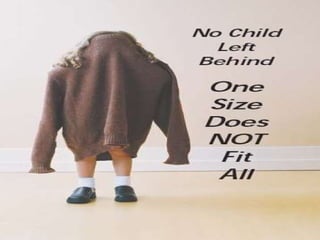
Differentiated Instruction: Beginning the Journey One Size does NOT fit ALL! Cape Alternative School March 15, 2010 Susan R. Hekmat [email_address]
 
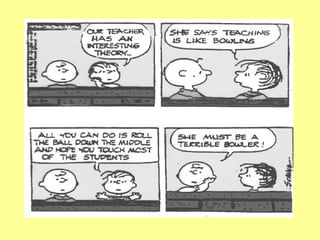
The biggest mistake of past centuries in teaching has been to treat all children as if they were variants of the same individual and thus to feel justified in teaching them all the same subjects in the same way. Howard Gardner Source: Siegel, J., and M.F. Shaughnessy. (March 1994). “Educating for Understanding: An Interview with Howard Gardner.”  Phi Delta Kappan  75, 7: 564.
“  All students can learn and succeed…. but not on the same day and not in the same way.”   William G. Spady
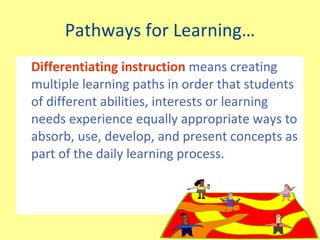
Pathways for Learning… Differentiating instruction  means creating multiple learning paths in order that students of different abilities, interests or learning needs experience equally appropriate ways to absorb, use, develop, and present concepts as part of the daily learning process.
DI  is…. A teaching philosophy….  not  a program Proactive  response to varied needs of students-not just a collection of strategies Implementing flexible grouping strategies Organized Respectful tasks
DI is ….. (cont.) Student centered Blend of whole class, group and individual instruction Rooted in assessment Change process that takes time to practice and perfect Systematic process with essential key principals
What DI isn’t….. Just modifying grading system and reducing work loads Giving more work for the good student and less and different work for the poor students Tracking Focusing on student weaknesses and ignoring student strengths Chaotic DI
Why Differentiate? All kids are different; one size does not fit all. Differentiation provides all students with access to all curriculum. Differentiation increase student engagement. Differentiation works in conjunction with an RTI Model
There is no such thing as the  “standard issued” student!
 
AREAS OF DIFFERENTIATION “ Think 7” to Differentiate
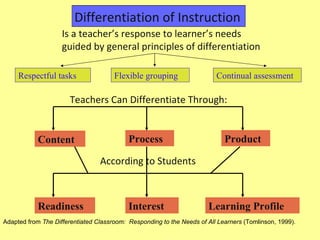
Differentiation of Instruction   Is a teacher’s response to learner’s needs   guided by general principles of differentiation Respectful tasks Flexible grouping Continual assessment Teachers Can Differentiate Through: Content Process Product According to Students Readiness Interest Learning Profile Adapted from  The Differentiated Classroom:  Responding to the Needs of All Learners  (Tomlinson, 1999).
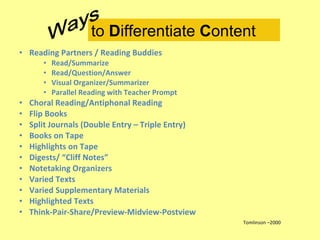
Reading Partners / Reading Buddies Read/Summarize Read/Question/Answer Visual Organizer/Summarizer Parallel Reading with Teacher Prompt Choral Reading/Antiphonal Reading Flip Books Split Journals (Double Entry – Triple Entry) Books on Tape Highlights on Tape Digests/ “Cliff Notes” Notetaking Organizers Varied Texts Varied Supplementary Materials Highlighted Texts Think-Pair-Share/Preview-Midview-Postview Tomlinson –2000 to  D ifferentiate  C ontent Ways
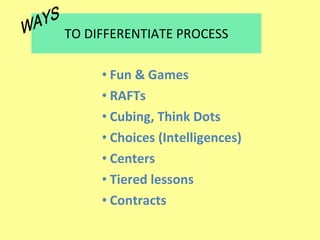
TO DIFFERENTIATE PROCESS Fun & Games RAFTs Cubing, Think Dots Choices (Intelligences) Centers Tiered lessons Contracts WAYS
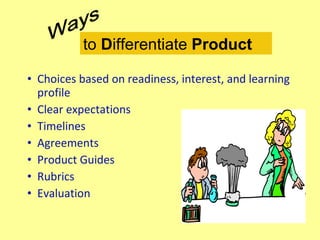
Choices based on readiness, interest, and learning profile Clear expectations Timelines Agreements Product Guides Rubrics Evaluation to  D ifferentiate  Product Ways
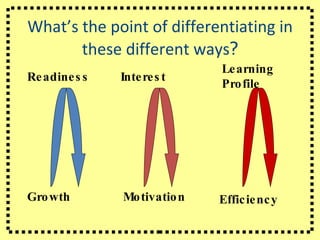
What’s the point of differentiating in these different ways ? Readiness Growth Interest Learning Profile Motivation Efficiency
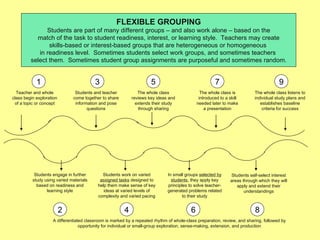
FLEXIBLE GROUPING Students are part of many different groups – and also work alone – based on the match of the task to student readiness, interest, or learning style.  Teachers may create  skills-based or interest-based groups that are heterogeneous or homogeneous  in readiness level.  Sometimes students select work groups, and sometimes teachers  select them.  Sometimes student group assignments are purposeful and sometimes random. 1 3 5 7 9 8 6 4 2 Teacher and whole class begin exploration of a topic or concept Students and teacher come together to share information and pose questions The whole class reviews key ideas and extends their study through sharing The whole class is introduced to a skill needed later to make a presentation The whole class listens to individual study plans and establishes baseline criteria for success Students engage in further study using varied materials based on readiness and learning style Students work on varied  assigned tasks  designed to help them make sense of key ideas at varied levels of complexity and varied pacing In small groups  selected by students , they apply key principles to solve teacher-generated problems related to their study Students self-select interest areas through which they will apply and extend their understandings A differentiated classroom is marked by a repeated rhythm of whole-class preparation, review, and sharing, followed by opportunity for individual or small-group exploration, sense-making, extension, and production
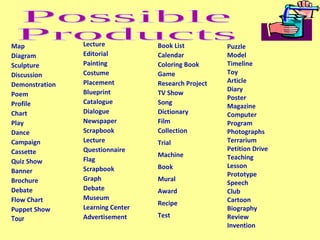
Map Diagram Sculpture Discussion Demonstration Poem Profile Chart Play Dance Campaign Cassette Quiz Show Banner Brochure Debate Flow Chart Puppet Show Tour Lecture Editorial Painting Costume Placement Blueprint Catalogue Dialogue Newspaper Scrapbook Lecture Questionnaire Flag Scrapbook Graph Debate Museum Learning Center Advertisement Possible Products Book List Calendar Coloring Book Game Research Project TV Show Song Dictionary Film Collection Trial Machine Book Mural Award Recipe Test Puzzle Model Timeline Toy Article Diary Poster Magazine Computer Program Photographs Terrarium Petition Drive Teaching Lesson Prototype Speech Club Cartoon Biography Review Invention
 
 
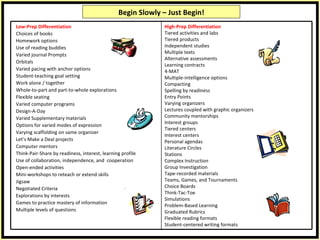
Begin Slowly – Just Begin! Low-Prep Differentiation Choices of books Homework options Use of reading buddies Varied journal Prompts Orbitals Varied pacing with anchor options Student-teaching goal setting Work alone / together Whole-to-part and part-to-whole explorations Flexible seating Varied computer programs Design-A-Day Varied Supplementary materials Options for varied modes of expression Varying scaffolding on same organizer Let’s Make a Deal projects Computer mentors Think-Pair-Share by readiness, interest, learning profile Use of collaboration, independence, and  cooperation Open-ended activities Mini-workshops to reteach or extend skills Jigsaw Negotiated Criteria Explorations by interests Games to practice mastery of information Multiple levels of questions High-Prep Differentiation Tiered activities and labs Tiered products Independent studies Multiple texts Alternative assessments Learning contracts 4-MAT Multiple-intelligence options Compacting Spelling by readiness Entry Points Varying organizers Lectures coupled with graphic organizers Community mentorships Interest groups Tiered centers Interest centers Personal agendas Literature Circles Stations Complex Instruction Group Investigation Tape-recorded materials Teams, Games, and Tournaments Choice Boards Think-Tac-Toe Simulations Problem-Based Learning Graduated Rubrics Flexible reading formats Student-centered writing formats
LEARNER PROFILE How students learn best Learner Profile
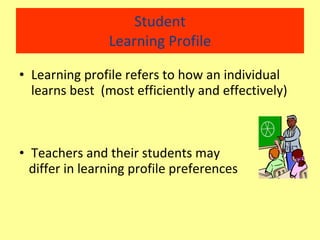
Student Learning Profile Learning profile refers to how an individual learns best  (most efficiently and effectively) Teachers and their students may  differ in learning profile preferences
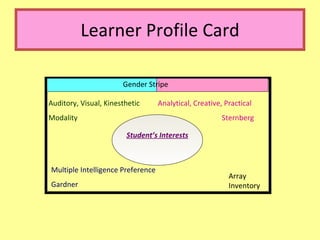
Learner Profile Card Auditory, Visual, Kinesthetic Modality Multiple Intelligence Preference Gardner Analytical, Creative, Practical Sternberg Student’s Interests Array Inventory Gender Stripe
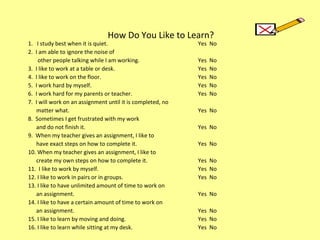
How Do You Like to Learn? 1.  I study best when it is quiet. Yes  No 2.  I am able to ignore the noise of   other people talking while I am working. Yes  No 3.  I like to work at a table or desk. Yes  No 4.  I like to work on the floor. Yes  No 5.  I work hard by myself. Yes  No 6.  I work hard for my parents or teacher. Yes  No 7.  I will work on an assignment until it is completed, no  matter what. Yes  No 8.  Sometimes I get frustrated with my work  and do not finish it. Yes  No 9.  When my teacher gives an assignment, I like to  have exact steps on how to complete it. Yes  No 10. When my teacher gives an assignment, I like to  create my own steps on how to complete it. Yes  No 11.  I like to work by myself. Yes  No 12. I like to work in pairs or in groups. Yes  No 13. I like to have unlimited amount of time to work on  an assignment. Yes  No 14. I like to have a certain amount of time to work on  an assignment. Yes  No 15. I like to learn by moving and doing. Yes  No 16. I like to learn while sitting at my desk. Yes  No
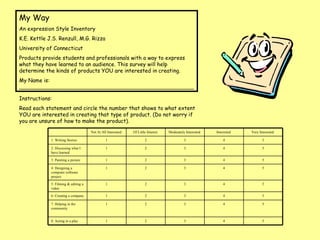
My Way  An expression Style Inventory  K.E. Kettle J.S. Renzull, M.G. Rizza  University of Connecticut  Products provide students and professionals with a way to express what they have learned to an audience. This survey will help determine the kinds of products YOU are interested in creating.  My Name is: ____________________________________________________ Instructions: Read each statement and circle the number that shows to what extent YOU are interested in creating that type of product. (Do not worry if you are unsure of how to make the product).  Not At All Interested  Of Little Interest  Moderately Interested  Interested  Very Interested  1. Writing Stories  1 2 3 4 5 2. Discussing what I have learned 1 2 3 4 5 3. Painting a picture  1 2 3 4 5 4. Designing a computer software project  1 2 3 4 5 5. Filming & editing a video  1 2 3 4 5 6. Creating a company 1 2 3 4 5 7. Helping in the community  1 2 3 4 5 8. Acting in a play  1 2 3 4 5
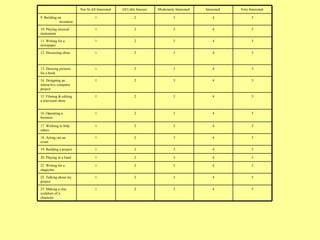
Not At All Interested  Of Little Interest  Moderately Interested  Interested  Very Interested  9. Building an invention  1 2 3 4 5 10. Playing musical instrument  1 2 3 4 5 11. Writing for a newspaper  1 2 3 4 5 12. Discussing ideas  1 2 3 4 5 13. Drawing pictures for a book  1 2 3 4 5 14. Designing an interactive computer project  1 2 3 4 5 15. Filming & editing a television show 1 2 3 4 5 16. Operating a business  1 2 3 4 5 17. Working to help others  1 2 3 4 5 18. Acting out an event  1 2 3 4 5 19. Building a project  1 2 3 4 5 20. Playing in a band  1 2 3 4 5 21. Writing for a magazine  1 2 3 4 5 22. Talking about my project  1 2 3 4 5 23. Making a clay sculpture of a character  1 2 3 4 5
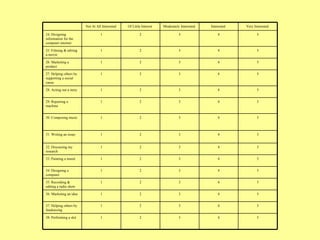
Not At All Interested  Of Little Interest  Moderately Interested  Interested  Very Interested  24. Designing information for the computer internet  1 2 3 4 5 25. Filming & editing a movie  1 2 3 4 5 26. Marketing a product  1 2 3 4 5 27. Helping others by supporting a social cause  1 2 3 4 5 28. Acting out a story  1 2 3 4 5 29. Repairing a machine  1 2 3 4 5 30. Composing music  1 2 3 4 5 31. Writing an essay  1 2 3 4 5 32. Discussing my research  1 2 3 4 5 33. Painting a mural  1 2 3 4 5 34. Designing a computer  1 2 3 4 5 35. Recording & editing a radio show  1 2 3 4 5 36. Marketing an idea  1 2 3 4 5 37. Helping others by fundraising  1 2 3 4 5 38. Performing a skit  1 2 3 4 5
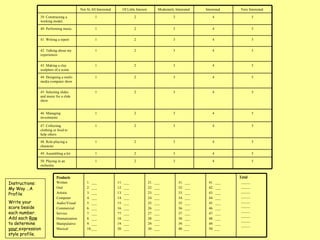
Instructions: My Way …A Profile  Write your score beside each number. Add each  Row  to determine  your  expression style profile.  Not At All Interested  Of Little Interest  Moderately Interested  Interested  Very Interested  39. Constructing a working model.  1 2 3 4 5 40. Performing music  1 2 3 4 5 41. Writing a report  1 2 3 4 5 42. Talking about my experiences  1 2 3 4 5 43. Making a clay sculpture of a scene  1 2 3 4 5 44. Designing a multi-media computer show  1 2 3 4 5 45. Selecting slides and music for a slide show 1 2 3 4 5 46. Managing investments 1 2 3 4 5 47. Collecting clothing or food to help others  1 2 3 4 5 48. Role-playing a character  1 2 3 4 5 49. Assembling a kit  1 2 3 4 5 50. Playing in an orchestra  1 2 3 4 5 Products   Written  Oral  Artistic  Computer  Audio/Visual  Commercial  Service  Dramatization  Manipulative  Musical  1.  ___ 2.  ___ 3.  ___ 4.  ___ 5.  ___ 6.  ___ 7.  ___ 8.  ___ 9.  ___ 10.___ 11.  ___ 12.  ___ 13.  ___ 14.  ___ 15.  ___ 16.  ___ 77.  ___ 18.  ___ 19.  ___ 20.  ___ 21.  ___ 22.  ___ 23.  ___ 24.  ___ 25.  ___ 26.  ___ 27.  ___ 28.  ___ 29.  ___ 30 . ___ 31.  ___ 32.  ___ 33.  ___ 34.  ___ 35.  ___ 36.  ___ 37.  ___ 38.  ___ 39.  ___ 40. ___ 41.  ___ 42.  ___ 43.  ___ 44.  ___ 45.  ___ 46.  ___ 47.  ___ 48.  ___ 49.  ___ 50. ___ Total _____ _____ _____ _____ _____ _____ _____ _____ _____ _____
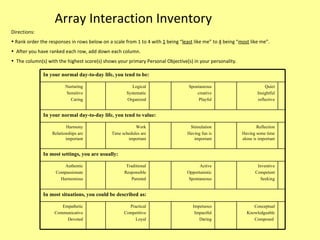
Array Interaction Inventory Directions: Rank order the responses in rows below on a scale from 1 to 4 with  1  being “ least  like me” to  4  being “ most  like me”. After you have ranked each row, add down each column. The column(s) with the highest score(s) shows your primary Personal Objective(s) in your personality. In your normal day-to-day life, you tend to be: Nurturing Sensitive Caring Logical Systematic Organized Spontaneous creative Playful Quiet Insightful reflective In your normal day-to-day life, you tend to value: Harmony Relationships are important Work Time schedules are important Stimulation Having fun is important Reflection Having some time alone is important In most settings, you are usually: Authentic Compassionate Harmonious Traditional Responsible Parental Active Opportunistic Spontaneous Inventive Competent Seeking In most situations, you could be described as: Empathetic Communicative Devoted Practical Competitive Loyal Impetuous Impactful Daring Conceptual Knowledgeable Composed
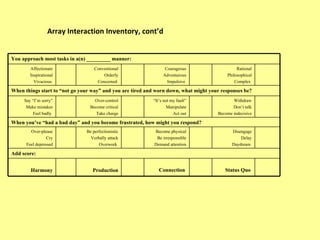
Array Interaction Inventory, cont’d You approach most tasks in a(n) _________ manner: Affectionate Inspirational Vivacious  Conventional Orderly Concerned  Courageous Adventurous Impulsive  Rational Philosophical Complex  When things start to “not go your way” and you are tired and worn down, what might your responses be? Say “I’m sorry” Make mistakes Feel badly  Over-control Become critical Take charge “ It’s not my fault” Manipulate Act out Withdraw Don’t talk Become indecisive When you’ve “had a bad day” and you become frustrated, how might you respond? Over-please Cry Feel depressed Be perfectionistic Verbally attack Overwork  Become physical Be irresponsible Demand attention Disengage Delay Daydream  Add score: Harmony Production Connection   Status Quo
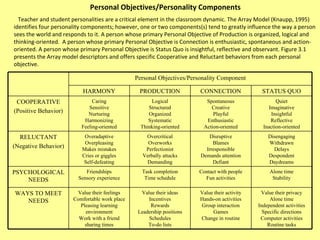
Personal Objectives/Personality Components Teacher and student personalities are a critical element in the classroom dynamic. The Array Model (Knaupp, 1995) identifies four personality components; however, one or two components(s) tend to greatly influence the way a person sees the world and responds to it. A person whose primary Personal Objective of Production is organized, logical and thinking-oriented.  A person whose primary Personal Objective is Connection is enthusiastic, spontaneous and action-oriented. A person whose primary Personal Objective is Status Quo is insightful, reflective and observant. Figure 3.1 presents the Array model descriptors and offers specific Cooperative and Reluctant behaviors from each personal objective. Personal Objectives/Personality Component HARMONY PRODUCTION CONNECTION STATUS QUO COOPERATIVE (Positive Behavior) Caring Sensitive Nurturing Harmonizing Feeling-oriented Logical Structured Organized Systematic Thinking-oriented Spontaneous Creative Playful Enthusiastic Action-oriented Quiet Imaginative Insightful Reflective Inaction-oriented RELUCTANT (Negative Behavior) Overadaptive Overpleasing Makes mistakes Cries or giggles Self-defeating Overcritical Overworks Perfectionist Verbally attacks Demanding Disruptive Blames Irresponsible Demands attention Defiant Disengaging Withdrawn Delays Despondent Daydreams PSYCHOLOGICAL NEEDS Friendships Sensory experience Task completion Time schedule Contact with people Fun activities Alone time Stability WAYS TO MEET NEEDS Value their feelings Comfortable work place Pleasing learning environment Work with a friend sharing times Value their ideas Incentives Rewards Leadership positions Schedules To-do lists Value their activity Hands-on activities Group interaction Games Change in routine Value their privacy Alone time Independent activities Specific directions Computer activities Routine tasks
Learning Modalities/Styles www.vark-learn.com Visual Auditory  Tactile Multimodile
Modality Preferences Instrument
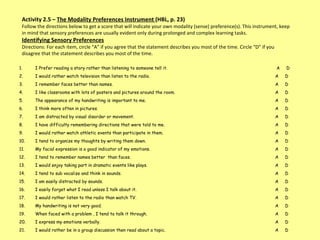
Activity 2.5 –  The Modality Preferences Instrument  (HBL, p. 23) Follow the directions below to get a score that will indicate your own modality (sense) preference(s). This instrument, keep in mind that sensory preferences are usually evident only during prolonged and complex learning tasks.  Identifying Sensory Preferences Directions: For each item, circle “A” if you agree that the statement describes you most of the time. Circle “D” if you disagree that the statement describes you most of the time.  I Prefer reading a story rather than listening to someone tell it.   A  D I would rather watch television than listen to the radio.  A  D I remember faces better than names. A  D  I like classrooms with lots of posters and pictures around the room.  A  D  The appearance of my handwriting is important to me.  A  D  I think more often in pictures.  A  D I am distracted by visual disorder or movement.  A  D  I have difficulty remembering directions that were told to me.  A  D I would rather watch athletic events than participate in them.  A  D I tend to organize my thoughts by writing them down.  A  D My facial expression is a good indicator of my emotions.  A  D I tend to remember names better  than faces.  A  D I would enjoy taking part in dramatic events like plays.  A  D I tend to sub vocalize and think in sounds. A  D I am easily distracted by sounds.  A  D I easily forget what I read unless I talk about it.  A  D I would rather listen to the radio than watch TV. A  D  My handwriting is not very good.  A  D When faced with a problem , I tend to talk it through. A  D I express my emotions verbally.  A  D I would rather be in a group discussion then read about a topic.  A  D
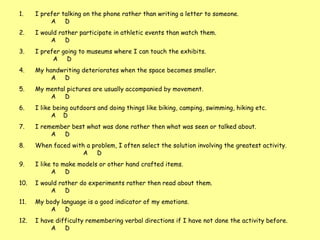
I prefer talking on the phone rather than writing a letter to someone.  A  D  I would rather participate in athletic events than watch them.  A  D I prefer going to museums where I can touch the exhibits.   A  D My handwriting deteriorates when the space becomes smaller.  A  D My mental pictures are usually accompanied by movement.  A  D I like being outdoors and doing things like biking, camping, swimming, hiking etc.    A  D I remember best what was done rather then what was seen or talked about.  A  D When faced with a problem, I often select the solution involving the greatest activity.  A  D I like to make models or other hand crafted items.    A  D I would rather do experiments rather then read about them.  A  D My body language is a good indicator of my emotions.    A  D I have difficulty remembering verbal directions if I have not done the activity before.  A  D  .
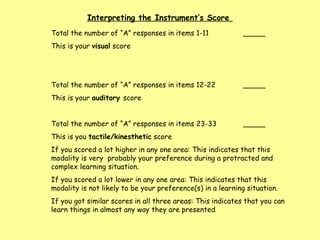
Total the number of “A” responses in items 1-11  _____ This is your  visual  score Total the number of “A” responses in items 12-22 _____ This is your  auditory  score  Total the number of “A” responses in items 23-33 _____ This is you  tactile/kinesthetic  score  If you scored a lot higher in any one area: This indicates that this modality is very  probably your preference during a protracted and complex learning situation.  If you scored a lot lower in any one area: This indicates that this modality is not likely to be your preference(s) in a learning situation. If you got similar scores in all three areas: This indicates that you can learn things in almost any way they are presented Interpreting the Instrument’s Score
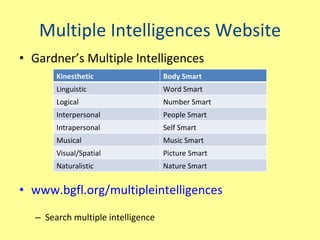
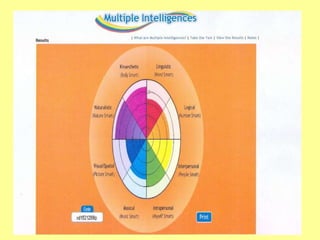
Multiple Intelligences Website Gardner’s Multiple Intelligences www.bgfl.org/multipleintelligences Search multiple intelligence Kinesthetic Body Smart Linguistic Word Smart Logical Number Smart Interpersonal People Smart Intrapersonal Self Smart Musical Music Smart Visual/Spatial Picture Smart Naturalistic Nature Smart
 
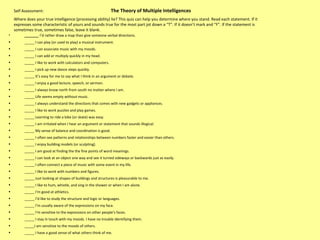
Self Assessment:    The Theory of Multiple Intelligences  Where does your true intelligence (processing ability) lie? This quiz can help you determine where you stand. Read each statement. If it expresses some characteristic of yours and sounds true for the most part jot down a “T”. If it doesn’t mark and “F”. If the statement is sometimes true, sometimes false, leave it blank.  _____  I’d rather draw a map than give someone verbal directions.  _____ I can play (or used to play) a musical instrument.  _____ I can associate music with my moods. _____ I can add or multiply quickly in my head. _____ I like to work with calculators and computers.  _____ I pick up new dance steps quickly.  _____ It’s easy for me to say what I think in an argument or debate.  _____ I enjoy a good lecture, speech, or sermon.  _____ I always know north from south no matter where I am.  _____ Life seems empty without music.  _____ I always understand the directions that comes with new gadgets or appliances.  _____ I like to work puzzles and play games.  _____ Learning to ride a bike (or skate) was easy.  _____ I am irritated when I hear an argument or statement that sounds illogical.  _____ My sense of balance and coordination is good.  _____ I often see patterns and relationships between numbers faster and easier than others.  _____ I enjoy building models (or sculpting).  _____ I am good at finding the the fine points of word meanings.  _____ I can look at an object one way and see it turned sideways or backwards just as easily.  _____ I often connect a piece of music with some event in my life.  _____ I like to work with numbers and figures.  _____ Just looking at shapes of buildings and structures is pleasurable to me.  _____ I like to hum, whistle, and sing in the shower or when I am alone.  _____ I’m good at athletics. _____ I’d like to study the structure and logic or languages.  _____ I’m usually aware of the expressions on my face.  _____ I’m sensitive to the expressions on other people’s faces.  _____ I stay in touch with my moods. I have no trouble identifying them.  _____I am sensitive to the moods of others.  _____ I have a good sense of what others think of me.
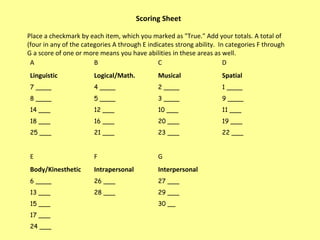
Scoring Sheet   Place a checkmark by each item, which you marked as "True." Add your totals. A total of (four in any of the categories A through E indicates strong ability.  In categories F through G a score of one or more means you have abilities in these areas as well.       A B C D Linguistic Logical/Math. Musical Spatial 7 ____ 4 ____ 2 ____ 1 ____ 8 ____ 5 ____ 3 ____ 9 ____ 14 ___ 12 ___ 10 ___ 11 ___ 18 ___ 16 ___ 20 ___ 19 ___ 25 ___ 21 ___ 23 ___ 22 ___ E F G Body/Kinesthetic Intrapersonal Interpersonal 6 ____ 26 ___ 27 ___ 13 ___ 28 ___ 29 ___ 15 ___ 30 __ 17 ___ 24 ___
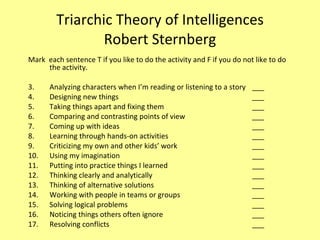
Triarchic Theory of Intelligences Robert Sternberg Mark  each sentence T if you like to do the activity and F if you do not like to do the activity. Analyzing characters when I’m reading or listening to a story  ___ Designing new things ___ Taking things apart and fixing them ___ Comparing and contrasting points of view ___ Coming up with ideas ___ Learning through hands-on activities ___ Criticizing my own and other kids’ work ___ Using my imagination ___ Putting into practice things I learned ___ Thinking clearly and analytically ___ Thinking of alternative solutions ___ Working with people in teams or groups ___ Solving logical problems  ___ Noticing things others often ignore  ___ Resolving conflicts  ___
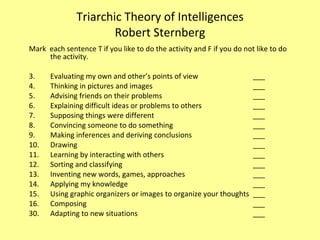
Triarchic Theory of Intelligences Robert Sternberg Mark  each sentence T if you like to do the activity and F if you do not like to do the activity. Evaluating my own and other’s points of view ___ Thinking in pictures and images ___ Advising friends on their problems ___ Explaining difficult ideas or problems to others ___ Supposing things were different ___ Convincing someone to do something ___ Making inferences and deriving conclusions ___ Drawing ___ Learning by interacting with others ___ Sorting and classifying ___ Inventing new words, games, approaches ___ Applying my knowledge ___ Using graphic organizers or images to organize your thoughts ___ Composing ___ 30. Adapting to new situations ___
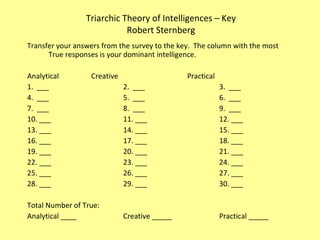
Triarchic Theory of Intelligences – Key Robert Sternberg Transfer your answers from the survey to the key.  The column with the most True responses is your dominant intelligence. Analytical Creative Practical 1.  ___ 2.  ___ 3.  ___ 4.  ___ 5.  ___ 6.  ___ 7.  ___ 8.  ___ 9.  ___ 10. ___ 11. ___ 12. ___ 13. ___ 14. ___ 15. ___ 16. ___ 17. ___ 18. ___ 19. ___ 20. ___ 21. ___ 22. ___ 23. ___ 24. ___ 25. ___ 26. ___ 27. ___ 28. ___ 29. ___ 30. ___ Total Number of True: Analytical ____ Creative _____ Practical _____
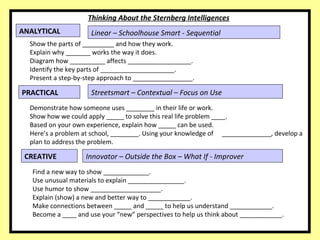
Linear – Schoolhouse Smart - Sequential ANALYTICAL Thinking About the Sternberg Intelligences Show the parts of _________ and how they work. Explain why _______ works the way it does. Diagram how __________ affects __________________. Identify the key parts of _____________________. Present a step-by-step approach to _________________. Streetsmart – Contextual – Focus on Use PRACTICAL Demonstrate how someone uses ________ in their life or work. Show how we could apply _____ to solve this real life problem ____. Based on your own experience, explain how _____ can be used. Here’s a problem at school, ________. Using your knowledge of  ______________, develop a plan to address the problem. CREATIVE Innovator – Outside the Box – What If - Improver Find a new way to show _____________. Use unusual materials to explain ________________. Use humor to show ____________________. Explain (show) a new and better way to ____________. Make connections between _____ and _____ to help us understand ____________. Become a ____ and use your “new” perspectives to help us think about ____________.
Remember!!! Differentiation is a process and it takes time to perfect Start small… 1-2 tasks per week Not important how fast you start, it’s just important that you get moving
Thank you for all you do for our students! Please fill out the evaluations and leave on your table. Have a great day!

E:\Differentiated Instruction\Di Ppts\Cape Alt School

  • 1.
    Differentiated Instruction: Beginningthe Journey One Size does NOT fit ALL! Cape Alternative School March 15, 2010 Susan R. Hekmat [email_address]
  • 2.
  • 3.
    The biggest mistakeof past centuries in teaching has been to treat all children as if they were variants of the same individual and thus to feel justified in teaching them all the same subjects in the same way. Howard Gardner Source: Siegel, J., and M.F. Shaughnessy. (March 1994). “Educating for Understanding: An Interview with Howard Gardner.” Phi Delta Kappan 75, 7: 564.
  • 4.
    “ Allstudents can learn and succeed…. but not on the same day and not in the same way.” William G. Spady
  • 5.
    Pathways for Learning…Differentiating instruction means creating multiple learning paths in order that students of different abilities, interests or learning needs experience equally appropriate ways to absorb, use, develop, and present concepts as part of the daily learning process.
  • 6.
    DI is….A teaching philosophy…. not a program Proactive response to varied needs of students-not just a collection of strategies Implementing flexible grouping strategies Organized Respectful tasks
  • 7.
    DI is …..(cont.) Student centered Blend of whole class, group and individual instruction Rooted in assessment Change process that takes time to practice and perfect Systematic process with essential key principals
  • 8.
    What DI isn’t…..Just modifying grading system and reducing work loads Giving more work for the good student and less and different work for the poor students Tracking Focusing on student weaknesses and ignoring student strengths Chaotic DI
  • 9.
    Why Differentiate? Allkids are different; one size does not fit all. Differentiation provides all students with access to all curriculum. Differentiation increase student engagement. Differentiation works in conjunction with an RTI Model
  • 10.
    There is nosuch thing as the “standard issued” student!
  • 11.
  • 12.
    AREAS OF DIFFERENTIATION“ Think 7” to Differentiate
  • 13.
    Differentiation of Instruction Is a teacher’s response to learner’s needs guided by general principles of differentiation Respectful tasks Flexible grouping Continual assessment Teachers Can Differentiate Through: Content Process Product According to Students Readiness Interest Learning Profile Adapted from The Differentiated Classroom: Responding to the Needs of All Learners (Tomlinson, 1999).
  • 14.
    Reading Partners /Reading Buddies Read/Summarize Read/Question/Answer Visual Organizer/Summarizer Parallel Reading with Teacher Prompt Choral Reading/Antiphonal Reading Flip Books Split Journals (Double Entry – Triple Entry) Books on Tape Highlights on Tape Digests/ “Cliff Notes” Notetaking Organizers Varied Texts Varied Supplementary Materials Highlighted Texts Think-Pair-Share/Preview-Midview-Postview Tomlinson –2000 to D ifferentiate C ontent Ways
  • 15.
    TO DIFFERENTIATE PROCESSFun & Games RAFTs Cubing, Think Dots Choices (Intelligences) Centers Tiered lessons Contracts WAYS
  • 16.
    Choices based onreadiness, interest, and learning profile Clear expectations Timelines Agreements Product Guides Rubrics Evaluation to D ifferentiate Product Ways
  • 17.
    What’s the pointof differentiating in these different ways ? Readiness Growth Interest Learning Profile Motivation Efficiency
  • 18.
    FLEXIBLE GROUPING Studentsare part of many different groups – and also work alone – based on the match of the task to student readiness, interest, or learning style. Teachers may create skills-based or interest-based groups that are heterogeneous or homogeneous in readiness level. Sometimes students select work groups, and sometimes teachers select them. Sometimes student group assignments are purposeful and sometimes random. 1 3 5 7 9 8 6 4 2 Teacher and whole class begin exploration of a topic or concept Students and teacher come together to share information and pose questions The whole class reviews key ideas and extends their study through sharing The whole class is introduced to a skill needed later to make a presentation The whole class listens to individual study plans and establishes baseline criteria for success Students engage in further study using varied materials based on readiness and learning style Students work on varied assigned tasks designed to help them make sense of key ideas at varied levels of complexity and varied pacing In small groups selected by students , they apply key principles to solve teacher-generated problems related to their study Students self-select interest areas through which they will apply and extend their understandings A differentiated classroom is marked by a repeated rhythm of whole-class preparation, review, and sharing, followed by opportunity for individual or small-group exploration, sense-making, extension, and production
  • 19.
    Map Diagram SculptureDiscussion Demonstration Poem Profile Chart Play Dance Campaign Cassette Quiz Show Banner Brochure Debate Flow Chart Puppet Show Tour Lecture Editorial Painting Costume Placement Blueprint Catalogue Dialogue Newspaper Scrapbook Lecture Questionnaire Flag Scrapbook Graph Debate Museum Learning Center Advertisement Possible Products Book List Calendar Coloring Book Game Research Project TV Show Song Dictionary Film Collection Trial Machine Book Mural Award Recipe Test Puzzle Model Timeline Toy Article Diary Poster Magazine Computer Program Photographs Terrarium Petition Drive Teaching Lesson Prototype Speech Club Cartoon Biography Review Invention
  • 20.
  • 21.
  • 22.
    Begin Slowly –Just Begin! Low-Prep Differentiation Choices of books Homework options Use of reading buddies Varied journal Prompts Orbitals Varied pacing with anchor options Student-teaching goal setting Work alone / together Whole-to-part and part-to-whole explorations Flexible seating Varied computer programs Design-A-Day Varied Supplementary materials Options for varied modes of expression Varying scaffolding on same organizer Let’s Make a Deal projects Computer mentors Think-Pair-Share by readiness, interest, learning profile Use of collaboration, independence, and cooperation Open-ended activities Mini-workshops to reteach or extend skills Jigsaw Negotiated Criteria Explorations by interests Games to practice mastery of information Multiple levels of questions High-Prep Differentiation Tiered activities and labs Tiered products Independent studies Multiple texts Alternative assessments Learning contracts 4-MAT Multiple-intelligence options Compacting Spelling by readiness Entry Points Varying organizers Lectures coupled with graphic organizers Community mentorships Interest groups Tiered centers Interest centers Personal agendas Literature Circles Stations Complex Instruction Group Investigation Tape-recorded materials Teams, Games, and Tournaments Choice Boards Think-Tac-Toe Simulations Problem-Based Learning Graduated Rubrics Flexible reading formats Student-centered writing formats
  • 23.
    LEARNER PROFILE Howstudents learn best Learner Profile
  • 24.
    Student Learning ProfileLearning profile refers to how an individual learns best (most efficiently and effectively) Teachers and their students may differ in learning profile preferences
  • 25.
    Learner Profile CardAuditory, Visual, Kinesthetic Modality Multiple Intelligence Preference Gardner Analytical, Creative, Practical Sternberg Student’s Interests Array Inventory Gender Stripe
  • 26.
    How Do YouLike to Learn? 1. I study best when it is quiet. Yes No 2. I am able to ignore the noise of other people talking while I am working. Yes No 3. I like to work at a table or desk. Yes No 4. I like to work on the floor. Yes No 5. I work hard by myself. Yes No 6. I work hard for my parents or teacher. Yes No 7. I will work on an assignment until it is completed, no matter what. Yes No 8. Sometimes I get frustrated with my work and do not finish it. Yes No 9. When my teacher gives an assignment, I like to have exact steps on how to complete it. Yes No 10. When my teacher gives an assignment, I like to create my own steps on how to complete it. Yes No 11. I like to work by myself. Yes No 12. I like to work in pairs or in groups. Yes No 13. I like to have unlimited amount of time to work on an assignment. Yes No 14. I like to have a certain amount of time to work on an assignment. Yes No 15. I like to learn by moving and doing. Yes No 16. I like to learn while sitting at my desk. Yes No
  • 27.
    My Way An expression Style Inventory K.E. Kettle J.S. Renzull, M.G. Rizza University of Connecticut Products provide students and professionals with a way to express what they have learned to an audience. This survey will help determine the kinds of products YOU are interested in creating. My Name is: ____________________________________________________ Instructions: Read each statement and circle the number that shows to what extent YOU are interested in creating that type of product. (Do not worry if you are unsure of how to make the product). Not At All Interested Of Little Interest Moderately Interested Interested Very Interested 1. Writing Stories 1 2 3 4 5 2. Discussing what I have learned 1 2 3 4 5 3. Painting a picture 1 2 3 4 5 4. Designing a computer software project 1 2 3 4 5 5. Filming & editing a video 1 2 3 4 5 6. Creating a company 1 2 3 4 5 7. Helping in the community 1 2 3 4 5 8. Acting in a play 1 2 3 4 5
  • 28.
    Not At AllInterested Of Little Interest Moderately Interested Interested Very Interested 9. Building an invention 1 2 3 4 5 10. Playing musical instrument 1 2 3 4 5 11. Writing for a newspaper 1 2 3 4 5 12. Discussing ideas 1 2 3 4 5 13. Drawing pictures for a book 1 2 3 4 5 14. Designing an interactive computer project 1 2 3 4 5 15. Filming & editing a television show 1 2 3 4 5 16. Operating a business 1 2 3 4 5 17. Working to help others 1 2 3 4 5 18. Acting out an event 1 2 3 4 5 19. Building a project 1 2 3 4 5 20. Playing in a band 1 2 3 4 5 21. Writing for a magazine 1 2 3 4 5 22. Talking about my project 1 2 3 4 5 23. Making a clay sculpture of a character 1 2 3 4 5
  • 29.
    Not At AllInterested Of Little Interest Moderately Interested Interested Very Interested 24. Designing information for the computer internet 1 2 3 4 5 25. Filming & editing a movie 1 2 3 4 5 26. Marketing a product 1 2 3 4 5 27. Helping others by supporting a social cause 1 2 3 4 5 28. Acting out a story 1 2 3 4 5 29. Repairing a machine 1 2 3 4 5 30. Composing music 1 2 3 4 5 31. Writing an essay 1 2 3 4 5 32. Discussing my research 1 2 3 4 5 33. Painting a mural 1 2 3 4 5 34. Designing a computer 1 2 3 4 5 35. Recording & editing a radio show 1 2 3 4 5 36. Marketing an idea 1 2 3 4 5 37. Helping others by fundraising 1 2 3 4 5 38. Performing a skit 1 2 3 4 5
  • 30.
    Instructions: My Way…A Profile Write your score beside each number. Add each Row to determine your expression style profile. Not At All Interested Of Little Interest Moderately Interested Interested Very Interested 39. Constructing a working model. 1 2 3 4 5 40. Performing music 1 2 3 4 5 41. Writing a report 1 2 3 4 5 42. Talking about my experiences 1 2 3 4 5 43. Making a clay sculpture of a scene 1 2 3 4 5 44. Designing a multi-media computer show 1 2 3 4 5 45. Selecting slides and music for a slide show 1 2 3 4 5 46. Managing investments 1 2 3 4 5 47. Collecting clothing or food to help others 1 2 3 4 5 48. Role-playing a character 1 2 3 4 5 49. Assembling a kit 1 2 3 4 5 50. Playing in an orchestra 1 2 3 4 5 Products Written Oral Artistic Computer Audio/Visual Commercial Service Dramatization Manipulative Musical 1. ___ 2. ___ 3. ___ 4. ___ 5. ___ 6. ___ 7. ___ 8. ___ 9. ___ 10.___ 11. ___ 12. ___ 13. ___ 14. ___ 15. ___ 16. ___ 77. ___ 18. ___ 19. ___ 20. ___ 21. ___ 22. ___ 23. ___ 24. ___ 25. ___ 26. ___ 27. ___ 28. ___ 29. ___ 30 . ___ 31. ___ 32. ___ 33. ___ 34. ___ 35. ___ 36. ___ 37. ___ 38. ___ 39. ___ 40. ___ 41. ___ 42. ___ 43. ___ 44. ___ 45. ___ 46. ___ 47. ___ 48. ___ 49. ___ 50. ___ Total _____ _____ _____ _____ _____ _____ _____ _____ _____ _____
  • 31.
    Array Interaction InventoryDirections: Rank order the responses in rows below on a scale from 1 to 4 with 1 being “ least like me” to 4 being “ most like me”. After you have ranked each row, add down each column. The column(s) with the highest score(s) shows your primary Personal Objective(s) in your personality. In your normal day-to-day life, you tend to be: Nurturing Sensitive Caring Logical Systematic Organized Spontaneous creative Playful Quiet Insightful reflective In your normal day-to-day life, you tend to value: Harmony Relationships are important Work Time schedules are important Stimulation Having fun is important Reflection Having some time alone is important In most settings, you are usually: Authentic Compassionate Harmonious Traditional Responsible Parental Active Opportunistic Spontaneous Inventive Competent Seeking In most situations, you could be described as: Empathetic Communicative Devoted Practical Competitive Loyal Impetuous Impactful Daring Conceptual Knowledgeable Composed
  • 32.
    Array Interaction Inventory,cont’d You approach most tasks in a(n) _________ manner: Affectionate Inspirational Vivacious Conventional Orderly Concerned Courageous Adventurous Impulsive Rational Philosophical Complex When things start to “not go your way” and you are tired and worn down, what might your responses be? Say “I’m sorry” Make mistakes Feel badly Over-control Become critical Take charge “ It’s not my fault” Manipulate Act out Withdraw Don’t talk Become indecisive When you’ve “had a bad day” and you become frustrated, how might you respond? Over-please Cry Feel depressed Be perfectionistic Verbally attack Overwork Become physical Be irresponsible Demand attention Disengage Delay Daydream Add score: Harmony Production Connection Status Quo
  • 33.
    Personal Objectives/Personality ComponentsTeacher and student personalities are a critical element in the classroom dynamic. The Array Model (Knaupp, 1995) identifies four personality components; however, one or two components(s) tend to greatly influence the way a person sees the world and responds to it. A person whose primary Personal Objective of Production is organized, logical and thinking-oriented. A person whose primary Personal Objective is Connection is enthusiastic, spontaneous and action-oriented. A person whose primary Personal Objective is Status Quo is insightful, reflective and observant. Figure 3.1 presents the Array model descriptors and offers specific Cooperative and Reluctant behaviors from each personal objective. Personal Objectives/Personality Component HARMONY PRODUCTION CONNECTION STATUS QUO COOPERATIVE (Positive Behavior) Caring Sensitive Nurturing Harmonizing Feeling-oriented Logical Structured Organized Systematic Thinking-oriented Spontaneous Creative Playful Enthusiastic Action-oriented Quiet Imaginative Insightful Reflective Inaction-oriented RELUCTANT (Negative Behavior) Overadaptive Overpleasing Makes mistakes Cries or giggles Self-defeating Overcritical Overworks Perfectionist Verbally attacks Demanding Disruptive Blames Irresponsible Demands attention Defiant Disengaging Withdrawn Delays Despondent Daydreams PSYCHOLOGICAL NEEDS Friendships Sensory experience Task completion Time schedule Contact with people Fun activities Alone time Stability WAYS TO MEET NEEDS Value their feelings Comfortable work place Pleasing learning environment Work with a friend sharing times Value their ideas Incentives Rewards Leadership positions Schedules To-do lists Value their activity Hands-on activities Group interaction Games Change in routine Value their privacy Alone time Independent activities Specific directions Computer activities Routine tasks
  • 34.
    Learning Modalities/Styles www.vark-learn.comVisual Auditory Tactile Multimodile
  • 35.
  • 36.
    Activity 2.5 – The Modality Preferences Instrument (HBL, p. 23) Follow the directions below to get a score that will indicate your own modality (sense) preference(s). This instrument, keep in mind that sensory preferences are usually evident only during prolonged and complex learning tasks. Identifying Sensory Preferences Directions: For each item, circle “A” if you agree that the statement describes you most of the time. Circle “D” if you disagree that the statement describes you most of the time. I Prefer reading a story rather than listening to someone tell it. A D I would rather watch television than listen to the radio. A D I remember faces better than names. A D I like classrooms with lots of posters and pictures around the room. A D The appearance of my handwriting is important to me. A D I think more often in pictures. A D I am distracted by visual disorder or movement. A D I have difficulty remembering directions that were told to me. A D I would rather watch athletic events than participate in them. A D I tend to organize my thoughts by writing them down. A D My facial expression is a good indicator of my emotions. A D I tend to remember names better than faces. A D I would enjoy taking part in dramatic events like plays. A D I tend to sub vocalize and think in sounds. A D I am easily distracted by sounds. A D I easily forget what I read unless I talk about it. A D I would rather listen to the radio than watch TV. A D My handwriting is not very good. A D When faced with a problem , I tend to talk it through. A D I express my emotions verbally. A D I would rather be in a group discussion then read about a topic. A D
  • 37.
    I prefer talkingon the phone rather than writing a letter to someone. A D I would rather participate in athletic events than watch them. A D I prefer going to museums where I can touch the exhibits. A D My handwriting deteriorates when the space becomes smaller. A D My mental pictures are usually accompanied by movement. A D I like being outdoors and doing things like biking, camping, swimming, hiking etc. A D I remember best what was done rather then what was seen or talked about. A D When faced with a problem, I often select the solution involving the greatest activity. A D I like to make models or other hand crafted items. A D I would rather do experiments rather then read about them. A D My body language is a good indicator of my emotions. A D I have difficulty remembering verbal directions if I have not done the activity before. A D .
  • 38.
    Total the numberof “A” responses in items 1-11 _____ This is your visual score Total the number of “A” responses in items 12-22 _____ This is your auditory score Total the number of “A” responses in items 23-33 _____ This is you tactile/kinesthetic score If you scored a lot higher in any one area: This indicates that this modality is very probably your preference during a protracted and complex learning situation. If you scored a lot lower in any one area: This indicates that this modality is not likely to be your preference(s) in a learning situation. If you got similar scores in all three areas: This indicates that you can learn things in almost any way they are presented Interpreting the Instrument’s Score
  • 39.
    Multiple Intelligences WebsiteGardner’s Multiple Intelligences www.bgfl.org/multipleintelligences Search multiple intelligence Kinesthetic Body Smart Linguistic Word Smart Logical Number Smart Interpersonal People Smart Intrapersonal Self Smart Musical Music Smart Visual/Spatial Picture Smart Naturalistic Nature Smart
  • 40.
  • 41.
    Self Assessment: The Theory of Multiple Intelligences Where does your true intelligence (processing ability) lie? This quiz can help you determine where you stand. Read each statement. If it expresses some characteristic of yours and sounds true for the most part jot down a “T”. If it doesn’t mark and “F”. If the statement is sometimes true, sometimes false, leave it blank. _____ I’d rather draw a map than give someone verbal directions. _____ I can play (or used to play) a musical instrument. _____ I can associate music with my moods. _____ I can add or multiply quickly in my head. _____ I like to work with calculators and computers. _____ I pick up new dance steps quickly. _____ It’s easy for me to say what I think in an argument or debate. _____ I enjoy a good lecture, speech, or sermon. _____ I always know north from south no matter where I am. _____ Life seems empty without music. _____ I always understand the directions that comes with new gadgets or appliances. _____ I like to work puzzles and play games. _____ Learning to ride a bike (or skate) was easy. _____ I am irritated when I hear an argument or statement that sounds illogical. _____ My sense of balance and coordination is good. _____ I often see patterns and relationships between numbers faster and easier than others. _____ I enjoy building models (or sculpting). _____ I am good at finding the the fine points of word meanings. _____ I can look at an object one way and see it turned sideways or backwards just as easily. _____ I often connect a piece of music with some event in my life. _____ I like to work with numbers and figures. _____ Just looking at shapes of buildings and structures is pleasurable to me. _____ I like to hum, whistle, and sing in the shower or when I am alone. _____ I’m good at athletics. _____ I’d like to study the structure and logic or languages. _____ I’m usually aware of the expressions on my face. _____ I’m sensitive to the expressions on other people’s faces. _____ I stay in touch with my moods. I have no trouble identifying them. _____I am sensitive to the moods of others. _____ I have a good sense of what others think of me.
  • 42.
    Scoring Sheet  Place a checkmark by each item, which you marked as "True." Add your totals. A total of (four in any of the categories A through E indicates strong ability. In categories F through G a score of one or more means you have abilities in these areas as well.       A B C D Linguistic Logical/Math. Musical Spatial 7 ____ 4 ____ 2 ____ 1 ____ 8 ____ 5 ____ 3 ____ 9 ____ 14 ___ 12 ___ 10 ___ 11 ___ 18 ___ 16 ___ 20 ___ 19 ___ 25 ___ 21 ___ 23 ___ 22 ___ E F G Body/Kinesthetic Intrapersonal Interpersonal 6 ____ 26 ___ 27 ___ 13 ___ 28 ___ 29 ___ 15 ___ 30 __ 17 ___ 24 ___
  • 43.
    Triarchic Theory ofIntelligences Robert Sternberg Mark each sentence T if you like to do the activity and F if you do not like to do the activity. Analyzing characters when I’m reading or listening to a story ___ Designing new things ___ Taking things apart and fixing them ___ Comparing and contrasting points of view ___ Coming up with ideas ___ Learning through hands-on activities ___ Criticizing my own and other kids’ work ___ Using my imagination ___ Putting into practice things I learned ___ Thinking clearly and analytically ___ Thinking of alternative solutions ___ Working with people in teams or groups ___ Solving logical problems ___ Noticing things others often ignore ___ Resolving conflicts ___
  • 44.
    Triarchic Theory ofIntelligences Robert Sternberg Mark each sentence T if you like to do the activity and F if you do not like to do the activity. Evaluating my own and other’s points of view ___ Thinking in pictures and images ___ Advising friends on their problems ___ Explaining difficult ideas or problems to others ___ Supposing things were different ___ Convincing someone to do something ___ Making inferences and deriving conclusions ___ Drawing ___ Learning by interacting with others ___ Sorting and classifying ___ Inventing new words, games, approaches ___ Applying my knowledge ___ Using graphic organizers or images to organize your thoughts ___ Composing ___ 30. Adapting to new situations ___
  • 45.
    Triarchic Theory ofIntelligences – Key Robert Sternberg Transfer your answers from the survey to the key. The column with the most True responses is your dominant intelligence. Analytical Creative Practical 1. ___ 2. ___ 3. ___ 4. ___ 5. ___ 6. ___ 7. ___ 8. ___ 9. ___ 10. ___ 11. ___ 12. ___ 13. ___ 14. ___ 15. ___ 16. ___ 17. ___ 18. ___ 19. ___ 20. ___ 21. ___ 22. ___ 23. ___ 24. ___ 25. ___ 26. ___ 27. ___ 28. ___ 29. ___ 30. ___ Total Number of True: Analytical ____ Creative _____ Practical _____
  • 46.
    Linear – SchoolhouseSmart - Sequential ANALYTICAL Thinking About the Sternberg Intelligences Show the parts of _________ and how they work. Explain why _______ works the way it does. Diagram how __________ affects __________________. Identify the key parts of _____________________. Present a step-by-step approach to _________________. Streetsmart – Contextual – Focus on Use PRACTICAL Demonstrate how someone uses ________ in their life or work. Show how we could apply _____ to solve this real life problem ____. Based on your own experience, explain how _____ can be used. Here’s a problem at school, ________. Using your knowledge of ______________, develop a plan to address the problem. CREATIVE Innovator – Outside the Box – What If - Improver Find a new way to show _____________. Use unusual materials to explain ________________. Use humor to show ____________________. Explain (show) a new and better way to ____________. Make connections between _____ and _____ to help us understand ____________. Become a ____ and use your “new” perspectives to help us think about ____________.
  • 47.
    Remember!!! Differentiation isa process and it takes time to perfect Start small… 1-2 tasks per week Not important how fast you start, it’s just important that you get moving
  • 48.
    Thank you forall you do for our students! Please fill out the evaluations and leave on your table. Have a great day!

Editor's Notes

  • #4 Participant Hand Out 1- write your Perceptions PMI on back of Handout 1- for your notes, will refer to occassionally.
  • #10 It is unrealistic to think that all students can be at the same level at the same time. Unfortunately, NCLB has given the impression that all students can reach the same standard of expectations. True, we should all have high expectations for our students, but we want each one to improve upon his own skills and knowledge. I worry that the pressure to perform on standardized tests has focused more on the underachieving and/or subgroups leaving out a large number of students. Because no one wants their scores to look bad, they spend an inordinate amount of time prepping for the test. Let class discuss at this point their viewpoints.
  • #13 Tell that we are focusing in on Learning Profiles
  • #18 We are focusing on Learning Profile