Math Literacy –
Professional Development
Kayla Higginbotham
5th Grade Teacher – Troost Elementary
Kansas City Public Schools
khigginb@kcmsd.net
July 20, 2012
Purpose
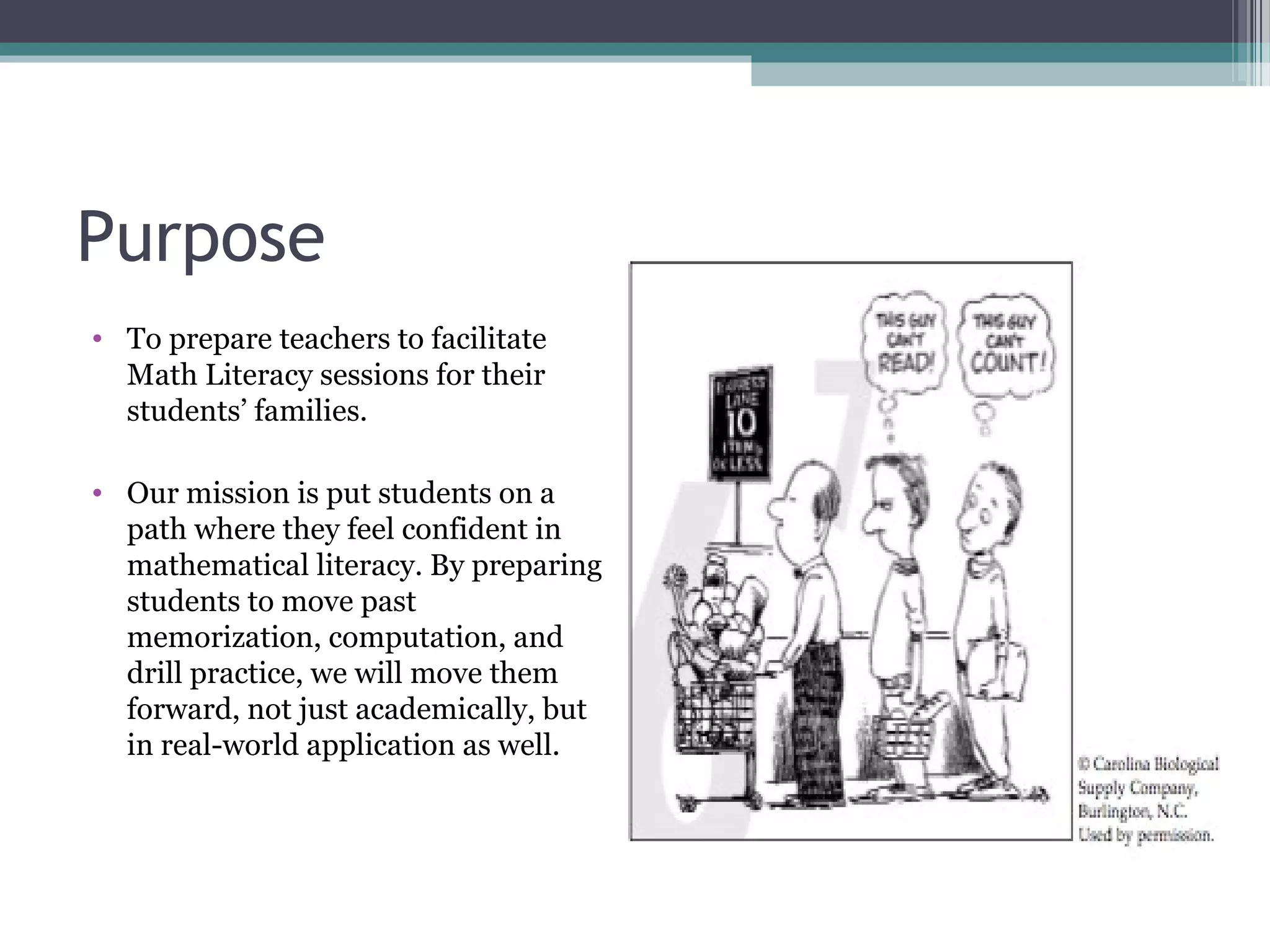
• To prepare teachers to facilitate
  Math Literacy sessions for their
  students’ families.

• Our mission is put students on a
  path where they feel confident in
  mathematical literacy. By preparing
  students to move past
  memorization, computation, and
  drill practice, we will move them
  forward, not just academically, but
  in real-world application as well.
Objective
• Teachers will be able to instruct the
  parents/guardians of their students in the area
  of Math Literacy.

• Parents/guardians will be given problem-solving
  strategies and techniques to use while working
  with their students at home to improve
  mathematical literacy.
Key Points
• What is Math Literacy?: “Literacy can simply be defined as the ability to
  read, write, speak, and use language. Mathematical Literacy implies that a
  person is able to reason, analyze, formulate, and solve problems in real-world
  setting,” (Martin, 2007).

• Why our students are in trouble: “The teenagers had to read the graph.
  They had to interpret it, analyze it, and explain their answers in writing. It took
  critical thinking. That’s where American teenagers lost it,” (ABC News, 2004).

• How to get students where they need to be: “Although mathematics is a
  specific area of knowledge, the kind of thinking developed in mathematics can
  be applied in all facets of life. Math teaching now emphasizes problem solving,
  developing and evaluating mathematical arguments, and being able to
  communicate one’s ideas. One might think of these as the new basics, the
  critical tools needed in the 21st century,” (National Council of Teachers of
  Mathematics, 2000).
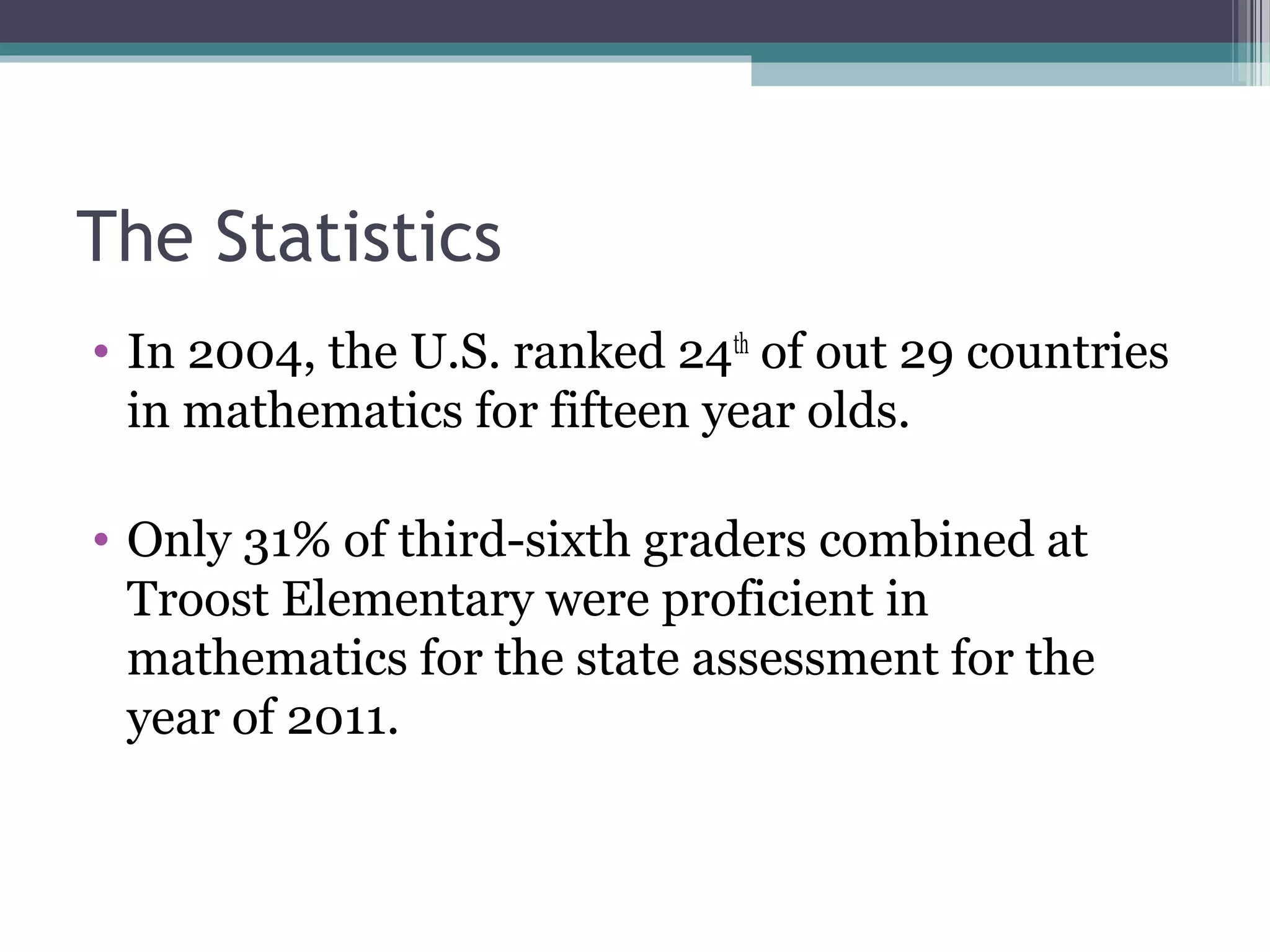
The Statistics
• In 2004, the U.S. ranked 24th of out 29 countries
  in mathematics for fifteen year olds.

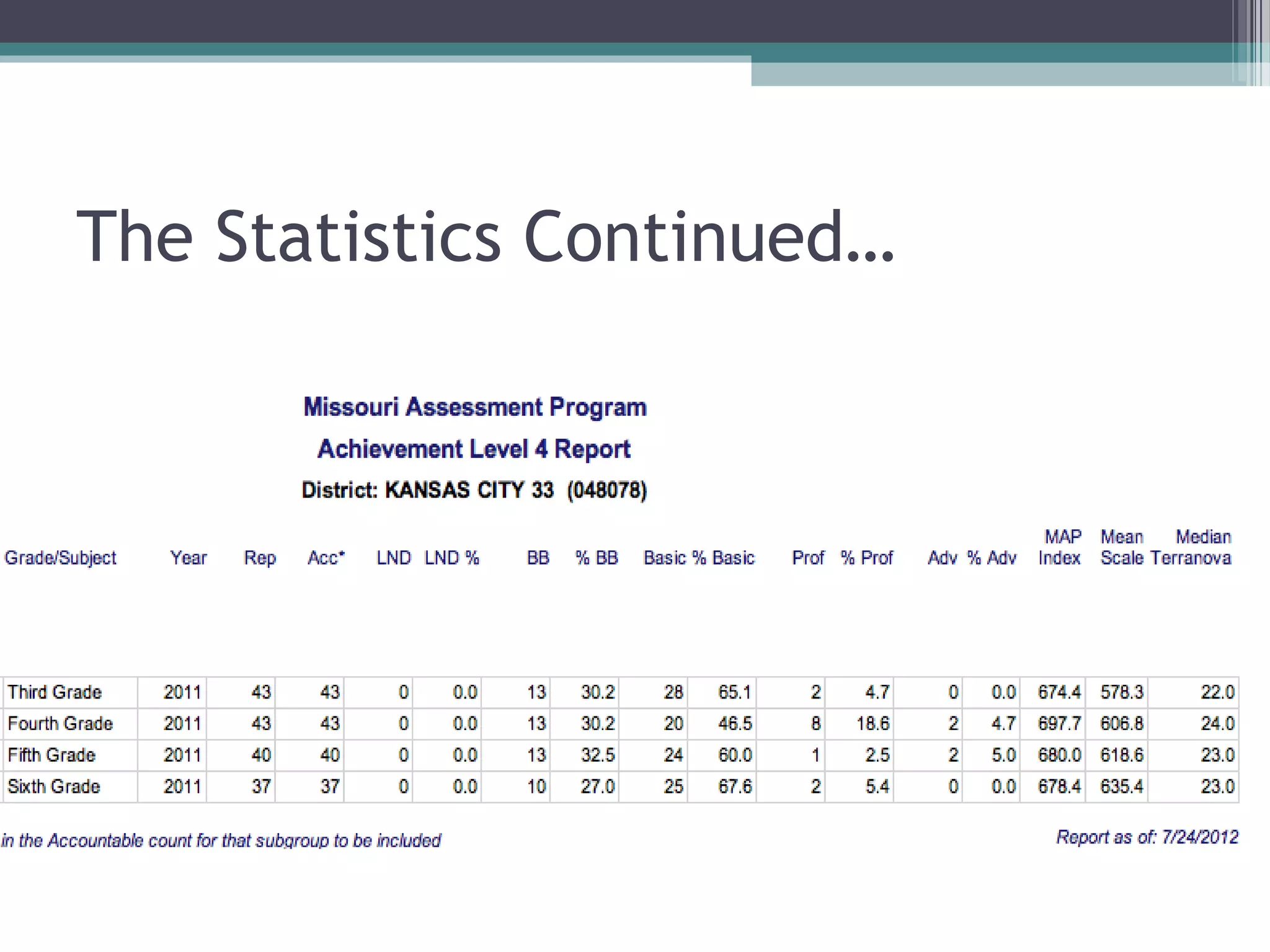
• Only 31% of third-sixth graders combined at
  Troost Elementary were proficient in
  mathematics for the state assessment for the
  year of 2011.
The Statistics Continued…
Overview
• This will be a 4-session series occurring every Wednesday in
  September 2012.
• The first session will be on September 5, 2012.
• Sessions will take place at Troost Elementary from 4:00 p.m.– 5:15
  p.m.
• Each week will focus on a specific component to help students tackle
  math literacy.
• Kayla Higginbotham will lead each session. These sessions will be
  predominantly focused on intermediate grades. However, if there
  are volunteers to lead for primary grades, breakout sessions will
  occur.
Overview Continued…
• Teachers will have the chance to use taught strategies with each other for the
  appropriate weekly skill. The first half of each session will be when the lesson is
  taught. The second half will be a time for teachers to put into practice what was
  just learned. In each session, teachers will have the chance to work
  independently and within cooperative learning groups.

• After teachers complete sessions, they will be equipped with
  information/materials in order to lead math literacy sessions with their
  students’ families. Materials include hand outs from the session, flash cards,
  manipulatives, internet resources, and notes taken.

• At the end of each session, teachers will have the opportunity to give feedback
  through short surveys to let presenter(s) know what was effective and what
  could be improved for future sessions.
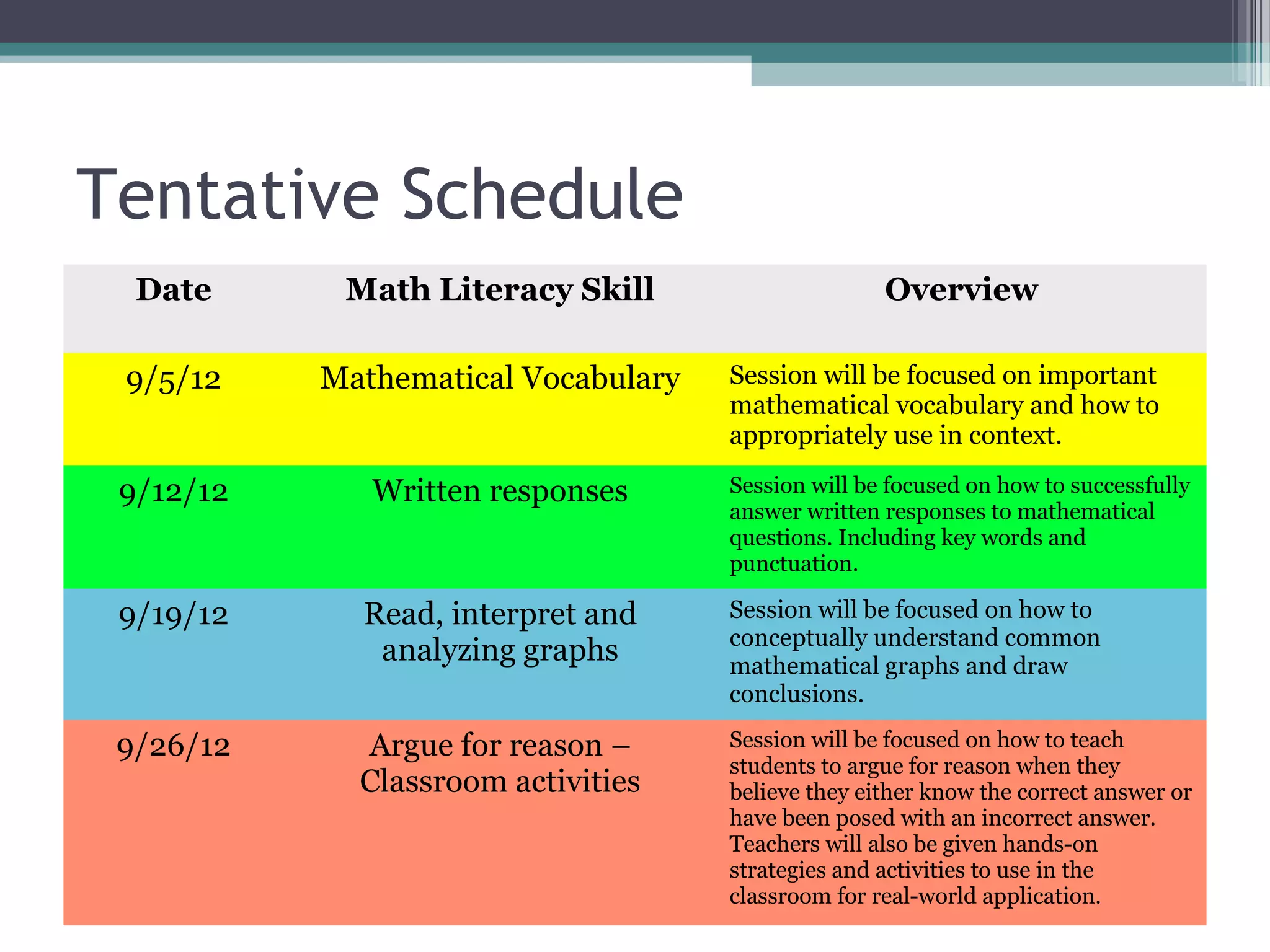
Tentative Schedule
  Date      Math Literacy Skill                     Overview

 9/5/12    Mathematical Vocabulary   Session will be focused on important
                                     mathematical vocabulary and how to
                                     appropriately use in context.

 9/12/12      Written responses      Session will be focused on how to successfully
                                     answer written responses to mathematical
                                     questions. Including key words and
                                     punctuation.

 9/19/12     Read, interpret and     Session will be focused on how to
                                     conceptually understand common
              analyzing graphs       mathematical graphs and draw
                                     conclusions.

 9/26/12     Argue for reason –      Session will be focused on how to teach
                                     students to argue for reason when they
             Classroom activities    believe they either know the correct answer or
                                     have been posed with an incorrect answer.
                                     Teachers will also be given hands-on
                                     strategies and activities to use in the
                                     classroom for real-world application.
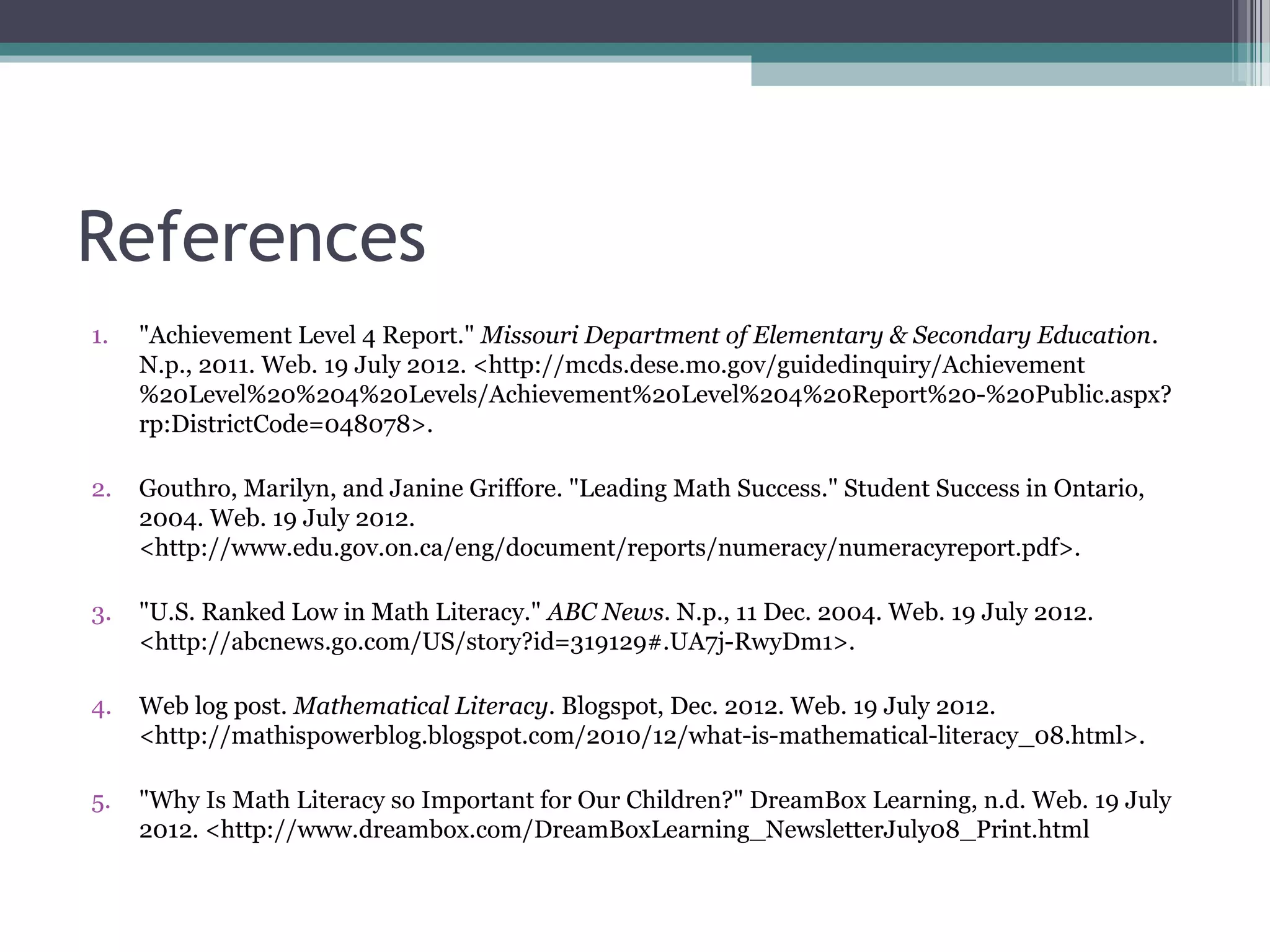
References
1.   "Achievement Level 4 Report." Missouri Department of Elementary & Secondary Education.
     N.p., 2011. Web. 19 July 2012. <http://mcds.dese.mo.gov/guidedinquiry/Achievement
     %20Level%20%204%20Levels/Achievement%20Level%204%20Report%20-%20Public.aspx?
     rp:DistrictCode=048078>.

2.   Gouthro, Marilyn, and Janine Griffore. "Leading Math Success." Student Success in Ontario,
     2004. Web. 19 July 2012.
     <http://www.edu.gov.on.ca/eng/document/reports/numeracy/numeracyreport.pdf>.

3.   "U.S. Ranked Low in Math Literacy." ABC News. N.p., 11 Dec. 2004. Web. 19 July 2012.
     <http://abcnews.go.com/US/story?id=319129#.UA7j-RwyDm1>.

4.   Web log post. Mathematical Literacy. Blogspot, Dec. 2012. Web. 19 July 2012.
     <http://mathispowerblog.blogspot.com/2010/12/what-is-mathematical-literacy_08.html>.

5.   "Why Is Math Literacy so Important for Our Children?" DreamBox Learning, n.d. Web. 19 July
     2012. <http://www.dreambox.com/DreamBoxLearning_NewsletterJuly08_Print.html

Math Literacy

  • 1.
    Math Literacy – ProfessionalDevelopment Kayla Higginbotham 5th Grade Teacher – Troost Elementary Kansas City Public Schools khigginb@kcmsd.net July 20, 2012
  • 2.
    Purpose • To prepareteachers to facilitate Math Literacy sessions for their students’ families. • Our mission is put students on a path where they feel confident in mathematical literacy. By preparing students to move past memorization, computation, and drill practice, we will move them forward, not just academically, but in real-world application as well.
  • 3.
    Objective • Teachers willbe able to instruct the parents/guardians of their students in the area of Math Literacy. • Parents/guardians will be given problem-solving strategies and techniques to use while working with their students at home to improve mathematical literacy.
  • 4.
    Key Points • Whatis Math Literacy?: “Literacy can simply be defined as the ability to read, write, speak, and use language. Mathematical Literacy implies that a person is able to reason, analyze, formulate, and solve problems in real-world setting,” (Martin, 2007). • Why our students are in trouble: “The teenagers had to read the graph. They had to interpret it, analyze it, and explain their answers in writing. It took critical thinking. That’s where American teenagers lost it,” (ABC News, 2004). • How to get students where they need to be: “Although mathematics is a specific area of knowledge, the kind of thinking developed in mathematics can be applied in all facets of life. Math teaching now emphasizes problem solving, developing and evaluating mathematical arguments, and being able to communicate one’s ideas. One might think of these as the new basics, the critical tools needed in the 21st century,” (National Council of Teachers of Mathematics, 2000).
  • 5.
    The Statistics • In2004, the U.S. ranked 24th of out 29 countries in mathematics for fifteen year olds. • Only 31% of third-sixth graders combined at Troost Elementary were proficient in mathematics for the state assessment for the year of 2011.
  • 6.
  • 7.
    Overview • This willbe a 4-session series occurring every Wednesday in September 2012. • The first session will be on September 5, 2012. • Sessions will take place at Troost Elementary from 4:00 p.m.– 5:15 p.m. • Each week will focus on a specific component to help students tackle math literacy. • Kayla Higginbotham will lead each session. These sessions will be predominantly focused on intermediate grades. However, if there are volunteers to lead for primary grades, breakout sessions will occur.
  • 8.
    Overview Continued… • Teacherswill have the chance to use taught strategies with each other for the appropriate weekly skill. The first half of each session will be when the lesson is taught. The second half will be a time for teachers to put into practice what was just learned. In each session, teachers will have the chance to work independently and within cooperative learning groups. • After teachers complete sessions, they will be equipped with information/materials in order to lead math literacy sessions with their students’ families. Materials include hand outs from the session, flash cards, manipulatives, internet resources, and notes taken. • At the end of each session, teachers will have the opportunity to give feedback through short surveys to let presenter(s) know what was effective and what could be improved for future sessions.
  • 9.
    Tentative Schedule Date Math Literacy Skill Overview 9/5/12 Mathematical Vocabulary Session will be focused on important mathematical vocabulary and how to appropriately use in context. 9/12/12 Written responses Session will be focused on how to successfully answer written responses to mathematical questions. Including key words and punctuation. 9/19/12 Read, interpret and Session will be focused on how to conceptually understand common analyzing graphs mathematical graphs and draw conclusions. 9/26/12 Argue for reason – Session will be focused on how to teach students to argue for reason when they Classroom activities believe they either know the correct answer or have been posed with an incorrect answer. Teachers will also be given hands-on strategies and activities to use in the classroom for real-world application.
  • 10.
    References 1. "Achievement Level 4 Report." Missouri Department of Elementary & Secondary Education. N.p., 2011. Web. 19 July 2012. <http://mcds.dese.mo.gov/guidedinquiry/Achievement %20Level%20%204%20Levels/Achievement%20Level%204%20Report%20-%20Public.aspx? rp:DistrictCode=048078>. 2. Gouthro, Marilyn, and Janine Griffore. "Leading Math Success." Student Success in Ontario, 2004. Web. 19 July 2012. <http://www.edu.gov.on.ca/eng/document/reports/numeracy/numeracyreport.pdf>. 3. "U.S. Ranked Low in Math Literacy." ABC News. N.p., 11 Dec. 2004. Web. 19 July 2012. <http://abcnews.go.com/US/story?id=319129#.UA7j-RwyDm1>. 4. Web log post. Mathematical Literacy. Blogspot, Dec. 2012. Web. 19 July 2012. <http://mathispowerblog.blogspot.com/2010/12/what-is-mathematical-literacy_08.html>. 5. "Why Is Math Literacy so Important for Our Children?" DreamBox Learning, n.d. Web. 19 July 2012. <http://www.dreambox.com/DreamBoxLearning_NewsletterJuly08_Print.html