Whitney Galusha SPED 6002 July 21, 2010
“ Thoughtful literacy is the ability to think about the ideas, events, and characters in the text, beyond just recalling details” (Allington, 2006).
For many children just calling the words is an accomplishment all on its own.  However calling words is not true reading. For a student to be a true, literate reader they must be able to read the words written and be able to comprehend the information presented. How do we help the students who struggle with one or both of these?  In order to do this we must first gather basic information on where the student is performing and what they already know.
Phonological Awareness usually involves the awareness of words, rhymes, and syllables at the preschool and kindergarten levels. It also includes individual phonemes during kindergarten and first grade. For students having trouble with Phonological Awareness teachers should: Emphasize blending, segmenting, and manipulation activities that focus on individual phoneme sound This includes sounds in the initial, final, and medial positions
Students should be able to: Recognize or produce words that rhyme Blend or segment syllables Blend or segment onset rhymes Recognize that two words begin or end with the same sound or different sounds Recognize that two words contain the same or different medial sounds Segment or blend a words individual sound Manipulate sounds to identify a new word when a sound is deleted or substituted in a word
Use tiles or chips to give the student something to manipulate Ask the student to begin with an easier take (changing the initial sound of a given word) then word towards harder tasks (have the student change the ending or medial sound in a word)
Word Identification is the ability to read words quickly and effortlessly recognizing words on sight Word identification instruction includes Teaching sight word recognition Teaching decoding skills
means that students are able to read a word automatically when encountering it in text or in an isolated list of words Sight words include High frequency words Irregular words Important vocabulary words in content-area books
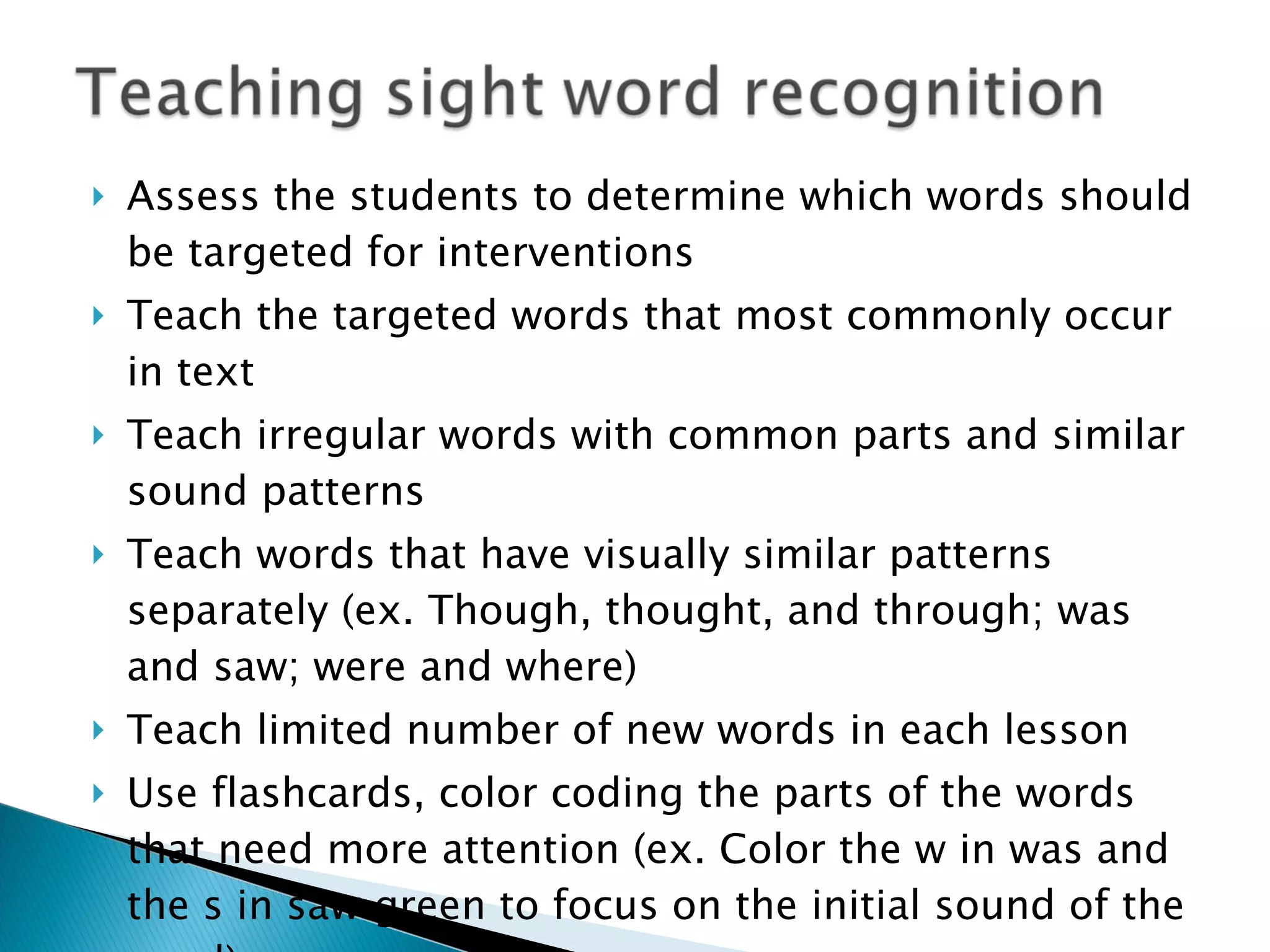
Assess the students to determine which words should be targeted for interventions Teach the targeted words that most commonly occur in text Teach irregular words with common parts and similar sound patterns Teach words that have visually similar patterns separately (ex. Though, thought, and through; was and saw; were and where) Teach limited number of new words in each lesson Use flashcards, color coding the parts of the words that need more attention (ex. Color the w in was and the s in saw green to focus on the initial sound of the word) Review words daily at the conclusion of the lesson
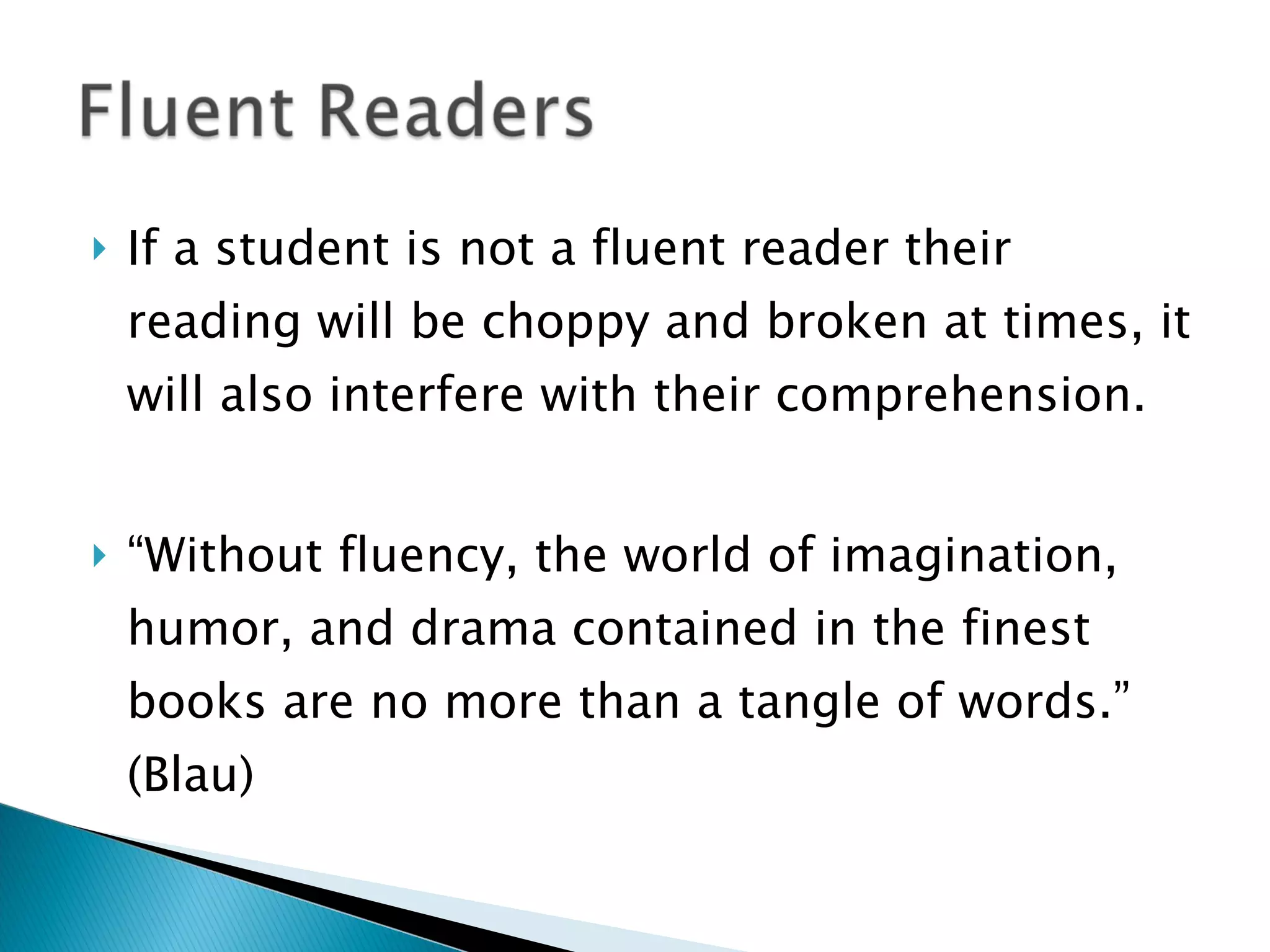
If a student is not a fluent reader their reading will be choppy and broken at times, it will also interfere with their comprehension.  “ Without fluency, the world of imagination, humor, and drama contained in the finest books are no more than a tangle of words.” (Blau)
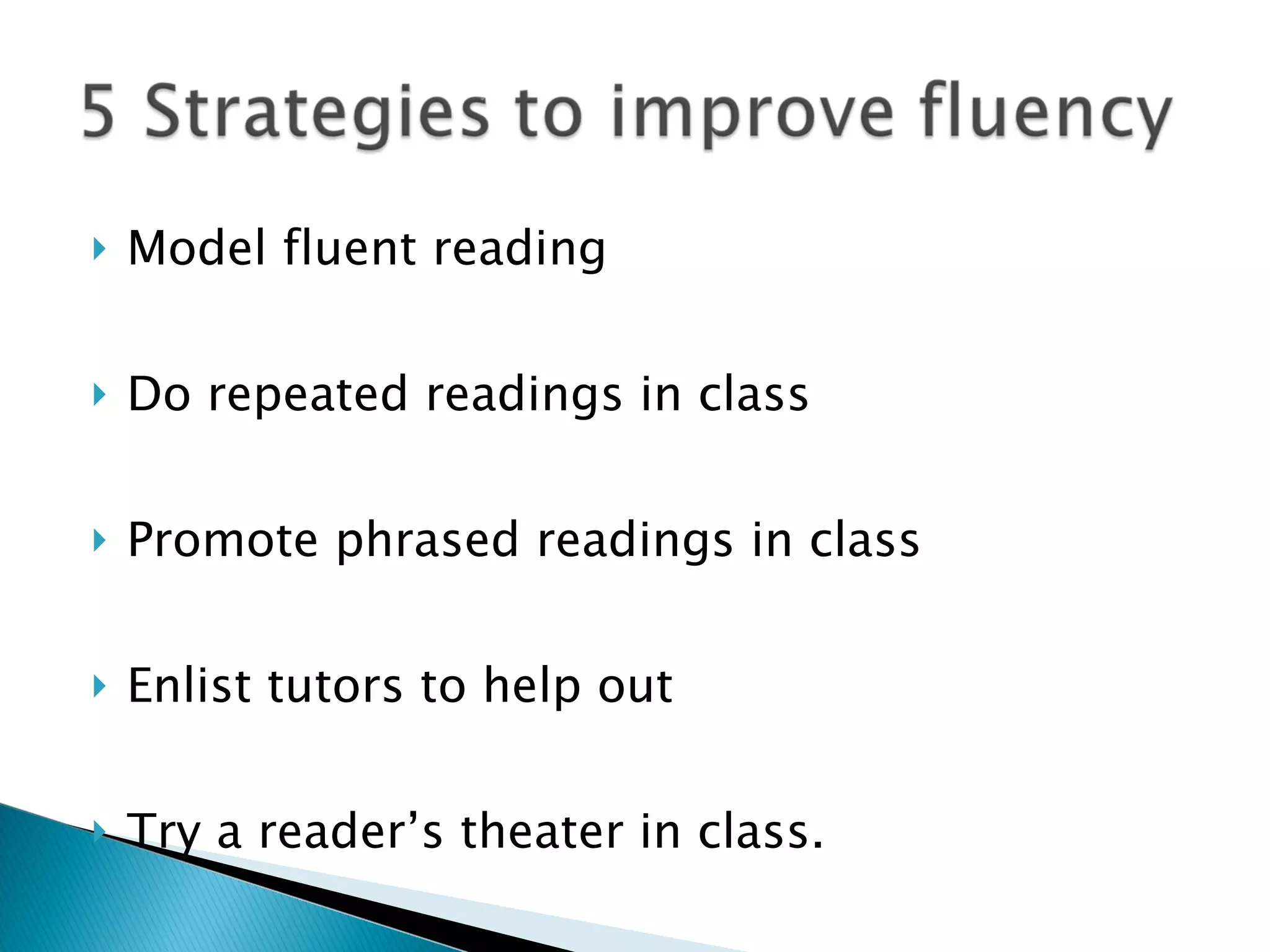
Model fluent reading Do repeated readings in class Promote phrased readings in class Enlist tutors to help out Try a reader’s theater in class.
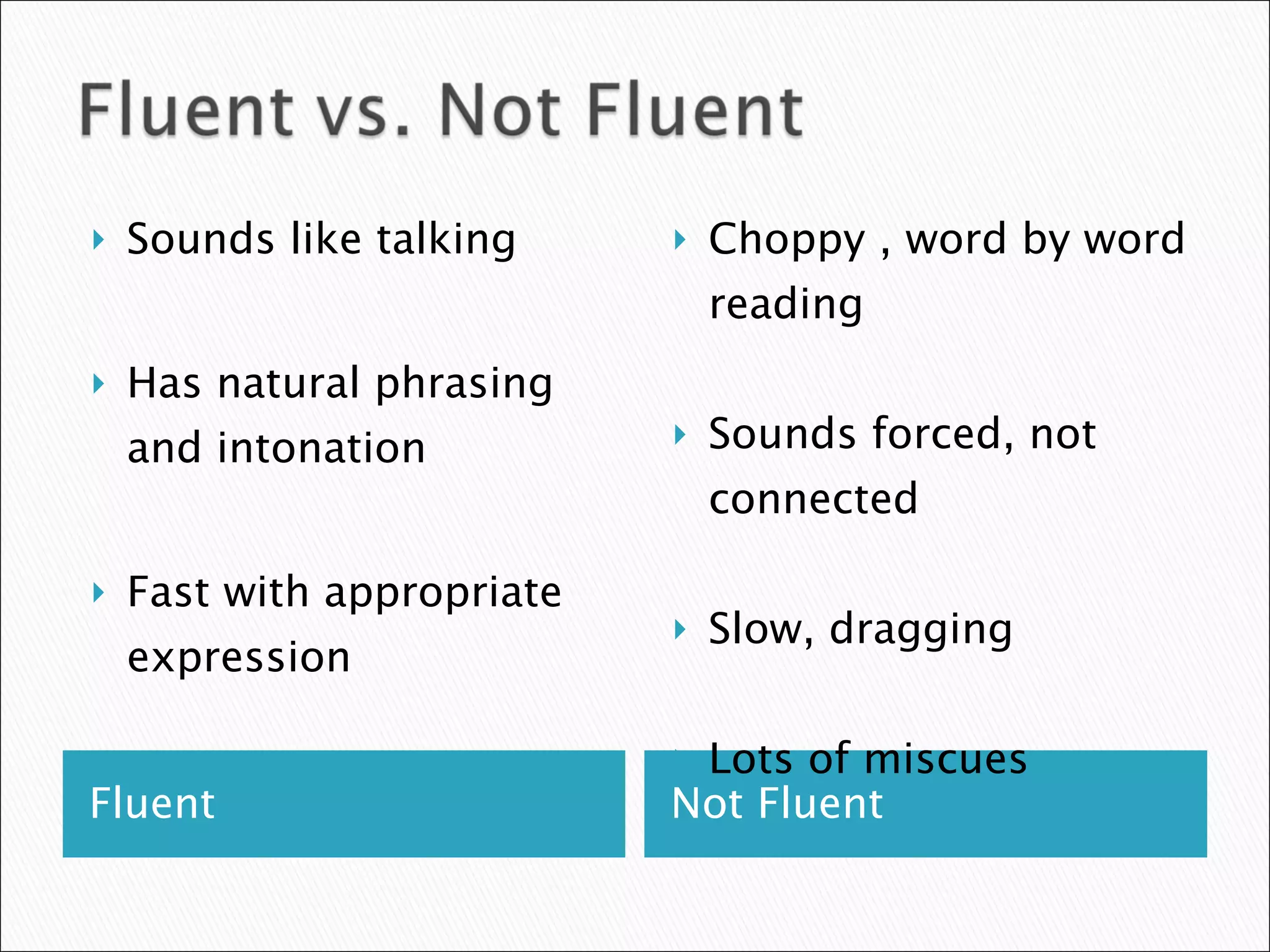
Fluent Not Fluent Sounds like talking Has natural phrasing and intonation Fast with appropriate expression Choppy , word by word reading Sounds forced, not connected Slow, dragging Lots of miscues
Have students practice reading many books that are below their actual reading level, this will help them pick up their pace Read a passage to a student and then having them read it back Recording a students reading and have them listen to it so they can hear what you are hearing Give the student an index card with a cut-out to frame the line they are reading right then, some students are overwhelmed by too many words on a page
When a student reads a book they are fluent with, comprehension is much more easily obtained Reading comprehension involves the following skills: Recalling word meaning Using context to make word-meaning inferences Finding answers to questions either explicitly or in paraphrase of the context Weaving together ideas from the content Recognizing a writers purpose, attitude, tone, and mood Identifying the writer’s technique Following the structure of a passage
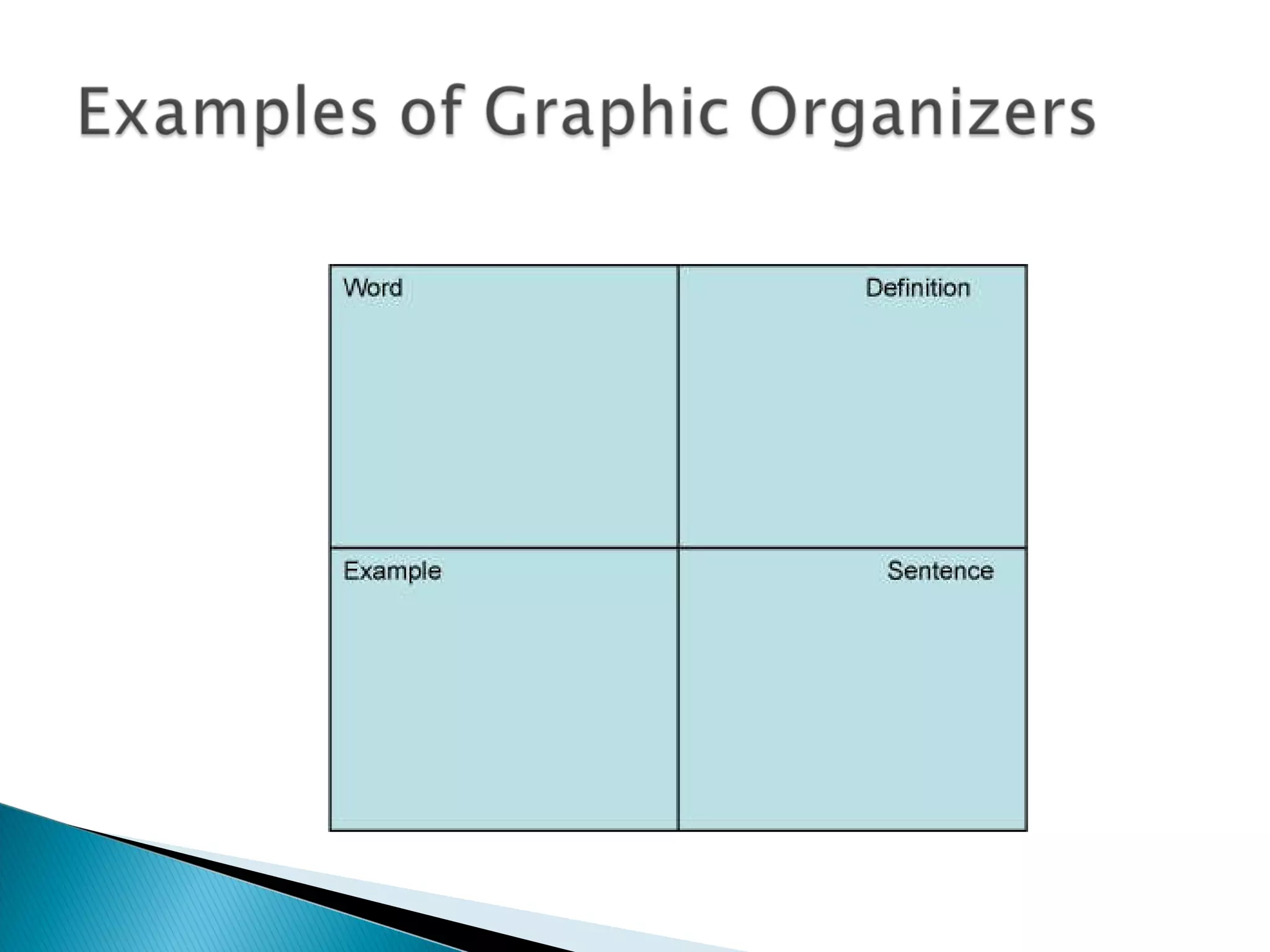
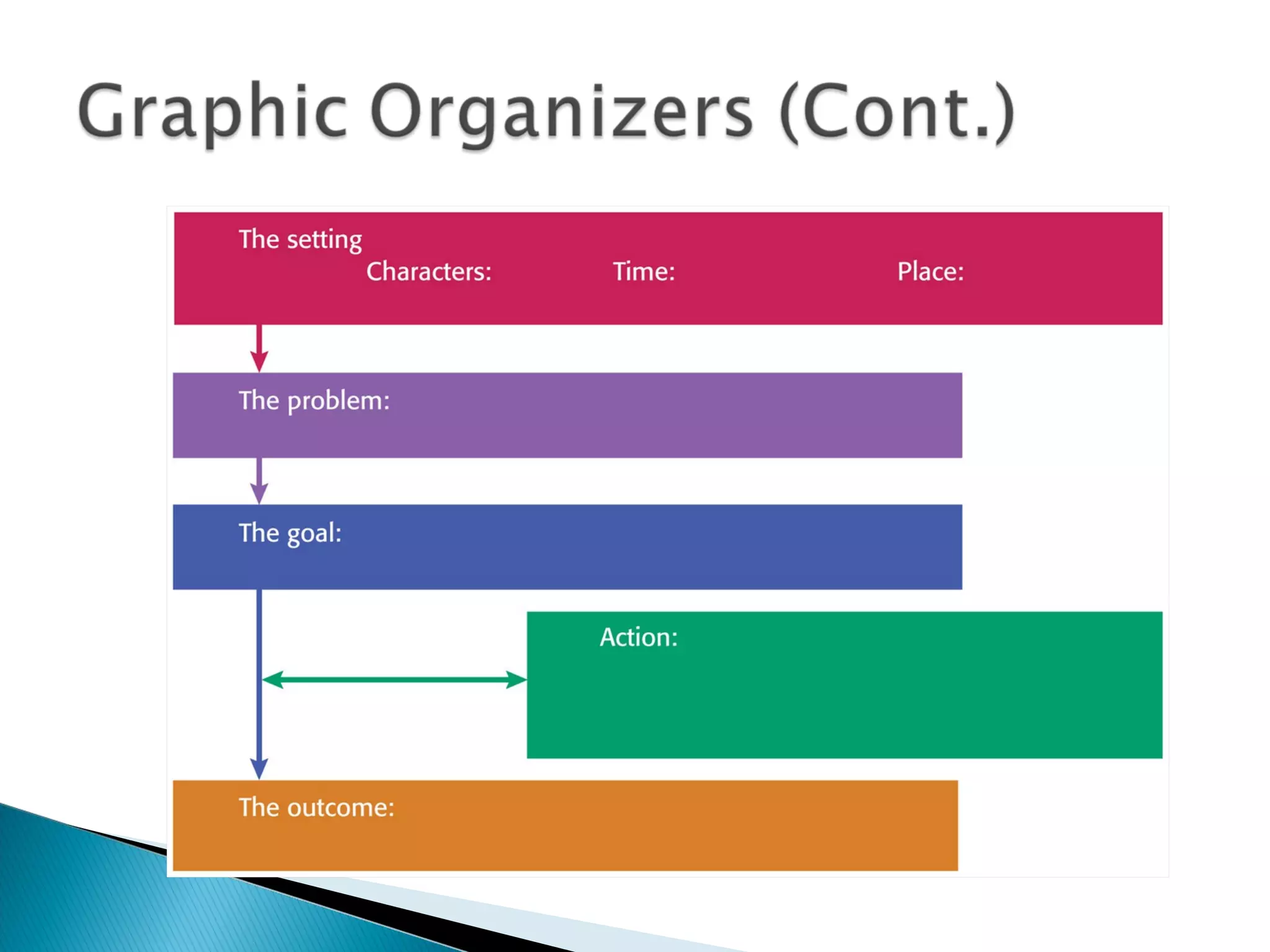
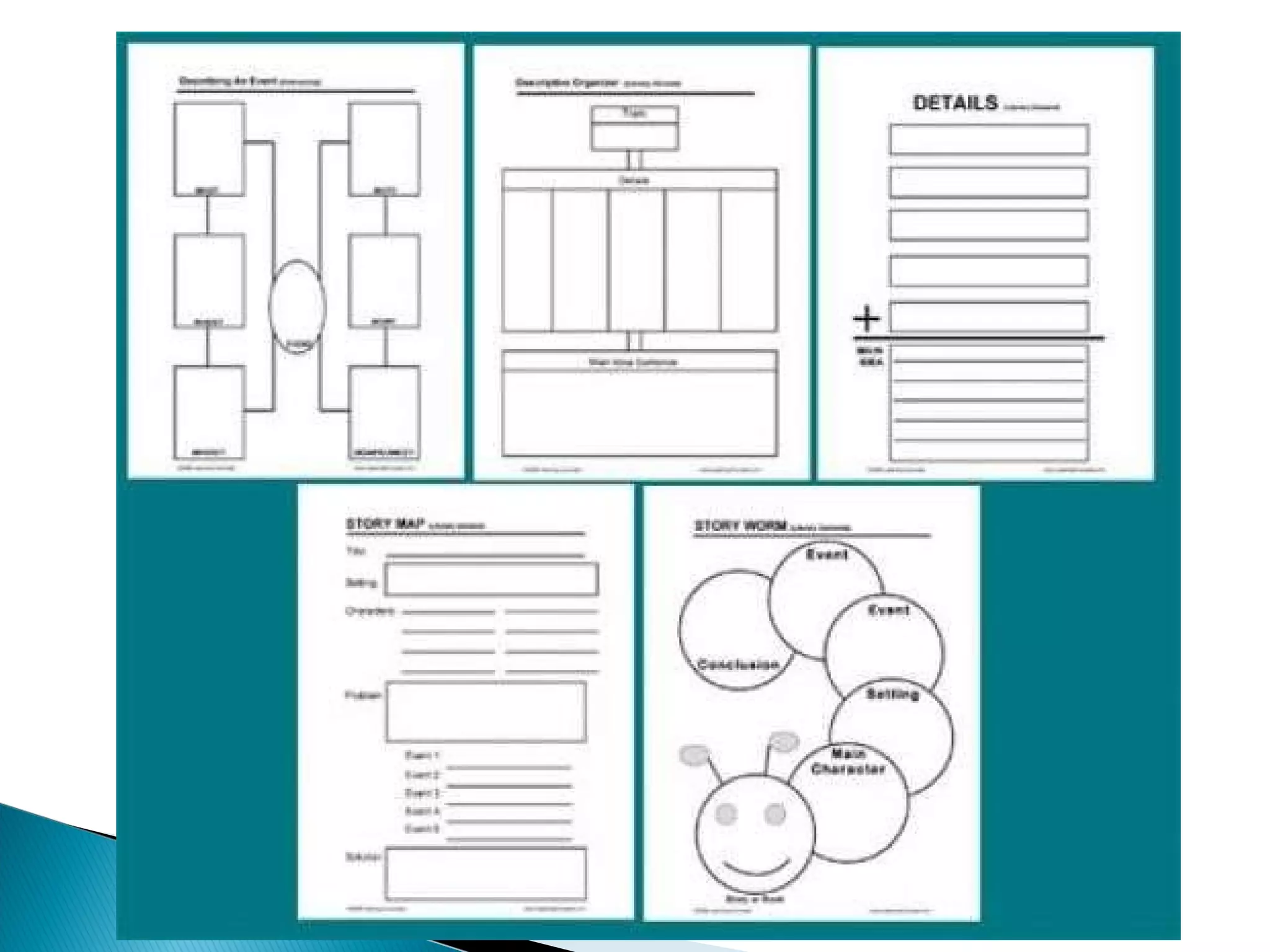
Effective comprehension teaching focuses on teaching the student to construct meaning before, during, and after reading the text Background knowledge, or prior knowledge, helps a reader understand what has been written Graphic organizers can assist students in comprehension
Use think alouds to model what students should be doing Before reading: Active students background knowledge Teach key vocabulary words Give students a purpose for reading Have students preview what they will be reading During Reading: Use a variety of questioning techniques Have student recall information Apply the information in various ways Graphic organizers can be used to help students visually depict what they are reading Show students how to self-monitor as they are reading Teach fix-up strategies to clarify the meaning of unknown words, concepts, and/or phrases
After Reading: Use various types of questioning to determine the depth of students understanding Review vocabulary terms Student should be able to summarize what has been read Graphic Organizers can be completed and discussed


“ Graphic organizers work well when students are assigned to cooperative learning groups.” “ The use of a computer software application that allows students to create graphic organizers can help foster reading comprehension in an inclusion classroom if other teacher tools and training are not available. Students needs can be met by a combination of teacher assistance in creating a graphic organizer in the most appropriate format.” http://hubpages.com/hub/Using-graphic-organizers-to-facilitate-learning
A just right book is not to hard or too easy It looks interesting to the reader (they want to read it) A student should use the five finger test to check put one finger up each time you come to an unknown word, when you reach 5 fingers put the book back and select another A reader should be able to understand what they are reading.
“ The more that you read, the more things you will know. The more that you learn, the more places you'll go.” ~Dr. Seuss~
Allington, R. (2006). What really matters for struggling readers. Knoxville: University of Tennessee Press. Lisa Blau  http://www2.scholastic.com/browse/article.jsp?id=4367 Bryant, B. Bryant, D. & Smith, D. (2008). Teaching students with special needs in inclusive classrooms. Boston: Pearson Education, Inc. http://hubpages.com/hub/Using-graphic-organizers-to-facilitate-learning http://www.liketoread.com/reading_habits.php http://www2.scholastic.com/browse/article.jsp?id=4367

Assiting Students in Learning to Read

  • 1.
    Whitney Galusha SPED6002 July 21, 2010
  • 2.
    “ Thoughtful literacyis the ability to think about the ideas, events, and characters in the text, beyond just recalling details” (Allington, 2006).
  • 3.
    For many childrenjust calling the words is an accomplishment all on its own. However calling words is not true reading. For a student to be a true, literate reader they must be able to read the words written and be able to comprehend the information presented. How do we help the students who struggle with one or both of these? In order to do this we must first gather basic information on where the student is performing and what they already know.
  • 4.
    Phonological Awareness usuallyinvolves the awareness of words, rhymes, and syllables at the preschool and kindergarten levels. It also includes individual phonemes during kindergarten and first grade. For students having trouble with Phonological Awareness teachers should: Emphasize blending, segmenting, and manipulation activities that focus on individual phoneme sound This includes sounds in the initial, final, and medial positions
  • 5.
    Students should beable to: Recognize or produce words that rhyme Blend or segment syllables Blend or segment onset rhymes Recognize that two words begin or end with the same sound or different sounds Recognize that two words contain the same or different medial sounds Segment or blend a words individual sound Manipulate sounds to identify a new word when a sound is deleted or substituted in a word
  • 6.
    Use tiles orchips to give the student something to manipulate Ask the student to begin with an easier take (changing the initial sound of a given word) then word towards harder tasks (have the student change the ending or medial sound in a word)
  • 7.
    Word Identification isthe ability to read words quickly and effortlessly recognizing words on sight Word identification instruction includes Teaching sight word recognition Teaching decoding skills
  • 8.
    means that studentsare able to read a word automatically when encountering it in text or in an isolated list of words Sight words include High frequency words Irregular words Important vocabulary words in content-area books
  • 9.
    Assess the studentsto determine which words should be targeted for interventions Teach the targeted words that most commonly occur in text Teach irregular words with common parts and similar sound patterns Teach words that have visually similar patterns separately (ex. Though, thought, and through; was and saw; were and where) Teach limited number of new words in each lesson Use flashcards, color coding the parts of the words that need more attention (ex. Color the w in was and the s in saw green to focus on the initial sound of the word) Review words daily at the conclusion of the lesson
  • 10.
    If a studentis not a fluent reader their reading will be choppy and broken at times, it will also interfere with their comprehension. “ Without fluency, the world of imagination, humor, and drama contained in the finest books are no more than a tangle of words.” (Blau)
  • 11.
    Model fluent readingDo repeated readings in class Promote phrased readings in class Enlist tutors to help out Try a reader’s theater in class.
  • 12.
    Fluent Not FluentSounds like talking Has natural phrasing and intonation Fast with appropriate expression Choppy , word by word reading Sounds forced, not connected Slow, dragging Lots of miscues
  • 13.
    Have students practicereading many books that are below their actual reading level, this will help them pick up their pace Read a passage to a student and then having them read it back Recording a students reading and have them listen to it so they can hear what you are hearing Give the student an index card with a cut-out to frame the line they are reading right then, some students are overwhelmed by too many words on a page
  • 14.
    When a studentreads a book they are fluent with, comprehension is much more easily obtained Reading comprehension involves the following skills: Recalling word meaning Using context to make word-meaning inferences Finding answers to questions either explicitly or in paraphrase of the context Weaving together ideas from the content Recognizing a writers purpose, attitude, tone, and mood Identifying the writer’s technique Following the structure of a passage
  • 15.
    Effective comprehension teachingfocuses on teaching the student to construct meaning before, during, and after reading the text Background knowledge, or prior knowledge, helps a reader understand what has been written Graphic organizers can assist students in comprehension
  • 16.
    Use think aloudsto model what students should be doing Before reading: Active students background knowledge Teach key vocabulary words Give students a purpose for reading Have students preview what they will be reading During Reading: Use a variety of questioning techniques Have student recall information Apply the information in various ways Graphic organizers can be used to help students visually depict what they are reading Show students how to self-monitor as they are reading Teach fix-up strategies to clarify the meaning of unknown words, concepts, and/or phrases
  • 17.
    After Reading: Usevarious types of questioning to determine the depth of students understanding Review vocabulary terms Student should be able to summarize what has been read Graphic Organizers can be completed and discussed
  • 18.
  • 19.
  • 20.
  • 21.
    “ Graphic organizerswork well when students are assigned to cooperative learning groups.” “ The use of a computer software application that allows students to create graphic organizers can help foster reading comprehension in an inclusion classroom if other teacher tools and training are not available. Students needs can be met by a combination of teacher assistance in creating a graphic organizer in the most appropriate format.” http://hubpages.com/hub/Using-graphic-organizers-to-facilitate-learning
  • 22.
    A just rightbook is not to hard or too easy It looks interesting to the reader (they want to read it) A student should use the five finger test to check put one finger up each time you come to an unknown word, when you reach 5 fingers put the book back and select another A reader should be able to understand what they are reading.
  • 23.
    “ The morethat you read, the more things you will know. The more that you learn, the more places you'll go.” ~Dr. Seuss~
  • 24.
    Allington, R. (2006).What really matters for struggling readers. Knoxville: University of Tennessee Press. Lisa Blau http://www2.scholastic.com/browse/article.jsp?id=4367 Bryant, B. Bryant, D. & Smith, D. (2008). Teaching students with special needs in inclusive classrooms. Boston: Pearson Education, Inc. http://hubpages.com/hub/Using-graphic-organizers-to-facilitate-learning http://www.liketoread.com/reading_habits.php http://www2.scholastic.com/browse/article.jsp?id=4367