Amit Singh Dahal
g5638545
Content Addressable
Network(CAN)
Structured P2P Network
Outline
 Introduction
 Overview
 Construction
 Routing
 Maintenance
 Evaluation
 Future Improvements
Introduction
 one of the original four distributed hash table
proposals, introduced concurrently with
Chords, Pastry, and Tapestry.
 developed at UC Berkeley
 CANs overlay routing easy to understand
 scalable indexing system for large-scale
decentralized storage applications
 has a good performance
Overview
 distributed, decentralized P2P infrastructure
system that maps keys onto values
 keys hashed into d dimensional Cartesian space
 Interface:
 insert(key, value)
 retrieve(key)
 associate to each node and item a unique
coordinate in an d-dimensional Cartesian space
Overview
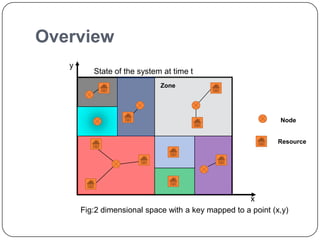
 entire space is partitioned amongst all the nodes
 every node “owns” a zone in the overall space
 can store data at “points” in the space
 can route from one “point” to another
 point  node that owns the enclosing zone
Overview
y
x
State of the system at time t
Node
Resource
Zone
Fig:2 dimensional space with a key mapped to a point (x,y)
Construction
Bootstrap
node
new node
Construction
I
Bootstrap
node
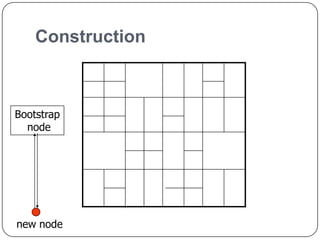
new node 1) Discover some node “I” already in CAN
Construction
2) Pick random point in space
I
(x,y)
new node
Construction
(x,y)
3) I routes to (x,y), discovers node J
I
J
new node
Construction
newJ
4) split J’s zone in half… new owns one half
Routing
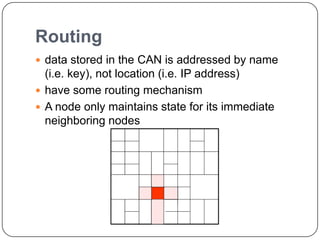
 data stored in the CAN is addressed by name
(i.e. key), not location (i.e. IP address)
 have some routing mechanism
 A node only maintains state for its immediate
neighboring nodes
Routing
y
Node
M(x,y)
N(x,y)
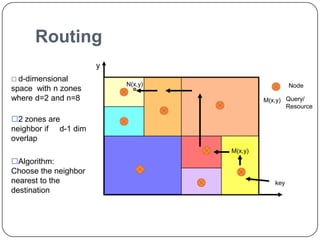
 d-dimensional
space with n zones
where d=2 and n=8
2 zones are
neighbor if d-1 dim
overlap
Algorithm:
Choose the neighbor
nearest to the
destination
M(x,y) Query/
Resource
key
Maintenance
 Use zone takeover in case of failure or leaving of
a node
 Send your neighbor table update to neighbors to
inform that you are alive at discrete time interval t
 If your neighbor does not send alive in time
t, takeover its zone
 Zone reassignment is needed
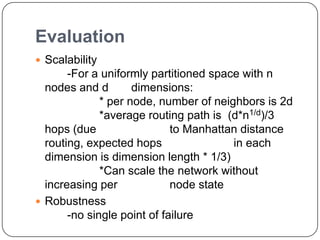
Evaluation
 Scalability
-For a uniformly partitioned space with n
nodes and d dimensions:
* per node, number of neighbors is 2d
*average routing path is (d*n1/d)/3
hops (due to Manhattan distance
routing, expected hops in each
dimension is dimension length * 1/3)
*Can scale the network without
increasing per node state
 Robustness
-no single point of failure
Future Improvements
 Multi-dimension
-increase in dimension reduces path length
 Caching and replication techniques for better
performance
 Overloading the zone
-increases availability, reduces path
length, reduces per hop latency
 Uniform partitioning
-compare the volume of the zone with its
neighbors
-partition the zone having largest volume
THANK
YOU!!! 

Content addressable network(can)

  • 1.
    Amit Singh Dahal g5638545 ContentAddressable Network(CAN) Structured P2P Network
  • 2.
    Outline  Introduction  Overview Construction  Routing  Maintenance  Evaluation  Future Improvements
  • 3.
    Introduction  one ofthe original four distributed hash table proposals, introduced concurrently with Chords, Pastry, and Tapestry.  developed at UC Berkeley  CANs overlay routing easy to understand  scalable indexing system for large-scale decentralized storage applications  has a good performance
  • 4.
    Overview  distributed, decentralizedP2P infrastructure system that maps keys onto values  keys hashed into d dimensional Cartesian space  Interface:  insert(key, value)  retrieve(key)  associate to each node and item a unique coordinate in an d-dimensional Cartesian space
  • 5.
    Overview  entire spaceis partitioned amongst all the nodes  every node “owns” a zone in the overall space  can store data at “points” in the space  can route from one “point” to another  point  node that owns the enclosing zone
  • 6.
    Overview y x State of thesystem at time t Node Resource Zone Fig:2 dimensional space with a key mapped to a point (x,y)
  • 7.
  • 8.
    Construction I Bootstrap node new node 1)Discover some node “I” already in CAN
  • 9.
    Construction 2) Pick randompoint in space I (x,y) new node
  • 10.
    Construction (x,y) 3) I routesto (x,y), discovers node J I J new node
  • 11.
    Construction newJ 4) split J’szone in half… new owns one half
  • 12.
    Routing  data storedin the CAN is addressed by name (i.e. key), not location (i.e. IP address)  have some routing mechanism  A node only maintains state for its immediate neighboring nodes
  • 13.
    Routing y Node M(x,y) N(x,y)  d-dimensional space withn zones where d=2 and n=8 2 zones are neighbor if d-1 dim overlap Algorithm: Choose the neighbor nearest to the destination M(x,y) Query/ Resource key
  • 14.
    Maintenance  Use zonetakeover in case of failure or leaving of a node  Send your neighbor table update to neighbors to inform that you are alive at discrete time interval t  If your neighbor does not send alive in time t, takeover its zone  Zone reassignment is needed
  • 15.
    Evaluation  Scalability -For auniformly partitioned space with n nodes and d dimensions: * per node, number of neighbors is 2d *average routing path is (d*n1/d)/3 hops (due to Manhattan distance routing, expected hops in each dimension is dimension length * 1/3) *Can scale the network without increasing per node state  Robustness -no single point of failure
  • 16.
    Future Improvements  Multi-dimension -increasein dimension reduces path length  Caching and replication techniques for better performance  Overloading the zone -increases availability, reduces path length, reduces per hop latency  Uniform partitioning -compare the volume of the zone with its neighbors -partition the zone having largest volume
  • 17.