CSE 5306
Distributed Systems
Architectures
1
Architecture
• Software architecture
– How software components are organized,
– How software components interact
• System architecture
– Instantiation and placement of software
components on real machines
• Centralized architecture, client-server system
• decentralized architecture, peer-to-peer system
• Hybrid architecture
2
Software Architecture
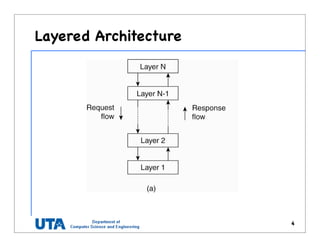
• Layered architecture
– widely adopted by the networking community
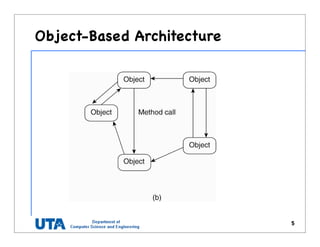
• Object-based architecture
– E.g., client-server style (ftp)
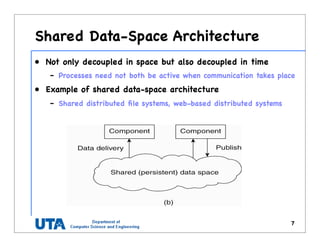
• Data-centered architecture
– Communicate through a common repository
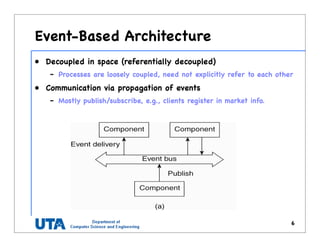
• Event-based architecture
– Communicate through the propagation of events,
e.g., publish/subscribe systems
3
Layered Architecture
4
Object-Based Architecture
5
Event-Based Architecture
6
• Decoupled in space (referentially decoupled)
– Processes are loosely coupled, need not explicitly refer to each other
• Communication via propagation of events
– Mostly publish/subscribe, e.g., clients register in market info.
Shared Data-Space Architecture
7
• Not only decoupled in space but also decoupled in time
– Processes need not both be active when communication takes place
• Example of shared data-space architecture
– Shared distributed file systems, web-based distributed systems
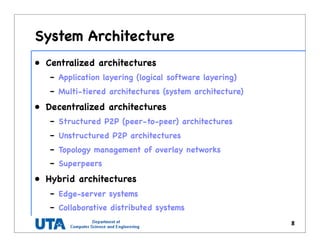
System Architecture
• Centralized architectures
– Application layering (logical software layering)
– Multi-tiered architectures (system architecture)
• Decentralized architectures
– Structured P2P (peer-to-peer) architectures
– Unstructured P2P architectures
– Topology management of overlay networks
– Superpeers
• Hybrid architectures
– Edge-server systems
– Collaborative distributed systems
8
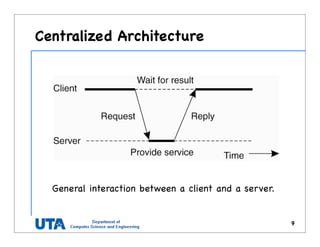
Centralized Architecture
9
General interaction between a client and a server.
Client-Server Communication
• Connectionless protocol
– It is hard for a sender to detect if the message is
successfully received
• Retransmission may cause problems
– Usually ok for idempotent operations
• Operations can be repeated many times without harm, e.g.,
get a quotes on stock, search on web
• Connection-oriented protocols
– Often used for non-idempotent operations
• E.g., buying stock
– Problem: low performance in local-area networks
10
Application Layering
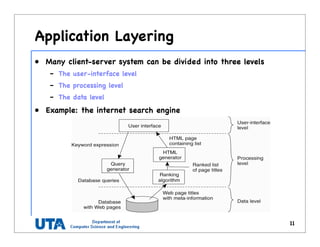
• Many client-server system can be divided into three levels
– The user-interface level
– The processing level
– The data level
• Example: the internet search engine
11
Two-tiered Architectures
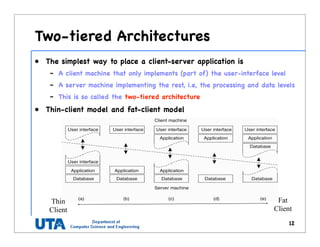
• The simplest way to place a client-server application is
– A client machine that only implements (part of) the user-interface level
– A server machine implementing the rest, i.e, the processing and data levels
– This is so called the two-tiered architecture
• Thin-client model and fat-client model
12
Thin
Client
Fat
Client
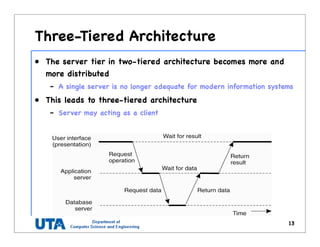
Three-Tiered Architecture
• The server tier in two-tiered architecture becomes more and
more distributed
– A single server is no longer adequate for modern information systems
• This leads to three-tiered architecture
– Server may acting as a client
13
Decentralized Architecture
• Multi-tiered architectures can be considered as vertical
distribution
– Placing logically different components on different machines
• An alternative is horizontal distribution (peer-to-peer
systems)
– A collection of logically equivalent parts
– Each part operates on its own share of the complete data
set, balancing the load
• The main question for peer-to-peer system is
– How to organize the processes in an overlay network
– Two types: structured and unstructured
14
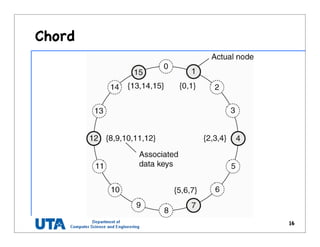
Structured P2P Architectures
• Structured: the overlay network is
constructed in a deterministic procedure
– Most popular: distributed hash table (DHT)
• Key questions
– How to map data item to nodes
– How to find the network address of the node
responsible for the needed data item
• Two examples
– Chord and Content Addressable Network (CAN)
15
Chord
16
Content Addressable Network (1)
17
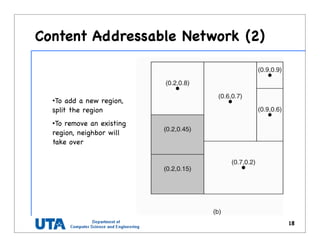
•2-dim space [0,1] x [0,1] is
divided among 6 nodes
•Each node has an
associated region
•Every data item in CAN
will be assigned a unique
point in space
•That node is responsible
for that data element.
Content Addressable Network (2)
18
•To add a new region,
split the region
•To remove an existing
region, neighbor will
take over
Unstructured P2P Architectures
• Largely relying on randomized algorithm to construct
the overlay network
– Each node has a list of neighbors, which is more or less
constructed in a random way
• One challenge is how to efficiently locate a needed
data item
– Flood the network?
• Many systems try to construct an overly network that
resembles a random graph
– Each node maintains a partial view, i.e., a set of live nodes
randomly chosen from the current set of nodes
19
Random Graph
• Given N nodes, we build
a random graph by
– having an edge
between any two nodes
at a probability p
• The random graph
theory is to answer
– what value should p
have such that it is
“almost certainly true”
that the graph is fully
connected
20
ors of the DSN. For ex-
eep-deprivation attack”
f the sensor nodes with
s by excessive commu-
pture typically requires
[7, 13, 14] be used to
hysical sensor manipu-
e sensor’s key ring and
ion3
. For some sensor
pt a node’s key ring in
can be very fast.
tion via sensor-node shield-
nodes, we note that our
ust than those based on
private sharing of keys
s against captured un-
mission key scheme, all
ed, whereas in the pair-
ks to the captured un-
contrast, in our scheme
ng are obtained, which
1000 2000 3000 4000 5000 6000 7000 8000 9000 10000
10
12
14
16
18
20
22
24
n (number of nodes)
Pr=0.99
Pr=0.999
Pr=0.9999
Pr=0.99999
Pr=0.999999
d(expecteddegreeofnode)
Figure 1: Expected degree of node vs. numbe
nodes, where Pc = Pr[G(n, p) is connected]
Partial View Construction
• A framework by Jelasity et al. in 2004
• Nodes exchange entries from their partial view
regularly
– Each entry is associated with an age tag
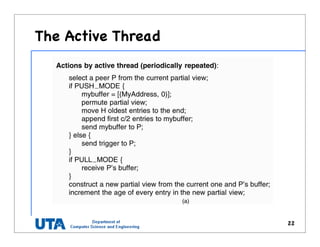
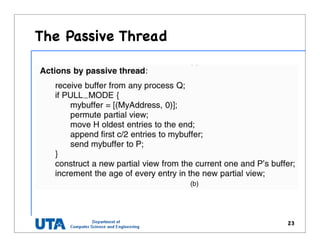
• Consists of an active thread and a passive thread
– The active thread initiate the communication with a
selected peer for partial view propagation
– The passive thread waits for response from another
peer and update its partial view accordingly
– A node can be in PUSH mode or PULL mode
21
The Active Thread
22
The Passive Thread
23
Topology Management
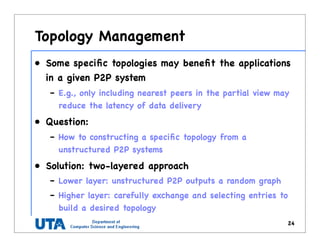
• Some specific topologies may benefit the applications
in a given P2P system
– E.g., only including nearest peers in the partial view may
reduce the latency of data delivery
• Question:
– How to constructing a specific topology from a
unstructured P2P systems
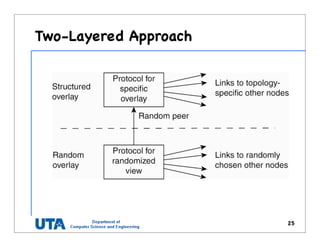
• Solution: two-layered approach
– Lower layer: unstructured P2P outputs a random graph
– Higher layer: carefully exchange and selecting entries to
build a desired topology
24
Two-Layered Approach
25
Example of Two-Layer Approach
26
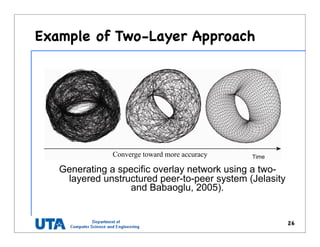
Generating a specific overlay network using a two-
layered unstructured peer-to-peer system (Jelasity
and Babaoglu, 2005).
Converge toward more accuracy
Finding Data Items
• This is quite challenging in unstructured P2P systems
– Assume a data item is randomly placed
• Solution 1: Flood the network with a search query
• Solution 2: A randomized algorithm
– Let us first assume that
• Each node knows the IDs of k other randomly selected nodes
• The ID of the hosting node is kept at m randomly picked nodes
– The search is done as follows
• Contact k direct neighbors for data items
• Ask your neighbors to help if none of them knows
– What is the probability of finding the answer directly?
27
Superpeers
• Used to address the following question
– How to find data items in unstructured P2P systems
– Flood the network with a search query?
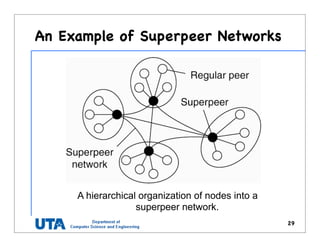
• An alternative is using superpeers
– Nodes such as those maintaining an index or acting
as a broker are generally referred to as superpeers
– They hold index of info. from its associated peers
(i.e. selected representative of some of the peers)
• Remaining question: how to pick the superpeers
28
An Example of Superpeer Networks
29
A hierarchical organization of nodes into a
superpeer network.
Hybrid Architectures
• Many real distributed systems combine
architectural features
– E.g., the superpeer networks -- combine
client-server architecture (centralized) with
peer-to-peer architecture (decentralized)
• Two examples of hybrid architectures
– Edge-server systems
– Collaborative distributed systems
30
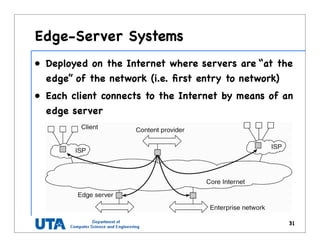
Edge-Server Systems
• Deployed on the Internet where servers are “at the
edge” of the network (i.e. first entry to network)
• Each client connects to the Internet by means of an
edge server
31
Collaborative Distributed Systems
• A hybrid distributed model that is based on
mutual collaboration of various systems
– Client-server scheme is deployed at the beginning
– Fully decentralized scheme is used for collaboration
after joining the system
• Examples of Collaborative Distributed System:
– BitTorrent: is a P2P File downloading system. It allows
download of various chunks of a file from other users
until the entire file is downloaded
– Globule: A Collaborative content distribution network. It
allows replication of web pages by various web servers
32
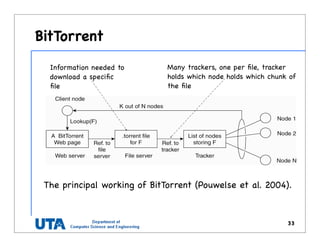
BitTorrent
33
The principal working of BitTorrent (Pouwelse et al. 2004).
Information needed to
download a specific
file
Many trackers, one per file, tracker
holds which node holds which chunk of
the file
Globule
• Collaborative content distribution network:
– Similar to edge-server systems
– Enhanced web servers from various users that replicates
web pages
• Components
– A component that can redirect client requests to other
servers.
– A component for analyzing access patterns.
– A component for managing the replication of Web pages.
• Has a centralized component for registering the servers
and make these servers known to others
34
Benefits of Globule
• Example:
– Alice has a web server; Bob has a web server
– Alice’s server can have replicated contents of the
Bob’s server and vice versa
• Good if your server goes down
• Good if too much traffic that your server can
not handle or gets too slow
• Better Geographic diversity
– Allow users to get quick response from the nearest
server with the replicated page
35
Architectures v.s. Middleware
• A middleware layer between application and the
distributed platforms for distribution transparency
• The question is:
– Given the software and system architecture, where the
middleware fits in?
• Many middleware follows a specific architecture style
– Object-based style, event-based style
– Benefits: simpler to design application
– Limitations: the solution may not be optimal
• Should be adaptable to application requirements
– Separating policies from mechanism
36
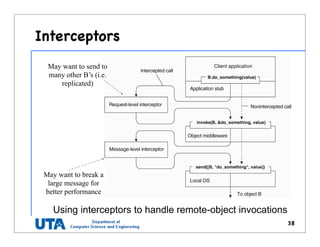
Supporting Technology: Interceptors
• An Interceptor is a software that
– breaks the usual flow of control and
– allows other (application specific) code to be
executed
• It makes middleware more adaptable to
– application requirements and changing environment
• Interceptors are good for
– providing transparent replication and
– improving performance
37
Interceptors
Using interceptors to handle remote-object invocations
38
May want to send to
many other B’s (i.e.
replicated)
May want to break a
large message for
better performance
General Approaches for Adaptability
• Separation of concerns:
– Modularizing the system and separate security from
functionality
– However, the problem is that a lot of things you cannot easily
separate, e.g., security
• Computational reflection
– Ability to inspect itself, and if necessary, adapt its behavior
– Reflective middleware has yet to proof itself as a powerful
tool to manage the complexity of distribute systems
• Component-based design (stand-alone)
– However, components are less independent than one may think
– Replacement of one component may have huge impact on others
39
Self-Management in Distributed Sys.
• Distributed systems are often required to adapt to
environmental changes by
– switching policies for allocation resources
• The algorithms to make the changes are often already in
the components
– But the challenge is how to make such change without human
intervention
• A strong interplay between software architectures and
system architectures
– Organize components in a way that monitoring and adjustment
can be done easily
– Decide where the processes to be executed to do the adaption
40
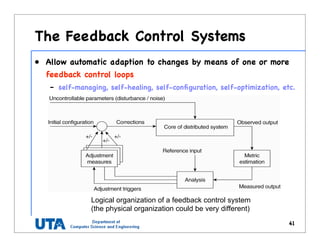
The Feedback Control Systems
• Allow automatic adaption to changes by means of one or more
feedback control loops
– self-managing, self-healing, self-configuration, self-optimization, etc.
41
Logical organization of a feedback control system
(the physical organization could be very different)
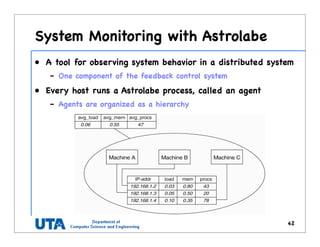
System Monitoring with Astrolabe
• A tool for observing system behavior in a distributed system
– One component of the feedback control system
• Every host runs a Astrolabe process, called an agent
– Agents are organized as a hierarchy
42
Replication Strategy in Globule
43
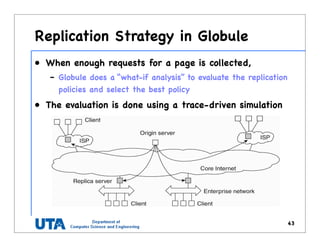
• When enough requests for a page is collected,
– Globule does a “what-if analysis” to evaluate the replication
policies and select the best policy
• The evaluation is done using a trace-driven simulation
Replication Strategy in Globule
44
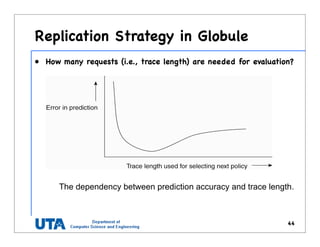
The dependency between prediction accuracy and trace length.
• How many requests (i.e., trace length) are needed for evaluation?
Automatic Component Repair in Jade
• Jade: A Java implementation framework that allows
components to be added and removed at runtime
• Steps in a simple auto-repair example
– Terminate every binding between a component on a non-faulty
node, and a component on the node that just failed.
– Request the node manager to start and add a new node to the
domain.
– Configure the new node with exactly the same components as
those on the crashed node.
– Re-establish all the bindings (between client & server
interfaces) that were previously terminated.
• Done via a repair management server (can be replicated)
45

chapter 2 architecture

  • 1.
  • 2.
    Architecture • Software architecture –How software components are organized, – How software components interact • System architecture – Instantiation and placement of software components on real machines • Centralized architecture, client-server system • decentralized architecture, peer-to-peer system • Hybrid architecture 2
  • 3.
    Software Architecture • Layeredarchitecture – widely adopted by the networking community • Object-based architecture – E.g., client-server style (ftp) • Data-centered architecture – Communicate through a common repository • Event-based architecture – Communicate through the propagation of events, e.g., publish/subscribe systems 3
  • 4.
  • 5.
  • 6.
    Event-Based Architecture 6 • Decoupledin space (referentially decoupled) – Processes are loosely coupled, need not explicitly refer to each other • Communication via propagation of events – Mostly publish/subscribe, e.g., clients register in market info.
  • 7.
    Shared Data-Space Architecture 7 •Not only decoupled in space but also decoupled in time – Processes need not both be active when communication takes place • Example of shared data-space architecture – Shared distributed file systems, web-based distributed systems
  • 8.
    System Architecture • Centralizedarchitectures – Application layering (logical software layering) – Multi-tiered architectures (system architecture) • Decentralized architectures – Structured P2P (peer-to-peer) architectures – Unstructured P2P architectures – Topology management of overlay networks – Superpeers • Hybrid architectures – Edge-server systems – Collaborative distributed systems 8
  • 9.
    Centralized Architecture 9 General interactionbetween a client and a server.
  • 10.
    Client-Server Communication • Connectionlessprotocol – It is hard for a sender to detect if the message is successfully received • Retransmission may cause problems – Usually ok for idempotent operations • Operations can be repeated many times without harm, e.g., get a quotes on stock, search on web • Connection-oriented protocols – Often used for non-idempotent operations • E.g., buying stock – Problem: low performance in local-area networks 10
  • 11.
    Application Layering • Manyclient-server system can be divided into three levels – The user-interface level – The processing level – The data level • Example: the internet search engine 11
  • 12.
    Two-tiered Architectures • Thesimplest way to place a client-server application is – A client machine that only implements (part of) the user-interface level – A server machine implementing the rest, i.e, the processing and data levels – This is so called the two-tiered architecture • Thin-client model and fat-client model 12 Thin Client Fat Client
  • 13.
    Three-Tiered Architecture • Theserver tier in two-tiered architecture becomes more and more distributed – A single server is no longer adequate for modern information systems • This leads to three-tiered architecture – Server may acting as a client 13
  • 14.
    Decentralized Architecture • Multi-tieredarchitectures can be considered as vertical distribution – Placing logically different components on different machines • An alternative is horizontal distribution (peer-to-peer systems) – A collection of logically equivalent parts – Each part operates on its own share of the complete data set, balancing the load • The main question for peer-to-peer system is – How to organize the processes in an overlay network – Two types: structured and unstructured 14
  • 15.
    Structured P2P Architectures •Structured: the overlay network is constructed in a deterministic procedure – Most popular: distributed hash table (DHT) • Key questions – How to map data item to nodes – How to find the network address of the node responsible for the needed data item • Two examples – Chord and Content Addressable Network (CAN) 15
  • 16.
  • 17.
    Content Addressable Network(1) 17 •2-dim space [0,1] x [0,1] is divided among 6 nodes •Each node has an associated region •Every data item in CAN will be assigned a unique point in space •That node is responsible for that data element.
  • 18.
    Content Addressable Network(2) 18 •To add a new region, split the region •To remove an existing region, neighbor will take over
  • 19.
    Unstructured P2P Architectures •Largely relying on randomized algorithm to construct the overlay network – Each node has a list of neighbors, which is more or less constructed in a random way • One challenge is how to efficiently locate a needed data item – Flood the network? • Many systems try to construct an overly network that resembles a random graph – Each node maintains a partial view, i.e., a set of live nodes randomly chosen from the current set of nodes 19
  • 20.
    Random Graph • GivenN nodes, we build a random graph by – having an edge between any two nodes at a probability p • The random graph theory is to answer – what value should p have such that it is “almost certainly true” that the graph is fully connected 20 ors of the DSN. For ex- eep-deprivation attack” f the sensor nodes with s by excessive commu- pture typically requires [7, 13, 14] be used to hysical sensor manipu- e sensor’s key ring and ion3 . For some sensor pt a node’s key ring in can be very fast. tion via sensor-node shield- nodes, we note that our ust than those based on private sharing of keys s against captured un- mission key scheme, all ed, whereas in the pair- ks to the captured un- contrast, in our scheme ng are obtained, which 1000 2000 3000 4000 5000 6000 7000 8000 9000 10000 10 12 14 16 18 20 22 24 n (number of nodes) Pr=0.99 Pr=0.999 Pr=0.9999 Pr=0.99999 Pr=0.999999 d(expecteddegreeofnode) Figure 1: Expected degree of node vs. numbe nodes, where Pc = Pr[G(n, p) is connected]
  • 21.
    Partial View Construction •A framework by Jelasity et al. in 2004 • Nodes exchange entries from their partial view regularly – Each entry is associated with an age tag • Consists of an active thread and a passive thread – The active thread initiate the communication with a selected peer for partial view propagation – The passive thread waits for response from another peer and update its partial view accordingly – A node can be in PUSH mode or PULL mode 21
  • 22.
  • 23.
  • 24.
    Topology Management • Somespecific topologies may benefit the applications in a given P2P system – E.g., only including nearest peers in the partial view may reduce the latency of data delivery • Question: – How to constructing a specific topology from a unstructured P2P systems • Solution: two-layered approach – Lower layer: unstructured P2P outputs a random graph – Higher layer: carefully exchange and selecting entries to build a desired topology 24
  • 25.
  • 26.
    Example of Two-LayerApproach 26 Generating a specific overlay network using a two- layered unstructured peer-to-peer system (Jelasity and Babaoglu, 2005). Converge toward more accuracy
  • 27.
    Finding Data Items •This is quite challenging in unstructured P2P systems – Assume a data item is randomly placed • Solution 1: Flood the network with a search query • Solution 2: A randomized algorithm – Let us first assume that • Each node knows the IDs of k other randomly selected nodes • The ID of the hosting node is kept at m randomly picked nodes – The search is done as follows • Contact k direct neighbors for data items • Ask your neighbors to help if none of them knows – What is the probability of finding the answer directly? 27
  • 28.
    Superpeers • Used toaddress the following question – How to find data items in unstructured P2P systems – Flood the network with a search query? • An alternative is using superpeers – Nodes such as those maintaining an index or acting as a broker are generally referred to as superpeers – They hold index of info. from its associated peers (i.e. selected representative of some of the peers) • Remaining question: how to pick the superpeers 28
  • 29.
    An Example ofSuperpeer Networks 29 A hierarchical organization of nodes into a superpeer network.
  • 30.
    Hybrid Architectures • Manyreal distributed systems combine architectural features – E.g., the superpeer networks -- combine client-server architecture (centralized) with peer-to-peer architecture (decentralized) • Two examples of hybrid architectures – Edge-server systems – Collaborative distributed systems 30
  • 31.
    Edge-Server Systems • Deployedon the Internet where servers are “at the edge” of the network (i.e. first entry to network) • Each client connects to the Internet by means of an edge server 31
  • 32.
    Collaborative Distributed Systems •A hybrid distributed model that is based on mutual collaboration of various systems – Client-server scheme is deployed at the beginning – Fully decentralized scheme is used for collaboration after joining the system • Examples of Collaborative Distributed System: – BitTorrent: is a P2P File downloading system. It allows download of various chunks of a file from other users until the entire file is downloaded – Globule: A Collaborative content distribution network. It allows replication of web pages by various web servers 32
  • 33.
    BitTorrent 33 The principal workingof BitTorrent (Pouwelse et al. 2004). Information needed to download a specific file Many trackers, one per file, tracker holds which node holds which chunk of the file
  • 34.
    Globule • Collaborative contentdistribution network: – Similar to edge-server systems – Enhanced web servers from various users that replicates web pages • Components – A component that can redirect client requests to other servers. – A component for analyzing access patterns. – A component for managing the replication of Web pages. • Has a centralized component for registering the servers and make these servers known to others 34
  • 35.
    Benefits of Globule •Example: – Alice has a web server; Bob has a web server – Alice’s server can have replicated contents of the Bob’s server and vice versa • Good if your server goes down • Good if too much traffic that your server can not handle or gets too slow • Better Geographic diversity – Allow users to get quick response from the nearest server with the replicated page 35
  • 36.
    Architectures v.s. Middleware •A middleware layer between application and the distributed platforms for distribution transparency • The question is: – Given the software and system architecture, where the middleware fits in? • Many middleware follows a specific architecture style – Object-based style, event-based style – Benefits: simpler to design application – Limitations: the solution may not be optimal • Should be adaptable to application requirements – Separating policies from mechanism 36
  • 37.
    Supporting Technology: Interceptors •An Interceptor is a software that – breaks the usual flow of control and – allows other (application specific) code to be executed • It makes middleware more adaptable to – application requirements and changing environment • Interceptors are good for – providing transparent replication and – improving performance 37
  • 38.
    Interceptors Using interceptors tohandle remote-object invocations 38 May want to send to many other B’s (i.e. replicated) May want to break a large message for better performance
  • 39.
    General Approaches forAdaptability • Separation of concerns: – Modularizing the system and separate security from functionality – However, the problem is that a lot of things you cannot easily separate, e.g., security • Computational reflection – Ability to inspect itself, and if necessary, adapt its behavior – Reflective middleware has yet to proof itself as a powerful tool to manage the complexity of distribute systems • Component-based design (stand-alone) – However, components are less independent than one may think – Replacement of one component may have huge impact on others 39
  • 40.
    Self-Management in DistributedSys. • Distributed systems are often required to adapt to environmental changes by – switching policies for allocation resources • The algorithms to make the changes are often already in the components – But the challenge is how to make such change without human intervention • A strong interplay between software architectures and system architectures – Organize components in a way that monitoring and adjustment can be done easily – Decide where the processes to be executed to do the adaption 40
  • 41.
    The Feedback ControlSystems • Allow automatic adaption to changes by means of one or more feedback control loops – self-managing, self-healing, self-configuration, self-optimization, etc. 41 Logical organization of a feedback control system (the physical organization could be very different)
  • 42.
    System Monitoring withAstrolabe • A tool for observing system behavior in a distributed system – One component of the feedback control system • Every host runs a Astrolabe process, called an agent – Agents are organized as a hierarchy 42
  • 43.
    Replication Strategy inGlobule 43 • When enough requests for a page is collected, – Globule does a “what-if analysis” to evaluate the replication policies and select the best policy • The evaluation is done using a trace-driven simulation
  • 44.
    Replication Strategy inGlobule 44 The dependency between prediction accuracy and trace length. • How many requests (i.e., trace length) are needed for evaluation?
  • 45.
    Automatic Component Repairin Jade • Jade: A Java implementation framework that allows components to be added and removed at runtime • Steps in a simple auto-repair example – Terminate every binding between a component on a non-faulty node, and a component on the node that just failed. – Request the node manager to start and add a new node to the domain. – Configure the new node with exactly the same components as those on the crashed node. – Re-establish all the bindings (between client & server interfaces) that were previously terminated. • Done via a repair management server (can be replicated) 45