THE CONTEMPORARY
WORLD
Professor
RE
I. INTRODUCTION ABOUT GLOBALIZATION
GLOBALIZATION
The growing interdependence of the
world's economies, cultures, and
populations, brought about by cross-
border trade in goods and services,
technology, and flows of investment,
people, and information.
To Eric Beerkens, Globalization refers to all those processes by
which the peoples of the world are mix into a single world
society to global society.
Globalization encompasses a multitude of processes that
involves economy, political systems, and culture.
It is the process of world shrinkage of distances getting shorter of
things moving closer.
It is a changing of human society develops and has happened
before and still happening today.
DIMENSIONS OF GLOBALIZATION
*Cultural Globalization
*Economic Globalization
*Political Globalization
*Technological Globalization
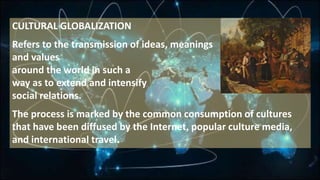
CULTURAL GLOBALIZATION
Refers to the transmission of ideas, meanings
and values
around the world in such a
way as to extend and intensify
social relations.
The process is marked by the common consumption of cultures
that have been diffused by the Internet, popular culture media,
and international travel.
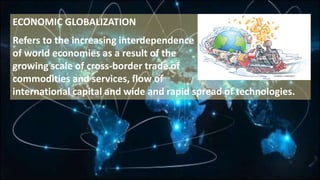
ECONOMIC GLOBALIZATION
Refers to the increasing interdependence
of world economies as a result of the
growing scale of cross-border trade of
commodities and services, flow of
international capital and wide and rapid spread of technologies.
POLITICAL GLOBALIZATION
Political globalization can be seen in changes
such as democratization of the world, creation
of the global civil society, and moving beyond
the centrality of the nation-state, particularly as
the sole actor in the field of politics.
TECHNOLOGICAL GLOBALIZATION
Can be defined as the increasing speed of
technological diffusion across the global
economy.
It refers to the spread of technologies
around the globe, and particularly from developed to developing
nations.
GLOBAL ECONOMIC ORGANIZATION
ATTRIBUTES OF GLOBALIZATION
1. Various forms of connectivity
2. Expansion and stretching of social relations
3. Intensification and acceleration of social exchanges and
activities
4. Occurs subjectively
TYPES OF GLOBALIZATION
1. Economic
Countries that trade with many others and have few
trade barriers are economically globalized.
2. Social
A measure of how easily information pass between people in their
country and different countries includes access to internet and
media networks.
3.Political
The amount of political co-operation there is between countries.
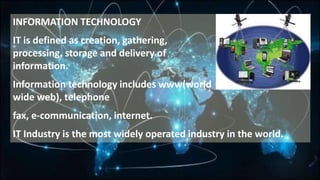
INFORMATION TECHNOLOGY
IT is defined as creation, gathering,
processing, storage and delivery of
information.
Information technology includes www(world
wide web), telephone
fax, e-communication, internet.
IT Industry is the most widely operated industry in the world.
APPLICATIONS OF INFORMATION TECHNOLOGY
*BUSINESS
*EDUCATION
*INDUSTRY
*IN HOME
*PRODUCT DESIGN
*PRODUCT MANUFACTURING
*URBAN STUDIES
*FISHING
*ENTERTAINMENT
*OCEAN STUDY
ADVANTAGES OF INFORMATION TECHNOLOGY
*MULTIPURPOSE USES
*HELPS GOVERNMENT IN MAINTAINING
RECORDS AND EFFICIENT GOVERNANACE
*PROGRESS IN BUSINESS
*QUICK AND EFFICIENT
*ANYWHERE ANY TIME
DISADVANTAGES OF INFORMATION TECHNOLOGY
*BRAIN DRAIN
*LACK OF SPIRIT OF RESEARCH
*LESS IMPORTANCE OF BOOKS
THE EFFECTS OF GLOBALIZATION
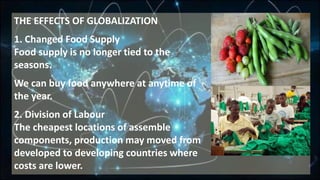
1. Changed Food Supply
Food supply is no longer tied to the
seasons.
We can buy food anywhere at anytime of
the year.
2. Division of Labour
The cheapest locations of assemble
components, production may moved from
developed to developing countries where
costs are lower.
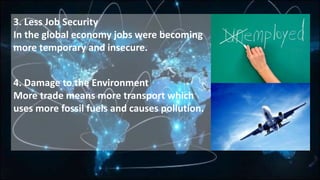
3. Less Job Security
In the global economy jobs were becoming
more temporary and insecure.
4. Damage to the Environment
More trade means more transport which
uses more fossil fuels and causes pollution.
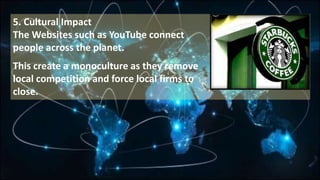
5. Cultural Impact
The Websites such as YouTube connect
people across the planet.
This create a monoculture as they remove
local competition and force local firms to
close.
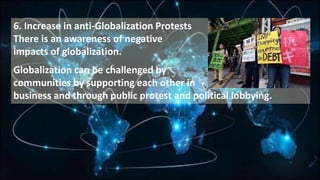
6. Increase in anti-Globalization Protests
There is an awareness of negative
impacts of globalization.
Globalization can be challenged by
communities by supporting each other in
business and through public protest and political lobbying.
BENEFITS OF GLOBALIZATION
*Free trade
*Free movement of labor
*Increased economies of scale
*Greater competition
*Increased investment
*Reducing monopoly profits
*Improved Information Technology
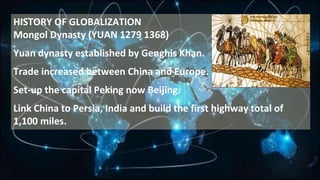
HISTORY OF GLOBALIZATION
Mongol Dynasty (YUAN 1279 1368)
Yuan dynasty established by Genghis Khan.
Trade increased between China and Europe.
Set-up the capital Peking now Beijing.
Link China to Persia, India and build the first highway total of
1,100 miles.
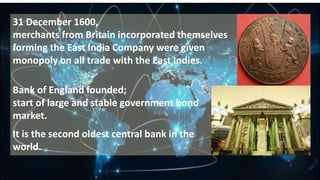
31 December 1600,
merchants from Britain incorporated themselves
forming the East India Company were given
monopoly on all trade with the East Indies.
Bank of England founded;
start of large and stable government bond
market.
It is the second oldest central bank in the
world.
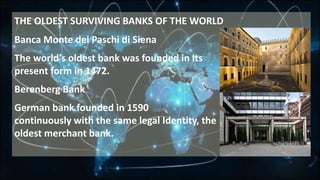
THE OLDEST SURVIVING BANKS OF THE WORLD
Banca Monte dei Paschi di Siena
The world's oldest bank was founded in its
present form in 1472.
Berenberg Bank
German bank founded in 1590
continuously with the same legal Identity, the
oldest merchant bank.
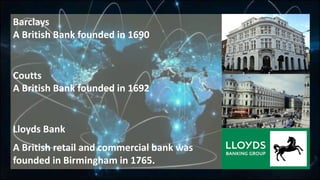
Barclays
A British Bank founded in 1690
Coutts
A British Bank founded in 1692
Lloyds Bank
A British retail and commercial bank was
founded in Birmingham in 1765.
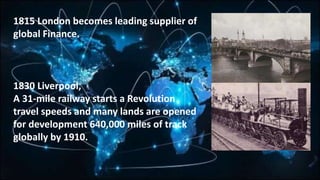
1815 London becomes leading supplier of
global Finance.
1830 Liverpool,
A 31-mile railway starts a Revolution
travel speeds and many lands are opened
for development 640,000 miles of track
globally by 1910.
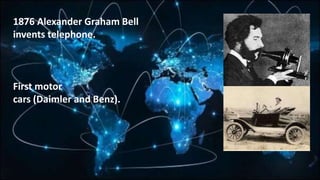
1876 Alexander Graham Bell
invents telephone.
First motor
cars (Daimler and Benz).
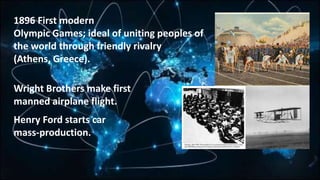
1896 First modern
Olympic Games; ideal of uniting peoples of
the world through friendly rivalry
(Athens, Greece).
Wright Brothers make first
manned airplane flight.
Henry Ford starts car
mass-production.
1917 Russian Revolution;
a new Soviet Union became independent of
global economy and the spread of
communism world wide.
1944-6 United Nations,
World Bank and IMF formed the
US dollar supremacy for next 25 years.
Market economy in
Russia and Eastern Europe brings Marxism to an
end.
Tim Berners-Lee invents
World Wide Web (www),
leading to global spread
of internet use.
2004 the Framework for global agreement on
trade was agreed and WTO was formed.
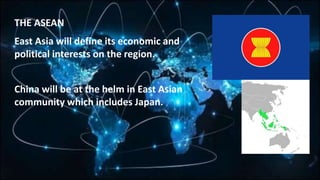
THE ASEAN
East Asia will define its economic and
political interests on the region.
China will be at the helm in East Asian
community which includes Japan.
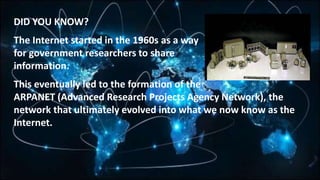
DID YOU KNOW?
The Internet started in the 1960s as a way
for government researchers to share
information.
This eventually led to the formation of the
ARPANET (Advanced Research Projects Agency Network), the
network that ultimately evolved into what we now know as the
Internet.
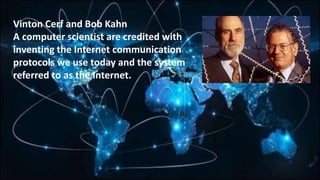
Vinton Cerf and Bob Kahn
A computer scientist are credited with
inventing the Internet communication
protocols we use today and the system
referred to as the Internet.
QUOTES OF GLOBALIZATION
Where globalization means, as it so often does,
that the rich and powerful now have new
means to further enrich and empower
themselves at the cost of the poorer and
weaker, we have a responsibility to protest in
the name of universal freedom.
Nelson Mandela
Describe the importance of globalization.
Explain how globalization affects the country’s
economy.
Examine how have you experienced
globalization.

CONTEMPORARY-WORLD LESSON FOR WEEK (1).pptx

  • 1.
  • 2.
    I. INTRODUCTION ABOUTGLOBALIZATION GLOBALIZATION The growing interdependence of the world's economies, cultures, and populations, brought about by cross- border trade in goods and services, technology, and flows of investment, people, and information.
  • 3.
    To Eric Beerkens,Globalization refers to all those processes by which the peoples of the world are mix into a single world society to global society. Globalization encompasses a multitude of processes that involves economy, political systems, and culture. It is the process of world shrinkage of distances getting shorter of things moving closer. It is a changing of human society develops and has happened before and still happening today.
  • 4.
    DIMENSIONS OF GLOBALIZATION *CulturalGlobalization *Economic Globalization *Political Globalization *Technological Globalization
  • 5.
    CULTURAL GLOBALIZATION Refers tothe transmission of ideas, meanings and values around the world in such a way as to extend and intensify social relations. The process is marked by the common consumption of cultures that have been diffused by the Internet, popular culture media, and international travel.
  • 6.
    ECONOMIC GLOBALIZATION Refers tothe increasing interdependence of world economies as a result of the growing scale of cross-border trade of commodities and services, flow of international capital and wide and rapid spread of technologies.
  • 7.
    POLITICAL GLOBALIZATION Political globalizationcan be seen in changes such as democratization of the world, creation of the global civil society, and moving beyond the centrality of the nation-state, particularly as the sole actor in the field of politics.
  • 8.
    TECHNOLOGICAL GLOBALIZATION Can bedefined as the increasing speed of technological diffusion across the global economy. It refers to the spread of technologies around the globe, and particularly from developed to developing nations.
  • 9.
  • 12.
    ATTRIBUTES OF GLOBALIZATION 1.Various forms of connectivity 2. Expansion and stretching of social relations 3. Intensification and acceleration of social exchanges and activities 4. Occurs subjectively
  • 13.
    TYPES OF GLOBALIZATION 1.Economic Countries that trade with many others and have few trade barriers are economically globalized. 2. Social A measure of how easily information pass between people in their country and different countries includes access to internet and media networks. 3.Political The amount of political co-operation there is between countries.
  • 14.
    INFORMATION TECHNOLOGY IT isdefined as creation, gathering, processing, storage and delivery of information. Information technology includes www(world wide web), telephone fax, e-communication, internet. IT Industry is the most widely operated industry in the world.
  • 15.
    APPLICATIONS OF INFORMATIONTECHNOLOGY *BUSINESS *EDUCATION *INDUSTRY *IN HOME *PRODUCT DESIGN *PRODUCT MANUFACTURING *URBAN STUDIES *FISHING *ENTERTAINMENT *OCEAN STUDY
  • 16.
    ADVANTAGES OF INFORMATIONTECHNOLOGY *MULTIPURPOSE USES *HELPS GOVERNMENT IN MAINTAINING RECORDS AND EFFICIENT GOVERNANACE *PROGRESS IN BUSINESS *QUICK AND EFFICIENT *ANYWHERE ANY TIME DISADVANTAGES OF INFORMATION TECHNOLOGY *BRAIN DRAIN *LACK OF SPIRIT OF RESEARCH *LESS IMPORTANCE OF BOOKS
  • 17.
    THE EFFECTS OFGLOBALIZATION 1. Changed Food Supply Food supply is no longer tied to the seasons. We can buy food anywhere at anytime of the year. 2. Division of Labour The cheapest locations of assemble components, production may moved from developed to developing countries where costs are lower.
  • 18.
    3. Less JobSecurity In the global economy jobs were becoming more temporary and insecure. 4. Damage to the Environment More trade means more transport which uses more fossil fuels and causes pollution.
  • 19.
    5. Cultural Impact TheWebsites such as YouTube connect people across the planet. This create a monoculture as they remove local competition and force local firms to close.
  • 20.
    6. Increase inanti-Globalization Protests There is an awareness of negative impacts of globalization. Globalization can be challenged by communities by supporting each other in business and through public protest and political lobbying.
  • 21.
    BENEFITS OF GLOBALIZATION *Freetrade *Free movement of labor *Increased economies of scale *Greater competition *Increased investment *Reducing monopoly profits *Improved Information Technology
  • 22.
    HISTORY OF GLOBALIZATION MongolDynasty (YUAN 1279 1368) Yuan dynasty established by Genghis Khan. Trade increased between China and Europe. Set-up the capital Peking now Beijing. Link China to Persia, India and build the first highway total of 1,100 miles.
  • 23.
    31 December 1600, merchantsfrom Britain incorporated themselves forming the East India Company were given monopoly on all trade with the East Indies. Bank of England founded; start of large and stable government bond market. It is the second oldest central bank in the world.
  • 24.
    THE OLDEST SURVIVINGBANKS OF THE WORLD Banca Monte dei Paschi di Siena The world's oldest bank was founded in its present form in 1472. Berenberg Bank German bank founded in 1590 continuously with the same legal Identity, the oldest merchant bank.
  • 25.
    Barclays A British Bankfounded in 1690 Coutts A British Bank founded in 1692 Lloyds Bank A British retail and commercial bank was founded in Birmingham in 1765.
  • 26.
    1815 London becomesleading supplier of global Finance. 1830 Liverpool, A 31-mile railway starts a Revolution travel speeds and many lands are opened for development 640,000 miles of track globally by 1910.
  • 27.
    1876 Alexander GrahamBell invents telephone. First motor cars (Daimler and Benz).
  • 28.
    1896 First modern OlympicGames; ideal of uniting peoples of the world through friendly rivalry (Athens, Greece). Wright Brothers make first manned airplane flight. Henry Ford starts car mass-production.
  • 29.
    1917 Russian Revolution; anew Soviet Union became independent of global economy and the spread of communism world wide. 1944-6 United Nations, World Bank and IMF formed the US dollar supremacy for next 25 years.
  • 30.
    Market economy in Russiaand Eastern Europe brings Marxism to an end. Tim Berners-Lee invents World Wide Web (www), leading to global spread of internet use. 2004 the Framework for global agreement on trade was agreed and WTO was formed.
  • 31.
    THE ASEAN East Asiawill define its economic and political interests on the region. China will be at the helm in East Asian community which includes Japan.
  • 32.
    DID YOU KNOW? TheInternet started in the 1960s as a way for government researchers to share information. This eventually led to the formation of the ARPANET (Advanced Research Projects Agency Network), the network that ultimately evolved into what we now know as the Internet.
  • 33.
    Vinton Cerf andBob Kahn A computer scientist are credited with inventing the Internet communication protocols we use today and the system referred to as the Internet.
  • 34.
    QUOTES OF GLOBALIZATION Whereglobalization means, as it so often does, that the rich and powerful now have new means to further enrich and empower themselves at the cost of the poorer and weaker, we have a responsibility to protest in the name of universal freedom. Nelson Mandela
  • 35.
    Describe the importanceof globalization. Explain how globalization affects the country’s economy. Examine how have you experienced globalization.