MODULE 2
THE STRUCTURES OF GLOBALIZATION
Prepared by: Ms. Jojean Marie D. Pondang
TOPIC 5: THE GLOBAL ECONOMY
OVERVIEW
This chapter identifies how the global economy has been constructed
analytically. The first task is to define what is really "new" about the global
economy. The increasingly seamless web of international production and
trade networks that girdle the globe appears to be a distinctive feature of
the last several decades, and it requires a new kind of organizational
perspective that has been growing rapidly. The second section of this
chapter takes a closer look at how and why production and trade have
been reorganized in the global economy in the contemporary era and the
complex network relationships that make up the global economy
specifically global commodity chains. The fourth section takes how a
focus on global production networks allows us to understand the
process of industrial upgrading. The fifth and concluding section of the
chapter examines several of the emerging challenges and dilemmas for
governance and development in the contemporary global economy.
LEARNING OUTCOME/S:
At the end of this module, you should be able to:
• Further explain economic globalization;
• Determine the actors that facilitate economic globalizations; and
• Articulate a stance on global economic integration.
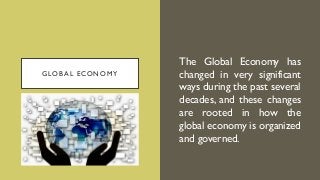
GLOBAL ECONOMY
The Global Economy has
changed in very significant
ways during the past several
decades, and these changes
are rooted in how the
global economy is organized
and governed.
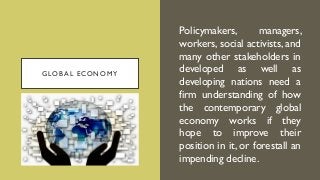
GLOBAL ECONOMY
Policymakers, managers,
workers, social activists, and
many other stakeholders in
developed as well as
developing nations need a
firm understanding of how
the contemporary global
economy works if they
hope to improve their
position in it, or forestall an
impending decline.
THE TOPIC OF THE GLOBAL
ECONOMY IS INHERENTLY
INTERDISCIPLINARY.
WHAT DOES GLOBAL ECONOMY
MEAN?
A global economy is an economic
interdependence established between the
most influential countries that drives the
worldwide economic environment. It is also
the aggregate economic output, movement
and influence of all countries.
THE GLOBAL ECONOMY CAN ALSO BE
DEFINED AS EACH COUNTRY ‘S
ECONOMY ADDED TOGETHER BUT
THAT IS NOT THE ONLY WAY TO
PORTRAIT HOW THE WORD
ECONOMY WORKS.
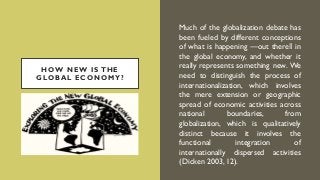
HOW NEW IS THE GLOBAL
ECONOMY?
HOW NEW IS THE
GLOBAL ECONOMY?
Much of the globalization debate has
been fueled by different conceptions
of what is happening ―out there‖ in
the global economy, and whether it
really represents something new. We
need to distinguish the process of
internationalization, which involves
the mere extension or geographic
spread of economic activities across
national boundaries, from
globalization, which is qualitatively
distinct because it involves the
functional integration of
internationally dispersed activities
(Dicken 2003, 12).
DEVELOPMENT OF A WORLD TRADING
SYSTEM
According to world-systems theory, the upward or
downward mobility of nations in the core, semi-
periphery, and periphery is determined by a
country‘s mode of incorporation in the capitalist
world-economy, and these shifts can only be
accurately portrayed by an in-depth analysis of the
cycles of capitalist accumulation in the longue durée
of history (Wallerstein 1974, 1980, 1989; Arrighi
1994).
AT THE GLOBAL SCALE, THE ―CLASSIC
INTERNATIONAL DIVISION OF LABOR
WAS BETWEEN THE INDUSTRIAL
COUNTRIES PRODUCING
MANUFACTURED GOODS, AND THE
NON-INDUSTRIALIZED ECONOMIES
THAT SUPPLIED RAW MATERIALS AND
AGRICULTURAL PRODUCTS TO THE
INDUSTRIAL NATIONS AND THAT
BECAME A MARKET FOR BASIC
MANUFACTURES.
THE REORGANIZATION OF
PRODUCTION AND TRADE IN THE
GLOBAL ECONOMY
The Role of Transnational Corporations while the post-war
international economic order was defined and legitimized by
the United States and the other core powers that supported
it in terms of the ideology of free trade, it was the way in
which TNCs linked the production of goods and services in
cross-border, value-adding networks that made the global
economy in the last half of the twentieth century
qualitatively distinct from what preceded it.
TRANSNATIONAL CORPORATIONS
HAVE BECOME THE PRIMARY MOVERS
AND SHAKERS OF THE GLOBAL
ECONOMY BECAUSE THEY HAVE THE
POWER TO COORDINATE AND
CONTROL SUPPLY CHAIN
OPERATIONS IN MORE THAN ONE
COUNTRY, EVEN IF THEY DO NOT
OWN THEM (DICKEN 2003, 198).
ANY IDEA ABOUT
INTERNATIONAL TRADE
AND PRODUCTION
NETWORKS?
THE EMERGENCE OF INTERNATIONAL
TRADE AND PRODUCTION NETWORKS
• The growth of world trade has probably received the most
attention in the globalization literature because of its direct
relevance to employment, wages, and the rising number of
free trade agreements around the world. The most
common causes usually given to explain expanding world
trade are technological (improvements in transportation
and communication technologies) and political (e.g., the
removal of protectionist barriers, such as tariffs, import
quotas, and exchange controls, which had restricted world
markets from 1913 until the end of the Second World
War).
THREE NEW ASPECTS OF MODERN
WORLD TRADE RELEVANT
The three new aspects of modern world trade relevant here
are (1) the rise of intra-industry and intra-product trade in
intermediate inputs; (2) the ability of producers to ―slice up
the value chain in Krugman‘s (1995) phrase, by breaking a
production process into many geographically separated
steps; and (3) the emergence of a global production
networks framework that highlights how these shifts have
altered governance structures and the distribution of gains in
the global economy.
PROCESS QUESTIONS:
WHAT IS GLOBAL ECONOMY?
DISCUSS HOW THE DEVELOPMENT
OF WORLD TRADING SYSTEM
CHANGES OVER A PERIOD OF
SEVERAL CENTURIES.
ASSESSMENT
DIRECTIONS: MAKE A 2- PARAGRAPH
ESSAY ABOUT THE GLOBAL ECONOMY.
WRITE YOUR ANSWER IN YOUR OWN
WORDS.
GUIDE QUESTION:
HOW DOES THE GLOBAL ECONOMY
AFFECT NOT ONLY THE FLOWS OF
GOODS AND SERVICES ACROSS
NATIONAL BORDERS?
TOPIC 6: THE GLOBAL ECONOMY
(Continuation)
SURPLUSES AND DEFICITS
SURPLUSES AND
DEFICITS
A good place to get a quick
snapshot of global trade (Mann
and Pluck,2007: 1159-66), as
well as net economic flows in
and out of a nation-state, is by
looking as a nation ‘s trade
surpluses and deficits. Of special
interest and importance as far
as trade surpluses and deficits
are concerned are the positions
of the two global economic
giants – the US and China – in
terms f their trade balances.
SLICING UP THE VALUE
CHAIN
The notion of a value-added chain
has been a useful tool for
international business scholars who
have focused on the strategies of
both firms and countries in the global
economy. Bruce Kogut (1984, 151), a
professor at the Wharton School of
Business, University of Pennsylvania,
was one of the first to argue that
value chains are a key element in
the new framework of competitive
analysis that is needed because of
the globalization of world markets:
―The formulation of strategy can be
fruitfully viewed as placing bets on
certain markets and on certain links
of the value-added chain
COMPARATIVE ADVANTAGE
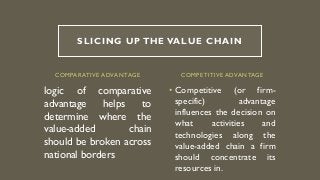
logic of comparative
advantage helps to
determine where the
value-added chain
should be broken across
national borders
• Competitive (or firm-
specific) advantage
influences the decision on
what activities and
technologies along the
value-added chain a firm
should concentrate its
resources in.
COMPETITIVE ADVANTAGE
SLICING UP THE VALUE CHAIN
PRODUCTION NETWORKS
IN THE GLOBAL ECONOMY
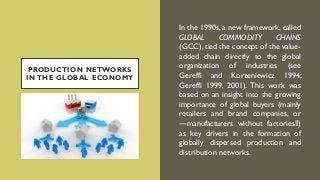
In the 1990s, a new framework, called
GLOBAL COMMODITY CHAINS
(GCC), tied the concept of the value-
added chain directly to the global
organization of industries (see
Gereffi and Korzeniewicz 1994;
Gereffi 1999, 2001). This work was
based on an insight into the growing
importance of global buyers (mainly
retailers and brand companies, or
―manufacturers without factories‖)
as key drivers in the formation of
globally dispersed production and
distribution networks.
SUPPLY CHAINS.
A generic label for an input-output structure of
value-adding activities, beginning with raw materials
and ending with a finished product International
production networks. A focus on the international
production networks in which TNCs act as ―global
network flagships‖ (Borrus, Ernst, and Haggard
2000)
GLOBAL COMMODITY CHAINS.
• An emphasis on the internal governance structure of
supply chains (especially the producer-driven vs. buyer-
driven distinction) and on the role of diverse lead firms in
setting up global production and sourcing networks
(Gereffi and Korzeniewicz 1994) French ―filière‖
approach. A loosely knit set of studies that used the filière
(i.e., channel or network) of activities as a method to study
primarily agricultural export commodities such as rubber,
cotton, coffee, and cocoa (Raikes, Jensen, and Ponte 2000).
GLOBAL VALUE CHAINS.
• Emphasis on the relative value of those economic
activities that are required to bring a good or
service from conception, through the different
phases of production (involving a combination of
physical transformation and the input of various
producer services), delivery to final consumers,
and final disposal after use (Kaplinsky 2000; Gereffi
and Kaplinsky 2001).
INDUSTRIAL UPGRADING AND
GLOBAL PRODUCTION NETWORKS
• Major changes in global business organization during the
last several decades of the twentieth century have had a
significant impact on the upgrading possibilities of
developing countries.
• This section will illustrate how the reorganization of
international trade and production networks affects the
capability of developing countries in different regions of the
world to improve their positions in the value chains of
diverse industries.
OUTSOURCING.
• Outsourcing is defined as the act of obtaining semi-finished products,
finished products or services from an outside company if these
activities were traditionally performed internally. In the previous
sentence, the word "product" may be replaced by "service". The
company that out sources is called "buyer" whereas the company that
provides the service is known as the "vendor". Note that outsourcing
leads to a significant rapprochement between the vendor and the
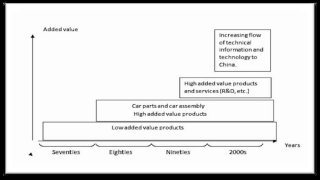
buyer. An important flow of technical and organizational information
inevitably occurs between the protagonists. We shall see later that this
can lead to significant problems.
"CORE COMPETENCIES"
• This concept was first introduced by Prahalad and Hamel (1990) and
used by many authors including Dekkers (2000). According to the
authors, the "core competencies" can be defined as the collective
knowledge of the production system concerned, in particular
knowledge of procedures and how to best integrate and optimize
them.
• More simply, one could say that the concept encapsulate the expertise
of the company with regard to its "strengths", that is to say, the
activities that make that the company is ranked ahead of the
competition.
MORE DETAILED DEFINITION OF THE
"CORE COMPETENCIES" CONCEPT
• In their article, Quinn and Hilmer (1994) give a more detailed definition of the
"core competencies" concept. In their view, the "core competencies" are
defined as follows:
- Have a range of expertise that crosses traditional functions horizontally,
- Have the capacity to adapt to changes in long-term demands of clients,
- These "core competencies" must be limited in number (as a matter of effective
management),
- Dominate the competitors with regard to these skills,
- Being close to customers in order to be recognized as a leader,
- Finally, be able to continue and even improve the domination of the
competitors
IS OUTSOURCING GOOD OR
BAD STRATEGY?
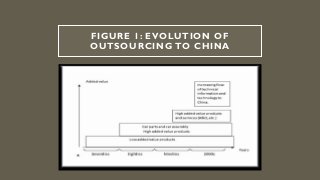
FIGURE 1: EVOLUTION OF
OUTSOURCING TO CHINA
THE GLOBALIZATION BACKLASH:
DILEMMAS OF GOVERNANCE AND
DEVELOPMENTS
As markets have gone global, many people sense
that globalization means greater vulnerability to
unfamiliar and unpredictable forces that can bring
economic instability and social dislocation, as well as
a flattening of culture in the face of well-financed
global marketing machines and ―brand bullies‖
(Rodrik 1997;Klein 2000; Ritzer 2000).
THE GLOBALIZATION BACKLASH:
DILEMMAS OF GOVERNANCE AND
DEVELOPMENTS
In addition, there is a growing imbalance in global rule-
making: on the one hand, the rules favoring market expansion
have become stronger and more enforceable (such as
intellectual property rights for software and pharmaceutical
companies, or the restrictions on local content provisions
and export performance requirements in the WTO); on the
other hand, rules that favor other valid social objectives, such
as human rights, labor standards, environmental sustainability,
or poverty reduction, are lagging behind.
Transnational corporations are being pressured to comply
with a broad range of social objectives in multi-stakeholder
institutions of private governance that can have an impact on
public policies in the developed as well as the developing
world. The challenge in research on the global economy is to
create theory and carry out insightful empirical studies that
provide tools to understand the constantly changing reality
we seek to apprehend and change.
SYNTHESIS
• Production chains may be very localized but increasingly
are global in scale to take advantage of international
division of labor.
• Institutional paradigms and local or regional frameworks
centered on the nation-state are being superseded by
approaches that emphasize transnational governance
structures, with an emphasis on power, networks, and the
uneven distribution of gains from globalization.
• The ―value chain‖ concept has recently gained popularity
as an overarching label for this body of research because it
focuses on value creation and value capture across the full
range of possible chain activities and end products (goods
and services), and because it avoids the limiting
connotations of the word commodity, which to some
implies the production of undifferentiated goods with low
barriers to entry.
• Global value chain (GVC) analysis accepts many of the observations
made previously on geographical fragmentation, and it focuses primarily
on the issues of industry (re)organization, coordination, governance,
and power in the chain (Humphrey and Schmitz 2001). Its concern is
to understand the nature and consequences of organizational
fragmentation in global industries.
• The GVC approach offers the possibility of understanding how firms
are linked in the global economy, but also acknowledges the broader
institutional context of these linkages, including trade policy, regulation,
and standards.
• More generally, the global production networks paradigm has been
used to join scholarly research on globalization with the concerns of
both policymakers and social activists, who are trying to harness the
potential gains of globalization to the pragmatic concerns of specific
countries and social constituencies that feel increasingly marginalized in
the international economic arena.
PROCESS QUESTION:
DOES OUTSOURCING IN THE
PHILIPPINES CONTRIBUTES ON ITS
ECONOMIC DEVELOPMENT?
The Contemporary World Module 2  Global Economy

The Contemporary World Module 2 Global Economy

  • 1.
    MODULE 2 THE STRUCTURESOF GLOBALIZATION Prepared by: Ms. Jojean Marie D. Pondang
  • 2.
    TOPIC 5: THEGLOBAL ECONOMY
  • 3.
    OVERVIEW This chapter identifieshow the global economy has been constructed analytically. The first task is to define what is really "new" about the global economy. The increasingly seamless web of international production and trade networks that girdle the globe appears to be a distinctive feature of the last several decades, and it requires a new kind of organizational perspective that has been growing rapidly. The second section of this chapter takes a closer look at how and why production and trade have been reorganized in the global economy in the contemporary era and the complex network relationships that make up the global economy specifically global commodity chains. The fourth section takes how a focus on global production networks allows us to understand the process of industrial upgrading. The fifth and concluding section of the chapter examines several of the emerging challenges and dilemmas for governance and development in the contemporary global economy.
  • 4.
    LEARNING OUTCOME/S: At theend of this module, you should be able to: • Further explain economic globalization; • Determine the actors that facilitate economic globalizations; and • Articulate a stance on global economic integration.
  • 5.
    GLOBAL ECONOMY The GlobalEconomy has changed in very significant ways during the past several decades, and these changes are rooted in how the global economy is organized and governed.
  • 6.
    GLOBAL ECONOMY Policymakers, managers, workers,social activists, and many other stakeholders in developed as well as developing nations need a firm understanding of how the contemporary global economy works if they hope to improve their position in it, or forestall an impending decline.
  • 7.
    THE TOPIC OFTHE GLOBAL ECONOMY IS INHERENTLY INTERDISCIPLINARY.
  • 8.
    WHAT DOES GLOBALECONOMY MEAN? A global economy is an economic interdependence established between the most influential countries that drives the worldwide economic environment. It is also the aggregate economic output, movement and influence of all countries.
  • 9.
    THE GLOBAL ECONOMYCAN ALSO BE DEFINED AS EACH COUNTRY ‘S ECONOMY ADDED TOGETHER BUT THAT IS NOT THE ONLY WAY TO PORTRAIT HOW THE WORD ECONOMY WORKS.
  • 10.
    HOW NEW ISTHE GLOBAL ECONOMY?
  • 11.
    HOW NEW ISTHE GLOBAL ECONOMY? Much of the globalization debate has been fueled by different conceptions of what is happening ―out there‖ in the global economy, and whether it really represents something new. We need to distinguish the process of internationalization, which involves the mere extension or geographic spread of economic activities across national boundaries, from globalization, which is qualitatively distinct because it involves the functional integration of internationally dispersed activities (Dicken 2003, 12).
  • 12.
    DEVELOPMENT OF AWORLD TRADING SYSTEM According to world-systems theory, the upward or downward mobility of nations in the core, semi- periphery, and periphery is determined by a country‘s mode of incorporation in the capitalist world-economy, and these shifts can only be accurately portrayed by an in-depth analysis of the cycles of capitalist accumulation in the longue durée of history (Wallerstein 1974, 1980, 1989; Arrighi 1994).
  • 13.
    AT THE GLOBALSCALE, THE ―CLASSIC INTERNATIONAL DIVISION OF LABOR WAS BETWEEN THE INDUSTRIAL COUNTRIES PRODUCING MANUFACTURED GOODS, AND THE NON-INDUSTRIALIZED ECONOMIES THAT SUPPLIED RAW MATERIALS AND AGRICULTURAL PRODUCTS TO THE INDUSTRIAL NATIONS AND THAT BECAME A MARKET FOR BASIC MANUFACTURES.
  • 14.
    THE REORGANIZATION OF PRODUCTIONAND TRADE IN THE GLOBAL ECONOMY The Role of Transnational Corporations while the post-war international economic order was defined and legitimized by the United States and the other core powers that supported it in terms of the ideology of free trade, it was the way in which TNCs linked the production of goods and services in cross-border, value-adding networks that made the global economy in the last half of the twentieth century qualitatively distinct from what preceded it.
  • 15.
    TRANSNATIONAL CORPORATIONS HAVE BECOMETHE PRIMARY MOVERS AND SHAKERS OF THE GLOBAL ECONOMY BECAUSE THEY HAVE THE POWER TO COORDINATE AND CONTROL SUPPLY CHAIN OPERATIONS IN MORE THAN ONE COUNTRY, EVEN IF THEY DO NOT OWN THEM (DICKEN 2003, 198).
  • 16.
    ANY IDEA ABOUT INTERNATIONALTRADE AND PRODUCTION NETWORKS?
  • 17.
    THE EMERGENCE OFINTERNATIONAL TRADE AND PRODUCTION NETWORKS • The growth of world trade has probably received the most attention in the globalization literature because of its direct relevance to employment, wages, and the rising number of free trade agreements around the world. The most common causes usually given to explain expanding world trade are technological (improvements in transportation and communication technologies) and political (e.g., the removal of protectionist barriers, such as tariffs, import quotas, and exchange controls, which had restricted world markets from 1913 until the end of the Second World War).
  • 18.
    THREE NEW ASPECTSOF MODERN WORLD TRADE RELEVANT The three new aspects of modern world trade relevant here are (1) the rise of intra-industry and intra-product trade in intermediate inputs; (2) the ability of producers to ―slice up the value chain in Krugman‘s (1995) phrase, by breaking a production process into many geographically separated steps; and (3) the emergence of a global production networks framework that highlights how these shifts have altered governance structures and the distribution of gains in the global economy.
  • 19.
    PROCESS QUESTIONS: WHAT ISGLOBAL ECONOMY? DISCUSS HOW THE DEVELOPMENT OF WORLD TRADING SYSTEM CHANGES OVER A PERIOD OF SEVERAL CENTURIES.
  • 20.
    ASSESSMENT DIRECTIONS: MAKE A2- PARAGRAPH ESSAY ABOUT THE GLOBAL ECONOMY. WRITE YOUR ANSWER IN YOUR OWN WORDS. GUIDE QUESTION: HOW DOES THE GLOBAL ECONOMY AFFECT NOT ONLY THE FLOWS OF GOODS AND SERVICES ACROSS NATIONAL BORDERS?
  • 21.
    TOPIC 6: THEGLOBAL ECONOMY (Continuation)
  • 22.
  • 23.
    SURPLUSES AND DEFICITS A goodplace to get a quick snapshot of global trade (Mann and Pluck,2007: 1159-66), as well as net economic flows in and out of a nation-state, is by looking as a nation ‘s trade surpluses and deficits. Of special interest and importance as far as trade surpluses and deficits are concerned are the positions of the two global economic giants – the US and China – in terms f their trade balances.
  • 24.
    SLICING UP THEVALUE CHAIN The notion of a value-added chain has been a useful tool for international business scholars who have focused on the strategies of both firms and countries in the global economy. Bruce Kogut (1984, 151), a professor at the Wharton School of Business, University of Pennsylvania, was one of the first to argue that value chains are a key element in the new framework of competitive analysis that is needed because of the globalization of world markets: ―The formulation of strategy can be fruitfully viewed as placing bets on certain markets and on certain links of the value-added chain
  • 25.
    COMPARATIVE ADVANTAGE logic ofcomparative advantage helps to determine where the value-added chain should be broken across national borders • Competitive (or firm- specific) advantage influences the decision on what activities and technologies along the value-added chain a firm should concentrate its resources in. COMPETITIVE ADVANTAGE SLICING UP THE VALUE CHAIN
  • 26.
    PRODUCTION NETWORKS IN THEGLOBAL ECONOMY In the 1990s, a new framework, called GLOBAL COMMODITY CHAINS (GCC), tied the concept of the value- added chain directly to the global organization of industries (see Gereffi and Korzeniewicz 1994; Gereffi 1999, 2001). This work was based on an insight into the growing importance of global buyers (mainly retailers and brand companies, or ―manufacturers without factories‖) as key drivers in the formation of globally dispersed production and distribution networks.
  • 27.
    SUPPLY CHAINS. A genericlabel for an input-output structure of value-adding activities, beginning with raw materials and ending with a finished product International production networks. A focus on the international production networks in which TNCs act as ―global network flagships‖ (Borrus, Ernst, and Haggard 2000)
  • 28.
    GLOBAL COMMODITY CHAINS. •An emphasis on the internal governance structure of supply chains (especially the producer-driven vs. buyer- driven distinction) and on the role of diverse lead firms in setting up global production and sourcing networks (Gereffi and Korzeniewicz 1994) French ―filière‖ approach. A loosely knit set of studies that used the filière (i.e., channel or network) of activities as a method to study primarily agricultural export commodities such as rubber, cotton, coffee, and cocoa (Raikes, Jensen, and Ponte 2000).
  • 29.
    GLOBAL VALUE CHAINS. •Emphasis on the relative value of those economic activities that are required to bring a good or service from conception, through the different phases of production (involving a combination of physical transformation and the input of various producer services), delivery to final consumers, and final disposal after use (Kaplinsky 2000; Gereffi and Kaplinsky 2001).
  • 30.
    INDUSTRIAL UPGRADING AND GLOBALPRODUCTION NETWORKS • Major changes in global business organization during the last several decades of the twentieth century have had a significant impact on the upgrading possibilities of developing countries. • This section will illustrate how the reorganization of international trade and production networks affects the capability of developing countries in different regions of the world to improve their positions in the value chains of diverse industries.
  • 31.
    OUTSOURCING. • Outsourcing isdefined as the act of obtaining semi-finished products, finished products or services from an outside company if these activities were traditionally performed internally. In the previous sentence, the word "product" may be replaced by "service". The company that out sources is called "buyer" whereas the company that provides the service is known as the "vendor". Note that outsourcing leads to a significant rapprochement between the vendor and the buyer. An important flow of technical and organizational information inevitably occurs between the protagonists. We shall see later that this can lead to significant problems.
  • 32.
    "CORE COMPETENCIES" • Thisconcept was first introduced by Prahalad and Hamel (1990) and used by many authors including Dekkers (2000). According to the authors, the "core competencies" can be defined as the collective knowledge of the production system concerned, in particular knowledge of procedures and how to best integrate and optimize them. • More simply, one could say that the concept encapsulate the expertise of the company with regard to its "strengths", that is to say, the activities that make that the company is ranked ahead of the competition.
  • 33.
    MORE DETAILED DEFINITIONOF THE "CORE COMPETENCIES" CONCEPT • In their article, Quinn and Hilmer (1994) give a more detailed definition of the "core competencies" concept. In their view, the "core competencies" are defined as follows: - Have a range of expertise that crosses traditional functions horizontally, - Have the capacity to adapt to changes in long-term demands of clients, - These "core competencies" must be limited in number (as a matter of effective management), - Dominate the competitors with regard to these skills, - Being close to customers in order to be recognized as a leader, - Finally, be able to continue and even improve the domination of the competitors
  • 34.
    IS OUTSOURCING GOODOR BAD STRATEGY?
  • 35.
    FIGURE 1: EVOLUTIONOF OUTSOURCING TO CHINA
  • 37.
    THE GLOBALIZATION BACKLASH: DILEMMASOF GOVERNANCE AND DEVELOPMENTS As markets have gone global, many people sense that globalization means greater vulnerability to unfamiliar and unpredictable forces that can bring economic instability and social dislocation, as well as a flattening of culture in the face of well-financed global marketing machines and ―brand bullies‖ (Rodrik 1997;Klein 2000; Ritzer 2000).
  • 38.
    THE GLOBALIZATION BACKLASH: DILEMMASOF GOVERNANCE AND DEVELOPMENTS In addition, there is a growing imbalance in global rule- making: on the one hand, the rules favoring market expansion have become stronger and more enforceable (such as intellectual property rights for software and pharmaceutical companies, or the restrictions on local content provisions and export performance requirements in the WTO); on the other hand, rules that favor other valid social objectives, such as human rights, labor standards, environmental sustainability, or poverty reduction, are lagging behind.
  • 39.
    Transnational corporations arebeing pressured to comply with a broad range of social objectives in multi-stakeholder institutions of private governance that can have an impact on public policies in the developed as well as the developing world. The challenge in research on the global economy is to create theory and carry out insightful empirical studies that provide tools to understand the constantly changing reality we seek to apprehend and change.
  • 40.
  • 41.
    • Production chainsmay be very localized but increasingly are global in scale to take advantage of international division of labor. • Institutional paradigms and local or regional frameworks centered on the nation-state are being superseded by approaches that emphasize transnational governance structures, with an emphasis on power, networks, and the uneven distribution of gains from globalization. • The ―value chain‖ concept has recently gained popularity as an overarching label for this body of research because it focuses on value creation and value capture across the full range of possible chain activities and end products (goods and services), and because it avoids the limiting connotations of the word commodity, which to some implies the production of undifferentiated goods with low barriers to entry.
  • 42.
    • Global valuechain (GVC) analysis accepts many of the observations made previously on geographical fragmentation, and it focuses primarily on the issues of industry (re)organization, coordination, governance, and power in the chain (Humphrey and Schmitz 2001). Its concern is to understand the nature and consequences of organizational fragmentation in global industries. • The GVC approach offers the possibility of understanding how firms are linked in the global economy, but also acknowledges the broader institutional context of these linkages, including trade policy, regulation, and standards. • More generally, the global production networks paradigm has been used to join scholarly research on globalization with the concerns of both policymakers and social activists, who are trying to harness the potential gains of globalization to the pragmatic concerns of specific countries and social constituencies that feel increasingly marginalized in the international economic arena.
  • 43.
    PROCESS QUESTION: DOES OUTSOURCINGIN THE PHILIPPINES CONTRIBUTES ON ITS ECONOMIC DEVELOPMENT?