Good Day Class
Welcome to our
CSS-9 CLASS
Week 3
MODULE 2
USING ANALOG AND DIGITAL MULTIMETER
L
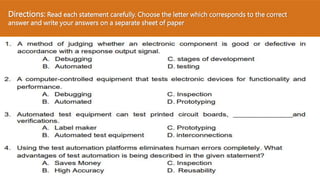
Directions: Read each statement carefully. Choose the letter which corresponds to the correct
answer and write your answers on a separate sheet of paper
Directions: Read each statement carefully. Choose the letter which corresponds to the correct
answer and write your answers on a separate sheet of paper
MODULE 2
USING ANALOG AND DIGITAL MULTIMETER
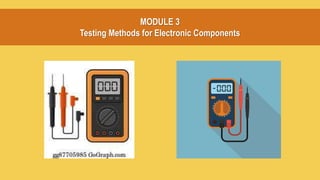
MODULE 3
Testing Methods for Electronic Components
EXPECTATIONS
At the end of the lesson, you should be able to:
1. identify various testing methods based on types of electronic
component
2. determine characteristics and appropriateness of testing
methods to be used during development and on completion
3. consider/select testing methods in relation to appropriate testing
strategy
BRIEF INTRODUCTION
This module covers the knowledge, skills and attitudes
required to test electronic components. It includes
competencies in determining the criteria for testing
electronics components, planning an approach for
component testing, testing the components and evaluating
the testing process.
Testing methods for electronic
components
Testing and test instruments are key to any electronics design,
development, production, and maintenance activity. Electronic
equipment can develop failures, or it may not work properly when it is
built. To discover whether a circuit is working, and then where the
problem is located, it is necessary to use various forms of test
equipment.
Testing methods for electronic
components
1. Automated
Automated test equipment (ATE) is computer-controlled test and
measurement equipment that allows for testing with minimal human
interaction. The tested devices are referred to as a device under test (DUT).
The advantages of this kind of testing include reducing testing time,
repeatability, and cost efficiency in high volume. The chief disadvantages
are the upfront costs for programming and setup.
Advantages of electronic test automation:
1. Saves Time
2. Saves Money
3. Early Detection of Bugs
4. Reusability
5. High Accuracy
Testing methods for electronic
components
2. Debugging
Debugging is the process of detecting and removing of existing and
potential errors (also called as ‘bugs’) in a software code that can cause it to
behave unexpectedly or crash. To prevent incorrect operation of a software or
system, debugging is used to find and resolve bugs or defects. When various
subsystems or modules are tightly coupled, debugging becomes harder as any
change in one module may cause more bugs to appear in another. Sometimes it
takes more time to debug a program than to code it.
Here’s the debugging process
1. Identify - the first step in the debugging, it means discover what is the bug and why
it happens.
2. Isolate - a step to separate the buggy code with other healthy code; I usually make
a Unit Test referencing that part of code and then reproduce the bug using that unit
tests.
3. Fix - a step to correct the buggy code; This step is the core part of debugging; If the
above two steps are doing well, it should be easy to handle this step.
4. Review - the final step and is easily forgotten by us; Review is a step to ensure the
bug you fixed are working correctly now
Testing methods for electronic
components
3. Electronic Component Inspection
Inspection An inspection involves checking something, i.e., examining and
assessing something. We may inspect an electronic circuits or components to make
sure that it meets specific standards. The inspectors need to ensure that nothing is
faulty. The latest generation electronic circuits include hundreds of components with
thousands of welds and interconnections: it is, therefore, essential to define rigorous
inspection and test procedures, capable of ensuring the quality of the final product.
Testing methods for electronic
components
3. Electronic Component
Inspection An inspection involves checking something, i.e., examining and
assessing something. We may inspect an electronic circuits or components to make
sure that it meets specific standards. The inspectors need to ensure that nothing is
faulty. The latest generation electronic circuits include hundreds of components with
thousands of welds and interconnections: it is, therefore, essential to define rigorous
inspection and test procedures, capable of ensuring the quality of the final product.
Testing methods for electronic
components
4. Platform testing
A platform is a group of technologies that are used as a base upon which
other applications, processes or technologies are developed. In personal
computing, a platform is the basic hardware (computer) and software
(operating system) on which software applications can be run. This
environment constitutes the basic foundation upon which any application or
software is supported and/or developed.
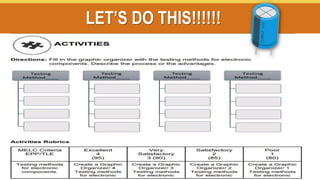
LET’S DO THIS!!!!!!
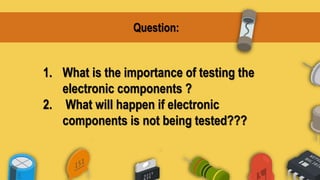
Question:
1. What is the importance of testing the
electronic components ?
2. What will happen if electronic
components is not being tested???
REMEMBER
Testing of electronic components is the first thing that we do
whether we are still a beginner in electronics or a professional. In
school, the first thing that we do in building a project is first to test
all the components to be used. because testing the electronic
components is of prime importance, it is necessary for us to know
thoroughly the correct way to test the components and the right way
to determine accurate test result.
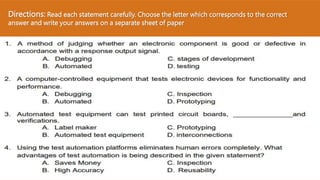
Directions: Read each statement carefully. Choose the letter which corresponds to the correct
answer and write your answers on a separate sheet of paper
Directions: Read each statement carefully. Choose the letter which corresponds to the correct
answer and write your answers on a separate sheet of paper
ASSIGNMENT
THANK YOU

MODULE 3- Q4 - Copy MODULE IN CSS- Copy.pptx

  • 1.
    Good Day Class Welcometo our CSS-9 CLASS Week 3
  • 2.
    MODULE 2 USING ANALOGAND DIGITAL MULTIMETER L
  • 3.
    Directions: Read eachstatement carefully. Choose the letter which corresponds to the correct answer and write your answers on a separate sheet of paper
  • 4.
    Directions: Read eachstatement carefully. Choose the letter which corresponds to the correct answer and write your answers on a separate sheet of paper
  • 6.
    MODULE 2 USING ANALOGAND DIGITAL MULTIMETER MODULE 3 Testing Methods for Electronic Components
  • 7.
    EXPECTATIONS At the endof the lesson, you should be able to: 1. identify various testing methods based on types of electronic component 2. determine characteristics and appropriateness of testing methods to be used during development and on completion 3. consider/select testing methods in relation to appropriate testing strategy
  • 8.
    BRIEF INTRODUCTION This modulecovers the knowledge, skills and attitudes required to test electronic components. It includes competencies in determining the criteria for testing electronics components, planning an approach for component testing, testing the components and evaluating the testing process.
  • 9.
    Testing methods forelectronic components Testing and test instruments are key to any electronics design, development, production, and maintenance activity. Electronic equipment can develop failures, or it may not work properly when it is built. To discover whether a circuit is working, and then where the problem is located, it is necessary to use various forms of test equipment.
  • 10.
    Testing methods forelectronic components 1. Automated Automated test equipment (ATE) is computer-controlled test and measurement equipment that allows for testing with minimal human interaction. The tested devices are referred to as a device under test (DUT). The advantages of this kind of testing include reducing testing time, repeatability, and cost efficiency in high volume. The chief disadvantages are the upfront costs for programming and setup.
  • 11.
    Advantages of electronictest automation: 1. Saves Time 2. Saves Money 3. Early Detection of Bugs 4. Reusability 5. High Accuracy
  • 12.
    Testing methods forelectronic components 2. Debugging Debugging is the process of detecting and removing of existing and potential errors (also called as ‘bugs’) in a software code that can cause it to behave unexpectedly or crash. To prevent incorrect operation of a software or system, debugging is used to find and resolve bugs or defects. When various subsystems or modules are tightly coupled, debugging becomes harder as any change in one module may cause more bugs to appear in another. Sometimes it takes more time to debug a program than to code it.
  • 13.
    Here’s the debuggingprocess 1. Identify - the first step in the debugging, it means discover what is the bug and why it happens. 2. Isolate - a step to separate the buggy code with other healthy code; I usually make a Unit Test referencing that part of code and then reproduce the bug using that unit tests. 3. Fix - a step to correct the buggy code; This step is the core part of debugging; If the above two steps are doing well, it should be easy to handle this step. 4. Review - the final step and is easily forgotten by us; Review is a step to ensure the bug you fixed are working correctly now
  • 14.
    Testing methods forelectronic components 3. Electronic Component Inspection Inspection An inspection involves checking something, i.e., examining and assessing something. We may inspect an electronic circuits or components to make sure that it meets specific standards. The inspectors need to ensure that nothing is faulty. The latest generation electronic circuits include hundreds of components with thousands of welds and interconnections: it is, therefore, essential to define rigorous inspection and test procedures, capable of ensuring the quality of the final product.
  • 15.
    Testing methods forelectronic components 3. Electronic Component Inspection An inspection involves checking something, i.e., examining and assessing something. We may inspect an electronic circuits or components to make sure that it meets specific standards. The inspectors need to ensure that nothing is faulty. The latest generation electronic circuits include hundreds of components with thousands of welds and interconnections: it is, therefore, essential to define rigorous inspection and test procedures, capable of ensuring the quality of the final product.
  • 16.
    Testing methods forelectronic components 4. Platform testing A platform is a group of technologies that are used as a base upon which other applications, processes or technologies are developed. In personal computing, a platform is the basic hardware (computer) and software (operating system) on which software applications can be run. This environment constitutes the basic foundation upon which any application or software is supported and/or developed.
  • 17.
  • 18.
    Question: 1. What isthe importance of testing the electronic components ? 2. What will happen if electronic components is not being tested???
  • 19.
    REMEMBER Testing of electroniccomponents is the first thing that we do whether we are still a beginner in electronics or a professional. In school, the first thing that we do in building a project is first to test all the components to be used. because testing the electronic components is of prime importance, it is necessary for us to know thoroughly the correct way to test the components and the right way to determine accurate test result.
  • 20.
    Directions: Read eachstatement carefully. Choose the letter which corresponds to the correct answer and write your answers on a separate sheet of paper
  • 21.
    Directions: Read eachstatement carefully. Choose the letter which corresponds to the correct answer and write your answers on a separate sheet of paper
  • 22.
  • 23.