TRAINING ON THE
MATATAG CURRICULUM
Venue : Kapitbayan Elementary School
Date : July 5, 2024
1
TRAINING ON THE
MATATAG CURRICULUM
Venue : Kapitbayan Elementary School
Date : July 5, 2024
2
K, G1, G4, G7 TEACHERS, AND SCHOOL LEADERS
MATATAG Curriculum Training | 2024
Session 12
Management
of School-Based Professional
Development Programs
3
Leonard S. Evangelista
MATATAG Curriculum Training | 2024
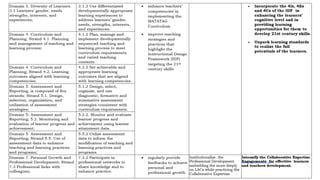
Domain 2. Managing School Operations and Resources
- Strand 2.2 Financial Management
● Indicator 2.2.2 Manage Finances adhering to
policies, guidelines, and issuances in
allocation, procurement, disbursement, and
liquidation aligned with the school plan
(for teachers’ professional development).
4
Domains, Strands, and Indicators of PPSSH
(DepEd Order No. 24, s. 2020)
PROFESSIONAL STANDARDS ADDRESSED
MATATAG Curriculum Training | 2024
Domain 3 Focusing on Teaching and Learning
- Strand 3.1 School-based review, contextualization and
implementation of learning standards
●
Indicator 3.1.2 Assist teachers in the review,
contextualization and implementation of learning
standards to make the MATATAG Curriculum
relevant for learners
5
Domains, Strands, and Indicators of PPSSH
(DepEd Order No. 24, s. 2020)
MATATAG Curriculum Training | 2024
Domains, Strands, and Indicators of PPSSH
(DepEd Order No. 24, s. 2020)
Domain 4 Developing Self and Others
- Strand 4.5 Professional development of school personnel
● Indicator 4.5.2 Implement professional development
initiatives to enhance strengths and address
performance gaps among school personnel.
● Indicator 4.5.3 Monitor and evaluate the
implementation of professional development
initiatives in enhancing strengths and in
addressing performance gaps among school
personnel.
6
MATATAG Curriculum Training | 2024
7
Domains, Strands, and Indicators of PPSSH
(DepEd Order No. 24, s. 2020)
Domain 5. Building Connections
Strand 5.4 Communication
Indicator 5.4.2. Communicate effectively in speaking
and in writing to teachers, learners, parents, and other
stakeholders through positive use of communication
platforms, to facilitate information sharing,
collaboration, and support.
MATATAG Curriculum Training | 2024
Domain 7 Personal Growth and Professional
Development
-Strand 7.4 Professional reflection and learning to improve
practice
● Indicator 7.4.2 Develop a personal
professional improvement plan based on
reflection of one’s practice and ongoing
professional learning
8
Domains, Strands, Indicators of PPSSH
(DepEd Order No. 24, s. 2020)
MATATAG Curriculum Training | 2024
Session Flow
Roles of School Leaders in Leading and
Managing School-Based PD Programs
Effect Size and Its Intervention Requirement
9
Whole-School Approach
School-Based PD Programs
Implementation Strategies for the Conduct of School-
Based Training on the MATATAG Curriculum
Work Application Plan (WAP),RTIP, DTIP, and CSBPDP
MATATAG Curriculum Training | 2024
Session Objectives
At the end of the session, participants will be able to:
• discuss the significant roles of school leaders in leading
and managing School-Based Professional Development
Programs to improve teacher practice;
• integrate the concept and elements of the whole-school
approach to curriculum planning and its link to teachers’
ongoing professional learning, articulating the effect size
and its impact on learning outcomes;
10
MATATAG Curriculum Training | 2024
• discuss the Implementation Strategies for the Conduct of
School-Based Training on the MATATAG Curriculum;
• develop a WAP capturing the general concepts of MATATAG
Curriculum articulating the a doable school-based
professional development plan for teachers on the MATATAG
Curriculum; and
• display willingness to implement the WAP to improve
learning outcomes.
11
Session Objectives
12
Keepin’ My Memory On
MATATAG Curriculum Training | 2024
For 5 minutes, please
accomplish the “Keepin’
My Memory On” the
template provided.
13
Instructions
MATATAG Curriculum Training | 2024 14
Keepin’ My Memory On
I experienced/practiced being (specify your role)
__________________during
(what PD program)_____________________________________________which
helped me (enhanced competencies) _________________________________.
Thus, (state the result) ______________________________________________.
MATATAG Curriculum Training | 2024
● Form a triad with your
seatmates A, B, C.
● Start with A, then take
turns in sharing your
answers.
15
Instructions
16
Let’s Process
MATATAG Curriculum Training | 2024 17
In sharing with your
teammates, what
struck you the most
about the roles you
performed during the
training?
MATATAG Curriculum Training | 2024 18
When was the last time you
either managed, implemented,
or participated in a school-
based PD program?
How was your experience?
MATATAG Curriculum Training | 2024 19
In leading, managing, or
implementing a school-based
professional development
program, what do you think
are the critical factors that we
need to consider?
MATATAG Curriculum Training | 2024
What is Effect Size and Why Does It Matter?
Effect size tells you how meaningful the
relationship between variables or the
difference between groups is. It indicates the
practical significance of a research outcome.
20
MATATAG Curriculum Training | 2024
What is Effect Size and Why Does It Matter?
A large effect size means that a research
finding has practical significance, while a
small effect size indicates limited practical
applications.
The larger the effect size, the greater the
impact of an intervention.
21
MATATAG Curriculum Training | 2024
Effect Size
● According to Hattie, an appropriate goal of
schooling (in his words) is for students to
achieve at least a year’s worth of learning for
a year’s input.
● To achieve this, we are looking at an effect
size of 0.4.
22
MATATAG Curriculum Training | 2024 23
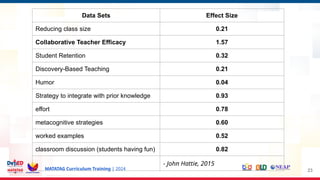
Data Sets Effect Size
Reducing class size 0.21
Collaborative Teacher Efficacy 1.57
Student Retention 0.32
Discovery-Based Teaching 0.21
Humor 0.04
Strategy to integrate with prior knowledge 0.93
effort 0.78
metacognitive strategies 0.60
worked examples 0.52
classroom discussion (students having fun) 0.82
- John Hattie, 2015
MATATAG Curriculum Training | 2024
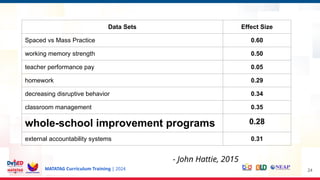
- John Hattie, 2015
24
Data Sets Effect Size
Spaced vs Mass Practice 0.60
working memory strength 0.50
teacher performance pay 0.05
homework 0.29
decreasing disruptive behavior 0.34
classroom management 0.35
whole-school improvement programs 0.28
external accountability systems 0.31
MATATAG Curriculum Training | 2024
Currently, the Effect Size of introducing CE and making it a
focus of teacher professional development to bring about
change in student learning is 1.57, according to John Hattie, as
shared by John Pegg in his talk to CT, NEAP and TECS teams.
The implications of this figure are huge and cannot be
ignored!
25
Effect Size
MATATAG Curriculum Training | 2024
There is an issue!!!
DepEd has good policies. In particular DepEd Order No. 35,
s. 2016 concerning LAC is consistent with best educational
thinking internationally. The Policy on using LACs has been
in the Philippines for years before this DepEd Order.
However, few if any tangible improvements are evident.
Consider PISA and NAT results.
What might have gone wrong?
26
27
Bureau of Human Resource and Organizational
Development
Performance of learners
in the overall test in the
three 21st
Century Skills in
NATG10 2020 and NATG10
2023 shows an increasing
trend.
However, the MPS in both school
years did not reach the minimum
proficiency level (NP: 50-74%).
How do learners’ overall performance in the NATG10
compare from 2020 to 2023?
21st Century Skills 2020 2023
Percentage
Increase/Decrease
Trend
Problem Solving 41.50 44.53 3.03
Information Literacy 39.90 43.56 3.66
Critical Thinking 36.80 41.11 4.31
Percentage Point Increase in Mean Percentage Scores (MPS)
28
Bureau of Human Resource and Organizational
Development
Performance of learners in
the overall test in the three
21st
Century Skills in NATG12
2019 and NATG12 2023
shows an increasing trend
However, the MPS in both school years
did not reach the minimum proficiency
level (NP: 50-74%).
How do learners’ overall performance in the NATG12
compare from 2019 to 2023?
21st Century Skills 2019 2023
Percentage
Increase/Decrease
Trend
Problem Solving 36.45 39.91 3.46
Information Literacy 34.43 43.33 8.90
Critical Thinking 34.62 39.76 5.14
(Low Proficient: 25-49%)
Percentage Point Increase/Decrease in Mean Percentage Scores (MPS)
MATATAG Curriculum Training | 2024
29
Is cohesive and collaborative action
by a school community that is being
strategically and continually
constructed to improve student
learning, behavior and wellbeing.
30
🔥 Training on Higher-Order Thinking Skills PLP 30
Every school has
different needs and
starting points.
MATATAG Curriculum Training | 2024
31
a framework that can be used to
assess what exists, create a plan to
address gaps and identify measures
of progress.
MATATAG Curriculum Training | 2024
32
An overarching
supportive, safe
and inclusive
school culture
A whole school approach
includes:
MATATAG Curriculum Training | 2024
33
School-based programs
in and out of the
classroom that focus on
social emotional
learning and respect for
differences
A whole school approach
includes:
MATATAG Curriculum Training | 2024
34
School policy that
prioritizes, monitors
and reports on progress
for all students, with a
focus on eliminating
disparities
A whole school approach
includes:
MATATAG Curriculum Training | 2024
35
School partnerships to
bring community
programs and resources
into the school setting, to
augment school capacity
and address families’ needs
beyond the classroom.
A whole school approach
includes:
MATATAG Curriculum Training | 2024
36
School partnerships to
bring community
programs and resources
into the school setting, to
augment school capacity
and address families’ needs
beyond the classroom.
A whole school approach
includes:
MATATAG Curriculum Training | 2024
Note: The Pilot in 35 schools focused on Grade 4
and Grade 7 offers leadership in schools, a
chance to practice and learn about a ‘whole-
school’ approach to curriculum in Grade 4 and/or
Grade 7 prior to working with more/all Grades in
coming years.
37
Whole-School Approach to Curriculum Planning
MATATAG Curriculum Training | 2024
A whole-school approach to curriculum planning
requires school stakeholders to be involved, to
trust and become a part of the way forward.
School stakeholders will be at developmentally
different places in willingness and capacity to be
involved in a ‘whole-school’ approach.
38
Whole-School Approach to Curriculum Planning
MATATAG Curriculum Training | 2024
Purpose:
To ensure that there is a cohesive and
consistent curriculum offered throughout
each school in each Grade and in each
subject.
39
Whole-School Approach to Curriculum Planning
MATATAG Curriculum Training | 2024
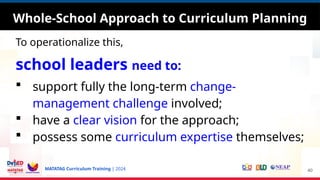
To operationalize this,
school leaders need to:
 support fully the long-term change-
management challenge involved;
 have a clear vision for the approach;
 possess some curriculum expertise themselves;
40
Whole-School Approach to Curriculum Planning
MATATAG Curriculum Training | 2024
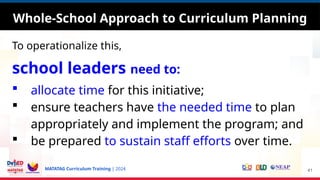
To operationalize this,
school leaders need to:
 allocate time for this initiative;
 ensure teachers have the needed time to plan
appropriately and implement the program; and
 be prepared to sustain staff efforts over time.
41
Whole-School Approach to Curriculum Planning
MATATAG Curriculum Training | 2024
Whole-School Approach to Curriculum Planning
In order to do this, schools need to:
● Officially adopt the need for a coordinated, whole-
school approach to curriculum planning;
● ensure that curriculum planning is not left to
individual teachers in isolation but is a collective
effort involving teams of teachers and oversighted
by School Heads;
42
MATATAG Curriculum Training | 2024
In order to do this, schools need to:
● develop thoughtfully Learning Action Cells (LACs)
established in a way that enable teams of teachers to
meet, discuss and plan learner learning, curriculum
delivery and assessment practices; and
● support strongly the development of collaborative
expertise groupings throughout the school.
43
Whole-School Approach to Curriculum Planning
MATATAG Curriculum Training | 2024
Whole-School Approach to Curriculum Planning
Benefits for learners:
1. MAXIMIZED LEARNING:
• A whole-school approach provides
students with a knowledge-rich
curriculum that incrementally
introduces new material.
• It connects it to previous learning and offers ample practice
opportunities.
• This approach is particularly valuable for building depth of
knowledge students need for advanced topics.
44
Whole-School Approach to Curriculum Planning
Photo taken from: https://www.philstar.com/headlines/2019/05/02/1914414/overworking-public-
school-teachers-can-erode-teaching-quality-state-think-tank
MATATAG Curriculum Training | 2024
Whole-School Approach to Curriculum Planning
Benefits for learners:
2. EQUITY IN EDUCATION:
• All students, regardless of the
class they are in, should receive the
same rich learning opportunities.
• A whole-school approach enables
teachers to reduce disparities in education and agree on:
○ What content to teach,
○ How to teach it, and
○ How to assess student learning.
45
Whole-School Approach to Curriculum Planning
Photo taken from: https://mb.com.ph/2023/5/3/dep-ed-beefs-up-training-
programs-for-teachers-school-leaders
MATATAG Curriculum Training | 2024
Whole-School Approach to Curriculum Planning
Benefits for learners:
3. EFFECTIVE TEACHING:
With access to shared curriculum
teachers can spend less time on:
Figuring out what to teach,
More time, focusing on how
to teach effectively, and
Tailoring instruction to meet
individual student needs.
46
Whole-School Approach to Curriculum Planning
Photo taken from: https://web.facebook.com/photo.php?fbid=745354564299686&set=pb.100064754464538.-
2207520000&type=3
MATATAG Curriculum Training | 2024
Whole-School Approach to Curriculum Planning
Benefits for teachers :
1. BUILDING EXPERTISE
• Shared, high-quality curriculum materials and a common
instructional approach enable teachers to improve their
classroom practice significantly.
• Teachers can discuss problem, learn from one another, and
refine curriculum materials collaboratively, enhancing their
teaching skills.
47
Whole-School Approach to Curriculum Planning
MATATAG Curriculum Training | 2024
Whole-School Approach to Curriculum Planning
Benefits for teachers :
2. REDUCED PLANNING LOAD
• Teachers with access to a shared bank of high-quality curriculum
materials for all subjects spend less time sourcing or creating materials.

• This reduced individual planning load allows teachers to concentrate on
other critical aspects of their roles, such as building relationships with
students.
48
Whole-School Approach to Curriculum Planning
MATATAG Curriculum Training | 2024
KEY ELEMENTS
SHARED SCHOOL VISION
School leaders should collectively agree on why,
what, and how they are implementing this
approach, using a clear vision as a guiding anchor.
49
Photos taken from: https://web.facebook.com/photo/?fbid=718367593652688&set=pcb.718370566985724
MATATAG Curriculum Training | 2024
DETAILED AND SEQUENCED
CURRICULUM MATERIALS
Schools should have curriculum maps and unit
plans that provide a structured framework for
teaching, ensuring that knowledge and skills
become increasingly sophisticated over time.
50
KEY ELEMENTS
MATATAG Curriculum Training | 2024
AGREED INSTRUCTIONAL
APPROACH
An agreed-upon instructional approach defines
what effective teaching looks like in the classroom. It is
often codified in documents like instructional
playbooks.
51
KEY ELEMENTS
MATATAG Curriculum Training | 2024
CURRICULUM
EXPERTISE
Curriculum leaders should
be well-trained and capable of
overseeing the implementation
of the curriculum approach.
52
KEY ELEMENTS
MATATAG Curriculum Training | 2024
PROFESSIONAL LEARNING
Ongoing professional learning is crucial for teachers to
improve their teaching quality and consistency.
○ Teachers need professional learning opportunities closely aligned
with the school’s curriculum approach.
○ This training should be connected to classroom practice and help
teachers implement the curriculum effectively.
○ Instructional coaching can play a vital role in translating
knowledge acquired through training into actual classroom
practice.
53
KEY ELEMENTS
MATATAG Curriculum Training | 2024
INDUCTING NEW TEACHERS
• New teachers should be provided with robust induction
programs that introduce them to the school’s curriculum
approach, instructional methods, and specific curriculum
materials.

• Pairing new teachers with mentors can guide them
through these processes can help them integrate
smoothly into the school’s educational framework.
54
KEY ELEMENTS
MATATAG Curriculum Training | 2024
IN SUMMARY
55
The main practical ideas of implementation
revolve around the importance of
collaborative, structured curriculum planning,
the provision of high-quality materials.

The benefits this approach offers to both
students and teachers.
Strong leadership, clear vision, and ongoing
professional development are vital
components of successful implementation.
1
2
3
56
School-Based PD Programs
MATATAG Curriculum Training | 2024 57
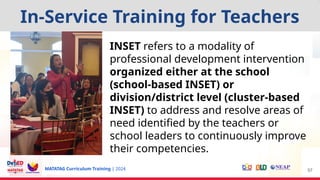
INSET refers to a modality of
professional development intervention
organized either at the school
(school-based INSET) or
division/district level (cluster-based
INSET) to address and resolve areas of
need identified by the teachers or
school leaders to continuously improve
their competencies.
In-Service Training for Teachers
MATATAG Curriculum Training | 2024 58
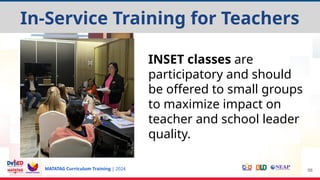
INSET classes are
participatory and should
be offered to small groups
to maximize impact on
teacher and school leader
quality.
In-Service Training for Teachers
59
Learning Action Cell (LAC)
(DO No. 35, s. 2016)
MATATAG Curriculum Training | 2024
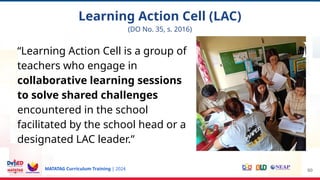
“Learning Action Cell is a group of
teachers who engage in
collaborative learning sessions
to solve shared challenges
encountered in the school
facilitated by the school head or a
designated LAC leader.”
60
Learning Action Cell (LAC)
(DO No. 35, s. 2016)
MATATAG Curriculum Training | 2024
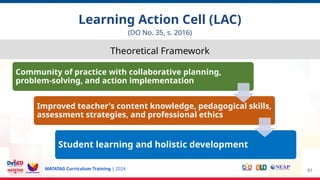
Theoretical Framework
61
Community of practice with collaborative planning,
problem-solving, and action implementation
Improved teacher's content knowledge, pedagogical skills,
assessment strategies, and professional ethics
Student learning and holistic development
Learning Action Cell (LAC)
(DO No. 35, s. 2016)
MATATAG Curriculum Training | 2024
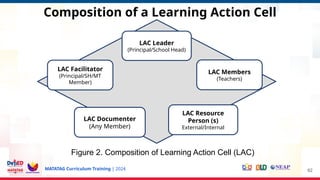
Composition of a Learning Action Cell
62
LAC Leader
(Principal/School Head)
LAC Members
(Teachers)
LAC Resource
Person (s)
External/Internal
LAC Documenter
(Any Member)
LAC Facilitator
(Principal/SH/MT
Member)
Figure 2. Composition of Learning Action Cell (LAC)
MATATAG Curriculum Training | 2024
“The greatest influence on student
progression in learning is having
expert, inspired and passionate
teachers and school leaders working
together to maximize the effect of
their teaching on all students in their
care.” - John Hattie, 2015
COLLABORATIVE EXPERTISE (CE)
MATATAG Curriculum Training | 2024
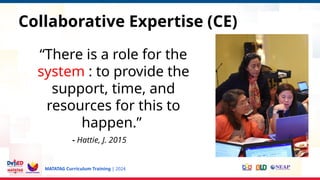
“There is a role for the
system : to provide the
support, time, and
resources for this to
happen.”
- Hattie, J. 2015
Collaborative Expertise (CE)
MATATAG Curriculum Training | 2024
COLLABORATIVE EXPERTISE (CE)
The concept of COLLABORATIVE
EXPERTISE in education concerns
addressing the need to improve student
learning outcomes by reducing within-school
variability in teacher effectiveness.
65
MATATAG Curriculum Training | 2024
COLLABORATIVE EXPERTISE MOVING FORWARD
Highlights the need to shift the education narrative towards
COLLABORATION,
EXPERTISE, AND
EVIDENCE-BASED IMPROVEMENT
This shift is critical if we, at the Department of Education, wish
ultimately, to lead schools, leaders, and teachers to help attain better
learning outcomes for learners.
66
Bureau of Human Resource and Organizational
Development
Improved Learning Outcomes for Students
-Three Fundamental Ideas
1. Most effective learning occurs when you
begin teaching where the learner is at.
2. Learning is consistent with the way brain
learns supported by cognition research.
3. Teachers, in a school, work as a team.
67
Bureau of Human Resource and Organizational
Development
Summary of Three Ideas
• Quality teaching can be promoted by three ideas evidenced by
teachers:
1. Knowing their subject and how it can be taught, and
where to start;
2. Using knowledge of how the brain learns to guide
teaching approaches to support student learning; and
3. Working to establish and utilize collaborative
expertise to facilitate greater coherence in learning
across their school.
68
MATATAG Curriculum Training | 2024
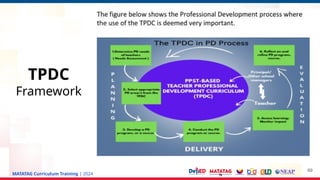
69
TPDC
Framework
MATATAG Curriculum Training | 2024
70
Customized School-Based Professional Development Programs Plan (CSBPDP)
(Adapted: Training and Development (Tan D) , Volume 3 and TPDC Framework)
MATATAG Curriculum Training | 2024
71
MATATAG Curriculum Training | 2024
72
MATATAG Curriculum Training | 2024
73
MATATAG Curriculum Training | 2024
74
MATATAG Curriculum Training | 2024
75
MATATAG Curriculum Training | 2024
76
MATATAG Curriculum Training | 2024
Implementation Strategies for
the Conduct of School-Based
Training on the MATATAG
Curriculum
MATATAG Curriculum Training | 2024
Thumbs Up, Thumbs Down,
Thumbs Sideway
Instructions:
Show a thumbs up if the
option is possible. Thumbs
down, if you believe it’s not.
Thumbs sideway, if unsure.
MATATAG Curriculum Training | 2024
Thumbs Up, Thumbs Down, Thumbs Sideway
Are you ready?
Game na ba kayo?
MATATAG Curriculum Training | 2024
1. Maximizing the loading
of other teachers per
learning area from other
grade levels not involved in
the initial phase of the
training
MATATAG Curriculum Training | 2024
2. Engaging SK
members to take
charge of the class
while the teachers are
in the training
MATATAG Curriculum Training | 2024
3. Scheduling a half-day
training for K,1,4, and 7
teachers totaling 40 hours
to ensure that the regular
classes will continue
without disruption
MATATAG Curriculum Training | 2024
4. Letting the most
active parents handle
the class and visit the
class now and then to
see whether the learners
are intact inside the
classroom.
MATATAG Curriculum Training | 2024
5. Taking turns by a batch of
Grade 4 or Grade 7 teachers,
maximizing the loading of
other batches of teachers not
yet involved in the scheduled
training (e.g. Batch 1/Week 1-
English, Science, Math, Batch
2/Week 2- Filipino, AP, Values
Education, Batch 3/Week 3-
TLE/HELE, MAPEH)
MATATAG Curriculum Training | 2024
6. Shorten the class and
let the learners go
home so as not to
distract the attendance
of the teachers in the
training.
MATATAG Curriculum Training | 2024
7. Maximizing the loading
of relieving (special)
teacher in the training-
program
MATATAG Curriculum Training | 2024
8. Tap the barangay
officials to organize
sports activities for the
learner to engage in.
MATATAG Curriculum Training | 2024
9. Hiring substitute
teachers, subject to the
availability of funds.
MATATAG Curriculum Training | 2024
10. Ask the school head
to merge classes with the
ALS learners.
MATATAG Curriculum Training | 2024
Based on the Joint DepEd Memorandum dated
December 20, 2023, School Heads are
expected to employ the suggested strategies
they find applicable to their school context in
implementing the Training on the MATATAG
Curriculum for K, 1, 4, and 7.
Joint DepEd Memorandum
dated December 20, 2023
MATATAG Curriculum Training | 2024
1. Maximizing the loading of other teachers per
learning area from other grade levels not involved
in the initial phase of the training
2. Scheduling a half-day training for K, 1, 4, and 7
teachers totaling 40 hours to ensure that the
regular classes will continue without disruption
Suggested strategies appropriate in their school
context in implementing the Training on MATATAG
Curriculum for K147.
(Joint DepEd Memorandum dated December 20, 2023)
MATATAG Curriculum Training | 2024
3. Taking turns by a batch of Grade 4 or Grade 7
teachers, maximizing the loading of other batches of
teachers not yet involved in the scheduled training
(e.g. Batch 1/Week 1- English, Science, Math, Batch
2/Week 2- Filipino, AP, Values Education, Batch 3/Week
3- TLE/HELE, MAPEH)
Suggested strategies appropriate in their school
context in implementing the Training on MATATAG
Curriculum for K147.
(Joint DepEd Memorandum dated December 20, 2023)
Suggested strategies appropriate in their school
context in implementing the Training on MATATAG
Curriculum for K147.
MATATAG Curriculum Training | 2024
4. Maximizing the loading of relieving (special)
teachers who are not in the training-program
5. Hiring substitute teachers, subject to the
availability of funds.
6. Tapping teacher applicants for voluntary
services during the duration of the training
program
Suggested strategies appropriate in their school
context in implementing the Training on MATATAG
Curriculum for K147.
(Joint DepEd Memorandum dated December 20, 2023)
Suggested strategies appropriate in their school
context in implementing the Training on MATATAG
Curriculum for K147.
MATATAG Curriculum Training | 2024
Work Application Plan (WAP)
in the Context of MATATAG Curriculum
MATATAG Curriculum Training | 2024
Significance of MATATAG Curriculum
To articulate the general shape of the MATATAG
Curriculum and to ensure its full implementation, all
the participants of the training (teachers and school
leaders) shall develop a Work Application Plan
(WAP).
MATATAG Curriculum Training | 2024
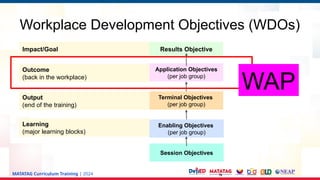
Workplace Development Objectives (WDOs)
Impact/Goal Results Objective
Outcome
(back in the workplace)
Application Objectives
(per job group)
WAP
Output
(end of the training)
Terminal Objectives
(per job group)
Learning
(major learning blocks)
Enabling Objectives
(per job group)
Session Objectives
MATATAG Curriculum Training | 2024
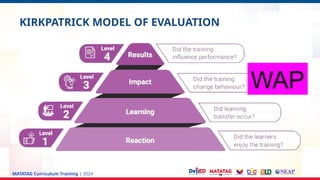
KIRKPATRICK MODEL OF EVALUATION
WAP
MATATAG Curriculum Training | 2024
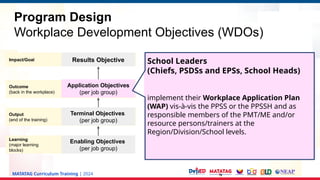
Program Design
Workplace Development Objectives (WDOs)
Impact/Goal
Outcome
(back in the workplace)
Output
(end of the training)
Learning
(major learning
blocks)
Results Objective
Application Objectives
(per job group)
Terminal Objectives
(per job group)
Enabling Objectives
(per job group)
School Leaders
(Chiefs, PSDSs and EPSs, School Heads)
implement their Workplace Application Plan
(WAP) vis-à-vis the PPSS or the PPSSH and as
responsible members of the PMT/ME and/or
resource persons/trainers at the
Region/Division/School levels.
MATATAG Curriculum Training | 2024
Impact/Goal
Outcome
(back in the workplace)
Output
(end of the training)
Learning
(major learning
blocks)
Results Objective
Application Objectives
(per job group)
Terminal Objectives
(per job group)
Enabling Objectives
(per job group)
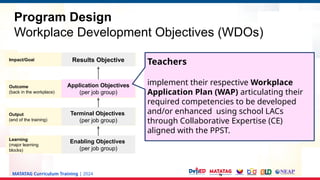
Teachers
implement their respective Workplace
Application Plan (WAP) articulating their
required competencies to be developed
and/or enhanced using school LACs
through Collaborative Expertise (CE)
aligned with the PPST.
Program Design
Workplace Development Objectives (WDOs)
MATATAG Curriculum Training | 2024
WAP Template
MATATAG Curriculum Training | 2024
WAP’s Up!
1. Individually, accomplish the WAP template.
2. Share your accomplished WAP in a triad.
MATATAG Curriculum Training | 2024
For Teachers
Work Application Plan
MATATAG Curriculum Training | 2024
Presentation and Critiquing
MATATAG Curriculum Training | 2024
Session Objectives
At the end of the session, participants will be able to:
• discuss the significant roles of school leaders in leading
and managing School-Based Professional Development
Programs to improve teacher practice;
• integrate the concept and elements of the whole-school
approach to curriculum planning and its link to teachers’
ongoing professional learning, articulating the effect size
and its impact on learning outcomes;
112
MATATAG Curriculum Training | 2024
• discuss the Implementation Strategies for the Conduct of
School-Based Training on the MATATAG Curriculum;
• develop a WAP capturing the general concepts of
MATATAG Curriculum articulating the a doable school-
based professional development plan for teachers on the
MATATAG Curriculum; and
• display willingness to implement the WAP to improve
learning outcomes.
113
Session Objectives
Bureau of Human Resource and Organizational
Development
Brain-Based Learning
John Pegg
The SiMERR National Research Centre
Chief Investigator:
University of New England
Australia
MATATAG Curriculum Training | 2024
References
● RA 9155 Governance of Basic Education Act of 2001
● RA 11713 Excellence in Teacher Education Act of 2022
● D.O. 83, s. 2012 “Implementing Guidelines on the Revised School-Based Management Framework, Assessment Process and Tool
(APAT)”
● D.O. 35, s. 2016 “The Learning Action Cell as a K to 12 Basic Education Program School-Based Continuing Professional Development
Strategy for the Improvement of Teaching and Learning”
● D.O. No. 11, s. 2019 Implementation of the NEAP Transformation
● D.O. 024, s. 2020 “National Adoption and Implementation of the Philippine Professional Standards for School Heads”
● DM No. 44, s. 2023 “Interim Guidelines for Quality Assurance of NEAP Core Programs”
● Paul V. Bredeson (2000) The school principal's role in teacher professional development, Journal of In-Service Education, 26:2, 385-
401, DOI: 10.1080/13674580000200114
● Competency-Based Learning and Development Management System in The Civil Service Commission
● © UNESCO 2005 ISBN: 92-803-1278-2 (Education Policy Series 3)
● https://theeducationhub.org.nz/instructional-leadership-and-why-it-matters/
● John Pegg, 2024
● John Hattie, 2015
● https://wholeschoolapproach.lerenvoormorgen.org/en/
● https://www.futureswithoutviolence.org/the-whole-school-approach/
● https://www.scribbr.com/statistics/effect-size/
● https://assessment.tki.org.nz/Using-evidence-for-learning/Working-with-data/Concepts/Effect-size
115
116
🔥 Training on Higher-Order Thinking Skills PLP 116
“He who learns but
does not think, is lost!
He who thinks but
does not learn is in
great danger.”
-Confucius
MATATAG Curriculum Training | 2024 117
Program Management Team
Curriculum and Teaching Strand
Bureau of Curriculum Development
Bureau of Learning Delivery
Bureau of Education Assessment
Bureau of Alternative Education
Bureau of Learning Resources
Human Resources and Organizational
Development Strand
National Educators Academy of the Philippines
(NEAP)
Professional Development Division
Quality Assurance Division
Session Guide and Presentation
Deck Developer/s
NEAP
Dir. Leah B. Apao
MATATAG CURRICULUM TRAINING RESOURCE PACKAGE
MARAMING SALAMAT!
118

SD_Management of School-based PD Programs.pptx

  • 1.
    TRAINING ON THE MATATAGCURRICULUM Venue : Kapitbayan Elementary School Date : July 5, 2024 1
  • 2.
    TRAINING ON THE MATATAGCURRICULUM Venue : Kapitbayan Elementary School Date : July 5, 2024 2 K, G1, G4, G7 TEACHERS, AND SCHOOL LEADERS
  • 3.
    MATATAG Curriculum Training| 2024 Session 12 Management of School-Based Professional Development Programs 3 Leonard S. Evangelista
  • 4.
    MATATAG Curriculum Training| 2024 Domain 2. Managing School Operations and Resources - Strand 2.2 Financial Management ● Indicator 2.2.2 Manage Finances adhering to policies, guidelines, and issuances in allocation, procurement, disbursement, and liquidation aligned with the school plan (for teachers’ professional development). 4 Domains, Strands, and Indicators of PPSSH (DepEd Order No. 24, s. 2020) PROFESSIONAL STANDARDS ADDRESSED
  • 5.
    MATATAG Curriculum Training| 2024 Domain 3 Focusing on Teaching and Learning - Strand 3.1 School-based review, contextualization and implementation of learning standards ● Indicator 3.1.2 Assist teachers in the review, contextualization and implementation of learning standards to make the MATATAG Curriculum relevant for learners 5 Domains, Strands, and Indicators of PPSSH (DepEd Order No. 24, s. 2020)
  • 6.
    MATATAG Curriculum Training| 2024 Domains, Strands, and Indicators of PPSSH (DepEd Order No. 24, s. 2020) Domain 4 Developing Self and Others - Strand 4.5 Professional development of school personnel ● Indicator 4.5.2 Implement professional development initiatives to enhance strengths and address performance gaps among school personnel. ● Indicator 4.5.3 Monitor and evaluate the implementation of professional development initiatives in enhancing strengths and in addressing performance gaps among school personnel. 6
  • 7.
    MATATAG Curriculum Training| 2024 7 Domains, Strands, and Indicators of PPSSH (DepEd Order No. 24, s. 2020) Domain 5. Building Connections Strand 5.4 Communication Indicator 5.4.2. Communicate effectively in speaking and in writing to teachers, learners, parents, and other stakeholders through positive use of communication platforms, to facilitate information sharing, collaboration, and support.
  • 8.
    MATATAG Curriculum Training| 2024 Domain 7 Personal Growth and Professional Development -Strand 7.4 Professional reflection and learning to improve practice ● Indicator 7.4.2 Develop a personal professional improvement plan based on reflection of one’s practice and ongoing professional learning 8 Domains, Strands, Indicators of PPSSH (DepEd Order No. 24, s. 2020)
  • 9.
    MATATAG Curriculum Training| 2024 Session Flow Roles of School Leaders in Leading and Managing School-Based PD Programs Effect Size and Its Intervention Requirement 9 Whole-School Approach School-Based PD Programs Implementation Strategies for the Conduct of School- Based Training on the MATATAG Curriculum Work Application Plan (WAP),RTIP, DTIP, and CSBPDP
  • 10.
    MATATAG Curriculum Training| 2024 Session Objectives At the end of the session, participants will be able to: • discuss the significant roles of school leaders in leading and managing School-Based Professional Development Programs to improve teacher practice; • integrate the concept and elements of the whole-school approach to curriculum planning and its link to teachers’ ongoing professional learning, articulating the effect size and its impact on learning outcomes; 10
  • 11.
    MATATAG Curriculum Training| 2024 • discuss the Implementation Strategies for the Conduct of School-Based Training on the MATATAG Curriculum; • develop a WAP capturing the general concepts of MATATAG Curriculum articulating the a doable school-based professional development plan for teachers on the MATATAG Curriculum; and • display willingness to implement the WAP to improve learning outcomes. 11 Session Objectives
  • 12.
  • 13.
    MATATAG Curriculum Training| 2024 For 5 minutes, please accomplish the “Keepin’ My Memory On” the template provided. 13 Instructions
  • 14.
    MATATAG Curriculum Training| 2024 14 Keepin’ My Memory On I experienced/practiced being (specify your role) __________________during (what PD program)_____________________________________________which helped me (enhanced competencies) _________________________________. Thus, (state the result) ______________________________________________.
  • 15.
    MATATAG Curriculum Training| 2024 ● Form a triad with your seatmates A, B, C. ● Start with A, then take turns in sharing your answers. 15 Instructions
  • 16.
  • 17.
    MATATAG Curriculum Training| 2024 17 In sharing with your teammates, what struck you the most about the roles you performed during the training?
  • 18.
    MATATAG Curriculum Training| 2024 18 When was the last time you either managed, implemented, or participated in a school- based PD program? How was your experience?
  • 19.
    MATATAG Curriculum Training| 2024 19 In leading, managing, or implementing a school-based professional development program, what do you think are the critical factors that we need to consider?
  • 20.
    MATATAG Curriculum Training| 2024 What is Effect Size and Why Does It Matter? Effect size tells you how meaningful the relationship between variables or the difference between groups is. It indicates the practical significance of a research outcome. 20
  • 21.
    MATATAG Curriculum Training| 2024 What is Effect Size and Why Does It Matter? A large effect size means that a research finding has practical significance, while a small effect size indicates limited practical applications. The larger the effect size, the greater the impact of an intervention. 21
  • 22.
    MATATAG Curriculum Training| 2024 Effect Size ● According to Hattie, an appropriate goal of schooling (in his words) is for students to achieve at least a year’s worth of learning for a year’s input. ● To achieve this, we are looking at an effect size of 0.4. 22
  • 23.
    MATATAG Curriculum Training| 2024 23 Data Sets Effect Size Reducing class size 0.21 Collaborative Teacher Efficacy 1.57 Student Retention 0.32 Discovery-Based Teaching 0.21 Humor 0.04 Strategy to integrate with prior knowledge 0.93 effort 0.78 metacognitive strategies 0.60 worked examples 0.52 classroom discussion (students having fun) 0.82 - John Hattie, 2015
  • 24.
    MATATAG Curriculum Training| 2024 - John Hattie, 2015 24 Data Sets Effect Size Spaced vs Mass Practice 0.60 working memory strength 0.50 teacher performance pay 0.05 homework 0.29 decreasing disruptive behavior 0.34 classroom management 0.35 whole-school improvement programs 0.28 external accountability systems 0.31
  • 25.
    MATATAG Curriculum Training| 2024 Currently, the Effect Size of introducing CE and making it a focus of teacher professional development to bring about change in student learning is 1.57, according to John Hattie, as shared by John Pegg in his talk to CT, NEAP and TECS teams. The implications of this figure are huge and cannot be ignored! 25 Effect Size
  • 26.
    MATATAG Curriculum Training| 2024 There is an issue!!! DepEd has good policies. In particular DepEd Order No. 35, s. 2016 concerning LAC is consistent with best educational thinking internationally. The Policy on using LACs has been in the Philippines for years before this DepEd Order. However, few if any tangible improvements are evident. Consider PISA and NAT results. What might have gone wrong? 26
  • 27.
    27 Bureau of HumanResource and Organizational Development Performance of learners in the overall test in the three 21st Century Skills in NATG10 2020 and NATG10 2023 shows an increasing trend. However, the MPS in both school years did not reach the minimum proficiency level (NP: 50-74%). How do learners’ overall performance in the NATG10 compare from 2020 to 2023? 21st Century Skills 2020 2023 Percentage Increase/Decrease Trend Problem Solving 41.50 44.53 3.03 Information Literacy 39.90 43.56 3.66 Critical Thinking 36.80 41.11 4.31 Percentage Point Increase in Mean Percentage Scores (MPS)
  • 28.
    28 Bureau of HumanResource and Organizational Development Performance of learners in the overall test in the three 21st Century Skills in NATG12 2019 and NATG12 2023 shows an increasing trend However, the MPS in both school years did not reach the minimum proficiency level (NP: 50-74%). How do learners’ overall performance in the NATG12 compare from 2019 to 2023? 21st Century Skills 2019 2023 Percentage Increase/Decrease Trend Problem Solving 36.45 39.91 3.46 Information Literacy 34.43 43.33 8.90 Critical Thinking 34.62 39.76 5.14 (Low Proficient: 25-49%) Percentage Point Increase/Decrease in Mean Percentage Scores (MPS)
  • 29.
    MATATAG Curriculum Training| 2024 29 Is cohesive and collaborative action by a school community that is being strategically and continually constructed to improve student learning, behavior and wellbeing.
  • 30.
    30 🔥 Training onHigher-Order Thinking Skills PLP 30 Every school has different needs and starting points.
  • 31.
    MATATAG Curriculum Training| 2024 31 a framework that can be used to assess what exists, create a plan to address gaps and identify measures of progress.
  • 32.
    MATATAG Curriculum Training| 2024 32 An overarching supportive, safe and inclusive school culture A whole school approach includes:
  • 33.
    MATATAG Curriculum Training| 2024 33 School-based programs in and out of the classroom that focus on social emotional learning and respect for differences A whole school approach includes:
  • 34.
    MATATAG Curriculum Training| 2024 34 School policy that prioritizes, monitors and reports on progress for all students, with a focus on eliminating disparities A whole school approach includes:
  • 35.
    MATATAG Curriculum Training| 2024 35 School partnerships to bring community programs and resources into the school setting, to augment school capacity and address families’ needs beyond the classroom. A whole school approach includes:
  • 36.
    MATATAG Curriculum Training| 2024 36 School partnerships to bring community programs and resources into the school setting, to augment school capacity and address families’ needs beyond the classroom. A whole school approach includes:
  • 37.
    MATATAG Curriculum Training| 2024 Note: The Pilot in 35 schools focused on Grade 4 and Grade 7 offers leadership in schools, a chance to practice and learn about a ‘whole- school’ approach to curriculum in Grade 4 and/or Grade 7 prior to working with more/all Grades in coming years. 37 Whole-School Approach to Curriculum Planning
  • 38.
    MATATAG Curriculum Training| 2024 A whole-school approach to curriculum planning requires school stakeholders to be involved, to trust and become a part of the way forward. School stakeholders will be at developmentally different places in willingness and capacity to be involved in a ‘whole-school’ approach. 38 Whole-School Approach to Curriculum Planning
  • 39.
    MATATAG Curriculum Training| 2024 Purpose: To ensure that there is a cohesive and consistent curriculum offered throughout each school in each Grade and in each subject. 39 Whole-School Approach to Curriculum Planning
  • 40.
    MATATAG Curriculum Training| 2024 To operationalize this, school leaders need to:  support fully the long-term change- management challenge involved;  have a clear vision for the approach;  possess some curriculum expertise themselves; 40 Whole-School Approach to Curriculum Planning
  • 41.
    MATATAG Curriculum Training| 2024 To operationalize this, school leaders need to:  allocate time for this initiative;  ensure teachers have the needed time to plan appropriately and implement the program; and  be prepared to sustain staff efforts over time. 41 Whole-School Approach to Curriculum Planning
  • 42.
    MATATAG Curriculum Training| 2024 Whole-School Approach to Curriculum Planning In order to do this, schools need to: ● Officially adopt the need for a coordinated, whole- school approach to curriculum planning; ● ensure that curriculum planning is not left to individual teachers in isolation but is a collective effort involving teams of teachers and oversighted by School Heads; 42
  • 43.
    MATATAG Curriculum Training| 2024 In order to do this, schools need to: ● develop thoughtfully Learning Action Cells (LACs) established in a way that enable teams of teachers to meet, discuss and plan learner learning, curriculum delivery and assessment practices; and ● support strongly the development of collaborative expertise groupings throughout the school. 43 Whole-School Approach to Curriculum Planning
  • 44.
    MATATAG Curriculum Training| 2024 Whole-School Approach to Curriculum Planning Benefits for learners: 1. MAXIMIZED LEARNING: • A whole-school approach provides students with a knowledge-rich curriculum that incrementally introduces new material. • It connects it to previous learning and offers ample practice opportunities. • This approach is particularly valuable for building depth of knowledge students need for advanced topics. 44 Whole-School Approach to Curriculum Planning Photo taken from: https://www.philstar.com/headlines/2019/05/02/1914414/overworking-public- school-teachers-can-erode-teaching-quality-state-think-tank
  • 45.
    MATATAG Curriculum Training| 2024 Whole-School Approach to Curriculum Planning Benefits for learners: 2. EQUITY IN EDUCATION: • All students, regardless of the class they are in, should receive the same rich learning opportunities. • A whole-school approach enables teachers to reduce disparities in education and agree on: ○ What content to teach, ○ How to teach it, and ○ How to assess student learning. 45 Whole-School Approach to Curriculum Planning Photo taken from: https://mb.com.ph/2023/5/3/dep-ed-beefs-up-training- programs-for-teachers-school-leaders
  • 46.
    MATATAG Curriculum Training| 2024 Whole-School Approach to Curriculum Planning Benefits for learners: 3. EFFECTIVE TEACHING: With access to shared curriculum teachers can spend less time on: Figuring out what to teach, More time, focusing on how to teach effectively, and Tailoring instruction to meet individual student needs. 46 Whole-School Approach to Curriculum Planning Photo taken from: https://web.facebook.com/photo.php?fbid=745354564299686&set=pb.100064754464538.- 2207520000&type=3
  • 47.
    MATATAG Curriculum Training| 2024 Whole-School Approach to Curriculum Planning Benefits for teachers : 1. BUILDING EXPERTISE • Shared, high-quality curriculum materials and a common instructional approach enable teachers to improve their classroom practice significantly. • Teachers can discuss problem, learn from one another, and refine curriculum materials collaboratively, enhancing their teaching skills. 47 Whole-School Approach to Curriculum Planning
  • 48.
    MATATAG Curriculum Training| 2024 Whole-School Approach to Curriculum Planning Benefits for teachers : 2. REDUCED PLANNING LOAD • Teachers with access to a shared bank of high-quality curriculum materials for all subjects spend less time sourcing or creating materials. • This reduced individual planning load allows teachers to concentrate on other critical aspects of their roles, such as building relationships with students. 48 Whole-School Approach to Curriculum Planning

  • 49.
    MATATAG Curriculum Training| 2024 KEY ELEMENTS SHARED SCHOOL VISION School leaders should collectively agree on why, what, and how they are implementing this approach, using a clear vision as a guiding anchor. 49 Photos taken from: https://web.facebook.com/photo/?fbid=718367593652688&set=pcb.718370566985724
  • 50.
    MATATAG Curriculum Training| 2024 DETAILED AND SEQUENCED CURRICULUM MATERIALS Schools should have curriculum maps and unit plans that provide a structured framework for teaching, ensuring that knowledge and skills become increasingly sophisticated over time. 50 KEY ELEMENTS
  • 51.
    MATATAG Curriculum Training| 2024 AGREED INSTRUCTIONAL APPROACH An agreed-upon instructional approach defines what effective teaching looks like in the classroom. It is often codified in documents like instructional playbooks. 51 KEY ELEMENTS
  • 52.
    MATATAG Curriculum Training| 2024 CURRICULUM EXPERTISE Curriculum leaders should be well-trained and capable of overseeing the implementation of the curriculum approach. 52 KEY ELEMENTS
  • 53.
    MATATAG Curriculum Training| 2024 PROFESSIONAL LEARNING Ongoing professional learning is crucial for teachers to improve their teaching quality and consistency. ○ Teachers need professional learning opportunities closely aligned with the school’s curriculum approach. ○ This training should be connected to classroom practice and help teachers implement the curriculum effectively. ○ Instructional coaching can play a vital role in translating knowledge acquired through training into actual classroom practice. 53 KEY ELEMENTS
  • 54.
    MATATAG Curriculum Training| 2024 INDUCTING NEW TEACHERS • New teachers should be provided with robust induction programs that introduce them to the school’s curriculum approach, instructional methods, and specific curriculum materials. • Pairing new teachers with mentors can guide them through these processes can help them integrate smoothly into the school’s educational framework. 54 KEY ELEMENTS

  • 55.
    MATATAG Curriculum Training| 2024 IN SUMMARY 55 The main practical ideas of implementation revolve around the importance of collaborative, structured curriculum planning, the provision of high-quality materials. The benefits this approach offers to both students and teachers. Strong leadership, clear vision, and ongoing professional development are vital components of successful implementation. 1 2 3

  • 56.
  • 57.
    MATATAG Curriculum Training| 2024 57 INSET refers to a modality of professional development intervention organized either at the school (school-based INSET) or division/district level (cluster-based INSET) to address and resolve areas of need identified by the teachers or school leaders to continuously improve their competencies. In-Service Training for Teachers
  • 58.
    MATATAG Curriculum Training| 2024 58 INSET classes are participatory and should be offered to small groups to maximize impact on teacher and school leader quality. In-Service Training for Teachers
  • 59.
    59 Learning Action Cell(LAC) (DO No. 35, s. 2016)
  • 60.
    MATATAG Curriculum Training| 2024 “Learning Action Cell is a group of teachers who engage in collaborative learning sessions to solve shared challenges encountered in the school facilitated by the school head or a designated LAC leader.” 60 Learning Action Cell (LAC) (DO No. 35, s. 2016)
  • 61.
    MATATAG Curriculum Training| 2024 Theoretical Framework 61 Community of practice with collaborative planning, problem-solving, and action implementation Improved teacher's content knowledge, pedagogical skills, assessment strategies, and professional ethics Student learning and holistic development Learning Action Cell (LAC) (DO No. 35, s. 2016)
  • 62.
    MATATAG Curriculum Training| 2024 Composition of a Learning Action Cell 62 LAC Leader (Principal/School Head) LAC Members (Teachers) LAC Resource Person (s) External/Internal LAC Documenter (Any Member) LAC Facilitator (Principal/SH/MT Member) Figure 2. Composition of Learning Action Cell (LAC)
  • 63.
    MATATAG Curriculum Training| 2024 “The greatest influence on student progression in learning is having expert, inspired and passionate teachers and school leaders working together to maximize the effect of their teaching on all students in their care.” - John Hattie, 2015 COLLABORATIVE EXPERTISE (CE)
  • 64.
    MATATAG Curriculum Training| 2024 “There is a role for the system : to provide the support, time, and resources for this to happen.” - Hattie, J. 2015 Collaborative Expertise (CE)
  • 65.
    MATATAG Curriculum Training| 2024 COLLABORATIVE EXPERTISE (CE) The concept of COLLABORATIVE EXPERTISE in education concerns addressing the need to improve student learning outcomes by reducing within-school variability in teacher effectiveness. 65
  • 66.
    MATATAG Curriculum Training| 2024 COLLABORATIVE EXPERTISE MOVING FORWARD Highlights the need to shift the education narrative towards COLLABORATION, EXPERTISE, AND EVIDENCE-BASED IMPROVEMENT This shift is critical if we, at the Department of Education, wish ultimately, to lead schools, leaders, and teachers to help attain better learning outcomes for learners. 66
  • 67.
    Bureau of HumanResource and Organizational Development Improved Learning Outcomes for Students -Three Fundamental Ideas 1. Most effective learning occurs when you begin teaching where the learner is at. 2. Learning is consistent with the way brain learns supported by cognition research. 3. Teachers, in a school, work as a team. 67
  • 68.
    Bureau of HumanResource and Organizational Development Summary of Three Ideas • Quality teaching can be promoted by three ideas evidenced by teachers: 1. Knowing their subject and how it can be taught, and where to start; 2. Using knowledge of how the brain learns to guide teaching approaches to support student learning; and 3. Working to establish and utilize collaborative expertise to facilitate greater coherence in learning across their school. 68
  • 69.
    MATATAG Curriculum Training| 2024 69 TPDC Framework
  • 70.
    MATATAG Curriculum Training| 2024 70 Customized School-Based Professional Development Programs Plan (CSBPDP) (Adapted: Training and Development (Tan D) , Volume 3 and TPDC Framework)
  • 71.
  • 72.
  • 73.
  • 74.
  • 75.
  • 76.
  • 77.
    MATATAG Curriculum Training| 2024 Implementation Strategies for the Conduct of School-Based Training on the MATATAG Curriculum
  • 78.
    MATATAG Curriculum Training| 2024 Thumbs Up, Thumbs Down, Thumbs Sideway Instructions: Show a thumbs up if the option is possible. Thumbs down, if you believe it’s not. Thumbs sideway, if unsure.
  • 79.
    MATATAG Curriculum Training| 2024 Thumbs Up, Thumbs Down, Thumbs Sideway Are you ready? Game na ba kayo?
  • 80.
    MATATAG Curriculum Training| 2024 1. Maximizing the loading of other teachers per learning area from other grade levels not involved in the initial phase of the training
  • 81.
    MATATAG Curriculum Training| 2024 2. Engaging SK members to take charge of the class while the teachers are in the training
  • 82.
    MATATAG Curriculum Training| 2024 3. Scheduling a half-day training for K,1,4, and 7 teachers totaling 40 hours to ensure that the regular classes will continue without disruption
  • 83.
    MATATAG Curriculum Training| 2024 4. Letting the most active parents handle the class and visit the class now and then to see whether the learners are intact inside the classroom.
  • 84.
    MATATAG Curriculum Training| 2024 5. Taking turns by a batch of Grade 4 or Grade 7 teachers, maximizing the loading of other batches of teachers not yet involved in the scheduled training (e.g. Batch 1/Week 1- English, Science, Math, Batch 2/Week 2- Filipino, AP, Values Education, Batch 3/Week 3- TLE/HELE, MAPEH)
  • 85.
    MATATAG Curriculum Training| 2024 6. Shorten the class and let the learners go home so as not to distract the attendance of the teachers in the training.
  • 86.
    MATATAG Curriculum Training| 2024 7. Maximizing the loading of relieving (special) teacher in the training- program
  • 87.
    MATATAG Curriculum Training| 2024 8. Tap the barangay officials to organize sports activities for the learner to engage in.
  • 88.
    MATATAG Curriculum Training| 2024 9. Hiring substitute teachers, subject to the availability of funds.
  • 89.
    MATATAG Curriculum Training| 2024 10. Ask the school head to merge classes with the ALS learners.
  • 90.
    MATATAG Curriculum Training| 2024 Based on the Joint DepEd Memorandum dated December 20, 2023, School Heads are expected to employ the suggested strategies they find applicable to their school context in implementing the Training on the MATATAG Curriculum for K, 1, 4, and 7. Joint DepEd Memorandum dated December 20, 2023
  • 91.
    MATATAG Curriculum Training| 2024 1. Maximizing the loading of other teachers per learning area from other grade levels not involved in the initial phase of the training 2. Scheduling a half-day training for K, 1, 4, and 7 teachers totaling 40 hours to ensure that the regular classes will continue without disruption Suggested strategies appropriate in their school context in implementing the Training on MATATAG Curriculum for K147. (Joint DepEd Memorandum dated December 20, 2023)
  • 92.
    MATATAG Curriculum Training| 2024 3. Taking turns by a batch of Grade 4 or Grade 7 teachers, maximizing the loading of other batches of teachers not yet involved in the scheduled training (e.g. Batch 1/Week 1- English, Science, Math, Batch 2/Week 2- Filipino, AP, Values Education, Batch 3/Week 3- TLE/HELE, MAPEH) Suggested strategies appropriate in their school context in implementing the Training on MATATAG Curriculum for K147. (Joint DepEd Memorandum dated December 20, 2023) Suggested strategies appropriate in their school context in implementing the Training on MATATAG Curriculum for K147.
  • 93.
    MATATAG Curriculum Training| 2024 4. Maximizing the loading of relieving (special) teachers who are not in the training-program 5. Hiring substitute teachers, subject to the availability of funds. 6. Tapping teacher applicants for voluntary services during the duration of the training program Suggested strategies appropriate in their school context in implementing the Training on MATATAG Curriculum for K147. (Joint DepEd Memorandum dated December 20, 2023) Suggested strategies appropriate in their school context in implementing the Training on MATATAG Curriculum for K147.
  • 94.
    MATATAG Curriculum Training| 2024 Work Application Plan (WAP) in the Context of MATATAG Curriculum
  • 95.
    MATATAG Curriculum Training| 2024 Significance of MATATAG Curriculum To articulate the general shape of the MATATAG Curriculum and to ensure its full implementation, all the participants of the training (teachers and school leaders) shall develop a Work Application Plan (WAP).
  • 96.
    MATATAG Curriculum Training| 2024 Workplace Development Objectives (WDOs) Impact/Goal Results Objective Outcome (back in the workplace) Application Objectives (per job group) WAP Output (end of the training) Terminal Objectives (per job group) Learning (major learning blocks) Enabling Objectives (per job group) Session Objectives
  • 97.
    MATATAG Curriculum Training| 2024 KIRKPATRICK MODEL OF EVALUATION WAP
  • 98.
    MATATAG Curriculum Training| 2024 Program Design Workplace Development Objectives (WDOs) Impact/Goal Outcome (back in the workplace) Output (end of the training) Learning (major learning blocks) Results Objective Application Objectives (per job group) Terminal Objectives (per job group) Enabling Objectives (per job group) School Leaders (Chiefs, PSDSs and EPSs, School Heads) implement their Workplace Application Plan (WAP) vis-à-vis the PPSS or the PPSSH and as responsible members of the PMT/ME and/or resource persons/trainers at the Region/Division/School levels.

  • 99.
    MATATAG Curriculum Training| 2024 Impact/Goal Outcome (back in the workplace) Output (end of the training) Learning (major learning blocks) Results Objective Application Objectives (per job group) Terminal Objectives (per job group) Enabling Objectives (per job group) Teachers implement their respective Workplace Application Plan (WAP) articulating their required competencies to be developed and/or enhanced using school LACs through Collaborative Expertise (CE) aligned with the PPST. Program Design Workplace Development Objectives (WDOs)
  • 100.
    MATATAG Curriculum Training| 2024 WAP Template
  • 101.
    MATATAG Curriculum Training| 2024 WAP’s Up! 1. Individually, accomplish the WAP template. 2. Share your accomplished WAP in a triad.
  • 102.
    MATATAG Curriculum Training| 2024 For Teachers Work Application Plan
  • 103.
  • 104.
  • 105.
  • 106.
  • 107.
  • 108.
  • 109.
  • 110.
  • 111.
    MATATAG Curriculum Training| 2024 Presentation and Critiquing
  • 112.
    MATATAG Curriculum Training| 2024 Session Objectives At the end of the session, participants will be able to: • discuss the significant roles of school leaders in leading and managing School-Based Professional Development Programs to improve teacher practice; • integrate the concept and elements of the whole-school approach to curriculum planning and its link to teachers’ ongoing professional learning, articulating the effect size and its impact on learning outcomes; 112
  • 113.
    MATATAG Curriculum Training| 2024 • discuss the Implementation Strategies for the Conduct of School-Based Training on the MATATAG Curriculum; • develop a WAP capturing the general concepts of MATATAG Curriculum articulating the a doable school- based professional development plan for teachers on the MATATAG Curriculum; and • display willingness to implement the WAP to improve learning outcomes. 113 Session Objectives

  • 114.

    Bureau of HumanResource and Organizational Development Brain-Based Learning John Pegg The SiMERR National Research Centre Chief Investigator: University of New England Australia
  • 115.
    MATATAG Curriculum Training| 2024 References ● RA 9155 Governance of Basic Education Act of 2001 ● RA 11713 Excellence in Teacher Education Act of 2022 ● D.O. 83, s. 2012 “Implementing Guidelines on the Revised School-Based Management Framework, Assessment Process and Tool (APAT)” ● D.O. 35, s. 2016 “The Learning Action Cell as a K to 12 Basic Education Program School-Based Continuing Professional Development Strategy for the Improvement of Teaching and Learning” ● D.O. No. 11, s. 2019 Implementation of the NEAP Transformation ● D.O. 024, s. 2020 “National Adoption and Implementation of the Philippine Professional Standards for School Heads” ● DM No. 44, s. 2023 “Interim Guidelines for Quality Assurance of NEAP Core Programs” ● Paul V. Bredeson (2000) The school principal's role in teacher professional development, Journal of In-Service Education, 26:2, 385- 401, DOI: 10.1080/13674580000200114 ● Competency-Based Learning and Development Management System in The Civil Service Commission ● © UNESCO 2005 ISBN: 92-803-1278-2 (Education Policy Series 3) ● https://theeducationhub.org.nz/instructional-leadership-and-why-it-matters/ ● John Pegg, 2024 ● John Hattie, 2015 ● https://wholeschoolapproach.lerenvoormorgen.org/en/ ● https://www.futureswithoutviolence.org/the-whole-school-approach/ ● https://www.scribbr.com/statistics/effect-size/ ● https://assessment.tki.org.nz/Using-evidence-for-learning/Working-with-data/Concepts/Effect-size 115
  • 116.
    116 🔥 Training onHigher-Order Thinking Skills PLP 116 “He who learns but does not think, is lost! He who thinks but does not learn is in great danger.” -Confucius
  • 117.
    MATATAG Curriculum Training| 2024 117 Program Management Team Curriculum and Teaching Strand Bureau of Curriculum Development Bureau of Learning Delivery Bureau of Education Assessment Bureau of Alternative Education Bureau of Learning Resources Human Resources and Organizational Development Strand National Educators Academy of the Philippines (NEAP) Professional Development Division Quality Assurance Division Session Guide and Presentation Deck Developer/s NEAP Dir. Leah B. Apao MATATAG CURRICULUM TRAINING RESOURCE PACKAGE
  • 118.

Editor's Notes

  • #1 Purpose of the Slide: Say: Do: Note: Change the title to reflect the governance level and target audience. Download this document as a PPT.
  • #2 Purpose of the Slide: Say: Do: Note: Change the title to reflect the governance level and target audience. Download this document as a PPT.
  • #3 Say: As introduced I am <name of resource person> and I will be your facilitator for this session. Purpose of the Slide: to give the title of the session and name of the RP/LF Say: I am _____________ and I will be facilitating the session titled ______. Other Notes: Faci may add more ad libs.
  • #9 Do: Read through the session flow.
  • #10 Purpose of the Slide: To give the objective/aim of the session Say: In this session, you will be ___________. At the end of the session, you will also be ____________. Below are the strands of the professional standards that this PD addresses. Other Notes:
  • #11 Purpose of the Slide: To give the objective/aim of the session Say: In this session, you will be ___________. At the end of the session, you will also be ____________. Below are the strands of the professional standards that this PD addresses. Other Notes:
  • #12 Say: I am confident that all of you have significant practices/experiences about attending or managing any professional development programs conducted at the school level. You may identify your specific roles and responsibilities, e.g. as resource person, facilitators, etc.
  • #13 Do: Read the instruction and distribute the template. Make sure that all participants have a copy.
  • #15 Say: I hope everyone is done with their answers. Now, let us share and process your responses. Do: Ask the participants to form into triads. Assign each one with letters like A, B, C. Take turns to share your answers starting with participant A to be followed by B, and C, respectively. Do: After the Triad Sharing, ask 2 to 3 participants to share their insights on the Triad Sharing.   Say: Can we have 2 to 3 of you who will share your learning or insights about the sharing you have had during the Triad Sharing?   Do: Call 2 to 3 participants to share.
  • #16 Say: Can we have 2 to 3 of you who will share your learning or insights about the sharing you have had during the Triad Sharing?   Do: Call 2 to 3 participants to share.
  • #17 Do: Write key concepts mentioned by the participants on the white board/sheets of manila paper. Key concepts that might be mentioned: Q2: Because I was able to impart my knowledge as a Resource Person to the participants… Do: Process the participants’ answers.
  • #18 Do: Write key concepts mentioned by the participants on the white board/sheets of manila paper. Key concepts that might be mentioned: Q3: It was during INSET. I felt proud being given the opportunity to serve as one of the members of PMT. Do: Process the participants’ answers.
  • #19 Do: Write key concepts mentioned by the participants on the white board/sheets of manila paper. Key concepts that might be mentioned: Q4: In managing a school-based training program, I believe that the one managing must consider the following: Understands the concepts and significance of school-based training program. Knows his/her roles about conducting school-based training program. Has full grasp of teacher’s performance and how to improve teaching competencies through providing continuous professional development programs or learning and development interventions. Can work with teachers through developing and implementing their Individual Action Plans. Preparation of implementation plan Uderstadns well the effect size and its intervention requirements Do: Process the participants’ answers. Say: You are right! These are some of the factors that need to be considered for the one, especially the School Head, when managing a school-based training program. Now, let us learn from issuances and experts the significance of managing a school-based professional development programs through INSET, LAC, and other Learning and Development interventions, the roles of School Heads, how the school heads use the results of teachers’ performance and in developing the Work Application Plan (WAP).
  • #20 Say: The Effect size tells you how meaningful the relationship between variables or the difference between groups is. It indicates the practical significance of a research outcome. A large effect size means that a research finding has practical significance, while a small effect size indicates limited practical applications.
  • #21 Say: The Effect size tells you how meaningful the relationship between variables or the difference between groups is. It indicates the practical significance of a research outcome. A large effect size means that a research finding has practical significance, while a small effect size indicates limited practical applications.
  • #22 https://assessment.tki.org.nz/Using-evidence-for-learning/Working-with-data/Concepts/Effect-sizeSay: Anything above 0.4 would imply that the innovation is working better than expected. The Professional Learning and Development BES suggests 0.2 – 0.4 is a small but educationally significant impact, 0.4 – 0.6 is a medium educationally significant impact and greater than 0.6 is large. Effect size is a way of quantifying the difference between two groups. In this instance we are quantifying the difference between the end of year and beginning of year results. An effect size of 1.0 indicates that a particular approach to teaching or technique advanced the learning of the students in the study by one standard deviation above the mean, typically associated with advancing children's achievement by one year, improving the rate of learning by 50%, or a correlation between some variable (for example, amount of homework) and achievement of approximately .50. When implementing a new programme, an effect size of 1.0 would mean that approximately 95% of average students receiving that treatment would exceed 84% of students not receiving that treatment (Hattie, 1999). According to Hattie (1999) normative comparison points of effect sizes are: 0.1 Student maturation 0.24 Any teacher in front of class 0.4 Innovations in schooling Anything above 0.4 would imply that the innovation is working better than expected. The Professional Learning and Development BES suggests 0.2 – 0.4 is a small but educationally significant impact, 0.4 – 0.6 is a medium educationally significant impact and greater than 0.6 is large.
  • #23 We should not ask in education what works, because nearly everything works. The right question to ask is how much difference did an activity or technique make?
  • #25 Say: According to Hattie (1999) normative comparison points of effect sizes are: 0.1 Student maturation 0.24 Any teacher in front of class 0.4 Innovations in schooling Anything above 0.4 would imply that the innovation is working better than expected. The Professional Learning and Development BES suggests 0.2 – 0.4 is a small but educationally significant impact, 0.4 – 0.6 is a medium educationally significant impact and greater than 0.6 is large.
  • #26 Do: Present the slide. Say: This is an issue! Discuss the implementation of LAC, pursuant to DepEd Order No. 35, s. 2016. The RO may share their own experience with LAC and how it has been implemented at the school level.
  • #27 Do: Present the slide. How does learners’ overall performance in the NATG10 compare from 2020 to 2023? Say: This shows our learners’ overall performance in the NATG10 compared to 2020 and 2023. Yes, the learners' performance in the three major 21st century skills, such as problem solving, information literacy, and critical thinking, has increased from 2020 to 2023. Though they are increasing, the scores are still way below the minimum proficiency level. As shown in this tabular presentation, the MPS in both school years did not reach the minimum proficiency level of 50–74% national planning standards.
  • #28 Do: Present the slide. How does learners’ overall performance in the NATG12 compare from 2020 to 2023? Say: This shows our learners’ overall performance in the NATG12 compared to 2019 and 2023. Yes, the learners' performance in the three major 21st century skills such as problem solving, information literacy, and critical thinking has increased from 2019 to 2023. Though they are increasing, the scores are still way below the minimum proficiency level. As shown in this tabular presentation, the MPS in both school years did not reach the minimum proficiency level of 50–74% national planning standards.
  • #29 Do. Discuss the concept of the whole-school approach and its key elements. Refer to the slides.
  • #30 Do. Discuss the concept of the whole-school approach and its key elements. Refer to the slides.
  • #31 Do. Discuss the concept of the whole-school approach and its key elements. Refer to the slides.
  • #32 Do. Discuss the concept of the whole-school approach and its key elements. Refer to the slides.
  • #33 Do. Discuss the concept of the whole-school approach and its key elements. Refer to the slides.
  • #34 Do. Discuss the concept of the whole-school approach and its key elements. Refer to the slides.
  • #35 Do. Discuss the concept of the whole-school approach and its key elements. Refer to the slides.
  • #36 Do. Discuss the concept of the whole-school approach and its key elements. Refer to the slides.
  • #55 Break
  • #56 Do: Present and discuss the existing School-Based PD Programs such as InSET, LAC, and CE
  • #57 Do: Read the text.
  • #58 Do: Read the text.
  • #59 Do: Review of the salient features of LAC with Collaborative Expertise and how it has be maximized during the implementation of the National Learning Camp
  • #60 Say: LAC is a group of teachers who engage in collaborative learning sessions to solve shared challenges encountered in the school facilitated by the school head or a designated LAC Leader. LACs will become the school-based communities of practice that are positive, caring, and safe spaces. Do: Put emphasis when saying the words in bold text. These words will be repeated throughout the session. Observe the participants reaction and acknowledge while passing through the text.
  • #61 Do: Read the slides. Put emphasis on the community of practice.
  • #62 Do: Review the composition of the LAC
  • #65 Considerations/Criteria for a better or a successful school-based PD Program
  • #67 Say: There are three fundamental ideas that each teacher and school leader has to focus on: 1.) Most effective learning occurs when you begin teaching where the learner is at. 2) Learning is consistent with the way brain learns supported by cognition research. 3) Teachers, in a school, work as a team.
  • #68 Say: In summary, Qaulity teaching can be promoted by these three ideas evidenced by each teacher: 1) knowing their subject and how it can be taught and where to start; 2) using knowledge of how the brain learns to guide teaching approaches to support student learning; and 3) Working to establish and utilize collaborative expertise to facilitate greater coherence in learning across their school. Thus, the school heads have to step up to help the teachers level up their teaching performance.
  • #69 Say: TPDC means Teacher Professional Development Curriculum 1. Determine PD Needs. The process starts with determining the PD needs of the teachers. The Needs Assessment may be conducted by the School Heads or Principals through observation, interview, and/or survey of teachers’ training needs. The Teachers can also conduct a self-evaluation for them to identify their own training needs. 2. Select Appropriate PD Areas. The TPDC thoroughly lists training areas from which School. Heads and Teachers can choose. PD areas for the seven PPST domains and strands have been identified to cover the possible training needs of teachers in the Proficient Career stage. The training areas have also been categorized into Basic and Advance to cater to the different training needs of the many Proficient Teachers. 3. Develop a PD Program or Course. Once the School Heads and/or Teachers have selected the specific PD program or source in the TPDC, experts in the PD areas will prepare a training program or course based on the needs of the teachers. 4. Conduct the PD Program or Course. The training programs are conducted based on the PD program or Course design. Lecturers and training facilitators ensure a highly interactive, relevance, and meaningful training course with handouts and other resources. 5. Asses Learning. After the conduct of the PD progra, School Heads monitor the impact of the training on the teachers’ professional practice. M&E instruments will be fielded to gauge teacher attainment of training objectives and to observe improved practice among the trainees.
  • #80 up
  • #81 down
  • #82 up
  • #83 down
  • #84 up
  • #85 down
  • #86 up
  • #87 down
  • #88 up
  • #89 down
  • #94 down
  • #96 Purpose of the Slide: Type here Do: Type here Say: Type here Other Notes:
  • #102 Note to the RP: The content of the Teachers’ WAP shall be discussed; however, the participants during the RTOT will not be accomplishing the template. Say: This is for the teachers’ WAP. This will be articulated by the School Head/Master Teacher, whoever will run the session, for the teachers to understand and appreciate their compliance. The WAP shall be accomplished by each teacher. Do: Provide each participant with the soft or hard copies of the WAP. Discuss the content of the WAP and allow them to ask questions prior to the actual planning. Say: Are there any other questions? If none, start planning now.
  • #103 Note to the RP: The content of the Teachers’ WAP shall be discussed; however, the participants during the RTOT will not be accomplishing the template. Say: This is for the teachers’ WAP. This will be articulated by the School Head/Master Teacher, whoever will run the session, for the teachers to understand and appreciate their compliance. The WAP shall be accomplished by each teacher. Do: Provide each participant with the soft or hard copies of the WAP. Discuss the content of the WAP and allow them to ask questions prior to the actual planning. Say: Are there any other questions? If none, start planning now.
  • #104 Note to the RP: The content of the Teachers’ WAP shall be discussed; however, the participants during the RTOT will not be accomplishing the template. Say: This is for the teachers’ WAP. This will be articulated by the School Head/Master Teacher, whoever will run the session, for the teachers to understand and appreciate their compliance. The WAP shall be accomplished by each teacher. Do: Provide each participant with the soft or hard copies of the WAP. Discuss the content of the WAP and allow them to ask questions prior to the actual planning. Say: Are there any other questions? If none, start planning now.
  • #105 Note to the RP: The content of the Teachers’ WAP shall be discussed; however, the participants during the RTOT will not be accomplishing the template. Say: This is for the teachers’ WAP. This will be articulated by the School Head/Master Teacher, whoever will run the session, for the teachers to understand and appreciate their compliance. The WAP shall be accomplished by each teacher. Do: Provide each participant with the soft or hard copies of the WAP. Discuss the content of the WAP and allow them to ask questions prior to the actual planning. Say: Are there any other questions? If none, start planning now.
  • #106 Note to the RP: The content of the Teachers’ WAP shall be discussed; however, the participants during the RTOT will not be accomplishing the template. Say: This is for the teachers’ WAP. This will be articulated by the School Head/Master Teacher, whoever will run the session, for the teachers to understand and appreciate their compliance. The WAP shall be accomplished by each teacher. Do: Provide each participant with the soft or hard copies of the WAP. Discuss the content of the WAP and allow them to ask questions prior to the actual planning. Say: Are there any other questions? If none, start planning now.
  • #107 Note to the RP: The content of the Teachers’ WAP shall be discussed; however, the participants during the RTOT will not be accomplishing the template. Say: This is for the teachers’ WAP. This will be articulated by the School Head/Master Teacher, whoever will run the session, for the teachers to understand and appreciate their compliance. The WAP shall be accomplished by each teacher. Do: Provide each participant with the soft or hard copies of the WAP. Discuss the content of the WAP and allow them to ask questions prior to the actual planning. Say: Are there any other questions? If none, start planning now.
  • #108 Note to the RP: The content of the Teachers’ WAP shall be discussed; however, the participants during the RTOT will not be accomplishing the template. Say: This is for the teachers’ WAP. This will be articulated by the School Head/Master Teacher, whoever will run the session, for the teachers to understand and appreciate their compliance. The WAP shall be accomplished by each teacher. Do: Provide each participant with the soft or hard copies of the WAP. Discuss the content of the WAP and allow them to ask questions prior to the actual planning. Say: Are there any other questions? If none, start planning now.
  • #109 Note to the RP: The content of the Teachers’ WAP shall be discussed; however, the participants during the RTOT will not be accomplishing the template. Say: This is for the teachers’ WAP. This will be articulated by the School Head/Master Teacher, whoever will run the session, for the teachers to understand and appreciate their compliance. The WAP shall be accomplished by each teacher. Do: Provide each participant with the soft or hard copies of the WAP. Discuss the content of the WAP and allow them to ask questions prior to the actual planning. Say: Are there any other questions? If none, start planning now.
  • #110 Note to the RP: The content of the Teachers’ WAP shall be discussed; however, the participants during the RTOT will not be accomplishing the template. Say: This is for the teachers’ WAP. This will be articulated by the School Head/Master Teacher, whoever will run the session, for the teachers to understand and appreciate their compliance. The WAP shall be accomplished by each teacher. Do: Provide each participant with the soft or hard copies of the WAP. Discuss the content of the WAP and allow them to ask questions prior to the actual planning. Say: Are there any other questions? If none, start planning now.
  • #111 Note for the RPs: For the RTOT, the DPMT shall ONLY accomplish the WAP for CES, EPS and PSDS (individually) and DTIP (to be prepared by the DPMT) templates. Other WAP and Implementation plan templates will be presented and discussed. For the DTOT, school heads and master teachers shall ONLY accomplish the WAP for School Heads and CSBPDP templates.
  • #112 Do: To recap, present the slides that contain the session objectives. Say: These are the session objectives that we tried to accomplish for three hours and a half. Are we achieving these objectives based on the discussions, interactions, and activities that we worked on collaboratively?
  • #113 Do: To recap, present the slides that contain the session objectives. Say: These are the session objectives that we tried to accomplish for three hours and a half. Are we achieving these objectives based on the discussions, interactions, and activities that we worked on collaboratively?
  • #114 Say: Dr. John Pegg is the one introducing to us the “Brain0Based Learning”
  • #115 Say: Our references in coming up with this Session on Management of School-Based PD programs.
  • #116 Say: Thank you very much everyone for being proactive in sharing your time and brilliant ideas. In closing, allow me to share with you, Confucius’ thought and I quotes, “ He who learns but does not think, is lost? He who thinks but does not learn is in great danger.”
  • #118 Say: Maraming Salamat po. Have a great day! To God always be the glory! Stay MATATAG para sa Bansang Makabata at mga Batang Makabansa?