Contact Lens:
After care Visit
Rabindra Adhikary
ravinems@iom.edu.np
acknowledgement
• Mr.Prakash Paudel
2
references
• 1.Anthony J.Philips, Janet Stone
▫ Contact Lenses, 3rd
edition
• 2. Contact Lenses :Procedures & Techniques
▫ Gerald E. Lowther
• 3.Lecture notes
• 4.Internet
3
purpose
• to develop & sustain good lens
performance
• to find out ocular pathology induced by
CL
• to find out post wear ocular changes by
CL
• to find out factors responsible for
discomfort
4
contents
• case history
• aftercare examination
• review of care & maintenance
• resolution of problems
• discussion of findings
• Success criteria
• Advise & treatment
5
approach
• vary for different purpose;
▫ soft contact lens
▫ RGP
▫ toric
▫ therapeutic contact lens
▫ prosthetic contact lens
▫ aphakic contact lens
▫ Cosmetic contact lens
6
based on
• history of CL use, time & limitation
• symptoms analysis in regard to
prevalence , duration & associated
circumstances
• evaluation of vision performance
• examination of lens fitting
• examination under slit lamp
biomicroscopy
• reassessment of lens parameters
• non-routine tests & measurements:
tear film analysis, keratometry ,
corneal sensitivity
7
History taking…
8
History taking
• wearing modality ; hrs/day,
days/wk
• brand of soln. used
• visit ; time,date,visit number
• quality of vision ,comfort,
ease of handling
• active listening is key element
9
History taking...
• blur
• redness
• discharge
• excessive tearing
• photophobia & pain
• spectacle blur
• glare
• diplopia
10
Ocular examination
11
• with contact lens:
▫ visual acuity ; near + distance
▫ comfort
▫ quality of vision
▫ CL fitting evaluation ;
 SCL ; centration, coverage, movement
 RGP; static –bearing , pooling
: dynamic ;centration, stability, movement
▫ blinking frequency
▫ head posture
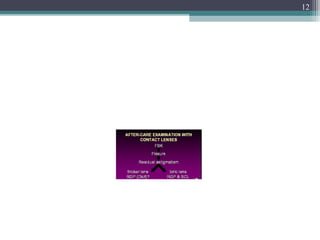
▫ Keratometry (FSK)
▫ retinoscopy & refraction
▫ binocular vision testing
12
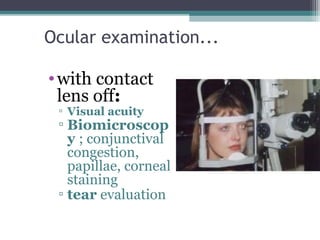
Ocular examination...
•with contact
lens off:
▫ Visual acuity
▫ Biomicroscop
y ; conjunctival
congestion,
papillae, corneal
staining
▫ tear evaluation
13
14
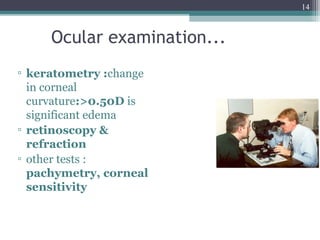
Ocular examination...
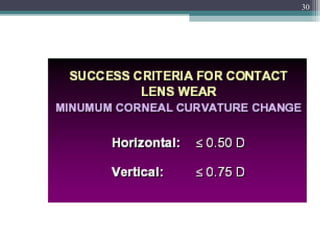
▫ keratometry :change
in corneal
curvature:>0.50D is
significant edema
▫ retinoscopy &
refraction
▫ other tests :
pachymetry, corneal
sensitivity
15
Ocular examination…
• Evaluation of Contact Lens:
▫ deposits, surface & edge inspection; scratches
▫ parameter measurement /verification
 -radiuscope
 -focimeter
 V-gauge
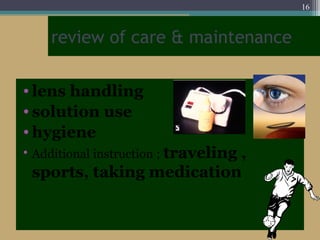
review of care & maintenance
• lens handling
• solution use
• hygiene
• Additional instruction ; traveling ,
sports, taking medication
16
17
18
19
Symptom analysis
• blur-incorrect lens power , corneal
oedema,dehydration,poor fitting
• Tight lens fitting –vision clear
immediately after blink & vice versa for
flat lens
• discomfort-damaged lens, poor edge,
decentred lens, FB under lens, soln.
toxicity
• photophobia & pain-corneal edema,
SPKs
• Burning –soln. toxicity, dry eye
20
Symptom analysis...
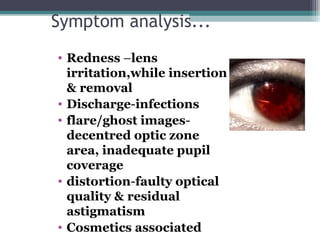
• Redness –lens
irritation,while insertion
& removal
• Discharge-infections
• flare/ghost images-
decentred optic zone
area, inadequate pupil
coverage
• distortion-faulty optical
quality & residual
astigmatism
• Cosmetics associated 21
problem encountered• bubbles –decrease vision ,increase
flare
• Reading difficulty – myopes have
to accommodate more
• Ghost images- due to poor lens
wetting & lens displacement ,
incomplete pupil coverage
• Chronic hyperemia-expose to
smoke ,wind,dust or glare
22
problem encountered…
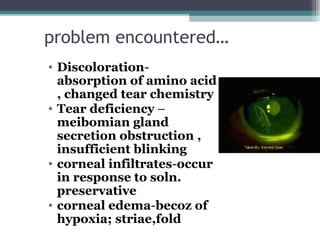
• Discoloration-
absorption of amino acid
, changed tear chemistry
• Tear deficiency –
meibomian gland
secretion obstruction ,
insufficient blinking
• corneal infiltrates-occur
in response to soln.
preservative
• corneal edema-becoz of
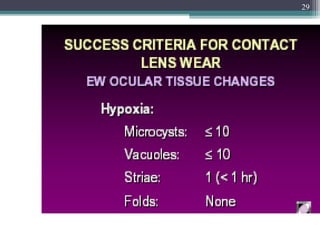
hypoxia; striae,fold
23
problem encountered…
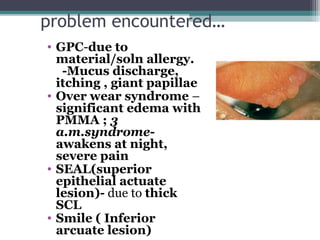
• GPC-due to
material/soln allergy.
-Mucus discharge,
itching , giant papillae
• Over wear syndrome –
significant edema with
PMMA ; 3
a.m.syndrome-
awakens at night,
severe pain
• SEAL(superior
epithelial actuate
lesion)- due to thick
SCL
• Smile ( Inferior
arcuate lesion) 24
problem encountered…
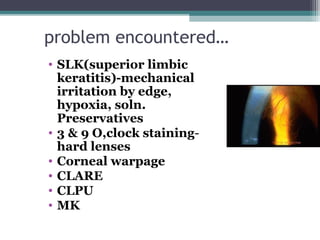
• SLK(superior limbic
keratitis)-mechanical
irritation by edge,
hypoxia, soln.
Preservatives
• 3 & 9 O,clock staining-
hard lenses
• Corneal warpage
• CLARE
• CLPU
• MK
25
problem encountered…
• Vascularisation-over wear , loss of
epithelial integrity,tight lens, poorly
finished edges
26
problem encountered…
• Glaucoma-corneal edema
• Diabetes-intolerance to contact lens
wear, reduced sensitivity, recurrent
epithelial erosions
• Hormonal factors ; edema results
during menstrual cycle , during
pregnancy
27
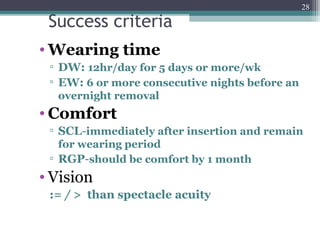
Success criteria
• Wearing time
▫ DW: 12hr/day for 5 days or more/wk
▫ EW: 6 or more consecutive nights before an
overnight removal
• Comfort
▫ SCL-immediately after insertion and remain
for wearing period
▫ RGP-should be comfort by 1 month
• Vision
:= / > than spectacle acuity
28
29
30
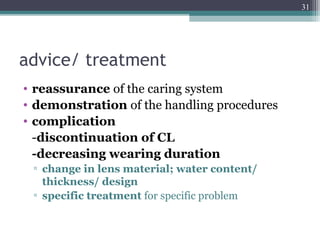
advice/ treatment
• reassurance of the caring system
• demonstration of the handling procedures
• complication
-discontinuation of CL
-decreasing wearing duration
▫ change in lens material; water content/
thickness/ design
▫ specific treatment for specific problem
31

Contact Lens: After care visit

  • 1.
    Contact Lens: After careVisit Rabindra Adhikary ravinems@iom.edu.np
  • 2.
  • 3.
    references • 1.Anthony J.Philips,Janet Stone ▫ Contact Lenses, 3rd edition • 2. Contact Lenses :Procedures & Techniques ▫ Gerald E. Lowther • 3.Lecture notes • 4.Internet 3
  • 4.
    purpose • to develop& sustain good lens performance • to find out ocular pathology induced by CL • to find out post wear ocular changes by CL • to find out factors responsible for discomfort 4
  • 5.
    contents • case history •aftercare examination • review of care & maintenance • resolution of problems • discussion of findings • Success criteria • Advise & treatment 5
  • 6.
    approach • vary fordifferent purpose; ▫ soft contact lens ▫ RGP ▫ toric ▫ therapeutic contact lens ▫ prosthetic contact lens ▫ aphakic contact lens ▫ Cosmetic contact lens 6
  • 7.
    based on • historyof CL use, time & limitation • symptoms analysis in regard to prevalence , duration & associated circumstances • evaluation of vision performance • examination of lens fitting • examination under slit lamp biomicroscopy • reassessment of lens parameters • non-routine tests & measurements: tear film analysis, keratometry , corneal sensitivity 7
  • 8.
  • 9.
    History taking • wearingmodality ; hrs/day, days/wk • brand of soln. used • visit ; time,date,visit number • quality of vision ,comfort, ease of handling • active listening is key element 9
  • 10.
    History taking... • blur •redness • discharge • excessive tearing • photophobia & pain • spectacle blur • glare • diplopia 10
  • 11.
    Ocular examination 11 • withcontact lens: ▫ visual acuity ; near + distance ▫ comfort ▫ quality of vision ▫ CL fitting evaluation ;  SCL ; centration, coverage, movement  RGP; static –bearing , pooling : dynamic ;centration, stability, movement ▫ blinking frequency ▫ head posture ▫ Keratometry (FSK) ▫ retinoscopy & refraction ▫ binocular vision testing
  • 12.
  • 13.
    Ocular examination... •with contact lensoff: ▫ Visual acuity ▫ Biomicroscop y ; conjunctival congestion, papillae, corneal staining ▫ tear evaluation 13
  • 14.
    14 Ocular examination... ▫ keratometry:change in corneal curvature:>0.50D is significant edema ▫ retinoscopy & refraction ▫ other tests : pachymetry, corneal sensitivity
  • 15.
    15 Ocular examination… • Evaluationof Contact Lens: ▫ deposits, surface & edge inspection; scratches ▫ parameter measurement /verification  -radiuscope  -focimeter  V-gauge
  • 16.
    review of care& maintenance • lens handling • solution use • hygiene • Additional instruction ; traveling , sports, taking medication 16
  • 17.
  • 18.
  • 19.
  • 20.
    Symptom analysis • blur-incorrectlens power , corneal oedema,dehydration,poor fitting • Tight lens fitting –vision clear immediately after blink & vice versa for flat lens • discomfort-damaged lens, poor edge, decentred lens, FB under lens, soln. toxicity • photophobia & pain-corneal edema, SPKs • Burning –soln. toxicity, dry eye 20
  • 21.
    Symptom analysis... • Redness–lens irritation,while insertion & removal • Discharge-infections • flare/ghost images- decentred optic zone area, inadequate pupil coverage • distortion-faulty optical quality & residual astigmatism • Cosmetics associated 21
  • 22.
    problem encountered• bubbles–decrease vision ,increase flare • Reading difficulty – myopes have to accommodate more • Ghost images- due to poor lens wetting & lens displacement , incomplete pupil coverage • Chronic hyperemia-expose to smoke ,wind,dust or glare 22
  • 23.
    problem encountered… • Discoloration- absorptionof amino acid , changed tear chemistry • Tear deficiency – meibomian gland secretion obstruction , insufficient blinking • corneal infiltrates-occur in response to soln. preservative • corneal edema-becoz of hypoxia; striae,fold 23
  • 24.
    problem encountered… • GPC-dueto material/soln allergy. -Mucus discharge, itching , giant papillae • Over wear syndrome – significant edema with PMMA ; 3 a.m.syndrome- awakens at night, severe pain • SEAL(superior epithelial actuate lesion)- due to thick SCL • Smile ( Inferior arcuate lesion) 24
  • 25.
    problem encountered… • SLK(superiorlimbic keratitis)-mechanical irritation by edge, hypoxia, soln. Preservatives • 3 & 9 O,clock staining- hard lenses • Corneal warpage • CLARE • CLPU • MK 25
  • 26.
    problem encountered… • Vascularisation-overwear , loss of epithelial integrity,tight lens, poorly finished edges 26
  • 27.
    problem encountered… • Glaucoma-cornealedema • Diabetes-intolerance to contact lens wear, reduced sensitivity, recurrent epithelial erosions • Hormonal factors ; edema results during menstrual cycle , during pregnancy 27
  • 28.
    Success criteria • Wearingtime ▫ DW: 12hr/day for 5 days or more/wk ▫ EW: 6 or more consecutive nights before an overnight removal • Comfort ▫ SCL-immediately after insertion and remain for wearing period ▫ RGP-should be comfort by 1 month • Vision := / > than spectacle acuity 28
  • 29.
  • 30.
  • 31.
    advice/ treatment • reassuranceof the caring system • demonstration of the handling procedures • complication -discontinuation of CL -decreasing wearing duration ▫ change in lens material; water content/ thickness/ design ▫ specific treatment for specific problem 31