Pasteurized
packed milk
Subtitle
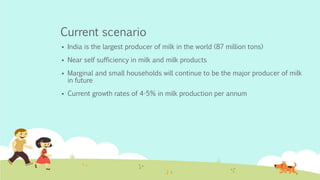
Current scenario
 India is the largest producer of milk in the world (87 million tons)
 Near self sufficiency in milk and milk products
 Marginal and small households will continue to be the major producer of milk
in future
 Current growth rates of 4-5% in milk production per annum
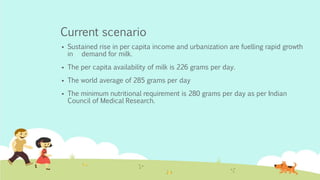
Current scenario
 Sustained rise in per capita income and urbanization are fuelling rapid growth
in demand for milk.
 The per capita availability of milk is 226 grams per day.
 The world average of 285 grams per day
 The minimum nutritional requirement is 280 grams per day as per Indian
Council of Medical Research.
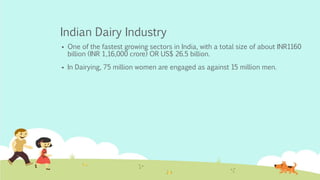
Indian Dairy Industry
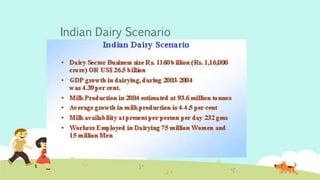
 One of the fastest growing sectors in India, with a total size of about INR1160
billion (INR 1,16,000 crore) OR US$ 26.5 billion.
 In Dairying, 75 million women are engaged as against 15 million men.
Indian Dairy Scenario
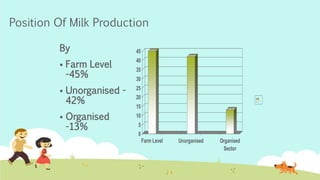
Position Of Milk Production
By
 Farm Level
-45%
 Unorganised -
42%
 Organised
-13%
0
5
10
15
20
25
30
35
40
45
Farm Level Unorganised Organised
Sector
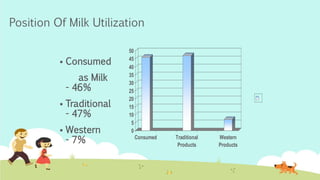
Position Of Milk Utilization
 Consumed
as Milk
- 46%
 Traditional
- 47%
 Western
- 7%
0
5
10
15
20
25
30
35
40
45
50
Consumed Traditional
Products
Western
Products
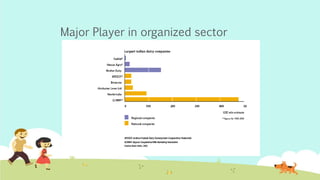
Major Player in organized sector
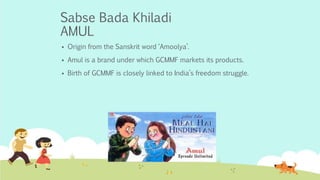
Sabse Bada Khiladi
AMUL
 Origin from the Sanskrit word ‘Amoolya’.
 Amul is a brand under which GCMMF markets its products.
 Birth of GCMMF is closely linked to India’s freedom struggle.
The Birth of Amul
 First Co-operative formed on 4th Jan 1946.
 Kaira District Co-operative Milk Producers Union Ltd.
formed 14th Dec 1946.
 Gujarat Co-operative Milk Marketing Federation
(GCMMF) was formed in 1973.
 Dr. Verghese Kurien was the architect of Amul’s
success.
Dr.Kurian’s Mantra for Amul
 Quality
 Economy
 Availability
 Service
Aaj Ka Amul
 GCMMF is India’s largest food products marketing organisation.
 12 district co-operative milk producers’ union.
 2.5 million producer members.
 2.28 billion litres milk collected in 2005-2006.
 Sales turnover stands at Rs.37736 million in 2005-06 (Rs.13790
million in 1995-96)
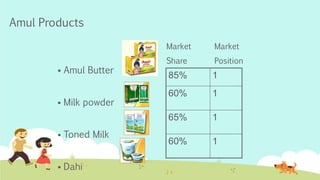
Amul Products
 Amul Butter
 Milk powder
 Toned Milk
 Dahi
85% 1
60% 1
65% 1
60% 1
Market Market
Share Position
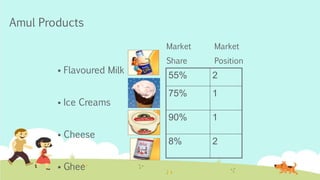
Amul Products
 Flavoured Milk
 Ice Creams
 Cheese
 Ghee
55% 2
75% 1
90% 1
8% 2
Market Market
Share Position
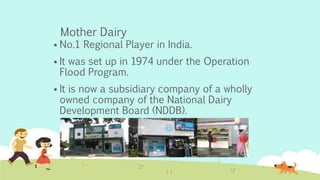
Mother Dairy
 No.1 Regional Player in India.
 It was set up in 1974 under the Operation
Flood Program.
 It is now a subsidiary company of a wholly
owned company of the National Dairy
Development Board (NDDB).
Products
 Mother Dairy markets & sells dairy products under the Mother Dairy brand
(like Liquid Milk, Dahi, Ice Creams, Dairy Whitener and Butter)
 Mother Dairy sources its entire requirement of liquid milk from dairy
cooperatives
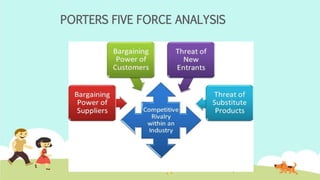
PORTERS FIVE FORCE ANALYSIS
THREAT OF NEW ENTRY
 It has the capacity to retaliate when new firm enter into
the industry
 Capital requirement in the initial phase is high because
plant and machinery is expensive hence it acts as an
entry barrier to new firm
BARGAINING POWER OF SUPPLIERS
 There is ample supply of cows and bulls for rearing and
cross breeding purposes
 They are available at very low prices also.
 Consumer switching cost is low
BARGAINING POWER OF BUYERS
 Concentration of buyers are more
 Buyer has full information about products of various
companies
 Buyer's purchases are a sizable percentage of the
selling industry's total sales – So the power of buyers
are high.
THREAT OF SUBSTITUTE
 Demand of fresh milk in domestic and overseas market
is increasing.
 Milk has been universally accepted as it possess the
essential vitamins and minerals required for good
health
 There are substitutes in soya based formulas or
goats’ milk, but the demand for them are low and does
not pose a major threat to cows’ milk.
 Buyer have less propensity to substitute products –
So the threat of substitute is low.
COMPETITIVE RIVALRY
Competitors are numerous Products are
undifferentiated
 Consumer switching costs are low
 Exit barriers are high
 Competitors are strategically diverse – So competitive
rivalry is high.
Pasteurized packed milk

Pasteurized packed milk

  • 1.
  • 2.
    Current scenario  Indiais the largest producer of milk in the world (87 million tons)  Near self sufficiency in milk and milk products  Marginal and small households will continue to be the major producer of milk in future  Current growth rates of 4-5% in milk production per annum
  • 3.
    Current scenario  Sustainedrise in per capita income and urbanization are fuelling rapid growth in demand for milk.  The per capita availability of milk is 226 grams per day.  The world average of 285 grams per day  The minimum nutritional requirement is 280 grams per day as per Indian Council of Medical Research.
  • 4.
    Indian Dairy Industry One of the fastest growing sectors in India, with a total size of about INR1160 billion (INR 1,16,000 crore) OR US$ 26.5 billion.  In Dairying, 75 million women are engaged as against 15 million men.
  • 5.
  • 6.
    Position Of MilkProduction By  Farm Level -45%  Unorganised - 42%  Organised -13% 0 5 10 15 20 25 30 35 40 45 Farm Level Unorganised Organised Sector
  • 7.
    Position Of MilkUtilization  Consumed as Milk - 46%  Traditional - 47%  Western - 7% 0 5 10 15 20 25 30 35 40 45 50 Consumed Traditional Products Western Products
  • 8.
    Major Player inorganized sector
  • 9.
    Sabse Bada Khiladi AMUL Origin from the Sanskrit word ‘Amoolya’.  Amul is a brand under which GCMMF markets its products.  Birth of GCMMF is closely linked to India’s freedom struggle.
  • 10.
    The Birth ofAmul  First Co-operative formed on 4th Jan 1946.  Kaira District Co-operative Milk Producers Union Ltd. formed 14th Dec 1946.  Gujarat Co-operative Milk Marketing Federation (GCMMF) was formed in 1973.  Dr. Verghese Kurien was the architect of Amul’s success.
  • 11.
    Dr.Kurian’s Mantra forAmul  Quality  Economy  Availability  Service
  • 12.
    Aaj Ka Amul GCMMF is India’s largest food products marketing organisation.  12 district co-operative milk producers’ union.  2.5 million producer members.  2.28 billion litres milk collected in 2005-2006.  Sales turnover stands at Rs.37736 million in 2005-06 (Rs.13790 million in 1995-96)
  • 13.
    Amul Products  AmulButter  Milk powder  Toned Milk  Dahi 85% 1 60% 1 65% 1 60% 1 Market Market Share Position
  • 14.
    Amul Products  FlavouredMilk  Ice Creams  Cheese  Ghee 55% 2 75% 1 90% 1 8% 2 Market Market Share Position
  • 15.
    Mother Dairy  No.1Regional Player in India.  It was set up in 1974 under the Operation Flood Program.  It is now a subsidiary company of a wholly owned company of the National Dairy Development Board (NDDB).
  • 16.
    Products  Mother Dairymarkets & sells dairy products under the Mother Dairy brand (like Liquid Milk, Dahi, Ice Creams, Dairy Whitener and Butter)  Mother Dairy sources its entire requirement of liquid milk from dairy cooperatives
  • 17.
  • 18.
    THREAT OF NEWENTRY  It has the capacity to retaliate when new firm enter into the industry  Capital requirement in the initial phase is high because plant and machinery is expensive hence it acts as an entry barrier to new firm
  • 19.
    BARGAINING POWER OFSUPPLIERS  There is ample supply of cows and bulls for rearing and cross breeding purposes  They are available at very low prices also.  Consumer switching cost is low
  • 20.
    BARGAINING POWER OFBUYERS  Concentration of buyers are more  Buyer has full information about products of various companies  Buyer's purchases are a sizable percentage of the selling industry's total sales – So the power of buyers are high.
  • 21.
    THREAT OF SUBSTITUTE Demand of fresh milk in domestic and overseas market is increasing.  Milk has been universally accepted as it possess the essential vitamins and minerals required for good health  There are substitutes in soya based formulas or goats’ milk, but the demand for them are low and does not pose a major threat to cows’ milk.  Buyer have less propensity to substitute products – So the threat of substitute is low.
  • 22.
    COMPETITIVE RIVALRY Competitors arenumerous Products are undifferentiated  Consumer switching costs are low  Exit barriers are high  Competitors are strategically diverse – So competitive rivalry is high.