Interview Interview Preparation Plan - Group product Manager - Netflix.pdf
1.
I N TE R V I E W P R E PA R AT I O N P L A N
N
PREMIUM
Group product Manager
Group product Manager
@ Netflix
Generated on 1/12/2026
JOBareo
J O B A R E O . CO M
2.
Contents
Group product Manager@ Netflix
1 About the Company
2 Hiring Process
3 Personalized Storytelling
4 Behavioral Questions
5 Technical Questions
6 Questions for the Interviewer
7 Study Topics
8 Personalized Tips
9 Preparation Schedule
GROUP PRODUCT MANAGER@ NETFLIX JOBareo
Executive Summary
TARGET ROLE
Group product
Manager
COMPANY
Netflix
PLAN TYPE
Personalized
GENERATED ON
1/12/2026
5.
About the Company
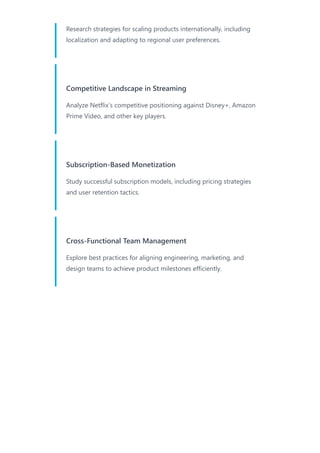
Netflix,Inc.
Sector: Communication Services[2]
Netflix, Inc. is a global leader in streaming media, offering TV series, films,
documentaries, mobile games, and original programming to over 300
million paid memberships across 190 countries. It operates primarily
through internet-connected devices and maintains a DVD-by-mail service
in the U.S., blending digital content delivery with innovative on-demand
entertainment. In December 2025, Netflix agreed to acquire Warner Bros.
Discovery's studio and streaming divisions in a $72 billion cash-and-stock
deal, expanding its content library and production capabilities.[1][2][3]
FOUNDED
1997[1][2]
HEADQUARTERS
Los Gatos,
California,
USA[1][2]
TYPE
public
LOCATIONS
190
countries[1]
[3]
Culture & Work Environment
Values
Focuses on innovation in content and technology for user experience.
Emphasizes scale through global subscriber growth and network effects.
Invests in original productions and diversification like mobile gaming.
6.
Current Moment
Agreed toacquire Warner Bros. Discovery studio and streaming divisions for
$72B in Dec 2025, expected to close Q3 2026; preparing Q4 2025 financial
results announcement.[2][4]
REVENUE
$43.38
billion[2]
PROFITABILITY
Earnings per
share $2.39
(prev. year)[2]
SIZE
large
Strategic Priorities
ESTIMATED SALARY RANGE
240000 - 700000 USD
Source: Levels.fyi, Comparably, 6figr, Fortune, Indeed
Strong commitment to original content creation.
Global scale and subscriber growth.
Technological innovation and user accessibility.
Content innovation and original programming.
Global subscriber expansion and retention.
Diversification into gaming and live events.
Major acquisitions for studio ownership and content expansion.
7.
Hiring Process
1 Resume/ Recruiter screen
Initial resume review followed by a ~30-minute phone
call with a Netflix recruiter to confirm role fit, motivation
for Netflix, and baseline experience; typically focuses on
culture fit and high‑level product ownership and lasts 30
minutes to 1 hour.[2][3]
2 Hiring manager interview
A deeper 45–60 minute interview (phone or video) with
the hiring manager that mixes behavioral questions
about ownership and impact with strategic product
questions to assess product instincts and role‑specific
experience; this round is often the key gate before the
loop.[2][3]
3 Panel / interview loop (PM, Eng, Design, Data,
partners)
Multi‑interviewer loop of ~3–5 interviews (virtual or
onsite) including other PMs, engineers, designers and
data/partner stakeholders; rounds cover product strategy,
design/case questions, execution/metrics, and
cross‑functional collaboration and each interview is ~45
minutes.[2][6]
4
Prepared presentation (case prompt) / product
case
8.
A 45–60 minuteprepared presentation or case given as a
prompt after earlier screens — candidates prepare a
product strategy/design/metrics response and present to
a panel on onsite/virtual day; includes Q&A and probes
on trade‑offs and metrics.[1][2]
5
Hiring committee / final calibration
Post‑loop review where interview feedback is
consolidated for a unanimous hiring decision by the
committee; may include follow‑up checks or reference
requests and typically takes several days to a couple
weeks to complete.[3][4]
6 Offer & compensation negotiation
If approved by the hiring committee, recruiter extends an
offer and conducts compensation discussion/negotiation;
timing varies (often days) and may include final logistics
(start date, relocation) and sign‑off.[3]
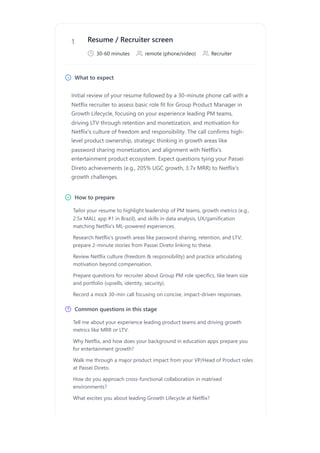
1 Resume /Recruiter screen
30-60 minutes remote (phone/video) Recruiter
What to expect
Initial review of your resume followed by a 30-minute phone call with a
Netflix recruiter to assess basic role fit for Group Product Manager in
Growth Lifecycle, focusing on your experience leading PM teams,
driving LTV through retention and monetization, and motivation for
Netflix's culture of freedom and responsibility. The call confirms high-
level product ownership, strategic thinking in growth areas like
password sharing monetization, and alignment with Netflix's
entertainment product ecosystem. Expect questions tying your Passei
Direto achievements (e.g., 205% UGC growth, 3.7x MRR) to Netflix's
growth challenges.
How to prepare
Common questions in this stage
Tailor your resume to highlight leadership of PM teams, growth metrics (e.g.,
2.5x MAU, app #1 in Brazil), and skills in data analysis, UX/gamification
matching Netflix's ML-powered experiences.
Research Netflix's growth areas like password sharing, retention, and LTV;
prepare 2-minute stories from Passei Direto linking to these.
Review Netflix culture (freedom & responsibility) and practice articulating
motivation beyond compensation.
Prepare questions for recruiter about Group PM role specifics, like team size
and portfolio (upsells, identity, security).
Record a mock 30-min call focusing on concise, impact-driven responses.
Tell me about your experience leading product teams and driving growth
metrics like MRR or LTV.
Why Netflix, and how does your background in education apps prepare you
for entertainment growth?
Walk me through a major product impact from your VP/Head of Product roles
at Passei Direto.
How do you approach cross-functional collaboration in matrixed
environments?
What excites you about leading Growth Lifecycle at Netflix?
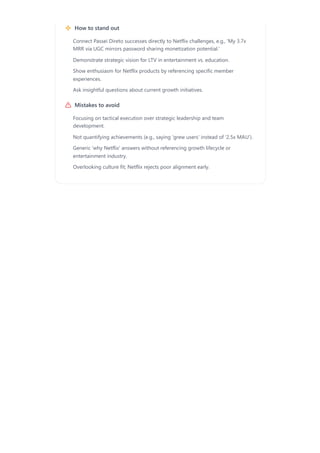
11.
How to standout
Mistakes to avoid
Connect Passei Direto successes directly to Netflix challenges, e.g., 'My 3.7x
MRR via UGC mirrors password sharing monetization potential.'
Demonstrate strategic vision for LTV in entertainment vs. education.
Show enthusiasm for Netflix products by referencing specific member
experiences.
Ask insightful questions about current growth initiatives.
Focusing on tactical execution over strategic leadership and team
development.
Not quantifying achievements (e.g., saying 'grew users' instead of '2.5x MAU').
Generic 'why Netflix' answers without referencing growth lifecycle or
entertainment industry.
Overlooking culture fit; Netflix rejects poor alignment early.
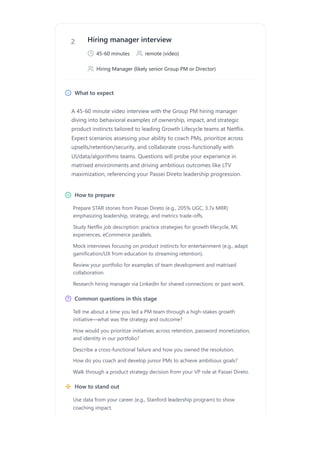
12.
2 Hiring managerinterview
45-60 minutes remote (video)
Hiring Manager (likely senior Group PM or Director)
What to expect
A 45-60 minute video interview with the Group PM hiring manager
diving into behavioral examples of ownership, impact, and strategic
product instincts tailored to leading Growth Lifecycle teams at Netflix.
Expect scenarios assessing your ability to coach PMs, prioritize across
upsells/retention/security, and collaborate cross-functionally with
UI/data/algorithms teams. Questions will probe your experience in
matrixed environments and driving ambitious outcomes like LTV
maximization, referencing your Passei Direto leadership progression.
How to prepare
Common questions in this stage
How to stand out
Prepare STAR stories from Passei Direto (e.g., 205% UGC, 3.7x MRR)
emphasizing leadership, strategy, and metrics trade-offs.
Study Netflix job description: practice strategies for growth lifecycle, ML
experiences, eCommerce parallels.
Mock interviews focusing on product instincts for entertainment (e.g., adapt
gamification/UX from education to streaming retention).
Review your portfolio for examples of team development and matrixed
collaboration.
Research hiring manager via LinkedIn for shared connections or past work.
Tell me about a time you led a PM team through a high-stakes growth
initiative—what was the strategy and outcome?
How would you prioritize initiatives across retention, password monetization,
and identity in our portfolio?
Describe a cross-functional failure and how you owned the resolution.
How do you coach and develop junior PMs to achieve ambitious goals?
Walk through a product strategy decision from your VP role at Passei Direto.
Use data from your career (e.g., Stanford leadership program) to show
coaching impact.
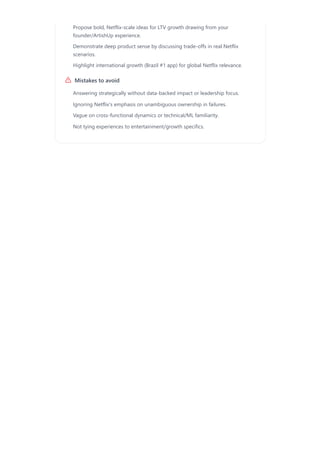
13.
Mistakes to avoid
Proposebold, Netflix-scale ideas for LTV growth drawing from your
founder/ArtishUp experience.
Demonstrate deep product sense by discussing trade-offs in real Netflix
scenarios.
Highlight international growth (Brazil #1 app) for global Netflix relevance.
Answering strategically without data-backed impact or leadership focus.
Ignoring Netflix's emphasis on unambiguous ownership in failures.
Vague on cross-functional dynamics or technical/ML familiarity.
Not tying experiences to entertainment/growth specifics.
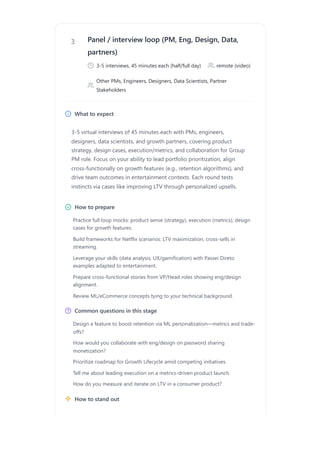
14.
3 Panel /interview loop (PM, Eng, Design, Data,
partners)
3-5 interviews, 45 minutes each (half/full day) remote (video)
Other PMs, Engineers, Designers, Data Scientists, Partner
Stakeholders
What to expect
3-5 virtual interviews of 45 minutes each with PMs, engineers,
designers, data scientists, and growth partners, covering product
strategy, design cases, execution/metrics, and collaboration for Group
PM role. Focus on your ability to lead portfolio prioritization, align
cross-functionally on growth features (e.g., retention algorithms), and
drive team outcomes in entertainment contexts. Each round tests
instincts via cases like improving LTV through personalized upsells.
How to prepare
Common questions in this stage
How to stand out
Practice full loop mocks: product sense (strategy), execution (metrics), design
cases for growth features.
Build frameworks for Netflix scenarios: LTV maximization, cross-sells in
streaming.
Leverage your skills (data analysis, UX/gamification) with Passei Direto
examples adapted to entertainment.
Prepare cross-functional stories from VP/Head roles showing eng/design
alignment.
Review ML/eCommerce concepts tying to your technical background.
Design a feature to boost retention via ML personalization—metrics and trade-
offs?
How would you collaborate with eng/design on password sharing
monetization?
Prioritize roadmap for Growth Lifecycle amid competing initiatives.
Tell me about leading execution on a metrics-driven product launch.
How do you measure and iterate on LTV in a consumer product?
15.
Mistakes to avoid
Leadwith portfolio-level strategy, referencing your Passei Direto scaling.
Incorporate entertainment insights (e.g., binge retention vs. education MAU).
Show analytical depth with data from your achievements.
Proactively suggest innovations like gamified security features.
Weak metrics rigor or ignoring North Star (eTVL/LTV).
Siloed thinking; not addressing cross-functional realities.
Generic cases without Netflix/entertainment tailoring.
Over-focusing on individual contrib vs. team leadership.
16.
4 Prepared presentation(case prompt) / product
case
45-60 minutes (plus prep time) remote (video)
Panel: Hiring Manager, PMs, Eng, Design, Data, Partners
What to expect
Receive a case prompt post-screens (e.g., strategize Growth Lifecycle
improvement for LTV), prepare a 15-20 min presentation, then present
to a 45-60 min panel with Q&A probing trade-offs, metrics, and
leadership. Tailored to Group PM: expect portfolio prioritization, team
alignment, cross-functional execution for areas like retention/upsells.
Panel assesses strategic communication and ability to inspire teams on
Netflix-scale problems.
How to prepare
Common questions in this stage
How to stand out
Practice 3-5 Netflix growth cases: structure as
problem/strategy/metrics/execution/impact.
Create slide decks (10-15 slides) mirroring your Passei Direto successes (e.g.,
MRR growth).
Anticipate deep dives: prepare backups on ML, A/B testing, LTV models.
Rehearse presentation for clarity, tying to leadership (Stanford program).
Time yourself: 20 min present + 40 min Q&A.
Why this strategy over alternatives—what metrics validate it?
How would you align/prioritize your PM team on this?
Trade-offs in scoping for eng feasibility and member impact?
How does this fit broader Netflix growth portfolio?
Defend assumptions with data from your experience.
Deliver data-rich, visionary deck with quantified projections like your 3.7x MRR.
Show team leadership: 'I'd coach PMs to own these scopes.'
Use visuals from UX/gamification expertise for member flows.
End with bold, measurable Netflix impact.
17.
Mistakes to avoid
Overlytactical decks lacking strategic vision/portfolio view.
Ignoring trade-offs or feasibility in matrixed org.
Poor storytelling; data dumps without narrative.
Not addressing entertainment nuances.
18.
5 Hiring committee/ final calibration
Several days to 2 weeks (passive for candidate)
remote (internal)
Hiring Committee (senior leaders, no candidate interaction)
What to expect
Behind-the-scenes review where interviewers submit feedback for
unanimous committee decision on your fit as Group PM leader; no
direct interview but possible reference checks or follow-ups.
Committee evaluates ownership, strategic impact, culture add, and
growth expertise across all rounds. Decision takes days to weeks,
focusing on your demonstrated ability to lead high-performing teams.
How to prepare
Common questions in this stage
How to stand out
Mistakes to avoid
During loop, explicitly address feedback loops and ownership in answers.
Prepare 3-5 strong references from Passei Direto leaders on your team
development.
Follow up promptly with thank-yous reinforcing key strengths.
Reflect on rounds to clarify any weak areas if follow-up requested.
Line up references emphasizing strategic growth leadership.
N/A (internal feedback review)
Secure glowing references tying to Netflix values (e.g., ambitious outcomes).
In prior rounds, showcase unanimous strengths in strategy/leadership.
If follow-up, provide additional impact data from career.
Demonstrate self-awareness and growth mindset.
Inconsistent performance across loop rounds.
Weak references not highlighting leadership scale.
No follow-up, missing chance to reinforce fit.
6 Offer &compensation negotiation
Days (1-2 calls) remote (phone/video)
Recruiter, Possibly Compensation Partner
What to expect
If approved, recruiter contacts with verbal/written offer detailing comp
(base, equity, bonus) for Group PM, discussing negotiation, start date,
relocation (Los Gatos possible). Netflix offers are top-of-market with
heavy equity; negotiation focuses on total value, vesting, sign-on.
Expect transparency on comp philosophy (no bands published).
How to prepare
Common questions in this stage
How to stand out
Mistakes to avoid
Research Netflix PM comp via levels.fyi (Group PM ~$500k+ TC); benchmark
vs. your Passei Direto level.
Prepare ask: 20-30% above initial based on your metrics/leadership.
List priorities: equity (Netflix stock growth), base, sign-on for Brazil-US move.
Practice negotiation script emphasizing your unique value (e.g., 3.7x MRR
leader).
Know walk-away: align with Netflix's high-bar offers.
What are your compensation expectations?
Are you interviewing elsewhere—what does their offer look like?
What start date works, and any relocation needs?
Questions on equity vesting or benefits?
Any final concerns before signing?
Frame ask around value: 'My growth track record warrants X for immediate
impact.'
Propose creative terms like accelerated vesting for proven results.
Express excitement while negotiating firmly.
Close quickly if terms align, signaling commitment.
Lowballing ask without market data.
21.
Personalized Storytelling
Who Iam: A seasoned product leader with a proven track record driving
growth, innovation, and internationalization in digital platforms.
• Main experience: Grew Monthly Active Users (MAU) by 2.5x at Passei
Direto, achieving market leadership in the education sector in Brazil.
• Technical differentiator: Expertise in product strategy, growth
monetization, and scaling global platforms.
• Impact generated: Drove a 3.7x increase in Monthly Recurring Revenue
(MRR) and led user-generated content growth by 205% as VP of Product.
Why this role: I see the Group Product Manager role at Netflix as the
perfect intersection of my passion for scalable product innovation and my
ability to lead teams that create impactful user experiences on a global
scale.
Focusing only on base, ignoring equity upside.
Emotional negotiation vs. data-driven.
Not negotiating at all—Netflix expects it.
22.
Behavioral Questions
Behavioral questionswith STAR-formatted answers
Q1: Describe a time when you led a cross-functional team to
achieve a challenging goal.
SITUATION: As VP of Product at Passei Direto, we identified
stagnant growth in our user-generated content (UGC).
TASK: My goal was to increase UGC submissions to drive
engagement and improve content relevance for users.
ACTION: I led a cross-functional team to implement
gamification features, create incentive programs for
contributors, and optimize the content upload process.
RESULT: UGC submissions grew by 205%, and engagement
metrics improved across key user cohorts.
Q2: Give an example of how you used data to drive a product
decision.
SITUATION: At Passei Direto, I noticed low retention rates
among first-time users.
TASK: My challenge was to identify the root cause and
design a solution to improve retention.
ACTION: I conducted cohort analyses and user interviews,
revealing that onboarding was too complex. I simplified the
onboarding process and introduced personalized content
recommendations using data-driven algorithms.
RESULT: Retention rates improved by 35% within six
months.
23.
Q3: Tell meabout a time you faced resistance to a product
idea. How did you handle it?
SITUATION: As Head of Product, I proposed a subscription
pricing model for Passei Direto, which was met with
resistance from the leadership team.
TASK: I needed to align stakeholders and prove the
model's viability.
ACTION: I prepared a detailed analysis of competitor
pricing strategies, ran simulations of different pricing
scenarios, and presented pilot test data.
RESULT: The subscription model was approved and led to
a 3.7x increase in MRR within two years.
Q4: How do you balance long-term strategic goals with short-
term deliverables?
SITUATION: At Passei Direto, balancing the development of
a new digital library feature with ongoing platform
maintenance was critical.
TASK: My goal was to ensure we met short-term stability
needs while advancing the long-term strategic feature
delivery.
ACTION: I created a two-track roadmap, allocating
resources to immediate bug fixes and feature optimization
while designating a dedicated team for long-term feature
development.
RESULT: We launched the digital library on time, adding
5,000 new books, while maintaining a 99.9% platform
uptime.
24.
Q5: Describe atime you successfully scaled a product for
international markets.
SITUATION: As VP of Product, we aimed to expand Passei
Direto into English-speaking markets.
TASK: My goal was to adapt the product for international
users while maintaining our core value proposition.
ACTION: I conducted market research, localized the UX/UI,
and partnered with content creators for regional relevance. I
also adjusted pricing strategies for competitive positioning.
RESULT: MAU in new markets increased by 150% in the
first year, and the app maintained its #1 position in
education within Brazil.
Q6: How do you foster innovation within your team?
SITUATION: At Passei Direto, I noticed team members
hesitating to propose bold ideas.
TASK: I needed to create an environment where
innovation flourished.
ACTION: I introduced a 'fail fast' culture, implemented
monthly innovation sprints, and rewarded experimental
ideas, even if they failed.
RESULT: Team morale improved, and we launched three
new features within six months, two of which significantly
boosted engagement.
25.
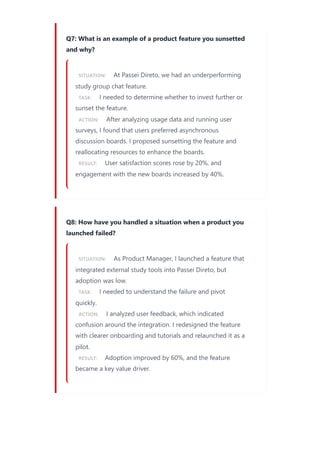
Q7: What isan example of a product feature you sunsetted
and why?
SITUATION: At Passei Direto, we had an underperforming
study group chat feature.
TASK: I needed to determine whether to invest further or
sunset the feature.
ACTION: After analyzing usage data and running user
surveys, I found that users preferred asynchronous
discussion boards. I proposed sunsetting the feature and
reallocating resources to enhance the boards.
RESULT: User satisfaction scores rose by 20%, and
engagement with the new boards increased by 40%.
Q8: How have you handled a situation when a product you
launched failed?
SITUATION: As Product Manager, I launched a feature that
integrated external study tools into Passei Direto, but
adoption was low.
TASK: I needed to understand the failure and pivot
quickly.
ACTION: I analyzed user feedback, which indicated
confusion around the integration. I redesigned the feature
with clearer onboarding and tutorials and relaunched it as a
pilot.
RESULT: Adoption improved by 60%, and the feature
became a key value driver.
26.
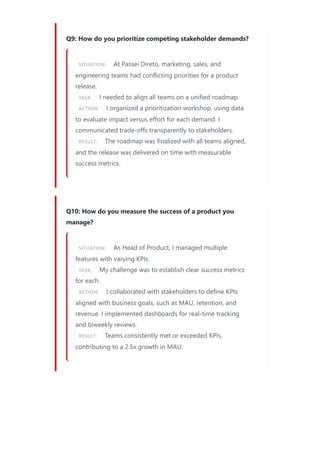
Q9: How doyou prioritize competing stakeholder demands?
SITUATION: At Passei Direto, marketing, sales, and
engineering teams had conflicting priorities for a product
release.
TASK: I needed to align all teams on a unified roadmap.
ACTION: I organized a prioritization workshop, using data
to evaluate impact versus effort for each demand. I
communicated trade-offs transparently to stakeholders.
RESULT: The roadmap was finalized with all teams aligned,
and the release was delivered on time with measurable
success metrics.
Q10: How do you measure the success of a product you
manage?
SITUATION: As Head of Product, I managed multiple
features with varying KPIs.
TASK: My challenge was to establish clear success metrics
for each.
ACTION: I collaborated with stakeholders to define KPIs
aligned with business goals, such as MAU, retention, and
revenue. I implemented dashboards for real-time tracking
and biweekly reviews.
RESULT: Teams consistently met or exceeded KPIs,
contributing to a 2.5x growth in MAU.
27.
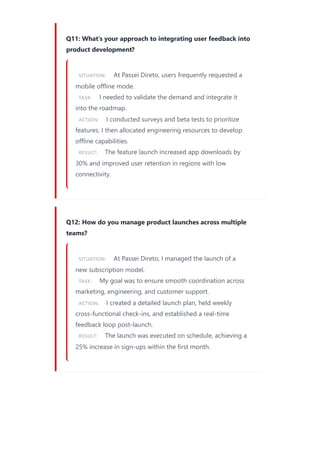
Q11: What’s yourapproach to integrating user feedback into
product development?
SITUATION: At Passei Direto, users frequently requested a
mobile offline mode.
TASK: I needed to validate the demand and integrate it
into the roadmap.
ACTION: I conducted surveys and beta tests to prioritize
features. I then allocated engineering resources to develop
offline capabilities.
RESULT: The feature launch increased app downloads by
30% and improved user retention in regions with low
connectivity.
Q12: How do you manage product launches across multiple
teams?
SITUATION: At Passei Direto, I managed the launch of a
new subscription model.
TASK: My goal was to ensure smooth coordination across
marketing, engineering, and customer support.
ACTION: I created a detailed launch plan, held weekly
cross-functional check-ins, and established a real-time
feedback loop post-launch.
RESULT: The launch was executed on schedule, achieving a
25% increase in sign-ups within the first month.
28.
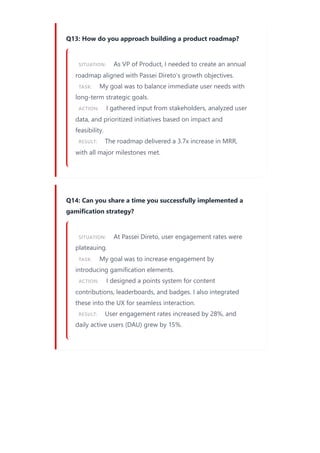
Q13: How doyou approach building a product roadmap?
SITUATION: As VP of Product, I needed to create an annual
roadmap aligned with Passei Direto’s growth objectives.
TASK: My goal was to balance immediate user needs with
long-term strategic goals.
ACTION: I gathered input from stakeholders, analyzed user
data, and prioritized initiatives based on impact and
feasibility.
RESULT: The roadmap delivered a 3.7x increase in MRR,
with all major milestones met.
Q14: Can you share a time you successfully implemented a
gamification strategy?
SITUATION: At Passei Direto, user engagement rates were
plateauing.
TASK: My goal was to increase engagement by
introducing gamification elements.
ACTION: I designed a points system for content
contributions, leaderboards, and badges. I also integrated
these into the UX for seamless interaction.
RESULT: User engagement rates increased by 28%, and
daily active users (DAU) grew by 15%.
29.
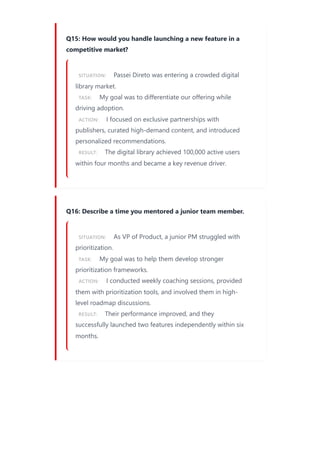
Q15: How wouldyou handle launching a new feature in a
competitive market?
SITUATION: Passei Direto was entering a crowded digital
library market.
TASK: My goal was to differentiate our offering while
driving adoption.
ACTION: I focused on exclusive partnerships with
publishers, curated high-demand content, and introduced
personalized recommendations.
RESULT: The digital library achieved 100,000 active users
within four months and became a key revenue driver.
Q16: Describe a time you mentored a junior team member.
SITUATION: As VP of Product, a junior PM struggled with
prioritization.
TASK: My goal was to help them develop stronger
prioritization frameworks.
ACTION: I conducted weekly coaching sessions, provided
them with prioritization tools, and involved them in high-
level roadmap discussions.
RESULT: Their performance improved, and they
successfully launched two features independently within six
months.
30.
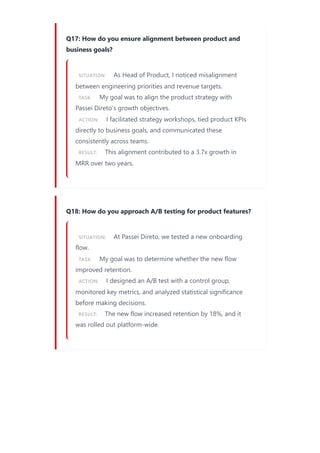
Q17: How doyou ensure alignment between product and
business goals?
SITUATION: As Head of Product, I noticed misalignment
between engineering priorities and revenue targets.
TASK: My goal was to align the product strategy with
Passei Direto’s growth objectives.
ACTION: I facilitated strategy workshops, tied product KPIs
directly to business goals, and communicated these
consistently across teams.
RESULT: This alignment contributed to a 3.7x growth in
MRR over two years.
Q18: How do you approach A/B testing for product features?
SITUATION: At Passei Direto, we tested a new onboarding
flow.
TASK: My goal was to determine whether the new flow
improved retention.
ACTION: I designed an A/B test with a control group,
monitored key metrics, and analyzed statistical significance
before making decisions.
RESULT: The new flow increased retention by 18%, and it
was rolled out platform-wide.
31.
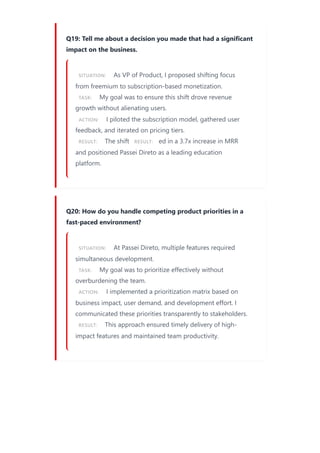
Q19: Tell meabout a decision you made that had a significant
impact on the business.
SITUATION: As VP of Product, I proposed shifting focus
from freemium to subscription-based monetization.
TASK: My goal was to ensure this shift drove revenue
growth without alienating users.
ACTION: I piloted the subscription model, gathered user
feedback, and iterated on pricing tiers.
RESULT: The shift RESULT: ed in a 3.7x increase in MRR
and positioned Passei Direto as a leading education
platform.
Q20: How do you handle competing product priorities in a
fast-paced environment?
SITUATION: At Passei Direto, multiple features required
simultaneous development.
TASK: My goal was to prioritize effectively without
overburdening the team.
ACTION: I implemented a prioritization matrix based on
business impact, user demand, and development effort. I
communicated these priorities transparently to stakeholders.
RESULT: This approach ensured timely delivery of high-
impact features and maintained team productivity.
32.
Technical Questions
Technical questionsspecific to the position
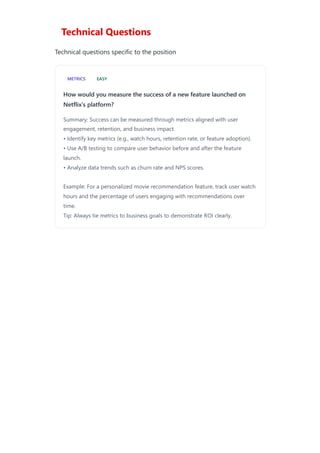
METRICS EASY
How would you measure the success of a new feature launched on
Netflix's platform?
Summary: Success can be measured through metrics aligned with user
engagement, retention, and business impact.
• Identify key metrics (e.g., watch hours, retention rate, or feature adoption).
• Use A/B testing to compare user behavior before and after the feature
launch.
• Analyze data trends such as churn rate and NPS scores.
Example: For a personalized movie recommendation feature, track user watch
hours and the percentage of users engaging with recommendations over
time.
Tip: Always tie metrics to business goals to demonstrate ROI clearly.
33.
PRODUCT-STRATEGY MEDIUM
How wouldyou approach prioritizing features for a product roadmap
at Netflix?
Summary: Prioritization should balance user needs, technical feasibility, and
business impact.
• Gather user feedback through surveys or analytics.
• Use frameworks like RICE (Reach, Impact, Confidence, Effort) to evaluate
features.
• Collaborate with cross-functional teams to assess feasibility and
dependencies.
• Align with business objectives such as subscription growth or market
differentiation.
Example: If improving user retention is a priority, focus on features like
personalized recommendations or binge-friendly UI updates.
Tip: Regularly revisit priorities to account for shifting market or business
dynamics.
34.
SYSTEM-DESIGN HARD
Design asystem to handle personalized recommendations for Netflix’s
global user base.
Summary: A scalable system for personalized recommendations requires
robust data processing and machine learning.
• Use distributed systems like Apache Kafka to collect and stream real-time
user behavior data.
• Implement ML algorithms like collaborative filtering or content-based
filtering.
• Ensure scalability with cloud solutions (e.g., AWS or GCP) and optimize for
latency through caching.
• Monitor system performance with analytics dashboards.
Example: Netflix could use a hybrid recommendation engine combining
collaborative filtering for global trends and deep learning for individual
preferences.
Tip: Prioritize scalability and regional customization to ensure relevance for
diverse markets.
35.
Questions for theInterviewer
1. Netflix recently acquired Warner Bros. Discovery. How do you envision
the product team leveraging this new content library to achieve
subscriber growth?
2. How does Netflix balance its focus on original content with the
integration of new acquisitions like Warner Bros. Discovery?
3. How do you see Netflix’s mobile gaming expansion aligning with its
core streaming business?
4. What challenges do you foresee in scaling subscriber growth in
saturated markets, and how is your team addressing them?
5. Netflix is known for its data-driven approach. How does your team
ensure that data insights translate into impactful product decisions?
6. What role does gamification play in Netflix's strategy for engaging
and retaining subscribers?
7. How does Netflix prioritize technological innovation while
maintaining a user-first approach?
8. What is the biggest challenge Netflix faces in personalizing user
experiences with AI, and how can this be addressed?
9. How do you approach fostering collaboration across globally
distributed product teams at Netflix?
10. What qualities do you prioritize when hiring or promoting product
managers within Netflix?
36.
Study Topics
Netflix’s ProductStrategy
Understand Netflix’s approach to balancing original content
creation, global expansion, and diversification into areas like
mobile gaming.
Data-Driven Decision-Making
Review methods for leveraging data analytics to drive product
innovation, including A/B testing and user behavior analysis.
Gamification in Product Design
Study examples of successful gamification strategies, particularly
those relevant to enhancing engagement and retention.
AI and Personalization
Deep dive into AI-driven recommendation systems and their role
in personalizing user experiences on Netflix’s platform.
Global Market Expansion
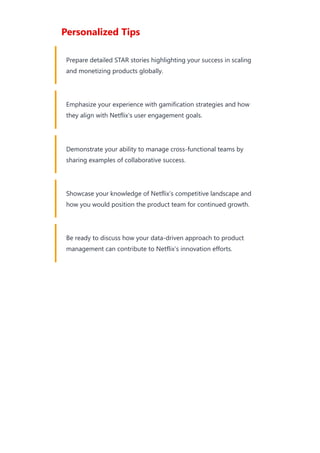
37.
Research strategies forscaling products internationally, including
localization and adapting to regional user preferences.
Competitive Landscape in Streaming
Analyze Netflix’s competitive positioning against Disney+, Amazon
Prime Video, and other key players.
Subscription-Based Monetization
Study successful subscription models, including pricing strategies
and user retention tactics.
Cross-Functional Team Management
Explore best practices for aligning engineering, marketing, and
design teams to achieve product milestones efficiently.
38.
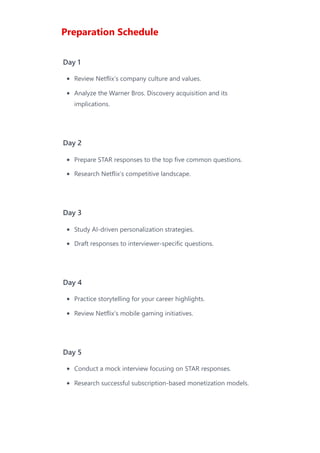
Personalized Tips
Prepare detailedSTAR stories highlighting your success in scaling
and monetizing products globally.
Emphasize your experience with gamification strategies and how
they align with Netflix’s user engagement goals.
Demonstrate your ability to manage cross-functional teams by
sharing examples of collaborative success.
Showcase your knowledge of Netflix’s competitive landscape and
how you would position the product team for continued growth.
Be ready to discuss how your data-driven approach to product
management can contribute to Netflix’s innovation efforts.
39.
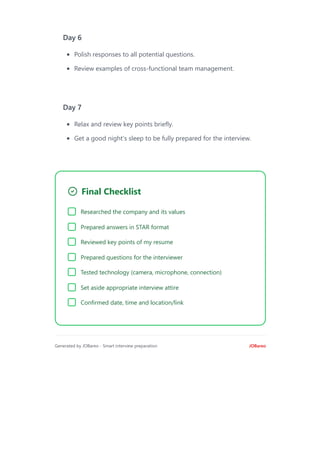
Preparation Schedule
Day 1
ReviewNetflix’s company culture and values.
Analyze the Warner Bros. Discovery acquisition and its
implications.
Day 2
Prepare STAR responses to the top five common questions.
Research Netflix’s competitive landscape.
Day 3
Study AI-driven personalization strategies.
Draft responses to interviewer-specific questions.
Day 4
Practice storytelling for your career highlights.
Review Netflix’s mobile gaming initiatives.
Day 5
Conduct a mock interview focusing on STAR responses.
Research successful subscription-based monetization models.
40.
Day 6
Polish responsesto all potential questions.
Review examples of cross-functional team management.
Day 7
Relax and review key points briefly.
Get a good night’s sleep to be fully prepared for the interview.
Final Checklist
Researched the company and its values
Prepared answers in STAR format
Reviewed key points of my resume
Prepared questions for the interviewer
Tested technology (camera, microphone, connection)
Set aside appropriate interview attire
Confirmed date, time and location/link
Generated by JOBareo - Smart interview preparation JOBareo
41.
JOBareo
Good luck withyour
interview!
Visit jobareo.com for more plans and resources
Prepared by JOBareo - your smart interview preparation
platform

![About the Company
Netflix, Inc.
Sector: Communication Services[2]
Netflix, Inc. is a global leader in streaming media, offering TV series, films,
documentaries, mobile games, and original programming to over 300
million paid memberships across 190 countries. It operates primarily
through internet-connected devices and maintains a DVD-by-mail service
in the U.S., blending digital content delivery with innovative on-demand
entertainment. In December 2025, Netflix agreed to acquire Warner Bros.
Discovery's studio and streaming divisions in a $72 billion cash-and-stock
deal, expanding its content library and production capabilities.[1][2][3]
FOUNDED
1997[1][2]
HEADQUARTERS
Los Gatos,
California,
USA[1][2]
TYPE
public
LOCATIONS
190
countries[1]
[3]
Culture & Work Environment
Values
Focuses on innovation in content and technology for user experience.
Emphasizes scale through global subscriber growth and network effects.
Invests in original productions and diversification like mobile gaming.](https://image.slidesharecdn.com/interviewpreparationplan-groupproductmanager-netflix-260112195542-2bc88594/85/Interview-Interview-Preparation-Plan-Group-product-Manager-Netflix-pdf-5-320.jpg)
![Current Moment
Agreed to acquire Warner Bros. Discovery studio and streaming divisions for
$72B in Dec 2025, expected to close Q3 2026; preparing Q4 2025 financial
results announcement.[2][4]
REVENUE
$43.38
billion[2]
PROFITABILITY
Earnings per
share $2.39
(prev. year)[2]
SIZE
large
Strategic Priorities
ESTIMATED SALARY RANGE
240000 - 700000 USD
Source: Levels.fyi, Comparably, 6figr, Fortune, Indeed
Strong commitment to original content creation.
Global scale and subscriber growth.
Technological innovation and user accessibility.
Content innovation and original programming.
Global subscriber expansion and retention.
Diversification into gaming and live events.
Major acquisitions for studio ownership and content expansion.](https://image.slidesharecdn.com/interviewpreparationplan-groupproductmanager-netflix-260112195542-2bc88594/85/Interview-Interview-Preparation-Plan-Group-product-Manager-Netflix-pdf-6-320.jpg)
![Hiring Process
1 Resume / Recruiter screen
Initial resume review followed by a ~30-minute phone
call with a Netflix recruiter to confirm role fit, motivation
for Netflix, and baseline experience; typically focuses on
culture fit and high‑level product ownership and lasts 30
minutes to 1 hour.[2][3]
2 Hiring manager interview
A deeper 45–60 minute interview (phone or video) with
the hiring manager that mixes behavioral questions
about ownership and impact with strategic product
questions to assess product instincts and role‑specific
experience; this round is often the key gate before the
loop.[2][3]
3 Panel / interview loop (PM, Eng, Design, Data,
partners)
Multi‑interviewer loop of ~3–5 interviews (virtual or
onsite) including other PMs, engineers, designers and
data/partner stakeholders; rounds cover product strategy,
design/case questions, execution/metrics, and
cross‑functional collaboration and each interview is ~45
minutes.[2][6]
4
Prepared presentation (case prompt) / product
case](https://image.slidesharecdn.com/interviewpreparationplan-groupproductmanager-netflix-260112195542-2bc88594/85/Interview-Interview-Preparation-Plan-Group-product-Manager-Netflix-pdf-7-320.jpg)
![A 45–60 minute prepared presentation or case given as a
prompt after earlier screens — candidates prepare a
product strategy/design/metrics response and present to
a panel on onsite/virtual day; includes Q&A and probes
on trade‑offs and metrics.[1][2]
5
Hiring committee / final calibration
Post‑loop review where interview feedback is
consolidated for a unanimous hiring decision by the
committee; may include follow‑up checks or reference
requests and typically takes several days to a couple
weeks to complete.[3][4]
6 Offer & compensation negotiation
If approved by the hiring committee, recruiter extends an
offer and conducts compensation discussion/negotiation;
timing varies (often days) and may include final logistics
(start date, relocation) and sign‑off.[3]](https://image.slidesharecdn.com/interviewpreparationplan-groupproductmanager-netflix-260112195542-2bc88594/85/Interview-Interview-Preparation-Plan-Group-product-Manager-Netflix-pdf-8-320.jpg)






![New Jobs Experience [Webcast]](https://cdn.slidesharecdn.com/ss_thumbnails/newjobspostingwebinar5-160517203317-thumbnail.jpg?width=640&height=640&fit=bounds)


