



Consumer Choice Theory


                         1
Consumer choice theory
• Utility is the satisfaction or
pleasure derived from consumption
of a good or service.
• Actual measurement of utility is
impossible, but economists assume
it can be measured by a fictitious
unit called the util.

                                     2
• Cardinal Utility Theory – Utility can be
quantified.
• Ordinal Utility Theory – Utility cannot be
quantified. Consumers can only rank their
preferences.
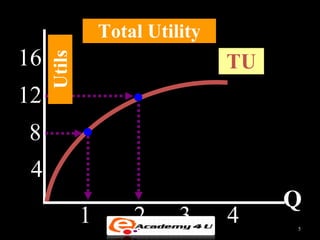
• Total utility (TU) is the total level of
satisfaction derived from all units of a good or
service consumed.
• Marginal utility (MU) is the change in total
utility from a one unit change in the quantity of
a good or service consumed.

                                                    3
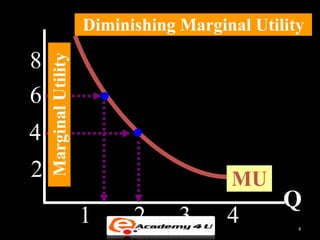
Diminishing Marginal Utility

8   Marginal Utility

6
4
2                                        MU
                                                Q
                       1     2     3     4        4
Total Utility
16   Utils                       TU
12
8
 4
                                      Q
             1       2     3     4    5
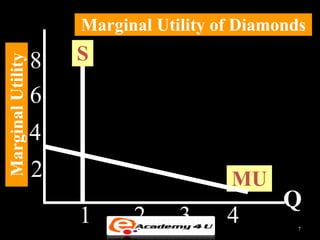
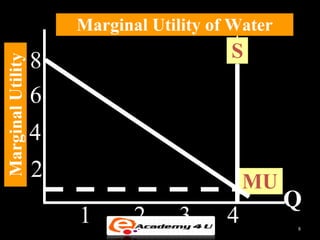
Even though water provides a greater
    utility than diamonds, why are
      diamonds more expensive?
 DIAMOND-WATER PARADOX
- Water is plentiful in most of the
  world, so its marginal utility is low,
  hence its price is also low
- Diamonds are scarce, so its
  marginal utility is high, hence its
  price is high
                                           6
Marginal Utility of Diamonds

                   8   S
Marginal Utility


                   6
                   4
                   2                     MU
                                                Q
                       1     2     3     4        7
Marginal Utility of Water

                   8                      S
Marginal Utility


                   6
                   4
                   2                          MU
                                                   Q
                       1      2     3     4        8
• The law of diminishing marginal
utility states that marginal utility of a
good or service eventually declines as
consumption increases.

• Consumer equilibrium is the
condition of reaching the maximum
level of satisfaction, given a budget,
when the marginal utility per dollar
spent on each good purchased is equal.

                                            9
• Consumer equilibrium and the law
of diminishing marginal utility can
be used to derive a downward-
sloping demand curve.
• When the price of a good falls,
consumer equilibrium no longer
holds because the marginal utility
the marginal utility per dollar for the
good rises.
                                          10
• To restore equilibrium, the
consumer must increase
consumption.
• As the quantity demanded
increases, the marginal utility falls
until equilibrium is again achieved.
• Thus, the price falls and the
quantity demanded rises, as
predicted by the law of demand
                                        11
Consumer Equilibrium
       MU A          MU B            MU Z
1.
      price A
                =    price B     =   price Z

1. Total expenditure = Budget
 If the marginal utility per last dollar
  spend on each good is equal and the
  entire budget is spent, total utility is
  maximized.
                                               12
If the marginal utility per last
dollar spend on each good is equal
and the entire budget is spent, total
utility is maximized.

     When the price of a normal
good falls, the income effect and
the substitution effect combine to
cause the quantity demanded to
increase.
                                         13
• The income effect and the
substitution effect are
complementary explanations for the
law of demand.
• When the price changes, these
effects work in combination to
change in the quantity demanded in
the opposite directions.

                                     14
Income effect and substitution effect
  • As the price falls, the consumer
  substitutes the cheaper the cheaper good
  for other goods that are now relatively
  more expensive. This is the substitution
  effect.
  • Also, as the price falls, real purchasing
  power increases, causing an increase in
  the consumer’s willingness and ability
  to purchase a good or service. This is
  the income effect.
                                                15
ORDINAL UTILITY THEORY

• Utility cannot be quantified
• Consumers can only rank their
  preferences
• E.g. Hani gets a higher utility from
  consuming an orange than an apple
• Uses indifference curve analysis


                                         16
INDIFFERENCE CURVE ANALYSIS

•  Uses two types of curves:
2. Indifference Curve (IC) is a curve that shows
   various combinations of two goods that give a
   consumer the same level of satisfaction
3. Budget Line (BL) is a line that shows various
   combinations of two goods that can be bought
   by a consumer, given a certain level of income
   and prices of the two goods


                                                    17
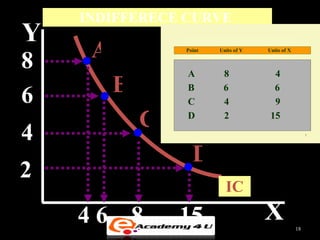
INDIFFERECE CURVE
Y
8    A           Point   Units of Y   Units of X


                 A        8             4

6        B       B        6             6
                 C        4             9

             C   D        2            15

4                                                       7


                   D
2
                           IC
    46 8         15                   X            18
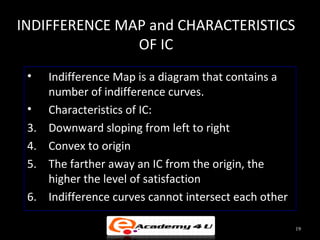
INDIFFERENCE MAP and CHARACTERISTICS
               OF IC
 •    Indifference Map is a diagram that contains a
      number of indifference curves.
 •    Characteristics of IC:
 3.   Downward sloping from left to right
 4.   Convex to origin
 5.   The farther away an IC from the origin, the
      higher the level of satisfaction
 6.   Indifference curves cannot intersect each other

                                                        19
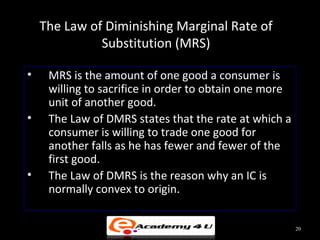
The Law of Diminishing Marginal Rate of
              Substitution (MRS)

•    MRS is the amount of one good a consumer is
     willing to sacrifice in order to obtain one more
     unit of another good.
•    The Law of DMRS states that the rate at which a
     consumer is willing to trade one good for
     another falls as he has fewer and fewer of the
     first good.
•    The Law of DMRS is the reason why an IC is
     normally convex to origin.


                                                        20
BUDGET LINE (BL)


•   BL shows various combinations of two
    goods that can be bought by a consumer,
    given his income and prices of the two
    goods.
•   Example: next slide 


                                              21
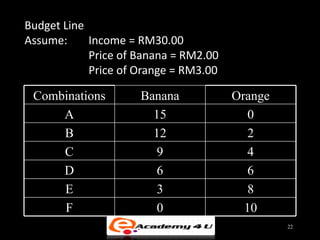
Budget Line
Assume:     Income = RM30.00
            Price of Banana = RM2.00
            Price of Orange = RM3.00

 Combinations        Banana            Orange
     A                 15                 0
     B                 12                 2
     C                 9                  4
     D                 6                  6
     E                 3                  8
     F                 0                 10
                                                22
CONSUMER EQUILIBRIUM

•   Consumer equilibrium is achieved when
    the consumer purchases the combination
    that gives him the highest level of
    satisfaction, given his income and the
    prices of the two goods.
•   CE is achieved at the point where IC is
    tangent to BL where price ratio = MRS


                                              23

Consumer choice theory

  • 1.
  • 2.
    Consumer choice theory •Utility is the satisfaction or pleasure derived from consumption of a good or service. • Actual measurement of utility is impossible, but economists assume it can be measured by a fictitious unit called the util. 2
  • 3.
    • Cardinal UtilityTheory – Utility can be quantified. • Ordinal Utility Theory – Utility cannot be quantified. Consumers can only rank their preferences. • Total utility (TU) is the total level of satisfaction derived from all units of a good or service consumed. • Marginal utility (MU) is the change in total utility from a one unit change in the quantity of a good or service consumed. 3
  • 4.
    Diminishing Marginal Utility 8 Marginal Utility 6 4 2 MU Q 1 2 3 4 4
  • 5.
    Total Utility 16 Utils TU 12 8 4 Q 1 2 3 4 5
  • 6.
    Even though waterprovides a greater utility than diamonds, why are diamonds more expensive? DIAMOND-WATER PARADOX - Water is plentiful in most of the world, so its marginal utility is low, hence its price is also low - Diamonds are scarce, so its marginal utility is high, hence its price is high 6
  • 7.
    Marginal Utility ofDiamonds 8 S Marginal Utility 6 4 2 MU Q 1 2 3 4 7
  • 8.
    Marginal Utility ofWater 8 S Marginal Utility 6 4 2 MU Q 1 2 3 4 8
  • 9.
    • The lawof diminishing marginal utility states that marginal utility of a good or service eventually declines as consumption increases. • Consumer equilibrium is the condition of reaching the maximum level of satisfaction, given a budget, when the marginal utility per dollar spent on each good purchased is equal. 9
  • 10.
    • Consumer equilibriumand the law of diminishing marginal utility can be used to derive a downward- sloping demand curve. • When the price of a good falls, consumer equilibrium no longer holds because the marginal utility the marginal utility per dollar for the good rises. 10
  • 11.
    • To restoreequilibrium, the consumer must increase consumption. • As the quantity demanded increases, the marginal utility falls until equilibrium is again achieved. • Thus, the price falls and the quantity demanded rises, as predicted by the law of demand 11
  • 12.
    Consumer Equilibrium MU A MU B MU Z 1. price A = price B = price Z 1. Total expenditure = Budget  If the marginal utility per last dollar spend on each good is equal and the entire budget is spent, total utility is maximized. 12
  • 13.
    If the marginalutility per last dollar spend on each good is equal and the entire budget is spent, total utility is maximized. When the price of a normal good falls, the income effect and the substitution effect combine to cause the quantity demanded to increase. 13
  • 14.
    • The incomeeffect and the substitution effect are complementary explanations for the law of demand. • When the price changes, these effects work in combination to change in the quantity demanded in the opposite directions. 14
  • 15.
    Income effect andsubstitution effect • As the price falls, the consumer substitutes the cheaper the cheaper good for other goods that are now relatively more expensive. This is the substitution effect. • Also, as the price falls, real purchasing power increases, causing an increase in the consumer’s willingness and ability to purchase a good or service. This is the income effect. 15
  • 16.
    ORDINAL UTILITY THEORY •Utility cannot be quantified • Consumers can only rank their preferences • E.g. Hani gets a higher utility from consuming an orange than an apple • Uses indifference curve analysis 16
  • 17.
    INDIFFERENCE CURVE ANALYSIS • Uses two types of curves: 2. Indifference Curve (IC) is a curve that shows various combinations of two goods that give a consumer the same level of satisfaction 3. Budget Line (BL) is a line that shows various combinations of two goods that can be bought by a consumer, given a certain level of income and prices of the two goods 17
  • 18.
    INDIFFERECE CURVE Y 8 A Point Units of Y Units of X A 8 4 6 B B 6 6 C 4 9 C D 2 15 4 7 D 2 IC 46 8 15 X 18
  • 19.
    INDIFFERENCE MAP andCHARACTERISTICS OF IC • Indifference Map is a diagram that contains a number of indifference curves. • Characteristics of IC: 3. Downward sloping from left to right 4. Convex to origin 5. The farther away an IC from the origin, the higher the level of satisfaction 6. Indifference curves cannot intersect each other 19
  • 20.
    The Law ofDiminishing Marginal Rate of Substitution (MRS) • MRS is the amount of one good a consumer is willing to sacrifice in order to obtain one more unit of another good. • The Law of DMRS states that the rate at which a consumer is willing to trade one good for another falls as he has fewer and fewer of the first good. • The Law of DMRS is the reason why an IC is normally convex to origin. 20
  • 21.
    BUDGET LINE (BL) • BL shows various combinations of two goods that can be bought by a consumer, given his income and prices of the two goods. • Example: next slide  21
  • 22.
    Budget Line Assume: Income = RM30.00 Price of Banana = RM2.00 Price of Orange = RM3.00 Combinations Banana Orange A 15 0 B 12 2 C 9 4 D 6 6 E 3 8 F 0 10 22
  • 23.
    CONSUMER EQUILIBRIUM • Consumer equilibrium is achieved when the consumer purchases the combination that gives him the highest level of satisfaction, given his income and the prices of the two goods. • CE is achieved at the point where IC is tangent to BL where price ratio = MRS 23