Chapter 6
Consumer Choice Theory
    • Key Concepts
    • Summary
    • Practice Quiz
    • Internet Exercises
       ©2000 South-Western College Publishing
                                                1
In this chapter, you will
  learn to solve these
   economic puzzles:
 When ordering Big Macs,
Under what conditions might
  Do white ratspizza, pay
   milkshakes, obey and
    you be willing to the
 otherlaw of demand? you
   $10,000 forhow can of
       goods, a gallon
 water and 1the highest one-
     obtain cent for a
    possible diamond?
       carat satisfaction?
                     2
What is Util?
A hypothetical unit used
 to measure how much
 utility a person obtains
 from consuming a good


                    3
What is Utility?
The satisfaction, or
 pleasure, that people
 receive from consuming
 a good or service


                 4
What is Total Utility?
The amount of satisfaction
 received from all the units
 of a good or service
 consumed


                    5
Why does a consumer
buy one bundle of goods,
 rather than another?
  Consumers make one
   choice over another
   depending on their
   marginal utility
                  6
What is Marginal Utility?
The change in total utility
 from one additional unit
 of a good or service


                     7
What is the Law of
   Diminishing
 Marginal Utility?
The principle that the
 extra satisfaction of a
 good or service declines
 as people consume more
 in a given period
                   8
Diminishing Marginal Utility

8   Marginal Utility

6
4
2                                        MU
                                                Q
                       1     2     3     4
                                         9
Total Utility
16   Utils                 TU
12
8
 4
                                     Q
             1   2   3     4
                           10
When is Total Utility
    maximized?
When the marginal utility
 per dollar of each good is
 equal and the entire
 budget is spent

                     11
What is
Consumer Equilibrium?
A condition in which total
 utility cannot increase by
 spending more of a
 given budget on one
 good and spending less
 on another good
                     12
Even though water
 provides a greater utility
 than diamonds, why are
diamonds more expensive?
  Water is plentiful in most
   of the world, so its
   marginal utility is low
                      13
Marginal Utility of Diamonds

8   Marginal Utility   S
6
4
                           MUd
2                                        MU
                                                Q
                       1     2     3     4
                                         14
Marginal Utility of Water

8   Marginal Utility                        S

6
4
2                           MUw              MU
                                                  Q
                       1       2     3     4
                                           15
Marginal Utility for Big Macs and
Milkshakes (utils per day) ($2 each)
           BIG MACS   MILKSHAKES
Quantity   MU MU/P     MU MU/P

  1         8    4      6        3
  2         4    2      4        2
  3         2    1      1        1/2
  4         1   1/2     0        0

                            16
Consumer Equilibrium

 MU A         MU B          MU Z
price A   =   price B   =   price Z


                            17
Consumer Equilibrium
        Price of Big Mac = $2
MU of Big Mac        MU of milkshake
price of Big Mac   = price of milkshake

        4 utils         4 utils
          $2       =      $2

                             18
What happens if the
price of a Big Mac falls
 to $1 and upsets the
previous equilibrium?


                  19
Consumer Equilibrium
      Price of Big Mac = $1
 MU of Big Mac      MU of milkshake
price of Big Mac
                   >price of milkshake
        4 utils    >   4 utils
          $1             $2


                             20
What happens to
  the number of Big
  Macs bought when
   the price drops?
To restore maximum total
 utility, the consumer
 spends more on Big Macs

                  21
What does this discussion
   of Utility reveal?
 The law of demand, that is,
  as the price of a good
  declines, consumers will
  buy more units of the
  good, and vice versa
                     22
What are two alternative
explanations of demand?
     Income effect
    Substitution effect


                     23
What is the
   Income effect?
The change in quantity
 demanded of a good or
 service caused by a
 change in real income
 (purchasing power)
                 24
What does the Income
   effect show?
As prices decline, your real
 income increases,
 increasing your buying
 power, so you buy more
 units, ceteris paribus
                     25
What is the
 Substitution effect?
The change in quantity
 demanded of a good or
 service caused by the
 change in its price
 relative to substitutes
                   26
What does the
Substitution effect show?
Suppose the price of a Pepsi
 falls and the price of a
 Coke remains unchanged;
 you will buy more Pepsi,
 because relatively, it is less
 expensive than Coke
                        27
What does the
Substitution and Income
     effect prove?
The law of demand, that is,
 as the price of a good
 declines, consumers will
 buy more units of the
 good, and vice versa
                    28
What is a Normal Good?
 A good that consumers
  will buy more of as their
  incomes increase


                     29
What is an
    Inferior Good?
A good that consumers
 will buy less of as their
 incomes increase


                     30
Key Concepts


           31
Key Concepts
•   What is Util?
•   What is Utility?
•   What is Total Utility?
•   What is Marginal Utility?
•   What is the Law of Diminishing Marginal U
•   When is Total Utility maximized?
•   What is Consumer Equilibrium?


                               32
Key Concepts cont.
•   What are two alternative explanations of dem
•   What is the Income effect?
•   What is the Substitution effect?
•   What does the Substitution and Income effec
•   What is a Normal Good?
•   What is an Inferior Good?


                                33
Summary


          34
Utility is the satisfaction or
pleasure derived from consumption
of a good or service. Actual
measurement of utility is
impossible, but economists assume
it can be measured by a fictitious
unit called the util.


                            35
Total utility is the total level of
satisfaction derived from all units of
a good or service consumed.
Marginal utility is the change in
total utility from a one unit change
in the quantity of a good or service
consumed.


                               36
Diminishing Marginal Utility

8   Marginal Utility

6
4
2                                        MU
                                                Q
                       1     2     3     4
                                         37
Total Utility
16   Utils                 TU
12
8
 4
                                     Q
             1   2   3     4
                           38
The law of diminishing
marginal utility states that
marginal utility of a good or
service eventually declines as
consumption increases.


                         39
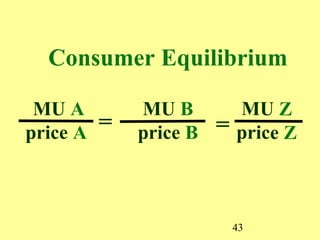
Consumer equilibrium is the
condition of reaching the
maximum level of satisfaction,
given a budget, when the marginal
utility per dollar spent on each
good purchased is equal.


                          40
Consumer equilibrium and the
law of diminishing marginal utility
can be used to derive a downward-
sloping demand curve. When the
price of a good falls, consumer
equilibrium no longer holds because
the marginal utility the marginal
utility per dollar for the good rises.

                             41
To restore equilibrium, the
consumer must increase
consumption. As the quantity
demanded increases, the marginal
utility falls until equilibrium is
again achieved. Thus, the price falls
and the quantity demanded rises, as
predicted by the law of demand

                            42
Consumer Equilibrium

 MU A         MU B          MU Z
price A   =   price B   =   price Z


                            43
The income effect and the
substitution effect are
complementary explanations for the
law of demand. When the price
changes, these effects work in
combination to change in the
quantity demanded in the opposite
directions.

                          44
As the price falls, real
purchasing power increases,
causing an increase in the
consumer’s willingness and ability
to purchase a good or service. This
is the income effect. Also, as the
price falls, the consumer substitutes
the cheaper the cheaper good for
other goods that are now relatively
more expensive. This is the
substitution effect.
                             45
If the marginal utility per last
dollar spend on each good is equal
and the entire budget is spent, total
utility is maximized.


                              46
When the price of a normal good
falls, the income effect and the
substitution effect combine to cause
the quantity demanded to increase.


                           47
Chapter 6 Quiz


  ©2000 South-Western College Publishing
                                           48
1. As an individual consumes more of a given
  good, the marginal utility of that good to the
  consumer
   a. rises at an increasing rate.
   b. rises at a decreasing rate.
   c. falls.
   d. rises.
C. As a consumer consumes more and more of
  anything, the satisfaction received on the last
  unit becomes less and less with each unit.

                                     49
2. The amount of added utility that a
  consumer gains from the consumption of one
  more unit of a good is called
   a. incremental utility.
   b. total utility.
   c. diminishing utility.
   d. marginal utility.

D. The word “margin” means that last
 unit or the last increment.


                                 50
3. A certain consumer buys only food and
  compact discs. If the quantity of food
  bought increases, while that of compact discs
  remains the same, the marginal utility of
  food will
   a. fall relative to the marginal utility of
     compact discs.
   b. rise relative to the marginal utility of
     compact discs.
   c. rise, but not as fast as the marginal utility
     of compact discs falls.
   d. fall, but not as fast as the marginal utility
     of compact discs falls.
A. As more units of food are purchased, the
  marginal utility diminishes, while that of
  compact discs remains the same.

                                      51
4. Rational consumers will continue to
   consume two goods until
    a. the marginal utility per dollar’s worth of
      the two goods is the same.
    b. the marginal utility is the same for each
      good.
    c. the prices of the two goods are equal.
    d. the prices of the two goods are unequal.
A. If a consumer can raise his/her marginal
  utility by purchasing more of a good, more
  units of that good will be purchased. At the
  point that marginal utility cannot be
  increased by purchasing more units of either
  good, the consumer will stop purchasing.
                                    52
5. Assume a person’s consumption of just the
  right amounts of pork and chicken is in
  equilibrium. We can conclude that the
   a. marginal utility of pork must equal the
     marginal utility of chicken.
   b. price of pork must equal the price of
     chicken.
   c. ratio of marginal cost to price must be the
     same in both the pork and the chicken
     markets.
   d. ratio of marginal utility to price must be
     the same for pork and chicken.
 D. In terms of satisfaction, the two goods
   become identical at the point of equilibrium.
                                   53
6. Assume an individual consumes only milk and
  doughnuts, and he/she has arranged
  consumption so that the last glass of milk
  yields 12 utils and the last doughnut 6 utils. If
  the price of milk is $1 per glass and the price
  of a doughnut is $.50, we can conclude that the
   a. consumer should consume less milk and
     more doughnuts.
   b. price of milk is too high relative to
     doughnuts.
   c. consumer should consume more milk and
     fewer doughnuts.
   d. consumer is in equilibrium.
   D. At this point, the ratio of utils to price
     is the same.
                                      54
7. Suppose an individual consumes pizza and
   cola. To reach consumer equilibrium, the
   individual must consume pizza and cola so
   that the
    a. price paid for the two goods is the same.
    b. marginal utility of the two goods is equal.
    c. ratio of marginal utility to price is the
      same for both goods.
    d. ratio of marginal utility of cola to
      marginal utility of pizza is 1.
C. When the ratio of utils to price is the same
  for two goods, the consumer cannot increase
  his/her satisfaction by buying more of either.
                                      55
8. A state of consumer equilibrium for goods
  consumed prevails when the
   a. marginal utility of all goods is the same.
   b. marginal utility per dollar’s worth of two
     goods is the same.
   c. price of two goods is the same.
   d. marginal cost per dollar spent on two
     goods is the same.
B. When the marginal utility of two goods is
  the same, the consumer cannot increase
  his/her level of satisfaction by purchasing
  more of either good.
                                    56
9. The change in quantity demanded resulting
  from a change in purchasing power is
  known as the
   a. income effect.
   b. substitution effect.
   c. law of demand.
   d. consumer equilibrium effect.
A. When prices decline the purchasing power
 of the consumer increases, and vice versa.
 Therefore, a change in prices has the same
 effect on the buying power of the consumer
 as if his/her income had changed.
                                 57
Total Utility for Multiplex Tickets,
          Video Rentals, and Popcorn
    Total Utility      Total Utility       Total Utility
  from Multiplex       from Video         from Popcorn
      Tickets            Rentals

1 movie (30 utils)   1 video (14 utils)   1 bag (8 utils)
2 movies (54 utils) 2 videos (24 utils)   2 bags (13 utils)
3 movies (72 utils) 3 videos (30 utils)   3 bags (15 utils)
4 movies (84 utils) 4 videos (32 utils)   4 bags (16 utils)

                        Exhibit 4
                                           58
10. In exhibit 4, assume Multiplex tickets cost
  $6 each, video rentals cost $2 each, and bags
  of popcorn cost $1 each. What is the
  marginal utility of renting a third video?
   a. 6 utils.
   b. 8 utils.
   c. 10 utils.
   d. 30 utils.

A. If the total utility for 2 videos is 24 utils
 and the total utility for 3 videos is 30 utils,
 the additional utils added by the third
 video is 6.
                                    59
11. In exhibit 4, assume Multiplex tickets cost $6
  each, video rentals cost $2 each, and bags of
  popcorn cost $1 each. Suppose the consumer has
  $12 per week to spend on Multiplex tickets,
  video rentals, and popcorn. What combination
  of goods will give the consumer the most utility?
   a. 1 movie, 3 videos, and no popcorn.
   b. 1 movie, 2 videos, and 2 bags of popcorn.
   c. 1 movie, 1 video, and 4 bags of popcorn.
   d. 2 movies, no video, and no bags of popcorn.
  B. 67 total utils are achieved with this
    combination, a yields 60 utils, c yields 60
    utils and d yields 54 utils.
                                       60
Internet Exercises
Click on the picture of the book,
 choose updates by chapter for
 the latest internet exercises.


                            61
END

      62

06 consumer choice theory

  • 1.
    Chapter 6 Consumer ChoiceTheory • Key Concepts • Summary • Practice Quiz • Internet Exercises ©2000 South-Western College Publishing 1
  • 2.
    In this chapter,you will learn to solve these economic puzzles: When ordering Big Macs, Under what conditions might Do white ratspizza, pay milkshakes, obey and you be willing to the otherlaw of demand? you $10,000 forhow can of goods, a gallon water and 1the highest one- obtain cent for a possible diamond? carat satisfaction? 2
  • 3.
    What is Util? Ahypothetical unit used to measure how much utility a person obtains from consuming a good 3
  • 4.
    What is Utility? Thesatisfaction, or pleasure, that people receive from consuming a good or service 4
  • 5.
    What is TotalUtility? The amount of satisfaction received from all the units of a good or service consumed 5
  • 6.
    Why does aconsumer buy one bundle of goods, rather than another? Consumers make one choice over another depending on their marginal utility 6
  • 7.
    What is MarginalUtility? The change in total utility from one additional unit of a good or service 7
  • 8.
    What is theLaw of Diminishing Marginal Utility? The principle that the extra satisfaction of a good or service declines as people consume more in a given period 8
  • 9.
    Diminishing Marginal Utility 8 Marginal Utility 6 4 2 MU Q 1 2 3 4 9
  • 10.
    Total Utility 16 Utils TU 12 8 4 Q 1 2 3 4 10
  • 11.
    When is TotalUtility maximized? When the marginal utility per dollar of each good is equal and the entire budget is spent 11
  • 12.
    What is Consumer Equilibrium? Acondition in which total utility cannot increase by spending more of a given budget on one good and spending less on another good 12
  • 13.
    Even though water provides a greater utility than diamonds, why are diamonds more expensive? Water is plentiful in most of the world, so its marginal utility is low 13
  • 14.
    Marginal Utility ofDiamonds 8 Marginal Utility S 6 4 MUd 2 MU Q 1 2 3 4 14
  • 15.
    Marginal Utility ofWater 8 Marginal Utility S 6 4 2 MUw MU Q 1 2 3 4 15
  • 16.
    Marginal Utility forBig Macs and Milkshakes (utils per day) ($2 each) BIG MACS MILKSHAKES Quantity MU MU/P MU MU/P 1 8 4 6 3 2 4 2 4 2 3 2 1 1 1/2 4 1 1/2 0 0 16
  • 17.
    Consumer Equilibrium MUA MU B MU Z price A = price B = price Z 17
  • 18.
    Consumer Equilibrium Price of Big Mac = $2 MU of Big Mac MU of milkshake price of Big Mac = price of milkshake 4 utils 4 utils $2 = $2 18
  • 19.
    What happens ifthe price of a Big Mac falls to $1 and upsets the previous equilibrium? 19
  • 20.
    Consumer Equilibrium Price of Big Mac = $1 MU of Big Mac MU of milkshake price of Big Mac >price of milkshake 4 utils > 4 utils $1 $2 20
  • 21.
    What happens to the number of Big Macs bought when the price drops? To restore maximum total utility, the consumer spends more on Big Macs 21
  • 22.
    What does thisdiscussion of Utility reveal? The law of demand, that is, as the price of a good declines, consumers will buy more units of the good, and vice versa 22
  • 23.
    What are twoalternative explanations of demand? Income effect Substitution effect 23
  • 24.
    What is the Income effect? The change in quantity demanded of a good or service caused by a change in real income (purchasing power) 24
  • 25.
    What does theIncome effect show? As prices decline, your real income increases, increasing your buying power, so you buy more units, ceteris paribus 25
  • 26.
    What is the Substitution effect? The change in quantity demanded of a good or service caused by the change in its price relative to substitutes 26
  • 27.
    What does the Substitutioneffect show? Suppose the price of a Pepsi falls and the price of a Coke remains unchanged; you will buy more Pepsi, because relatively, it is less expensive than Coke 27
  • 28.
    What does the Substitutionand Income effect prove? The law of demand, that is, as the price of a good declines, consumers will buy more units of the good, and vice versa 28
  • 29.
    What is aNormal Good? A good that consumers will buy more of as their incomes increase 29
  • 30.
    What is an Inferior Good? A good that consumers will buy less of as their incomes increase 30
  • 31.
  • 32.
    Key Concepts • What is Util? • What is Utility? • What is Total Utility? • What is Marginal Utility? • What is the Law of Diminishing Marginal U • When is Total Utility maximized? • What is Consumer Equilibrium? 32
  • 33.
    Key Concepts cont. • What are two alternative explanations of dem • What is the Income effect? • What is the Substitution effect? • What does the Substitution and Income effec • What is a Normal Good? • What is an Inferior Good? 33
  • 34.
  • 35.
    Utility is thesatisfaction or pleasure derived from consumption of a good or service. Actual measurement of utility is impossible, but economists assume it can be measured by a fictitious unit called the util. 35
  • 36.
    Total utility isthe total level of satisfaction derived from all units of a good or service consumed. Marginal utility is the change in total utility from a one unit change in the quantity of a good or service consumed. 36
  • 37.
    Diminishing Marginal Utility 8 Marginal Utility 6 4 2 MU Q 1 2 3 4 37
  • 38.
    Total Utility 16 Utils TU 12 8 4 Q 1 2 3 4 38
  • 39.
    The law ofdiminishing marginal utility states that marginal utility of a good or service eventually declines as consumption increases. 39
  • 40.
    Consumer equilibrium isthe condition of reaching the maximum level of satisfaction, given a budget, when the marginal utility per dollar spent on each good purchased is equal. 40
  • 41.
    Consumer equilibrium andthe law of diminishing marginal utility can be used to derive a downward- sloping demand curve. When the price of a good falls, consumer equilibrium no longer holds because the marginal utility the marginal utility per dollar for the good rises. 41
  • 42.
    To restore equilibrium,the consumer must increase consumption. As the quantity demanded increases, the marginal utility falls until equilibrium is again achieved. Thus, the price falls and the quantity demanded rises, as predicted by the law of demand 42
  • 43.
    Consumer Equilibrium MUA MU B MU Z price A = price B = price Z 43
  • 44.
    The income effectand the substitution effect are complementary explanations for the law of demand. When the price changes, these effects work in combination to change in the quantity demanded in the opposite directions. 44
  • 45.
    As the pricefalls, real purchasing power increases, causing an increase in the consumer’s willingness and ability to purchase a good or service. This is the income effect. Also, as the price falls, the consumer substitutes the cheaper the cheaper good for other goods that are now relatively more expensive. This is the substitution effect. 45
  • 46.
    If the marginalutility per last dollar spend on each good is equal and the entire budget is spent, total utility is maximized. 46
  • 47.
    When the priceof a normal good falls, the income effect and the substitution effect combine to cause the quantity demanded to increase. 47
  • 48.
    Chapter 6 Quiz ©2000 South-Western College Publishing 48
  • 49.
    1. As anindividual consumes more of a given good, the marginal utility of that good to the consumer a. rises at an increasing rate. b. rises at a decreasing rate. c. falls. d. rises. C. As a consumer consumes more and more of anything, the satisfaction received on the last unit becomes less and less with each unit. 49
  • 50.
    2. The amountof added utility that a consumer gains from the consumption of one more unit of a good is called a. incremental utility. b. total utility. c. diminishing utility. d. marginal utility. D. The word “margin” means that last unit or the last increment. 50
  • 51.
    3. A certainconsumer buys only food and compact discs. If the quantity of food bought increases, while that of compact discs remains the same, the marginal utility of food will a. fall relative to the marginal utility of compact discs. b. rise relative to the marginal utility of compact discs. c. rise, but not as fast as the marginal utility of compact discs falls. d. fall, but not as fast as the marginal utility of compact discs falls. A. As more units of food are purchased, the marginal utility diminishes, while that of compact discs remains the same. 51
  • 52.
    4. Rational consumerswill continue to consume two goods until a. the marginal utility per dollar’s worth of the two goods is the same. b. the marginal utility is the same for each good. c. the prices of the two goods are equal. d. the prices of the two goods are unequal. A. If a consumer can raise his/her marginal utility by purchasing more of a good, more units of that good will be purchased. At the point that marginal utility cannot be increased by purchasing more units of either good, the consumer will stop purchasing. 52
  • 53.
    5. Assume aperson’s consumption of just the right amounts of pork and chicken is in equilibrium. We can conclude that the a. marginal utility of pork must equal the marginal utility of chicken. b. price of pork must equal the price of chicken. c. ratio of marginal cost to price must be the same in both the pork and the chicken markets. d. ratio of marginal utility to price must be the same for pork and chicken. D. In terms of satisfaction, the two goods become identical at the point of equilibrium. 53
  • 54.
    6. Assume anindividual consumes only milk and doughnuts, and he/she has arranged consumption so that the last glass of milk yields 12 utils and the last doughnut 6 utils. If the price of milk is $1 per glass and the price of a doughnut is $.50, we can conclude that the a. consumer should consume less milk and more doughnuts. b. price of milk is too high relative to doughnuts. c. consumer should consume more milk and fewer doughnuts. d. consumer is in equilibrium. D. At this point, the ratio of utils to price is the same. 54
  • 55.
    7. Suppose anindividual consumes pizza and cola. To reach consumer equilibrium, the individual must consume pizza and cola so that the a. price paid for the two goods is the same. b. marginal utility of the two goods is equal. c. ratio of marginal utility to price is the same for both goods. d. ratio of marginal utility of cola to marginal utility of pizza is 1. C. When the ratio of utils to price is the same for two goods, the consumer cannot increase his/her satisfaction by buying more of either. 55
  • 56.
    8. A stateof consumer equilibrium for goods consumed prevails when the a. marginal utility of all goods is the same. b. marginal utility per dollar’s worth of two goods is the same. c. price of two goods is the same. d. marginal cost per dollar spent on two goods is the same. B. When the marginal utility of two goods is the same, the consumer cannot increase his/her level of satisfaction by purchasing more of either good. 56
  • 57.
    9. The changein quantity demanded resulting from a change in purchasing power is known as the a. income effect. b. substitution effect. c. law of demand. d. consumer equilibrium effect. A. When prices decline the purchasing power of the consumer increases, and vice versa. Therefore, a change in prices has the same effect on the buying power of the consumer as if his/her income had changed. 57
  • 58.
    Total Utility forMultiplex Tickets, Video Rentals, and Popcorn Total Utility Total Utility Total Utility from Multiplex from Video from Popcorn Tickets Rentals 1 movie (30 utils) 1 video (14 utils) 1 bag (8 utils) 2 movies (54 utils) 2 videos (24 utils) 2 bags (13 utils) 3 movies (72 utils) 3 videos (30 utils) 3 bags (15 utils) 4 movies (84 utils) 4 videos (32 utils) 4 bags (16 utils) Exhibit 4 58
  • 59.
    10. In exhibit4, assume Multiplex tickets cost $6 each, video rentals cost $2 each, and bags of popcorn cost $1 each. What is the marginal utility of renting a third video? a. 6 utils. b. 8 utils. c. 10 utils. d. 30 utils. A. If the total utility for 2 videos is 24 utils and the total utility for 3 videos is 30 utils, the additional utils added by the third video is 6. 59
  • 60.
    11. In exhibit4, assume Multiplex tickets cost $6 each, video rentals cost $2 each, and bags of popcorn cost $1 each. Suppose the consumer has $12 per week to spend on Multiplex tickets, video rentals, and popcorn. What combination of goods will give the consumer the most utility? a. 1 movie, 3 videos, and no popcorn. b. 1 movie, 2 videos, and 2 bags of popcorn. c. 1 movie, 1 video, and 4 bags of popcorn. d. 2 movies, no video, and no bags of popcorn. B. 67 total utils are achieved with this combination, a yields 60 utils, c yields 60 utils and d yields 54 utils. 60
  • 61.
    Internet Exercises Click onthe picture of the book, choose updates by chapter for the latest internet exercises. 61
  • 62.
    END 62