CONSUMER BEHAVIOUR Consumer is a king -- buying power, preferences & price signals Preference & choice Objectives To derive maximum utility To pay lowest possible price
UTILITY ANALYSIS Utility – capacity of commodity to satisfy  human want Cardinal approach -- measurability of utility Ordinal approach – Ranking of utility
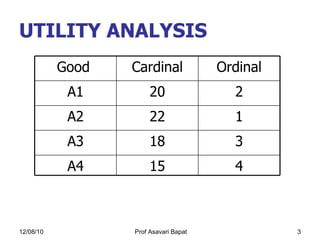
UTILITY ANALYSIS 4 15 A4 3 18 A3 1 22 A2 2 20 A1 Ordinal Cardinal Good
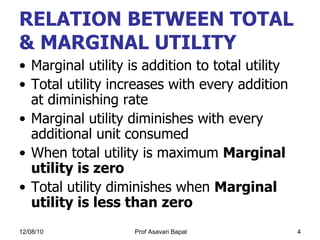
RELATION BETWEEN TOTAL & MARGINAL UTILITY Marginal utility is addition to total utility  Total utility increases with every addition at diminishing rate Marginal utility diminishes with every additional unit consumed When total utility is maximum  Marginal utility is zero Total utility diminishes when  Marginal utility is less than zero
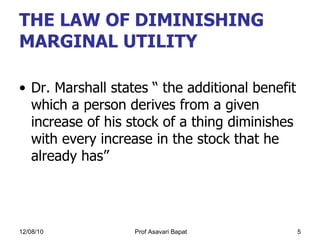
THE LAW OF DIMINISHING MARGINAL UTILITY  Dr. Marshall states “ the additional benefit which a person derives from a given increase of his stock of a thing diminishes with every increase in the stock that he already has”
“ceteris paribus marginal utility from every successive unit consumed goes on declining”  Homogeneous units Time period of consumption Consumption up to  the point where MU=PRICE
ASSUMPTIONS OF THE LAW OF DMU Cardinal measurement of utility Consumer is rational Limited income Constant prices MUM is constant
THE LAW OF EQUI-MARGINAL UTILITY The consumer will distribute his given amount of money on different goods in such a way that the marginal utility of last rupee spent on each good is made equal Ratios of MU to P for all goods are equal
CONSUMER’S EQUILIBRIUM Maximum satisfaction by allocating income over different goods in such a way that MU of all goods will be in proportion to their respective prices MU of exp. or MU last rupee spent on each good will be made equal MUa/Pa= MUb/Pb=MUc/Pc = ----MUn/Pn
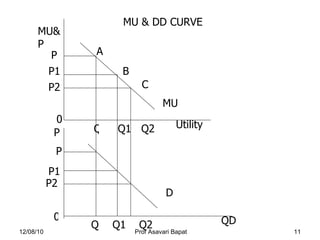
DIMINISHING MU & THE LAW OF DEMAND   Demand curve slopes downward as MU declines with every additional unit consumed  Consumer demands the good till  MU = price So lower quantity is demanded at high price & vice versa
D MU Q Q1 Q2 Q Q1 Q2 A B C P2 P1 P P P1 P2 QD MU&P 0 0 P Utility MU & DD CURVE
LIMITATIONS OF CARDINAL ANALYSIS Measurability of utility questioned Utility is not independent Mum is not constant No distinction between income & substitution effects Unable to explain Giffen paradox  Neglects cross effects of related goods  Unrealistic
INDIFFERENCE CURVE (IC) ANALYSIS   Scale of preference the base of IC technique  Based of Ordinal measurement of utility  Ranking of goods as per satisfaction derived  Two goods consumed Independent of Prices & income
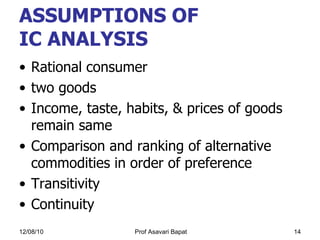
ASSUMPTIONS OF  IC ANALYSIS   Rational consumer  two goods Income, taste, habits, & prices of goods remain same Comparison and ranking of alternative commodities in order of preference Transitivity Continuity
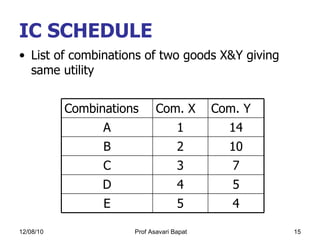
IC SCHEDULE List of combinations of two goods X&Y giving same utility 4 5 E 5 4 D 7 3 C 10 2 B 14 1 A Com. Y Com. X Combinations
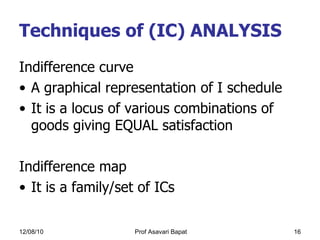
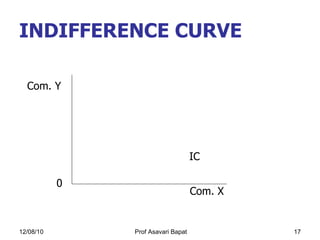
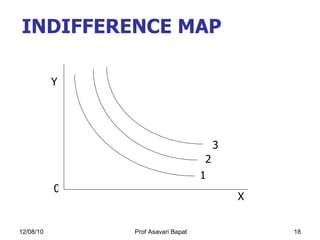
Techniques of (IC) ANALYSIS Indifference curve A graphical representation of I schedule It is a locus of various combinations of goods giving EQUAL satisfaction Indifference map  It is a family/set of ICs
INDIFFERENCE CURVE 0 Com. X Com. Y IC
INDIFFERENCE MAP  1 2 3 0 X Y
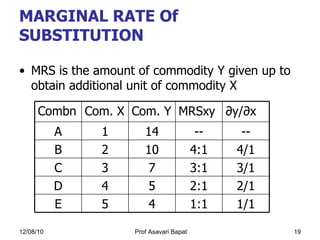
MARGINAL RATE Of SUBSTITUTION MRS is the amount of commodity Y given up to obtain additional unit of commodity X 1/1 1:1 4 5 E 2/1 2:1 5 4 D 3/1 3:1 7 3 C 4/1 4:1 10 2 B -- -- 14 1 A ∂ y/∂x MRSxy Com. Y Com. X Combn
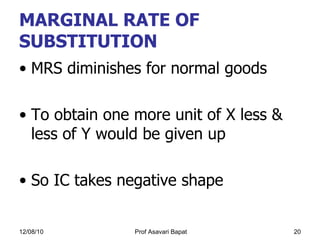
MARGINAL RATE OF SUBSTITUTION MRS diminishes for normal goods  To obtain one more unit of X less & less of Y would be given up  So IC takes negative shape
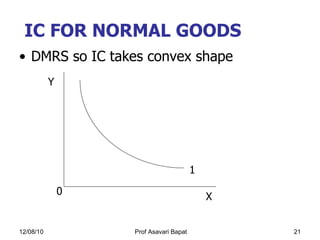
IC FOR NORMAL GOODS DMRS so IC takes convex shape  0 X Y 1
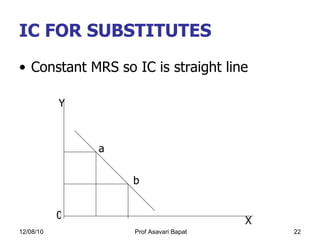
IC FOR SUBSTITUTES Constant MRS so IC is straight line  Y X 0 a b
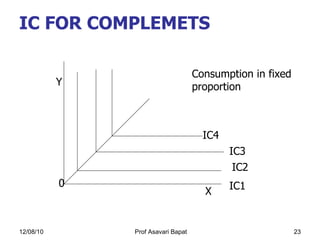
IC FOR COMPLEMETS IC1 IC2 IC3 IC4 0 X Y Consumption in fixed proportion
PROPERTIES OF IC All ICs slope downwards from left to right No two ICs intersect  IC is convex to origin (reasons) Higher IC represents higher level of satisfaction IC can not touch either axis ICs need not be parallel to each other
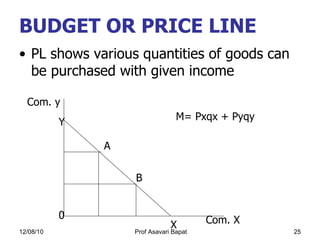
BUDGET OR PRICE LINE PL shows various quantities of goods can be purchased with given income  0 Com. X Com. y A B X Y M= Pxqx + Pyqy
CONSUMER’S EQUILIBRIUM Transformation of scale of preferences into reality by buying certain units of x & y to maximize satisfaction No tendency to rearrange his purchases Constraints faced by Consumer  prices of goods  Consumer’s income
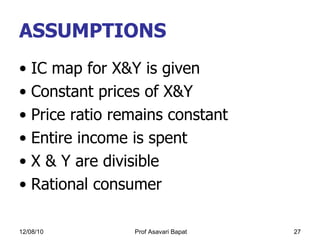
ASSUMPTIONS  IC map for X&Y is given  Constant prices of X&Y Price ratio remains constant Entire income is spent X & Y are divisible Rational consumer
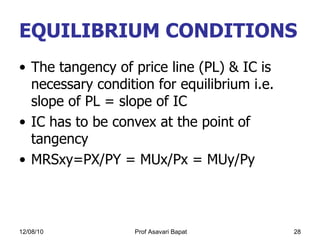
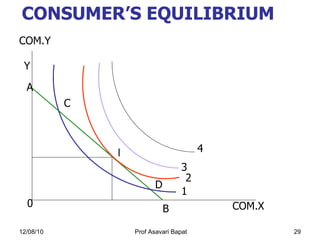
EQUILIBRIUM CONDITIONS  The tangency of price line (PL) & IC is necessary condition for equilibrium i.e. slope of PL = slope of IC IC has to be convex at the point of tangency MRSxy=PX/PY = MUx/Px = MUy/Py
CONSUMER’S EQUILIBRIUM COM.Y 1 2 3 4 E A B 0 C D Y COM.X
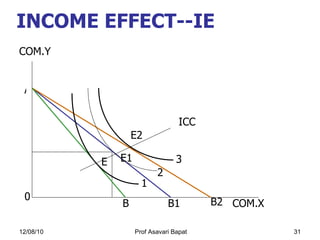
INCOME EFFECT--IE Change in real income changes the position of consumer equilibrium Consumer is better/worse off  Real income increases or declines Incase of normal goods IE is positive Income consumption curve rises upward
INCOME EFFECT--IE COM.Y ICC 1 2 3 A B B1 B2 0 COM.X E E1 E2
INCOME EFFECT--IE In case of normal goods IE is Positive  If commodity x is inferior IE is negative ICC rises up and bends backward If commodity y is inferior IE is negative ICC rises up and turns downward
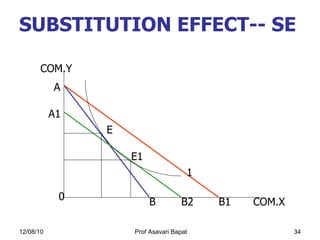
SUBSTITUTION EFFECT--SE Change in price influences the position of consumer equilibrium Adjustment in money income to maintain real income constant Price effect= Income effect+ substitution effect
SUBSTITUTION EFFECT-- SE E E1 1 A COM.X COM.Y 0 B B2 B1 A1
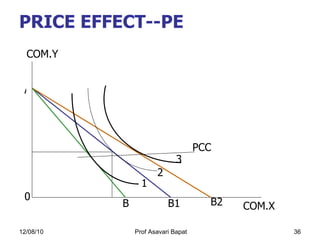
PRICE EFFECT--PE Change in price influences the position of consumer equilibrium Consumer is better/worse off  Real income increases or declines Incase of  normal  goods PE is positive PE is negative for  inferior/Giffen  goods Price effect= income effect+ substitution effect
PRICE EFFECT--PE PCC 1 2 3 A B B1 B2 0 COM.Y COM.X
DERIVATION OF DEMAND CURVE FROM PRICE CONSUMPTION CURVE
SUPERIORITY OF IC ANALYSIS Ordinal utility Consideration of Diminishing MUM Separating price effect into income & substitution effects Explains Giffen's paradox Better way of classifying substitutes & complementary goods Wider application
Consumer’s surplus Dr. Marshall defines consumer’s surplus as “excess of the price which a consumer would be willing to pay, rather than go without a thing over that which he actually does pay, is the economic measure of this surplus satisfaction– it may be called consumer’s surplus” Consumer’s surplus=  Σ MU -  Σ P

Lecture iv

  • 1.
    CONSUMER BEHAVIOUR Consumeris a king -- buying power, preferences & price signals Preference & choice Objectives To derive maximum utility To pay lowest possible price
  • 2.
    UTILITY ANALYSIS Utility– capacity of commodity to satisfy human want Cardinal approach -- measurability of utility Ordinal approach – Ranking of utility
  • 3.
    UTILITY ANALYSIS 415 A4 3 18 A3 1 22 A2 2 20 A1 Ordinal Cardinal Good
  • 4.
    RELATION BETWEEN TOTAL& MARGINAL UTILITY Marginal utility is addition to total utility Total utility increases with every addition at diminishing rate Marginal utility diminishes with every additional unit consumed When total utility is maximum Marginal utility is zero Total utility diminishes when Marginal utility is less than zero
  • 5.
    THE LAW OFDIMINISHING MARGINAL UTILITY Dr. Marshall states “ the additional benefit which a person derives from a given increase of his stock of a thing diminishes with every increase in the stock that he already has”
  • 6.
    “ceteris paribus marginalutility from every successive unit consumed goes on declining” Homogeneous units Time period of consumption Consumption up to the point where MU=PRICE
  • 7.
    ASSUMPTIONS OF THELAW OF DMU Cardinal measurement of utility Consumer is rational Limited income Constant prices MUM is constant
  • 8.
    THE LAW OFEQUI-MARGINAL UTILITY The consumer will distribute his given amount of money on different goods in such a way that the marginal utility of last rupee spent on each good is made equal Ratios of MU to P for all goods are equal
  • 9.
    CONSUMER’S EQUILIBRIUM Maximumsatisfaction by allocating income over different goods in such a way that MU of all goods will be in proportion to their respective prices MU of exp. or MU last rupee spent on each good will be made equal MUa/Pa= MUb/Pb=MUc/Pc = ----MUn/Pn
  • 10.
    DIMINISHING MU &THE LAW OF DEMAND Demand curve slopes downward as MU declines with every additional unit consumed Consumer demands the good till MU = price So lower quantity is demanded at high price & vice versa
  • 11.
    D MU QQ1 Q2 Q Q1 Q2 A B C P2 P1 P P P1 P2 QD MU&P 0 0 P Utility MU & DD CURVE
  • 12.
    LIMITATIONS OF CARDINALANALYSIS Measurability of utility questioned Utility is not independent Mum is not constant No distinction between income & substitution effects Unable to explain Giffen paradox Neglects cross effects of related goods Unrealistic
  • 13.
    INDIFFERENCE CURVE (IC)ANALYSIS Scale of preference the base of IC technique Based of Ordinal measurement of utility Ranking of goods as per satisfaction derived Two goods consumed Independent of Prices & income
  • 14.
    ASSUMPTIONS OF IC ANALYSIS Rational consumer two goods Income, taste, habits, & prices of goods remain same Comparison and ranking of alternative commodities in order of preference Transitivity Continuity
  • 15.
    IC SCHEDULE Listof combinations of two goods X&Y giving same utility 4 5 E 5 4 D 7 3 C 10 2 B 14 1 A Com. Y Com. X Combinations
  • 16.
    Techniques of (IC)ANALYSIS Indifference curve A graphical representation of I schedule It is a locus of various combinations of goods giving EQUAL satisfaction Indifference map It is a family/set of ICs
  • 17.
    INDIFFERENCE CURVE 0Com. X Com. Y IC
  • 18.
    INDIFFERENCE MAP 1 2 3 0 X Y
  • 19.
    MARGINAL RATE OfSUBSTITUTION MRS is the amount of commodity Y given up to obtain additional unit of commodity X 1/1 1:1 4 5 E 2/1 2:1 5 4 D 3/1 3:1 7 3 C 4/1 4:1 10 2 B -- -- 14 1 A ∂ y/∂x MRSxy Com. Y Com. X Combn
  • 20.
    MARGINAL RATE OFSUBSTITUTION MRS diminishes for normal goods To obtain one more unit of X less & less of Y would be given up So IC takes negative shape
  • 21.
    IC FOR NORMALGOODS DMRS so IC takes convex shape 0 X Y 1
  • 22.
    IC FOR SUBSTITUTESConstant MRS so IC is straight line Y X 0 a b
  • 23.
    IC FOR COMPLEMETSIC1 IC2 IC3 IC4 0 X Y Consumption in fixed proportion
  • 24.
    PROPERTIES OF ICAll ICs slope downwards from left to right No two ICs intersect IC is convex to origin (reasons) Higher IC represents higher level of satisfaction IC can not touch either axis ICs need not be parallel to each other
  • 25.
    BUDGET OR PRICELINE PL shows various quantities of goods can be purchased with given income 0 Com. X Com. y A B X Y M= Pxqx + Pyqy
  • 26.
    CONSUMER’S EQUILIBRIUM Transformationof scale of preferences into reality by buying certain units of x & y to maximize satisfaction No tendency to rearrange his purchases Constraints faced by Consumer prices of goods Consumer’s income
  • 27.
    ASSUMPTIONS ICmap for X&Y is given Constant prices of X&Y Price ratio remains constant Entire income is spent X & Y are divisible Rational consumer
  • 28.
    EQUILIBRIUM CONDITIONS The tangency of price line (PL) & IC is necessary condition for equilibrium i.e. slope of PL = slope of IC IC has to be convex at the point of tangency MRSxy=PX/PY = MUx/Px = MUy/Py
  • 29.
    CONSUMER’S EQUILIBRIUM COM.Y1 2 3 4 E A B 0 C D Y COM.X
  • 30.
    INCOME EFFECT--IE Changein real income changes the position of consumer equilibrium Consumer is better/worse off Real income increases or declines Incase of normal goods IE is positive Income consumption curve rises upward
  • 31.
    INCOME EFFECT--IE COM.YICC 1 2 3 A B B1 B2 0 COM.X E E1 E2
  • 32.
    INCOME EFFECT--IE Incase of normal goods IE is Positive If commodity x is inferior IE is negative ICC rises up and bends backward If commodity y is inferior IE is negative ICC rises up and turns downward
  • 33.
    SUBSTITUTION EFFECT--SE Changein price influences the position of consumer equilibrium Adjustment in money income to maintain real income constant Price effect= Income effect+ substitution effect
  • 34.
    SUBSTITUTION EFFECT-- SEE E1 1 A COM.X COM.Y 0 B B2 B1 A1
  • 35.
    PRICE EFFECT--PE Changein price influences the position of consumer equilibrium Consumer is better/worse off Real income increases or declines Incase of normal goods PE is positive PE is negative for inferior/Giffen goods Price effect= income effect+ substitution effect
  • 36.
    PRICE EFFECT--PE PCC1 2 3 A B B1 B2 0 COM.Y COM.X
  • 37.
    DERIVATION OF DEMANDCURVE FROM PRICE CONSUMPTION CURVE
  • 38.
    SUPERIORITY OF ICANALYSIS Ordinal utility Consideration of Diminishing MUM Separating price effect into income & substitution effects Explains Giffen's paradox Better way of classifying substitutes & complementary goods Wider application
  • 39.
    Consumer’s surplus Dr.Marshall defines consumer’s surplus as “excess of the price which a consumer would be willing to pay, rather than go without a thing over that which he actually does pay, is the economic measure of this surplus satisfaction– it may be called consumer’s surplus” Consumer’s surplus= Σ MU - Σ P