CONSUMER CHOICE


     The Theory of Demand
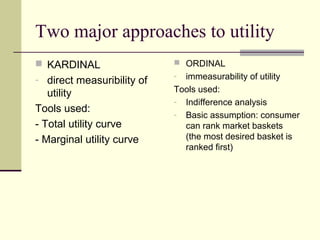
Two major approaches to utility
 KARDINAL                   ORDINAL
                            - immeasurability of utility
- direct measuribility of
   utility                  Tools used:
                            - Indifference analysis
Tools used:                 - Basic assumption: consumer
- Total utility curve         can rank market baskets
- Marginal utility curve      (the most desired basket is
                              ranked first)
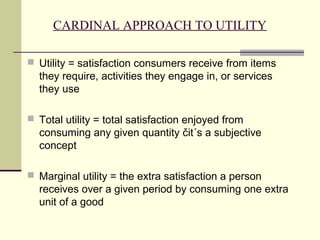
CARDINAL APPROACH TO UTILITY

 Utility = satisfaction consumers receive from items
  they require, activities they engage in, or services
  they use

 Total utility = total satisfaction enjoyed from
  consuming any given quantity čit´s a subjective
  concept

 Marginal utility = the extra satisfaction a person
  receives over a given period by consuming one extra
  unit of a good
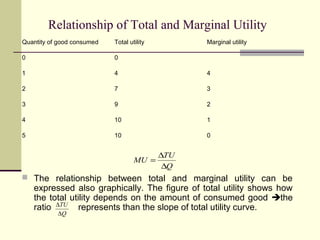
Relationship of Total and Marginal Utility
Quantity of good consumed   Total utility         Marginal utility

0                           0

1                           4                     4

2                           7                     3

3                           9                     2

4                           10                    1

5                           10                    0


                                            ∆TU
                                    MU =
                                             ∆Q
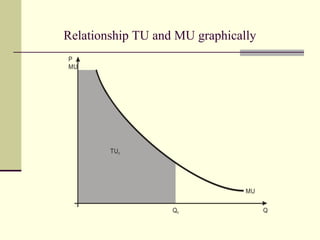
 The relationship between total and marginal utility can be
    expressed also graphically. The figure of total utility shows how
    the total utility depends on the amount of consumed good the
    ratio ∆TU represents than the slope of total utility curve.
           ∆Q
Relationship TU and MU graphically
P
MU


        TU0


                                MU

                   Q0                Q
1. Gossen´s law
 The law of diminishing marginal utility – the amount of
      extra or marginal utility declines as a person
      consumes more and more of a good
 čUtility tends to increase as you consume more of a
      good, however, according to the law of diminishing
      marginal utility, your total utility will grow at a slower
      and slower rate
Consumer Equilibrium
 As a rational consumer, you presumably seek to obtain
  the greatest possible utility from your limited monthly
  income.

 On condition we don´t have to pay anything for a good,
  the equlibrium level of consumption of that good would
  be the amount that brings us the highest total utility.

 Equilibrium amount of a good will be bought than, as
  long as the marginal utility equals the price of that
  product:
                      MU = P
2. Gossen´s law

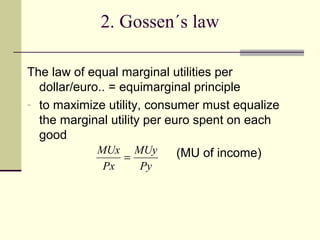
The law of equal marginal utilities per
  dollar/euro.. = equimarginal principle
- to maximize utility, consumer must equalize
  the marginal utility per euro spent on each
  good
             MUx MUy         (MU of income)
                   =
             Px     Py
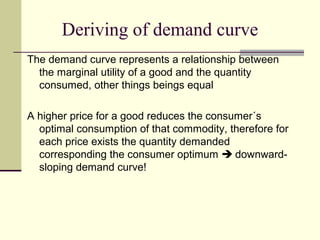
Deriving of demand curve
The demand curve represents a relationship between
  the marginal utility of a good and the quantity
  consumed, other things beings equal

A higher price for a good reduces the consumer´s
  optimal consumption of that commodity, therefore for
  each price exists the quantity demanded
  corresponding the consumer optimum  downward-
  sloping demand curve!
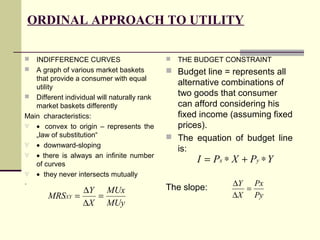
ORDINAL APPROACH TO UTILITY

  INDIFFERENCE CURVES                          THE BUDGET CONSTRAINT
 A graph of various market baskets           Budget line = represents all
   that provide a consumer with equal
   utility
                                               alternative combinations of
 Different individual will naturally rank     two goods that consumer
   market baskets differently                  can afford considering his
Main characteristics:                          fixed income (assuming fixed
∀ • convex to origin – represents the          prices).
   „law of substitution“                      The equation of budget line
∀ • downward-sloping
                                               is:
∀ • there is always an infinite number
   of curves
                                                     I = Px ∗ X + Py ∗ Y
∀ • they never intersects mutually
•                                                            ∆Y Px
                  ∆Y MUx                     The slope:        =
       MRSXY =      =                                        ∆X Py
                  ∆X MUy
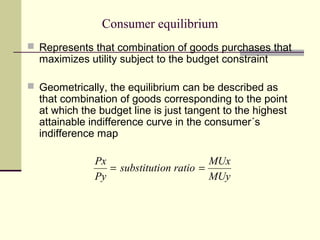
Consumer equilibrium
 Represents that combination of goods purchases that
  maximizes utility subject to the budget constraint

 Geometrically, the equilibrium can be described as
  that combination of goods corresponding to the point
  at which the budget line is just tangent to the highest
  attainable indifference curve in the consumer´s
  indifference map

              Px                        MUx
                 = substitution ratio =
              Py                        MUy
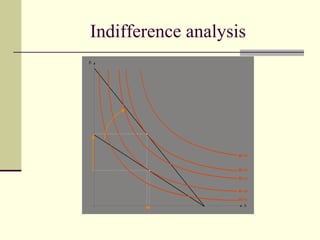
Indifference analysis
B


                   TU=7


                   TU=5

                   TU=4


                   TU=2

                   TU=1
                     A
DERIVING THE DEMAND CURVE


   Kept other things constant, when the price of X has increased, it will mean that
    the less of that product you can afford with your income

   čgraphically it means the change of the budget line slope – it becomes steeper
    and therefore will touch different indifference curve (representing lower level of
    utility)  each price corresponds other optimal point and therefore different
    quantity of good demanded, in that way we can construct the demand curve
    (individual)
CONSUMER SURPLUS


= the gap between the total utility of a good and its total
   market value
 The surplus arises because we „receive more than
   we pay for“, it is rooted in the law of diminishing
   marginal utility
 we pay for each unit what the last unit is worth – but
   by the law of diminishing marginal utility the earlier
   units are worth more to us than the last thus, we
   enjoy a surplus of utility on each of these earlier units
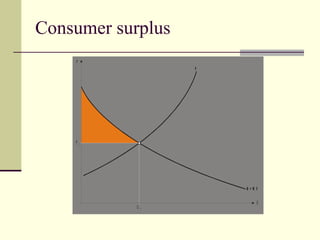
Consumer surplus
    P
                         S


    P0

                    RZ


                             D =M U

                                  Q
            Q   0
Tasks:

1. Can be TU positive and MU negative at the same time? Draw graphs and explain.


2. Knowing following dates:
a) Draw the graphs of TU and MU curves.
b) Calculate, how high consumer surplus you´ll get, when the market price of good is 8
       Eur and decide, how many units you will consume.
         Q        1       2       3        4       5       6        7
         TU       20      36      48       56      60      60       58


3. Px = 120 Eur and Py = 80 Eur. Graphically show, what will happen when Px has
       increased by 18 Eur and at the same time Py by 12 Eur. Use the tools of
       indifference analysis.

4. Your function of TU is: TU = 10X – X2 . (where X is quantity of good consumed per
       week).
a) Write the equation of MU and decide, at what level of consumption start TU decrease?
b) Derive and draw TU and MU curves.
c) Assume Px = 6 Eur. By what level of consumption of good X will household maximize
       its utility, knowing, that the ratio MU/P for all other goods = 1)?

Consumer choice

  • 1.
    CONSUMER CHOICE The Theory of Demand
  • 2.
    Two major approachesto utility  KARDINAL  ORDINAL - immeasurability of utility - direct measuribility of utility Tools used: - Indifference analysis Tools used: - Basic assumption: consumer - Total utility curve can rank market baskets - Marginal utility curve (the most desired basket is ranked first)
  • 3.
    CARDINAL APPROACH TOUTILITY  Utility = satisfaction consumers receive from items they require, activities they engage in, or services they use  Total utility = total satisfaction enjoyed from consuming any given quantity čit´s a subjective concept  Marginal utility = the extra satisfaction a person receives over a given period by consuming one extra unit of a good
  • 4.
    Relationship of Totaland Marginal Utility Quantity of good consumed Total utility Marginal utility 0 0 1 4 4 2 7 3 3 9 2 4 10 1 5 10 0 ∆TU MU = ∆Q  The relationship between total and marginal utility can be expressed also graphically. The figure of total utility shows how the total utility depends on the amount of consumed good the ratio ∆TU represents than the slope of total utility curve. ∆Q
  • 5.
    Relationship TU andMU graphically P MU TU0 MU Q0 Q
  • 6.
    1. Gossen´s law The law of diminishing marginal utility – the amount of extra or marginal utility declines as a person consumes more and more of a good čUtility tends to increase as you consume more of a good, however, according to the law of diminishing marginal utility, your total utility will grow at a slower and slower rate
  • 7.
    Consumer Equilibrium  Asa rational consumer, you presumably seek to obtain the greatest possible utility from your limited monthly income.  On condition we don´t have to pay anything for a good, the equlibrium level of consumption of that good would be the amount that brings us the highest total utility.  Equilibrium amount of a good will be bought than, as long as the marginal utility equals the price of that product:  MU = P
  • 8.
    2. Gossen´s law Thelaw of equal marginal utilities per dollar/euro.. = equimarginal principle - to maximize utility, consumer must equalize the marginal utility per euro spent on each good MUx MUy (MU of income) = Px Py
  • 9.
    Deriving of demandcurve The demand curve represents a relationship between the marginal utility of a good and the quantity consumed, other things beings equal A higher price for a good reduces the consumer´s optimal consumption of that commodity, therefore for each price exists the quantity demanded corresponding the consumer optimum  downward- sloping demand curve!
  • 10.
    ORDINAL APPROACH TOUTILITY  INDIFFERENCE CURVES  THE BUDGET CONSTRAINT  A graph of various market baskets  Budget line = represents all that provide a consumer with equal utility alternative combinations of  Different individual will naturally rank two goods that consumer market baskets differently can afford considering his Main characteristics: fixed income (assuming fixed ∀ • convex to origin – represents the prices). „law of substitution“  The equation of budget line ∀ • downward-sloping is: ∀ • there is always an infinite number of curves I = Px ∗ X + Py ∗ Y ∀ • they never intersects mutually • ∆Y Px ∆Y MUx The slope: = MRSXY = = ∆X Py ∆X MUy
  • 11.
    Consumer equilibrium  Representsthat combination of goods purchases that maximizes utility subject to the budget constraint  Geometrically, the equilibrium can be described as that combination of goods corresponding to the point at which the budget line is just tangent to the highest attainable indifference curve in the consumer´s indifference map Px MUx = substitution ratio = Py MUy
  • 12.
    Indifference analysis B TU=7 TU=5 TU=4 TU=2 TU=1 A
  • 13.
    DERIVING THE DEMANDCURVE  Kept other things constant, when the price of X has increased, it will mean that the less of that product you can afford with your income  čgraphically it means the change of the budget line slope – it becomes steeper and therefore will touch different indifference curve (representing lower level of utility)  each price corresponds other optimal point and therefore different quantity of good demanded, in that way we can construct the demand curve (individual)
  • 14.
    CONSUMER SURPLUS = thegap between the total utility of a good and its total market value  The surplus arises because we „receive more than we pay for“, it is rooted in the law of diminishing marginal utility  we pay for each unit what the last unit is worth – but by the law of diminishing marginal utility the earlier units are worth more to us than the last thus, we enjoy a surplus of utility on each of these earlier units
  • 15.
    Consumer surplus P S P0 RZ D =M U Q Q 0
  • 16.
    Tasks: 1. Can beTU positive and MU negative at the same time? Draw graphs and explain. 2. Knowing following dates: a) Draw the graphs of TU and MU curves. b) Calculate, how high consumer surplus you´ll get, when the market price of good is 8 Eur and decide, how many units you will consume. Q 1 2 3 4 5 6 7 TU 20 36 48 56 60 60 58 3. Px = 120 Eur and Py = 80 Eur. Graphically show, what will happen when Px has increased by 18 Eur and at the same time Py by 12 Eur. Use the tools of indifference analysis. 4. Your function of TU is: TU = 10X – X2 . (where X is quantity of good consumed per week). a) Write the equation of MU and decide, at what level of consumption start TU decrease? b) Derive and draw TU and MU curves. c) Assume Px = 6 Eur. By what level of consumption of good X will household maximize its utility, knowing, that the ratio MU/P for all other goods = 1)?