Chapter 3 Consumer Behavior
Topics to be Discussed Consumer Preferences Budget Constraints Consumer Choice Revealed Preferences
Topics to be Discussed Marginal Utility and Consumer Choices Cost-of-Living Indexes
Consumer Behavior Two applications that illustrate the importance of the economic theory of consumer behavior are: Apple-Cinnamon Cheerios The Food Stamp Program.
Consumer Behavior General Mills had to determine how high a price to charge for Apple-Cinnamon Cheerios before it went to the market.
Consumer Behavior When the food stamp program was established in the early 1960s, the designers had to determine to what extent the food stamps would provide people with more food and not just simply subsidize the food they would have bought anyway.
Consumer Behavior These two problems require an understanding of the economic theory of consumer behavior.
Consumer Behavior There are three steps involved in the study of consumer behavior. 1)  We will study  consumer preferences . To describe how and why people prefer one good to another.
Consumer Behavior There are three steps involved in the study of consumer behavior. 2) Then we will turn to  budget  constraints . People have limited incomes.
Consumer Behavior There are three steps involved in the study of consumer behavior. 3)  Finally, we will combine consumer  preferences and budget constraints  to determine  consumer choices . What combination of goods will consumers buy to maximize their satisfaction?
Consumer Preferences A  market basket  is a collection of one or more commodities. One market basket may be preferred over another market basket containing a different combination of goods. Market Baskets
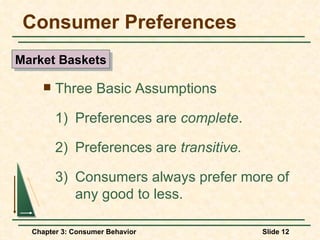
Consumer Preferences Three Basic Assumptions  1)  Preferences are  complete . 2)  Preferences are  transitive. 3)  Consumers always prefer more of  any good to less. Market Baskets
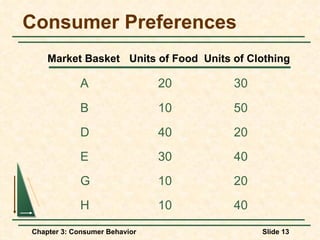
Consumer Preferences A 20 30 B 10 50 D 40 20 E 30 40 G 10 20 H 10 40 Market Basket Units of Food   Units of Clothing
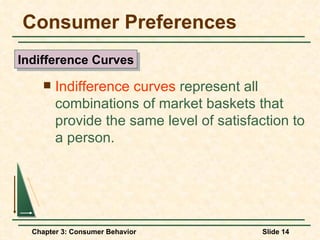
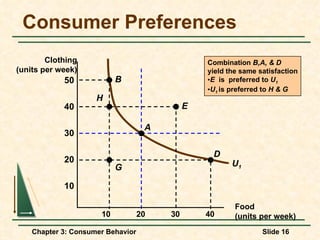
Consumer Preferences Indifference curves  represent all combinations of market baskets that provide the same level of satisfaction to a person. Indifference Curves
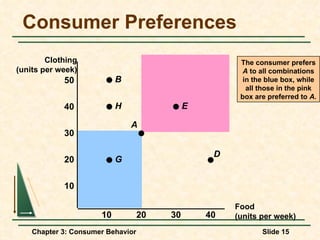
Consumer Preferences Food (units per week) 10 20 30 40 10 20 30 40 Clothing (units per week) 50 The consumer prefers A  to all combinations in the blue box, while all those in the pink box are preferred to  A. G A E H B D
Consumer Preferences Food (units per week) 10 20 30 40 10 20 30 40 Clothing (units per week) 50 U 1 Combination  B,A, & D yield the same satisfaction E  is  preferred to  U 1 U 1   is preferred to  H & G G D A E H B
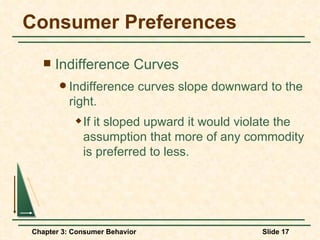
Consumer Preferences Indifference Curves Indifference curves slope downward to the right. If it sloped upward it would violate the assumption that more of any commodity is preferred to less.
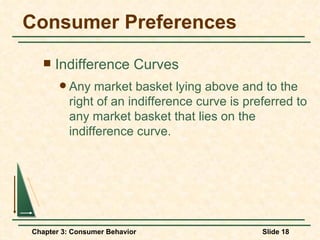
Consumer Preferences Indifference Curves Any market basket lying above and to the right of an indifference curve is preferred to any market basket that lies on the indifference curve.
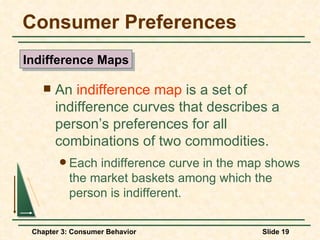
Consumer Preferences An  indifference map  is a set of indifference curves that describes a person’s preferences for all combinations of two commodities. Each indifference curve in the map shows the market baskets among which the person is indifferent. Indifference Maps
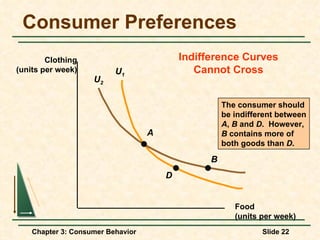
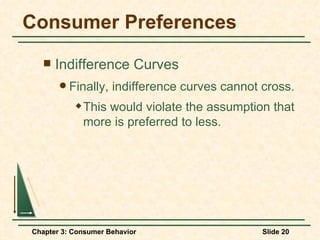
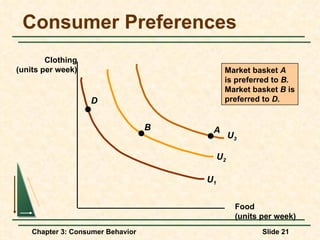
Consumer Preferences Indifference Curves Finally, indifference curves cannot cross. This would violate the assumption that more is preferred to less.
Consumer Preferences Food (units per week) Clothing (units per week) U 2 U 3 U 1 A B D Market basket  A is preferred to  B. Market basket  B  is preferred to  D.
Consumer Preferences Food (units per week) Clothing (units per week) Indifference Curves Cannot Cross U 1 U 2 A D B The consumer should be indifferent between A ,  B  and  D .  However, B  contains more of both goods than  D .
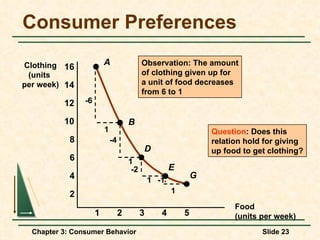
Consumer Preferences Food (units per week) Clothing (units  per week) 2 3 4 5 1 2 4 6 8 10 12 14 16 Question : Does this relation hold for giving up food to get clothing? A B D E G -1 -6 1 1 -4 -2 1 1 Observation: The amount of clothing given up for  a unit of food decreases from 6 to 1
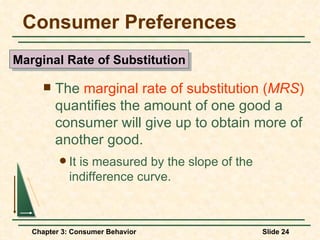
Consumer Preferences The  marginal rate of substitution ( MRS )  quantifies the amount of one good a consumer will give up to obtain more of another good. It is measured by the slope of the indifference curve. Marginal Rate of Substitution
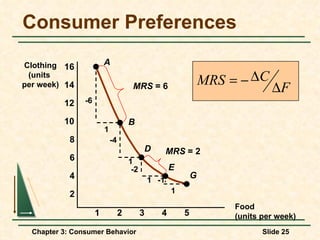
Consumer Preferences Food (units per week) Clothing (units  per week) 2 3 4 5 1 2 4 6 8 10 12 14 16 A B D E G -6 1 1 1 1 -4 -2 -1 MRS  = 6 MRS  = 2
Consumer Preferences We will now add a fourth assumption regarding consumer preference: Along an indifference curve there is a  diminishing marginal rate of substitution. Note the  MRS  for  AB  was 6, while that for  DE  was 2. Marginal Rate of Substitution
Consumer Preferences Question What are the first three assumptions? Marginal Rate of Substitution
Consumer Preferences Indifference curves are convex because as more of one good is consumed, a consumer would prefer to give up fewer units of a second good to get additional units of the first one. Consumers prefer a balanced market basket Marginal Rate of Substitution
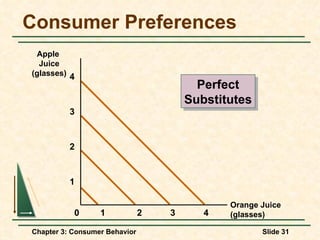
Consumer Preferences Perfect Substitutes and Perfect Complements Two goods are perfect substitutes when the marginal rate of substitution of one good for the other is constant. Marginal Rate of Substitution
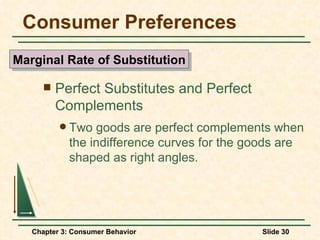
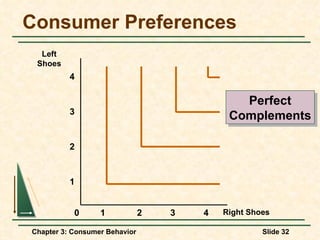
Consumer Preferences Perfect Substitutes and Perfect Complements Two goods are perfect complements when the indifference curves for the goods are shaped as right angles. Marginal Rate of Substitution
Consumer Preferences Orange Juice (glasses) Apple  Juice (glasses) 2 3 4 1 1 2 3 4 0 Perfect Substitutes
Consumer Preferences Right Shoes Left Shoes 2 3 4 1 1 2 3 4 0 Perfect Complements
Consumer Preferences BADS Things for which less is preferred to more Examples Air pollution Asbestos
Consumer Preferences What Do You Think? How can we account for Bads in the analysis of consumer preferences?
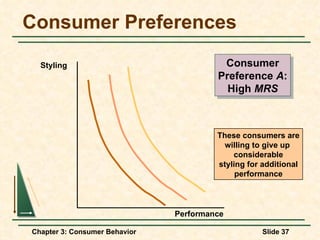
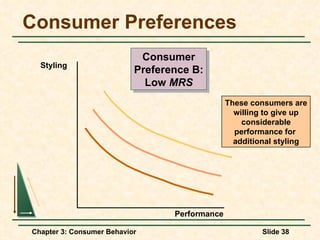
Consumer Preferences Automobile executives must regularly decide  when to introduce new models and how much money to invest in restyling. Designing New Automobiles ( I )
Consumer Preferences An analysis of consumer preferences would help to determine when and if car companies should change the styling of their cars. Designing New Automobiles ( I )
Consumer Preferences Styling Performance Consumer Preference  A : High  MRS These consumers are willing to give up  considerable styling for additional performance
Consumer Preferences Styling Performance Consumer Preference B: Low  MRS These consumers are willing to give up considerable performance for  additional styling
Consumer Preferences What Do You Think? How can we determine the consumers preference? Designing New Automobiles ( I )
Consumer Preferences A recent study of automobile demand in the United States shows that over the past two decades most consumers have preferred styling over performance. Designing New Automobiles ( I )
Consumer Preferences Growth of Japanese Imports 1970’s and 1980’s 15% of domestic cars underwent a style change each year This compares to 23% for imports Designing New Automobiles ( I )
Consumer Preferences Utility Utility:  Numerical score representing the satisfaction that a consumer gets from a given market basket.
Consumer Preferences Utility If buying 3 copies of  Microeconomics  makes you happier than buying one shirt, then we say that the books give you more utility than the shirt.
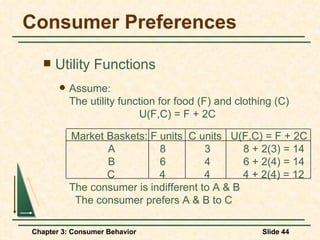
Consumer Preferences Utility Functions Assume: The utility function for food (F) and clothing (C)  U(F,C) = F + 2C Market Baskets: F units  C units  U(F,C) = F + 2C   A  8  3  8 + 2(3) = 14   B  6  4  6 + 2(4) = 14  C  4  4  4 + 2(4) = 12 The consumer is indifferent to A & B    The consumer prefers A & B to C
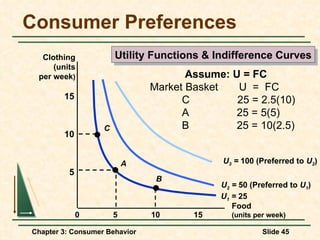
Consumer Preferences Food (units per week) 10 15 5 5 10 15 0 Clothing (units per week ) Utility Functions & Indifference Curves U 1  =  25 U 2  =  50 (Preferred to  U 1 ) U 3  =  100 (Preferred to  U 2 ) A B C Assume: U = FC Market Basket  U  =  FC C  25 = 2.5(10) A  25 = 5(5) B  25 = 10(2.5)
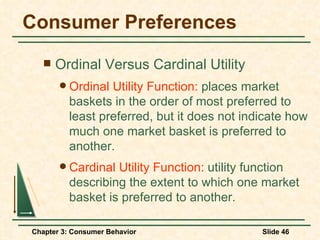
Consumer Preferences Ordinal Versus Cardinal Utility Ordinal Utility Function:  places market baskets in the order of most preferred to least preferred, but it does not indicate how much one market basket is preferred to another. Cardinal Utility Function:  utility function describing the extent to which one market basket is preferred to another.
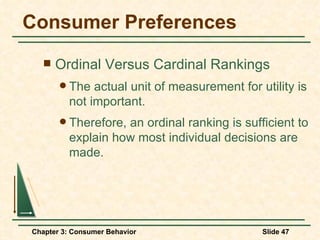
Consumer Preferences Ordinal Versus Cardinal Rankings The actual unit of measurement for utility is not important. Therefore, an ordinal ranking is sufficient to explain how most individual decisions are made.
Budget Constraints Preferences do not explain all of consumer behavior. Budget constraints  also limit an individual’s ability to consume in light of the prices they must pay for various goods and services.
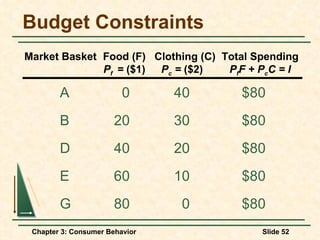
Budget Constraints The Budget Line The  budget line   indicates all combinations of two commodities for which total money spent equals total income.
Budget Constraints The Budget Line Let F equal the amount of food purchased, and C is the amount of clothing. Price of food =  P f   and price of  clothing =  P c Then  P f  F  is the amount of money spent on food, and  P c   C  is the amount of money spent on clothing.
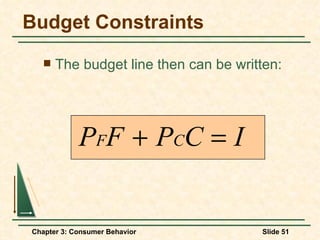
Budget Constraints The budget line then can be written:
Budget Constraints A 0 40 $80 B 20 30 $80 D 40 20 $80 E 60 10 $80 G 80 0 $80 Market Basket Food (F)   Clothing (C) Total Spending P f  =  ($1) P c  =  ($2) P f F + P c C = I
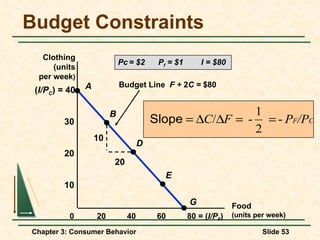
Budget Constraints ( I/P C ) = 40 Food (units per week) 40 60 80 = ( I/P F ) 20 10 20 30 0 Clothing (units per week ) Pc   = $2  P f  = $1  I = $80 Budget Line  F +  2 C =  $80 10 20 A B D E G
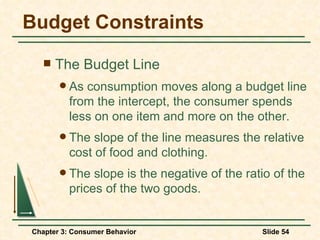
Budget Constraints The Budget Line As consumption moves along a budget line from the intercept, the consumer spends less on one item and more on the other. The slope of the line measures the relative cost of food and clothing. The slope is the negative of the ratio of the prices of the two goods.
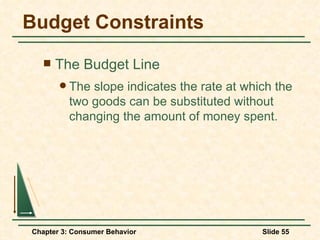
Budget Constraints The Budget Line The slope indicates the rate at which the two goods can be substituted without changing the amount of money spent.
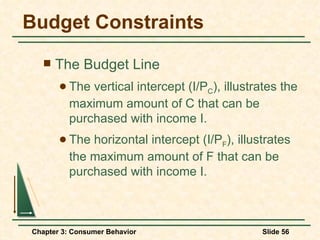
Budget Constraints The Budget Line The vertical intercept (I/P C ), illustrates the maximum amount of C that can be purchased with income I. The horizontal intercept (I/P F ), illustrates the maximum amount of F that can be purchased with income I.
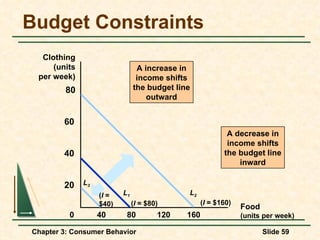
Budget Constraints The Effects of Changes in Income and Prices Income Changes An increase in income causes the budget line to shift outward, parallel to the original line (holding prices constant).
Budget Constraints The Effects of Changes in Income and Prices Income Changes A decrease in income causes the budget line to shift inward, parallel to the original line (holding prices constant).
Budget Constraints Food (units per week) Clothing (units per week) 80 120 160 40 20 40 60 80 0 A increase in income shifts the budget line outward ( I  = $160) L 2 ( I  = $80) L 1 L 3 ( I  = $40) A decrease in income shifts the budget line inward
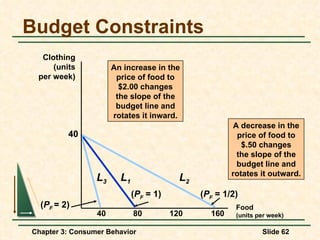
Budget Constraints The Effects of Changes in Income and Prices Price Changes If the price of one good increases, the budget line shifts inward, pivoting from the other good’s intercept.
Budget Constraints The Effects of Changes in Income and Prices Price Changes If the price of one good decreases, the budget line shifts outward, pivoting from the other good’s intercept.
Budget Constraints Food (units per week) Clothing (units per week) 80 120 160 40 40 ( P F  = 1) L 1 An increase in the price of food to $2.00 changes the slope of the budget line and rotates it inward. L 3 ( P F  = 2) ( P F  = 1/2) L 2 A decrease in the price of food to $.50 changes the slope of the budget line and rotates it outward.
Budget Constraints The Effects of Changes in Income and Prices Price Changes If the two goods increase in price, but the  ratio  of the two prices is unchanged, the slope will not change.
Budget Constraints The Effects of Changes in Income and Prices Price Changes However, the budget line will shift inward to a point parallel to the original budget line.
Budget Constraints The Effects of Changes in Income and Prices Price Changes If the two goods decrease in price, but the  ratio  of the two prices is unchanged, the slope will not change.
Budget Constraints The Effects of Changes in Income and Prices Price Changes However, the budget line will shift outward to a point parallel to the original budget line.
Consumer Choice Consumers choose a combination of goods that will maximize the satisfaction they can achieve, given the limited budget available to them.
Consumer Choice The maximizing market basket must satisfy two conditions: 1)  It must be located on the budget line. 2)  Must give the consumer the most  preferred  combination of goods and  services.
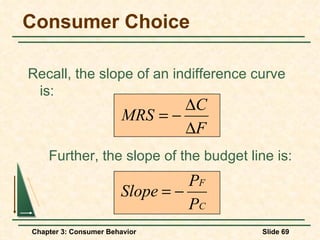
Recall, the slope of an indifference curve is: Consumer Choice Further, the slope of the budget line is:
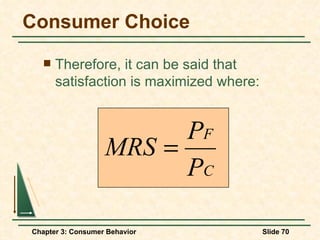
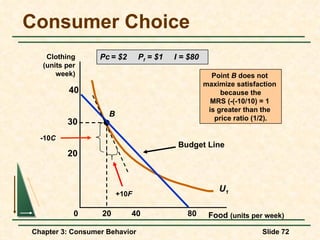
Consumer Choice Therefore, it can be said that satisfaction is maximized where:
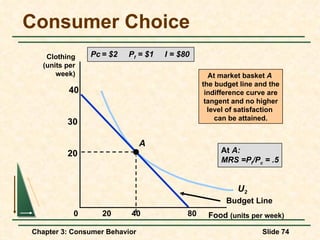
Consumer Choice It can be said that satisfaction is maximized when  marginal rate of substitution (of F and C) is equal to the ratio of the prices (of F and C).
Consumer Choice Food  (units per week) Clothing (units per week) 40 80 20 20 30 40 0 U 1 B Budget Line Pc   = $2  P f  = $1  I = $80 Point  B  does not  maximize satisfaction  because the MRS (-(-10/10) = 1  is greater than the  price ratio (1/2). -10 C +10 F
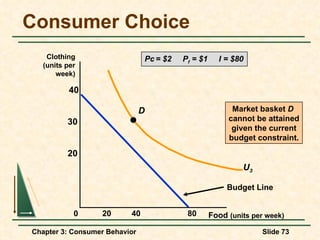
Consumer Choice Pc   = $2  P f  = $1  I = $80 Food  (units per week) Clothing (units per week) 40 80 20 20 30 40 0 Budget Line U 3 D Market basket  D   cannot be attained given the current budget constraint.
Consumer Choice Pc   = $2  P f  = $1  I = $80 Food  (units per week) Clothing (units per week) 40 80 20 20 30 40 0 U 2 Budget Line A At market basket  A   the budget line and the indifference curve are tangent and no higher level of satisfaction  can be attained. At  A: MRS =P f /P c  = .5
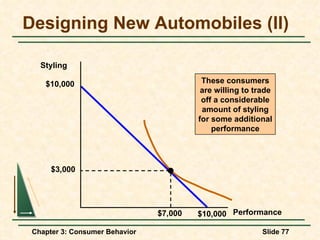
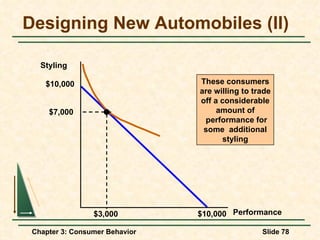
Consumer Choice Consider two groups of consumers, each wishing to spend $10,000 on the styling and performance of cars. Each group has different preferences. Designing New Automobiles ( II )
Consumer Choice By finding the point of tangency between a group’s indifference curve and the budget constraint auto companies can design a production and marketing plan. Designing New Automobiles ( II )
Designing New Automobiles (II) Styling Performance $10,000 $10,000 $3,000 $7,000 These consumers are willing to trade off a considerable amount of styling for some additional performance
Designing New Automobiles (II) Styling $10,000 $10,000 Performance $3,000 These consumers are willing to trade off a considerable amount of performance for some  additional styling $7,000
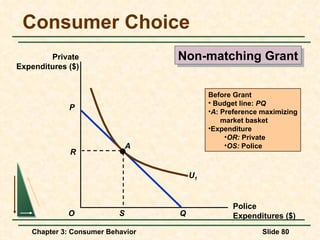
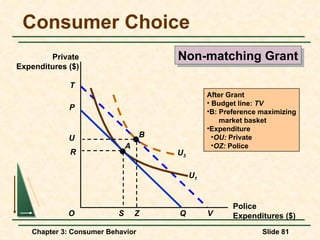
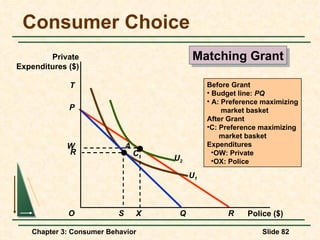
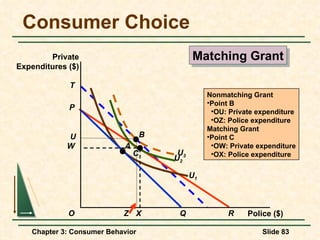
Consumer Choice Choosing between a non-matching and matching grant to fund police expenditures Decision Making & Public Policy
Consumer Choice Non-matching Grant Police Expenditures ($) Private Expenditures ($) O P Q U 1 A Before Grant Budget line:  PQ A : Preference maximizing market basket  Expenditure OR:  Private OS:  Police R S
Consumer Choice R Non-matching Grant P Police Expenditures ($) Private Expenditures ($) O S Q A V T U 3 U 1 After Grant Budget line:  TV B: Preference maximizing market basket  Expenditure OU:  Private OZ:  Police B U Z
Consumer Choice T Matching Grant Police ($) Private Expenditures ($) O Q S R A P R U 2 U 1 Before Grant Budget line:  PQ A: Preference maximizing market basket  After Grant C: Preference maximizing market basket Expenditures OW: Private OX: Police C X W
Consumer Choice T Nonmatching Grant Point B OU: Private expenditure OZ: Police expenditure Matching Grant Point C OW: Private expenditure OX: Police expenditure W X Matching Grant P Police ($) Private Expenditures ($) O Q A U 2 C R U 3 U 1 B U Z
Consumer Choice A  corner solution  exists if a consumer buys in extremes, and buys all of one category of good and none of another.  This exists where the indifference curves are tangent to the horizontal and vertical axis. MRS  is  not  equal to  P A /P B A Corner Solution
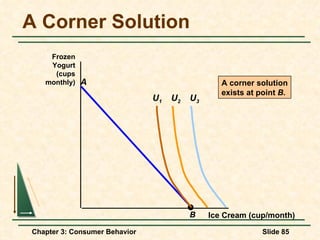
A Corner Solution Ice Cream (cup/month) Frozen Yogurt (cups monthly) B A U 2 U 3 U 1 A corner solution exists at point  B.
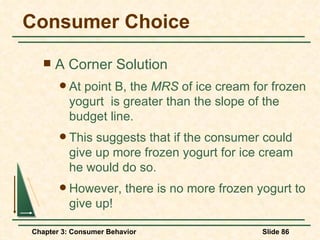
Consumer Choice A Corner Solution At point B, the  MRS  of ice cream for frozen yogurt  is greater than the slope of the budget line. This suggests that if the consumer could give up more frozen yogurt for ice cream he would do so. However, there is no more frozen yogurt to give up!
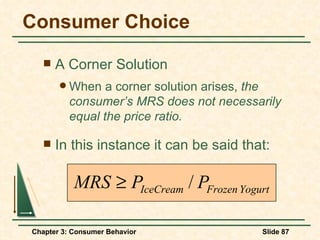
Consumer Choice A Corner Solution When a corner solution arises,  the consumer’s MRS does not necessarily equal the price ratio. In this instance it can be said that:
Consumer Choice A Corner Solution If the MRS is, in fact, significantly greater than the price ratio, then a small decrease in the price of frozen yogurt  will not  alter the consumer’s market basket.
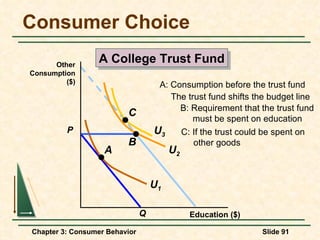
Consumer Choice Suppose Jane Doe’s parents set up a trust fund for her college education. Originally, the money must be used for education. A College Trust Fund
Consumer Choice If part of the money could be used for the purchase of other goods, her consumption preferences change. A College Trust Fund
Consumer Choice Education ($) Other Consumption ($) A College Trust Fund The trust fund shifts the budget line P Q U 2 A U 1 A: Consumption before the trust fund B B: Requirement that the trust fund  must be spent on education C U 3 C: If the trust could be spent on  other goods
Revealed Preferences If we know the choices a consumer has made, we can determine what her preferences are if we have information about a sufficient number of choices that are made when prices and incomes vary.
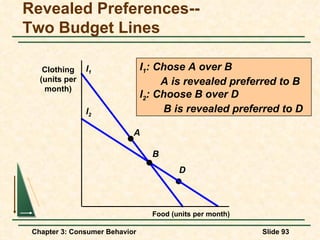
Revealed Preferences-- Two Budget Lines D l 1 A I 1 : Chose A over B A is revealed preferred to B l 2 : Choose B over D B is revealed preferred to D Food (units per month) Clothing (units per month) l 2 B
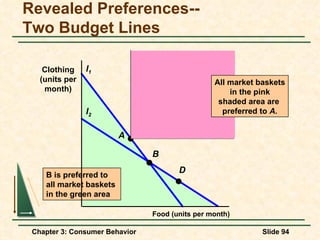
Revealed Preferences-- Two Budget Lines Food (units per month) Clothing (units per month) B is preferred to all market baskets  in the green area l 2 B l 1 D A All market baskets in the pink shaded area are  preferred to  A.
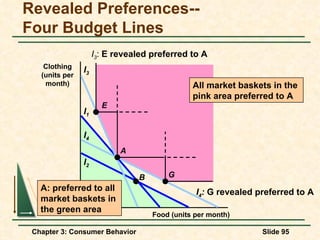
Revealed Preferences-- Four Budget Lines Food (units per month) Clothing (units per month) All market baskets in the  pink area preferred to A l 1 l 2 l 3 l 4 A: preferred to all market baskets in  the green area E B A G I 3 :  E revealed preferred to A   I 4 :  G revealed preferred to A
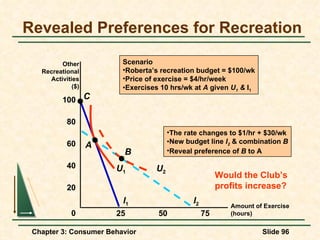
Revealed Preferences for Recreation Amount of Exercise  (hours) Other Recreational Activities ($) 0 25 50 75 20 40 60 80 100 Scenario Roberta’s recreation budget = $100/wk Price of exercise = $4/hr/week Exercises 10 hrs/wk at  A  given  U 1  &  I 1 Would the Club’s  profits increase? l 1 C l 2 U 2 B The rate changes to $1/hr + $30/wk New budget line  I 2  & combination  B Reveal preference of  B  to A U 1 A
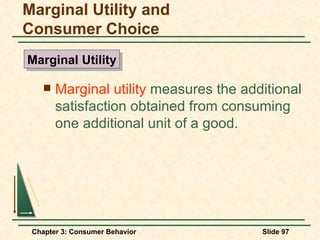
Marginal utility  measures the additional satisfaction obtained from consuming one additional unit of a good. Marginal Utility and Consumer Choice Marginal Utility
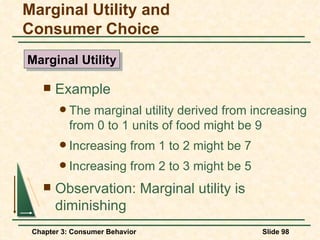
Example The marginal utility derived from increasing from 0 to 1 units of food might be 9 Increasing from 1 to 2 might be 7 Increasing from 2 to 3 might be 5 Observation: Marginal utility is diminishing Marginal Utility and Consumer Choice Marginal Utility
The  principle of diminishing marginal utility  states that as more and more of a good is consumed, consuming additional amounts will yield smaller and smaller additions to utility. Marginal Utility and Consumer Choice Diminishing Marginal Utility
Marginal Utility and the Indifference Curve If consumption moves along an indifference curve, the additional utility derived from an increase in the consumption one good, food (F),  must balance the loss of utility from the decrease in the consumption in the other good, clothing (C). Marginal Utility and Consumer Choice
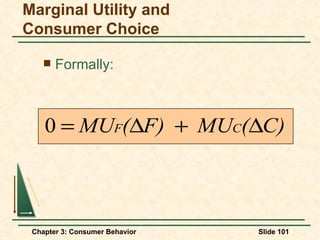
Formally: Marginal Utility and Consumer Choice
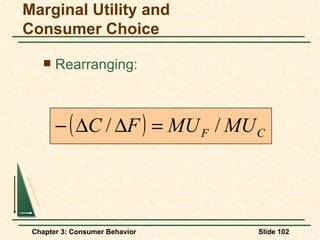
Rearranging:  Marginal Utility and Consumer Choice
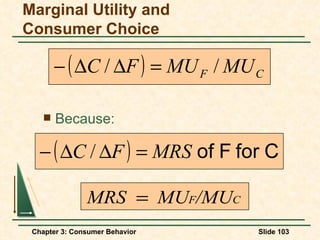
Because: Marginal Utility and Consumer Choice
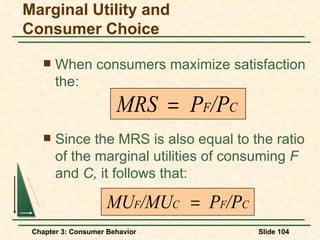
When consumers maximize satisfaction the: Marginal Utility and Consumer Choice Since the MRS is also equal to the ratio of the marginal utilities of consuming  F  and  C,  it follows that:
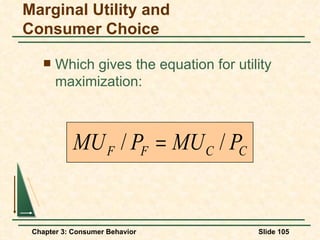
Which gives the equation for utility maximization: Marginal Utility and Consumer Choice
Total utility is maximized when the budget is allocated so that  the marginal utility per dollar of expenditure is the same for each good. This is referred to as the  equal marginal principle. Marginal Utility and Consumer Choice
In 1974 and again in 1979, the government imposed price controls on gasoline. This resulted in shortages and gasoline was rationed. Marginal Utility and Consumer Choice Gasoline Rationing
Nonprice rationing is an alternative to market rationing. Under one form everyone has an equal chance to purchase a rationed good. Gasoline is rationed by long lines at the gas pumps. Marginal Utility and Consumer Choice Gasoline Rationing
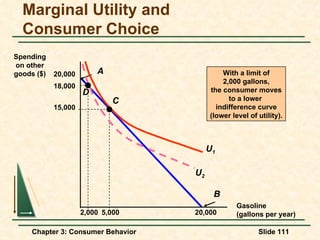
Rationing hurts some by limiting the amount of gasoline they can buy. This can be seen in the following model. It applies to a woman with an annual income of $20,000. Marginal Utility and Consumer Choice
The horizontal axis shows her annual consumption of gasoline at $1/gallon. The vertical axis shows her remaining income after purchasing gasoline. Marginal Utility and Consumer Choice
Marginal Utility and Consumer Choice Gasoline (gallons per year) Spending on other goods ($) 20,000 B 20,000 A 5,000 U 1 C 15,000 2,000 D With a limit of 2,000 gallons, the consumer moves to a lower  indifference curve (lower level of utility). 18,000 U 2
Cost-of-Living Indexes The CPI is calculated each year as the ratio of the cost of a typical bundle of consumer goods and services today in comparison to the cost during a base period.
Cost-of-Living Indexes What Do You Think? Does the CPI accurately reflect the cost of living for retirees? Is it appropriate to use the CPI as a cost-of-living index for other government programs, for private union pensions, and for other private wage agreements?
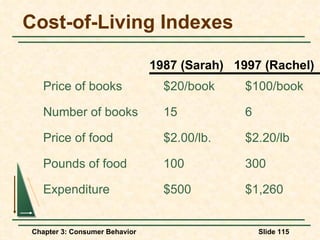
Cost-of-Living Indexes Example Two sisters, Rachel and Sarah, have identical preferences. Sarah began college in 1987 with a $500 discretionary budget.  In 1997, Rachel started college and her parents promised her a budget that was equivalent in purchasing power.
Cost-of-Living Indexes Price of books $20/book $100/book Number of books 15 6 Price of food $2.00/lb. $2.20/lb Pounds of food 100 300 Expenditure $500 $1,260 1987 (Sarah)  1997 (Rachel)
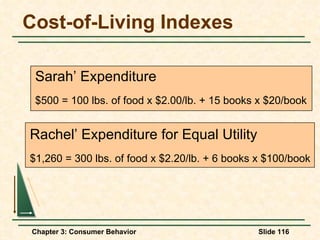
Cost-of-Living Indexes Rachel’ Expenditure for Equal Utility $1,260 = 300 lbs. of food x $2.20/lb. + 6 books x $100/book Sarah’ Expenditure $500 = 100 lbs. of food x $2.00/lb. + 15 books x $20/book
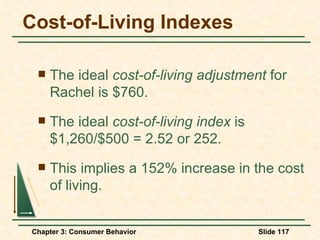
Cost-of-Living Indexes The ideal  cost-of-living adjustment  for Rachel is $760. The ideal  cost-of-living index  is $1,260/$500 = 2.52 or 252. This implies a 152% increase in the cost of living.
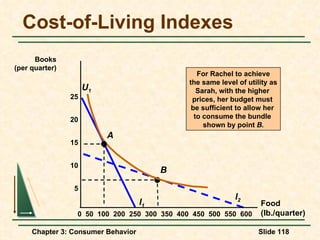
Cost-of-Living Indexes Food (lb./quarter) Books (per quarter) 450 25 20 15 10 5 0 600 50 100 200 250 300 350 400 550 500 For Rachel to achieve the same level of utility as Sarah, with the higher  prices, her budget must  be sufficient to allow her  to consume the bundle  shown by point  B. l 2 B l 1 U 1 A
Cost-of-Living Indexes The ideal cost of living index represents the cost of attaining a given level of utility at current (1997) prices relative to the cost of attaining the same utility at base (1987) prices.
Cost-of-Living Indexes To do this on an economy-wide basis would entail large amounts of information. Price indexes, like the CPI, use a fixed consumption bundle in the base period. Called a  Laspeyres price index
Cost-of-Living Indexes The Laspeyres index tells us: The amount of money at current year prices that an individual requires to purchase the bundle of goods and services that was chosen in the base year divided by the cost of purchasing the same bundle at base year prices. Laspeyres Index
Cost-of-Living Indexes Calculating Rachel’s Laspeyres cost of living index  Setting the quantities of goods in 1997 equal to what were bought by her sister, but setting their prices at their 1997 levels result in an expenditure of  $1,720 (100 x 2.20 + 15 x $100)
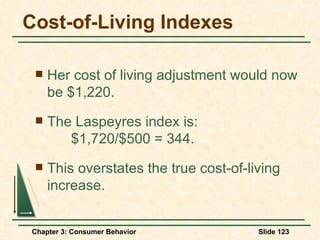
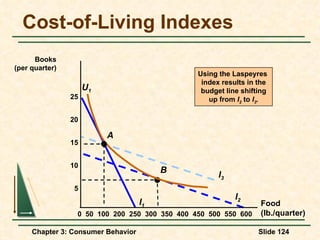
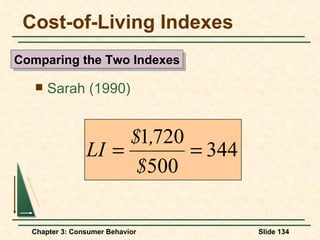
Cost-of-Living Indexes Her cost of living adjustment would now be $1,220. The Laspeyres index is:  $1,720/$500 = 344. This overstates the true cost-of-living increase.
Cost-of-Living Indexes l 2 Food (lb./quarter) Books (per quarter) 450 25 20 15 10 5 0 600 50 100 200 250 300 350 400 550 500 Using the Laspeyres  index results in the budget line shifting up from  I 2  to  I 3 . l 3 B l 1 U 1 A
Cost-of-Living Indexes What Do You Think? Does the Laspeyres index always overstate the true cost-of-living index?
Cost-of-Living Indexes Yes! The Laspeyres index assumes that consumers do not alter their consumption patterns as prices change.
Cost-of-Living Indexes Yes! By increasing purchases of those items that have become relatively cheaper, and decreasing purchases of the relatively more expensive items consumers can achieve the same level of utility without having to consume the same bundle of goods.
Cost-of-Living Indexes The Paasche Index Calculates the amount of money at current-year prices that an individual requires to purchase a current bundle of goods and services divided by the cost of purchasing the same bundle in the base year.
Cost-of-Living Indexes Both indexes involve ratios that involve today’s current year prices,  P Ft  and  P Ct . However, the Laspeyres index relies on base year consumption,  F b  and  C b . Whereas, the Paasche index relies on today’s current consumption,  F t  and  C t  . Comparing the Two Indexes
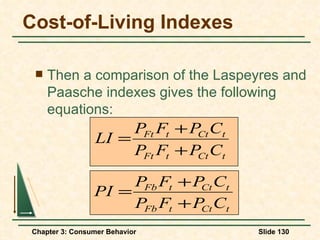
Cost-of-Living Indexes Then a comparison of the Laspeyres and Paasche indexes gives the following equations:
Cost-of-Living Indexes Suppose: Two goods: Food ( F ) and Clothing ( C ) Comparing the Two Indexes
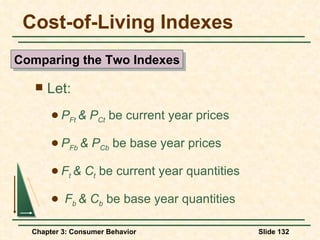
Cost-of-Living Indexes Let: P Ft  & P Ct   be current year prices P Fb  & P Cb   be base year prices F t  & C t   be current year quantities F b  & C b   be base year quantities Comparing the Two Indexes
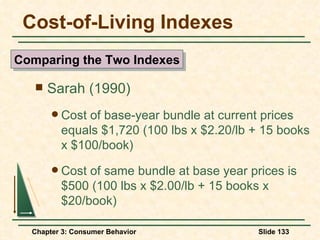
Cost-of-Living Indexes Sarah (1990) Cost of base-year bundle at current prices equals $1,720 (100 lbs x $2.20/lb + 15 books x $100/book) Cost of same bundle at base year prices is $500 (100 lbs x $2.00/lb + 15 books x $20/book) Comparing the Two Indexes
Cost-of-Living Indexes Sarah (1990) Comparing the Two Indexes
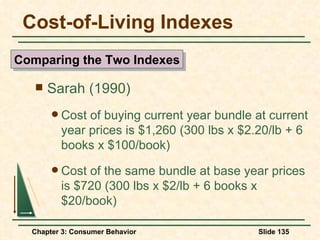
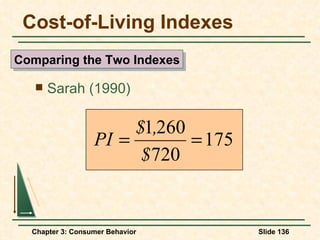
Cost-of-Living Indexes Sarah (1990) Cost of buying current year bundle at current year prices is $1,260 (300 lbs x $2.20/lb + 6 books x $100/book) Cost of the same bundle at base year prices is $720 (300 lbs x $2/lb + 6 books x $20/book) Comparing the Two Indexes
Cost-of-Living Indexes Sarah (1990) Comparing the Two Indexes
Cost-of-Living Indexes The Paasche index will understate the cost of living because it assumes that the individual will buy the current year bundle in the base year. The Paasche Index
Cost-of-Living Indexes In 1995, the government adopted the  chain-weighted  price index to deflate its measure of real GDP. Developed to overcome problems that arose when long-term comparisons of GDP were made using fixed-weight price indexes and prices were rapidly changing.
Cost-of-Living Indexes What Do You Think? What is the impact on the Federal budget of using the CPI (a Laspeyres index) to adjust social security and other programs for changes in the cost of living? The Bias of the CPI
Summary People behave rationally in an attempt to maximize satisfaction from a particular combination of goods and services. Consumer choice has two related parts: the consumer’s preferences and the budget line.
Summary Consumers make choices by comparing market baskets or bundles of commodities. Indifference curves are downward sloping and cannot intersect one another. Consumer preferences can be completely described by an indifference map.
Summary The marginal rate of substitution of  F  for  C  is the maximum amount of  C  that a person is willing to give up to obtain one additional unit of  F. Budget lines represent all combinations of goods for which consumers expend all their income.
Summary Consumers maximize satisfaction subject to budget constraints. The theory of revealed preference shows how the choices that individuals make when prices and income vary can be used to determine their preferences.
End of Chapter 3 Consumer Behavior

Chapter 3 Consumer Behaviour

  • 1.
  • 2.
    Topics to beDiscussed Consumer Preferences Budget Constraints Consumer Choice Revealed Preferences
  • 3.
    Topics to beDiscussed Marginal Utility and Consumer Choices Cost-of-Living Indexes
  • 4.
    Consumer Behavior Twoapplications that illustrate the importance of the economic theory of consumer behavior are: Apple-Cinnamon Cheerios The Food Stamp Program.
  • 5.
    Consumer Behavior GeneralMills had to determine how high a price to charge for Apple-Cinnamon Cheerios before it went to the market.
  • 6.
    Consumer Behavior Whenthe food stamp program was established in the early 1960s, the designers had to determine to what extent the food stamps would provide people with more food and not just simply subsidize the food they would have bought anyway.
  • 7.
    Consumer Behavior Thesetwo problems require an understanding of the economic theory of consumer behavior.
  • 8.
    Consumer Behavior Thereare three steps involved in the study of consumer behavior. 1) We will study consumer preferences . To describe how and why people prefer one good to another.
  • 9.
    Consumer Behavior Thereare three steps involved in the study of consumer behavior. 2) Then we will turn to budget constraints . People have limited incomes.
  • 10.
    Consumer Behavior Thereare three steps involved in the study of consumer behavior. 3) Finally, we will combine consumer preferences and budget constraints to determine consumer choices . What combination of goods will consumers buy to maximize their satisfaction?
  • 11.
    Consumer Preferences A market basket is a collection of one or more commodities. One market basket may be preferred over another market basket containing a different combination of goods. Market Baskets
  • 12.
    Consumer Preferences ThreeBasic Assumptions 1) Preferences are complete . 2) Preferences are transitive. 3) Consumers always prefer more of any good to less. Market Baskets
  • 13.
    Consumer Preferences A20 30 B 10 50 D 40 20 E 30 40 G 10 20 H 10 40 Market Basket Units of Food Units of Clothing
  • 14.
    Consumer Preferences Indifferencecurves represent all combinations of market baskets that provide the same level of satisfaction to a person. Indifference Curves
  • 15.
    Consumer Preferences Food(units per week) 10 20 30 40 10 20 30 40 Clothing (units per week) 50 The consumer prefers A to all combinations in the blue box, while all those in the pink box are preferred to A. G A E H B D
  • 16.
    Consumer Preferences Food(units per week) 10 20 30 40 10 20 30 40 Clothing (units per week) 50 U 1 Combination B,A, & D yield the same satisfaction E is preferred to U 1 U 1 is preferred to H & G G D A E H B
  • 17.
    Consumer Preferences IndifferenceCurves Indifference curves slope downward to the right. If it sloped upward it would violate the assumption that more of any commodity is preferred to less.
  • 18.
    Consumer Preferences IndifferenceCurves Any market basket lying above and to the right of an indifference curve is preferred to any market basket that lies on the indifference curve.
  • 19.
    Consumer Preferences An indifference map is a set of indifference curves that describes a person’s preferences for all combinations of two commodities. Each indifference curve in the map shows the market baskets among which the person is indifferent. Indifference Maps
  • 20.
    Consumer Preferences IndifferenceCurves Finally, indifference curves cannot cross. This would violate the assumption that more is preferred to less.
  • 21.
    Consumer Preferences Food(units per week) Clothing (units per week) U 2 U 3 U 1 A B D Market basket A is preferred to B. Market basket B is preferred to D.
  • 22.
    Consumer Preferences Food(units per week) Clothing (units per week) Indifference Curves Cannot Cross U 1 U 2 A D B The consumer should be indifferent between A , B and D . However, B contains more of both goods than D .
  • 23.
    Consumer Preferences Food(units per week) Clothing (units per week) 2 3 4 5 1 2 4 6 8 10 12 14 16 Question : Does this relation hold for giving up food to get clothing? A B D E G -1 -6 1 1 -4 -2 1 1 Observation: The amount of clothing given up for a unit of food decreases from 6 to 1
  • 24.
    Consumer Preferences The marginal rate of substitution ( MRS ) quantifies the amount of one good a consumer will give up to obtain more of another good. It is measured by the slope of the indifference curve. Marginal Rate of Substitution
  • 25.
    Consumer Preferences Food(units per week) Clothing (units per week) 2 3 4 5 1 2 4 6 8 10 12 14 16 A B D E G -6 1 1 1 1 -4 -2 -1 MRS = 6 MRS = 2
  • 26.
    Consumer Preferences Wewill now add a fourth assumption regarding consumer preference: Along an indifference curve there is a diminishing marginal rate of substitution. Note the MRS for AB was 6, while that for DE was 2. Marginal Rate of Substitution
  • 27.
    Consumer Preferences QuestionWhat are the first three assumptions? Marginal Rate of Substitution
  • 28.
    Consumer Preferences Indifferencecurves are convex because as more of one good is consumed, a consumer would prefer to give up fewer units of a second good to get additional units of the first one. Consumers prefer a balanced market basket Marginal Rate of Substitution
  • 29.
    Consumer Preferences PerfectSubstitutes and Perfect Complements Two goods are perfect substitutes when the marginal rate of substitution of one good for the other is constant. Marginal Rate of Substitution
  • 30.
    Consumer Preferences PerfectSubstitutes and Perfect Complements Two goods are perfect complements when the indifference curves for the goods are shaped as right angles. Marginal Rate of Substitution
  • 31.
    Consumer Preferences OrangeJuice (glasses) Apple Juice (glasses) 2 3 4 1 1 2 3 4 0 Perfect Substitutes
  • 32.
    Consumer Preferences RightShoes Left Shoes 2 3 4 1 1 2 3 4 0 Perfect Complements
  • 33.
    Consumer Preferences BADSThings for which less is preferred to more Examples Air pollution Asbestos
  • 34.
    Consumer Preferences WhatDo You Think? How can we account for Bads in the analysis of consumer preferences?
  • 35.
    Consumer Preferences Automobileexecutives must regularly decide when to introduce new models and how much money to invest in restyling. Designing New Automobiles ( I )
  • 36.
    Consumer Preferences Ananalysis of consumer preferences would help to determine when and if car companies should change the styling of their cars. Designing New Automobiles ( I )
  • 37.
    Consumer Preferences StylingPerformance Consumer Preference A : High MRS These consumers are willing to give up considerable styling for additional performance
  • 38.
    Consumer Preferences StylingPerformance Consumer Preference B: Low MRS These consumers are willing to give up considerable performance for additional styling
  • 39.
    Consumer Preferences WhatDo You Think? How can we determine the consumers preference? Designing New Automobiles ( I )
  • 40.
    Consumer Preferences Arecent study of automobile demand in the United States shows that over the past two decades most consumers have preferred styling over performance. Designing New Automobiles ( I )
  • 41.
    Consumer Preferences Growthof Japanese Imports 1970’s and 1980’s 15% of domestic cars underwent a style change each year This compares to 23% for imports Designing New Automobiles ( I )
  • 42.
    Consumer Preferences UtilityUtility: Numerical score representing the satisfaction that a consumer gets from a given market basket.
  • 43.
    Consumer Preferences UtilityIf buying 3 copies of Microeconomics makes you happier than buying one shirt, then we say that the books give you more utility than the shirt.
  • 44.
    Consumer Preferences UtilityFunctions Assume: The utility function for food (F) and clothing (C) U(F,C) = F + 2C Market Baskets: F units C units U(F,C) = F + 2C A 8 3 8 + 2(3) = 14 B 6 4 6 + 2(4) = 14 C 4 4 4 + 2(4) = 12 The consumer is indifferent to A & B The consumer prefers A & B to C
  • 45.
    Consumer Preferences Food(units per week) 10 15 5 5 10 15 0 Clothing (units per week ) Utility Functions & Indifference Curves U 1 = 25 U 2 = 50 (Preferred to U 1 ) U 3 = 100 (Preferred to U 2 ) A B C Assume: U = FC Market Basket U = FC C 25 = 2.5(10) A 25 = 5(5) B 25 = 10(2.5)
  • 46.
    Consumer Preferences OrdinalVersus Cardinal Utility Ordinal Utility Function: places market baskets in the order of most preferred to least preferred, but it does not indicate how much one market basket is preferred to another. Cardinal Utility Function: utility function describing the extent to which one market basket is preferred to another.
  • 47.
    Consumer Preferences OrdinalVersus Cardinal Rankings The actual unit of measurement for utility is not important. Therefore, an ordinal ranking is sufficient to explain how most individual decisions are made.
  • 48.
    Budget Constraints Preferencesdo not explain all of consumer behavior. Budget constraints also limit an individual’s ability to consume in light of the prices they must pay for various goods and services.
  • 49.
    Budget Constraints TheBudget Line The budget line indicates all combinations of two commodities for which total money spent equals total income.
  • 50.
    Budget Constraints TheBudget Line Let F equal the amount of food purchased, and C is the amount of clothing. Price of food = P f and price of clothing = P c Then P f F is the amount of money spent on food, and P c C is the amount of money spent on clothing.
  • 51.
    Budget Constraints Thebudget line then can be written:
  • 52.
    Budget Constraints A0 40 $80 B 20 30 $80 D 40 20 $80 E 60 10 $80 G 80 0 $80 Market Basket Food (F) Clothing (C) Total Spending P f = ($1) P c = ($2) P f F + P c C = I
  • 53.
    Budget Constraints (I/P C ) = 40 Food (units per week) 40 60 80 = ( I/P F ) 20 10 20 30 0 Clothing (units per week ) Pc = $2 P f = $1 I = $80 Budget Line F + 2 C = $80 10 20 A B D E G
  • 54.
    Budget Constraints TheBudget Line As consumption moves along a budget line from the intercept, the consumer spends less on one item and more on the other. The slope of the line measures the relative cost of food and clothing. The slope is the negative of the ratio of the prices of the two goods.
  • 55.
    Budget Constraints TheBudget Line The slope indicates the rate at which the two goods can be substituted without changing the amount of money spent.
  • 56.
    Budget Constraints TheBudget Line The vertical intercept (I/P C ), illustrates the maximum amount of C that can be purchased with income I. The horizontal intercept (I/P F ), illustrates the maximum amount of F that can be purchased with income I.
  • 57.
    Budget Constraints TheEffects of Changes in Income and Prices Income Changes An increase in income causes the budget line to shift outward, parallel to the original line (holding prices constant).
  • 58.
    Budget Constraints TheEffects of Changes in Income and Prices Income Changes A decrease in income causes the budget line to shift inward, parallel to the original line (holding prices constant).
  • 59.
    Budget Constraints Food(units per week) Clothing (units per week) 80 120 160 40 20 40 60 80 0 A increase in income shifts the budget line outward ( I = $160) L 2 ( I = $80) L 1 L 3 ( I = $40) A decrease in income shifts the budget line inward
  • 60.
    Budget Constraints TheEffects of Changes in Income and Prices Price Changes If the price of one good increases, the budget line shifts inward, pivoting from the other good’s intercept.
  • 61.
    Budget Constraints TheEffects of Changes in Income and Prices Price Changes If the price of one good decreases, the budget line shifts outward, pivoting from the other good’s intercept.
  • 62.
    Budget Constraints Food(units per week) Clothing (units per week) 80 120 160 40 40 ( P F = 1) L 1 An increase in the price of food to $2.00 changes the slope of the budget line and rotates it inward. L 3 ( P F = 2) ( P F = 1/2) L 2 A decrease in the price of food to $.50 changes the slope of the budget line and rotates it outward.
  • 63.
    Budget Constraints TheEffects of Changes in Income and Prices Price Changes If the two goods increase in price, but the ratio of the two prices is unchanged, the slope will not change.
  • 64.
    Budget Constraints TheEffects of Changes in Income and Prices Price Changes However, the budget line will shift inward to a point parallel to the original budget line.
  • 65.
    Budget Constraints TheEffects of Changes in Income and Prices Price Changes If the two goods decrease in price, but the ratio of the two prices is unchanged, the slope will not change.
  • 66.
    Budget Constraints TheEffects of Changes in Income and Prices Price Changes However, the budget line will shift outward to a point parallel to the original budget line.
  • 67.
    Consumer Choice Consumerschoose a combination of goods that will maximize the satisfaction they can achieve, given the limited budget available to them.
  • 68.
    Consumer Choice Themaximizing market basket must satisfy two conditions: 1) It must be located on the budget line. 2) Must give the consumer the most preferred combination of goods and services.
  • 69.
    Recall, the slopeof an indifference curve is: Consumer Choice Further, the slope of the budget line is:
  • 70.
    Consumer Choice Therefore,it can be said that satisfaction is maximized where:
  • 71.
    Consumer Choice Itcan be said that satisfaction is maximized when marginal rate of substitution (of F and C) is equal to the ratio of the prices (of F and C).
  • 72.
    Consumer Choice Food (units per week) Clothing (units per week) 40 80 20 20 30 40 0 U 1 B Budget Line Pc = $2 P f = $1 I = $80 Point B does not maximize satisfaction because the MRS (-(-10/10) = 1 is greater than the price ratio (1/2). -10 C +10 F
  • 73.
    Consumer Choice Pc = $2 P f = $1 I = $80 Food (units per week) Clothing (units per week) 40 80 20 20 30 40 0 Budget Line U 3 D Market basket D cannot be attained given the current budget constraint.
  • 74.
    Consumer Choice Pc = $2 P f = $1 I = $80 Food (units per week) Clothing (units per week) 40 80 20 20 30 40 0 U 2 Budget Line A At market basket A the budget line and the indifference curve are tangent and no higher level of satisfaction can be attained. At A: MRS =P f /P c = .5
  • 75.
    Consumer Choice Considertwo groups of consumers, each wishing to spend $10,000 on the styling and performance of cars. Each group has different preferences. Designing New Automobiles ( II )
  • 76.
    Consumer Choice Byfinding the point of tangency between a group’s indifference curve and the budget constraint auto companies can design a production and marketing plan. Designing New Automobiles ( II )
  • 77.
    Designing New Automobiles(II) Styling Performance $10,000 $10,000 $3,000 $7,000 These consumers are willing to trade off a considerable amount of styling for some additional performance
  • 78.
    Designing New Automobiles(II) Styling $10,000 $10,000 Performance $3,000 These consumers are willing to trade off a considerable amount of performance for some additional styling $7,000
  • 79.
    Consumer Choice Choosingbetween a non-matching and matching grant to fund police expenditures Decision Making & Public Policy
  • 80.
    Consumer Choice Non-matchingGrant Police Expenditures ($) Private Expenditures ($) O P Q U 1 A Before Grant Budget line: PQ A : Preference maximizing market basket Expenditure OR: Private OS: Police R S
  • 81.
    Consumer Choice RNon-matching Grant P Police Expenditures ($) Private Expenditures ($) O S Q A V T U 3 U 1 After Grant Budget line: TV B: Preference maximizing market basket Expenditure OU: Private OZ: Police B U Z
  • 82.
    Consumer Choice TMatching Grant Police ($) Private Expenditures ($) O Q S R A P R U 2 U 1 Before Grant Budget line: PQ A: Preference maximizing market basket After Grant C: Preference maximizing market basket Expenditures OW: Private OX: Police C X W
  • 83.
    Consumer Choice TNonmatching Grant Point B OU: Private expenditure OZ: Police expenditure Matching Grant Point C OW: Private expenditure OX: Police expenditure W X Matching Grant P Police ($) Private Expenditures ($) O Q A U 2 C R U 3 U 1 B U Z
  • 84.
    Consumer Choice A corner solution exists if a consumer buys in extremes, and buys all of one category of good and none of another. This exists where the indifference curves are tangent to the horizontal and vertical axis. MRS is not equal to P A /P B A Corner Solution
  • 85.
    A Corner SolutionIce Cream (cup/month) Frozen Yogurt (cups monthly) B A U 2 U 3 U 1 A corner solution exists at point B.
  • 86.
    Consumer Choice ACorner Solution At point B, the MRS of ice cream for frozen yogurt is greater than the slope of the budget line. This suggests that if the consumer could give up more frozen yogurt for ice cream he would do so. However, there is no more frozen yogurt to give up!
  • 87.
    Consumer Choice ACorner Solution When a corner solution arises, the consumer’s MRS does not necessarily equal the price ratio. In this instance it can be said that:
  • 88.
    Consumer Choice ACorner Solution If the MRS is, in fact, significantly greater than the price ratio, then a small decrease in the price of frozen yogurt will not alter the consumer’s market basket.
  • 89.
    Consumer Choice SupposeJane Doe’s parents set up a trust fund for her college education. Originally, the money must be used for education. A College Trust Fund
  • 90.
    Consumer Choice Ifpart of the money could be used for the purchase of other goods, her consumption preferences change. A College Trust Fund
  • 91.
    Consumer Choice Education($) Other Consumption ($) A College Trust Fund The trust fund shifts the budget line P Q U 2 A U 1 A: Consumption before the trust fund B B: Requirement that the trust fund must be spent on education C U 3 C: If the trust could be spent on other goods
  • 92.
    Revealed Preferences Ifwe know the choices a consumer has made, we can determine what her preferences are if we have information about a sufficient number of choices that are made when prices and incomes vary.
  • 93.
    Revealed Preferences-- TwoBudget Lines D l 1 A I 1 : Chose A over B A is revealed preferred to B l 2 : Choose B over D B is revealed preferred to D Food (units per month) Clothing (units per month) l 2 B
  • 94.
    Revealed Preferences-- TwoBudget Lines Food (units per month) Clothing (units per month) B is preferred to all market baskets in the green area l 2 B l 1 D A All market baskets in the pink shaded area are preferred to A.
  • 95.
    Revealed Preferences-- FourBudget Lines Food (units per month) Clothing (units per month) All market baskets in the pink area preferred to A l 1 l 2 l 3 l 4 A: preferred to all market baskets in the green area E B A G I 3 : E revealed preferred to A I 4 : G revealed preferred to A
  • 96.
    Revealed Preferences forRecreation Amount of Exercise (hours) Other Recreational Activities ($) 0 25 50 75 20 40 60 80 100 Scenario Roberta’s recreation budget = $100/wk Price of exercise = $4/hr/week Exercises 10 hrs/wk at A given U 1 & I 1 Would the Club’s profits increase? l 1 C l 2 U 2 B The rate changes to $1/hr + $30/wk New budget line I 2 & combination B Reveal preference of B to A U 1 A
  • 97.
    Marginal utility measures the additional satisfaction obtained from consuming one additional unit of a good. Marginal Utility and Consumer Choice Marginal Utility
  • 98.
    Example The marginalutility derived from increasing from 0 to 1 units of food might be 9 Increasing from 1 to 2 might be 7 Increasing from 2 to 3 might be 5 Observation: Marginal utility is diminishing Marginal Utility and Consumer Choice Marginal Utility
  • 99.
    The principleof diminishing marginal utility states that as more and more of a good is consumed, consuming additional amounts will yield smaller and smaller additions to utility. Marginal Utility and Consumer Choice Diminishing Marginal Utility
  • 100.
    Marginal Utility andthe Indifference Curve If consumption moves along an indifference curve, the additional utility derived from an increase in the consumption one good, food (F), must balance the loss of utility from the decrease in the consumption in the other good, clothing (C). Marginal Utility and Consumer Choice
  • 101.
    Formally: Marginal Utilityand Consumer Choice
  • 102.
    Rearranging: MarginalUtility and Consumer Choice
  • 103.
    Because: Marginal Utilityand Consumer Choice
  • 104.
    When consumers maximizesatisfaction the: Marginal Utility and Consumer Choice Since the MRS is also equal to the ratio of the marginal utilities of consuming F and C, it follows that:
  • 105.
    Which gives theequation for utility maximization: Marginal Utility and Consumer Choice
  • 106.
    Total utility ismaximized when the budget is allocated so that the marginal utility per dollar of expenditure is the same for each good. This is referred to as the equal marginal principle. Marginal Utility and Consumer Choice
  • 107.
    In 1974 andagain in 1979, the government imposed price controls on gasoline. This resulted in shortages and gasoline was rationed. Marginal Utility and Consumer Choice Gasoline Rationing
  • 108.
    Nonprice rationing isan alternative to market rationing. Under one form everyone has an equal chance to purchase a rationed good. Gasoline is rationed by long lines at the gas pumps. Marginal Utility and Consumer Choice Gasoline Rationing
  • 109.
    Rationing hurts someby limiting the amount of gasoline they can buy. This can be seen in the following model. It applies to a woman with an annual income of $20,000. Marginal Utility and Consumer Choice
  • 110.
    The horizontal axisshows her annual consumption of gasoline at $1/gallon. The vertical axis shows her remaining income after purchasing gasoline. Marginal Utility and Consumer Choice
  • 111.
    Marginal Utility andConsumer Choice Gasoline (gallons per year) Spending on other goods ($) 20,000 B 20,000 A 5,000 U 1 C 15,000 2,000 D With a limit of 2,000 gallons, the consumer moves to a lower indifference curve (lower level of utility). 18,000 U 2
  • 112.
    Cost-of-Living Indexes TheCPI is calculated each year as the ratio of the cost of a typical bundle of consumer goods and services today in comparison to the cost during a base period.
  • 113.
    Cost-of-Living Indexes WhatDo You Think? Does the CPI accurately reflect the cost of living for retirees? Is it appropriate to use the CPI as a cost-of-living index for other government programs, for private union pensions, and for other private wage agreements?
  • 114.
    Cost-of-Living Indexes ExampleTwo sisters, Rachel and Sarah, have identical preferences. Sarah began college in 1987 with a $500 discretionary budget. In 1997, Rachel started college and her parents promised her a budget that was equivalent in purchasing power.
  • 115.
    Cost-of-Living Indexes Priceof books $20/book $100/book Number of books 15 6 Price of food $2.00/lb. $2.20/lb Pounds of food 100 300 Expenditure $500 $1,260 1987 (Sarah) 1997 (Rachel)
  • 116.
    Cost-of-Living Indexes Rachel’Expenditure for Equal Utility $1,260 = 300 lbs. of food x $2.20/lb. + 6 books x $100/book Sarah’ Expenditure $500 = 100 lbs. of food x $2.00/lb. + 15 books x $20/book
  • 117.
    Cost-of-Living Indexes Theideal cost-of-living adjustment for Rachel is $760. The ideal cost-of-living index is $1,260/$500 = 2.52 or 252. This implies a 152% increase in the cost of living.
  • 118.
    Cost-of-Living Indexes Food(lb./quarter) Books (per quarter) 450 25 20 15 10 5 0 600 50 100 200 250 300 350 400 550 500 For Rachel to achieve the same level of utility as Sarah, with the higher prices, her budget must be sufficient to allow her to consume the bundle shown by point B. l 2 B l 1 U 1 A
  • 119.
    Cost-of-Living Indexes Theideal cost of living index represents the cost of attaining a given level of utility at current (1997) prices relative to the cost of attaining the same utility at base (1987) prices.
  • 120.
    Cost-of-Living Indexes Todo this on an economy-wide basis would entail large amounts of information. Price indexes, like the CPI, use a fixed consumption bundle in the base period. Called a Laspeyres price index
  • 121.
    Cost-of-Living Indexes TheLaspeyres index tells us: The amount of money at current year prices that an individual requires to purchase the bundle of goods and services that was chosen in the base year divided by the cost of purchasing the same bundle at base year prices. Laspeyres Index
  • 122.
    Cost-of-Living Indexes CalculatingRachel’s Laspeyres cost of living index Setting the quantities of goods in 1997 equal to what were bought by her sister, but setting their prices at their 1997 levels result in an expenditure of $1,720 (100 x 2.20 + 15 x $100)
  • 123.
    Cost-of-Living Indexes Hercost of living adjustment would now be $1,220. The Laspeyres index is: $1,720/$500 = 344. This overstates the true cost-of-living increase.
  • 124.
    Cost-of-Living Indexes l2 Food (lb./quarter) Books (per quarter) 450 25 20 15 10 5 0 600 50 100 200 250 300 350 400 550 500 Using the Laspeyres index results in the budget line shifting up from I 2 to I 3 . l 3 B l 1 U 1 A
  • 125.
    Cost-of-Living Indexes WhatDo You Think? Does the Laspeyres index always overstate the true cost-of-living index?
  • 126.
    Cost-of-Living Indexes Yes!The Laspeyres index assumes that consumers do not alter their consumption patterns as prices change.
  • 127.
    Cost-of-Living Indexes Yes!By increasing purchases of those items that have become relatively cheaper, and decreasing purchases of the relatively more expensive items consumers can achieve the same level of utility without having to consume the same bundle of goods.
  • 128.
    Cost-of-Living Indexes ThePaasche Index Calculates the amount of money at current-year prices that an individual requires to purchase a current bundle of goods and services divided by the cost of purchasing the same bundle in the base year.
  • 129.
    Cost-of-Living Indexes Bothindexes involve ratios that involve today’s current year prices, P Ft and P Ct . However, the Laspeyres index relies on base year consumption, F b and C b . Whereas, the Paasche index relies on today’s current consumption, F t and C t . Comparing the Two Indexes
  • 130.
    Cost-of-Living Indexes Thena comparison of the Laspeyres and Paasche indexes gives the following equations:
  • 131.
    Cost-of-Living Indexes Suppose:Two goods: Food ( F ) and Clothing ( C ) Comparing the Two Indexes
  • 132.
    Cost-of-Living Indexes Let:P Ft & P Ct be current year prices P Fb & P Cb be base year prices F t & C t be current year quantities F b & C b be base year quantities Comparing the Two Indexes
  • 133.
    Cost-of-Living Indexes Sarah(1990) Cost of base-year bundle at current prices equals $1,720 (100 lbs x $2.20/lb + 15 books x $100/book) Cost of same bundle at base year prices is $500 (100 lbs x $2.00/lb + 15 books x $20/book) Comparing the Two Indexes
  • 134.
    Cost-of-Living Indexes Sarah(1990) Comparing the Two Indexes
  • 135.
    Cost-of-Living Indexes Sarah(1990) Cost of buying current year bundle at current year prices is $1,260 (300 lbs x $2.20/lb + 6 books x $100/book) Cost of the same bundle at base year prices is $720 (300 lbs x $2/lb + 6 books x $20/book) Comparing the Two Indexes
  • 136.
    Cost-of-Living Indexes Sarah(1990) Comparing the Two Indexes
  • 137.
    Cost-of-Living Indexes ThePaasche index will understate the cost of living because it assumes that the individual will buy the current year bundle in the base year. The Paasche Index
  • 138.
    Cost-of-Living Indexes In1995, the government adopted the chain-weighted price index to deflate its measure of real GDP. Developed to overcome problems that arose when long-term comparisons of GDP were made using fixed-weight price indexes and prices were rapidly changing.
  • 139.
    Cost-of-Living Indexes WhatDo You Think? What is the impact on the Federal budget of using the CPI (a Laspeyres index) to adjust social security and other programs for changes in the cost of living? The Bias of the CPI
  • 140.
    Summary People behaverationally in an attempt to maximize satisfaction from a particular combination of goods and services. Consumer choice has two related parts: the consumer’s preferences and the budget line.
  • 141.
    Summary Consumers makechoices by comparing market baskets or bundles of commodities. Indifference curves are downward sloping and cannot intersect one another. Consumer preferences can be completely described by an indifference map.
  • 142.
    Summary The marginalrate of substitution of F for C is the maximum amount of C that a person is willing to give up to obtain one additional unit of F. Budget lines represent all combinations of goods for which consumers expend all their income.
  • 143.
    Summary Consumers maximizesatisfaction subject to budget constraints. The theory of revealed preference shows how the choices that individuals make when prices and income vary can be used to determine their preferences.
  • 144.
    End of Chapter3 Consumer Behavior

Editor's Notes