Consumer Behaviour
Analysis of Online & Traditional Purchasing Trend
Submitted by:-
Gopal Kumar
Y13UC105
Ayush Maheswari
Y13UC062
1
Outline:
Consumer Psychology
Purchasing Behaviour
Psychological factors of purchasing
Modes of purchasing
Statement of Purpose
Objectives
Method
Sample
2
What is Consumer Psychology?
Consumer behaviour refers to the mental and emotional
process and the physical activities of the people who
purchase and use goods and services to satisfy particular
need and want[1].
The study of consumer behaviour is concerned with all aspects of
purchasing behaviour from pre-purchase activities to post-purchase
consumption and evaluation activities.
[1] Bearden et. al. (2004): Marketing principles and perspectives”, as quoted in Satish Bathra, S H H Kazmi. Consumer
Behavior” Text and Cases, Excel books, New Delhi. 3
Need of Consumer Psychology:
Out of 11000 new products introduced by 77 companies, only
56% are present after 5 years[2].
Only 8% of new product concepts offered by 112 leading
companies reached the market. Out of 83% failed to meet
marketing objectives[2].
[2]- “Does the Psychological Continuum Influence the Consumer Behaviour” by *S. Joseph Xavier and **D. Sugumar
4
Importance of Consumer Psychology:
The study of Consumer Behaviour helps the marketers to understand
what consumer's purchase, and helps understanding why they
purchase it (Kumar, 2004).
It helps in creating new users and retaining customers.
It also helps in understanding the factors influencing Consumer's
Purchasing Behaviour.
By analysis of consumer behaviour, marketers get to know about the
sale of product and helps in creating focused marketing strategies.
5
What is Purchase Behaviour:
Purchasing is the process of browsing and/or purchasing items in
exchange for money.
Purchasing Behaviour is the decision processes and acts of
people involved in purchasing and using products.
6
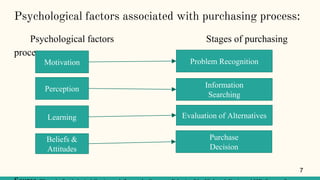
Psychological factors associated with purchasing process:
Psychological factors Stages of purchasing
process
Motivation
Perception
Learning
Beliefs &
Attitudes
Problem Recognition
Information
Searching
Evaluation of Alternatives
Purchase
Decision
7
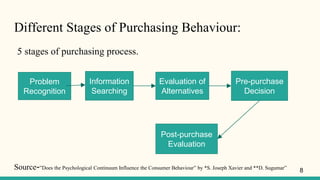
Different Stages of Purchasing Behaviour:
5 stages of purchasing process.
Source-”Does the Psychological Continuum Influence the Consumer Behaviour” by *S. Joseph Xavier and **D. Sugumar”
Problem
Recognition
Information
Searching
Post-purchase
Evaluation
Evaluation of
Alternatives
8
Types of purchasing mode:
Traditional (Offline) Purchasing/Shopping,
Online Purchasing/Shopping.
9
Traditional Shopping:
It has the ability to physically choose and check out what an item or
product is like, how would it look like, and what are its features.
In the traditional shopping, one has to leave home, either walk or take a
ride to the store or shopping center in order to buy what one wants.
Advantages of traditional shopping are product tangibility, instant
delivery, etc.
Disadvantages of traditional shopping are lack of proper information,
less variety, less choices for product comparison.
10
Online Shopping:
Online shopping or e-shopping is a form of electronic commerce which
allows consumers to directly buy goods or services from a seller over
the internet using a web browser.
Advantages of online stores are lots of variety, easier product
comparison, lesser price, proper information about product etc.
Disadvantages of online shopping are instant delivery is not feasible,
lack of tangibility.
11
Purpose:
It is believed that consumers or customers make purchase decisions on
the receipt of small selectively chosen pieces of information. Thus it
will be very important to understand what and how much
information is required by the customer to help him/her evaluate the
goods and services offerings.
The present study explores whether there will be significant difference
between consumer’s buying decision processes in online and
traditional medium.
12
Objectives:
To assess the consumer’s preferences for their purchases
either online or offline.
To study the factors influencing consumer behaviour while
buying various products online and offline.
To analyse the comparative advantages and disadvantages of
web stores and traditional stores.
13
Method:
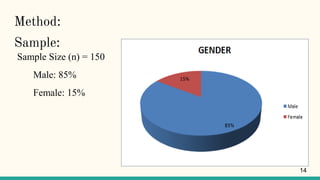
Sample:
Sample Size (n) = 150
Male: 85%
Female: 15%
14
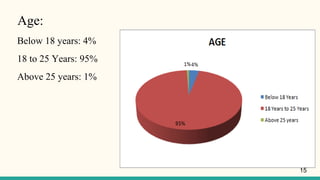
Age:
Below 18 years: 4%
18 to 25 Years: 95%
Above 25 years: 1%
15
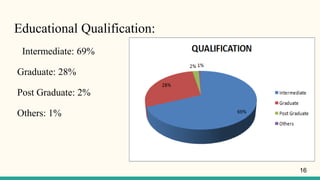
Educational Qualification:
Intermediate: 69%
Graduate: 28%
Post Graduate: 2%
Others: 1%
16
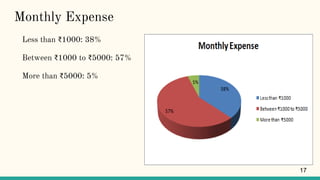
Monthly Expense
Less than ₹1000: 38%
Between ₹1000 to ₹5000: 57%
More than ₹5000: 5%
17
Measure:
Questionnaire Development:
Stage I
At initial stage we did a Literature Review regarding all possibilities
and aspects for consumer behaviour of Traditional and Online
Purchasing Trend.
Stage II
After Stage I we made an Informal Interaction with sample
participants and assessed their feedback.
18
Stage III
At this Stage based upon Stage I & Stage II various Dimensions were
identified relevant to our study.
Stage IV
Tools/Items were developed in the form of series of Questionnaire
with relevant Dimensions.
Stage V
A Pilot Study was done and then incorporated the changes which
were suggested & then Final Administration was concluded.
19
Measure(cont.):
● Demographic Profile
○ Age
○ Gender
○ Qualification
○ Monthly expense
Following dimensions were emerged:
● Stores
○ Online store
○ Traditional store 20
Measure (cont.):
Online store
Product searching
Platform
Recommendation
Traditional store
Location of store
Type of store
21
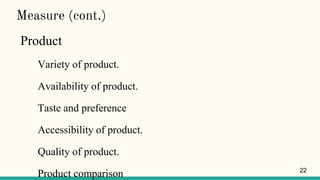
Measure (cont.)
Product
Variety of product.
Availability of product.
Taste and preference
Accessibility of product.
Quality of product.
Product comparison 22
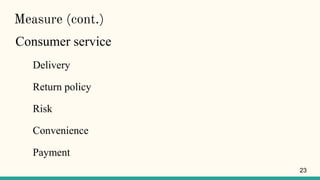
Measure (cont.)
Consumer service
Delivery
Return policy
Risk
Convenience
Payment
23
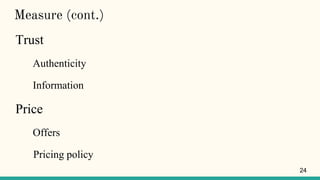
Measure (cont.)
Trust
Authenticity
Information
Price
Offers
Pricing policy
24
Survey Form
Consumer behaviour survey form.
25
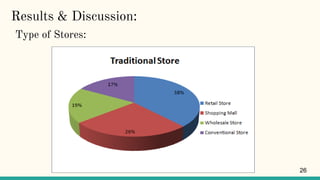
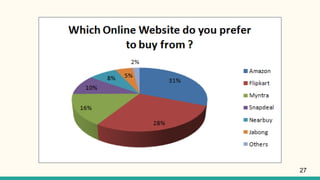
Results & Discussion:
Type of Stores:
26
27
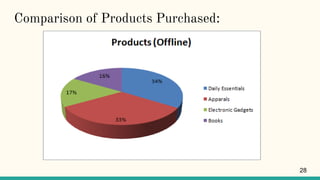
Comparison of Products Purchased:
28
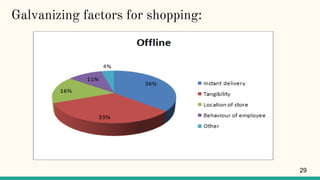
Galvanizing factors for shopping:
29
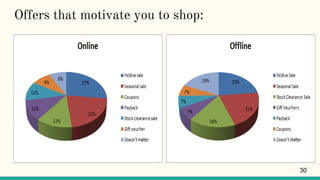
Offers that motivate you to shop:
30
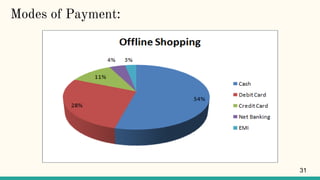
Modes of Payment:
31
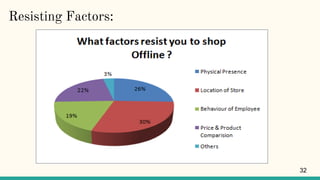
Resisting Factors:
32
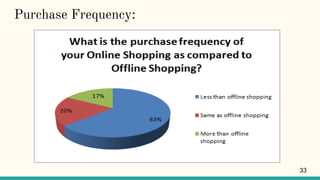
Purchase Frequency:
33
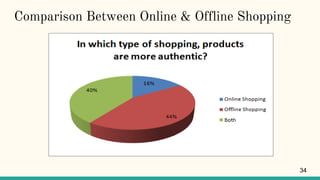
Comparison Between Online & Offline Shopping
34
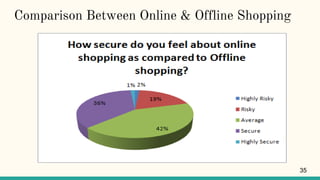
Comparison Between Online & Offline Shopping
35
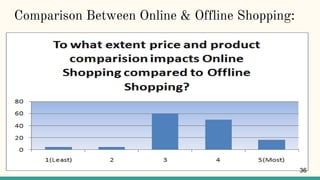
Comparison Between Online & Offline Shopping:
36
37
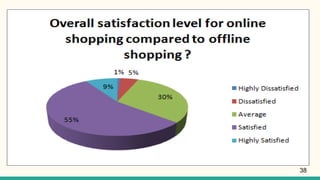
38
Conclusions:
Through our study on Consumer Behaviour - Analysis of Online &
Traditional purchasing Trend, we concluded that age group between 18
Years to 25 Years are more aligned towards online shopping in comparison
to traditional shopping. It was due to ease of access to internet, familiarity
with online shopping, relevant product information and doorstep
delivery.
Preferences of online and traditional shopping differs from product to product
like for daily essentials and apparels respondents tend towards traditional
shopping due to factors like tangibility, instant delivery etc. whereas for
some products like electronics goods and books respondents tend towards
online shopping due to variety, authenticity etc. 39
Limitation and Future Implications
In our circle most of the respondents were between the age
group of 18 - 25 years and most of them were dependent
individuals.
Another limitation was of a small sample size and lower sex
ratio.
Another challenge was that the respondents were from similar
locality.
40
References:
Sunil, S. P. A. C. E. "Bricks or Clicks: Consumer Preference-A Comparative Analysis." International Journal of
Marketing and Business Communication 2.3 (2015)..
Dr. Dharmendra Mehta, Er. Sunayana Soni and Dr. Naveen K.Mehta “Review of Literature on Online vs. Offline
Consumer Behavior” (2015)
Shanthi, R., and Kannaiah Desti. "Consumers' perception on online shopping." Journal of Marketing and Consumer
Research 13 (2015): 14-21.
Lieber, Ethan, and Chad Syverson. "Online versus offline competition." Oxford Handbook of the Digital Economy
(2012): 189-223.
http://www.business2community.com/consumer-marketing/online-versus-offline-the-pros-and-cons-of-online-retail-
0205608#ByrdosAIEEQ3uJw0.97
Kim, Jihyun, and Jihye Park. "A consumer shopping channel extension model: attitude shift toward the online store."41
Thank you
42

Consumer behaviour towards online and traditional purchasing

  • 1.
    Consumer Behaviour Analysis ofOnline & Traditional Purchasing Trend Submitted by:- Gopal Kumar Y13UC105 Ayush Maheswari Y13UC062 1
  • 2.
    Outline: Consumer Psychology Purchasing Behaviour Psychologicalfactors of purchasing Modes of purchasing Statement of Purpose Objectives Method Sample 2
  • 3.
    What is ConsumerPsychology? Consumer behaviour refers to the mental and emotional process and the physical activities of the people who purchase and use goods and services to satisfy particular need and want[1]. The study of consumer behaviour is concerned with all aspects of purchasing behaviour from pre-purchase activities to post-purchase consumption and evaluation activities. [1] Bearden et. al. (2004): Marketing principles and perspectives”, as quoted in Satish Bathra, S H H Kazmi. Consumer Behavior” Text and Cases, Excel books, New Delhi. 3
  • 4.
    Need of ConsumerPsychology: Out of 11000 new products introduced by 77 companies, only 56% are present after 5 years[2]. Only 8% of new product concepts offered by 112 leading companies reached the market. Out of 83% failed to meet marketing objectives[2]. [2]- “Does the Psychological Continuum Influence the Consumer Behaviour” by *S. Joseph Xavier and **D. Sugumar 4
  • 5.
    Importance of ConsumerPsychology: The study of Consumer Behaviour helps the marketers to understand what consumer's purchase, and helps understanding why they purchase it (Kumar, 2004). It helps in creating new users and retaining customers. It also helps in understanding the factors influencing Consumer's Purchasing Behaviour. By analysis of consumer behaviour, marketers get to know about the sale of product and helps in creating focused marketing strategies. 5
  • 6.
    What is PurchaseBehaviour: Purchasing is the process of browsing and/or purchasing items in exchange for money. Purchasing Behaviour is the decision processes and acts of people involved in purchasing and using products. 6
  • 7.
    Psychological factors associatedwith purchasing process: Psychological factors Stages of purchasing process Motivation Perception Learning Beliefs & Attitudes Problem Recognition Information Searching Evaluation of Alternatives Purchase Decision 7
  • 8.
    Different Stages ofPurchasing Behaviour: 5 stages of purchasing process. Source-”Does the Psychological Continuum Influence the Consumer Behaviour” by *S. Joseph Xavier and **D. Sugumar” Problem Recognition Information Searching Post-purchase Evaluation Evaluation of Alternatives 8
  • 9.
    Types of purchasingmode: Traditional (Offline) Purchasing/Shopping, Online Purchasing/Shopping. 9
  • 10.
    Traditional Shopping: It hasthe ability to physically choose and check out what an item or product is like, how would it look like, and what are its features. In the traditional shopping, one has to leave home, either walk or take a ride to the store or shopping center in order to buy what one wants. Advantages of traditional shopping are product tangibility, instant delivery, etc. Disadvantages of traditional shopping are lack of proper information, less variety, less choices for product comparison. 10
  • 11.
    Online Shopping: Online shoppingor e-shopping is a form of electronic commerce which allows consumers to directly buy goods or services from a seller over the internet using a web browser. Advantages of online stores are lots of variety, easier product comparison, lesser price, proper information about product etc. Disadvantages of online shopping are instant delivery is not feasible, lack of tangibility. 11
  • 12.
    Purpose: It is believedthat consumers or customers make purchase decisions on the receipt of small selectively chosen pieces of information. Thus it will be very important to understand what and how much information is required by the customer to help him/her evaluate the goods and services offerings. The present study explores whether there will be significant difference between consumer’s buying decision processes in online and traditional medium. 12
  • 13.
    Objectives: To assess theconsumer’s preferences for their purchases either online or offline. To study the factors influencing consumer behaviour while buying various products online and offline. To analyse the comparative advantages and disadvantages of web stores and traditional stores. 13
  • 14.
    Method: Sample: Sample Size (n)= 150 Male: 85% Female: 15% 14
  • 15.
    Age: Below 18 years:4% 18 to 25 Years: 95% Above 25 years: 1% 15
  • 16.
    Educational Qualification: Intermediate: 69% Graduate:28% Post Graduate: 2% Others: 1% 16
  • 17.
    Monthly Expense Less than₹1000: 38% Between ₹1000 to ₹5000: 57% More than ₹5000: 5% 17
  • 18.
    Measure: Questionnaire Development: Stage I Atinitial stage we did a Literature Review regarding all possibilities and aspects for consumer behaviour of Traditional and Online Purchasing Trend. Stage II After Stage I we made an Informal Interaction with sample participants and assessed their feedback. 18
  • 19.
    Stage III At thisStage based upon Stage I & Stage II various Dimensions were identified relevant to our study. Stage IV Tools/Items were developed in the form of series of Questionnaire with relevant Dimensions. Stage V A Pilot Study was done and then incorporated the changes which were suggested & then Final Administration was concluded. 19
  • 20.
    Measure(cont.): ● Demographic Profile ○Age ○ Gender ○ Qualification ○ Monthly expense Following dimensions were emerged: ● Stores ○ Online store ○ Traditional store 20
  • 21.
    Measure (cont.): Online store Productsearching Platform Recommendation Traditional store Location of store Type of store 21
  • 22.
    Measure (cont.) Product Variety ofproduct. Availability of product. Taste and preference Accessibility of product. Quality of product. Product comparison 22
  • 23.
    Measure (cont.) Consumer service Delivery Returnpolicy Risk Convenience Payment 23
  • 24.
  • 25.
  • 26.
  • 27.
  • 28.
  • 29.
  • 30.
    Offers that motivateyou to shop: 30
  • 31.
  • 32.
  • 33.
  • 34.
    Comparison Between Online& Offline Shopping 34
  • 35.
    Comparison Between Online& Offline Shopping 35
  • 36.
    Comparison Between Online& Offline Shopping: 36
  • 37.
  • 38.
  • 39.
    Conclusions: Through our studyon Consumer Behaviour - Analysis of Online & Traditional purchasing Trend, we concluded that age group between 18 Years to 25 Years are more aligned towards online shopping in comparison to traditional shopping. It was due to ease of access to internet, familiarity with online shopping, relevant product information and doorstep delivery. Preferences of online and traditional shopping differs from product to product like for daily essentials and apparels respondents tend towards traditional shopping due to factors like tangibility, instant delivery etc. whereas for some products like electronics goods and books respondents tend towards online shopping due to variety, authenticity etc. 39
  • 40.
    Limitation and FutureImplications In our circle most of the respondents were between the age group of 18 - 25 years and most of them were dependent individuals. Another limitation was of a small sample size and lower sex ratio. Another challenge was that the respondents were from similar locality. 40
  • 41.
    References: Sunil, S. P.A. C. E. "Bricks or Clicks: Consumer Preference-A Comparative Analysis." International Journal of Marketing and Business Communication 2.3 (2015).. Dr. Dharmendra Mehta, Er. Sunayana Soni and Dr. Naveen K.Mehta “Review of Literature on Online vs. Offline Consumer Behavior” (2015) Shanthi, R., and Kannaiah Desti. "Consumers' perception on online shopping." Journal of Marketing and Consumer Research 13 (2015): 14-21. Lieber, Ethan, and Chad Syverson. "Online versus offline competition." Oxford Handbook of the Digital Economy (2012): 189-223. http://www.business2community.com/consumer-marketing/online-versus-offline-the-pros-and-cons-of-online-retail- 0205608#ByrdosAIEEQ3uJw0.97 Kim, Jihyun, and Jihye Park. "A consumer shopping channel extension model: attitude shift toward the online store."41
  • 42.