
Uploaded byLeena Barapatre
Webster and wind model
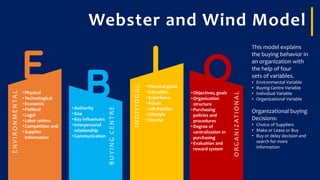
The Webster and Wind model outlines organizational buying behavior through four variable sets: environmental, buying center, individual, and organizational. Key decision factors include supplier choice, make-or-buy decisions, and the complexity of the buying center's authority and relationships. Individual traits and organizational structures also significantly influence the purchasing process.
More Related Content


Similar to Webster and wind model


Webster and wind model
- 1. Webster and WindModel This model explains the buying behavior in an organization with the help of four sets of variables. • Environmental Variable • Buying Centre Variable • Individual Variable • Organizational Variable Organizational buying Decisions: • Choice of Suppliers • Make or Lease or Buy • Buy or delay decision and search for more information E•Physical •Technological •Economic •Political •Legal •Labor unions •Competition and •Supplier Information B ENVIRONMENTAL BUYINGCENTRE •Authority •Size •Key influencers •Interpersonal relationship •Communication INDIVIDUAL I•Personal goals •Education •Experience •Values •Job Position •Lifestyle •Income O ORGANIZATIONAL •Objectives, goals •Organization structure •Purchasing policies and procedures •Degree of centralization in purchasing •Evaluation and reward system
Editor's Notes
- #2 Introduction: Webster and Wind (1972) developed a general model for organizational buying behavior. According to webster (1965), to understand Organizational Buying Behavior(OBB), it is necessary to examine both organizational and individual decision making, since, as emphasized by Webster and wind (1972), individual behavior is the base of all organizational buying behavior. Environmental: For example, in a recessionary(Covid) economic condition, industrial firms minimize the quantity of items purchased. The environmental factors influence the buying decisions of individual organizations. Organisational: These variables particularly influence the composition and functioning of the buying center, and also, the degree of centralization or decentralization in the purchasing function in the buying organization. Buying Centre and organisational Variable: A buying center, also called decision-making unit, brings together "all those members of an organization who become involved in the buying process for a particular product or service“. OBB is influenced by the organizational variables, the environmental variables and the individual variables. The output of the group decision-making process of the buying center includes solutions to the buying problems of the organization and also the satisfaction of personal goals of individual members of the buying center. Individual: Ultimately its individuals making the decision of buying or not or from where so characteristics of individuals, education, experience, values, income affects the buying behavior End: strengths of the model, developed in 1972, are that it is comprehensive, generally applicable, analytical, and that it identifies many key variables, which could be considered while developing marketing strategies by industrial marketers. However, the model is weak in explaining the specific influence of the key variables. These variables particularly influence the composition and functioning of the buying Centre and also the degree of centralization or de-centralization in the purchasing function of the buying organization. The functioning of the buying Centre is influenced by the organizational variables