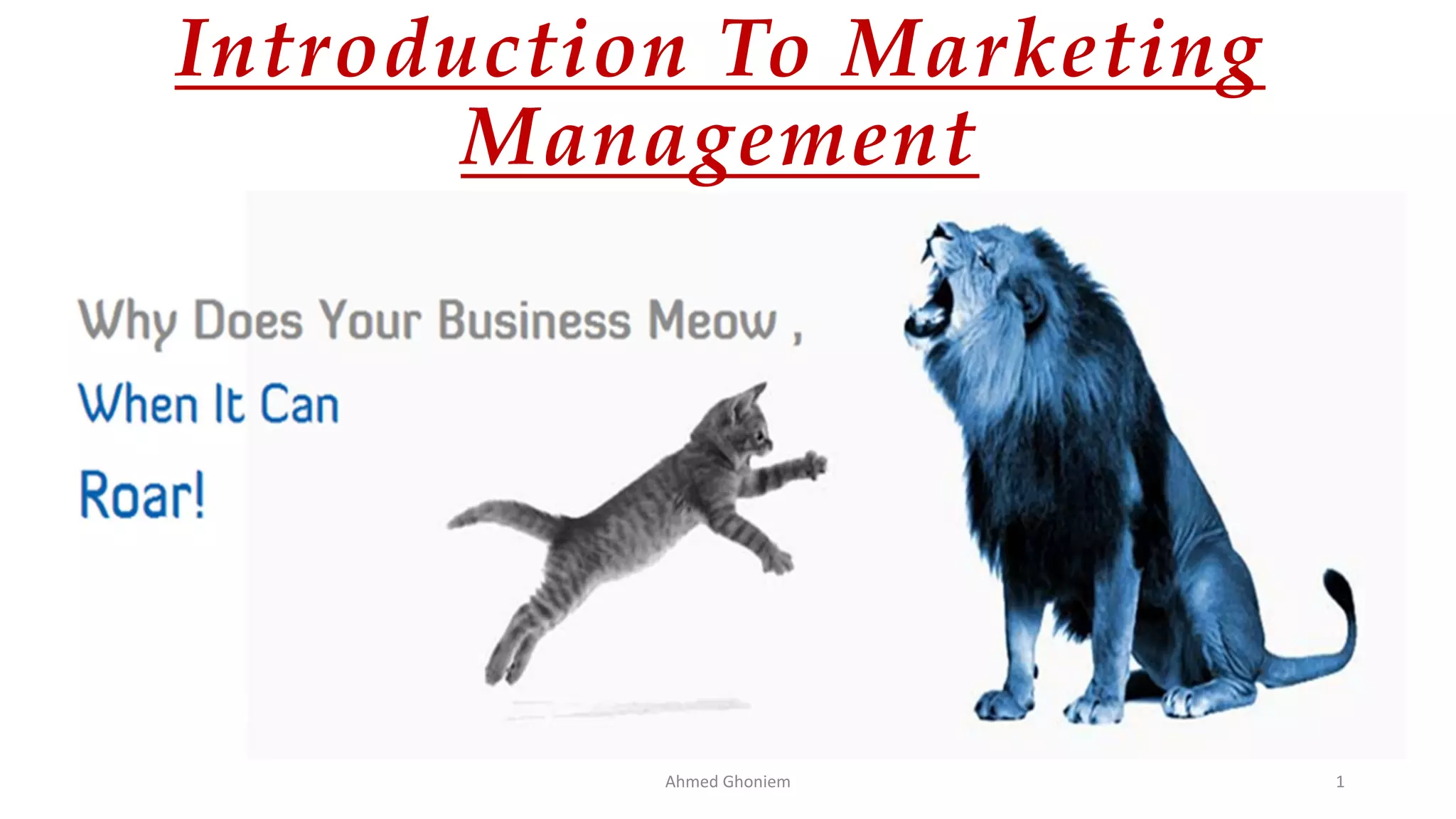
Introduction To Marketing
Management
Ahmed Ghoniem 1
Ahmed Ghoniem 2
Ahmed Ghoniem
Business Consultant | Entrepreneur
(+2) 0111863 4115
ahmedghoniem@ymail.com
LinkedIn: http://www.linkedin.com/in/ahmedghoniem
YouTube: https://www.youtube.com/user/ahmed0ghoniem/videos
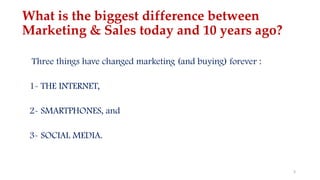
What is the biggest difference between
Marketing & Sales today and 10 years ago?
3
Three things have changed marketing (and buying) forever :
1- THE INTERNET,
2- SMARTPHONES, and
3- SOCIAL MEDIA.
Marketing Challenges Into The New Century
• Growth Of Non-profit Marketing
• The Information Technology Boom
• Rapid Globalization
• The Changing World Economy
• The Call For More Ethics And Social Responsibility
Ahmed Ghoniem 4
5
What are the 10 things that can be marketed?
1- Product
2- Service
3- Event
4- City / Country
5- Person
6- Enterprise
7- Science
8- Research
9- Property
10- Idea
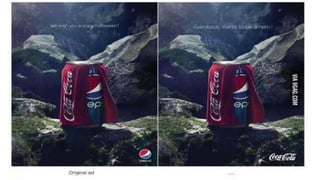
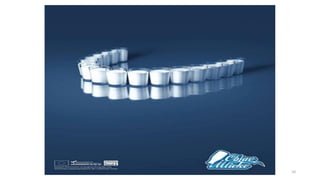
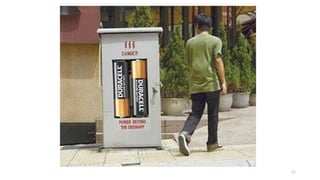
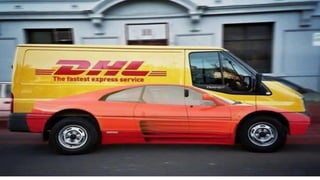
Some photos about how to show
an Idea!
6
7
8
9
10
11
12
13
14
15
16
17
18
Ahmed Ghoniem 19
Ahmed Ghoniem 20
Ahmed Ghoniem 21
Ahmed Ghoniem 22
Ahmed Ghoniem 23
Ahmed Ghoniem 24
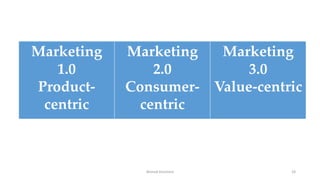
Marketing
1.0
Product-
centric
Marketing
2.0
Consumer-
centric
Marketing
3.0
Value-centric
Ahmed Ghoniem 25
Ahmed Ghoniem 26
Content
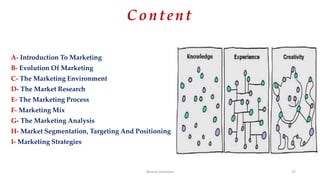
A- Introduction To Marketing
B- Evolution Of Marketing
C- The Marketing Environment
D- The Market Research
E- The Marketing Process
F- Marketing Mix
G- The Marketing Analysis
H- Market Segmentation, Targeting And Positioning
I- Marketing Strategies
Ahmed Ghoniem 27
A-
Introduction To Marketing
Ahmed Ghoniem 28
What is Marketing?
• Marketing deals with identifying & meeting human & social needs.
• Marketing is a societal process by which individuals and groups obtain what
they need through creating , offering and freely exchanging products and
services of value with others.
• Marketing is the process by which companies create value for customers &
build strong customer relationships in order to capture profit from customers
in return.
Ahmed Ghoniem 29
Marketing:
• “Satisfying customer needs”
• “Meeting needs profitably”
• “Generating customer value at a profit”
- “Managing profitable customer relationships by delivering
superior value to customers”
Simply put:
Marketing is the delivery of customer satisfaction at a profit
Ahmed Ghoniem 30
Marketing
Common subject matters:
- The ability to satisfy customers,
- The identification of favorable marketing opportunities,
- The need to create an edge over competitors,
- The capacity to make profits to enable a viable future for the organization,
- The use of resources to maximize a business’ market position,
- The aim to increase market share mainly in target markets
Ahmed Ghoniem 31
Marketing Defined
• Many people think of marketing only as selling and advertising.
• Selling and advertising are only the tip of the marketing ice-berg.
• Marketing is one of 5 key-core functions that are central to all
organizations.
• Marketers act as the customers’ voice within the firm and marketers are
responsible for many more decisions than just advertising or sales:
• Analyze industries to identify emerging trends.
• Determine which national and international markets to enter or exit.
• Conduct research to understand consumer behavior.
• Design integrated marketing mixes – products, prices, channels of
distribution, and promotion programs.
Ahmed Ghoniem 32
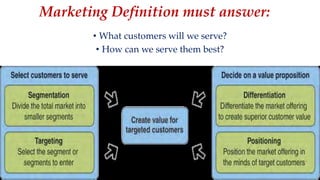
Marketing Definition must answer:
• What customers will we serve?
• How can we serve them best?
Ahmed Ghoniem 33
Marketing VS Market
• Market: is a Set of actual and potential products, services and buyers who
might transact with a seller.
Market = Customer
“Market is a mechanism where buyers and sellers meet”
Ahmed Ghoniem 34
What is difference between client and a
customer and a consumer?
Well, they are all customers really but :
- A client is more of a business term for a person who returns again to their
business and who they have regular dealings with, including lawyers,
doctors, beauticians, banks etc.
- A consumer is someone who uses the products, this includes eating,
drinking or buying make-up or food and general goods.
- A customer is anyone who is spending the money!
Ahmed Ghoniem 35
Marketing Common Mistakes
• We have no competition.
• It’s a great idea, so people will want it.
• I want one, so there must be a market.
• It’s growing market, I can’t miss
• No rational customer would say NO
Ahmed Ghoniem 36
Ahmed Ghoniem 37
B-
Evolution Of Marketing
Ahmed Ghoniem 38
• How marketing has become “Marketing” as we
understand it and apply its practices today?
Ahmed Ghoniem 39
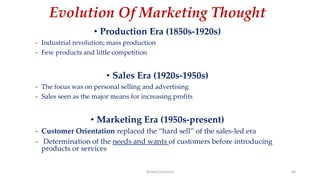
Evolution Of Marketing Thought
• Production Era (1850s-1920s)
- Industrial revolution; mass production
- Few products and little competition
• Sales Era (1920s-1950s)
- The focus was on personal selling and advertising
- Sales seen as the major means for increasing profits
• Marketing Era (1950s-present)
- Customer Orientation replaced the “hard sell” of the sales-led era
- Determination of the needs and wants of customers before introducing
products or services
Ahmed Ghoniem 40
Evolution Of Marketing Thought
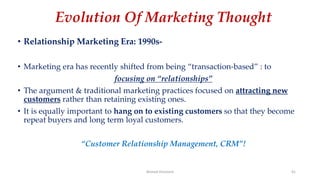
• Relationship Marketing Era: 1990s-
• Marketing era has recently shifted from being “transaction-based” : to
focusing on “relationships”
• The argument & traditional marketing practices focused on attracting new
customers rather than retaining existing ones.
• It is equally important to hang on to existing customers so that they become
repeat buyers and long term loyal customers.
“Customer Relationship Management, CRM”!
Ahmed Ghoniem 41
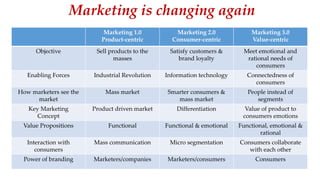
Marketing 1.0
Product-centric
Marketing 2.0
Consumer-centric
Marketing 3.0
Value-centric
Objective Sell products to the
masses
Satisfy customers &
brand loyalty
Meet emotional and
rational needs of
consumers
Enabling Forces Industrial Revolution Information technology Connectedness of
consumers
How marketers see the
market
Mass market Smarter consumers &
mass market
People instead of
segments
Key Marketing
Concept
Product driven market Differentiation Value of product to
consumers emotions
Value Propositions Functional Functional & emotional Functional, emotional &
rational
Interaction with
consumers
Mass communication Micro segmentation Consumers collaborate
with each other
Power of branding Marketers/companies Marketers/consumers Consumers
Marketing is changing again
Ahmed Ghoniem 43
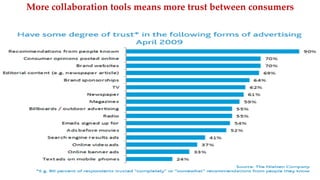
More collaboration tools means more trust between consumers
C-
The Marketing Environment
Ahmed Ghoniem 44
The Marketing Environment
- The factors and forces outside marketing that affect marketing
management ability to build and maintain successful relationships with
target customers.
• Macro Environment (PESTEL)
- Political Factors
- Economic Factors
- Social / Cultural Factors
- Technological Factors
- Environmental Factors
- Legal Factors
• Micro Environment
- Customers
- Suppliers
- Competitors
- New Comers
Ahmed Ghoniem 45
The Marketing Environment
Macro environment
1. Political Factors: These are all about how and to what degree a
government intervenes in the economy. This can include:
• Governmental regulations & rules
• Tax regime
• Trade policies
• Special interests
It is clear from the list above that political factors often have an impact on
organizations and how they do business.
Organizations need to be able to respond to the current and anticipated future
legislation, and adjust their marketing policy accordingly.
Ahmed Ghoniem 46
The Marketing Environment
Macro environment
2. Economic Factors: Economic factors have a significant impact on how an
organization does business and also how profitable they are. Factors include:
• Changes in Income
• Changing customer spending patterns
• Unemployment
• Inflation
• Increase Rate
These factors can be further broken down into macro-economical and micro-
economical factors. Macro-economical factors deal with the management of demand
in any given economy. Governments use interest rate control, taxation policy and
government expenditure as their main mechanisms they use for this.
Micro-economic factors are all about the way people spend their incomes. This has a
large impact on B2C organizations in particular.
Ahmed Ghoniem 47
The Marketing Environment
Macro environment
• 3.Social Factors: Also known as socio-cultural factors, are the areas that
involve the shared belief and attitudes of the population.
These factors include:
• population growth,
• age distribution,
• health consciousness,
• career attitudes and so on.
These factors are of particular interest as they have a direct effect on how marketers
understand customers and what drives them.
Ahmed Ghoniem 48
The Marketing Environment
Macro environment
4.Technological Factors: forces that create new technologies, creating new
products and opportunities
We all know how fast the technological landscape changes and how this impacts
the way we market our products.
Technological factors affect marketing and the management thereof in three
distinct ways:
• New ways of producing goods and services
• New ways of distributing goods and services
• New ways of communicating with target markets
Examples mobiles; laptops, robotic surgery ..etc.
Google glass
Galaxy Gear
Ahmed Ghoniem 49
The Marketing Environment
Macro environment
5. Environmental Factors: These factors have only really become reality
in the last fifteen years or so.
They have become important due to
• Increasing shortage of raw materials,
• Increased pollution
• Energy Sources
(this is a good example were one factor could be classes as political and
environmental at the same time).
• These are just some of the issues marketers are facing within this factor.
More and more consumers are demanding that the products they buy are
sourced ethically, and if possible from a sustainable source.
Ahmed Ghoniem 50
The Marketing Environment
Macro environment
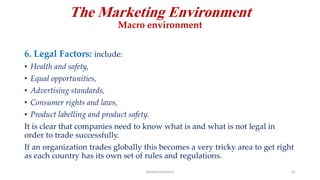
6. Legal Factors: include:
• Health and safety,
• Equal opportunities,
• Advertising standards,
• Consumer rights and laws,
• Product labelling and product safety.
It is clear that companies need to know what is and what is not legal in
order to trade successfully.
If an organization trades globally this becomes a very tricky area to get right
as each country has its own set of rules and regulations.
Ahmed Ghoniem 51
The Marketing Environment
Micro environment
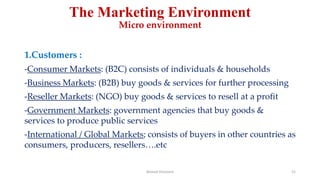
1.Customers :
-Consumer Markets: (B2C) consists of individuals & households
-Business Markets: (B2B) buy goods & services for further processing
-Reseller Markets: (NGO) buy goods & services to resell at a profit
-Government Markets: government agencies that buy goods &
services to produce public services
-International / Global Markets; consists of buyers in other countries as
consumers, producers, resellers….etc
Ahmed Ghoniem 52
The Marketing Environment
Micro environment
2.Competitors:
3.Suppliers; supply problems that affect the marketing can be
supply shortage, or delays, labor strikes , supply costs …etc
4. New Comers:
Ahmed Ghoniem 53
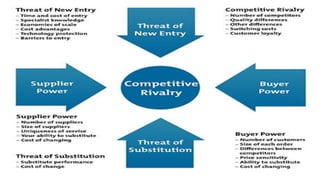
Porter’s Five Forces Analysis
Ahmed Ghoniem 54
Ahmed Ghoniem 55
Porter’s Five Forces Analysis
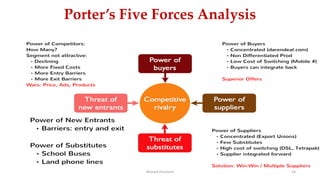
• Understanding the Tool
• Five Forces Analysis assumes that there are five important forces that
determine competitive power in a business situation. These are:
1- Supplier Power: Here you assess how easy it is for suppliers to drive up
prices. This is driven by the number of suppliers of each key input, the
uniqueness of their product or service, their strength and control over you,
the cost of switching from one to another, and so on. The fewer the supplier
choices you have, and the more you need suppliers' help, the more powerful
your suppliers are.
Ahmed Ghoniem 56
Porter’s Five Forces Analysis
2- Buyer Power: Here you ask yourself how easy it is for buyers to drive
prices down. Again, this is driven by the number of buyers, the importance
of each individual buyer to your business, the cost to them of switching
from your products and services to those of someone else, and so on. If you
deal with few, powerful buyers, then they are often able to dictate terms to
you.
3- Competitive Rivalry: What is important here is the number and
capability of your competitors. If you have many competitors, and they offer
equally attractive products and services, then you'll most likely have little
power in the situation, because suppliers and buyers will go elsewhere if
they don't get a good deal from you. On the other hand, if no-one else can
do what you do, then you can often have tremendous strength.
Ahmed Ghoniem 57
Porter’s Five Forces Analysis
4- Threat of Substitution: This is affected by the ability of your customers to find a
different way of doing what you do – for example, if you supply a unique software
product that automates an important process, people may substitute by doing the
process manually or by outsourcing it. If substitution is easy and substitution is
viable, then this weakens your power.
5- Threat of New Entry: Power is also affected by the ability of people to enter your
market. If it costs little in time or money to enter your market and compete
effectively, if there are few economies of scale in place, or if you have little
protection for your key technologies, then new competitors can quickly enter your
market and weaken your position. If you have strong and durable barriers to entry,
then you can preserve a favorable position and take fair advantage of it.
Ahmed Ghoniem 58
Ahmed Ghoniem 59
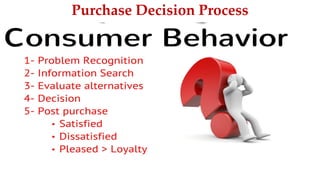
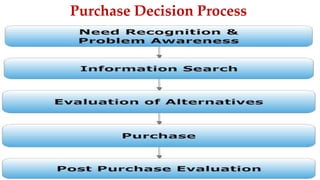
Purchase Decision Process
Ahmed Ghoniem 60
Purchase Decision Process
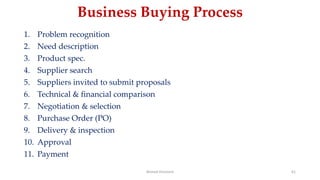
Business Buying Process
1. Problem recognition
2. Need description
3. Product spec.
4. Supplier search
5. Suppliers invited to submit proposals
6. Technical & financial comparison
7. Negotiation & selection
8. Purchase Order (PO)
9. Delivery & inspection
10. Approval
11. Payment
Ahmed Ghoniem 61
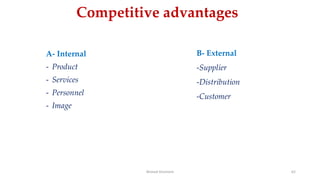
Competitive advantages
A- Internal
- Product
- Services
- Personnel
- Image
Ahmed Ghoniem 62
B- External
-Supplier
-Distribution
-Customer
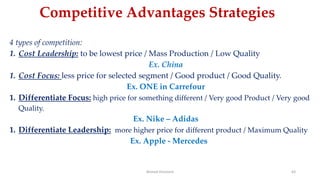
Competitive Advantages Strategies
4 types of competition:
1. Cost Leadership: to be lowest price / Mass Production / Low Quality
Ex. China
1. Cost Focus: less price for selected segment / Good product / Good Quality.
Ex. ONE in Carrefour
1. Differentiate Focus: high price for something different / Very good Product / Very good
Quality.
Ex. Nike – Adidas
1. Differentiate Leadership: more higher price for different product / Maximum Quality
Ex. Apple - Mercedes
Ahmed Ghoniem 63
Ahmed Ghoniem 64
D-
The Market Research
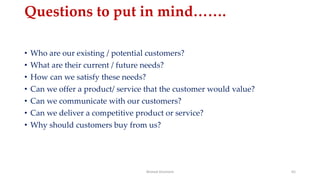
Questions to put in mind…….
• Who are our existing / potential customers?
• What are their current / future needs?
• How can we satisfy these needs?
• Can we offer a product/ service that the customer would value?
• Can we communicate with our customers?
• Can we deliver a competitive product or service?
• Why should customers buy from us?
Ahmed Ghoniem 65
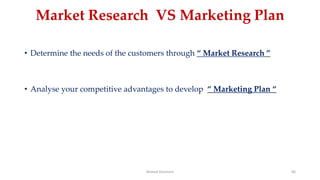
Market Research VS Marketing Plan
• Determine the needs of the customers through “ Market Research ”
• Analyse your competitive advantages to develop “ Marketing Plan “
Ahmed Ghoniem 66
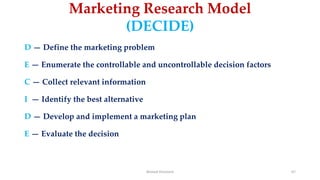
Marketing Research Model
(DECIDE)
D — Define the marketing problem
E — Enumerate the controllable and uncontrollable decision factors
C — Collect relevant information
I — Identify the best alternative
D — Develop and implement a marketing plan
E — Evaluate the decision
Ahmed Ghoniem 67
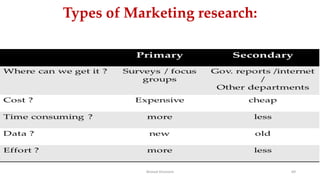
Types of Marketing research:
• Two types:
• Primary (New Data)
• Secondary (Already Existing Data)
• How can we get primary / secondary data ???
• Which is more expensive???
• Which needs more efforts ???
• Which is more time consuming ???
Ahmed Ghoniem 68
Types of Marketing research:
Ahmed Ghoniem 69
Focus Groups (In depth interviews):
• It is a group of people who are asked about their attitude towards a
product, service, concept, advertisement, idea, or packaging.
• Questions are asked in an interactive group setting where participants
are free to talk with other group members.
• Focus groups are a powerful means to evaluate services or test new
ideas.
• Basically, focus groups are interviews, but of 6-10 people at the same
time in the same group. One can get a great deal of information during a
focus group session.
Ahmed Ghoniem 70
Survey
• Are the most widely used set of methods in market research.
• The Questionnaire is the common method for collecting data from a
survey.
• Surveys can be conducted by mail, face-to-face, telephone, email or
Web.
Ahmed Ghoniem 71
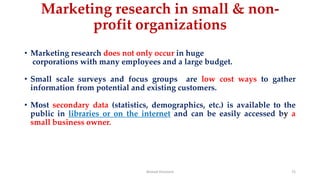
Marketing research in small & non-
profit organizations
• Marketing research does not only occur in huge
corporations with many employees and a large budget.
• Small scale surveys and focus groups are low cost ways to gather
information from potential and existing customers.
• Most secondary data (statistics, demographics, etc.) is available to the
public in libraries or on the internet and can be easily accessed by a
small business owner.
Ahmed Ghoniem 72
Ahmed Ghoniem 73
E-
The Marketing Process
Ahmed Ghoniem 74
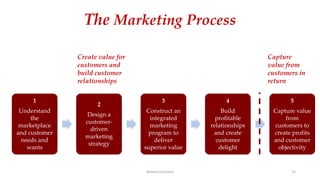
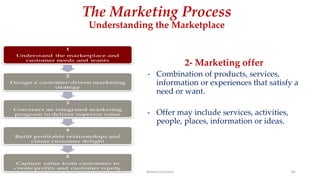
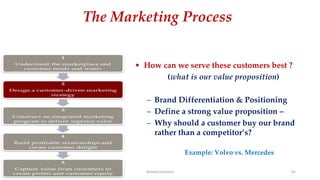
The Marketing Process
1
Understand
the
marketplace
and customer
needs and
wants
2
Design a
customer-
driven
marketing
strategy
3
Construct an
integrated
marketing
program to
deliver
superior value
4
Build
profitable
relationships
and create
customer
delight
5
Capture value
from
customers to
create profits
and customer
objectivity
Create value for
customers and
build customer
relationships
Capture
value from
customers in
return
Ahmed Ghoniem 75
The Marketing Process
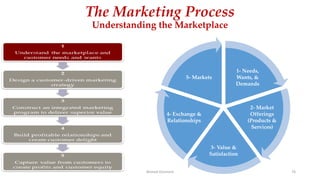
Understanding the Marketplace
1- Needs,
Wants, &
Demands
2- Market
Offerings
(Products &
Services)
3- Value &
Satisfaction
4- Exchange &
Relationships
5- Markets
Ahmed Ghoniem 76
The Marketing Process
Understanding the Marketplace
Ahmed Ghoniem 77
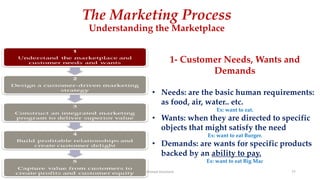
1- Customer Needs, Wants and
Demands
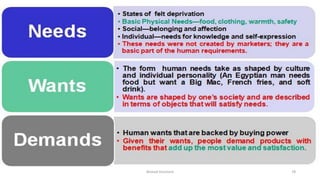
• Needs: are the basic human requirements:
as food, air, water.. etc.
Ex: want to eat.
• Wants: when they are directed to specific
objects that might satisfy the need
Ex: want to eat Burger.
• Demands: are wants for specific products
backed by an ability to pay.
Ex: want to eat Big Mac
Ahmed Ghoniem 78
Ahmed Ghoniem 79
Ahmed Ghoniem 80
The Marketing Process
Understanding the Marketplace
2- Marketing offer
- Combination of products, services,
information or experiences that satisfy a
need or want.
- Offer may include services, activities,
people, places, information or ideas.
Ahmed Ghoniem 81
The Marketing Process
Understanding the Marketplace
2- Marketing offer cont’d
Difference Between Products & Services
• Product:
Anything that can be offered to a market to
satisfy a need or want
• Services:
Activities or benefits offered for sale that are
essentially intangible and don’t result in the
ownership of anything.
Ahmed Ghoniem 82
The Marketing Process
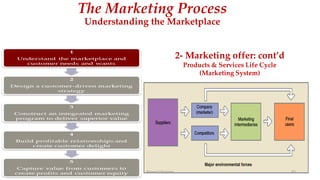
Understanding the Marketplace
2- Marketing offer: cont’d
Products & Services Life Cycle
(Marketing System)
Ahmed Ghoniem 83
The Marketing Process
Understanding the Marketplace
3- Value & Satisfaction
• Value = Benefit / Cost
– Customers form expectations regarding value.
– Marketers must deliver value to consumers.
• Satisfaction
– A satisfied customer will buy again and tell
others about their good experience.
Ahmed Ghoniem 84
The Marketing Process
Understanding the Marketplace
Value Gained From
Owning a Product and
Costs of Obtaining the
Product is
“Customer Value”
Product’s Perceived
Performance in
Delivering Value
Relative to Buyer’s
Expectations is
“Customer Satisfaction”
Total Quality
Management Involves
Improving the Quality of
Products, Services, and
Marketing Processes
Ahmed Ghoniem 85
3- Value & Satisfaction cont’d
The Marketing Process
Understanding the Marketplace
4- Exchange & Relationships
• Exchange:
- The act of obtaining a desired object from
someone by offering something in return
- One exchange is not the goal, relationships
with several exchanges are the goal
• Relationships: are built through delivering
value and satisfaction
- Marketing network: consists of the company and all
its supporting stakeholders
Ahmed Ghoniem 86
The Marketing Process
Understanding the Marketplace
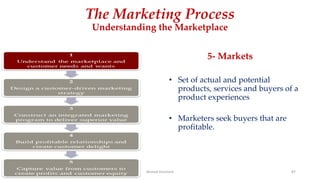
5- Markets
• Set of actual and potential
products, services and buyers of a
product experiences
• Marketers seek buyers that are
profitable.
Ahmed Ghoniem 87
The Marketing Process
Understanding the Marketplace
Ahmed Ghoniem 88
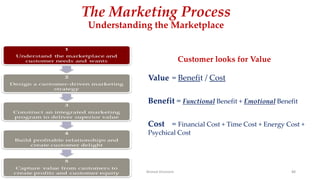
Customer looks for Value
Value = Benefit / Cost
Benefit = Functional Benefit + Emotional Benefit
Cost = Financial Cost + Time Cost + Energy Cost +
Psychical Cost
The Marketing Process
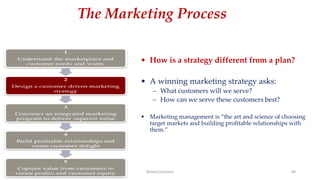
• How is a strategy different from a plan?
• A winning marketing strategy asks:
– What customers will we serve?
– How can we serve these customers best?
• Marketing management is “the art and science of choosing
target markets and building profitable relationships with
them.”
Ahmed Ghoniem 89
The Marketing Process
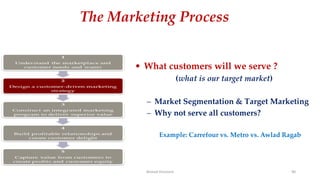
• What customers will we serve ?
(what is our target market)
– Market Segmentation & Target Marketing
– Why not serve all customers?
Example: Carrefour vs. Metro vs. Awlad Ragab
Ahmed Ghoniem 90
The Marketing Process
• How can we serve these customers best ?
(what is our value proposition)
– Brand Differentiation & Positioning
– Define a strong value proposition –
– Why should a customer buy our brand
rather than a competitor’s?
Example: Volvo vs. Mercedes
Ahmed Ghoniem 91
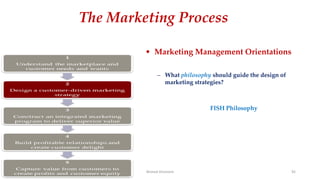
The Marketing Process
• Marketing Management Orientations
– What philosophy should guide the design of
marketing strategies?
FISH Philosophy
Ahmed Ghoniem 92
Ahmed Ghoniem 93
FISH Philosophy
• Choose your attitude: It's about accepting responsibility for the choices you make.
• Play: It's about having fun, enjoying yourself, being spontaneous and creative.
• Make their Day: It's about doing somethings special for others.
• Be There: It's about being focused on the person or task you are working on.
Why Fish philosophy?
Provide amazing service that makes customers want to come back again and again.
Build a culture where employees love to give their best every day.
Build effective leaders who inspire through their example.
Improve teamwork and build trust.
Ahmed Ghoniem 94
FISH Philosophy
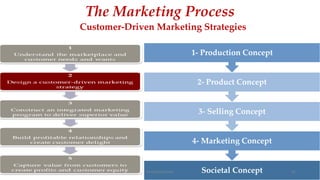
The Marketing Process
Customer-Driven Marketing Strategies
Societal Concept
4- Marketing Concept
3- Selling Concept
2- Product Concept
1- Production Concept
Ahmed Ghoniem 95
The Marketing Process
Customer-Driven Marketing Strategies
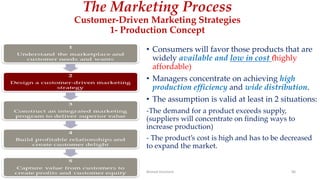
1- Production Concept
• Consumers will favor those products that are
widely available and low in cost (highly
affordable)
• Managers concentrate on achieving high
production efficiency and wide distribution.
• The assumption is valid at least in 2 situations:
-The demand for a product exceeds supply,
(suppliers will concentrate on finding ways to
increase production)
- The product’s cost is high and has to be decreased
to expand the market.
Ahmed Ghoniem 96
The Marketing Process
Customer-Driven Marketing Strategies
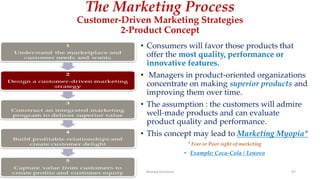
2-Product Concept
• Consumers will favor those products that
offer the most quality, performance or
innovative features.
• Managers in product-oriented organizations
concentrate on making superior products and
improving them over time.
• The assumption : the customers will admire
well-made products and can evaluate
product quality and performance.
• This concept may lead to Marketing Myopia*
* Fear or Poor sight of marketing
• Example: Coca-Cola / Lenovo
Ahmed Ghoniem 97
The Marketing Process
Customer-Driven Marketing Strategies
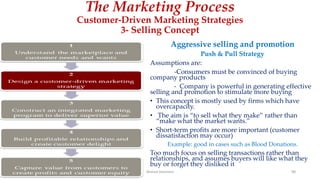
3- Selling Concept
Aggressive selling and promotion
Push & Pull Strategy
Assumptions are:
-Consumers must be convinced of buying
company products
- Company is powerful in generating effective
selling and promotion to stimulate more buying
• This concept is mostly used by firms which have
overcapacity.
• The aim is “to sell what they make” rather than
“make what the market wants.”
• Short-term profits are more important (customer
dissatisfaction may occur)
Example: good in cases such as Blood Donations.
Too much focus on selling transactions rather than
relationships, and assumes buyers will like what they
buy or forget they disliked it
Ahmed Ghoniem 98
The Marketing Process
Customer-Driven Marketing Strategies
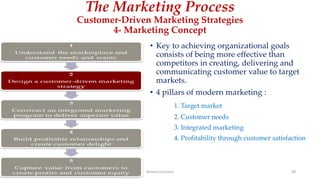
4- Marketing Concept
• Key to achieving organizational goals
consists of being more effective than
competitors in creating, delivering and
communicating customer value to target
markets.
• 4 pillars of modern marketing :
1. Target market
2. Customer needs
3. Integrated marketing
4. Profitability through customer satisfaction
Ahmed Ghoniem 99
The Marketing Process
Customer-Driven Marketing Strategies
4- Marketing Concept
1) Target market:
homogenous group of
customers to whom the
company wishes to
appeal
2) Customer needs:
• Consumers may not be
fully conscious of their
needs
• It may not be easy to
articulate these needs
• They may use words that
require some
interpretation
• Customer-oriented
thinking: to define
customer needs from the
customer’s point of view
• Sales revenue: New
customers + Repeat
customers
• “Customer Retention” vs.
“Customer Attraction”
• Customer satisfaction is a
function of the product
perceived performance
and buyer’s expectations
Ahmed Ghoniem 100
The Marketing Process
Customer-Driven Marketing Strategies
4- Marketing Concept
3) Integrated Marketing
1- Various marketing functions must work together for customer
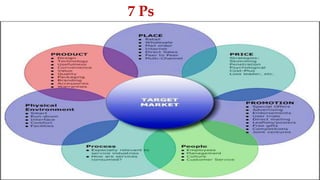
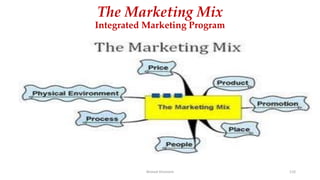
satisfaction (coordination of 4Ps / 7Ps Marketing Mix elements)
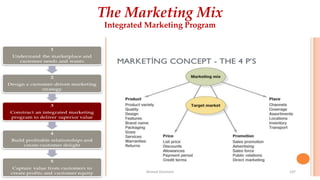
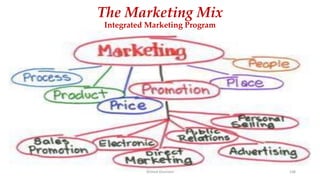
2- Marketing Mix: controllable variables the company puts
together to satisfy its target market(s).
- Product: Product variety, quality, design, features, brand name,
packaging, sizes, services, warranties, returns
- Price: List price, discounts, allowances, payment period, credit
terms
- Promotion: Sales promotion, advertising, sales force, public
relations, direct marketing.
- Place: Channels, coverage, assortments, locations, inventory,
transport.
Ahmed Ghoniem 101
The Marketing Process
Customer-Driven Marketing Strategies
4- Marketing Concept
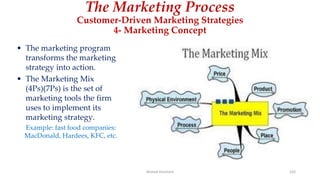
• The marketing program
transforms the marketing
strategy into action.
• The Marketing Mix
(4Ps)(7Ps) is the set of
marketing tools the firm
uses to implement its
marketing strategy.
Example: fast food companies:
MacDonald, Hardees, KFC, etc.
Ahmed Ghoniem 102
The Marketing Process
Customer-Driven Marketing Strategies
4- Marketing Concept
3) Integrated Marketing (cont’d)
3- Marketing must be well coordinated with other departments in
the company; all departments have to work together to satisfy
customers’ needs and wants
4) Profitability through customer satisfaction
- To achieve profits as a result of creating superior customer value
Ahmed Ghoniem 103
The Marketing Process
Customer-Driven Marketing Strategies
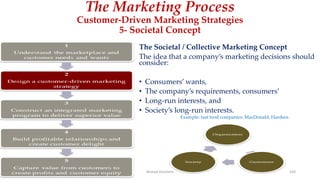
5- Societal Concept
The Societal / Collective Marketing Concept
The idea that a company’s marketing decisions should
consider:
• Consumers’ wants,
• The company’s requirements, consumers’
• Long-run interests, and
• Society’s long-run interests.
Example: fast food companies: MacDonald, Hardees
Ahmed Ghoniem 104
Ahmed Ghoniem 105
F-
The Marketing Mix
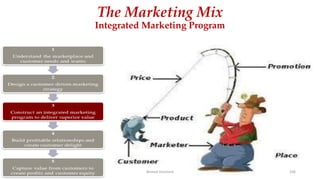
The Marketing Mix
Integrated Marketing Program
Ahmed Ghoniem 106
The Marketing Mix
Integrated Marketing Program
Ahmed Ghoniem 107
The Marketing Mix
Integrated Marketing Program
Ahmed Ghoniem 108
Ahmed Ghoniem 109
7 Ps
The Marketing Mix
Integrated Marketing Program
Ahmed Ghoniem 110
The Marketing Mix
1- Product
Products include physical objects, services, events, persons, places,
ideas…etc
1.Consumer Products
2.Industrial Products
Ahmed Ghoniem 111
The Marketing Mix
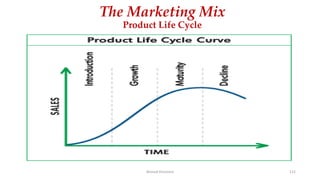
Product Life Cycle
Ahmed Ghoniem 112
The Marketing Mix
Ahmed Ghoniem 113
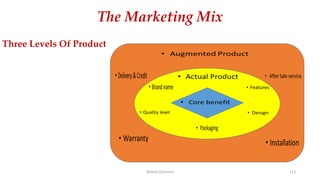
Three Levels Of Product
The Marketing Mix
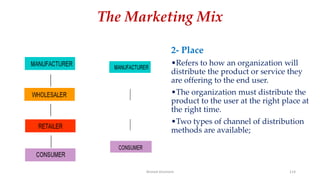
2- Place
•Refers to how an organization will
distribute the product or service they
are offering to the end user.
•The organization must distribute the
product to the user at the right place at
the right time.
•Two types of channel of distribution
methods are available;
Ahmed Ghoniem 114
The Marketing Mix
3- Price
It is the amount of money charged for a product or service, it is agreed upon that the
price offered must cover the cost of the product and return a profit to the producer .
There are 5 marketing objectives to determine the price of a product :
a. Maximize short term profit
b. Maximize current market share
c. Market skimming
d. Product quality leadership
e. Survival
Ahmed Ghoniem 115
The Marketing Mix
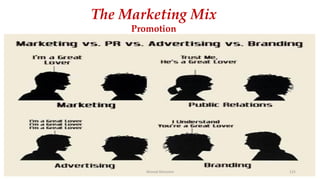
4- Promotion
There are 5 different key types of promotion :
1.Advertising
2.Sales Promotion
3.Public Relations
4.Personal Selling
5.Direct Marketing
Ahmed Ghoniem 116
The Marketing Mix
Promotion
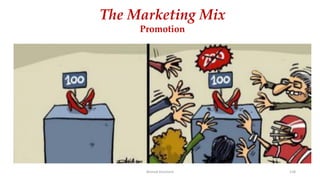
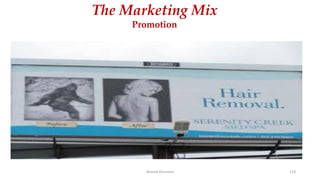
4.1 Advertising
•Popular means of reaching a target audience.
•Cost effective way to build awareness.
•To create a good ad, the marketer must create a message that is distinct, meaningful
and credible.
•There are many advertising 'media' such as newspapers, magazines and journals,
television, cinema, outdoor advertising (such as posters, bus sides).
Ahmed Ghoniem 117
Ahmed Ghoniem 118
The Marketing Mix
Promotion
Ahmed Ghoniem 119
The Marketing Mix
Promotion
The Marketing Mix
Promotion
4.2 Sales Promotion
•Short term incentive to encourage customers to make a purchase.
•There are many sales promotion types as :
a. Advertising Specialties: A product imprinted with a logo as mugs, T-shirts. Etc
b. Cash Rebates: A partial refund to the buyer
c. Discounting : reducing the listed price for a limited period of time
d. Coupons
e. Samples
N.B: Advertising offers reasons to buy a product or service, sales promotion offers
reasons to buy now
Ahmed Ghoniem 120
The Marketing Mix
Promotion
4.3 Public Relations
•Used to obtain favorable publicity, building good corporate image and handling
unfavorable rumors, stories and events
•Influence the public beliefs, feelings and opinions about the company .
•Mass promotion tool & cheap
•There are several types of public relations :
a. Written material as brochures, magazines, articles etc
b. Special Events as presentations, conferences
c. Public Service Activities as donating money, volunteers or resources to activities
designed to a social cause
d. Speeches as giving talks
Ahmed Ghoniem 121
The Marketing Mix
Promotion
4.4 Personal Selling
•Personal presentation by the firm’s sales force for the purpose of making sales &
building customer relations
•The sales message can be customized to meet the needs of the customer.
•Involves 2 way personal communication as face-to-face, by telephone, through
video or web conference.
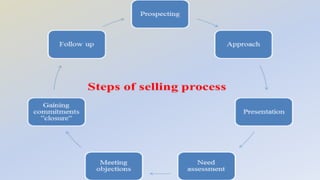
SALES PROCESS
Ahmed Ghoniem 122
Ahmed Ghoniem 123
The Marketing Mix
Promotion
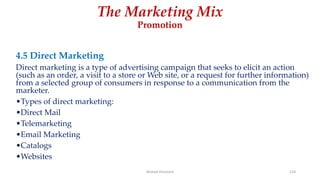
4.5 Direct Marketing
Direct marketing is a type of advertising campaign that seeks to elicit an action
(such as an order, a visit to a store or Web site, or a request for further information)
from a selected group of consumers in response to a communication from the
marketer.
•Types of direct marketing:
•Direct Mail
•Telemarketing
•Email Marketing
•Catalogs
•Websites
Ahmed Ghoniem 124
Ahmed Ghoniem 125
The Marketing Mix
Promotion
Ahmed Ghoniem 126
G-
The Marketing Analysis
Ahmed Ghoniem 127
The Marketing Analysis
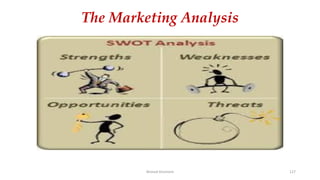
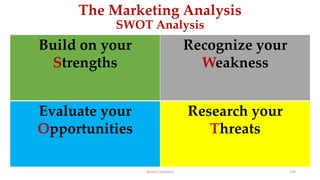
SWOT Analysis
Build on your
Strengths
Recognize your
Weakness
Evaluate your
Opportunities
Research your
Threats
Ahmed Ghoniem 128
The Marketing Analysis
Ahmed Ghoniem 129
Ahmed Ghoniem 130
The Marketing Analysis
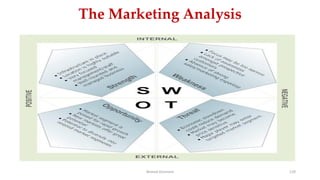
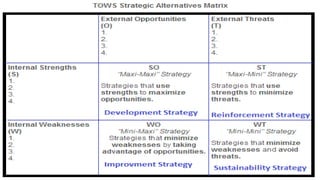
• What is Organization’s SWOT ?
•It is a marketing analysis tool that involves monitoring the external and
internal marketing environment.
•Internal environment (strengths / weakness) analysis:
• A strength is something a firm does well or a characteristic that
enhances its competitiveness.
• A weakness is something a firm lacks, does poorly, or a condition
placing it at a disadvantage
Ahmed Ghoniem 131
The Marketing Analysis
Strength can be …
•Valuable competencies or know-how
•Valuable physical assets
•Valuable human assets
•Valuable organizational assets
•Valuable intangible assets-e.g. “Image”
•Important competitive capabilities
•An attribute that places an organization in a position of competitive advantage
•Alliances with capable partners
Ahmed Ghoniem 132
The Marketing Analysis
Weakness can be …
•Deficiencies in know-how or expertise or competencies
•Lack of important physical, organizational, or intangible assets
•Missing capabilities in key areas
•High unit cost
•Poor relationship with employees / suppliers
Ahmed Ghoniem 133
The Marketing Analysis
External environment (opportunities / Threats) analysis:
• An Opportunity is a factor that the company may be able to exploit to
its advantage.
• An Environmental Threat current and emerging external factors that
may challenge the company’s performance.
Ahmed Ghoniem 134
The Marketing Analysis
Sources of a marketing opportunity…
•Diversify your business interests
•Is to supply an existing product or service in a new or superior way.
•A new product.
•Changes in use of technology opening up opportunities for your business
to utilize these technologies such as Ecommerce or Internet sales
Ahmed Ghoniem 135
The Marketing Analysis
Examples of threats…
•Changing customer tastes
•Technological advances
•Tax increase
•Change in governmental policies
•Closing of geographic markets
Ahmed Ghoniem 136
The Marketing Analysis
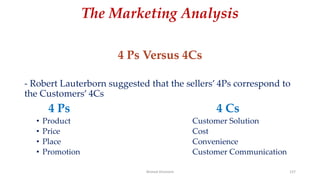
4 Ps Versus 4Cs
- Robert Lauterborn suggested that the sellers’ 4Ps correspond to
the Customers’ 4Cs
4 Ps 4 Cs
• Product Customer Solution
• Price Cost
• Place Convenience
• Promotion Customer Communication
Ahmed Ghoniem 137
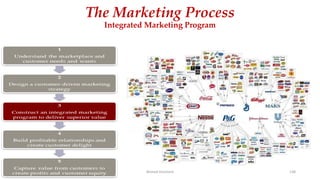
The Marketing Process
Integrated Marketing Program
Ahmed Ghoniem 138
The Marketing Process
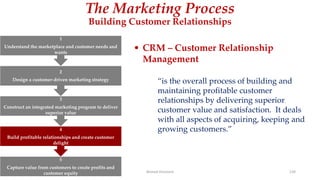
Building Customer Relationships
• CRM – Customer Relationship
Management
“is the overall process of building and
maintaining profitable customer
relationships by delivering superior
customer value and satisfaction. It deals
with all aspects of acquiring, keeping and
growing customers.”
5
Capture value from customers to create profits and
customer equity
4
Build profitable relationships and create customer
delight
3
Construct an integrated marketing program to deliver
superior value
2
Design a customer-driven marketing strategy
1
Understand the marketplace and customer needs and
wants
Ahmed Ghoniem 139
The Marketing Process
Relationship Building Blocks:
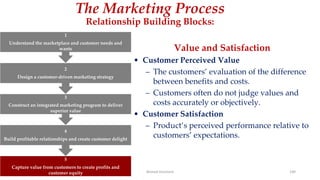
Value and Satisfaction
• Customer Perceived Value
– The customers’ evaluation of the difference
between benefits and costs.
– Customers often do not judge values and
costs accurately or objectively.
• Customer Satisfaction
– Product’s perceived performance relative to
customers’ expectations.
5
Capture value from customers to create profits and
customer equity
4
Build profitable relationships and create customer delight
3
Construct an integrated marketing program to deliver
superior value
2
Design a customer-driven marketing strategy
1
Understand the marketplace and customer needs and
wants
Ahmed Ghoniem 140
The Marketing Process
Customer Relationship
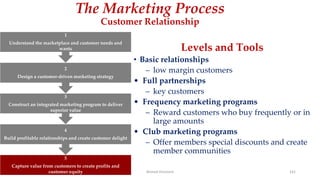
Levels and Tools
• Basic relationships
– low margin customers
• Full partnerships
– key customers
• Frequency marketing programs
– Reward customers who buy frequently or in
large amounts
• Club marketing programs
– Offer members special discounts and create
member communities
5
Capture value from customers to create profits and
customer equity
4
Build profitable relationships and create customer delight
3
Construct an integrated marketing program to deliver
superior value
2
Design a customer-driven marketing strategy
1
Understand the marketplace and customer needs and
wants
Ahmed Ghoniem 141
The Marketing Process
The Changing Nature of Customer Relationships
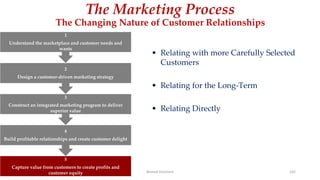
• Relating with more Carefully Selected
Customers
• Relating for the Long-Term
• Relating Directly
5
Capture value from customers to create profits and
customer equity
4
Build profitable relationships and create customer delight
3
Construct an integrated marketing program to deliver
superior value
2
Design a customer-driven marketing strategy
1
Understand the marketplace and customer needs and
wants
Ahmed Ghoniem 142
The Marketing Process
The Changing Nature of Customer Relationships
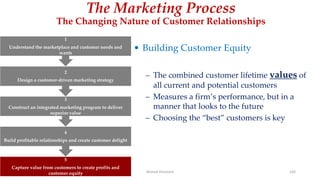
• Building Customer Equity
– The combined customer lifetime values of
all current and potential customers
– Measures a firm’s performance, but in a
manner that looks to the future
– Choosing the “best” customers is key
5
Capture value from customers to create profits and
customer equity
4
Build profitable relationships and create customer delight
3
Construct an integrated marketing program to deliver
superior value
2
Design a customer-driven marketing strategy
1
Understand the marketplace and customer needs and
wants
Ahmed Ghoniem 143
Conclusion
• The process of building profitable customer relationships
by creating value for customers and capturing value in
return
Ahmed Ghoniem 144
H-
Market Segmentation,
Targeting And Positioning
Ahmed Ghoniem 145
Ahmed Ghoniem 146
Ahmed Ghoniem 147
MARKETS
• MARKET SEGMENTS: Groups of customers with different wants,
buying preferences or product-use behavior.
• TARGET MARKET: A market segment for which the seller designs a
marketing mix.
Ahmed Ghoniem 148
Market Segmentation
• A Process of dividing the total market for goods or services into several
smaller, internally homogeneous groups
• Members of each group are similar with respect to the factors that
influence demand.
Ahmed Ghoniem 149
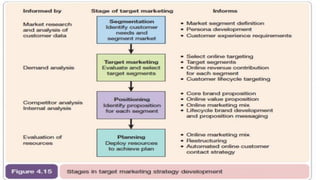
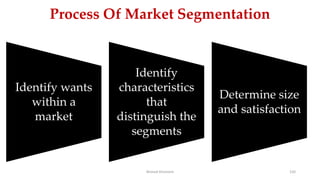
Process Of Market Segmentation
Identify wants
within a
market
Identify
characteristics
that
distinguish the
segments
Determine size
and satisfaction
Ahmed Ghoniem 150
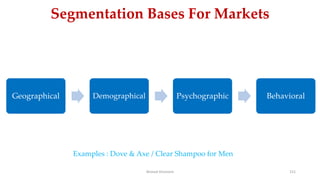
Segmentation Bases For Markets
Geographical Demographical Psychographic Behavioral
Examples : Dove & Axe / Clear Shampoo for Men
Ahmed Ghoniem 151
Segmentation Bases For Markets
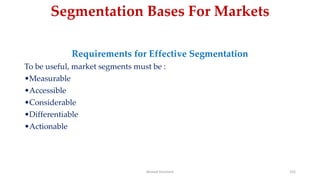
Requirements for Effective Segmentation
To be useful, market segments must be :
•Measurable
•Accessible
•Considerable
•Differentiable
•Actionable
Ahmed Ghoniem 152
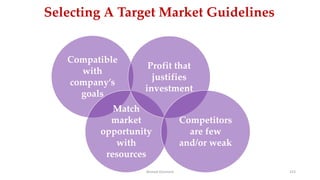
Selecting A Target Market Guidelines
Compatible
with
company’s
goals
Match
market
opportunity
with
resources
Profit that
justifies
investment
Competitors
are few
and/or weak
Ahmed Ghoniem 153
Ahmed Ghoniem 154
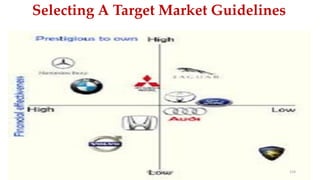
Selecting A Target Market Guidelines
Ahmed Ghoniem 155
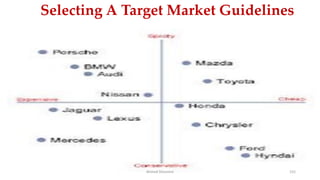
Selecting A Target Market Guidelines
Differentiation and Positioning
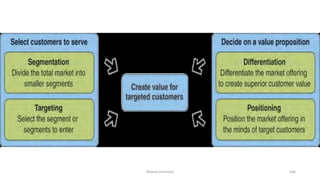
Positioning: Creating and maintaining in the minds of a target
market a particular image relative to competing products
• THREE STEPS:
1- Select position concept
2- Design the feature that conveys position
3- Coordinate the marketing mix to convey position
Ahmed Ghoniem 156
Differentiation and Positioning
Dimensions of product Differentiation :
•Form: size, shape or physical structure ex: aspirin
•Features: ex: telephone (waiting, caller ID…etc)
•Performance quality: is the level at which the product is operating
•Durability: a measure of product’s expected operating life under natural or
stressful conditions ex kitchen appliances, vehicles
•Reliability: measuring product’s malfunction or failure ex home appliance
•Style: Product’s look and feel to the buyer
•Toyota Yaris & Honda positioned as Economy
•Mercedes and Cadillac positioned as Luxury
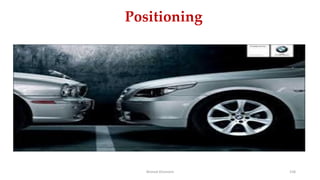
•BMW & Porsche positioned as Performance
Ahmed Ghoniem 157
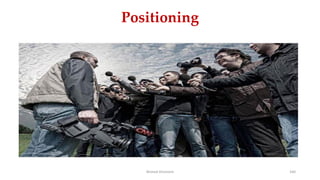
Positioning
Ahmed Ghoniem 158
Positioning
Ahmed Ghoniem 159
Positioning
Ahmed Ghoniem 160
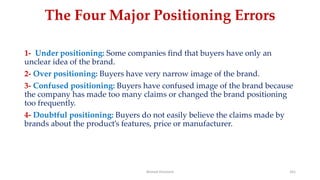
The Four Major Positioning Errors
1- Under positioning: Some companies find that buyers have only an
unclear idea of the brand.
2- Over positioning: Buyers have very narrow image of the brand.
3- Confused positioning: Buyers have confused image of the brand because
the company has made too many claims or changed the brand positioning
too frequently.
4- Doubtful positioning: Buyers do not easily believe the claims made by
brands about the product’s features, price or manufacturer.
Ahmed Ghoniem 161
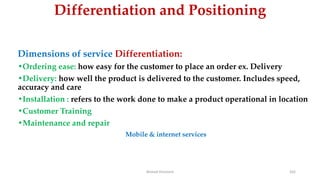
Differentiation and Positioning
Dimensions of service Differentiation:
•Ordering ease: how easy for the customer to place an order ex. Delivery
•Delivery: how well the product is delivered to the customer. Includes speed,
accuracy and care
•Installation : refers to the work done to make a product operational in location
•Customer Training
•Maintenance and repair
Mobile & internet services
Ahmed Ghoniem 162
Ahmed Ghoniem 163
I-
Marketing Strategies
•The Market strategy is “the marketing logic by which the business unit
hopes to achieve its marketing objectives”
•It combines all of its marketing goals into one comprehensive plan. A good
marketing strategy should be drawn from market research ad focus on the
right product mmix in order to achieve the maximum profit potential and
sustain the business. The marketing strategy is the foundation of a
marketing plan.
•There are many marketing strategies that a marketing manager can adopt.
However, the most important ones are:
»Differentiation.
» Un-differentiation.
» Concentration.
» Matching.
» Adaptation
Ahmed Ghoniem 164
Marketing Strategies
Differentiation Strategy
A differentiated marketing strategy is when a company creates campaigns that
appeal to at least two market segments or target groups. For example, a store can
promote a sale that appeals to people in at least two cities or locations, or a
company can market a product that appeals to women in at least two age groups.
Differentiated marketing strategies can target many more than two segments;
shoe companies often create campaigns that appeal to both men and women in a
variety of age groups.
Differentiated marketing strategies can also use different messages in the same
campaign for different segments. For example, a retailer might market low cost to
a budget-conscious segment and product quality to an affluent market segment.
Ahmed Ghoniem 165
Marketing Strategies
Differentiation Strategy
•What :To brand the products of the company in order to attract more customers in a
competitive market. It is a hybrid strategy between un-deffrentiated and concentrated.
•For whom : Customers are differ in needs, behavior, income, occupations, education ..
etc. and have the knowledge to target the differences and willing and able to afford the
cost of differentiation
•With what: highly distinguished products that can be easily linked to the company.
•How : using varieties of differentiating possibilities, including : Form, Features.
Customization, Performance Quality, Product Durability, Style ..etc.
•When : New entries, high number of competitors,
•Disadvantage :
•Highly risky.
•Costly.
•It is based on massive research and development cost.
•Required highly accurate market STP.
Ahmed Ghoniem 166
Marketing Strategies
Un-Differentiation (Standardized) Strategy
• Basically, in an undifferentiated marketing strategy, marketers use the same
message for all segments of the market. This is similar to mass marketing;
marketers typically create a message that appeals to everyone, so the message
is often general or simple to allow more people to relate.
Ahmed Ghoniem 167
Marketing Strategies
Un-Differentiation (Standardized) Strategy
What :To build and develop a unified marketing mix to target different market
segments. (mass market approach).
•For whom : Customers are similar in needs, behavior, income, occupations,
education .. etc
•With what: Similar products.
•How : STP (segmentation, targeting, positioning).
•When : Similar needs – high tech – big number of resources – mass production
•Disadvantage :
•It suppose the similarities in the needs and neglect the customers’
differences
•It is based on massive research and development cost.
•It is a short term strategy.
Ahmed Ghoniem 168
Marketing Strategies
Concentrated Strategy
A concentrated marketing strategy is targeted to one specific market
segment or audience. For example, a company might market a
product specifically for teenage girls, or a retailer might market his
business to residents in a specific town.
Concentrated marketing strategies are often geared for smaller groups
of people, because they are designed to appeal to a specific segment.
Ahmed Ghoniem 169
Marketing Strategies
Concentrated Strategy
•What : approaching and targeting one segment. For example, targeting a specific age or
gender or ethnic group . It is profitable to SMEs whose resources are very limited, because it
enables the company to achieve a strong market position in the specific market segment it
serves without mass production, mass distribution, or mass advertising.
•For whom : to ONE segments only, the well defined
•With what: with highly distinguish product that identify the need this segment only.
•How : intensive and continuous marketing research, strong CRM, .
•Building new brand- acquire an existing one
•When : Limited resources, highly competitive environment, lack of information about the
market as a whole.
Disadvantage :
•Exposed to gain customer satisfaction
•Higher effort and cost to identified segment preferences.
•Pressure to monitor the new entries.
•Difficulties to maintain loyalty.
Ahmed Ghoniem 170
Marketing Strategies Example
• To better understand differentiated, concentrated and undifferentiated
marketing strategies, it helps to look at an example from each perspective.
Assume a restaurant is trying to market its new business.
• Using a differentiated marketing strategy, the restaurant can appeal to the
college crowd by marketing cheap specials on food and drinks, the family
crowd by marketing kid-friendly meal options and table entertainment
and to the elderly by marketing senior discounts and early-bird specials.
• Using a concentrated marketing strategy, the restaurant can market its
convenient location to a group of residents within 10 miles of the business.
Using an undifferentiated marketing strategy, the restaurant can highlight
its grand opening celebration.
Ahmed Ghoniem 171
Marketing Strategies
Adaptation Strategy (Tailoring Marketing)
Modification
• One way to adapt a product to meet a need in the marketplace is to modify it by
changing the features. Some consumers don’t need or want all the bells and
whistles you’re offering, while others are willing to pay more for extra features. A
hair salon that offers a basic wash and cut might start offering perms and tinting,
or bring in a nail professional. A golf manufacturer that’s been unsuccessful
selling high-end bags to country club golfers might add a walking stand and sell
it for a lower price to recreational golfers who play at municipal courses.
Pricing
• The only thing you might need to change about your product to adapt to
customer demand is the price. If you’ve been unsuccessful trying to sell in big
boxes at a bargain price, change your brand and sell it for a higher price in
boutiques and specialty retailers. This might entail changing the name and
packaging to create a higher perceived value. In some cases, you can sell virtually
the same product for different prices if you segment the market correctly with a
careful branding strategy.
Ahmed Ghoniem 172
Marketing Strategies
Adaptation Strategy (Tailoring Marketing)
•What : the necessity to adopt a new strategy based on differentiation in the
culture in the potential new market.
•For whom : Customers are from different culture.
•With what: highly distinguished products that can be easily linked to the
company.
•How : Brand Adaptation – Product Adoption.
•Building new brand- acquire an existing one
•When : Entering new markets with different demographic different
culture.
•Disadvantage :
•Exposed to gain customer satisfaction
•Higher effort and cost to identified customer cultural preferences.
Ahmed Ghoniem 173
Matching Strategy
•Chase Strategy (demand matching strategy): Matching the product to the
needs of the customers
- Think of this strategy in terms of a restaurant, which produces meals only
when a customer orders, therefore matching the actual production with
customer demand.
•Advantage : keeps inventories low; lower costs of capital, production.. Etc
•Disadvantage : high risk because if there is no current demand, there is no
production.
Also, it required high CRM and PRM.
Ahmed Ghoniem 174
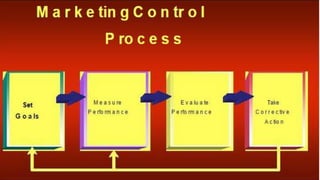
Marketing Control
Marketing control is the process of measuring and evaluating the results
of marketing strategies and plans and making corrective actions to ensure
that the marketing objectives are attained. There are four main steps to be
followed :
1)Set specific Goals : what do we want to achieve.
2)Measure the performance : what is happening?.
3)Evaluate performance : why is it happening? .
4)Take corrective actions : what should we do about it?
Ahmed Ghoniem 175
Ahmed Ghoniem 176
Ahmed Ghoniem 177

Introduction to Marketing Management

  • 1.
  • 2.
    Ahmed Ghoniem 2 AhmedGhoniem Business Consultant | Entrepreneur (+2) 0111863 4115 ahmedghoniem@ymail.com LinkedIn: http://www.linkedin.com/in/ahmedghoniem YouTube: https://www.youtube.com/user/ahmed0ghoniem/videos
  • 3.
    What is thebiggest difference between Marketing & Sales today and 10 years ago? 3 Three things have changed marketing (and buying) forever : 1- THE INTERNET, 2- SMARTPHONES, and 3- SOCIAL MEDIA.
  • 4.
    Marketing Challenges IntoThe New Century • Growth Of Non-profit Marketing • The Information Technology Boom • Rapid Globalization • The Changing World Economy • The Call For More Ethics And Social Responsibility Ahmed Ghoniem 4
  • 5.
    5 What are the10 things that can be marketed? 1- Product 2- Service 3- Event 4- City / Country 5- Person 6- Enterprise 7- Science 8- Research 9- Property 10- Idea
  • 6.
    Some photos abouthow to show an Idea! 6
  • 7.
  • 8.
  • 9.
  • 10.
  • 11.
  • 12.
  • 13.
  • 14.
  • 15.
  • 16.
  • 17.
  • 18.
  • 19.
  • 20.
  • 21.
  • 22.
  • 23.
  • 24.
  • 25.
  • 26.
  • 27.
    Content A- Introduction ToMarketing B- Evolution Of Marketing C- The Marketing Environment D- The Market Research E- The Marketing Process F- Marketing Mix G- The Marketing Analysis H- Market Segmentation, Targeting And Positioning I- Marketing Strategies Ahmed Ghoniem 27
  • 28.
  • 29.
    What is Marketing? •Marketing deals with identifying & meeting human & social needs. • Marketing is a societal process by which individuals and groups obtain what they need through creating , offering and freely exchanging products and services of value with others. • Marketing is the process by which companies create value for customers & build strong customer relationships in order to capture profit from customers in return. Ahmed Ghoniem 29
  • 30.
    Marketing: • “Satisfying customerneeds” • “Meeting needs profitably” • “Generating customer value at a profit” - “Managing profitable customer relationships by delivering superior value to customers” Simply put: Marketing is the delivery of customer satisfaction at a profit Ahmed Ghoniem 30
  • 31.
    Marketing Common subject matters: -The ability to satisfy customers, - The identification of favorable marketing opportunities, - The need to create an edge over competitors, - The capacity to make profits to enable a viable future for the organization, - The use of resources to maximize a business’ market position, - The aim to increase market share mainly in target markets Ahmed Ghoniem 31
  • 32.
    Marketing Defined • Manypeople think of marketing only as selling and advertising. • Selling and advertising are only the tip of the marketing ice-berg. • Marketing is one of 5 key-core functions that are central to all organizations. • Marketers act as the customers’ voice within the firm and marketers are responsible for many more decisions than just advertising or sales: • Analyze industries to identify emerging trends. • Determine which national and international markets to enter or exit. • Conduct research to understand consumer behavior. • Design integrated marketing mixes – products, prices, channels of distribution, and promotion programs. Ahmed Ghoniem 32
  • 33.
    Marketing Definition mustanswer: • What customers will we serve? • How can we serve them best? Ahmed Ghoniem 33
  • 34.
    Marketing VS Market •Market: is a Set of actual and potential products, services and buyers who might transact with a seller. Market = Customer “Market is a mechanism where buyers and sellers meet” Ahmed Ghoniem 34
  • 35.
    What is differencebetween client and a customer and a consumer? Well, they are all customers really but : - A client is more of a business term for a person who returns again to their business and who they have regular dealings with, including lawyers, doctors, beauticians, banks etc. - A consumer is someone who uses the products, this includes eating, drinking or buying make-up or food and general goods. - A customer is anyone who is spending the money! Ahmed Ghoniem 35
  • 36.
    Marketing Common Mistakes •We have no competition. • It’s a great idea, so people will want it. • I want one, so there must be a market. • It’s growing market, I can’t miss • No rational customer would say NO Ahmed Ghoniem 36
  • 37.
  • 38.
  • 39.
    • How marketinghas become “Marketing” as we understand it and apply its practices today? Ahmed Ghoniem 39
  • 40.
    Evolution Of MarketingThought • Production Era (1850s-1920s) - Industrial revolution; mass production - Few products and little competition • Sales Era (1920s-1950s) - The focus was on personal selling and advertising - Sales seen as the major means for increasing profits • Marketing Era (1950s-present) - Customer Orientation replaced the “hard sell” of the sales-led era - Determination of the needs and wants of customers before introducing products or services Ahmed Ghoniem 40
  • 41.
    Evolution Of MarketingThought • Relationship Marketing Era: 1990s- • Marketing era has recently shifted from being “transaction-based” : to focusing on “relationships” • The argument & traditional marketing practices focused on attracting new customers rather than retaining existing ones. • It is equally important to hang on to existing customers so that they become repeat buyers and long term loyal customers. “Customer Relationship Management, CRM”! Ahmed Ghoniem 41
  • 42.
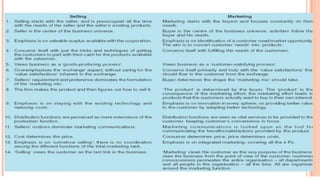
    Marketing 1.0 Product-centric Marketing 2.0 Consumer-centric Marketing3.0 Value-centric Objective Sell products to the masses Satisfy customers & brand loyalty Meet emotional and rational needs of consumers Enabling Forces Industrial Revolution Information technology Connectedness of consumers How marketers see the market Mass market Smarter consumers & mass market People instead of segments Key Marketing Concept Product driven market Differentiation Value of product to consumers emotions Value Propositions Functional Functional & emotional Functional, emotional & rational Interaction with consumers Mass communication Micro segmentation Consumers collaborate with each other Power of branding Marketers/companies Marketers/consumers Consumers Marketing is changing again
  • 43.
    Ahmed Ghoniem 43 Morecollaboration tools means more trust between consumers
  • 44.
  • 45.
    The Marketing Environment -The factors and forces outside marketing that affect marketing management ability to build and maintain successful relationships with target customers. • Macro Environment (PESTEL) - Political Factors - Economic Factors - Social / Cultural Factors - Technological Factors - Environmental Factors - Legal Factors • Micro Environment - Customers - Suppliers - Competitors - New Comers Ahmed Ghoniem 45
  • 46.
    The Marketing Environment Macroenvironment 1. Political Factors: These are all about how and to what degree a government intervenes in the economy. This can include: • Governmental regulations & rules • Tax regime • Trade policies • Special interests It is clear from the list above that political factors often have an impact on organizations and how they do business. Organizations need to be able to respond to the current and anticipated future legislation, and adjust their marketing policy accordingly. Ahmed Ghoniem 46
  • 47.
    The Marketing Environment Macroenvironment 2. Economic Factors: Economic factors have a significant impact on how an organization does business and also how profitable they are. Factors include: • Changes in Income • Changing customer spending patterns • Unemployment • Inflation • Increase Rate These factors can be further broken down into macro-economical and micro- economical factors. Macro-economical factors deal with the management of demand in any given economy. Governments use interest rate control, taxation policy and government expenditure as their main mechanisms they use for this. Micro-economic factors are all about the way people spend their incomes. This has a large impact on B2C organizations in particular. Ahmed Ghoniem 47
  • 48.
    The Marketing Environment Macroenvironment • 3.Social Factors: Also known as socio-cultural factors, are the areas that involve the shared belief and attitudes of the population. These factors include: • population growth, • age distribution, • health consciousness, • career attitudes and so on. These factors are of particular interest as they have a direct effect on how marketers understand customers and what drives them. Ahmed Ghoniem 48
  • 49.
    The Marketing Environment Macroenvironment 4.Technological Factors: forces that create new technologies, creating new products and opportunities We all know how fast the technological landscape changes and how this impacts the way we market our products. Technological factors affect marketing and the management thereof in three distinct ways: • New ways of producing goods and services • New ways of distributing goods and services • New ways of communicating with target markets Examples mobiles; laptops, robotic surgery ..etc. Google glass Galaxy Gear Ahmed Ghoniem 49
  • 50.
    The Marketing Environment Macroenvironment 5. Environmental Factors: These factors have only really become reality in the last fifteen years or so. They have become important due to • Increasing shortage of raw materials, • Increased pollution • Energy Sources (this is a good example were one factor could be classes as political and environmental at the same time). • These are just some of the issues marketers are facing within this factor. More and more consumers are demanding that the products they buy are sourced ethically, and if possible from a sustainable source. Ahmed Ghoniem 50
  • 51.
    The Marketing Environment Macroenvironment 6. Legal Factors: include: • Health and safety, • Equal opportunities, • Advertising standards, • Consumer rights and laws, • Product labelling and product safety. It is clear that companies need to know what is and what is not legal in order to trade successfully. If an organization trades globally this becomes a very tricky area to get right as each country has its own set of rules and regulations. Ahmed Ghoniem 51
  • 52.
    The Marketing Environment Microenvironment 1.Customers : -Consumer Markets: (B2C) consists of individuals & households -Business Markets: (B2B) buy goods & services for further processing -Reseller Markets: (NGO) buy goods & services to resell at a profit -Government Markets: government agencies that buy goods & services to produce public services -International / Global Markets; consists of buyers in other countries as consumers, producers, resellers….etc Ahmed Ghoniem 52
  • 53.
    The Marketing Environment Microenvironment 2.Competitors: 3.Suppliers; supply problems that affect the marketing can be supply shortage, or delays, labor strikes , supply costs …etc 4. New Comers: Ahmed Ghoniem 53
  • 54.
    Porter’s Five ForcesAnalysis Ahmed Ghoniem 54
  • 55.
  • 56.
    Porter’s Five ForcesAnalysis • Understanding the Tool • Five Forces Analysis assumes that there are five important forces that determine competitive power in a business situation. These are: 1- Supplier Power: Here you assess how easy it is for suppliers to drive up prices. This is driven by the number of suppliers of each key input, the uniqueness of their product or service, their strength and control over you, the cost of switching from one to another, and so on. The fewer the supplier choices you have, and the more you need suppliers' help, the more powerful your suppliers are. Ahmed Ghoniem 56
  • 57.
    Porter’s Five ForcesAnalysis 2- Buyer Power: Here you ask yourself how easy it is for buyers to drive prices down. Again, this is driven by the number of buyers, the importance of each individual buyer to your business, the cost to them of switching from your products and services to those of someone else, and so on. If you deal with few, powerful buyers, then they are often able to dictate terms to you. 3- Competitive Rivalry: What is important here is the number and capability of your competitors. If you have many competitors, and they offer equally attractive products and services, then you'll most likely have little power in the situation, because suppliers and buyers will go elsewhere if they don't get a good deal from you. On the other hand, if no-one else can do what you do, then you can often have tremendous strength. Ahmed Ghoniem 57
  • 58.
    Porter’s Five ForcesAnalysis 4- Threat of Substitution: This is affected by the ability of your customers to find a different way of doing what you do – for example, if you supply a unique software product that automates an important process, people may substitute by doing the process manually or by outsourcing it. If substitution is easy and substitution is viable, then this weakens your power. 5- Threat of New Entry: Power is also affected by the ability of people to enter your market. If it costs little in time or money to enter your market and compete effectively, if there are few economies of scale in place, or if you have little protection for your key technologies, then new competitors can quickly enter your market and weaken your position. If you have strong and durable barriers to entry, then you can preserve a favorable position and take fair advantage of it. Ahmed Ghoniem 58
  • 59.
    Ahmed Ghoniem 59 PurchaseDecision Process
  • 60.
    Ahmed Ghoniem 60 PurchaseDecision Process
  • 61.
    Business Buying Process 1.Problem recognition 2. Need description 3. Product spec. 4. Supplier search 5. Suppliers invited to submit proposals 6. Technical & financial comparison 7. Negotiation & selection 8. Purchase Order (PO) 9. Delivery & inspection 10. Approval 11. Payment Ahmed Ghoniem 61
  • 62.
    Competitive advantages A- Internal -Product - Services - Personnel - Image Ahmed Ghoniem 62 B- External -Supplier -Distribution -Customer
  • 63.
    Competitive Advantages Strategies 4types of competition: 1. Cost Leadership: to be lowest price / Mass Production / Low Quality Ex. China 1. Cost Focus: less price for selected segment / Good product / Good Quality. Ex. ONE in Carrefour 1. Differentiate Focus: high price for something different / Very good Product / Very good Quality. Ex. Nike – Adidas 1. Differentiate Leadership: more higher price for different product / Maximum Quality Ex. Apple - Mercedes Ahmed Ghoniem 63
  • 64.
    Ahmed Ghoniem 64 D- TheMarket Research
  • 65.
    Questions to putin mind……. • Who are our existing / potential customers? • What are their current / future needs? • How can we satisfy these needs? • Can we offer a product/ service that the customer would value? • Can we communicate with our customers? • Can we deliver a competitive product or service? • Why should customers buy from us? Ahmed Ghoniem 65
  • 66.
    Market Research VSMarketing Plan • Determine the needs of the customers through “ Market Research ” • Analyse your competitive advantages to develop “ Marketing Plan “ Ahmed Ghoniem 66
  • 67.
    Marketing Research Model (DECIDE) D— Define the marketing problem E — Enumerate the controllable and uncontrollable decision factors C — Collect relevant information I — Identify the best alternative D — Develop and implement a marketing plan E — Evaluate the decision Ahmed Ghoniem 67
  • 68.
    Types of Marketingresearch: • Two types: • Primary (New Data) • Secondary (Already Existing Data) • How can we get primary / secondary data ??? • Which is more expensive??? • Which needs more efforts ??? • Which is more time consuming ??? Ahmed Ghoniem 68
  • 69.
    Types of Marketingresearch: Ahmed Ghoniem 69
  • 70.
    Focus Groups (Indepth interviews): • It is a group of people who are asked about their attitude towards a product, service, concept, advertisement, idea, or packaging. • Questions are asked in an interactive group setting where participants are free to talk with other group members. • Focus groups are a powerful means to evaluate services or test new ideas. • Basically, focus groups are interviews, but of 6-10 people at the same time in the same group. One can get a great deal of information during a focus group session. Ahmed Ghoniem 70
  • 71.
    Survey • Are themost widely used set of methods in market research. • The Questionnaire is the common method for collecting data from a survey. • Surveys can be conducted by mail, face-to-face, telephone, email or Web. Ahmed Ghoniem 71
  • 72.
    Marketing research insmall & non- profit organizations • Marketing research does not only occur in huge corporations with many employees and a large budget. • Small scale surveys and focus groups are low cost ways to gather information from potential and existing customers. • Most secondary data (statistics, demographics, etc.) is available to the public in libraries or on the internet and can be easily accessed by a small business owner. Ahmed Ghoniem 72
  • 73.
    Ahmed Ghoniem 73 E- TheMarketing Process
  • 74.
  • 75.
    The Marketing Process 1 Understand the marketplace andcustomer needs and wants 2 Design a customer- driven marketing strategy 3 Construct an integrated marketing program to deliver superior value 4 Build profitable relationships and create customer delight 5 Capture value from customers to create profits and customer objectivity Create value for customers and build customer relationships Capture value from customers in return Ahmed Ghoniem 75
  • 76.
    The Marketing Process Understandingthe Marketplace 1- Needs, Wants, & Demands 2- Market Offerings (Products & Services) 3- Value & Satisfaction 4- Exchange & Relationships 5- Markets Ahmed Ghoniem 76
  • 77.
    The Marketing Process Understandingthe Marketplace Ahmed Ghoniem 77 1- Customer Needs, Wants and Demands • Needs: are the basic human requirements: as food, air, water.. etc. Ex: want to eat. • Wants: when they are directed to specific objects that might satisfy the need Ex: want to eat Burger. • Demands: are wants for specific products backed by an ability to pay. Ex: want to eat Big Mac
  • 78.
  • 79.
  • 80.
  • 81.
    The Marketing Process Understandingthe Marketplace 2- Marketing offer - Combination of products, services, information or experiences that satisfy a need or want. - Offer may include services, activities, people, places, information or ideas. Ahmed Ghoniem 81
  • 82.
    The Marketing Process Understandingthe Marketplace 2- Marketing offer cont’d Difference Between Products & Services • Product: Anything that can be offered to a market to satisfy a need or want • Services: Activities or benefits offered for sale that are essentially intangible and don’t result in the ownership of anything. Ahmed Ghoniem 82
  • 83.
    The Marketing Process Understandingthe Marketplace 2- Marketing offer: cont’d Products & Services Life Cycle (Marketing System) Ahmed Ghoniem 83
  • 84.
    The Marketing Process Understandingthe Marketplace 3- Value & Satisfaction • Value = Benefit / Cost – Customers form expectations regarding value. – Marketers must deliver value to consumers. • Satisfaction – A satisfied customer will buy again and tell others about their good experience. Ahmed Ghoniem 84
  • 85.
    The Marketing Process Understandingthe Marketplace Value Gained From Owning a Product and Costs of Obtaining the Product is “Customer Value” Product’s Perceived Performance in Delivering Value Relative to Buyer’s Expectations is “Customer Satisfaction” Total Quality Management Involves Improving the Quality of Products, Services, and Marketing Processes Ahmed Ghoniem 85 3- Value & Satisfaction cont’d
  • 86.
    The Marketing Process Understandingthe Marketplace 4- Exchange & Relationships • Exchange: - The act of obtaining a desired object from someone by offering something in return - One exchange is not the goal, relationships with several exchanges are the goal • Relationships: are built through delivering value and satisfaction - Marketing network: consists of the company and all its supporting stakeholders Ahmed Ghoniem 86
  • 87.
    The Marketing Process Understandingthe Marketplace 5- Markets • Set of actual and potential products, services and buyers of a product experiences • Marketers seek buyers that are profitable. Ahmed Ghoniem 87
  • 88.
    The Marketing Process Understandingthe Marketplace Ahmed Ghoniem 88 Customer looks for Value Value = Benefit / Cost Benefit = Functional Benefit + Emotional Benefit Cost = Financial Cost + Time Cost + Energy Cost + Psychical Cost
  • 89.
    The Marketing Process •How is a strategy different from a plan? • A winning marketing strategy asks: – What customers will we serve? – How can we serve these customers best? • Marketing management is “the art and science of choosing target markets and building profitable relationships with them.” Ahmed Ghoniem 89
  • 90.
    The Marketing Process •What customers will we serve ? (what is our target market) – Market Segmentation & Target Marketing – Why not serve all customers? Example: Carrefour vs. Metro vs. Awlad Ragab Ahmed Ghoniem 90
  • 91.
    The Marketing Process •How can we serve these customers best ? (what is our value proposition) – Brand Differentiation & Positioning – Define a strong value proposition – – Why should a customer buy our brand rather than a competitor’s? Example: Volvo vs. Mercedes Ahmed Ghoniem 91
  • 92.
    The Marketing Process •Marketing Management Orientations – What philosophy should guide the design of marketing strategies? FISH Philosophy Ahmed Ghoniem 92
  • 93.
  • 94.
    • Choose yourattitude: It's about accepting responsibility for the choices you make. • Play: It's about having fun, enjoying yourself, being spontaneous and creative. • Make their Day: It's about doing somethings special for others. • Be There: It's about being focused on the person or task you are working on. Why Fish philosophy? Provide amazing service that makes customers want to come back again and again. Build a culture where employees love to give their best every day. Build effective leaders who inspire through their example. Improve teamwork and build trust. Ahmed Ghoniem 94 FISH Philosophy
  • 95.
    The Marketing Process Customer-DrivenMarketing Strategies Societal Concept 4- Marketing Concept 3- Selling Concept 2- Product Concept 1- Production Concept Ahmed Ghoniem 95
  • 96.
    The Marketing Process Customer-DrivenMarketing Strategies 1- Production Concept • Consumers will favor those products that are widely available and low in cost (highly affordable) • Managers concentrate on achieving high production efficiency and wide distribution. • The assumption is valid at least in 2 situations: -The demand for a product exceeds supply, (suppliers will concentrate on finding ways to increase production) - The product’s cost is high and has to be decreased to expand the market. Ahmed Ghoniem 96
  • 97.
    The Marketing Process Customer-DrivenMarketing Strategies 2-Product Concept • Consumers will favor those products that offer the most quality, performance or innovative features. • Managers in product-oriented organizations concentrate on making superior products and improving them over time. • The assumption : the customers will admire well-made products and can evaluate product quality and performance. • This concept may lead to Marketing Myopia* * Fear or Poor sight of marketing • Example: Coca-Cola / Lenovo Ahmed Ghoniem 97
  • 98.
    The Marketing Process Customer-DrivenMarketing Strategies 3- Selling Concept Aggressive selling and promotion Push & Pull Strategy Assumptions are: -Consumers must be convinced of buying company products - Company is powerful in generating effective selling and promotion to stimulate more buying • This concept is mostly used by firms which have overcapacity. • The aim is “to sell what they make” rather than “make what the market wants.” • Short-term profits are more important (customer dissatisfaction may occur) Example: good in cases such as Blood Donations. Too much focus on selling transactions rather than relationships, and assumes buyers will like what they buy or forget they disliked it Ahmed Ghoniem 98
  • 99.
    The Marketing Process Customer-DrivenMarketing Strategies 4- Marketing Concept • Key to achieving organizational goals consists of being more effective than competitors in creating, delivering and communicating customer value to target markets. • 4 pillars of modern marketing : 1. Target market 2. Customer needs 3. Integrated marketing 4. Profitability through customer satisfaction Ahmed Ghoniem 99
  • 100.
    The Marketing Process Customer-DrivenMarketing Strategies 4- Marketing Concept 1) Target market: homogenous group of customers to whom the company wishes to appeal 2) Customer needs: • Consumers may not be fully conscious of their needs • It may not be easy to articulate these needs • They may use words that require some interpretation • Customer-oriented thinking: to define customer needs from the customer’s point of view • Sales revenue: New customers + Repeat customers • “Customer Retention” vs. “Customer Attraction” • Customer satisfaction is a function of the product perceived performance and buyer’s expectations Ahmed Ghoniem 100
  • 101.
    The Marketing Process Customer-DrivenMarketing Strategies 4- Marketing Concept 3) Integrated Marketing 1- Various marketing functions must work together for customer satisfaction (coordination of 4Ps / 7Ps Marketing Mix elements) 2- Marketing Mix: controllable variables the company puts together to satisfy its target market(s). - Product: Product variety, quality, design, features, brand name, packaging, sizes, services, warranties, returns - Price: List price, discounts, allowances, payment period, credit terms - Promotion: Sales promotion, advertising, sales force, public relations, direct marketing. - Place: Channels, coverage, assortments, locations, inventory, transport. Ahmed Ghoniem 101
  • 102.
    The Marketing Process Customer-DrivenMarketing Strategies 4- Marketing Concept • The marketing program transforms the marketing strategy into action. • The Marketing Mix (4Ps)(7Ps) is the set of marketing tools the firm uses to implement its marketing strategy. Example: fast food companies: MacDonald, Hardees, KFC, etc. Ahmed Ghoniem 102
  • 103.
    The Marketing Process Customer-DrivenMarketing Strategies 4- Marketing Concept 3) Integrated Marketing (cont’d) 3- Marketing must be well coordinated with other departments in the company; all departments have to work together to satisfy customers’ needs and wants 4) Profitability through customer satisfaction - To achieve profits as a result of creating superior customer value Ahmed Ghoniem 103
  • 104.
    The Marketing Process Customer-DrivenMarketing Strategies 5- Societal Concept The Societal / Collective Marketing Concept The idea that a company’s marketing decisions should consider: • Consumers’ wants, • The company’s requirements, consumers’ • Long-run interests, and • Society’s long-run interests. Example: fast food companies: MacDonald, Hardees Ahmed Ghoniem 104
  • 105.
  • 106.
    The Marketing Mix IntegratedMarketing Program Ahmed Ghoniem 106
  • 107.
    The Marketing Mix IntegratedMarketing Program Ahmed Ghoniem 107
  • 108.
    The Marketing Mix IntegratedMarketing Program Ahmed Ghoniem 108
  • 109.
  • 110.
    The Marketing Mix IntegratedMarketing Program Ahmed Ghoniem 110
  • 111.
    The Marketing Mix 1-Product Products include physical objects, services, events, persons, places, ideas…etc 1.Consumer Products 2.Industrial Products Ahmed Ghoniem 111
  • 112.
    The Marketing Mix ProductLife Cycle Ahmed Ghoniem 112
  • 113.
    The Marketing Mix AhmedGhoniem 113 Three Levels Of Product
  • 114.
    The Marketing Mix 2-Place •Refers to how an organization will distribute the product or service they are offering to the end user. •The organization must distribute the product to the user at the right place at the right time. •Two types of channel of distribution methods are available; Ahmed Ghoniem 114
  • 115.
    The Marketing Mix 3-Price It is the amount of money charged for a product or service, it is agreed upon that the price offered must cover the cost of the product and return a profit to the producer . There are 5 marketing objectives to determine the price of a product : a. Maximize short term profit b. Maximize current market share c. Market skimming d. Product quality leadership e. Survival Ahmed Ghoniem 115
  • 116.
    The Marketing Mix 4-Promotion There are 5 different key types of promotion : 1.Advertising 2.Sales Promotion 3.Public Relations 4.Personal Selling 5.Direct Marketing Ahmed Ghoniem 116
  • 117.
    The Marketing Mix Promotion 4.1Advertising •Popular means of reaching a target audience. •Cost effective way to build awareness. •To create a good ad, the marketer must create a message that is distinct, meaningful and credible. •There are many advertising 'media' such as newspapers, magazines and journals, television, cinema, outdoor advertising (such as posters, bus sides). Ahmed Ghoniem 117
  • 118.
    Ahmed Ghoniem 118 TheMarketing Mix Promotion
  • 119.
    Ahmed Ghoniem 119 TheMarketing Mix Promotion
  • 120.
    The Marketing Mix Promotion 4.2Sales Promotion •Short term incentive to encourage customers to make a purchase. •There are many sales promotion types as : a. Advertising Specialties: A product imprinted with a logo as mugs, T-shirts. Etc b. Cash Rebates: A partial refund to the buyer c. Discounting : reducing the listed price for a limited period of time d. Coupons e. Samples N.B: Advertising offers reasons to buy a product or service, sales promotion offers reasons to buy now Ahmed Ghoniem 120
  • 121.
    The Marketing Mix Promotion 4.3Public Relations •Used to obtain favorable publicity, building good corporate image and handling unfavorable rumors, stories and events •Influence the public beliefs, feelings and opinions about the company . •Mass promotion tool & cheap •There are several types of public relations : a. Written material as brochures, magazines, articles etc b. Special Events as presentations, conferences c. Public Service Activities as donating money, volunteers or resources to activities designed to a social cause d. Speeches as giving talks Ahmed Ghoniem 121
  • 122.
    The Marketing Mix Promotion 4.4Personal Selling •Personal presentation by the firm’s sales force for the purpose of making sales & building customer relations •The sales message can be customized to meet the needs of the customer. •Involves 2 way personal communication as face-to-face, by telephone, through video or web conference. SALES PROCESS Ahmed Ghoniem 122
  • 123.
  • 124.
    The Marketing Mix Promotion 4.5Direct Marketing Direct marketing is a type of advertising campaign that seeks to elicit an action (such as an order, a visit to a store or Web site, or a request for further information) from a selected group of consumers in response to a communication from the marketer. •Types of direct marketing: •Direct Mail •Telemarketing •Email Marketing •Catalogs •Websites Ahmed Ghoniem 124
  • 125.
    Ahmed Ghoniem 125 TheMarketing Mix Promotion
  • 126.
    Ahmed Ghoniem 126 G- TheMarketing Analysis
  • 127.
  • 128.
    The Marketing Analysis SWOTAnalysis Build on your Strengths Recognize your Weakness Evaluate your Opportunities Research your Threats Ahmed Ghoniem 128
  • 129.
  • 130.
  • 131.
    The Marketing Analysis •What is Organization’s SWOT ? •It is a marketing analysis tool that involves monitoring the external and internal marketing environment. •Internal environment (strengths / weakness) analysis: • A strength is something a firm does well or a characteristic that enhances its competitiveness. • A weakness is something a firm lacks, does poorly, or a condition placing it at a disadvantage Ahmed Ghoniem 131
  • 132.
    The Marketing Analysis Strengthcan be … •Valuable competencies or know-how •Valuable physical assets •Valuable human assets •Valuable organizational assets •Valuable intangible assets-e.g. “Image” •Important competitive capabilities •An attribute that places an organization in a position of competitive advantage •Alliances with capable partners Ahmed Ghoniem 132
  • 133.
    The Marketing Analysis Weaknesscan be … •Deficiencies in know-how or expertise or competencies •Lack of important physical, organizational, or intangible assets •Missing capabilities in key areas •High unit cost •Poor relationship with employees / suppliers Ahmed Ghoniem 133
  • 134.
    The Marketing Analysis Externalenvironment (opportunities / Threats) analysis: • An Opportunity is a factor that the company may be able to exploit to its advantage. • An Environmental Threat current and emerging external factors that may challenge the company’s performance. Ahmed Ghoniem 134
  • 135.
    The Marketing Analysis Sourcesof a marketing opportunity… •Diversify your business interests •Is to supply an existing product or service in a new or superior way. •A new product. •Changes in use of technology opening up opportunities for your business to utilize these technologies such as Ecommerce or Internet sales Ahmed Ghoniem 135
  • 136.
    The Marketing Analysis Examplesof threats… •Changing customer tastes •Technological advances •Tax increase •Change in governmental policies •Closing of geographic markets Ahmed Ghoniem 136
  • 137.
    The Marketing Analysis 4Ps Versus 4Cs - Robert Lauterborn suggested that the sellers’ 4Ps correspond to the Customers’ 4Cs 4 Ps 4 Cs • Product Customer Solution • Price Cost • Place Convenience • Promotion Customer Communication Ahmed Ghoniem 137
  • 138.
    The Marketing Process IntegratedMarketing Program Ahmed Ghoniem 138
  • 139.
    The Marketing Process BuildingCustomer Relationships • CRM – Customer Relationship Management “is the overall process of building and maintaining profitable customer relationships by delivering superior customer value and satisfaction. It deals with all aspects of acquiring, keeping and growing customers.” 5 Capture value from customers to create profits and customer equity 4 Build profitable relationships and create customer delight 3 Construct an integrated marketing program to deliver superior value 2 Design a customer-driven marketing strategy 1 Understand the marketplace and customer needs and wants Ahmed Ghoniem 139
  • 140.
    The Marketing Process RelationshipBuilding Blocks: Value and Satisfaction • Customer Perceived Value – The customers’ evaluation of the difference between benefits and costs. – Customers often do not judge values and costs accurately or objectively. • Customer Satisfaction – Product’s perceived performance relative to customers’ expectations. 5 Capture value from customers to create profits and customer equity 4 Build profitable relationships and create customer delight 3 Construct an integrated marketing program to deliver superior value 2 Design a customer-driven marketing strategy 1 Understand the marketplace and customer needs and wants Ahmed Ghoniem 140
  • 141.
    The Marketing Process CustomerRelationship Levels and Tools • Basic relationships – low margin customers • Full partnerships – key customers • Frequency marketing programs – Reward customers who buy frequently or in large amounts • Club marketing programs – Offer members special discounts and create member communities 5 Capture value from customers to create profits and customer equity 4 Build profitable relationships and create customer delight 3 Construct an integrated marketing program to deliver superior value 2 Design a customer-driven marketing strategy 1 Understand the marketplace and customer needs and wants Ahmed Ghoniem 141
  • 142.
    The Marketing Process TheChanging Nature of Customer Relationships • Relating with more Carefully Selected Customers • Relating for the Long-Term • Relating Directly 5 Capture value from customers to create profits and customer equity 4 Build profitable relationships and create customer delight 3 Construct an integrated marketing program to deliver superior value 2 Design a customer-driven marketing strategy 1 Understand the marketplace and customer needs and wants Ahmed Ghoniem 142
  • 143.
    The Marketing Process TheChanging Nature of Customer Relationships • Building Customer Equity – The combined customer lifetime values of all current and potential customers – Measures a firm’s performance, but in a manner that looks to the future – Choosing the “best” customers is key 5 Capture value from customers to create profits and customer equity 4 Build profitable relationships and create customer delight 3 Construct an integrated marketing program to deliver superior value 2 Design a customer-driven marketing strategy 1 Understand the marketplace and customer needs and wants Ahmed Ghoniem 143
  • 144.
    Conclusion • The processof building profitable customer relationships by creating value for customers and capturing value in return Ahmed Ghoniem 144
  • 145.
    H- Market Segmentation, Targeting AndPositioning Ahmed Ghoniem 145
  • 146.
  • 147.
  • 148.
    MARKETS • MARKET SEGMENTS:Groups of customers with different wants, buying preferences or product-use behavior. • TARGET MARKET: A market segment for which the seller designs a marketing mix. Ahmed Ghoniem 148
  • 149.
    Market Segmentation • AProcess of dividing the total market for goods or services into several smaller, internally homogeneous groups • Members of each group are similar with respect to the factors that influence demand. Ahmed Ghoniem 149
  • 150.
    Process Of MarketSegmentation Identify wants within a market Identify characteristics that distinguish the segments Determine size and satisfaction Ahmed Ghoniem 150
  • 151.
    Segmentation Bases ForMarkets Geographical Demographical Psychographic Behavioral Examples : Dove & Axe / Clear Shampoo for Men Ahmed Ghoniem 151
  • 152.
    Segmentation Bases ForMarkets Requirements for Effective Segmentation To be useful, market segments must be : •Measurable •Accessible •Considerable •Differentiable •Actionable Ahmed Ghoniem 152
  • 153.
    Selecting A TargetMarket Guidelines Compatible with company’s goals Match market opportunity with resources Profit that justifies investment Competitors are few and/or weak Ahmed Ghoniem 153
  • 154.
    Ahmed Ghoniem 154 SelectingA Target Market Guidelines
  • 155.
    Ahmed Ghoniem 155 SelectingA Target Market Guidelines
  • 156.
    Differentiation and Positioning Positioning:Creating and maintaining in the minds of a target market a particular image relative to competing products • THREE STEPS: 1- Select position concept 2- Design the feature that conveys position 3- Coordinate the marketing mix to convey position Ahmed Ghoniem 156
  • 157.
    Differentiation and Positioning Dimensionsof product Differentiation : •Form: size, shape or physical structure ex: aspirin •Features: ex: telephone (waiting, caller ID…etc) •Performance quality: is the level at which the product is operating •Durability: a measure of product’s expected operating life under natural or stressful conditions ex kitchen appliances, vehicles •Reliability: measuring product’s malfunction or failure ex home appliance •Style: Product’s look and feel to the buyer •Toyota Yaris & Honda positioned as Economy •Mercedes and Cadillac positioned as Luxury •BMW & Porsche positioned as Performance Ahmed Ghoniem 157
  • 158.
  • 159.
  • 160.
  • 161.
    The Four MajorPositioning Errors 1- Under positioning: Some companies find that buyers have only an unclear idea of the brand. 2- Over positioning: Buyers have very narrow image of the brand. 3- Confused positioning: Buyers have confused image of the brand because the company has made too many claims or changed the brand positioning too frequently. 4- Doubtful positioning: Buyers do not easily believe the claims made by brands about the product’s features, price or manufacturer. Ahmed Ghoniem 161
  • 162.
    Differentiation and Positioning Dimensionsof service Differentiation: •Ordering ease: how easy for the customer to place an order ex. Delivery •Delivery: how well the product is delivered to the customer. Includes speed, accuracy and care •Installation : refers to the work done to make a product operational in location •Customer Training •Maintenance and repair Mobile & internet services Ahmed Ghoniem 162
  • 163.
  • 164.
    Marketing Strategies •The Marketstrategy is “the marketing logic by which the business unit hopes to achieve its marketing objectives” •It combines all of its marketing goals into one comprehensive plan. A good marketing strategy should be drawn from market research ad focus on the right product mmix in order to achieve the maximum profit potential and sustain the business. The marketing strategy is the foundation of a marketing plan. •There are many marketing strategies that a marketing manager can adopt. However, the most important ones are: »Differentiation. » Un-differentiation. » Concentration. » Matching. » Adaptation Ahmed Ghoniem 164
  • 165.
    Marketing Strategies Differentiation Strategy Adifferentiated marketing strategy is when a company creates campaigns that appeal to at least two market segments or target groups. For example, a store can promote a sale that appeals to people in at least two cities or locations, or a company can market a product that appeals to women in at least two age groups. Differentiated marketing strategies can target many more than two segments; shoe companies often create campaigns that appeal to both men and women in a variety of age groups. Differentiated marketing strategies can also use different messages in the same campaign for different segments. For example, a retailer might market low cost to a budget-conscious segment and product quality to an affluent market segment. Ahmed Ghoniem 165
  • 166.
    Marketing Strategies Differentiation Strategy •What:To brand the products of the company in order to attract more customers in a competitive market. It is a hybrid strategy between un-deffrentiated and concentrated. •For whom : Customers are differ in needs, behavior, income, occupations, education .. etc. and have the knowledge to target the differences and willing and able to afford the cost of differentiation •With what: highly distinguished products that can be easily linked to the company. •How : using varieties of differentiating possibilities, including : Form, Features. Customization, Performance Quality, Product Durability, Style ..etc. •When : New entries, high number of competitors, •Disadvantage : •Highly risky. •Costly. •It is based on massive research and development cost. •Required highly accurate market STP. Ahmed Ghoniem 166
  • 167.
    Marketing Strategies Un-Differentiation (Standardized)Strategy • Basically, in an undifferentiated marketing strategy, marketers use the same message for all segments of the market. This is similar to mass marketing; marketers typically create a message that appeals to everyone, so the message is often general or simple to allow more people to relate. Ahmed Ghoniem 167
  • 168.
    Marketing Strategies Un-Differentiation (Standardized)Strategy What :To build and develop a unified marketing mix to target different market segments. (mass market approach). •For whom : Customers are similar in needs, behavior, income, occupations, education .. etc •With what: Similar products. •How : STP (segmentation, targeting, positioning). •When : Similar needs – high tech – big number of resources – mass production •Disadvantage : •It suppose the similarities in the needs and neglect the customers’ differences •It is based on massive research and development cost. •It is a short term strategy. Ahmed Ghoniem 168
  • 169.
    Marketing Strategies Concentrated Strategy Aconcentrated marketing strategy is targeted to one specific market segment or audience. For example, a company might market a product specifically for teenage girls, or a retailer might market his business to residents in a specific town. Concentrated marketing strategies are often geared for smaller groups of people, because they are designed to appeal to a specific segment. Ahmed Ghoniem 169
  • 170.
    Marketing Strategies Concentrated Strategy •What: approaching and targeting one segment. For example, targeting a specific age or gender or ethnic group . It is profitable to SMEs whose resources are very limited, because it enables the company to achieve a strong market position in the specific market segment it serves without mass production, mass distribution, or mass advertising. •For whom : to ONE segments only, the well defined •With what: with highly distinguish product that identify the need this segment only. •How : intensive and continuous marketing research, strong CRM, . •Building new brand- acquire an existing one •When : Limited resources, highly competitive environment, lack of information about the market as a whole. Disadvantage : •Exposed to gain customer satisfaction •Higher effort and cost to identified segment preferences. •Pressure to monitor the new entries. •Difficulties to maintain loyalty. Ahmed Ghoniem 170
  • 171.
    Marketing Strategies Example •To better understand differentiated, concentrated and undifferentiated marketing strategies, it helps to look at an example from each perspective. Assume a restaurant is trying to market its new business. • Using a differentiated marketing strategy, the restaurant can appeal to the college crowd by marketing cheap specials on food and drinks, the family crowd by marketing kid-friendly meal options and table entertainment and to the elderly by marketing senior discounts and early-bird specials. • Using a concentrated marketing strategy, the restaurant can market its convenient location to a group of residents within 10 miles of the business. Using an undifferentiated marketing strategy, the restaurant can highlight its grand opening celebration. Ahmed Ghoniem 171
  • 172.
    Marketing Strategies Adaptation Strategy(Tailoring Marketing) Modification • One way to adapt a product to meet a need in the marketplace is to modify it by changing the features. Some consumers don’t need or want all the bells and whistles you’re offering, while others are willing to pay more for extra features. A hair salon that offers a basic wash and cut might start offering perms and tinting, or bring in a nail professional. A golf manufacturer that’s been unsuccessful selling high-end bags to country club golfers might add a walking stand and sell it for a lower price to recreational golfers who play at municipal courses. Pricing • The only thing you might need to change about your product to adapt to customer demand is the price. If you’ve been unsuccessful trying to sell in big boxes at a bargain price, change your brand and sell it for a higher price in boutiques and specialty retailers. This might entail changing the name and packaging to create a higher perceived value. In some cases, you can sell virtually the same product for different prices if you segment the market correctly with a careful branding strategy. Ahmed Ghoniem 172
  • 173.
    Marketing Strategies Adaptation Strategy(Tailoring Marketing) •What : the necessity to adopt a new strategy based on differentiation in the culture in the potential new market. •For whom : Customers are from different culture. •With what: highly distinguished products that can be easily linked to the company. •How : Brand Adaptation – Product Adoption. •Building new brand- acquire an existing one •When : Entering new markets with different demographic different culture. •Disadvantage : •Exposed to gain customer satisfaction •Higher effort and cost to identified customer cultural preferences. Ahmed Ghoniem 173
  • 174.
    Matching Strategy •Chase Strategy(demand matching strategy): Matching the product to the needs of the customers - Think of this strategy in terms of a restaurant, which produces meals only when a customer orders, therefore matching the actual production with customer demand. •Advantage : keeps inventories low; lower costs of capital, production.. Etc •Disadvantage : high risk because if there is no current demand, there is no production. Also, it required high CRM and PRM. Ahmed Ghoniem 174
  • 175.
    Marketing Control Marketing controlis the process of measuring and evaluating the results of marketing strategies and plans and making corrective actions to ensure that the marketing objectives are attained. There are four main steps to be followed : 1)Set specific Goals : what do we want to achieve. 2)Measure the performance : what is happening?. 3)Evaluate performance : why is it happening? . 4)Take corrective actions : what should we do about it? Ahmed Ghoniem 175
  • 176.
  • 177.