Research Guide:
Dr. Dileep Singh
Associate Professor,
Department of Business Administration,
Faculty of Commerce,
University of Rajasthan, Jaipur
Online Shopping In India:
A Study Of Factors
Influencing Consumer’s
Online Purchasing Behavior
Submitted By:
Harshit Sharma
Research Scholar
Department of Business Administration,
University of Rajasthan, Jaipur
 The study involves understanding consumer behaviour of various different people, who
are different on various demographic factors.
 As category of people is different in terms of what they think, the choice of the product
and services and many others.
 This psychology can be drastically different from customer to customer, when we
segregate them on various demographic factors and on top of the same, this keeps on
changing with external and internal environment (region/ religion, government, customs
and culture) and so many other factors.
 Factors which influences the Buying Decision of a buyer is: Cultural, Social (Groups,
Family Roles and States etc.) & Personal Factors (Age, Occupation, Income ,
Lifestyle etc.).
Consumer Behaviour at a Glance…
 For every personal user or consumer everywhere in the world the most recognized form of e-
commerce falls into the business to consumer (B2C) category, which involved internet shopping
or online purchasing.
 It refers to online shoppers from bricks-and-mortar retailers, like- Wal-Mart online
shoppers, as well as from internet-only online retailing markets such as Amazon.com
(enormous online retailer).
 In 2017, an estimated 1.66 billion consumers overall world/ worldwide purchasing or buying
goods from an online store. During the same year, worldwide e-retail sales approximated to 2.3
trillion U.S. dollars and extension show a growth of up to 4.48 trillion U.S. dollars by 2021.
 Mobile Marketing: A smartphone device is a platform to communicate offers, incentives,
coupons, and can be used as a very effective direct marketing tool by marketers. The beauty of
this concept is marketing directly to your target customer and the phone become so personalized
that the customer has no escape to look at this.
Overview of Online Market….
 Expanding Market: The world is watching India, growing in most of the sectors and industries and retail is
one of them.
 Government Initiatives Gaining Momentum: Digital India, Start-up India, Make in India & Skill India etc.
 Growing Internet Users: KANTAR- IMRB (2017) India, currently with 481 million internet users, has the
second highest Internet user base and is expected to reach 500 million users by June 2018.
 Mobile Phones: Game Changer: According to KPCB, India has the highest share of mobile based e-
Commerce sales globally at 41per cent (KPBC, 2015). The leading e-Commerce companies state that almost
70-75 per cent of their online traffic comes from mobile phones and thus higher revenues are coming from
mobile applications.
 Digital Payments: Cash-on-Delivery (COD) remains a popular mode of payment for Indian e-Commerce
transactions. Cash transactions result in high administration costs even for the e-Commerce companies
which reduces their margins. Hence, new digital payment solutions are evolving to address these
challenges. Further, the Indian government’s initiative to extend banking facilities to its previously unbanked
citizens through the ‘Jan Dhan Yojna’ scheme has added a significant number of debit cards (over 110
Million) thereby providing these customers access to electronic payments.
 Internet Density: Internet penetration in the country is growing rapidly, crossing 481 million in 2017 and is
expected to hit 500 million users by June 2018. AIMIA report highlights that urban India’s internet
penetration was 64.84 per cent in December 2017, in comparison to only 20.26 per cent for rural India.
Recent Trends and Changes…
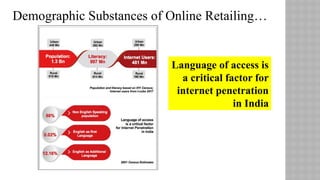
Demographic Substances of Online Retailing…
Language of access is
a critical factor for
internet penetration
in India
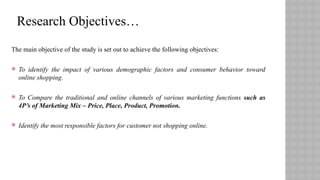
The main objective of the study is set out to achieve the following objectives:
 To identify the impact of various demographic factors and consumer behavior toward
online shopping.
 To Compare the traditional and online channels of various marketing functions such as
4P’s of Marketing Mix – Price, Place, Product, Promotion.
 Identify the most responsible factors for customer not shopping online.
Research Objectives…
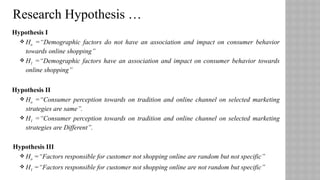
Hypothesis I
 Ho =“Demographic factors do not have an association and impact on consumer behavior
towards online shopping”
 H1 =“Demographic factors have an association and impact on consumer behavior towards
online shopping”
Hypothesis II
 Ho =“Consumer perception towards on tradition and online channel on selected marketing
strategies are same”.
 H1 =“Consumer perception towards on tradition and online channel on selected marketing
strategies are Different”.
Hypothesis III
 Ho =“Factors responsible for customer not shopping online are random but not specific”
 H1 =“Factors responsible for customer not shopping online are not random but specific”
Research Hypothesis …
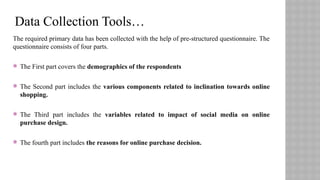
The required primary data has been collected with the help of pre-structured questionnaire. The
questionnaire consists of four parts.
 The First part covers the demographics of the respondents
 The Second part includes the various components related to inclination towards online
shopping.
 The Third part includes the variables related to impact of social media on online
purchase design.
 The fourth part includes the reasons for online purchase decision.
Data Collection Tools…
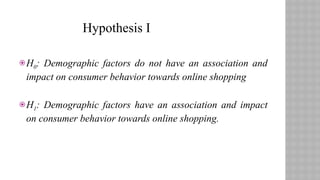
H0: Demographic factors do not have an association and
impact on consumer behavior towards online shopping
H1: Demographic factors have an association and impact
on consumer behavior towards online shopping.
Hypothesis I
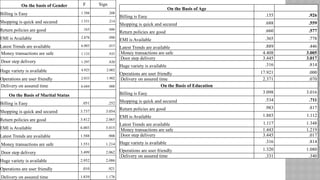
On the basis of Gender F Sign
Billing is Easy 1.588 .208
Shopping is quick and secured 1.551 .214
Return policies are good .163 .686
EMI is Available 2.878 .090
Latest Trends are available 6.003 .015
Money transactions are safe 1.133 .935
Door step delivery 1.297 .820
Huge variety is available 4.925 2.002
Operations are user friendly 2.033 1.902
Delivery on assured time 6.684 .000
On the Basis of Marital Status
Billing is Easy .051 .252
Shopping is quick and secured 3.737 3.054
Return policies are good 3.412 2.065
EMI is Available 6.003 5.015
Latest Trends are available 1.588 .908
Money transactions are safe 1.551 1.214
Door step delivery 3.499 2.062
Huge variety is available 2.952 2.086
Operations are user friendly .010 .921
Delivery on assured time 1.839 1.176
On the Basis of Age
Billing is Easy .155 .926
Shopping is quick and secured .688 .559
Return policies are good .660 .577
EMI is Available .365 .778
Latest Trends are available .889 .446
Money transactions are safe 4.408 3.005
Door step delivery 3.445 3.017
Huge variety is available .316 .814
Operations are user friendly 17.921 .000
Delivery on assured time 2.371 .070
On the Basis of Education
Billing is Easy 3.098 3.016
Shopping is quick and secured .534 .711
Return policies are good .983 .817
EMI is Available 1.885 1.112
Latest Trends are available 1.117 1.348
Money transactions are safe 1.443 1.219
Door step delivery 3.445 .017
Huge variety is available .316 .814
Operations are user friendly 1.320 1.080
Delivery on assured time .331 .340
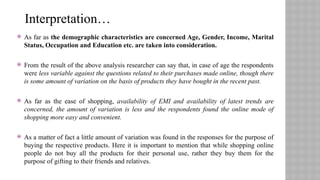
 As far as the demographic characteristics are concerned Age, Gender, Income, Marital
Status, Occupation and Education etc. are taken into consideration.
 From the result of the above analysis researcher can say that, in case of age the respondents
were less variable against the questions related to their purchases made online, though there
is some amount of variation on the basis of products they have bought in the recent past.
 As far as the ease of shopping, availability of EMI and availability of latest trends are
concerned, the amount of variation is less and the respondents found the online mode of
shopping more easy and convenient.
 As a matter of fact a little amount of variation was found in the responses for the purpose of
buying the respective products. Here it is important to mention that while shopping online
people do not buy all the products for their personal use, rather they buy them for the
purpose of gifting to their friends and relatives.
Interpretation…
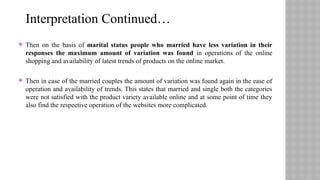
 Then on the basis of marital status people who married have less variation in their
responses the maximum amount of variation was found in operations of the online
shopping and availability of latest trends of products on the online market.
 Then in case of the married couples the amount of variation was found again in the ease of
operation and availability of trends. This states that married and single both the categories
were not satisfied with the product variety available online and at some point of time they
also find the respective operation of the websites more complicated.
Interpretation Continued…
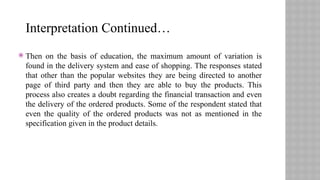
 Then on the basis of education, the maximum amount of variation is
found in the delivery system and ease of shopping. The responses stated
that other than the popular websites they are being directed to another
page of third party and then they are able to buy the products. This
process also creates a doubt regarding the financial transaction and even
the delivery of the ordered products. Some of the respondent stated that
even the quality of the ordered products was not as mentioned in the
specification given in the product details.
Interpretation Continued…
 In light of the above interpretation it can be inferred that there is a
significant impact of demographic factors on the respective consumer
behavior, as far as online shopping is concerned and on the basis of above
analysis and discussion the null hypothesis Demographic factors do not
have an association and impact on consumer behavior towards online
shopping is rejected and alternate hypothesis will be accepted.
Interpretation Continued…
 H0: Consumer perception towards traditional and online channels on
selected marketing strategies are same.
 H1: Consumer perception towards traditional and online channels on
selected marketing strategies are different.
Hypothesis II
Price of Product
On the Basis of Gender On the Basis of Income
End User
Price
Discount Deliver
y
Charge
s
Cash
Back
and
Offer
Coupon
s and
Voucher
s
End
User
Price
Discount Delivery
Charges
Cash
Back and
Offer
Coupon
s and
Voucher
s
Calculated
Value
.159 .243 .159 .063 .943 .445 .435 .053 .943 .063
Table Value 3.67 2.827 3.67 5.537 2.860 1.621 1.664 5.878 2.860
5.537
Payment Option
On the Basis of Gender On the Basis of Income
Cash
Discount
Credit
Facility
EMI
Option
Cash
on
Deliver
y
Cards/
wallet/
Net-
banking
Cash
Discou
nt
Credit
Facility
EMI
Option
Cash on
Delivery
Cards/
wallet/
Net-
banking
Calculated
Value
.035 .375 .040 .168 .177 .943 .631 .703 .943 .339
Table Value 6.705 1.962 6.436 3.571 3.463 2.860 6.145 5.504 2.860 9.04
Convenience
On the Basis of Gender On the Basis of Income
Time
consumed
to search
alternatives
Home
Delivery
Transp
ortation
/
Comm
uting
Parking
and
Jams
Shoppin
g hours
Time
consu
med to
search
alterna
tives
Home
Delivery
Transport
ation/
Commuti
ng
Parking
and Jams
Shoppin
g hours
Calculated
Value
.939 .560 .687 .779 .779 .897 .635
.070 .629 .629
Table Value 2.917 6.781 5.641 4.795 4.795 3.528 6.113 14.488 6.164 6.164
Product Aspects
On the Basis of Gender On the Basis of Income
Quality of
Product
Variety
of
Product
Avail
abilit
y of
Prod
uct
Kno
wled
ge/
Infor
matio
n
about
Prod
uct
Guara
ntee/
Warra
nty/
Excha
nge
and
return
Qual
ity
of
Prod
uct
Var
iety
of
Pro
duc
t
Availab
ility of
Product
Knowle
dge/
Informa
tion
about
Product
Guara
ntee/
Warra
nty/
Excha
nge
and
return
Calcul
ated
Value
.928 .146 .575 .928 .605 .605
.57
5
.176 .698 .603
Table
Value
5.745 17.101 10.47 5.745 6.378
6.37
8
10.
473
16.353 9.053 10.148
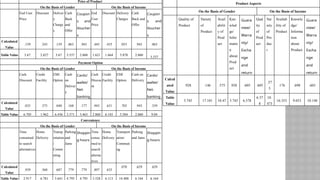
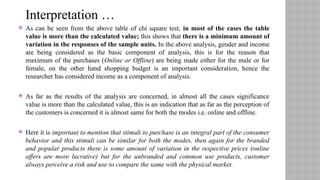
 As can be seen from the above table of chi square test, in most of the cases the table
value is more than the calculated value; this shows that there is a minimum amount of
variation in the responses of the sample units. In the above analysis, gender and income
are being considered as the basic component of analysis, this is for the reason that
maximum of the purchases (Online or Offline) are being made either for the male or for
female, on the other hand shopping budget is an important consideration, hence the
researcher has considered income as a component of analysis.
 As far as the results of the analysis are concerned, in almost all the cases significance
value is more than the calculated value, this is an indication that as far as the perception of
the customers is concerned it is almost same for both the modes i.e. online and offline.
 Here it is important to mention that stimuli to purchase is an integral part of the consumer
behavior and this stimuli can be similar for both the modes, then again for the branded
and popular products there is some amount of variation in the respective prices (online
offers are more lucrative) but for the unbranded and common use products, customer
always perceive a risk and use to compare the same with the physical market.
Interpretation …
 Then there is another factor of need and availability, some of the respondents stated that
they consider the online mode of shopping when they have minimum available time as
compared to the delivery time given by the online seller, if that much of time is not
available then the y go for the offline mode of shopping and fulfill their need.
 Some of the respondents also stated that there are certain products which are exclusively
launched on the online modes of shopping like electronic gadgets, some apparels,
accessories, etc. at such junctures they use to buy the same online, as these products
might not be available in offline mode.
Interpretation Continue…
 On the basis of above chi square analysis and discussion with the
respondents it can be said that there is a minimum amount of variation in the
perception of the customer for online and offline mode of shopping and in
lieu of the same the null hypothesis ‘Consumer perception towards on
tradition and online channel on selected marketing strategies are same.’ can
be accepted and the alternate hypothesis can be rejected.
Results…
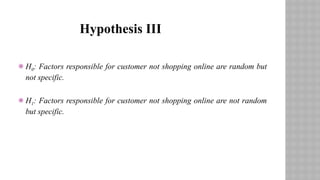
 H0: Factors responsible for customer not shopping online are random but
not specific.
 H1: Factors responsible for customer not shopping online are not random
but specific.
Hypothesis III
On the Basis of Age F Sign
Online fraud and scam are frequent .155 .926
Don’t want to share Personal Information .688 .559
Payment Failure happens .660 .577
Price are high or equal to local market .365 .778
I cannot negotiate while shopping online .889 .446
Shopping Experience/ Fun is missing online shopping 3.011 1.250
On the Basis of Education
Online fraud and scam are frequent 3.098 .016
Don’t want to share Personal Information .534 .711
Payment Failure happens .983 .417
Price are high or equal to local market 1.885 .112
I cannot negotiate while shopping online 1.117 .348
Shopping Experience/ Fun is missing online shopping 1.443 .219
On the Basis of Income
Online fraud and scam are frequent .209 .890
Don’t want to share Personal Information .579 .629
Payment Failure happens .993 .396
Price are high or equal to local market .593 .620
I cannot negotiate while shopping online .456 .713
Shopping Experience/ Fun is missing online shopping 1.111 .344
On the Basis of Occupation
Online fraud and scam are frequent .082 .970
Don’t want to share Personal Information .360 .782
Payment Failure happens 1.355 .256
Price are high or equal to local market .660 .577
I cannot negotiate while shopping online .313 .816
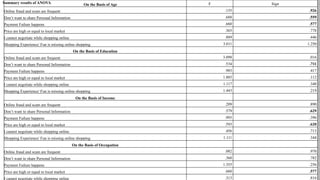
Summary results of ANOVA
 In this particular hypothesis the researcher has analyzed the reasons that why some of the
respondents are not shopping from online mode, here the researcher has assumed that to a
certain extent some of the demographic factor are responsible for the same. Obviously there
may be some other reasons but due to the limitation of time and resources only demographic
factors are considered at this present stage.
 This is a well known fact that there is a highest variation of demography in our country, to
some extent and reasons age, income and gender becomes extremely important and for
some other reasons the same factors are not being even considered. Due to the diversity of
this demographic distribution online market is also being influenced.
 As can be seen in the above given table of summary of ANOVA results, there are a variety
of reason that the respondents have stated for not doing online shopping, like in case of age,
a high amount of variation can be seen for the online scams and frauds, prices of the
respective products, shopping experience, etc. these are some of the factors where the
amount of variation is maximum, this shows that for such factors respondents are not
willing to buy certain products online.
Interpretation …
 Then on the basis of education, again the respondents have a fear of online
frauds, they don’t want to share their personal information on online
forums, issues of payment failures, difference in the prices of online and
offline mode and they also miss the fun of shopping and bargaining.
 As far as income is concerned, again the same components are having
maximum amount of variation, i.e. respondents have a fear of online frauds,
they don’t want to share their personal information on online forums, issues
of payment failures, difference in the prices of online and offline mode and
they also miss the fun of shopping and bargaining.
Interpretation Continue …
On the basis of above analysis and discussion it can be
said that the respondents do not have any specific
reason for not shopping online, though the reasons are
common but not specific, so the null hypothesis
‘Factors responsible for customer not shopping online
are random but not specific’ is rejected and the
alternate hypothesis is accepted.
Result …
Major Findings ....
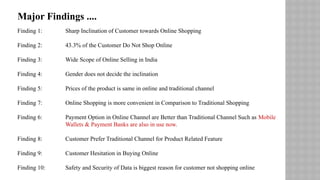
Finding 1: Sharp Inclination of Customer towards Online Shopping
Finding 2: 43.3% of the Customer Do Not Shop Online
Finding 3: Wide Scope of Online Selling in India
Finding 4: Gender does not decide the inclination
Finding 5: Prices of the product is same in online and traditional channel
Finding 7: Online Shopping is more convenient in Comparison to Traditional Shopping
Finding 6: Payment Option in Online Channel are Better than Traditional Channel Such as Mobile
Wallets & Payment Banks are also in use now.
Finding 8: Customer Prefer Traditional Channel for Product Related Feature
Finding 9: Customer Hesitation in Buying Online
Finding 10: Safety and Security of Data is biggest reason for customer not shopping online
 It is also found that the majority of the people who shop online already have 4 to 6 years of
internet usage experience which is followed by 7 to 10 years of experience. By considering
this fact, it is suggested to online traders to utilize their consumers’ databases for
disseminating store related information through their mail Id. As most of the respondents
using internet on daily basis, marketers should use these huge opportunities of contacting
them frequently by increasing the frequency of e-mail transactions with them. The study
also reveals that the respondents mostly utilize the home place to browse, marketer should
understand the domestic mood of their consumers and they can introduce ‘Family Bulk
Offers’ to the consumers to attain the purchase excitement through online purchase.
Suggestions ….
 As most of the e-purchasers showing their desirable payment methods as credit
card payment and cash on delivery, e-sellers should reduce the difficulties in e-
payment by reducing possible fraudulent activities. For getting huge market potential
in online sales, companies can introduce installment sales also. By providing complete
satisfaction to the online purchasers by needed quality and suitable services, companies
can make efficient usage e-Word of mouth, which is becoming a greatest referral,
medium in online shopping field.
 As younger people are easily attracted by website layouts and the presentation style
of websites plays major role in the online purchasing rather than elder people. So e-
marketers should concentrate more on the web site layout and the ways of presenting the
products. Utilization of colorful pictures, celebrity images, running advertising matters
using HTML and personalized display of desire-relevant products can induce the
purchasing intention of the younger to make online purchasing.
Suggestions ….
 While creating appropriate marketing strategies for online trade, companies should
understand that aged people make their online purchase by their attitude and younger
generations make it by evaluating the perceived usefulness of the e-shopping. The
strategies used in e-marketing should create favorable attitude to the senior people and
the usefulness of the online shopping should be assured to sustain the market potential
of young customers.
 Post graduate respondents with sound E-commerce knowledge and awareness about the
website factors are showing greater interest in online purchase. E-traders can conduct
free Web literacy programs through which all the interested people can learn about
the ways to use websites. These types of programs will certainly more helpful for the
online new purchasers to get awareness about cyber laws, ways to return damaged
goods and methods of receiving online after sales services.
Suggestions ….
 Online personalized sales promotion strategies can be designed on the basis of their
internet experience and the volume of time they spend on net because their
ecommerce knowledge and web site accessibility are the main factors which
motivates them to online shopping. Companies can maintain their quality of their
product and services in such a way that their online consumers should perceive
their online shopping experience as very useful rather than traditional purchase
by building separate quality control cells for the products sell through online.
 Exclusive complaint handling cells and after sales service centers should be
introduced for obtaining the major believability about the online shopping in the
attitude of the emerging consumers.
Suggestions ….
 Online shopping today is an incomplete, fragmented, and sometimes frustrating process.
Therefore merchants should set themselves apart from their competitors by factors other
than price, constantly innovate and move towards creating customer confidence to trade
online. They should provide massive selection at lower prices, offer a personalized
customer experience and their web sites should deliver a shopping experience that
addresses all of the consumer needs like recommendation about the products, feedback
from other customers, etc.
 Marketers should educate the customers about e-commerce like educating them on
safety tips like reading the item description, looking for a seller’s feedback score and
asking questions, detecting spoof mails and informing them about the new online crimes
which happen regularly.
Suggestions ….
THANK YOU

PPT Dr Harshit Sharma - PhD Pre viva Presentation

  • 1.
    Research Guide: Dr. DileepSingh Associate Professor, Department of Business Administration, Faculty of Commerce, University of Rajasthan, Jaipur Online Shopping In India: A Study Of Factors Influencing Consumer’s Online Purchasing Behavior Submitted By: Harshit Sharma Research Scholar Department of Business Administration, University of Rajasthan, Jaipur
  • 2.
     The studyinvolves understanding consumer behaviour of various different people, who are different on various demographic factors.  As category of people is different in terms of what they think, the choice of the product and services and many others.  This psychology can be drastically different from customer to customer, when we segregate them on various demographic factors and on top of the same, this keeps on changing with external and internal environment (region/ religion, government, customs and culture) and so many other factors.  Factors which influences the Buying Decision of a buyer is: Cultural, Social (Groups, Family Roles and States etc.) & Personal Factors (Age, Occupation, Income , Lifestyle etc.). Consumer Behaviour at a Glance…
  • 3.
     For everypersonal user or consumer everywhere in the world the most recognized form of e- commerce falls into the business to consumer (B2C) category, which involved internet shopping or online purchasing.  It refers to online shoppers from bricks-and-mortar retailers, like- Wal-Mart online shoppers, as well as from internet-only online retailing markets such as Amazon.com (enormous online retailer).  In 2017, an estimated 1.66 billion consumers overall world/ worldwide purchasing or buying goods from an online store. During the same year, worldwide e-retail sales approximated to 2.3 trillion U.S. dollars and extension show a growth of up to 4.48 trillion U.S. dollars by 2021.  Mobile Marketing: A smartphone device is a platform to communicate offers, incentives, coupons, and can be used as a very effective direct marketing tool by marketers. The beauty of this concept is marketing directly to your target customer and the phone become so personalized that the customer has no escape to look at this. Overview of Online Market….
  • 4.
     Expanding Market:The world is watching India, growing in most of the sectors and industries and retail is one of them.  Government Initiatives Gaining Momentum: Digital India, Start-up India, Make in India & Skill India etc.  Growing Internet Users: KANTAR- IMRB (2017) India, currently with 481 million internet users, has the second highest Internet user base and is expected to reach 500 million users by June 2018.  Mobile Phones: Game Changer: According to KPCB, India has the highest share of mobile based e- Commerce sales globally at 41per cent (KPBC, 2015). The leading e-Commerce companies state that almost 70-75 per cent of their online traffic comes from mobile phones and thus higher revenues are coming from mobile applications.  Digital Payments: Cash-on-Delivery (COD) remains a popular mode of payment for Indian e-Commerce transactions. Cash transactions result in high administration costs even for the e-Commerce companies which reduces their margins. Hence, new digital payment solutions are evolving to address these challenges. Further, the Indian government’s initiative to extend banking facilities to its previously unbanked citizens through the ‘Jan Dhan Yojna’ scheme has added a significant number of debit cards (over 110 Million) thereby providing these customers access to electronic payments.  Internet Density: Internet penetration in the country is growing rapidly, crossing 481 million in 2017 and is expected to hit 500 million users by June 2018. AIMIA report highlights that urban India’s internet penetration was 64.84 per cent in December 2017, in comparison to only 20.26 per cent for rural India. Recent Trends and Changes…
  • 5.
    Demographic Substances ofOnline Retailing… Language of access is a critical factor for internet penetration in India
  • 6.
    The main objectiveof the study is set out to achieve the following objectives:  To identify the impact of various demographic factors and consumer behavior toward online shopping.  To Compare the traditional and online channels of various marketing functions such as 4P’s of Marketing Mix – Price, Place, Product, Promotion.  Identify the most responsible factors for customer not shopping online. Research Objectives…
  • 7.
    Hypothesis I  Ho=“Demographic factors do not have an association and impact on consumer behavior towards online shopping”  H1 =“Demographic factors have an association and impact on consumer behavior towards online shopping” Hypothesis II  Ho =“Consumer perception towards on tradition and online channel on selected marketing strategies are same”.  H1 =“Consumer perception towards on tradition and online channel on selected marketing strategies are Different”. Hypothesis III  Ho =“Factors responsible for customer not shopping online are random but not specific”  H1 =“Factors responsible for customer not shopping online are not random but specific” Research Hypothesis …
  • 8.
    The required primarydata has been collected with the help of pre-structured questionnaire. The questionnaire consists of four parts.  The First part covers the demographics of the respondents  The Second part includes the various components related to inclination towards online shopping.  The Third part includes the variables related to impact of social media on online purchase design.  The fourth part includes the reasons for online purchase decision. Data Collection Tools…
  • 9.
    H0: Demographic factorsdo not have an association and impact on consumer behavior towards online shopping H1: Demographic factors have an association and impact on consumer behavior towards online shopping. Hypothesis I
  • 10.
    On the basisof Gender F Sign Billing is Easy 1.588 .208 Shopping is quick and secured 1.551 .214 Return policies are good .163 .686 EMI is Available 2.878 .090 Latest Trends are available 6.003 .015 Money transactions are safe 1.133 .935 Door step delivery 1.297 .820 Huge variety is available 4.925 2.002 Operations are user friendly 2.033 1.902 Delivery on assured time 6.684 .000 On the Basis of Marital Status Billing is Easy .051 .252 Shopping is quick and secured 3.737 3.054 Return policies are good 3.412 2.065 EMI is Available 6.003 5.015 Latest Trends are available 1.588 .908 Money transactions are safe 1.551 1.214 Door step delivery 3.499 2.062 Huge variety is available 2.952 2.086 Operations are user friendly .010 .921 Delivery on assured time 1.839 1.176 On the Basis of Age Billing is Easy .155 .926 Shopping is quick and secured .688 .559 Return policies are good .660 .577 EMI is Available .365 .778 Latest Trends are available .889 .446 Money transactions are safe 4.408 3.005 Door step delivery 3.445 3.017 Huge variety is available .316 .814 Operations are user friendly 17.921 .000 Delivery on assured time 2.371 .070 On the Basis of Education Billing is Easy 3.098 3.016 Shopping is quick and secured .534 .711 Return policies are good .983 .817 EMI is Available 1.885 1.112 Latest Trends are available 1.117 1.348 Money transactions are safe 1.443 1.219 Door step delivery 3.445 .017 Huge variety is available .316 .814 Operations are user friendly 1.320 1.080 Delivery on assured time .331 .340
  • 11.
     As faras the demographic characteristics are concerned Age, Gender, Income, Marital Status, Occupation and Education etc. are taken into consideration.  From the result of the above analysis researcher can say that, in case of age the respondents were less variable against the questions related to their purchases made online, though there is some amount of variation on the basis of products they have bought in the recent past.  As far as the ease of shopping, availability of EMI and availability of latest trends are concerned, the amount of variation is less and the respondents found the online mode of shopping more easy and convenient.  As a matter of fact a little amount of variation was found in the responses for the purpose of buying the respective products. Here it is important to mention that while shopping online people do not buy all the products for their personal use, rather they buy them for the purpose of gifting to their friends and relatives. Interpretation…
  • 12.
     Then onthe basis of marital status people who married have less variation in their responses the maximum amount of variation was found in operations of the online shopping and availability of latest trends of products on the online market.  Then in case of the married couples the amount of variation was found again in the ease of operation and availability of trends. This states that married and single both the categories were not satisfied with the product variety available online and at some point of time they also find the respective operation of the websites more complicated. Interpretation Continued…
  • 13.
     Then onthe basis of education, the maximum amount of variation is found in the delivery system and ease of shopping. The responses stated that other than the popular websites they are being directed to another page of third party and then they are able to buy the products. This process also creates a doubt regarding the financial transaction and even the delivery of the ordered products. Some of the respondent stated that even the quality of the ordered products was not as mentioned in the specification given in the product details. Interpretation Continued…
  • 14.
     In lightof the above interpretation it can be inferred that there is a significant impact of demographic factors on the respective consumer behavior, as far as online shopping is concerned and on the basis of above analysis and discussion the null hypothesis Demographic factors do not have an association and impact on consumer behavior towards online shopping is rejected and alternate hypothesis will be accepted. Interpretation Continued…
  • 15.
     H0: Consumerperception towards traditional and online channels on selected marketing strategies are same.  H1: Consumer perception towards traditional and online channels on selected marketing strategies are different. Hypothesis II
  • 16.
    Price of Product Onthe Basis of Gender On the Basis of Income End User Price Discount Deliver y Charge s Cash Back and Offer Coupon s and Voucher s End User Price Discount Delivery Charges Cash Back and Offer Coupon s and Voucher s Calculated Value .159 .243 .159 .063 .943 .445 .435 .053 .943 .063 Table Value 3.67 2.827 3.67 5.537 2.860 1.621 1.664 5.878 2.860 5.537 Payment Option On the Basis of Gender On the Basis of Income Cash Discount Credit Facility EMI Option Cash on Deliver y Cards/ wallet/ Net- banking Cash Discou nt Credit Facility EMI Option Cash on Delivery Cards/ wallet/ Net- banking Calculated Value .035 .375 .040 .168 .177 .943 .631 .703 .943 .339 Table Value 6.705 1.962 6.436 3.571 3.463 2.860 6.145 5.504 2.860 9.04 Convenience On the Basis of Gender On the Basis of Income Time consumed to search alternatives Home Delivery Transp ortation / Comm uting Parking and Jams Shoppin g hours Time consu med to search alterna tives Home Delivery Transport ation/ Commuti ng Parking and Jams Shoppin g hours Calculated Value .939 .560 .687 .779 .779 .897 .635 .070 .629 .629 Table Value 2.917 6.781 5.641 4.795 4.795 3.528 6.113 14.488 6.164 6.164 Product Aspects On the Basis of Gender On the Basis of Income Quality of Product Variety of Product Avail abilit y of Prod uct Kno wled ge/ Infor matio n about Prod uct Guara ntee/ Warra nty/ Excha nge and return Qual ity of Prod uct Var iety of Pro duc t Availab ility of Product Knowle dge/ Informa tion about Product Guara ntee/ Warra nty/ Excha nge and return Calcul ated Value .928 .146 .575 .928 .605 .605 .57 5 .176 .698 .603 Table Value 5.745 17.101 10.47 5.745 6.378 6.37 8 10. 473 16.353 9.053 10.148
  • 17.
     As canbe seen from the above table of chi square test, in most of the cases the table value is more than the calculated value; this shows that there is a minimum amount of variation in the responses of the sample units. In the above analysis, gender and income are being considered as the basic component of analysis, this is for the reason that maximum of the purchases (Online or Offline) are being made either for the male or for female, on the other hand shopping budget is an important consideration, hence the researcher has considered income as a component of analysis.  As far as the results of the analysis are concerned, in almost all the cases significance value is more than the calculated value, this is an indication that as far as the perception of the customers is concerned it is almost same for both the modes i.e. online and offline.  Here it is important to mention that stimuli to purchase is an integral part of the consumer behavior and this stimuli can be similar for both the modes, then again for the branded and popular products there is some amount of variation in the respective prices (online offers are more lucrative) but for the unbranded and common use products, customer always perceive a risk and use to compare the same with the physical market. Interpretation …
  • 18.
     Then thereis another factor of need and availability, some of the respondents stated that they consider the online mode of shopping when they have minimum available time as compared to the delivery time given by the online seller, if that much of time is not available then the y go for the offline mode of shopping and fulfill their need.  Some of the respondents also stated that there are certain products which are exclusively launched on the online modes of shopping like electronic gadgets, some apparels, accessories, etc. at such junctures they use to buy the same online, as these products might not be available in offline mode. Interpretation Continue…
  • 19.
     On thebasis of above chi square analysis and discussion with the respondents it can be said that there is a minimum amount of variation in the perception of the customer for online and offline mode of shopping and in lieu of the same the null hypothesis ‘Consumer perception towards on tradition and online channel on selected marketing strategies are same.’ can be accepted and the alternate hypothesis can be rejected. Results…
  • 20.
     H0: Factorsresponsible for customer not shopping online are random but not specific.  H1: Factors responsible for customer not shopping online are not random but specific. Hypothesis III
  • 21.
    On the Basisof Age F Sign Online fraud and scam are frequent .155 .926 Don’t want to share Personal Information .688 .559 Payment Failure happens .660 .577 Price are high or equal to local market .365 .778 I cannot negotiate while shopping online .889 .446 Shopping Experience/ Fun is missing online shopping 3.011 1.250 On the Basis of Education Online fraud and scam are frequent 3.098 .016 Don’t want to share Personal Information .534 .711 Payment Failure happens .983 .417 Price are high or equal to local market 1.885 .112 I cannot negotiate while shopping online 1.117 .348 Shopping Experience/ Fun is missing online shopping 1.443 .219 On the Basis of Income Online fraud and scam are frequent .209 .890 Don’t want to share Personal Information .579 .629 Payment Failure happens .993 .396 Price are high or equal to local market .593 .620 I cannot negotiate while shopping online .456 .713 Shopping Experience/ Fun is missing online shopping 1.111 .344 On the Basis of Occupation Online fraud and scam are frequent .082 .970 Don’t want to share Personal Information .360 .782 Payment Failure happens 1.355 .256 Price are high or equal to local market .660 .577 I cannot negotiate while shopping online .313 .816 Summary results of ANOVA
  • 22.
     In thisparticular hypothesis the researcher has analyzed the reasons that why some of the respondents are not shopping from online mode, here the researcher has assumed that to a certain extent some of the demographic factor are responsible for the same. Obviously there may be some other reasons but due to the limitation of time and resources only demographic factors are considered at this present stage.  This is a well known fact that there is a highest variation of demography in our country, to some extent and reasons age, income and gender becomes extremely important and for some other reasons the same factors are not being even considered. Due to the diversity of this demographic distribution online market is also being influenced.  As can be seen in the above given table of summary of ANOVA results, there are a variety of reason that the respondents have stated for not doing online shopping, like in case of age, a high amount of variation can be seen for the online scams and frauds, prices of the respective products, shopping experience, etc. these are some of the factors where the amount of variation is maximum, this shows that for such factors respondents are not willing to buy certain products online. Interpretation …
  • 23.
     Then onthe basis of education, again the respondents have a fear of online frauds, they don’t want to share their personal information on online forums, issues of payment failures, difference in the prices of online and offline mode and they also miss the fun of shopping and bargaining.  As far as income is concerned, again the same components are having maximum amount of variation, i.e. respondents have a fear of online frauds, they don’t want to share their personal information on online forums, issues of payment failures, difference in the prices of online and offline mode and they also miss the fun of shopping and bargaining. Interpretation Continue …
  • 24.
    On the basisof above analysis and discussion it can be said that the respondents do not have any specific reason for not shopping online, though the reasons are common but not specific, so the null hypothesis ‘Factors responsible for customer not shopping online are random but not specific’ is rejected and the alternate hypothesis is accepted. Result …
  • 25.
    Major Findings .... Finding1: Sharp Inclination of Customer towards Online Shopping Finding 2: 43.3% of the Customer Do Not Shop Online Finding 3: Wide Scope of Online Selling in India Finding 4: Gender does not decide the inclination Finding 5: Prices of the product is same in online and traditional channel Finding 7: Online Shopping is more convenient in Comparison to Traditional Shopping Finding 6: Payment Option in Online Channel are Better than Traditional Channel Such as Mobile Wallets & Payment Banks are also in use now. Finding 8: Customer Prefer Traditional Channel for Product Related Feature Finding 9: Customer Hesitation in Buying Online Finding 10: Safety and Security of Data is biggest reason for customer not shopping online
  • 26.
     It isalso found that the majority of the people who shop online already have 4 to 6 years of internet usage experience which is followed by 7 to 10 years of experience. By considering this fact, it is suggested to online traders to utilize their consumers’ databases for disseminating store related information through their mail Id. As most of the respondents using internet on daily basis, marketers should use these huge opportunities of contacting them frequently by increasing the frequency of e-mail transactions with them. The study also reveals that the respondents mostly utilize the home place to browse, marketer should understand the domestic mood of their consumers and they can introduce ‘Family Bulk Offers’ to the consumers to attain the purchase excitement through online purchase. Suggestions ….
  • 27.
     As mostof the e-purchasers showing their desirable payment methods as credit card payment and cash on delivery, e-sellers should reduce the difficulties in e- payment by reducing possible fraudulent activities. For getting huge market potential in online sales, companies can introduce installment sales also. By providing complete satisfaction to the online purchasers by needed quality and suitable services, companies can make efficient usage e-Word of mouth, which is becoming a greatest referral, medium in online shopping field.  As younger people are easily attracted by website layouts and the presentation style of websites plays major role in the online purchasing rather than elder people. So e- marketers should concentrate more on the web site layout and the ways of presenting the products. Utilization of colorful pictures, celebrity images, running advertising matters using HTML and personalized display of desire-relevant products can induce the purchasing intention of the younger to make online purchasing. Suggestions ….
  • 28.
     While creatingappropriate marketing strategies for online trade, companies should understand that aged people make their online purchase by their attitude and younger generations make it by evaluating the perceived usefulness of the e-shopping. The strategies used in e-marketing should create favorable attitude to the senior people and the usefulness of the online shopping should be assured to sustain the market potential of young customers.  Post graduate respondents with sound E-commerce knowledge and awareness about the website factors are showing greater interest in online purchase. E-traders can conduct free Web literacy programs through which all the interested people can learn about the ways to use websites. These types of programs will certainly more helpful for the online new purchasers to get awareness about cyber laws, ways to return damaged goods and methods of receiving online after sales services. Suggestions ….
  • 29.
     Online personalizedsales promotion strategies can be designed on the basis of their internet experience and the volume of time they spend on net because their ecommerce knowledge and web site accessibility are the main factors which motivates them to online shopping. Companies can maintain their quality of their product and services in such a way that their online consumers should perceive their online shopping experience as very useful rather than traditional purchase by building separate quality control cells for the products sell through online.  Exclusive complaint handling cells and after sales service centers should be introduced for obtaining the major believability about the online shopping in the attitude of the emerging consumers. Suggestions ….
  • 30.
     Online shoppingtoday is an incomplete, fragmented, and sometimes frustrating process. Therefore merchants should set themselves apart from their competitors by factors other than price, constantly innovate and move towards creating customer confidence to trade online. They should provide massive selection at lower prices, offer a personalized customer experience and their web sites should deliver a shopping experience that addresses all of the consumer needs like recommendation about the products, feedback from other customers, etc.  Marketers should educate the customers about e-commerce like educating them on safety tips like reading the item description, looking for a seller’s feedback score and asking questions, detecting spoof mails and informing them about the new online crimes which happen regularly. Suggestions ….
  • 31.