ONLINE CONSUMER BEHAVIOUR OF E-COMMERCE
Presented By:
Amit Maity – 02
Darshana Mistry – 08
Shreya Jain – 27
Zalak Soni – 32
Safiya Mir – 36
Introduction
 "Electronic commerce" e-Commerce refers to the use of an electronic
medium to carry out commercial transactions.
 A client who purchases on the Internet is called a Online Consumer.
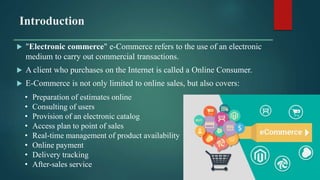
 E-Commerce is not only limited to online sales, but also covers:
• Preparation of estimates online
• Consulting of users
• Provision of an electronic catalog
• Access plan to point of sales
• Real-time management of product availability
• Online payment
• Delivery tracking
• After-sales service
Online Consumer Behaviour
 Online consumer behavior is the study of the
intersection between online consumers and
online businesses.
 It includes the study of why, where, when,
where, how often and under what conditions
consumers consume different goods or
services.
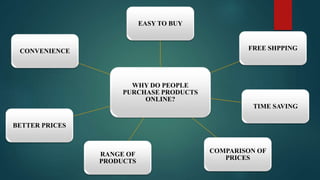
WHY DO PEOPLE
PURCHASE PRODUCTS
ONLINE?
EASY TO BUY
FREE SHPPING
TIME SAVING
COMPARISON OF
PRICES
RANGE OF
PRODUCTS
BETTER PRICES
CONVENIENCE
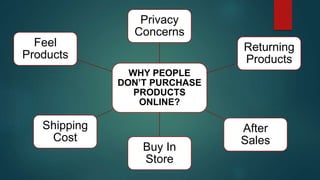
WHY PEOPLE
DON’T PURCHASE
PRODUCTS
ONLINE?
Privacy
Concerns
Returning
Products
After
Sales
Buy In
Store
Shipping
Cost
Feel
Products
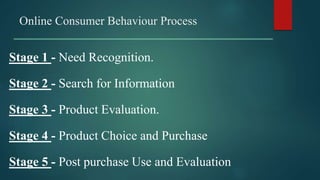
Online Consumer Behaviour Process
Stage 1 - Need Recognition.
Stage 2 - Search for Information
Stage 3 - Product Evaluation.
Stage 4 - Product Choice and Purchase
Stage 5 - Post purchase Use and Evaluation
Factors Of Online Consumer Behaviour
 The external factors
 Internal factors
 The functional motives
 The non-functional motives
Filtering Elements
 Security
 Privacy
 Trust
 User Friendly
 Catalogue
 Delivery Service
 After Sales Service
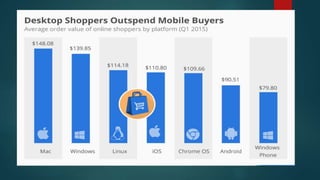
Platforms Used By Consumers
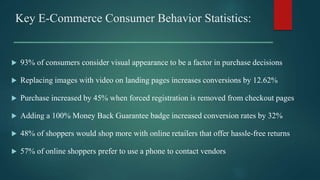
Key E-Commerce Consumer Behavior Statistics:
 93% of consumers consider visual appearance to be a factor in purchase decisions
 Replacing images with video on landing pages increases conversions by 12.62%
 Purchase increased by 45% when forced registration is removed from checkout pages
 Adding a 100% Money Back Guarantee badge increased conversion rates by 32%
 48% of shoppers would shop more with online retailers that offer hassle-free returns
 57% of online shoppers prefer to use a phone to contact vendors
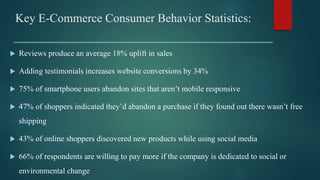
 Reviews produce an average 18% uplift in sales
 Adding testimonials increases website conversions by 34%
 75% of smartphone users abandon sites that aren’t mobile responsive
 47% of shoppers indicated they’d abandon a purchase if they found out there wasn’t free
shipping
 43% of online shoppers discovered new products while using social media
 66% of respondents are willing to pay more if the company is dedicated to social or
environmental change
Key E-Commerce Consumer Behavior Statistics:
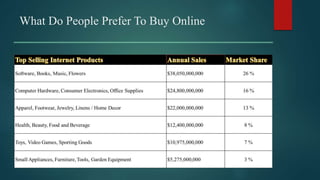
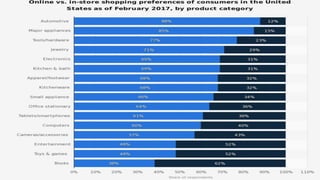
What Do People Prefer To Buy Online
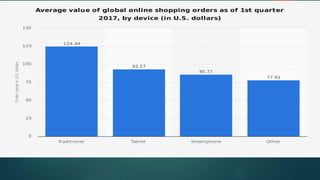
Mobile Revolution in E-Commerce
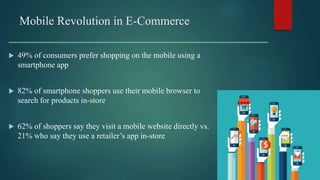
 49% of consumers prefer shopping on the mobile using a
smartphone app
 82% of smartphone shoppers use their mobile browser to
search for products in-store
 62% of shoppers say they visit a mobile website directly vs.
21% who say they use a retailer’s app in-store
Effect Of Advertisements And Internet On
Consumer Behaviour
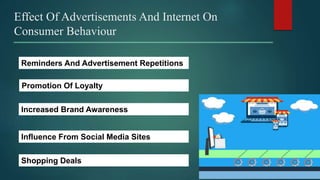
Reminders And Advertisement Repetitions
Promotion Of Loyalty
Increased Brand Awareness
Influence From Social Media Sites
Shopping Deals
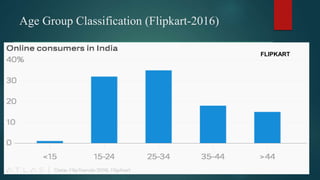
Age Group Classification (Flipkart-2016)
FLIPKART
Looking At The Future…
The combination of rising incomes and increased internet access equates to
strong growth potential for e-commerce in INDIA.
 New Policies
 Personalized
 Drone delivery
 Google’s Buy Now Button
Conclusion
• Online shopping is becoming more popular day by day with the
increase in the usage of World Wide Web known as www
• Understanding customer’s need for online selling has become
challenge for marketers
• Specially understanding the consumer’s attitudes towards online
shopping, making improvement in the factors that influence
consumers to shop online and working on factors that affect
consumers to shop online will help marketers to gain the
competitive edge over others
THANK YOU

Online consumer behavior of e commerce

  • 1.
  • 2.
    Presented By: Amit Maity– 02 Darshana Mistry – 08 Shreya Jain – 27 Zalak Soni – 32 Safiya Mir – 36
  • 3.
    Introduction  "Electronic commerce"e-Commerce refers to the use of an electronic medium to carry out commercial transactions.  A client who purchases on the Internet is called a Online Consumer.  E-Commerce is not only limited to online sales, but also covers: • Preparation of estimates online • Consulting of users • Provision of an electronic catalog • Access plan to point of sales • Real-time management of product availability • Online payment • Delivery tracking • After-sales service
  • 4.
    Online Consumer Behaviour Online consumer behavior is the study of the intersection between online consumers and online businesses.  It includes the study of why, where, when, where, how often and under what conditions consumers consume different goods or services.
  • 5.
    WHY DO PEOPLE PURCHASEPRODUCTS ONLINE? EASY TO BUY FREE SHPPING TIME SAVING COMPARISON OF PRICES RANGE OF PRODUCTS BETTER PRICES CONVENIENCE
  • 6.
  • 7.
    Online Consumer BehaviourProcess Stage 1 - Need Recognition. Stage 2 - Search for Information Stage 3 - Product Evaluation. Stage 4 - Product Choice and Purchase Stage 5 - Post purchase Use and Evaluation
  • 8.
    Factors Of OnlineConsumer Behaviour  The external factors  Internal factors  The functional motives  The non-functional motives
  • 9.
    Filtering Elements  Security Privacy  Trust  User Friendly  Catalogue  Delivery Service  After Sales Service
  • 10.
  • 11.
    Key E-Commerce ConsumerBehavior Statistics:  93% of consumers consider visual appearance to be a factor in purchase decisions  Replacing images with video on landing pages increases conversions by 12.62%  Purchase increased by 45% when forced registration is removed from checkout pages  Adding a 100% Money Back Guarantee badge increased conversion rates by 32%  48% of shoppers would shop more with online retailers that offer hassle-free returns  57% of online shoppers prefer to use a phone to contact vendors
  • 12.
     Reviews producean average 18% uplift in sales  Adding testimonials increases website conversions by 34%  75% of smartphone users abandon sites that aren’t mobile responsive  47% of shoppers indicated they’d abandon a purchase if they found out there wasn’t free shipping  43% of online shoppers discovered new products while using social media  66% of respondents are willing to pay more if the company is dedicated to social or environmental change Key E-Commerce Consumer Behavior Statistics:
  • 13.
    What Do PeoplePrefer To Buy Online
  • 18.
    Mobile Revolution inE-Commerce  49% of consumers prefer shopping on the mobile using a smartphone app  82% of smartphone shoppers use their mobile browser to search for products in-store  62% of shoppers say they visit a mobile website directly vs. 21% who say they use a retailer’s app in-store
  • 19.
    Effect Of AdvertisementsAnd Internet On Consumer Behaviour Reminders And Advertisement Repetitions Promotion Of Loyalty Increased Brand Awareness Influence From Social Media Sites Shopping Deals
  • 20.
    Age Group Classification(Flipkart-2016) FLIPKART
  • 21.
    Looking At TheFuture… The combination of rising incomes and increased internet access equates to strong growth potential for e-commerce in INDIA.  New Policies  Personalized  Drone delivery  Google’s Buy Now Button
  • 22.
    Conclusion • Online shoppingis becoming more popular day by day with the increase in the usage of World Wide Web known as www • Understanding customer’s need for online selling has become challenge for marketers • Specially understanding the consumer’s attitudes towards online shopping, making improvement in the factors that influence consumers to shop online and working on factors that affect consumers to shop online will help marketers to gain the competitive edge over others
  • 23.

Editor's Notes

  • #4 Most of the time, it refers to the sale of products via Internet.
  • #5 Analysts look at how consumers respond to various aspects of an online business, and compare the factors that led to a consumer either making a purchase or leaving the website.
  • #8 Stage 1. Need Recognition Perhaps you’re planning to backpack around the country after you graduate, but you don’t have a particularly good backpack. Marketers often try to stimulate consumers into realizing they have a need for a product. Do you think it’s a coincidence that Gatorade, Powerade, and other beverage makers locate their machines in gymnasiums so you see them after a long, tiring workout? Previews at movie theaters are another example. How many times have you have heard about a movie and had no interest in it—until you saw the preview? Afterward, you felt like had to see it. Stage 2. Search for Information Saylor URL: http://www.saylor.org/courses/bus203 Saylor.org 5 Maybe you have owned several backpacks and know what you like and don’t like about them. Or, there might be a particular brand that you’ve purchased in the past that you liked and want to purchase in the future. This is a great position for the company that owns the brand to be in— something firms strive for. Why? Because it often means you will limit your search and simply buy their brand again. If what you already know about backpacks doesn’t provide you with enough information, you’ll probably continue to gather information from various sources. Frequently people ask friends, family, and neighbors about their experiences with products. Magazines such as Consumer Reports or Backpacker Magazine might also help you. Internet shopping sites such as Amazon.com have become a common source of information about products. Epinions.com is an example of consumer-generated review site. The site offers product ratings, buying tips, and price information. Amazon.com also offers product reviews written by consumers. People prefer “independent” sources such as this when they are looking for product information. However, they also often consult nonneutral sources of information, such advertisements, brochures, company Web sites, and salespeople. Stage 3. Product Evaluation Obviously, there are hundreds of different backpacks available to choose from. It’s not possible for you to examine all of them. (In fact, good salespeople and marketing professionals know that providing you with too many choices can be so overwhelming, you might not buy anything at all.) Consequently, you develop what’s called evaluative criteria to help you narrow down your choices. Evaluative criteria are certain characteristics that are important to you such as the price of the backpack, the size, the number of compartments, and color. Some of these characteristics are more important than others. For example, the size of the backpack and the price might be more important to you than the color—unless, say, the color is hot pink and you hate pink. Saylor URL: http://www.saylor.org/courses/bus203 Saylor.org 6 Marketing professionals want to convince you that the evaluative criteria you are considering reflect the strengths of their products. For example, you might not have thought about the weight or durability of the backpack you want to buy. However, a backpack manufacturer such as Osprey might remind you through magazine ads, packaging information, and its Web site that you should pay attention to these features—features that happen to be key selling points of its backpacks. Stage 4. Product Choice and Purchase Stage 4 is the point at which you decide what backpack to purchase. However, in addition to the backpack, you are probably also making other decisions at this stage, including where and how to purchase the backpack and on what terms. Maybe the backpack was cheaper at one store than another, but the salesperson there was rude. Or maybe you decide to order online because you’re too busy to go to the mall. Other decisions, particularly those related to big ticket items, are made at this point. If you’re buying a high-definition television, you might look for a store that will offer you credit or a warranty. Stage 5. Postpurchase Use and Evaluation At this point in the process you decide whether the backpack you purchased is everything it was cracked up to be. Hopefully it is. If it’s not, you’re likely to suffer what’s called postpurchase dissonance. You might call it buyer’s remorse. You want to feel good about your purchase, but you don’t. You begin to wonder whether you should have waited to get a better price, purchased something else, or gathered more information first. Consumers commonly feel this way, which is a problem for sellers. If you don’t feel good about what you’ve purchased from them, you might return the item and never purchase anything from them again. Or, worse yet, you might tell everyone you know how bad the product was. Companies do various things to try to prevent buyer’s remorse. For smaller items, they might offer a money back guarantee. Or, they might encourage their salespeople to tell you what a great purchase you made. How many times have you heard a salesperson say, “That outfit looks so Saylor URL: http://www.saylor.org/courses/bus203 Saylor.org 7 great on you!”? For larger items, companies might offer a warranty, along with instruction booklets, and a toll-free troubleshooting line to call. Or they might have a salesperson call you to see if you need help with product.
  • #9 The first elements to identify are factors that motivate customers to buy products or services online. They are divided into four categories. The external factors are the ones beyond the control of the customers. They can divide into five sectors namely demographic, socio-economic, technology and public policy; culture; sub- culture; reference groups; and marketing. Internal factors are the personal traits or behaviors which include attitudes, learning, perception, motivation, self image. The functional motives is related to the consumer needs and include things like time, convenience of shopping online, price, the environment of shopping place, selection of products etc. The non-functional motives related to the culture or social values like the brand of the store or product.
  • #11 The "amazon era" of technology and e-commerce has made cost and convenience a forefront of retail and consumer product business.  Low prices, ease and efficiency are top motivators for many consumers when choosing stores, brands and products. Shoppers are moved to transaction and brand loyalty by a range of factors. By 2020 online commerce sales is expected to cross $120 billion. Specialization and customization are the underlining features of online trading
  • #19 Mobile apps also boost the in-store experience by streamlining multiple channels (omnichannel retailing) into a seamless buying journey for the consumer. Integrating a digital catalog into a retailer’s physical store can improve the customer experience and increase sales significantly by generating a simple way for the consumer to find and learn more about appealing products. As technology continues to evolve, so too will the growth of e-Commerce apps. One of the primary tactics that retailers utilize is figuring out a way to make it easier for a customer to purchase goods or services by simply tapping a button on their phone.
  • #21 Metro cities like Bengaluru, Mumbai, and Delhi, with greater population accounted for most online shopping. Flipkart also noted that “sales of branded products across categories saw a sharp increase. Although shoppers between 25 and 34 years of age were most active on e-commerce portals, a surprising number of older people also shopped online in 2016.
  • #22 Drone delivery: companies have been working their way around to innovate the delivery process to shorten human effort as well as time.  Personalized Customer experience is growing. New policies will be introduced to improve connectivity, particularly through smartphones. Google's buy now button: Google is reportedly working on its own “buy now” style button that would allow e-shoppers search for products on Google and purchase them with a single click, right through Google's own search results page.