
Presented By:- 
Neetu Marwah
 Though similar, consumers are unique in 
themselves; they have needs and wants 
which are varied and diverse from one 
another; and they have different 
consumption patterns and consumption 
behavior. 
 The marketer helps satisfy these needs and 
wants through product and service offerings. 
For a firm to survive, compete and grow, it is 
essential that the marketer identifies these 
needs and wants, and provides product 
offerings more effectively and efficiently 
than other competitors.
Customer: Someone who regularly 
purchases from a particular store or 
company. 
Consumer: Anyone engaging in any of the 
activities namely evaluating, acquiring, 
using or disposing of a product
 In a layman’s language consumer behavior 
deals with the buying behavior of individuals. 
 Consumer Behavior is a branch which deals 
with the various stages a consumer goes 
through before purchasing products or 
services for his end use. 
 it continues through pre-purchase activity to 
the post purchase experience; 
 it includes the stages of evaluating, 
acquiring, using and disposing of goods and 
services”.
 The subject can be studied at micro or macro 
levels depending upon whether it is analyzed at the 
individual level or at the group level. 
 The subject is interdisciplinary. 
 Consumer behavior is dynamic and interacting in 
nature. 
 As a field of study it is descriptive and 
also analytical/ interpretive. 
 It is a science as well as an art.
 What 'the consumers buy: goods and 
services 
 ‘Why’ they buy it: need and want 
 ‘When’ do they buy it: time: day, week, 
month, year, occasions etc 
 ‘Where’ they buy it: place 
 ‘How often they buy’ it: time interval 
 ‘How often they use’ it: frequency of use
 Household consumer (personal consumer) 
 Organizational consumer (industrial or 
business consumer)
 The individual who buys goods and services 
for his or her own use, for household use, for 
the use of a family member, or for a friend.
 A business, government agency, or other 
institution (profit or nonprofit) that buys the 
goods, services, and/or equipment necessary 
for the organization to function.
 Cultural factors 
Social factors 
Personal factors 
Psychological factors
 Cultural factor divided into three sub factors (i) 
Culture (ii) Sub Culture (iii) Social Class 
i. Culture:- Culture is the most basic cause of a 
person’s wants and behavior. 
ii. Sub culture:- Each culture contains smaller sub 
cultures a group of people with shared value 
system based on common life experiences and 
situations. Sub culture includes nationalities, 
religions, racial group and geographic regions. 
iii. Social class:- social classes are society’s 
relatively permanent and ordered divisions 
whose members share similar values, interests 
and behaviour.
 A consumer’s behaviour also is influenced by social 
factors such as the (i) Groups (ii) Family (iii) Roles and 
status 
i. Groups:- Two or more people who interact to 
accomplish individual or mutual goals. A person’s 
behaviors is influenced by many small groups 
ii. Family:- Family members can strongly influence buyer 
behaviour 
iii. Roles and status:- A person belongs to many groups, 
family, clubs, organizations. The person’s position in 
each group can be defined in terms of both role and 
status.
 It includes) Age and life cycle stage (ii) Occupation 
(iii) Economic situation (iv) Life Style (v) 
Personality and self concept. 
i. Age and Life cycle Stage:- People changes the 
goods and services they buy over their lifetimes 
ii. Occupation:- A person’s occupation affects the 
goods and services bought 
iii. Economic situation:- A person’s economic 
situation will affect product choice 
iv. Life style:- Life Style is a person’s Pattern of 
living 
v. Personality and self concept:- Each person’s 
distinct personality influence his or her buying 
behaviour
 It includes these Factors(i) Motivation (ii) Perception (iii) 
Learning (iv) Beliefs and attitudes 
i. Motivation:- Motive (drive) a need that is sufficiently 
pressing to direct the person to seek satisfaction of 
the need 
ii. Perception:- The process by which people select, 
Organize, and interpret information to form a 
meaningful picture of the world 
iii. Learning:- Changes in an individuals behaviour arising 
from experience 
iv. Beliefs and attitudes:- Belief is a descriptive thought 
that a person holds about something and Attitude, a 
Person’s consistently favorable or unfavorable 
evaluations, feelings, and tendencies towards an 
object or idea
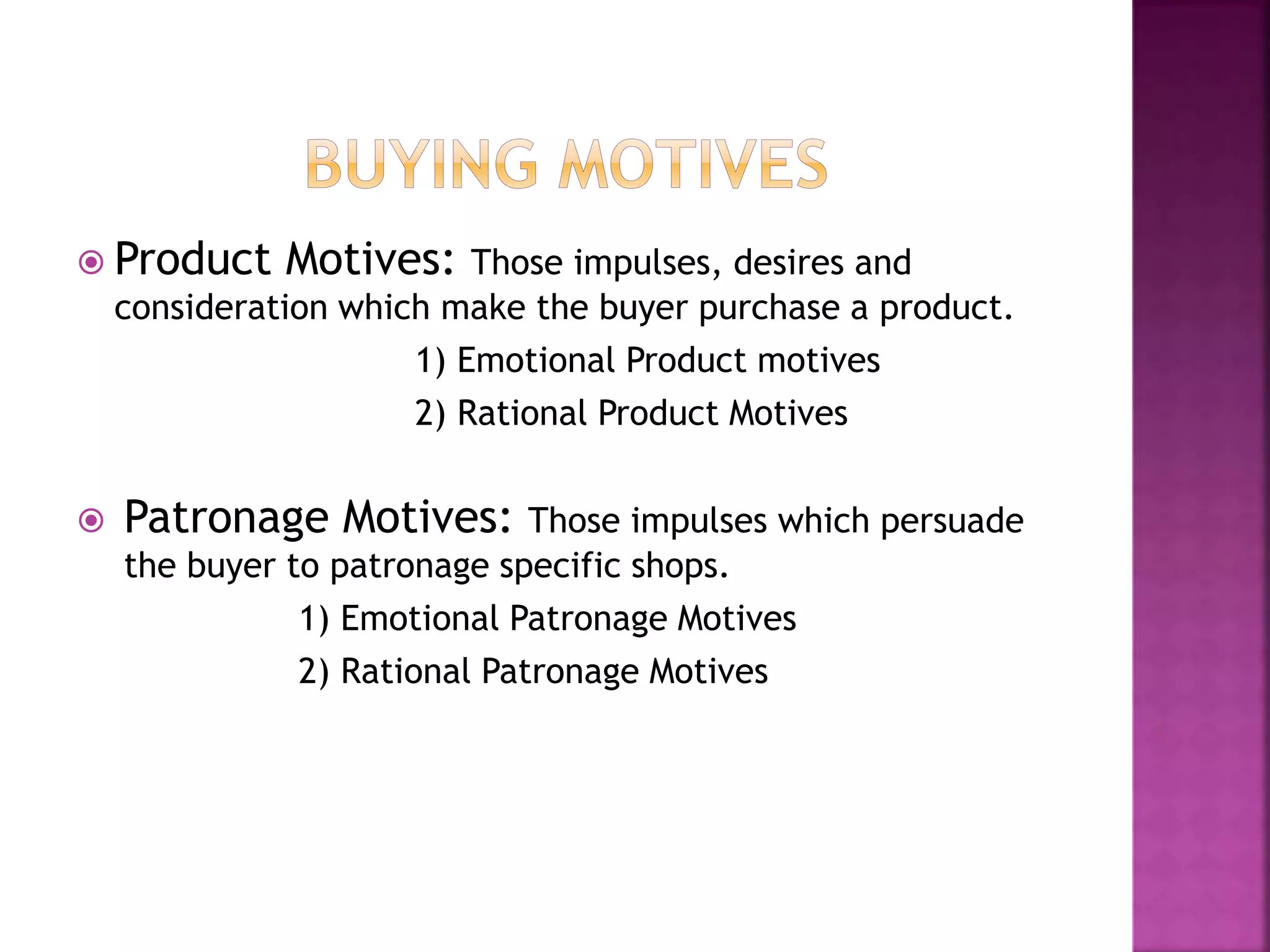
 Product Motives: Those impulses, desires and 
consideration which make the buyer purchase a product. 
1) Emotional Product motives 
2) Rational Product Motives 
 Patronage Motives: Those impulses which persuade 
the buyer to patronage specific shops. 
1) Emotional Patronage Motives 
2) Rational Patronage Motives
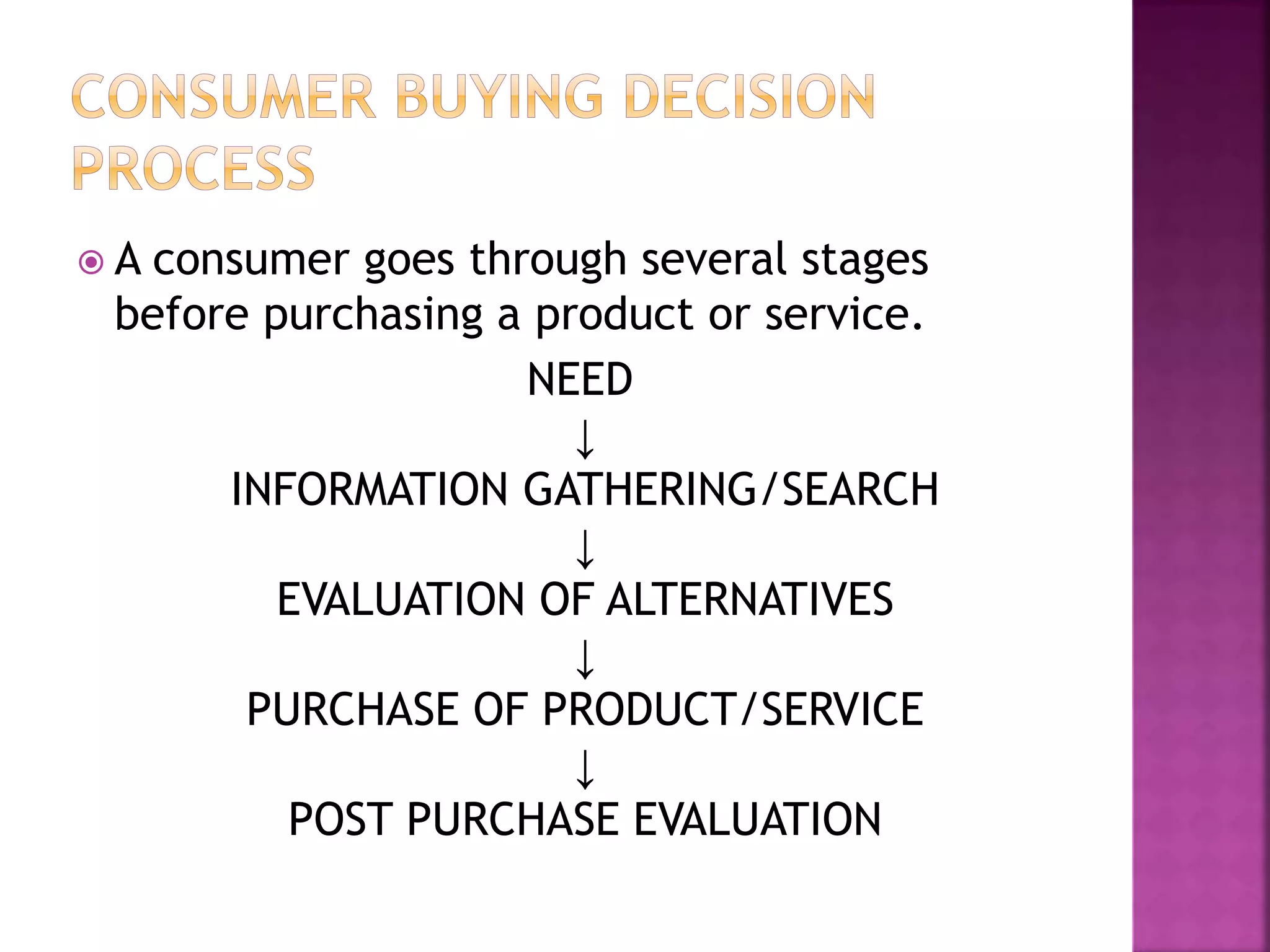
 A consumer goes through several stages 
before purchasing a product or service. 
NEED 
↓ 
INFORMATION GATHERING/SEARCH 
↓ 
EVALUATION OF ALTERNATIVES 
↓ 
PURCHASE OF PRODUCT/SERVICE 
↓ 
POST PURCHASE EVALUATION
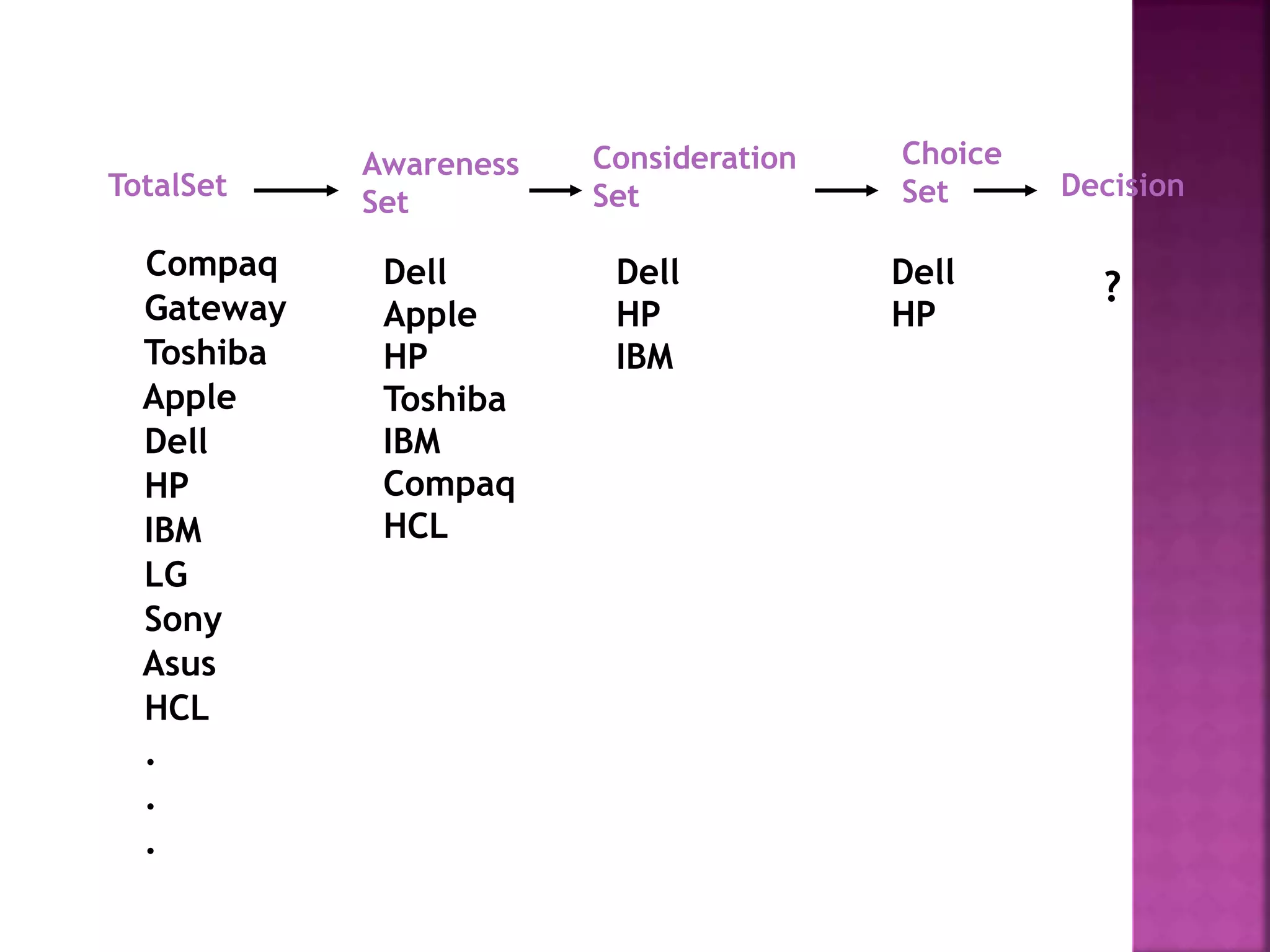
Compaq 
Gateway 
Toshiba 
Apple 
Dell 
HP 
IBM 
LG 
Sony 
Asus 
HCL 
. 
. 
. 
Dell 
Apple 
HP 
Toshiba 
IBM 
Compaq 
HCL 
Dell 
HP 
IBM 
Dell 
HP 
? 
TotalSet 
Awareness 
Set 
Consideration 
Set 
Choice 
Set Decision
Introduction to Consumer Behaviour

Introduction to Consumer Behaviour

  • 1.
  • 2.
     Though similar,consumers are unique in themselves; they have needs and wants which are varied and diverse from one another; and they have different consumption patterns and consumption behavior.  The marketer helps satisfy these needs and wants through product and service offerings. For a firm to survive, compete and grow, it is essential that the marketer identifies these needs and wants, and provides product offerings more effectively and efficiently than other competitors.
  • 3.
    Customer: Someone whoregularly purchases from a particular store or company. Consumer: Anyone engaging in any of the activities namely evaluating, acquiring, using or disposing of a product
  • 4.
     In alayman’s language consumer behavior deals with the buying behavior of individuals.  Consumer Behavior is a branch which deals with the various stages a consumer goes through before purchasing products or services for his end use.  it continues through pre-purchase activity to the post purchase experience;  it includes the stages of evaluating, acquiring, using and disposing of goods and services”.
  • 5.
     The subjectcan be studied at micro or macro levels depending upon whether it is analyzed at the individual level or at the group level.  The subject is interdisciplinary.  Consumer behavior is dynamic and interacting in nature.  As a field of study it is descriptive and also analytical/ interpretive.  It is a science as well as an art.
  • 6.
     What 'theconsumers buy: goods and services  ‘Why’ they buy it: need and want  ‘When’ do they buy it: time: day, week, month, year, occasions etc  ‘Where’ they buy it: place  ‘How often they buy’ it: time interval  ‘How often they use’ it: frequency of use
  • 7.
     Household consumer(personal consumer)  Organizational consumer (industrial or business consumer)
  • 8.
     The individualwho buys goods and services for his or her own use, for household use, for the use of a family member, or for a friend.
  • 9.
     A business,government agency, or other institution (profit or nonprofit) that buys the goods, services, and/or equipment necessary for the organization to function.
  • 10.
     Cultural factors Social factors Personal factors Psychological factors
  • 11.
     Cultural factordivided into three sub factors (i) Culture (ii) Sub Culture (iii) Social Class i. Culture:- Culture is the most basic cause of a person’s wants and behavior. ii. Sub culture:- Each culture contains smaller sub cultures a group of people with shared value system based on common life experiences and situations. Sub culture includes nationalities, religions, racial group and geographic regions. iii. Social class:- social classes are society’s relatively permanent and ordered divisions whose members share similar values, interests and behaviour.
  • 12.
     A consumer’sbehaviour also is influenced by social factors such as the (i) Groups (ii) Family (iii) Roles and status i. Groups:- Two or more people who interact to accomplish individual or mutual goals. A person’s behaviors is influenced by many small groups ii. Family:- Family members can strongly influence buyer behaviour iii. Roles and status:- A person belongs to many groups, family, clubs, organizations. The person’s position in each group can be defined in terms of both role and status.
  • 13.
     It includes)Age and life cycle stage (ii) Occupation (iii) Economic situation (iv) Life Style (v) Personality and self concept. i. Age and Life cycle Stage:- People changes the goods and services they buy over their lifetimes ii. Occupation:- A person’s occupation affects the goods and services bought iii. Economic situation:- A person’s economic situation will affect product choice iv. Life style:- Life Style is a person’s Pattern of living v. Personality and self concept:- Each person’s distinct personality influence his or her buying behaviour
  • 14.
     It includesthese Factors(i) Motivation (ii) Perception (iii) Learning (iv) Beliefs and attitudes i. Motivation:- Motive (drive) a need that is sufficiently pressing to direct the person to seek satisfaction of the need ii. Perception:- The process by which people select, Organize, and interpret information to form a meaningful picture of the world iii. Learning:- Changes in an individuals behaviour arising from experience iv. Beliefs and attitudes:- Belief is a descriptive thought that a person holds about something and Attitude, a Person’s consistently favorable or unfavorable evaluations, feelings, and tendencies towards an object or idea
  • 15.
     Product Motives:Those impulses, desires and consideration which make the buyer purchase a product. 1) Emotional Product motives 2) Rational Product Motives  Patronage Motives: Those impulses which persuade the buyer to patronage specific shops. 1) Emotional Patronage Motives 2) Rational Patronage Motives
  • 16.
     A consumergoes through several stages before purchasing a product or service. NEED ↓ INFORMATION GATHERING/SEARCH ↓ EVALUATION OF ALTERNATIVES ↓ PURCHASE OF PRODUCT/SERVICE ↓ POST PURCHASE EVALUATION
  • 17.
    Compaq Gateway Toshiba Apple Dell HP IBM LG Sony Asus HCL . . . Dell Apple HP Toshiba IBM Compaq HCL Dell HP IBM Dell HP ? TotalSet Awareness Set Consideration Set Choice Set Decision