Alphabet Soup for Offers in
Compromise
Michael DeBlis III, Esq.
Partner
DeBlis Law
Michael DeBlis III, Esq.
• Trial Lawyer
• Actor
• Author
• NCDC Graduate
• Marathon runner
Concept & Goals
• Taxpayers who have few assets and little
prospect of generating sufficient income to
pay a tax liability in full may be allowed to
strike a settlement for less than the full
amount due to settle their case.
• The IRS’s acceptance of an offer in
compromise conclusively settles the liability,
absent fraud or mistake.
Authority
• IRC 7122 gives secretary of treasury the
authority to compromise any tax debt owed to
the government. If the government accepts
the OIC, the TP pays less than the full amount
due to settle their case
Concept & Goals
• What is the policy goal? To achieve collection
of what is potentially collectible at the earliest
possible time and at the least cost to the
government while providing taxpayers with a
fresh start toward future voluntary
compliance.
Concept & Goals
• The IRS will compromise tax liability on
three grounds:
–Doubt as to liability,
–Doubt as to collectability, and
–Promotion of effective tax
administration.
Concept & Goals
• The IRS allows taxpayers three different
payment options:
–A cash, lump sum offer, usually payable
within 90 days;
–A short-term periodic payment offer,
payable over a two-year period; and
–A deferred periodic payment offer, payable
over the number of years remaining in the
statute of limitations on collection.
Offer in Compromise Application
• A taxpayer requests an offer in compromise by
submitting one of two forms:
– Form 656  To request relief based on doubt as
to collectability and/or effective tax administration
(includes a checklist for the taxpayer to use to
determine whether he is eligible to file an offer in
compromise);
– Form 656-L  To request relief based on doubt as
to liability.
Offer in Compromise Application
• Processing Fee
– Taxpayers must submit a $150 processing fee for
offers based on doubt as to collectability and
effective tax administration. This fee does not
apply to offers based on doubt as to liability.
– This fee is mandatory if the taxpayer earns
$24,000 or more and is single. However, it can be
waived in the case of low-income taxpayers –
those with income at or below 250% of the
poverty rate.
Offer in Compromise Application
– The processing fee is not refundable, even if the
IRS declares that the offer request is incomplete
or incorrect and cannot be processed.
– The user fee may be refunded if:
• The IRS accepts the offer based on effective tax
administration, or
• The IRS accepts the offer because of doubt as
to collectability and collection of an amount
greater than that offered would create
economic hardship for the taxpayer.
Offer in Compromise Application
• Down payment
– Most taxpayers must submit a down payment before
the IRS will process their application. This advance
payment is generally not refundable even if the IRS
rejects the taxpayer’s offer request.
– For lump sum offers, the taxpayer must remit 20% of
the amount of the lump sum offer.
– For periodic payment offers, the taxpayer must remit
the amount of the first proposed installment and
comply with her or her own proposed payment
schedule while the offer is being considered.
– The IRS waives the down payment requirement for
low-income taxpayers and for offers based on doubt
as to liability.
Processing the Application
• The IRS will process an offer in compromise
only if the taxpayer:
–Remits the required payments,
–Completes the application in full,
–Has filed all required tax returns and paid
the necessary estimated taxes, and
–Is not in bankruptcy
Processing the Application
• If the IRS returns an offer to the taxpayer
stating that it cannot be processed, can the
taxpayer appeal the decision? No.
What happens when the IRS accepts
an offer in compromise?
• The settlement will not be reopened unless the
taxpayer has falsified information, concealed
assets, or there was a mutual mistake of fact.
• The taxpayer must agree to fully comply with all
filing and payment requirements for five years
from the date the IRS accepts the offer.
• If the taxpayer fails to carry out his obligations
under the agreement, the IRS can terminate the
agreement and collect the originally determined
liability.
What happens if the IRS intends to
reject the TP’s offer in compromise
• It sets into play the following chain of events:
– First, an independent review of any proposed
rejection must take place. The IRS may not
arbitrarily reject an OIC until this independent
administrative review has occurred.
What happens if the IRS intends to
reject the TP’s offer in compromise
– Second, if the IRS rejects the offer, the IRS must
inform the taxpayer. If an OIC is rejected by either
the examination or the collection function after an
independent administrative review, TP will receive
an explanation of all available appeal rights.
– Third, the taxpayer has the right to appeal the
rejection to the IRS Appeals Division. He or she
has 30 days from the date of the rejection letter
to request an appeal.
May IRS Chief Counsel weigh in and provide an
opinion on whether to accept or reject a
taxpayer’s offer in compromise?
• An opinion of IRS counsel is required in all
cases where the unpaid tax – including
interest, penalties, and additions – is $50,000
or more.
• IRS Chief Counsel review consists of legal and
policy review.
• IRS Chief Counsel’s review is not a veto power,
although few revenue officers would settle in
the face of a negative Chief Counsel review.
What are collateral agreements?
• The IRS may condition acceptance of an OIC on
the taxpayer’s execution of a collateral
agreement to pay the IRS a certain percentage of
his or her future income over a specified number
of years.
• For example, if a taxpayer has the potential to
significantly increase his income over a relatively
short period of time, the IRS may require the
taxpayer to pay over a certain percentage of
future income in excess of a negotiated amount.
What are collateral agreements?
• Suppose that the taxpayer is a lawyer who has
accepted a personal injury case on a contingency
fee. If the case resolves within a certain number of
years (i.e., 5 years), the IRS might insist that it get
25% or 50% of any amount in excess of $100,000.
• The IRS does not like these agreements because
they have to monitor them five years into the
future.
• The IRS may withhold a refund from the taxpayer in
the year that a collateral agreement is executed.
Offers Based on Doubt as to
Collectability
• Most often accepted by IRS.
• Exists when the taxpayer cannot pay the full
amount of tax liability owed within the remainder
of the statute of limitations on collection.
• TP agrees that the tax is owed, but doesn’t
believe that he can fully pay the balance due. This
type of offer is initially considered by the
collection function and requires payment of a $
150 filing fee.
Offers Based on Doubt as to
Collectability
• In evaluating offers on this basis, the IRS
conducts an examination of the taxpayer’s
assets, liabilities, and earnings potential.
Offers Based on Doubt as to
Collectability
• What standard does the IRS use to
determine whether an offer based on
doubt as to collectability should be
accepted?
–The standard is: “Does the amount
reflect reasonable collection
potential?”
Offers Based on Doubt as to
Collectability
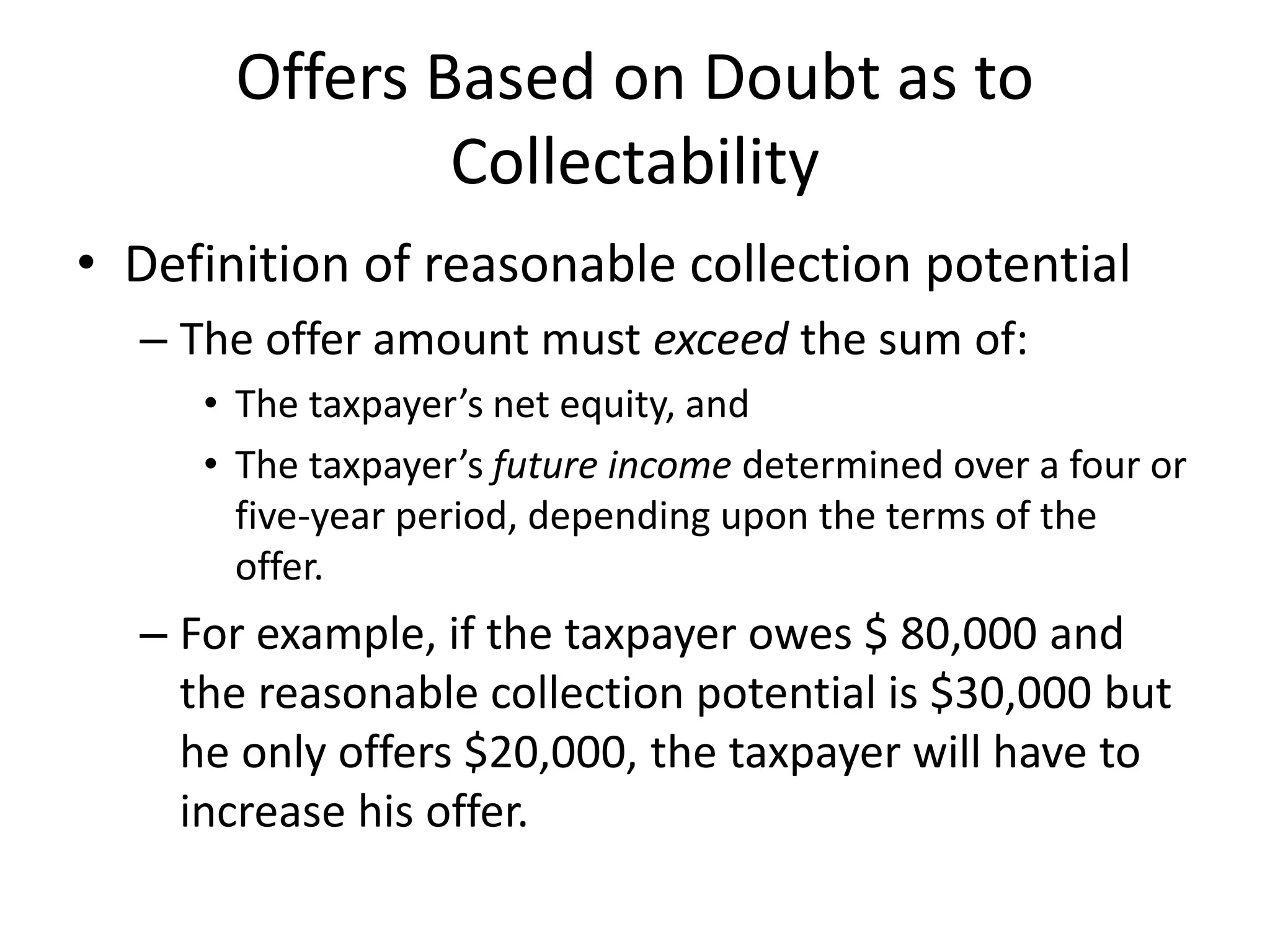
• Definition of reasonable collection potential
– The offer amount must exceed the sum of:
• The taxpayer’s net equity, and
• The taxpayer’s future income determined over a four or
five-year period, depending upon the terms of the
offer.
– For example, if the taxpayer owes $ 80,000 and
the reasonable collection potential is $30,000 but
he only offers $20,000, the taxpayer will have to
increase his offer.
Offers Based on Doubt as to
Collectability
• Calculating the taxpayer’s equity in assets
– Includes:
• Cash,
• Amounts in checking and investment accounts,
• Cash value of any life insurance policies, and
• Accounts receivable
– The realizable value of a taxpayer’s other real and
personal property is its “quick sale” value. The
quick sale value is 80% of the current fair market
value of the assets.
Offers Based on Doubt as to
Collectability
• Calculating the taxpayer’s future income
– When determining whether an offer should be
accepted based on doubt as to collectability, the IRS
may also consider a taxpayer’s earnings potential and
the likelihood of any increases in future income.
– Basic idea: The IRS looks at both income and
expenses. For income, it projects into the future what
it expects the taxpayer to be earning based on his or
her present situation and what it expects him or her
to be doing in the future. For expenses, the IRS
projects into the future what it expects the taxpayer’s
expenses to be.
Offers Based on Doubt as to
Collectability
– To determine a taxpayer’s future income, the IRS
uses information from his or her Collection
Information Statement (Form 433) in combination
with estimated national and local living costs (i.e.,
collection financial standards). These standards
are disregarded if the resulting amount would
leave the taxpayer unable to provide for basic
living expenses.
Offers Based on Doubt as to
Collectability
A taxpayer’s future income = taxpayer’s monthly
income (-) allowable expenses.
Offers Based on Doubt as to
Collectability
• Allowable expenses:
– Food, clothing;
• Based on a national standard.
– Out-of-pocket health care expenses;
• Based on a national standard.
– Housing and utilities; and
• Based on standard living costs in the state and county in which the taxpayer lives.
– Transportation.
• Consists of ownership and operating costs associated with a car.
• Ownership costs  Based on a national standard.
• Operating costs  Based on local standards.
Offers Based on Doubt as to Liability
• The taxpayer does not agree that he owes the
tax.
• Generally, the examination function considers
this type of offer and TP is not required to pay
a filing fee. Exceptions are offers submitted to
compromise a trust fund recovery penalty
which is considered by the collection function
Offers Based on Doubt as to Liability
• Given that the taxpayer has other avenues
available to negotiate with the IRS over the
extent of his tax liability, compromises on the
basis of doubt as to liability are rare.
• For example, through the requirement for a
notice of deficiency, taxpayers may contest
liability in the Tax Court. Taxpayers may also
contest liability in a refund or in a collection
suit.
Offers Based on Doubt as to Liability
• Once the liability is judicially contested, the
IRS will not consider offers in compromise
based upon doubt as to liability.
• Administratively, taxpayers also have
procedural rights, including invoking Appeals
Office consideration to contest liability.
Offers Based on Doubt as to Liability
• Nevertheless, some taxpayers have not had an
effective review of their liability for the
assessed taxes. They may not owe the taxes.
In that case, they can use OICs to contest their
liability for the underlying taxes.
• Taxpayers applying for an offer in compromise
based on doubt as to liability must file Form
656-L.
• This form does not require taxpayers to
submit a Collection Financial Statement.
Offers Based on Doubt as to Liability &
Doubt as to Collectability
• In these combination offers, the liability issues
will be considered first by either the
examination or collection functions depending
on the type of tax.
• Why? To the extent that the taxpayer is not
liable for the tax, there is no reason for a
complete investigation of the taxpayer’s
financial situation.
Offers Based on Doubt as to Liability &
Doubt as to Collectability
• If the revenue agent determines that the
taxpayer is liable for the tax, the case will be
forwarded to the collection function to
consider whether the tax liability is collectible.
Offers Based on Effective Tax
Administration
• Even if the taxpayer has assets and income that
allow him to pay the amount of tax liability owed,
the IRS may still accept an offer in compromise so
long as it promotes effective tax administration.
• In other words, on paper TP can fully pay the
liability but circumstances exist that with the
acceptance of the offer, the public will be
confident that the tax laws were administered
fairly and equitably
Offers Based on Effective Tax
Administration
• Issue: Will accepting this offer promote
effective tax administration?
Offers Based on Effective Tax
Administration
• Compromising the tax liability could promote
effective tax administration for any one of the
following reasons:
– Collection of the entire liability would cause the
taxpayer economic hardship, or
– Compelling public policy or equity considerations
provide a sufficient basis for compromising the
liability.
Offers Based on Effective Tax
Administration
• Collection of the entire liability would cause
the taxpayer economic hardship
– Economic hardship might exist if the taxpayer
faces a long-term illness, medical condition, or
disability and it is foreseeable that his or her
financial resources will be exhausted as a result.
– It can also cover cases where the sale or
liquidation of assets to pay a tax bill would
prevent the taxpayer from meeting basic living
expenses.
Offers Based on Effective Tax
Administration
• Compelling public policy or equity
considerations provide a sufficient basis for
compromising the liability
– Compromise will be justified only where collection
of the full liability would undermine public
confidence that the tax laws are being
administered in a fair and equitable manner.
– No ETA offer will be accepted if it would
undermine taxpayer compliance.
Offers Based on Effective Tax
Administration
• The IRS will not accept an ETA offer if it
determines that the taxpayer also qualifies for an
offer based on doubt as to collectability.
• However, if payment of the liability would still
cause the taxpayer economic hardship, the IRS
may treat the offer as one based on doubt as to
collectability with “special circumstances.”
• The same factors that the IRS takes into account
when processing an ETA offer are taken into
account in a special circumstances offer.
What effect does an offer in compromise
have on collection activities?
• Once the taxpayer submits an offer in
compromise, the IRS cannot levy against his or
her property while it processes the offer.
• Collection action is postponed for 30 days
following rejection of the taxpayer’s offer, and
during any appeal of that rejection.
What effect does an offer in compromise
have on collection activities?
• However, much to the chagrin of taxpayers,
the Statute of Limitations for collection is
tolled during any period in which the IRS is
prohibited from enforcing collection.
What effect does an offer in compromise
have on collection activities?
• If an accepted offer is payable in installments, the
taxpayer may be asked to extend the statute of
limitations on assessment for the period the offer
remains in force.
• During the taxable year in which the offer is
accepted, the IRS will also retain any refund to
which the taxpayer would otherwise be entitled
and apply that refund against the taxpayer’s
outstanding tax liability.
Appealing the Rejection of an Offer in
Compromise
• IRC 7122(d) gives TPs the right to appeal the
rejection of an OIC to the Office of Appeals.
This represents the second largest collection-
related program in Appeals
Appealing the Rejection of an Offer in
Compromise
• When to request an appeal
–An appeal must be made within 30 days
from the date of a rejection letter. The
appeals division has no authority to
consider offer in compromise appeals
submitted after the 30-day period expires.
Appealing the Rejection of an Offer in
Compromise
• What does Appeals consider?
– Appeals considers the same administrative guidelines
and requirements that collections relies on. However,
the appeals process offers an opportunity for a fresh
look at the computation of reasonable collection
potential (RCP).
– Appeals will use their settlement authority in offers
filed based on doubt as to liability. Appeals also
considers offers in compromise that are submitted as
a collection alternative in CDP hearings
Appealing the Rejection of an Offer in
Compromise
– If a taxpayer’s financial situation is complex or
asset values must be verified, Appeals must ask
Compliance to conduct an evaluation and send
them a report. Based on this investigation, the
Appeals employee will determine whether an
offer is acceptable as submitted, whether the
offer amount needs to be raised, or whether it
must be rejected.
Appealing the Rejection of an Offer in
Compromise
– Whether the Appeals’ decision is final is based on
the source of offer consideration. In an equivalent
hearing, the Appeals’ decision is final. In a CDP
hearing, the TP whose offer has been rejected as a
collection alternative has the opportunity for
judicial review based on an abuse of discretion
standard
Tel. 973.783.7000
MJDeBlis@DeBlisLaw.com
www.DeBlisLaw.com

Alphabet Soup for Offers in Compromise

  • 1.
    Alphabet Soup forOffers in Compromise Michael DeBlis III, Esq. Partner DeBlis Law
  • 2.
    Michael DeBlis III,Esq. • Trial Lawyer • Actor • Author • NCDC Graduate • Marathon runner
  • 3.
    Concept & Goals •Taxpayers who have few assets and little prospect of generating sufficient income to pay a tax liability in full may be allowed to strike a settlement for less than the full amount due to settle their case. • The IRS’s acceptance of an offer in compromise conclusively settles the liability, absent fraud or mistake.
  • 4.
    Authority • IRC 7122gives secretary of treasury the authority to compromise any tax debt owed to the government. If the government accepts the OIC, the TP pays less than the full amount due to settle their case
  • 5.
    Concept & Goals •What is the policy goal? To achieve collection of what is potentially collectible at the earliest possible time and at the least cost to the government while providing taxpayers with a fresh start toward future voluntary compliance.
  • 6.
    Concept & Goals •The IRS will compromise tax liability on three grounds: –Doubt as to liability, –Doubt as to collectability, and –Promotion of effective tax administration.
  • 7.
    Concept & Goals •The IRS allows taxpayers three different payment options: –A cash, lump sum offer, usually payable within 90 days; –A short-term periodic payment offer, payable over a two-year period; and –A deferred periodic payment offer, payable over the number of years remaining in the statute of limitations on collection.
  • 8.
    Offer in CompromiseApplication • A taxpayer requests an offer in compromise by submitting one of two forms: – Form 656  To request relief based on doubt as to collectability and/or effective tax administration (includes a checklist for the taxpayer to use to determine whether he is eligible to file an offer in compromise); – Form 656-L  To request relief based on doubt as to liability.
  • 9.
    Offer in CompromiseApplication • Processing Fee – Taxpayers must submit a $150 processing fee for offers based on doubt as to collectability and effective tax administration. This fee does not apply to offers based on doubt as to liability. – This fee is mandatory if the taxpayer earns $24,000 or more and is single. However, it can be waived in the case of low-income taxpayers – those with income at or below 250% of the poverty rate.
  • 10.
    Offer in CompromiseApplication – The processing fee is not refundable, even if the IRS declares that the offer request is incomplete or incorrect and cannot be processed. – The user fee may be refunded if: • The IRS accepts the offer based on effective tax administration, or • The IRS accepts the offer because of doubt as to collectability and collection of an amount greater than that offered would create economic hardship for the taxpayer.
  • 11.
    Offer in CompromiseApplication • Down payment – Most taxpayers must submit a down payment before the IRS will process their application. This advance payment is generally not refundable even if the IRS rejects the taxpayer’s offer request. – For lump sum offers, the taxpayer must remit 20% of the amount of the lump sum offer. – For periodic payment offers, the taxpayer must remit the amount of the first proposed installment and comply with her or her own proposed payment schedule while the offer is being considered. – The IRS waives the down payment requirement for low-income taxpayers and for offers based on doubt as to liability.
  • 12.
    Processing the Application •The IRS will process an offer in compromise only if the taxpayer: –Remits the required payments, –Completes the application in full, –Has filed all required tax returns and paid the necessary estimated taxes, and –Is not in bankruptcy
  • 13.
    Processing the Application •If the IRS returns an offer to the taxpayer stating that it cannot be processed, can the taxpayer appeal the decision? No.
  • 14.
    What happens whenthe IRS accepts an offer in compromise? • The settlement will not be reopened unless the taxpayer has falsified information, concealed assets, or there was a mutual mistake of fact. • The taxpayer must agree to fully comply with all filing and payment requirements for five years from the date the IRS accepts the offer. • If the taxpayer fails to carry out his obligations under the agreement, the IRS can terminate the agreement and collect the originally determined liability.
  • 15.
    What happens ifthe IRS intends to reject the TP’s offer in compromise • It sets into play the following chain of events: – First, an independent review of any proposed rejection must take place. The IRS may not arbitrarily reject an OIC until this independent administrative review has occurred.
  • 16.
    What happens ifthe IRS intends to reject the TP’s offer in compromise – Second, if the IRS rejects the offer, the IRS must inform the taxpayer. If an OIC is rejected by either the examination or the collection function after an independent administrative review, TP will receive an explanation of all available appeal rights. – Third, the taxpayer has the right to appeal the rejection to the IRS Appeals Division. He or she has 30 days from the date of the rejection letter to request an appeal.
  • 17.
    May IRS ChiefCounsel weigh in and provide an opinion on whether to accept or reject a taxpayer’s offer in compromise? • An opinion of IRS counsel is required in all cases where the unpaid tax – including interest, penalties, and additions – is $50,000 or more. • IRS Chief Counsel review consists of legal and policy review. • IRS Chief Counsel’s review is not a veto power, although few revenue officers would settle in the face of a negative Chief Counsel review.
  • 18.
    What are collateralagreements? • The IRS may condition acceptance of an OIC on the taxpayer’s execution of a collateral agreement to pay the IRS a certain percentage of his or her future income over a specified number of years. • For example, if a taxpayer has the potential to significantly increase his income over a relatively short period of time, the IRS may require the taxpayer to pay over a certain percentage of future income in excess of a negotiated amount.
  • 19.
    What are collateralagreements? • Suppose that the taxpayer is a lawyer who has accepted a personal injury case on a contingency fee. If the case resolves within a certain number of years (i.e., 5 years), the IRS might insist that it get 25% or 50% of any amount in excess of $100,000. • The IRS does not like these agreements because they have to monitor them five years into the future. • The IRS may withhold a refund from the taxpayer in the year that a collateral agreement is executed.
  • 20.
    Offers Based onDoubt as to Collectability • Most often accepted by IRS. • Exists when the taxpayer cannot pay the full amount of tax liability owed within the remainder of the statute of limitations on collection. • TP agrees that the tax is owed, but doesn’t believe that he can fully pay the balance due. This type of offer is initially considered by the collection function and requires payment of a $ 150 filing fee.
  • 21.
    Offers Based onDoubt as to Collectability • In evaluating offers on this basis, the IRS conducts an examination of the taxpayer’s assets, liabilities, and earnings potential.
  • 22.
    Offers Based onDoubt as to Collectability • What standard does the IRS use to determine whether an offer based on doubt as to collectability should be accepted? –The standard is: “Does the amount reflect reasonable collection potential?”
  • 23.
    Offers Based onDoubt as to Collectability • Definition of reasonable collection potential – The offer amount must exceed the sum of: • The taxpayer’s net equity, and • The taxpayer’s future income determined over a four or five-year period, depending upon the terms of the offer. – For example, if the taxpayer owes $ 80,000 and the reasonable collection potential is $30,000 but he only offers $20,000, the taxpayer will have to increase his offer.
  • 24.
    Offers Based onDoubt as to Collectability • Calculating the taxpayer’s equity in assets – Includes: • Cash, • Amounts in checking and investment accounts, • Cash value of any life insurance policies, and • Accounts receivable – The realizable value of a taxpayer’s other real and personal property is its “quick sale” value. The quick sale value is 80% of the current fair market value of the assets.
  • 25.
    Offers Based onDoubt as to Collectability • Calculating the taxpayer’s future income – When determining whether an offer should be accepted based on doubt as to collectability, the IRS may also consider a taxpayer’s earnings potential and the likelihood of any increases in future income. – Basic idea: The IRS looks at both income and expenses. For income, it projects into the future what it expects the taxpayer to be earning based on his or her present situation and what it expects him or her to be doing in the future. For expenses, the IRS projects into the future what it expects the taxpayer’s expenses to be.
  • 26.
    Offers Based onDoubt as to Collectability – To determine a taxpayer’s future income, the IRS uses information from his or her Collection Information Statement (Form 433) in combination with estimated national and local living costs (i.e., collection financial standards). These standards are disregarded if the resulting amount would leave the taxpayer unable to provide for basic living expenses.
  • 27.
    Offers Based onDoubt as to Collectability A taxpayer’s future income = taxpayer’s monthly income (-) allowable expenses.
  • 28.
    Offers Based onDoubt as to Collectability • Allowable expenses: – Food, clothing; • Based on a national standard. – Out-of-pocket health care expenses; • Based on a national standard. – Housing and utilities; and • Based on standard living costs in the state and county in which the taxpayer lives. – Transportation. • Consists of ownership and operating costs associated with a car. • Ownership costs  Based on a national standard. • Operating costs  Based on local standards.
  • 29.
    Offers Based onDoubt as to Liability • The taxpayer does not agree that he owes the tax. • Generally, the examination function considers this type of offer and TP is not required to pay a filing fee. Exceptions are offers submitted to compromise a trust fund recovery penalty which is considered by the collection function
  • 30.
    Offers Based onDoubt as to Liability • Given that the taxpayer has other avenues available to negotiate with the IRS over the extent of his tax liability, compromises on the basis of doubt as to liability are rare. • For example, through the requirement for a notice of deficiency, taxpayers may contest liability in the Tax Court. Taxpayers may also contest liability in a refund or in a collection suit.
  • 31.
    Offers Based onDoubt as to Liability • Once the liability is judicially contested, the IRS will not consider offers in compromise based upon doubt as to liability. • Administratively, taxpayers also have procedural rights, including invoking Appeals Office consideration to contest liability.
  • 32.
    Offers Based onDoubt as to Liability • Nevertheless, some taxpayers have not had an effective review of their liability for the assessed taxes. They may not owe the taxes. In that case, they can use OICs to contest their liability for the underlying taxes. • Taxpayers applying for an offer in compromise based on doubt as to liability must file Form 656-L. • This form does not require taxpayers to submit a Collection Financial Statement.
  • 33.
    Offers Based onDoubt as to Liability & Doubt as to Collectability • In these combination offers, the liability issues will be considered first by either the examination or collection functions depending on the type of tax. • Why? To the extent that the taxpayer is not liable for the tax, there is no reason for a complete investigation of the taxpayer’s financial situation.
  • 34.
    Offers Based onDoubt as to Liability & Doubt as to Collectability • If the revenue agent determines that the taxpayer is liable for the tax, the case will be forwarded to the collection function to consider whether the tax liability is collectible.
  • 35.
    Offers Based onEffective Tax Administration • Even if the taxpayer has assets and income that allow him to pay the amount of tax liability owed, the IRS may still accept an offer in compromise so long as it promotes effective tax administration. • In other words, on paper TP can fully pay the liability but circumstances exist that with the acceptance of the offer, the public will be confident that the tax laws were administered fairly and equitably
  • 36.
    Offers Based onEffective Tax Administration • Issue: Will accepting this offer promote effective tax administration?
  • 37.
    Offers Based onEffective Tax Administration • Compromising the tax liability could promote effective tax administration for any one of the following reasons: – Collection of the entire liability would cause the taxpayer economic hardship, or – Compelling public policy or equity considerations provide a sufficient basis for compromising the liability.
  • 38.
    Offers Based onEffective Tax Administration • Collection of the entire liability would cause the taxpayer economic hardship – Economic hardship might exist if the taxpayer faces a long-term illness, medical condition, or disability and it is foreseeable that his or her financial resources will be exhausted as a result. – It can also cover cases where the sale or liquidation of assets to pay a tax bill would prevent the taxpayer from meeting basic living expenses.
  • 39.
    Offers Based onEffective Tax Administration • Compelling public policy or equity considerations provide a sufficient basis for compromising the liability – Compromise will be justified only where collection of the full liability would undermine public confidence that the tax laws are being administered in a fair and equitable manner. – No ETA offer will be accepted if it would undermine taxpayer compliance.
  • 40.
    Offers Based onEffective Tax Administration • The IRS will not accept an ETA offer if it determines that the taxpayer also qualifies for an offer based on doubt as to collectability. • However, if payment of the liability would still cause the taxpayer economic hardship, the IRS may treat the offer as one based on doubt as to collectability with “special circumstances.” • The same factors that the IRS takes into account when processing an ETA offer are taken into account in a special circumstances offer.
  • 41.
    What effect doesan offer in compromise have on collection activities? • Once the taxpayer submits an offer in compromise, the IRS cannot levy against his or her property while it processes the offer. • Collection action is postponed for 30 days following rejection of the taxpayer’s offer, and during any appeal of that rejection.
  • 42.
    What effect doesan offer in compromise have on collection activities? • However, much to the chagrin of taxpayers, the Statute of Limitations for collection is tolled during any period in which the IRS is prohibited from enforcing collection.
  • 43.
    What effect doesan offer in compromise have on collection activities? • If an accepted offer is payable in installments, the taxpayer may be asked to extend the statute of limitations on assessment for the period the offer remains in force. • During the taxable year in which the offer is accepted, the IRS will also retain any refund to which the taxpayer would otherwise be entitled and apply that refund against the taxpayer’s outstanding tax liability.
  • 44.
    Appealing the Rejectionof an Offer in Compromise • IRC 7122(d) gives TPs the right to appeal the rejection of an OIC to the Office of Appeals. This represents the second largest collection- related program in Appeals
  • 45.
    Appealing the Rejectionof an Offer in Compromise • When to request an appeal –An appeal must be made within 30 days from the date of a rejection letter. The appeals division has no authority to consider offer in compromise appeals submitted after the 30-day period expires.
  • 46.
    Appealing the Rejectionof an Offer in Compromise • What does Appeals consider? – Appeals considers the same administrative guidelines and requirements that collections relies on. However, the appeals process offers an opportunity for a fresh look at the computation of reasonable collection potential (RCP). – Appeals will use their settlement authority in offers filed based on doubt as to liability. Appeals also considers offers in compromise that are submitted as a collection alternative in CDP hearings
  • 47.
    Appealing the Rejectionof an Offer in Compromise – If a taxpayer’s financial situation is complex or asset values must be verified, Appeals must ask Compliance to conduct an evaluation and send them a report. Based on this investigation, the Appeals employee will determine whether an offer is acceptable as submitted, whether the offer amount needs to be raised, or whether it must be rejected.
  • 48.
    Appealing the Rejectionof an Offer in Compromise – Whether the Appeals’ decision is final is based on the source of offer consideration. In an equivalent hearing, the Appeals’ decision is final. In a CDP hearing, the TP whose offer has been rejected as a collection alternative has the opportunity for judicial review based on an abuse of discretion standard
  • 49.