INDIFFERENCE CURVE ANALYSIS
by
Dr. S. Janakiraman
Assistant Professor of Economics
Government Arts College (Autonomous),
Coimbatore.
Utility
The satisfaction or pleasure a
consumer derives from the
consumption or possession of a
good (or service) or an activity (or
lack thereof), over a certain span of
time.
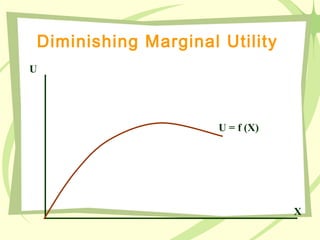
Diminishing Marginal Utility
U
X
U = f (X)
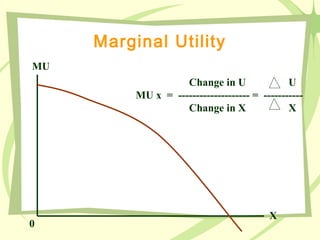
Marginal Utility
MU
X
0
Change in U U
MU x = -------------------- = -----------
Change in X X
Prelude to Indifference
discussion
Marginal utility analysis requires some
numerical measure of utility in order to
determine the optimal consumption
combinations
Economists have developed another, more
general, approach to utility and consumer
behavior
This approach does not require that numbers
be attached to specific levels of utility
INDIFFERENCE CURVES AND UTILITY
MAXIMIZATION
• All this new approach requires is that
consumers be able to rank their
preferences for various combinations of
goods
• Specifically, the consumer should be able
to say whether
– Combination A is preferred to combination B
– Combination B is preferred to combination A.
or
– Both combinations are equally preferred
An Indifference Curve:
Definition
• An indifference curve is a curve showing all
the quantity mixes of two goods from which
the consumer derives the same level of
utility.
• An indifference curve is convex to the
origin, reflecting the principle of
diminishing marginal utility.
• The slope of an indifference curve measures
the marginal rate of substitution, MRS.
Consumer Preferences
• Indifference curve shows all
combinations of goods that provide the
consumer with the same satisfaction, or
the same utility
• Thus, the consumer finds all
combinations on a curve equally
preferred
• Since each of the alternative bundles of
goods yields the same level of utility, the
consumer is indifferent about which
combination is actually consumed
Indifference Curves
• Indifference curves are also convex
to the origin  they are bowed
inward toward the origin
• The curve gets flatter as you move
down it
Marginal Rate of Substitution
• Definition: The rate at which a
consumer is willing to substitute one
good for another good while remaining
at the same level of satisfaction. That is
the amount of good X needed to replace
one unit of (lost) good Y to keep the
consumer’s level of satisfaction (utility)
unchanged.
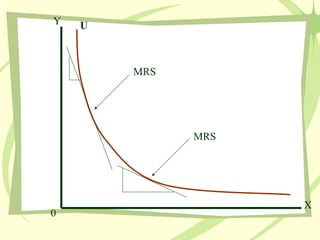
• MRS = Slope of the indifference curve
U
0
Y
X
MRS
MRS
Marginal Rate of Substitution
• The law of diminishing marginal rate of
substitution says that as a persons
consumption of pizza increases, the
number of videos that they are willing to
give up to get another pizza declines
• This implies that the indifference curve
has a diminishing slope  as we move
down the indifference curve, the
consumption of pizza increases and the
marginal utility of additional pizza
declines
The principle of diminishing
marginal utility:
• As a consumer consumes more
and more of a good, beyond a
certain level, the utility of each
additional unit of it (marginal
utility) begins to decrease.
• As a consumer consumes more
and more of a good, beyond a
certain level, each additional unit
of that good becomes less dear to
him/her
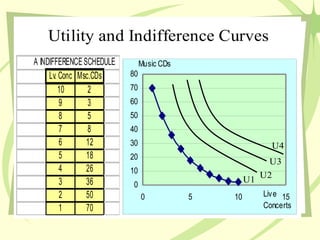
Indifference Map
• We can use the same approach to
generate a series of indifference curves,
called an indifference map  graphical
representation of a consumer’s tastes
• Each curve in the map reflects a different
level of utility
Utility and Indifference Curves
0
10
20
30
40
50
60
70
80
0 5 10 15
Music CDs
Live
Concerts
A INDIFFERENCESCHEDULE
Lv. Conc Msc.CDs
10 2
9 3
8 5
7 8
6 12
5 18
4 26
3 36
2 50
1 70
U1 U2
U3
U4
Properties of Indifference Curves
• A particular indifference curve
reflects a constant level of utility
• If total utility is to remain constant, an
increase in the consumption of one
good must be offset by a decrease in
the consumption of the other good 
indifference curves slope downward
• Higher indifference curves represent
higher levels of utility
Properties of Indifference Curves
• Because of the law of diminishing
marginal rate of substitution, indifference
curves are bowed in toward the origin
• Indifference curves do not intersect
• Indifference curves are a graphical
representation of a consumer’s tastes for
the two goods
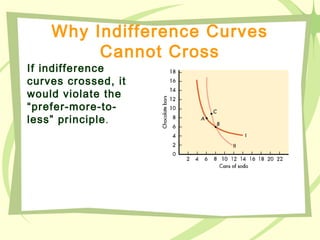
Why Indifference Curves
Cannot Cross
If indifference
curves crossed, it
would violate the
“prefer-more-to-
less” principle.
Budget Line
• A line showing all combinations of the
quantities of two goods a consumer can
buy with a given amount of income
(budget).
• Assuming a consumer is spending all her
income on two (symbolic) consumer
goods: CDs and live concerts,
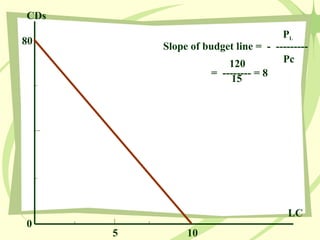
Income = Pc . Qc + PL . QL
Pc = 15 , PL = 120 , Income = 1200
CD intercept = 80 LC intercept = 10
CDs
LC
80
105
0
Slope of budget line = - ---------
Pc
PL
= -------- = 8
120
15
Summary
• The indifference curve indicates what the
consumer is willing to buy
• The budget line shows what the
consumer is able to buy
• When the indifference curve and the
budget line are combined, we find the
quantities of each good the consumer is
both willing and able to buy

Indifference Curve

  • 1.
    INDIFFERENCE CURVE ANALYSIS by Dr.S. Janakiraman Assistant Professor of Economics Government Arts College (Autonomous), Coimbatore.
  • 2.
    Utility The satisfaction orpleasure a consumer derives from the consumption or possession of a good (or service) or an activity (or lack thereof), over a certain span of time.
  • 3.
  • 4.
    Marginal Utility MU X 0 Change inU U MU x = -------------------- = ----------- Change in X X
  • 5.
    Prelude to Indifference discussion Marginalutility analysis requires some numerical measure of utility in order to determine the optimal consumption combinations Economists have developed another, more general, approach to utility and consumer behavior This approach does not require that numbers be attached to specific levels of utility
  • 6.
    INDIFFERENCE CURVES ANDUTILITY MAXIMIZATION • All this new approach requires is that consumers be able to rank their preferences for various combinations of goods • Specifically, the consumer should be able to say whether – Combination A is preferred to combination B – Combination B is preferred to combination A. or – Both combinations are equally preferred
  • 7.
    An Indifference Curve: Definition •An indifference curve is a curve showing all the quantity mixes of two goods from which the consumer derives the same level of utility. • An indifference curve is convex to the origin, reflecting the principle of diminishing marginal utility. • The slope of an indifference curve measures the marginal rate of substitution, MRS.
  • 8.
    Consumer Preferences • Indifferencecurve shows all combinations of goods that provide the consumer with the same satisfaction, or the same utility • Thus, the consumer finds all combinations on a curve equally preferred • Since each of the alternative bundles of goods yields the same level of utility, the consumer is indifferent about which combination is actually consumed
  • 9.
    Indifference Curves • Indifferencecurves are also convex to the origin  they are bowed inward toward the origin • The curve gets flatter as you move down it
  • 10.
    Marginal Rate ofSubstitution • Definition: The rate at which a consumer is willing to substitute one good for another good while remaining at the same level of satisfaction. That is the amount of good X needed to replace one unit of (lost) good Y to keep the consumer’s level of satisfaction (utility) unchanged. • MRS = Slope of the indifference curve
  • 11.
  • 12.
    Marginal Rate ofSubstitution • The law of diminishing marginal rate of substitution says that as a persons consumption of pizza increases, the number of videos that they are willing to give up to get another pizza declines • This implies that the indifference curve has a diminishing slope  as we move down the indifference curve, the consumption of pizza increases and the marginal utility of additional pizza declines
  • 13.
    The principle ofdiminishing marginal utility: • As a consumer consumes more and more of a good, beyond a certain level, the utility of each additional unit of it (marginal utility) begins to decrease. • As a consumer consumes more and more of a good, beyond a certain level, each additional unit of that good becomes less dear to him/her
  • 14.
    Indifference Map • Wecan use the same approach to generate a series of indifference curves, called an indifference map  graphical representation of a consumer’s tastes • Each curve in the map reflects a different level of utility
  • 15.
    Utility and IndifferenceCurves 0 10 20 30 40 50 60 70 80 0 5 10 15 Music CDs Live Concerts A INDIFFERENCESCHEDULE Lv. Conc Msc.CDs 10 2 9 3 8 5 7 8 6 12 5 18 4 26 3 36 2 50 1 70 U1 U2 U3 U4
  • 16.
    Properties of IndifferenceCurves • A particular indifference curve reflects a constant level of utility • If total utility is to remain constant, an increase in the consumption of one good must be offset by a decrease in the consumption of the other good  indifference curves slope downward • Higher indifference curves represent higher levels of utility
  • 17.
    Properties of IndifferenceCurves • Because of the law of diminishing marginal rate of substitution, indifference curves are bowed in toward the origin • Indifference curves do not intersect • Indifference curves are a graphical representation of a consumer’s tastes for the two goods
  • 18.
    Why Indifference Curves CannotCross If indifference curves crossed, it would violate the “prefer-more-to- less” principle.
  • 19.
    Budget Line • Aline showing all combinations of the quantities of two goods a consumer can buy with a given amount of income (budget). • Assuming a consumer is spending all her income on two (symbolic) consumer goods: CDs and live concerts, Income = Pc . Qc + PL . QL Pc = 15 , PL = 120 , Income = 1200 CD intercept = 80 LC intercept = 10
  • 20.
    CDs LC 80 105 0 Slope of budgetline = - --------- Pc PL = -------- = 8 120 15
  • 21.
    Summary • The indifferencecurve indicates what the consumer is willing to buy • The budget line shows what the consumer is able to buy • When the indifference curve and the budget line are combined, we find the quantities of each good the consumer is both willing and able to buy