Consumer’s Equilibrium
Part - I
CBSE Revised Syllabus 2020 -21
Consumer's equilibrium - meaning of utility, marginal utility,
Law of diminishing marginal utility,
Conditions of consumer's equilibrium using marginal utility
analysis.
Introduction
• A consumer is one who buys goods and services for satisfaction of wants.
• He takes decision with regard to the kind of goods to be purchased in
order to satisfy his wants.
• The main objective is to get maximum satisfaction form spending his
income on various goods and services.
• The two main approaches to study consumer’s behaviour and consumer’s
equilibrium are:
1. Cardinal Utility Approach (or Marshall’s Utility Analysis or Marginal
Utility Analysis)
2. Ordinal Utility Approach (or Indifference Curve or Hicksian Analysis)
Concept of Uility
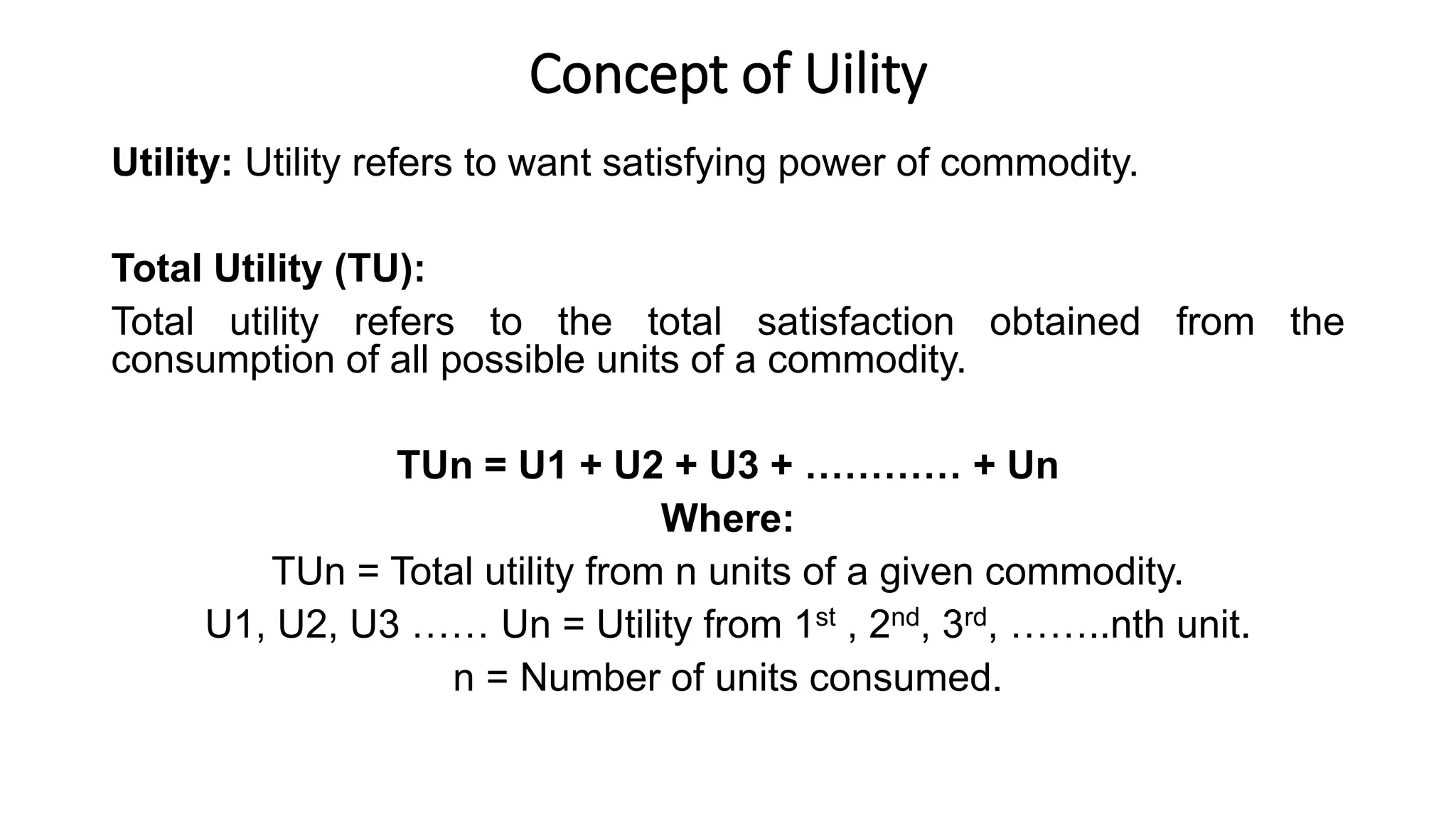
Utility: Utility refers to want satisfying power of commodity.
Total Utility (TU):
Total utility refers to the total satisfaction obtained from the
consumption of all possible units of a commodity.
TUn = U1 + U2 + U3 + ………… + Un
Where:
TUn = Total utility from n units of a given commodity.
U1, U2, U3 …… Un = Utility from 1st , 2nd, 3rd, ……..nth unit.
n = Number of units consumed.
Marginal Utility
Marginal Utility (MU)
Marginal utility is the additional utility from the consumption of one more unit of the
given commodity.
It is the utility derived from the last unit of a commodity purchased.
MUn = TUn – TUn-1
MUn = Marginal utility from nth unit.
TUn = Total utility from the n units.
TUn-1 = Total utility from n-1 units
n = Number of units of consumption.
MU = Change in Total Utility
MU = ΔTU/ ΔQ
Change in number of Units
Law of Diminishing Marginal Utility
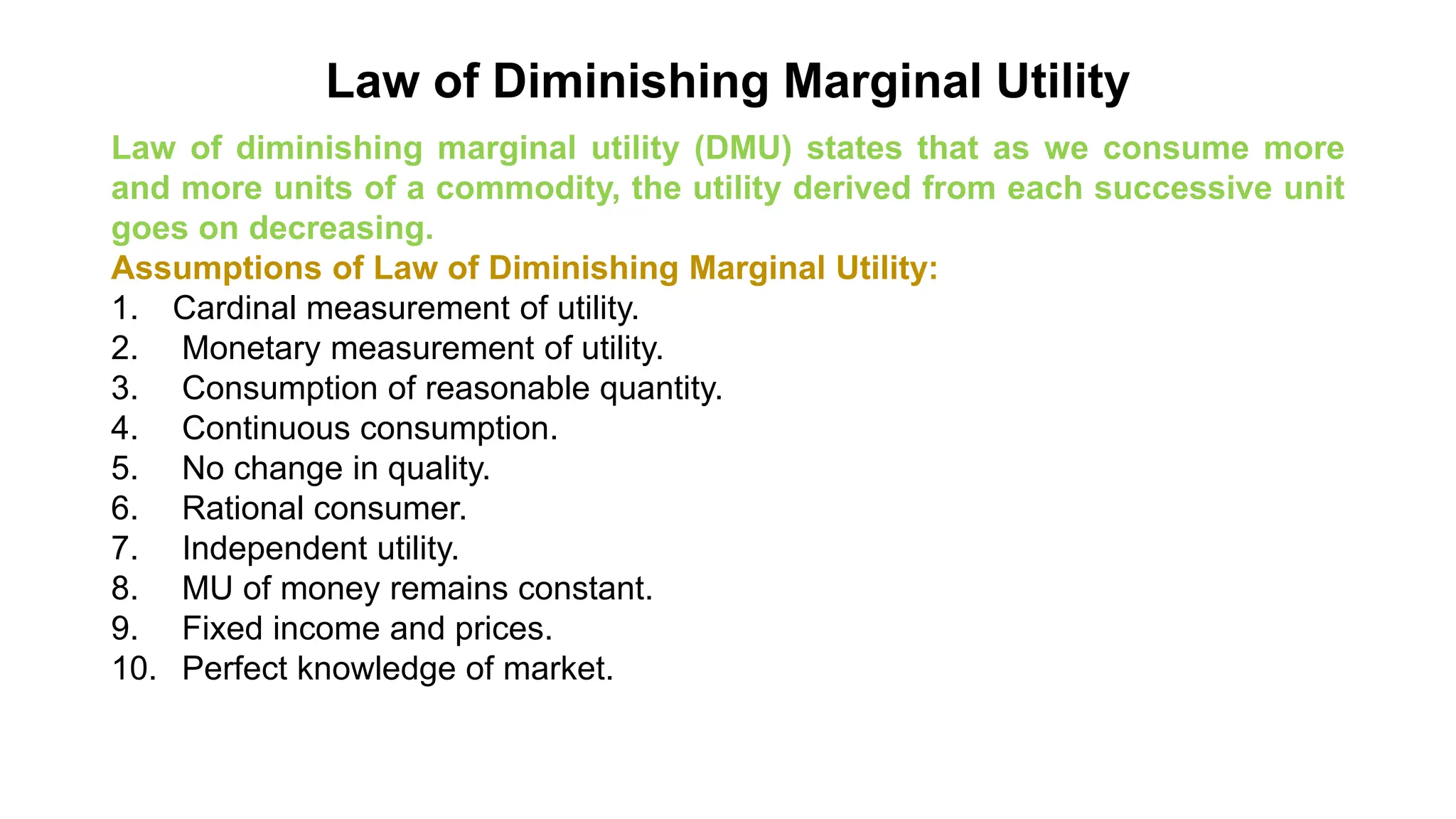
Law of diminishing marginal utility (DMU) states that as we consume more
and more units of a commodity, the utility derived from each successive unit
goes on decreasing.
Assumptions of Law of Diminishing Marginal Utility:
1. Cardinal measurement of utility.
2. Monetary measurement of utility.
3. Consumption of reasonable quantity.
4. Continuous consumption.
5. No change in quality.
6. Rational consumer.
7. Independent utility.
8. MU of money remains constant.
9. Fixed income and prices.
10. Perfect knowledge of market.
Diagrammatic Expression of Law of DMU
Table Diagram of DMU
Units of
Ice
Cream
Total
Utility
(in utils)
Margina
l Utility
(in
utils)
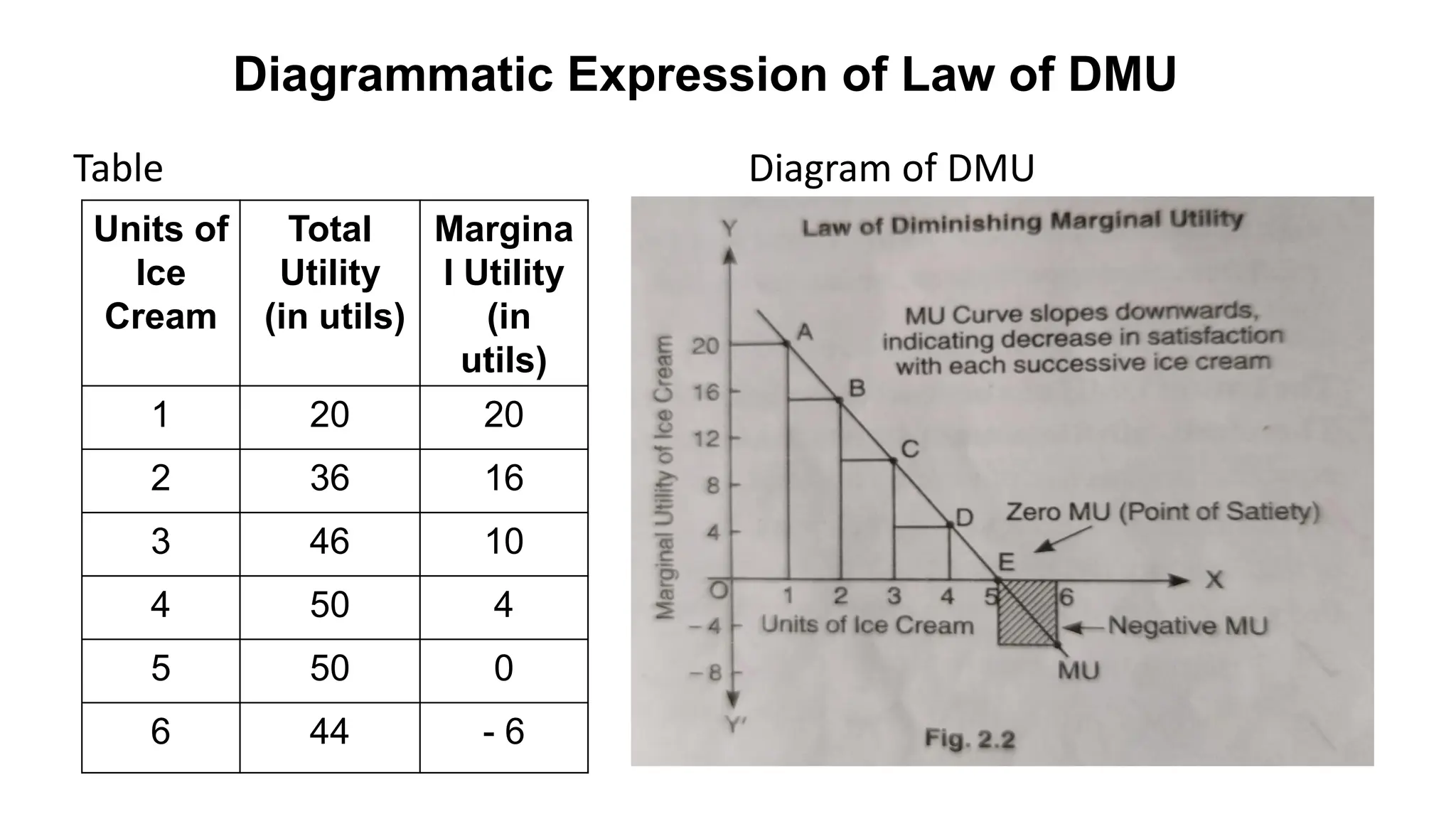
1 20 20
2 36 16
3 46 10
4 50 4
5 50 0
6 44 - 6
In the above diagram, units of ice cream are shown along the X
– axis and MU along the Y – axis. MU from each successive ice-
cream is represented by points A, B, C, D and E.
MU falls from 20 to 16 and then to 10 utils, when consumption is
increased from 1st to 2nd and then to 3rd ice-cream. 5th ice –
cream has no utility (MU = 0) and this is known as the ‘Point of
satiety’. When 6th ice-cream is consumed, MU becomes negative.
MU curve slopes downwards showing that MU of successive
units is falling.
Consumer’s Equilibrium
Consumer equilibrium refers to a situation when a consumer is
having maximum satisfaction with limited income and has no
tendency to change his way of existing expenditure.
Consumer’s equilibrium can be discussed under two different
situations: -
1. Consumer spends his entire income on a Single Commodity.
2. Consumer spends his entire income on Two Commodities.
Consumer Equilibrium in case of Single Commodity
A consumer purchasing a single commodity will be at equilibrium, when he is
buying such a quantity of that commodity, which gives him maximum
satisfaction.
Equilibrium Condition:
Consumer in consumption of single commodity (say, x) will be at equilibrium
when:
Marginal Utility (MUx) is equal to price (P) paid for the commodity; i.e.
MUx = Px
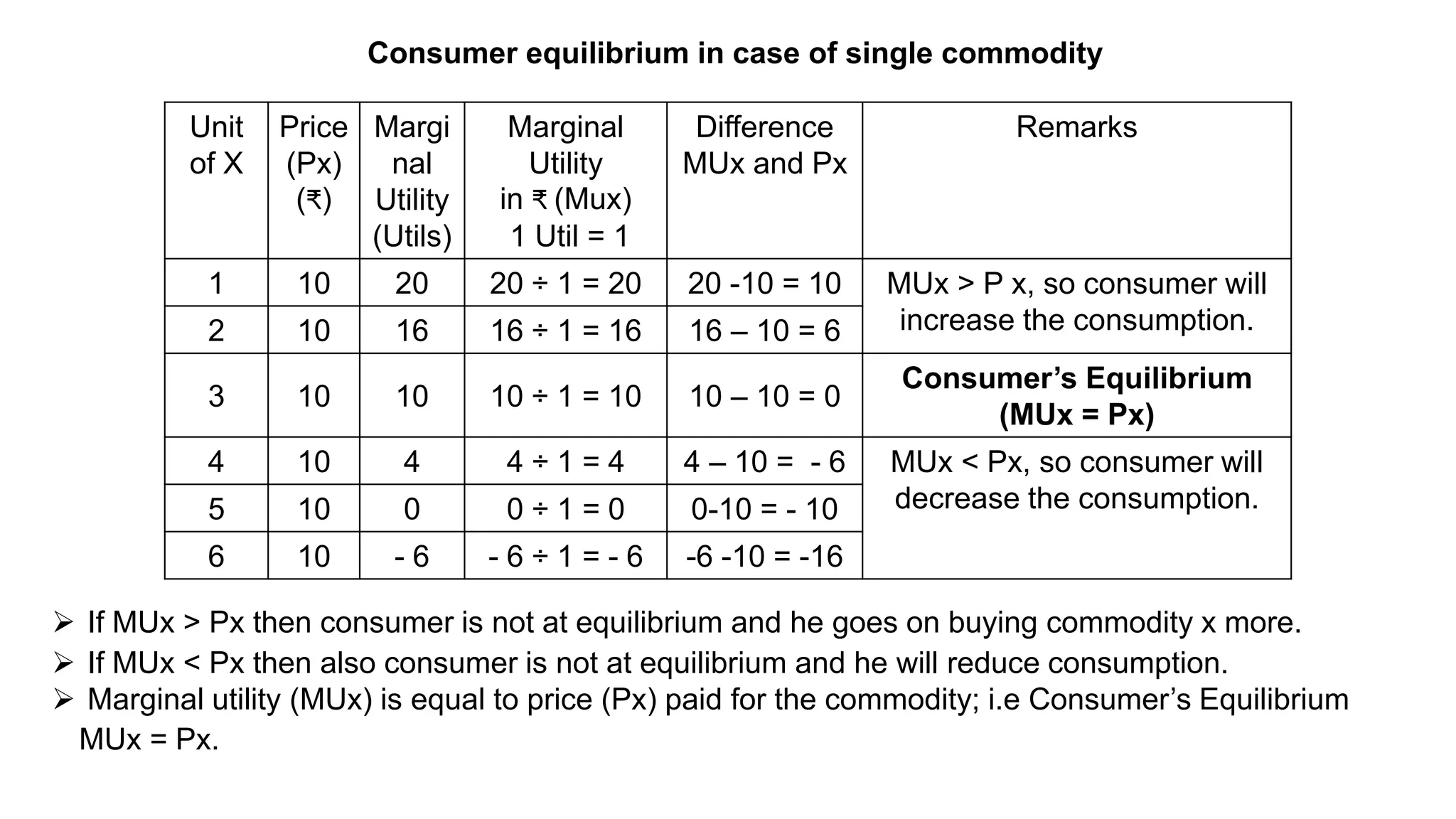
Consumer equilibrium in case of single commodity
➢ If MUx > Px then consumer is not at equilibrium and he goes on buying commodity x more.
➢ If MUx < Px then also consumer is not at equilibrium and he will reduce consumption.
➢ Marginal utility (MUx) is equal to price (Px) paid for the commodity; i.e Consumer’s Equilibrium
MUx = Px.
Unit
of X
Price
(Px)
(₹)
Margi
nal
Utility
(Utils)
Marginal
Utility
in ₹ (Mux)
1 Util = 1
Difference
MUx and Px
Remarks
1 10 20 20 ÷ 1 = 20 20 -10 = 10 MUx > P x, so consumer will
increase the consumption.
2 10 16 16 ÷ 1 = 16 16 – 10 = 6
3 10 10 10 ÷ 1 = 10 10 – 10 = 0
Consumer’s Equilibrium
(MUx = Px)
4 10 4 4 ÷ 1 = 4 4 – 10 = - 6 MUx < Px, so consumer will
decrease the consumption.
5 10 0 0 ÷ 1 = 0 0-10 = - 10
6 10 - 6 - 6 ÷ 1 = - 6 -6 -10 = -16
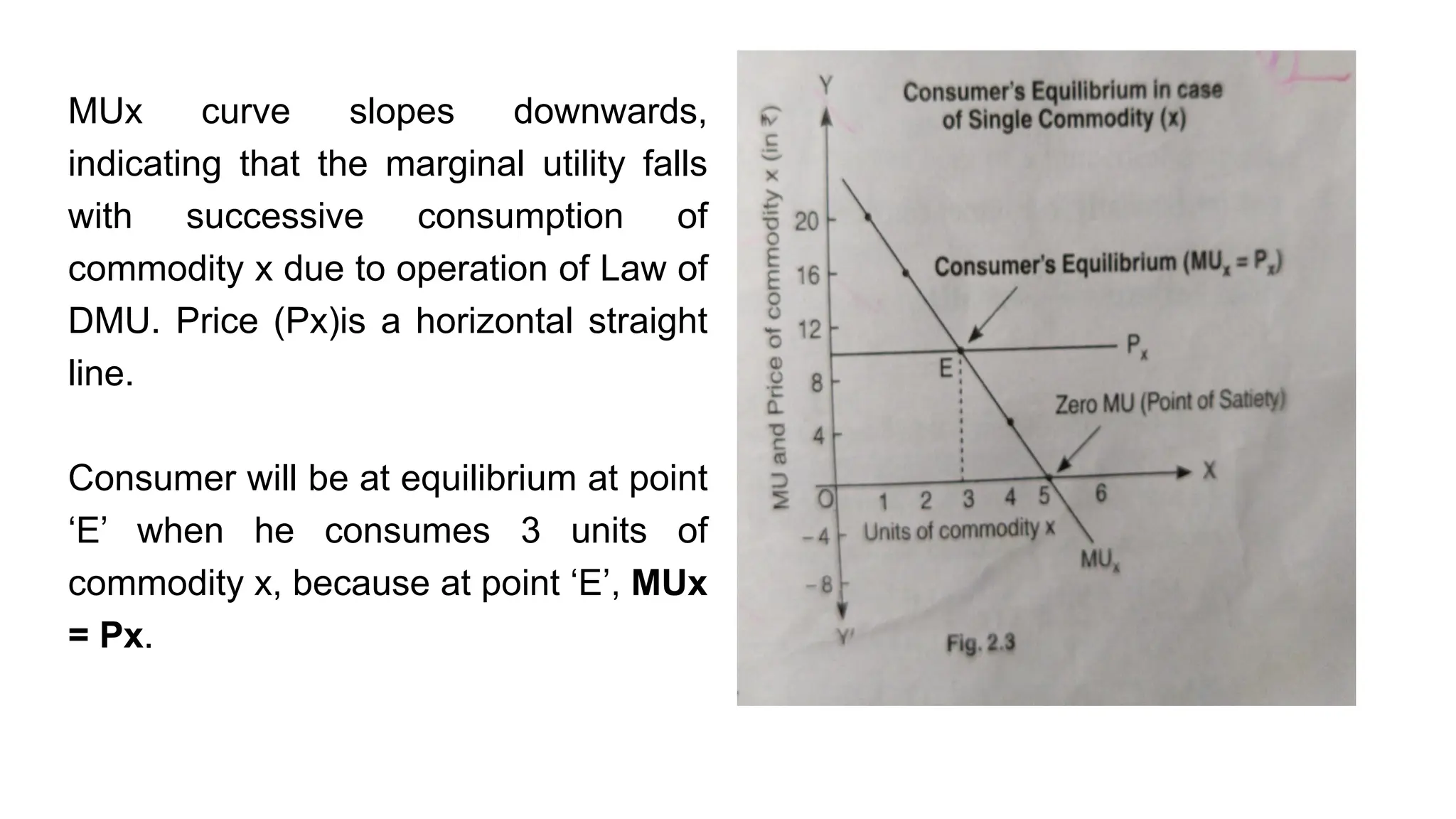
MUx curve slopes downwards,
indicating that the marginal utility falls
with successive consumption of
commodity x due to operation of Law of
DMU. Price (Px)is a horizontal straight
line.
Consumer will be at equilibrium at point
‘E’ when he consumes 3 units of
commodity x, because at point ‘E’, MUx
= Px.
Consumer Equilibrium in Case of Two Commodity
According to the law of Equi-marginal utility, a consumer gets maximum
satisfaction, when ratios of MU of two commodities and their respective
prices are equal and MU falls as consumption increases.
It means, there are two necessary conditions to attain Consumer’s
Equilibrium in case of Two Commodities:
(i) The ratio of Marginal Utility to Price is same in case of both the goods.
If consumer consumes to two goods (x and y).
Then at equilibrium MUx = MUy = MUm
MUm is marginal utility of money (m).
If MUm = 1, then MUx = MUy
(ii) MU falls as consumption increases.
Px Py
Px Py
Thanks
Prepared By
Rohitash Kumar
PGT Economics
KV No 1 Colaba

Consumer Equilibrium powerpoint presentation

  • 1.
  • 2.
    CBSE Revised Syllabus2020 -21 Consumer's equilibrium - meaning of utility, marginal utility, Law of diminishing marginal utility, Conditions of consumer's equilibrium using marginal utility analysis.
  • 3.
    Introduction • A consumeris one who buys goods and services for satisfaction of wants. • He takes decision with regard to the kind of goods to be purchased in order to satisfy his wants. • The main objective is to get maximum satisfaction form spending his income on various goods and services. • The two main approaches to study consumer’s behaviour and consumer’s equilibrium are: 1. Cardinal Utility Approach (or Marshall’s Utility Analysis or Marginal Utility Analysis) 2. Ordinal Utility Approach (or Indifference Curve or Hicksian Analysis)
  • 4.
    Concept of Uility Utility:Utility refers to want satisfying power of commodity. Total Utility (TU): Total utility refers to the total satisfaction obtained from the consumption of all possible units of a commodity. TUn = U1 + U2 + U3 + ………… + Un Where: TUn = Total utility from n units of a given commodity. U1, U2, U3 …… Un = Utility from 1st , 2nd, 3rd, ……..nth unit. n = Number of units consumed.
  • 5.
    Marginal Utility Marginal Utility(MU) Marginal utility is the additional utility from the consumption of one more unit of the given commodity. It is the utility derived from the last unit of a commodity purchased. MUn = TUn – TUn-1 MUn = Marginal utility from nth unit. TUn = Total utility from the n units. TUn-1 = Total utility from n-1 units n = Number of units of consumption. MU = Change in Total Utility MU = ΔTU/ ΔQ Change in number of Units
  • 6.
    Law of DiminishingMarginal Utility Law of diminishing marginal utility (DMU) states that as we consume more and more units of a commodity, the utility derived from each successive unit goes on decreasing. Assumptions of Law of Diminishing Marginal Utility: 1. Cardinal measurement of utility. 2. Monetary measurement of utility. 3. Consumption of reasonable quantity. 4. Continuous consumption. 5. No change in quality. 6. Rational consumer. 7. Independent utility. 8. MU of money remains constant. 9. Fixed income and prices. 10. Perfect knowledge of market.
  • 7.
    Diagrammatic Expression ofLaw of DMU Table Diagram of DMU Units of Ice Cream Total Utility (in utils) Margina l Utility (in utils) 1 20 20 2 36 16 3 46 10 4 50 4 5 50 0 6 44 - 6
  • 8.
    In the abovediagram, units of ice cream are shown along the X – axis and MU along the Y – axis. MU from each successive ice- cream is represented by points A, B, C, D and E. MU falls from 20 to 16 and then to 10 utils, when consumption is increased from 1st to 2nd and then to 3rd ice-cream. 5th ice – cream has no utility (MU = 0) and this is known as the ‘Point of satiety’. When 6th ice-cream is consumed, MU becomes negative. MU curve slopes downwards showing that MU of successive units is falling.
  • 9.
    Consumer’s Equilibrium Consumer equilibriumrefers to a situation when a consumer is having maximum satisfaction with limited income and has no tendency to change his way of existing expenditure. Consumer’s equilibrium can be discussed under two different situations: - 1. Consumer spends his entire income on a Single Commodity. 2. Consumer spends his entire income on Two Commodities.
  • 10.
    Consumer Equilibrium incase of Single Commodity A consumer purchasing a single commodity will be at equilibrium, when he is buying such a quantity of that commodity, which gives him maximum satisfaction. Equilibrium Condition: Consumer in consumption of single commodity (say, x) will be at equilibrium when: Marginal Utility (MUx) is equal to price (P) paid for the commodity; i.e. MUx = Px
  • 11.
    Consumer equilibrium incase of single commodity ➢ If MUx > Px then consumer is not at equilibrium and he goes on buying commodity x more. ➢ If MUx < Px then also consumer is not at equilibrium and he will reduce consumption. ➢ Marginal utility (MUx) is equal to price (Px) paid for the commodity; i.e Consumer’s Equilibrium MUx = Px. Unit of X Price (Px) (₹) Margi nal Utility (Utils) Marginal Utility in ₹ (Mux) 1 Util = 1 Difference MUx and Px Remarks 1 10 20 20 ÷ 1 = 20 20 -10 = 10 MUx > P x, so consumer will increase the consumption. 2 10 16 16 ÷ 1 = 16 16 – 10 = 6 3 10 10 10 ÷ 1 = 10 10 – 10 = 0 Consumer’s Equilibrium (MUx = Px) 4 10 4 4 ÷ 1 = 4 4 – 10 = - 6 MUx < Px, so consumer will decrease the consumption. 5 10 0 0 ÷ 1 = 0 0-10 = - 10 6 10 - 6 - 6 ÷ 1 = - 6 -6 -10 = -16
  • 12.
    MUx curve slopesdownwards, indicating that the marginal utility falls with successive consumption of commodity x due to operation of Law of DMU. Price (Px)is a horizontal straight line. Consumer will be at equilibrium at point ‘E’ when he consumes 3 units of commodity x, because at point ‘E’, MUx = Px.
  • 13.
    Consumer Equilibrium inCase of Two Commodity According to the law of Equi-marginal utility, a consumer gets maximum satisfaction, when ratios of MU of two commodities and their respective prices are equal and MU falls as consumption increases. It means, there are two necessary conditions to attain Consumer’s Equilibrium in case of Two Commodities: (i) The ratio of Marginal Utility to Price is same in case of both the goods. If consumer consumes to two goods (x and y). Then at equilibrium MUx = MUy = MUm MUm is marginal utility of money (m). If MUm = 1, then MUx = MUy (ii) MU falls as consumption increases. Px Py Px Py
  • 14.
    Thanks Prepared By Rohitash Kumar PGTEconomics KV No 1 Colaba