Engineering Economics (MS-310)
Utility & Its Types
DR. NAEEM ABAS KALAIR
Electrical Engineering Department,
University of Gujrat.
Meaning of Utility
The simple meaning of ‘utility’ is ‘usefulness’.
In economics utility is the capacity of a
commodity to satisfy human wants.
Utility is the quality in goods to satisfy human
wants.
Thus, it is said that “Wants satisfying
capacity of goods or services is called
Utility.”
Meaning of Utility
 Utility depends upon the intensity of want.
 When a want is unsatisfied or more intense,
there is a greater urge to demand a particular
commodity which satisfies a given want.
 In modern time utility has been called as
‘expected satisfaction.’
 Expected satisfaction may be less or equal to
or more than the real satisfaction.
Definition of Utility
According to Prof. Waugh:
“Utility is the power of commodity to satisfy
human wants.”
According to Fraser:
“On the whole in recent years the wider
definition is preferred and utility is identified,
with desireness rather than with satisfyingness.”
Characteristics of Utility
1- Utility has no Ethical or Moral Significance
A commodity which satisfies any type of want,
whether moral or immoral, socially desirable or
undesirable, has utility, i.e., a knife has utility as
a household appliance to a housewife, but it has
also a utility to a killer for stabbing some body.
2- Utility is Psychological
o Utility of a commodity depends on a consumer’s
mental attitude and assessment regarding its power to
satisfy his particular want.
o Psychologically, every consumer has his likes and
dislikes and everyone determines his own level of
satisfaction.
o For Example, a consumer who is fond of apples may
find a high utility in apples in comparison to the
consumer who has no liking for apples. Similarly a
strictly vegetarian person has no utility for mutton or
chicken.
3- Utility is always Individual and Relative
• Utility of a commodity varies in different
situations in relation to time and place.
• Even the same consumer may derive a higher
or lower utility for the same commodity at
different times and different places.
• For example—a person may find more utility
in woolen clothes during the winter than in
summer or at Kashmir than at Mumbai.
4- Utility is not Necessarily Equated with
Usefulness
 Utility simply means the ability to satisfy a
want.
 A commodity may have utility but it may not
be useful to the consumer.
 For instance—A cigarette has utility to the
smoker but it is injurious to his health.
 However, demand for a commodity depends
on its utility rather than its usefulness.
5- Utility cannot be Measured
Objectively
• Utility being a subjective phenomenon or feeling
of a consumer cannot be expressed in numerical
terms.
• So utility cannot be measured cardinally or
numerically.
• It cannot be measured directly in a precise
manner.
• Professor Marshall has however, unrealistically
assumed cardinal measurement of utility in his
analysis of demand.
6- Utility Depends on the Intensity of Want
 Utility is the function of intensity of want.
 A want which is unsatisfied and greatly intense
will imply a high utility for the commodity
concerned to a person.
 But when a man is satisfied in the process of
consumption it tends to experience a lesser
utility of the commodity than before.
 In other words, the more of a thing we have,
the less we want it.
7- Utility is Different from Pleasure
• A commodity may have utility but its
consumption may not give any pleasure to the
consumer, e.g., medicine or an injection.
• An injection or medicinal tablet gives no
pleasure, but it is necessary for the patient.
8- Utility is also Distinct from
Satisfaction
Utility and satisfaction, both are
though inter-related but they have not
been considered as the same in a strict
sense.
Different Types of Utility w.r.t Production
• In economics, production refers to the creation of
utilities in several ways.
• Thus, there are following types of utility w.r.t
production:
1. Form Utility.
2. Place Utility.
3. Time Utility.
4. Service Utility.
1. Form Utility
• This utility is created by changing the form or
shape of the materials.
• For example—A cabinet turned out from steel
furniture made of wood and so on.
• Basically, form utility is created by the
manufacturing of goods.
2. Place Utility
• This utility is created by transporting goods from one
place to another.
• Thus, in marketing goods from the factory to the
market place, place utility is created.
• Similarly, when food-grains are shifted from farms to
the city market by the grain merchants, place utility is
created.
• Place utility of a commodity is always more in an area
of scarcity than in an area of abundance.
• For Example, Kashmir apples are more popular and
fetch higher prices in Pune than in Srinagar on account
of such place utility.
3. Time Utility
• Storing, hoarding and preserving certain goods
over a period of time may lead to the creation
of time utility for such goods.
• For Example, by hoarding or storing food
grains at the time of a bumper harvest and
releasing their stocks for sale at the time of
scarcity, traders derive the advantage of time
utility and thereby fetch higher prices for food-
grains.
4. Service Utility
This utility is created in rendering personal
services to the customers by various
professionals, such as lawyers, doctors, teachers,
bankers, actors etc.
Types of Utility w.r.t Unit of
Consumption
This category has three following types:
(i) Marginal Utility.
(ii) Total Utility.
(iii) Average Utility.
(i) Marginal Utility
• Marginal utility is the utility derived from the
last or marginal unit of consumption.
• It has been said—as the last unit in the given
total stock of a commodity.
• According to Prof. Boulding, ”The marginal
utility of any quantity of a commodity is the
increase in total utility which results from a
unit increase in its consumption.”
Continued…
• For Example, Suppose Mr. Shanker is consuming
bread and he takes five breads.
• By taking first unit he derives utility up to 20;
second unit 16; third unit 12; fourth unit 8 and
from fifth 2.
• In this example the marginal unit is fifth bread
and the marginal utility derived is 2.
• If we will consume only four bread then the
marginal unit will be fourth bread and utility will
be 8.
Kinds of Marginal Utility
Marginal utility is of three kinds:
(a) Positive Marginal Utility.
(b) Zero Marginal Utility.
(c) Negative Marginal Utility.
Continued…
It is a matter of general experience that if a man
is consuming a particular goods, then receiving
of next unit of goods reduces the utilities of the
goods and ultimately a situation comes when the
utility given by the goods become zero and if the
use of the goods still continues, then the next
unit will give dis-utility. In other words it can be
said that we will derive “negative utility”.
Continued…
• This can be studied better by the following
table:
Continued…
• From the table given above it is clear that up to
the consumption of the fifth bread we receive
positive utility.
• 6th unit is the unit of full satisfaction i.e.,
Utility derive from that unit is zero.
• From 7th unit the utility received will be
negative utility.
• The table can be represented in shape of
diagram as follows:
Continued…
• In diagram, OX axis shows unit of bread and
OY axis shows the Marginal Utility received.
• From the figure it is clear that from the first
unit of bread utility received are 20 which has
been shown on the top of the line.
Continued…
• Similarly 2, 3, 4, 5 Unit of bread’s utility is 16,
12, 8, 4 respectively.
• All these have been shown on OX line which
shows positive marginal utility.
• Utility of the sixth bread is zero.
• And that of the seventh bread is negative and
negative rectangle has been shown below OX
line.
(ii) Total Utility
• Total Utility is the utility from all units of
consumption.
• According to Mayers, ”Total Utility is the sum of
the marginal utilities associated with the
consumption of the successive units.”
• Suppose, a man consumes five breads at a time.
He derives from first bread 20 units of satisfaction
from second 16, from third 12, from fourth 8 and
from fifth 4 i.e., total 60 units.
Continued…
• This can be shown by the following table:
(iii) Average Utility
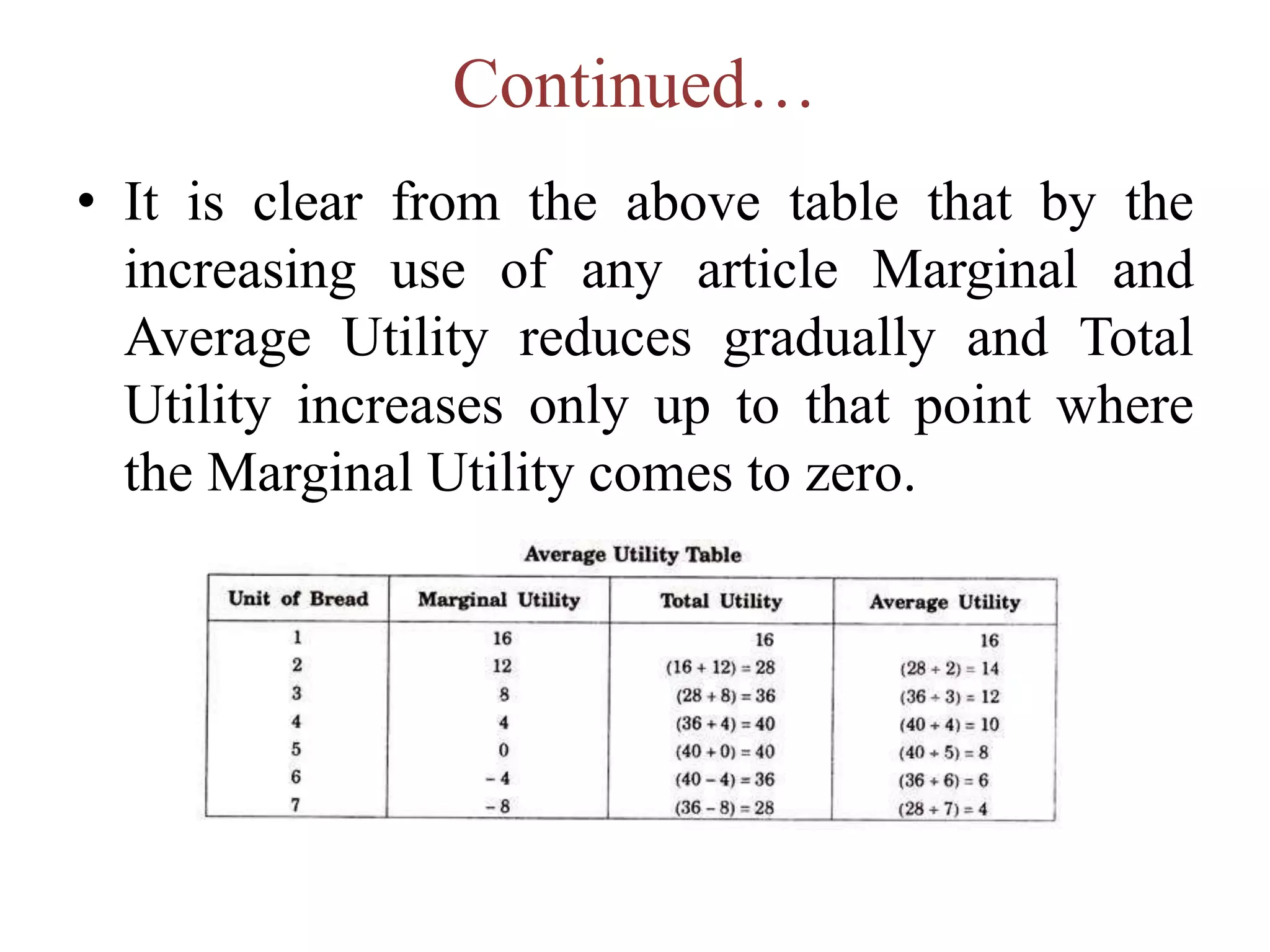
• Average Utility is that utility in which the total
unit of consumption of goods is divided by
number of Total Units.
• The Quotient is known as Average Utility.
• For example, If the total Utility of 4 bread is
40 then the average utility of 4 bread will be
10 (40 ÷ 10= 4), similarly the average utility of
3 bread will be 12 if the total Utility of 3 bread
is 36 i.e., (36 ÷ 3 = 12).
Continued…
• It is clear from the above table that by the
increasing use of any article Marginal and
Average Utility reduces gradually and Total
Utility increases only up to that point where
the Marginal Utility comes to zero.
Relation between Total Utility and
Marginal Utility
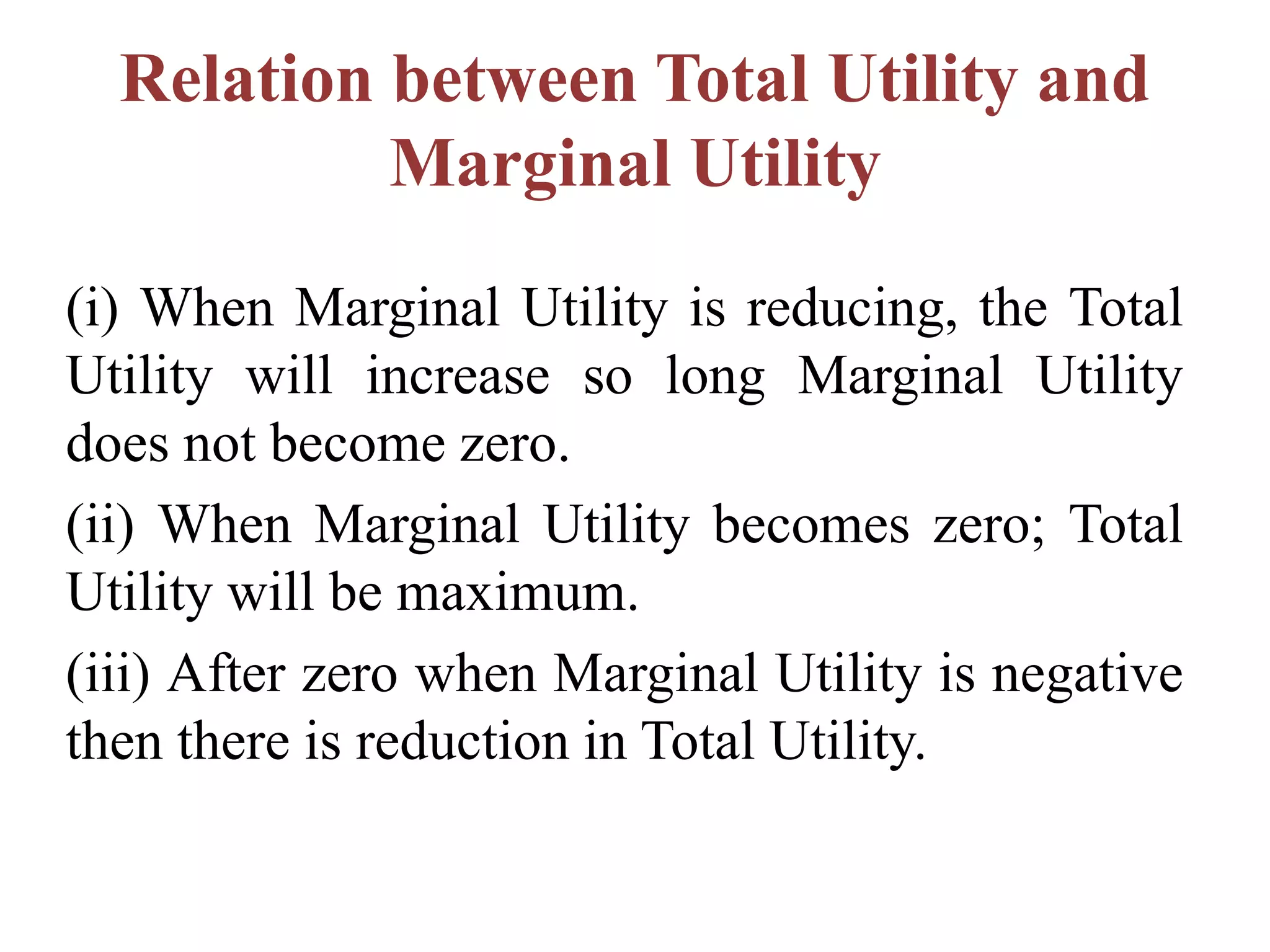
(i) When Marginal Utility is reducing, the Total
Utility will increase so long Marginal Utility
does not become zero.
(ii) When Marginal Utility becomes zero; Total
Utility will be maximum.
(iii) After zero when Marginal Utility is negative
then there is reduction in Total Utility.
Continued…
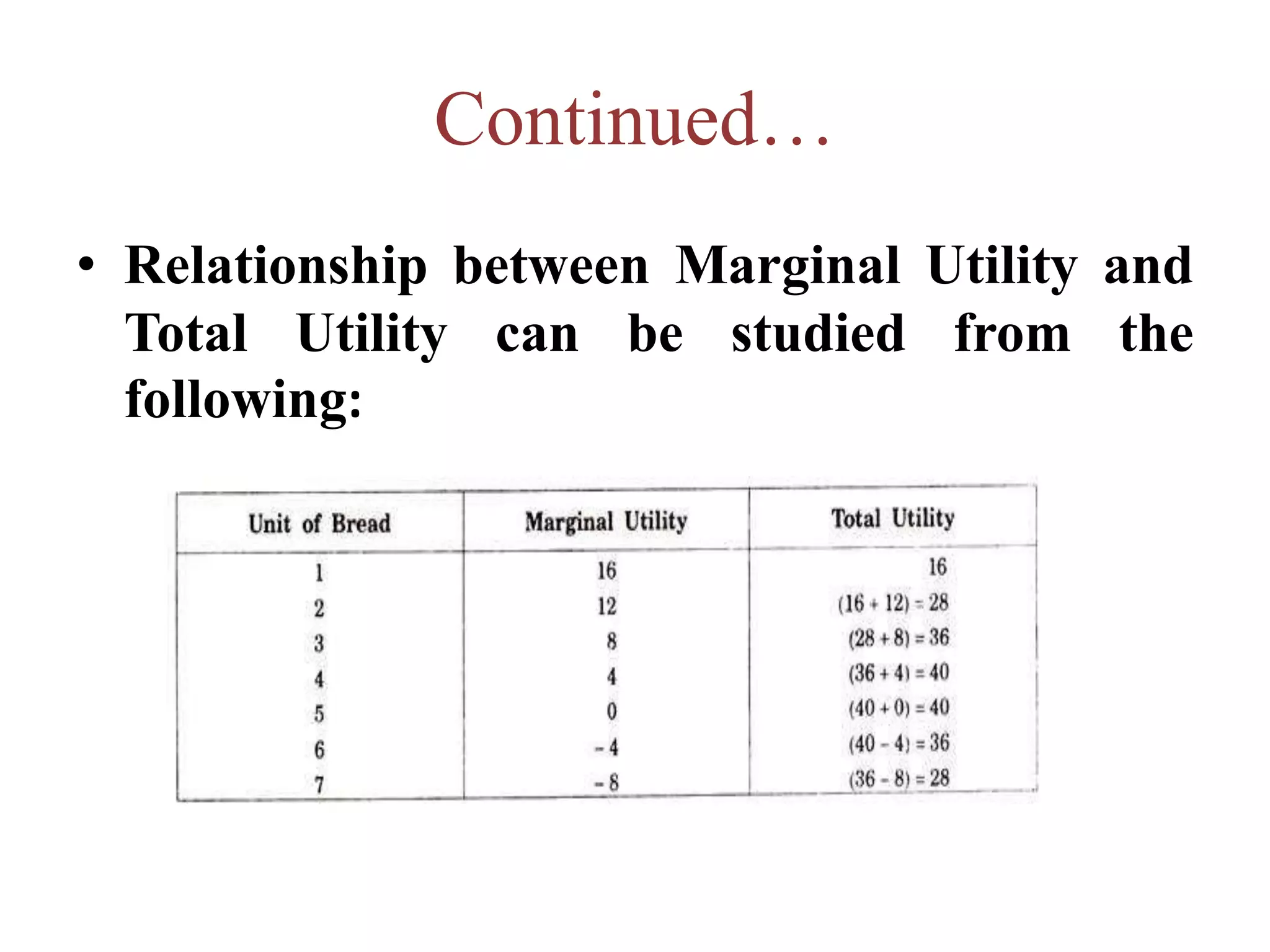
• Relationship between Marginal Utility and
Total Utility can be studied from the
following:
Continued…
• From the above table it is clear that up to fourth bread
Marginal Utility is positive and there is no regular
increase in the Total Utility.
• And on fifth bread the Marginal Utility is zero and on
this point the increase in Total Utility stops.
• This is point of safety, As Prof. Bounding has said that
“Point of full satisfaction and point of full safety is that
point where consumption increases but there is no
increase in Total Utility.”
• If after fifth bread, extra bread is consumed then there
will be dis-utility and Marginal Utility will be negative.
• Sixth and seventh bread shows dis-utility.
Thank you!!!

Utility

  • 1.
    Engineering Economics (MS-310) Utility& Its Types DR. NAEEM ABAS KALAIR Electrical Engineering Department, University of Gujrat.
  • 2.
    Meaning of Utility Thesimple meaning of ‘utility’ is ‘usefulness’. In economics utility is the capacity of a commodity to satisfy human wants. Utility is the quality in goods to satisfy human wants. Thus, it is said that “Wants satisfying capacity of goods or services is called Utility.”
  • 3.
    Meaning of Utility Utility depends upon the intensity of want.  When a want is unsatisfied or more intense, there is a greater urge to demand a particular commodity which satisfies a given want.  In modern time utility has been called as ‘expected satisfaction.’  Expected satisfaction may be less or equal to or more than the real satisfaction.
  • 4.
    Definition of Utility Accordingto Prof. Waugh: “Utility is the power of commodity to satisfy human wants.” According to Fraser: “On the whole in recent years the wider definition is preferred and utility is identified, with desireness rather than with satisfyingness.”
  • 5.
    Characteristics of Utility 1-Utility has no Ethical or Moral Significance A commodity which satisfies any type of want, whether moral or immoral, socially desirable or undesirable, has utility, i.e., a knife has utility as a household appliance to a housewife, but it has also a utility to a killer for stabbing some body.
  • 6.
    2- Utility isPsychological o Utility of a commodity depends on a consumer’s mental attitude and assessment regarding its power to satisfy his particular want. o Psychologically, every consumer has his likes and dislikes and everyone determines his own level of satisfaction. o For Example, a consumer who is fond of apples may find a high utility in apples in comparison to the consumer who has no liking for apples. Similarly a strictly vegetarian person has no utility for mutton or chicken.
  • 7.
    3- Utility isalways Individual and Relative • Utility of a commodity varies in different situations in relation to time and place. • Even the same consumer may derive a higher or lower utility for the same commodity at different times and different places. • For example—a person may find more utility in woolen clothes during the winter than in summer or at Kashmir than at Mumbai.
  • 8.
    4- Utility isnot Necessarily Equated with Usefulness  Utility simply means the ability to satisfy a want.  A commodity may have utility but it may not be useful to the consumer.  For instance—A cigarette has utility to the smoker but it is injurious to his health.  However, demand for a commodity depends on its utility rather than its usefulness.
  • 9.
    5- Utility cannotbe Measured Objectively • Utility being a subjective phenomenon or feeling of a consumer cannot be expressed in numerical terms. • So utility cannot be measured cardinally or numerically. • It cannot be measured directly in a precise manner. • Professor Marshall has however, unrealistically assumed cardinal measurement of utility in his analysis of demand.
  • 10.
    6- Utility Dependson the Intensity of Want  Utility is the function of intensity of want.  A want which is unsatisfied and greatly intense will imply a high utility for the commodity concerned to a person.  But when a man is satisfied in the process of consumption it tends to experience a lesser utility of the commodity than before.  In other words, the more of a thing we have, the less we want it.
  • 11.
    7- Utility isDifferent from Pleasure • A commodity may have utility but its consumption may not give any pleasure to the consumer, e.g., medicine or an injection. • An injection or medicinal tablet gives no pleasure, but it is necessary for the patient.
  • 12.
    8- Utility isalso Distinct from Satisfaction Utility and satisfaction, both are though inter-related but they have not been considered as the same in a strict sense.
  • 13.
    Different Types ofUtility w.r.t Production • In economics, production refers to the creation of utilities in several ways. • Thus, there are following types of utility w.r.t production: 1. Form Utility. 2. Place Utility. 3. Time Utility. 4. Service Utility.
  • 14.
    1. Form Utility •This utility is created by changing the form or shape of the materials. • For example—A cabinet turned out from steel furniture made of wood and so on. • Basically, form utility is created by the manufacturing of goods.
  • 15.
    2. Place Utility •This utility is created by transporting goods from one place to another. • Thus, in marketing goods from the factory to the market place, place utility is created. • Similarly, when food-grains are shifted from farms to the city market by the grain merchants, place utility is created. • Place utility of a commodity is always more in an area of scarcity than in an area of abundance. • For Example, Kashmir apples are more popular and fetch higher prices in Pune than in Srinagar on account of such place utility.
  • 16.
    3. Time Utility •Storing, hoarding and preserving certain goods over a period of time may lead to the creation of time utility for such goods. • For Example, by hoarding or storing food grains at the time of a bumper harvest and releasing their stocks for sale at the time of scarcity, traders derive the advantage of time utility and thereby fetch higher prices for food- grains.
  • 17.
    4. Service Utility Thisutility is created in rendering personal services to the customers by various professionals, such as lawyers, doctors, teachers, bankers, actors etc.
  • 18.
    Types of Utilityw.r.t Unit of Consumption This category has three following types: (i) Marginal Utility. (ii) Total Utility. (iii) Average Utility.
  • 19.
    (i) Marginal Utility •Marginal utility is the utility derived from the last or marginal unit of consumption. • It has been said—as the last unit in the given total stock of a commodity. • According to Prof. Boulding, ”The marginal utility of any quantity of a commodity is the increase in total utility which results from a unit increase in its consumption.”
  • 20.
    Continued… • For Example,Suppose Mr. Shanker is consuming bread and he takes five breads. • By taking first unit he derives utility up to 20; second unit 16; third unit 12; fourth unit 8 and from fifth 2. • In this example the marginal unit is fifth bread and the marginal utility derived is 2. • If we will consume only four bread then the marginal unit will be fourth bread and utility will be 8.
  • 21.
    Kinds of MarginalUtility Marginal utility is of three kinds: (a) Positive Marginal Utility. (b) Zero Marginal Utility. (c) Negative Marginal Utility.
  • 22.
    Continued… It is amatter of general experience that if a man is consuming a particular goods, then receiving of next unit of goods reduces the utilities of the goods and ultimately a situation comes when the utility given by the goods become zero and if the use of the goods still continues, then the next unit will give dis-utility. In other words it can be said that we will derive “negative utility”.
  • 23.
    Continued… • This canbe studied better by the following table:
  • 24.
    Continued… • From thetable given above it is clear that up to the consumption of the fifth bread we receive positive utility. • 6th unit is the unit of full satisfaction i.e., Utility derive from that unit is zero. • From 7th unit the utility received will be negative utility. • The table can be represented in shape of diagram as follows:
  • 25.
    Continued… • In diagram,OX axis shows unit of bread and OY axis shows the Marginal Utility received. • From the figure it is clear that from the first unit of bread utility received are 20 which has been shown on the top of the line.
  • 26.
    Continued… • Similarly 2,3, 4, 5 Unit of bread’s utility is 16, 12, 8, 4 respectively. • All these have been shown on OX line which shows positive marginal utility. • Utility of the sixth bread is zero. • And that of the seventh bread is negative and negative rectangle has been shown below OX line.
  • 27.
    (ii) Total Utility •Total Utility is the utility from all units of consumption. • According to Mayers, ”Total Utility is the sum of the marginal utilities associated with the consumption of the successive units.” • Suppose, a man consumes five breads at a time. He derives from first bread 20 units of satisfaction from second 16, from third 12, from fourth 8 and from fifth 4 i.e., total 60 units.
  • 28.
    Continued… • This canbe shown by the following table:
  • 29.
    (iii) Average Utility •Average Utility is that utility in which the total unit of consumption of goods is divided by number of Total Units. • The Quotient is known as Average Utility. • For example, If the total Utility of 4 bread is 40 then the average utility of 4 bread will be 10 (40 ÷ 10= 4), similarly the average utility of 3 bread will be 12 if the total Utility of 3 bread is 36 i.e., (36 ÷ 3 = 12).
  • 30.
    Continued… • It isclear from the above table that by the increasing use of any article Marginal and Average Utility reduces gradually and Total Utility increases only up to that point where the Marginal Utility comes to zero.
  • 31.
    Relation between TotalUtility and Marginal Utility (i) When Marginal Utility is reducing, the Total Utility will increase so long Marginal Utility does not become zero. (ii) When Marginal Utility becomes zero; Total Utility will be maximum. (iii) After zero when Marginal Utility is negative then there is reduction in Total Utility.
  • 32.
    Continued… • Relationship betweenMarginal Utility and Total Utility can be studied from the following:
  • 33.
    Continued… • From theabove table it is clear that up to fourth bread Marginal Utility is positive and there is no regular increase in the Total Utility. • And on fifth bread the Marginal Utility is zero and on this point the increase in Total Utility stops. • This is point of safety, As Prof. Bounding has said that “Point of full satisfaction and point of full safety is that point where consumption increases but there is no increase in Total Utility.” • If after fifth bread, extra bread is consumed then there will be dis-utility and Marginal Utility will be negative. • Sixth and seventh bread shows dis-utility.
  • 34.