Role of Motivation; Personality and
Self Concept
Consumer motivation is an internal state that drives people to identify and buy products
or services that fulfill conscious and unconscious needs or desires. The fulfillment of
those needs can then motivate them to make a repeat purchase or to find different
goods and services to better fulfill those needs.
One way an individual can maintain their self-concept is through the consumption of
products. Possessions (products) help to define the self and create a sense of identity.
“Through the purchase and use of products, consumers define, maintain and enhance
their self-concept” .
Consumers will be motivated to purchase positively valued products in order to maintain a
positive self-image, but will also seek out products that have an image similar to their own
(whether positive or negative) in order to maintain self-consistency.
Personality and Self Concept are important parameters while studying consumer behaviour. It
helps us understand the market behavioural pattern and trends.
Attention is the central process and perception is not at all possible without attention.
The process of attention serves the various functions in the organization of our
perception and other cognitive functions.
Customer attention is when a person or group focuses on or pays attention to a
specific thing or activity. It can be measured by tracking how long someone looks at,
thinks about, or talks about a particular item.
Consumer perception is the process by which people interpret and respond to the stimuli
they encounter in the marketplace. It influences how they recognize, evaluate, and
choose products and services that satisfy their needs and wants.
Consumer learning is the process by which consumers acquire the information that they
apply to future purchase behavior. Simply put, learning is the foundation of consumer
behavior.
Learning always keeps you active to educate about various skills, knowledge, and
competencies. Continuous learning helps to innovate new ideas. This nurtures your brain
and thinking ability.
Consumer attitude refers to a set of emotions, behavioral intentions, and beliefs that a
consumer has toward behavior or product. It can be changed by influencing one or more of
its three compartments; behavioral, affective, and cognitive.
Attitudes are widely regarded as one of the most important drivers of purchase behavior,
so it's no surprise that savvy marketers strive to understand and influence their target
customers' attitudes.
The overall idea is that some combination of thinking or logic, feeling or emotion, and intent
to do something, work in combination to create the likelihood of the formation of attitudes
or beliefs about or towards something, someone or an action. This intent has a high
correlation with action.
Consumer Attitude- Formation and Change
Values are believed to provide the motivation for buying. Tend to be abstract so their
impact on consumer behaviour is quite indirect. The way in which consumers use product
and services in a certain area to attain their values is called consumer lifestyle.
Consumer Values and Lifestyles
External Determinants of Consumer
Behaviour
Influence of Culture and Sub Culture
A culture is a shared social tradition that may include language, social norms, beliefs, art,
literature, music, traditions, pastimes, values, knowledge, recreation, mythology, ritual
and religion.
A subculture is a self-organized tradition of shared interests, lifestyles, beliefs, customs,
norms, style or tastes.
A subculture is a group of people who share a set of secondary values, Many factors can place
an individual in one or several subcultures. People of a subculture are part of a larger culture
but also share a specific identity within a smaller group. Important Factors Comprising
“Subculture”
Social Class
Social Class affects consumer behavior by shaping individuals' perceptions of their needs
and wants. People in the same social class tend to have similar attitudes, live in similar
neighborhoods, attend the same schools, have similar tastes in fashion, and shop at the
same types of stores.
Social class usually is defined by the amount of status that members of a specific class
possess in relation to members of other classes. Social-class membership often serves as a
frame of reference for the development of consumer attitudes and behaviour.
Reference groups are groups (social groups, work groups, family, or close friends) a
consumer identifies with and may want to join. They influence consumers' attitudes and
behavior. A reference group helps shape a person's attitudes and behaviours. Opinion
leaders are people who influence others.
An individual tends to discuss with his immediate family members before purchasing a
particular product or service. Family members might support an individual's decision to
buy a particular product, stop him for purchasing it or suggest few other options. Family
comprises of: Parents.
Family influences
Traditional consumer behavior model
Learning Model
The learning model is like a guide that explains how you pick things when you go
shopping. It’s all about how you learn and make choices based on your experiences.
Think of it like this: when you have a good experience with a product, like a yummy ice
cream flavor, you remember it.
Economic Model
Economic models are like tools that help you make smart choices when you’re
shopping. It’s all about finding the best deal for your money. Think of it this way: you
want to get the most value from your cash.
Psychoanalytical model
The psychoanalytical model is a bit like a detective for your shopping choices. It tries to
figure out why you buy certain things based on your hidden feelings and desires. Imagine
it’s like there’s a secret shopper inside your head. This model believes that even you
might not know why you make some choices.
Sociocultural Models
Sociocultural consumer behavior models are like the puzzle pieces that make up your
shopping decisions. They focus on how your family, friends, and the world around you
influence what you choose to buy. Imagine you’re like a sponge, soaking up ideas from
your surroundings.
Contemporary consumer behavior models
Engel-Kollat-Blackwell (EKB) Model
The Engel-Kollat-Blackwell (EKB) model is like a roadmap for your shopping journey. It helps
you understand all the steps you go through when deciding to buy something.
Recognizing a problem: First, you realize that you need or want something, like a new
phone or a pair of shoes. This model acknowledges that you’re like a detective, searching
for what’s missing in your life.
Gathering information: Next, you start gathering facts, like reading reviews or asking
friends for advice. It’s like you’re collecting clues to solve a mystery.
Evaluating options: You compare different products, considering things like features, prices,
and quality. This step is a bit like being a judge at a talent show, trying to find the best
contestant.
Making a choice: Eventually, you make a decision and choose a product. It’s like casting your
vote for the best candidate.
Post-purchase evaluation: After buying, you think about whether you’re happy with your
choice. It’s like reflecting on how well your favorite team performed after a game.
This model helps you see that shopping is a step-by-step process, kind of like following a
treasure map with a final “X” that marks your purchase.
Black Box Model
The Black Box model is like a magic box that helps you understand your shopping
decisions. Imagine it as a mysterious container with inputs, processes inside, and outputs.
Inputs (Stimuli): This is where everything begins. It’s like all the things that catch your
attention when you’re shopping – ads, recommendations, and product displays. It’s like
someone handing you a riddle to solve.
Inside the Black Box: Inside this magical box, something interesting happens, but you
can’t see exactly what. It’s where your brain works its magic, processing all the
information you’ve gathered. It’s like your thoughts are a secret recipe, mixing all the
ingredients together.
Outputs: This is where your decision comes out. You make a choice, like picking a product
to buy or deciding not to. It’s like solving the riddle from the beginning, and your answer is
your decision.
Hawkins Stern Impulse Buying Model
The “Hawkins Stern Impulse Buying Model” challenges the idea that you always make
carefully thought-out decisions before buying something. It also sorts impulse buying into
different types:
Escape purchase: Sometimes, you see something that’s just too visually appealing to resist,
even if you didn’t plan to buy it when you made your shopping list.
Reminder purchase: You might get influenced by in-store promotions or reminders, like
those bag clips strategically placed in the potato chip aisle that make you realize you need
them.
Suggested purchase: Social media ads, store employees, or even your family and friends
might suggest things to you. For example, a website might suggest that other customers
bought a lens cleaner and glasses case with their glasses, and you decide to get them, too.
Planned purchase: Occasionally, you plan to buy something, and when the store offers a
discount or a promotion deal, you go ahead and get it.
Many business professionals like to use this consumer behavior modeling because, let’s face
it, we all make impulse purchases from time to time. For them, it’s a way to focus on in-
store marketing, product packaging, and discounts.
Howard Sheth Model
The “Howard Sheth Model” explains that when you make a purchase, there’s a specific
decision-making process with certain factors that influence it.
Marketing and business development professionals find this model useful in most industries
because, as a consumer, you may follow this process when buying any product or service.
This decision-making process involves three levels:
Extensive problem-solving: Imagine you know very little about the product you want to buy
and the companies that make it. You use your problem-solving skills to figure out what’s
available and what the market offers.
Limited problem-solving: As you learn more about the product and compare different
options, you’re at this level. It’s like you’re becoming a savvy shopper, checking out what
various companies have to offer.
Habitual response behavior: At this stage, you know a lot about the product you want and
how to get it. It’s almost like second nature; you’re very familiar with the product and the
available ways to buy it.
This consumer behavior models help professionals understand your decision-making
process when you’re making a purchase, regardless of the product or service. It guides them
in tailoring their strategies to meet your specific needs at each stage of the process.
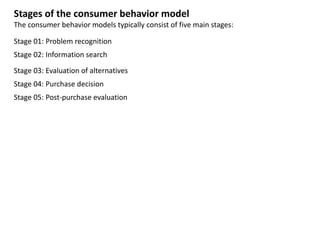
Stages of the consumer behavior model
The consumer behavior models typically consist of five main stages:
Stage 01: Problem recognition
Stage 02: Information search
Stage 03: Evaluation of alternatives
Stage 04: Purchase decision
Stage 05: Post-purchase evaluation

CONSUMER BEHAVIOUR WHAT IS CONSUMER AND BEHA

  • 2.
    Role of Motivation;Personality and Self Concept Consumer motivation is an internal state that drives people to identify and buy products or services that fulfill conscious and unconscious needs or desires. The fulfillment of those needs can then motivate them to make a repeat purchase or to find different goods and services to better fulfill those needs. One way an individual can maintain their self-concept is through the consumption of products. Possessions (products) help to define the self and create a sense of identity. “Through the purchase and use of products, consumers define, maintain and enhance their self-concept” . Consumers will be motivated to purchase positively valued products in order to maintain a positive self-image, but will also seek out products that have an image similar to their own (whether positive or negative) in order to maintain self-consistency. Personality and Self Concept are important parameters while studying consumer behaviour. It helps us understand the market behavioural pattern and trends.
  • 3.
    Attention is thecentral process and perception is not at all possible without attention. The process of attention serves the various functions in the organization of our perception and other cognitive functions. Customer attention is when a person or group focuses on or pays attention to a specific thing or activity. It can be measured by tracking how long someone looks at, thinks about, or talks about a particular item. Consumer perception is the process by which people interpret and respond to the stimuli they encounter in the marketplace. It influences how they recognize, evaluate, and choose products and services that satisfy their needs and wants. Consumer learning is the process by which consumers acquire the information that they apply to future purchase behavior. Simply put, learning is the foundation of consumer behavior. Learning always keeps you active to educate about various skills, knowledge, and competencies. Continuous learning helps to innovate new ideas. This nurtures your brain and thinking ability.
  • 4.
    Consumer attitude refersto a set of emotions, behavioral intentions, and beliefs that a consumer has toward behavior or product. It can be changed by influencing one or more of its three compartments; behavioral, affective, and cognitive. Attitudes are widely regarded as one of the most important drivers of purchase behavior, so it's no surprise that savvy marketers strive to understand and influence their target customers' attitudes. The overall idea is that some combination of thinking or logic, feeling or emotion, and intent to do something, work in combination to create the likelihood of the formation of attitudes or beliefs about or towards something, someone or an action. This intent has a high correlation with action. Consumer Attitude- Formation and Change Values are believed to provide the motivation for buying. Tend to be abstract so their impact on consumer behaviour is quite indirect. The way in which consumers use product and services in a certain area to attain their values is called consumer lifestyle. Consumer Values and Lifestyles
  • 5.
    External Determinants ofConsumer Behaviour Influence of Culture and Sub Culture A culture is a shared social tradition that may include language, social norms, beliefs, art, literature, music, traditions, pastimes, values, knowledge, recreation, mythology, ritual and religion. A subculture is a self-organized tradition of shared interests, lifestyles, beliefs, customs, norms, style or tastes. A subculture is a group of people who share a set of secondary values, Many factors can place an individual in one or several subcultures. People of a subculture are part of a larger culture but also share a specific identity within a smaller group. Important Factors Comprising “Subculture”
  • 6.
    Social Class Social Classaffects consumer behavior by shaping individuals' perceptions of their needs and wants. People in the same social class tend to have similar attitudes, live in similar neighborhoods, attend the same schools, have similar tastes in fashion, and shop at the same types of stores. Social class usually is defined by the amount of status that members of a specific class possess in relation to members of other classes. Social-class membership often serves as a frame of reference for the development of consumer attitudes and behaviour. Reference groups are groups (social groups, work groups, family, or close friends) a consumer identifies with and may want to join. They influence consumers' attitudes and behavior. A reference group helps shape a person's attitudes and behaviours. Opinion leaders are people who influence others. An individual tends to discuss with his immediate family members before purchasing a particular product or service. Family members might support an individual's decision to buy a particular product, stop him for purchasing it or suggest few other options. Family comprises of: Parents. Family influences
  • 7.
    Traditional consumer behaviormodel Learning Model The learning model is like a guide that explains how you pick things when you go shopping. It’s all about how you learn and make choices based on your experiences. Think of it like this: when you have a good experience with a product, like a yummy ice cream flavor, you remember it. Economic Model Economic models are like tools that help you make smart choices when you’re shopping. It’s all about finding the best deal for your money. Think of it this way: you want to get the most value from your cash. Psychoanalytical model The psychoanalytical model is a bit like a detective for your shopping choices. It tries to figure out why you buy certain things based on your hidden feelings and desires. Imagine it’s like there’s a secret shopper inside your head. This model believes that even you might not know why you make some choices.
  • 8.
    Sociocultural Models Sociocultural consumerbehavior models are like the puzzle pieces that make up your shopping decisions. They focus on how your family, friends, and the world around you influence what you choose to buy. Imagine you’re like a sponge, soaking up ideas from your surroundings. Contemporary consumer behavior models Engel-Kollat-Blackwell (EKB) Model The Engel-Kollat-Blackwell (EKB) model is like a roadmap for your shopping journey. It helps you understand all the steps you go through when deciding to buy something. Recognizing a problem: First, you realize that you need or want something, like a new phone or a pair of shoes. This model acknowledges that you’re like a detective, searching for what’s missing in your life. Gathering information: Next, you start gathering facts, like reading reviews or asking friends for advice. It’s like you’re collecting clues to solve a mystery. Evaluating options: You compare different products, considering things like features, prices, and quality. This step is a bit like being a judge at a talent show, trying to find the best contestant.
  • 9.
    Making a choice:Eventually, you make a decision and choose a product. It’s like casting your vote for the best candidate. Post-purchase evaluation: After buying, you think about whether you’re happy with your choice. It’s like reflecting on how well your favorite team performed after a game. This model helps you see that shopping is a step-by-step process, kind of like following a treasure map with a final “X” that marks your purchase. Black Box Model The Black Box model is like a magic box that helps you understand your shopping decisions. Imagine it as a mysterious container with inputs, processes inside, and outputs. Inputs (Stimuli): This is where everything begins. It’s like all the things that catch your attention when you’re shopping – ads, recommendations, and product displays. It’s like someone handing you a riddle to solve. Inside the Black Box: Inside this magical box, something interesting happens, but you can’t see exactly what. It’s where your brain works its magic, processing all the information you’ve gathered. It’s like your thoughts are a secret recipe, mixing all the ingredients together. Outputs: This is where your decision comes out. You make a choice, like picking a product to buy or deciding not to. It’s like solving the riddle from the beginning, and your answer is your decision.
  • 10.
    Hawkins Stern ImpulseBuying Model The “Hawkins Stern Impulse Buying Model” challenges the idea that you always make carefully thought-out decisions before buying something. It also sorts impulse buying into different types: Escape purchase: Sometimes, you see something that’s just too visually appealing to resist, even if you didn’t plan to buy it when you made your shopping list. Reminder purchase: You might get influenced by in-store promotions or reminders, like those bag clips strategically placed in the potato chip aisle that make you realize you need them. Suggested purchase: Social media ads, store employees, or even your family and friends might suggest things to you. For example, a website might suggest that other customers bought a lens cleaner and glasses case with their glasses, and you decide to get them, too. Planned purchase: Occasionally, you plan to buy something, and when the store offers a discount or a promotion deal, you go ahead and get it. Many business professionals like to use this consumer behavior modeling because, let’s face it, we all make impulse purchases from time to time. For them, it’s a way to focus on in- store marketing, product packaging, and discounts.
  • 11.
    Howard Sheth Model The“Howard Sheth Model” explains that when you make a purchase, there’s a specific decision-making process with certain factors that influence it. Marketing and business development professionals find this model useful in most industries because, as a consumer, you may follow this process when buying any product or service. This decision-making process involves three levels: Extensive problem-solving: Imagine you know very little about the product you want to buy and the companies that make it. You use your problem-solving skills to figure out what’s available and what the market offers. Limited problem-solving: As you learn more about the product and compare different options, you’re at this level. It’s like you’re becoming a savvy shopper, checking out what various companies have to offer. Habitual response behavior: At this stage, you know a lot about the product you want and how to get it. It’s almost like second nature; you’re very familiar with the product and the available ways to buy it. This consumer behavior models help professionals understand your decision-making process when you’re making a purchase, regardless of the product or service. It guides them in tailoring their strategies to meet your specific needs at each stage of the process.
  • 12.
    Stages of theconsumer behavior model The consumer behavior models typically consist of five main stages: Stage 01: Problem recognition Stage 02: Information search Stage 03: Evaluation of alternatives Stage 04: Purchase decision Stage 05: Post-purchase evaluation