AN INTRODUCTION TO BUSINESS
     VALUE ENGINEERING


   Atlanta, June 7, 2010
                           © Joseph Little 2009
                                              1
What is it?

 BV Engineering is the values, principles and
 practices that enable us to deliver more and
 more Business Value [from a given team] as
 we improve.

 A learning and incremental improvement
 approach to giving customers more of what
 they really want, looking at the whole process,
 end-to-end.


                                    CSM v9.3 © Jeff Sutherland 1993-2008

                       2
Why do I call it BVE?

 Scrum: Continuous Improvement

 Engineering rigor


                                 CSM v9.3 © Jeff Sutherland 1993-2008

                     3
Attributions

 Some people who directly or indirectly
 contributed: Ken Schwaber, Jeff Sutherland,
 Kent Beck, Peter Drucker, Takeuchi & Nonaka,
 Jim York, Chris Mats, Kent McDonald, Womack
 & Jones, Mary & Tom Poppendieck, Taiichi
 Ohno, some friends at “a large financial
 institution in Virginia”, and many others.


                                  CSM v9.3 © Jeff Sutherland 1993-2008

                      4
Joe Little, CST & MBA

Agile Coach & Trainer
20+ years in senior level consulting to well-known firms in New York,
London and Charlotte
Focus on delivery of Business Value
CST, CSP, CSM
Was Senior Manager in Big 6 consulting
Head of Kitty Hawk Consulting, Inc. since 1991
Head of LeanAgileTraining.com
Started trying to do [Agile] before reading The Mythical Man-Month

–   http://agileconsortium.blogspot.com
–   jhlittle@kittyhawkconsulting.com


                                                   © Joseph Little 2009
                                                                      5
A Start

 “You’ve got to be very careful if you don’t
 know where you’re going, because you might
 not get there.”    Yogi Berra


                                  © Joseph Little 2009
                                                     6
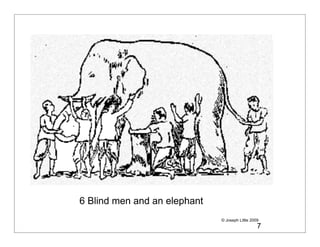
6 Blind men and an elephant
                              © Joseph Little 2009
                                                 7
My main stance

 “I’m mad as hell and I’m not going to take it
 anymore.” (movie quote)


 “The biggest thing to fix is how we do BV
 Engineering.”


                                     © Joseph Little 2009
                                                        8
What are the numbers for your
team?

 Cost per year

 NPV delivered per year

 Derive: “The multiple”


                          © Joseph Little 2009
                                             9
Let’s do the math...

 Assume team costs $1,000,000 per year
 Assume normal multiple is 3x (ie, delivers
 $3,000,000 in BV)
 Assume the “real work” itself does NOT get
 any faster


                                   © Joseph Little 2009
                                                     10
Could a better Product Owner make
a difference?

 We make the stories 20% better
 We use Pareto’s “85-33” rule to get more done
 in less time
 We identify more high value epics
 We motivate the team, so that they are more
 productive
 We assure that we actually hit the mark,
 rather than just say that we did

 What’s that worth? 3X more BV?
                                   © Joseph Little 2009
                                                     11
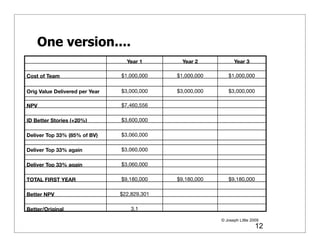
One version....
                                  Year 1        Year 2           Year 3

Cost of Team                    $1,000,000    $1,000,000      $1,000,000


Orig Value Delivered per Year   $3,000,000    $3,000,000      $3,000,000

NPV                             $7,460,556

ID Better Stories (+20%)        $3,600,000

Deliver Top 33% (85% of BV)     $3,060,000

Deliver Top 33% again           $3,060,000

Deliver Top 33% again           $3,060,000

TOTAL FIRST YEAR                $9,180,000    $9,180,000      $9,180,000

Better NPV                      $22,829,301

Better/Original                     3.1

                                                           © Joseph Little 2009
                                                                             12
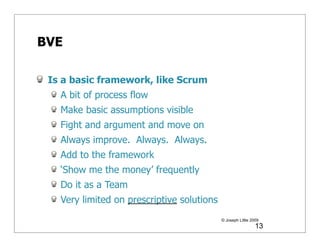
BVE

 Is a basic framework, like Scrum
   A bit of process flow
   Make basic assumptions visible
   Fight and argument and move on
   Always improve. Always. Always.
   Add to the framework
   ‘Show me the money’ frequently
   Do it as a Team
   Very limited on prescriptive solutions
                                            © Joseph Little 2009
                                                              13
Now let’s change subjects...

 To think practically, let’s use this framework...


                                      © Joseph Little 2009
                                                        14
© Joseph Little 2009
                  15
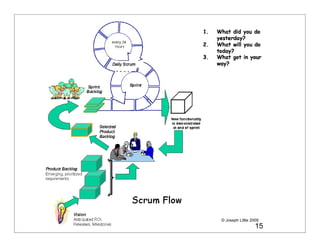
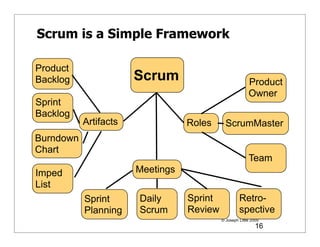
Scrum is a Simple Framework

Product
Backlog                Scrum                             Product
                                                         Owner
Sprint
Backlog
           Artifacts              Roles      ScrumMaster
Burndown
Chart
                                                         Team
Imped                  Meetings
List
           Sprint      Daily      Sprint            Retro-
           Planning    Scrum      Review            spective
                                           © Joseph Little 2009
                                                             16
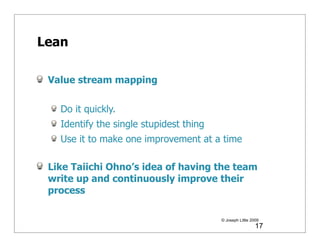
Lean

 Value stream mapping

   Do it quickly.
   Identify the single stupidest thing
   Use it to make one improvement at a time

 Like Taiichi Ohno’s idea of having the team
 write up and continuously improve their
 process

                                         © Joseph Little 2009
                                                           17
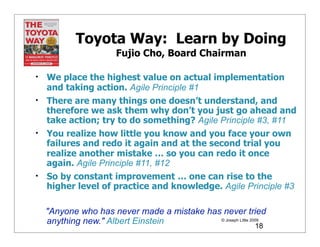
Toyota Way: Learn by Doing
                       Fujio Cho, Board Chairman

•   We place the highest value on actual implementation
    and taking action. Agile Principle #1
•   There are many things one doesn’t understand, and
    therefore we ask them why don’t you just go ahead and
    take action; try to do something? Agile Principle #3, #11
•   You realize how little you know and you face your own
    failures and redo it again and at the second trial you
    realize another mistake … so you can redo it once
    again. Agile Principle #11, #12
•   So by constant improvement … one can rise to the
    higher level of practice and knowledge. Agile Principle #3

    "Anyone who has never made a mistake has never tried
    anything new." Albert Einstein          © Joseph Little 2009
                                                              18
The biggest problem

 People don’t want to admit stupidity


 People don’t want to make visible their
 inability to predict how the business will work


                                     © Joseph Little 2009
                                                       19
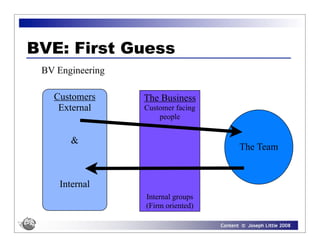
BVE: First Guess
 BV Engineering

   Customers      The Business
    External      Customer facing
                      people


       &
                                           The Team


     Internal
                  Internal groups
                  (Firm oriented)

                                    Content © Joseph Little 2008
Some problems

 We set up the telephone game

 Customers are not consistent

 The needs of the customers and of the firm are
 sometimes in contradiction (or at least
 somewhat antagonistic)

 It is difficult to accurately measure success


                                     © Joseph Little 2009
                                                       21
Some more problems

 La donne e mobile
    The customer is always changing his mind & who the
    customers are is always changing
 Stuff is happening out there
   Everything in the environment, both for the customers
   and for us, is changing
 Wow, this technology stuff is always changing
    A brilliant product today is yesterday’s news tomorrow
 “I know it when I see it”
   The customers can’t tell you what they want
 “What we’ve got here is a failure to communicate”
    It is impossible to accurately convey what you want
                                            © Joseph Little 2009
                                                              22
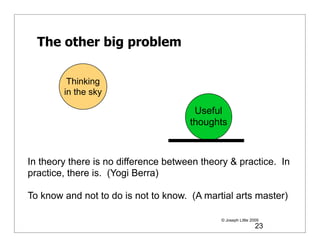
The other big problem

         Thinking
        in the sky

                                       Useful
                                      thoughts


In theory there is no difference between theory & practice. In
practice, there is. (Yogi Berra)

To know and not to do is not to know. (A martial arts master)

                                             © Joseph Little 2009
                                                               23
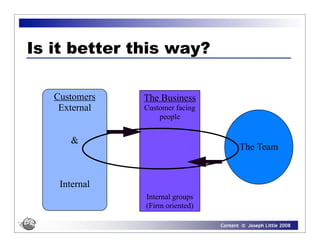
Is it better this way?

   Customers   The Business
    External   Customer facing
                   people


      &
                                        The Team


    Internal
               Internal groups
               (Firm oriented)

                                 Content © Joseph Little 2008
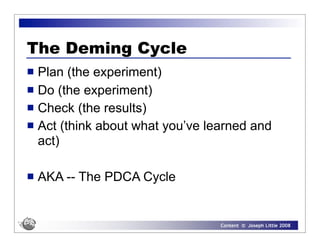
The Deming Cycle
 Plan (the experiment)
 Do (the experiment)
 Check (the results)
 Act (think about what you’ve learned and
  act)

   AKA -- The PDCA Cycle


                                 Content © Joseph Little 2008
Hallmarks of real BV Engineering!

1. The process is visible and articulated &
   improved
2. Failures in BV communication are identified
   and corrected frequently, quickly
3. There is a theory, and a concerted attempt to
   prove out the theory
4. There is appropriate dynamism and change
5. Business & Technology are partners
6. Success is forecast and also measured after
   the fact
7. Human judgment is involved (it’s not just the
   numbers)                             © Joseph Little 2009
                                                        26
BVE is simple

 Yes, in its basics, like all important things, very
 simple.

 And VERY hard to do well.


                                       © Joseph Little 2009
                                                         27
Stopping Point...

 Any questions now??


                       © Joseph Little 2009
                                         28
Two opposite approaches

 Proctor & Gamble: A ‘traditional’ but highly
 disciplined approach. “What does the customer
 want?” “How do we advertise our product?”

 Google: A new (or old?) approach. Let’s try
 something, and see if they like it. If so, then
 we’ll build on it.


                                      © Joseph Little 2009
                                                        29
Proctor & Gamble

 Full marketing program
 Focus groups, customer interviews,
 observation, customer segmentation (& lots of
 other tools)
 Financial (& other numeric) forecasts
 Multiple experiments, high rigor
 Advertising


                                   © Joseph Little 2009
                                                     30
Google

 Let employees create what they want
 Get a prototype out there “in the real world”
 See who bites
 Develop product incrementally based on
 customer input
 Monetize later (after we have a real product
 that a bunch of people really want)
 Get more “at bats”


                                     © Joseph Little 2009
                                                       31
How do I start to act on this?


                             © Joseph Little 2009
                                               32
In the Workshop: Exercise #1

 What is Business Value for us?


 First pass at the BV Model.


                                  © Joseph Little 2009
                                                    33
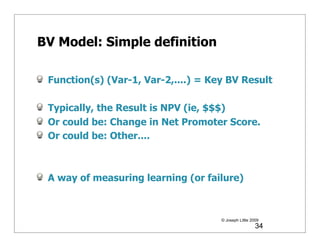
BV Model: Simple definition

 Function(s) (Var-1, Var-2,....) = Key BV Result

 Typically, the Result is NPV (ie, $$$)
 Or could be: Change in Net Promoter Score.
 Or could be: Other....


 A way of measuring learning (or failure)


                                     © Joseph Little 2009
                                                       34
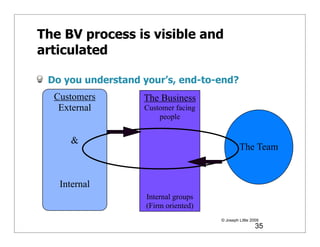
The BV process is visible and
articulated

 Do you understand your’s, end-to-end?
  Customers        The Business
   External        Customer facing
                       people


     &
                                               The Team


   Internal
                    Internal groups
                    (Firm oriented)
                                      © Joseph Little 2009
                                                        35
In the Workshop: Exercise #2

 Map out the BVE process is your specific
 area....

   Identify people involved
   Make plain the theories used (some very stupid)
   Make plain the assumptions
   Make plain the BV Model (second pass)
   See the single biggest thing to improve


                                        © Joseph Little 2009
                                                          36
The process is always being
improved

 Is your process always being improved?
 Does everyone know that?
 What is the approach to improvement?

 Small example: Which stakeholders are
 involved? Do we have the right ones? Are we
 making the most use of them? Are we
 overweighted in compliance, legal, regulatory
 input? How good is our process of engaging
 them, and getting the most with the least effort?
 Are we creating knowledge just-in-time?
                                      © Joseph Little 2009
                                                        37
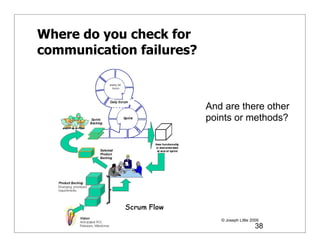
Where do you check for
communication failures?


                          And are there other
                          points or methods?


                             © Joseph Little 2009
                                               38
A theory, that is being proved out

 Is the theory stated as such, or is it assumed
 to be right?
 How it is being proved out?
 What happens when (not if) it is (somewhat)
 wrong?


                                     © Joseph Little 2009
                                                       39
Dynamism and change

 The appropriate amount of dynamism and
 change will vary by situation.
 In general, my experience is that we are
 adapting too slowly.


                                  © Joseph Little 2009
                                                    40
Business & Technology are partners

 In fact, there is minimal distinction. Anyone
 can help a partner learn. Can question. Can
 propose
   Remember: There is no technical success
 The Technologists often know more about the
 customers than you’d think
 Should we talk about the failure modes here?
 Everyone on the Team understands what real
 success would be


                                     © Joseph Little 2009
                                                       41
Success is measured

 1 to 3 key “end” metrics. Identified. Forecast.
 Then the real results are obtained.
   Perhaps not perfectly, but reasonably
 And learned from. (Was the product wrong?
 Was the theory wrong?)
 And communicated back to the Team


                                    © Joseph Little 2009
                                                      42
Human judgment

 Yes, stuff often happens that makes one
 question whether the “scientific” experiment
 was fair
 Yes, one can still have a hunch that the
 product will succeed later (if not now)


 So, metrics do not absolve managers from
 tough human judgment about the actuals and
 other information they get back

                                   © Joseph Little 2009
                                                     43
The unbearable lightness of metrics

 We use metrics (about the past) to take
 forward-looking action
 Metrics help us see how bad we were at
 predicting the future
 Metrics help us learn (perhaps first, by helping
 us see how much we don’t know)


                                     © Joseph Little 2009
                                                       44
Multiple Steps are important

 Some firms focus too much on one or two
 steps (eg, initial focus group, user story
 creation, the PO review of completed stories,
 the product launch)
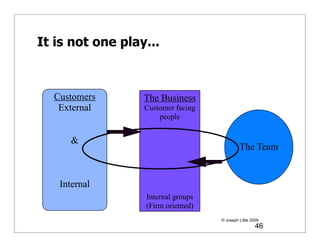
 It is not one play; it is the culmination of plays
 that wins the game

 Examples: Understand the customer better and
 spend more time to assure that the Team
 understands the customer’s problem better
 and better
                                       © Joseph Little 2009
                                                         45
It is not one play...


  Customers       The Business
   External       Customer facing
                      people


     &
                                             The Team


   Internal
                  Internal groups
                  (Firm oriented)
                                    © Joseph Little 2009
                                                      46
The BVE Framework is very simple

 But all of BV Engineering is not simple.
 And BV Engineering in your specific case will
 not be simple.


                                    © Joseph Little 2009
                                                      47
RESULT: Another practical use

 When you hear people talking about the new
 BVE “tool” or solution....

 You now have a framework to put that tool or
 solution into a context.

 And you now know to ask, at least: “Is that the
 part of BVE for us that is the most FUBAR?”


                                    © Joseph Little 2009
                                                      48
The next 6 slides show some of the
rich detail


                           © Joseph Little 2009
                                             49
Elements of BV Engineering 1

1. PO Team
2. Product Backlog
3. PB prioritized by BV
4. Priority Poker
5. Story Points (proxy for cost, for cost-benefit
   analysis)
6. Minimum Marketable Feature Set
7. Reprioritize before each Sprint
8. Increase velocity (remove impediments)

                                       © Joseph Little 2009
                                                         50
Elements of BV Engineering 2

1. Making the stories smaller
2. Value Stream mapping
3. Kano Analysis
4. Voice of the Customer
5. Having the team live with the customers
6. Pareto chart (eg, of causes of customer
   problems)
7. Process charts or high level use cases
8. Other Lean, Six Sigma, or TQM tools

                                     © Joseph Little 2009
                                                       51
Elements of BV Engineering 3

1. Understanding the importance of minimizing
   technical debt
2. Agile portfolio management
3. What quality means to the customer and why
   it is ‘free’
4. Just-in-time knowledge creation
5. Modifying the BV model frequently (& the
   values in the model)
6. Removing impediments
7. Comparing our BV Engineering to theirs
    We’re different; what does it mean?
                                          © Joseph Little 2009
                                                            52
Elements of BV Engineering 4

1. Identifying better sources for good user
   stories (eg, observation, “living with”, experts,
   user interaction, “prototypes”, etc)
2. Identifying good user stories
3. Fleshing out good user stories with an Agile
   specification
4. Improving the monetization of User Stories (or
   themes)
5. Improving the conversations around the user
   stories
6. Getting better feedback faster
                                       © Joseph Little 2009
                                                         53
Some metrics I like

1. NPV (net present value)
2. ROI (return on investment)
3. Faster end-to-end cycle time
4. Increased sales
5. Increased market share
6. More eyeballs (on a webpage)
7. Improved eyeball demographics
8. Reduced costs


                                   © Joseph Little 2009
                                                     54
More metrics I like

1. Reduced risk (although I prefer if this is made
   more concrete by being monetized...see
   underwriting)
2. Net promoter score
3. Any specific metric showing higher customer
   satisfaction
4. Others??


                                       © Joseph Little 2009
                                                         55
Lies, damn lies & statistics

 It is not having numbers...
 It is making good use of numbers (that are
 reasonably accurate)


                                   © Joseph Little 2009
                                                     56
The End


          For now....


                        © Joseph Little 2009
                                          57
Retrospective

 What do you remember?

 What will you act on tomorrow?

 What thing(s) will you do to improve your BV
 Engineering?


                                   © Joseph Little 2009
                                                     58

Intro to BV Engineering Atlanta

  • 1.
    AN INTRODUCTION TOBUSINESS VALUE ENGINEERING Atlanta, June 7, 2010 © Joseph Little 2009 1
  • 2.
    What is it? BV Engineering is the values, principles and practices that enable us to deliver more and more Business Value [from a given team] as we improve. A learning and incremental improvement approach to giving customers more of what they really want, looking at the whole process, end-to-end. CSM v9.3 © Jeff Sutherland 1993-2008 2
  • 3.
    Why do Icall it BVE? Scrum: Continuous Improvement Engineering rigor CSM v9.3 © Jeff Sutherland 1993-2008 3
  • 4.
    Attributions Some peoplewho directly or indirectly contributed: Ken Schwaber, Jeff Sutherland, Kent Beck, Peter Drucker, Takeuchi & Nonaka, Jim York, Chris Mats, Kent McDonald, Womack & Jones, Mary & Tom Poppendieck, Taiichi Ohno, some friends at “a large financial institution in Virginia”, and many others. CSM v9.3 © Jeff Sutherland 1993-2008 4
  • 5.
    Joe Little, CST& MBA Agile Coach & Trainer 20+ years in senior level consulting to well-known firms in New York, London and Charlotte Focus on delivery of Business Value CST, CSP, CSM Was Senior Manager in Big 6 consulting Head of Kitty Hawk Consulting, Inc. since 1991 Head of LeanAgileTraining.com Started trying to do [Agile] before reading The Mythical Man-Month – http://agileconsortium.blogspot.com – jhlittle@kittyhawkconsulting.com © Joseph Little 2009 5
  • 6.
    A Start “You’vegot to be very careful if you don’t know where you’re going, because you might not get there.” Yogi Berra © Joseph Little 2009 6
  • 7.
    6 Blind menand an elephant © Joseph Little 2009 7
  • 8.
    My main stance “I’m mad as hell and I’m not going to take it anymore.” (movie quote) “The biggest thing to fix is how we do BV Engineering.” © Joseph Little 2009 8
  • 9.
    What are thenumbers for your team? Cost per year NPV delivered per year Derive: “The multiple” © Joseph Little 2009 9
  • 10.
    Let’s do themath... Assume team costs $1,000,000 per year Assume normal multiple is 3x (ie, delivers $3,000,000 in BV) Assume the “real work” itself does NOT get any faster © Joseph Little 2009 10
  • 11.
    Could a betterProduct Owner make a difference? We make the stories 20% better We use Pareto’s “85-33” rule to get more done in less time We identify more high value epics We motivate the team, so that they are more productive We assure that we actually hit the mark, rather than just say that we did What’s that worth? 3X more BV? © Joseph Little 2009 11
  • 12.
    One version.... Year 1 Year 2 Year 3 Cost of Team $1,000,000 $1,000,000 $1,000,000 Orig Value Delivered per Year $3,000,000 $3,000,000 $3,000,000 NPV $7,460,556 ID Better Stories (+20%) $3,600,000 Deliver Top 33% (85% of BV) $3,060,000 Deliver Top 33% again $3,060,000 Deliver Top 33% again $3,060,000 TOTAL FIRST YEAR $9,180,000 $9,180,000 $9,180,000 Better NPV $22,829,301 Better/Original 3.1 © Joseph Little 2009 12
  • 13.
    BVE Is abasic framework, like Scrum A bit of process flow Make basic assumptions visible Fight and argument and move on Always improve. Always. Always. Add to the framework ‘Show me the money’ frequently Do it as a Team Very limited on prescriptive solutions © Joseph Little 2009 13
  • 14.
    Now let’s changesubjects... To think practically, let’s use this framework... © Joseph Little 2009 14
  • 15.
  • 16.
    Scrum is aSimple Framework Product Backlog Scrum Product Owner Sprint Backlog Artifacts Roles ScrumMaster Burndown Chart Team Imped Meetings List Sprint Daily Sprint Retro- Planning Scrum Review spective © Joseph Little 2009 16
  • 17.
    Lean Value streammapping Do it quickly. Identify the single stupidest thing Use it to make one improvement at a time Like Taiichi Ohno’s idea of having the team write up and continuously improve their process © Joseph Little 2009 17
  • 18.
    Toyota Way: Learnby Doing Fujio Cho, Board Chairman • We place the highest value on actual implementation and taking action. Agile Principle #1 • There are many things one doesn’t understand, and therefore we ask them why don’t you just go ahead and take action; try to do something? Agile Principle #3, #11 • You realize how little you know and you face your own failures and redo it again and at the second trial you realize another mistake … so you can redo it once again. Agile Principle #11, #12 • So by constant improvement … one can rise to the higher level of practice and knowledge. Agile Principle #3 "Anyone who has never made a mistake has never tried anything new." Albert Einstein © Joseph Little 2009 18
  • 19.
    The biggest problem People don’t want to admit stupidity People don’t want to make visible their inability to predict how the business will work © Joseph Little 2009 19
  • 20.
    BVE: First Guess BV Engineering Customers The Business External Customer facing people & The Team Internal Internal groups (Firm oriented) Content © Joseph Little 2008
  • 21.
    Some problems Weset up the telephone game Customers are not consistent The needs of the customers and of the firm are sometimes in contradiction (or at least somewhat antagonistic) It is difficult to accurately measure success © Joseph Little 2009 21
  • 22.
    Some more problems La donne e mobile The customer is always changing his mind & who the customers are is always changing Stuff is happening out there Everything in the environment, both for the customers and for us, is changing Wow, this technology stuff is always changing A brilliant product today is yesterday’s news tomorrow “I know it when I see it” The customers can’t tell you what they want “What we’ve got here is a failure to communicate” It is impossible to accurately convey what you want © Joseph Little 2009 22
  • 23.
    The other bigproblem Thinking in the sky Useful thoughts In theory there is no difference between theory & practice. In practice, there is. (Yogi Berra) To know and not to do is not to know. (A martial arts master) © Joseph Little 2009 23
  • 24.
    Is it betterthis way? Customers The Business External Customer facing people & The Team Internal Internal groups (Firm oriented) Content © Joseph Little 2008
  • 25.
    The Deming Cycle Plan (the experiment)  Do (the experiment)  Check (the results)  Act (think about what you’ve learned and act)  AKA -- The PDCA Cycle Content © Joseph Little 2008
  • 26.
    Hallmarks of realBV Engineering! 1. The process is visible and articulated & improved 2. Failures in BV communication are identified and corrected frequently, quickly 3. There is a theory, and a concerted attempt to prove out the theory 4. There is appropriate dynamism and change 5. Business & Technology are partners 6. Success is forecast and also measured after the fact 7. Human judgment is involved (it’s not just the numbers) © Joseph Little 2009 26
  • 27.
    BVE is simple Yes, in its basics, like all important things, very simple. And VERY hard to do well. © Joseph Little 2009 27
  • 28.
    Stopping Point... Anyquestions now?? © Joseph Little 2009 28
  • 29.
    Two opposite approaches Proctor & Gamble: A ‘traditional’ but highly disciplined approach. “What does the customer want?” “How do we advertise our product?” Google: A new (or old?) approach. Let’s try something, and see if they like it. If so, then we’ll build on it. © Joseph Little 2009 29
  • 30.
    Proctor & Gamble Full marketing program Focus groups, customer interviews, observation, customer segmentation (& lots of other tools) Financial (& other numeric) forecasts Multiple experiments, high rigor Advertising © Joseph Little 2009 30
  • 31.
    Google Let employeescreate what they want Get a prototype out there “in the real world” See who bites Develop product incrementally based on customer input Monetize later (after we have a real product that a bunch of people really want) Get more “at bats” © Joseph Little 2009 31
  • 32.
    How do Istart to act on this? © Joseph Little 2009 32
  • 33.
    In the Workshop:Exercise #1 What is Business Value for us? First pass at the BV Model. © Joseph Little 2009 33
  • 34.
    BV Model: Simpledefinition Function(s) (Var-1, Var-2,....) = Key BV Result Typically, the Result is NPV (ie, $$$) Or could be: Change in Net Promoter Score. Or could be: Other.... A way of measuring learning (or failure) © Joseph Little 2009 34
  • 35.
    The BV processis visible and articulated Do you understand your’s, end-to-end? Customers The Business External Customer facing people & The Team Internal Internal groups (Firm oriented) © Joseph Little 2009 35
  • 36.
    In the Workshop:Exercise #2 Map out the BVE process is your specific area.... Identify people involved Make plain the theories used (some very stupid) Make plain the assumptions Make plain the BV Model (second pass) See the single biggest thing to improve © Joseph Little 2009 36
  • 37.
    The process isalways being improved Is your process always being improved? Does everyone know that? What is the approach to improvement? Small example: Which stakeholders are involved? Do we have the right ones? Are we making the most use of them? Are we overweighted in compliance, legal, regulatory input? How good is our process of engaging them, and getting the most with the least effort? Are we creating knowledge just-in-time? © Joseph Little 2009 37
  • 38.
    Where do youcheck for communication failures? And are there other points or methods? © Joseph Little 2009 38
  • 39.
    A theory, thatis being proved out Is the theory stated as such, or is it assumed to be right? How it is being proved out? What happens when (not if) it is (somewhat) wrong? © Joseph Little 2009 39
  • 40.
    Dynamism and change The appropriate amount of dynamism and change will vary by situation. In general, my experience is that we are adapting too slowly. © Joseph Little 2009 40
  • 41.
    Business & Technologyare partners In fact, there is minimal distinction. Anyone can help a partner learn. Can question. Can propose Remember: There is no technical success The Technologists often know more about the customers than you’d think Should we talk about the failure modes here? Everyone on the Team understands what real success would be © Joseph Little 2009 41
  • 42.
    Success is measured 1 to 3 key “end” metrics. Identified. Forecast. Then the real results are obtained. Perhaps not perfectly, but reasonably And learned from. (Was the product wrong? Was the theory wrong?) And communicated back to the Team © Joseph Little 2009 42
  • 43.
    Human judgment Yes,stuff often happens that makes one question whether the “scientific” experiment was fair Yes, one can still have a hunch that the product will succeed later (if not now) So, metrics do not absolve managers from tough human judgment about the actuals and other information they get back © Joseph Little 2009 43
  • 44.
    The unbearable lightnessof metrics We use metrics (about the past) to take forward-looking action Metrics help us see how bad we were at predicting the future Metrics help us learn (perhaps first, by helping us see how much we don’t know) © Joseph Little 2009 44
  • 45.
    Multiple Steps areimportant Some firms focus too much on one or two steps (eg, initial focus group, user story creation, the PO review of completed stories, the product launch) It is not one play; it is the culmination of plays that wins the game Examples: Understand the customer better and spend more time to assure that the Team understands the customer’s problem better and better © Joseph Little 2009 45
  • 46.
    It is notone play... Customers The Business External Customer facing people & The Team Internal Internal groups (Firm oriented) © Joseph Little 2009 46
  • 47.
    The BVE Frameworkis very simple But all of BV Engineering is not simple. And BV Engineering in your specific case will not be simple. © Joseph Little 2009 47
  • 48.
    RESULT: Another practicaluse When you hear people talking about the new BVE “tool” or solution.... You now have a framework to put that tool or solution into a context. And you now know to ask, at least: “Is that the part of BVE for us that is the most FUBAR?” © Joseph Little 2009 48
  • 49.
    The next 6slides show some of the rich detail © Joseph Little 2009 49
  • 50.
    Elements of BVEngineering 1 1. PO Team 2. Product Backlog 3. PB prioritized by BV 4. Priority Poker 5. Story Points (proxy for cost, for cost-benefit analysis) 6. Minimum Marketable Feature Set 7. Reprioritize before each Sprint 8. Increase velocity (remove impediments) © Joseph Little 2009 50
  • 51.
    Elements of BVEngineering 2 1. Making the stories smaller 2. Value Stream mapping 3. Kano Analysis 4. Voice of the Customer 5. Having the team live with the customers 6. Pareto chart (eg, of causes of customer problems) 7. Process charts or high level use cases 8. Other Lean, Six Sigma, or TQM tools © Joseph Little 2009 51
  • 52.
    Elements of BVEngineering 3 1. Understanding the importance of minimizing technical debt 2. Agile portfolio management 3. What quality means to the customer and why it is ‘free’ 4. Just-in-time knowledge creation 5. Modifying the BV model frequently (& the values in the model) 6. Removing impediments 7. Comparing our BV Engineering to theirs We’re different; what does it mean? © Joseph Little 2009 52
  • 53.
    Elements of BVEngineering 4 1. Identifying better sources for good user stories (eg, observation, “living with”, experts, user interaction, “prototypes”, etc) 2. Identifying good user stories 3. Fleshing out good user stories with an Agile specification 4. Improving the monetization of User Stories (or themes) 5. Improving the conversations around the user stories 6. Getting better feedback faster © Joseph Little 2009 53
  • 54.
    Some metrics Ilike 1. NPV (net present value) 2. ROI (return on investment) 3. Faster end-to-end cycle time 4. Increased sales 5. Increased market share 6. More eyeballs (on a webpage) 7. Improved eyeball demographics 8. Reduced costs © Joseph Little 2009 54
  • 55.
    More metrics Ilike 1. Reduced risk (although I prefer if this is made more concrete by being monetized...see underwriting) 2. Net promoter score 3. Any specific metric showing higher customer satisfaction 4. Others?? © Joseph Little 2009 55
  • 56.
    Lies, damn lies& statistics It is not having numbers... It is making good use of numbers (that are reasonably accurate) © Joseph Little 2009 56
  • 57.
    The End For now.... © Joseph Little 2009 57
  • 58.
    Retrospective What doyou remember? What will you act on tomorrow? What thing(s) will you do to improve your BV Engineering? © Joseph Little 2009 58