

Kaleidoscope
  Yorkshire


 Work Life Balance
Aim

 To learn more about the issues
  surrounding work life balance
  including its purpose, importance
  and implications
Objectives
 Discuss what we mean by work life balance
 Examine some statistics relating to work life
  balance
 Describe an unhealthy work life situation
 Explore our own personal responsibility to
  change
 Describe the benefits of achieving a better
  work life balance
 Explore what the employer can do
 Examine the law and legislation that affects
  work life balance
What       do we mean by
work       life balance?
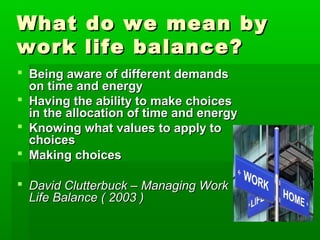
 Being aware of different demands
  on time and energy
 Having the ability to make choices
  in the allocation of time and energy
 Knowing what values to apply to
  choices
 Making choices

 David Clutterbuck – Managing Work
  Life Balance ( 2003 )
I wish I had spent
more time at the
office……
            Would you be
            saying this on
            your
            deathbed???
Some stats!

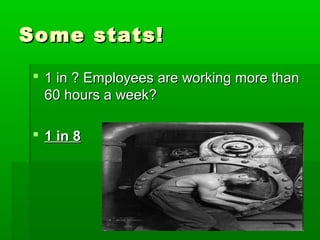
  1 in ? Employees are working more than
   60 hours a week?

  1 in 8
Some stats…cont

 Stress related sick leave costs
  British industry £150 million every
  year – True or False?

 False – Its £370 million!
Some stats cont…
 A report by the CIPD in 2009 found that ?
  % of workers say their employer has
  family friendly policies and personal
  support services in place?

   33%
   65%
   80%
Some stats cont..

 When working long hours more
  than a ¼ of employees feel:
 Depressed – 27%
 Anxious – 34%
 Irritable – 58%
If we have an unhealthy
work balance what are
the signs that we see?
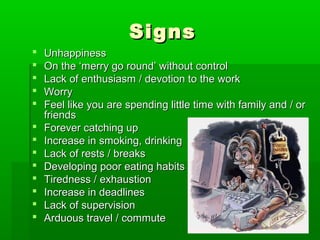
Signs
   Unhappiness
   On the ‘merry go round’ without control
   Lack of enthusiasm / devotion to the work
   Worry
   Feel like you are spending little time with family and / or
    friends
   Forever catching up
   Increase in smoking, drinking
   Lack of rests / breaks
   Developing poor eating habits
   Tiredness / exhaustion
   Increase in deadlines
   Lack of supervision
   Arduous travel / commute
What can we do
ourselves?
   Take personal responsibility
   Keep a track
   Don’t work long hours
   Take regular rests / breaks
   Draw the line
   Awareness
   Change jobs?
How can the
employer /
organisation help?
   Promote a good work life balance
   Create policies and procedures
   Create conducive atmosphere
   Training for Managers
   Review work roles
   Managing absence
   Time off
   Mental Health at work
So…..if our work life
balance is healthy,
what are the
benefits?
 Benefits to the employer
 Benefits to the individual
Benefits to the
    Employer
 Higher productivity
 Increased flexibility
 Better service for clients
 Raised morale, motivation and
  commitment
 Reduced absenteeism
 Improved recruitment and retention
 Meeting legal requirements
Benefits to the
individual
 More value and balance in your daily
  life
 A sense of control over work, family
  and leisure
 Improved relationships both on and off
  the job
 Reduction in stress ( and other
  problems e.g. anxiety,sleep problems )
The Law!
   Annual Leave
   Working Time
   Parental Leave
   Time off for dependant care
   Maternity leave
   Paternity leave
   Adoption leave
   Right to request flexible working
   Part time work
   Detriment
What employers do
next
   Identify business need
   Adapting policies
   Performance
   Guidelines
   Lead from the top
   Communicate
   Monitor progress
And finally…

 Work life balance can
  offer potential benefits to
  both the employer ( in
  terms of competitive
  performance, positive
  culture etc ) and to the
  employee ( in terms of
  greater well being )

Work life balance

  • 1.
    Kaleidoscope Yorkshire Work Life Balance
  • 2.
    Aim  To learnmore about the issues surrounding work life balance including its purpose, importance and implications
  • 3.
    Objectives  Discuss whatwe mean by work life balance  Examine some statistics relating to work life balance  Describe an unhealthy work life situation  Explore our own personal responsibility to change  Describe the benefits of achieving a better work life balance  Explore what the employer can do  Examine the law and legislation that affects work life balance
  • 4.
    What do we mean by work life balance?  Being aware of different demands on time and energy  Having the ability to make choices in the allocation of time and energy  Knowing what values to apply to choices  Making choices  David Clutterbuck – Managing Work Life Balance ( 2003 )
  • 5.
    I wish Ihad spent more time at the office…… Would you be saying this on your deathbed???
  • 6.
    Some stats! 1 in ? Employees are working more than 60 hours a week?  1 in 8
  • 7.
    Some stats…cont  Stressrelated sick leave costs British industry £150 million every year – True or False?  False – Its £370 million!
  • 8.
    Some stats cont… A report by the CIPD in 2009 found that ? % of workers say their employer has family friendly policies and personal support services in place?  33%  65%  80%
  • 9.
    Some stats cont.. When working long hours more than a ¼ of employees feel:  Depressed – 27%  Anxious – 34%  Irritable – 58%
  • 10.
    If we havean unhealthy work balance what are the signs that we see?
  • 11.
    Signs  Unhappiness  On the ‘merry go round’ without control  Lack of enthusiasm / devotion to the work  Worry  Feel like you are spending little time with family and / or friends  Forever catching up  Increase in smoking, drinking  Lack of rests / breaks  Developing poor eating habits  Tiredness / exhaustion  Increase in deadlines  Lack of supervision  Arduous travel / commute
  • 12.
    What can wedo ourselves?  Take personal responsibility  Keep a track  Don’t work long hours  Take regular rests / breaks  Draw the line  Awareness  Change jobs?
  • 13.
    How can the employer/ organisation help?  Promote a good work life balance  Create policies and procedures  Create conducive atmosphere  Training for Managers  Review work roles  Managing absence  Time off  Mental Health at work
  • 14.
    So…..if our worklife balance is healthy, what are the benefits?  Benefits to the employer  Benefits to the individual
  • 15.
    Benefits to the Employer  Higher productivity  Increased flexibility  Better service for clients  Raised morale, motivation and commitment  Reduced absenteeism  Improved recruitment and retention  Meeting legal requirements
  • 16.
    Benefits to the individual More value and balance in your daily life  A sense of control over work, family and leisure  Improved relationships both on and off the job  Reduction in stress ( and other problems e.g. anxiety,sleep problems )
  • 17.
    The Law!  Annual Leave  Working Time  Parental Leave  Time off for dependant care  Maternity leave  Paternity leave  Adoption leave  Right to request flexible working  Part time work  Detriment
  • 18.
    What employers do next  Identify business need  Adapting policies  Performance  Guidelines  Lead from the top  Communicate  Monitor progress
  • 19.
    And finally…  Worklife balance can offer potential benefits to both the employer ( in terms of competitive performance, positive culture etc ) and to the employee ( in terms of greater well being )

Editor's Notes

  • #5 Leading on from what Clutterbuck describes, work life balance describes how you combine work with other areas of your life – for example, childcare, socialising, activities outside of work, its an issue for each and every one of us- as workers, as parents, it looks at when we work and for how long….
  • #6 Theres probabky very few people who would be regretting this in their final moments!!...Bill Gates says in his autobiography he used to bring his sleeping bag into the office to snatch some sleep, maybe hes not such a good example….!!!, he does practically own the world!...but there are many people working many more hours than their allotted full or part time hours, the world of work in a lot of trades and services has altered, we want 24 hour access, the 7 day a week society….more and more people are doing juggling acts, juggling responsibilties at home and at work sometimes in jobs with long hours and high work intensity, many people feel their increasing work demands are getting in the way of their non work commitments. Such factors are having an important effect upon peoples health and well being, particuarly mental health.
  • #7 1 in 8 – although I have read recently that figure is now 1 in 6, infact this figure is slightly old, its from an Education and Employment survey in the mid noughties. The number of women working these hours has more than doubled in the last 5 years.
  • #8 That’s around 91 million working days every year.
  • #9 Its only 33%, ok, bigger organisations and companies are probably better in creating and following through on work life balance policies and procedures, they have the infrastructure, not all of us are afforded this luxury, smaller organisations, privately run firms sometimes do not have this built in at all – self employed too. CIPD? – Chartered Institute of Personnel development…..
  • #10 This was in a study commisioned by the MH Foundation,
  • #11 What I would like you to do in small groups is to list the signs that we might see at work if within our roles we are experiencing an unhealthy work life balance – 5 mins
  • #12 And the list goes on! Having an in-balance between your work and personal life can have very damaging effects on your health. An in-balance is basically a lack of clearly defined and consistently enforced boundaries between your work life and your personal life. When you fail to have a healthy work life balance, you end up experiencing emotional stress and possibly worse. The truth is that once you allow your life to overwhelm you week after week, you open yourself up to feelings of lack of control, anxiety , exhaustion, despair, and more. You run the risk of suffering from burnout syndrome and addictive behaviors. In the end, your health, your family , and your career all become victims of this lack of balance. Has anyone got any personal stories they feel they could share???
  • #13 So lets have a think, if we recognise these bad signs, what can we do, in other words what have we got within our control to stop these things occuring. 5 mins. Personal responsibility – Speak to managers about demands being too high, unreasonable, address the pressures, they probably wont go away otherwise. Keep a track – If you are working long hours, keep a check, write down what you are doing and when, compare what you do with other colleagues who are doing a similar job, are they pushed for time, stressed, staying late, coming in early etc. Change jobs – Sometimes it does come down to that…if it cant be changed, is there something else? – a clean break and complete change can often be the answer – less extreme might be changing your role, adapting it, reviewing it, working in a very different way that hasn’t been considered previously. Long hours – Sometimes we work long hours because we don’t prioritise our work well enough – True?.....sometimes we need to be tighter in terms of what we do and when we do it, how long to we spend doing things?, are we spending too long on the small things and not dealing with the big picture?, and we not working very productively?, are meetings, appointments a waste of time, do we have to do the things we do without question?, can we shed some of the load?. Rests / breaks – This isnt an opportunity to have an extra ciggie or 2!...break regularly to walk about, take a breath of fresh air, have a drink, not just coffee or tea, get out of the workplace itself. Draw the line – Draw the line between work and leisure. Don’t bring work home, physically and mentally, turn off the work phone if your’e not needed, don’t check for emails. Awareness – A lot of people are simply not very good at recognising or are just not aware that unhealthy work life patterns can mean stress and mental ill health, combatting this is the key, using your non working time to relax, enjoy yourself, enjoy your family, holiday, trips out, hobbies and social activities – taking your life back almost.
  • #14 Ok, so that’s us, what we can do, so what can the employer, organisation do? Policies and procedures – Does your organisation have a Stress at work policy for example?, organisations can offer guidance and support for those who are suffering from stress,anxiety or depressed mood due to work life balance issues etc. Conducive atmosphere – Employers can promote a good working atmosphere, openness, allow time to talk freely about work problems and pressures and come to agreements and consensus about how problems can be overcome. Training for Managers – Sometimes managers need some training in recognising burned out workers, stress etc, trained to provide better working and effective systems and well thought out roles and responsibilities. Review work roles – are the roles well defined, are job specifications relevant?, can the employee carry out the duties effectively within the day, shift etc. re-look at policies and procedures, are they workable in practice and not just token gestures and written because they need to be written. Managing absence – Without exacting punitive measures, althiugh sickness needs managing effective, welfare and well being are paramount too, why is someone off, what can managers do to prevent this, could be a work life issue. Time off – Other than holidays etc, allowing staff to attend appointments, other appointments with agreement – with limits. Children – sports days, occassions – xmas concert, parents evenings etc.Allow staff to swap shifts about, work flexibly within the day etc. Mental health at work – Put on some events, training, getting people to come to do some stress management techniques, Yoga, Tai chi – SBS example. I want to go back to the employer again in a minute, as the employer does have legal obligations – EU directives, Work and Families Act 2006 etc.
  • #16 There may well be costs to increasing a better work life balance for staff, such cost should be outweighed by the gains, difficulty sometimes is in managers difficulty in embracing flexible practices and looking at differing arrangements, resistance comes from percieved problems.
  • #17 Any more to add to this list, this is not a complete and ownerous list!
  • #18 Much of the legislation is driven by the EU directives which were extended in 2003. In 2004 the govt published a 10 year strategy for childcare, including proposals on existing maternity and paternity leave, this in turn became the Work and Families Act 2006, which was effective from 2007. This is a list of the provisions. So, instead of me just going through these, ive done a quiz! – I also have a handout on this but its pretty much covering the main points.
  • #19 Successful action to develop a successful work life strategy is as much about the process of making changes as about the changes themselves. Its not just about complying with the law it is about finding out about employees needs and priorities and considering how they can be met in ways that are consistent with the needs of the business.