By
Chris
Jessica
Brooke
Key People
Key Theories
Key Concepts
Application Through Technology
Opinions
•Brooke
•Jessica
•Chris

Sources
                 Click this icon to come back to this
                 page at any time.
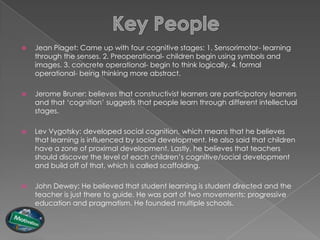
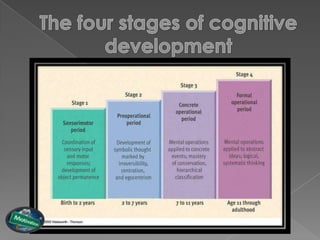
   Jean Piaget: Came up with four cognitive stages: 1. Sensorimotor- learning
    through the senses. 2. Preoperational- children begin using symbols and
    images. 3. concrete operational- begin to think logically. 4. formal
    operational- being thinking more abstract.

   Jerome Bruner: believes that constructivist learners are participatory learners
    and that „cognition‟ suggests that people learn through different intellectual
    stages.

   Lev Vygotsky: developed social cognition, which means that he believes
    that learning is influenced by social development. He also said that children
    have a zone of proximal development. Lastly, he believes that teachers
    should discover the level of each children‟s cognitive/social development
    and build off of that, which is called scaffolding.

   John Dewey: He believed that student learning is student directed and the
    teacher is just there to guide. He was part of two movements: progressive
    education and pragmatism. He founded multiple schools.
•   By reflecting on our own experiences, we build an interpretation of the world
    we live in
•   Individual learner constructs knowledge for his/her self by relating information
    to prior experiences/knowledge.
•   Purpose for learning is for individual to construct their own meaning (not just
    memorize the right answer)
•   Fosters critical thinking, promotes logical and conceptual growth, develops
    analytical skills
•   students should be exposed to data, primary sources, and the ability to
    interact with other students so that they can learn from the incorporation of
    their experiences
•   Learning is an active process as opposed to a passive one
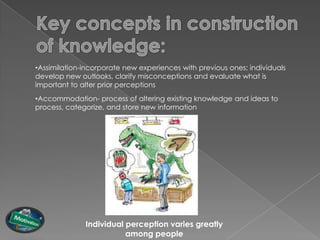
•Assimilation-incorporate new experiences with previous ones; individuals
develop new outlooks, clarify misconceptions and evaluate what is
important to alter prior perceptions
•Accommodation- process of altering existing knowledge and ideas to
process, categorize, and store new information


              Individual perception varies greatly
                         among people
•    Teacher is more of a facilitator to the
                             students, enabling them to construct their
                             own knowledge
                         •   Pedagogy shifts from teacher-centered to
                             student centered.
                         •    Rather than lecture and have students
                             memorize and recite information, the
                             teacher should ask thought-provoking
                             questions for students to respond to
                             (develops critical thinking)
                         •   Teacher provides to the students an
                             environment plentiful in data, sources of
                             information, and the opportunity to interact
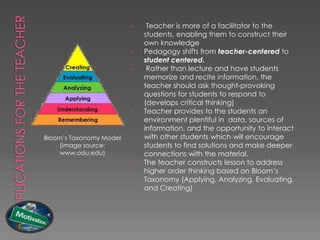
Bloom‟s Taxonomy Model       with other students which will encourage
    (image source:           students to find solutions and make deeper
    www.odu.edu)             connections with the material.
                         •   The teacher constructs lesson to address
                             higher order thinking based on Bloom‟s
                             Taxonomy (Applying, Analyzing, Evaluating,
                             and Creating)
•   Internet is a very valuable tool for teachers to introduce constructivist
    learning theory application into the classroom.
•   Many possibilities exist such as:
      • Math programs that allow students to manipulate shapes from 2D
         and 3D forms for a better understanding of geometry
      • Demonstrations of mathematical or scientific experiments that may
         otherwise not be possible to facilitate in the classroom
      • Online open forums containing real-life problems that students can
         devise solutions for (independently or collaboratively)
      • Videos of scientific material such as life processes, components of the
         human body, chemical reactions, the metabolic process, and so on
         to further develop the comprehension
I think that students are better off if they learn many different ways
when they are young. By doing so, they can find out which way is best
for them and what works.
I think the philosophy behind constructivism is crucial to the
learning environment because it encourages students to think for
themselves. So much of the information I was taught in school is
based on memorization—which only works for a small segment of
students. In this day and age students are surrounded with
information from all different sources and I think it is important for
them to evaluate, analyze, interpret, and form their own opinions
as opposed to just “going along with it”. The key benefit to
associating information with a student‟s own real life experiences is
that they are creating a deeper understanding of the material.
Today‟s Technology is Changing so fast, what we learn
today will be all but obsolete tomorrow. If we don‟t stay on
top of the changes you can be left behind. The sooner we
teach children the trends and they learn how these changes
impact their learning, the sooner they will be teaching us.
http://www.teach-nology.com/currenttrends/constructivism


http://www.funderstanding.com/theory/constructivism


http://constructivisminelt.wikispaces.com/file/view/M13-1c2.jpg/334445146/M13-1c2.jpg


http://www.teach-nology.com/currenttrends/constructivism/and_technology


http://www.conseilcoopipe.org/wp-content/uploads/2012/03/motivation.jpg

Costructivist group2

  • 1.
  • 2.
    Key People Key Theories KeyConcepts Application Through Technology Opinions •Brooke •Jessica •Chris Sources Click this icon to come back to this page at any time.
  • 3.
    Jean Piaget: Came up with four cognitive stages: 1. Sensorimotor- learning through the senses. 2. Preoperational- children begin using symbols and images. 3. concrete operational- begin to think logically. 4. formal operational- being thinking more abstract.  Jerome Bruner: believes that constructivist learners are participatory learners and that „cognition‟ suggests that people learn through different intellectual stages.  Lev Vygotsky: developed social cognition, which means that he believes that learning is influenced by social development. He also said that children have a zone of proximal development. Lastly, he believes that teachers should discover the level of each children‟s cognitive/social development and build off of that, which is called scaffolding.  John Dewey: He believed that student learning is student directed and the teacher is just there to guide. He was part of two movements: progressive education and pragmatism. He founded multiple schools.
  • 5.
    By reflecting on our own experiences, we build an interpretation of the world we live in • Individual learner constructs knowledge for his/her self by relating information to prior experiences/knowledge. • Purpose for learning is for individual to construct their own meaning (not just memorize the right answer) • Fosters critical thinking, promotes logical and conceptual growth, develops analytical skills • students should be exposed to data, primary sources, and the ability to interact with other students so that they can learn from the incorporation of their experiences • Learning is an active process as opposed to a passive one
  • 6.
    •Assimilation-incorporate new experienceswith previous ones; individuals develop new outlooks, clarify misconceptions and evaluate what is important to alter prior perceptions •Accommodation- process of altering existing knowledge and ideas to process, categorize, and store new information Individual perception varies greatly among people
  • 7.
    Teacher is more of a facilitator to the students, enabling them to construct their own knowledge • Pedagogy shifts from teacher-centered to student centered. • Rather than lecture and have students memorize and recite information, the teacher should ask thought-provoking questions for students to respond to (develops critical thinking) • Teacher provides to the students an environment plentiful in data, sources of information, and the opportunity to interact Bloom‟s Taxonomy Model with other students which will encourage (image source: students to find solutions and make deeper www.odu.edu) connections with the material. • The teacher constructs lesson to address higher order thinking based on Bloom‟s Taxonomy (Applying, Analyzing, Evaluating, and Creating)
  • 8.
    Internet is a very valuable tool for teachers to introduce constructivist learning theory application into the classroom. • Many possibilities exist such as: • Math programs that allow students to manipulate shapes from 2D and 3D forms for a better understanding of geometry • Demonstrations of mathematical or scientific experiments that may otherwise not be possible to facilitate in the classroom • Online open forums containing real-life problems that students can devise solutions for (independently or collaboratively) • Videos of scientific material such as life processes, components of the human body, chemical reactions, the metabolic process, and so on to further develop the comprehension
  • 9.
    I think thatstudents are better off if they learn many different ways when they are young. By doing so, they can find out which way is best for them and what works.
  • 10.
    I think thephilosophy behind constructivism is crucial to the learning environment because it encourages students to think for themselves. So much of the information I was taught in school is based on memorization—which only works for a small segment of students. In this day and age students are surrounded with information from all different sources and I think it is important for them to evaluate, analyze, interpret, and form their own opinions as opposed to just “going along with it”. The key benefit to associating information with a student‟s own real life experiences is that they are creating a deeper understanding of the material.
  • 11.
    Today‟s Technology isChanging so fast, what we learn today will be all but obsolete tomorrow. If we don‟t stay on top of the changes you can be left behind. The sooner we teach children the trends and they learn how these changes impact their learning, the sooner they will be teaching us.
  • 12.