TRUE OR FALSE
1. Curriculum is a standards-based sequence of planned experiences
where students practice and achieve proficiency in content and applied
learning skills.
2. In discipline perspective, curriculum should be organized around the
core knowledge and modes of inquiry of a discipline.
3. The traditional perspective promotes the need to incorporate all
aspects of a student’s life in developing the curriculum he will learn.
4. The behavioral perspective promotes the setting of learning objectives
and the focusing of curriculum to meet the needs of students as they
acquire those objectives.
5. The constructivist perspective promotes the notion that educators
should devise curricula so that students may personalize their learning.
“Education is a process, and
curriculum is the means to the
process”.
Curriculum
Perspectives
What is Curriculum?
 The term ‘curriculum’ is, etymologically, derived from the
Latin word “currere”.
 Curriculum is from Modern Latin, in which this term means ‘a
course of study”.
What is Curriculum?
 Curriculum is a standards-based sequence of planned
experiences where students practice and achieve proficiency in
content and applied learning skills.
Emil Ahangarzadeh (2014)
breaks down five theoretical
perspectives on curriculum:
The Traditional Perspective
The traditional perspective promotes a return to
the mastery of basic literacy skills and the
diffusion of common values
The Experiential Perspective
The experiential perspective promotes
the need to incorporate all aspects of a
student’s life in developing the curriculum
he will learn.
Structure of the Disciplines
The disciplines perspective promotes the
development of intellectual capabilities by
focusing on the thought structures of given
content areas.
The Behavioral Perspective
The behavioral perspective promotes the
setting of learning objectives and the focusing
of curriculum to meet the needs of students as
they acquire those objectives.
The Constructivist Perspective
The constructivist perspective promotes the
notion that educators should devise curricula so
that students may personalize their learning by
reorganizing their thought structures around
what they learn in school.
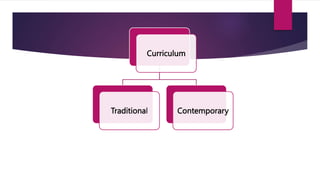
Curriculum
Traditional Contemporary
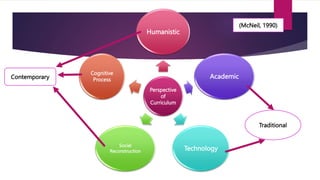
Perspective
of
Curriculum
Humanistic
Academic
Technology
Social
Reconstruction
Cognitive
Process
Traditional
Contemporary
(McNeil, 1990)
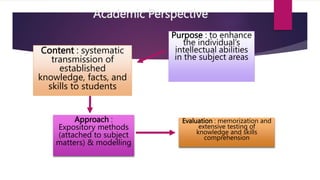
Academic Perspective
Content : systematic
transmission of
established
knowledge, facts, and
skills to students
Approach :
Expository methods
(attached to subject
matters) & modelling
Evaluation : memorization and
extensive testing of
knowledge and skills
comprehension
Purpose : to enhance
the individual’s
intellectual abilities
in the subject areas
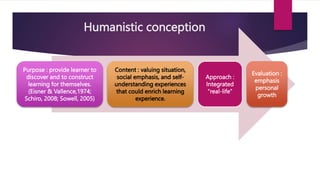
Humanistic conception
Purpose : provide learner to
discover and to construct
learning for themselves.
(Eisner & Vallence,1974;
Schiro, 2008; Sowell, 2005)
Content : valuing situation,
social emphasis, and self-
understanding experiences
that could enrich learning
experience.
Approach :
Integrated
“real-life”
Evaluation :
emphasis
personal
growth
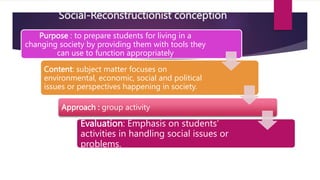
Social-Reconstructionist conception
Purpose : to prepare students for living in a
changing society by providing them with tools they
can use to function appropriately
Content: subject matter focuses on
environmental, economic, social and political
issues or perspectives happening in society.
Approach : group activity
Evaluation: Emphasis on students’
activities in handling social issues or
problems.
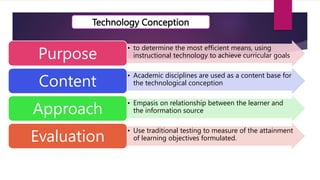
Technology Conception
• to determine the most efficient means, using
instructional technology to achieve curricular goals
Purpose
• Academic disciplines are used as a content base for
the technological conception
Content
• Empasis on relationship between the learner and
the information source
Approach
• Use traditional testing to measure of the attainment
of learning objectives formulated.
Evaluation
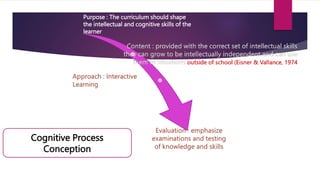
Cognitive Process
Conception
Purpose : The curriculum should shape
the intellectual and cognitive skills of the
learner
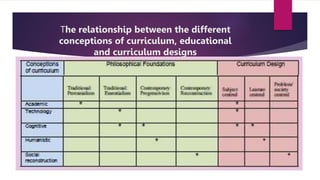
The relationship between the different
conceptions of curriculum, educational
and curriculum designs
Identification.
 It promotes the need to incorporate all aspects of a student’s life in developing the
curriculum he will learn.
 Which curriculum perspective promotes the notion that educators should devise
curricula so that students may personalize their learning by reorganizing their thought
structures around what they learn in school?
 It promotes the setting of learning objectives and the focusing of curriculum to meet
the needs of students as they acquire those objectives.
 What curriculum perspective promotes the development of intellectual capabilities by
focusing on the thought structures of given content areas?
 Which perspective promotes a return to the mastery of basic literacy skills and the
diffusion of common values?
PREPARED BY:
MARY JEAN C. ROMULO

Curriculum-Perspectives-Advance Curriculum.pptx

  • 2.
    TRUE OR FALSE 1.Curriculum is a standards-based sequence of planned experiences where students practice and achieve proficiency in content and applied learning skills. 2. In discipline perspective, curriculum should be organized around the core knowledge and modes of inquiry of a discipline. 3. The traditional perspective promotes the need to incorporate all aspects of a student’s life in developing the curriculum he will learn. 4. The behavioral perspective promotes the setting of learning objectives and the focusing of curriculum to meet the needs of students as they acquire those objectives. 5. The constructivist perspective promotes the notion that educators should devise curricula so that students may personalize their learning.
  • 3.
    “Education is aprocess, and curriculum is the means to the process”.
  • 4.
  • 5.
    What is Curriculum? The term ‘curriculum’ is, etymologically, derived from the Latin word “currere”.  Curriculum is from Modern Latin, in which this term means ‘a course of study”.
  • 6.
    What is Curriculum? Curriculum is a standards-based sequence of planned experiences where students practice and achieve proficiency in content and applied learning skills.
  • 7.
    Emil Ahangarzadeh (2014) breaksdown five theoretical perspectives on curriculum:
  • 9.
    The Traditional Perspective Thetraditional perspective promotes a return to the mastery of basic literacy skills and the diffusion of common values
  • 11.
    The Experiential Perspective Theexperiential perspective promotes the need to incorporate all aspects of a student’s life in developing the curriculum he will learn.
  • 12.
    Structure of theDisciplines The disciplines perspective promotes the development of intellectual capabilities by focusing on the thought structures of given content areas.
  • 13.
    The Behavioral Perspective Thebehavioral perspective promotes the setting of learning objectives and the focusing of curriculum to meet the needs of students as they acquire those objectives.
  • 14.
    The Constructivist Perspective Theconstructivist perspective promotes the notion that educators should devise curricula so that students may personalize their learning by reorganizing their thought structures around what they learn in school.
  • 15.
  • 16.
  • 17.
    Academic Perspective Content :systematic transmission of established knowledge, facts, and skills to students Approach : Expository methods (attached to subject matters) & modelling Evaluation : memorization and extensive testing of knowledge and skills comprehension Purpose : to enhance the individual’s intellectual abilities in the subject areas
  • 18.
    Humanistic conception Purpose :provide learner to discover and to construct learning for themselves. (Eisner & Vallence,1974; Schiro, 2008; Sowell, 2005) Content : valuing situation, social emphasis, and self- understanding experiences that could enrich learning experience. Approach : Integrated “real-life” Evaluation : emphasis personal growth
  • 19.
    Social-Reconstructionist conception Purpose :to prepare students for living in a changing society by providing them with tools they can use to function appropriately Content: subject matter focuses on environmental, economic, social and political issues or perspectives happening in society. Approach : group activity Evaluation: Emphasis on students’ activities in handling social issues or problems.
  • 20.
    Technology Conception • todetermine the most efficient means, using instructional technology to achieve curricular goals Purpose • Academic disciplines are used as a content base for the technological conception Content • Empasis on relationship between the learner and the information source Approach • Use traditional testing to measure of the attainment of learning objectives formulated. Evaluation
  • 21.
    Cognitive Process Conception Purpose :The curriculum should shape the intellectual and cognitive skills of the learner
  • 22.
    The relationship betweenthe different conceptions of curriculum, educational and curriculum designs
  • 23.
    Identification.  It promotesthe need to incorporate all aspects of a student’s life in developing the curriculum he will learn.  Which curriculum perspective promotes the notion that educators should devise curricula so that students may personalize their learning by reorganizing their thought structures around what they learn in school?  It promotes the setting of learning objectives and the focusing of curriculum to meet the needs of students as they acquire those objectives.  What curriculum perspective promotes the development of intellectual capabilities by focusing on the thought structures of given content areas?  Which perspective promotes a return to the mastery of basic literacy skills and the diffusion of common values?
  • 24.

Editor's Notes

  • #5 Did the lesson accomplish what the teacher intended it to accomplish? This is the major question which must be answered in order to gauge a lesson's effectiveness. ​Lesson effectiveness from the curricular perspective focuses on looking at it in relation to the student learning intentions, as well as their success criteria for those learning intentions. This is one area where Hattie (2012) notes the importance of teacher collaboration. This aids in making accurate judgments about whether or not students met the success criteria for the learning intentions (pg. 161).  It is important that both teachers and students reflect upon the learning goals -- as well as how those goals will be attained and achieved. Teachers must provide opportunities for themselves and students to reflect on the success of a lesson or unit of study.  Hattie suggests a diary for students where they detail "what they think they are learning, indicators of their progress, how confident they are that they will achieve these learning intentions in the time available, and their perception of their degree of success" (pg. 161). In addition to judging lesson effectiveness with learning intentions, it is important to remember that students may change and re-evaluate their learning intentions as they progress. In addition to students, colleagues can provide additional feedback on a lesson's effectiveness through a critique of the learning intentions and success criteria.  Collaborative teams provide the perfect time for teachers to get feedback on their lessons and units in terms of intentions and success. http://emilyjlang.weebly.com/curricular-perspective.html
  • #6 The term curriculum has been used with quite different meanings ever since its concept came into existence. process?a series of actions or events performed to make something or achieve a particular result, 
  • #7 Curriculum is the central guide for all educators as to what is essential for teaching and learning, so that every student has access to rigorous academic experiences. Curriculum can be recognized as an authoritative prescription for the course of study of a system of schools. According to old concept, the curriculum was merely an outline of the course of study. The new concept of curriculum represents a very broad dimension in itself, which means that it is tailored very flexibly by the curriculum developers to meet the diverse needs of the students at various age levels in recent days.
  • #8 About Education management executive with 18 years of administration experience at the school, district, and county level as well as 6 years of secondary school teaching; contemporaneously working for 15 years as an adjunct professor in the fields of fine art and education. Expertise includes, program integration and project design, English learner and compensatory education leadership, teacher preparation education, fine arts education, and professional development facilitation. Specialties: school administration, curriculum development, adult learning, training and professional development, language acquisition, and program evaluation.
  • #10 Basic Literacy is the ability to read, write, and comprehend. It includes proper diction as well as grammar, spelling, and punctuation Passion (Enthusiasm, Fun) Leadership (Influence, Competitive Advantage) Learning (Continuous Improvement, Knowledge) Customers (Customer Satisfaction) People (Employee Engagement) Safety (Health) Community (Corporate Citizenship) Environment (Sustainability) Integrity (Ethics, Honesty) Respect (Trust, Dignity) Excellence (Quality, Performance) Responsibility (Accountability, Commitment) Teamwork (Collaboration, Cooperation) Innovation (Creativity, Ingenuity) Robert Presenting Values Laughing cropped 600x362Achievement (Results, Success) Fairness (Diversity, Inclusive) Care (Service, Compassion) Passion (Enthusiasm, Fun) Leadership (Influence, Competitive Advantage) Learning (Continuous Improvement, Knowledge) Customers (Customer Satisfaction) People (Employee Engagement) Safety (Health) Community (Corporate Citizenship) Environment (Sustainability) The Traditional Point of View of Curriculum Team MRMPublished onTuesday, August 22, 2023 The realm of education is a tapestry woven from the threads of historical legacies, societal values, and evolving pedagogical paradigms. At the heart of this educational fabric lies the traditional viewpoint of curriculum, an approach that has stood the test of time and profoundly influenced how knowledge is structured, transmitted, and received in formal learning settings. Characterized by its subject-centered organization, fixed content, and emphasis on foundational knowledge, the traditional curriculum has deep historical roots that have shaped educational systems across cultures and epochs. In an individual classroom, the traditional curriculum involves the presentation of information in the form of blocks or units which are broken into smaller units of information and presented by the teacher to the students. Traditionally, exchange between students and teachers is less encouraged, and the facilitation of class discussion is also not a part of this curriculum. These are seen as shortcomings by some educators, who feel that students are more likely to develop critical thinking skills and to internalize and apply the information if they have discussions with the class, present projects which allow them to expand the material, and so forth. Increasingly, such activities are being accepted into curricula around the world
  • #12 A philosophy that informs many methodologies in which educators purposefully engage with learners in direct experience and focused reflection in order to increase knowledge, develop skills, clarify values, and develop people’s capacity to contribute to their communities
  • #13 Organization of Core Ideas Joseph Schwab (1978), a philosopher of science, explained the notion of the “structure” of a discipline by focusing first on the way the core ideas of a discipline are organized: What are the building blocks that reflect the central concepts in a discipline, and how do they connect with one another? (Schwab, 1978; Shulman, 2001). Schwab argued that teachers need to understand the structure of a discipline to help students acquire new knowledge and skills. For instance, mathematics is structured around core ideas like the inverse operations of addition and subtraction, the concepts of ratio and proportion, and the ideas of balance and equilibrium, among other topics. Whether students are engaged in primary arithmetic or algebra, these ideas repeat themselves again and again, and they organize much of the work people do in the field. Both Bruner (1960) and Schwab (1962) assert that students can understand the basic concepts of subject matter at an early age when they are taught in an intellectually honest way: “We begin with the hypothesis that any subject can be taught effectively in some intellectually honest form to any child at any stage of development”(Bruner, 1960, p. 32). In fact, Bruner suggests that students be taught in a spiral curriculum that introduces central concepts in the disciplines early in a child’s education and revisits these concepts again and again in the later grades in more sophisticated ways. “By consistently reexamining material taught in elementary and secondary schools for its fundamental character, one is able to narrow the gap between ‘advanced’ knowledge and ‘elementary’ knowledge” (Bruner, 1960, p. 26).
  • #14 where goals and objectives are specified. Contents and activities are arranged to match with specified learning objectives. The learning outcomes are evaluated in terms of goals and objectives that are set at the beginning.
  • #15 Constructivism hypothesizes that individuals will try to make sense of all information that they perceive, and that each individual will, therefore, “construct” their own meaning from that information. It promotes learning through experience in an environment that involves the “real world” and offers meaningful, personally interesting challenges. Moreover it requires active learning, provides opportunities to solve real world problems, answer real questions, address real needs and offers the student an opportunity to perform as an expert or professional in their chosen field. Approaching instruction from the constructivist continuum reaches a broader range of students and increases comprehension and self-confidence in all students, teaching students to think for themselves, ask questions and seek answers. The constructivist focus on the social context and larger community of learners has resulted in a major shift away from individually-based instruction to instruction that incorporates and embeds teaching within the larger community of peers, younger students, as well as those Thus, another important method used in a constructivist design is a collaborative learning. The common point of this method is that group members are responsible for both their learning and the learning of group members; the success of the group is rewarded. Other activities are applied in a constructivist design that encourage making sense of the subject matter, exposure to multiple sources of information, and opportunities for students to demonstrate their understanding in diverse ways, such as problem-based learning, inquiry activities, dialogues with peers and teachers.
  • #18 1. It is the traditional way of approaching curriculum 2. Basically, the curriculum should be used to help individuals understand knowledge (skills, tools, concepts)
  • #19 Focuses on the individual and the individuals needs and interests (Orstien & Hunkins, 2009; Schiro, 2008). A curriculum should be student oriented and child centred meaning children can pursue their individual choices. Everything in the curriculum should bring personal meaning to each individual that relates to experiences unique to the learner. This can allow the individual to learn ways on how to manage things of personal significance.
  • #20 focuses on society needs (Eisner & Vallence, 1974). We should create an education where subject matter focuses on environmental, economic, social and political issues or perspectives happening in society (ie. Pollution, earth quake). Education should be structured to prepare students for living in a changing society by providing them with tools they can use to function appropriately. It’s about giving the learner real life situations they can experience in the curriculum. This allows young learners to have a better understanding and connection with society where in the curriculum they are learning ways on how to live
  • #21 Focuses on how curriculum should be taught or how knowledge should be communicated Through this conception you focus more on the organization and presentation of materials to the learner. Everything is decided before children come into the classroom
  • #22 focuses on the development of the intellectual process. The curriculum should shape the intellectual and cognitive skills of the learner. Once they gain the skills the learner can apply it to other forms of learning and in any context This approach believes if the learner is provided with the correct set of intellectual skills they can grow to be intellectually independent and can use them in situations outside of school