GANDHIJI - LIFE AND
EDUCATIONAL CONTRIBUTIONS
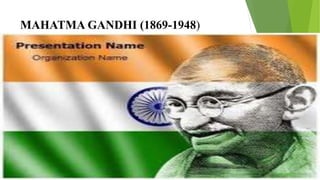
MAHATMA GANDHI (1869-1948)
MAHATMA GANDHI ON EDUCATION
 The real difficulty is that people have no idea of what education
truly is. We assess the value of education in the same manner as we
assess the value of land or of shares in the stock exchange market.
We want to provide only such education as would enable the
student to earn more. We hardly give any thought to the
improvement of the character of the educated. The girls, we say, do
not have to earn; so why should they be educated? As long as such
ideas persist there is no hope of our ever knowing the true value of
education.
Life-Sketch
 Gandhiji is the great Apostle of non-violence.
 The major part of his life was spent for experimenting
with truth.
 sathyagraha has been the most important tool used by
Gandhiji while working as the architect of India's
freedom
Main publications
 My Experiments with truth,
 Commentary on the Bhagavat Gita
 The words of Gandhi
 The Essential Gandhi
 Non –Violent Resistance(satyagraha)
 He was the editor of a number of journals such as Harijan and
Young India and has published innumerable booklets containing
his views on various aspects, including education
Philosophy of life
Gandhijis philosophy is
 Absolute faith in God
 Personal surrender to His will,
 Belief in the brotherhood not only of all human beings but of all
living things,
 Sprit of renunciation
 Ideal of continual service to his fellow creatures.
Educational Philosophy
He has been considered to be a revolutionary educational thinker of modern India.
Through his educational scheme usually known as ‘Basic Education’ he wanted to bring
about a social revolution in our country, that would result in the creation of a new social
order, that would reflect his philosophy of education and life. Gandhiji was at the same
time an idealist, a naturalist, a pragmatist and a humanist. His philosophy of education is
naturalistic in its settings, idealistic in its goals, pragmatic in its method and humanistic in
its outlook. He said, by education I mean an all-round drawing out of the best in the
child and man-body, mind and spirit.
 The aims of education included harmonious development of the personality of the
individual, his social, cultural and spiritual development, preparation for complete
living, character formation, social training for effective citizenship, economic self-
sufficiency, etc. The method he suggested for education is chiefly craft centred.
Education for him is a kind of insurance against unemployment. The curriculum
broadly covers craft-education, general education, training of the arts and physical
education.
Basic Education
 Gandhiji experimented his philosophy of education at Sabarmathy and also at Wardha.
His Wardha Scheme was a revolt against
 the sterile,
 book-centred,
 examination-orientered system of education that had developed during the British rule..
BASIC EDUCATION
 His basic education is an education for life and through life.
 It is called Basic because it is based on Indian culture,
 Planned to give a base for life,
 Meant to lay down the minimum educational standards which every child
is entitled to receive
 Imparted through basic necessities of life,
 Linked with basic urges of the child,
 Based on the native potentials of the child
 Related to the basic needs of the community
BASIC EDUCATION CURRICULAM
 craft,
 Mother tongue,
 Arithmetic,
 Social studies,
 General sciences
 Art
 Games, etc.
Basic education is significant as
 It is a self-supporting system,
 Advocates a novel philosophy of life
 A new work-oriented method of teaching
 Aims at imparting education for citizenship
 It aims not only at character building but also social,
political and economic uplift of all sections of the
society.
DEMERITS OF BASIC EDUCATION
 Basic education has not been properly selected
 Teaching through a craft has not been taken seriously
 The self-sufficiency aspect has been neglected.
 Lack of enthusiastic teachers, absence of text books,
on-availability of raw materials, etc.
These are certain reasons for the failure of Basic
Education in our country
THANK YOU