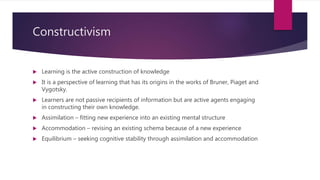
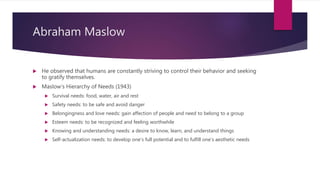
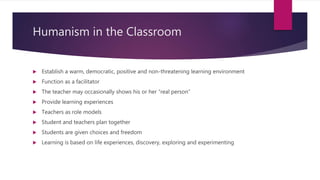
Constructivism holds that learning involves actively constructing knowledge rather than passively receiving information. It emphasizes that students learn by experiencing and reflecting on the world. The document outlines key aspects of constructivism including assimilation, accommodation, and the zone of proximal development. It also discusses how constructivism and humanism influence classroom practices, advocating for student-centered learning, social learning experiences, and meeting students' basic psychological needs.