Learning theories
and online learning
Claire Major, 2013
What is learning?
Learning is a process.
The process of learning
   leads to change.
A change to what?
It depends….
Theories of learning
Learning changes an individual.
Psychological theories
     of learning.
• Behaviorism
• Cognitivism
• Constructivism
Behaviorism
Learning is a change to behavior.
Famous behaviorists include
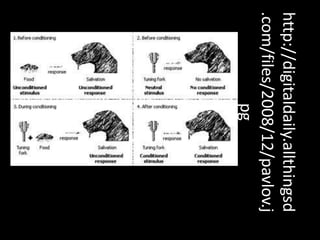
Skinner and Pavlov

Classical conditioning
http://mytwopixelsworth.files.wordpress.com
 /2011/04/2011_04_11_skinnerbox_large.gif
http://digitaldaily.allthingsd
.com/files/2008/12/pavlov.j
              pg
Thorndike

Operant conditioning
http://animalbehaviour.net/OperantCondition
                  ing.htm
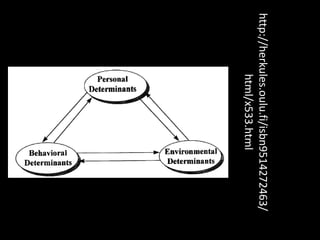
Bandura

Social learning theory
http://herkules.oulu.fi/isbn9514272463/
            html/x533.html
According to behaviorists
Acquiring knowledge
Stimulus and response
Rewards and punishments
Cognitivistm
Learning is a change to the way
   that the brain processes.
Famous cognitivists include
Wertheimer
Gestalt psychology
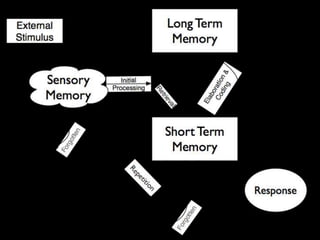
Atkinson; Shiffrin

Information processing
       theory
Anderson
Schema theory
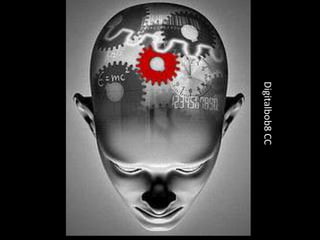
Digitalbob8 CC
Cognitivists believe that
Changing mental processes
Duplication of knowledge
  constructs of knower
Existing schemata and
  prior experiences
Constructivsm
Learning is a process
in which the learner constructs or
  builds new ideas or concepts.
Learning is a personal endeavor.
Famous constructivists include…
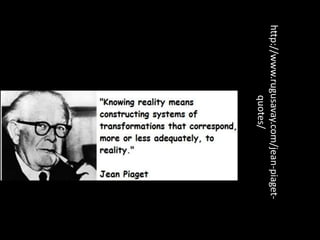
Piaget

Cognitive constructivism
http://www.rugusavay.com/jean-piaget-
              quotes/
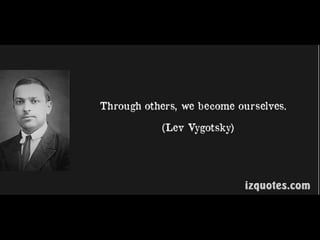
Vygotsky

Social constructivism
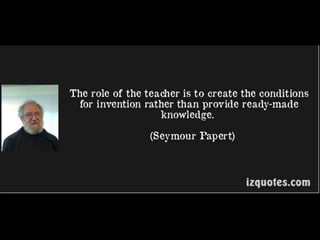
Pappert

Social constructionism
According to constructivists
Constructing new knowledge
 (e.g. a new internal reality)
Experience of an individual
acting and engaging with others
Prior experiences
Cool theories!
But some people…
THINK
New ideas
• Sociology

• Anthropology

• Philosophy

• Education
Social/relational
learning theories
Learning is a change in
connections, whether
 social, relational, or
    technological.
Learning does not belong to an
          individual
Hutchings, Perry

Distributed learning theory
  (distributed cognition)
Famous social/relational
learning theorists include
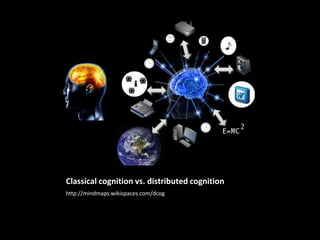
Classical cognition vs. distributed cognition
http://mindmaps.wikispaces.com/dcog
Lave; Wenger; Seely Brown

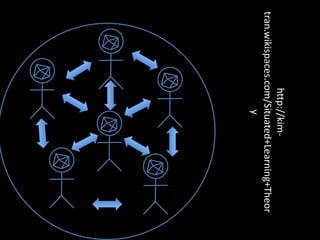
 Situated learning theory
   (situated cognitition)
http://kim-
tran.wikispaces.com/Situated+Learning+Theor
                       y
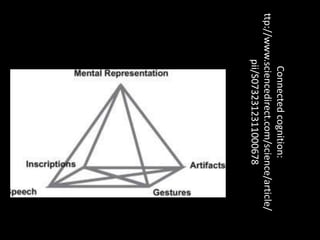
Siemens; Downes

    Connectivism
(a bit like connected
   cognition???)
Connected cognition:
ttp://www.sciencedirect.com/science/article/
         pii/S0732312311000678
According to these theorists:
A group of individuals building a
    networked intelligence
Resources are shared within a
        community
Cultural context
Online learning?
http://www.usdla.org/html/journal/FEB02_Iss
             ue/article01.html
Knowledge resides
amongst individuals
 and technologies.
interact with each other and
      with technology.
engage in joint activity and have
         shared tools.
Employ social interactions with
         technology.
think and learn with
 objects and tools.
They construct a common
  language and shared
     understanding.
construct a network of both
human and non-human actors/
Active agents
Is it important?
Beliefs drive actions…
conscious or subconscious.
Ask:
Who am I?
What do I believe?
What is the role of technology?
Make informed decisions.
Create better learning
environments and activities.
Help students learn.
The point.
NOTES:
Forthcoming
Suggestions?
Permalink:http://clairemajor.net/
 2013/04/19/learning-theories-
     and-online-learning/

Learning style presentation for pedagogy first

Editor's Notes

  • #2 I’m Claire Major, and may talk today is about learning theories and online learning.
  • #3 Central to this talk is the following question: What is learning?
  • #4 Many scholars agree that learning is a process
  • #5 They also agree that the result of the process of learning leads to some kind of change
  • #6 The underlying question then is this:What kind of change does learning cause?
  • #7 The answer depends upon whom you ask.
  • #8 There are many different theories of learning, that attempt to describe what learning is, how it happens, and what change results.
  • #9 Some of these theories describe learning as a change that happens within an individual’s mind.
  • #10 These theories tend to come from the field of psychology, and there are three main psychological theories of learning…..
  • #12 Behaviorism is the earliest of these theories
  • #14 Famous behaviorists include
  • #15 Skinner and Pavlov, with their ideas about classical conditioning.
  • #16 Think about Skinner’s rats…
  • #17 And Pavlov’s dog.
  • #18 Thorndike is another famous behaviorists, with his notion of operant conditioning.
  • #19 Think Thorndike’s cat in the puzzle box
  • #20 Bandura is sometimes thought of as a bahaviorist, although he represents a bridge to cognitivist learning theory….
  • #21 Particiularly with his conception of personal determinants, which include an individuals knowledge, prior experiences, and attitudes.
  • #22 According to behavorists…
  • #23 Acquiring knowledge through experience is the goal of learning is the goal of learning.
  • #24 Stimulus and response is the mechanism for learning
  • #25 Rewards and punishmentsare factors that influence learning.
  • #26 Cognitivism is another pscyhological theory of learning
  • #27 Cognitivists hold that learning is a relatively permanent change in a learner’s schemata or in the way the brain processes.
  • #28 Famous cognitivists include
  • #29 Wrtheimer, with his notion of Gestalt psychology
  • #30 Which holds that the brian is holistic, with self organizing principles, such as multistabliity in which ambiguous images pop back and forth in our perception.
  • #31 Atkinson and Shiffrin and their ideas about information processing
  • #32 Which suggest that the mind works like a computer, as information is temporarily held in short term memory before moving to long term memory.
  • #33 And Anderson, with his notion of schema theory is another famous cognitivist.
  • #34 Which canbe described as a mental structure or a system for organizing and perceiving new information.
  • #35 Cognitivists believe that
  • #36 Changing mental processes (e.g. problem-solving) is the goal of learning.
  • #37 Duplication of knowledge constructs of knower who organizes information for the learner is how learning occurs.
  • #38 Existing schemata and prior experiences are factors that influence learning. 
  • #39 The thirdpschological theory of learning is constructivism.
  • #40 Constructivists believe that learning is a process in which the learner constructs or builds new ideas or concepts based upon current and past knowledge.
  • #41 Learning is a personal endeavor, whereby internalized concepts, rules, and general principles may consequently be applied in a practical real-world context.
  • #42 Famous constructovists include
  • #43 Piaget, with his notion of congnitive constructivism
  • #44 Who says that knowing reality means constructing systems of transofrmations that correspond, more or less adequately, to reality
  • #45 Vygotsky, with his notion of social constructivism
  • #46 Wy says that through others, we become ourselves
  • #47 Pappert who extended Vygotsky’s notion to a new form, which he called social constructionism.
  • #48 Papert says that the role of the teacher is to create conditions for invention rathern than provide ready-made knowledge.
  • #49 Constructivists believe that
  • #50 Constructing new knowledge (e.g. a new internal reality) is the goal of learning.
  • #51 Experience of an individual acting and engaging with others is how learning occurs.
  • #52 Prior experiences are the key factors that influence learning.
  • #53 These theories are interesting, and they have good evidence to support their efficacy.
  • #55 Are starting to think about learning a bit differently…this shift is in part enabled because of technology
  • #56 Thus a new camp of learning theories and theorists has developed…
  • #57 Are coming from a range of fields, including sociology, anthropology, philosophy, education
  • #58 These are at times called social learning theories, at times called realtional learning theories, and occasionally called contextual learning theoreis.
  • #59 They set forth a view of learning that holds that all learning is a change in connections to other people and tools.
  • #60 Learning, then, does not belong to an individual but to many, evidenced through the conversations amongst individuals.
  • #61 Hutchings and Perry and their ideas about distributed learning theory
  • #63 Which suggest that learning exists outside of the mind and resides with people and tools
  • #64 Lave and Wenger and Seely brown and their ideas about situated learning theory
  • #65 Which suggests that learning is contextually bound.
  • #66 And Siemens and Downs and tehir notion of Connectivism
  • #67 Which isuggests that learning is represented in nodes and ties between indivdiuals and artifacts.
  • #68 According to social relational theorists:
  • #69 A group of individuals building a networked intelligence is a goal of learning.
  • #70 Resources are shared within a community, in which members interact with each other and with technological tools is the way in which learning happens.
  • #71 Is a factor that Influences learning.
  • #72 We can create online courses from an individualists perspective, developing them to support behaviorial, cognitive or social constructivist perspectives.
  • #73 online learning can also support a social relational view of learning
  • #74 In an online course, knowledge resides amongst individuals and their technological objects and tools
  • #75 In online courses, students interact with each other and with technology.
  • #76 Online, students engage in joint activity and have shared tools.
  • #77 Their interactions with technology are by nature social ones.
  • #78 Students use their objects and tools and they think and learn with them
  • #79 They construct a common language and shared understanding while they are simultaneously engaged in the pursuit of individual and collective objectives.
  • #80 STudents learn as they construct a network of both human and non-human actors, including technical tools.
  • #81 Thus they are active agents in a socio-cultural and socio-technological environment.
  • #82 Why is any of this important?
  • #83 Because our beliefs about learning drive our pedagogical decisions and ultimately our teaching acts…
  • #84 Whether they do so on a conscious or subconscious level.
  • #85 We should ask ourselves the following questions:
  • #86 Who am I theoretically speaking? What is my stance on learning?Am IA behavorists?A cognitivistA constructivist?
  • #87 Can reside outside the mind of an individual?
  • #88 Technological tools and artifacts in the process of learning?
  • #89 Being aware of our stances toward learning can help us make better, more informed decisions.
  • #90 Being more aware of what we see as the goal and process of learning can help us to create better learning environments and activities.

  • #91 Being aware of and owning our stances can help us help students learn.
  • #92 That is, after all, the point.
  • #94 I plan to use an extended version of this information in a book that I’m currently writing…
  • #95 Please comment if you have suggestions for improving this content!
  • #96 The permalink to this presentation is at clairemajor.net