Copyright © The McGraw-Hill Companies, Inc. Permission required for reproduction or display.
BEd
(Secondary)
ES001:
EDUCATIONAL
PSYCHOLOGY:
Session 1
Introduction to Educational
Psychology, Adolescence and
Adolescent Development
LEARNERS AND LEARNING
2
Psychology Educational Psychology
Content:
• What do you know about it?
• What do you need to know about it?
• How ed.psy helps teachers and students?
3
The Role of Education Psychology
After you got the knowledge, then what are you going to do with it?
• How do we face current situation?
• Do we change our practices as often as we should?
• How do we know if changes we make are effective?
4
AN INTRODUCTION
TO
EDUCATIONAL PSYCHOLOGY
5
What is it?
Psychology is the scientific study of behaviour and mental
processes.
Educational psychology is the branch of psychology that
specialises in understanding teaching and learning in
educational settings.
6
Educational Psychology:
A Tool for Effective Teaching
Teaching as Science & Art
As a science, educational psychology’s aim is to provide you
with research knowledge that you can effectively apply to
your teaching situations.
But your teaching will still remain an art.
7
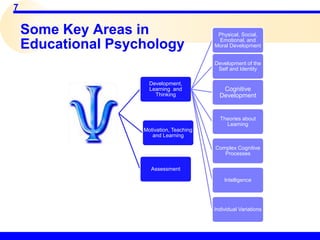
Some Key Areas in
Educational Psychology
Development,
Learning and
Thinking
Development of the
Self and Identity
Cognitive
Development
Theories about
Learning
Complex Cognitive
Processes
Intelligence
Individual Variations
Physical, Social,
Emotional, and
Moral Development
Motivation, Teaching
and Learning
Assessment
8
ADOLESCENCE
9
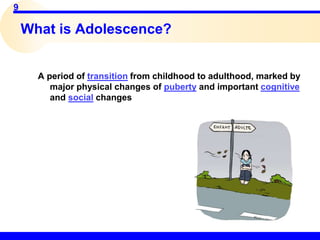
What is Adolescence?
A period of transition from childhood to adulthood, marked by
major physical changes of puberty and important cognitive
and social changes
10
PERSPECTIVES
ON
ADOLESCENCE
11
Historical Perspective
Early History
In early Greece, the philosophers commented about the nature of
youth.
Plato (4th Century B.C.)
Aristotle (4th Century B.C.)
In the Middle Ages, children and adolescents were viewed as miniature
adults and were subject to harsh discipline.
In the 18th Century, the French philosopher Jean-Jacques Rousseau
offered a more enlightened view of adolescence.
12
Historical Perspective
The 20th & 21st Centuries
• G. Stanley Hall’s Storm-and-Stress View
• Margaret Mead’s Sociocultural View
• The Inventionist View
• Further Changes in the 20th and 21st Centuries
– The women’s movement
– The dual family and career objectives
– Increased use of media and technology by adolescents
– Increased diversity
13
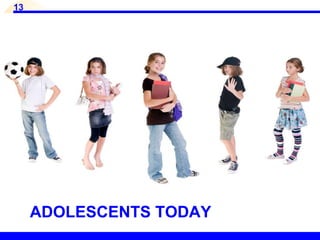
ADOLESCENTS TODAY
14
Activity: Adolescents Today
Note down some of your observations about adolescents
today.
Share these observations within your group.
The observations can be generic ones relating to any aspects of their
lives including fashion, appearances, attitudes and language,
And/ Or
characteristics and traits of adolescents which fascinate you.
15
Stereotypes of Adolescents
Stereotype: A generalization that reflects our impressions
and beliefs about a broad category of people.
All stereotypes carry an image of what the typical member
of a particular group is like.
16
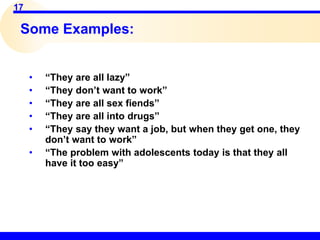
Stereotypes of Adolescents:
17
Some Examples:
• “They are all lazy”
• “They don’t want to work”
• “They are all sex fiends”
• “They are all into drugs”
• “They say they want a job, but when they get one, they
don’t want to work”
• “The problem with adolescents today is that they all
have it too easy”
18
• The negative stereotyping of adolescents is overdrawn.
(Benson & others, 2006; Collins & Steinberg, 2006).
• Psychologists now focus on the positive side of human
experience and greater emphasis on hope, optimism, positive
individual traits, creativity, and positive group and civic values,
such as responsibility, nurturance, civility, and tolerance.
(Benson & others, 2006; Reinders & Youniss, 2006).
A Positive View of Adolescence
19
• Adults’ perceptions of adolescents emerge from a combination of
personal experience and media portrayals, neither of which
produces an objective picture of how typical adolescents develop
(Feldman & Elliott, 1990).
A Positive View of Adolescence
20
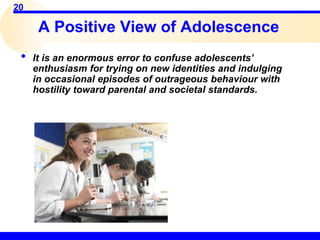
• It is an enormous error to confuse adolescents’
enthusiasm for trying on new identities and indulging
in occasional episodes of outrageous behaviour with
hostility toward parental and societal standards.
A Positive View of Adolescence
21
Today’s Adolescents in the U.S. and
Around the World
"It’s the best of times and the worst of times.”
• Televisions, computers, cell phones, and air travel are
often the norm, not the exception.
• However, the temptations and hazards of the adult world
descend on adolescents so early that too often they are
not cognitively and emotionally ready to handle them
effectively.
22
Youth Around The World
• Two-thirds of Asian Indian adolescents accept their parents’
choice of a marital partner for them
(Verma & Saraswathi, 2002).
• In the Philippines, many female adolescents sacrifice their
own futures by migrating to the city to earn money that they
can send home to their families.
23
Youth Around The World
• Street youth in Kenya and other parts of the world learn to
survive under highly stressful circumstances. In some cases
abandoned by their parents, they may engage in delinquency
or prostitution to provide for their economic needs.
• In the Middle East, many adolescents are not allowed to
interact with the other sex, even in school (Booth, 2002).
• Cultural differences among adolescents have by no means
disappeared (Berry, 2007; Larson & Wilson, 2004; Saraswathi,
2006).
24
Youth Around The World
 Rapid global change is altering the experience of
adolescence, presenting new opportunities and challenges to
young people’s health and well-being.
 Around the world, adolescents’ experiences may differ
depending on their gender, families, schools, and peers
(Brown & Larson, 2002; Larson & Wilson, 2004).
25
Brad Brown and Reed Larson (2002) summarized some of
these changes and traditions in the world’s youth:
• Health and well-being
• Gender
• Family
• School
• Peers
Adolescents’ lives are characterized by a combination of change
and tradition.
Youth Around The World
26
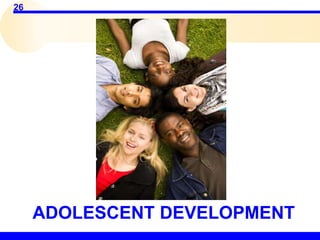
ADOLESCENT DEVELOPMENT
27
The Nature of Development
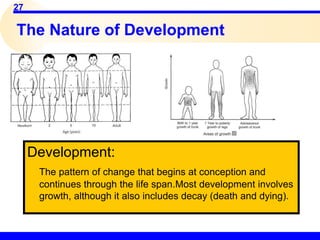
Development:
The pattern of change that begins at conception and
continues through the life span.Most development involves
growth, although it also includes decay (death and dying).
28
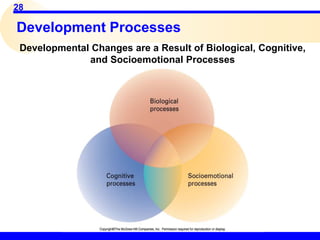
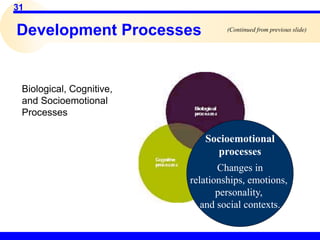
Development Processes
Developmental Changes are a Result of Biological, Cognitive,
and Socioemotional Processes
29
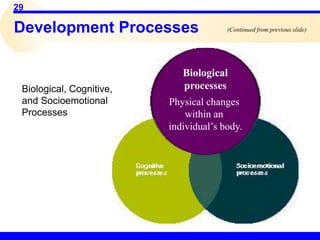
Development Processes
Biological, Cognitive,
and Socioemotional
Processes
Biological
processes
Physical changes
within an
individual’s body.
(Continued from previous slide)
30
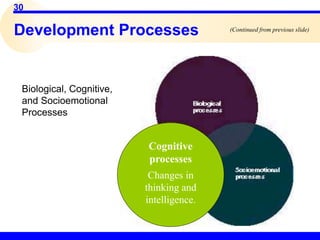
Development Processes
Biological, Cognitive,
and Socioemotional
Processes
Cognitive
processes
Changes in
thinking and
intelligence.
(Continued from previous slide)
31
Development Processes
Biological, Cognitive,
and Socioemotional
Processes
Socioemotional
processes
Changes in
relationships, emotions,
personality,
and social contexts.
(Continued from previous slide)
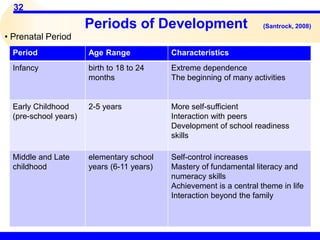
32
Periods of Development (Santrock, 2008)
Period Age Range Characteristics
Infancy birth to 18 to 24
months
Extreme dependence
The beginning of many activities
Early Childhood
(pre-school years)
2-5 years More self-sufficient
Interaction with peers
Development of school readiness
skills
Middle and Late
childhood
elementary school
years (6-11 years)
Self-control increases
Mastery of fundamental literacy and
numeracy skills
Achievement is a central theme in life
Interaction beyond the family
• Prenatal Period
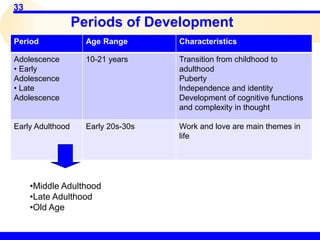
33
Periods of Development
Period Age Range Characteristics
Adolescence
• Early
Adolescence
• Late
Adolescence
10-21 years Transition from childhood to
adulthood
Puberty
Independence and identity
Development of cognitive functions
and complexity in thought
Early Adulthood Early 20s-30s Work and love are main themes in
life
•Middle Adulthood
•Late Adulthood
•Old Age
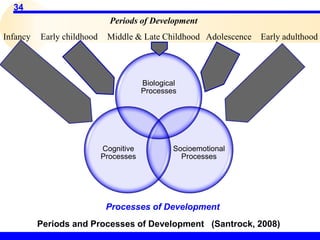
34
Processes of Development
Biological
Processes
Socioemotional
Processes
Cognitive
Processes
Periods and Processes of Development (Santrock, 2008)
Periods of Development
Infancy Early childhood Middle & Late Childhood Adolescence Early adulthood
35
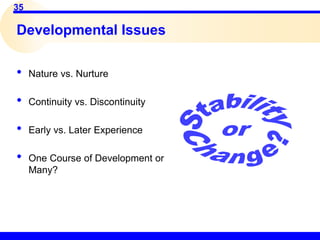
Developmental Issues
• Nature vs. Nurture
• Continuity vs. Discontinuity
• Early vs. Later Experience
• One Course of Development or
Many?
36
1. Maturation and Experience
(Nature vs. Nurture)
• Nature:
An organism’s
biological inheritance.
• Nurture: Environmental
experiences
37
The Nature Vs. Nurture Controversy
• The nature proponents:
Biological inheritance is the most important influence on
development.
• The nurture proponents:
Environmental experiences are the most important.
38
• How is our intelligences?
Is it nature or nurture?
• How about our body proportional?
Nature or Nurture?
• How about our learning style?
39
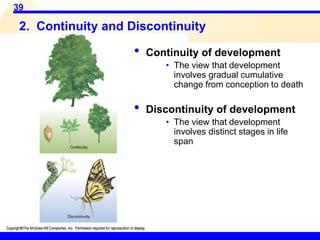
2. Continuity and Discontinuity
• Continuity of development
• The view that development
involves gradual cumulative
change from conception to death
• Discontinuity of development
• The view that development
involves distinct stages in life
span
40
3. Early and Later Experience
• Focuses on the degree to which early experiences
(especially in infancy) or later experiences are the key
determinants of the child’s development.
41
4. One Course of Development or Many?
• The same sequence of development for all children?
• Or do different contexts, and unique combinations of
genetic and environmental circumstances result in
different paths of change?
42
Evaluating the Developmental Issues
• It’s unwise to take an extreme position on developmental
issues
• Nature and nurture, continuity and discontinuity, and early
and later experience all affect our development throughout
the human life span
• The above consensus has not meant the absence of
spirited debate
43
Social Contexts of Development
• Contexts are the settings in which development occurs.
• Contexts are influenced by historical, economic, social, and
cultural factors.
• Adolescent development occurs against
a cultural backdrop that includes family, peers, school, church,
neighborhood, community, region, and nation (Berry, 2007;
McLoyd, Aikens, & Burton, 2006; Parke & Buriel, 2006; Shirev
& Levy, 2007).
44
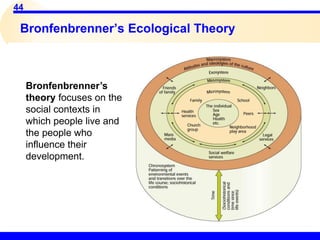
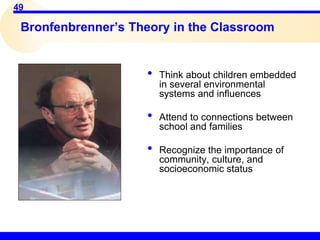
Bronfenbrenner’s Ecological Theory
Bronfenbrenner’s
theory focuses on the
social contexts in
which people live and
the people who
influence their
development.
45
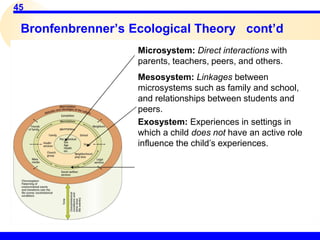
Bronfenbrenner’s Ecological Theory cont’d
Microsystem: Direct interactions with
parents, teachers, peers, and others.
Mesosystem: Linkages between
microsystems such as family and school,
and relationships between students and
peers.
Exosystem: Experiences in settings in
which a child does not have an active role
influence the child’s experiences.
46
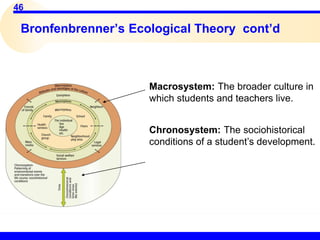
Bronfenbrenner’s Ecological Theory cont’d
Macrosystem: The broader culture in
which students and teachers live.
Chronosystem: The sociohistorical
conditions of a student’s development.
47
Sid’s father left his family years ago and provides no support for them. Sid
and his three siblings live with their mother in a public housing project for
low-income families. They receive public assistance in the form of reduced
rent, money to live on, and participation in a food program. Sid and his
siblings receive free school lunches, and do not have to pay the standard
book rental fee. In addition, they receive free medical care when ill or
injured, but Sid’s mother considers the care they receive to be
substandard. Recently, she contacted legal aid about obtaining child
support from her children’s father
Bronfenbrenner’s Ecological Theory
Theory into Practice
Q.1: What aspects of Sid’s microsystem are discussed in
the example? Explain.
Q.2: What aspects of Sid’s exosystem are discussed in the
example? Explain.
48
Sid’s father left them years ago and provides no support for the family. Sid
and his three siblings live with their mother in a public housing project for
low-income families. They receive public assistance in the form of reduced
rent, money to live on, and participate in a food program. Sid and his
siblings receive free school lunches, and do not have to pay the standard
book rental fee. In addition, they receive free medical care when ill or
injured, but Sid’s mother considers the care they receive to be
substandard. Recently, she contacted legal aid about obtaining child
support from her children’s father.
Bronfenbrenner’s Ecological Theory
Theory into Practice
Q.3: How is the mesosystem currently operating for Sid?
Explain.
49
Bronfenbrenner’s Theory in the Classroom
• Think about children embedded
in several environmental
systems and influences
• Attend to connections between
school and families
• Recognize the importance of
community, culture, and
socioeconomic status
50
Development and Education
• Understanding children’s development enables teachers to
know the level at which it is appropriate to teach their students
• Importance of developmentally appropriate teaching practices
51
Development and Education
• Developmentally appropriate teaching takes place at a level
that is neither too difficult and stressful nor too easy and
boring for the child’s developmental level.
• Challenges of ‘splintered development’ (Horowitz, et. al.,
2005)

Adolescence Development-introduction

  • 1.
    Copyright © TheMcGraw-Hill Companies, Inc. Permission required for reproduction or display. BEd (Secondary) ES001: EDUCATIONAL PSYCHOLOGY: Session 1 Introduction to Educational Psychology, Adolescence and Adolescent Development LEARNERS AND LEARNING
  • 2.
    2 Psychology Educational Psychology Content: •What do you know about it? • What do you need to know about it? • How ed.psy helps teachers and students?
  • 3.
    3 The Role ofEducation Psychology After you got the knowledge, then what are you going to do with it? • How do we face current situation? • Do we change our practices as often as we should? • How do we know if changes we make are effective?
  • 4.
  • 5.
    5 What is it? Psychologyis the scientific study of behaviour and mental processes. Educational psychology is the branch of psychology that specialises in understanding teaching and learning in educational settings.
  • 6.
    6 Educational Psychology: A Toolfor Effective Teaching Teaching as Science & Art As a science, educational psychology’s aim is to provide you with research knowledge that you can effectively apply to your teaching situations. But your teaching will still remain an art.
  • 7.
    7 Some Key Areasin Educational Psychology Development, Learning and Thinking Development of the Self and Identity Cognitive Development Theories about Learning Complex Cognitive Processes Intelligence Individual Variations Physical, Social, Emotional, and Moral Development Motivation, Teaching and Learning Assessment
  • 8.
  • 9.
    9 What is Adolescence? Aperiod of transition from childhood to adulthood, marked by major physical changes of puberty and important cognitive and social changes
  • 10.
  • 11.
    11 Historical Perspective Early History Inearly Greece, the philosophers commented about the nature of youth. Plato (4th Century B.C.) Aristotle (4th Century B.C.) In the Middle Ages, children and adolescents were viewed as miniature adults and were subject to harsh discipline. In the 18th Century, the French philosopher Jean-Jacques Rousseau offered a more enlightened view of adolescence.
  • 12.
    12 Historical Perspective The 20th& 21st Centuries • G. Stanley Hall’s Storm-and-Stress View • Margaret Mead’s Sociocultural View • The Inventionist View • Further Changes in the 20th and 21st Centuries – The women’s movement – The dual family and career objectives – Increased use of media and technology by adolescents – Increased diversity
  • 13.
  • 14.
    14 Activity: Adolescents Today Notedown some of your observations about adolescents today. Share these observations within your group. The observations can be generic ones relating to any aspects of their lives including fashion, appearances, attitudes and language, And/ Or characteristics and traits of adolescents which fascinate you.
  • 15.
    15 Stereotypes of Adolescents Stereotype:A generalization that reflects our impressions and beliefs about a broad category of people. All stereotypes carry an image of what the typical member of a particular group is like.
  • 16.
  • 17.
    17 Some Examples: • “Theyare all lazy” • “They don’t want to work” • “They are all sex fiends” • “They are all into drugs” • “They say they want a job, but when they get one, they don’t want to work” • “The problem with adolescents today is that they all have it too easy”
  • 18.
    18 • The negativestereotyping of adolescents is overdrawn. (Benson & others, 2006; Collins & Steinberg, 2006). • Psychologists now focus on the positive side of human experience and greater emphasis on hope, optimism, positive individual traits, creativity, and positive group and civic values, such as responsibility, nurturance, civility, and tolerance. (Benson & others, 2006; Reinders & Youniss, 2006). A Positive View of Adolescence
  • 19.
    19 • Adults’ perceptionsof adolescents emerge from a combination of personal experience and media portrayals, neither of which produces an objective picture of how typical adolescents develop (Feldman & Elliott, 1990). A Positive View of Adolescence
  • 20.
    20 • It isan enormous error to confuse adolescents’ enthusiasm for trying on new identities and indulging in occasional episodes of outrageous behaviour with hostility toward parental and societal standards. A Positive View of Adolescence
  • 21.
    21 Today’s Adolescents inthe U.S. and Around the World "It’s the best of times and the worst of times.” • Televisions, computers, cell phones, and air travel are often the norm, not the exception. • However, the temptations and hazards of the adult world descend on adolescents so early that too often they are not cognitively and emotionally ready to handle them effectively.
  • 22.
    22 Youth Around TheWorld • Two-thirds of Asian Indian adolescents accept their parents’ choice of a marital partner for them (Verma & Saraswathi, 2002). • In the Philippines, many female adolescents sacrifice their own futures by migrating to the city to earn money that they can send home to their families.
  • 23.
    23 Youth Around TheWorld • Street youth in Kenya and other parts of the world learn to survive under highly stressful circumstances. In some cases abandoned by their parents, they may engage in delinquency or prostitution to provide for their economic needs. • In the Middle East, many adolescents are not allowed to interact with the other sex, even in school (Booth, 2002). • Cultural differences among adolescents have by no means disappeared (Berry, 2007; Larson & Wilson, 2004; Saraswathi, 2006).
  • 24.
    24 Youth Around TheWorld  Rapid global change is altering the experience of adolescence, presenting new opportunities and challenges to young people’s health and well-being.  Around the world, adolescents’ experiences may differ depending on their gender, families, schools, and peers (Brown & Larson, 2002; Larson & Wilson, 2004).
  • 25.
    25 Brad Brown andReed Larson (2002) summarized some of these changes and traditions in the world’s youth: • Health and well-being • Gender • Family • School • Peers Adolescents’ lives are characterized by a combination of change and tradition. Youth Around The World
  • 26.
  • 27.
    27 The Nature ofDevelopment Development: The pattern of change that begins at conception and continues through the life span.Most development involves growth, although it also includes decay (death and dying).
  • 28.
    28 Development Processes Developmental Changesare a Result of Biological, Cognitive, and Socioemotional Processes
  • 29.
    29 Development Processes Biological, Cognitive, andSocioemotional Processes Biological processes Physical changes within an individual’s body. (Continued from previous slide)
  • 30.
    30 Development Processes Biological, Cognitive, andSocioemotional Processes Cognitive processes Changes in thinking and intelligence. (Continued from previous slide)
  • 31.
    31 Development Processes Biological, Cognitive, andSocioemotional Processes Socioemotional processes Changes in relationships, emotions, personality, and social contexts. (Continued from previous slide)
  • 32.
    32 Periods of Development(Santrock, 2008) Period Age Range Characteristics Infancy birth to 18 to 24 months Extreme dependence The beginning of many activities Early Childhood (pre-school years) 2-5 years More self-sufficient Interaction with peers Development of school readiness skills Middle and Late childhood elementary school years (6-11 years) Self-control increases Mastery of fundamental literacy and numeracy skills Achievement is a central theme in life Interaction beyond the family • Prenatal Period
  • 33.
    33 Periods of Development PeriodAge Range Characteristics Adolescence • Early Adolescence • Late Adolescence 10-21 years Transition from childhood to adulthood Puberty Independence and identity Development of cognitive functions and complexity in thought Early Adulthood Early 20s-30s Work and love are main themes in life •Middle Adulthood •Late Adulthood •Old Age
  • 34.
    34 Processes of Development Biological Processes Socioemotional Processes Cognitive Processes Periodsand Processes of Development (Santrock, 2008) Periods of Development Infancy Early childhood Middle & Late Childhood Adolescence Early adulthood
  • 35.
    35 Developmental Issues • Naturevs. Nurture • Continuity vs. Discontinuity • Early vs. Later Experience • One Course of Development or Many?
  • 36.
    36 1. Maturation andExperience (Nature vs. Nurture) • Nature: An organism’s biological inheritance. • Nurture: Environmental experiences
  • 37.
    37 The Nature Vs.Nurture Controversy • The nature proponents: Biological inheritance is the most important influence on development. • The nurture proponents: Environmental experiences are the most important.
  • 38.
    38 • How isour intelligences? Is it nature or nurture? • How about our body proportional? Nature or Nurture? • How about our learning style?
  • 39.
    39 2. Continuity andDiscontinuity • Continuity of development • The view that development involves gradual cumulative change from conception to death • Discontinuity of development • The view that development involves distinct stages in life span
  • 40.
    40 3. Early andLater Experience • Focuses on the degree to which early experiences (especially in infancy) or later experiences are the key determinants of the child’s development.
  • 41.
    41 4. One Courseof Development or Many? • The same sequence of development for all children? • Or do different contexts, and unique combinations of genetic and environmental circumstances result in different paths of change?
  • 42.
    42 Evaluating the DevelopmentalIssues • It’s unwise to take an extreme position on developmental issues • Nature and nurture, continuity and discontinuity, and early and later experience all affect our development throughout the human life span • The above consensus has not meant the absence of spirited debate
  • 43.
    43 Social Contexts ofDevelopment • Contexts are the settings in which development occurs. • Contexts are influenced by historical, economic, social, and cultural factors. • Adolescent development occurs against a cultural backdrop that includes family, peers, school, church, neighborhood, community, region, and nation (Berry, 2007; McLoyd, Aikens, & Burton, 2006; Parke & Buriel, 2006; Shirev & Levy, 2007).
  • 44.
    44 Bronfenbrenner’s Ecological Theory Bronfenbrenner’s theoryfocuses on the social contexts in which people live and the people who influence their development.
  • 45.
    45 Bronfenbrenner’s Ecological Theorycont’d Microsystem: Direct interactions with parents, teachers, peers, and others. Mesosystem: Linkages between microsystems such as family and school, and relationships between students and peers. Exosystem: Experiences in settings in which a child does not have an active role influence the child’s experiences.
  • 46.
    46 Bronfenbrenner’s Ecological Theorycont’d Macrosystem: The broader culture in which students and teachers live. Chronosystem: The sociohistorical conditions of a student’s development.
  • 47.
    47 Sid’s father lefthis family years ago and provides no support for them. Sid and his three siblings live with their mother in a public housing project for low-income families. They receive public assistance in the form of reduced rent, money to live on, and participation in a food program. Sid and his siblings receive free school lunches, and do not have to pay the standard book rental fee. In addition, they receive free medical care when ill or injured, but Sid’s mother considers the care they receive to be substandard. Recently, she contacted legal aid about obtaining child support from her children’s father Bronfenbrenner’s Ecological Theory Theory into Practice Q.1: What aspects of Sid’s microsystem are discussed in the example? Explain. Q.2: What aspects of Sid’s exosystem are discussed in the example? Explain.
  • 48.
    48 Sid’s father leftthem years ago and provides no support for the family. Sid and his three siblings live with their mother in a public housing project for low-income families. They receive public assistance in the form of reduced rent, money to live on, and participate in a food program. Sid and his siblings receive free school lunches, and do not have to pay the standard book rental fee. In addition, they receive free medical care when ill or injured, but Sid’s mother considers the care they receive to be substandard. Recently, she contacted legal aid about obtaining child support from her children’s father. Bronfenbrenner’s Ecological Theory Theory into Practice Q.3: How is the mesosystem currently operating for Sid? Explain.
  • 49.
    49 Bronfenbrenner’s Theory inthe Classroom • Think about children embedded in several environmental systems and influences • Attend to connections between school and families • Recognize the importance of community, culture, and socioeconomic status
  • 50.
    50 Development and Education •Understanding children’s development enables teachers to know the level at which it is appropriate to teach their students • Importance of developmentally appropriate teaching practices
  • 51.
    51 Development and Education •Developmentally appropriate teaching takes place at a level that is neither too difficult and stressful nor too easy and boring for the child’s developmental level. • Challenges of ‘splintered development’ (Horowitz, et. al., 2005)

Editor's Notes

  • #35 Development moves through the infancy, early childhood, middle and late childhood, adolescence and early adulthood periods. These periods of development are the result of biological, cognitive, and socioemotional processes.