CONSTRUCTION
INTRODUCTION 
Constructions: The drawing of various shapes using 
only a pair of compasses and straightedge or ruler. No 
measurement of lengths or angles is allowed. 
The word construction in geometry has a very specific 
meaning: the drawing of geometric items such as lines 
and circles using only compasses and straightedge or 
ruler. Very importantly, you are not allowed to measure 
angles with a protractor, or measure lengths with a 
ruler.
BASIC CONSTRUCTION 
• An angle bisector is a ray, which divides an 
angle in to two equal parts. The bisector of a 
line segment is a line that cuts the line 
segment into two equal halves. A 
perpendicular bisector is a line, which divides 
a given line segment into two equal halves 
and is also perpendicular to the line 
segment.
1) To Construct the bisector of a given 
angle 
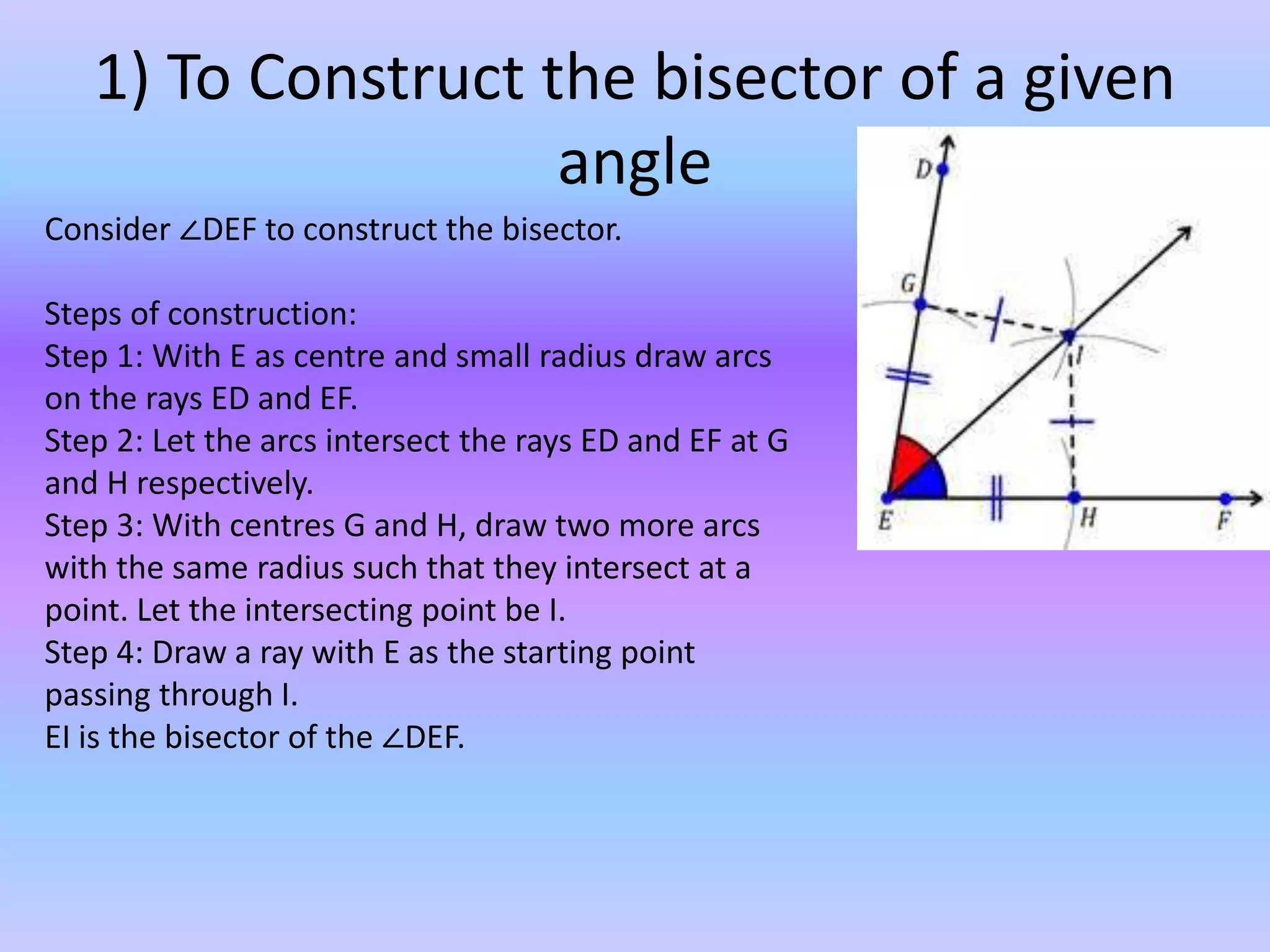
Consider ∠DEF to construct the bisector. 
Steps of construction: 
Step 1: With E as centre and small radius draw arcs 
on the rays ED and EF. 
Step 2: Let the arcs intersect the rays ED and EF at G 
and H respectively. 
Step 3: With centres G and H, draw two more arcs 
with the same radius such that they intersect at a 
point. Let the intersecting point be I. 
Step 4: Draw a ray with E as the starting point 
passing through I. 
EI is the bisector of the ∠DEF.
2) To construct the perpendicular bisector of a 
given line segment. 
Consider the line segment PQ to construct the 
perpendicular bisector. 
Steps of Construction: 
Step 1: Draw a line segment PQ. 
Step 2: With P as centre draw two arcs on either 
sides of PQ with radius more the half the length of 
the given line segment. 
Step 3: Similarly draw two more arcs with same 
radius from point Q such that they intersect the 
previous arcs at R and S respectively. 
Step 4: Join the points R and S. 
RS is the required perpendicular bisector of the 
given line segment PQ.
To construct an angle of 60 at the initial 
point of a given ray 
Consider ray PQ with P as the initial point. 
Construction of a ray PR such that it makes angle of 
60° with PQ. 
Steps of Construction: 
Step 1: Draw a ray PQ. 
Step 2: With P as centre draw an arc with small radius 
such that it intersects ray PQ at C. 
Step 3: With C as centre and same radius draw another 
arc to intersect the previous arc at D. 
Step 4: Draw a ray PR from point P through D. 
Hence, ∠RPQ is equal to 60°.
CONSTRUCTION OF TRIANGLES 
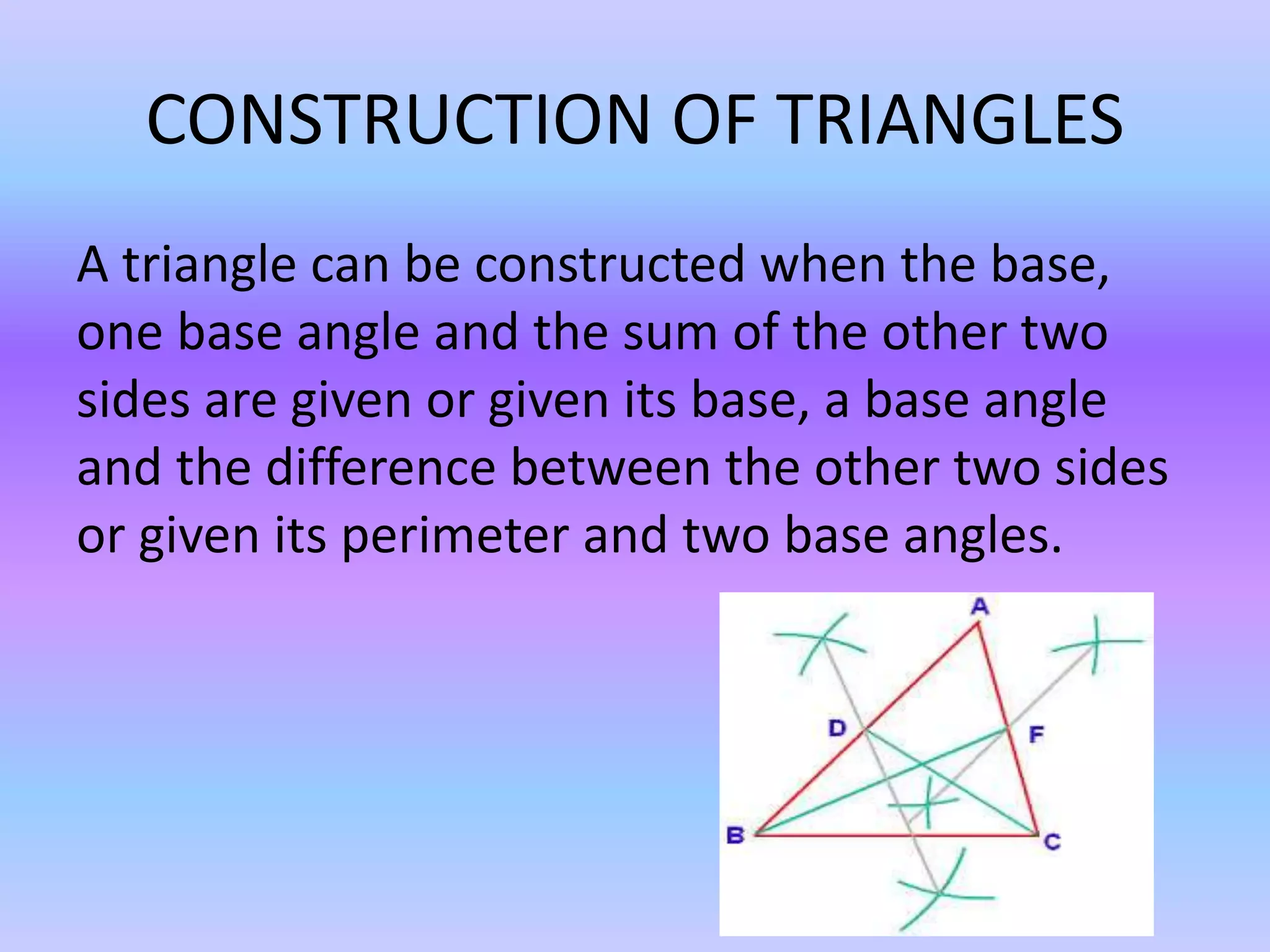
A triangle can be constructed when the base, 
one base angle and the sum of the other two 
sides are given or given its base, a base angle 
and the difference between the other two sides 
or given its perimeter and two base angles.
To construct a triangle, given its base, a 
base angle and sum of other two sides 
• In ΔPQR, QR = 'a' cm, ∠PQR = x°, and PQ + PR = 'b' cm. 
Step 1: Draw the base QR = 'a' cm. 
Step 2: Draw ∠XQR = x°. 
Step 3: Mark an arc S on QX such that QS = 'b' cm. 
Step 4: Join RS. 
Step 5: Draw the perpendicular bisector of RS such that it 
intersects QS at P. 
Step 6: Join PR. 
Thus, ΔPQR is the required triangle.
To construct a triangle given ots base, a base 
angle and the difference of the two other sides 
In ΔABC, given BC = 'a' cm, ∠B = x° and difference of 
two sides AB and AC is equal to 'b' cm. 
Case I: AB > AC 
Step 1: Draw the base BC = 'a' cm. 
Step 2: Make ∠XBC = x°. 
Step 3: Mark a point D on ray BX such that BD = 'b' 
cm. 
Step 4: Join DC. 
Step 5: Draw perpendicular bisector of DC such that, 
it intersects ray BX at a point A. 
Step 6: Join AC. 
Thus, ABC is the required triangle.
Case II: AB < AC 
Step 1: Draw the base BC = 'a' cm. 
Step 2: Make ∠XBC = x° and extend ray BX in the opposite 
direction. 
Step 3: Mark a point D on the extended ray BX such that BD = 
'b' cm. 
Step 4: Join DC. 
Step 5: Draw a perpendicular bisector of DC such that, it 
intersects ray BX at point A. 
Step 6: Join AC. 
Thus, ABC is the required triangle.
To construct a triangle given its 
perimeter and its two base angles. 
Construction of ΔABC, given perimeter ( AB + BC + CA) = 
'a' cm, ∠B = x° and ∠C = y°. 
Steps of construction: 
Step 1: Draw XY = 'a' cm. 
Step 2: Draw the ray XL at X making an angle of x° with XY. 
Step 3: Draw the ray YM at Y making an angle of y° with 
XY. 
Step 4: Draw angle bisector of ∠LXY. 
Step 5: Draw angle bisector of ∠MYX such that it meets 
the angle bisector of ∠LXY at a point A. 
Step 6: Draw the perpendicular bisector of AX such that 
it meets XY at a point B. 
Step 7: Draw the perpendicular bisector of AY such that it 
meets XY at a point C. 
Step 8: Join AB and AC. 
Thus, ABC is the required triangle.
SUMMARY 
In this chapter we have learnt construction using ruler and 
compass 
• To bisect a given angle. 
• To draw a perpendicular bisector of a given line segment. 
• To construct an angle of 60. 
• To construct a triangle given its base, abase angle and sum 
of the other two sides. 
• To construct a triangle given its base, a base angle and the 
difference of the other two sides. 
• To construct a triangle given its perimeter and its two base 
angles.
Construction class 9

Construction class 9

  • 1.
  • 2.
    INTRODUCTION Constructions: Thedrawing of various shapes using only a pair of compasses and straightedge or ruler. No measurement of lengths or angles is allowed. The word construction in geometry has a very specific meaning: the drawing of geometric items such as lines and circles using only compasses and straightedge or ruler. Very importantly, you are not allowed to measure angles with a protractor, or measure lengths with a ruler.
  • 3.
    BASIC CONSTRUCTION •An angle bisector is a ray, which divides an angle in to two equal parts. The bisector of a line segment is a line that cuts the line segment into two equal halves. A perpendicular bisector is a line, which divides a given line segment into two equal halves and is also perpendicular to the line segment.
  • 4.
    1) To Constructthe bisector of a given angle Consider ∠DEF to construct the bisector. Steps of construction: Step 1: With E as centre and small radius draw arcs on the rays ED and EF. Step 2: Let the arcs intersect the rays ED and EF at G and H respectively. Step 3: With centres G and H, draw two more arcs with the same radius such that they intersect at a point. Let the intersecting point be I. Step 4: Draw a ray with E as the starting point passing through I. EI is the bisector of the ∠DEF.
  • 5.
    2) To constructthe perpendicular bisector of a given line segment. Consider the line segment PQ to construct the perpendicular bisector. Steps of Construction: Step 1: Draw a line segment PQ. Step 2: With P as centre draw two arcs on either sides of PQ with radius more the half the length of the given line segment. Step 3: Similarly draw two more arcs with same radius from point Q such that they intersect the previous arcs at R and S respectively. Step 4: Join the points R and S. RS is the required perpendicular bisector of the given line segment PQ.
  • 6.
    To construct anangle of 60 at the initial point of a given ray Consider ray PQ with P as the initial point. Construction of a ray PR such that it makes angle of 60° with PQ. Steps of Construction: Step 1: Draw a ray PQ. Step 2: With P as centre draw an arc with small radius such that it intersects ray PQ at C. Step 3: With C as centre and same radius draw another arc to intersect the previous arc at D. Step 4: Draw a ray PR from point P through D. Hence, ∠RPQ is equal to 60°.
  • 7.
    CONSTRUCTION OF TRIANGLES A triangle can be constructed when the base, one base angle and the sum of the other two sides are given or given its base, a base angle and the difference between the other two sides or given its perimeter and two base angles.
  • 8.
    To construct atriangle, given its base, a base angle and sum of other two sides • In ΔPQR, QR = 'a' cm, ∠PQR = x°, and PQ + PR = 'b' cm. Step 1: Draw the base QR = 'a' cm. Step 2: Draw ∠XQR = x°. Step 3: Mark an arc S on QX such that QS = 'b' cm. Step 4: Join RS. Step 5: Draw the perpendicular bisector of RS such that it intersects QS at P. Step 6: Join PR. Thus, ΔPQR is the required triangle.
  • 9.
    To construct atriangle given ots base, a base angle and the difference of the two other sides In ΔABC, given BC = 'a' cm, ∠B = x° and difference of two sides AB and AC is equal to 'b' cm. Case I: AB > AC Step 1: Draw the base BC = 'a' cm. Step 2: Make ∠XBC = x°. Step 3: Mark a point D on ray BX such that BD = 'b' cm. Step 4: Join DC. Step 5: Draw perpendicular bisector of DC such that, it intersects ray BX at a point A. Step 6: Join AC. Thus, ABC is the required triangle.
  • 10.
    Case II: AB< AC Step 1: Draw the base BC = 'a' cm. Step 2: Make ∠XBC = x° and extend ray BX in the opposite direction. Step 3: Mark a point D on the extended ray BX such that BD = 'b' cm. Step 4: Join DC. Step 5: Draw a perpendicular bisector of DC such that, it intersects ray BX at point A. Step 6: Join AC. Thus, ABC is the required triangle.
  • 11.
    To construct atriangle given its perimeter and its two base angles. Construction of ΔABC, given perimeter ( AB + BC + CA) = 'a' cm, ∠B = x° and ∠C = y°. Steps of construction: Step 1: Draw XY = 'a' cm. Step 2: Draw the ray XL at X making an angle of x° with XY. Step 3: Draw the ray YM at Y making an angle of y° with XY. Step 4: Draw angle bisector of ∠LXY. Step 5: Draw angle bisector of ∠MYX such that it meets the angle bisector of ∠LXY at a point A. Step 6: Draw the perpendicular bisector of AX such that it meets XY at a point B. Step 7: Draw the perpendicular bisector of AY such that it meets XY at a point C. Step 8: Join AB and AC. Thus, ABC is the required triangle.
  • 12.
    SUMMARY In thischapter we have learnt construction using ruler and compass • To bisect a given angle. • To draw a perpendicular bisector of a given line segment. • To construct an angle of 60. • To construct a triangle given its base, abase angle and sum of the other two sides. • To construct a triangle given its base, a base angle and the difference of the other two sides. • To construct a triangle given its perimeter and its two base angles.