CONSTRUCTIONS
Step 1 :
Construct an angle of given measure at O using protractor.
Step 2 :
With ‘O’ as center draw an arc of any radius to cut the rays of the angle at A and
B.
Step 3 :
Step 5 :
Join OC.
OC is the angle bisector of the given angle.
This construction clearly shows how to draw the angle bisector of a given angle with compass and straightedge or ruler. The angle bisector divides th
For example, if we draw angle bisector for the angle 60°, the angle bisector will divide 60° in to two equal parts and each part will measure 30°.
Key Concept - Angle Bisector
1. Construct an angle of 90° at the initial point of a given ray and justify the construction.
Construction Procedure:
To construct an angle 90°, follow the given steps:
1. Draw a ray OA
2. Take O as a centre with any radius, draw an arc DCB is that cuts OA at B.
3. With B as a centre with the same radius, mark a point C on the arc DCB.
4. With C as a centre and the same radius, mark a point D on the arc DCB.
5. Take C and D as centre, draw two arcs which intersect each other with the same radius at P.
6. Finally, the ray OP is joined which makes an angle 90° with OP is formed.
2. Construct an angle of 45° at the initial point of a given ray and justify the construction.
Construction Procedure:
1. Draw a ray OA
2. Take O as a centre with any radius, draw an arc DCB is that cuts OA at B.
3. With B as a centre with the same radius, mark a point C on the arc DCB.
4. With C as a centre and the same radius, mark a point D on the arc DCB.
5. Take C and D as centre, draw two arcs which intersect each other with the same radius at P.
6. Finally, the ray OP is joined which makes an angle 90° with OP is formed.
7. Take B and Q as centre draw the perpendicular bisector which intersects at the point R
8. Draw a line that joins the point O and R
9. So, the angle formed ROA = 45°
∠
Solution:
(i) 30°
Construction Procedure:
1. Draw a ray OA
2. Take O as a centre with any radius, draw an arc BC which cuts OA at
B.
3. With B and C as centres, draw two arcs which intersect each other
at the point E and the perpendicular bisector is drawn.
4. Thus, EOA is the required angle making 30° with OA.
∠
Construction Procedure:
1. Draw an angle POA = 90°
∠
2. Take O as a centre with any radius, draw an arc BC which cuts OA at B and OP at Q
3. Now, draw the bisector from the point B and Q where it intersects at the point R such that it
makes an angle ROA = 45°.
∠
4. Again, ROA is bisected such that TOA is formed which makes an angle of 22.5° with OA
∠ ∠
(iii) 15°
Construction Procedure:
1. An angle DOA = 60° is drawn.
∠
2. Take O as centre with any radius, draw an arc BC which cuts OA at B and OD at C
3. Now, draw the bisector from the point B and C where it intersects at the point E such that it
makes an angle EOA = 30°.
∠
4. Again, EOA is bisected such that FOA is formed which makes an angle of 15° with OA.
∠ ∠
5. Thus, FOA is the required angle making 15° with OA.
∠
4. Construct the following angles and verify by measuring them by a protractor:
(i) 75° (ii) 105° (iii) 135°
Solution:
(i) 75°
Construction Procedure:
1. A ray OA is drawn.
2. With O as centre draw an arc of any radius and intersect at the point B on the ray OA.
3. With B as centre draw an arc C and C as centre draw an arc D.
4. With D and C as centre draw an arc, that intersect at the point P.
5. Join the points O and P
6. The point that arc intersect the ray OP is taken as Q.
7. With Q and C as centre draw an arc, that intersect at the point R.
8. Join the points O and R
9. Thus, AOE is the required angle making 75° with OA.
∠
(ii) 105°
Construction Procedure:
1. A ray OA is drawn.
2. With O as centre draw an arc of any radius and intersect at the point B on the ray OA.
3. With B as centre draw an arc C and C as centre draw an arc D.
4. With D and C as centre draw an arc, that intersect at the point P.
5. Join the points O and P
6. The point that arc intersect the ray OP is taken as Q.
7. With Q and Q as centre draw an arc, that intersect at the point R.
8. Join the points O and R
9. Thus, AOR is the required angle making 105° with OA.
∠
(iii) 135°
Construction Procedure:
1. Draw a line AOA‘
2. Draw an arc of any radius that cuts the line AOA‘at the point B and B‘
3. With B as centre, draw an arc of same radius at the point C.
4. With C as centre, draw an arc of same radius at the point D
5. With D and C as centre, draw an arc that intersect at the point O
6. Join OP
7. The point that arc intersect the ray OP is taken as Q and it forms an angle 90°
8. With B‘ and Q as centre, draw an arc that intersects at the point R
9. Thus, AOR is the required angle making 135° with OA.
∠
5. Construct an equilateral triangle, given its side and justify the construction.
Construction Procedure:
1. Let draw a line segment AB = 4 cm .
2. With A and B as centres, draw two arcs on the line segment AB and note the point as D and E.
3. With D and E as centres, draw the arcs that cuts the previous arc respectively that forms an
angle of 60° each.
4. Now, draw the lines from A and B that are extended to meet each other at the point C.
5. Therefore, ABC is the required triangle.
1. Construct a triangle ABC in which BC = 7cm, B =
∠
75° and AB+AC = 13 cm.
Construction Procedure:
The steps to draw the triangle of given measurement is
as follows:
1. Draw a line segment of base BC = 7 cm
2. Measure and draw B = 75° and draw the ray BX
∠
3. Take a compass and measure AB+AC = 13 cm.
4. With B as the centre, draw an arc at the point be D
5. Join DC
6. Now draw the perpendicular bisector of the line DC
and the intersection point is taken as A.
7. Now join AC
8. Therefore, ABC is the required triangle.
2. Construct a triangle ABC in which BC = 8cm, B = 45° and AB–AC = 3.5 cm
∠ .
Construction Procedure:
The steps to draw the triangle of given measurement is as follows:
1. Draw a line segment of base BC = 8 cm
2. Measure and draw B = 45° and draw the ray BX
∠
3. Take a compass and measure AB-AC = 3.5 cm.
4. With B as centre and draw an arc at the point be D on the ray BX
5. Join DC
6. Now draw the perpendicular bisector of the line CD and the intersection point is taken as A.
7. Now join AC
8. Therefore, ABC is the required triangle.
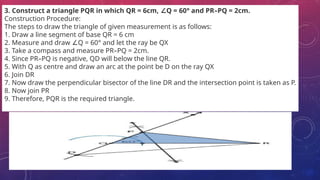
3. Construct a triangle PQR in which QR = 6cm, Q = 60° and PR–PQ = 2cm.
∠
Construction Procedure:
The steps to draw the triangle of given measurement is as follows:
1. Draw a line segment of base QR = 6 cm
2. Measure and draw Q = 60° and let the ray be QX
∠
3. Take a compass and measure PR–PQ = 2cm.
4. Since PR–PQ is negative, QD will below the line QR.
5. With Q as centre and draw an arc at the point be D on the ray QX
6. Join DR
7. Now draw the perpendicular bisector of the line DR and the intersection point is taken as P.
8. Now join PR
9. Therefore, PQR is the required triangle.
4. Construct a triangle XYZ in which Y = 30°, Z = 90° and XY+YZ+ZX = 11 cm.
∠ ∠
Construction Procedure:
The steps to draw the triangle of given measurement is as follows:
1. Draw a line segment AB which is equal to XY+YZ+ZX = 11 cm.
2. Make an angle Y = 30° from the point A and the angle be LAB
∠ ∠
3. Make an angle Z = 90° from the point B and the angle be MAB
∠ ∠
4. Bisect LAB and MAB at the point X.
∠ ∠
5. Now take the perpendicular bisector of the line XA and XB and the intersection point be Y and
Z, respectively.
6. Join XY and XZ
7. Therefore, XYZ is the required triangle
5. Construct a right triangle whose base is 12cm and sum of its hypotenuse and other side is 18 c
Construction Procedure:
The steps to draw the triangle of given measurement is as follows:
1. Draw a line segment of base BC = 12 cm
2. Measure and draw B = 90° and draw the ray BX
∠
3. Take a compass and measure AB+AC = 18 cm.
4. With B as centre and draw an arc at the point be D on the ray BX
5. Join DC
6. Now draw the perpendicular bisector of the line CD and the intersection point is taken as A.
7. Now join AC
8. Therefore, ABC is the required triangle.
1.Draw a line BC=8 cm
2. Draw an arc with B as centre which
intersects BC at X
3). Again use compass and same
radius (as of step 2)with X as
center , draw an arc which cuts first
arc at D
4). Again use compass and opened to the same radius (as
of step 2). And with D as center , draw another arc which
cuts first arc at E
5). Again use compass and opened to the same radius (as
of step 2). And With E & D as center , draw two arcs
which cuts each other at F
6). Join OE
7) Again use compass and some radius with G & X
as center and, draw two arcs which cuts each
other M and join BM.
8) with B as centre as 3.5cm radius
draw an arc on 45 degrees as Y
9) Join CY

Constructions.pptx CLASS IX G MATHEMATICS

  • 1.
  • 2.
    Step 1 : Constructan angle of given measure at O using protractor. Step 2 : With ‘O’ as center draw an arc of any radius to cut the rays of the angle at A and B. Step 3 :
  • 3.
    Step 5 : JoinOC. OC is the angle bisector of the given angle. This construction clearly shows how to draw the angle bisector of a given angle with compass and straightedge or ruler. The angle bisector divides th For example, if we draw angle bisector for the angle 60°, the angle bisector will divide 60° in to two equal parts and each part will measure 30°. Key Concept - Angle Bisector
  • 4.
    1. Construct anangle of 90° at the initial point of a given ray and justify the construction. Construction Procedure: To construct an angle 90°, follow the given steps: 1. Draw a ray OA 2. Take O as a centre with any radius, draw an arc DCB is that cuts OA at B. 3. With B as a centre with the same radius, mark a point C on the arc DCB. 4. With C as a centre and the same radius, mark a point D on the arc DCB. 5. Take C and D as centre, draw two arcs which intersect each other with the same radius at P. 6. Finally, the ray OP is joined which makes an angle 90° with OP is formed.
  • 5.
    2. Construct anangle of 45° at the initial point of a given ray and justify the construction. Construction Procedure: 1. Draw a ray OA 2. Take O as a centre with any radius, draw an arc DCB is that cuts OA at B. 3. With B as a centre with the same radius, mark a point C on the arc DCB. 4. With C as a centre and the same radius, mark a point D on the arc DCB. 5. Take C and D as centre, draw two arcs which intersect each other with the same radius at P. 6. Finally, the ray OP is joined which makes an angle 90° with OP is formed. 7. Take B and Q as centre draw the perpendicular bisector which intersects at the point R 8. Draw a line that joins the point O and R 9. So, the angle formed ROA = 45° ∠
  • 6.
    Solution: (i) 30° Construction Procedure: 1.Draw a ray OA 2. Take O as a centre with any radius, draw an arc BC which cuts OA at B. 3. With B and C as centres, draw two arcs which intersect each other at the point E and the perpendicular bisector is drawn. 4. Thus, EOA is the required angle making 30° with OA. ∠
  • 7.
    Construction Procedure: 1. Drawan angle POA = 90° ∠ 2. Take O as a centre with any radius, draw an arc BC which cuts OA at B and OP at Q 3. Now, draw the bisector from the point B and Q where it intersects at the point R such that it makes an angle ROA = 45°. ∠ 4. Again, ROA is bisected such that TOA is formed which makes an angle of 22.5° with OA ∠ ∠
  • 8.
    (iii) 15° Construction Procedure: 1.An angle DOA = 60° is drawn. ∠ 2. Take O as centre with any radius, draw an arc BC which cuts OA at B and OD at C 3. Now, draw the bisector from the point B and C where it intersects at the point E such that it makes an angle EOA = 30°. ∠ 4. Again, EOA is bisected such that FOA is formed which makes an angle of 15° with OA. ∠ ∠ 5. Thus, FOA is the required angle making 15° with OA. ∠
  • 9.
    4. Construct thefollowing angles and verify by measuring them by a protractor: (i) 75° (ii) 105° (iii) 135° Solution: (i) 75° Construction Procedure: 1. A ray OA is drawn. 2. With O as centre draw an arc of any radius and intersect at the point B on the ray OA. 3. With B as centre draw an arc C and C as centre draw an arc D. 4. With D and C as centre draw an arc, that intersect at the point P. 5. Join the points O and P 6. The point that arc intersect the ray OP is taken as Q. 7. With Q and C as centre draw an arc, that intersect at the point R. 8. Join the points O and R 9. Thus, AOE is the required angle making 75° with OA. ∠
  • 10.
    (ii) 105° Construction Procedure: 1.A ray OA is drawn. 2. With O as centre draw an arc of any radius and intersect at the point B on the ray OA. 3. With B as centre draw an arc C and C as centre draw an arc D. 4. With D and C as centre draw an arc, that intersect at the point P. 5. Join the points O and P 6. The point that arc intersect the ray OP is taken as Q. 7. With Q and Q as centre draw an arc, that intersect at the point R. 8. Join the points O and R 9. Thus, AOR is the required angle making 105° with OA. ∠
  • 11.
    (iii) 135° Construction Procedure: 1.Draw a line AOA‘ 2. Draw an arc of any radius that cuts the line AOA‘at the point B and B‘ 3. With B as centre, draw an arc of same radius at the point C. 4. With C as centre, draw an arc of same radius at the point D 5. With D and C as centre, draw an arc that intersect at the point O 6. Join OP 7. The point that arc intersect the ray OP is taken as Q and it forms an angle 90° 8. With B‘ and Q as centre, draw an arc that intersects at the point R 9. Thus, AOR is the required angle making 135° with OA. ∠
  • 12.
    5. Construct anequilateral triangle, given its side and justify the construction. Construction Procedure: 1. Let draw a line segment AB = 4 cm . 2. With A and B as centres, draw two arcs on the line segment AB and note the point as D and E. 3. With D and E as centres, draw the arcs that cuts the previous arc respectively that forms an angle of 60° each. 4. Now, draw the lines from A and B that are extended to meet each other at the point C. 5. Therefore, ABC is the required triangle.
  • 13.
    1. Construct atriangle ABC in which BC = 7cm, B = ∠ 75° and AB+AC = 13 cm. Construction Procedure: The steps to draw the triangle of given measurement is as follows: 1. Draw a line segment of base BC = 7 cm 2. Measure and draw B = 75° and draw the ray BX ∠ 3. Take a compass and measure AB+AC = 13 cm. 4. With B as the centre, draw an arc at the point be D 5. Join DC 6. Now draw the perpendicular bisector of the line DC and the intersection point is taken as A. 7. Now join AC 8. Therefore, ABC is the required triangle.
  • 14.
    2. Construct atriangle ABC in which BC = 8cm, B = 45° and AB–AC = 3.5 cm ∠ . Construction Procedure: The steps to draw the triangle of given measurement is as follows: 1. Draw a line segment of base BC = 8 cm 2. Measure and draw B = 45° and draw the ray BX ∠ 3. Take a compass and measure AB-AC = 3.5 cm. 4. With B as centre and draw an arc at the point be D on the ray BX 5. Join DC 6. Now draw the perpendicular bisector of the line CD and the intersection point is taken as A. 7. Now join AC 8. Therefore, ABC is the required triangle.
  • 15.
    3. Construct atriangle PQR in which QR = 6cm, Q = 60° and PR–PQ = 2cm. ∠ Construction Procedure: The steps to draw the triangle of given measurement is as follows: 1. Draw a line segment of base QR = 6 cm 2. Measure and draw Q = 60° and let the ray be QX ∠ 3. Take a compass and measure PR–PQ = 2cm. 4. Since PR–PQ is negative, QD will below the line QR. 5. With Q as centre and draw an arc at the point be D on the ray QX 6. Join DR 7. Now draw the perpendicular bisector of the line DR and the intersection point is taken as P. 8. Now join PR 9. Therefore, PQR is the required triangle.
  • 16.
    4. Construct atriangle XYZ in which Y = 30°, Z = 90° and XY+YZ+ZX = 11 cm. ∠ ∠ Construction Procedure: The steps to draw the triangle of given measurement is as follows: 1. Draw a line segment AB which is equal to XY+YZ+ZX = 11 cm. 2. Make an angle Y = 30° from the point A and the angle be LAB ∠ ∠ 3. Make an angle Z = 90° from the point B and the angle be MAB ∠ ∠ 4. Bisect LAB and MAB at the point X. ∠ ∠ 5. Now take the perpendicular bisector of the line XA and XB and the intersection point be Y and Z, respectively. 6. Join XY and XZ 7. Therefore, XYZ is the required triangle
  • 17.
    5. Construct aright triangle whose base is 12cm and sum of its hypotenuse and other side is 18 c Construction Procedure: The steps to draw the triangle of given measurement is as follows: 1. Draw a line segment of base BC = 12 cm 2. Measure and draw B = 90° and draw the ray BX ∠ 3. Take a compass and measure AB+AC = 18 cm. 4. With B as centre and draw an arc at the point be D on the ray BX 5. Join DC 6. Now draw the perpendicular bisector of the line CD and the intersection point is taken as A. 7. Now join AC 8. Therefore, ABC is the required triangle.
  • 18.
    1.Draw a lineBC=8 cm 2. Draw an arc with B as centre which intersects BC at X 3). Again use compass and same radius (as of step 2)with X as center , draw an arc which cuts first arc at D
  • 19.
    4). Again usecompass and opened to the same radius (as of step 2). And with D as center , draw another arc which cuts first arc at E 5). Again use compass and opened to the same radius (as of step 2). And With E & D as center , draw two arcs which cuts each other at F
  • 20.
    6). Join OE 7)Again use compass and some radius with G & X as center and, draw two arcs which cuts each other M and join BM.
  • 21.
    8) with Bas centre as 3.5cm radius draw an arc on 45 degrees as Y 9) Join CY