By-
Supriya Negi
Class-IX C
Roll No.-30
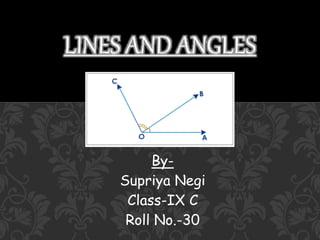
LINES AND ANGLES
Introduction
Basic terms and definitions
Intersecting lines and Non-intersecting
lines
Perpendicular lines
Angles
Types of angles
Parallel lines
Transversal
CONTENT
• In our daily life, we see different types of
angles formed between the edges of plane
surfaces. For making a similar kind of model
using the plane surfaces, we need to have a
thorough knowledge of angles.
• In science, we study the properties of light
by drawing the ray diagrams. For example, to
study the refraction property of light when
it enters from one medium to the other
medium, we see the properties of
intersecting lines and parallel lines.
INTRODUCTION
LINES : A straight path extending in both
directions with no end points.
LINE SEGMENT : A part of a line that
includes two points, called end points, and all
the points between them.
RAY : A part of a line, with one end point,
that continues without end in one direction.
BASICTERMS AND DEFINITIONS
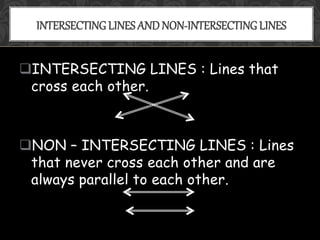
INTERSECTING LINES : Lines that
cross each other.
NON – INTERSECTING LINES : Lines
that never cross each other and are
always parallel to each other.
INTERSECTING LINES AND NON-INTERSECTING LINES
Two lines that intersect each other to
form a right angle are called parallel
lines.
PERPENDICULAR LINES
Angle is formed when two rays originate from the
same end point. The rays making an angle are called
the arms of the angle and the end point is called the
vertex of the angle. There are many types of angles
such as :
• Acute angle
• Right angle
• Obtuse angle
• Straight angle
• Reflex angle
• Adjacent angles
• Linear pair of angles
ANGLES
An angle whose measure is more
than 0˚ but less than 90˚ is called
an acute angle.
ACUTE ANGLE
EXAMPLES OF ACUTE ANGLES
An angle whose measure is equal to 90˚
is called a right angle.
RIGHT ANGLE
EXAMPLES OF RIGHT ANGLES
An angle whose measure is less than 180˚
but more than 90˚ is called an obtuse
angle.
OBTUSE ANGLE
EXAMPLES OF OBTUSE ANGLES
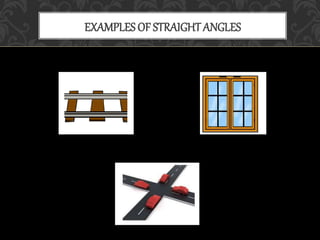
An angle whose measure is equal to 180˚
is called a straight angle.
STRAIGHT ANGLES
EXAMPLES OF STRAIGHT ANGLES
An angle whose measure is more than
180˚ but less than 360˚ is called reflex
angle.
REFLEXANGLE
EXAMPLES OF REFLEX ANGLES
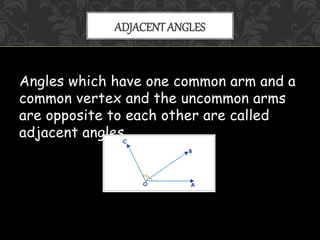
Angles which have one common arm and a
common vertex and the uncommon arms
are opposite to each other are called
adjacent angles.
ADJACENTANGLES
EXAMPLES OF ADJACENT ANGLES
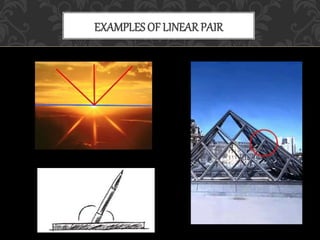
Angle formed by a line intersecting a
straight line is called a linear pair.
LINEARPAIR OF ANGLES
EXAMPLES OF LINEAR PAIR
Angles formed by two intersecting lines
such that the opposite angles are equal
are called vertically opposite angles.
VERTICALLY OPPOSITE ANGLES
EXAMPLES OF VERTICALLY OPPOSITE ANGLES.
Parallel lines are the lines that remain
the same distance apart over their
entire length. No matter how far we
extend them, they will never meet.
PARALLELLINES
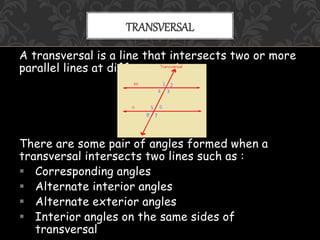
A transversal is a line that intersects two or more
parallel lines at different points.
There are some pair of angles formed when a
transversal intersects two lines such as :
 Corresponding angles
 Alternate interior angles
 Alternate exterior angles
 Interior angles on the same sides of
transversal
TRANSVERSAL
CORRESPONDING ANGLES
ALTERNATE INTERIORANGLES
ALTERNATE EXTERIOR ANGLES
INTERIOR ANGLES ON THE SAME SIDES OF TRANSVERSAL
END OF PRESENTATION
Thank you for watching.

Lines and angles

  • 1.
    By- Supriya Negi Class-IX C RollNo.-30 LINES AND ANGLES
  • 2.
    Introduction Basic terms anddefinitions Intersecting lines and Non-intersecting lines Perpendicular lines Angles Types of angles Parallel lines Transversal CONTENT
  • 3.
    • In ourdaily life, we see different types of angles formed between the edges of plane surfaces. For making a similar kind of model using the plane surfaces, we need to have a thorough knowledge of angles. • In science, we study the properties of light by drawing the ray diagrams. For example, to study the refraction property of light when it enters from one medium to the other medium, we see the properties of intersecting lines and parallel lines. INTRODUCTION
  • 4.
    LINES : Astraight path extending in both directions with no end points. LINE SEGMENT : A part of a line that includes two points, called end points, and all the points between them. RAY : A part of a line, with one end point, that continues without end in one direction. BASICTERMS AND DEFINITIONS
  • 5.
    INTERSECTING LINES :Lines that cross each other. NON – INTERSECTING LINES : Lines that never cross each other and are always parallel to each other. INTERSECTING LINES AND NON-INTERSECTING LINES
  • 6.
    Two lines thatintersect each other to form a right angle are called parallel lines. PERPENDICULAR LINES
  • 7.
    Angle is formedwhen two rays originate from the same end point. The rays making an angle are called the arms of the angle and the end point is called the vertex of the angle. There are many types of angles such as : • Acute angle • Right angle • Obtuse angle • Straight angle • Reflex angle • Adjacent angles • Linear pair of angles ANGLES
  • 8.
    An angle whosemeasure is more than 0˚ but less than 90˚ is called an acute angle. ACUTE ANGLE
  • 9.
  • 10.
    An angle whosemeasure is equal to 90˚ is called a right angle. RIGHT ANGLE
  • 11.
  • 12.
    An angle whosemeasure is less than 180˚ but more than 90˚ is called an obtuse angle. OBTUSE ANGLE
  • 13.
  • 14.
    An angle whosemeasure is equal to 180˚ is called a straight angle. STRAIGHT ANGLES
  • 15.
  • 16.
    An angle whosemeasure is more than 180˚ but less than 360˚ is called reflex angle. REFLEXANGLE
  • 17.
  • 18.
    Angles which haveone common arm and a common vertex and the uncommon arms are opposite to each other are called adjacent angles. ADJACENTANGLES
  • 19.
  • 20.
    Angle formed bya line intersecting a straight line is called a linear pair. LINEARPAIR OF ANGLES
  • 21.
  • 22.
    Angles formed bytwo intersecting lines such that the opposite angles are equal are called vertically opposite angles. VERTICALLY OPPOSITE ANGLES
  • 23.
    EXAMPLES OF VERTICALLYOPPOSITE ANGLES.
  • 24.
    Parallel lines arethe lines that remain the same distance apart over their entire length. No matter how far we extend them, they will never meet. PARALLELLINES
  • 25.
    A transversal isa line that intersects two or more parallel lines at different points. There are some pair of angles formed when a transversal intersects two lines such as :  Corresponding angles  Alternate interior angles  Alternate exterior angles  Interior angles on the same sides of transversal TRANSVERSAL
  • 26.
  • 27.
  • 28.
  • 29.
    INTERIOR ANGLES ONTHE SAME SIDES OF TRANSVERSAL
  • 30.
    END OF PRESENTATION Thankyou for watching.