MATHEMATICS
CLASS 5
Geometry
WE WOULD LEARN ABOUT
Basic symbols in geometry
How are angles formed?
Types of angles
Measuring and drawing angles
using protractor
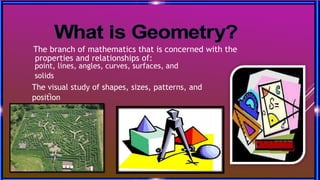
The branch of mathematics that is concerned with the
properties and relationships of:
point, lines, angles, curves, surfaces, and
solids
-
The visual study of shapes, sizes, patterns, and
position
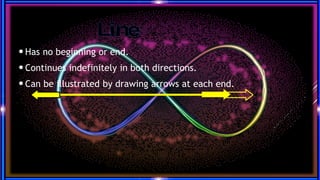
 Has no beginning or end.
 Continues indefinitely in both directions.
 Can be illustrated by drawing arrows at each end.
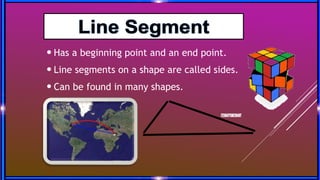
 Has a beginning point and an end point.
 Line segments on a shape are called sides.
 Can be found in many shapes.
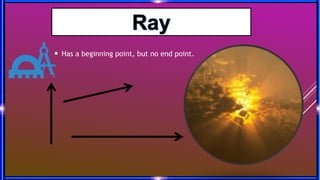
 Has a beginning point, but no end point.
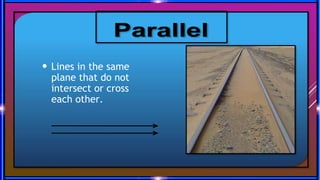
 Lines in the same
plane that do not
intersect or cross
each other.
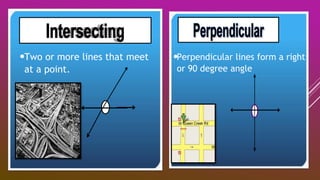
Two or more lines that meet
at a point.
Perpendicular lines form a right
or 90 degree angle
.

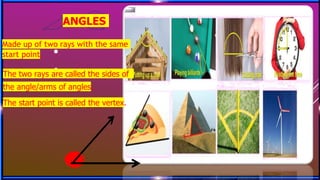
Made up of two rays with the same
start point.

The start point is called the vertex.

The two rays are called the sides of
the angle/arms of angles.
ANGLES
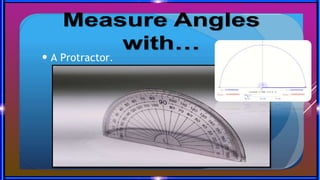
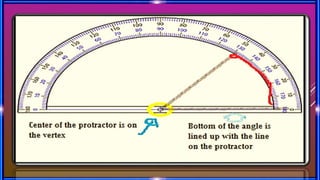
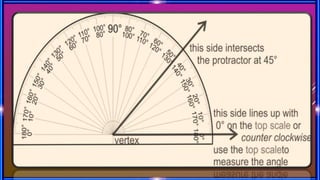
 A Protractor.
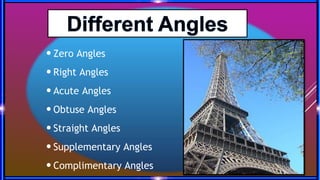
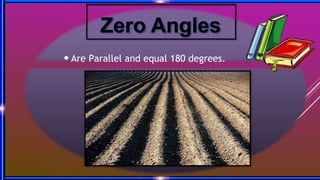
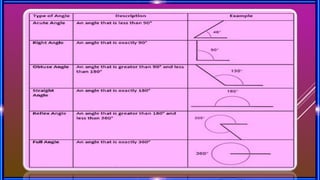
 Zero Angles
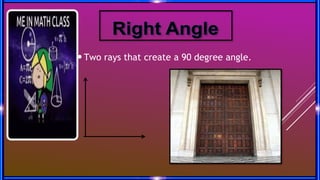
 Right Angles
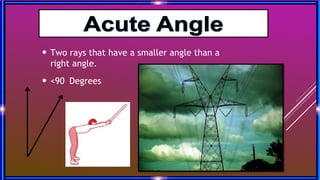
 Acute Angles
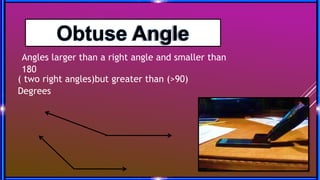
 Obtuse Angles
 Straight Angles
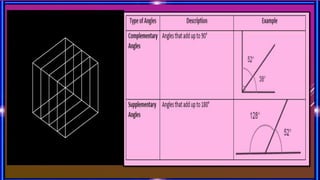
 Supplementary Angles
 Complimentary Angles
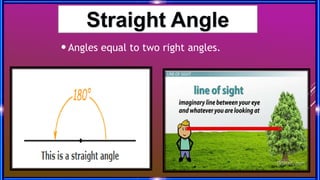
 Are Parallel and equal 180 degrees.
 Two rays that create a 90 degree angle.
 Two rays that have a smaller angle than a
right angle.
 Degrees<90
Angles larger than a right angle and smaller than
180
( two right angles)but greater than (>90)
Degrees
 Angles equal to two right angles.
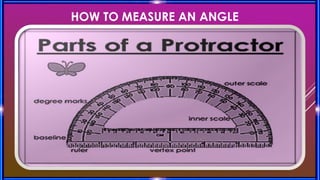
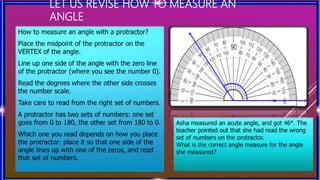
LET US REVISE HOW TO MEASURE AN
ANGLE

Angles class 5

  • 1.
  • 2.
    WE WOULD LEARNABOUT Basic symbols in geometry How are angles formed? Types of angles Measuring and drawing angles using protractor
  • 3.
    The branch ofmathematics that is concerned with the properties and relationships of: point, lines, angles, curves, surfaces, and solids - The visual study of shapes, sizes, patterns, and position
  • 5.
     Has nobeginning or end.  Continues indefinitely in both directions.  Can be illustrated by drawing arrows at each end.
  • 6.
     Has abeginning point and an end point.  Line segments on a shape are called sides.  Can be found in many shapes.
  • 7.
     Has abeginning point, but no end point.
  • 8.
     Lines inthe same plane that do not intersect or cross each other.
  • 9.
    Two or morelines that meet at a point. Perpendicular lines form a right or 90 degree angle .
  • 10.
     Made up oftwo rays with the same start point.  The start point is called the vertex.  The two rays are called the sides of the angle/arms of angles. ANGLES
  • 12.
  • 13.
     Zero Angles Right Angles  Acute Angles  Obtuse Angles  Straight Angles  Supplementary Angles  Complimentary Angles
  • 14.
     Are Paralleland equal 180 degrees.
  • 15.
     Two raysthat create a 90 degree angle.
  • 16.
     Two raysthat have a smaller angle than a right angle.  Degrees<90
  • 17.
    Angles larger thana right angle and smaller than 180 ( two right angles)but greater than (>90) Degrees
  • 18.
     Angles equalto two right angles.
  • 25.
    LET US REVISEHOW TO MEASURE AN ANGLE