I. Philippine Third
Republic
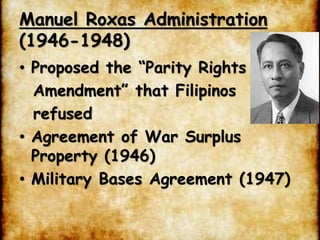
Manuel Roxas Administration
(1946-1948)
• Proposed the “Parity Rights
Amendment” that Filipinos
refused
• Agreement of War Surplus
Property (1946)
• Military Bases Agreement (1947)
• Failed to stamp-out graft and
corruption
• Chinese Immigration Quota
Anomaly
• Failed to contain HUKs insurgency
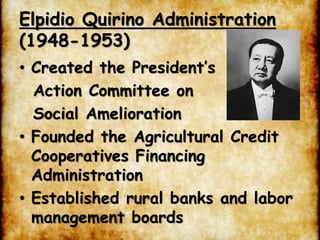
Elpidio Quirino Administration
(1948-1953)
• Created the President’s
Action Committee on
Social Amelioration
• Founded the Agricultural Credit
Cooperatives Financing
Administration
• Established rural banks and labor
management boards
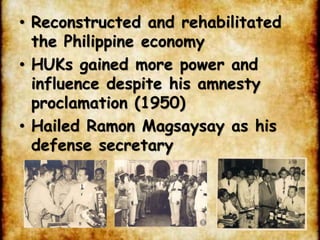
• Reconstructed and rehabilitated
the Philippine economy
• HUKs gained more power and
influence despite his amnesty
proclamation (1950)
• Hailed Ramon Magsaysay as his
defense secretary
Ramon Magsaysay
Administration (1953-1957)
• “Most popular president
the masses ever had”
• Constructed irrigation systems
• Popularized “Barong Tagalog”
• Established SEATO in Manila
(1954)
• San Francisco Treaty was signed
Carlos Garcia Administration
(1957-1962)
• Propagation of “Filipino
First Policy”
• Projection of Philippine Culture
through “Bayanihan Folk Dance
Group”
• Created the “Rizal Centennial
Commission”
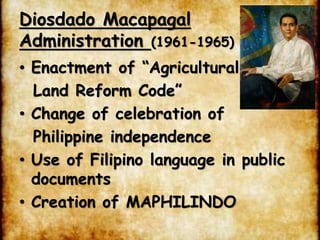
Diosdado Macapagal
Administration (1961-1965)
• Enactment of “Agricultural
Land Reform Code”
• Change of celebration of
Philippine independence
• Use of Filipino language in public
documents
• Creation of MAPHILINDO
Ferdinand Marcos Presidency
(1965-1987)
*First Term (1965-1969)
• Had a slogan of “This
nation can be great again.”
• Built different roads, bridges,
trains (PNR)
• Introduction of “Miracle rice”
• Held the “Manila Summit
Conference” (1966)
*Second Term (1969-1972)
• Philippines suffered economic
crisis
• Rampant graft and corruption
• Gross violation of 1935
Constitution
• Massive Communist threat
Founded Communist groups:
• Kabataang Makabayan (1964)
• Samahan ng Demokratikong
Kabataan (1964)
-became the vanguards of 1970
First Quarter Storm
• Communist Party of the Philippines
-adheres Marxist-Leninism and
Mao thought
• New People’s Army
• National Democratic Front
• 1971 Constitutional Convention
happened through R.A. 6132
(June 1, 1971)
• Opened by Sen. President
Gil Puyat and Speaker
Cornello Villareal
• Headed by Carlos
Garcia and later,
Diosdado Macapagal
• Several delegates walked out the
session after Marcos’ speech
• Liberal Party’s proclamation rally
on August 21, 1971 at Plaza
Miranda was disturbed by
explosion of two grenades
• 8 persons killed
and 120 people
wounded
• Few hours after the Plaza
Miranda bombing, Marcos issued
the “Proclamation No. 880” that
suspends the “Writ of Habeas
Corpus”
• Restored the “writ”
to the country on
January 11, 1972
Thank you!
Yosef Eric C. Hipolito, LPT, MA
Bachelor of Arts in History
yosefhipoito19@gmail.com

Philippine Third Republic

  • 1.
  • 2.
    Manuel Roxas Administration (1946-1948) •Proposed the “Parity Rights Amendment” that Filipinos refused • Agreement of War Surplus Property (1946) • Military Bases Agreement (1947)
  • 3.
    • Failed tostamp-out graft and corruption • Chinese Immigration Quota Anomaly • Failed to contain HUKs insurgency
  • 4.
    Elpidio Quirino Administration (1948-1953) •Created the President’s Action Committee on Social Amelioration • Founded the Agricultural Credit Cooperatives Financing Administration • Established rural banks and labor management boards
  • 5.
    • Reconstructed andrehabilitated the Philippine economy • HUKs gained more power and influence despite his amnesty proclamation (1950) • Hailed Ramon Magsaysay as his defense secretary
  • 6.
    Ramon Magsaysay Administration (1953-1957) •“Most popular president the masses ever had” • Constructed irrigation systems • Popularized “Barong Tagalog” • Established SEATO in Manila (1954) • San Francisco Treaty was signed
  • 7.
    Carlos Garcia Administration (1957-1962) •Propagation of “Filipino First Policy” • Projection of Philippine Culture through “Bayanihan Folk Dance Group” • Created the “Rizal Centennial Commission”
  • 8.
    Diosdado Macapagal Administration (1961-1965) •Enactment of “Agricultural Land Reform Code” • Change of celebration of Philippine independence • Use of Filipino language in public documents • Creation of MAPHILINDO
  • 9.
    Ferdinand Marcos Presidency (1965-1987) *FirstTerm (1965-1969) • Had a slogan of “This nation can be great again.” • Built different roads, bridges, trains (PNR) • Introduction of “Miracle rice” • Held the “Manila Summit Conference” (1966)
  • 10.
    *Second Term (1969-1972) •Philippines suffered economic crisis • Rampant graft and corruption • Gross violation of 1935 Constitution • Massive Communist threat
  • 11.
    Founded Communist groups: •Kabataang Makabayan (1964) • Samahan ng Demokratikong Kabataan (1964) -became the vanguards of 1970 First Quarter Storm • Communist Party of the Philippines -adheres Marxist-Leninism and Mao thought
  • 12.
    • New People’sArmy • National Democratic Front
  • 13.
    • 1971 ConstitutionalConvention happened through R.A. 6132 (June 1, 1971) • Opened by Sen. President Gil Puyat and Speaker Cornello Villareal • Headed by Carlos Garcia and later, Diosdado Macapagal
  • 14.
    • Several delegateswalked out the session after Marcos’ speech • Liberal Party’s proclamation rally on August 21, 1971 at Plaza Miranda was disturbed by explosion of two grenades • 8 persons killed and 120 people wounded
  • 15.
    • Few hoursafter the Plaza Miranda bombing, Marcos issued the “Proclamation No. 880” that suspends the “Writ of Habeas Corpus” • Restored the “writ” to the country on January 11, 1972
  • 16.
    Thank you! Yosef EricC. Hipolito, LPT, MA Bachelor of Arts in History yosefhipoito19@gmail.com