THE CAMPAIGN FOR 
REFORMS 
BY: MS. KHARYL C. GENODEPANON
The nature of the reform movement 
• People were discontented because they remained poor and 
burdened with heavy taxes 
• Filipinos cannot participate in the government
Aims, 
• Making the Philippines a province of Spain 
• Represented in the Spanish law making body 
• Filipinos would become Spanish citizen 
“Benevolent Assimilation”
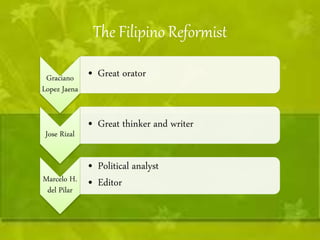
The Filipino Reformist 
Graciano 
Lopez Jaena 
• Great orator 
Jose Rizal 
• Great thinker and writer 
Marcelo H. 
del Pilar 
• Political analyst 
• Editor
The Pro-Filipino societies 
• Circulo Hispano-Filipino- the purpose of this newspaper 
was to bring the attention of the Spanish authorities in Spain the 
conditions I the Philippines and to work for the introduction of 
reforms which would benefit the Filipinos 
• Associacion Hispano-Filipino- to work for the material 
and moral improvement of the Philippines
Masonry and its Role 
• To work for freedom and prosperity 
• Good government 
• Representation in the Spanish Cortes 
• Make the Philippines a province of Spain
La liga Filipina 
• To unite the whole archipelago into one strong body 
• Mutual protection of all members in the case of necessity 
• The encouragement of agriculture, commerce and 
education 
• Defense against any kind of violence and injustice 
• Study of applications and reforms
Why the reform movement failed? 
• Spanish high officials in Spain were too 
busy with their own problems 
• Lack of financial support 
• The reformist themselves were not united
Bonifacio and the Katipunan 
By: Ms. Kharyl C. Genodepanon
Reform 
Revolution
FOUNDING OF THE KATIPUNAN 
• July 7, 1892 (Azcaraga street now Claro M. 
Recto Avenue) 
Includes the following men: 
 Andres Bonifacio 
 Teodoro Plata 
 Valentin Diaz 
 Ladislaw Diwa 
 Deodato Arellano 
-membership was a through a system called “TRIANGLE”
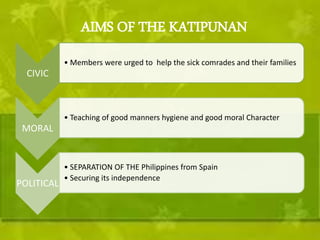
AIMS OF THE KATIPUNAN 
CIVIC 
• Members were urged to help the sick comrades and their families 
MORAL 
• Teaching of good manners hygiene and good moral Character 
POLITICAL 
• SEPARATION OF THE Philippines from Spain 
• Securing its independence
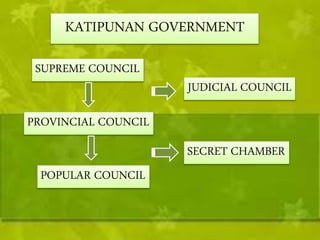
KATIPUNAN GOVERNMENT 
SUPREME COUNCIL 
PROVINCIAL COUNCIL 
POPULAR COUNCIL 
JUDICIAL COUNCIL 
SECRET CHAMBER
Three kinds of members 
– KATIPON ( Anak ng Baya n ) 
– KAWAL ( Gomburza ) 
– BAYANI ( Rizal ) 
Katipunan Codes 
Katipunan Flags- a flag was made by Benita Rodriguez with 
the help of the wife of Bonifacio Gregoria de Jesus 
“The Kalayaan” 
Bonifacio- “Pag-ibig sa Tinubuang Lupa” (Agapito Bagumbayan) 
Valenzuela- “Pahayag” (Madlang Away )
Andres Bonifacio 
• November 30, 1896 ,Azcaraga Street near the present 
Manila Railroad station 
• Santiago Bonifacio and Catalina de Castro 
• Ciriaco, Procopio, Troadio and his sisters Espiridiona and 
Maxima
The Katipunan 
Revolution 
By: Ms. Kharyl C. Genodepanon
Teodoro Patiflo 
Madre Portera 
Father Mariano Gil 
The Discovery of the Katipunan 
August 19, 1896
- In the yard of Juan Ramos the son of Melchora Aquino or 
“Tandang Sora”- Mother of the Katipunan 
“ bring out your cedulas and tear them to pieces to show that 
we are prepared to take up arms” 
“Long live Philippines! Long live Katipunan!” 
“THE CRY OF THE PUGADLAWIN”
August 30, 1896 
They attack the powder magazine located in San Juan del Monte 
Martial law 
Cavite, Laguna, Batangas, Bulacan, Pampanga, Tarlac and 
Nueva Ecija 
-Those who would surrender 48 hrs after the publication 
of the decree would not be tried in the Military court
“THE REIGN OF TERROR” 
• September 4, - four Katiponeros were executed in 
Bagumbayan field 
• Sept. 12- 13 suspects from cavite were also executed “ the 
13 martyr's of Cavite” 
• January 4, 1897- 12 Bikolano patriots were were also shot 
to death
Rizal’s Execution- Dec. 30, 1896 
-His execution did not dishearten the revolutionist, on the 
contrary they resolved to fight to the bitter end, thus Rizal’ 
s execution encouraged rather than discouraged the 
Filipinos to fight heroically for their country and its 
independence
Emilio Aguinaldo- “Heneral Miong” 
• His famous victory was in Imus on September 5, he 
defeated the Spanish army contingent under the 
command of General Ernesto de Aguirre
“Tejeros convention” 
• March 22, 1897 
• March 23, - Tejeros Resolution- Bonifacio and 45 others give their 
reasons for not recognizing the previous election 
 President – Emilio Aguinaldo 
 Vice President- Mariano Trias 
 Captain General- Artenio Recarte 
 Director of war- Emiliano Riego de Dios 
 Director of the Interior- Andres Bonifacio
Naik Military Agreement 
• Was a military agreement in which another government 
would be established , General Pio del Pilar was to be the 
commander of this army and the head of the government 
was Bonifacio himself
The Execution of Bonifacio 
• Colonel Agapito Bonzon 
• May 10, 1897 in Mount Tala part of Mount 
Buntis 
• Bonifacio and his brother Ciriaco
• Gov. Gen. Camilo de Polavieja- succeeded Gen. Ramon 
Blanco in Dec. 1896 grew tired of the Filipinos who refused 
to surrender 
• Gov. Gen. – Fernando Primo de Rivera, took personal 
charge of the military campaign against the rebels. 
- Rivera tied hrd to win over the Filipinos back but he failed,
Biyak na Bato Republic 
• Felix Ferrer and Isabelo Artacho 
– copied the Cuban Constition 
• Article VIII provided that 
• “ the Tagalog shall be the 
official language of the Republic 
the constitution was approved 
on November 1, 
President: Emilio Aguinaldo 
Vice President: Mariano Trias 
Secretary of Interior: Isabelo 
Artacho 
Secretary of war- Emiliano Riego 
de Dios 
Secretary of the Treasury- 
Baldomero Aguinaldo
The Truce of Biyak-na-Bato 
• Nov. 18, Dec.14 and 15 1897 
• The agreement provided: 
– That Aguinaldo and his men would go into voluntary exile 
– That primo de Rivera would pay Aguinaldo the amount of 
800,000 pesos 
– The latter would pay an additional amount of 900,000 to the 
families of non-combatant Filipinos who suffered during the 
revolution
The Failure of the Truce 
• Both the Spaniards and the Filipinos did not trust each other that 
resulted to mutual suspicion 
• Bad faith on both sides, 
“Where there is bad faith there can be no permanent 
peace”

The Campaign for Reforms

  • 1.
    THE CAMPAIGN FOR REFORMS BY: MS. KHARYL C. GENODEPANON
  • 2.
    The nature ofthe reform movement • People were discontented because they remained poor and burdened with heavy taxes • Filipinos cannot participate in the government
  • 3.
    Aims, • Makingthe Philippines a province of Spain • Represented in the Spanish law making body • Filipinos would become Spanish citizen “Benevolent Assimilation”
  • 4.
    The Filipino Reformist Graciano Lopez Jaena • Great orator Jose Rizal • Great thinker and writer Marcelo H. del Pilar • Political analyst • Editor
  • 5.
    The Pro-Filipino societies • Circulo Hispano-Filipino- the purpose of this newspaper was to bring the attention of the Spanish authorities in Spain the conditions I the Philippines and to work for the introduction of reforms which would benefit the Filipinos • Associacion Hispano-Filipino- to work for the material and moral improvement of the Philippines
  • 6.
    Masonry and itsRole • To work for freedom and prosperity • Good government • Representation in the Spanish Cortes • Make the Philippines a province of Spain
  • 7.
    La liga Filipina • To unite the whole archipelago into one strong body • Mutual protection of all members in the case of necessity • The encouragement of agriculture, commerce and education • Defense against any kind of violence and injustice • Study of applications and reforms
  • 8.
    Why the reformmovement failed? • Spanish high officials in Spain were too busy with their own problems • Lack of financial support • The reformist themselves were not united
  • 9.
    Bonifacio and theKatipunan By: Ms. Kharyl C. Genodepanon
  • 10.
  • 11.
    FOUNDING OF THEKATIPUNAN • July 7, 1892 (Azcaraga street now Claro M. Recto Avenue) Includes the following men:  Andres Bonifacio  Teodoro Plata  Valentin Diaz  Ladislaw Diwa  Deodato Arellano -membership was a through a system called “TRIANGLE”
  • 12.
    AIMS OF THEKATIPUNAN CIVIC • Members were urged to help the sick comrades and their families MORAL • Teaching of good manners hygiene and good moral Character POLITICAL • SEPARATION OF THE Philippines from Spain • Securing its independence
  • 13.
    KATIPUNAN GOVERNMENT SUPREMECOUNCIL PROVINCIAL COUNCIL POPULAR COUNCIL JUDICIAL COUNCIL SECRET CHAMBER
  • 14.
    Three kinds ofmembers – KATIPON ( Anak ng Baya n ) – KAWAL ( Gomburza ) – BAYANI ( Rizal ) Katipunan Codes Katipunan Flags- a flag was made by Benita Rodriguez with the help of the wife of Bonifacio Gregoria de Jesus “The Kalayaan” Bonifacio- “Pag-ibig sa Tinubuang Lupa” (Agapito Bagumbayan) Valenzuela- “Pahayag” (Madlang Away )
  • 15.
    Andres Bonifacio •November 30, 1896 ,Azcaraga Street near the present Manila Railroad station • Santiago Bonifacio and Catalina de Castro • Ciriaco, Procopio, Troadio and his sisters Espiridiona and Maxima
  • 16.
    The Katipunan Revolution By: Ms. Kharyl C. Genodepanon
  • 17.
    Teodoro Patiflo MadrePortera Father Mariano Gil The Discovery of the Katipunan August 19, 1896
  • 18.
    - In theyard of Juan Ramos the son of Melchora Aquino or “Tandang Sora”- Mother of the Katipunan “ bring out your cedulas and tear them to pieces to show that we are prepared to take up arms” “Long live Philippines! Long live Katipunan!” “THE CRY OF THE PUGADLAWIN”
  • 19.
    August 30, 1896 They attack the powder magazine located in San Juan del Monte Martial law Cavite, Laguna, Batangas, Bulacan, Pampanga, Tarlac and Nueva Ecija -Those who would surrender 48 hrs after the publication of the decree would not be tried in the Military court
  • 20.
    “THE REIGN OFTERROR” • September 4, - four Katiponeros were executed in Bagumbayan field • Sept. 12- 13 suspects from cavite were also executed “ the 13 martyr's of Cavite” • January 4, 1897- 12 Bikolano patriots were were also shot to death
  • 21.
    Rizal’s Execution- Dec.30, 1896 -His execution did not dishearten the revolutionist, on the contrary they resolved to fight to the bitter end, thus Rizal’ s execution encouraged rather than discouraged the Filipinos to fight heroically for their country and its independence
  • 22.
    Emilio Aguinaldo- “HeneralMiong” • His famous victory was in Imus on September 5, he defeated the Spanish army contingent under the command of General Ernesto de Aguirre
  • 23.
    “Tejeros convention” •March 22, 1897 • March 23, - Tejeros Resolution- Bonifacio and 45 others give their reasons for not recognizing the previous election  President – Emilio Aguinaldo  Vice President- Mariano Trias  Captain General- Artenio Recarte  Director of war- Emiliano Riego de Dios  Director of the Interior- Andres Bonifacio
  • 24.
    Naik Military Agreement • Was a military agreement in which another government would be established , General Pio del Pilar was to be the commander of this army and the head of the government was Bonifacio himself
  • 25.
    The Execution ofBonifacio • Colonel Agapito Bonzon • May 10, 1897 in Mount Tala part of Mount Buntis • Bonifacio and his brother Ciriaco
  • 26.
    • Gov. Gen.Camilo de Polavieja- succeeded Gen. Ramon Blanco in Dec. 1896 grew tired of the Filipinos who refused to surrender • Gov. Gen. – Fernando Primo de Rivera, took personal charge of the military campaign against the rebels. - Rivera tied hrd to win over the Filipinos back but he failed,
  • 27.
    Biyak na BatoRepublic • Felix Ferrer and Isabelo Artacho – copied the Cuban Constition • Article VIII provided that • “ the Tagalog shall be the official language of the Republic the constitution was approved on November 1, President: Emilio Aguinaldo Vice President: Mariano Trias Secretary of Interior: Isabelo Artacho Secretary of war- Emiliano Riego de Dios Secretary of the Treasury- Baldomero Aguinaldo
  • 28.
    The Truce ofBiyak-na-Bato • Nov. 18, Dec.14 and 15 1897 • The agreement provided: – That Aguinaldo and his men would go into voluntary exile – That primo de Rivera would pay Aguinaldo the amount of 800,000 pesos – The latter would pay an additional amount of 900,000 to the families of non-combatant Filipinos who suffered during the revolution
  • 29.
    The Failure ofthe Truce • Both the Spaniards and the Filipinos did not trust each other that resulted to mutual suspicion • Bad faith on both sides, “Where there is bad faith there can be no permanent peace”