F. Rizal’s First
Travel abroad
• Without his parent consent, Rizal
decided to study in Europe with
Paciano’s 35 peso monthly
allowance (May 3, 1882)
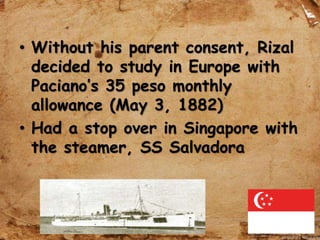
• Had a stop over in Singapore with
the steamer, SS Salvadora
On a letter of Rizal to his brother
Paciano, he mentioned that had another
important reason for deciding to study
in Europe as he called as his “secret
mission.” He revealed that this secret
was to observe carefully the life and
culture, languages and customs,
industries and business, and the
government and laws of the European
nations.
“Preparing myself for the mighty task
of liberating his people from the
brutality and tyranny of Spain.”
Persons who knew the secret departure of
Rizal:
Paciano Rizal
Antonio Rivera
Saturina Rizal
Lucia Rizal
Capt. Juan Valenzuela
Sanday Valenzuela
Pedro Paterno
Mateo Evangelista
Ateneo Jesuit Fathers
Jose M. Cecilio
During the voyage to Singapore, the
ship captain, Donato Lecha from Spain
befriended him.
In order to fight the boredom, Rizal
played chess with his fellow passengers
who defeated by him.
He landed in Singapore and registered
at Hotel de la Paz. He spent two days
on sightseeing the country’s Botanical
Garden, Buddhist temples and statue of
Sir Thomas Stanford Raffles.
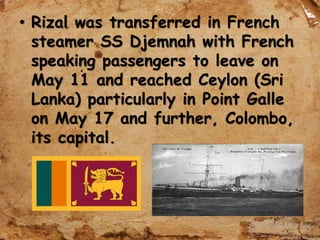
• Rizal was transferred in French
steamer SS Djemnah with French
speaking passengers to leave on
May 11 and reached Ceylon (Sri
Lanka) particularly in Point Galle
on May 17 and further, Colombo,
its capital.
• Upon his journey, he crossed Indian
Ocean, Cape of Guardafui in Africa
(“inhospitable but famous”) and had a
stopover in the hot city of Aden,
Yemen and saw camels.
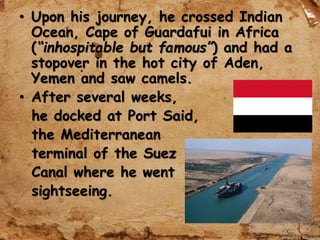
• After several weeks,
he docked at Port Said,
the Mediterranean
terminal of the Suez
Canal where he went
sightseeing.
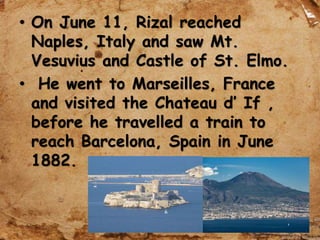
• On June 11, Rizal reached
Naples, Italy and saw Mt.
Vesuvius and Castle of St. Elmo.
• He went to Marseilles, France
and visited the Chateau d’ If ,
before he travelled a train to
reach Barcelona, Spain in June
1882.
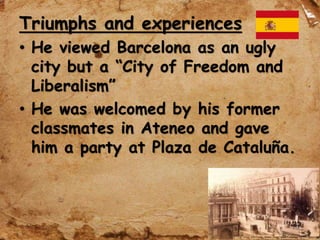
Triumphs and experiences
• He viewed Barcelona as an ugly
city but a “City of Freedom and
Liberalism”
• He was welcomed by his former
classmates in Ateneo and gave
him a party at Plaza de Cataluña.
• Rizal wrote “Amor Patria,” his first
essay written in Spain under the pen-
name Laong Laan.
• He sent this article to his friend in
Manila, Basilio Teodoro Moran, a
publisher of “Diariong Tagalog.” It was
appeared on the said newspaper on
August 20, 1882; translated by Marcelo
H. Del Pilar in Tagalog.
• Conversely, Moran congratulated Rizal
and requested for more articles that
was why he became an essay writer in
“Diariong Tagalog” then he wrote his
second and third article, “Los Viajes”
and “Revista de Madrid.”
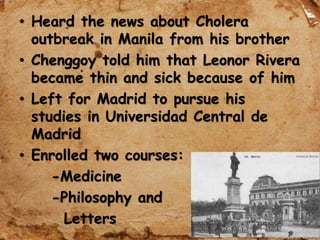
• Heard the news about Cholera
outbreak in Manila from his brother
• Chenggoy told him that Leonor Rivera
became thin and sick because of him
• Left for Madrid to pursue his
studies in Universidad Central de
Madrid
• Enrolled two courses:
-Medicine
-Philosophy and
Letters
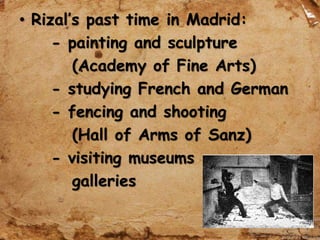
• Rizal’s past time in Madrid:
- painting and sculpture
(Academy of Fine Arts)
- studying French and German
- fencing and shooting
(Hall of Arms of Sanz)
- visiting museums
galleries
Rizal bought famous books such as:
-Lives of Presidents of the United
States from Washington to Johnson
-History of French Revolution
-The Wandering Jew
-Uncle Tom’s Cabin of Harriet Beecher
Stowe
-Hebrew Grammar
-Complete Works of Voltaire
-Ancient Poetry
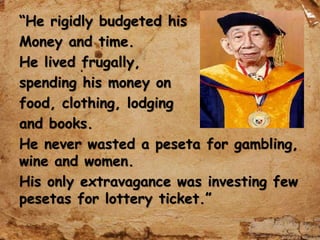
“He rigidly budgeted his
Money and time.
He lived frugally,
spending his money on
food, clothing, lodging
and books.
He never wasted a peseta for gambling,
wine and women.
His only extravagance was investing few
pesetas for lottery ticket.”
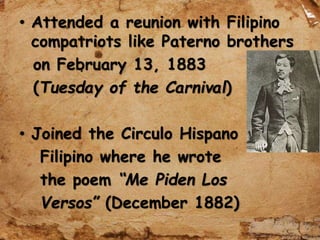
• Attended a reunion with Filipino
compatriots like Paterno brothers
on February 13, 1883
(Tuesday of the Carnival)
• Joined the Circulo Hispano
Filipino where he wrote
the poem “Me Piden Los
Versos” (December 1882)
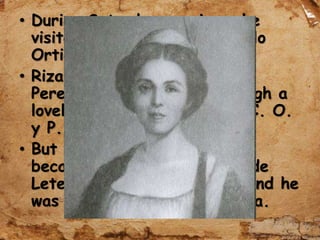
• During Saturday evenings, he
visited the home of Don Pablo
Ortiga y Rey.
• Rizal met Consuelo Ortega y
Perez and courted her through a
lovely poem, A La Señorita C. O.
y P.
• But their love did not last
because his friend Eduardo de
Lete was courting Consuelo and he
was engaged to Leonor Rivera.
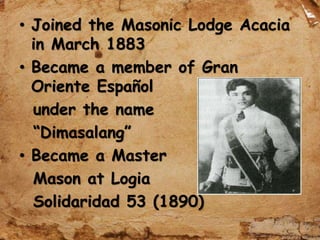
• Joined the Masonic Lodge Acacia
in March 1883
• Became a member of Gran
Oriente Español
under the name
“Dimasalang”
• Became a Master
Mason at Logia
Solidaridad 53 (1890)
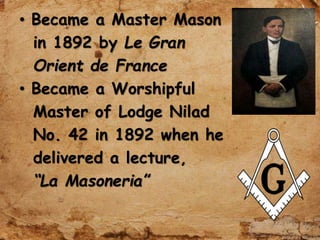
• Became a Master Mason
in 1892 by Le Gran
Orient de France
• Became a Worshipful
Master of Lodge Nilad
No. 42 in 1892 when he
delivered a lecture,
“La Masoneria”
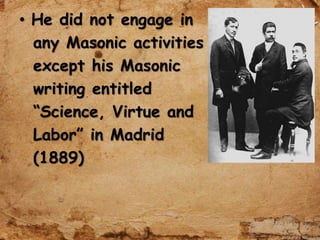
• He did not engage in
any Masonic activities
except his Masonic
writing entitled
“Science, Virtue and
Labor” in Madrid
(1889)
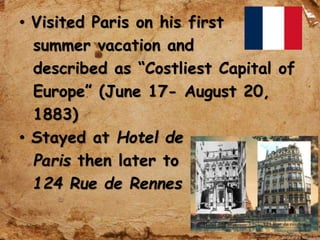
• Visited Paris on his first
summer vacation and
described as “Costliest Capital of
Europe” (June 17- August 20,
1883)
• Stayed at Hotel de
Paris then later to
124 Rue de Rennes
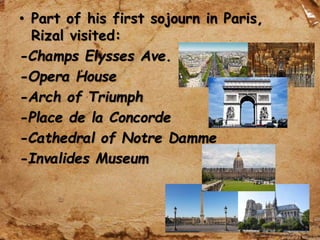
• Part of his first sojourn in Paris,
Rizal visited:
-Champs Elysses Ave.
-Opera House
-Arch of Triumph
-Place de la Concorde
-Cathedral of Notre Damme
-Invalides Museum
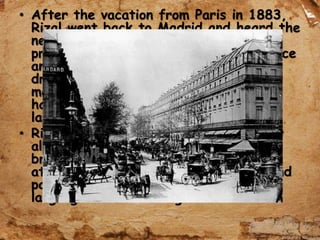
• After the vacation from Paris in 1883,
Rizal went back to Madrid and heard the
news about their financial and land
problems in Laguna; the harvests of rice
and sugarcane failed on account of
drought and locusts in Calamba, the
manager of the Dominican-owned
hacienda increased the rentals of the
lands of Rizal family.
• Rizal experienced to have late monthly
allowances and was unable to take
breakfast on June 24, 1884. He
attended his class at the university and
participated in the contest in Greek
language and won the gold medal.
• He gave a controversial speech
(Brindis) on party held at
Restaurant Ingles to
celebrate the triumph of
Luna and Hidalgo who won
on a arts contest in Madrid
“Genius knows no country,
genius sprouts cosmopolitan
like space, like life, like God.”
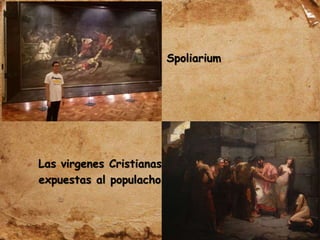
• Spoliarium
Las virgenes Cristianas
expuestas al populacho
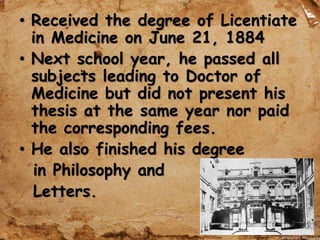
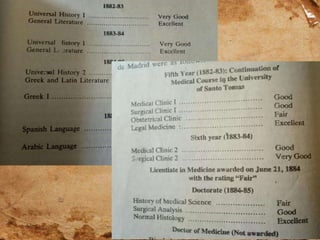
• Received the degree of Licentiate
in Medicine on June 21, 1884
• Next school year, he passed all
subjects leading to Doctor of
Medicine but did not present his
thesis at the same year nor paid
the corresponding fees.
• He also finished his degree
in Philosophy and
Letters.
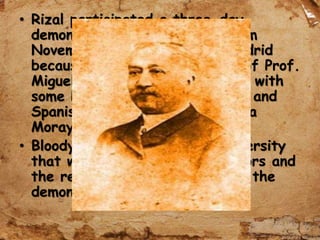
• Rizal participated a three-day
demonstration of students (from
November 20-22, 1884) in Madrid
because of “excommunication” of Prof.
Miguel Morayta to be alongside with
some Peruvian, Cuban, Mexican and
Spanish students shouting, “Viva
Morayta! Down with Bishops!”
• Bloody fights raged in the university
that was supported by professors and
the rector who resigned during the
demonstration.
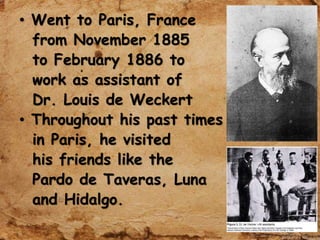
• Went to Paris, France
from November 1885
to February 1886 to
work as assistant of
Dr. Louis de Weckert
• Throughout his past times
in Paris, he visited
his friends like the
Pardo de Taveras, Luna
and Hidalgo.
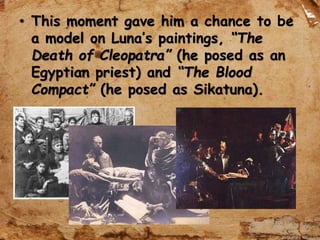
• This moment gave him a chance to be
a model on Luna’s paintings, “The
Death of Cleopatra” (he posed as an
Egyptian priest) and “The Blood
Compact” (he posed as Sikatuna).
• Being on the house of Pardo de
Taveras, despite being no natural
aptitude in music, Rizal came to play
the flute well. He composed the song
“Alin Mang Lahi” and played in flute
during impromptu reunions of Filipinos.
• Arrived at Heidelberg, Germany
(February 3, 1886) and lived
with German Law students who
were fond of playing chess.
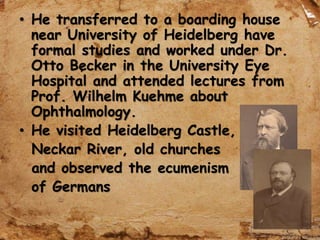
• He transferred to a boarding house
near University of Heidelberg have
formal studies and worked under Dr.
Otto Becker in the University Eye
Hospital and attended lectures from
Prof. Wilhelm Kuehme about
Ophthalmology.
• He visited Heidelberg Castle,
Neckar River, old churches
and observed the ecumenism
of Germans
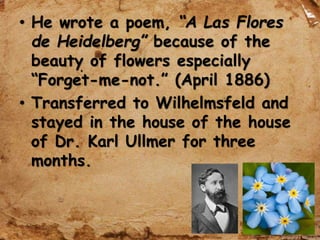
• He wrote a poem, “A Las Flores
de Heidelberg” because of the
beauty of flowers especially
“Forget-me-not.” (April 1886)
• Transferred to Wilhelmsfeld and
stayed in the house of the house
of Dr. Karl Ullmer for three
months.
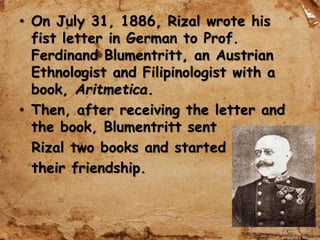
• On July 31, 1886, Rizal wrote his
fist letter in German to Prof.
Ferdinand Blumentritt, an Austrian
Ethnologist and Filipinologist with a
book, Aritmetica.
• Then, after receiving the letter and
the book, Blumentritt sent
Rizal two books and started
their friendship.
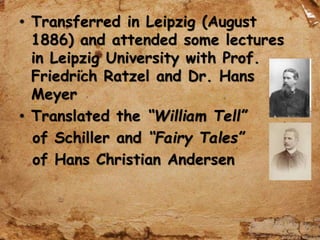
• Transferred in Leipzig (August
1886) and attended some lectures
in Leipzig University with Prof.
Friedrich Ratzel and Dr. Hans
Meyer
• Translated the “William Tell”
of Schiller and “Fairy Tales”
of Hans Christian Andersen
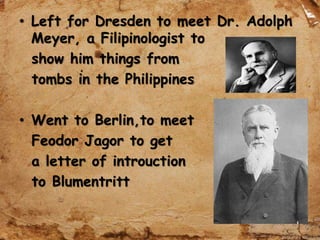
• Left for Dresden to meet Dr. Adolph
Meyer, a Filipinologist to
show him things from
tombs in the Philippines
• Went to Berlin,to meet
Feodor Jagor to get
a letter of introuction
to Blumentritt
Five reasons why Rizal lived in Berlin:
1. to gain further knowledge in
ophthalmology,
2. to further studies of sciences and
languages,
3. to observe the economic had political
conditions of the German nation,
4. to associate with famous German
scientists and scholars; and
5. to publish his first written novel.
• In the same place, Rizal was invited
by Dr. Rudolf Virchow to give a
lecture in Ethnographic Society of
Berlin. In response to invitation, he
wrote a scholarly paper in German,
“Tagalische Verkunst” and read on the
society in April 1887.
• Worked as an assistant to
the clinic of Dr. Schweigger
in Berlin
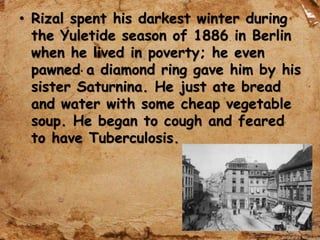
• Rizal spent his darkest winter during
the Yuletide season of 1886 in Berlin
when he lived in poverty; he even
pawned a diamond ring gave him by his
sister Saturnina. He just ate bread
and water with some cheap vegetable
soup. He began to cough and feared
to have Tuberculosis.
• “Uncle Tom’s Cabin” inspired Rizal to write
his first novel
• In a reunion of Filipinos in the house of
Paternos in Madrid in January 2, 1884,
Rizal proposed the writing of the novel to
those Filipinos like Graciano Lopez Jaena,
Evaristo Aguirre, Eduardo de Lete, Julio
Llorente, Melecio Figueroa and Valentin
Ventura.
• Unfortunately, the project did not
materialize because those compatriots who
were expected to collaborate on the novel
did not write anything.
• Rizal began writing the novel in Madrid
and finished about half of it. Then, he
wrote the last few chapters of the novel
in Wilhelmsfeld in April-June, 1886.
Revisions were made but he was sick and
penniless. In the midst of despondency,
he received a telegram from Bulakenyo
Dr. Maximo Viola who was coming to
Berlin. Anyhow, the most productive
moment of Rizal in the city was when his
first novel with the help of Dr. Viola in
February 21, 1887 published at Berliner
Buchdrukerei actien-Gesselschaft.
Grand Tour with Viola
• GERMANY (May 11, 1887)
They left Berlin via train to visit
the floral exposition in Dresden and
to visit Dr. Adolph Meyer and Dr.
Feodor Jagor. They toured also to
Potsdam and visited some museums.
• CZECH REPUBLIC
May 13, via train, the two arrived at
Leitmeritz, Bohemia (Czech Republic) and
met Ferdinand Blumentritt. The two
Filipinos were introduced to Blumentritt’s
family and stayed at their house for three
days. Rizal experienced to speak in a
meeting of Tourists’ Club of Leitmeritz
and the audience fascinated because of
his German speaking skills. In this visit
also, he met the eminent naturalist, Prof.
Robert Klutschak and Dr. Carlos Czepelak.
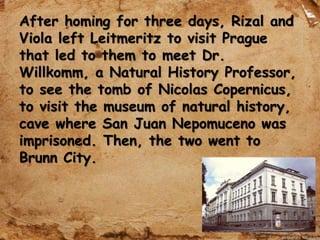
After homing for three days, Rizal and
Viola left Leitmeritz to visit Prague
that led to them to meet Dr.
Willkomm, a Natural History Professor,
to see the tomb of Nicolas Copernicus,
to visit the museum of natural history,
cave where San Juan Nepomuceno was
imprisoned. Then, the two went to
Brunn City.
• AUSTRIA
Towards the end of the month,
Rizal and Viola explored Austria
where they saw the churches,
theaters, art galleries and
museums in Vienna. They stayed at
Hotel Metropole and met the
novelist Norfenfals and scholars
Masner and Nordmann.
The two left Vienna for Lintz through a
river boat to Danube River in May 24.
During the journey, Rizal observed the:
barges loaded with products in the
boat, flowers and plants growing in the
river banks, villages in the riverbanks,
and he noticed the passengers who used
paper napkins during meals.
They landed to Lintz and traveled to
Salzburg in order to go back to Munich,
Germany.
• GERMANY
They traveled from Munich to
Nuremberg, the oldest city in the
country. They observed the torture
machines used during the Catholic
Inquisition in Europe and the huge
manufacturing of dolls.
They transferred to Ulm where they
saw and walked to the tallest
cathedral in Germany, the Ulm
Cathedral. Then, they boarded to
Stuttgart and Baden to reach
Rheinfall.
• SWITZERLAND
They witnessed the largest water fall in
Europe, the Rheinfall.
They stayed for two days in Schaffhausen
and continued to tour in Basel, Bern and
Lausanne.
In Geneva, Rizal celebrated his 26th
birthday with Viola in a lake tour and
heard sad news about the Igorots who
were exhibited in the Madrid Exposition.
Later, he expressed his anger to
Blumentritt.
• They parted ways, but Rizal toured in
Italy
He went to Turin, Milan, Venice and
Florence.
On the June 27, 1887, he reached the
“Eternal City” of Rome and visited the
St. Peter’s Church and St. Peter’s
Square in Vatican (“City of Popes”) after
two days.
On the same day, he wrote to his
father; “On the 15th of July, I shall
embark for our country so that from the
15th to the 30th of August we shall see
each other.”
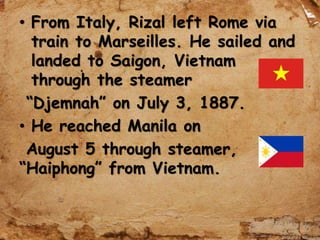
• From Italy, Rizal left Rome via
train to Marseilles. He sailed and
landed to Saigon, Vietnam
through the steamer
“Djemnah” on July 3, 1887.
• He reached Manila on
August 5 through steamer,
“Haiphong” from Vietnam.
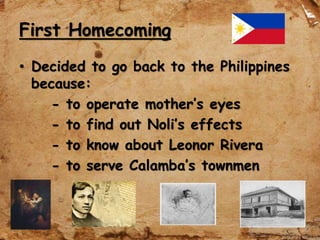
First Homecoming
• Decided to go back to the Philippines
because:
- to operate mother’s eyes
- to find out Noli’s effects
- to know about Leonor Rivera
- to serve Calamba’s townmen
• Rizal returned to Calamba on August 8
and his family welcomed him with
plentiful tears of joy and worry.
• He established a medical clinic in
Calamba and he was called as “Doctor
Uliman” (Doctor German). Aside from
eye problems, Rizal also treated other
ailments as he acquired lucrative medical
practice.
• As Gregorio Zaide mentioned, his
professional fees were reasonable as he
was able to earn P900 as a Physician.
• He also opened a gymnasium for young
folks where he introduced European
sports like gymnastics, fencing, and
shooting.
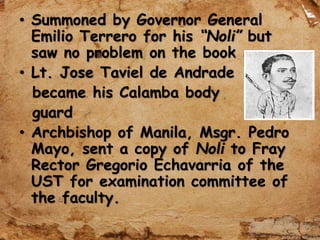
• Summoned by Governor General
Emilio Terrero for his “Noli” but
saw no problem on the book
• Lt. Jose Taviel de Andrade
became his Calamba body
guard
• Archbishop of Manila, Msgr. Pedro
Mayo, sent a copy of Noli to Fray
Rector Gregorio Echavarria of the
UST for examination committee of
the faculty.
• After the UST’s examination, the
novel declared as “heretical, impious,
and scandalous in the religious order,
and anti-patriotic.”
• In addition Fr. Salvador Font,
Augustinian curate of Tondo also
submitted a report to Governor
General on December 29 that the
novel contained subversive ideas
against the Church and Spain.
Calamba men solicited Rizal’s help in
gathering the facts and listing their
grievances against the hacienda
management.
So, Rizal investigated the issue and
enumerated some findings. Then, those
findings were reported by Rizal to the
Spanish government.
On that note, Calamba people noted him
as their town’s champion.
• Friars pressured Governor General
Terrero to advise Rizal to leave the
country.
Thank you!
Yosef Eric C. Hipolito, LPT, MA
Bachelor of Arts in History
yosefhipolito19@gmail.com

Rizal’s First Travel Abroad

  • 1.
  • 2.
    • Without hisparent consent, Rizal decided to study in Europe with Paciano’s 35 peso monthly allowance (May 3, 1882) • Had a stop over in Singapore with the steamer, SS Salvadora
  • 3.
    On a letterof Rizal to his brother Paciano, he mentioned that had another important reason for deciding to study in Europe as he called as his “secret mission.” He revealed that this secret was to observe carefully the life and culture, languages and customs, industries and business, and the government and laws of the European nations. “Preparing myself for the mighty task of liberating his people from the brutality and tyranny of Spain.”
  • 4.
    Persons who knewthe secret departure of Rizal: Paciano Rizal Antonio Rivera Saturina Rizal Lucia Rizal Capt. Juan Valenzuela Sanday Valenzuela Pedro Paterno Mateo Evangelista Ateneo Jesuit Fathers Jose M. Cecilio
  • 5.
    During the voyageto Singapore, the ship captain, Donato Lecha from Spain befriended him. In order to fight the boredom, Rizal played chess with his fellow passengers who defeated by him. He landed in Singapore and registered at Hotel de la Paz. He spent two days on sightseeing the country’s Botanical Garden, Buddhist temples and statue of Sir Thomas Stanford Raffles.
  • 6.
    • Rizal wastransferred in French steamer SS Djemnah with French speaking passengers to leave on May 11 and reached Ceylon (Sri Lanka) particularly in Point Galle on May 17 and further, Colombo, its capital.
  • 7.
    • Upon hisjourney, he crossed Indian Ocean, Cape of Guardafui in Africa (“inhospitable but famous”) and had a stopover in the hot city of Aden, Yemen and saw camels. • After several weeks, he docked at Port Said, the Mediterranean terminal of the Suez Canal where he went sightseeing.
  • 8.
    • On June11, Rizal reached Naples, Italy and saw Mt. Vesuvius and Castle of St. Elmo. • He went to Marseilles, France and visited the Chateau d’ If , before he travelled a train to reach Barcelona, Spain in June 1882.
  • 9.
    Triumphs and experiences •He viewed Barcelona as an ugly city but a “City of Freedom and Liberalism” • He was welcomed by his former classmates in Ateneo and gave him a party at Plaza de Cataluña.
  • 10.
    • Rizal wrote“Amor Patria,” his first essay written in Spain under the pen- name Laong Laan. • He sent this article to his friend in Manila, Basilio Teodoro Moran, a publisher of “Diariong Tagalog.” It was appeared on the said newspaper on August 20, 1882; translated by Marcelo H. Del Pilar in Tagalog. • Conversely, Moran congratulated Rizal and requested for more articles that was why he became an essay writer in “Diariong Tagalog” then he wrote his second and third article, “Los Viajes” and “Revista de Madrid.”
  • 11.
    • Heard thenews about Cholera outbreak in Manila from his brother • Chenggoy told him that Leonor Rivera became thin and sick because of him • Left for Madrid to pursue his studies in Universidad Central de Madrid • Enrolled two courses: -Medicine -Philosophy and Letters
  • 12.
    • Rizal’s pasttime in Madrid: - painting and sculpture (Academy of Fine Arts) - studying French and German - fencing and shooting (Hall of Arms of Sanz) - visiting museums galleries
  • 13.
    Rizal bought famousbooks such as: -Lives of Presidents of the United States from Washington to Johnson -History of French Revolution -The Wandering Jew -Uncle Tom’s Cabin of Harriet Beecher Stowe -Hebrew Grammar -Complete Works of Voltaire -Ancient Poetry
  • 14.
    “He rigidly budgetedhis Money and time. He lived frugally, spending his money on food, clothing, lodging and books. He never wasted a peseta for gambling, wine and women. His only extravagance was investing few pesetas for lottery ticket.”
  • 15.
    • Attended areunion with Filipino compatriots like Paterno brothers on February 13, 1883 (Tuesday of the Carnival) • Joined the Circulo Hispano Filipino where he wrote the poem “Me Piden Los Versos” (December 1882)
  • 16.
    • During Saturdayevenings, he visited the home of Don Pablo Ortiga y Rey. • Rizal met Consuelo Ortega y Perez and courted her through a lovely poem, A La Señorita C. O. y P. • But their love did not last because his friend Eduardo de Lete was courting Consuelo and he was engaged to Leonor Rivera.
  • 17.
    • Joined theMasonic Lodge Acacia in March 1883 • Became a member of Gran Oriente Español under the name “Dimasalang” • Became a Master Mason at Logia Solidaridad 53 (1890)
  • 18.
    • Became aMaster Mason in 1892 by Le Gran Orient de France • Became a Worshipful Master of Lodge Nilad No. 42 in 1892 when he delivered a lecture, “La Masoneria”
  • 19.
    • He didnot engage in any Masonic activities except his Masonic writing entitled “Science, Virtue and Labor” in Madrid (1889)
  • 20.
    • Visited Parison his first summer vacation and described as “Costliest Capital of Europe” (June 17- August 20, 1883) • Stayed at Hotel de Paris then later to 124 Rue de Rennes
  • 21.
    • Part ofhis first sojourn in Paris, Rizal visited: -Champs Elysses Ave. -Opera House -Arch of Triumph -Place de la Concorde -Cathedral of Notre Damme -Invalides Museum
  • 22.
    • After thevacation from Paris in 1883, Rizal went back to Madrid and heard the news about their financial and land problems in Laguna; the harvests of rice and sugarcane failed on account of drought and locusts in Calamba, the manager of the Dominican-owned hacienda increased the rentals of the lands of Rizal family. • Rizal experienced to have late monthly allowances and was unable to take breakfast on June 24, 1884. He attended his class at the university and participated in the contest in Greek language and won the gold medal.
  • 23.
    • He gavea controversial speech (Brindis) on party held at Restaurant Ingles to celebrate the triumph of Luna and Hidalgo who won on a arts contest in Madrid “Genius knows no country, genius sprouts cosmopolitan like space, like life, like God.”
  • 24.
    • Spoliarium Las virgenesCristianas expuestas al populacho
  • 25.
    • Received thedegree of Licentiate in Medicine on June 21, 1884 • Next school year, he passed all subjects leading to Doctor of Medicine but did not present his thesis at the same year nor paid the corresponding fees. • He also finished his degree in Philosophy and Letters.
  • 27.
    • Rizal participateda three-day demonstration of students (from November 20-22, 1884) in Madrid because of “excommunication” of Prof. Miguel Morayta to be alongside with some Peruvian, Cuban, Mexican and Spanish students shouting, “Viva Morayta! Down with Bishops!” • Bloody fights raged in the university that was supported by professors and the rector who resigned during the demonstration.
  • 28.
    • Went toParis, France from November 1885 to February 1886 to work as assistant of Dr. Louis de Weckert • Throughout his past times in Paris, he visited his friends like the Pardo de Taveras, Luna and Hidalgo.
  • 29.
    • This momentgave him a chance to be a model on Luna’s paintings, “The Death of Cleopatra” (he posed as an Egyptian priest) and “The Blood Compact” (he posed as Sikatuna).
  • 30.
    • Being onthe house of Pardo de Taveras, despite being no natural aptitude in music, Rizal came to play the flute well. He composed the song “Alin Mang Lahi” and played in flute during impromptu reunions of Filipinos. • Arrived at Heidelberg, Germany (February 3, 1886) and lived with German Law students who were fond of playing chess.
  • 31.
    • He transferredto a boarding house near University of Heidelberg have formal studies and worked under Dr. Otto Becker in the University Eye Hospital and attended lectures from Prof. Wilhelm Kuehme about Ophthalmology. • He visited Heidelberg Castle, Neckar River, old churches and observed the ecumenism of Germans
  • 32.
    • He wrotea poem, “A Las Flores de Heidelberg” because of the beauty of flowers especially “Forget-me-not.” (April 1886) • Transferred to Wilhelmsfeld and stayed in the house of the house of Dr. Karl Ullmer for three months.
  • 33.
    • On July31, 1886, Rizal wrote his fist letter in German to Prof. Ferdinand Blumentritt, an Austrian Ethnologist and Filipinologist with a book, Aritmetica. • Then, after receiving the letter and the book, Blumentritt sent Rizal two books and started their friendship.
  • 34.
    • Transferred inLeipzig (August 1886) and attended some lectures in Leipzig University with Prof. Friedrich Ratzel and Dr. Hans Meyer • Translated the “William Tell” of Schiller and “Fairy Tales” of Hans Christian Andersen
  • 35.
    • Left forDresden to meet Dr. Adolph Meyer, a Filipinologist to show him things from tombs in the Philippines • Went to Berlin,to meet Feodor Jagor to get a letter of introuction to Blumentritt
  • 36.
    Five reasons whyRizal lived in Berlin: 1. to gain further knowledge in ophthalmology, 2. to further studies of sciences and languages, 3. to observe the economic had political conditions of the German nation, 4. to associate with famous German scientists and scholars; and 5. to publish his first written novel.
  • 37.
    • In thesame place, Rizal was invited by Dr. Rudolf Virchow to give a lecture in Ethnographic Society of Berlin. In response to invitation, he wrote a scholarly paper in German, “Tagalische Verkunst” and read on the society in April 1887. • Worked as an assistant to the clinic of Dr. Schweigger in Berlin
  • 38.
    • Rizal spenthis darkest winter during the Yuletide season of 1886 in Berlin when he lived in poverty; he even pawned a diamond ring gave him by his sister Saturnina. He just ate bread and water with some cheap vegetable soup. He began to cough and feared to have Tuberculosis.
  • 39.
    • “Uncle Tom’sCabin” inspired Rizal to write his first novel • In a reunion of Filipinos in the house of Paternos in Madrid in January 2, 1884, Rizal proposed the writing of the novel to those Filipinos like Graciano Lopez Jaena, Evaristo Aguirre, Eduardo de Lete, Julio Llorente, Melecio Figueroa and Valentin Ventura. • Unfortunately, the project did not materialize because those compatriots who were expected to collaborate on the novel did not write anything.
  • 40.
    • Rizal beganwriting the novel in Madrid and finished about half of it. Then, he wrote the last few chapters of the novel in Wilhelmsfeld in April-June, 1886. Revisions were made but he was sick and penniless. In the midst of despondency, he received a telegram from Bulakenyo Dr. Maximo Viola who was coming to Berlin. Anyhow, the most productive moment of Rizal in the city was when his first novel with the help of Dr. Viola in February 21, 1887 published at Berliner Buchdrukerei actien-Gesselschaft.
  • 42.
    Grand Tour withViola • GERMANY (May 11, 1887) They left Berlin via train to visit the floral exposition in Dresden and to visit Dr. Adolph Meyer and Dr. Feodor Jagor. They toured also to Potsdam and visited some museums.
  • 43.
    • CZECH REPUBLIC May13, via train, the two arrived at Leitmeritz, Bohemia (Czech Republic) and met Ferdinand Blumentritt. The two Filipinos were introduced to Blumentritt’s family and stayed at their house for three days. Rizal experienced to speak in a meeting of Tourists’ Club of Leitmeritz and the audience fascinated because of his German speaking skills. In this visit also, he met the eminent naturalist, Prof. Robert Klutschak and Dr. Carlos Czepelak.
  • 44.
    After homing forthree days, Rizal and Viola left Leitmeritz to visit Prague that led to them to meet Dr. Willkomm, a Natural History Professor, to see the tomb of Nicolas Copernicus, to visit the museum of natural history, cave where San Juan Nepomuceno was imprisoned. Then, the two went to Brunn City.
  • 45.
    • AUSTRIA Towards theend of the month, Rizal and Viola explored Austria where they saw the churches, theaters, art galleries and museums in Vienna. They stayed at Hotel Metropole and met the novelist Norfenfals and scholars Masner and Nordmann.
  • 46.
    The two leftVienna for Lintz through a river boat to Danube River in May 24. During the journey, Rizal observed the: barges loaded with products in the boat, flowers and plants growing in the river banks, villages in the riverbanks, and he noticed the passengers who used paper napkins during meals. They landed to Lintz and traveled to Salzburg in order to go back to Munich, Germany.
  • 47.
    • GERMANY They traveledfrom Munich to Nuremberg, the oldest city in the country. They observed the torture machines used during the Catholic Inquisition in Europe and the huge manufacturing of dolls. They transferred to Ulm where they saw and walked to the tallest cathedral in Germany, the Ulm Cathedral. Then, they boarded to Stuttgart and Baden to reach Rheinfall.
  • 48.
    • SWITZERLAND They witnessedthe largest water fall in Europe, the Rheinfall. They stayed for two days in Schaffhausen and continued to tour in Basel, Bern and Lausanne. In Geneva, Rizal celebrated his 26th birthday with Viola in a lake tour and heard sad news about the Igorots who were exhibited in the Madrid Exposition. Later, he expressed his anger to Blumentritt.
  • 49.
    • They partedways, but Rizal toured in Italy He went to Turin, Milan, Venice and Florence. On the June 27, 1887, he reached the “Eternal City” of Rome and visited the St. Peter’s Church and St. Peter’s Square in Vatican (“City of Popes”) after two days. On the same day, he wrote to his father; “On the 15th of July, I shall embark for our country so that from the 15th to the 30th of August we shall see each other.”
  • 50.
    • From Italy,Rizal left Rome via train to Marseilles. He sailed and landed to Saigon, Vietnam through the steamer “Djemnah” on July 3, 1887. • He reached Manila on August 5 through steamer, “Haiphong” from Vietnam.
  • 51.
    First Homecoming • Decidedto go back to the Philippines because: - to operate mother’s eyes - to find out Noli’s effects - to know about Leonor Rivera - to serve Calamba’s townmen
  • 52.
    • Rizal returnedto Calamba on August 8 and his family welcomed him with plentiful tears of joy and worry. • He established a medical clinic in Calamba and he was called as “Doctor Uliman” (Doctor German). Aside from eye problems, Rizal also treated other ailments as he acquired lucrative medical practice. • As Gregorio Zaide mentioned, his professional fees were reasonable as he was able to earn P900 as a Physician. • He also opened a gymnasium for young folks where he introduced European sports like gymnastics, fencing, and shooting.
  • 53.
    • Summoned byGovernor General Emilio Terrero for his “Noli” but saw no problem on the book • Lt. Jose Taviel de Andrade became his Calamba body guard • Archbishop of Manila, Msgr. Pedro Mayo, sent a copy of Noli to Fray Rector Gregorio Echavarria of the UST for examination committee of the faculty.
  • 54.
    • After theUST’s examination, the novel declared as “heretical, impious, and scandalous in the religious order, and anti-patriotic.” • In addition Fr. Salvador Font, Augustinian curate of Tondo also submitted a report to Governor General on December 29 that the novel contained subversive ideas against the Church and Spain.
  • 55.
    Calamba men solicitedRizal’s help in gathering the facts and listing their grievances against the hacienda management. So, Rizal investigated the issue and enumerated some findings. Then, those findings were reported by Rizal to the Spanish government. On that note, Calamba people noted him as their town’s champion.
  • 56.
    • Friars pressuredGovernor General Terrero to advise Rizal to leave the country.
  • 58.
    Thank you! Yosef EricC. Hipolito, LPT, MA Bachelor of Arts in History yosefhipolito19@gmail.com